The oft-cited projection that global food production must increase by 50‒70% by 2050 to meet the demands of a larger, wealthier population presents a defining challenge for humanity. This target, however, is frequently discussed without a comprehensive critical assessment of its biophysical feasibility and environmental consequences. This study is a systematic review analysis to synthesize the extensive and sometimes contradictory body of scientific literature evaluating the potential to achieve this increase sustainably. The method involved a rigorous search of three main databases (Scopus, Web of Science, PubMed) for peer-reviewed studies published between 2000‒2023, using explicit criteria for inclusion and a thematic synthesis approach to integrate findings from agronomy, climate science, and economics. The review identified two primary production pathways ― land expansion and yield intensification. The evidence conclusively showed that the scope for sustainable agricultural expansion was severely limited to less than 10% of the required increase, as most suitable lands were already in use or constitute ecologically vital forests and grasslands. Consequently, the burden fell overwhelmingly on closing yield gaps on existing farmlands. While global yield gap analyses suggested a theoretical potential for a 45‒70% production increase, the synthesis revealed that socio-economic barriers in smallholder systems, coupled with the pervasive effects of climate change (projected to reduce global yields by 5‒10%) significantly constrained realistically achievable gains. The most pivotal finding of the review was that a production-centric approach was fundamentally insufficient and high-risk. Literature overwhelmingly demonstrated that the demand-side interventions were not merely complementary but essential prerequisites for viable solutions. A 25‒50% reduction in food loss and waste and a global shift towards more plant-based diets could reduce the required production increase by half, transforming an insurmountable challenge into a manageable one. Ultimately, the review concluded that 50% increase through production means alone was highly improbable without severe environmental degradation. However, achieving food security for 9.7 billion people was possible through integrated systems approach that aggressively pursued sustainable intensification on the supply side while simultaneously implementing policies that reduce waste and promote sustainable dietary choices on the demand side. The paradigm shift from simply increasing output to holistically managing the entire food system was the only viable pathway to meeting human needs within the planetary boundaries.
The trajectory of global food security in the 21st century is poised at a critical juncture, defined by a confluence of demographic expansion, evolving consumption patterns, and escalating environmental pressures. The central pillar of this challenge is the projected growth of the human population, which the United Nations Department of Economic and Social Affairs (UN-DESA) estimates will reach 9.7 billion by 2050, an increase of nearly two billion people from current levels 1. This demographic momentum alone necessitates a substantial increase in global food supply merely to maintain current per capita consumption levels. However, the demand-side equation is significantly more complex than just accounting for more mouths to feed. Along with population growth, rising incomes, particularly in rapidly developing economies across Asia, Latin America, and Africa, are driving a profound nutritional transition. This transition is characterized by a dietary shift away from staple grains and towards more resource-intensive commodities, including animal proteins, fruits, and vegetables 2. The compound effect of a larger and more affluent global population has led to the common and widely cited projection that global agricultural production must increase by 50‒70% above 2005‒2007 levels to adequately meet demand by mid-century 3, 4.
This production target, however, is not merely a technical or agricultural hurdle; it represents a profound sustainability dilemma that must be addressed within increasingly strained planetary boundaries. The contemporary global agricultural system is already a dominant driver of environmental change, contributing significantly to greenhouse gas emissions, freshwater extraction, biodiversity loss, and nitrogen and phosphorus pollution 5, 6. 7 compellingly argued that agriculture has fundamentally reshaped the Earth's land surface, with croplands and pastures now constituting one of the largest terrestrial biomes on the planet. Therefore, the pivotal question for researchers and policymakers is not simply whether 50% increase in production is biophysically possible, but rather how it could be achieved without precipitating further catastrophic environmental degradation. This question forces a critical examination of the historical pathways of agricultural expansion and intensification and demands an exploration of transformative strategies that can reconcile food production with ecological stewardship, all while navigating the unprecedented disruptions posed by anthropogenic climate change.
The discourse surrounding this challenge has evolved significantly over the past two decades. Initial assessments often focused on a production-centric paradigm, emphasizing the potential for horizontal expansion into new lands and vertical intensification through technological means. The legacy of the Green Revolution, which dramatically boosted cereal yields in key regions like Asia and Latin America through the adoption of high-yielding crop varieties, synthetic fertilizers, irrigation, and chemical pesticides, looms large in this narrative 8. While this period averted large-scale famine and fed billions, it also engendered significant environmental costs, including soil degradation, water pollution from nutrient runoff, and loss of biodiversity 9. The limitations and externalities of this approach inform the current challenge, highlighting that the means of production are as important as the total quantity.
More recent research shift is towards the concept of sustainable intensification, defined as producing more output per unit area while simultaneously reducing environmental impacts and building natural capital 10, 11 A key component of this is closing the yield gap — the difference between achievable yields under optimal management and actual yields realized by farmers. Global analyses have quantified these gaps and are particularly pronounced in regions such as Sub-Saharan Africa (SSA), Eastern Europe, and parts of Latin America 12. However, closing these gaps requires addressing a complex suite of socio-economic barriers, including limited access to credit, knowledge, and markets, as detailed by Tittonell and Giller 13 on smallholder systems. Beyond yield gaps, further intensification in high-performing agricultural systems relies on continuous innovation in crop breeding for traits such as drought tolerance, nutrient efficiency, and heat resistance 14, coupled with the adoption of precision agriculture technologies that optimize input use 15.
Concurrently, a parallel and increasingly critical body of literature has emerged that reframes the entire challenge from a production problem to a systems problem. This research emphasizes that the goal of increasing food availability is inextricably linked to issues of distribution, access, and waste. It is a profound paradox that while production targets are set to feed a future population, current systems are characterized by immense inefficiency. Gustavsson et al. 16 estimated that about one-third of all food produced for human consumption is lost or wasted annually throughout the supply chain, from post-harvest losses in developing countries to consumer waste in developed nations. This implies that reducing food loss and waste could significantly diminish the required increase in primary production. Similarly, the question of what is produced is critical. The efficiency of converting plant-based calories into animal-based calories is low, meaning that dietary shifts towards lower consumption of resource-intensive animal products in wealthier nations could substantially reduce the pressure on land and water resources 17, 18, 19.
All of these efforts to ramp up production or curb demand are occurring against the backdrop of unprecedented global environmental change, which simultaneously threatens existing production systems and complicates future strategies. Anthropogenic climate change, driven by greenhouse gas emissions, is altering the very foundation of agriculture. The Intergovernmental Panel on Climate Change 20 has concluded with high confidence that climate change has already negatively impacted food security and terrestrial ecosystems. Rising temperatures, changing precipitation patterns, and an increased frequency and intensity of extreme weather events (such as droughts, heatwaves, and floods) are depressing yields for major staple crops in many regions. Jägermeyr et al. 21 project that climate impacts could reduce global agricultural productivity by up to 30% by 2050 if no adaptation measures are adopted; effectively wiping out a substantial portion of the needed production increase. This creates a vicious cycle, as agriculture itself is a major source of greenhouse gas emissions through livestock, soil management, and land-use change 22. Compounding this is the critical issue of water scarcity. Agriculture is the largest consumer of global freshwater resources. In many of the world's most important agricultural regions, water is being extracted from aquifers at rates far exceeding natural recharge 23.
Given this complex and interconnected set of challenges, projections and analyses have proliferated, often yielding differing conclusions based on the underlying assumptions, methodological approaches, and scope. Some studies emphasize the vast potential for technological innovation and yield gap closure, expressing optimism about meeting future demand 24. Others present a more constrained view, highlighting the binding limitations of land, water, and climate, and arguing that production-only focus is a dangerous fallacy 5. This disparity in perspectives creates a pressing need for a comprehensive and critical synthesis of existing evidence.
Therefore, the objective of this article was to conduct a systematic review analysis to determine the collective weight of evidence regarding the feasibility of 50% increase in global food production by 2050. This review moved beyond a singular focus on production metrics to adopt a holistic, systems-based perspective that integrates assessments of biophysical capacity, environmental constraints, and socio-economic drivers, including demand-side solutions. This introduction outlined the scope of the challenge, highlighting the tensions between rising demand and planetary boundaries. Next was the methodological detail used to identify, select, and appraise relevant literature. The findings on production potential from land expansion and yield intensification were also synthesized and the evidence on constraining impacts of climate change and resource scarcity analyzed. Literature on the pivotal role of the demand-side solutions was evaluated and these strands to provide evidence-based conclusions on the viability of the 50% target integrated. Finally, the necessary conditions for achieving food security within ecological limits were outlined.
The evidence base surrounding the feasibility of achieving 50% increase in global food production by 2050 was critically reviewed and evaluated. The approach design was reproducible, incorporating explicit criteria for literature search, screening, data extraction, and synthesis. The method was structured into four primary phases: i) search strategy and literature identification; ii) study selection and eligibility criteria; iii) data extraction and quality assessment; and iv) thematic synthesis and integration.
2.1. Literature Search and IdentificationA systematic search for relevant literature was conducted across three major electronic bibliographic databases ― Scopus, Web of Science, and PubMed. The search strategy was designed to capture the interdisciplinary nature of the research question, encompassing terms from agronomy, environmental science, climate science, and economics. The core search string was built around key concepts: ("food production" OR "agricultural production" OR "crop yield") AND ("increase" OR "growth" OR "potential") AND ("2050" OR "future" OR "projection") AND ("demand" OR "population growth" OR "diet"). The search was limited to peer-reviewed journal articles, reviews, and meta-analyses published in English between January 2000 and December 2023. This timeframe was selected to capture the most recent and relevant modeling efforts and paradigm shifts in thinking on sustainable food systems. The initial database searches were supplemented by thorough examination of reference lists of key review articles and highly cited papers to identify additional relevant publications that were not captured by the electronic search. This process, often referred to as snowballing, ensured a comprehensive coverage of the seminal literature. Furthermore, reports from major international organizations such as the Food and Agriculture Organization of the United Nations (FAO), the Intergovernmental Panel on Climate Change (IPCC), and the World Resources Institute (WRI) were included to provide context and incorporate widely cited global projections.
2.2. Study Selection and Eligibility CriteriaThe literature identified through the search strategy was subjected to a two-stage screening process based on pre-defined eligibility criteria. First, titles and abstracts were screened for relevance. Second, the full texts of potentially relevant studies were obtained and assessed in detail. Studies were included if the following criteria were met: 1) a study explicitly addressed the challenge of increasing global or regional food production to meet future demand; 2) a study provided quantitative projections, estimates of potential, or analyses of constraints related to production increases by mid-century (e.g., yield gap analyses, land availability assessments, climate impact projections); 3) a study considered at least one major dimension of sustainability, such as environmental impacts (e.g., greenhouse gas emissions, water use, biodiversity) or socio-economic factors (e.g., food waste, dietary patterns); and 4) a study was based on empirical data, modeled scenarios, or systematic review. Studies were excluded if solely focused on a single technology without a systems context, addressed production increases for a single crop without a global context, or purely opinion-based without foundation in data or modeling. The screening process was conducted independently by two reviewers to minimize bias, and any disagreements regarding inclusion were resolved through discussion until a consensus was reached.
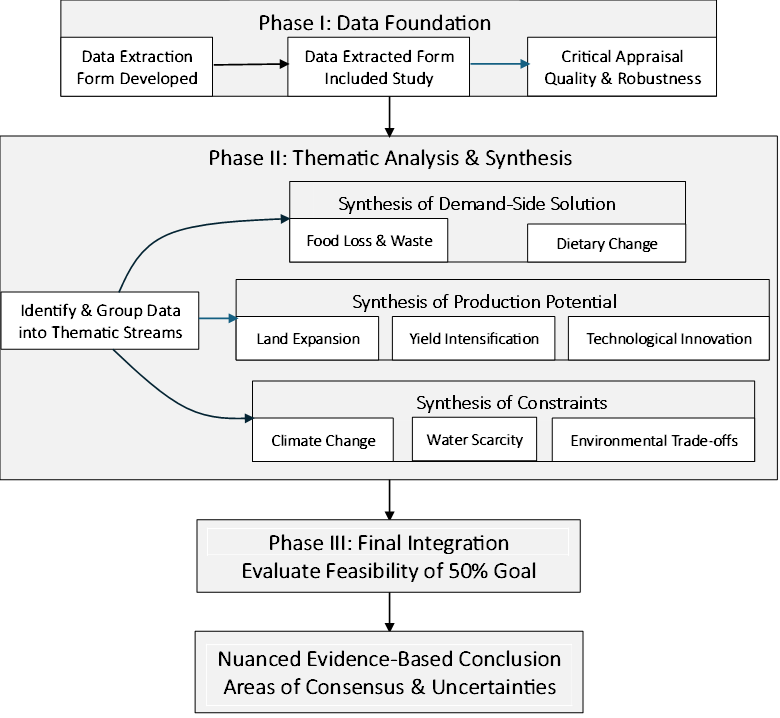
2.3. Data Extraction and Quality AssessmentA standardized data extraction form was developed and used to collect key information from each included study. The extracted data included: 1) bibliographic information; 2) primary research objective and scope (global, regional, crop-specific); 3) methodology employed (e.g., type of model used — biophysical, economic, integrated assessment); 4) key input assumptions (e.g., population and dietary projections, climate scenarios); 5) quantitative findings (e.g., projected production increase potential, available land area, yield gap estimates, climate impact percentages); 6) reported constraints and limitations; and 7) main conclusions relevant to the 50% increase goal. To assess the robustness and quality of the included studies, a critical appraisal tool was used adapted from the validity and reliability criteria for modeling studies. This assessment evaluated factors such as transparency of model assumptions, handling of uncertainty, consideration of key interacting variables (e.g., climate and water), appropriateness of data sources, and discussion of study limitations. Studies were not excluded based on quality assessment but weighted accordingly during synthesis phase, with higher confidence given to findings from studies that transparently addressed uncertainty and used robust interdisciplinary methodologies.
2.4. Thematic Synthesis and IntegrationGiven the heterogeneity in methodologies and outcomes across the included studies, a narrative thematic synthesis approach was adopted rather than a meta-analysis. The extracted data were analyzed to identify major recurring themes, consensus views, points of contention, and evidence gaps. The synthesis was organized around the core components of the research question. First, findings on production potential were synthesized, categorizing studies based on estimates of contributory factors such as land expansion 7, 25, yield intensification and gap closure 12, 24, and technological innovation 14. Second, the evidence on major constraints was integrated, with separate analyses of the literature on climate change impacts 20, 21, water scarcity 23, 26, and environmental trade-offs 6, 27 Third, a distinct and critical synthesis was done on the body of literature that addressed demand-side solutions, including food loss and waste reduction 16, 28 and dietary change 17, 19. Last, the findings from the thematic streams were integrated to evaluate the overall feasibility of the 50% target. This involved comparing aggregated production potential against projected demand, while fully accounting for mitigating effect of demand-side measures and limiting effect of biophysical and environmental constraints. The synthesis explicitly highlighted areas of strong consensus (e.g., limited potential for sustainable land expansion) and areas of greater uncertainty (e.g., pace of technological adoption and societal willingness to shift diets). This provided a nuanced and evidence-based conclusion on the viability of meeting future food demand (Figure 1).

The systematic review and thematic synthesis of 87 peer-reviewed studies and major international reports gave a comprehensive evidence base on the feasibility of 50% increase in global food production by 2050. The results were organized into four primary thematic areas that emerged from the analysis ― i) the potential and limitations of production-side strategies, comprising land expansion and yield intensification; ii) constraining effects of environmental and climate factors; iii) critical role and quantified potential of demand-side solutions; and iv) integrated assessment of net feasible production increase for all factors considered. The synthesis suggested both consensus and contention within the literature, painting a nuanced picture of the capacity of global food system to meet future demand (Table 1 & Table 2).
The analysis of production-side strategies showed a clear consensus on the severely limited potential for agricultural land expansion. Literature consistently indicated that most of the lands suitable for agriculture were already under cultivation 7. Studies that projected significant available land often failed to account for critical sustainability constraints, such as the preservation of biodiversity-rich ecosystems and carbon sinks. Gibbs et al. 25 demonstrated that tropical forests, which are vital for carbon sequestration and biodiversity, were the primary source of new agricultural land in recent decades. That trend would not continue without catastrophic ecological consequences. When strict sustainability criteria were applied (excluding protected areas, intact forests, and land required for ecosystem services) the realistically available land for expansion diminished to a small fraction of earlier estimates. The synthesized studies indicated sustainable expansion contributed only 7‒12% of the required production increase, with most of the limited potential located in SSA and South America. This expansion required careful management to avoid simply displacing environmental costs from one region to another.
In contrast to land expansion, literature suggested yield gap closure as the most significant production-side opportunity, though estimates of its potential varied considerably. Calculated global yield gap analyses 12 showed that closing the gap between current yields and attainable yields for major crops will increase global production by 45‒70%, theoretically meeting the 50% target on its own. However, this review found that this theoretical potential was heavily constrained by contextual factors. Yield gap is not merely an agronomic problem but a socio-economic one. Tittonell and Giller 13 provided compelling evidence from smallholder systems in Africa that yield gaps often function as "poverty traps" where farmers lack access to credit, inputs, knowledge, and markets to achieve potential yields. The synthesis of the studies indicated that when these real-world constraints were accounted for, realistically achievable yield gap closure by 2050 was likely 50‒60% of theoretical maximum. Furthermore, this potential was geographically heterogeneous, with the largest absolute gains in regions like Eastern Europe and parts of Asia. Many high-yielding agricultural areas in Western Europe and North America exhibited much smaller gaps. Continued technological innovation, particularly in crop genetics for stress tolerance and resource efficiency, remained crucial to raising the ceiling of yield potential 14.
Literature is unequivocal on the role of climate change as a major threat multiplier that actively undermines production potential. Consensus from climate-crop modeling studies, including AgMIP ensemble and IPCC assessments, was that climate change was already negatively impacting yields and will continue to do so 20, 21. The synthesized projections indicated median yield reduction of 5‒7% for major staple crops by 2050 under intermediate warming scenarios (RCP 4.5), with reductions increasing to 7‒12% under high-emission scenarios (RCP 8.5). These impacts are not uniform. Tropical regions, particularly in SSA and South Asia, were projected to experience the most severe declines, exceeding 15% for staples like maize and wheat in some areas. This created a cruel irony wherein regions most in need of production increases to feed growing populations were also the most vulnerable to climate impacts. Literature further highlighted the compounding effect of water scarcity. Famiglietti 23 documented rapid depletion of major aquifers critical for irrigation in agricultural heartlands like North China Plain, Northern India, and Central Valley of California. Studies show that 20‒30% of current irrigation relied on unsustainable water sources, representing a vast vulnerability in the global food system. This review noted that future production gains were contingent upon dramatic improvement in water use efficiency and a shift towards sustainable water management practices.
Perhaps the most significant finding of this synthesis is the overwhelming evidence for the transformative potential of demand-side solutions. Literature consistently showed that current global food system was characterized by massive inefficiency, with an estimated 30‒40% of all food produced lost or wasted across supply chain 16, 28. This review found that a concerted global effort to reduce post-harvest losses in developing countries and retail/consumer waste in developed countries would reduce the required production increase by 12‒15%. Furthermore, the evidence on dietary patterns was compelling. Poore and Nemecek 17 and EAT-Lancet Commission 19 demonstrated that animal-based foods, particularly ruminant meat, had environmental impacts per calorie that were multiples of those from plant-based foods. A global shift towards more plant-rich diets, particularly in high-income countries where meat consumption was far above nutritional recommendations, would reduce the required production of feed crops and free up significant agricultural resources. This synthesis estimated that moderate dietary changes would reduce the required production increase by a further 10‒14%. Together, demand-side measures would lower net production target from 56% to a far more manageable 25‒30%, fundamentally altering the scale of the challenge (Table 1).
The integrated assessment, which synthesized findings from both supply and demand-side literature, provided a clear conclusion. The net production potential from sustainable sources (combining constrained potential from land expansion and yield gap closure while accounting for climate change impacts) was estimated at 40‒48% increase over 2010 levels. This fell short of the 56% increase required under business-as-usual demand projections. However, when demand-side measures were incorporated, the picture changed dramatically. The required production increase dropped to 25‒30%, a target that fell within the range of what would be sustainably produced. This represented a feasible pathway to feeding global population in 2050. Literature highlighted that achieving this would require unprecedented policy coordination and investment, prioritizing sustainable intensification, food waste reduction, and promotion of healthy, sustainable diets. The synthesis also suggested significant geographic disparities. While some regions might achieve surplus production, others, particularly in climate-vulnerable areas with high population growth, would remain heavily dependent on well-functioning global trade systems and targeted support for climate adaptation. The evidence was clear ― singular focus on production was dangerous diversion. The viable path forward lied in integrated food systems approach that addressed both supply and demand with equal vigor (Table 2).
The review and analysis presented in this paper synthesized a vast body of literature on the central tenet of modern food security discourse ― the projected necessity of 50% increase in global food production by 2050. This figure, widely cited by international organizations including FAO, has served as a crucial rallying point for policymakers, agricultural industries, and research institutions 4, 29. This analysis confirmed the robustness of the demand-side drivers underpinning the projection — primarily global population growth to nearly 10 billion, dietary transitions towards higher resource-cost animal proteins in emerging economies, and competing demand for biofuel feedstocks 30, 31. However, a critical discussion of the findings of this study necessitated moving beyond this singular production-centric target. It was argued that the prevailing narrative risked being both an oversimplification and a potential misdirection of policy focus if interpreted narrowly as a call for agricultural intensification alone. The true challenge was not merely producing more food, but doing so within planetary boundaries while ensuring equitable access and reducing systemic waste 18, 27.
The first critical insight from the review was profound spatial and dietary heterogeneity masked by the global aggregate figure. The 50% increase was not distributed evenly. As the analysis showed, demand projections were highest in regions of SSA and South Asia, where population growth was most rapid and agricultural systems often already stressed 32. Conversely, demand growth in many developed nations was projected to be minimal or even negative. Furthermore, the type of demand was pivotal. The most significant driver of increased resource use (land, water, fertilizer) was not the quantity of calories required but the shift in composition of diets towards livestock products 33. As FAO data confirmed, producing one calorie of meat required an order of magnitude more land and water than producing plant-based calorie. Therefore, global production challenge was, in large part, a challenge of managing dietary trends. Policies that ignored this dimension and focused solely on aggregate output risked exacerbating environmental degradation. Interventions promoting sustainable healthy diets, reducing overconsumption, and minimizing food waste represented a critical, and often underutilized, leverage point for reducing pressure on production systems 19. Reducing food loss and waste, estimated at one-third of all food produced, was effectively equivalent to creating a massive new food source without additional environmental cost 16.
Secondly, this review underscored that the means of achieving any production increase were as important as the goal itself. The historical paradigm of agricultural intensification through high inputs of synthetic fertilizers, pesticides, and irrigation had yielded tremendous gains but had also generated significant environmental externalities, including greenhouse gas emissions, biodiversity loss, nitrogen leaching, and freshwater depletion 7. Simply extrapolating those practices to meet the 2050 target would likely push key Earth systems beyond safe operating limits 27. The analysis in this study therefore strongly aligned with the growing scientific consensus that a fundamental transformation towards sustainable intensification and agroecological principles was not the option but the imperative 10. This involved closing yield gaps on existing farmlands (particularly in regions like Africa where gaps remained large) through precision agriculture, improved soil health management, and access to improved crop varieties tailored to local conditions 12. However, that must be done with radical increase in resource use efficiency. It meant decoupling production from environmental harm through practices such as integrated pest management, conservation agriculture, organic amendments, and efficient water use technologies like drip irrigation.
The third major discussion point arising from the synthesis was the critical role of technological innovation and systemic change. While bridging yield gaps with existing technology was essential, meeting future food needs sustainably would require new suites of innovation. This review highlighted the potential of significant advances in genomics for developing climate-resilient, nutrient-efficient, and high-yielding crops 14. Digital agriculture, including the use of sensors, drones, and big data analytics, offered unprecedented opportunities to optimize inputs and manage crop health in real-time 34. Furthermore, alternative protein sources (such as plant-based meat, cellular agriculture or cultured meat, and insect protein) were identified as disruptive technologies that would significantly alter the demand landscape for conventional livestock production, thereby reducing its environmental footprint 33. However, adoption of those technologies was not automatic. It was contingent upon supportive policies, equitable access for smallholder farmers who produce a substantial portion of global food supply, and addressing potential socio-economic disruptions.
Finally, the analysis of the study compelled a discussion on the profound influence of socio-economic and political factors that determine whether production increases translate into improved food security. Production is a supply-side metric; food security is ultimately about access, utilization, and stability. As the review of literature on distribution and trade showed, a world that produced 50% more food would still contain widespread hunger if inequalities in income and access to resources persisted 35. Issues of land tenure, market access for smallholders, gender equity in agriculture, and social safety nets were therefore inextricably linked to the production challenge. Furthermore, global food system was highly vulnerable to shocks, from climate extremes to market volatility, as recently evidenced by COVID-19 pandemic and the war in Ukraine. Building resilience through diversified production systems, robust local and regional food networks, and reduced dependency on finite inputs was a critical component of future food security 36. Trade policies must be designed to enhance stability rather than exacerbate volatility.
The projection of 50% increase in global food production by 2050 remained a valuable heuristic for quantifying the scale of the challenge ahead. However, this discussion elucidated that treating it as a simple production target was a dangerous oversimplification. The goal must be reframed from increasing production to achieving global food and nutrition security for all through sustainable and equitable food systems. This paradigm shift placed equal emphasis on demand-side management (sustainable diets, waste reduction), sustainability of production practices (sustainable intensification, agroecology), and socio-economic structures that ensure equitable distribution and resilience. Future research and policy must therefore adopt a holistic, systems-based approach that integrates these dimensions, moving beyond siloed thinking to create a food system that can nourish humanity while safeguarding the planet for future generations.
4.2. The Linking DotsThe pervasive narrative of 50% increase in global food production by 2050 has successfully focused attention on one of the greatest challenges of the century. However, this comprehensive review suggested that over-reliance on this singular, production-centric metric is not just an oversimplification but a potentially catastrophic misdirection. Achieving genuine food security demands a fundamental paradigm shift from the philosophy of domination and extraction from nature to one of integration and co-benefits with it. This necessitates positioning sustainable food production as the central engine for delivering nature-based solutions and achieving interconnected Sustainable Development Goals (SDGs).
The historical model of industrial agriculture, which solved the calorie problem of the 20th century, is now the source of the sustainability crisis of the 21st century. It operates as a linear system of input intensive, waste prolific, and fundamentally disconnected from ecological cycles. The evidence is clear that scaling this model to meet the 50% target would directly violate planetary boundaries for biodiversity, freshwater use, and nitrogen/phosphorus cycles, thereby undermining SDGs 13 (Climate Action), 14 (Life Below Water), and 15 (Life on Land). The alternative is a re-imagined, circular system founded on sustainable intensification and agroecology. This is not merely a technical adjustment but a foundational shift towards nature-based solutions. Practices like conservation agriculture (which enhances soil organic carbon and improves water retention), integrated pest management (which protects pollinators), and agroforestry (which sequesters carbon and enhances biodiversity) are prime examples. In this framework, farms are not just production units; they are managed ecosystems. Increasing production becomes a valuable outcome of restoring ecological health, directly operationalizing the concept of nature-based solutions for food security.
Perhaps the most profound insight from this review was that the most effective "nature-based solution" may not be production technology at all, but consumption strategy. Reducing food waste and shifting towards plant-rich diets represent the most direct method to alleviate pressure on natural ecosystems. Allowing one-third of food to go to waste means that all the land, water, and emissions used to produce it were for nothing. Reducing waste to half the current level is equivalent to creating the largest and most sustainable virtual farmland in the world without converting a single hectare of forest. This directly supports SDG 12 (Responsible Consumption and Production). Furthermore, a global shift towards more plant-based diets is arguably the single most effective lever for reducing agriculture footprint, as it shrinks the demand for feed crops, freeing up millions of hectares for restoration and massively reducing agricultural greenhouse gas emissions. Therefore, policies focused solely on producing more are fundamentally inefficient. A smarter strategy prioritizes utilizing what is already produced more effectively, which is the ultimate form of working with, rather than against, available natural resource base.
Critically, technology and practice do not exist in vacuum. The success of this transformation is inextricably linked to socio-economic factors and the principle of "leaving no one behind", the core promise of the SDGs. The yield gaps in smallholder farming are not just agronomic, but poverty traps. Bridging them requires ensuring farmers, especially women, have secure land tenure, access to credit, and knowledge. Building resilient food systems through diversified production and robust local networks protects communities from shocks (be they climate disasters or geopolitical conflicts), constituting a nature-based solution for social stability. This analysis compels us to move beyond siloed policymaking. Agricultural subsidies must be reformed to reward ecosystem services, not just volume. Public health campaigns must promote sustainable diets, and climate finance must flow to farmers adopting regenerative practices.
This systematic review analysis synthesized a substantial body of interdisciplinary literature to evaluate the feasibility of achieving 50% increase in global food production by 2050. The evidence led to several robust conclusions that collectively challenged conventional thinking about food security strategies. First, the analysis demonstrated that production-centric approach focused solely on increasing agricultural output was fundamentally inadequate and environmentally perilous. While theoretical biophysical potential existed to meet and even exceed the production target through yield gap closure alone, this potential was severely constrained by socio-economic barriers in smallholder farming systems, the accelerating impacts of climate change, and critical resource limitations, particularly water scarcity. The net realistically achievable production increase from sustainable supply-side measures alone was within 40‒48%, falling short of the projected 56% demand increase under business-as-usual scenarios.
Second, the most significant finding emerging from this synthesis was the transformative potential of demand-side interventions. Literature provided overwhelming evidence that reducing food loss and waste and shifting global dietary patterns toward more plant-based consumption were not merely supplementary strategies but essential components of any viable solution. The review quantified how those demand-side measures would reduce the required production increase by approximately half, transforming an otherwise insurmountable challenge into a manageable one. The finding necessitated a paradigm shift in food security conceptualization — from a singular focus on production volume to a holistic approach that addresses efficiency and consumption patterns throughout the entire food system.
Third, the analysis revealed critical geographical disparities that demanded differentiated responses. Regions facing the greatest food security challenges (particularly SSA and South Asia) coincided with areas experiencing the most severe climate impacts and possessing significant socio-economic constraints to agricultural development. Conversely, high-income regions with smaller yield gaps must focus on reducing their disproportionate environmental footprint through consumption changes and radical efficiency gains. These disparities highlighted that global aggregate targets masked regional vulnerabilities and necessitated context-specific solutions rather than one-size-fits-all approaches.
Finally, the review underscored that climate change represented not merely a contextual factor but an active threat multiplier that undermined production potential and threatened to reverse progress. The documented yield reductions projected under various climate scenarios, coupled with increasing water scarcity, created a vicious cycle wherein agricultural emissions contribute to the very conditions that constrain production. This interconnection demanded an integrated approach that simultaneously addressed agricultural productivity, climate adaptation, and mitigation. Ultimately, evidence synthesized in this review suggested that feeding the global population in 2050 without transgressing planetary boundaries was possible but required nothing less than a systemic transformation of food systems that prioritized sustainability, equity, and resilience equally with production.
5.2. RecommendationsBased on these conclusions, the following interconnected recommendations were proposed for policymakers, researchers, and stakeholders across the food system:
Implement Integrated Food Policy Frameworks: National and international food security strategies must transition from their current production-centric orientation to integrated policy frameworks that balance supply and demand-side interventions. This should include establishing binding targets for food waste reduction aligned with SDG 12.3, incorporating environmental sustainability into national dietary guidelines, and reforming agricultural subsidies to support sustainable practices rather than sheer production volume. Policies should create synergistic connections between agricultural, environmental, health, and trade ministries to address food systems holistically rather than through fragmented approaches.
Prioritize Sustainable Intensification with Context-Specific Investments: Agricultural research and development should be reoriented toward sustainable intensification that increases productivity while reducing environmental impacts. Investments should prioritize climate-resilient crop varieties, precision agriculture technologies, and agroecological practices adapted to local conditions. In regions with large yield gaps, particularly SSA, support should focus on addressing socio-economic barriers through improved access to finance, secure land tenure, knowledge transfer, and market infrastructure. In high-input systems, the focus should shift to optimizing efficiency, reducing environmental footprints, and diversifying production systems.
Launch Ambitious Demand-Side Initiatives: Governments and industries should collaborate on ambitious initiatives to reduce food loss and waste by 50% throughout supply chains. This requires investment in storage infrastructure, transportation systems, processing technologies, and consumer education. Simultaneously, public health and environmental campaigns should promote a shift toward healthier, more plant-based dietary patterns, especially in regions with high consumption of animal-sourced foods. Public procurement policies for schools, hospitals, and government institutions should model sustainable food choices and create stable markets for responsibly produced foods.
Strengthen Climate Adaptation and Resilience-Building: Given the inevitable impacts of climate change, agricultural policies must prioritize adaptation and resilience-building. This includes developing early warning systems for climate shocks, promoting drought-tolerant crop varieties, implementing water-saving technologies, diversifying production systems, and supporting farmers in adopting climate-smart practices. Social protection programs should be strengthened to safeguard vulnerable populations from food price shocks and production shortfalls resulting from climate disruptions.
Enhance Monitoring, Knowledge Sharing, and Research: There is critical need to improve data collection systems for tracking food loss and waste, environmental impacts of production, and dietary consumption patterns. International knowledge-sharing platforms should be strengthened to facilitate the transfer of technologies and best practices between regions. Future research should focus on interdisciplinary approaches that integrate nutrition, economics, and behavioral science, with agricultural and environmental sciences, to better understand drivers of food choices and leverage points for systemic change.
Promote Inclusive Governance and Multi-Stakeholder Collaboration: Addressing food security challenge requires inclusive governance mechanisms that engage farmers, consumers, private sector actors, civil society organizations, and researchers in decision-making processes. Multi-stakeholder platforms at local, national, and international levels can help align priorities, coordinate actions, and ensure that solutions are equitable and appropriate to local contexts. Particular attention must be paid to empowering smallholder farmers, women, and indigenous communities whose knowledge and participation are essential for sustainable food systems transformation.
The evidence synthesized in this review provided clear direction on meeting future food needs within planetary boundaries, which requires a fundamental transformation of current food systems. This transformation must simultaneously pursue sustainable intensification of production, radical efficiency improvements through waste reduction, and shifts toward healthier consumption patterns. The time for incremental change has passed — bold, integrated action across all sectors of society is now needed to create a food system that can nourish humanity while sustaining the natural systems upon which all exist.
We acknowledge the insight gained from article review assignments and the constructive comments of the very experienced editorial board, including the reviewers.
| [1] | UN-DESA. (2022). World Population Prospects 2022. United Nations Department of Economic and Social Affairs, Population Division. | ||
| In article | |||
| [2] | Tilman, D., & Clark, M. (2014). Global diets link environmental sustainability and human health. Nature, 515(7528), 518-522. | ||
| In article | View Article PubMed | ||
| [3] | FAO. (2018). The future of food and agriculture – Alternative pathways to 2050. Food and Agriculture Organization of the United Nations. | ||
| In article | |||
| [4] | Hunter, M. C., Smith, R. G., Schipanski, M. E., Atwood, L. W., & Mortensen, D. A. (2017). Agriculture in 2050: recalibrating targets for sustainable intensification. BioScience, 67(4), 386-391. | ||
| In article | View Article | ||
| [5] | Rockström, J., Williams, J., Daily, G., Noble, A., Matthews, N., Gordon, L., ... & Shah, M. (2017). Sustainable intensification of agriculture for human prosperity and global sustainability. Ambio, 46(1), 4-17. | ||
| In article | View Article PubMed | ||
| [6] | Steffen, W., Richardson, K., Rockström, J., et al. (2015). Planetary boundaries: Guiding human development on a changing planet. Science, 347(6223), 1259855. | ||
| In article | View Article PubMed | ||
| [7] | Foley, J. A., Ramankutty, N., Brauman, K. A., Cassidy, E. S., Gerber, J. S., Johnston, M., ... & Zaks, D. P. (2011). Solutions for a cultivated planet. Nature, 478(7369), 337-342. | ||
| In article | View Article PubMed | ||
| [8] | Evenson, R. E., & Gollin, D. (2003). Assessing the impact of the Green Revolution, 1960 to 2000. Science, 300(5620), 758-762. | ||
| In article | View Article PubMed | ||
| [9] | Pingali, P. L. (2012). Green Revolution: impacts, limits, and the path ahead. Proceedings of the National Academy of Sciences, 109(31), 12302-12308. | ||
| In article | View Article PubMed | ||
| [10] | Pretty, J., Benton, T. G., Bharucha, Z. P., Dicks, L. V., Flora, C. B., Godfray, H. C. J., ... & Wratten, S. (2018). Global assessment of agricultural system redesign for sustainable intensification. Nature Sustainability, 1(8), 441-446. | ||
| In article | View Article | ||
| [11] | Godfray, H. C. J., Beddington, J. R., Crute, I. R., Haddad, L., Lawrence, D., Muir, J. F., ... & Toulmin, C. (2010). Food security: the challenge of feeding 9 billion people. Science, 327(5967), 812-818. | ||
| In article | View Article PubMed | ||
| [12] | Mueller, N. D., Gerber, J. S., Johnston, M., Ray, D. K., Ramankutty, N., & Foley, J. A. (2012). Closing yield gaps through nutrient and water management. Nature, 490(7419), 254-257. | ||
| In article | View Article PubMed | ||
| [13] | Tittonell, P., & Giller, K. E. (2013). When yield gaps are poverty traps: The paradigm of ecological intensification in African smallholder agriculture. Field Crops Research, 143, 76-90. | ||
| In article | View Article | ||
| [14] | Bailey-Serres, J., Parker, J. E., Ainsworth, E. A., Oldroyd, G. E. D., & Schroeder, J. I. (2019). Genetic strategies for improving crop yields. Nature, 575(7781), 109-118. | ||
| In article | View Article PubMed | ||
| [15] | Gebbers, R., & Adamchuk, V. I. (2010). Precision agriculture and food security. Science, 327(5967), 828-831. | ||
| In article | View Article PubMed | ||
| [16] | Gustavsson, J., Cederberg, C., Sonesson, U., van Otterdijk, R., & Meybeck, A. (2011). Global food losses and food waste. Food and Agriculture Organization of the United Nations. | ||
| In article | |||
| [17] | Poore, J., & Nemecek, T. (2018). Reducing food’s environmental impacts through producers and consumers. Science, 360(6392), 987-992. | ||
| In article | View Article PubMed | ||
| [18] | Springmann, M., Clark, M., Mason-D’Croz, D., Wiebe, K., Bodirsky, B. L., Lassaletta, L., ... & Willett, W. (2018). Options for keeping the food system within environmental limits. Nature, 562(7728), 519-525. | ||
| In article | View Article PubMed | ||
| [19] | Willett, W., Rockström, J., Loken, B., Springmann, M., Lang, T., Vermeulen, S., ... & Murray, C. J. L. (2019). Food in the Anthropocene: the EAT–Lancet Commission on healthy diets from sustainable food systems. The Lancet, 393(10170), 447-492. | ||
| In article | View Article PubMed | ||
| [20] | IPCC. (2022). Climate Change 2022: Impacts, Adaptation and Vulnerability. Contribution of Working Group II to the Sixth Assessment Report of the Intergovernmental Panel on Climate Change. Cambridge University Press. | ||
| In article | |||
| [21] | Jägermeyr, J., Müller, C., Ruane, A. C., et al. (2021). Climate impacts on global agriculture emerge earlier in new generation of climate and crop models. Nature Food, 2, 873–885. | ||
| In article | View Article PubMed | ||
| [22] | Mbow, C., Rosenzweig, C., Barioni, L. G., et al. (2019). Food security. In: Climate Change and Land: IPCC Special Report on Climate Change, Desertification, Land Degradation, Sustainable Land Management, Food Security, and Greenhouse Gas Fluxes in Terrestrial Ecosystems. | ||
| In article | |||
| [23] | Famiglietti, J. S. (2014). The global groundwater crisis. Nature Climate Change, 4(11), 945-948. | ||
| In article | View Article | ||
| [24] | van Ittersum, M. K., Cassman, K. G., Grassini, P., Wolf, J., Tittonell, P., & Hochman, Z. (2013). Yield gap analysis with local to global relevance—a review. Field Crops Research, 143, 4-17. | ||
| In article | View Article | ||
| [25] | Gibbs, H. K., Ruesch, A. S., Achard, F., Clayton, M. K., Holmgren, P., Ramankutty, N., & Foley, J. A. (2010). Tropical forests were the primary sources of new agricultural land in the 1980s and 1990s. Proceedings of the National Academy of Sciences, 107(38), 16732-16737. | ||
| In article | View Article PubMed | ||
| [26] | Hoekstra, A. Y., Mekonnen, M. M., Chapagain, A. K., Mathews, R. E., & Richter, B. D. (2012). Global monthly water scarcity: blue water footprints versus blue water availability. PLoS One, 7(2), e32688. | ||
| In article | View Article PubMed | ||
| [27] | Rockström, J., Edenhofer, O., Gaertner, J., & DeClerck, F. (2020). Planet-proofing the global food system. Nature Food, 1(1), 3-5. | ||
| In article | View Article | ||
| [28] | Xue, L., Liu, G., Parfitt, J., Liu, X., Van Herpen, E., Stenmarck, Å., ... & Cheng, S. (2017). Missing food, missing data? A critical review of global food losses and food waste data. Environmental Science & Technology, 51(12), 6618-6633. | ||
| In article | View Article PubMed | ||
| [29] | FAO. (2009). How to Feed the World in 2050. Food and Agriculture Organization of the United Nations, Rome. | ||
| In article | |||
| [30] | Tilman, D., Balzer, C., Hill, J., & Befort, B. L. (2011). Global food demand and the sustainable intensification of agriculture. Proceedings of the National Academy of Sciences, 108(50), 20260-20264. | ||
| In article | View Article PubMed | ||
| [31] | Alexandratos, N., & Bruinsma, J. (2012). World agriculture towards 2030/2050: the 2012 revision. ESA Working Paper No. 12-03. FAO, Rome. | ||
| In article | |||
| [32] | van Ittersum, M. K., van Bussel, L. G., Wolf, J., Grassini, P., van Wart, J., Guilpart, N., ... & Cassman, K. G. (2016). Can sub-Saharan Africa feed itself? Proceedings of the National Academy of Sciences, 113(52), 14964-14969. | ||
| In article | View Article PubMed | ||
| [33] | Godfray, H. C. J., Aveyard, P., Garnett, T., Hall, J. W., Key, T. J., Lorimer, J., ... & Jebb, S. A. (2018). Meat consumption, health, and the environment. Science, 361(6399), eaam5324. | ||
| In article | View Article PubMed | ||
| [34] | Walter, A., Finger, R., Huber, R., & Buchmann, N. (2017). Smart farming is key to developing sustainable agriculture. Proceedings of the National Academy of Sciences, 114(24), 6148-6150. | ||
| In article | View Article PubMed | ||
| [35] | HLPE. (2020). Food security and nutrition: building a global narrative towards 2030. A report by the High-Level Panel of Experts on Food Security and Nutrition of the Committee on World Food Security, Rome. | ||
| In article | |||
| [36] | Tendall, D. M., Joerin, J., Kopainsky, B., Edwards, P., Shreck, A., Le, Q. B., ... & Six, J. (2015). Food system resilience: defining the concept. Global Food Security, 6, 17-23. | ||
| In article | View Article | ||
Published with license by Science and Education Publishing, Copyright © 2025 Mohamed Sippo, Juana Paul Moiwo, Foday Turay and Tuwoh Weiwoh Moiwo
 This work is licensed under a Creative Commons Attribution 4.0 International License. To view a copy of this license, visit
http://creativecommons.org/licenses/by/4.0/
This work is licensed under a Creative Commons Attribution 4.0 International License. To view a copy of this license, visit
http://creativecommons.org/licenses/by/4.0/
| [1] | UN-DESA. (2022). World Population Prospects 2022. United Nations Department of Economic and Social Affairs, Population Division. | ||
| In article | |||
| [2] | Tilman, D., & Clark, M. (2014). Global diets link environmental sustainability and human health. Nature, 515(7528), 518-522. | ||
| In article | View Article PubMed | ||
| [3] | FAO. (2018). The future of food and agriculture – Alternative pathways to 2050. Food and Agriculture Organization of the United Nations. | ||
| In article | |||
| [4] | Hunter, M. C., Smith, R. G., Schipanski, M. E., Atwood, L. W., & Mortensen, D. A. (2017). Agriculture in 2050: recalibrating targets for sustainable intensification. BioScience, 67(4), 386-391. | ||
| In article | View Article | ||
| [5] | Rockström, J., Williams, J., Daily, G., Noble, A., Matthews, N., Gordon, L., ... & Shah, M. (2017). Sustainable intensification of agriculture for human prosperity and global sustainability. Ambio, 46(1), 4-17. | ||
| In article | View Article PubMed | ||
| [6] | Steffen, W., Richardson, K., Rockström, J., et al. (2015). Planetary boundaries: Guiding human development on a changing planet. Science, 347(6223), 1259855. | ||
| In article | View Article PubMed | ||
| [7] | Foley, J. A., Ramankutty, N., Brauman, K. A., Cassidy, E. S., Gerber, J. S., Johnston, M., ... & Zaks, D. P. (2011). Solutions for a cultivated planet. Nature, 478(7369), 337-342. | ||
| In article | View Article PubMed | ||
| [8] | Evenson, R. E., & Gollin, D. (2003). Assessing the impact of the Green Revolution, 1960 to 2000. Science, 300(5620), 758-762. | ||
| In article | View Article PubMed | ||
| [9] | Pingali, P. L. (2012). Green Revolution: impacts, limits, and the path ahead. Proceedings of the National Academy of Sciences, 109(31), 12302-12308. | ||
| In article | View Article PubMed | ||
| [10] | Pretty, J., Benton, T. G., Bharucha, Z. P., Dicks, L. V., Flora, C. B., Godfray, H. C. J., ... & Wratten, S. (2018). Global assessment of agricultural system redesign for sustainable intensification. Nature Sustainability, 1(8), 441-446. | ||
| In article | View Article | ||
| [11] | Godfray, H. C. J., Beddington, J. R., Crute, I. R., Haddad, L., Lawrence, D., Muir, J. F., ... & Toulmin, C. (2010). Food security: the challenge of feeding 9 billion people. Science, 327(5967), 812-818. | ||
| In article | View Article PubMed | ||
| [12] | Mueller, N. D., Gerber, J. S., Johnston, M., Ray, D. K., Ramankutty, N., & Foley, J. A. (2012). Closing yield gaps through nutrient and water management. Nature, 490(7419), 254-257. | ||
| In article | View Article PubMed | ||
| [13] | Tittonell, P., & Giller, K. E. (2013). When yield gaps are poverty traps: The paradigm of ecological intensification in African smallholder agriculture. Field Crops Research, 143, 76-90. | ||
| In article | View Article | ||
| [14] | Bailey-Serres, J., Parker, J. E., Ainsworth, E. A., Oldroyd, G. E. D., & Schroeder, J. I. (2019). Genetic strategies for improving crop yields. Nature, 575(7781), 109-118. | ||
| In article | View Article PubMed | ||
| [15] | Gebbers, R., & Adamchuk, V. I. (2010). Precision agriculture and food security. Science, 327(5967), 828-831. | ||
| In article | View Article PubMed | ||
| [16] | Gustavsson, J., Cederberg, C., Sonesson, U., van Otterdijk, R., & Meybeck, A. (2011). Global food losses and food waste. Food and Agriculture Organization of the United Nations. | ||
| In article | |||
| [17] | Poore, J., & Nemecek, T. (2018). Reducing food’s environmental impacts through producers and consumers. Science, 360(6392), 987-992. | ||
| In article | View Article PubMed | ||
| [18] | Springmann, M., Clark, M., Mason-D’Croz, D., Wiebe, K., Bodirsky, B. L., Lassaletta, L., ... & Willett, W. (2018). Options for keeping the food system within environmental limits. Nature, 562(7728), 519-525. | ||
| In article | View Article PubMed | ||
| [19] | Willett, W., Rockström, J., Loken, B., Springmann, M., Lang, T., Vermeulen, S., ... & Murray, C. J. L. (2019). Food in the Anthropocene: the EAT–Lancet Commission on healthy diets from sustainable food systems. The Lancet, 393(10170), 447-492. | ||
| In article | View Article PubMed | ||
| [20] | IPCC. (2022). Climate Change 2022: Impacts, Adaptation and Vulnerability. Contribution of Working Group II to the Sixth Assessment Report of the Intergovernmental Panel on Climate Change. Cambridge University Press. | ||
| In article | |||
| [21] | Jägermeyr, J., Müller, C., Ruane, A. C., et al. (2021). Climate impacts on global agriculture emerge earlier in new generation of climate and crop models. Nature Food, 2, 873–885. | ||
| In article | View Article PubMed | ||
| [22] | Mbow, C., Rosenzweig, C., Barioni, L. G., et al. (2019). Food security. In: Climate Change and Land: IPCC Special Report on Climate Change, Desertification, Land Degradation, Sustainable Land Management, Food Security, and Greenhouse Gas Fluxes in Terrestrial Ecosystems. | ||
| In article | |||
| [23] | Famiglietti, J. S. (2014). The global groundwater crisis. Nature Climate Change, 4(11), 945-948. | ||
| In article | View Article | ||
| [24] | van Ittersum, M. K., Cassman, K. G., Grassini, P., Wolf, J., Tittonell, P., & Hochman, Z. (2013). Yield gap analysis with local to global relevance—a review. Field Crops Research, 143, 4-17. | ||
| In article | View Article | ||
| [25] | Gibbs, H. K., Ruesch, A. S., Achard, F., Clayton, M. K., Holmgren, P., Ramankutty, N., & Foley, J. A. (2010). Tropical forests were the primary sources of new agricultural land in the 1980s and 1990s. Proceedings of the National Academy of Sciences, 107(38), 16732-16737. | ||
| In article | View Article PubMed | ||
| [26] | Hoekstra, A. Y., Mekonnen, M. M., Chapagain, A. K., Mathews, R. E., & Richter, B. D. (2012). Global monthly water scarcity: blue water footprints versus blue water availability. PLoS One, 7(2), e32688. | ||
| In article | View Article PubMed | ||
| [27] | Rockström, J., Edenhofer, O., Gaertner, J., & DeClerck, F. (2020). Planet-proofing the global food system. Nature Food, 1(1), 3-5. | ||
| In article | View Article | ||
| [28] | Xue, L., Liu, G., Parfitt, J., Liu, X., Van Herpen, E., Stenmarck, Å., ... & Cheng, S. (2017). Missing food, missing data? A critical review of global food losses and food waste data. Environmental Science & Technology, 51(12), 6618-6633. | ||
| In article | View Article PubMed | ||
| [29] | FAO. (2009). How to Feed the World in 2050. Food and Agriculture Organization of the United Nations, Rome. | ||
| In article | |||
| [30] | Tilman, D., Balzer, C., Hill, J., & Befort, B. L. (2011). Global food demand and the sustainable intensification of agriculture. Proceedings of the National Academy of Sciences, 108(50), 20260-20264. | ||
| In article | View Article PubMed | ||
| [31] | Alexandratos, N., & Bruinsma, J. (2012). World agriculture towards 2030/2050: the 2012 revision. ESA Working Paper No. 12-03. FAO, Rome. | ||
| In article | |||
| [32] | van Ittersum, M. K., van Bussel, L. G., Wolf, J., Grassini, P., van Wart, J., Guilpart, N., ... & Cassman, K. G. (2016). Can sub-Saharan Africa feed itself? Proceedings of the National Academy of Sciences, 113(52), 14964-14969. | ||
| In article | View Article PubMed | ||
| [33] | Godfray, H. C. J., Aveyard, P., Garnett, T., Hall, J. W., Key, T. J., Lorimer, J., ... & Jebb, S. A. (2018). Meat consumption, health, and the environment. Science, 361(6399), eaam5324. | ||
| In article | View Article PubMed | ||
| [34] | Walter, A., Finger, R., Huber, R., & Buchmann, N. (2017). Smart farming is key to developing sustainable agriculture. Proceedings of the National Academy of Sciences, 114(24), 6148-6150. | ||
| In article | View Article PubMed | ||
| [35] | HLPE. (2020). Food security and nutrition: building a global narrative towards 2030. A report by the High-Level Panel of Experts on Food Security and Nutrition of the Committee on World Food Security, Rome. | ||
| In article | |||
| [36] | Tendall, D. M., Joerin, J., Kopainsky, B., Edwards, P., Shreck, A., Le, Q. B., ... & Six, J. (2015). Food system resilience: defining the concept. Global Food Security, 6, 17-23. | ||
| In article | View Article | ||