Aim: The analysis of processing and marketing channels was studied on the Abobodoumé and Dabou landing sites from March to August 2022. Methods: Commercial fishing data were obtained from management surveys and interviews with stakeholders from Mars to August 2023. Crabs were sampled using trap boxes and scales. Results: Four (4) species in 3 families (Portunidae, Gecarcinida and Calappidae) and 3 genera (Callinectes, Cardisoma and Calappa) were inventoried. These are Callinectes amnicola, Callinecte pallidus, Cardisoma armatum and Calappa rubroguttata. The Callinectes genus is the most diverse and abundant. These different species are sold on national markets at prices ranging from 5,000 to 20,000 F Cfa. The various actors in the crab sector were non-nationals, maintly Ghanaian (42.86%). This activity was very lucrative, with remarkable economic advantages ranging from 5,000 to 30,000 FCFA per day for fishermen and, from 2,000 to 5,000 FCFA for fishmongers. Crab marketing circuit was divided into 4 levels: fishermen, wholesalers, processors and retailers. Conclusion: The results of this study highlight a number of edible crab species. In order to improve the management of the crab sector, it is necessary to train and organise the actors involved in the sector.
In many parts of the world, fishing is one of the main activities carried out by man to satisfy his needs and contribute to the fight against food insecurity 1. Indeed, fishing provides the main sources of food protein and thus contributes to economic growth 2. Among these fishery products, crabs are highly prized 3. With their high nutritional value, crabs are highly prized for the quality of their mineral-rich and low-fat meat 4. Also, they include several candidate species for aquaculture 5. In 2020, total world fisheries and aquaculture production were estimated at 214 million tonnes for an average price of around 151 billion USD 3. In Côte d'Ivoire, crab farming contributes more than 300 million FCFA per year to the economy 6. Crab fishing also contributes to job creation 6. Thus, given their importance, certain crab species such as Callinectes amnicola, Cardisoma armatum, Portunus validus and Scylla serrata, were actively fished and commercially exploited to excess 7, 8, 9. However, this fish product is a highly perishable foodstuff, with a very high rate of spoilage after fishing 10. Thus, for better preservation after fishing, crab undergoes several treatments such as freezing, chilling, grilling, smoking and cooking 10. In addition, crab passes through various market players and exchange points before reaching the final consumer. Consequently, knowledge of edible crab processing and marketing channels is essential for their sustainable management. It is in this context that the present study was initiated. Its aim is to learn more about edible crabs, the types of processing used, the players involved and the various marketing channels.
Abobodoumé and Dabou landings were chosen as study sites because of their accessibility in any seasons and the high level of crab landing and sales activity.
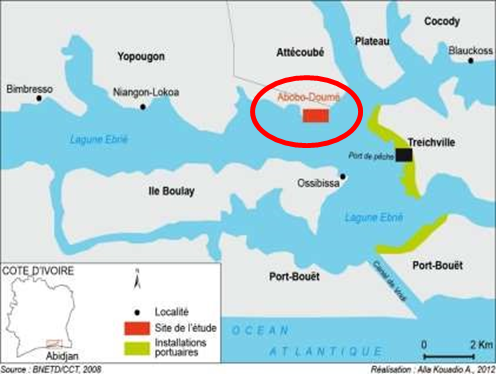
Abobodoumé landing stage is located in the south-western part of Attécoubé commune. It is bordered to the north by the village of Locodjro, to the east by the Banco bay, to the west by the commune of Yopougon and to the south by the Ebrié lagoon 11 (Figure 1). Abobodoumé covers an area of 2.37 km² with latitudes 5°10' and 5°30' North and longitudes 3°45' and 4°21'West 12.
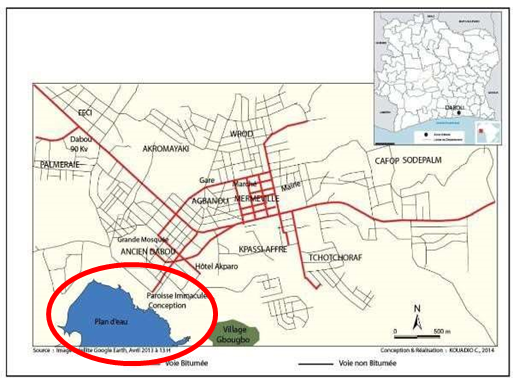
Dabou landing stage is located in the town of Dabou in southern Côte d'Ivoire, 50 km from the extreme west of Abidjan. It lies between longitudes 4°16' and 4°60' West and latitudes 5°07' and 5°33' North. It covers an area of 1,290 km² 13 (Figure 2).


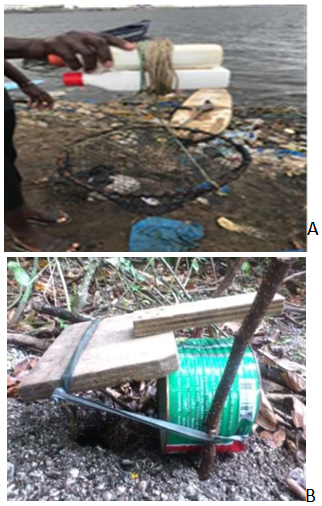
Data collection consisted of field observations and socio-economic surveys using questionnaires and interviews. The framework surveys focused on fishing stakeholders, marketing systems and economic aspects. The crabs collected in this study come from the commercial fishery. The various specimens were supplied by fishmongers and fishermen at the 2 sites. Water crabs were caught using scales, which are passive, cone-shaped catching devices. They consist of 2 floats and a metal frame mounted on 20 mm mesh nets (Figure 3A). Land crabs were captured using trap boxes (Figure 3B). Data were collected from March to August 2022. Crabs were identified using the key of Manning and Holthius 14.

Frequency index (FI) is expressed in terms of the species' regularity in catches and landings. It was determined using the following mathematical expression: FI = (Pi/P) x 100 where Pi = Number of samples where species i appears,P = Total number of samples 15. When FI ≥ 75%, species is said to be frequent,50 ≤ FI˂ 75%, species is said to be common,25 ≤ FI˂ 50%, species is said to be occasional,10 ≤ FI˂ 25%, species is said to be rare,FI ˂ 10%, species is said to be accidental.
Relative abundance (RA) is the degree of presence of a species in terms of numerical abundance during a landing. It is obtained using the following formula: Ar = (Ni/Nt) x 100 (Ni = number of species i and Nt = total number of species) 16.
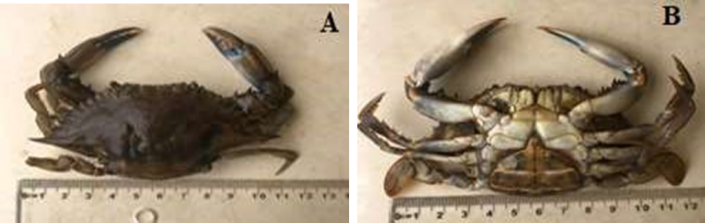
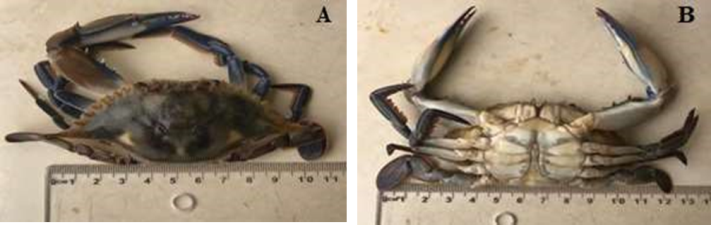
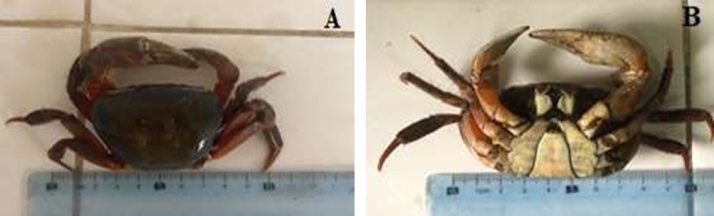
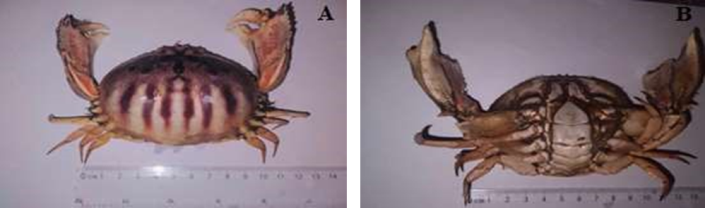
The inventory of edible crabs on Abobodoumé and Dabou landing stages identified 4 species. These species belong to 3 families (Portunidae, Gecarcinidae and Calappidae) and 3 genera (Callinectes, Cardisoma and Calappa). Portunidae family is the most represented, with 2 species: Callinectes amnicola (Figure 4) and Callinectes pallidus (Figure 5). Gecarcinidae and Calappidae families each have 1 species, respectively Cardisoma armatum (Figure 6) and Calappa rubroguttata (Figure 7). The Portunidae and Calappidae families were characterized by swimming crabs, while the Gecarcinidae were mantly represented by walking crabs.


The frequency indices and relative abundance of the crabs sampled were presented in Table 1. Callinectes amnicola and Callinectes pallidus were classified as “frequent” species, with frequency indices of 100% and 90% respectively. Cardisoma armatum is classified as “common”, with a frequency index of 50%. Callapa rubroguttata, with a frequency index of 30%, is classified as “occasional”.
In terms of relative abundance, Callinectes amnicola, with an occurrence rate of 80%, is the most abundant species on landings. It is followed by Callinectes pallidus (10%), Cardisoma armatum (8%) and Calappa rubroguttata (2%).
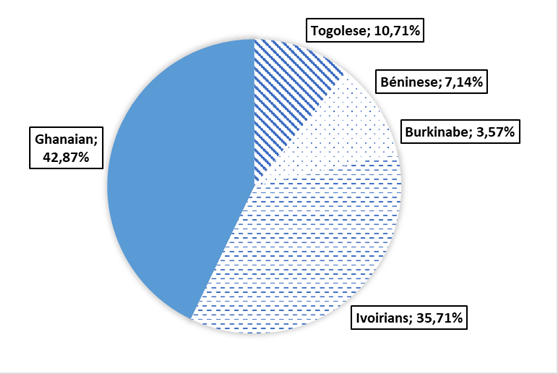
A total of 58 fishermen were counted at the two landing stages, including 28 at Abobodoumé and 30 at Dabou. On both landings, non-nationals were the most numerous.At Abobodoumé landing site, 42.86% of actors were Ghanaian, 35.71% Ivorian, 11% Togolese, 7.14% Beninese and 3.57% Burkinabe (Figure 8A). At the Dabou landing stage, 90% were Beninese and 10% Ivorians (Figure 8B).

The age of the fishermen interviewed at the Abobodoumé landing stage ranged from 18 to 42, and that of the Dabou fishermen from 21 to 55. Two age groups were observed at the landing sites: young people under 30 and adults over 30 years.
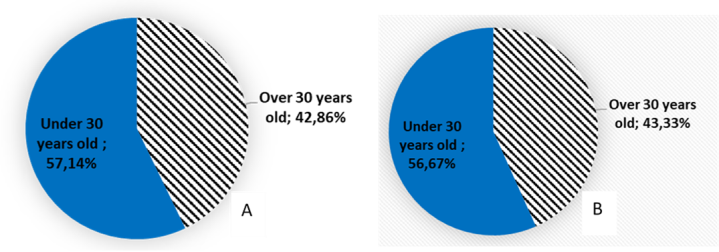
At the Abobodoumé landing stage, young people represent 57.14% and adults 42.86% of total fishermens (Figure 9A). At the Dabou landing stage, young people represent 56.67% and adults 43.33% (Figure 9B).

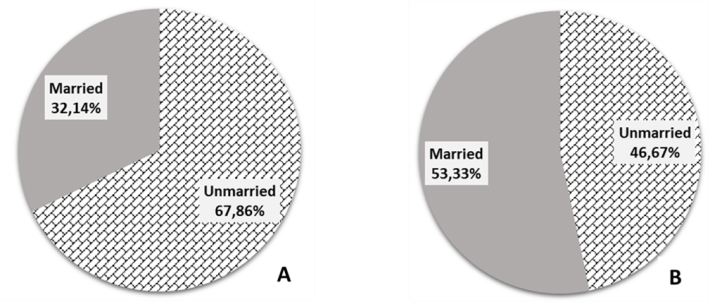
At the Abobodoumé landing stage, 67.86% of fishermen were single, compared with 32.14% who were married (Figure 10A). At the Dabou landing stage, 53.33% of fishermen were married, compared with 46.67% who were single (Figure 10B).
All landing stages exhibit a dichotomy of angler groups. There are two categories of fishermen: professional and occasional. Professional fishermen are defined as individuals whose primary source of income is derived from fishing activities. These figures represent 54% of the total number of fishermen at Abobodoumé landing stage and 63.33% at Dabou landing stage. With regard to occasional fishermen, they constitute 46% of the total number at Abobodoumé landing stage and 36.67% at Dabou landing stage (Figure 11A and B).


A total of 48 fishmongers were identified during the surveys at the two landing stages (23 at the Abobodoumé landing stage and 25 at the Dabou landing stage).
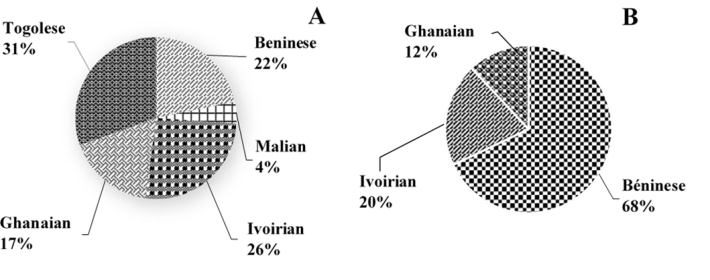
The Abobodoumé landing stage is dominated by non-nationals (74%). The proportion of Ivorian women involved in this activity is only 26%. The non-nationals involved in this activity are Togolese (31%), Beninese (22%), Ghanaian (17%) and Malian (4%) (Figure 12A). At the Dabou landing stage, activity is also dominated by non-nationals (80%), namely women from Benin (68%) and Ghana (12%). Ivorian women accounted for 20% (Figure 12B).

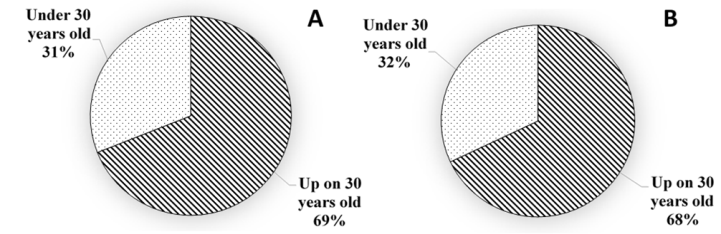
The age of the women fishmongers at the Abobodoumé landing site varies from 24 to 49 years. Women aged 30 and over are the most numerous (69%). This is followed by those aged under 30 years old (31%) (Figure 13A). At the Dabou landing site, the age of fish sellers varies from 20 to 48 years. Women aged 30 and over are the most numerous (68%). They are followed by those under 30 (Figure 13B).
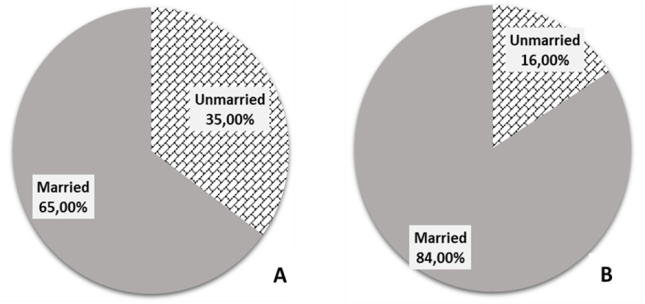
On both landing sites, married women fishmongers were the most numerous. On the Abobodoumé landing site, they accounted for 65% and on the Dabou landing site, 84%. Unmarried women accounted for 35% at the Abobodoumé landing site and 16% at the Dabou landing site (Figure 14 A and B).


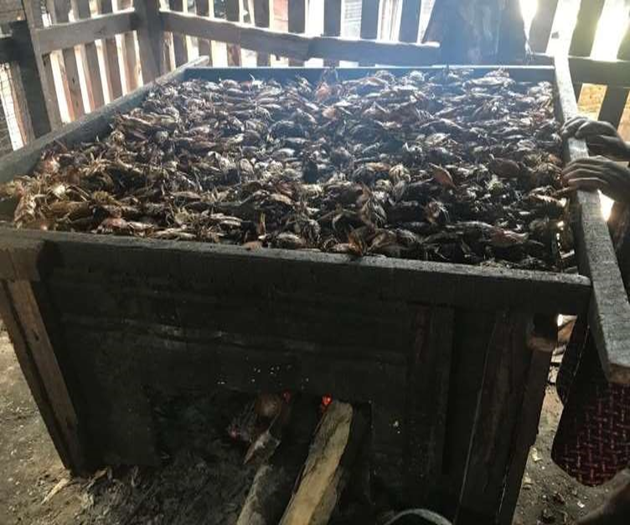
According to the various surveys carried out at the two landing sites, only women smoke crabs. Smoking is one of the most common methods of preserving crabs. It is generally carried out near the landing site and in the traditional way. The equipment used is a metal oven and firewood (Figure 15). As crabs are a perishable food, smoking is the preferred method to avoid wastage, as there is no suitable equipment to keep them fresh. Before smoking, crabs were thoroughly rinsed and then placed on the smoking grills. The smoking time depends on a number of factors, including the size of the species, the volume of the fire and the choice of processor. After smoking, the crabs were bagged and transported to the nearest market and other markets in the country.

Buying and selling prices vary according to season, size and species. Fishermen sell crabs in baskets. The selling price varies from 5,000 to 7,000 CFA francs during periods of high crab production for small species and an average of 10,000 CFA francs for large crabs. During periods of low production, the selling price varies between 10,000 and 12,000 CFA francs for small crabs and between 15,000 and 20,000 CFA francs for large crabs.
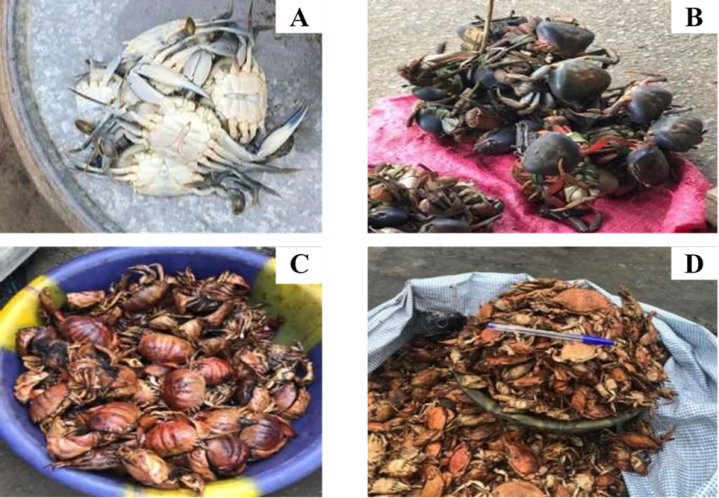
The fishmongers sell these products either wholesale or retail. Wholesale, they sell baskets of small individuals at a price that varies from 7000 to 10,000 FCFA during the high production period, and baskets of large individuals at an average price of 15,000 FCFA. During the low production period, small crabs are sold for between 12,000 and 15,000 FCFA. Prices for large crabs range from 18,000 to 25,000 FCFA per basket. At the retail level, crabs were sold in piles (from 6 to 24 individuals). The price of these piles depends on the species, size and season. On average, they range from FCFA 500 to FCFA 2,000 (Figure 16).

Fishermen's incomes at all landing sites depend on seasons. Fishermen at Abobodoumé earn between 5,000 and 30,000 FCFA per day during low production periods (March to May). However, during high abundance production periods (June to August) they earn between FCFA 3,000 and 15,000. The fishermen pay a tax of 500 FCFA for each landing to the traditional chiefs.
In Dabou, during the good season (March to June), fishermen earn a minimum of 3,000 FCFA and a maximum of 20,000 FCFA per day. During the bad season (July-August), daily earnings vary between 2,000 and 10,000 FCFA. Dabou fishermen pay two types of tax: a tax of 12,000 CFA francs is paid every two weeks to the village community, and another tax of 10,000 CFA francs is paid annually to the water and forestry authorities.
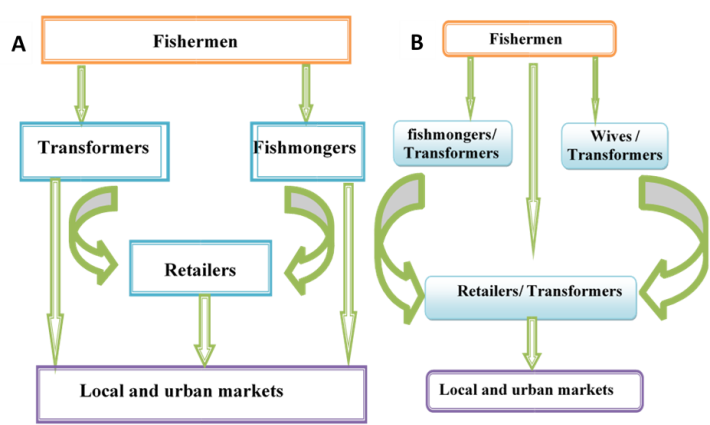
3.8. Marketing ChannelsThe succession of intermediaries and markets through which the crabs pass from the fisherman to the consumer make up the marketing circuit. The investigations carried out in the field and with the various actors in the marketing chain have provided an overview of the marketing circuit for the different species of crab landed at the two landing sites. This circuit comprises 4 groups of actors: fishermen, wholesalers, processors and retailers (Figure 17A). Distribution to the local market is divided between supermarkets and communal markets. As far as fishing and marketing are concerned, everyone works individually. Fishmongers act as intermediaries between the fishermen and the retailers. They may also sell the crabs on the retail market. Sometimes fishmonger is a member of the fisherman's family, but more often she is someone with working capital. This available cash is used to pay the fishermen an average advance of 50% immediately on delivery of the product. The rest is paid after the crabs have been sold. A fishmonger usually works with 2 or 3 fishermen.
At the landing site in Dabou, most fishermen sell their catch to their wife or a family member. This cycle also consists of 4 actors: fisherman, fishmonger, fisherman's wife and retailer (Figure 17B). In some cases, retailer bought her products directly from fisherman. In this cycle, everyone except fisherman was a processor.

The results of this work have enabled us to show that four species of crab are marketed at the Abobodoumé and Dabou landing sites. Three of these species are swimmers (Callinectes amnicola, Callinectes pallidus and Calappa rubroguttata) and one is a walker (Cardisoma armatum). Our results are in agreement with those of Fisher et al 17. This author states that the two species Callinectes amnicola and Callinectes pallidus were found in Ivorian lagoon waters. Calappa rubroguttata was the species least represented at the site because it is caught accidentally. The same observation was made by 18 in their study of eight species of edible decapod crustaceans in Senegalese waters. The crab fishery at both landing sites is dominated by foreigners, particularly Ghanaians and Beninese. This observation seems to be due to the fact that nationals find fishing very tiring and prefer to engage in other activities. These findings confirm those of 6, who state that in the Aby lagoon, shellfish fishing is in the hands of foreigners of Ghanaian, Beninese and Togolese nationality. There is a high proportion of young people under the age of 30. This can be explained by the fact that fishing requires a certain level of physical strength. It is a very tedious and exhausting activity. The same observation was made by 6 in the Aby lagoon and by 19 in Madagascar during a study on the contribution of marine and artisanal fishing to the economic life of fishermen.
At the Abobodoumé landing site, most fishermen are single and illiterate. In Dabou, on the other hand, married fishermen predominate. The predominance of single fishermen in Abobodoumé is due to the high cost of living in the town. With regard to the classification of fishermen at the two landing sites, professional fishermen are the most numerous, which could be explained by the fact that crab fishing is a lucrative activity. It's a job that brings in enough money to feed people well and allow fishermen to provide for themselves and their families.
As far as wholesalers are concerned, the wholesale sector seems to be dominated by non-nationals. This would be justified by the relationship that exists between fishermen and nationals of the same country, who are responsible for processing and marketing. This finding differs from that of 20 for the Aby lagoon area, where nationals tend to dominate the activity, with a slight representation of non-nationals. Similarly, there is a preponderance of married women in the area, which is due to the various constraints of the activity, which requires a certain level of responsibility. The majority of people working in this activity are adults (30 to 45 years old). This observation is justified by the fact that the activity is rather arduous and requires physically strong people 20.
The crabs are smoked in the traditional way around the landing stages. The crabs are washed beforehand and placed on the grills. Our observations confirm those of 20, who states that the smoking time varies according to the species, size and desired state of preservation. Also for 21 and 22, successful smoking results in a moisture loss of between 15% and 25% and prolongs preservation.
The analysis of the marketing circuit identified 4 actors involved in marketing at the Abobodoumé landing site. These include fishermen, fishmongers, retailers and processors. At the Dabou landing stage, 4 actors were also identified, including the fisherman, the fishmonger or wholesaler, the fisherman's wife and the retailer. This is a very simple circuit, but these actors are not organised in a cooperative. These results differ from those of 23, who found the involvement of 3 actors in the crab chain in Benin. However, our results confirm those of 24, who found the involvement of several actors in the value chain, including fishermen, primary collectors, wholesalers, retailers and processors.
Crabs are usually sold in baskets, bowls and piles, depending on the different players. Fishmongers buy traps at prices ranging from 5,000 to 7,000 F CFA for small species, which are sold for an average of 9,000 F CFA. Large species are bought for an average of FCFA 10,000 and sold for an average of 12,000 F CFA. Retailers sell in bundles of 500 FCFA. For the species Cardisoma armatum, retailers use lots of 7 to 8 crabs tied in nets at prices of FCFA 2,000. The variation in prices observed for all actors in the cycle could be explained by differences in size, season and quality, but also by the maturity of the crabs.
As far as the income of the actors is concerned, it should be noted that the crab industry provides a significant income for the actors concerned, which enables them to meet their needs. It should also be noted that this income varies from period to period. On average, fishermen earn between 5,000 and 30,000 FCFA per day. Fish traders generally earn between 3,000 and 5,000 CFAF. Overall, the activity remains relatively profitable for those involved. Our comments are in line with those of 6.
The inventory of crabs caught showed that four edible species are marketed at the two landing stages. These were Callinectes amnicola, Callinectes pallidus, Cardisoma armatum and Calappa rubroguttata. Among these species, Callinectes amnicola was the most commonly landed. Crab fishing remains dominated by non-nationals, with a large number of Ghanaian nationals at the Abobodoumé landing site and Beninese nationals at the Dabou landing site. Majority of them were young people under the age of 30. In terms of marital status, there is a high proportion of single people at the Abobodoumé landing site and a high proportion of married people at the Dabou landing site. The fishmongers were also non-natives, with a high proportion of women aged between 30 and 45. Processing was carried out exclusively by women and the processing technique used was smoking. The marketing circuit consists of 4 actors: fishermen, wholesalers or fishmongers, processors and retailers. The crab industry is of great socio-economic interest to the local population and is an important source of foreign exchange.
The results of this study highlight a number of edible crab species. In order to improve the management of the crab sector, it is necessary to train and organise the actors involved in the sector.
The authors are grateful tothe customary authorities of the two villages where the two landing sites are located for their agreement. Authors would also like to thank all the fishmongers and fishermen we interviewed in Abobodoumé and Dabou for giving us some of their time by answering to ours requests.
| [1] | Houmenou, A.B.P., 2016. Evaluation de la qualité microbiologique du crabe fumé vendu dans le marché de Dantokpa. Mémoire de licence de l’Université d’Abomey-Calavi, Spécialité: Biotechnologie de la production et de la santé animale, Benin, 54p. | ||
| In article | |||
| [2] | FAO, 2010. Situation mondiale des pêches et de l’aquaculture. Rome, 99p. | ||
| In article | |||
| [3] | FAO, 2020. Situation mondiale des pêches et de l’aquaculture 2022. Rome, 174p. | ||
| In article | |||
| [4] | Trudeau, C., 2005. Santé Canada: Fichier Canadiens sur les éléments nutritifs. 20p. | ||
| In article | |||
| [5] | Goussanou, A., Bonou, A.G., Chikou, A., Gandonou, P., Mensah, G.A., & Youssao, A.K.I., 2017. Morphological, structural characteristics and growth relationship of crabs Callinectes amnicola and Cardisoma armatum in the complex Nokoué lake Porto-Novo lagoon in South Benin. Journal of Applied Biosciences, 118: 11803-11816. | ||
| In article | |||
| [6] | Sankare, Y., 2014. Mesure de gestion du stock de crabes nageurs Callinectes amnicola de Rochebrune, 1883 (Crustacea-Decapoda-Portunidae) du complexe lagunaire Aby-TendoEhy (Côte d’Ivoire-Afrique de l’Ouest). Centre de Recherche Oceanologique, 227-250. | ||
| In article | |||
| [7] | Olalekan, E.I. & Lawal-Are, A.O., 2013. Comparative study of condition factor, stomach analysis and some aspects of reproductive biology of two land crabs: Cardisoma armatum (Herklots,1851) and Cardisoma guanhumi (Latreille,1825) from a mangrove swamp ecosystem, Lagos, Nigeria. Journal of Marine Science: Research of Development, 4(1): 1-4. | ||
| In article | View Article | ||
| [8] | Alberts-Hubatsch, H., 2015. Movement patterns and habitat use of the exploited swimming crab Scylla serrata (Forskal,1775). Faculty of Biology/Chemistry, 129p. | ||
| In article | |||
| [9] | Etchian, O.A., Dakouri, R., Blé, C.M., Lawal-Are, A.O., & Cuesta, A.J., 2016. Some Ecological aspects of the Gecarcinidae land Crab, Cardisoma armatum Herklots,1851(Crustacea, Brachyura, Gecarcinidae) from the estuarine region of the Comoe River, Côte d’Ivoire. International Journal of Biological and Chemical Sciences, 10 (2): 457-474. | ||
| In article | View Article | ||
| [10] | Dègnon, R.G., Dahouenon-Ahoussi, E., Adjou, E.S., Ayikpé, O., Tossou, S., Soumanou, M.M., & Sohounnhloué D.C.K., 2012. Impact des traitements post-capture sur la qualité microbiologique des crevettes (penaeus spp) du lac Ahemé au Benin destinées à l’exportation. Journal of Applied Biosciences, 53: 3749-3759. | ||
| In article | |||
| [11] | Kouassi, C.A., Kambire, B. & Alla, D.A., 2021. Risques environnementaux de l’extraction de sable sur le front lagunaire Ebrié d’Abobodoumé (District autonome d’Abidjan). Revue ivoirienne des lettres, arts et sciences humaines, 48: 95-109. | ||
| In article | |||
| [12] | INS, 2014. Annuaire statistique des pêches et de l’élevage, 36 p. | ||
| In article | |||
| [13] | Dibi, B., Doumouya I., N’go Y.A., & Gone D.L., 2005. Origine et mécanisme de la minéralisation des eaux souterraines de la région de Dabou, Côte d’Ivoire. Apport de l’analyse en composantes principales normées. Revue des sciences de la vie et de la terre, 5(1): 5-16. | ||
| In article | |||
| [14] | Manning, R.B. & Holthius, B.L., 1981. West Africain Brachyuran crabs (Crustacea: Decapoda). Smithsnian contributions to zoology, 306: 1-390. | ||
| In article | View Article | ||
| [15] | Dajoz, R., 2006. Précis d’écologie. 8ème Édition, DUNOD, Paris, 631 p. | ||
| In article | |||
| [16] | Faurie, C., Ferra C., Medori, P., Devaux, J., & Hemptinne, J.L., 2003. Ecologie approche scientifique et pratique. Edition Lavoisier, Paris, France, 407 p. | ||
| In article | |||
| [17] | Fisher, W., Bianchi, G., & Scott, W.B., 1981. Fiches FAO d’identification des espèces pour les besoins de la pêche Atlantique Centre-Est,zone de pêche 34-47 (en partie). Canada Fonds de Dépôt. Ottawa, Ministère des pêcheries et Océans, en accord avec l'organisation des Nations-Unies pour l'Alimentation et l'Agriculture, Vols. 1-7: pages variables. | ||
| In article | |||
| [18] | Clotilde-Ba, F.N., Diatta Y., & Capapé, C., 1997. Observations sur huit espèces comestibles de crustacés décapodes des eaux sénégalaises. Boletim do Museum Municipal do Funchal, 49(282): 171-184. | ||
| In article | |||
| [19] | Razafindralambo, N.Y., 1992. Contribution à l’étude socio-économique de la pêche maritime traditionnelle et artisanale à Madagascar: le cas de la région de Nosy-be, 44p. | ||
| In article | |||
| [20] | Adou, G.A.T., 2014. Femmes, commerce de produits halieutiques et structuration de l’espace lagunaire Aby. Revue tropicale de géographie de l’environnement, 2: 62-76. | ||
| In article | |||
| [21] | Diop, M.Y., 2007. Rapport de projet de gestion concertée des stocks de mulets, courbine et Tassergal entre le Sénégal et la Mauritanie, 16p. | ||
| In article | |||
| [22] | Sissoko, M., 2012. Atelier de formation sur la conservation, la transformation et la commercialisation du poisson, 15p. | ||
| In article | |||
| [23] | Mikpon, T., Nouvlessounon, D.D., Agbodjato, A.N., Lehmane, H., Amogou, O., N’Tcha C., Mousse, W., Sina, H., Ahissou, H., Adjanohoun, A., & Baba-Moussa, L., 2020. Socioeconomic and cultural values of two species of crabs (Cardisoma armatum Herklots and Callinectes amnicola Rochebrune) in Southern Benin. Journal International des pêches et de l’aquaculture, 12(2): 36-46. | ||
| In article | View Article | ||
| [24] | Holvoet K., 2010. Acteurs chaîne valeur plus, une approche innovatrice pour le secteur pêche en réponse au VIH/SIDA, expérience du Benin dans la chaine valeur crabe. 41p. | ||
| In article | |||
Published with license by Science and Education Publishing, Copyright © 2025 BODJI Iridjé Marcelle, Soro Mamadou, Coulibaly Lèfoungognon and N’ZI Konan Gervais
 This work is licensed under a Creative Commons Attribution 4.0 International License. To view a copy of this license, visit
http://creativecommons.org/licenses/by/4.0/
This work is licensed under a Creative Commons Attribution 4.0 International License. To view a copy of this license, visit
http://creativecommons.org/licenses/by/4.0/
| [1] | Houmenou, A.B.P., 2016. Evaluation de la qualité microbiologique du crabe fumé vendu dans le marché de Dantokpa. Mémoire de licence de l’Université d’Abomey-Calavi, Spécialité: Biotechnologie de la production et de la santé animale, Benin, 54p. | ||
| In article | |||
| [2] | FAO, 2010. Situation mondiale des pêches et de l’aquaculture. Rome, 99p. | ||
| In article | |||
| [3] | FAO, 2020. Situation mondiale des pêches et de l’aquaculture 2022. Rome, 174p. | ||
| In article | |||
| [4] | Trudeau, C., 2005. Santé Canada: Fichier Canadiens sur les éléments nutritifs. 20p. | ||
| In article | |||
| [5] | Goussanou, A., Bonou, A.G., Chikou, A., Gandonou, P., Mensah, G.A., & Youssao, A.K.I., 2017. Morphological, structural characteristics and growth relationship of crabs Callinectes amnicola and Cardisoma armatum in the complex Nokoué lake Porto-Novo lagoon in South Benin. Journal of Applied Biosciences, 118: 11803-11816. | ||
| In article | |||
| [6] | Sankare, Y., 2014. Mesure de gestion du stock de crabes nageurs Callinectes amnicola de Rochebrune, 1883 (Crustacea-Decapoda-Portunidae) du complexe lagunaire Aby-TendoEhy (Côte d’Ivoire-Afrique de l’Ouest). Centre de Recherche Oceanologique, 227-250. | ||
| In article | |||
| [7] | Olalekan, E.I. & Lawal-Are, A.O., 2013. Comparative study of condition factor, stomach analysis and some aspects of reproductive biology of two land crabs: Cardisoma armatum (Herklots,1851) and Cardisoma guanhumi (Latreille,1825) from a mangrove swamp ecosystem, Lagos, Nigeria. Journal of Marine Science: Research of Development, 4(1): 1-4. | ||
| In article | View Article | ||
| [8] | Alberts-Hubatsch, H., 2015. Movement patterns and habitat use of the exploited swimming crab Scylla serrata (Forskal,1775). Faculty of Biology/Chemistry, 129p. | ||
| In article | |||
| [9] | Etchian, O.A., Dakouri, R., Blé, C.M., Lawal-Are, A.O., & Cuesta, A.J., 2016. Some Ecological aspects of the Gecarcinidae land Crab, Cardisoma armatum Herklots,1851(Crustacea, Brachyura, Gecarcinidae) from the estuarine region of the Comoe River, Côte d’Ivoire. International Journal of Biological and Chemical Sciences, 10 (2): 457-474. | ||
| In article | View Article | ||
| [10] | Dègnon, R.G., Dahouenon-Ahoussi, E., Adjou, E.S., Ayikpé, O., Tossou, S., Soumanou, M.M., & Sohounnhloué D.C.K., 2012. Impact des traitements post-capture sur la qualité microbiologique des crevettes (penaeus spp) du lac Ahemé au Benin destinées à l’exportation. Journal of Applied Biosciences, 53: 3749-3759. | ||
| In article | |||
| [11] | Kouassi, C.A., Kambire, B. & Alla, D.A., 2021. Risques environnementaux de l’extraction de sable sur le front lagunaire Ebrié d’Abobodoumé (District autonome d’Abidjan). Revue ivoirienne des lettres, arts et sciences humaines, 48: 95-109. | ||
| In article | |||
| [12] | INS, 2014. Annuaire statistique des pêches et de l’élevage, 36 p. | ||
| In article | |||
| [13] | Dibi, B., Doumouya I., N’go Y.A., & Gone D.L., 2005. Origine et mécanisme de la minéralisation des eaux souterraines de la région de Dabou, Côte d’Ivoire. Apport de l’analyse en composantes principales normées. Revue des sciences de la vie et de la terre, 5(1): 5-16. | ||
| In article | |||
| [14] | Manning, R.B. & Holthius, B.L., 1981. West Africain Brachyuran crabs (Crustacea: Decapoda). Smithsnian contributions to zoology, 306: 1-390. | ||
| In article | View Article | ||
| [15] | Dajoz, R., 2006. Précis d’écologie. 8ème Édition, DUNOD, Paris, 631 p. | ||
| In article | |||
| [16] | Faurie, C., Ferra C., Medori, P., Devaux, J., & Hemptinne, J.L., 2003. Ecologie approche scientifique et pratique. Edition Lavoisier, Paris, France, 407 p. | ||
| In article | |||
| [17] | Fisher, W., Bianchi, G., & Scott, W.B., 1981. Fiches FAO d’identification des espèces pour les besoins de la pêche Atlantique Centre-Est,zone de pêche 34-47 (en partie). Canada Fonds de Dépôt. Ottawa, Ministère des pêcheries et Océans, en accord avec l'organisation des Nations-Unies pour l'Alimentation et l'Agriculture, Vols. 1-7: pages variables. | ||
| In article | |||
| [18] | Clotilde-Ba, F.N., Diatta Y., & Capapé, C., 1997. Observations sur huit espèces comestibles de crustacés décapodes des eaux sénégalaises. Boletim do Museum Municipal do Funchal, 49(282): 171-184. | ||
| In article | |||
| [19] | Razafindralambo, N.Y., 1992. Contribution à l’étude socio-économique de la pêche maritime traditionnelle et artisanale à Madagascar: le cas de la région de Nosy-be, 44p. | ||
| In article | |||
| [20] | Adou, G.A.T., 2014. Femmes, commerce de produits halieutiques et structuration de l’espace lagunaire Aby. Revue tropicale de géographie de l’environnement, 2: 62-76. | ||
| In article | |||
| [21] | Diop, M.Y., 2007. Rapport de projet de gestion concertée des stocks de mulets, courbine et Tassergal entre le Sénégal et la Mauritanie, 16p. | ||
| In article | |||
| [22] | Sissoko, M., 2012. Atelier de formation sur la conservation, la transformation et la commercialisation du poisson, 15p. | ||
| In article | |||
| [23] | Mikpon, T., Nouvlessounon, D.D., Agbodjato, A.N., Lehmane, H., Amogou, O., N’Tcha C., Mousse, W., Sina, H., Ahissou, H., Adjanohoun, A., & Baba-Moussa, L., 2020. Socioeconomic and cultural values of two species of crabs (Cardisoma armatum Herklots and Callinectes amnicola Rochebrune) in Southern Benin. Journal International des pêches et de l’aquaculture, 12(2): 36-46. | ||
| In article | View Article | ||
| [24] | Holvoet K., 2010. Acteurs chaîne valeur plus, une approche innovatrice pour le secteur pêche en réponse au VIH/SIDA, expérience du Benin dans la chaine valeur crabe. 41p. | ||
| In article | |||