 sciepub.com
 Quick Submission

Association of Obesity with Primary and Secondary Infertility among Infertile Women in Turkey: A Cross-sectional Study
Feray ÇAĞIRAN YILMAZ1, , Metin Saip SÜRÜCÜOĞLU2, Fatma TANILIR ÇAĞIRAN3
1Nutrition and Dietetic Department, Ankara University Faculty of Health Sciences, Ankara, Turkey
2Nutrition and Dietetic Department, Cyprus International University Faculty of Health Sciences, Lefkosa, Cyprus
3Department of Gynecology and Obstetrics, Diyarbakır Obstetrics and Gynecology of the Maternity and Child Health Hospital, Diyarbakır, Turkey
Abstract
Extremes in body weight, nutrition, and hormone profile can affect general health and reproductive performance. This cross-sectional study included 100 women (65 with primary infertility, 35 with secondary infertility) aged 20–42 years who visited the Department of Obstetrics and Gynecology of the Maternity and Child Health Hospital, Turkey. After preliminary clinical evaluation, anthropometric measurements and 24-h food consumption records were collected from all subjects. Fasting blood sample drawn on third day of menstrual cycle was analysed for serum luteinizing hormone (LH), follicle stimulating hormone (FSH), prolactin and thyroid stimulating hormone (TSH). Our study showed that women with secondary infertility had significantly higher BMIs, waist circumferences, hip circumferences, and waist-hip ratios than women with primary infertility. No significant differences between groups were noted in terms of individual hormone profiles. In the primary infertility group, no significant correlation was observed between hormonal factors and anthropometric measurements. However, in the secondary infertility group, serum prolactin levels demonstrated significant positive correlations with body weight and BMI. The daily energy and macronutrient intakes of women in both groups were similar, and the percentages of dietary fat and saturated fatty acid intakes were high in both groups. Weight loss should be considered as a first line of treatment in obese and overweight women with infertility. Obesity reduction may improve fertility outcomes.
Keywords: primary infertility, secondary infertility, nutrition, anthropometric measurements, hormones
Copyright © 2017 Science and Education Publishing. All Rights Reserved.Cite this article:
- Feray ÇAĞIRAN YILMAZ, Metin Saip SÜRÜCÜOĞLU, Fatma TANILIR ÇAĞIRAN. Association of Obesity with Primary and Secondary Infertility among Infertile Women in Turkey: A Cross-sectional Study. Journal of Food and Nutrition Research. Vol. 5, No. 4, 2017, pp 208-213. http://pubs.sciepub.com/jfnr/5/4/2
- YILMAZ, Feray ÇAĞIRAN, Metin Saip SÜRÜCÜOĞLU, and Fatma TANILIR ÇAĞIRAN. "Association of Obesity with Primary and Secondary Infertility among Infertile Women in Turkey: A Cross-sectional Study." Journal of Food and Nutrition Research 5.4 (2017): 208-213.
- YILMAZ, F. Ç. , SÜRÜCÜOĞLU, M. S. , & ÇAĞIRAN, F. T. (2017). Association of Obesity with Primary and Secondary Infertility among Infertile Women in Turkey: A Cross-sectional Study. Journal of Food and Nutrition Research, 5(4), 208-213.
- YILMAZ, Feray ÇAĞIRAN, Metin Saip SÜRÜCÜOĞLU, and Fatma TANILIR ÇAĞIRAN. "Association of Obesity with Primary and Secondary Infertility among Infertile Women in Turkey: A Cross-sectional Study." Journal of Food and Nutrition Research 5, no. 4 (2017): 208-213.
| Import into BibTeX | Import into EndNote | Import into RefMan | Import into RefWorks |
1. Introduction
Infertility is defined the failure to conceive after at least one year of unprotected coitus [1]. The number of couples affected by infertility has increased from 42.0 million in 1990 to 48.5 million in 2010 [2]. Obesity is defined as the accumulation of adipose tissue to excess [3]. The global prevalence of obesity has nearly doubled from 6.4% in 1980 to 12.0% in 2008 [4]. The prevalence of obesity has steadily increased in Turkey. According to Turkey Nutrition and Health Survey data, for example, 41.0% of all Turkish women are obese [5].
Obesity has long been observed to affect fertility adversely. A previous study concluded that various menstrual problems, recurrent miscarriage, and infertility affect 43.0% of all overweight and obese women [6]. The potential adverse effects of obesity on fertility in women include irregular cycles, oligo/amenorrhoea, chronic anovulation, increased risk of miscarriage, decreased conception rates after assisted reproductive technologies, increased morbidity in pregnant women, poorer outcomes of preterm deliveries, and polycystic ovary syndrome (PCOS) [7, 8]. Obesity has also been associated with reduced fecundity, while weight loss has been observed to increase fecundity [9, 10].
Studies report that even a slight weight loss in obese infertile women improves reproductive function; a 5%–10% reduction in body weight, for example, has been shown to be effective in reducing insulin and androgen levels [11, 12, 13].
The reproductive axis in women is controlled by a complex series of anterior pituitary gland hormones, gonadal sex steroid hormones, neurotransmitter systems, hypothalamic releasing factors, and various growth factors [14]. Disruption of the normal secretion of luteinizing hormone (LH) and follicular stimulating hormone (FSH) is evidenced in a number of reproductive disorders in women [15]. Thyroid hormones seem to play an important role in controlling the reproductive cycle. Hyperthyroidism and hypothyroidism exert adverse effects on female reproduction and cause menstrual disturbances. Hyperthyroidism is associated with increased sex hormone binding globulin, total estradiol, testosterone; hypothyroidism is associated with oligomenorrhea. In women, hyperprolactinemia leads to infertility [16, 17, 18]. Hyperprolactinemia usually presents as menstrual abnormalities, such as amenorrhea or oligomenorrhea, and luteal-phase issues [19].
Unhealthy eating habits, such as excessive intake of foods with high carbohydrate and fat contents, are the main factors promoting the development of nutritional problems [20]. A low-fat diet is traditionally believed to aid weight loss and improve reproductive dysfunction [21]. To boost reproductive health, a diet that includes fruits, vegetables, and whole grains and is low in saturated fats, cholesterol, refined grains, and sweets is recommended [22, 23].
The purpose of this study was to evaluate the association of anthropometric measurements, hormone profiles, and daily energy and macronutrient intakes in both primary and secondary infertility.
2. Materials
2.1. Study Design and Data CollectionThis study was carried out at the Department of Obstetrics and Gynecology of the Maternity and Child Health Hospital in Diyarbakır, Turkey. All the women underwent a preliminary clinical examination in the gynecology department and those without any history of any medical illness in either partner were included. A total of 100 women aged 20–42 years were included in this study, and all subjects gave informed consent to take part in this research after being provided verbal and written explanations. All studies were conducted according to the guidelines laid down in the Declaration of Helsinki, and all procedures involving human subjects were approved by the Ethics Committee of Ankara University (Ethics approval code 2014/1269). In this work, 65 women presented with primary infertility while 35 presented with secondary infertility. All of the women’s general characteristics and their 24-h food consumption records were collected by face to face interviews using a standard questionnaire. Anthropometric measurements were taken by the researcher. Fasting blood samples were collected between 8:00 am and 11:00 am. Five millilitre fasting venous blood sample was drawn from the subject on day 3 of menstrual cycle using standard venipuncture techniques. FSH, LH, prolactin and TSH levels were measured using a electrochemiluminescence immunoassay on a COBAS 6000 system E601 (Elecsys module) and immunoassay analyzers (Roche Diagnostics GmbH, Mannheim, Germany). Couple that has never conceived despite exposure to the risk of pregnancy for a period of 1 year were defined primary infertility and couples who fail to conceive following a previous pregnancy despite cohabitation and exposure to the risk of pregnancy (in the absence of contraception, breastfeeding or postpartum amenorrhea) for 1 year were defined secondary infertility.
2.2. Anthropometric MeasurementsWeight was measured by electronic scales to the nearest 0.1 kg and height was measured to the nearest 0.1 cm a wall-mounted stadiometer while participants were wearing light clothing and no shoes. Body mass index (BMI) (kg/m2) was evaluated according to World Health Organization (WHO) standards. Underweight was diagnosed when the BMI was less than 18.5 kg/m2; normal weight when the BMI was between 18.5–24.9 kg/m2; whereas overweight was diagnosed when the BMI was between 25.0–29.9 kg/m2; and when BMI exceeded 29.9 kg/m2, then participants were classified as obese [24]. Waist-hip-ratio (WHR) refers to the relationship between the waist circumference and the hip circumference. WHR is calculated by dividing the waist circumference by the hip (or gluteal) circumference. A WHR of more than 0.80 in women indicates central body distribution (android obesity), while a ratio of less than 0.80 indicates gynoid obesity [25].
2.3. Macronutrient IntakeMacronutrient intake was assessed by 24 hours recall dietary records maintained for one day by using a photographic atlas of food portion sizes [26]. The average energy (kcal), dietary fat (%), saturated fatty acids (%), dietary carbohydrate (%), dietary protein (%) and dietary fiber (g) intake analysis was carried out using a computerized system [27]. The number of women whose diet contained higher amounts than the maximum recommended intake for macronutrient as defined by Food and Nutrition Guideline for Turkey (FNGT) was calculated and reported in the tables [28].
2.4. Statistical AnalysisStatistical analysis was performed using SPSS 21.0 version for Windows. The results were given as mean ± Standard error of mean (SEM). Kolmogrov–Smirnov and Shapiro Wilk tests were used to assess the normality of the data. The difference between various anthropometric measurements, hormone levels, daily energy and macronutrient intakes between the primary and secondary infertility groups was determined by Mann Whitney U. Correlations were evaluated using the Pearson’s correlation test. For all statistical comparisons, the level of significance was set at p<0.05.
3. Results
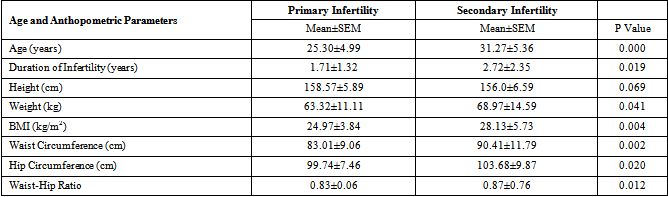
The ages and anthropometric measurements of women included in both groups were compared. The secondary infertility group had significantly higher BMIs, waist circumferences, hip circumferences, and waist-hip ratios than the primary infertility group (Table 1). The average duration of infertility in the primary infertility group was 1.71 ± 1.32 years and that in the secondary infertility was 2.72 ± 2.35 years (p = 0.019).




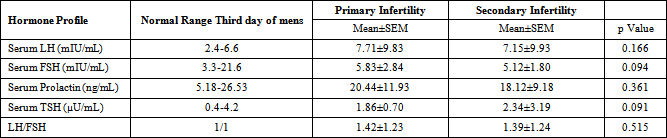
The primary and secondary infertility groups showed similar LH and FSH levels, but women with primary infertility revealed slightly higher mean levels of prolactin than women with secondary infertility. This difference was not statistically significant. Thyroid stimulating hormone (TSH) levels were slightly higher in the secondary infertility group than in the primary infertility group, but differences observed were statistically insignificant. No significant difference in LH/FSH ratio was observed between the groups (Table 2).




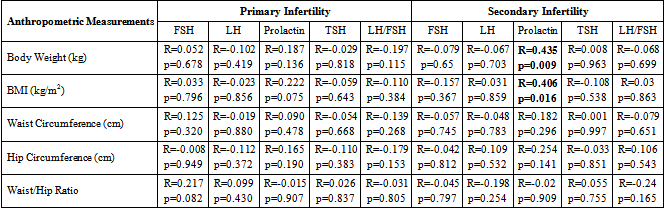
In the primary infertility group, no significant correlation was observed between hormonal factors and anthropometric measurements. By contrast, in the secondary infertility group, prolactin levels demonstrated significant positive correlations with body weight, and BMI (Table 3).
Table 3. Correlation of Hormonal Factors with Anthropometric Measurements in Primary and Secondary Infertility



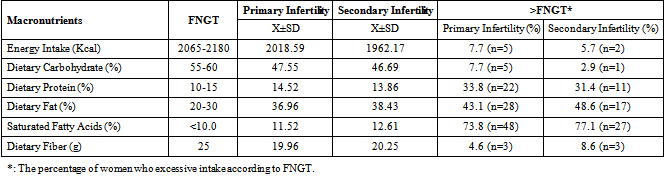
Daily mean energy and macronutrient intakes and comparisons with the FNGTs are presented in Table 4. The percentages of dietary fat and saturated fatty acid intakes were high in both groups, and dietary carbohydrate intakes were below the FNGT value.
Table 4. Daily Energy and Nutrient Intakes and Comparisons with the FNGT in Primary and Secondary Infertility Patients



4. Discussion
Most of the women recruited for this study presented with primary infertility. Several studies have similarly found that primary infertility is more common among women than secondary infertility [29, 30, 31, 32]. The prevalence of primary infertility, however, is relatively low throughout sub-Saharan Africa [33].
Increasing age in women is an acknowledged factor negatively influencing time to pregnancy (ESHRE, 2005. In our study, women with primary infertility (25.30 ± 4.99 years) were significantly younger than women with secondary infertility (31.27 ± 5.36 years). Several studies have shown that fertility declines with increasing age [34, 35].
Adipose tissue is essential for the normal development of female reproductive functions. The association between obesity and hyperinsulinaemia, hyperandrogenism, and abnormal secretion of other hormones, such as leptin, underlies the many reproductive disorders observed among infertile women [8, 36, 37]. In this study, 42% of the women recruited had a normal BMI, 38% were overweight, and 20.0% were either obese or grossly obese. Mean body weights, BMIs, waist circumferences, hip circumferences, and waist/hip ratios were found to be significantly higher in women with secondary infertility than in women with primary infertility. Higher anthropometric measurements observed in the secondary infertility group are generally attributed to the accumulation of fat with age as a result of previous pregnancies and nutritional and lifestyle changes [38, 39].
Infertility is often caused by an insufficiency or imbalance of hormones. Hormonal imbalances can be determined by blood tests of reproductive hormone levels. Measurement of FSH, LH, prolactin, and TSH at day 2 or 21 can indicate whether or not the hormonal state is compatible with pregnancy. Ovulatory disorders are often characterized by low serum concentrations of FSH and LH and high serum concentrations of prolactin [40, 41, 42]. Elevated serum LH concentrations and LH/FSH ratios are characteristic of women with PCOS [43]. While the LH/FSH ratio is a controversial criterion for identifying a sub-group of infertile women, high LH/FSH ratios have been associated with infertility [44]. In the present study, serum FSH, prolactin, and TSH levels were within the normal range but serum LH levels and LH/FSH ratios were above the reference range. All hormone levels were similar between both groups, and differences observed were not significant.
The primary role of LH is to regulate androgen production in the theca interna, while the primary role of FSH is to regulate the growth and maturation of ovarian follicles and stimulate the aromatization of androgens to estrogens [45]. High LH/FSH ratios (LH/FSH ratio of >2) have been associated with obesity [44]. Additionally, undiagnosed and untreated thyroid diseases can cause infertility [46]. While several studies report that reproductive hormonal parameters did not differ between slim and obese women [36, 47, 48, 49], other studies reveal that these parameters differed significantly [50, 51, 52]. In the present study, no significant associations among serum FSH, LH, TSH levels, and LH/FSH ratio with anthropometric measurements were found in both study groups.
Serum concentrations of prolactin increase physiologically in pregnancy and during lactation. Hyperprolactinemia induced by other reasons is a common cause of secondary amenorrhoea in reproductive women [53, 54]. A high prevalence of obesity has been significantly associated with hyperprolactinaemia [55], and an association between hyperprolactinemia and increased body weight has been demonstrated [56, 57, 58]. A previous work found that serum prolactin levels in infertile women are higher than those in their fertile counterparts [59]. In this work, the secondary infertility group revealed a significant positive correlation between prolactin levels and body weight and BMI.
Inappropriate diets, insufficient exercise, and obesity are often associated with infertility [60]. The quantity, proportion, and type of carbohydrates, proteins, and lipids consumed by women may exert important impacts on their fertility [61]. While our study revealed similar energy intakes and macronutrient consumption between both groups, all of the patients consumed more fat and saturated fat than recommended for healthy women. Limited data on the diet history of women with infertility are available. A study found that high saturated fatty acid levels in follicular fluid are inversely associated with the number of mature oocytes during assisted reproduction [62]. Similarly, in previous dietary studies, women with PCOS tended to consume diets with high dietary fat and saturated fat levels [63, 64].
This study presents several limitations. First, the small patient sample recruited for this research prevents us from drawing definitive conclusions and our exploratory findings must be confirmed in larger populations. Another limitation is that there was no control group with which to compare the anthropometric measurements, hormone profile, daily energy and macronutrient intakes.
5. Conclusion
In our study; the secondary infertility group had significantly higher BMIs, waist circumferences, hip circumferences, and waist-hip ratios than the primary infertility group. The primary and secondary infertility groups showed similar hormone levels. In the primary infertility group, no significant correlation was observed between hormonal factors and anthropometric measurements. By contrast, in the secondary infertility group, prolactin levels demonstrated significant positive correlations with body weight, and BMI. The percentages of dietary fat and saturated fatty acid intakes were high in both groups.
Healthy body weights may increase the chance of infertile women to succeed in trying to get pregnant naturally so we recommend that women of reproductive age adjust their lifestyles accordingly and make efforts to control their weight.
References
| [1] | E. Vayena, PJ, Rowe, PD Griffin. Current Practices and Controversies in Assisted Reproduction, World Health Organization, 2002. [E-book] Avaible: http://apps.who.int/iris/bitstream/10665/42576/1/9241590300.pdf. | ||
 In article In article | |||
| [2] | Mascarenhas, M. N., Flaxman, S. R., Boerma, T., Vanderpoel, S., Stevens, G. A., “National, regional, and global trends in infertility prevalence since 1990: a systematic analysis of 277 health surveys”, PLoS Medicine, 9(12), 1-12. 2012. | ||
| In article | View Article PubMed | ||
| [3] | James, P.T., “Obesity: the worldwide epidemic”, Clinics in Dermatology, 22(4), 276-280. 2004. | ||
| In article | View Article PubMed | ||
| [4] | Stevens, G.A., Singh, G.M., Lu, Y., Danaei, G., Lin, J.K., Finucane, M.M., Bahalim, A.N., Mclntire, R.K., Gutierrez, H.R., “National, regional, and global trends in adult overweight and obesity prevalences”, Popul Health Metr, 10(1), 22. 2012. | ||
| In article | View Article PubMed | ||
| [5] | The Ministry of Health of Turkey The General Directorate of Primary Health Care. Turkey, Nutrition and Health Survey (TNHS), Hacettepe University Nutrition and Dietetic Department, Ankara, 2014. | ||
| In article | |||
| [6] | Rogers, J., Mitchell, G.W., “The relation of obesity to menstrual disturbances”, New England Journal of Medicine, 247(2), 53-55. 1952. | ||
| In article | View Article PubMed | ||
| [7] | Pasquali, R., Pelusi, C., Genghini, S., Cacciari, M., Gambineri, A., “Obesity and reproductive disorders in women”, Human Reproduction Update, 9(4), 359-372. 2003. | ||
| In article | View Article PubMed | ||
| [8] | Pantasri, T., Norman, R.J., “The effects of being overweight and obese on female reproduction: a review”, Gynecological Endocrinology, 30(2), 90-94. 2013. | ||
| In article | View Article PubMed | ||
| [9] | Law, D.G., Maclehose, R.F., Longnecker, M.P., “Obesity and time to pregnancy”, Human Reproduction, 22(2), 414-420. 2007. | ||
| In article | |||
| [10] | Wise L.A., Rothman K.J., Mikkelsen E.M., Sørensen H.T., Riis A., Hatch E.E., “An internet-based prospective study of body size and time-to-pregnancy”, Human reproduction, 1-12. 2009. | ||
| In article | |||
| [11] | Hamilton-Fairley, D., Kiddy, D., Watson, H., Paterson, C., Franks, S., “Association of moderate obesity with a poor pregnancy outcome in women with polycystic ovary syndrome treated with low dose gonadotrophin”, BJOG: An International Journal of Obstetrics & Gynaecology, 99, 128-131. 1992. | ||
| In article | View Article | ||
| [12] | Clark, A.M., Thornley, B., Tomlinson, L., Galletley, C., Norman, R.J., “Weight loss in obese infertile women results in improvement in reproductive outcome for all forms of fertility treatment”, Human Reproduction, 13(6), 1502-1505. 1998. | ||
| In article | View Article PubMed | ||
| [13] | Norman, R.J., Noakes, M., Wu, R., Davies, M.J., Moran, L., Wang, J.X., “Improving reproductive performance in overweight/obese women with effective weight management”, Human Reproduction Update, 10(3), 267-280. 2004. | ||
| In article | View Article PubMed | ||
| [14] | Beshay, V.E, Carr, B.R., Hypothalamic Pituitary Ovarian Axis and Control of the Menstrual Cycle, Springer, New York, 2013, 31-42. | ||
| In article | View Article | ||
| [15] | Kumar, P., Sait, F., “Luteinizing hormone and its dilemma in ovulation induction”, Journal of human reproductive sciences, 4(1), 2. 2011. | ||
| In article | View Article PubMed | ||
| [16] | Koutras, D.A., “Disturbances of menstruation in thyroid disease”, Annals of the New York Academy of Sciences, 816(1), 280-284. 1997. | ||
| In article | View Article PubMed | ||
| [17] | Krassas, G.E., Pontikides, N., Kaltsas, T., Papadopoulou, P., Paunkovic, N., Duntas, L.H., “Disturbances of menstruation in hypothyroidism”, Clinical endocrinology, 50(5), 655-659. 1999. | ||
| In article | |||
| [18] | Dittrich, R., Beckmann, M.W., Oppelt, P.G., Hoffmann, I., Lotz, L., Kuwert, T., Mueller, A., “Thyroid hormone receptors and reproduction”, Journal of reproductive immunology, 90(1), 58-66. 2011. | ||
| In article | View Article PubMed | ||
| [19] | Yadav, A., Arora, M., Saini, V., Bhattacharjee, J., Jain, A., “Serum gonadotropin and prolactin levels in females with primary infertility and thyroid dysfunction in North Indian population”, Journal of Infertility and Reproductive Biology, 2(3), 88-91. 2014. | ||
| In article | |||
| [20] | Wahlqvist, M., “Nutrition and prevention of chronic diseases: a unifying eco-nutritional strategy”, Nutrition, metabolism and cardiovascular diseases, 14(1), 1-5. 2004. | ||
| In article | View Article | ||
| [21] | Scalzo, K., McKittrick, M., “Case problem: Dietary recommendations to combat obesity, insulin resistance, and other concerns related to polycystic ovary syndrome/Response”, Journal of the academy of nutrition and dietetics, 100(8), 955. 2000. | ||
| In article | |||
| [22] | Moran, L.J., Tsaqareli, V., Noakes, M., Norman, R., “Altered Preconception Fatty Acid Intake Is Associated with Improved Pregnancy Rates in Overweight and Obese Women Undertaking in Vitro Fertilisation”, Nutrients, 8(1), 10. 2016. | ||
| In article | View Article PubMed | ||
| [23] | Asemi, Z., Samimi, M., Tabassi, Z., Shakeri, H., Sabini, S.S., Esmaillzadeh, A., “Effects of DASH diet on lipid profiles and biomarkers of oxidative stress in overweight and obese women with polycystic ovary syndrome: a randomized clinical trial”, Nutrition, 30(11), 1287-1293. 2014. | ||
| In article | View Article PubMed | ||
| [24] | World Health Organizaiton (WHO), Appropriate Body-Mass İndex for Asian Populations and its Implications for Policy and Intervention Strategies, The Lancet, 2004, 363-157. | ||
| In article | |||
| [25] | World Health Organization (WHO), Obesity: Preventing and Managing The Global Epidemic, WHO Publishing Co., Geneva, 2000, 10. | ||
| In article | |||
| [26] | Rakıcıoğlu, N., Tek Acar, N., Ayaz, A., Pekcan, G., Photograph Catalog of Food and Dishes: Portion Sizes and Amounts, Ata Ofset Publishing, Ankara, 2009. | ||
| In article | |||
| [27] | Bebis, (Beslenme Bilgi Sistemi), Nutrition Data Base Software. Data base: The German Food Code and Nutrient Data Base (BLS II.3, 1999) with additions from USDA-sr and other sources, Istanbul, 2004. | ||
| In article | |||
| [28] | The Ministry of Health of Turkey The General Directorate of Primary Health Care, Food and Nutrition Guideline for Turkey (FNGT), Onur Publishing, Ankara, 2015. | ||
| In article | |||
| [29] | Goynumer, G., Yetim, G., Gokcen, O., Karaaslan, I., Wetherilt, L., Durukan, B., “Hysterosalpingography, laparoscopy or both in the diagnosis of tubal disease in infertility”, 1(2), 23-26. 2008. | ||
| In article | |||
| [30] | Dhandapani, K., Kodavanji, B., Vinodini, N., “Association of body mass index with primary and secondary infertility among infertile women in Mangalore: A cross-sectional study”, National journal of physiology, pharmacy and pharmacology, 6(1), 81-84. 2016. | ||
| In article | |||
| [31] | Mesbahi, S., Pourissa, M., Refahi, S., Tabarraei, Y., Dehghan, M.H., “Hysterosalpingographic abnormalities in infertile women”, Research journal of biological sciences, 4(4), 430-432. 2009. | ||
| In article | |||
| [32] | Templeton, A., Fraser, C., Thompson, B., “The epidemiology of infertility in Aberdeen”, BMJ, 301(6744), 148-152. 1990. | ||
| In article | View Article | ||
| [33] | Larsen, U., “Primary and secondary infertility in sub-Saharan Africa”, International journal of epidemiology, 29(2), 285-291. 2000. | ||
| In article | View Article PubMed | ||
| [34] | Raque-Bogdan, T.L., Hoffman, M.A., “The relationship among infertility, self-compassion, and well-being for women with primary or secondary infertility”, Psychology of women quarterly, 1, 1-13. 2015. | ||
| In article | View Article | ||
| [35] | Dunson, D,B., Baird, D.D., Colombo, B., “Increased infertility with age in men and women”, Obstetrics & Gynecology, 103(1), 51-56. 2004. | ||
| In article | View Article PubMed | ||
| [36] | Acién, P., Quereda, F., Matallin, P., Villarroya, E., Lopez-Fernandez, J.A., Acién, M., Mauri, M., Alfayate, R., “Insulin, androgens, and obesity in women with and without polycystic ovary syndrome: a heterogeneous group of disorders”, Fertility and sterility, 72(1), 32-40. 1999. | ||
| In article | View Article | ||
| [37] | Pasquali, R., Patton, L., Gambineri, A., “Obesity and infertility”, Current opinion in endocrinology, diabetes and obesity, 14(6), 482-487. 2007. | ||
| In article | View Article PubMed | ||
| [38] | Friis, H., Gomo, E., Kæstel, P., Nyazema, N., Ndhlovu, P., Fleischer-Michaelsen, K., “Does the first pregnancy precipitate age-related fat deposition?”, International journal of obesity, 26, 1274-1276. 2002. | ||
| In article | View Article PubMed | ||
| [39] | Evers, J.L., “Female subfertility”, The Lancet, 360(9327), 151-159. 2002. | ||
| In article | View Article | ||
| [40] | Yasmin, E., Davies, M., Conway, G., Balen, A.H., “British Fertility Society: ‘Ovulation induction in who type 1 anovulation: Guidelines for practice’ Produced on behalf of the BFS Policy and Practice Committee”, Human Fertility, 16(4), 228-234. 2013. | ||
| In article | View Article PubMed | ||
| [41] | Weiss, R.V., Clapauch, R., “Female infertility of endocrine origin,. Arquivos Brasileiros de Endocrinologia & Metabologia, 58(2), 144-152. 2014. | ||
| In article | View Article PubMed | ||
| [42] | Jawad, A.H., Ibrahim, S,A., Jawad Z.H., Hadi, D.M., “A study of the correlation of some sex hormone with obesity in women with secondary ınfertility”, Journal of Al-Nahrain University, 18(1), 44-49. 2015. | ||
| In article | View Article | ||
| [43] | Hendriks, M., Ket, J.C.F., Hompes, P.G.A., Homburg, R., Lambalk, C.B., “Why does ovarian surgery in PCOS help? Insight into the endocrine implications of ovarian surgery for ovulation induction in polycystic ovary syndrome”, Human Reproduction Update, 13(3), 249-264. 2007. | ||
| In article | View Article PubMed | ||
| [44] | Beydoun, H.A., Beydoun, M., Wiggins, N., Stadtmauer, L., “Relationship of obesity-related disturbances with LH/FSH ratio among post-menopausal women in the United States”, Maturitas, 71(1), 55-61. 2012. | ||
| In article | View Article PubMed | ||
| [45] | Balen, A., “The pathophysiology of polycystic ovary syndrome: trying to understand PCOS and its endocrinology”, Best practice & research clinical obstetrics & gynaecology, 18(5), 685-706. 2004. | ||
| In article | View Article PubMed | ||
| [46] | Verma, I., Sood, R., Juneja, S., Kaur S., “Prevalence of hypothyroidism in infertile women and evaluation of response of treatment for hypothyroidism on infertility”, International journal of applied and basic medical research, 2(1), 17. 2012. | ||
| In article | View Article PubMed | ||
| [47] | Pavičić, B.D., Škrgatić, L., Bukvić Mokos, Z., Trgovčić, I., “Hyperandrogenemia association with acne and hirsutism severity in Croatian women with polycystic ovary syndrome”, Acta dermatovenerologica Croatica, 21(2), 105-112. 2012. | ||
| In article | |||
| [48] | Pagán, Y.L., Srouji, S.S., Jimenez, Y., Emerson, A., Gill, S., Hall, J.E., “Inverse relationship between luteinizing hormone and body mass index in polycystic ovarian syndrome: investigation of hypothalamic and pituitary contributions”, The journal of clinical endocrinology & metabolism, 91(4), 1309-1316. 2006. | ||
| In article | View Article PubMed | ||
| [49] | Ramezanali, F., Khalili, G., Arabipoor, A., Lankarani, N.B., Moini, A., “Relationships between serum luteinizing hormone level, endometrial thickness and body mass index in polycystic ovary syndrome patients with and without endometrial hyperplasia”, International journal of fertility & sterility, 10(1), 36. 2016. | ||
| In article | PubMed PubMed | ||
| [50] | Su, H.W., Chen, C.M., Chou, S.Y., Liang, S.J., Hsu, C.S., Hsu, M.I., “Polycystic ovary syndrome or hyperprolactinaemia: a study of mild hyperprolactinaemia”, Gynecological Endocrinology, 27(1), 55-62. 2011. | ||
| In article | View Article PubMed | ||
| [51] | Ecochard, R., Marret, H., Barbato, M., Boehringer, H., “Gonadotropin and body mass index: high FSH levels in lean, normally cycling women”, Obstetrics & Gynecology, 96(1), 8-12. 2000. | ||
| In article | View Article | ||
| [52] | Taylor, A.E., McCourt, B., Martin, K.A., Anderson, E.J., Adams, J.M., Schoenfeld, D., Hall, J.E., “Determinants of abnormal gonadotropin secretion in clinically defined women with polycystic ovary syndrome 1”, The journal of clinical endocrinology & metabolism, 82(7), 2248-2256. 1997. | ||
| In article | View Article | ||
| [53] | Bahar, A., Akha, O., Kashi, Z., Vesgari, Z., “Hyperprolactinemia in association with subclinical hypothyroidism”, Caspian journal of internal medicine, 2(2), 229. 2011. | ||
| In article | PubMed PubMed | ||
| [54] | Practice Committee of the American Society for Reproductive Medicine (ASRM). “Current Evaluation of Amenorrhea”, Fertility and sterility, 90 (1), 33-39. 2004. | ||
| In article | |||
| [55] | Pereira-Lima, J.F.S., Leães, C.G.S., Neto, F.M.F., Rosa-Barbosa, M.V., Silva, A.L.M., Costa Oliveira, M., “Hyperprolactinemia and body weight: prevalence of obesity and overweight in patients with hyperprolactinemia”, research journal of endocrinology and metabolism, 1(1), 2. 2013. | ||
| In article | |||
| [56] | Greenman, Y., Tordjman, K., Stern, N., “Increased body weight associated with prolactin secreting pituitary adenomas: weight loss with normalization of prolactin levels”, Clinical endocrinology, 48(5), 547-553. 1998. | ||
| In article | View Article | ||
| [57] | Creemers, L.B., Zelissen, P.M.J., Van't Verlaat J.W., Koppeschaar, H.P.F., “Prolactinoma and body weight: a retrospective study”, Acta endocrinologica, 125(4), 392-396. 1991. | ||
| In article | View Article | ||
| [58] | Bernabeu, I., Casanueva, F.F., “Metabolic syndrome associated with hyperprolactinemia: a new indication for dopamine agonist treatment”, Endocrine, 44(2), 273-274. 2013. | ||
| In article | View Article PubMed | ||
| [59] | Turankar, S., Sonone, K., Turankar, A., “Hyperprolactinaemia and its comparision with hypothyroidism in primary infertile women”, J Clin Diagn Res, 7(5), 794-796. 2013. | ||
| In article | View Article | ||
| [60] | Wade, G., Jones, J.E., “Neuroendocrinology of nutritional infertility”, American journal of physiology-regulatory, ıntegrative and comparative physiology, 287(6), 1277-1296. 2004. | ||
| In article | View Article PubMed | ||
| [61] | López, M., Reyes-Martin, K.I., Gutiérrez-Gómez, Y.Y., “Dietary Intake and Infertility: A review”, The FASEB Journal, 29(1), 590.512. 2015. | ||
| In article | |||
| [62] | Shaaker, M., Rahimipour, A., Nouri, M., Khanaki, K., Darabi, M., Farzadi, L., Shahnazi, V., Mehdizadeh, A., “Fatty acid composition of human follicular fluid phospholipids and fertilization rate in assisted reproductive techniques”, Iranian biomedical journal, 16(3), 168-162. 2012. | ||
| In article | |||
| [63] | Ahmadi, A., Akbarzadeh, M., Mohammadi, F., Akbari, M., Jafar, B., Tolide-le, H.R., “Anthropometric characteristics and dietary pattern of women with polycystic ovary syndrome”, Indian journal of endocrinology and metabolism, 17(4), 672. 2013. | ||
| In article | View Article PubMed | ||
| [64] | Jeanes, Y., Barr, S., Smith, K., Hart, K.H., “Dietary management of women with polycystic ovary syndrome in the United Kingdom: the role of dietitians”, Journal of human nutrition and dietetics, 22(6), 551-558. 2009. | ||
| In article | View Article PubMed | ||
 CiteULike
 Mendeley
 StumbleUpon
 Delicious
 Facebook
 Twitter
 LinkedIn