Background The transition to college is associated with changes in dietary and physical activity behaviors that may increase the risk of weight gain and chronic disease. However, campus health programs may not always reflect students identified needs and preferences. This study examined how formative findings from the broader Be Fit, Active, and Balanced project were used to inform the development of an in-person cooking, nutrition, and physical activity workshop series. Methodology and Principal Findings Data were drawn from a prelaunch cross-sectional assessment of 170 students attending a public university in the southeastern United States. The assessment examined eating habits, meal patterns, food access and insecurity, and physical activity preferences. An interdisciplinary team reviewed the findings and translated identified needs into decisions about workshop content, hands-on activities, and delivery strategies. Nearly half of students reported eating only two meals per day, and 62% consumed one or two servings of fruits and vegetables daily. Students also reported challenges affording food, limited use of available food resources, frequent reliance on fast food, and limited access to kitchens. These findings informed the inclusion of low-cost nutrition strategies, familiar foods, cooking activities appropriate for limited food preparation resources, strategies to increase fruit and vegetable intake, and information about campus food resources. Physical activity findings supported flexible options that accommodated students’ schedules and preferences for both independent and social activity. Conclusions and Significance Formative findings provided a foundation for workshop development and demonstrate how student-informed needs assessment data can be translated into the content and delivery of campus-based health promotion programming. This approach may inform similar program development efforts at other institutions.
Young adulthood represents a critical and underappreciated risk period for weight gain and the development of chronic disease. Compared with peers who do not attend college, young adults who transition to a university setting are at greater risk of weight gain, in part due to decreased physical activity and poor dietary habits that may accompany the demands of academic life 1, 2, 3. These behaviors may persist beyond college and increase the risk of chronic conditions later in life 4, 5. During the college transition, students often assume greater responsibility for food choices, meal preparation, and physical activity while navigating academic demands, changing schedules, financial constraints, and new social environments 6, 7. Managing these demands can make it difficult for students to develop consistent eating and physical activity habits 6. Their behaviors are shaped by more than just what they know about health; campus environments, social relationships, and academic responsibilities also play important roles 6, 8. Despite the well-documented burden of these challenges, campus health interventions have predominantly targeted individual-level knowledge and behavior 6, 8, are rarely designed with student input 6, 9, 10, and seldom account for environmental and social contexts, as well as academic factors that shape students’ nutrition and physical activity behaviors 9, 10.
Addressing these gaps requires approaches centered on the student experience rather than on assumptions about what students need 11, 12. Formative research provides an opportunity to identify the needs, preferences, barriers, and contextual factors that may influence health behaviors and participation in health promotion interventions 13, 14, 15. Rather than relying on generic, top-down content, formative research enables researchers to better understand the experiences and needs of the population they aim to reach, including the practical, social, and environmental factors that may make healthy behavior change easier or more difficult to sustain 16, 17. This is particularly important for students attending a Historical Black College or University (NCCU) and other Minority Serving Institutions, who are often underrepresented in the development of health promotion programs and whose needs may differ meaningfully from those of more commonly studied populations 1, 18. Gathering input from students through surveys and interviews can help identify these factors and inform the content and activities of interventions that are relevant and feasible for the student population 19, 20.
BeFAB was developed using this formative approach incorporating a prelaunch survey to inform intervention development based on the needs and content of students at the target institution. BeFAB (Be fit, Active, & Balanced) was originally developed and evaluated as a digital health intervention for overweight and obese postpartum women, demonstrating clinically meaningful weight loss and improvements in physical activity 21, 22. Digital health interventions have shown promise in delivering weight-management support to young adults, particularly when behavioral strategies such as self-monitoring, tailored feedback, and social support are incorporated 23, 24, 25. Building on the original BeFAB intervention, a separate BeFAB-NCCU study was developed for college students attending NCCU. Formative research conducted as part of BeFAB-NCCU was used to understand students’ health behaviors, needs, barriers, and preferences. Building on the original BeFAB intervention, a separate BeFAB-NCCU study was developed for college students attending NCCU. Formative research conducted as part of BeFAB-NCCU was used to understand students’ health behaviors, needs, barriers, and preferences.
Best practices for developing health promotion interventions emphasize understanding the population for whom the intervention is intended, including their needs, preferences, behaviors, and the social and environmental contexts in which health behaviors occur 26, 27, 28. Formative research provides a means of gathering this information before intervention content and delivery strategies are developed 26, 29. BeFAB-NCCU was grounded in an integrated theoretical framework drawing from the Social Ecological Model 30, 31, Health Belief Model 30, 32, Theory of Planned Behavior 33, and Theory of Normative Influence 34 to address multiple influences on health behavior. Within this broader framework, formative research was used to identify students’ behaviors, needs, preferences, and contextual factors related to nutrition and physical activity and to guide development of the intervention
2.2. Study Setting and Formative ResearchPhase 1 formative research was conducted among students attending a public university in the southeastern United States. The formative assessment included a cross-sectional student survey, focus groups, assessments of the campus and surrounding community, and ongoing input from a Community Advisory Board comprising students, faculty, and community stakeholders. These activities were conducted to better understand students’ health behaviors, barriers, motivators, needs, and preferences and to inform development of the broader BeFAB-NCCU intervention.
The present study focused specifically on findings from the cross-sectional survey that were relevant to development of the cooking, nutrition, and physical activity workshop series.
2.3. Participants and RecruitmentStudents were eligible to participate in the formative survey if they were currently enrolled at the university and at least 18 years of age. Recruitment strategies included campus emails, flyers, social media posts, classroom announcements, student organizations, and other campus-based outreach. Participants completed the survey online or in person and received a $20 gift card.
A total of 170 students participated in the formative survey. The broader BeFAB-NCCU survey assessed multiple aspects of students’ health behaviors, needs, motivators, barriers, and preferences. For the present study, survey items relevant to the development of the cooking, nutrition, and physical activity workshop series were examined, including meal patterns; fruit and vegetable intake; food access and affordability; food sources and preferences; cooking environment; and physical activity behaviors, motivators, and preferences.
2.4. Community Advisory BoardThe Community Advisory Board provided ongoing input throughout the formative process to help ensure that intervention content and delivery strategies reflected the student population and campus context. Input from the Board supplemented the formative data and contributed to interpretation of student needs and consideration of feasible approaches for intervention delivery.
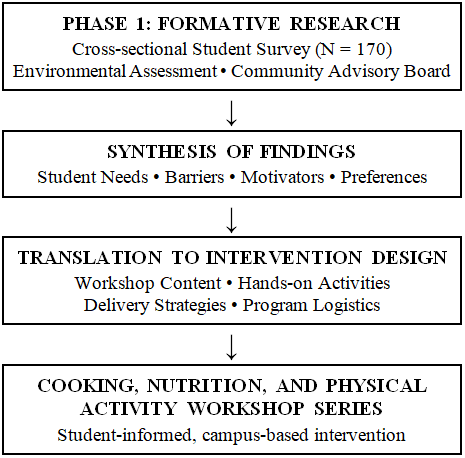
2.5. Data Analysis and Translation of FindingsFindings from Phase 1 informed multiple components of the broader BeFAB-NCCU intervention. For the present study, survey findings relevant to nutrition and physical activity were summarized descriptively and reviewed to identify needs, barriers, motivators, and preferences with implications for development of the workshop series.
The research team then interpreted these findings in relation to the university setting and used them to inform decisions regarding workshop content, hands-on activities, and delivery strategies. This translation process links identified student needs and preferences with specific intervention design considerations. Figure 1 illustrates the formative research and translation process used to move from data collection and interpretation to intervention design decisions.
A total of 170 students were included in the analytic sample (Table 1). Participants had a mean age of 20.5 years (SD = 3.9), and the sample was predominantly Black or African American (97%). Students represented all academic classifications, with freshmen comprising the largest group (31%). Most students lived on campus (66%). Among participants who reported housing type, dormitory residence was the most common arrangement (66%).
Survey results on students' health behaviors, barriers, and preferences are reported here, with a focus on how they shaped the workshop's content and delivery; the broader survey included additional items that informed other parts of the BeFAB-NCCU intervention, described elsewhere. These findings may also be useful for other programs working with similar student populations. Not all students answered every item, so percentages below reflect the number of respondents to each question rather than the full sample of 170.
Students were asked where they get health information. The most common sources were health care providers (57%), internet search engines (49%), and social media (46%), followed by family members (36%), health classes or workshops (27%), and health videos (26%). Health care providers were also the most trusted source, with three-quarters (75%) of students reporting high trust, and family members (45%) and internet search engines (29%) were widely trusted as well. Social media, by contrast, was trusted far less. Facebook and Twitter/X were the least trusted health information sources, with 49% of students reporting no trust in each platform. Taking together, this told us students relied on a mix of personal and digital sources for health information but didn't extend the same trust to social media that they gave to people and providers. That pointed toward an in-person workshop delivered directly by people students could trust, reinforced with digital resources rather than built around social media content.
Students' eating patterns pointed to similarly practical needs. Nearly half (47%) reported eating only two meals a day, 27% regularly skipped breakfast, and just 26% ate on a consistent schedule. These findings call for low-effort strategies to add a regular meal, particularly breakfast, that can flex around unpredictable class schedules. Produce intake was also low, with 62% of students consuming only one to two servings of fruits and vegetables per day and just 4% reporting five or more servings. Only eight students provided reasons for not eating more fruits and vegetables, including taste, cost, not including them in meals, and simply not thinking about them. Given the small number of responses, these findings were considered illustrative rather than representative of the larger sample. Still, when considered alongside the low overall intake, they suggested an opportunity for the workshop to incorporate fruits and vegetables into simple, appealing meals rather than focusing solely on recommendations to increase intake. Approximately two-thirds of students lived on campus, many without access to a full kitchen, which further supported the use of recipes and cooking activities that could be completed with limited equipment, such as a microwave and mini-refrigerator.
Food access and affordability were also important considerations in planning the workshop. More than half of students reported worrying at least some of the time about affording food (59%) or healthy meals specifically (57%), and approximately one-third (33%) indicated that cost influenced their food choices. Only 26% reported using the campus food pantry. These findings suggested that workshop content could address both the cost of preparing healthy meals and awareness of available campus food resources. Grocery stores were the most commonly reported source of food (68%), although students also reported getting food from fast-food establishments (55%), restaurants (43%), and meal-delivery services or apps (36%). Students ate fast food an average of 2.8 days per week, suggesting that the workshop could include practical strategies for making healthier choices when eating out rather than simply encouraging students to avoid fast food. Students’ commonly preferred foods, including chicken, sandwiches, pizza, and pasta, also provided a starting point for recipe development. Using foods students were already familiar with could provide opportunities to introduce healthier preparation methods and ingredients while still reflecting their food preferences.
Physical activity findings also helped inform the workshop. Although 42% of students reported being physically active three or more days per week, 31% described themselves as only sometimes active, suggesting an opportunity to encourage more regular physical activity. Students identified seeing results (53%), feeling strong (46%), having fun (45%), and relieving stress (36%) as reasons that motivated them to be physically active. These findings suggested that physical activity content could focus on benefits beyond weight loss and include activities that students found enjoyable and manageable.
Walking was preferred by 35% of students and provided an activity that could be easily incorporated into the workshop and continued outside the program. Students expressed interest in exercising with others, with 90% reporting that they would be at least somewhat likely to exercise with friends, although nearly half reported exercising alone. Interest in self-guided options, including apps and activities that could be completed independently, also supported provision of flexible ways for students to be active. In addition, 41% of students reported intending to begin exercising soon, and 80% indicated they were likely to do so within the next two weeks. Collectively, these findings supported the inclusion of physical activity options that were flexible and enjoyable, and that could be completed either independently or with others.
Overall, the nutrition and physical activity findings identified several considerations for intervention development, including affordability, limited cooking resources, familiar food preferences, and the need for flexible approaches to physical activity. Table 2summarizes how the formative findings were interpreted and translated into consideration for intervention content and delivery.
The formative findings highlighted several important considerations for intervention development, including the need for practical, affordable, and flexible strategies that aligned with students’ daily routines, available resources, and their expressed preferences. Rather than rely primarily on general health recommendations, the findings supported an approach that considered how students were actually eating, preparing food, accessing their meals, and engaging in physical activity within the university setting.
Students’ irregular eating patterns, skipped breakfasts, low fruit and vegetable intake, and limited kitchen access indicated the need for simple strategies that could fit into students’ everyday college routines. This included meals that could be prepared using limited appliances and kitchen tools. Because many students reported eating at fast-food restaurants and using meal-delivery services, the workshop also needed to include practical ways to make healthier choices when eating out or ordering food.
Affordability was also an important consideration. Students’ concerns about the cost of food and healthy meals showed the need for options that were realistic for a college budget. This included lower-cost meal ideas, affordable food choices, and making students more aware of campus food resources. Students also preferred familiar foods, which suggested that the intervention should build on foods they already liked and ate. This created an opportunity to introduce healthier ingredients and preparation methods without asking students to completely change the foods they were used to.
The physical activity findings also showed the importance of including movement along with the nutrition component of the intervention. Students varied in how active they were, the types of activities they preferred, and whether they liked to exercise alone or with others. Walking was a practical option because it required little equipment and could easily fit into students’ daily routines. Students’ interest in exercising with friends, as well as having options they could do on their own, supported offering both group and self-guided activities. These findings also suggested that physical activity should be presented as part of an overall healthy lifestyle, with attention to benefits such as feeling stronger, reducing stress, having fun, and seeing progress rather than focusing only on weight loss.
Finally, students’ health information preferences also helped shape how intervention content was delivered. Although students frequently used internet searches and social media for health information, they placed trust in health care providers and other interpersonal sources. This supported the use of direct, credible instruction supplemented by digital resources that students could access outside of structured activities. Overall, the formative data provided a practical foundation for translating students’ needs, behaviors, and preferences into intervention design decisions that were responsible to the university setting.
This paper demonstrates how formative research can inform intervention development designed to promote healthier behaviors and potentially reduce long-term chronic disease risk. By examining students’ eating patterns, food access, physical activity, behaviors, barriers, and preferences, the formative research data provided information that could be directly applied to the development of a health promotion intervention.
Entering college is a time of significant change in a young adult’s life. Changes in daily routines, living environments, schedules, and independence can influence health behaviors and may negatively affect eating and physical activity patterns. These changes highlight the importance of developing health promotion interventions that consider the realities of students’ daily lives. One of the clearest lessons from the formative process was the importance of convenience and ease. Balancing irregular schedules, limited cooking resources, food costs, and frequent reliance on foods prepared outside the home have been identified as common barriers to healthy eating among college students 35, 36, 37. These factors were also evident in our formative findings and suggested that recommendations needed to be practical and achievable within the college environment. Building on foods that are familiar to young adults and considering their eating behaviors may provide a more practical starting point for changing health behavior patterns and establishing healthier routines 38.
Along with convenience and ease, another important consideration in intervention planning was to affordability. Affordability was also important, as the cost of food influenced many students’ choices in what they ate, where they ate, and how they obtained food. This supported including affordable food choices, lower-cost meal ideas, and information about campus food resources. Students also preferred familiar foods, which suggested that healthier options should build on foods they already liked and ate. This allowed the intervention to build on foods students already enjoyed while introducing healthier ingredients and easier preparation methods.
This work is also timely given the current federal emphasis on nutrition, physical activity, and chronic disease prevention. These priorities are reflected not only in HHS policy initiatives but also in federal funding opportunities that support development and evaluation of prevention health interventions.
The formative findings also reinforced the importance of addressing nutrition and physical activity together. Students reported challenges related to eating healthy while also varying in their current activity levels and preferences. Addressing both health behavior areas provided a more comprehensive approach to promote healthy behaviors among students.
Several limitations should be considered. Data was collected at a single university, which may limit generalizability to other college populations or NCCU settings. Not all students responded to every survey item, and some questions had relatively small numbers of responses. Additionally, the findings were based on self-reported data and may be subject to recall or social-desirability bias.
This paper demonstrates how formative research can be used to guide the development of health promotion interventions for college students. The findings highlighted the importance of convenience, affordability, familiar foods, meal preparation using the cooking resources available in-residence halls, and flexible physical activity options. Combining nutrition and physical activity together provided a more complete approach to promoting healthy behaviors and helped to ensure that intervention reflected the realities of students’ daily lives.
The formative findings provided the foundation for the development of the Fuel & Fit workshop series by helping identify approaches that were practical, relevant, and responsive to students’ needs and preferences. Using students’ experiences to guide intervention development may help create programs that students can more easily incorporate into their everyday lives. This process may also provide a useful approach for other universities seeking to develop student-informed nutrition and physical activity interventions that support healthier behaviors during the college years and beyond.
Research reported in this publication was supported by the National Institutes of Health (NIH), National Institute on Minority Health and Health Disparities (NIMHD), through the Research Centers in Minority Institutions (RCMI) Program at North Carolina Central University under Award Number U54MD012392.
This study was approved by Institutional Review Board (IRB) at North Carolina Central University (1201673)
Participants provided written informed consent prior to participating. This ensured that they fully understood the study’s purpose, procedures, and potential risks and benefits.
The authors declare no conflict of interest.
| [1] | León, E.; Tabares, M.; Baile, J.I.; Salazar, J.G.; Zepeda, A.P. Eating Behaviors Associated with Weight Gain among University Students Worldwide and Treatment Interventions: A Systematic Review. Journal of American College Health 2024, 72, 1624–1631. | ||
| In article | View Article PubMed | ||
| [2] | Vadeboncoeur, C.; Townsend, N.; Foster, C. A Meta-Analysis of Weight Gain in First Year University Students: Is Freshman 15 a Myth? BMC Obes 2015, 2, 22. | ||
| In article | View Article PubMed | ||
| [3] | Deforche, B.; Van Dyck, D.; Deliens, T.; De Bourdeaudhuij, I. Changes in Weight, Physical Activity, Sedentary Behaviour and Dietary Intake during the Transition to Higher Education: A Prospective Study. Int J Behav Nutr Phys Act 2015, 12, 16. | ||
| In article | View Article PubMed | ||
| [4] | Daw, J.; Margolis, R.; Wright, L. Emerging Adulthood, Emergent Health Lifestyles: Sociodemographic Determinants of Trajectories of Smoking, Binge Drinking, Obesity, and Sedentary Behavior. J Health Soc Behav 2017, 58, 181–197. | ||
| In article | View Article PubMed | ||
| [5] | Lawrence, E.M.; Mollborn, S.; Hummer, R.A. Health Lifestyles across the Transition to Adulthood: Implications for Health. Soc Sci Med 2017, 193, 23–32. | ||
| In article | View Article PubMed | ||
| [6] | Åsberg, K.; Eldh, A.C.; Löf, M.; Bendtsen, M. A Balancing Act-Finding One´s Way to Health and Well-Being: A Qualitative Analysis of Interviews with Swedish University Students on Lifestyle and Behavior Change. PLoS One 2022, 17, e0275848. | ||
| In article | View Article PubMed | ||
| [7] | Maillet, M.A.; Grouzet, F.M.E. Understanding Changes in Eating Behavior during the Transition to University from a Self-Determination Theory Perspective: A Systematic Review. J Am Coll Health 2023, 71, 422–439. | ||
| In article | View Article PubMed | ||
| [8] | Freije, S.L.; Lederer, A.M.; Rose, D.; Nobari, T.Z.; Gálvez, A.; Knapp, M.; Chaparro, M.P. Institutional Determinants of Food Insecurity and Dietary Behaviors Among Postsecondary Students in the United States: A Multilevel Analysis. J Acad Nutr Diet 2025, 125, 1131–1143. | ||
| In article | View Article PubMed | ||
| [9] | Belogianni, K.; Baldwin, C. Types of Interventions Targeting Dietary, Physical Activity, and Weight-Related Outcomes among University Students: A Systematic Review of Systematic Reviews. Adv Nutr 2019, 10, 848–863. | ||
| In article | View Article PubMed | ||
| [10] | Vadeboncoeur, C.; Townsend, N.; Foster, C. A Meta-Analysis of Weight Gain in First Year University Students: Is Freshman 15 a Myth? BMC Obes 2015, 2, 22. | ||
| In article | View Article PubMed | ||
| [11] | Deforche, B.; Van Dyck, D.; Deliens, T.; De Bourdeaudhuij, I. Changes in Weight, Physical Activity, Sedentary Behaviour and Dietary Intake during the Transition to Higher Education: A Prospective Study. Int J Behav Nutr Phys Act 2015, 12, 16. | ||
| In article | View Article PubMed | ||
| [12] | Daw, J.; Margolis, R.; Wright, L. Emerging Adulthood, Emergent Health Lifestyles: Sociodemographic Determinants of Trajectories of Smoking, Binge Drinking, Obesity, and Sedentary Behavior. J Health Soc Behav 2017, 58, 181–197. | ||
| In article | View Article PubMed | ||
| [13] | Lawrence, E.M.; Mollborn, S.; Hummer, R.A. Health Lifestyles across the Transition to Adulthood: Implications for Health. Soc Sci Med 2017, 193, 23–32. | ||
| In article | View Article PubMed | ||
| [14] | Åsberg, K.; Eldh, A.C.; Löf, M.; Bendtsen, M. A Balancing Act-Finding One´s Way to Health and Well-Being: A Qualitative Analysis of Interviews with Swedish University Students on Lifestyle and Behavior Change. PLoS One 2022, 17, e0275848. | ||
| In article | View Article PubMed | ||
| [15] | Maillet, M.A.; Grouzet, F.M.E. Understanding Changes in Eating Behavior during the Transition to University from a Self-Determination Theory Perspective: A Systematic Review. J Am Coll Health 2023, 71, 422–439. | ||
| In article | View Article PubMed | ||
| [16] | Freije, S.L.; Lederer, A.M.; Rose, D.; Nobari, T.Z.; Gálvez, A.; Knapp, M.; Chaparro, M.P. Institutional Determinants of Food Insecurity and Dietary Behaviors Among Postsecondary Students in the United States: A Multilevel Analysis. J Acad Nutr Diet 2025, 125, 1131–1143. | ||
| In article | View Article PubMed | ||
| [17] | Belogianni, K.; Baldwin, C. Types of Interventions Targeting Dietary, Physical Activity, and Weight-Related Outcomes among University Students: A Systematic Review of Systematic Reviews. Adv Nutr 2019, 10, 848–863. | ||
| In article | View Article PubMed | ||
| [18] | Gonzalez, C.M.; De Leon, E. A Call to Promote Interventions for Increased Diversity in Health Professions Programs—Beyond Trends. JAMA Netw Open 2023, 6, e2347852. | ||
| In article | View Article PubMed | ||
| [19] | Stewart, E.C.; Sims, B.L.; Spicer, Y.N.; Paul, M.J. Becoming-A Journey to Wellness: Engaging NCCU Students in Developing a Theory-Based YouTube Healthy Lifestyle Intervention. J Health Care Poor Underserved 2022, 33, 499–505. | ||
| In article | View Article PubMed | ||
| [20] | Rodney, A.; Mincey, K.; Gross, T.T.; Marshall, N.A.; Felder, K.; Reid, I.; Watson, K.; Griffin, A. Grown Woman: Understanding What Influences Health Behaviors in Black Female Students at a NCCU. J Am Coll Health 2020, 68, 698–703. | ||
| In article | View Article PubMed | ||
| [21] | Patchen, L.; Ellis, L.; Harrington, C.B.; Ma, T.; Mohanraj, R.; Andrews, V.; Evans, W.D. Engaging African American Parents to Develop a Mobile Health Technology for Breastfeeding: KULEA-NET. J Hum Lact 2020, 36, 448–460. | ||
| In article | View Article PubMed | ||
| [22] | Napolitano, M.A.; Harrington, C.B.; Patchen, L.; Ellis, L.P.; Ma, T.; Chang, K.; Gaminian, A.; Bailey, C.P.; Evans, W.D. Feasibility of a Digital Intervention to Promote Healthy Weight Management among Postpartum African American/Black Women. International Journal of Environmental Research and Public Health 2021, 18, 2178. | ||
| In article | View Article PubMed | ||
| [23] | Schaafsma, H.; Caruso, O.; Diaconita, S.; McEachern, L.; Seabrook, J.; Gilliland, J. Enhancing Postsecondary Students’ Dietary Behaviours: A Systematic Review of Mobile Health Interventions. J Hum Nutr Diet 2025, 38, e70130. | ||
| In article | View Article PubMed | ||
| [24] | Peng, S.; Yuan, F.; Othman, A.T.; Zhou, X.; Shen, G.; Liang, J. The Effectiveness of E-Health Interventions Promoting Physical Activity and Reducing Sedentary Behavior in College Students: A Systematic Review and Meta-Analysis of Randomized Controlled Trials. Int J Environ Res Public Health 2022, 20, 318. | ||
| In article | View Article PubMed | ||
| [25] | Zhou, Q.; Jiang, J.; Yin, Z.; Fan, R. Effect of Digital Health Interventions on College Students’ Lifestyle Behaviors: Systematic Review. J Med Internet Res 2026, 28, e82192. | ||
| In article | View Article PubMed | ||
| [26] | Pleasant, A.; O’Leary, C.; Carmona, R.H. Using Formative Research to Tailor a Community Intervention Focused on the | ||
| In article | |||
| [27] | Prevention of Chronic Disease. Eval Program Plann 2020, 78, 101716. | ||
| In article | View Article PubMed | ||
| [28] | Aagaard-Hansen, J.; Bloch, P. Settings, Populations, and Time: A Conceptual Framework for Public Health Interventions. Front Public Health 2023, 11, 1297019. | ||
| In article | View Article PubMed | ||
| [29] | Kitsaras, G.; Asimakopoulou, K.; Henshaw, M.; Borrelli, B. Theoretical and Methodological Approaches in Designing, Developing, and Delivering Interventions for Oral Health Behaviour Change. Community Dentistry and Oral Epidemiology 2023, 51, 91–102. | ||
| In article | View Article PubMed | ||
| [30] | Bentley, M.E.; Johnson, S.L.; Wasser, H.; Creed-Kanashiro, H.; Shroff, M.; Fernandez-Rao, S.; Cunningham, M. Formative Research Methods for Designing Culturally Appropriate, Integrated Child Nutrition and Development Interventions: An Overview. Ann N Y Acad Sci 2014, 1308, 54–67. | ||
| In article | View Article PubMed | ||
| [31] | Translating Social Ecological Theory into Guidelines for Community Health Promotion - Daniel Stokols, 1996. | ||
| In article | |||
| [32] | Stokols, D. Establishing and Maintaining Healthy Environments. Toward a Social Ecology of Health Promotion. American Psychologist 1992, 47, 6–22. | ||
| In article | View Article PubMed | ||
| [33] | Gatimu, G. P405 Social Learning Theory and Health Belief Model as a Predictor and Influencer of Youth Behavior in HIV Testing. Sexually Transmitted Infections 2019, 95, A196. | ||
| In article | View Article | ||
| [34] | Gatimu, G. P405 Social Learning Theory and Health Belief Model as a Predictor and Influencer of Youth Behavior in HIV Testing. Sexually Transmitted Infections 2019, 95, A196. | ||
| In article | View Article | ||
| [35] | McDermott, M.S.; Oliver, M.; Svenson, A.; Simnadis, T.; Beck, E.J.; Coltman, T.; Iverson, D.; Caputi, P.; Sharma, R. The Theory of Planned Behaviour and Discrete Food Choices: A Systematic Review and Meta-Analysis. Int J Behav Nutr Phys Act 2015, 12, 162. | ||
| In article | View Article PubMed | ||
| [36] | Avram, C.; Nyulas, V.; Onisor, D.; Georgescu, I.M.; Szakacs, J.; Ruta, F. Food Behavior and Lifestyle Among Students: The Influence of the University Environment. Nutrients 2024, 17, 12. | ||
| In article | View Article PubMed | ||
| [37] | Munt, A.E.; Partridge, S.R.; Allman-Farinelli, M. The Barriers and Enablers of Healthy Eating among Young Adults: A Missing | ||
| In article | |||
| [38] | Piece of the Obesity Puzzle: A Scoping Review. Obesity Reviews 2017, 18, 1–17. | ||
| In article | |||
Published with license by Science and Education Publishing, Copyright © 2026 Karen L Webb, Crystal McLean, Aaron Moore, Kimberly Powell, Amy Linder, Cherise B. Harrington, Bertha Nikki Wilson, Carmen Linate, Doris Campbell, Kyla Hill, Tamara Henry and Irene A. Doherty
 This work is licensed under a Creative Commons Attribution 4.0 International License. To view a copy of this license, visit
http://creativecommons.org/licenses/by/4.0/
This work is licensed under a Creative Commons Attribution 4.0 International License. To view a copy of this license, visit
http://creativecommons.org/licenses/by/4.0/
| [1] | León, E.; Tabares, M.; Baile, J.I.; Salazar, J.G.; Zepeda, A.P. Eating Behaviors Associated with Weight Gain among University Students Worldwide and Treatment Interventions: A Systematic Review. Journal of American College Health 2024, 72, 1624–1631. | ||
| In article | View Article PubMed | ||
| [2] | Vadeboncoeur, C.; Townsend, N.; Foster, C. A Meta-Analysis of Weight Gain in First Year University Students: Is Freshman 15 a Myth? BMC Obes 2015, 2, 22. | ||
| In article | View Article PubMed | ||
| [3] | Deforche, B.; Van Dyck, D.; Deliens, T.; De Bourdeaudhuij, I. Changes in Weight, Physical Activity, Sedentary Behaviour and Dietary Intake during the Transition to Higher Education: A Prospective Study. Int J Behav Nutr Phys Act 2015, 12, 16. | ||
| In article | View Article PubMed | ||
| [4] | Daw, J.; Margolis, R.; Wright, L. Emerging Adulthood, Emergent Health Lifestyles: Sociodemographic Determinants of Trajectories of Smoking, Binge Drinking, Obesity, and Sedentary Behavior. J Health Soc Behav 2017, 58, 181–197. | ||
| In article | View Article PubMed | ||
| [5] | Lawrence, E.M.; Mollborn, S.; Hummer, R.A. Health Lifestyles across the Transition to Adulthood: Implications for Health. Soc Sci Med 2017, 193, 23–32. | ||
| In article | View Article PubMed | ||
| [6] | Åsberg, K.; Eldh, A.C.; Löf, M.; Bendtsen, M. A Balancing Act-Finding One´s Way to Health and Well-Being: A Qualitative Analysis of Interviews with Swedish University Students on Lifestyle and Behavior Change. PLoS One 2022, 17, e0275848. | ||
| In article | View Article PubMed | ||
| [7] | Maillet, M.A.; Grouzet, F.M.E. Understanding Changes in Eating Behavior during the Transition to University from a Self-Determination Theory Perspective: A Systematic Review. J Am Coll Health 2023, 71, 422–439. | ||
| In article | View Article PubMed | ||
| [8] | Freije, S.L.; Lederer, A.M.; Rose, D.; Nobari, T.Z.; Gálvez, A.; Knapp, M.; Chaparro, M.P. Institutional Determinants of Food Insecurity and Dietary Behaviors Among Postsecondary Students in the United States: A Multilevel Analysis. J Acad Nutr Diet 2025, 125, 1131–1143. | ||
| In article | View Article PubMed | ||
| [9] | Belogianni, K.; Baldwin, C. Types of Interventions Targeting Dietary, Physical Activity, and Weight-Related Outcomes among University Students: A Systematic Review of Systematic Reviews. Adv Nutr 2019, 10, 848–863. | ||
| In article | View Article PubMed | ||
| [10] | Vadeboncoeur, C.; Townsend, N.; Foster, C. A Meta-Analysis of Weight Gain in First Year University Students: Is Freshman 15 a Myth? BMC Obes 2015, 2, 22. | ||
| In article | View Article PubMed | ||
| [11] | Deforche, B.; Van Dyck, D.; Deliens, T.; De Bourdeaudhuij, I. Changes in Weight, Physical Activity, Sedentary Behaviour and Dietary Intake during the Transition to Higher Education: A Prospective Study. Int J Behav Nutr Phys Act 2015, 12, 16. | ||
| In article | View Article PubMed | ||
| [12] | Daw, J.; Margolis, R.; Wright, L. Emerging Adulthood, Emergent Health Lifestyles: Sociodemographic Determinants of Trajectories of Smoking, Binge Drinking, Obesity, and Sedentary Behavior. J Health Soc Behav 2017, 58, 181–197. | ||
| In article | View Article PubMed | ||
| [13] | Lawrence, E.M.; Mollborn, S.; Hummer, R.A. Health Lifestyles across the Transition to Adulthood: Implications for Health. Soc Sci Med 2017, 193, 23–32. | ||
| In article | View Article PubMed | ||
| [14] | Åsberg, K.; Eldh, A.C.; Löf, M.; Bendtsen, M. A Balancing Act-Finding One´s Way to Health and Well-Being: A Qualitative Analysis of Interviews with Swedish University Students on Lifestyle and Behavior Change. PLoS One 2022, 17, e0275848. | ||
| In article | View Article PubMed | ||
| [15] | Maillet, M.A.; Grouzet, F.M.E. Understanding Changes in Eating Behavior during the Transition to University from a Self-Determination Theory Perspective: A Systematic Review. J Am Coll Health 2023, 71, 422–439. | ||
| In article | View Article PubMed | ||
| [16] | Freije, S.L.; Lederer, A.M.; Rose, D.; Nobari, T.Z.; Gálvez, A.; Knapp, M.; Chaparro, M.P. Institutional Determinants of Food Insecurity and Dietary Behaviors Among Postsecondary Students in the United States: A Multilevel Analysis. J Acad Nutr Diet 2025, 125, 1131–1143. | ||
| In article | View Article PubMed | ||
| [17] | Belogianni, K.; Baldwin, C. Types of Interventions Targeting Dietary, Physical Activity, and Weight-Related Outcomes among University Students: A Systematic Review of Systematic Reviews. Adv Nutr 2019, 10, 848–863. | ||
| In article | View Article PubMed | ||
| [18] | Gonzalez, C.M.; De Leon, E. A Call to Promote Interventions for Increased Diversity in Health Professions Programs—Beyond Trends. JAMA Netw Open 2023, 6, e2347852. | ||
| In article | View Article PubMed | ||
| [19] | Stewart, E.C.; Sims, B.L.; Spicer, Y.N.; Paul, M.J. Becoming-A Journey to Wellness: Engaging NCCU Students in Developing a Theory-Based YouTube Healthy Lifestyle Intervention. J Health Care Poor Underserved 2022, 33, 499–505. | ||
| In article | View Article PubMed | ||
| [20] | Rodney, A.; Mincey, K.; Gross, T.T.; Marshall, N.A.; Felder, K.; Reid, I.; Watson, K.; Griffin, A. Grown Woman: Understanding What Influences Health Behaviors in Black Female Students at a NCCU. J Am Coll Health 2020, 68, 698–703. | ||
| In article | View Article PubMed | ||
| [21] | Patchen, L.; Ellis, L.; Harrington, C.B.; Ma, T.; Mohanraj, R.; Andrews, V.; Evans, W.D. Engaging African American Parents to Develop a Mobile Health Technology for Breastfeeding: KULEA-NET. J Hum Lact 2020, 36, 448–460. | ||
| In article | View Article PubMed | ||
| [22] | Napolitano, M.A.; Harrington, C.B.; Patchen, L.; Ellis, L.P.; Ma, T.; Chang, K.; Gaminian, A.; Bailey, C.P.; Evans, W.D. Feasibility of a Digital Intervention to Promote Healthy Weight Management among Postpartum African American/Black Women. International Journal of Environmental Research and Public Health 2021, 18, 2178. | ||
| In article | View Article PubMed | ||
| [23] | Schaafsma, H.; Caruso, O.; Diaconita, S.; McEachern, L.; Seabrook, J.; Gilliland, J. Enhancing Postsecondary Students’ Dietary Behaviours: A Systematic Review of Mobile Health Interventions. J Hum Nutr Diet 2025, 38, e70130. | ||
| In article | View Article PubMed | ||
| [24] | Peng, S.; Yuan, F.; Othman, A.T.; Zhou, X.; Shen, G.; Liang, J. The Effectiveness of E-Health Interventions Promoting Physical Activity and Reducing Sedentary Behavior in College Students: A Systematic Review and Meta-Analysis of Randomized Controlled Trials. Int J Environ Res Public Health 2022, 20, 318. | ||
| In article | View Article PubMed | ||
| [25] | Zhou, Q.; Jiang, J.; Yin, Z.; Fan, R. Effect of Digital Health Interventions on College Students’ Lifestyle Behaviors: Systematic Review. J Med Internet Res 2026, 28, e82192. | ||
| In article | View Article PubMed | ||
| [26] | Pleasant, A.; O’Leary, C.; Carmona, R.H. Using Formative Research to Tailor a Community Intervention Focused on the | ||
| In article | |||
| [27] | Prevention of Chronic Disease. Eval Program Plann 2020, 78, 101716. | ||
| In article | View Article PubMed | ||
| [28] | Aagaard-Hansen, J.; Bloch, P. Settings, Populations, and Time: A Conceptual Framework for Public Health Interventions. Front Public Health 2023, 11, 1297019. | ||
| In article | View Article PubMed | ||
| [29] | Kitsaras, G.; Asimakopoulou, K.; Henshaw, M.; Borrelli, B. Theoretical and Methodological Approaches in Designing, Developing, and Delivering Interventions for Oral Health Behaviour Change. Community Dentistry and Oral Epidemiology 2023, 51, 91–102. | ||
| In article | View Article PubMed | ||
| [30] | Bentley, M.E.; Johnson, S.L.; Wasser, H.; Creed-Kanashiro, H.; Shroff, M.; Fernandez-Rao, S.; Cunningham, M. Formative Research Methods for Designing Culturally Appropriate, Integrated Child Nutrition and Development Interventions: An Overview. Ann N Y Acad Sci 2014, 1308, 54–67. | ||
| In article | View Article PubMed | ||
| [31] | Translating Social Ecological Theory into Guidelines for Community Health Promotion - Daniel Stokols, 1996. | ||
| In article | |||
| [32] | Stokols, D. Establishing and Maintaining Healthy Environments. Toward a Social Ecology of Health Promotion. American Psychologist 1992, 47, 6–22. | ||
| In article | View Article PubMed | ||
| [33] | Gatimu, G. P405 Social Learning Theory and Health Belief Model as a Predictor and Influencer of Youth Behavior in HIV Testing. Sexually Transmitted Infections 2019, 95, A196. | ||
| In article | View Article | ||
| [34] | Gatimu, G. P405 Social Learning Theory and Health Belief Model as a Predictor and Influencer of Youth Behavior in HIV Testing. Sexually Transmitted Infections 2019, 95, A196. | ||
| In article | View Article | ||
| [35] | McDermott, M.S.; Oliver, M.; Svenson, A.; Simnadis, T.; Beck, E.J.; Coltman, T.; Iverson, D.; Caputi, P.; Sharma, R. The Theory of Planned Behaviour and Discrete Food Choices: A Systematic Review and Meta-Analysis. Int J Behav Nutr Phys Act 2015, 12, 162. | ||
| In article | View Article PubMed | ||
| [36] | Avram, C.; Nyulas, V.; Onisor, D.; Georgescu, I.M.; Szakacs, J.; Ruta, F. Food Behavior and Lifestyle Among Students: The Influence of the University Environment. Nutrients 2024, 17, 12. | ||
| In article | View Article PubMed | ||
| [37] | Munt, A.E.; Partridge, S.R.; Allman-Farinelli, M. The Barriers and Enablers of Healthy Eating among Young Adults: A Missing | ||
| In article | |||
| [38] | Piece of the Obesity Puzzle: A Scoping Review. Obesity Reviews 2017, 18, 1–17. | ||
| In article | |||