Vitamin A deficiency related diseases are a major problem in Sub-Sahara Africa and any staple crop that contains high levels of total carotenoids including β-carotene can be used to combat these challenges. However, there is little or no information on farmers’ and consumers’ perceptions and preferences for yellow flesh cassava varieties that contain high levels of total carotenoids. This study was done to assess the perceptions and preferences of Ghanaian farmers and consumers for yellow flesh cassava varieties. A survey was conducted on cassava farmers and consumers in Abura-Asebu-Kwamankese, Agona East, Asikuma-Odoben-Brakwa, Assin South, and Twifo-Ati-Morkwa, which are the five major cassava-growing districts in the Central region. In all, 600 respondents consisting of 200 farmers and 400 consumers were interviewed using a content validated structured questionnaire. Data were analysed using SPSS version 25 and showed that 91.2% of the consumers and 88.8% of the farmers have heard of the yellow flesh cassava and 72% were willing to cultivate it, but lack of planting materials and non-availability of a ready market were their major constraints. Also, the majority of the farmers and consumers recommended that fufu and gari be made from the yellow flesh cassava. It is recommended that breeders should breed for mealy yellow flesh cassava to meet demand. More sensitization is also needed to increase the patronage for yellow flesh cassava.
Biofortification is a new intervention that seeks to improve the micronutrient content of staple foods consumed by majority of poor people using conventional plant-breeding techniques in order to make a measurable impact on micronutrient malnutrition. The development of biofortified provitamin A cassava by the International Institute for Tropical Agriculture (IITA) and research partners is a strategy to address the deficiency of vitamin A of white cassava root varieties. Biofortified yellow flesh cassava has β-carotene, a dietary precursor of vitamin A, which is responsible for the yellow to orange colour of flesh storage roots 9.
The adoption of a new technology by farmers is usually driven by a combination of many factors. One important aspect is farmers’ attitudes, perceptions and knowledge towards the technology. There are differences in the preferences for attributes depending upon economic status of the farmer, geographic location and their farming objectives. Variety preference has been shown to be influenced by area of residence 2.
The success of such yellow flesh cassava development depends on whether it is accepted and consumed by the target populations. With cassava being a staple food in Ghana, as in much of Sub-Saharan Africa, the effective introduction of provitamin A cassava could have a substantial impact on reducing the frequency of vitamin A deficiency in Ghana, and elsewhere in Sub-Saharan Africa, where it is a major public health concern. Even though yellow flesh cassava appears to be a successful crop in Ghana, potential consumer preference needs to be demonstrated, as this is key in marketing strategies and product development in agriculture. Also, there is limited information on the preference for yellow flesh cassava by consumers and farmers 3. The present study aimed to solicit information from farmers and consumers in the Central Region of Ghana regarding their perceptions and preferences for yellow flesh cassava. The objectives were to:
i. assess the perceptions of farmers and consumers for yellow flesh cassava varieties in the Central Region.
ii. assess the preferences of farmers and consumers in the Central Region for yellow flesh cassava varieties with provitamin A.
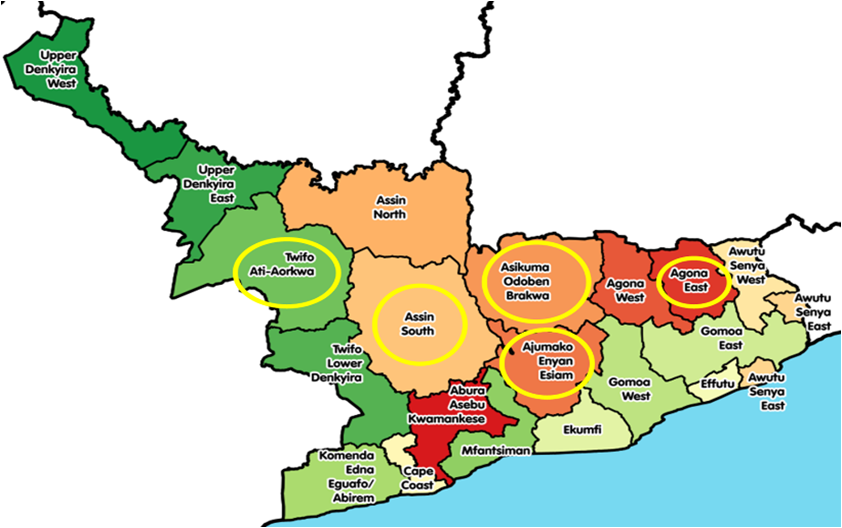
The study was carried out in five major cassava growing districts in the Central Region of Ghana, namely, Assin South, Abura-Asebu-Kwamankese, Agona East, Twifo Ati Morkwa and Odoben-Asikuma-Brakwa (Figure 1). A total number of 200 farmers and 400 consumers were sampled in all the five districts (120 per district) with 40 farmers and 80 consumers from each district.

Cassava farmers’ and consumers’ knowledge about yellow flesh cassava, source of information about yellow flesh cassava, willingness to cultivate yellow flesh cassava and perceived use of yellow flesh cassava were sourced from using pre-tested structured questionnaires for interviews. Also, data were collected on participants’ age, marital status, educational level and farm size. Ethical clearance was sought from the School of Graduate Studies of the University of Cape Coast. Respondents’ consent was obtained before they were interviewed.
A total of 600 questionnaires were administered to respondents consisting of 200 cassava farmers and 400 consumers. Data collected were entered into Microsoft Office Excel 2019, then collated using the Statistical Package for Social Sciences version 25 (SPSS), and reported in percentage, frequency, arithmetic means and standard deviation.
Results in Table 1 show the socio-economic characteristics of the respondents (farmers). Males constituted 75% and females 25% of the respondents. Twenty-seven percent of the respondents (farmers) were aged between 40-49 years, 23% between 30-39 years and 22 % between 60-69 years. A total of 44 % of the farmers who cultivated cassava had primary/middle/JHS school education. Thirty-eight percent of the farmers had no formal education, and tended to be conservative as they resist the adoption of new innovations, 16% of the farmers had secondary education and 2% had tertiary education and tended to be more knowledgeable and more willing to adopt new technologies (Table 1).
It was observed that 51% of the respondents (consumers) were females and 49% males. Most of the consumers’ ages ranged between 20-59 years. Most of the consumers had primary/middle/JHS education (45%), followed by those without formal education and SHS/SSS graduates with 31% and 18% respectively (Table 1).
Results in Table 2 show that 88% of respondents were aware of yellow flesh cassava. Seventy-seven percent of the respondents have eaten yellow flesh cassava. The study also revealed that 81.1% of the farmers and 69.4. % of the consumers did not known the perceived benefits of yellow flesh cassava. Also 81.1% of the farmers and 76.2% of consumers did not know the advantages of beta carotene in food crops (Table 2).
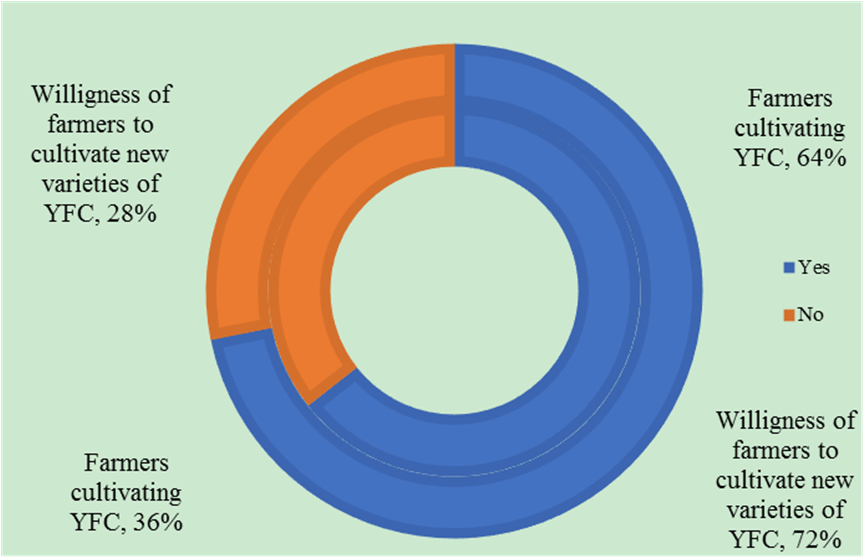
Currently, 64 % of farmers are cultivating YFC. Of the total respondents (farmers), 72 % were willing to accept and cultivate new YFC varieties (Figure 2).

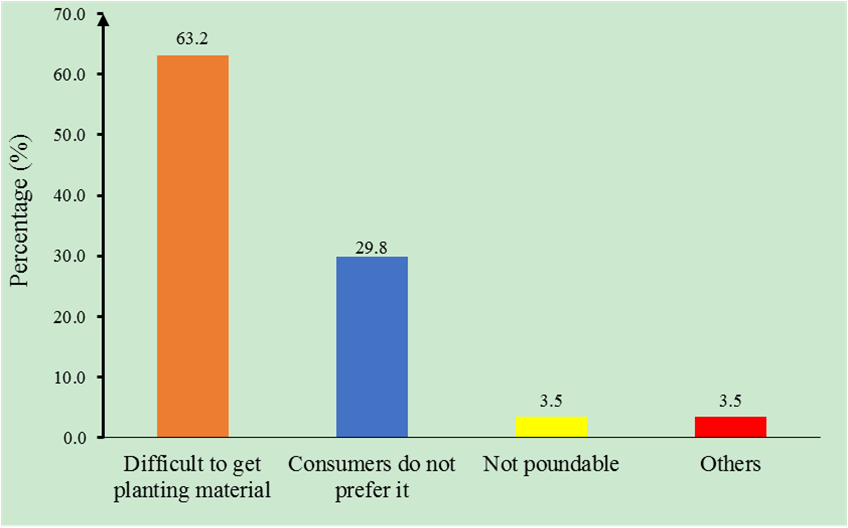
Reasons given for not cultivating YFC included difficulties in getting planting materials and customers not preferring it. Another reason given was that cooked YFC was not poundable (mealy). The percentages of responses are shown in Figure 3.

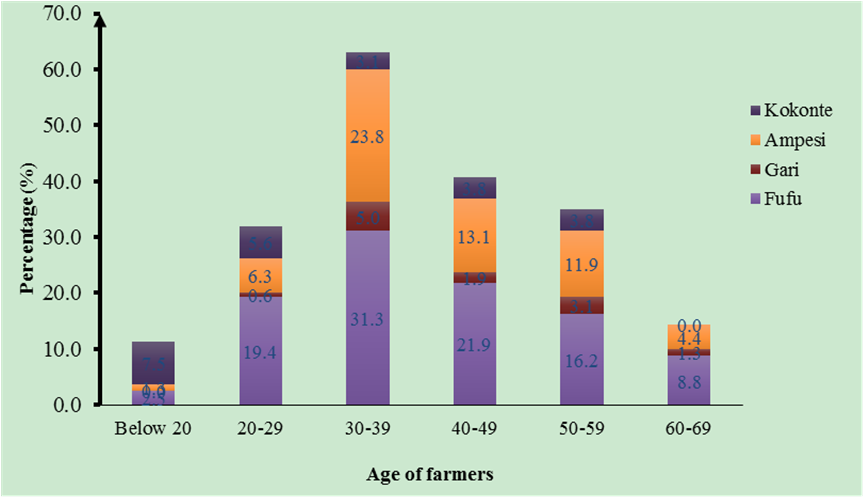
Cassava product consumption patterns data indicated that fufu was the most preferred product followed by gari, Ampesi and Kokonte (Figure 4).

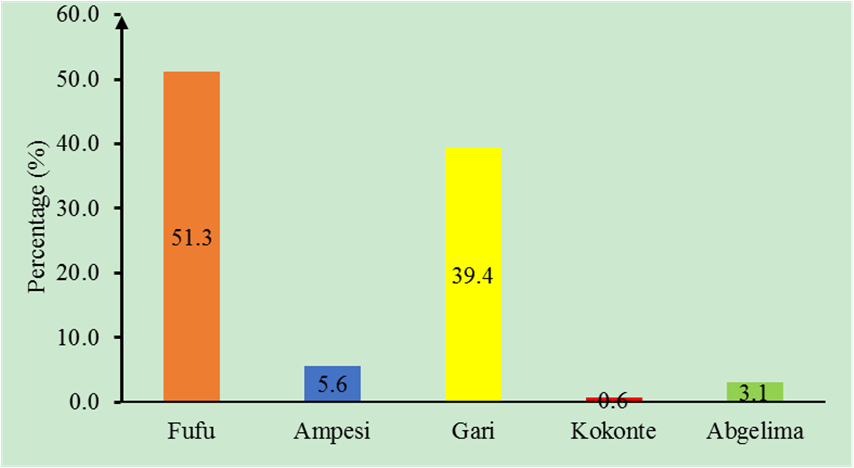
The majority of the respondents (51.3%) recommended that fufu be made from the yellow flesh cassava, followed by 39.4% and 5.6% for ‘gari’ and ‘Ampesi’ respectively. The remaining 3.1% and 0.6 % recommended yellow flesh cassava to be used for ‘Abgelima’ and ‘Kokonte’ respectively (Figure 5).

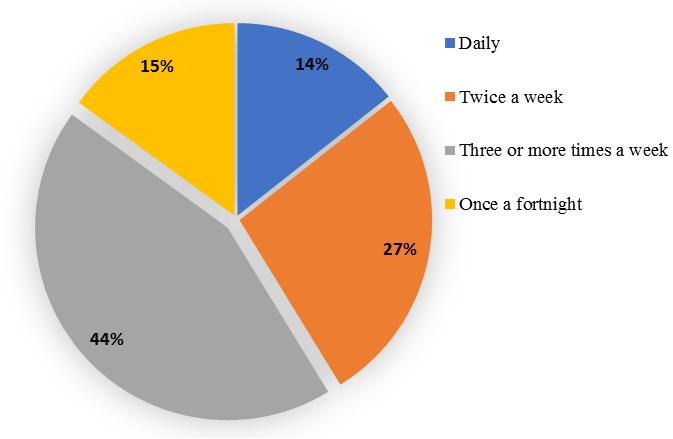
Most of the respondents consume cassava three or more times in a week (44%), this was followed by those that consumed cassava twice in a week (27%) with 15% of respondents consuming cassava once a fortnight (Figure 6).

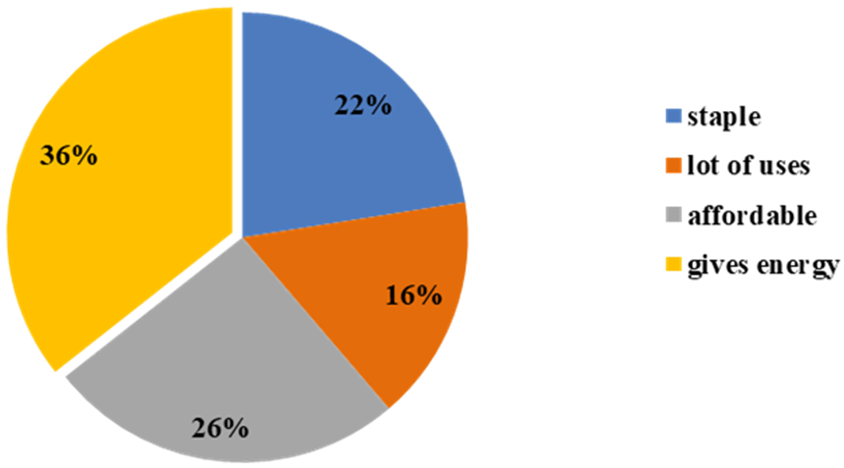
Respondents gave several reasons for cassava consumption (Figure 7). Most of the respondents consume cassava because it gives energy (36 %), it is affordable (26 %), it is a staple (22 %) and has lots of other uses (16 %) espcially its’ by products.

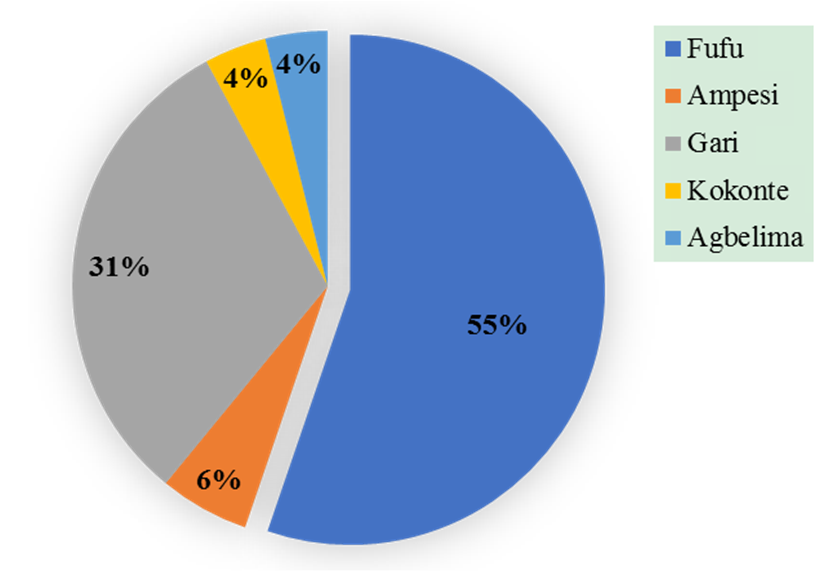
The majority of the consumers (55%) recommended that yellow flesh cassava could be used for fufu, followed by 31% and 6% for gari and Ampesi respectively (Figure 8).
It was observed that cassava farming is a male dominated business. This agrees with 6 who reported a high percentage of male cassava farmers, indicating the predominance of males in cassava farming. According to 12, it is generally believed that males are often more energetic and are readily available for energy demanding jobs like land clearing and preparation, planting, weed control and harvesting. It was also reported 11 that women were found to contribute less than half of the total labour inputs in the cassava production system in five of the six Collaborative Study of Cassava in Africa (COSCA) countries. However, this is contrary to other findings 14, 15 which reported a higher percentage of females (women) in cassava production, marketing and processing because of the low level of education of the women. Culturally, cassava production is the primary occupation of women in the communities where the study was carried out.
The majority of the farmers were above 40 years (Table 1). This indicates that the youth are not into farming because they do not perceive it to be lucrative and therefore, they leave it for the adult population. This is in a sharp contrast with another study 6 which recorded more than 50% of the cassava farmers as youth below 36 years. According to them, the youth were actively involved in cassava cultivation because when new varieties are released, young people adopt these innovations faster than older people.
Most of the farmers and consumers have a good educational background starting from the primary/middle/ JHS level to tertiary level (Table 1). Education is very important as it helps to refine a person’s perceptions of issues and helps him/her make reasonable decisions based on available information. The high level of formal education of the farmers in all five districts contributed to the willingness of farmers to accept new varieties of YFC. Education facilitates adoption of new varieties 1; hence, the high level of education among the respondents could have influenced their willingness and acceptance of improved yellow flesh cassava varieties with provitamin A.
On the knowledge about yellow flesh cassava, the majority of the farmers and consumers have heard of it through relatives and other farmers. This supports the assertion that farmers obtain new information through family and friends. Most of the farmers that have heard of the yellow flesh cassava, have also eaten it in the form of fufu or gari. However, most of them did not know the perceived benefits of yellow flesh cassava varieties and the importance of ß-carotene in diets (Table 2). This implies that there must be education to create public awareness on the benefits of ß-carotene in the diet and hence the need for the consumption of yellow flesh cassava varieties. If this is done, it will increase the consumption of yellow flesh cassava varieties which will help reduce vitamin A dietary deficiency in the country. Nutrition education is a vital tool in communicating the nutritional and health benefits of bio-fortified foods 15 and it is also an important factor that affects acceptability of bio-fortified foods. This was confirmed by another study 4, which reported that mothers in Uganda easily accepted bio-fortified foods after receiving nutrition education.
Since the yellow flesh cassava varieties currently cultivated by farmers are landraces, they are not easily available. Therefore, farmers are not willing to cultivate it due to the lack of planting materials or non-availability of a ready market (Figure 3). This agrees with another study 8, which reported that the major constraints limiting cassava production and productivity include poor crop management practices and limited access to quality planting material.
In Ghana, cassava is mainly consumed as fufu, gari or as a dried milled product known as kokonte 7. From the study, it was noted that the majority of the farmers have eaten yellow flesh cassava in the form of gari. These were followed by a few who have also eaten YFC in the form of fufu (Figure 4). This is due to longer shelf life of gari which makes it a popular quick food preferred by consumers. This agrees with 13 who reported gari to be the most consumed cassava product, making it a more viable vehicle for the introduction of yellow flesh cassava to the Ghanaian populace. However, when they were asked to recommend possible YFC products they preferred, the majority of them recommended fufu made from yellow flesh cassava (Figure 5, Figure 8). This is because yellow fufu is very attractive and appealing to the eye and can still be consumed with or without plantain. Also, others recommended that yellow flesh cassava should be made into gari since yellow gari is more attractive and nutritious than the white gari. Since the majority of the farmers and consumers prefer yellow flesh cassava varieties to be processed into fufu and gari, it is important for breeders to consider breeding more yellow flesh cassava varieties that are mealy with high starch and dry matter. This will make it easier to pound and also prevent a lot of wastage during gari processing, since varieties with low dry matter and starch content lead to wastage due to high-water content in such varieties.
The majority of the consumers generally consume cassava products more than three times a week because it gives them a lot of energy (Figure 6). According to them, fufu contains a lot of energy that helps them to work on the farm. This agrees with previous results 6 that reported fufu as the most consumed cassava product. Fufu is known to be more energy dense because of the addition of cocoyam, plantain or yam. Also, a section of the respondents consume cassava because it is a staple food in Ghana. Other reasons given for the consumption of cassava included it being affordable and having lots of other uses 5 such as peels and discards as feed.
From the present study, the majority of the respondents across the five districts indicated their willingness to accept new varieties of yellow flesh cassava due to its perceived nutritional benefits. This agrees with a previous study, 10 which observed that varieties with farmers’ preferred traits are easily adopted. Also, these results were confirmed 5 in a study where it was observed that approximately half of the individuals interviewed were willing to accept yellow flesh cassava as food.
The study showed that cassava was widely consumed more than three times a week in the Central region of Ghana and the majority of the respondents consumed cassava in the form of gari and fufu. The majority of the respondents have heard of the yellow flesh cassava but did not have any knowledge on its nutritional value. However, a large number of the respondents were willing to accept and cultivate new varieties of YFC and consume it in the form of gari and fufu. This is due to its attractive yellow colour and perceived nutritional value. Lack of planting materials and non-availability of a ready market were the major constraints. More public education has to be done on sensitizing the population on the nutritional benefits of yellow flesh cassava to help reduce vitamin A deficiency related diseases in Ghana. Also, yellow flesh cassava planting materials should be made readily available by breeders so that farmers can easily get access to it.
The authors wish to thank Harvest Plus and International Institute of Tropical Agriculture (IITA) for funding this work.
The authors declare that no conflicts of interest exist.
| [1] | Ajibefun, I. A. & Aderinola, E. A. (2004). Determinants of technical efficiency and policy implication in traditional agricultural production: Empirical study of Nigerian food crop farmers. In Final Report Presentation at Bi-annual Research Workshop of African Economic Research Consortium. Nairobi, Kenya. pp. 3-6. | ||
| In article | |||
| [2] | Birol, E., Smale, M. and Gyovai, A. (2006). Using a Choice Experiment to Estimate Farmers’ Valuation of Agrobiodiversity on Hungarian Small Farms. Environmental and Resource Economics, 34 (4): 439-469. | ||
| In article | View Article | ||
| [3] | Bouis, H.E, Hotz C., McClafferty, B., Meenakshi, J.V, and Pfeiffer, W.H. (2011). Bio-fortification: a new tool to reduce micronutrient malnutrition. Food Nutr. Bull. 32: 31-40. | ||
| In article | View Article PubMed | ||
| [4] | Chowdhury, S., Meenakshi, J., Tomlins, K. I., and Owori, C. (2011). Are consumers in developing countries willing to pay more for micronutrient-dense biofortified foods? Evidence from a field experiment in Uganda. American Journal of Agricultural Economics, 93 (1): 83-97. | ||
| In article | View Article | ||
| [5] | Duah E. A., Parkes E., Baah O. R., Acquatey-Mensah A., Danquah O.A., Holger K., Kulakow P., and Steiner-Aseidu M., (2016). Consumption Trends of White Cassava and Consumer Perceptions of Yellow Cassava in Ghana. Journal of Food and Nutrition Research, 4 (12): 814-819. | ||
| In article | |||
| [6] | Kamanda I., (2007). Genetic improvement of root yield and nutritional quality of cassava (Manihot esculenta Crantz) in Sierra Leone. PhD Thesis. University of Ghana, Legon. | ||
| In article | |||
| [7] | Kleih, U., Phillips, D., Wordey, M.T, and Komlaga, G. (2013). Cassava Market and Value Chain Analysis, Ghana Case Study, Final Report. CAVA.:19. | ||
| In article | |||
| [8] | Mtunda, K. J. (2009). Breeding, evaluation and selection of cassava for high starch content and yield in Tanzania. PhD thesis, University of KwaZulu-Natal, South Africa. | ||
| In article | |||
| [9] | Njoku, D. (2012). Improving beta-carotene content in farmers’ preferred cassava cultivars in Nigeria. PhD Thesis. West Africa Centre for Crop Improvement. University of Ghana. Legon. Accra. Ghana. | ||
| In article | |||
| [10] | Nkonya, E. M. and Featherstone, A. M. (2001). Cross-pollinated crop variety adoption studies and seed recycling: the case of maize in Tanzania. Eastern Africa Journal of Rural Development, 17: 25-34. | ||
| In article | View Article | ||
| [11] | Nweke, F., Spenser, D. and Lyam, J. (2001). The cassava Transformation: Africa Best Kept Secret. Michigan State University Press, East Lansing, USA. pp 273. | ||
| In article | |||
| [12] | Oladeji, J. O., Oyedokun, A. O. and Bankole, M. B. (2001). Youth Activities and Constraints to Community Development in Akoko – North, Ondo State, Nigeria. Journal of Agricultural Extension. 13: 1-10. | ||
| In article | |||
| [13] | Onyemauwa, C.S. (2010). Analysis of Household Consumption of Cassava Products in Ohaozara, Ebonyi State, Southeast Nigeria. Researcher. 2 (6): 1-6. | ||
| In article | |||
| [14] | Oyegbami, A., Oboh, G., and Omueti, O. (2010). Cassava Processors awareness of occupational and environmental hazards associated with cassava processing in South Western Nigeria. African Journal of Food, Agriculture, Nutrition and Development, 10 (2): 2176-2186. | ||
| In article | View Article | ||
| [15] | Tanumihardjo, S.A (2008). Food-Based Approaches for Ensuring Adequate Vitamin A. Nutrition. Comprehensive Revised in Food Science and Food Safety. 7(4): 373-381. | ||
| In article | |||
| [16] | Thompson, R. (2013). Genetic analysis of postharvest physiological deterioration in cassava (Manihot esculenta Crantz) storage roots. PhD Thesis. West Africa Centre for Crop Improvement. University of Ghana. Legon. Accra. Ghana. | ||
| In article | |||
Published with license by Science and Education Publishing, Copyright © 2023 Emmanuel Ogyiri Adu, Godwin Amenorpe, Kingsley Joseph Taah, Paul Agu Asare, Elizabeth Parkes, Maryke Labuschagne and Peter Kulakow
 This work is licensed under a Creative Commons Attribution 4.0 International License. To view a copy of this license, visit
http://creativecommons.org/licenses/by/4.0/
This work is licensed under a Creative Commons Attribution 4.0 International License. To view a copy of this license, visit
http://creativecommons.org/licenses/by/4.0/
| [1] | Ajibefun, I. A. & Aderinola, E. A. (2004). Determinants of technical efficiency and policy implication in traditional agricultural production: Empirical study of Nigerian food crop farmers. In Final Report Presentation at Bi-annual Research Workshop of African Economic Research Consortium. Nairobi, Kenya. pp. 3-6. | ||
| In article | |||
| [2] | Birol, E., Smale, M. and Gyovai, A. (2006). Using a Choice Experiment to Estimate Farmers’ Valuation of Agrobiodiversity on Hungarian Small Farms. Environmental and Resource Economics, 34 (4): 439-469. | ||
| In article | View Article | ||
| [3] | Bouis, H.E, Hotz C., McClafferty, B., Meenakshi, J.V, and Pfeiffer, W.H. (2011). Bio-fortification: a new tool to reduce micronutrient malnutrition. Food Nutr. Bull. 32: 31-40. | ||
| In article | View Article PubMed | ||
| [4] | Chowdhury, S., Meenakshi, J., Tomlins, K. I., and Owori, C. (2011). Are consumers in developing countries willing to pay more for micronutrient-dense biofortified foods? Evidence from a field experiment in Uganda. American Journal of Agricultural Economics, 93 (1): 83-97. | ||
| In article | View Article | ||
| [5] | Duah E. A., Parkes E., Baah O. R., Acquatey-Mensah A., Danquah O.A., Holger K., Kulakow P., and Steiner-Aseidu M., (2016). Consumption Trends of White Cassava and Consumer Perceptions of Yellow Cassava in Ghana. Journal of Food and Nutrition Research, 4 (12): 814-819. | ||
| In article | |||
| [6] | Kamanda I., (2007). Genetic improvement of root yield and nutritional quality of cassava (Manihot esculenta Crantz) in Sierra Leone. PhD Thesis. University of Ghana, Legon. | ||
| In article | |||
| [7] | Kleih, U., Phillips, D., Wordey, M.T, and Komlaga, G. (2013). Cassava Market and Value Chain Analysis, Ghana Case Study, Final Report. CAVA.:19. | ||
| In article | |||
| [8] | Mtunda, K. J. (2009). Breeding, evaluation and selection of cassava for high starch content and yield in Tanzania. PhD thesis, University of KwaZulu-Natal, South Africa. | ||
| In article | |||
| [9] | Njoku, D. (2012). Improving beta-carotene content in farmers’ preferred cassava cultivars in Nigeria. PhD Thesis. West Africa Centre for Crop Improvement. University of Ghana. Legon. Accra. Ghana. | ||
| In article | |||
| [10] | Nkonya, E. M. and Featherstone, A. M. (2001). Cross-pollinated crop variety adoption studies and seed recycling: the case of maize in Tanzania. Eastern Africa Journal of Rural Development, 17: 25-34. | ||
| In article | View Article | ||
| [11] | Nweke, F., Spenser, D. and Lyam, J. (2001). The cassava Transformation: Africa Best Kept Secret. Michigan State University Press, East Lansing, USA. pp 273. | ||
| In article | |||
| [12] | Oladeji, J. O., Oyedokun, A. O. and Bankole, M. B. (2001). Youth Activities and Constraints to Community Development in Akoko – North, Ondo State, Nigeria. Journal of Agricultural Extension. 13: 1-10. | ||
| In article | |||
| [13] | Onyemauwa, C.S. (2010). Analysis of Household Consumption of Cassava Products in Ohaozara, Ebonyi State, Southeast Nigeria. Researcher. 2 (6): 1-6. | ||
| In article | |||
| [14] | Oyegbami, A., Oboh, G., and Omueti, O. (2010). Cassava Processors awareness of occupational and environmental hazards associated with cassava processing in South Western Nigeria. African Journal of Food, Agriculture, Nutrition and Development, 10 (2): 2176-2186. | ||
| In article | View Article | ||
| [15] | Tanumihardjo, S.A (2008). Food-Based Approaches for Ensuring Adequate Vitamin A. Nutrition. Comprehensive Revised in Food Science and Food Safety. 7(4): 373-381. | ||
| In article | |||
| [16] | Thompson, R. (2013). Genetic analysis of postharvest physiological deterioration in cassava (Manihot esculenta Crantz) storage roots. PhD Thesis. West Africa Centre for Crop Improvement. University of Ghana. Legon. Accra. Ghana. | ||
| In article | |||