 sciepub.com
 Quick Submission

Comparative Analysis on Investment Decision of Telecommunication and Banking Industries in Nigeria
Raymond A. Ezejiofor1, Moses C. Olise2, John-Akamelu Racheal C.3,
1Department of Accountancy, Nnamdi Azikiwe University, Awka
2Department of Marketing, Nnamdi Azikiwe University, Awka
3Department of Entrepreneur studies Unit, Nnamdi Azikiwe University, Awka
Abstract
This study assesses the investment value of Telecommunication firm so as to determine whether it is comparable with commercial banks in Nigeria, using performance variables; profitability ratios, dividend coverage ratios, debt-equity ratios and Efficiency ratios. Ipso- facto and time series research design were adopted. Data were collected from seven years annual reports and accounts of the Telecommunication firms and commercial banks to compute the ratios on Profitability; Dividend cover; long-Term solvency and operating Efficiency. The data collected were analyzed with financial ratios and t-test statistic was used to determine whether there were significant differences in mean of Telecommunication firms as against their commercial banks counterpart. Findings show that there is a significant difference between the profitability of telecommunication firms with that of commercial banks in Nigeria; that there is a significant difference between the coverage ratio of telecommunication firms with that of commercial banks in Nigeria; that there is a significant difference between the debt ratio of telecommunication firms with that of commercial banks in Nigeria and also that there is a significant difference in the efficiency ratios of telecommunication firms with that of commercial banks. The implication of this finding is that telecommunication firms have high investment value than commercial banks and as such telecommunication firms do not maintain high liquidity value when compare with commercial banks.
Keywords: comparability analysis, investment value, financial performance
Copyright © 2017 Science and Education Publishing. All Rights Reserved.Cite this article:
- Raymond A. Ezejiofor, Moses C. Olise, John-Akamelu Racheal C.. Comparative Analysis on Investment Decision of Telecommunication and Banking Industries in Nigeria. Journal of Finance and Economics. Vol. 5, No. 2, 2017, pp 65-75. http://pubs.sciepub.com/jfe/5/2/4
- Ezejiofor, Raymond A., Moses C. Olise, and John-Akamelu Racheal C.. "Comparative Analysis on Investment Decision of Telecommunication and Banking Industries in Nigeria." Journal of Finance and Economics 5.2 (2017): 65-75.
- Ezejiofor, R. A. , Olise, M. C. , & C., J. R. (2017). Comparative Analysis on Investment Decision of Telecommunication and Banking Industries in Nigeria. Journal of Finance and Economics, 5(2), 65-75.
- Ezejiofor, Raymond A., Moses C. Olise, and John-Akamelu Racheal C.. "Comparative Analysis on Investment Decision of Telecommunication and Banking Industries in Nigeria." Journal of Finance and Economics 5, no. 2 (2017): 65-75.
| Import into BibTeX | Import into EndNote | Import into RefMan | Import into RefWorks |
1. Introduction
A firm can finance its investment by debt and/or equity [1]. Measuring financial performance is very important because it builds on the results, make different decisions in economic units. [2] state that firm performance is very essential to management as it is an outcome which has been achieved by an individual or a group of individuals in an organization related to its authority and responsibility in achieving the goal legally, not against the law, and conforming to the morale and ethics. Performance is the function of the ability of an organization to gain and manage the resources in several different ways to develop competitive advantage. [3] affirmed that performance measures are the life blood of economic units, since without them no decisions can be made. Financial performance measure is one of the important performance measures for economic units. Financial performance measures are used as the indicators to evaluate the success of economic units in achieving stated strategies, objectives and critical success factors [4]. However, the main objective of financial performance measuring is to determine the operating and financial characteristics and the efficiency and performance of economic unity management, as reflected in the financial records and reports [5].
Investment is the change in capital stock during a period unlike capital. Investment is a flow term and not a stock term. This means that capital is measured at a point in time, while investment can only be measure over a period of time. Investment plays a very important and positive role for progress and prosperity of any country. Many countries rely on investment to solve their economic problem such as poverty, unemployment etc [6].
It is the norm in the investment management industry today that financial analysts and investment managers tend to focus on financial statement ratios as measures of a company’s performance as a rule of the thumb, for investment decision making without evidence of the strength of these performance measures’ relationship with subsequent yields of investments as depicted by future share price performance. The critical problem is therefore a generalization of the relationship on common financial statement ratios and future share price performance without research on the specific behavior of future share price to each performance measure for a particular company or industry, on a particular share market. For example the assumption, if a company’s earnings per share are high the company is doing well and the share price performance will do well in the short term [7].
Most of the studies in Nigeria on investment decision focused merely on banking industry, capital market and other manufacturing companies in Nigeria, for instance, studies like; [8-14][8]. This is not surprising because their activities have major impact on the investment values and they believed to be making huge profits from their operations. None of the study has investigated on the level of investment value to investors using Telecommunication firms in Nigeria. The studies of [15] and [7] who investigate the shareholders return and market capitalization and the relationship between Performance Measures and Share Price of Telecommunications Companies were carried out in India and Malaysia respectively. [16] and [17] on their own only focused on the positive contributions of telecommunication infra-structure and investment to economic growth in Nigeria. It is worthy of note that to date, the nation’s telecommunications sector has shown leadership in the nation’s overall ICT growth [18]. The telecoms sector also surprisingly have been experiencing rapid growth and contributing substantially to the nation’s growth with high investment values.
However, the extent of the Telecommunication firm’s investment values to investor’s in relation to other sectors of the economy is yet to be explored. The need to determine whether there is significant difference on investment value of the telecommunication firms with that of commercial banks in Nigeria become critical and appeared apparent, thereby remain an issue for further analysis.
On the basis of the foregoing, the study assesses the investment value of Telecommunication firms in relation to commercial banks so as to determine their significant difference in relation to their investment values.
1.1. Objective of the StudyThe main objective of this study is to assess the investment decision on Telecommunication firms so as to determine whether it is comparable with commercial banks in Nigeria.
Specifically, the study intends to achieve the followings;
1. To ascertain whether there is significant difference in the profitability ratios of telecommunication firms in Nigeria compared with commercial banks in Nigeria.
2. To compare the coverage ratios of the telecommunication firms and that of commercial banks to determine which one guarantees more stability of dividend.
3. To evaluate the debt ratios of telecommunication firms and that of commercial banks to determine which one relies more on external financing.
4. To assess the activity ratios of telecommunication firms and that of commercial banks to determine the one that is more effective in utilizing its assets to generate sales.
1.2. Formulation of Hypotheses (Null)1. HO: There is no significant difference between the profitability ratios of telecommunication firms and that of commercial banks in Nigeria.
2. HO: There is no significant difference in the coverage ratio of telecommunication firms and that of commercial banks in Nigeria.
3. HO: There is no significant difference in debt ratio of telecommunication firms and that of commercial banks in Nigeria.
4. HO: There is no significant difference in the activity ratios of telecommunication firms and that of commercial banks.
1.3. Importance of the StudyThe study of this nature is relevant to both researchers and managers. The major issues faced by the finance managers are not only to receive or gather the funds but also their meaningful deployment in order to generate maximum returns.
After analyzing the performance of the company, it will help the existing investors to know whether to continue their investment or withdraw their interest. The study will equally help in widening knowledge on financial performance in investment decision making.
The findings of this study will educate the general public especially the investors on where to invest their fund and why a firm is high in liquidity or profitable than the other.
This paper will equally serve as a reference to students in this noble institution and other school who may be interested to embark on a further research on the study of this nature and above all, report of this study shall definitely add to existing knowledge in research methodology.
2. Review of Related Literature
2.1. Conceptual Framework2.1.1. Investment Decision
It is the duty of every investor to utilize profitably the resources that have been placed at its disposal, and to carry out investment function many decisions have to be made. Investment decision can be considered one of the most important decisions taken by investors, if not the most important one. The investment decision making process influence the investors affirmation in turbulent business environment and increase its market share [19]. It concerns the issue of capital allocation for fixed assets or financial assets; central place returns to fixed assets, acquired as a result of capital investment. By this decision, financial resources at investors’ disposal are allocated efficiently to acquire more market share. In addition, the available liquidities may be placed considering the efficiency criteria on the capital market, to purchase financial assets [19, 20]. In any case of chosen alternative, the investment decision ought to be subordinated to achieve the investment objectives at long-term. [21] explain that investment decisions are those concerning the conversion of capital money in material form such as machinery, equipment, buildings, through operations of acquisition of these assets.
As postulated by [22], investment decisions or analysis has to do with an efficient allocation of capital. It involves decision to commit the firm’s funds to the long-term assets. Such decisions are of considerable importance to the firm since they tend to determine its value size by influencing its growths, profitability and risk.
The investment decisions of a firm are generally known as the capital budgeting decision may be defined as the firm’s decision to invest its current funds most efficiently in the long-term assets in anticipation of an expected flow of benefits over a series of years. According to Canada and White is the series of decisions by individual economic units as to how much and where resources will be obtained and expected for future. Situation where capital expenditure decisions are made or taken, they are based primary with measurement of capital productivity which provides an objective means of measuring the economic worth of individual investment proposals in order to have a realistic basis for choosing among the firm’s long run property [22] The long-term asset is those which affect the firms operation beyond the year period. The firm’s investment decision would generally include expansion acquisition, modernization and replacements of the long-term assets. Sales of division or business divestment are also analyzed as an investment decision. Activities such as change in the methods of sales distribution or undertaking an advertisement campaign or a research and development programmes have long-term implications for the firms expenditures and benefits, and therefore, they may also be evaluated as investment decisions. It is important to note that investment in long-term assets invariably requires funds to be tied up in the current assets such as inventories and receivables, some of the features of investment decisions are as follows;
a) The exchange of current funds for future benefits
b) The funds are invested in long-term assets
c) The benefits will occur to the firm over a series of years
The two importance aspects of investment decisions are;
a) The evaluation of the prospective profitability of new investments.
b) The measurement of a cut-off rate against that the prospective return on new investment could be compared [23].
Future benefits of investment are difficult to measure and cannot be predicted with certainty. Risk in investment arises because of the uncertain returns. Investment proposals should therefore, be evaluated in terms of expected return and risk. Beside the decision to commit funds in new investment proposals, capital budgeting also involves replacement decisions that are decision of recommitting funds when an asset becomes less productive or non-profitable. The correct cut-off rate in investments is the opportunity cost of capital which is the expected rate of return that an investor could earn by investing in financial assets of equivalent risk.
In the long run, major investment projects are followed by significant equity under-performance. However, financing decisions importantly affect these long-run returns. Investments funded out of the firm’s internal resources are followed by insignificant abnormal returns, contradicting the hypothesis that managers routinely over-invest in net operating assets. This is particularly surprising because managers are often said to have considerable autonomy over free cash flow. In sharp contrast with the first result, meanwhile the externally financed investments generate significant mean under performance over the next year. This under performance is greater for built investments than for acquisitions, and for any investment financed with debt. These results seem to challenge the conventional wisdom that debt serves as a disciplining device, or that outside monitors are most active when a firm is issuing new securities [24].
It is significant to emphasize that expenditure and benefits of an investment should be measured in cash. In an investment analysis, it is cash flow which is important, not the accounting profit. It may also be pointed out that investment decisions affect the firm’s value. The firm’s value will increase if investments are profitable and add to the shareholder’s wealth.
2.1.2. Operating Variables
All the performance measurements adopted by the previous researchers were centered on one or two measures, that is, profitability/ROE and ROA. However, ROE, usually will not give the fair/expected result because the shareholders’ fund is always mistakenly or intentionally treated as equity (E) in banking. Besides, the multiple criteria used by CBN totally ignored profitability. The omission or ignoring profitability as performance measurement by the regulatory authority – CBN is fundamental.
1. Profitability Ratios:
These ratios are used to assess ability of a business to earn profit in comparison with all its expenses during a specific time period. Generally, accounting profit is the difference between revenue and cost [25]. If these ratios are higher than competitors, industry averages or previous years’ ratio then it can be considered that firm is performing profitably. Following profitability ratios are used in this research.
Return on Assets (ROA): ROA gives profitability on assets of the firm after meeting all expenses and taxes. It measures the profit of the firm after tax for each dollar invested in assets [26]. It is indicator of managerial performance. So, higher value of this ratio means better managerial performance [25]. ROA can be increased by increasing profit margin or asset turnover. ROA = Net Profit / Total Assets
Return on Equity (ROE): Return on equity represents profitability of shareholders of the firm after meeting all expenses and taxes [26] ROE is net earning per dollar equity capital. Higher ROE means better managerial performance. But higher ROE can be due to financial leverage. So higher leveraged firms have higher ROE which increases risk too [25]. Usually ROE is higher for high growth companies. ROE = Net Profit / Shareholders’ Equity
Yield on Earning Assets (YOEA): This ratio represents earning percentage of earning assets. Higher the ratio, higher is return of bank to earning assets. This ratio can be used as proxy of net ineterest margin. YOEA = Net Interest Income / Earning Assets.
2. Liquidity Ratios:
a. Liquidity ratios measure ability of the firm to meet its short-term (less than a year) obligations and reveal short-term financial strength and weakness [25]. Higher liquidity ratio means bank has higher margin of safety and ability to meet its short-term obligations. Saving accounts and tranactions deposits can be withdrawn at any time and bank faces liquidity problem when withdrawal exceeds new deposits over a short period of time [27]. Following liquidity ratios are used.
b. Cash to Deposit Ratio (CDR):
This ratio measures cash holding by commercial banks. Cash is most liquid asset in banks. The purpose of this holding is to meet demands of withdrawal from depositors. It is important in maintaining customer trust. But on the other hand, it reduces opportunity to earn income from cash. CDR = Total Cash Holdings / Total Deposits
c. Loan to Deposit Ratio (LDR): Loan to deposit ratio is an important indicator of liquidity position of the bank. Loans means advances for conventional banks. Bank with lower LDR is considered to have excessive liquidity, potentially lower profit and hence less risk as compared to bank of higher LDR. LDR = Loans / Total Deposits
d. Loan to Asset Ratio (LAR): It is another important measure of liquidity position of the bank. LAR measures liquidity of bank in terms of its assets. Higher the ratio, less liquid is the bank. LAR = Loans / Total assets.
3. Solvency and Risk Ratios:
These ratios are also called financial gearing, debt or financial leverage ratios. These ratios measure risk and solvency of firms by determining how much the firm depends on debt financing rather than equity capital. These ratios determine the probability that the firm default on its debts. Greater the debts, greater is the probability that the firm will become unable to fulfill its contractual obligations leading to bankrupcy and financial distress. Although debt is important source of financing and provide significant tax advantage but it may create conflict of interest between debtors and shareholders [25]. If amount of assets held by a firm is greater than all types of liabilities then firm is considered solvent. Following ratios are used to measure solvency.
a. Debt-Equity Ratio (DER):
This ratio measures the extent to which a firm uses debts. It measures ability of a firm to absorb financial shock. If creditor of the bank defaults in paying back loans or assets value decreases, bank capital provide shield against those loan losses. A bank with lower DER is considered better than bank with higher DER. = Total Debt / Shareholders’ Equity.
Debt to Total Assets Ratio (DTAR): It measures amount of debts the firm uses in financing its total assets. It is indicator of financial strength of the bank and gives information about solvency of the bank. Higher DTAR means that bank uses more debt financing than equity capital which leads to risky situation. DTAR = Total Debt / Total Assets.
Equity Multiplier (EM): It indicates amount of assets per dollar of shareholders’ equity. Higher value of it shows that bank has used more debts to convert into assets with share capital. Higher value of EM leads to risky situation. EM = Total Assets / Shareholders’ Equity
4. Efficiency or Activity Ratios:
Efficiency, activity or turnover ratios measure efficiency in assets or resource management. These ratios measure overall effectiveness of the firm in utilizing its assets to generate sales, quality of receivables and success in collection, effectiveness of inventory management practices and efficiency of the firm in controlling its expenses. Following ratios are used to measure efficiency of sample banks.
a. Asset Utilization (AU): This ratio measures how efficiently the firm is utilizing its assets. Higher value of this ratio means that firm is using its assets efficiently in generating total revenue. Lower value of it means that firm should either increase its revenue or dispose some of its assets [25]. Total revenue of a bank can be defined as net spread before provision plus all other incomes. Asset Utilization = Total Revenue / Total Assets.
b. Income Expense Ratio (IER): It measures amount of income earned per dollar of operating expenses. This is most commonly used ratio in banking sector to measure managerial efficiency in generating total income while controlling its operating expenses. Higher IER is preferred over lower ones. Total income is net spread earned before provision plus all other income. IER = Total Income / Total Operating Expenses
c. Operating Efficiency (OE): This ratio measures amount of operating revenue per dollar of operating expense. It provides information about managerial efficiency in generating operating revenues and controlling its operating expenses. In other words, how efficienct is the bank. High OE is preferred over lower OE. OE = Total Operating Revenue / Total Operating Expenses.
2.2. Theoretical FrameworksThe Pecking Order Theory
The resulting pecking order of financing is as follows: internally generated funds first, followed by respectively low-risk debt financing and share financing.
In [28] outside investors rationally discount the firm's stock price when managers issue equity instead of riskless debt. To avoid this discount, managers avoid equity whenever possible. The Myers and Majluf model predicts that managers will follow a pecking order, using up internal funds first, then using up risky debt, and finally resorting to equity. In the absence of investment opportunities, firms retain profits and build up financial slack to avoid having to raise external finance in the future.
The pecking order theory regards the market-to-book ratio as a measure of investment opportunities. With this interpretation in mind, both [28] note that a contemporaneous relationship between the market-to-book ratio and capital structure, is difficult to reconcile with the static pecking order model. Iteration of the static version also suggests that periods of high investment opportunities will tend to push leverage higher toward a debt capacity.
This study anchored on the pecking order theory as a better predictor, hence the theory suggests that periods of high investment opportunities will tend to push leverage higher toward a debt capacity as well regards the market-to-book ratio as a measure of investment opportunities, these is an eye opener for the investors to rationally discount the firm's stock price when managers issue equity instead of riskless debt.
2.3. Empirical ReviewQuite number of studies had investigated on the issues concerning investment decision using financial statement of different sector of the economy. The study of Popoola, Akinsanya, Babarinde and Farinde [8] on Published Financial Statement as a Correlate of Investment Decision among Commercial Bank Stakeholders in Nigeria. A correlation research design was used in the study. 180 users of published financial statement were purposively sampled from Lagos and Ibadan. Data generated were analyzed using Pearson correlation and regression. The findings of the study revealed that, balance sheet is negatively related with investment decision (r= - .483; p<.01) while income statement (r= .249; p<.001), notes on the account (r= .230; p<.001), cash flow statement (r= .202; p<.001), value added statement (r= .328; p<.001) and five-year financial summary (r= .191; p<.01) are positively related with investment decision. Findings also revealed that components of published financial statement significantly predicted good investment decision (R2= .983; F(5,175)=284.5; p<.05) for commercial bank stakeholders.
On the study of [29] on Corporate Reputation & Firm Performance: An Empirical Literature Evidence. This work is a review of empirical studies on corporate reputation with emphasis on how it can help organizations achieve strong competitive advantage, enhance stock market performance as well as performance values on other measures. It reveals that cultivating a strong reputation is a necessary foundation for today’s firms that intend to beat the competition, enhance their market outlook and financial performance as well as sustained existence.
In a related study by [30] on Ratio Analysis as an Instrument – for Decision Making. The study examines the financial statement of TCS and find out the impact of ratio analysis on decision making. To fulfill the objectives of the study and to make a detailed evaluation of financial status, the case study method has been adopted. For the present study ratios and comparative statement analysis are the tools selected. The study thereby concluded that Practical applications of ratio analysis require the comparisons of a firm's financial ratios to some norms, or pre specified benchmarks.
On the seminal paper by [31] first examined the role of financial constraints and firms’ investment behavior by using firm-level panel data of 427 US manufacturing firms over the period 1970 to 1984. The authors grouped firms into three categories by the level of dividend payout, which is assumed to be a proxy of the financial constraints: low, medium and high dividend payout firms. They then estimated investment with cash flow and Tobin’s q as explanatory variables in each group. They found significantly larger estimated coefficients of cash flow for the low-dividend-payout firms than the high-dividend-firms. As long as quality adequately controls for firm’s investment opportunities, a sensitivity of investment to cash flow could suggest a rejection of a perfect capital market and importance of the financial constraints.
In a bid to identify the institutional factors that affect investment constraints, [32] investigated financing constraints in a large cross-country data set covering most of Europe. They found a strongly positive coefficient on the cash flow, suggesting the presence of financial constraints. Their results also showed that the cash flow sensitivity of investment is lower in countries with better finance, thus, suggesting that investment is less likely to be constrained in countries with better financial development. They found this effect to be weaker in conglomerate subsidiaries, which are likely to have access to internal capital markets and depend less on external financing.
These and several other studies, following this traditional approach have tried to use the sensitivity of cash-flow as a sign of financial constraints [33]. Their results suggest that large firms and those with high dividend payout ratios will have lower investment to cash-flow sensitivity than smaller firms and those firms with low dividend payout ratios, since they are less affected by capital market imperfections that result in much higher cost of external finance relative to internal funds.
Adelegan [14] evaluated the impact of capital market imperfections on investment behaviour of productive sector firms in Nigeria between 1984 and 2000. The study adopted a model based on Tobin’s q theory and employed the OLS and instrumental variable techniques to estimate the model. Their results revealed that the Nigerian capital market is imperfect and that bigger and older firms rely more on internal funds compared to smaller and newer firms. Their switching regression analysis showed that an increase in both future profit prospects measured by Tobin’s q and cash flow result in an increase in corporate investments of firms that have low credit worthiness. The conclusion emerges that the incidence and severity of information and agency problems vary across firms and over time, thereby having different effects on investment behaviour. The implication is that capital market imperfections lead to binding financial constraints on corporate investment behavior in Nigeria.
Akinmulegun [13] in his paper The Effect of Financial Leverage on Corporate Performance of Some Selected Companies in Nigeria empirically examines the effect of financial leverage on selected indicators of corporate performance in Nigeria”. Leverage therefore significantly affects corporate performance in Nigeria. Other detailed objectives are to: Examine the impact of leverage on the earnings per share and net assets per share of corporate firms in Nigeria. The econometric findings presented in this study evidence that leverage shocks (debt/ equity ratio) have significant effect on corporate performance especially when the net assets per share (NAPS) is used as an indicator of corporate performance in Nigeria over the period covered by the study.
Rajin [15] investigates the influence of financial leverage on shareholders return and market capitalization, evidence of telecommunication sector companies in India. He find out that the nature of relationship and the state of influence of the financial leverage on shareholder’s return and market capitalization individually indicates positive relationship between financial leverage and shareholder return but negative relationship between financial leverage and market capitalization.
Ekwe [9] investigated on the degree of reliance of the published financial statements by corporate investors. The study employed survey research design by which data were generated by means of questionnaire administered on one hundred and fifty corporate investors and senior management officials of the selected banks. The descriptive statistics and percentage analysis were used for the data analysis and the hypotheses were tested using t-test statistic. The statistical package for social sciences (SPSS) software version 17.0 was employed in the analysis of data and test of hypotheses. The results reveal that one of the primary responsibility of management to the investors is to give a standardized financial statement evaluated and authenticated by a qualified auditor or financial experts (tcal (16.59) > tcritical (2.353). p < 0.05). It also showed that investors do understand the financial statement well before making investment decisions (tcal (17.306) > tcritical (2.353). p < 0.05). The results of the analysis also indicated that investors depend heavily on the credibility of auditors/financial expert approval of financial statement in making investment decisions (tcal (4.592) > tcritical (2.353). p < 0.05) and as such published financial statement is very important in the investors’ decision making (tcal 74.500 > tcritical 6.314; p < 0.05). It hereby concludes that the ability of the investors to read and understand the financial report determines the degree of impact the published annual report will have on the investor’s investment decision making.
Many economists have observed a positive correlation between the level of telecommunication use and some index of economic well-being.
Mushure [7] Examining the Relationship between Performance Measures and Share Price: An Empirical Study on Mobile Telecommunications Companies Listed on Bursa Malaysia. This research paper is a quantitative study of the relationship between financial and non-financial performance measures, and future share price performance of mobile telecommunications companies. Four variables’ relationships to future share price performance were studied; these variables were Earnings Per Share (EPS), Price Earnings (P/E), Return on Equity (ROE), and Subscriber Growth (SG). The study found evidence that from one quarter to the next, EPS and P/E had the strongest relationship with the subsequent quarter’s share price, whilst ROE and SG were poor predictors of share price performance. Furthermore the study found that these relationships, whilst true for one company, did not necessarily exist for all companies even though the companies were all in the mobile telecommunications industry.
Osuala, Ugwumba and Osuji, [10] investigates the effect of information content of financial statements on shareholders’ investment decisions. In order to determine the relationship between information contents of financial statements and shareholders’ investment decisions, some of the key contents of financial statement were used to derive the proxy variables used in the study, namely profitability, dividend per share, earnings per share, leverage, and liquidity; while shareholders’ investment decisions was represented by change in number of shares. Data for the study were obtained from the published annual financial report of the selected firms. Regression model was employed to establish the relationship between the variables. The findings indicate that shareholders in the Nigerian capital market do not rely much on financial statements as a major determining factor for their investment decisions. It was observed that other factors or variables outside firms’ annual reports such as regularity of dividend payment and market price of shares are vital to shareholders their investment decisions.
In a related study on Effect of Financial Reporting on Investment Decision Making of Manufacturing Firms in Nigeria by Afolabi [11], survey research design was adopted. The study surveyed 50 accounts, investment and financial analysts/ managers within the sector for obtaining required data for analysis using a well-structured questionnaire. The study test the research hypothesis using analysis of variance (ANOVA) and the results revealed that financial reporting disclosure, corporate fraud and scandals, and financial reporting transparency have significant influence on effective management decision making as related to investments in quoted manufacturing firms in Nigeria.
[12] determine the effect of financial leverage on financial performance of the Nigeria pharmaceutical companies over a period of twelve (12) years (2001 – 2012) for the three (3) selected companies. The ex-post facto research design was used for this study. The secondary data were obtained from the financial statement (Comprehensive income statement and Statement of financial position) of the selected pharmaceutical companies’ quoted on the Nigerian Stock Exchange (NSE). Descriptive statistics, Pearson correlation and regressions were employed and used for this study. The results of the analysis showed that debt ratio (DR) and debt-equity ratio (DER) have negative relationship with Return on Assets (ROA) while interest coverage ratio (ICR) has a positive relationship with Return on Assets (ROA) in Nigeria pharmaceutical industry. The analysis also revealed that all the independent variables have no significant effect on financial performance of the sampled companies.
2.4. Summary of Literature ReviewMost of the studies in Nigeria on investment decision focused merely on banking industry, capital market and other manufacturing companies in Nigeria. Studies like; [8-14][8]. This is not surprising because their activities have major impact on the investment values and they believed to be making huge profits from their operations. None of the study has investigated on the level of investment value to investors using Telecommunication firms in Nigeria. The studies of [15] and [7] who investigate the shareholders return and market capitalization and the relationship between Performance Measures and Share Price of Telecommunications Companies were carried out in India and Malaysia respectively. [16] and [17] on their own, only focused on the positive contributions of telecommunication infrastructure and investment to economic growth in Nigeria. The telecoms sector also surprisingly have been experiencing rapid growth and contributing substantially to the nation’s growth with high investment values.
Meanwhile, no other study known to the researcher gave attention to investigation in comparison between Telecommunication and Nigerian Commercial banks or any other sector to determine which one is more attractive for investment value. Meanwhile it appeared apparent that this study goes to fill this gap by comparing Telecommunication and Nigerian Commercial banks to determine which one is more investment friendly.
3. Methodology
3.1. Research DesignDue to the nature of the study, Ipso-facto and time series research design was adopted. The descriptive design involves collection of data in other to founds answers to unanswered questions concerning the current status of a subject [34]. The study analyzed the audited accounts of commercial banks and network establishments. This involves use of financial accounts of these organizations under assessment from the 2008 to 2014 to generate the financial analysis that discriminated the most in prediction of the performance of these two sectors.
3.2. Population and Sampling TechniquesThe accessible population for the study consists of four major Telecommunication firms (network establishments) and eighteen commercial banks in Nigeria.
The researcher used Convenient Sampling to selects three Telecommunication and three commercial banks in order to give the two sectors equal representative in the study. The three (3) network establishments with three commercial banks selected were shown in Table 1 below;





Data were collected from only secondary sources. This data obtained from the Annual report and accounts of the corporate organizations under assessment. The data extracted were those of the discriminating variables that include:
A. Earning and Profitability:
1. Return on investment (ROI):
2. Return on Equity (ROE):
3. Profit Margin (PM):
B. Dividend Cover
1. EPS
2. DPS
C. Long Term Leverage Ratio:
1. Debt-Equity Ratio (DER):
2. Debt to Total Assets Ratio (DTAR):
3. Equity Multiplier (EM):
D. Efficiency and Activity Ratio:
1. Assets Utilization Ratio (AUR)
2. Income Expense Ratio (IER):
3. Operating Efficiency Ratio (OER)
3.4. Method of Data AnalysisIn analyzing the data collected, the key financial ratios on profitability, coverage, debt and activity were extracted from six years annual reports and accounts and tested with the t-test statistical tool to determine whether there is significance differences in the performance of telecommunication firms and commercial banks in Nigeria. This was done with the aids of Statistical Package for Social Sciences (SPSS) version 20.0 software packages.
Decision rule:
Using SPSS, 5% is considered a normal significance level. The acceptance or rejection criterion was based on the computed mean value and confidence interval of the difference.
4. Data Presentation and Analysis
4.1. Data Presentation








Hypothesis one (null)
T-Test
HO: There is no significant difference between the profitability of telecommunication firms and that of commercial banks in Nigeria.







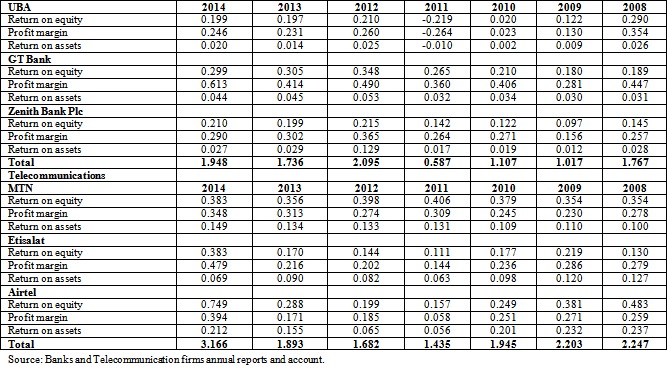
In the Table 6, the mean of Telecom profitability is 2.08 while that of bank’s profitability is 1.47. In this case the mean of Telecommunication is higher than that of bank. Looking at the confidence interval of the difference Table 7, Banks has lower value of .95 and 1.99 upper value while the Telecommunication has 1.57 and 2.60 respectively. This however is an indication that Telecommunication is more profitable than bank. Therefore, we reject null hypothesis and accept alternative hypothesis which upheld that there is a significant difference between the profitability of telecommunication firms with that of commercial banks in Nigeria.
Hypothesis Two (Null)
HO: There is no significant difference in the dividend sustainability of telecommunication firms and that of commercial banks in Nigeria.







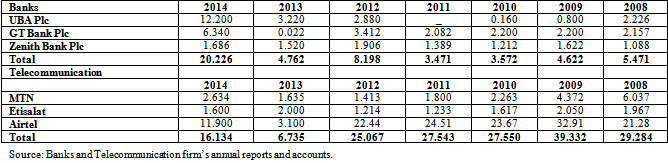
In the Table 8, the mean of Telecommunication dividend cover is 24.59 while that of bank is 7.46. In this case the mean of Telecommunication is higher than that of bank. Looking at the confidence interval of the difference Table 9, Telecommunication firms has lower value of 15.10 and 34.08 upper value while Bank has 2.10 and 12.82 respectively. This however is an indication that Telecommunication firms have higher dividend cover than Banks. Therefore, we reject null hypothesis and accept alternative hypothesis which uphold that there is a significant difference in the dividend sustainability of telecommunication firms and that of commercial banks in Nigeria.
Hypothesis Three (Null)
HO: There is no significant difference in the reliance on external financing of telecommunication firms and that of commercial banks in Nigeria.







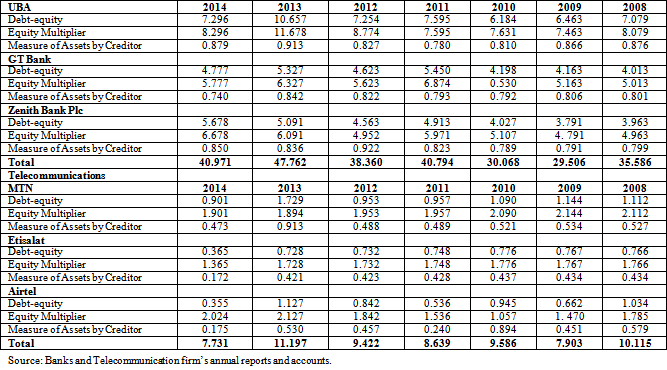
In the Table 10, the mean of Telecom solvency is 9.25 while that of bank is 37.71. In this case the mean of Telecommunication is lower than that of bank. Looking at the confidence interval of the difference Table 11, Banks has lower value of 31.75 and 43.67 upper value while the Telecommunication has 8.17 and 10.33 respectively. This however is an indication that bank has higher liquidity value than Telecommunication. Therefore, we reject null hypothesis and accept alternative hypothesis which uphold that there is a significant difference in the reliance on external financing of telecommunication firms and that of commercial banks in Nigeria.
Hypothesis Four (Null)
HO: There is no significant difference in the activity ratios of telecommunication firms and that of commercial banks.







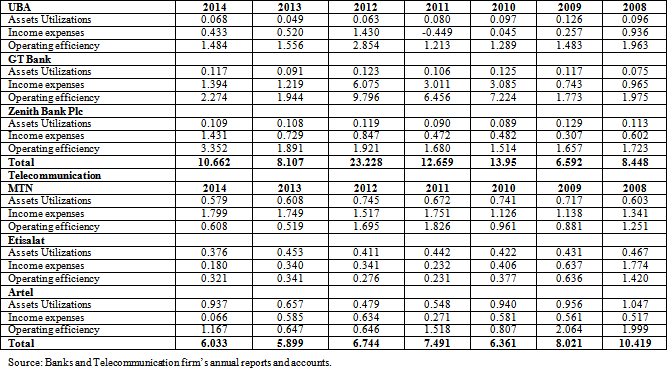
In the Table 12, the mean of Telecom efficiency is 7.29 while that of bank efficiency is 12.09. In this case the mean of Telecommunication is lower than that of bank. Looking at the confidence interval of the difference Table 13, Banks has lower value of 7.06 and 17.13 upper value while the Telecommunication has 5.91 and 8.67 respectively. This however is an indication that bank is more efficiency in value than Telecommunication. Therefore, we reject null hypothesis and accept alternative hypothesis which uphold that there is a significant difference in the activity ratios of telecommunication firms and that of commercial banks.
4.3. Discussion of FindingsIn the four hypotheses tested, hypotheses one and two results shows that telecommunication firms are more profitable with high dividend cover than commercial banks. On the other hands hypotheses three and four results shows that commercial banks have high long term solvency. That is their reliance on external financing is higher with high efficiency/activity than Telecommunication firms in Nigeria.
This finding was in agreement with [35], whose results shows that there is a negative relation between performance and leverage, that Long term debt is more expensive due to certain direct and indirect costs, therefore employing high level of debt results to low profitability. That is the case between banks and Telecommunication firms. Others are [36] who found a statistically positive relationship between economic growth and telecom investment. Also supported by Ebiringa, and Ezeji [1] though their results across banks studied shows mixed outcome, that leverage financing was established as critical strategy for maximization of shareholders returns. The conclusion therefore is that in order to ensure that leverage financing leads to desired outcome business organizations must established their optimum level as well as strike a strategic balance with associated financing risk and returns to owners of the firm.
5. Summary of Findings, Conclusion and Recommendations
5.1. Summary of FindingsBased on the data collected for the study and analysis made, the following findings were drawn;
1. There is a significant difference between the profitability of telecommunication firms and that of commercial banks in Nigeria.
2. There is a significant difference in the dividend sustainability of telecommunication firms and that of commercial banks in Nigeria.
3. There is a significant difference in the reliance on external financing of telecommunication firms and that of commercial banks in Nigeria.
4. There is a significant difference in the activity ratios of telecommunication firms and that of commercial banks.
5.2. Implication of the StudyThe findings of this study implies that telecommunication is has high investment value than commercial banks and as such it does not maintain high liquidity value like commercial banks, this means that if bank want to maintain optimum profitability, they will invest all their funds in long-Term assets.
5.3. Conclusion and RecommendationFinancial statement plays a vital role in investment decision making; for instance, where companies invest hundreds of billions of naira every year in fixed assets. By their nature, these investment decisions have the potential to affect the firm’s fortunes over several years. A good decision can boost earning sharply and dramatically increase the value of the firm.
This study however, assesses the financial performance of Telecommunication firm so as to determine whether their investment value is comparable with firms in the banking sector. This study has found that telecommunication is more profitable with higher dividend cover than bank. In other words, banks have more liquidity value with high efficiency than telecommunication firms.
On the other hand, telecommunication firms have high investment value than banks because telecommunication is not a deposit organization and as such is not required to maintain high liquidity, Which means that if bank want to maintain optimum profitability, they will invest all their funds in long-Term assets.
Also because of the nature of bank transactions and obligations they owned their customer and since they are under obligation by CBN to maintain customer’s withdrawal, they maintain high liquidity and efficiency.
Conclusively, It shows that the more solvency organization is the less its profitability. So, telecommunication has more return on investment, only the investor who is liquidity conscious will invest in bank.
Based on the result from the analysis, the researcher made the following recommendations;
Potential shareholders should make proper investigation about the financial state of the company of their interest before making investment decisions. Besides, they should seek the advice of financial analysts so as to be properly guided in their investment decisions.
References
| [1] | Ebiringa, O. T. & Ezeji, E. C., (2012). Analysis of Effect of Financing Leverage on Bank Performance: Evidence from Nigeria. Journal of Public Administration and Governance ISSN 2161-7104 2012, 2(4). | ||
 In article In article | |||
| [2] | Hansen, G., & Mowen, M. (2005). Management accounting, 7 edition. Singapore: South-Western. | ||
| In article | |||
| [3] | Benjalux, S. J. (2006). An Empirical Study into Factors Influencing the use of value-Based Management Tools, Ph D, Thesis, Southern Cross University. | ||
| In article | |||
| [4] | Katja, L. (2009). Assessing the resource usage decisions and financial performance in Finnish sawmills within the resource-based view framework. Faculty of Forest Sciences, University of Joensuu, Finland. | ||
| In article | PubMed | ||
| [5] | Amalendu, B. (2010). Financial Performance of Indian Pharmaceutical Industry: A Case Study. Asian Journal of Management Research, ISSN 2229-3795. | ||
| In article | |||
| [6] | Udonsah, I. L., (2012). The impact of interest rate on investment decision in Nigeria: An econometric | ||
| In article | |||
| [7] | Mushure, G. O., (2014). Examining the Relationship Between Performance Measures and Share Price: An Empirical Study on Mobile Telecommunications Companies Listed on Bursa Malaysia. International Journal of Sciences: Basic and Applied Research (IJSBAR)(2014) Volume 13 (2): 158-171. | ||
| In article | |||
| [8] | Popoola, C. F., Akinsanya, K., Babarinde, S. B., & Farinde, D. A. (2014). Published financial statement as a correlate of investment decision among commercial bank stakeholders in Nigeria. International Journal of Social, Management, Economics and Business Engineering 8 (1), 2014. | ||
| In article | |||
| [9] | Ekwe, M. C. (2013). Reliance on published financial statements and investment decision making in the Nigeria banking sector. European Journal of Accounting Auditing and Finance Research. 1(4) pp.67-82. | ||
| In article | |||
| [10] | Osuala, A.E., Ugwumba, E. C. and Osuji, J.I. (2012). Financial Statements Content and Investment Decisions –A Study Of Selected Firms. Jorind 10 (2), June, 2012. ISSN 1596 - 8308. www.transcampus.org./journals, www.ajol.info/journals/jorind. | ||
| In article | |||
| [11] | Afolabi, M. O., (2013). Effect of financial reporting on investment decision making of manufacturing firms in Nigeria. European journal of Humanities and social sciences. 22 (1). | ||
| In article | |||
| [12] | Enekwe, C. I., Agu, C. I., & Eziedo, K.N. ( 2014). The effect of financial leverage on financial performance: evidence of quoted pharmaceutical companies in Nigeria. IOSR Journal of Economics and Finance (IOSR-JEF) e-ISSN: 2321-5933, p-ISSN: 2321-5925.5(3). | ||
| In article | |||
| [13] | Akinmulegun, S. O, (2012). The Effect of Financial Leverage on Corporate Performance of Some Selected Companies in Nigeria. Canadian Social Science 8(1): 2012, pp. 85-91. | ||
| In article | |||
| [14] | Adelegan, O. (2006). Capital market imperfections and corporate investment behaviour in Nigeria, An unpublished Ph.D thesis in the Department of Economics, University of Ibadan, Nigeria. | ||
| In article | |||
| [15] | Rajin, S (2012). Impact of Financial Leverage on Shareholders returns and market Capitalization: Empirical evidence of telecommunication sector Companies India International Journal of Research in IT, Management and Engineering 2(12). | ||
| In article | |||
| [16] | Osotimehin, K.O, Akinkoye, E.Y. & Olasanmi, O.O. (2010). The effects of investment in Telecommunication Infrastructure on Economic Growth in Nigeria (1992-2007), Oxford Business & Economics Conference Program, St. Hugh’s College, Oxford University, Oxford, UK. | ||
| In article | PubMed | ||
| [17] | Tella A.S, Amaghionyeodiwe L.A & Adesoye, B.A., (2007). The effects of Investment in Telecommunication Infrastructure on Economic Growth in Nigeria. UN-IDEP and AFEA joint conference on “Sector-led Growth in Africa and Implications for Development”. | ||
| In article | |||
| [18] | Oladipo, O. D. (2013). The effect of investment in telecommunication on economic growth: evidence from Nigeria. International Journal of Advancements in Research & Technology, 2(1). | ||
| In article | |||
| [19] | Martin, A. (2006). The impact of taxation on the investment localization decision in the context of globalization” Analele Stiinłifice Ale Universităłii Alexandru Ioan Cuza” Din Iasi, Tomul LVI. Pp. 133-142. | ||
| In article | |||
| [20] | Zager, K. & Zager, L. (2006). The role of financial information in decision making process”. Consumer Satisfaction–Global Perspective, Pp. 35-40. | ||
| In article | |||
| [21] | Bucataru, D. (2002). Gestiunea financiară a întreprinderii”, Partea I, Sedcom Libris Publ. H., Iasi. | ||
| In article | |||
| [22] | Pandey, I. M. (2005). Financial management. 9th edition. India; vikas Irish Publication. | ||
| In article | |||
| [23] | Amedu, M.A., (2012). Role of financial statement in investment decision making: A case study of first bank of Nigerian Plc”. A B.Sc Project submitted in the Department of Accountancy, Caritas university Amorji Nike Enugu, 2012. | ||
| In article | |||
| [24] | Elsas, R., Flannery, M. J. & Garfinke,l J. A. (2006). Major investments, firm financing decisions, and long-run performance. Link SUR to Harford on mergers (02-06). | ||
| In article | View Article | ||
| [25] | Ross, S. A., Westerfield, R. W. & Jaffe, J. (2005). Corporate finance. McGraw-Hill Inc.7th Ed. | ||
| In article | |||
| [26] | Van Horne, J. C., & Wachchowwicz, J.M.(2005). Fundamental of financial management. Pearson education limited 12 edition. | ||
| In article | |||
| [27] | Sammad, A., & Kabir, H. (2000). The performance of Malasian Islamic bank during 1984-1997: an exploratory study. Thought on economics 10(1and 2). 7-26. | ||
| In article | |||
| [28] | Myers, S. C., & Majiuf, N. S. (1984). Corporate financing and investment decisions when firms have information those investors do not have. Journal of financial economics. 13(2):187-221. | ||
| In article | View Article | ||
| [29] | Iwu-Egwuonwu, R.C. (2011). Corporate reputation and firm performance: empirical literature evidence. International journal of business and management. 6(4). | ||
| In article | View Article | ||
| [30] | Puja, A. S., & Padma, C., (2013). Ratio analysis is an instrument – for decision making - A Study, Asia Pacific Journal of Research. August 2013, I, (36). | ||
| In article | |||
| [31] | Fazzari, S., Hubbard, G., & Petersen, B. (1988). Financing constraints, and investment.” Brookings Pap. Econ. Act., 1, pp 141-206. | ||
| In article | View Article | ||
| [32] | Becker, B. & Sivadasen, J. (2006). The effect of financial development on the investment-cash flow relationship: Cross-country evidence from Europe”, ECB Working paper series No. 689. | ||
| In article | |||
| [33] | Bond, S. & J. van Reenen, (2006). Microeconometric models of investment and employment”, in J. Heckman and E. Leamer (eds) Handbook of Econometrics, 6(2). | ||
| In article | |||
| [34] | Nzewi, U. C. (2009). An analysis of the profitability of commercial banks, the post consolidated period in Nigeria” Journal of the management sciences, 9(2) July. | ||
| In article | |||
| [35] | Raza, M.W. (2013). Effect of financial leverage on firm performance. Empirical evidence from Karachi Stock Exchange. Online at http://mpra.ub.uni-muenchen.de/50383/ MPRA Paper No. 50383, posted 8. October 2013 11:17 UTC. | ||
| In article | |||
| [36] | Roller, L.H. & Waverman, L. (2001). Telecommunications infrastructure and economic development: A simultaneous approach, American Economic Review, 91 (4): 909- 923. | ||
| In article | View Article | ||
 CiteULike
 Mendeley
 StumbleUpon
 Delicious
 Facebook
 Twitter
 LinkedIn