 sciepub.com
 Quick Submission

Research on the Correlation between Corporate Governance and Performance with Different External Competitive Intensity

1Ecnomicas and Management Department, Shanxi University, Taiyuan, China
Abstract
In the long-term practice of corporate governance, corporate governance system has been improved, and formed a set of interrelated governance system. According to its function, it can be divided into: incentive mechanism, supervision mechanism, agency competition mechanism, and external governance mechanism. This paper selects the financial data of listed companies of Shanghai Stock Exchange in 2014-2015 as samples. Through regression analysis, it is concluded that the more competitive the environment is, the weaker the corporate performance is sensitive to corporate governance.
Keywords: external competitive intensity corporate governance corporate performance
Copyright © 2017 Science and Education Publishing. All Rights Reserved.Cite this article:
- Zhang Xiaoyi, Feng Yazhu. Research on the Correlation between Corporate Governance and Performance with Different External Competitive Intensity. Journal of Finance and Economics. Vol. 5, No. 2, 2017, pp 61-64. http://pubs.sciepub.com/jfe/5/2/3
- Xiaoyi, Zhang, and Feng Yazhu. "Research on the Correlation between Corporate Governance and Performance with Different External Competitive Intensity." Journal of Finance and Economics 5.2 (2017): 61-64.
- Xiaoyi, Z. , & Yazhu, F. (2017). Research on the Correlation between Corporate Governance and Performance with Different External Competitive Intensity. Journal of Finance and Economics, 5(2), 61-64.
- Xiaoyi, Zhang, and Feng Yazhu. "Research on the Correlation between Corporate Governance and Performance with Different External Competitive Intensity." Journal of Finance and Economics 5, no. 2 (2017): 61-64.
| Import into BibTeX | Import into EndNote | Import into RefMan | Import into RefWorks |
1. Introduction
Corporate governance refers to the maintenance mechanism of shareholders' rights. Therefore, the primary task of corporate governance is to solve the agency problem between the executives and the large shareholders caused by the separation of two powers. Some scholars believe that when faced with the different intensity of the external competitive environment, the sensitivity of corporate performance to corporate governance retains changed. For example, companies in strong competitive industry, because of small market share, face great market pressure. If executives have more serious agency problems, corporate performance will become poor, or even negative, then the company will be threatened to survive that affect the employment of executives, So there is little agency problem in the competitive industry. Conversely, in a weak competitive environment, because of price monopoly, the agency problem is not the main factor determining the performance of the company. They don't have to worry about survival problem, and only the interests of shareholders will be damaged to some extent. So for those monopoly industries, there will be more serious agency problem, and the impact of corporate governance on performance may be more significant. On the contrary, in a strong competitive external environment, where agency problem is not obvious, the impact of corporate governance improvement on performance may be less significant.
Based on the data of China listed companies, this paper analyzes the relationship between corporate governance and corporate performance, and concludes that different external competitive environment intensity leads to different sensitivity of corporate governance to corporate performance.
2. Research Hypotheses
2.1. Independence of the Board of Directors Can Improve the Value of CompanyThe main principal-agent problem of Listed Companies in China is: large shareholders exploit minority shareholders. The management right of the board of directors and company are controlled by the large shareholders and their managers (agents of large shareholders).This governance structure not only causes the interests of minority shareholders in the company to be damaged, but also leads to short-term behavior of the company. Therefore, we need to introduce independent directors who are independent of the companies, organizations and shareholders. Independent directors should be honesty to the company and all shareholders, and independent directors should be diligent and actively participate in corporate affairs. Independent directors should conscientiously perform their duties and consciously safeguard the overall interests of the company in accordance with the relevant laws, regulations and articles of association. The most important thing is that independent directors should pay attention to the legitimate rights and interests of minority shareholders, and take appropriate and reasonable means to protect them from harm (From the "corporate governance", Second Edition). So we introduce independent directors in the board of directors, which can restrain the decision of the large shareholders to make use of their control position to damage the minority shareholders on board. For minority shareholders, the value of the company will be improved, and independent directors can also independently supervise the behavior decisions of executives, thereby reducing the agency problem. So we can say: the independence of the board of directors can improve the value of the company to a certain extent.
H1: board independence can be an effective indicator of corporate governance.
2.2. Competition has Supervision and Incentive Effect on ExecutivesWe generally use competition outcome of the product market as the most intuitive evaluation of executives, which is also the most direct constraint. The result of product market competition is also an effective standard to test the efficiency of corporate governance. Information product market provided, for example, the price of the products, sales volume, market share and profits can make a basic and effective evaluation on corporate governance efficiency and executive management ability to a certain extent. Product market competition can at least play the following role: First, improve governance mechanisms and governance efficiency; Second, give executives tremendous pressure, and strongly asked them to change the way of management and adjust the way of operation, method; Third, distinguish quality of executives, reputation mechanisms can force executives to work hard, expel inferior executives, and improve the overall quality of executives. Therefore, incentives and restrains for executives from the external market competition are in the following two aspects: first, to motivate the current executives to work hard to avoid dismissing due to mismanagement. Because of the presence of an active executive talent market, once the executives cannot effectively operate a company, companies can recruit those who have work ability to improve the company's operating performance through the executive talent market. Second, executives' human capital is often associated with the company's operating performance, which can constantly motivate executives to carry out effective innovation, pay attention to create value, and enhance the value of the company. By raising the value of the company, the human capital of executives can also be improved to a certain extent, so that the executives market has higher value and stronger competitiveness. Executives who are proven capable and responsible to investors will be hired on a higher salary and have a good reputation that raising the value of their human capital. On the contrary, executives with weak ability will have the threat of dismissal. Executive’s salaries and employment opportunities are determined by the level of performance, so executives will focus on the operation and management that beneficial on investors. At the same time, because we are more and more pursuing efficient management, executives and investors can push each other with encouragement, which helps to solve the agency problems existing in companies. Girod X, Mueller H. (2008) thought that the assumption of competition can reduce executive slack is established in American listed companies.
H2: competition reduces agency costs by reducing executive slack.
3. Sample Selection and Variable Design
This paper uses the 2014 - 2015 financial data of listed companies from CSMAR. Because the research purpose is to explore corporate performance sensitivity to corporate governance when faced different competition environment, samples were screened as follows: select companies that already listed in 2014; select companies that are not listed as ST; select companies which disclose board independence and performance simultaneously; financial listed companies and other companies which have great different operation conditions are not considered.
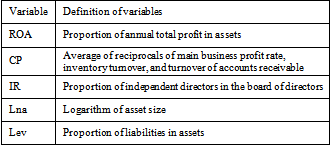
The average of reciprocals of main business profit rate, inventory turnover, and turnover of accounts receivable is designated as competition index CP, which includes the company's profitability, operating capacity and other basic performance information. Bigger CP value shows more competitive environment. Lower main business profit rate, inventory turnover, and turnover of accounts receivable suggest that companies survive in a harsh external environment. We choose ROA as a measure of corporate performance. The proportion of independent directors in the board of directors IR is chose as a measure of corporate governance capacity. The explanatory variable is IR, control variables include asset size and the asset-liability ratio, and explained variable is ROA.




4. Model and Variable Description
4.1. Listed Companies with Main Business Profit Rate Not Less than -10% in not Harsh Competitive EnvironmentThe following model is established.
 |
Where β1 represents sensitivity of ROA to IR in certain degree of competitive environment, and β2 represents sensitivity of ROA to IR. Assume x=CP*IR in regression.
(1) Statistical features of variables
Because of the large number of samples, we must first calculate the statistical characteristics of the samples to observe the characteristics of variables as follows:


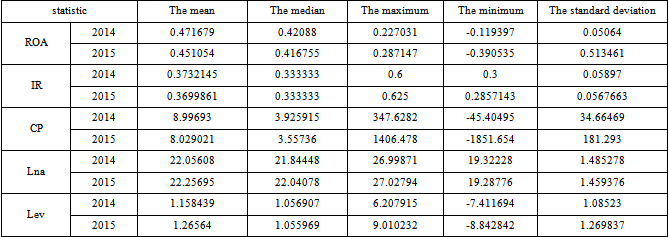


The median and mean of IR in 2014 are respectively 0.33333 and 0.372214. The mean of IR in 2015 is 0.36998 which shows the board independence is weakened. Approach of median and mean shows that most IRs are concentrated in the vicinity of 0.3333. The minimum of CP is a larger negative value which indicates that the competition intensity is very small due to the negative main business profit rate of a lot of companies in 2015. However, negative main business profit rate will make the indicator of IR meaningless. Because this shows that the company is facing an extremely bad competition environment. The revised approach is to increase the main business profit rate by 10%, and then re calculate the CP value. And the samples with still negative main business profit rate are left aside.




The adjusted minimum and maximum of CP are respectively 0.3333819 and 157.839. Therefore, CP can completely reflect the extent of competition of market. However, the median and mean values of ROA all decreased, and the mean of IR decreased from 0.3732145 in 2014 to 0.3699861 in 2015. It shows that overall governance effect of listed companies has deteriorated, and ROA and IR have a tendency to change in the same direction.
(2) Model building
After Hausman test on samples, fixed effect model should be used for regression. And the results are as follows:


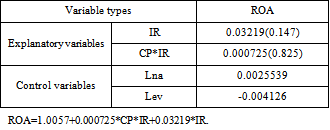

From the above table, IR and ROA are positively correlated, but not significant. The empirical results also show that ROA is significantly positive correlated with CP*IR (p=0.825).Higher IR can enhance the company's performance with same CP and simultaneously higher CP means better performance with same IR, which are consistent with our hypothesis. We assumed that competition reduces agency costs by reducing executive slack. Therefore, under the same corporate governance, the agency cost of the companies with higher competitive intensity will be less, so that the performance will be better. Lna is significantly positive related to ROA, and Lev has a significantly negatively related to ROA, which illustrate that the selection of control variables is successful.
(3) Rank the samples in accordance with the CP value from small to large, take the first 1/4 and the latter 1/4 of the samples respectively for regression. The results of regression are as follows:

)
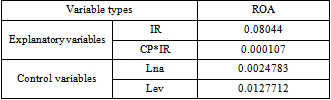

There are basically no difference between regression results and assumptions, because the CP value of the samples are relatively small, which shows that competitive pressure is smaller.
We know that in this part of the samples agency problem is quite prominent. IR is more significant positive related to ROA. This means that the weaker the external competitive environment, the more obvious the influence of corporate governance improvement on corporate performance.
Similarly, take 1/4 samples for regression, the result is as follows:

)
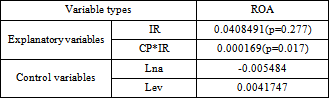

IR is not significant positive related to ROA (p=0.277). Coefficient (0.0408491) is less than that of the previous empirical analysis suggests that the larger the CP value, the less sensitive to corporate governance. This is consistent with our hypothesis: assuming that the agency problem can be reduced by competition, the impact of corporate governance on firm performance is not obvious. CP*IR has a not significant positive explanatory power for ROA (p=0.017). This means that the stronger the external competitive environment, the less significant the impact of corporate governance improvement on corporate performance which is consistent with our hypothesis. Performance can be improved by reducing agency problems because of high competitive intensity.
4.2. Analysis on Samples in Harsh Competitive EnvironmentRank the samples in accordance with main business profit rate which is less than -10% from small to large. The serious degree of loss of these companies adding the harsh competitive environment makes the samples not suitable to the above model.
Rebuild the model as follows:
 |
Analyze the relationship between corporate governance and its performance using OLS regression. The results are as follows:


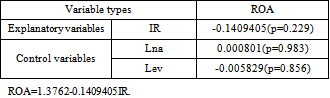

The results show that corporate governance of listed companies in harsh competition environment has a not significant negative explanatory power to corporate performance (p=0.229), and the coefficient is -0.14409405 which is also consistent with our hypothesis. High competitive strength makes the company's agency problem not obvious. Spending man power and material resources for corporate governance are considered as a waste of corporate resources behavior.
5. Conclusion and Suggestion
This paper mainly studies the sensitivity of corporate performance to corporate governance in different degree of external competition. We find that the overall effect of external competition mechanism is obvious in Chinese listed companies, indicating that the competition mechanism of Chinese market plays a certain role. But there are many insolvent but not bankrupt companies, and the role of competition constraints on agency problems will be affected. Some factors of model regression are not significant because the board of directors of China is not perfect. As indicator of IR in this paper, it only shows the form of the independence of the board of directors, but not the required independent effect of companies to a certain extent.
The research shows that corporate performance of companies or industries with strong external competitive environment are less sensitive to corporate governance due to the relatively large market pressure. More serious agency problems will lead to poor or even negative performance. Company survival in the market will be threatened, and executives will face unemployment. Therefore, it is not necessary for corporate governance for the companies with few agency problems. Otherwise, we cannot receive satisfactory results but waste resources. On the basis of the above research, two suggestions are put forward:
1. In order to make corporate governance as an effective internal restraint mechanism to restrain the behavior of executives who are also supervised and motivated, as well as to reduce the agency problem, the improvement of Chinese corporate governance should be developed in external competitive environment of weak companies or industries.
2. To ensure that the board of directors and its members have sufficient rights and professional competence, they should be fully informed by effective information, adequately empowered to independently perform duties, and richly armed with working methods, so that the board of directors would be more effective to crux issues.
References
| [1] | Andy Neely, Chris Adams, Mike Kennerley, The Scorecard for Measuring and Managing Business Success, 2004. [E-book] | ||
 In article In article | |||
| [2] | Zhou Peng, An empirical study on the relationship among internationalization strategy, board function and enterprise performance, Economic Research, 2013, 11-12. | ||
| In article | |||
| [3] | Lin Shixian, A review of the characteristics of board of directors and corporate performance in China, Economic Research Guide, 2014, 11-25. | ||
| In article | |||
| [4] | Zhong Jiyin Board of director and corporate governance, China Development Press, 2009, 7. 21. | ||
| In article | |||
| [5] | Zhang Weiying, Ownership, governance structure and principal agent relationship, Economic Research, 1996, 9: 27. | ||
| In article | |||
| [6] | Zheng Hongliang, Liu Hanming, Tang Mudan, A survey of corporate governance in China 2000~2010. Economic Research Reference, 2011. 7: 12. | ||
| In article | |||
 CiteULike
 Mendeley
 StumbleUpon
 Delicious
 Facebook
 Twitter
 LinkedIn