Central Bank Digital Currencies (CBDCs) are currently on the rise across the world, which include the following countries China, Bahamas, and Jamaica. This research study explored the core barriers affecting the uptake of JAM-DEX, Jamaica’s central bank digital currency, using a mixed-methods approach. The study utilised a convergent parallel research design where quantitative and qualitative data were collected simultaneously from questionnaires and interviews. The study included 50 users and 1147 non-users of the currency, merchants, cybersecurity experts, and financial experts. The findings revealed that the primary barriers affecting adopting comprise limited awareness, low levels of financial and digital literacy, and trust-related concerns. Additionally, a key barrier identified is the very high levels of distrust among non-users due to their limited understanding of JAM-DEX, cybersecurity and fraud concerns and low trust in digital financial systems. Users, however have greater awareness and confidence in the currency but reported concerns about the functionality and usability of platforms. Another emerging concern was merchant acceptance impacting the ecosystem readiness but their low level of acceptance reduces the usefulness and effectiveness of the currency. The expert participants (cybersecurity and financial experts) emphasized the need for strengthening regulatory support, security assurance, and transparency to encourage public confidence. The findings suggest that besides technological issues influencing adoption, trust, knowledge and ecosystem readiness remain a challenge, recommending that public education be improved along with strengthening institutional credibility, and expanding merchant participation.
According to Dionysopoulos et al. 1, central banks are increasing identifying innovative measures that can transform the payment systems and improve the monetary policy and financial stability. Prodan et al. 2 pointed out that CBDCs have increasingly become the most actively researched areas in digital finance to ascertain the impact it has economically, technological, and societally. JAM-DEX, according to Ref 3 was officially introduced by the Bank of Jamaica (BOJ) as Jamaica’s Central Bank Digital Currency (CBDC) in 2022. Jamaica is one of the first countries to launch a CBDC to facilitate retail services following the amendments of the Bank of Jamaica Act (BOJA) 2022. The government’s intention of providing the digital currency was to modernise the financial system, facilitating digital transactions and supporting financial inclusion where Jamaicans can have access to a secure and alternative means to cash. It is noteworthy to mention, according to BOJ 4 and Ref 5 that the most crucial policy objective is financial inclusion, particularly since over 17% of Jamaica’s population remains unbanked, and a larger percentage is underbanked. This indicates that quite a few Jamaicans have limited access to the formal financial services. Thus, the design of JAM-DEX was to expand access to digital financial services through digital wallets such as Lynk, JN Pay Wallet, and the most recent Sagicor Wallet. Through these wallets, Jamaicans are not necessarily required to leverage a traditional banking account generally involving a lot of documents and procedures to obtain 4, 5. As such, some barriers associated with the formal banking system are reduced.
During and after the COVID-19 pandemic, digital payment solutions gained increased attention fostering greater development and implementation resulting from the government-mandated stay-at-home measures. With these restrictions, there was less contact and an accelerated demand for individuals to consider remote payment options. This has allowed Jamaica to strengthen its digital payments infrastructure by establishing JAM-DEX to facilitate a safer and more streamlined e-commerce experience that promote greater accessibility and efficiency within the financial system 6.
Notwithstanding the benefits of the digital currency and the government’s efforts to enable large-scale financial inclusion, high adoption rates of JAM-DEX remain relatively modest. Ref 7 reported that by 2023 approximately 100,000 persons in Jamaica had registered digital wallets linked to JAM-DEX, while merchants’ participation remained limited. The persistent low uptake of the currency indicates that there exist factors influencing consumer and merchant acceptance.
1.1. Purpose of the StudyDionysopoulos et al. 1, further noted that as countries like Jamaica continue to implement its CBDC, there are several factors that become increasingly relevant to address that influence public acceptance. Consequently, this study aimed to comprehensively investigate the factors affecting the acceptance of JAM-DEX across Jamaica. It focuses particularly on the levels of awareness, trust, perceived benefits, technological barriers, and security concerns to examine their relation with JAM-DEX. The research also sought to identify the core challenges and opportunities associated with the adoption of JAM-DEX in providing financial inclusion.
1.2. Research QuestionsThe research study is guided by the following research questions:
1. What are the key determinants causing limited uptake of JAM-DEX amongst the Jamaican populace?
2. How do demographic, socio-economic, and technological factors affect the adoption of JAM-DEX?
3. What essential mechanisms should be considered in creating policy measures to improve the acceptance of JAM-DEX?
1.3. HypothesesResearch Hypotheses for Research Question 1
Null hypothesis: There is no statistically significant relationship between the essential factors [trust, financial literacy, technological access, and security concerns] and the limited uptake of JAM-DEX amongst the Jamaican populace.
Alternative hypothesis: There exists a statistically significant relationship between the essential factors [trust, financial literacy, technological access, and security concerns] and the limited uptake of JAM-DEX amongst the Jamaican populace.
Research Hypotheses for Research Question 2
Null hypothesis: There is no statistically significant relationship between the demographic, socio-economic, and technological factors and the adoption of JAM-DEX amongst the Jamaican populace.
Alternative hypothesis: There is a statistically significant relationship between the demographic, socio-economic, and technological factors and the adoption of JAM-DEX amongst the Jamaican populace.
1.4. Significance of the StudyThis study is crucial as it provides evidence-based insights into the key factors causing low acceptance of JAM-DEX. The study will also identify practical solutions to build trust and improve the adoption of digital currency. As such, it stands to guide stakeholders, including policymakers, technology developers, and financial stakeholders on the most suitable policies that promote the usability of JAM-DEX among the Jamaican population.
1.5. DefinitionsCentral Bank Digital Currency (CBDC): Leucci 8 defined CBDCs as a digital form of money issued by the central bank, allowing banks to make different digital wallets available to make transfers simple.
Digital Wallet: Kagan 9 explains that digital wallets are software applications made available on digital platforms such as CBDCs, usually provided by commercial banks and/ or central banks that are password enabled. This facilitates mobile transactions whether through credit, debit or bank account information.
Marginalised groups: A group of people who are disadvantaged from financial opportunities due to conditions beyond their control, such as access to the internet or not having sufficient documents to obtain a bank account.
Non-users of JAM-DEX: A group of individuals in Jamaica, who has never registered on the JAM-DEX platform.
Users of JAM-DEX: A group of individuals in Jamaica who has registered on JAM-DEX to access digital wallets to facilitate day-to-day transaction activities anywhere and at any time.
Central bank digital currencies (CBDCs) are presently transforming the global financial landscape, especially following the COVID-19 pandemic and the developing economies’ financial ecosystem. This has caused countries to start identifying how to treat digital payments and money in the future. Diffusion of Innovation Theory and the Theory of Financial Inclusion will provide the conceptual framework for this research and will guide the research design, data collection processes, and data analysis.
2.1. History and Development of CBDCsCentral Bank Digital Currencies (CBDCs) have emerged as a major advancement in the global financial landscape, driven by rapid digitalisation, decrease cash usage, and the upsurge of digital payment platforms. CBDCs are digital representations of a country’s fiat currency, issued and regulated by the central bank. According to Ref 10, unlike its counterparts such as Bitcoin, CBDCs are centralised and operate under the authority of government institutions with its development and adoption becoming a priority for many countries, aiming to enhance financial inclusion, reduce transaction costs, and modernise payment systems. Shahen and Sharaf 11 explained that CBDCs have become part of a broader digital transformation agenda introduced to improve payment ecosystems. They stated that these digital currencies have the potential to not only enhance efficiency, speed, and transparency of digital transactions, but also for cross-border payment initiatives, especially as the global economy become increasingly digitised. Despite these potential benefits, Benhayoun & Solberg Söilen 12, Borgonovo et al. 13 and Ozili 14 cautions that the existence of a CBDC does not equate automatic guaranteed widespread adoption, trust and financial inclusion. Rather, the author points out that thorough assessment is imperative to identify what may constrain the effectiveness of the digital currency. The author further stated that challenges such as technological limitations, institutional readiness, user acceptance, privacy concerns, and trust deficits may strain the adoption process affecting the intended policy objectives. So, once central banks evaluate these challenges, they can determine what hinders CBDCs from meeting all goals, particularly because understanding factors influencing will facilitate necessary improvements in order to facilitate access to financial services and modernize payment systems. For instance, Hamm et al. 15 shared that it is through an investigation of the Digital Euro in Germany that it was uncovered that privacy concerns were discovered to be a hindrance to digital currency adoption, where individuals required institutional governance involving adequate protection of their privacy and security.
In the global arena, there are ongoing discussions about countries exploring and developing CBDCs. Ref 16 shared in a 2023 report that research is being conducted by at least 80% of central banks to assess the needs, benefits, and challenges. Eventually, several countries have considered launching them through pilot programmes. Thus far, there are currencies such as China’s digital yuan, the Eastern Caribbean’s DCash, and Sweden’s e-krona that have emerged, with China’s digital yuan (e-CYN) presently being used throughout China. It has more so been used for cross-border payments as well as to facilitate retail and e-commerce, public services like transportation, and government disbursements such as subsidies in major cities such as Shenzhen, Beijing, and Shanghai, as shared by Ref 11, Ref 17, Ref 18, and Ref 19. There are online store platforms like Alibaba that facilitate the buying and selling of goods and services by providing customer-to-customer (C2C), business-to-customer (B2C), and business-to-business (B2B) platforms allowing payments using QR codes and cashless, mobile-first checkouts. Li 20 recently stated that local shops are now using China’s digital yuan in Hong Kong. He/she further shared that in June 2023, 120 million digital wallets were used, and that China had a record of 1.8 trillion yuan obtained from domestic retail transaction payments. Similarly, the Bahamas’ Sand Dollar, the world’s first CBDC, has been fully implemented by their Central Bank, mostly focusing on providing financial inclusion to remote areas mentioned by Ref 16, and is utilized by individuals, merchants, and the government, as well as across the Archipelago and allows individuals to perform daily transactions by accessing the Sand Dollar 21, where digital wallets and linked cards are available from several merchants. It not only modernises payments, offering customer-to-business (C2B) and business-to-business (B2B) transactions, but also facilitates disaster relief in times of emergencies like hurricanes. Similarly to Bahamas and Africa, Ref 22 and Ref 23 stated that Nigeria launched its CBDC in 2021 the second digital currency making the eNaira wallet available. However, it has not been widely adopted because of cybersecurity issues, not enough technological infrastructure to sustain it, and a lack of providing individuals with technological awareness, causing concerns that African countries are not fully prepared yet.
Jamaica also launched its CBDC, namely JAM-DEX, in 2022, allowing for cash deposits, transfers, and ATM transactions for financial inclusion, as shared by Normandin et al 24 and Patterson 25. According to Ref 26, it has the potential to function as a digital representation of Jamaica’s flat currency that is officially authorized and supported ensuring a more inclusive and direct form of financial access. The Jamaican government, according to Ref 27 had taken the initiative during the COVID-19 pandemic to roll out JAM-DEX, particularly due to the challenges with the stay-at-home requirement and like other CBDCs, played a crucial role during that period, more so as individuals had no access to physical structures due to the “stay at home” sanctions, as these CBDCs facilitated direct peer-to-peer transactions without intermediaries that could attract additional costs, unlike credit cards. During the course of the pandemic, a growing number of people were required to pay their utility bills and make purchases online because of limited operating hours and crowding in public areas which were enforced under the stay-at-home measures. The Jamaican populace can easily and affordably complete online transactions, accessible to all who possesses internet access regardless possessing a bank account or not. Eventually, after the pandemic, people have become more receptive and adaptive to digital currency platforms worldwide. This validates the study that there is a need for its adaptation tool based on its uniqueness that can serve as the bridge between cash-reliant individuals and the global digital economy. However, Baker 28 explained that despite its ability in providing digital payments, insurance, credit and savings, this promising digital platform is not progressing. Initially, when was rolled out, it lacked public awareness, experienced technological hurdles that was critical for its implementation, as pointed out by Bowie Jones 29. Ref 10 reported that across the world, there were several central banks having challenges with fully operationalizing their CBDCs ranging from technological infrastructure, cybersecurity and users’ trust and based on the IMF paper published in 2023. The paper further explained that more regulatory legal frameworks needed to be established to reduce fraud, cybersecurity risks, and ensure compliance. BOJ, in its effort to facilitate a smooth roll-out of the digital platform revised its technological infrastructure from which 10,000 outdated Point of Sale (POS) machines were upgraded, as reported by Normandin et al. 24. Utilizing the same platform, NCB provided its customers with a fully functional wallet, called Lynk, while JN followed similarly with JN Pay Wallet. Bank of Jamaica 4 and Bank of Jamaica 7 recorded in 2023 that about 100,000 Jamaicans registered on the digital platform, which it hopes would bring about an increase in demand utilizing strategies such as increased public awareness campaigns as well as incentives provision. However, the number of registered persons was insufficient based on its objectives validating its implementation for application by, along with the expansion of financial services by financial institutions and Fintech companies. The present dilemma with JAM-DEX uptake has been pointed out by Dashan Hendricks 30 in the Jamaica Observer, indicating that even though JAM-DEX is fully operational, there is ‘nowhere to spend it’. He went on to say that POS are needed to facilitate transactions, but need retrofitting commercial banks, so customers must resort to payments using cash, defeating the purpose of moving towards a cashless society. The JAM-DEX is mainly used to facilitate person-to-person payments, which is not far-reaching. Hendricks reported that BOJ shared that more merchants have bought in since Sumfest to using JAM-DEX, yet the struggle continues.
2.2. Market Response of JAM-DEX as Merchants UptakeThe uptake of digital payments remains uneven across the economy. To address this, the BOJ partnered with Chicken and Tings, a local restaurant chain, to promote digital payments through a campaign launched in September 2025, utilizing the slogan “Get it wid JAM-DEX! Good food, double the flavor,” where the public was informed that the first 50 individuals who spend up to $2,000.00 can expect to receive a free meal under the strategy “2 for 1 Wednesdays” 31, 32. The promotion highlighted Jam-DEX as a safer and more secure alternative to carrying cash. CEO Emilio Madden of Chicken and Tings expressed that, “Digital currency is the way forward so as much as we can help to push it, we will try to do so.” 32. What they observed after the promotional strategy was completed, others expressed interested. Miles 32 reported that Chicken and Tings designed their operations to ensure that their payment system was feasible and accommodating. Jemone Leith, the marketing manager of Chicken and Tings, stated that “Personally, I prefer JAM-DEX; it feels more secure. And once the BOJ finalises its platform, we plan to integrate it into our own payment systems and website.” 32. Douglas 31 also shared that Chicken and Tings has seen an increase in sales of about 10% - 15% whenever JAM-DEX discounts are provided to customers. Additionally, Usain Bolt’s Track and Records restaurant has also partnered with BOJ in November 2025 where customers making payment with JAM-DEX can receive a second meal 31. The marketing manager of Track and Records, Christina Buckle, described their phase by stating that, “I would say we are in an education phase where people are learning about JAM-DEX rather than making payments, but so far they are fairly adaptable to it,” 31. She further explained that people specifically are coming based on the promotion where they can obtain a free meal but cannot say yet its impact on the business. Following the Category 5 hurricane Melissa that negatively impacted the ATMs, Mr. Richard Byles, the Governor of BOJ, encouraged the public to utilize JAM-DEX which was operational 31. Additionally, the 2024 data from the Planning Institute of Jamaica (PIOJ) revealed that 282,274 registered users now utilized the digital platform, while the number of merchants has risen to 4,417 31. Miles 32 also noted that the Bank of Jamaica (BOJ) recorded a 30% increase in transaction volume for Jam-DEX in 2025. Furthermore, CEO Madden accounted that “Adoption is not yet universal, but awareness and usage are definitely growing. Customers are becoming more comfortable with the platform, more so when it’s incentivised. Promotions such as this help bridge the gap between curiosity and regular usage,” 31. However, these merchants' cases were at the experimental phase, indicating that the broader adoption is still posing challenges for consistent merchant uptake. The questions to be answered are ‘what next after the campaign ends?’, and ‘what merchants will do to maintain usage of JAM-DEX?’
2.3. Diffusion of Innovation TheoryDiffusion Innovations Theory developed by Everett Rogers is relevant to the experiences being seen to the adaption to JAM-DEX in our society as it described the processes by which new ideas and practices are adopted and the reason for its proliferation over extended periods 33, 34. Guo & Huang 33 and Halton 35 further explained that this theory looked at the main people within the theory such as follows:
Innovators: Those who are risk takers to new ideas
Early adopters: Those who are interested in trying new technologies and demonstrating their value within society
Early majority: Those who paved the way for the use of an innovation within mainstream society and are part of the general population
Late majority: Those who follow suit of the early majority viewing their adaptation as part of their daily lives to ‘fit in’ the general population
Laggards: Those who fall behind the general population and will only adopt when traditional alternatives are no longer available
Furthermore, Kaur et al. 36, Kemp et al. 37, Matlala 38, and Ristanović & Šostar 39 mentioned that an innovation like JAM-DEX are often influenced by consumer behaviours driven by a range of psychological, social, and cultural factors. Kaur et al. (2024) further stated that adoption is more than about technological availability but also how individuals perceive the technology that impact their confidence in using it. Additionally, Paul Golding 40 shared from a study with 200 participants that there is a direct relationship between individuals’ behavioural intentions and actual use of behaviour, while their behavioural intentions are positively affected by social influences. In other words, people would use JAM-DEX if they had already made up their minds to do so. Therefore, individuals usually make up their minds about adopting new technologies after assessing if they trust them, asking questions such as whether they are government-backed systems, the risks associated with them, and other individuals’ past experiences. This may be why only a fraction of the population has registered and obtained digital wallets since the rollout of JAM-DEX, indicating that JAM-DEX is in the early stages of adoption 7. Research studies have revealed that when consumers feel confident about new technologies, they are likely to engage with them. However, according to Matlala 38 their confidence is built from knowing that the features of the platform are secured and user-friendly, and there is transparency in its operations compared to existing alternatives. Dionysopoulos et al. 1 and Prodan et al. 2 further added that across the countries that sought to implement CBDCs, there are several hurdles they must overcome including the design of the platforms, financial infrastructure, accessibility, monetary policy implications, financial stability concerns, and privacy considerations. Additionally, Prodan et al. 2 pointed out that countries are struggling with adoption-related issues, particularly the developing ones because the populace within these countries often are the ones with limited understanding of the implementation and development of digital currencies. To address these issues for successful implementation, they suggested that it will take more than improving payment efficiency and financial inclusion, instead emphasis must be placed on public confidence, institutional readiness, and dealing with security and operational challenges.
Garcia-Aviles 41, however, explained that for an innovation like JAM-DEX, the DOI theory is suitable to facilitate awareness by the dissemination of information to the wider population using different channels. The theory suggests that there needs to be an assessment of the awareness levels of the populace and the informational channels to identify appropriate public education campaigns and incentives to increase the uptake/ adoption of JAM-DEX, which is closely aligned with the relevance and timeliness of this research study.
2.4. Theory of Financial InclusionAnother theory relevant to the adaptation of JAM-DEX is the Theory of Financial Inclusion which means that (marginalized) individuals and businesses have access to useful and affordable financial products and services that meet their needs in a responsible and sustainable way [6, 7, 42, 43] 6, 7, 42, 43. In a recent article published written by Chris Patterson 44 he stated that Jamaica’s Prime Minister Dr. Andrew Holness in addressing the launch of the World Bank Report on Digital Financial Inclusion and Transformation in Jamaica at the Banquet Hall, Jamaica House on April 23, pointed to the need for banks to lower online banking transaction costs to get more people to use digital payments and move away from relying heavily on cash as transaction cost was way too high. To alleviate this Jamaican who relied on in-person banking have been slashed with steeper costs for branch transactions while digital payments largely remained unchanged in their efforts to increase online banking services, however despite their efforts, customer complaints against banks and other deposit-taking institutions have surged pointing to issues related to electronic banking channels at the highest 45. As indicated by its Assistant General Manager, Colin McGann of Innovation at MC Systems 46 “Jamaica does not have a large presence in the global online economy due to its local online payment platforms which make payments into their local bank accounts from customers limited. He added that the business culture in Jamaica is driven by legacy, perceived value and trust in tangibility.
2.5. Adoption Barriers for Digital CurrenciesCBDCs’ adoption across countries, including Jamaica, the Bahamas, and Africa, has been hindered due to several factors. These include individuals’ lack of trust in financial institutions, lack of digital literacy, and accessibility due to limited infrastructure, especially among marginalised groups.
Trust in Online Financial Platforms
Kaur et al. 36 noted that individuals’ behavioural intention regarding trust, security concerns, awareness, and technological experiences are explanatory factors influencing CBDC adoption. Currently, trust in online financial platforms in Jamaica is growing but remains cautious. While consumers value the convenience of digital banking and payment platforms, trust is heavily influenced by high security standards and persistent concerns regarding cybercrime, internal fraud, and online investment scams. The change brought about by COVID-19 has forced Jamaicans to go digital to keep the economy going. Jamaicans now have to access many services online instead of in person. While many of us have transitioned successfully to doing business online, a lot of us are still struggling with the digital world,” she said (Hon Marsha Smith Minister of State in the Ministry of Finance & Public Service) written by Lisa Rowe 47 in 2021. According to Cordel Green 48, Jamaica Observer writer, the low levels of trust in governments contribute to the lack of action regarding the spread of misinformation and disinformation, which has diminished confidence in institutions, governmental bodies, and digital platforms.
Technology Literacy
Technology literacy is another hindrance to the adoption of JAM-DEX because, outside of quelling individuals’ fear and revitalizing their confidence, they need to know about technologies, especially emerging ones. Umar 49 shared that by engaging individuals with widespread public education about digital currencies, governments can better facilitate adoption. In other words, people cannot buy something they do not know about in terms of how it works, what the benefits are, and why it matters. In Jamaica, however, according to Hendricks 30 efforts were made to provide public education campaigns even at Sumfest, but still a large segment of the population has not yet registered, especially those in rural areas. In an interview on the Business Day, according to Master Card’s country manager, Dalton Falls, awareness and understanding are still very low as 76% of our consumers requires a clear understanding of products before they use it. In that study 92% of Jamaicans says that while they were eager to embrace the technology more businesses need to accept digital payments for this to work 50.
Accessibility
Another challenge to adopting CBDCs is accessibility issues. In developing countries, there is limited internet and mobile penetration, particularly in rural communities. The Asian Development Bank (ADB) 51 reported that digital technologies hinge their survival on the use of the internet and mobile access, which requires the availability of reliable digital infrastructure. As such, countries have to make these services accessible in terms of geography, quality, and cost. In Jamaica, there is a high volume of mobile phones; however, the internet is the main problem. The quality of the internet, based on broadband services, causing connectivity issues, particularly in underserved areas, according to Ref 52 and Ref 53. This is a significant hurdle to JAM-DEX adoption.
Additional Factors
Other factors identified to be affecting the adoption of CBDCs are transaction costs, the perceived difficulty in setting up and using digital wallets, and ‘nowhere to spend it’. Ref 17, Ref 54, Ref 55 and Ref 56 pointed out that the regulations and frameworks established by the central banks are not clear to the masses, which need revision and explanations to drive adoption. Hendricks 30 pointed out that the infrastructure is necessary to facilitate the usage of JAM-DEX, mentioning that there is ‘nowhere to spend it’. Presently, the BOJ is working to have the POS machines converted to accommodate JAM-DEX, which involves the commercial banks retrofitting them which the central bank is waiting for completion. Also, there are still small and medium-sized businesses who are reluctant to uptake JAM-DEX. Another factor, reported by Statista 57 is CBDCs are not well-known since the adoption rates are low [below 10%] in many countries.
This study involved the collection of qualitative and quantitative data simultaneously through the usage of a mixed-methods approach, leveraging a convergent parallel research design. The study explored measured trends and deep human perspectives, from qualitative and quantitative instruments, including questionnaires and interviews. This involved examining the perceptions, public awareness, shared concerns, and key barriers [institutional and infrastructural] influencing the adoption of JAM-DEX. The data was first analysed separately, which was then combined to provide nuanced insights through comparison and interpretation, ensuring triangulation of data sources, as noted by Ivankova & Plano Clark 58. The researchers were able to enrich the findings of measurable trends by providing supported narratives based on qualitative themes, as well as clarifying any discrepancies to facilitate well-rounded policy-relevant conclusions.
3.2. Participants and Sampling MethodThe study collected data from 1,225 participants across Jamaica in all parishes—both urban and rural. The urban parishes consisted of Kingston, St. Andrew, St. Catherine, St. James, and St. Ann, which are characterised as highly developed based on having a high-density population. The rural parishes were Clarendon, Manchester, St. Elizabeth, St. Thomas, Portland, St. Mary, Westmoreland, Hanover, and Trelawny, which are known for their focus on agriculture or nature. The participants comprised 1147 non-users, 50 users (0.02% registered individuals), 4 financial experts, 20 merchants/entrepreneurs, and 4 cybersecurity experts.
The selection of the groups of consumers was conducted using a random sampling calculator and taking into consideration Jamaica’s population. It was revealed that a minimum of 246 consumer participants [users and non-users] was sufficient at a 95% confidence interval, corresponding to a margin of error of  6.25% to guarantee statistical reliability of the data, as indicated by Ref 59 and Ref 60. However, over the years it has become consistent national survey practice in Jamaica to use Don Anderson’s methodology for major Jamaican issues including a larger sample of at least 1000 respondents to fortify representativeness, as noted by Ref 61 and Ref 62. This method also ensures generalizability of the data and support more reliable inferences on the key barriers to JAM-DEX adoption. These consumer participants were split into two strata users and non-users, where the majority of these respondents constituted non-users, given the low adoption nationally. This was conveyed by reports by Bank of Jamaica 7, IMF 17, Douglas 31 and Rose 63 that only a small proportion of the Jamaican population are registered wallet users. Consequently, although the researchers targeted 200 users, only 50 eligible users were identified across the island and recruited. This imbalance reflects the current adoption landscape across Jamaica, and accounted for as a limitation to the study as comparison of users and non-users was made regarding factors affecting adoption. Nevertheless, including JAM-DEX users was critical to provide valuable insights based on their experiences as early adopters of the platform. Additionally, users and non-users were engaged in a screening process using particular questions to confirm whether they were registered wallet holders or not.
Contrastingly, purposive sampling was used to select merchants, financial experts, and cybersecurity experts, because of their specialized job functions and knowledge which align with the study’s objectives. The merchants/entrepreneurs across the island represented diverse sectors (or business activities) including retail, fashion, jewelry, construction, professional services, logistics, and the food and beverage. The financial experts, however, provided perspectives on JAM-DEX adoption trends, merchant readiness, and broader implications for the financial sector. The cybersecurity experts, on the other hand, contributed valuable perspectives about trust-building, digital security, and fraud prevention. The qualitative sample size was aligned with the data saturation principles to ensure recurring themes and recommendations were identified.
3.3. Data Collection Instruments and MethodsThe data was collected using questionnaires and interview instruments throughout 2025. The questionnaires consisted of Likert-scale, closed, and open-ended questions which focused on awareness and financial literacy, trust and security, technology access and usability, demographics, socioeconomic factors, and policy recommendations. Questionnaires served as the primary data collection instruments and were administered to users and non-users of JAM-DEX, as they were a larger group of respondents. These questionnaires were supported by interviews with 2 users and 10 non-users to capture more in-depth insights through shared personal experiences, concerns, and recommendations. Additionally, the merchants/entrepreneurs, cybersecurity experts, and financial experts were interviewed.
3.4. Data AnalysisThe data analysis for this mixed-methods study will be completed based on alignment with the research questions. The findings were interpreted in light of several limitations, particularly due to the imbalance between users and non-users of JAM-DEX. These limitations align with Kaur et al. 36 who cautioned about generalizability of findings due to the small number of users. For research question 1, the data analysis focused on the following areas: awareness and financial literacy, trust and security, and technological access and usability of JAM-DEX. This involved descriptive and inferential statistical methods for the data collected from the questionnaires. The descriptive statistics comprised frequencies, percentages, mean, standard deviation, and measurable patterns commonly seen in the data related to key variables, levels of awareness, trust levels by users, security concerns, and barrier prevalence. The inferential statistics methods included the Chi-square tests of independence involved assessing the association related to trust level and adoption status (user vs non-user), security concerns and trust level, and awareness of benefits and likelihood of adoption. These tests were conducted since they satisfied the assumption that all expected frequencies must be greater than 5.
Also, thematic analysis was done for the open-ended questions on the questionnaires and interviews. The responses were coded into themes including digital literacy, merchant readiness, security concerns, and perception of government-led digital systems. This allowed the researchers to garner insights into the narrative accounts of perceptions and experiences.
For research question 2, the data analysis focused on the following areas: demographic, socio-economic, and technological factors. This involved descriptive and inferential statistical methods for the data collected from the questionnaires. The descriptive statistics comprised frequencies, percentages, and measurable patterns in the JAM-DEX adoption. The researchers provided a comparison of data related to demographics and socioeconomic factors. Profile comparisons were done between users and non-users, focusing on age categories, parish (urban vs rural), education level, employment status, and income level. The inferential statistics methods the multivariable binary logistic regression test which was done to strengthen the analysis to ascertain who is most likely to adopt or least likely to adopt JAM-DEX. The binary logistic regression model is
 |
This was done by considering the dependent variable – adoption status, and independent variables (groups/ predictors) – age, education, income, employment, and technological barriers. By examining these patterns, the researchers could strengthen the explanations based on narrative perspectives that complement the inferences from statistical tests.
For research question 3, the data analysis focused on policy recommendations, indicating that the bulk of the analyses involved supportive quantitative evidence provided for research questions 1 and 2. This involved descriptive statistics and thematic analysis. The descriptive statistics were used to provide the ranking of policy preferences captured by users and non-users. The thematic analysis focused on themes including incentives vs regulation, merchant onboarding, cybersecurity assurance, public education initiative, and institutional trust and transparency.
3.5. Difficulties and LimitationsThe researchers considered that including rural participants might be impacted by the lack of internet access when they and the data collectors moved across rural parishes and thus prepared physical instruments. Also, the researchers initially desired at least 200 users of JAM-DEX to participate in the study; however, this was reduced to 50, where most individuals indicated they are non-users. Furthermore, initially the intent was to include at least 30 merchants to participate in the study but due to timing and reluctance the number decreased to 20. Another challenge was getting suitable government agencies involved which would have helped to enhance the findings in terms of triangulation. Additionally, the researchers sought to mitigate biases in self-reported data through validation and cross-referencing with secondary data from BOJ reports.
3.6. Validation of Instruments and Ethical ConsiderationsThe researchers obtained ethics approval from their institution’s ethics committee and requested permission from business and professionals to participate in the study. The researchers obtained informed consent from all participants after providing them with information about the purpose of the study, confidentiality procedures, voluntary participations, and the right to withdraw at any stage of the data collection process without penalty. Also, to protect participants’ privacy, all responses were anonymized and aggregated for data analysis.
Moreover, since non-users were the largest number of participants, the researchers ensured that their responses were analysed objectively to avoid over-representing negative perspectives, so there are different perspectives, and ensured that users’ experiences were adequately incorporated and represented. The researchers guaranteed that vulnerable persons who participated in the study were specially taken care of, especially those with low literacy in terms of vocabulary and digital technologies, by providing them with simplified explanations and guided assistance to ensure inclusivity.
Prior to the data collection, the instruments were piloted with 23 participants, including 5 JAM-DEX users, 10 non-users, 4 merchants, 2 financial experts, and 2 cybersecurity experts. This allowed the researchers to obtain feedback on the clarity, relevance, and appropriateness of the instruments. For the questionnaires issued to users and non-users, the final reliability coefficients using Cronbach’s alpha were 0.81 and 0.78 respectively after reviewing and improving the unclear items and inconsistencies. For the interviews, recommendations were made to improve wording, structure and length of instruments to improve clarity, reduce ambiguity and minimize overwhelming participants with too many questions.
The study provides results from the data using tables, charts, and analyses to help examine the factors affecting the uptake of JAM-DEX. This involves bringing together the perspectives of users, non-users, financial experts, cybersecurity experts, and merchants. Their voices give insights into the levels of awareness, trust, perceived benefits, technological barriers, and security concerns associated with the adoption of JAM-DEX. The discussion of findings focuses on the research questions used in generating this study. Additionally, as the number of users is relatively small, the results are considered to be indicative of adoption patterns. This decision aligns with Kaur et al. 36 who noted that a small sample of users impacts the generalizability and causality of the findings.
4.1. Research Question 1 ResultsWhat are the key determinants causing limited uptake of JAM-DEX amongst the Jamaican populace?
The analysis for research question 1 emphasises that there are essential factors deterring the adoption of JAM-DEX among Jamaicans. For this question, the study focused on three main areas influencing the uptake of JAM-DEX: awareness and financial literacy, trust and security, and technological access and usability.
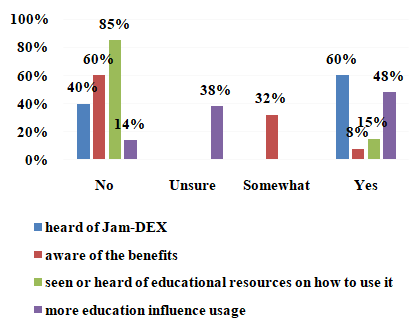
The analysis underscores a shared perception among users and non-users of JAM-DEX that there is limited and inconsistent information, which has contributed to low acceptance across the island. Figure 1 illustrates that substantial knowledge gaps exist among non-users, where the majority (approximately 60%) reported that they have only heard of JAM-DEX and were not aware of its benefits. On the other hand, 32% mentioned that they were ‘somewhat’ aware of the benefits of JAM-DEX, while less than 10% cited knowledge of the benefits.
However, further analysis indicates that this level of awareness does not translate into meaningful understanding of the currency, such as its purpose, functionality, or even the benefits of using it, compared to traditional payment methods. While approximately 40% indicates some level of awareness, only 15% had seen or heard of educational resources on how to use the currency, affecting the value-added understanding of JAM-DEX.
Figure 1 further adds that non-users’ lack of awareness was in part due to limited financial education. Approximately 85% stated that they had “not seen nor heard of any educational resources” to help them navigate its usage, which contributes to this knowledge gap. Almost half (48%) indicated that more public information was needed to influence their likelihood of using it. On the contrary, 38% expressed that they were unsure if receiving more information would encourage usage, while a small proportion (14%) of non-users were unwilling to adopt JAM-DEX, regardless of greater exposure via to public education.

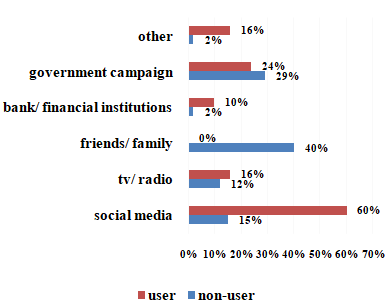
Moreover, both groups of consumers were asked to identify the primary information channels through which they became aware of JAM-DEX. Their general exposure is relevant to comprehending the critical role these channels play in influencing their decisions to adopt JAM-DEX. The findings revealed that 40% of non-users mostly rely on informal and passive information channels, particularly friends and family (Figure 2). However, about 27% of non-users obtained information through social media and television/radio. These patterns confirm that non-users have limited exposure to credible sources of information that provide more detail or structured about the purpose, benefits, and use of JAM-DEX.
Among JAM-DEX users, social media and government campaigns were the main sources of receiving information. Sixty percent shared that they became aware through social media, an informal source.{1} While these users have adopted JAM-DEX, the findings suggest that they could benefit from more credible financial information to promote consistent use of JAM-DEX. Contrastingly, other users obtained information from formal sources, including financial institutions (10%) and government campaigns (24%), reflecting greater exposure to accurate information that may have been valuable to support adoption decisions. Together, the results in Figure 2 indicate that in-depth and quality financial education is crucial to address the low adoption of JAM-DEX. Moreover, the findings based on Figure 2 are closely associated with the request for more public education on JAM-DEX as presented in Figure 1.
Users’ and non-users’ were also asked to share perceptions of the quality and trustworthiness of the information received about JAM-DEX. Table 1 provides these insights, which are crucial to understanding whether current education initiatives are sufficient to facilitate adoption as well as to encourage sustained and meaningful usage of the currency. Similar to the previous findings, users had mixed responses about the adequacy of information circulated. Thirty percent of users expressed that the information received was sufficient, while 20% stated “no”, suggesting the information received was either incomplete, unclear, complex, or lacked practicality. Additionally, 50% of the users reported ‘somewhat’ adequate, indicating they found the information to be lacking in areas potentially necessary to effectively use JAM-DEX.

Further analysis was conducted to assess users’ rating of the quality of information available on JAM-DEX, in order to comprehend their confidence level in using JAM-DEX. The overall ratings indicate that these educational resources are moderately effective, with a mean rating of 2.88 (~3) out of 5. Only a small proportion of users positively rated these materials as providing ‘excellent’ (6%) or ‘good’ (18%) information, while most reported them to be ‘fair’ (40%) or ‘poor’ (50%). The results imply that the average user requires more relevant information to fully engage with JAM-DEX, and build their financial confidence. This is of particular importance for those already concerned about the reliability and security of the system. High-quality educational resources are crucial for acceptance and sustained use of JAM-DEX, which can facilitate everyday usage of the currency over time. The findings also indicate that the uneven exposure of users to high-quality information appears to have influenced disengagement stemming from a reliance on informal sources of information.
Another key determinant of the limited uptake of JAM-DEX in Jamaica is trust and security. The results in Table 1 showed that non-users have a low level of trust in digital payment systems like JAM-DEX. About 1 in 10 non-users stated that they trust these systems, while 36% expressed a complete lack of trust. Also, approximately half (46%) of the non-users mentioned that they have either some level of trust or were unsure about the trustworthiness and security of the platform. Additionally, Table 1 provides ratings of how much the users trust JAM-DEX, acting as a counterbalance to non-users’ skepticism, and highlights the reliability of the system, as well as potential risks.
Table 1 provides results from a five-point rating scale from Level 1 (‘no trust at all’) through Level 5 (‘complete trust’). According to the survey, only a small number of users had very low trust, as was reported equally by 10% of the respondents for Level 1 and Level 2. Most users had moderate to high trust in using JAM-DEX, with 40% of the users indicating moderate trust (Level 3) and another 40% indicating the mean trust rating was 3.28 out of 5, suggesting that each user had a positive moderate trust in JAM-DEX, on average. Furthermore, the mean indicates that users were cautious as they engaged with JAM-DEX.
The standard deviation (1.18) indicates moderate clusters in responses, accounting for the varied responses from low to high. Considering these insights, the study highlights the need for more structured, targeted, institution-led financial education, from agents such as financial institutions, the government, and other critical stakeholders, to support the transmission of more credible information and strengthen the uptake of JAM-DEX.
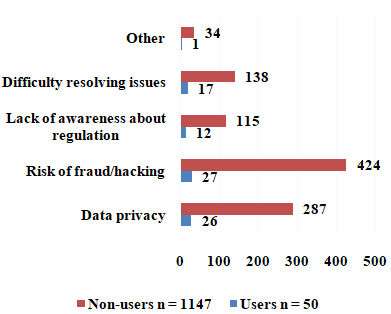
A closer inspection into trust and security challenges indicate that perceptions of trust seem to be connected to the broader concerns about the security of financial ecosystems. In Jamaica, notable illicit financial activities, such as fraud, hacking, data privacy breaches, and financial scams have recently increased in frequency. As such, Figure 3 shows that fear of fraud and hacking stand out as main concerns among 54% of users and 37% non-users. Moreover, as cybercrime has both psychological and behavioural impacts on decision-making, participants’ apprehension to meaningfully engage with JAM-DEX is understandable. A similar proportion of users and non-users are concerned about data privacy, particularly as the system requires their personal and financial information to fully onboard. These results suggest that a broad sense of unease about the security and data privacy elements of Jamaica’s financial systems. Compounding the unease is the uncertainty about the legal and regulatory frameworks existing to safeguard digital transactions on platforms like JAM-DEX, indicating gaps between individuals’ understanding of regulations and the existing assurance provided by the government and the Bank of Jamaica (BOJ).
In addition, time lags between technological glitches and resolution also impact overall confidence in adopting JAM-DEX. Among users and non-users, 34% and 12%, respectively, are concerned about the measures and length of time taken to financial issues based on the protocols of financial institutions in Jamaica. Such low confidence stems from poor with the customer service support from financial institutions regarding dispute resolution, account errors, or fraudulent attempts.

The findings were further strengthened by performing three sets of Chi-square tests of JAM-DEX adoption determinants to ascertain their correlation (Table 2). One test examined the relationship between participants’ awareness of benefits and the likelihood of adoption. Individuals being knowledgeable about the benefits of JAM-DEX are far more likely to accept it (p-value < 0.001), while those having little to no awareness of JAM-DEX are more likely to display hesitancy or an unwillingness to adopt. These inferences further fortify the descriptive patterns that non-users are mostly not aware of JAM-DEX’s value proposition, such as reduced costs, increased convenience, or financial inclusion, and so, tend not to enroll in the system. This indicates that with improvements in awareness and digital literacy, the government can expect meaningful outcomes in terms of increased acceptance.
In addition, a Chi-square test was conducted to determine the statistical association between participants’ trust level and their adoption status (users and non-users). The results in Table 2 revealed that trust is statistically linked to users’ and non-users’ willingness to adopt JAM-DEX (p-value < 0.001). It indicates that persons with higher trust levels are more likely to use the system and vice versa. However, the results also imply that, while individuals are registered to use JAM-DEX, they do not necessarily trust the platform in its entirety due to lingering security concerns.
Table 3 provides the themes from users’, non-users’, merchants, and financial and cybersecurity experts narrative accounts about barriers affecting JAM-DEX adoption. Users of JAM-DEX were mostly concerned about trust and security issues, such as fear of fraud and hacking, as well as data privacy. For users, it is more than JAM-DEX simply having the platform. Rather, it is knowing where, when, and how it can be used. In their opinion, functional awareness is important to know how the digital currency can be spent. One individual accounted that, “I have never seen a store that uses it.” Moreover, 16 users have outlined merchant use, indicating several were not yet aware of which merchants use JAM-DEX to facilitate transactions. This weakens engagement with the currency, since visibility and merchant uptake are low, emphasizing the need for financial literacy among the population. Low engagement intersects greatly with technological access and usability, indicating that even if merchant uptake increases, the accessibility and functionality of JAM-DEX are important. Also, as previously mentioned, users experienced technical difficulties, pointing to the possible challenges merchants may also face. As a consequence of limited merchant acceptance, only 16 users stated they used JAM-DEX to pay their bills, mostly utilities, showing that the majority of users are still using cash or traditional banking methods to conduct most of their transactions. Therefore, JAM-DEX is not perceived to be an integral platform for conducting financial transactions. Further insights from the data collected revealed that 26 users leverage JAM-DEX to send and receive money, rather than going to remittance services, while 8 uses it to engage in e-commerce, and 20 pay for goods and services. Nonetheless, most of their transactions are done through bank transfers to friends/ family, of which only a few include retail purchases.
On the other hand, the qualitative insights from non-users indicate that awareness and financial literacy are often misunderstood, fragmented. This is primarily due to the information sources they utilized. Table 3 illustrates confusion about JAM-DEX in terms of what it really is and what it facilitates. For instance, one respondent stated, “I just heard about it I think about Jamaica Digital Exchange, BOJ focusing on exchange rate but I realized it is not that but I don’t know much about it.” This narrative – thinking that JAM-DEX had to do with exchange rates, as opposed to being a digital payment instrument for both online and in-person transactions – is not strange among the Jamaican populace. An additional 30 non-users added that the information received was neither clear nor consistent across news outlets, compounding their confusion and lack of awareness. If individuals are to use JAM-DEX, public education is required to foster conceptual understanding.
Additionally, individuals are fearful of making mistakes that result in a loss of money. One user accounts that, “Mi nuh know how fi use it suppose mi mek mistake and lose my money”. This suggests a lack of digital confidence coupled with limited knowledge affects non-users engaging with JAM-DEX. Non-users also expressed their fears of being scammed and hacked. Another individual stated “Bwoy, the scamming nuff”, “I have worries and fears about scamming when using these payments system”, and “Bwoy mi skeptical enuh, look pon weh happen with the SSL Limited scamming”. This suggests that people are paranoid about exposure of personal and financial information, as in the case of SSL, causing them to become resistant to products like JAM-DEX and confirms previous findings of the prevalence of low or uncertain trust levels. Non-users have also expressed “Too much complications in considering it”, pointing to other psychological barriers impacting their likelihood to adopt.
Table 3 also shows the themes narrated by cybersecurity and financial experts, and merchants/entrepreneurs regarding barriers that affect JAM-DEX’s adoption. The qualitative insights from cybersecurity experts (2) revealed that Jamaican have a ‘general distrust of digital banking’ due to fear of fraud and hacking, confirming previous findings. They believe that digital systems are neither safe nor reliable based on perceived vulnerability to fraudulent activities, resulting from first- and secondhand experiences, or assumptions. One of the two cybersecurity experts went on to say that ‘age’ is another factor closely related to [and an amplifier of] the fear of fraud and hacking. More specifically, the elderly tends to be more vulnerable and, therefore, are likely to be the victims of these activities. As a result, they often associate digital systems with some financial risk, such as scamming. These outcomes are likely due to their lack of familiarity with digital systems or past experiences of fraud, either personal or shared. Cybersecurity experts interviewed unanimously emphasised that most individuals tend to have ‘limited digital literacy’ as well as ‘low cybersecurity awareness’, thus heightening their constant fear of fraud and hacking. Another component of this fear is the belief that the government is monitoring them, which has caused data privacy [surveillance] anxiety. These experts shared that some individuals tend to have a lack of confidence in state institutions, believing that their information may be misused, tracked, or accessed without their permission. This belief indicates that people are uncertain about how their data is collected, stored, and protected by state institutions. Cybersecurity experts also posited that this belief, just like the fear of fraud and hacking, is likely caused by low cybersecurity awareness and limited digital literacy.
Reinforcing the accounts of cybersecurity experts, financial experts reiterate the importance of establishing trust in digital systems to build confidence and encourage user enrollment. Table 3 presents accounts from the 4 financial experts interviewed surrounding mistrust in government-led digital systems. There is a consensus that “persons are not open to the digital world in Jamaica. [They have a] general fear in our culture of anything digital: “fear of information leak, fear of infrastructural/platform crash,” and [instead, have a] “preference for physical cash”. System glitches and delays add another layer of mistrust and low confidence in using digital currencies. “There are technical issues sometimes when customers send money across; so they come to verify and at times complain of not receiving money”. Compounding this is the limited knowledge of financial policies. While Jamaicans are aware that they exist, they still lack clarity about what they actually mean, their importance, and intended benefits, such as data protection and system security and efficiency.
Among the merchants interviewed, challenges to JAM-DEX’s adoption mainly surrounded limited awareness, both on their part and that of customers. The results revealed that 16 of the 20 were not engaged with any digital wallets/currency. The findings indicate that some merchants are not aware of JAM-DEX, and even if they are, they do not understand what it really is, its purpose is, and the processes involved with adopting it. Until they become more knowledgeable, it is almost impossible to make any decisions about using JAM-DEX. Another theme impacting merchant readiness is a lack of marketing of the product, further adding to the limited awareness. Fewer customers are using it now compared to COVID, even if more are registered, because “in terms of marketing we are not getting a wide cross-section of people wanting it. It was quickly accepted during the pandemic when touching was an issue and customers found it suited. However, there is no push as much as before since ppl have learnt now how to deal with COVID symptoms, etc”.
On the other hand, few merchants have integrated JAM-DEX into their regular business operations. When these merchants were further interviewed, 4 narrated that they use digital wallets, with 2 using Lynk, offered by NCB on JAM-DEX, and 2 using PayPal and/ or WePay Caribbean. Those using Lynk explained that they initially registered to use for personal transactions, but ended up using it for business purposes. One stated that the current nature of usage is for monthly salary payments to workers, while the other accepts payments occasionally from customers who request to use it. They further stated that the JAM-DEX platform is easy to use and have not experienced challenges outside of the norm, like application issues, lack of customer service, slow processing, and setup problems. However, it was explained that whenever the challenges occurred, message(s) were sent notifying that the platform, or related issues, were being fixed or updated. The merchant shared that it took a maximum of 3 hours to recover. Additionally, one of the JAM-DEX user pointed out that the current holding limit per transaction per day to facilitate business transaction, especially for payroll is currently inadequate to meet his/ her daily cashflow demands. As such, the findings suggest increasing the holding limit to improve business efficiency.
For merchants using other digital wallets, there is a general lack of awareness of JAM-DEX. One merchant who used PayPal and WePay Caribbean explained that these wallets are used by his overseas clients, providing them with entertainment services, including dubs and management consultancy services. However, neither these overseas clients nor the merchant is aware of JAM-DEX, or the extent to which it can be used to conduct businesses internationally, they use PayPal to facilitate the purchase of hair products and booking appointments, but they are fully unaware of JAM-DEX.
Overall, these themes point to a general lack of awareness about JAM-DEX, and the required financial education and reliable infrastructure to facilitate trust, build confidence, and encourage both merchants’ and consumers’ adoption of the digital currency.
4.2. Research Question 2 ResultsHow do demographic, socio-economic, and technological factors affect the adoption of JAM-DEX by Jamaicans?
The analysis for research question 2 highlights that key demographic and socio-economic factors are hindering the adoption of JAM-DEX among the Jamaican populace. The profiles of the consumer participants are essential to providing more meaningful insights about JAM-DEX adoption. The study looked at the age of the users and non-users, where they live (rural or urban), their employment status and monthly income. Table 4 shows the age distribution of the users and non-users, which is crucial to this study since age impacts perceptions related to digital literacy, risks, and openness to innovation.
The findings revealed that there exists a generational divide between users and non-users. Individuals within the age group 25-34 years account for 40% of all users and 18% of non-users. This indicates that more young working adults have adopted JAM-DEX, aligning with the fact that young people are likely more digital literate than their counterparts due to higher exposure to smartphones. On the other hand, 20% of users fell within the 18-24 age group, indicating moderate adoption of the digital currency. For the same age group, there are 24% of non-users. This implies that it takes more than age for the consideration of adoption, including factors such as income stability.
Contrastingly, for older age groups (at least 45 years and above), there are fewer users and non-users accounted; also, for age 65+, there are no users within that range. The results emphasise that older Jamaicans are less likely to accept JAM-DEX. These results are consistent with earlier findings about trust, digital literacy, and security issues, where older persons might perceive JAM-DEX to be less useful to them, have low digital confidence, and a fear of fraud and hacking.
The findings indicated that the data is skewed, suggesting that younger individuals are far more likely to adopt. This result further conveys the disproportionality across age groups, inferring that age influences the adoption of JAM-DEX. However, there are other factors tied to age for adoption, such as digital literacy levels, individuals’ digital confidence, and perceived security concerns. Thus, age-sensitive information is needed along with trust-building initiatives.
Geographic location was considered because it is critical for the wide-scale adoption of the financial currency across the country’s population. Moreover, JAM-DEX adoption requires individuals to have access to suitable infrastructure, digital services, and internet connectivity. Generally, these accesses are different for urban and rural areas and can vary based on behavioural and perceptual factors.
The results revealed that 64% of users and 63% of non-users lived in urban areas. These proportions are almost the same, indicating that there are factors other than geographical location affecting individuals’ enrollment.
As part of demographics, educational attainment was examined, since it plays a critical role in comprehending the adoption of the digital currency (Table 4). This is because usage and acceptance are reliant on individuals’ exposure to digital and financial education, such as their ability to use technology and financial tools, which require the interpretation of information about emerging technologies and digital systems. In the context of this study, education serves as the lens that facilitates awareness of JAM-DEX, along with examining the security concerns and perceived benefits.
The findings revealed that 33% of the non-users and 62% of the users have a tertiary education. On the other hand, 53% of the non-users possessed secondary education, compared to only 20% of the users. Additionally, 18% of users and 10% of non-users obtained vocational training. Also, 3% of the non-users only had primary education, while 1% accounted for those who did not attend any formal schools [a few of whom stated they could not read and write].
Socio-economic factors, like demographic characteristics, are essential in this study to provide more meaningful insights about JAM-DEX adoption. The socio-economic factors examined include employment status and income brackets as they both shape financial capacity and help to make informed financial decisions. Table 4 provides the employment distribution for both users and non-users of JAM-DEX. The findings uncovered that 54% of users and 36% of non-users have full-time employment, indicating that these individuals have stable jobs and hence, stable income. Further analysis revealed that amongst the full-time employed users, all of them have attained highest qualification from at least the secondary level. Comparatively, only 3 (0.26%) of non-users working full-time did not have any formal education, revealing that 35.74% have at least primary education. The results suggest full-time workers may be more inclined to adopt JAM-DEX, especially since the platform facilitates convenient and efficient services such as transfers, bill payments, and retail purchases. Contrastingly, 12% of the non-users are unemployed, implying that they are currently less likely to adopt, even though one of JAM-DEX’s goals is financial inclusion. Furthermore, 18% of users were self-employed compared to 22% of non-users, suggesting that entrepreneurial status alone is inadequate to guarantee acceptance of JAM-DEX. Instead, there may be other factors influencing their willingness to adopt JAM-DEX. Additionally, the qualitative narrations indicates that for entrepreneurs/self-employed individuals to become users of JAM-DEX, they need strong mediation related to customer demand, merchant readiness, and strong perceived operational value. The results revealed that 12% of users and 11% of non-users were students presently completing tertiary-level education. These results convey a similar message as that of self-employed individuals; that age-related digital literacy alone does not guarantee adoption, unless they become aware of the benefits of being derived, and develop institutional trust. Retired individuals were the minority group within the adoption status and accounted for 4% of non-users and 2% users. This finding reiterates that older individuals are more hesitant than younger individuals in adopting digital financial systems.
Income is a central socio-economic factor that intersects completely with employment status. This is the greatest motivator for individuals to engage with digital financial tools. This is because individuals with income are more likely to assess whether they trust digital payment systems to put their money, the level of convenience, and how accessible these systems are, like JAM-DEX. Table 4 shows the income distribution of users and non-users. The findings uncovered that the two lower-income brackets (below JMD 50,000 and JMD 50,001 – JMD 100,000) have a similar proportionality across users and non-users. Contrastingly, there is a notable difference in higher incomes (JMD 200,000 and above) earned by users (22%) and non-users (11%). A notable difference was also evident for the income bracket, JMD 100,001 – JMD 199,999, in which the percent of users earning this amount was twice that of non-users. As such, persons earning more money would be more willing to adopt JAM-DEX due to the convenience and flexibility it provides. However, some individuals selected ‘prefer not to say’, which accounted for most non-users (51%) and 32% of users. This highlights individuals’ level of distrust in general, uncomfortable disclosing their earnings, or even that their income may be obtained from informal sources, which intersect with financial data collection.
For richer insights, the study performed a multivariable binary logistic regression to examine the multivariable effects of JAM-DEX adoption. The variables included were age groups, education status, employment status, monthly income, and technological barriers.
The inferential analysis in Table 5 revealed that education level and technological barriers were the only statistically significant predictors of JAM-DEX acceptance. The results indicate that individuals having tertiary qualifications were approximately two times more likely (odds ratio (OR) = 1.637, β = 0.493) to register as users, compared to those who went to primary or secondary school. This emphasises that engagement with digital currencies like JAM-DEX is typically driven by financial literacy, digital confidence, and cognitive readiness. Consequently, adoption tends to be heavily skewed toward more educated individuals.
The inferential analysis indicates interesting results. Consistent with individuals’ responses that they experienced technological barriers, the variable was a significant predictor (odds ratio = 2.803, p = 0.004 < 0.05) of adoption. According to the results, the odds of adoption were 2.8 times greater for JAM-DEX adopters than those in the reference group, indicating that adopters (users) are more likely to experience technological challenges such as connectivity issues, transaction delays, and application malfunctions, and report it since they have direct experience with the platform. Contrastingly, though non-users have never used the platform, their perception of digital platforms having technological glitches is likely to play a role in non-enrollment. Nonetheless, the findings indicate that even with the inconvenience experienced, users still perceive JAM-DEX to be beneficial. Therefore, while reliable digital infrastructure remains a concern, it does not completely dissuade users from continued engagement, as the benefits outweigh the challenges.
Additionally, the study uncovered that age (β = -0.102, OR = 0.903), income level (β = 0.297, OR = 1.347), and employment status (β = -0.186, OR = 0.830) were not statistically significant predictors of JAM-DEX adoption. However, the odds ratio suggest variation in the likelihood of adoption across these factors, indicating that demographic and economic characteristics alone are insufficient drivers of JAM-DEX adoption.
Table 6 illustrates the qualitative insights into quantitative patterns observed related to JAM-DEX adoption, based on demographic characteristics, socio-economic status, and technological conditions. The quantitative findings in Table 6, along with the narrations by individuals, revealed that persons at least age 45 are less likely to adopt. One expressed, “prefer cash even though the process might be lengthy to stand in long lines”. She shared that she goes to the bank to obtain cash whenever she needs it and that she prefers to join the lines at Jamaica Public Service (JPS) and National Water Commission (NWC), which are long at times, to pay her utility bills. Just like her, 2 other persons declared that they used cash to make payments instead of online banking to avoid being scammed. Others lamented that even though they use cards instead of cash, they are not interested in online banking due to the risk of fraud and hacking. They have made statements such as “better to stick to the evil I know”, indicating their level of distrust when faced with unfamiliar systems. This indicates that older people have powerful psychological barriers and are less willing to trust beyond familiarity.
The qualitative results reinforce the quantitative findings that rural residents are significantly affected by higher technological barriers. These respondents have shared comments such as “Bwoy, the internet connection sometimes man rough I tell you”, “I don’t even own a phone;”, and “Mi still have my banga, never use a smartphone”. These comments further convey access challenges, which are based on location. This indicates that individuals are not necessarily opposed to JAM-DEX adoption; the problem is that they experienced the inconsistency in internet connectivity, especially in areas considered extremely rural based on location. Two people mentioned device issues, either not having a phone, or the phone cannot facilitate registration and usage of JAM-DEX. The findings further imply that individuals are still resistant to digital technologies, especially in rural areas. This once again suggests that disparities are causing low adoption, due to digital infrastructural gaps.
The results in Table 6, also emphasised the quantitative findings that individuals obtaining higher incomes (JMD $200,000 and above) are higher users of JAM-DEX. They have expressed that they find it to be convenient, not a necessity. This is because they can stay anywhere to pay their bills and send money to friends and family, amongst performing other transactions. Also, they have indicated that using alternative payment methods is not out of the question if JAM-DEX becomes inconvenient to them. Additionally, the findings highlight individuals (users and non-users) being hesitant even when aware of JAM-DEX, because they do not trust government-led digital systems. They are cautious because they believe the government is not giving sufficient oversight of financial institutions, making them transparent and accountable to mitigate fraud. As such, they are skeptical about government control, a constraint on the adoption of the digital currency.
Furthermore, amongst the merchants are small business owners/entrepreneurs who shared that they were not aware of JAM-DEX, lacked an understanding of it, experienced low customer usage/demand, and customers still prefer alternative payment methods. The findings indicate that merchants who use JAM-DEX expressed that there are customers who prefer to use cash, debit/credit cards instead of JAM-DEX when they make payments. While other merchants who lack awareness do not use it at all, and they also notice that their customers are not aware, this creates a self-reinforcing cycle between customers and merchants. Also, one merchant pointed out that his business caters to overseas customers who use PayPal and WePay, stating that if JAM-DEX can facilitate his clients and they are willing to use it, he is willing to accept it.
4.3. Research Question 3 ResultsWhat essential mechanisms should be considered in creating policy measures to improve the acceptance of JAM-DEX by Jamaicans?
This research question focuses on key mechanisms (policy measures) that may be required to improve the uptake of JAM-DEX by the Jamaican populace. This involved identifying evidence-based solutions that provide targeted interventions addressing barriers, including awareness and financial literacy, trust, security concerns, and socio-economic conditions.
Table 7 shows a comparison of users’ and non-users' policy preferences, reinforcing policy design to strike a balance between consumer-level reassurance and system-level expansion. The results revealed that users’ (56%) and non-users’ (55%) strong preference of establishing fraud protection mechanisms closely aligned, indicating that security is a universal concern. However, the call for public education campaigns holds a notable difference in the proportion of users (60%) and non-users (54%) who preferred this policy initiative. The findings indicate that users prioritise financial education above everything else for the integration and harmonization of JAM-DEX amongst the broader Jamaican populace. However, non-users (21%) are calling for tax incentives more than users (8%), suggesting that some non-users see this as their motivator to register to use JAM-DEX, though not a retention strategy. On the other hand, for the proposed policy preference ‘merchants’ incentives’, there is a clear distinction between the proportion of users’ (60%) and non-users’ (18%) responses, indicating a gap. This suggests that based on users’ interaction with JAM-DEX, they know clearly that the number of merchants accepting the currency is limited, which undermines the usefulness.
However, non-users are already comfortable using other payment methods, which merchants accept, so whether enough merchants accept JAM-DEX or not is presently not as important to them for daily transactions. Additionally, non-users (54%) place greater emphasis on ‘improved security features’ than users (42%). This implies that non-users are seemingly more worried about the risks of fraud or even making mistakes, which appears to be derived from stories or assumptions. While a smaller proportion of users suggest that once individuals begin using JAM-DEX, these fears begin to dissipate as their financial confidence improves. However, these fears remain a deterrent to non-users’ adoption of the digital currency.
Figure 4 illustrates users’ recommended improvements for wider usage of JAM-DEX. Compared to non-users, current users (66%) strongly believe that more educational resources are needed to facilitate practical improvements among the populace in shaping their adoption decisions.

This suggests that even those who are already registered need more guidance to advance their knowledge in using JAM-DEX. Greater merchant acceptance closely followed this, endorsed by 60% of users, indicating that there are not enough places where they can spend the digital currency daily, which constrains the usage of the currency. Furthermore, 56% of users called for ‘enhanced security features’, while 42% desired ‘improved ease of use’, suggesting that JAM-DEX facilitate them with completing basic transactions, but the process might involve friction, including app glitches, slow processing times, or confusing steps, causing inconsistencies or inconvenience. Finally, 38% of users expressed that better customer support is needed to clarify areas where they might have a limited understanding, as well as to deal with disputes on time.
Table 8 illustrates the policy viewpoints of merchants/ entrepreneurs, and cybersecurity and financial experts which are vital in JAM-DEX environment, which are essential to comprehend the evolving nature of the financial systems particularly with the interplay of the digital currency. Their perspective is crucial since they operate at the frontline for the successful implementation of the currency. While cybersecurity experts are the service protectors and merchants/ entrepreneurs are service providers, both form a synergy for the implementation process in providing valuable practical and structural insights based on the current gaps related to knowledge, costs, trust, and ecosystem readiness. Based on the qualitative findings, merchants/ entrepreneurs have expressed that for JAM-DEX acceptance to become widespread, government need to prioritise merchant onboarding. This constitutes of first engaging merchants/ entrepreneurs in education programmes tailored to inform and train them about the use of the platform. This may also include incentives particularly for small and medium-sized enterprises (SMEs) to offset the costs associated initially to setup the service(s) to accommodate the currency. This is a necessary consideration because business owners have to focus on devices, infrastructure, or time investment, which can be a key barrier especially for SMEs. So, if government establish policy measures such as subsidies, tax incentives, or reduced transaction fees, it will help these businesses take care of the upfront costs for the digital transition. It will not only encourage merchant onboarding but indicating that the government is committed to drive the transformation process with them in mind. Once, these stakeholders adopt the currency, they can facilitate integration into their daily business operations. These findings suggest that these stakeholders can become equipped with the confidence they need as they enhance their business capability in terms of infrastructure, resources, and even training of staff to effectively use the platform. Eventually, as more merchants are educated and equipped, customers can buy-in through merchants leveraging their own business methods for instance through advertisements and/ or various other marketing strategies. This will help add value to the government public education campaigns, especially since they interact with customers daily.
Additionally, there are merchants who desire for government to properly communicate about the currency so they can know what is in it for them and the need for financial digital transformation and what policies would guide the use of the platform particularly in terms of trust-building measures not just for them but also customers.
Otherwise, onboarding will be slower than intended. Cybersecurity experts, on the other hand, though in agreement with the merchants/ entrepreneurs, especially in public education, shared further valuable insights into dealing with cybersecurity issues to make the JAM-DEX environment welcoming for both customers and merchants/ entrepreneurs. Their perspectives focus on the structural integrity of the platforms emphasizing the need for a secure system that users can find to be both robust and trustworthy to ensure clarity between perceived and actual security. They pointed out the need to include multi-layer authentication models to guarantee safety login along with the ISO/IEC 27001 framework. This will help increase users’ confidence as they navigate the platform where they can begin to feel like the platform is reliable and safe to use, as well as minimize the chances of unauthorized transactions. These stakeholders expressed that the government can leverage ISO/IEC 27001 framework to identify global best practices that are both integral and fundamental to manage the security of financial information. Furthermore, they noted that the China’s digital yuan model seems to be working, so Jamaica could assess the pros and cons of their model to identify what can work our currency. In other words, they are encouraging government to use the China’s digital yuan model as a reference point specifically focusing on the model’s security architecture, scalability, and user trust. They also stated that it is critical to ensure that security assurance is at the top of list in continually refining the platform.
Table 8 also display emerged comparative policy themes which places emphasis on balancing subsidies with rules as they encourage adoption, assessing the necessity for merchant adoption (financial and technical), developing public awareness strategy, and dealing with institutional trust and transparency issues. The findings indicate that while support mechanisms are pertinent for widespread adoption, government need to establish clear rules and accountability structures for its users to comprehend. Also, investment through sources of funding alone is insufficient for merchants to adopt, if they do not become operationally ready. These policy themes though expressed by merchants and cybersecurity experts, have also been stressed by users and nonusers of JAM-DEX (consumers) who made similar recommendations as shown in Table 8. These findings reiterate the need for trust, education, and system usability features that encourage consumers to become willing with adoption.
The findings of this study align with Ozili 14 and Qu et al. 64 argument that having established a CBDC does not mean automatic public adoption. As such, it is critical identify factors influencing adoption, while assessing the effectiveness of the CBDC design and potential benefits. In this mixed-method study, it was reported that limited awareness and financial literacy have left both users and non-users hesitant to adopt it. Consistent with Rogers’ Diffusion of Innovation theory, Guo & Huang 33 noted that when individuals lack access to adequate and credible information source then uncertainty about adoption increases slowing down the process. Furthermore, the communication channels were indicated to be informal by participants in disseminating information suggesting that the current public education efforts are not effective. These findings align with previous CBDC studies which reported that the major hindrance to adoption is lack of awareness and knowledge about the digital currency.
Throughout the findings, participants have consistently reported that trust is the most influential determinant of their adoption. Users and non-users have shared concerns about customer support, hacking, data privacy, and institutional accountability. According to Ref 22, Ref 33, Ref 38, Ref 42, Ref 65, and Ref 66 if technology is more complicated or risky, then people are less likely to use technology due to frustration, which can lead to disengagement or the spread of incorrect information to non-users or users. Therefore, there needs to be quality information shared from credible sources to users and non-users. The findings suggest that these information sources need to sufficiently address individuals’ fears regarding security and governance to alleviate their resistance to JAM-DEX. Similar trends have been observed in Nigeria’s eNaira, where adoption was initially low Ref 22 shared, despite its widespread availability. Additionally, previous studies like Benhayoun & Solberg Söilen 12, Ozili’s 14, Qu et al. 64, and Singh & Yadav 67 emphasized that perceived risk and institutional trust are crucial predictors of individuals’ digital financial adoption.
The findings also revealed that adoption is constrained by lack of ecosystem readiness, where participants revealed that JAM-DEX is not very useful without widespread acceptance. This aligns with observed experiences with other CBDCs shared by Dionysopoulos et al. 1 who indicated that there needs to be available and functioning merchants adopting to encourage individual willingness. However, based on the findings, merchant perceived value of JAM-DEX remain limited. On the other hand, while socio-economic factors influence JAM-DEX adoption, they are not drivers. The next findings indicate that younger individuals, particularly working adults with stable incomes and higher digital literacy, are more willing to adopt JAM-DEX. The results suggest that age influences adoption, although other age-related factors, such as digital literacy and security concerns, also play a role. People are more willing to adopt new technologies when past negative experiences or failures with similar tools do not discourage them, according to Matlala 33. Furthermore, individuals who have established digital habits are more likely to continue using new platforms such as JAM-DEX.
Three main policy themes were revealed in the study: trust-building measures, sustained financial literacy and digital education programmes, and merchant onboarding initiatives. Kacker and Sinha 68 pointed out that it is more than implementing policies, rather governments must ensure the quality of these frameworks are carefully considered. They further noted that these policies must be clearly communicated, especially to the populace so they can properly comprehend without misinterpretations. The findings suggest that non-users collective views indicate high levels of distrust, however, the users are not so far behind who expressed moderate levels of confidence. This pattern further suggest that trust building initiatives need to be established by strengthening consumer protection mechanisms, complaint resolution systems, transparent governance practices, and coordinated cybersecurity frameworks 68. The cybersecurity experts pointed out that this must be done in alignment with global CBDC recommendations inclusive of the ISO/IEC 27001 framework, as outlined by Ref 26. Also, closely tied to the very high distrust levels is the need for sustained financial literacy and digital education programmes, stated by all participants in this study. These findings have been reinforced by United Nations Development Programme 53, which has identified the need for Jamaica to become digitally ready especially to provide services to the vulnerable populations. The call for education programme is more about practical usage (training and information) than just mere awareness where individuals can become confident in leveraging the platform so that the platform become both technically accessible and socially utilized.
Another crucial revelation from the findings is need for merchant readiness and ecosystem development, which users and non-users highlight that currently merchant acceptance is limited. Ekong & Ekong 23 indicate that merchant integration is vital for the JAM-DEX emphasizing it is more than an individual decision, otherwise the uptake will remain significantly slow. Furthermore, this is a network-dependent process requiring wide participation across the various ecosystems including communities, schools, and industries for the currency to become normalised; which are aligned to lessons learnt from the Bahamas’ Sand Dollar, as outlined by Wright et al. 69. The study recognizes the need for merchant onboarding strategies and partnership initiatives, where merchants work with fintech providers and financial institutions, for increased acceptance of JAM-DEX by both consumers and merchants. Note that without the acceptance by both consumers and merchants, the currency will become irrelevant.
4.5. ConclusionThe findings examined factors influencing the limited uptake of JAM-DEX amongst merchants, consumers (users and non-users of JAM-DEX), financial and cybersecurity experts. The results uncovered that the pertinent factors associated JAM-DEX adoption are awareness, quality of information, trust and security concerns, technological barriers, and merchant uptake. Despite most participants have heard about JAM-DEX, they have limited understanding of its purpose and benefits. The findings suggest that the general concerns about trust and cybersecurity and availability of credible information sources influence individuals willingness to adopt the digital currency. Additionally, the findings indicate that ecosystem readiness is critically to the adoption process, which involve merchant acceptance. Also, the findings revealed that the main predictors of JAM-DEX adoption are education level and technological barriers, while the other factors such as employment, income, age, and geographic location were considered not statistically significant. Moreover, the stakeholders in this study have collectively called for effective measures that places emphasis on the following education, cybersecurity assurance, merchant ecosystem development, and transparent governance, as the driving force for widespread acceptance.
The authors would like to thank the participants of the study and the data collectors who assisted with the data collection process. We also express gratitude to the School of Graduate Studies, Research and Entrepreneurship (SGSRE) for providing the funding for this research project. Finally, we thank Miss Monique Graham, an Economist Consultant and Dr. Orinthia Fisher-Howe, Administrative Officer and Adjunct Lecturer for the editing of this paper.
Based on the binary logistic regression as shown in Table 5, a model diagnostics was done. The findings revealed that the predictor set statistically (χ²(5) = 16.76, p = 0.005) improves the prediction power of the model (Table 9).
Furthermore, based on the Cox & Snell R² and the Nagelkerke R², the variation in the level of JAM-DEX adoption (dependent variable) that is explained by indicators in Table 5 is quite small, with an R² of 2.7% and 7.8%, respectively. This suggest that even though the findings revealed that technological barriers and education are statistically significant predictors, adoption decisions are explained by other factors not included in this model. Also, the model revealed a high overall classification accuracy of 94.4%, resulting from the highly imbalanced distribution of users and non-users. The sensitivity, however, was 0.0% and the specificity was 100.0% indicating that while non-users were substantially identified, users (adopters) were harder to be classified due to the severe imbalance between users and non-users. Nonetheless, the acceptable discriminatory power (AUC = 0.709) indicated that despite classification accuracy the model performs better than chance. Overall, the findings suggest that for future studies, additional demographic, behavioural, technological, and contextual factors would have been appropriate to be captured that may be likely to influence individuals' decisions to adopt JAM-DEX.
{1}. Although social media is an informal source, governments have used these platforms to reach a wider array of individuals. As such, social media also includes official accounts of government institutions. However, due to nature of information transmission on these informal platforms, we understand knowledge received to be unreliable, for the most part.
| [1] | Dionysopoulos, L., Marra, M., & Urquhart, A. (2024). Central bank digital currencies: A critical review. International Review of Financial Analysis, 91, 103031. | ||
| In article | View Article | ||
| [2] | Prodan, S., Konhäusner, P., Dabija, D., Lazaroiu, G., & Marincean, L. (2024). The rise in popularity of Central Bank digital currencies. A systematic review. Heliyon, 10(9), e30561. | ||
| In article | View Article PubMed | ||
| [3] | NCB Capital Markets Ltd. (2022, June 30). JAM-DEX phased Rollout progresses. https:// ncbcapitalmarkets.com/ research/latestnews/4032-JAM-DEX-phased-rollout-progresses. | ||
| In article | |||
| [4] | Bank of Jamaica. (n.d.). A primer on BOJ’s bank digital currency. Retrieved on September 16, 2024, from . | ||
| In article | |||
| [5] | Jamaica Information Service. (2022). Govt provides incentives to boost JAM-DEX use. Retrieved on September 16, 2024, from . | ||
| In article | |||
| [6] | Bank of Jamaica. (2022a). Jamaica’s central bank digital currency – JAM-DEX. Retrieved on September 16, 2024, from . | ||
| In article | |||
| [7] | Bank of Jamaica. (2023). CBDC FAQs. Retrieved on September 16, 2024 from https://boj.org.jm/core-functions/currency/cbdc/. | ||
| In article | |||
| [8] | Leucci, S. (2025). Central Bank digital currency. European Data Protection Supervisor. publications/ techsonar/central-bank-digital-currency_en. | ||
| In article | |||
| [9] | Kagan, J. (2011, August 5). What is a digital wallet? Investopedia. Retrieved December 20, 2025, from https:// terms/d/digital-wallet.asp. | ||
| In article | |||
| [10] | Deloitte. (2021, September). Central bank digital currencies: The next disruptor. https://www.deloitte.com/content/dam/assets-shared/legacy/docs/perspectives/2022/gx-fsi-central-bank-digital-currencies.pdf. | ||
| In article | |||
| [11] | Shahen, A. M., & Sharaf, M. F. (2026). Central bank digital currencies and cross-border digital payments: A systematic review in a fragmented global financial environment. FinTech, 5(2), 50. | ||
| In article | View Article | ||
| [12] | Solberg Söilen, K., & Benhayoun, L. (2021). Household acceptance of Central Bank digital currency: The role of institutional trust. International Journal of Bank Marketing, 40(1), 172-196. | ||
| In article | View Article | ||
| [13] | Borgonovo, E., et al. (2021). Money, privacy, anonymity: What do experiments tell us? Journal of Financial Stability, 56, 100920. | ||
| In article | View Article | ||
| [14] | Ozili, P. K. (2022). Central bank digital currency research around the world: A review of literature. MPRA Paper No. 111389. | ||
| In article | View Article | ||
| [15] | Tronnier, F., Harborth, D., & Hamm, P. (2022). Investigating privacy concerns and trust in the digital euro in Germany. Electronic Commerce Research and Applications, 53, 101158. | ||
| In article | View Article | ||
| [16] | PwC. (2023). PwC global CBDC index and Stablecoin overview 2023. Retrieved on September 16, 2024, from . | ||
| In article | |||
| [17] | International Monetary Fund. (2023). Central bank digital currency—Initial considerations. International Monetary Fund. . | ||
| In article | View Article | ||
| [18] | Koonprasert, T.T., Kanada, S., Tsuda, N., and Reshidi, E. (2024, September). Central Bank Digital Currency Adoption Inclusive Strategies for Intermediaries and Users. https://www.imf.org/-/media/files/publications/ftn063/2024/english/ftnea2024005.pdf. | ||
| In article | View Article | ||
| [19] | Clyde & Co. (2024, August 16). Digital yuan: A global game-changer in the era of central bank digital currencies. Clyde & Co. . | ||
| In article | |||
| [20] | Li, S. (2024, May 17). Hong Kong allows China's digital yuan to be used in local shops. reuters.com. https:// markets/currencies/hong-kong-allows-chinas-digital-yuan-be-used-local-shops-2024-05-17/. | ||
| In article | |||
| [21] | SandDollar. (n.d.). Digital Bahamian dollar SandDollar. Central Bank of The Bahamas. Retrieved June 6, 2026, from . | ||
| In article | |||
| [22] | Abdullahi, M., Ahmad, A., Pandey, B. K., & Pandey, D. (2024). Digital Currency adoption: A Comparative analysis of Global trends and the Nigerian ENaira Digital Currency. SN Computer Science, 5(5). | ||
| In article | View Article | ||
| [23] | Ekong, U. M., & Ekong, C. N. (2022). Digital currency and financial inclusion in Nigeria: lessons for development. Journal of Internet and Digital Economics, 2(1), 46–67. | ||
| In article | View Article | ||
| [24] | Normandin, J., Brunetti, J., Cadillac, N., Casteneda, M., Gelinas, K., McCormick, M., Modol, A., Reynolds, H., Almaraz, J., Guijarro, V., & Solinis, A. (2025). Understanding the impact of digital currencies: from private companies to central banks. Journal for Global Business and Community, 16(2). | ||
| In article | View Article | ||
| [25] | Patterson, C. (2025, May 28). BOJ anticipates digital currency expansion will ease ATM challenges. Jamaica Information Service – The Voice of Jamaica. https://jis.gov.jm/boj-anticipates-digital-currency-expansion-will-ease-atm-challenges/. | ||
| In article | |||
| [26] | Bank for International Settlements (BIS). (2023). Central bank digital currencies: Motivations, economic implications, and the research frontier. Retrieved from . | ||
| In article | |||
| [27] | Peterson Institute for International Economics (PIIE). (2023). How are Central Bank Digital Currencies Different from Other Payment Methods?. Retrieved from . | ||
| In article | |||
| [28] | Baker, C. (2024). Examining the potential of the JAM-DEX® CBDC to improve financial inclusion in Jamaica. In Advances in finance, accounting, and economics book series (pp. 170–193). | ||
| In article | View Article | ||
| [29] | Bowie Jones, S. (2022, June 29). Jamaica’s readiness for Digital Currency. Myers Fletcher & Gordon. https:// myersfletcher.com/ jamaicas-readiness-for-digital-currency/. | ||
| In article | |||
| [30] | Hendricks, D. (2025, August 24). The JAM-DEX dilemma. Jamaica Observer. https:// 2025/08/24/JAM-DEX-dilemma/. | ||
| In article | |||
| [31] | Douglas, L. (2026, January 9). Restaurants test appetite for JAM-DEX. Jamaica Gleaner. . | ||
| In article | |||
| [32] | Miles, K. (2025, September 20). Food merchant tapped for JAM-DEX revival. Jamaica Observer. https:// 2025/09/19/ food-merchant-tapped-JAM-DEX-revival/#google_vignette. | ||
| In article | |||
| [33] | Guo, Q., & Huang, W. (2024). Analyzing the diffusion of Innovations Theory. Scientific and Social Research, 6(12), 95–98. | ||
| In article | View Article | ||
| [34] | Rogers, E.M. (2003). Diffusion of innovations, 5th Ed. New York, NY: Free Press. | ||
| In article | |||
| [35] | Halton, C. (2026) Understanding the Diffusion of Innovations Theory with Examples. Retrieved from . | ||
| In article | |||
| [36] | Kaur, H., Kaur, R., Mago, M., Singh, M., & Mehta, K. (2024). Exploring factors affecting central bank digital currency adoption: A perspective from Generation Z. Metamorphosis: A Journal of Management Research, 23(2). | ||
| In article | View Article | ||
| [37] | Kemp, E. A., Borders, A. L., Anaza, N. A., & Johnston, W. J. (2018). The heart in organizational buying: marketers’ understanding of emotions and decision-making of buyers. Journal of Business and Industrial Marketing, 33(1), 19-28. | ||
| In article | View Article | ||
| [38] | Matlala, N.P. (2024). Consumer behaviour towards the adoption of digital banking channels. Consumer Behavior Review, 8(1), e-260295. | ||
| In article | View Article | ||
| [39] | Šostar, M., & Ristanović, V. (2023). Assessment of Influencing Factors on Consumer Behavior Using the AHP Model. Sustainability, 15(13), 1-24. | ||
| In article | View Article | ||
| [40] | Golding, P. (2024). Consumer acceptance of central bank digital currency in a fully launched market. Technium Social Sciences Journal, 63, 184–198. | ||
| In article | View Article | ||
| [41] | Garcia‐Aviles, J. A. (2020). Diffusion of innovation. The International Encyclopedia of Media Psychology, 1–8. | ||
| In article | View Article | ||
| [42] | Bank of Jamaica. (2022b, December 30). JAM-DEX facilitates Government Wage Payment Employment Generation (Christmas Work) Programme. Bank of Jamaica. https://boj.org.jm/JAM-DEX-facilitates-government-wage-paymentemployment-generation-christmas-work-programme/. | ||
| In article | |||
| [43] | Kaur, N., & Hanspal, M. (2022). Financial inclusion- a theoretical framework. Journal of Production Operations Management and Economics, 25, 9–23. | ||
| In article | View Article | ||
| [44] | Patterson C. (2026). PM Calls for Fully Digital Financial System. Retrieved from . | ||
| In article | |||
| [45] | Jamaica Observer (2025) Digital Banking push, Branch transaction climb, digital payments largely unchanged. Retrieved from . | ||
| In article | |||
| [46] | MC Systems (2026). Are Jamaica Businesses Embracing The Digital Age? . | ||
| In article | |||
| [47] | Rowe, L. (2021). More Jamaicans Encouraged to do Digital Banking. Retrieved from . | ||
| In article | |||
| [48] | Green, C. (2025) A new era of trust and safety. Navigating the challenges of AI transformation. Retrieved from https:// www.jamaicaobserver.com/2025/02/23/new-era-trust-safety/. | ||
| In article | |||
| [49] | Umar, M. (2025). The role of financial literacy in accelerating the adoption of a Central Bank digital currency. Borsa Istanbul Review, 25, 1-9. | ||
| In article | View Article | ||
| [50] | Television Jamaica (2026). Jamaican’s Show Strong Digital Payment Trust but Infrastructure Lags/Business Day broadcast May 27, 2026. | ||
| In article | |||
| [51] | Asian Development Bank. (2024). Digital transformation and the future of digital infrastructure in Asia and the Pacific. Asian Development Bank. . | ||
| In article | |||
| [52] | Annexus Technologies. (2024, February 25). What causes the internet in Jamaica to be so poor? Top Managed IT Service Provider in Toronto | Annexus Technology. https:// www. annexustech.ca/blogs/post/what-causes-the-internet-in-jamaica-to-be-so-poor. | ||
| In article | |||
| [53] | United Nations Development Programme. (2022, May). Digital Readiness Analysis JAMAICA. https:// info.undp.org/ docs/pdc/Documents/JAM/DRA_Jamaica_Final%20Report.pdf. | ||
| In article | |||
| [54] | Atlantic Council. (2023). Central Bank Digital Currency Tracker. Atlantic Council GeoEconomics Center. . | ||
| In article | |||
| [55] | Bank for International Settlements. (2021). Central bank digital currencies: User needs and adoption. Bank for International Settlements. . | ||
| In article | |||
| [56] | Suss, E. C. (2024). Central bank digital currency: The future of money and payments. Palgrave Macmillan.. | ||
| In article | |||
| [57] | Statista. (2023). Central bank digital currencies (CBDC) – Statistics & facts. Statista. . | ||
| In article | |||
| [58] | Plano Clark, V. L., & Ivankova, N. V. (2016). Mixed methods research: A guide to the field. SAGE Publications. | ||
| In article | View Article | ||
| [59] | Ahmed, S. K. (2025). Sample size for saturation in qualitative research: Debates, definitions, and strategies. ScienceDirect. . | ||
| In article | View Article PubMed | ||
| [60] | Sample Size Calculator. (n.d.). Sample size determination tool. Retrieved from https://www.surveysystem.com/sscalc.htm. | ||
| In article | |||
| [61] | Jamaica Gleaner. (2023). No validity in increasing poll sample size. Retrieved from . | ||
| In article | |||
| [62] | Jamaica Gleaner. (2024). Don Anderson: How do opinion polls and election results compare? Retrieved from . | ||
| In article | |||
| [63] | Rose, D. (2025). Jam-Dex gains ground - CBDC available to pay taxes. https://www.jamaicaobserver.com/2025/04/23/jam-dex-gains-ground/. | ||
| In article | |||
| [64] | Qu, B., Wei, L., & Zhang, Y. (2022). Factors affecting consumer acceptance of electronic cash in China: An empirical study. Financial Innovation, 8(1), 9. | ||
| In article | View Article PubMed | ||
| [65] | Magotra, I., Sharma, J., & Sharma, S. K. (2019). Adoption of Self-Service Technologies Among Banking Customers: A Revisit. International Journal of Applied Management and Technology, 18(1). | ||
| In article | View Article | ||
| [66] | Parasuraman, A. (2000). Technology Readiness Index (Tri): A Multiple-Item Scale to Measure Readiness to Embrace New Technologies. Journal of Service Research, 2(4), 307-320. | ||
| In article | View Article | ||
| [67] | Singh, V., & Yadav, M. (2025). User adoption of digital currency: A systematic review and future agenda using TCCM approach. Central Bank Review, 25(1), 100183. | ||
| In article | View Article | ||
| [68] | Kacker, M., & Sinha, M. (2024). Institutional quality and CBDC development: A cross-country analysis. SSRN. | ||
| In article | View Article | ||
| [69] | Wright, A., McKenzie, S., Bodie, L., & Belle, C. (2022, July 26). Financial inclusion and central bank digital currency in The Bahamas. Central Bank of The Bahamas. . | ||
| In article | |||
Published with license by Science and Education Publishing, Copyright © 2026 Shaneille Samuels and Tricia Morris
 This work is licensed under a Creative Commons Attribution 4.0 International License. To view a copy of this license, visit
http://creativecommons.org/licenses/by/4.0/
This work is licensed under a Creative Commons Attribution 4.0 International License. To view a copy of this license, visit
http://creativecommons.org/licenses/by/4.0/
| [1] | Dionysopoulos, L., Marra, M., & Urquhart, A. (2024). Central bank digital currencies: A critical review. International Review of Financial Analysis, 91, 103031. | ||
| In article | View Article | ||
| [2] | Prodan, S., Konhäusner, P., Dabija, D., Lazaroiu, G., & Marincean, L. (2024). The rise in popularity of Central Bank digital currencies. A systematic review. Heliyon, 10(9), e30561. | ||
| In article | View Article PubMed | ||
| [3] | NCB Capital Markets Ltd. (2022, June 30). JAM-DEX phased Rollout progresses. https:// ncbcapitalmarkets.com/ research/latestnews/4032-JAM-DEX-phased-rollout-progresses. | ||
| In article | |||
| [4] | Bank of Jamaica. (n.d.). A primer on BOJ’s bank digital currency. Retrieved on September 16, 2024, from . | ||
| In article | |||
| [5] | Jamaica Information Service. (2022). Govt provides incentives to boost JAM-DEX use. Retrieved on September 16, 2024, from . | ||
| In article | |||
| [6] | Bank of Jamaica. (2022a). Jamaica’s central bank digital currency – JAM-DEX. Retrieved on September 16, 2024, from . | ||
| In article | |||
| [7] | Bank of Jamaica. (2023). CBDC FAQs. Retrieved on September 16, 2024 from https://boj.org.jm/core-functions/currency/cbdc/. | ||
| In article | |||
| [8] | Leucci, S. (2025). Central Bank digital currency. European Data Protection Supervisor. publications/ techsonar/central-bank-digital-currency_en. | ||
| In article | |||
| [9] | Kagan, J. (2011, August 5). What is a digital wallet? Investopedia. Retrieved December 20, 2025, from https:// terms/d/digital-wallet.asp. | ||
| In article | |||
| [10] | Deloitte. (2021, September). Central bank digital currencies: The next disruptor. https://www.deloitte.com/content/dam/assets-shared/legacy/docs/perspectives/2022/gx-fsi-central-bank-digital-currencies.pdf. | ||
| In article | |||
| [11] | Shahen, A. M., & Sharaf, M. F. (2026). Central bank digital currencies and cross-border digital payments: A systematic review in a fragmented global financial environment. FinTech, 5(2), 50. | ||
| In article | View Article | ||
| [12] | Solberg Söilen, K., & Benhayoun, L. (2021). Household acceptance of Central Bank digital currency: The role of institutional trust. International Journal of Bank Marketing, 40(1), 172-196. | ||
| In article | View Article | ||
| [13] | Borgonovo, E., et al. (2021). Money, privacy, anonymity: What do experiments tell us? Journal of Financial Stability, 56, 100920. | ||
| In article | View Article | ||
| [14] | Ozili, P. K. (2022). Central bank digital currency research around the world: A review of literature. MPRA Paper No. 111389. | ||
| In article | View Article | ||
| [15] | Tronnier, F., Harborth, D., & Hamm, P. (2022). Investigating privacy concerns and trust in the digital euro in Germany. Electronic Commerce Research and Applications, 53, 101158. | ||
| In article | View Article | ||
| [16] | PwC. (2023). PwC global CBDC index and Stablecoin overview 2023. Retrieved on September 16, 2024, from . | ||
| In article | |||
| [17] | International Monetary Fund. (2023). Central bank digital currency—Initial considerations. International Monetary Fund. . | ||
| In article | View Article | ||
| [18] | Koonprasert, T.T., Kanada, S., Tsuda, N., and Reshidi, E. (2024, September). Central Bank Digital Currency Adoption Inclusive Strategies for Intermediaries and Users. https://www.imf.org/-/media/files/publications/ftn063/2024/english/ftnea2024005.pdf. | ||
| In article | View Article | ||
| [19] | Clyde & Co. (2024, August 16). Digital yuan: A global game-changer in the era of central bank digital currencies. Clyde & Co. . | ||
| In article | |||
| [20] | Li, S. (2024, May 17). Hong Kong allows China's digital yuan to be used in local shops. reuters.com. https:// markets/currencies/hong-kong-allows-chinas-digital-yuan-be-used-local-shops-2024-05-17/. | ||
| In article | |||
| [21] | SandDollar. (n.d.). Digital Bahamian dollar SandDollar. Central Bank of The Bahamas. Retrieved June 6, 2026, from . | ||
| In article | |||
| [22] | Abdullahi, M., Ahmad, A., Pandey, B. K., & Pandey, D. (2024). Digital Currency adoption: A Comparative analysis of Global trends and the Nigerian ENaira Digital Currency. SN Computer Science, 5(5). | ||
| In article | View Article | ||
| [23] | Ekong, U. M., & Ekong, C. N. (2022). Digital currency and financial inclusion in Nigeria: lessons for development. Journal of Internet and Digital Economics, 2(1), 46–67. | ||
| In article | View Article | ||
| [24] | Normandin, J., Brunetti, J., Cadillac, N., Casteneda, M., Gelinas, K., McCormick, M., Modol, A., Reynolds, H., Almaraz, J., Guijarro, V., & Solinis, A. (2025). Understanding the impact of digital currencies: from private companies to central banks. Journal for Global Business and Community, 16(2). | ||
| In article | View Article | ||
| [25] | Patterson, C. (2025, May 28). BOJ anticipates digital currency expansion will ease ATM challenges. Jamaica Information Service – The Voice of Jamaica. https://jis.gov.jm/boj-anticipates-digital-currency-expansion-will-ease-atm-challenges/. | ||
| In article | |||
| [26] | Bank for International Settlements (BIS). (2023). Central bank digital currencies: Motivations, economic implications, and the research frontier. Retrieved from . | ||
| In article | |||
| [27] | Peterson Institute for International Economics (PIIE). (2023). How are Central Bank Digital Currencies Different from Other Payment Methods?. Retrieved from . | ||
| In article | |||
| [28] | Baker, C. (2024). Examining the potential of the JAM-DEX® CBDC to improve financial inclusion in Jamaica. In Advances in finance, accounting, and economics book series (pp. 170–193). | ||
| In article | View Article | ||
| [29] | Bowie Jones, S. (2022, June 29). Jamaica’s readiness for Digital Currency. Myers Fletcher & Gordon. https:// myersfletcher.com/ jamaicas-readiness-for-digital-currency/. | ||
| In article | |||
| [30] | Hendricks, D. (2025, August 24). The JAM-DEX dilemma. Jamaica Observer. https:// 2025/08/24/JAM-DEX-dilemma/. | ||
| In article | |||
| [31] | Douglas, L. (2026, January 9). Restaurants test appetite for JAM-DEX. Jamaica Gleaner. . | ||
| In article | |||
| [32] | Miles, K. (2025, September 20). Food merchant tapped for JAM-DEX revival. Jamaica Observer. https:// 2025/09/19/ food-merchant-tapped-JAM-DEX-revival/#google_vignette. | ||
| In article | |||
| [33] | Guo, Q., & Huang, W. (2024). Analyzing the diffusion of Innovations Theory. Scientific and Social Research, 6(12), 95–98. | ||
| In article | View Article | ||
| [34] | Rogers, E.M. (2003). Diffusion of innovations, 5th Ed. New York, NY: Free Press. | ||
| In article | |||
| [35] | Halton, C. (2026) Understanding the Diffusion of Innovations Theory with Examples. Retrieved from . | ||
| In article | |||
| [36] | Kaur, H., Kaur, R., Mago, M., Singh, M., & Mehta, K. (2024). Exploring factors affecting central bank digital currency adoption: A perspective from Generation Z. Metamorphosis: A Journal of Management Research, 23(2). | ||
| In article | View Article | ||
| [37] | Kemp, E. A., Borders, A. L., Anaza, N. A., & Johnston, W. J. (2018). The heart in organizational buying: marketers’ understanding of emotions and decision-making of buyers. Journal of Business and Industrial Marketing, 33(1), 19-28. | ||
| In article | View Article | ||
| [38] | Matlala, N.P. (2024). Consumer behaviour towards the adoption of digital banking channels. Consumer Behavior Review, 8(1), e-260295. | ||
| In article | View Article | ||
| [39] | Šostar, M., & Ristanović, V. (2023). Assessment of Influencing Factors on Consumer Behavior Using the AHP Model. Sustainability, 15(13), 1-24. | ||
| In article | View Article | ||
| [40] | Golding, P. (2024). Consumer acceptance of central bank digital currency in a fully launched market. Technium Social Sciences Journal, 63, 184–198. | ||
| In article | View Article | ||
| [41] | Garcia‐Aviles, J. A. (2020). Diffusion of innovation. The International Encyclopedia of Media Psychology, 1–8. | ||
| In article | View Article | ||
| [42] | Bank of Jamaica. (2022b, December 30). JAM-DEX facilitates Government Wage Payment Employment Generation (Christmas Work) Programme. Bank of Jamaica. https://boj.org.jm/JAM-DEX-facilitates-government-wage-paymentemployment-generation-christmas-work-programme/. | ||
| In article | |||
| [43] | Kaur, N., & Hanspal, M. (2022). Financial inclusion- a theoretical framework. Journal of Production Operations Management and Economics, 25, 9–23. | ||
| In article | View Article | ||
| [44] | Patterson C. (2026). PM Calls for Fully Digital Financial System. Retrieved from . | ||
| In article | |||
| [45] | Jamaica Observer (2025) Digital Banking push, Branch transaction climb, digital payments largely unchanged. Retrieved from . | ||
| In article | |||
| [46] | MC Systems (2026). Are Jamaica Businesses Embracing The Digital Age? . | ||
| In article | |||
| [47] | Rowe, L. (2021). More Jamaicans Encouraged to do Digital Banking. Retrieved from . | ||
| In article | |||
| [48] | Green, C. (2025) A new era of trust and safety. Navigating the challenges of AI transformation. Retrieved from https:// www.jamaicaobserver.com/2025/02/23/new-era-trust-safety/. | ||
| In article | |||
| [49] | Umar, M. (2025). The role of financial literacy in accelerating the adoption of a Central Bank digital currency. Borsa Istanbul Review, 25, 1-9. | ||
| In article | View Article | ||
| [50] | Television Jamaica (2026). Jamaican’s Show Strong Digital Payment Trust but Infrastructure Lags/Business Day broadcast May 27, 2026. | ||
| In article | |||
| [51] | Asian Development Bank. (2024). Digital transformation and the future of digital infrastructure in Asia and the Pacific. Asian Development Bank. . | ||
| In article | |||
| [52] | Annexus Technologies. (2024, February 25). What causes the internet in Jamaica to be so poor? Top Managed IT Service Provider in Toronto | Annexus Technology. https:// www. annexustech.ca/blogs/post/what-causes-the-internet-in-jamaica-to-be-so-poor. | ||
| In article | |||
| [53] | United Nations Development Programme. (2022, May). Digital Readiness Analysis JAMAICA. https:// info.undp.org/ docs/pdc/Documents/JAM/DRA_Jamaica_Final%20Report.pdf. | ||
| In article | |||
| [54] | Atlantic Council. (2023). Central Bank Digital Currency Tracker. Atlantic Council GeoEconomics Center. . | ||
| In article | |||
| [55] | Bank for International Settlements. (2021). Central bank digital currencies: User needs and adoption. Bank for International Settlements. . | ||
| In article | |||
| [56] | Suss, E. C. (2024). Central bank digital currency: The future of money and payments. Palgrave Macmillan.. | ||
| In article | |||
| [57] | Statista. (2023). Central bank digital currencies (CBDC) – Statistics & facts. Statista. . | ||
| In article | |||
| [58] | Plano Clark, V. L., & Ivankova, N. V. (2016). Mixed methods research: A guide to the field. SAGE Publications. | ||
| In article | View Article | ||
| [59] | Ahmed, S. K. (2025). Sample size for saturation in qualitative research: Debates, definitions, and strategies. ScienceDirect. . | ||
| In article | View Article PubMed | ||
| [60] | Sample Size Calculator. (n.d.). Sample size determination tool. Retrieved from https://www.surveysystem.com/sscalc.htm. | ||
| In article | |||
| [61] | Jamaica Gleaner. (2023). No validity in increasing poll sample size. Retrieved from . | ||
| In article | |||
| [62] | Jamaica Gleaner. (2024). Don Anderson: How do opinion polls and election results compare? Retrieved from . | ||
| In article | |||
| [63] | Rose, D. (2025). Jam-Dex gains ground - CBDC available to pay taxes. https://www.jamaicaobserver.com/2025/04/23/jam-dex-gains-ground/. | ||
| In article | |||
| [64] | Qu, B., Wei, L., & Zhang, Y. (2022). Factors affecting consumer acceptance of electronic cash in China: An empirical study. Financial Innovation, 8(1), 9. | ||
| In article | View Article PubMed | ||
| [65] | Magotra, I., Sharma, J., & Sharma, S. K. (2019). Adoption of Self-Service Technologies Among Banking Customers: A Revisit. International Journal of Applied Management and Technology, 18(1). | ||
| In article | View Article | ||
| [66] | Parasuraman, A. (2000). Technology Readiness Index (Tri): A Multiple-Item Scale to Measure Readiness to Embrace New Technologies. Journal of Service Research, 2(4), 307-320. | ||
| In article | View Article | ||
| [67] | Singh, V., & Yadav, M. (2025). User adoption of digital currency: A systematic review and future agenda using TCCM approach. Central Bank Review, 25(1), 100183. | ||
| In article | View Article | ||
| [68] | Kacker, M., & Sinha, M. (2024). Institutional quality and CBDC development: A cross-country analysis. SSRN. | ||
| In article | View Article | ||
| [69] | Wright, A., McKenzie, S., Bodie, L., & Belle, C. (2022, July 26). Financial inclusion and central bank digital currency in The Bahamas. Central Bank of The Bahamas. . | ||
| In article | |||