In an interconnected world, fluctuations in global oil prices significantly impact the economies of oil-exporting countries. This study investigates the effects of oil price shocks on the macroeconomic variables of major Organisation for Economic Co-operation and Development (OECD) oil-exporting countries from 1990 to 2022 using the panel vector autoregressive (PVAR) approach. The model comprises four variables to analyze the heterogeneous dynamic response to oil price shocks. The results indicate that oil price shocks negatively affect the economic growth rate and interest rates. The impact on inflation is positive but decreases after several periods. The shock's effect on the exchange rate is negative at first and slightly turns to positive thereafter.
Studies indicate that individual economies are interlinked through different channels which through them financial crises can affect important macroeconomic variables such as GDP and Inflation, leading to the spread of the crisis to many countries. Different countries have been affected in different ways from various economic and financial crises due to their interactions and linkages in the global economy. It can be said that the extent of the globalization of the economy and consequently the close relationship between the global monetary and financial markets transmits the effects of the crisis of one country's economy to the economies of other countries and international markets. These transmission channels include scarce resources such as oil and gas, political and technological development.
Oil is one of the important sources of revenue for the oil-exporting countries as well as the main raw material in the production process in the oil-importing countries. Oil price is determined in the global markets and its fluctuations can cause instability in exporting and importing countries' macroeconomic variables.
In oil exporting countries, oil revenue affects Gross Domestic Production (GDP) as a part of export revenues directly. In many oil-exporting countries, because of the government's reliance on oil revenues, changes in oil price have a significant impact on the economy, that result in inflationary pressures, exchange rates increase, economic recessions and unemployment increase in society 1. Studies show that these changes also affect oil-importing countries that lead to slower economic growth and higher inflation. In addition to this direct effect, it also affects on the other parts of GDP's equation, indirectly.
In the current decade unexpected growth in new emerging Asian economies such as China, India and to less extent Japan's growth were treated as a positive exogenous shock for global crude oil market in mid-2003 to mid-2008, whereas the decline in the real price of oil since mid-2008 was associated as much with negative growth shock in OECD economies as in emerging Asia 2.
Most of the studies are related to the oil importing countries; hence the goal of this study is to find the consequences of oil price shocks on macroeconomic variables of selected oil exporting of OECD countries. This paper is structured as follows; First the theoretical and empirical literature are presented. In the next section, methodology and estimation are presented. After the estimation of Panel SVAR model conclusions are presented.
A large body of researches and papers suggests that oil price shocks have significant consequences on different economic activity across the world.
There has been a vast literature that examines the impact of oil price on economic activity since the early pioneering work of Hamilton 3. In his ground-breaking work, Hamilton finds that since World War II, oil price shocks have preceded seven of eight US recessions the period 1948 -1980 in the US economy. Burbidge and Harrison 4 in a survey using VAR showed that the effect of oil price rise on inflation in US and Canada is more than Japan, Germany and England. Also, the effect of oil shock on industrial production in US and England is bigger than others. Mork 5 considered the relation between oil price and GDP in US during the period 1988-1949. He applies the Granger causality test and concluded that increase in oil price has a positive effect on US production. Also, oil price decrease causes decreasing in GDP. Rodriguez and Sachs 6 believed that resource abundant economies tend to have higher level of GDP per capita in comparison to resource poor countries. They introduce natural resource as a factor of production function (like oil) which expands more slowly than labor and capital in Ramsey model.
Berument and Ceylan 7 studied the effect of oil price shock on economic growth in MENA region covering the time period of 1960-2003. They applied Dynamic VAR Model to investigate this relation. The results showed that there was a positive effect in Iran, Iraq, Algeria, Jordan, Kuwait, Oman, Syria, Tunisia, while on other case including Bahrain, Djibouti, Egypt, Morocco and Yemen, there was no significant relation statistically. Galesi and Lombardi 8 examined the impact of oil and food price shocks on 33 countries during 1999-2007 using GVAR approach. They conclude that the direct inflationary effects of oil price shocks affect mostly developed countries and food price increases significantly affect inflation in emerging countries. Baumeister and Peersman 9 showed the dynamic effects of oil price shocks for some industrialized countries from 1986 to 2008. They found that oil-demand driven shocks resulting from global economic activity led to higher inflation and activity in the target countries, which is consistent with the results of the Kalian’s study. Cashin et al. 10 analyzed 38 countries/regions over the period of 1979–2011 through the estimation of a global VAR model. The results showed that oil supply price shocks had different economic effects compared to oil demand shocks and these effects were also different given that the target country is an importer or exporter of oil. Akinlo and Apanisile 11 estimated a panel data model for a sample of 20 sub-Saharan African countries from the period of 1986 – 2012, showing that fluctuations in oil price has a positive and insignificant impact on economic growth for non-oil producing countries but a positive and significant effect for oil exporting countries.
Using a dynamic stochastic general equilibrium (DSGE), Plante and Traum 12 confirmed the existence of this relationship with the finding that an increase in oil price volatility is likely to result in an increase in investments and rise in real GDP due to heightened precautionary savings motives. Mohaddes and Raissi 13 examined the global macroeconomic consequences of falling oil prices due to the oil revolution in the USA using a GVAR model for 38 countries/regions over the period 1979Q2 to 2011Q2. The results, indicated that different countries showed different responses to price shocks on U.S. oil supply, so that real GDP growth increases in both advanced and emerging market oil-importing economies.
Iacoviello and Navarro 14 studied the effect of oil price shocks on consumption of oil-importing countries using panel VAR for 50 countries over the years 1975-2015. The results showed that oil price declines had large and positive effects on the consumption of oil-importing countries, while it made a depression on consumption of oil exporters. Mohaddes et.al. 15 developed a quarterly macro-econometric model for 33 countries over the period 1981Q2-2018Q2 using GVAR. They analyzed the macroeconomic implications of global shocks such as oil price shock on the Saudi economy. The results indicate that Saudi Arabia’s economy is more sensitive to development in China than to shocks in the USA. It is also observed that a potential low oil price environment and tighter global financial conditions could both have a significant negative effect on the Saudi economy. Omolade et al. 16, studied the relationship between crude oil price shocks and macroeconomic performance in Africa’s oil-producing countries. A Panel Structural Vector Auto-Regression model is adopted for analysis. The results show that the reaction of output to sharp increases and declines in oil prices differ. It is also observed that structural inflation accompanies sharp declines in oil prices more than monetary inflation, since both outputs and investment decline significantly.
Hajebi & Mohammadi 17, investigated the impact of oil price shocks on the macroeconomic variables of major oil-exporting countries from 1990Q1 to 2020Q4 using GVAR. The results of this study indicate that the economic consequences of a positive oil price shock are different on macroeconomic variables in oil-exporting countries in short-run and long-run. However, in response to a positive oil price shock, most of OPEC countries experience long-run inflationary pressures. Deyshappriya et al. 18 in a study using panel data analysis found that there is a mixed impact of oil price on economic growth of OECD countries. They showed that an increase in oil price positively affects economic growth only through interest rates while the oil price hike negatively affects economic growth through all other channel variables such as exchange rate, government expenditure and investment. Since the total negative effect of oil price on economic growth outnumbers the positive effect, the net impact of an oil price hike on economic growth is negative.
In the economic literature, any deviation of the variable values from their long-run expected trend is called a shock 19. A typical oil price shock is an increase in oil prices, which affects macroeconomic performance through real income, production cost and uncertainty (2). Many studies found that oil-price increases are expected to slow economic growth and increase inflation in oil-importing countries. As a result, rising oil prices will lead to scarcity of oil supply as a raw material for the production of firms and consequently will decrease the profits of the manufacturing firms and in the long run lead to a decrease in the production capacity of firms in those countries 20. In contrast, in oil-exporting countries, rising oil revenues are expected to have a positive impact on the economic growth of these countries, but studies show that countries that are rich in natural resources have lower economic growth than other countries; as, oil shocks can affect the total demand of the economy through the government budget. In most of the major oil exporter, imports will also increase, that cause damage to domestic production and double down on economic growth. But in some other oil-exporters such as Norway, oil export revenues are spent on overseas investment and an appropriate management is in place (1). In addition, there are some invisible factors. Therefore, the system of the global economy is a system with a large number of dimensions and its own complexities, which faces a major challenge as a result of global economic modeling. In this regard, the present paper aimed to investigate the effects of oil price shocks on macroeconomic variables of major oil exporting countries of OECD using Panel SVAR approach and it was shown how important macroeconomic variables of different countries respond to oil price shock.
Panel VAR analysis has become a widely used tool among empirical researchers, particularly for those interested in studying the underlying dynamic relationships among economic variables. This technique combines the traditional VAR approach, which treats all the variables in the system as endogenous, with the panel data approach, which allows for unobserved individual heterogeneity.
Panel VAR is not restricted to reflect the effect of the independent on the dependent variable. Therefore, the output of Panel VAR is concerned with all dependent variables and independent variables simultaneously. Equation (1) is written as follows:
 | (1) |
In the equation (1), the cross-sectional and time effects in panel data are represented in order of αi and yt. zit is the vector of endogenous lagged variables, while εit represents the model's error term. The use of panel data is preferred over time series data because, in addition to increasing degrees of freedom, it provides more reliable estimates. Moreover, within the framework of the PVAR model, there is no need to test the significance of the coefficients. Additionally, it is possible to test multiple cross-sections simultaneously within the model and consider the coefficients either jointly for all of them or separately for each. In summary, PVAR models are extensively used in econometrics literature to examine various economic shocks, evaluate and critique macroeconomic theories, analyze and develop macroeconomic models.
Given the numerous advantages of the panel data method and the limitations associated with using time series models over short periods, such as statistical constraints, if this method is intended for use in a study and there is uncertainty about the exogeneity or endogeneity of a variable, employing a vector auto regression approach within the panel data framework can alleviate this concern. The panel vector autoregressive (PVAR) model encompasses the traditional VAR method with the distinction that the data is of a composite (panel) nature. This method allows for the examination of the relationship between the dependent variable and its past values, as well as the past values of other variables. The structural form of the PVAR is as follows:
 | (2) |
 | (3) |
 where
where  (4)
(4)
Y1it and y2it are stationary. ε1it and ε2it are error terms. ω1 and ω2 are variances and are independent from each other the maximum lag in these equations is set 1 and the PVAR model is order 1.
Rewriting the structural form of equations (2) and (3), in the matrices form, we have:
 | (5) |
 | (6) |
 | (7) |
 | (8) |
 | (9) |
Where 
The equation (10) is the standard form of PVAR model. Now the equations can be estimated by OLS method. Based on economic theories, b21 or b12 can be set 0.
 | (10) |
 | (11) |
The present study was aimed to investigate the effect of oil price shocks on macroeconomic variables of major oil-exporters of OECD countries over the period of 1990-2022. The countries under study in this research are Major oil-exporting countries of OECD by taking into account their highest rank in oil exports and the availability of reliable data{1} 21. The variables include: real interest rate (rir), the inflation (Inf), the real effective exchange rate (Ex), GDP growth rate (GDPg) and Oil Price (oil), with annual data extracted from the World Development Indicator of the World and OECD database.
4.2. Model EstimationIn the first step, to prevent pseudo regressions, the variables' stationary was first examined by Im-Shin-Pesaran (IPS) test. Using the conducted tests, it was investigated whether the time series used have a stationary process (zero integration order) or non- stationary process (non-zero integration order). For this purpose, the unit root test was used to examine the variables. If the calculated P-Value is less than five percent, the hypothesis of the existence of a unit root is rejected for that variable. The unit root test was performed in the presence of intercept and the trend (at a significance level of less than 0.5 and at a confidence level of 95 percent). The tests were evaluated by Eviews 9.
The variables used in this study include real interest rate, GDP growth, real exchange rate index, inflation rate, and oil price. The results of Table 1 show that the null hypothesis, based on which there is a unit root, is rejected for GDP growth rate, inflation, and real interest rate at a 95 percent confidence level, and these variables are stationary at this level, and the exchange rate, and oil price are stationary in the first order difference.
Co-integration means that two or more time series variables are integrated together based on theoretical foundations to form a long-term equilibrium relationship, although these time series themselves may have a random trend (would be non-stationary), they follow each other well over time so that the difference between them is stationary, therefore, the concept of co-integration implies that there is a long-term equilibrium relationship towards which the economic system moves over time 22.
In the following, before estimating the model, the validity of the long-term relationship between the variables is investigated by the co-integration test. Pedroni 23 proposed seven co-integration tests in two general groups where the intercept and time trend coefficients are allowed to vary among individual units. The first group is based on the intra-dimensional method including panel v-statistics, panel ρ-statistics, panel PP-statistics, and panel ADF-statistics. The second group, which includes three group-ρ, group-PP, and group-ADF statistics, is based on the inter-dimensional method. For both groups, variables are non-stationary under the null hypothesis, and there is no long-term relationship between the variables of the model, while the opposite hypothesis is that there is a co-integration vector between the variables. For the first group statistics, the hypothesis  is tested against the hypothesis
  While for the second group statistics, the hypothesis
  is tested against the hypothesis
  .
.
According to the results of the stationary test in Table 1, the exchange rate, and oil price are not at a significant level, and become stationary with one time differentiation, therefore, before estimating the model, the co-integration test should be performed to examine whether there is a false regression. In this study, Pedroni test was used to examine the co-integration between the variables. Table 2 shows the results of the Pedroni co-integration test for the data. The significance of most of the statistics indicates that the null hypothesis of this test is rejected that there is no co-integration relationship, and the existence of co-integration between variables is confirmed, and it can be said that there is a long-term equilibrium relationship between the variables.
One of the most important issues in Vector Autoregressive (VAR) models is to determine the optimal lag length. The results related to the determination of the optimal lag are shown in the Table 3.
According to the Table 3, Schwartz, Akaike and Hannan–Quinn information criteria are used to determine the gap in the Vector Autoregressive (VAR) model. The lowest value in all three criteria above is in the first lag order. Hence, the optimal gap is selected equal to one.
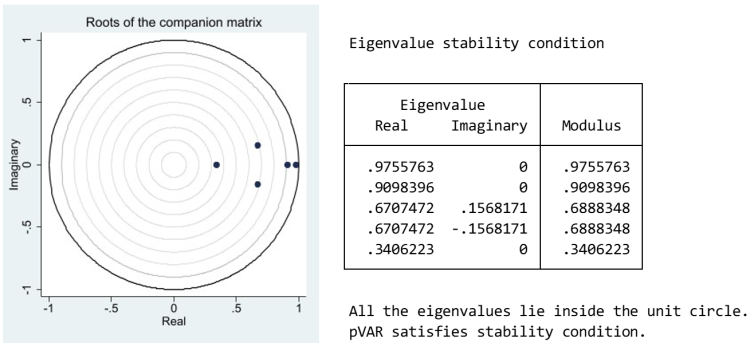
In the analysis of vector autoregressive models, it is necessary to examine the stability conditions of the model before analyzing the shock-response functions. The stability condition of the model is that all modules of the companion matrix are strictly smaller than one, and the inverse of the polynomial characteristic root of the estimated gap lies inside the unit circle. In the figure 1, the stability condition of the model is presented for the estimated model.

According to the Table 3 and figure 1, the unit roots of the estimated model lie inside the unit circle, and all matrix modules are smaller than one. Since the stability condition of the model is that all the modules of the companion matrix are strictly smaller than one, and the inverse of the unit root of the estimated gap polynomial lies inside the unit circle, therefore, the stability of the model is satisfied.
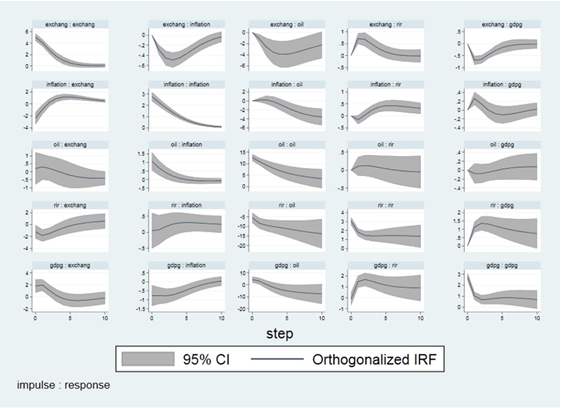
The impulse-response functions describe the reaction of one variable to the innovations in another variable in the system, while holding all other shocks equal to zero. The identifying assumption is that the variables that come earlier in the ordering affect the following variables contemporaneously, as well as with a lag, while the variables that come later affect the previous variables only with a lag. In other words, the variables that appear earlier in the systems are more exogenous and the ones that appear later are more endogenous.
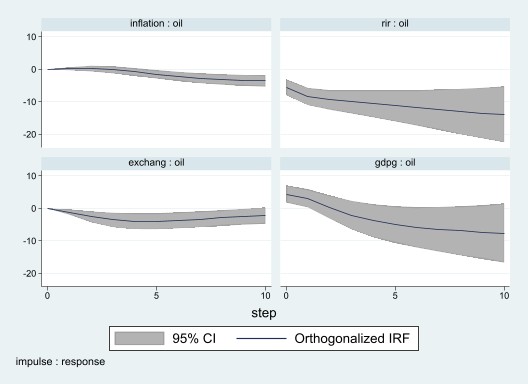
Impulse response functions and analysis of variance decomposition are used to interpret the coefficients in the vector autoregressive estimated models. Examining the impulse response functions is actually the study of the timing of the effect of shocks. In these functions, the effect of one standard deviation of oil price shock is investigated on other variables in the model. That is, what change would be made in the dependent variable of the model if a shock equal to one standard deviation is applied to the independent variables of the equation? In the following, the results of the oil price shock impulse response functions test are presented. In this figure, the horizontal axis shows the time, and the vertical axis shows the amount of deviation from the initial value.
As seen in the figure 2, the effect of the oil price shock on the economic growth rate and the interest rate is negative. The effect of oil price shock on inflation is first seen with a positive mild slope, and then it decreases a little, and the effect of this shock disappears after 8 periods. The effect of the oil price shock on the exchange rate is negative till fourth period, and is positive after that.
The negative effect of oil price shock on economic growth can be explained by government expenditure followed by investment. Although, higher oil price can benefit the OECD oil exporters economy by boosting revenues from oil exports, however considering global economic slowdown, the demand for oil from these oil exporters could be decreased and then negatively impact the GDP growth rate of these countries. Higher oil prices increase the cost of imports, leading to higher inflation. This can reduce the purchasing power of the currency. However, by improvement in the trade balance the exchange rate can be strengthened.
Inflationary pressure and reduced consumer spending in presence of oil price shock the lead lower GDP growth rate, will provide a situation for these countries to maintain or lower interest rate to stimulate the economy.

Another application of VAR models was proposed by Sims 24, which is known as innovation accounting (shocks). This term refers to tracking the reaction of the system to a shock (innovation) in one of the variables. In the study of the analysis of the variance decomposition of model variables, the variance of the prediction error is analyzed into elements that include the shocks of each variable. While impulse response functions indicate the reaction of an endogenous variable over time to the shock caused by another variable of the system, the analysis of variance decomposition measures the contribution of each shock to the variance of the endogenous variable of the system.

In other words, with the analysis of variance decomposition, the contribution of the variables in the model is determined from the changes of each variable over time. The results of the analysis of variance decomposition of oil price presented in the following tables
The results of the analysis of variance of the oil price show that the relative share of oil price shock is 76 percent in its own changes in the first period, and it decreases over time. In the first period, 76 percent of the error variance in oil price is explained by the variable itself, 14 percent by the interest rate, and 1 percent by the GDP growth. In the following periods, a decrease in the share of oil price, and an increase in the share of interest rate, inflation rate, and exchange rate can be seen from the analysis of variance decomposition in oil price. The share of GDP growth has a fluctuating trend with the analysis of variance decomposition of oil price.
This study examines the effect of oil price shocks on macroeconomic variables of major OECD oil-exporting countries. The study considered five OECD countries, Canada, Norway, Mexico, UK and the USA based on the availability of data collected from the World Development Indicator of the World Bank and OECD database over the period 1990-2022.The empirical model is estimated using Panel VAR (PVAR) analysis which includes the lag of the independent variables. According to the Impulse Response Functions (IRFs), the effect of the oil price shock on the economic growth rate and the interest rate is negative. The effect of oil price shock on inflation is positive at first, however after some periods it experiences decrease. The impact of this shock on the exchange rate is negative till fourth period, and is positive after that.
To manage the impact of oil price shock on the economy of the major OECD oil-exporting countries, this study recommends revenue management policies through stabilization funds and also interest rate adjustment based on inflation and GDP growth rate. That is raising rates may be necessary if inflation spikes, while lowering rates could support growth during economic slowdowns. Moreover, boosting investment in renewable energy can reduce long-term dependency on oil and shield the economy from future oil price shocks. Besides, allowing the exchange rate to float can help absorb external shocks, reducing the need for drastic monetary policy changes.
While this study provides valuable insights, it is not without limitations. The PVAR model assumes linear and symmetric relationships, which may not fully capture nonlinear dynamics or country-specific differences in shock transmission. Additionally, structural shifts associated with major global crises such as the 2008 financial crisis and the COVID-19 pandemic were not explicitly modeled. Future research could benefit from extending the model to incorporate such crisis effects and from exploring additional macroeconomic variables—such as unemployment, fiscal balances, and external accounts—for a more comprehensive policy analysis.
Moreover, expanding the country sample to include other major oil-exporting economies—particularly Gulf Cooperation Council (GCC) and OPEC member countries—could improve the generalizability and richness of the findings. However, limited and inconsistent access to long-term, reliable macroeconomic data for many of these countries poses a significant challenge, which is recognized as a limitation of the current study.
Overall, the findings support the importance of flexible and forward-looking macroeconomic policies in oil-exporting economies. Policymakers should focus not only on managing short-term volatility but also on strengthening long-term structural resilience through economic diversification, sound fiscal frameworks, and adaptive monetary strategies.
{1}. Using World Development Indicators (WDI, 2023); The Major Oil-exporting countries of OECD are: Canada, Norway, Mexico, UK, USA
| [1] | Hajebi, E., Razmi, S. M. J., Mahdavi Adeli, M. H. & Mohamadi, T. (2019). Effect of U.S. Monetary policy shock on GDP of oil-exporting countries: A GVAR Approach. Journal of Econometric Modelling, 4(4), 59-84. | ||
| In article | |||
| [2] | Kilian, L., & Murphy, D. (2014). The Role of Inventories and Speculative Trading in the Global Market for Crude Oil. Journal of Applied Econometrics, 29(3), 454-478. | ||
| In article | View Article | ||
| [3] | Hamilton, J., (1983),” Oil and the Macroeconomy since World War ii ", Journal of Political Economy, Vol. 91, PP. 228-248. 34- Hamilton, J., (2003),”What Is Oil Shock? Journal of Econometics, Vol. 113, PP. 363-398. | ||
| In article | View Article | ||
| [4] | Burbidge, J. & Harrison, A. (1984). Testing for the Effects of Oil-Price Rises Using Vector Autoregressions. International Economic Review 25(2). Pp. 459-484. | ||
| In article | View Article | ||
| [5] | Mork, J. F., (1994), “Oil and Macroeconomy When Price Goes Up and Down; An Extension of Hamilton Results”, Journal of Political Economic, Vol. 94. | ||
| In article | |||
| [6] | Rodriguez, F, and J.D. Sachs., (1999), “Why Do Resource Abundant Economies Grow More Slowly? A New Explanation and an Application to Venezuela”, Journal of Economic Growth, Vol. 4, PP. 277-303. | ||
| In article | View Article | ||
| [7] | Berument, H. & Ceylan, N.B. (2010), “The impact of oil price shocks on the economic growth of the selected MENA countries. The Energy Journal, 31(1), 149-176. | ||
| In article | View Article | ||
| [8] | Galesi, A., & Lombardi, M. (2009). External Shocks and International Inflation Linkages: AGlobal VAR Analysis. Eurosystem, 1-45. | ||
| In article | View Article | ||
| [9] | Baumeister, C., & Peersman, G. (2013a). The Role of Time-Varying Price Elasticities in Accounting for Volatility Changes in the Crude Oil Market. Journal of Applied Econometrics, 27(8), 1087- 1109. | ||
| In article | View Article | ||
| [10] | Cashin, P., Mohaddes, K., Raissi, M., & Raissi, M. (2014). The Differential Effects of Oil Demand and Supply Shocks on the global Economy. Energy Economics, (44), 113-134. | ||
| In article | View Article | ||
| [11] | Akinlo, T., & Apanisile, O.T., (2015). The Impact of Volatility of Oil Price on the Economic Growth in Sub-Saharan Africa. Journal of Economics, Management and Trade. 5(3). | ||
| In article | View Article PubMed | ||
| [12] | Plante, M. & Traum, N. (2012). Time-Varying Oil Price Volatility and Macroeconomic Aggregates. Center for Applied Economics and Policy Research Working Paper.002. | ||
| In article | View Article | ||
| [13] | Mohaddes, K., & Raissi, M. (2018). The U.S. Oil Supply Revolution and the global Economy. Empirical Economics, 1-32. | ||
| In article | |||
| [14] | Iacoviello, M., & Navarro, G. (2018). Foreign Effects of Higher U.S. Interest Rates. Journal of International Money and Finance, (30), 10-25. | ||
| In article | |||
| [15] | Mohaddes, K., Raisi, M., & Sarangi, N. (2019). Macroeconomic Effects of Global Shocks in the GCC: Evidence from Saudi Arabia. United Nations, Beirut. E/ESCWA/EDID/2019/WP.15. | ||
| In article | |||
| [16] | Omolade, A., Ngalawa, H., & Kutu, A. (2019) Crude oil price shocks and macroeconomic performance in Africa’s oil-producing countries, Cogent Economics & Finance, 7:1, 1607431. | ||
| In article | View Article | ||
| [17] | Hajebi, E. & Mohammadi, T. (2022). The Impact of Oil Price Shocks on the Macroeconomic Variables of Major Oil Exporting Countries: A GVAR Approach. International Journal of Management, Accounting and Economics. 9(4). | ||
| In article | |||
| [18] | Deyshappriya, N.P.R.; Rukshan, I.A.D.D.W. & Padmakanthi, N.P.D. (2023). Impact of Oil Price on Economic Growth of OECD Countries: A Dynamic Panel Data Analysis. Sustainability. 15, 4888. | ||
| In article | View Article | ||
| [19] | Esfahani, H.S., Mohaddes, K., & Pesaran, M.H. (2014). An Empirical Growth Model for Major Oil Exporters. Journal of Applied Econometrics. 29(1). Pp. 1-21. | ||
| In article | View Article | ||
| [20] | Hamilton, J. (2013). Historical Oil Shocks. Handbook of Major Events in Economic History, 239-265. | ||
| In article | |||
| [21] | World Bank, World Development Indicators, 2023. https:// databank.worldbank.org/source/world-development-indicators. | ||
| In article | |||
| [22] | Noferesti, M. Unit Root and Cointegration in Econometrics. Rasa Cultural Service Institute, Tehran, 1999. | ||
| In article | |||
| [23] | Pedroni, P. (2004). Panel Cointegration: Asymptotic and Finite Sample Properties of Pooled Time Series Tests with an Application to the PPP Hypothesis. Econometrics Theory. 3. Pp. 579-625. | ||
| In article | View Article | ||
| [24] | Sims, C.A., (1980). Macroeconomics and Reality. Econometrica. 48(1). Pp. 1-48. | ||
| In article | View Article | ||
Published with license by Science and Education Publishing, Copyright © 2025 Elnaz Hajebi and S. Yaser Samadi
 This work is licensed under a Creative Commons Attribution 4.0 International License. To view a copy of this license, visit
http://creativecommons.org/licenses/by/4.0/
This work is licensed under a Creative Commons Attribution 4.0 International License. To view a copy of this license, visit
http://creativecommons.org/licenses/by/4.0/
| [1] | Hajebi, E., Razmi, S. M. J., Mahdavi Adeli, M. H. & Mohamadi, T. (2019). Effect of U.S. Monetary policy shock on GDP of oil-exporting countries: A GVAR Approach. Journal of Econometric Modelling, 4(4), 59-84. | ||
| In article | |||
| [2] | Kilian, L., & Murphy, D. (2014). The Role of Inventories and Speculative Trading in the Global Market for Crude Oil. Journal of Applied Econometrics, 29(3), 454-478. | ||
| In article | View Article | ||
| [3] | Hamilton, J., (1983),” Oil and the Macroeconomy since World War ii ", Journal of Political Economy, Vol. 91, PP. 228-248. 34- Hamilton, J., (2003),”What Is Oil Shock? Journal of Econometics, Vol. 113, PP. 363-398. | ||
| In article | View Article | ||
| [4] | Burbidge, J. & Harrison, A. (1984). Testing for the Effects of Oil-Price Rises Using Vector Autoregressions. International Economic Review 25(2). Pp. 459-484. | ||
| In article | View Article | ||
| [5] | Mork, J. F., (1994), “Oil and Macroeconomy When Price Goes Up and Down; An Extension of Hamilton Results”, Journal of Political Economic, Vol. 94. | ||
| In article | |||
| [6] | Rodriguez, F, and J.D. Sachs., (1999), “Why Do Resource Abundant Economies Grow More Slowly? A New Explanation and an Application to Venezuela”, Journal of Economic Growth, Vol. 4, PP. 277-303. | ||
| In article | View Article | ||
| [7] | Berument, H. & Ceylan, N.B. (2010), “The impact of oil price shocks on the economic growth of the selected MENA countries. The Energy Journal, 31(1), 149-176. | ||
| In article | View Article | ||
| [8] | Galesi, A., & Lombardi, M. (2009). External Shocks and International Inflation Linkages: AGlobal VAR Analysis. Eurosystem, 1-45. | ||
| In article | View Article | ||
| [9] | Baumeister, C., & Peersman, G. (2013a). The Role of Time-Varying Price Elasticities in Accounting for Volatility Changes in the Crude Oil Market. Journal of Applied Econometrics, 27(8), 1087- 1109. | ||
| In article | View Article | ||
| [10] | Cashin, P., Mohaddes, K., Raissi, M., & Raissi, M. (2014). The Differential Effects of Oil Demand and Supply Shocks on the global Economy. Energy Economics, (44), 113-134. | ||
| In article | View Article | ||
| [11] | Akinlo, T., & Apanisile, O.T., (2015). The Impact of Volatility of Oil Price on the Economic Growth in Sub-Saharan Africa. Journal of Economics, Management and Trade. 5(3). | ||
| In article | View Article PubMed | ||
| [12] | Plante, M. & Traum, N. (2012). Time-Varying Oil Price Volatility and Macroeconomic Aggregates. Center for Applied Economics and Policy Research Working Paper.002. | ||
| In article | View Article | ||
| [13] | Mohaddes, K., & Raissi, M. (2018). The U.S. Oil Supply Revolution and the global Economy. Empirical Economics, 1-32. | ||
| In article | |||
| [14] | Iacoviello, M., & Navarro, G. (2018). Foreign Effects of Higher U.S. Interest Rates. Journal of International Money and Finance, (30), 10-25. | ||
| In article | |||
| [15] | Mohaddes, K., Raisi, M., & Sarangi, N. (2019). Macroeconomic Effects of Global Shocks in the GCC: Evidence from Saudi Arabia. United Nations, Beirut. E/ESCWA/EDID/2019/WP.15. | ||
| In article | |||
| [16] | Omolade, A., Ngalawa, H., & Kutu, A. (2019) Crude oil price shocks and macroeconomic performance in Africa’s oil-producing countries, Cogent Economics & Finance, 7:1, 1607431. | ||
| In article | View Article | ||
| [17] | Hajebi, E. & Mohammadi, T. (2022). The Impact of Oil Price Shocks on the Macroeconomic Variables of Major Oil Exporting Countries: A GVAR Approach. International Journal of Management, Accounting and Economics. 9(4). | ||
| In article | |||
| [18] | Deyshappriya, N.P.R.; Rukshan, I.A.D.D.W. & Padmakanthi, N.P.D. (2023). Impact of Oil Price on Economic Growth of OECD Countries: A Dynamic Panel Data Analysis. Sustainability. 15, 4888. | ||
| In article | View Article | ||
| [19] | Esfahani, H.S., Mohaddes, K., & Pesaran, M.H. (2014). An Empirical Growth Model for Major Oil Exporters. Journal of Applied Econometrics. 29(1). Pp. 1-21. | ||
| In article | View Article | ||
| [20] | Hamilton, J. (2013). Historical Oil Shocks. Handbook of Major Events in Economic History, 239-265. | ||
| In article | |||
| [21] | World Bank, World Development Indicators, 2023. https:// databank.worldbank.org/source/world-development-indicators. | ||
| In article | |||
| [22] | Noferesti, M. Unit Root and Cointegration in Econometrics. Rasa Cultural Service Institute, Tehran, 1999. | ||
| In article | |||
| [23] | Pedroni, P. (2004). Panel Cointegration: Asymptotic and Finite Sample Properties of Pooled Time Series Tests with an Application to the PPP Hypothesis. Econometrics Theory. 3. Pp. 579-625. | ||
| In article | View Article | ||
| [24] | Sims, C.A., (1980). Macroeconomics and Reality. Econometrica. 48(1). Pp. 1-48. | ||
| In article | View Article | ||