The behaviour of loan officers is affected by various cognitive biases mentioned in literature. They are inherent with the loan officer’s decision to grant a loan. We examine four cognitive biases using a sample 47 loan officers of microfinance institutions. we use multiple regressions to examine the effects of four types of cognitive biases on the loan officer’s decision to grant loans. The results show that Prior hypotheses bias, escalating commitment, reasoning by analogy and illusion of control all have significant effects on the decision of the loan officer to grant loans. We suggest that loan officers should consider the possibility of these cognitive biases interfering in their decision making process and awaken their consciences with regards to them when taking the decision to grant a loan.
The role played by SMEs in the creation of jobs and economic development is known both in developing and industrialised nations. In Cameroon and other Sub-Saharan African countries SMEs constitute the basis of the economy. They are considered as a strategic tool of economic and social development 1 and more than 70% of the rural population in Africa works either formally or informally in SMEs. Despite the contribution f SMEs to the economy of countries access to bank financing remains an important challenge 2, 3. The difficulties faced by SMEs to access bank loans could be attributed to the insufficient information given to banks 3, 4. In fact, banks always face the problem of information asymmetry when dealing with SMEs which leads to credit rationing 5. Credit rationing is when those who are creditworthy do not get loans from the bank. The obstacles faced by SME to access financing have always been a major issue of debate in economic literature and politics. In order to have an insight on the bank financing difficulties of SME it is imperative to examine the factors that influence the loan granting decisions of the banker/loan officer. Some studies suggest that bankers are very sensitive to the personality of the owner/manager of the SME 6, 7 since it is a determining element in entrepreneurial success. To the best of our knowledge no study has examined cognitive bias as a factor that could affect access to finance by SMEs. It is in this light that we want to examine cognitive biases as a factor that influences the decision to grant loans in MFIs. In most developing countries financial institutions are reluctant to grant loans to small and medium sized enterprises since they do not often have prepared financial statements and credit history. Formal access to loans by SMEs is mostly obstructed by the collateral requirement in the conventional financing sector and this can be attributed to the size of the SMEs and age, lack of business strategy, collateral, financial information, bank requirement as well as the owner-manager’s level of education and business experience 8. Information asymmetry also affects SMEs access to loans. Loans from financial institutions remain one of the essentials ways of dealing with the issue of access to finance by SMEs. Access to loan is affected by information asymmetry 9. Most studies examine SMEs access to loans from the perspective of the characteristics of the loan and the firm but this study attempts to examine the loan officer characteristic and its effect on the decision to grant loans to SMEs. One of such characteristics are the cognitive biases embedded in the behaviour of the loan officer. In this perspective, Forbeneh A. J. et al. 10 examined the primary issue causing commercial banks to lend to SMEs with the help of interviews with loan officers using a verbal protocol analysis and the results suggests that confidence is the paramount issue urging commercial banks to grant loans to SMEs. Behavioural biases are often ignored that is the tendency to reason in certain ways that can lead to systematic errors or deviations from a standard of rationality or good judgment in thinking or reasoning 11.
Evidence and explanation proposed in the theory of bounded rationality explain that individuals are not always able to obtain all the relevant information, which is required to make possible decisions 12.
Cognitive biases are an essential ingredient in the decision making process. A better understanding of how biases influence the decision making process should help managers be more effective in achieving their goals. There has been growing recognition of the importance of cognitive biases in decision making.
According to behavioral finance, individuals behave according to cognitive bias in the decision process 12, 13. The concept of cognitive bias can be explained as deterioration in the way individuals perceive reality 14.
However, little effort has been made to integrate cognitive biases to various types of decision making beyond the early attempts by Lyles and Thomas 15 to study biases in problem formulation. In fact many scholars assume that some cognitive biases are strong tendencies that are present in various situations. Funda Civek 16 also examined the effects of investor’s cognitive biases on stock investment decisions and suggests that investors are not fully rational. Within the scope of irrational act of investors, the ability to select stocks has been illusory. It is in this light that this paper seeks to examine the effects of cognitive biases on the decision of loan offers to grant loans to SMEs in Cameroon. Many studies have examined the obstacles faced by SMEs in having access to loans in Cameroon but no study has examined the influence of cognitive biases of loans officers as an obstacle to loan access by SMEs despite the existence of several studies on the effects of cognitive biases on decision making.
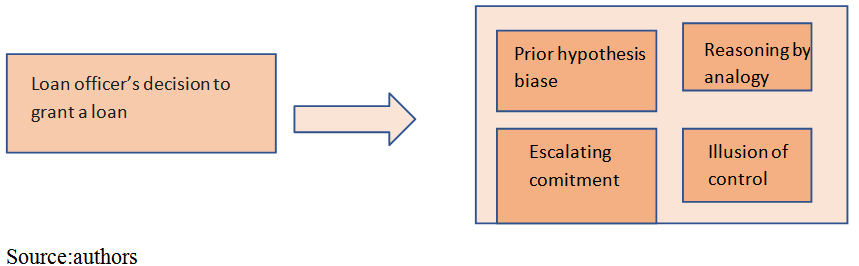
The rationality of loan officers in taking the decision to grant loans to SME is bounded by their own cognitive capabilities. They are not super humans it is difficult for them to absorb and process all the information provided to them by the firm effectively and as such they may tend to fall back on certain rules of thumb or heuristics when making the decision to grant loans. Many of those rules of thumbs are actually quite useful since they may help them to make sense out of a complex and uncertain world. However, sometimes they may make severe and systematic errors in the decision making process. These systematic errors seem to emanate from a series of cognitive biases in the way human decision makers process information and take decisions. Because of cognitive biases many loan officers/managers may end up making poor decisions and deteriorate the loan portfolio of the bank. There are five well-known cognitive biases. These biases have been verified repeatedly in laboratory settings so we can reasonably be sure that loan officers/bankers are prone to them. The prior hypothesis bias refers to the fact that the loan officers who have prior believes about the relationship between two variables then to make decisions on the basis of these beliefs even when presented with evidence that their beliefs are wrong. For example They tend to seek and use information that is consistent with their previous beliefs while ignoring information that contradicts the beliefs. This suggest that a banker who has a strong prior belief that a firms that does not fulfills certain conditions should not be granted a loan will reject the loan application of the firm despite evidence that the firm is trustworthy.
When a banker/loan officer has committed significant resources in assessing the loan file of a firm they may tend to commit more resources when they receive feedback that the firm is not credit worthy. This can be referred to as escalating commitment. This may be an irrational response and a more logical response would be to reject the loan application and focus on other application files rather than escalate commitments. Feelings of personal achievement might induce loan officers to stick to a particular loan application file despite evidence that the firm is not credit worthy.
Loan officers can also use simple analogies to make sense out of the information provided to them in the loan file. This form of bias is known as reasoning by analogy. For instance they may believe that since borrowers with given characteristics have not defaulted in the past then those who possess those characteristics today should also be credit worthy. The bias of representativeness arises when the loan officer in taking the decision to grant a loan by generalising from a small sample or even a single vivid anecdote.
The loan officer may equally overestimate his ability to control the post ante events when deciding to grant the loan. This may occur when the experience and seniority of the loan officer makes them to be overconfident about their ability to succeed. According to Richard Roll such overconfidence leads to what he has termed hubris hypothesis of takeover. He argues that senior experienced officers are overconfident about their ability to create value. This cognitive bias is referred to as illusion of control. The behavioural aspects that are taken into consideration while making decisions to grant loans are based on the limits of the arbitrage of loan officers.

There is an increasing interest in the research community to explore this emerging topic of behavioural finance 17.Many authors have identified the role of behavioural biases in decision making 18, 19, 20. The award of the Nobel Prize of economics to Richard Thaler arouse interest in behavioural finance. Despite the infancy of behavioural finance, there have been findings during the last 50 years. It represents a focus on problems of economic theory that result from the assumption of rationality. Publications on prospect theory and the replacement of behavioral economics with expected utility theory can be mentioned as the origin of behavioral finance. Prospect theory brought cognitive shortcuts, heuristics, and their substantial impact on the decision-making process. It contains three basic components as reference points: probability weighting, loss aversion and reduction of sensitivity. According to research by Statesman 21, in the field of behavioral finance, people critically underestimate probabilities and their objective value. Individuals arguably place extra emphasis on low probabilities but underweight high chances. Conventional finance has made progress within the framework of rational choice and expected benefit assumptions while behavioral finance is based on expectation theory 16 Thus in this study we focus on psychological and emotional biases given that human beings are usually imperfect and these biases are present in most of us.
According to authors such as Corr et al. 22, Thaler 23, and Tversky & Kahneman 23, behavioral economics focuses on understanding human psychology and particularly why people deviate from rational actions when they make decisions. The researchers confirm that many people are inclined to choose an option that brings instant pleasure rather than the one which will beget long-term satisfaction at the expense of short-term gratification. Using behavioral economics, individuals and institutions can take advantage of this to manipulate individuals and groups into a specific course of action or purchase. Behavioral economics, which combines ideas from psychology and economics, provides valuable insights regarding the fact that individuals are not always behaving in their best interest. A knowledge mix from judgment and decision making research is created in order to inform realistic assumptions about the thoughts, feelings and actions of individuals. A more cynical view is that behavioral economics is just repackaged psychology couched in terms more amenable to economics, but not “true” psychology, which is held in high regard. Samal and Mohapatra 24 studied the impact of behavioural biases on the investment decisions of risk-averse investors and they found that respondents have a similar perception of availability bias, representativeness and emotional contagion, while the other four factors herding, informational cascades, anchoring and overconfidence, showed significant discrimination in investment decisionmaking between the two groups of investors. The most discriminatory factor for investor groups identified was herding.
As presented by Kaustia 25, Chataway 26 and Bollen et al. 27, there is also a clear correlation between financial decision making and behavioral factors that should also be taken into account in the process of investment. To predict future stock prices and their changes based on publicly available information is not possible in an efficient market. Many early violations of this principle had no explicit link to behavior. So it was reported that small firms and “value firms” (those with a low price to earnings ratio) earned higher returns than other stocks with the same risk. These authors found in their work that some customers and investors were more likely to sell a stock that had increased value than one that had decreased. There is a field in finance in which a behavioral approach was least likely to succeed. The savings had to be the most promising. The standard life cycle model of savings abstracts from both bounded rationality and bounded willpower, but savings is both a complex cognitive problem and a difficult self-control problem. So, it is less surprising that a behavioral approach has been valuable here. Bollen et al. 27 and Shotton 12 confirmed that behavioral finance is focused on the influence of psychology on the behavior of managers, investors and financial analysts. It includes the subsequent effect on the markets, and it focuses on the fact that managers and investors are not always rational, have limits to their self-control, and are influenced by their own biases. Psychological and sociological factors have a great effect on the financial decision-making of managers. Sometimes, they are highly optimistic and self-confident during solving particular projects within teamwork. Their higher optimism can lead to wrong and irrational decisions. It is typical for behavioral finance that it enables us to learn from mistakes and experiences. Managers in various managerial levels can be influenced by their own optimism, and further, they can over-estimate particular future incidents. As it is a well-known fact, self-confidence can lead to mistakes and errors in decision-making, and highly self-confident managers tend to underestimate the risk of future results 28.
Baig, Umair, Batool Muhammad Hussain, Vida Davidaviciene, and Ieva Meidute Kavaliauskiene 29 explore the investment behavior of female entrepreneurs as the newcompetitor in the investment field and to determine the underlying factors that influence their investment attitudes. The study revealed that female entrepreneurs are not inclined to take risk in their business for investment decisions, they are somewhat conservative and risk averse. Kappal and Rastogi 30 also argued that individual investment behavior is affected by personality, gender difference, socio-economic environment, attitudes, myths, and other demographic information. Bikas, Egidijus, and Evelina Glinskyte 31, 32 identify and evaluate the financial factors influencing the investment behaviour of Lithuanian companies. Out of 26 Lithuanian companies listed on this stock exchange, 16 were selected whose activities are not related to financial instruments. The results provided strong evidence that a company’s financial assets have a positive impact on capital and overall profitability, i.e., Lithuanian companies with higher profitability invest in financial instruments more often, while companies with borrowed funds and with higher financial restrictions invest less. The study showed that the performance indicators of Lithuanian companies have a weak impact on the size of the company’s financial assets; therefore, it can be assumed that this is related to cognitive factors and heuristics. How ever the biases examined in this study are some of the major pitfall of strategic decision making and the decision to grant loans is a strategic decision in lending institutions.
In this study we use a cross sectional research design to examine the impact of cognitive biases on the decision of the loan officer to grant loans. A cross sectional study is a study design that is conducted within a short period at a particular point in time. This method was used by the researchers to study the characteristics of interest at a particular point in time 33.
4.2. Population and Sample Size of the Study34 indicates that population of a study is the full set of cases from which a sample is taken. The population of the study is made up of loan officers of microfinance institutions. As it is often impossible and generally accepted that the entire population of a study cannot be studied. In this regard, the researchers used both purposive and convenient sampling techniques to select fifty-one (51) loan officers as the sample size of the study.
4.3. Data Source and Method of Data CollectionThe data for this stud was collected using a comprehensive questionnaire designed to cover the objectives of the study was used to collect the data. The questionnaire was structured into four sections. The first section was aimed at obtaining demographics data about the respondents. Section B of the questionnaire focuses on the roles of cognitive biases. The third section examines the role of cognitive biases in the loan granting process of MFIs. The final section was to assess the Questionnaire was used to obtain data from the loan officers of MFIs.
Methods of Data Analysis
The questionnaires, which were administered to the respondents, were tabulated and data analyzed using descriptive, inferential and quantitative analytical techniques with estimations from the Gnu Regression,
Statistical tools such as frequency distribution tables were employed in analyzing the questionnaire. This study used the ordinary least squares multiple regression econometric model in estimating the study. The multiple regression model is specified as follows:
 |
Where LGD indicates the decision to grant a loan by loan officer; PH represents prior hypothesis biase, EC denotes the escalating commitment of loan officer in the loan granting process, RA also represents the reasoning by analogy, and IC is the illusion of control in the loan granting decision  represents the coefficients of the independent variables, and is the constant term and the explains the error term of the model.
The socio-economic demographic characteristics of the loan officers are summarized in Table 1.
Out of the 51 sample size, the statistics shown in table 1 below indicates that 35% of the respondents were females as against 65% of males. This indicates men dominate the manufacturing firms as compared to women.
The study explored the educational background of respondents and out of 51 respondents’ sampled, table 1 below identified majority of 45% respondent’s as master degree graduates. Other certificate holders followed with 37% and respondents with first degree certificate were 18%. This result indicates that there are more educated workers in the manufacturing sector.
Out of the 51 respondents, 14% of respondents indicated that they have been working with the MFI for the past 10 years and same to those less than a year. 39% of another group indicated that have been working with the firm between 1-4 years whilst 33% of the rest respondents claimed to have been in the institution for 5-10 years. Refer to table 1 below.
With respect to the 51 respondents, 2% of respondents indicated that the MFI have been in operation between 1-4years now. 39% of another group indicated that the firm has been operating between 5-10 years whilst 59%of the respondents claimed that the MFI has been in business for over 10 years. Refer to table 1 below.
The study examines the effects of cognitive biases on the loan officer’s decision to grant loans in Cameroon. With regards to this effect, loan officers were questioned to rate on weighting levels which are strongly agree, agree, neutral, disagree, and strongly disagree, for each statement. The statistical analysis results from Table 2 present responses on the effects of cognitive biases. It has been deduced that cognitive biases influence the loan officer’s decision to grant loan. Most loan officers believe that borrowers with similar characteristics may have the same behavior (prior hypothesis bias)
The decision of the loan officer sometimes integrates prior hypothesis bias (X = 1.68).
Implying that most of the respondents indicated that prior hypothesis bias sometimes influence the decision to grant loans in MFIs. Most loan officers believe that loan applicants with similar traits are likely to behave the same, few (SD= 0.579) disagree with the statement.
Also, respondents with a mean of 1.74 admitted to the fact that they were sometimes ignorant about the negative feedback from the loan applicant when taking the decision to grant a loan whereas a small portion (SD=0.63) disagree. The respondents also highly agreed (X = 1.91) to the fact that they sometimes compare loan applicant with previous borrowers with similar characteristics when deciding to grant loans whereas a small portion (SD=0.806) disagree.
Respondents further recognized (X =1.7) the fact that they sometimes consider their past experience as loan officer when deciding to grant loans. Cognitive biases distort the benchmark for the decision to grant loans.
5.3. Results and DiscussionAnalysis of Variance (ANOVA)
This analysis is caied out to determine the fitness of the regression model using f-statistics and the results for the analysis of variance are presented in table below
Considering the p-value (0.000) of the F-statistics (1015.43), the multiple regressions were found to be significant at 5%. This implies that there is enough evidence to reject the null hypothesis that model does not fit well for the data. This indicates that the model fits well with the data used in the study.
The relationship between cognitive biases and the decision to grant loans
This study examines the effects of cognitive bias on the decision to grant loans in MFIs. The testing of the relation ship between, Prior hypothesis bias, Escalating commitments, reasoning by analogy and illusion of control and the decision to grant loans in MFIs in Cameroon was done using the estimation of the Pearson correlation coefficients. From the table below it is seen that all the variables have the correlation coefficient above (r=0.970) and are all significant (Sig=0.000; p which implies that there is a strong positive relationship between the variables Prior hypothesis bias, escalating commitment, reasoning by analogy and illusion of control and the decision to grant loans to small businesses by MFIs in Cameroon. The test indicates that the relationship between the variables is positive showing that any 1% significant positive or negative changes in the level of prior hypothesis biases, escalating commitment, reasoning by analogy and illusion of control will lead to a corresponding 1% significant change in the decision of MFIs in Cameroon to grant loans to small businesses in Cameroon.
The study found that cognitive biases sometimes play a role in the decision to grant loans in MFIs. The multiple regressions were found to be significant at 5% thus the model fits well with the data of the study. The variables have a correlation above (r= 0.970) and are all significant showing that there is a strong positive relationship between the variables prior hypotheses biase, escalating commitment, reasoning by analogy and illusion of control and the decision to grant loans.
It equally reveals that 0.989 per cent variability of cognitive biases explained by the decision to grant loans by R² = 0.902. The findings also show that prior hypothesis bias, escalating commitment, reasoning by analogy and illusion of control play a vital role and have a positive effect on the decision of MFIs to grant loans.
This study examines the effects of cognitive biases on the decision to grant loans in MFIs in Cameroon. Based on the data collected and the findings obtained. Multiple regression was t\used to analyse the data collected and the results show that there is a strong positive relationship between the variables prior hypotheses bias, escalating commitment, reasoning by analogy and illusion of control and the decision to grant loans. The study concludes that the four cognitive biases that is prior hypothesis bias, escalating commitment, reasoning by analogy and illusion of control play an important role and equally has a positive effect on the decision to grant loans in microfinance institutions. It also concludes that 0.989 variability of congitive biases is explained by the decision to grant loans as indicated by R² = 0.989. The study also suggests that there is a strong positive correlation between cognitive biases and the decision to grant loans. Loan officers should get information from multiple perspectives and cross-referencing data to avoid reliance on biases. They should evaluate their skills and knowledge objectively so as to reduce biases.Behavioural biases play an important role in the decision to grant loans, Thus loan officers and managers should understand and correct them.
This questionaire will be used only for research purposes with the aim of understanding the effects of the behaviour of loan officers/managers on the decision to grant loans. The information provided is strictly for academic purpose.
A-Information about respondent Tick [√] the correct answer1. What is your gender? Male [ ] Female [ ]
2. What is your level of education
Bachelor degree [ ] Masters [ ] Others [ ]
3. How long have you been working with the institution ?
Less than 1 year [ ] 1 to 4 Years [ ] 5 to 10 years [ ] 10 years and above [ ]
4. What is the position you occupy in the institution ?
Loan officer [ ] Branch Manager [ ]
5. Your institution has been existing for how many years ?
1 to 4 years [ ] 5 to 10 years [ ] Above 10 years [ ]
B-Information about the effect of behavioural biases in decision makingTo what extent do you usually realise the following affect your decisions when you arbitrage to grant loans to SMEs.
Respond by ticking [√] the correct answer
SA = Strongly agree , A= Agree , N = Neutral, D= Disagree , SD= Strongly disagree

| [1] | Wamba, H. (2001). L'impact de l'asymmétrie d'information dans l'optimisation de la valeur de l'entreprise: exemple de la PME camerounaise. SCSE, Montréal. | ||
| In article | |||
| [2] | Collier, P. (2009). Repenser le financement des petites entreprises en Afrique. La Revue Proparco, 1, 3-5. | ||
| In article | |||
| [3] | Van Pham, T.H., Audet, 1. and St-Pierre, l. (2009). Les déterminants de l’accès au financement bancaire des PME dans un pays en transition: le cas du Vietnam. Communication présentée lors des Ile journées scientifiques du Réseau Entrepreneuriat. INRPME-AUF-AIREPME, Trois-Rivières, 27 au 29 mai 2009. | ||
| In article | |||
| [4] | Bruns, V. and Fletcher, M. (2008). Banks 'risk assessment of Swedish SMEs. Venture Capital, 10(2), 171-194. | ||
| In article | View Article | ||
| [5] | Alexandre, H. and Buisson, H. (2010). L'impact de la crise sur le rationnement du credit des PME françaises. Cahier de recherche de DRM n02010-06. | ||
| In article | |||
| [6] | Gartner w. b. (1988). ‘’Who is an entrepreneur?’’ is the wrong question, American journal of small business, Vol. 12, No. 4p.p11-31. | ||
| In article | View Article | ||
| [7] | Cooper A. (1993)… Challenges in predicting new firm performance, Journal of Business Venturing, Vol.8 pp. 243 | ||
| In article | View Article | ||
| [8] | Abdesamed, K. H., and Wahab K. A., ( 2014). Financing of small and medium sized enterprises (SMEs) in Libya: Determinants of accessing bank loans. Middle East Journal of scientific Research, 21, 113-122. | ||
| In article | |||
| [9] | Petersen M. A. and Rajan R. G.(1994). The benefits of lending relationships: Evidence from small business data. The Journal of Finance, 49(1), 3-37. | ||
| In article | View Article | ||
| [10] | Forbeneh Agha Jude, Chi Collins Penn and Ntieche Adamou (2018). Financing of Small and Medium-Sized Enterprises: A Supply-Side Approach Based on the Lending decision of Commercial banks. Volume 4, Issue 3, p.131-143, September-December 2018. | ||
| In article | View Article | ||
| [11] | Shefrin, H. (2006). Behavioral Corporate Finance. McGraw-Hill. | ||
| In article | |||
| [12] | Kinoshita, K., Suzuki, K., & Shimokawa, T. (2013). Evolutionary foundation of bounded rationality in a financial market. IEEE Transactions on Evolutionary Computation, 17(4), 528-544. | ||
| In article | View Article | ||
| [13] | Shotton, R. (2018). The Choice Factory: 25 behavioural biases that influence what we buy. London: Harriman House. | ||
| In article | |||
| [14] | Aksoy, E. (2016) Irrational Investor Behavior and Cognitive Biases Effective in Decision Making: ISEExample, (MasterThesis). Istanbul University Institute of Social Sciences, Istanbul. | ||
| In article | |||
| [15] | Tekin, B., 2018. Behavioral finance' as the human dimension of finance in the context of cognitive bias and hristristic: a literature review and compilation. International Journal of Human Studies, 1(2), 35-62. | ||
| In article | View Article | ||
| [16] | Lyles M. A. and Thomas H. (1988). ‘Strategic problem formulation: biases and assumptions embedded in alternative decision making models’’ Journal of Management studies. 25, 131-45. | ||
| In article | View Article | ||
| [17] | Civek, Funda (2019). The Effect Of Investors’ Cognitive Bias On Stock Decision Making. Quantrade Journal of Complex Systems in Social Sciences, 1 (1), 13-21. Retrieved from https:// dergipark.org.tr/ tr/pub/quantrade/issue/49567/635651. | ||
| In article | |||
| [18] | Ranjana Upashi1, A.M. Kadakol(2023).Impact of Behavioral Biases on Investment Decision Making: Evidence from the Review of Literature.Abhigyān Management Journal From FORE Print ISSN: 0970-2385 Electronic ISSN: 2583-1445 Volume 41. | ||
| In article | View Article | ||
| [19] | Dangi, M., & Kohli, B. (2018). Role of behavioral biases in investment decisions: A factor analysis. Indian Journal of Finance, 12(3), 43-57. | ||
| In article | View Article | ||
| [20] | Chhapraa, I. U., Kashifa, M., Rehanb, R., & Baia, A. (2018). An empirical investigation of investor’s behavioral biases on financial decision making. Asian Journal of Empirical Research, 8(3), 99-109. | ||
| In article | View Article | ||
| [21] | Jain, J., Walia, N., & Gupta, S. (2019). Evaluation of behavioral biases affecting investment decision making of individual equity investors by fuzzy analytic hierarchy process. Review of Behavioral Finance, 12(3), 297-314. | ||
| In article | View Article | ||
| [22] | Statman, M., Fisher, K. L., & Anginer, D. (2008). Affect in a Behavioral Asset-Pricing Model. Financial Analysts Journal, 64 (2), 20–29. | ||
| In article | View Article | ||
| [23] | Corr, P. A. & Plagnol, A. (2018). Behavioral Economics: The Basics. London: Routledge. | ||
| In article | View Article | ||
| [24] | Thaler, R. H. (2015). Misbehaving: The Making of Behavioral Economics. New York: W. W. Norton & Company Tversky, A., & Kahneman, D. (1981). The framing of decisions and the psychology of choice. Science, 211 (4481), 453–458. | ||
| In article | View Article PubMed | ||
| [25] | Samal, A., & Mohapatra, A. K. (2020). Impact of behavioral biases on investment decisions: A study on selected risk averse investors in India. International Journal of Advanced Science and Technology, 29(6), 2408-2425. | ||
| In article | |||
| [26] | Kaustia, M., Alho, E., & Puttonen, V. (2008). How much does expertise reduce behavioral biases? The chase of anchoring effects in stock return estimates. Financial Management, 37, 391–412. | ||
| In article | View Article | ||
| [27] | Chataway, R. (2020). The Behaviour Business: How to apply behavioural science for business success. London: Harriman House. | ||
| In article | |||
| [28] | Bollen, K., Cacioppo, J., Kaplan, R., Krosnic, J. A., & Olds, J. L. (2015). Social, Behavioral and Economic Sciences Perspectives on Robust and Reliable Science. Retrieved July 14, 2020 from https://www.nsf.gov/sbe/AC. | ||
| In article | |||
| [29] | Baker, H. K., & Nofsinger, J. R. (2010). Behavioral Finance: Investors, Corporations and Markets. Hoboken, New Jersey: John Wiley and Sons. | ||
| In article | View Article | ||
| [30] | Baig, Umair, Batool Muhammad Hussain, Vida Davidaviciene, and Ieva Meidute Kavaliauskiene. (2021). Exploring Investment Behavior of Women Entrepreneur: Some Future Directions. International Journal of Financial Studies 9: 20. | ||
| In article | View Article | ||
| [31] | Kappal, Jyoti M., and Shailesh Rastogi. (2020). Investment behaviour of women entrepreneurs. Qualitative Research in Financial Markets. [CrossRef]. | ||
| In article | View Article | ||
| [32] | Bikas, Egidijus, and Evelina Glinskyte( 2021). Financial Factors ˙ Determining the Investment Behavior of Lithuanian Business Companies. Economies. | ||
| In article | View Article | ||
| [33] | Oslen Chris and St George, Diane.Marie (2004). Cross-sectional study Design and Data Analysis. College Entrance Examination Board, New York. http:// cdn.physioblasts.org/ fpublic/ 1355667773-1-F. | ||
| In article | |||
| [34] | Saunders M. N., Saunders M., Lewis, P. and Thomhill, A. (2011). Research Methods for Business Students. 5th Edition, Pearson Education, Essex. | ||
| In article | |||
Published with license by Science and Education Publishing, Copyright © 2024 Chi Collins Penn and Forbeneh Agha Jude
 This work is licensed under a Creative Commons Attribution 4.0 International License. To view a copy of this license, visit
http://creativecommons.org/licenses/by/4.0/
This work is licensed under a Creative Commons Attribution 4.0 International License. To view a copy of this license, visit
http://creativecommons.org/licenses/by/4.0/
| [1] | Wamba, H. (2001). L'impact de l'asymmétrie d'information dans l'optimisation de la valeur de l'entreprise: exemple de la PME camerounaise. SCSE, Montréal. | ||
| In article | |||
| [2] | Collier, P. (2009). Repenser le financement des petites entreprises en Afrique. La Revue Proparco, 1, 3-5. | ||
| In article | |||
| [3] | Van Pham, T.H., Audet, 1. and St-Pierre, l. (2009). Les déterminants de l’accès au financement bancaire des PME dans un pays en transition: le cas du Vietnam. Communication présentée lors des Ile journées scientifiques du Réseau Entrepreneuriat. INRPME-AUF-AIREPME, Trois-Rivières, 27 au 29 mai 2009. | ||
| In article | |||
| [4] | Bruns, V. and Fletcher, M. (2008). Banks 'risk assessment of Swedish SMEs. Venture Capital, 10(2), 171-194. | ||
| In article | View Article | ||
| [5] | Alexandre, H. and Buisson, H. (2010). L'impact de la crise sur le rationnement du credit des PME françaises. Cahier de recherche de DRM n02010-06. | ||
| In article | |||
| [6] | Gartner w. b. (1988). ‘’Who is an entrepreneur?’’ is the wrong question, American journal of small business, Vol. 12, No. 4p.p11-31. | ||
| In article | View Article | ||
| [7] | Cooper A. (1993)… Challenges in predicting new firm performance, Journal of Business Venturing, Vol.8 pp. 243 | ||
| In article | View Article | ||
| [8] | Abdesamed, K. H., and Wahab K. A., ( 2014). Financing of small and medium sized enterprises (SMEs) in Libya: Determinants of accessing bank loans. Middle East Journal of scientific Research, 21, 113-122. | ||
| In article | |||
| [9] | Petersen M. A. and Rajan R. G.(1994). The benefits of lending relationships: Evidence from small business data. The Journal of Finance, 49(1), 3-37. | ||
| In article | View Article | ||
| [10] | Forbeneh Agha Jude, Chi Collins Penn and Ntieche Adamou (2018). Financing of Small and Medium-Sized Enterprises: A Supply-Side Approach Based on the Lending decision of Commercial banks. Volume 4, Issue 3, p.131-143, September-December 2018. | ||
| In article | View Article | ||
| [11] | Shefrin, H. (2006). Behavioral Corporate Finance. McGraw-Hill. | ||
| In article | |||
| [12] | Kinoshita, K., Suzuki, K., & Shimokawa, T. (2013). Evolutionary foundation of bounded rationality in a financial market. IEEE Transactions on Evolutionary Computation, 17(4), 528-544. | ||
| In article | View Article | ||
| [13] | Shotton, R. (2018). The Choice Factory: 25 behavioural biases that influence what we buy. London: Harriman House. | ||
| In article | |||
| [14] | Aksoy, E. (2016) Irrational Investor Behavior and Cognitive Biases Effective in Decision Making: ISEExample, (MasterThesis). Istanbul University Institute of Social Sciences, Istanbul. | ||
| In article | |||
| [15] | Tekin, B., 2018. Behavioral finance' as the human dimension of finance in the context of cognitive bias and hristristic: a literature review and compilation. International Journal of Human Studies, 1(2), 35-62. | ||
| In article | View Article | ||
| [16] | Lyles M. A. and Thomas H. (1988). ‘Strategic problem formulation: biases and assumptions embedded in alternative decision making models’’ Journal of Management studies. 25, 131-45. | ||
| In article | View Article | ||
| [17] | Civek, Funda (2019). The Effect Of Investors’ Cognitive Bias On Stock Decision Making. Quantrade Journal of Complex Systems in Social Sciences, 1 (1), 13-21. Retrieved from https:// dergipark.org.tr/ tr/pub/quantrade/issue/49567/635651. | ||
| In article | |||
| [18] | Ranjana Upashi1, A.M. Kadakol(2023).Impact of Behavioral Biases on Investment Decision Making: Evidence from the Review of Literature.Abhigyān Management Journal From FORE Print ISSN: 0970-2385 Electronic ISSN: 2583-1445 Volume 41. | ||
| In article | View Article | ||
| [19] | Dangi, M., & Kohli, B. (2018). Role of behavioral biases in investment decisions: A factor analysis. Indian Journal of Finance, 12(3), 43-57. | ||
| In article | View Article | ||
| [20] | Chhapraa, I. U., Kashifa, M., Rehanb, R., & Baia, A. (2018). An empirical investigation of investor’s behavioral biases on financial decision making. Asian Journal of Empirical Research, 8(3), 99-109. | ||
| In article | View Article | ||
| [21] | Jain, J., Walia, N., & Gupta, S. (2019). Evaluation of behavioral biases affecting investment decision making of individual equity investors by fuzzy analytic hierarchy process. Review of Behavioral Finance, 12(3), 297-314. | ||
| In article | View Article | ||
| [22] | Statman, M., Fisher, K. L., & Anginer, D. (2008). Affect in a Behavioral Asset-Pricing Model. Financial Analysts Journal, 64 (2), 20–29. | ||
| In article | View Article | ||
| [23] | Corr, P. A. & Plagnol, A. (2018). Behavioral Economics: The Basics. London: Routledge. | ||
| In article | View Article | ||
| [24] | Thaler, R. H. (2015). Misbehaving: The Making of Behavioral Economics. New York: W. W. Norton & Company Tversky, A., & Kahneman, D. (1981). The framing of decisions and the psychology of choice. Science, 211 (4481), 453–458. | ||
| In article | View Article PubMed | ||
| [25] | Samal, A., & Mohapatra, A. K. (2020). Impact of behavioral biases on investment decisions: A study on selected risk averse investors in India. International Journal of Advanced Science and Technology, 29(6), 2408-2425. | ||
| In article | |||
| [26] | Kaustia, M., Alho, E., & Puttonen, V. (2008). How much does expertise reduce behavioral biases? The chase of anchoring effects in stock return estimates. Financial Management, 37, 391–412. | ||
| In article | View Article | ||
| [27] | Chataway, R. (2020). The Behaviour Business: How to apply behavioural science for business success. London: Harriman House. | ||
| In article | |||
| [28] | Bollen, K., Cacioppo, J., Kaplan, R., Krosnic, J. A., & Olds, J. L. (2015). Social, Behavioral and Economic Sciences Perspectives on Robust and Reliable Science. Retrieved July 14, 2020 from https://www.nsf.gov/sbe/AC. | ||
| In article | |||
| [29] | Baker, H. K., & Nofsinger, J. R. (2010). Behavioral Finance: Investors, Corporations and Markets. Hoboken, New Jersey: John Wiley and Sons. | ||
| In article | View Article | ||
| [30] | Baig, Umair, Batool Muhammad Hussain, Vida Davidaviciene, and Ieva Meidute Kavaliauskiene. (2021). Exploring Investment Behavior of Women Entrepreneur: Some Future Directions. International Journal of Financial Studies 9: 20. | ||
| In article | View Article | ||
| [31] | Kappal, Jyoti M., and Shailesh Rastogi. (2020). Investment behaviour of women entrepreneurs. Qualitative Research in Financial Markets. [CrossRef]. | ||
| In article | View Article | ||
| [32] | Bikas, Egidijus, and Evelina Glinskyte( 2021). Financial Factors ˙ Determining the Investment Behavior of Lithuanian Business Companies. Economies. | ||
| In article | View Article | ||
| [33] | Oslen Chris and St George, Diane.Marie (2004). Cross-sectional study Design and Data Analysis. College Entrance Examination Board, New York. http:// cdn.physioblasts.org/ fpublic/ 1355667773-1-F. | ||
| In article | |||
| [34] | Saunders M. N., Saunders M., Lewis, P. and Thomhill, A. (2011). Research Methods for Business Students. 5th Edition, Pearson Education, Essex. | ||
| In article | |||