This paper highlights the investment factors that influence economic growth in Kosovo. During the last years, the capital market in Kosovo has undergone a significant growth, where as a factor have been the investments made by the private and public sector, and the high remittances brought by foreign countries. The emerging market has also attracted and embraced the attention and interest of international investors, influencing capital growth. The total capitalization of the market had increased in 2022 by 3.5%, this was mainly influenced by exports and private consumption. Growth remained strong even in the second half of 2023, supported by the manufacturing industry and the finance and insurance sector. Kosovo's export turnover has undergone a significant transformation, with exports of goods and services increasing by 17% in 2022, driven by the furniture manufacturing industry. Private consumption has also been boosted by an inflow of remittances worth 1.2 billion euros in 2022, or about 13% of GDP. The latest indicators reveal a strong increase in remittances in the first two months of 2023, reaching a growth of 14.7% year-on-year. Kosovo experienced a decline in both public and private investment in 2022. In terms of public investment, the slowdown has been partly caused by economic operators seeking to review their contracts due to rising costs. Inflation increased significantly in 2022, averaging 11.6%. It peaked in January 2023 at 11.9%, where it is expected to decrease gradually to 7% in 2023.
Since the declaration of independence in 2008, Kosovo has continued to improve in economic performance, maintaining an annual growth rate of 3 to 5% of GDP for about a decade until 2011. Its economy was spared the most severe effects. evils of the global financial crisis of 2008-2010. Her government's finances are stable, with very low public debt and a low budget deficit. The banking system is the most stable in Southeast Europe. Kosovo has made progress in reforms, especially in tax and banking administration.
The period of "supervised independence" established in 2008 by the 25 countries of the International Steering Group will end in September 2012. Despite this progress, Kosovo faces major political challenges related to continued uncertainty over its status and the resulting inability to was fully integrated into the international arena, European 1 and regional institutions. It has been recognized as a state by 117 countries, but it cannot become a member state of the United Nations until Russia and China - two veto-wielding members of the UN Security Council - remove their objections.
The data suggests that employment growth from 2021 to 2022 was approximately 10.6%. This was mainly driven by a shift towards formalization, but also by the creation of new jobs and immigration. However, the labor market still faces a degree of inactivity as well as gender imbalances. Addressing these issues will be decisive for the long-term sustainability of Kosovo's economic growth. According to data from the Statistics Agency of Kosovo, a 5% increase in employment was recorded in Q1 2023, indicating a significant decrease in the unemployment rate 2.
During the last two years, Kosovo has successfully replenished its fiscal coffers, thanks to the positive trends of budget revenues, driven by the effects of inflation and the profits derived from the formalization of the informal economy. In particular, underspending on capital investments has contributed to the accumulation of these funds. Despite the country's possible macroeconomic risk, the fiscal situation is currently favorable, providing a degree of protection against economic volatility.
The rise in global energy and food prices has had a negative impact on the current account. The goods deficit reached €4.2 billion in 2022, although a surplus in services somewhat offset the damage caused. However, the overall deficit rose to €2.8 billion in 2022 – up to €350 million. However, it is worth noting that the deficit is being financed by remittances and foreign direct investment (FDI) in mitigating the negative impact on the economy. The latest data on international trade in goods reveals a marked decline in the trade deficit for the month of February 2023. The exports sector showed an increase compared to imports, exceeding them by a significant margin. Foreign direct investment (FDI) experienced significant growth in 2022. According to the figures of the central bank, FDI inflows into the country increased by 85% year-on-year, with the total amount reaching 778 million euros (8.7 % of GDP), compared to 421 million euros (5.3% of GDP) in 2021. Furthermore, there has been a promising start to 2023, with FDI reaching €56 million in January alone – a year-on-year increase of 79%. Kosovo's economic outlook for 2023 remains promising, with a growth forecast of 3.6%. However, it is important to note that this forecast depends on several factors, including a much-needed reduction in the rise in international commodity prices, the realization of stalled public investments and adequate growth in exports. The country's policymakers should continue to monitor these factors closely, to ensure that Kosovo's economy continues on its positive trajectory. The recent rise in energy prices may prove something of a drag on private demand and economic activity. Energy production in Kosovo continues to be dominated by lignite, and while in February and March 2022 the government applied a subsidy to the price of electricity for households consuming 800 kW hours per month, state subsidies prevented businesses from experiencing this growth. However, from April 2023, the cost of energy has increased by 15%, and the government plans to subsidize only those households that consume less than 800 kW hours per month. The increase in energy prices is expected to have an impact on household expenses and businesses will have to adapt to the new cost. It remains to be seen how this will affect Kosovo's economic performance, given the importance of affordable energy prices for businesses and households.
Economic growth theory is usually applied forexplaining the steady-state or long-run growth measured by the percentage increase in national income or some measure of the standard of living such as HDI (human development index) (Sengupta, 2011). 3. Thanks to its healthy fiscal position, the country may be able to mitigate the negative effects of economic risks and mitigate unforeseen challenges. However, other studies have revealed that failures occurring in the financial sector led to inefficient distribution of funds among the poor (Bolton and Aghion Citation1997 4.
According to Suprianto (2016) 5 economic growth is one illustration of the state or economic activity in a country. Then, economic growth is the most powerful instrument for reducing poverty and improving the quality of life in developing countries (Brown, 2007) 6. Ray and Mukherjee Citation2003) 7. Than, Acemoglu (2009) clarifies that economic growth sometimes increases pollution or may raise individual aspirations so that the same bundle of consumption may no longer satisfy an individual and on the other side, economic growth shows striking differences in the quality of life, standards of living, and health 8. On the other side Piętak (2015) explain that the level and rate of growth does not always reflect the real level of a population's living standards, it remains the primary measure of prosperity 9. Levine (Citation2005) later confirmed the hypothesis that financial development is key in economic growth 10. On the other side, economic growth according to (Sukirno, 2017) is an increase in GDP (Gross Domestic Product), without regard to population growth 11. Results of studies such as Banerjee and Newman (Citation1993) 12 and Zeira and Galor (Citation1993) 13 support the assertion that income inequality reduces with increased financial development. Sukirno continued that usually the term economic growth is used by developed countries to explain GDP growth, while the way to measure economic growth in a country is generally seen by Gross National Product (GDP) and Gross Domestic Product (GDP). BPK has the function of measuring the total expenditure of the national economic production of all citizens both working within the country and abroad. The relationship between financial development and economic progress has been reviewed Gurley and Shaw 14. While GDP has a function as a benchmark of the rate of economic growth based on income derived from domestic or the results of all products produced in the country regardless of nationality (Fair, 2007) 15. Supriyanto (2016) explains that economic growth in countries can be measured by comparing, for example in a national measure, the Gross National Product (GNP), the current year with the previous year 16. There are three problems in economic growth according to Supriyato (2016) briefly the term:
1) inflation, which can cause the redistribution of income among people, a decrease in economic efficiency, changes in production and employment opportunities in society.
2) unemployment, which causes a decrease in the level of production, which is caused by the decrease in expenditures made by the public and the use of high technology in industry.
3) balance of payments deficit, this happens when the value of imports is greater than the value of exports, the stability of the balance of payments reflects the stability of the currency exchange rate. The problem arising from the balance of payments deficit is that of currency depreciation and inflation. On the other hand, Jati Sengupta (2011) states that economic growth includes two sides, one is the production side with consumption as the final use and the other is the cost side, which is related to the cost implications of the various resources used in the production processes and distribution of the economy.
There are different models of economic activity in society according to Supriayanto (2016):
1) The model of two sectors of economic activity, which shows the relationship between the household sector and the company sector and also the banking sector.
2) The three-sector economic activity model, this model shows the relationship between
the household sector, banks, companies and the government through taxes.
3) The open model of economic activity, which shows the connection according to four interconnected sectors, namely the household sector, banks, companies, the government, but also the foreign sector.
Human resources that determine the most important thing in economic growth in a country by calculating the quality and quantity of human resources that have been directly available to influence economic growth. The quality of human resources can be assessed according to the creative skills, training and education they already have.
If a country has very good, skilled and trained human resources, the product will have to be of high quality. But the shortage of skilled human resources can hinder the growing economy, while the surplus of human resources will be less important in the growth economy. For this reason, human resources in a country must be proportional to the number of skills needed to produce in the growth of the economy. David Ricardo's opinion on how population growth can affect falling marginal products due to the limited amount of land. According to David Ricardo, increasing labor productivity requires more technological advances and significant capital accumulation. On the other hand, (Brito, 2011) explains that the modern process of economic growth has been simultaneous with a demographic revolution; moreover, it appears to be independent of the rate of population growth.
According to Smith and Ricardo, the macroeconomic problem of the 'laws of motion' of capitalism emerged as the main problem on the agenda, and it seemed necessary that the whole of economic analysis – including the basic theories of value and distribution – should be deliberately oriented towards its solution. The disproportionate contribution of young firms to employment creation holds across all economies, sectors, and years considered (Criscuolo, Gal, and Menon 2014) 17 The endogenous growth model – extensively explored by Lucas (Citation1988) 18, Romer (Citation1986) 19, and Rebelo (Citation1991) 20 – also established an association between economic growth and financial system development .
One of the ways to understand the impact of capital investment on economic growth is through the economic growth model. One of the most popular forms is the Solow Growth Model. This model includes several important components and can be represented by the following formula for total production:
Y=A⋅F(K,L)Y = A \cdot F(K, L)Y=A⋅F(K,L)
where:
• Y is the total production (output) of the economy.
• Is the factor of technical progress (technology).
• K is physical capital (capital investments).
• L is the labor force.
In this model, output (output) is a function of capital and labor, and an increase in capital investment (K) will increase total output, as long as technology and labor are constant.
For more details, this formula can be expanded to an ordinary production function, such as:
Y=Kα⋅L1−αY = K^\alpha \cdot L^{1-\alpha} Y=Kα⋅L1−α
where
α\alphaα is the coefficient showing the impact of capital on production. In this function:
- An increase in K (capital investment) will increase Y (total output), indicating that capital is a key factor in economic growth.
- The impact of capital on economic growth is related to its productivity and how advanced the technology is.
At a simpler level, you can use the concept of the importance of investment in economic growth:
In 2023, according to a study conducted by the Federal Reserve Bank of Richmond, approximately 40% of firms surveyed reported that high interest rates caused them to reduce capital expenditures 21.
After slowing in 2023, economic growth in the Western Balkans is expected to moderate in 2024, reaching three percent amid continued recovery in the European Union, the region's main trading partner, while lower inflation
should help in strengthening disposable incomes and supporting consumption.
The regional growth rate in 2024, although faster than in 2023, could be 0.1 percent lower than predicted by the World Bank in the previous edition of the report in April.
The growth projection for 2025 has been kept unchanged at 3.5 percent.
According to table no. 1, economic growth aftes the pandemic, for the countries of the Western Balkans, had the following effects: Economic growth in 2023 in Montenegro and Albania was stronger than expected. This was influenced by the large influx of tourists, and had a decrease in 2024 22. Growth in Serbia, North Macedonia, Bosnia and Herzegovina and Kosovo is expected to accelerate in 2024, supported by increased consumption and investment, where the highest decrease in 2023 is in North Macedonia with 1.8%, mainly influenced by low level of investments 23. It is worth noting that the countries of the region experienced a drop in export demand due to the slowing economic growth of the EU.
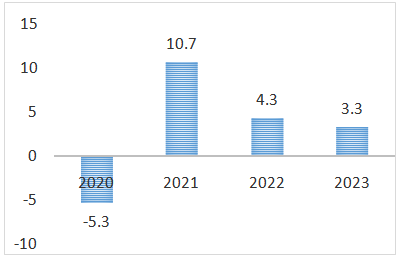
According to Figure 1, the economic decline in 200 was as a result of the COVID situation with -5.3%. This situation returned to a high growth in 2021 of 10.7%, causing a noticeable decrease in 2022 with 4.3% and 3.3% in 2023. Consumption, as the main component of domestic demand, in 2023 contributed 3.9% to real GDP growth compared to 2.9% in 2022. The increase in consumption can be explained through the increase in sources of financing consumption, the slowdown of increasing prices, as well as improving consumer confidence. Investments contributed positively to the real GDP growth by 1.1 percentage points compared to -1.4 percentage points in 2022, mainly as a result of the increase in public investments.

Formula: Total cost of investments in economic development = Expenditures for assistance in creating jobs + Expenditures for improving business conditions.
Examples by numbers
Work: An investment of 60 million euros to support new enterprises could create 10,000 new jobs.
Businesses: An investment of 30 million euros to improve the conditions for businesses (such as reducing taxes for new businesses) can increase the number of businesses and contribute to economic growth 25.
Formula: Total cost of investments in energy and environment = Expenditures for the construction of renewable plants + Expenditures for environmental protection projects 26.
Results:
• Renewable Energy: An investment of 80 million euros in the construction of solar plants can reduce dependence on non-renewable energy sources and contribute to the preservation of the environment.
• Environment: An investment of 20 million euros in wastewater treatment projects will improve water quality and public health 27.
These examples and tables illustrate how capital investments can have a significant impact on improving living conditions and economic development in Kosovo.
4.2. Rate of Return on Investment (ROI) AnalysisCalculation of the rate of return on investments for each year.
ROI Formula Return of Investment (equity)
ROI = GDP After Investments – GDP Before Investments
Impact Analysis on Job Creation
Assume that each year's investment creates a certain number of jobs.
Formula for the number of jobs created:
Jobs = Investments × Impact Coefficient.
Summary of Results
• Regression Analysis: Capital investment has a positive impact on GDP. For every 100 million euros of investment, the GDP increases by 2.5 million euros.
• ROI: The rate of return on investment is variable, but ranges from 4% to 5.13%, indicating a significant increase in GDP in line with investment.
• Job Creation: Capital investments also contribute to the creation of a significant number of jobs, increasing employment opportunities and improving living standards.
These analyzes and tables illustrate how capital investments contribute to economic growth and job creation in Kosovo.
4.3. Foreign Direct Investments (FDI)FDI Data:
• Investment Flow: In recent years, Kosovo has seen an increase in foreign investments direct, which help create jobs and increase production capacity.
• Examples of Investments: Investments by international companies in sectors such as telecommunications, banking, and manufacturing.
• Creation of Jobs: Foreign investments have helped to create jobs work and increased income for individuals.
• Increased Productivity: The improvement of technology and production methods has increased productivity in the sectors where investments were made.
Examples:
• In 2022, foreign direct investments in Kosovo were over 150 million euros, and their impact on economic growth is evident in various sectors, especially in construction and services.
Analysis of Economic Growth and Investment data
Examples of Analysis:
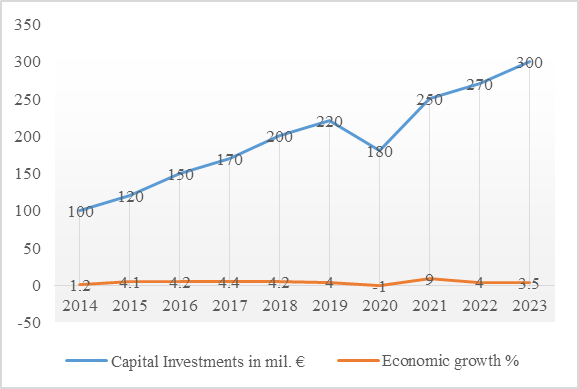
• Economic Growth: In 2021, Kosovo experienced a strong economic growth of 9% after a significant decline in 2020 due to the COVID-19 pandemic. This recovery is helped by increased capital investment and international aid.
• Independent Studies: Reports and studies made by international organizations have assessed the impact of capital investments on GDP growth, showing that these investments are important contributors to Kosovo's economic development 28
• These results provide a clear picture of the impact of capital investments on the economic growth of Kosovo. Further analysis of these factors and the study of their impacts on different sectors can provide more information for improving economic development policies and strategies 29.
Final conclusion: Economic Growth through Capital Investments in Kosovo
- The Importance of Capital Investments in Economic Growth
Through the analysis of macroeconomic data and capital investments in Kosovo during the last decade, it is clear that capital investments have a significant impact on the country's economic growth. Investments in infrastructure, such as building roads and improving the energy grid, have helped improve the efficiency of various economic sectors and created new opportunities for development. Also, foreign direct investments (FDI) and international aid have contributed to building the capacity of the main sectors and to the development of strategic industries.

- Impact of Infrastructure Investments
Investments in infrastructure are focused on important projects, such as the construction of major roads and the improvement of transport and energy systems. These investments have had a direct impact on increasing the productivity and efficiency of business sectors, contributing to a continuous increase in GDP. Moreover, infrastructure improvement has facilitated access to international markets and increased business competitiveness at the local and international level.
- The Role of Foreign Direct Investment
Foreign direct investments have played an important role in the development of various sectors in Kosovo. These investments have helped create new jobs, improve technology and production methods, and increase the country's productive capacity. Recent reports show that the increase in foreign investments has contributed to economic growth with an important factor, helping to diversify economic sectors and improve the standard of living for citizens.
- International Aids and Grants
International aid and grants have provided significant support for development projects and improving the quality of public services in Kosovo. These financial resources have contributed to aid for important sectors such as education, health, and infrastructure, helping to increase institutional capacity and develop the economy. International aid has had a significant impact on improving living conditions and stimulating economic growth 30.
The analysis of capital investments and their impacts on Kosovo's economic growth shows a strong relationship between these investments and GDP growth. Investments in infrastructure and other strategic sectors have contributed to improving economic efficiency and creating opportunities for development. Foreign investments and international aid have helped improve the country's capacity and aid the development of important sectors.
In order to maximize the impact of capital investments on economic growth, it is recommended that: Continue to invest in infrastructure to support economic development and improve trade links. To encourage foreign investments through policies that provide economic stability and incentives for investors. To increase transparency and effectiveness in the management of international aid and grants to maximize the benefits from these financial resources. In conclusion, capital investments have played a key role in improving Kosovo's economic performance and promoting economic growth. Continuous engagement in these areas will contribute to sustainable development and the improvement of living conditions for the citizens of Kosovo.
Recommendations according to analysis:
Infrastructure Sector:
Necessary investment: According to conventional analysis, infrastructure investment should account for at least 3-5% of GDP to achieve a sustainable impact on economic growth. For Kosovo, this means an investment of about 150-250 million euros per year, depending on the GDP level and infrastructure needs.
Creation of Jobs:
Number of jobs created: Each million euro investment in infrastructure projects often creates around 20-30 direct jobs. For an investment of 200 million euros, this could result in 4,000-6,000 new jobs.
Promotion of Foreign Direct Investment (FDI)
Increase in FDI Flow: Implementation of policies to increase foreign investment can aim for a 10-15% increase in FDI flow per year. For example, if Kosovo receives 150 million euros in foreign investments per year, a 10% increase will translate into an additional 15 million euros in capital additions from foreign investments.
Creating Investment Opportunities:
Increasing the Number of Investors: Promotion and incentive programs can aim to attract 5-10 new foreign investors per year. Each investor can bring an average investment of 5-10 million euros.
Capacity Development and Innovation
Investments in Education and Research:
Funds for R&D: Investment in research and development should constitute at least 0.5-1% of GDP. For Kosovo, this means an investment of about 25-50 million euros per year for research and development.
Support for Innovation:
Sponsorship of Innovative Projects: Every million euros invested in innovative projects can bring an increase in production by 2-5% in the relevant sector. For example, potential investments in innovative projects can help increase productivity in the technology sector by 3-4%.
Improving Governance and Efficiency:
Corruption Reduction: Implementing reforms to fight corruption can increase the efficiency of capital investments by 10-20%. This can help to use resources more efficiently and maximize the impact of investments.
| [1] | Progress Report for Kosovo. (2008). Commission of the European Committee. https://mapl.rks-gov.net/wp-content/uploads. | ||
| In article | |||
| [2] | Rexhepi, S, and Vataj G. Financial impact on the labor Market in the balkan countries. Corporate & Business Strategy Review / Volume 4, Issue 2, 2023. | ||
| In article | View Article | ||
| [3] | Sengupta, Chapter I literature review Economic. Downloads/02 _ Theory.pdf. 2011. | ||
| In article | |||
| [4] | Bolton, P, and P. Aghion. 1997. “A Theory of Trickle-Down Growth and Development.” The Review of Economic Studies 64 (2): 151–172. | ||
| In article | View Article | ||
| [5] | Supriyanto. Chapter I literature review Economic. Downloads/02 _ Theory.pdf. 2016. | ||
| In article | |||
| [6] | Brown. Chapter I literature review Economic Growth Theory. Downloads/ 02 _ Theory.pdf. 2007. | ||
| In article | |||
| [7] | Ray, D., and D. Mookherjee. 2003. “Persistent Inequality.” The Review of Economic Studies 70 (2): 369–393. | ||
| In article | View Article | ||
| [8] | Acemoglu. Chapter I literature review Economic Growth Theory. Downloads /02 _ Theory.pdf. 2009. | ||
| In article | |||
| [9] | Piętak. Chapter i literature review Economic Growth Theory. Downloads /02_ Theory.pdf. 2015. | ||
| In article | |||
| [10] | Levine, R. 2005. “Finance and Growth: Theory and Evidence.” Handbook of Economic Growth 1: 865–934. | ||
| In article | View Article | ||
| [11] | Sukirno. Chapter I literature review Economic Growth Theory. Downloads/ 02_Theory.pdf. 2017. | ||
| In article | |||
| [12] | Banerjee, A. V., and A. Newman. 1993. “Occupational Choice and the Process of Development.” Journal of Political Economy 101 (2): 274–298. | ||
| In article | View Article | ||
| [13] | Zeira, J., and O. Galor. 1993. “Income Distribution and Macroeconomics.” The Review of Economic Studies 60 (1): 35-52. | ||
| In article | View Article | ||
| [14] | Gurley, J. G., and E. S. Shaw. 1955. “Financial Aspects of Economic Development.” The American Economic Review 45 (4): 515–538. | ||
| In article | |||
| [15] | Fair. Chapter I literature review Economic Growth Theory. Downloads/ 02_ Theory.pdf. 2007. | ||
| In article | |||
| [16] | Supriyanto. Chapter I literature review Economic Growth Theory. Downloads/ 02_ Theory.pdf. 2016. | ||
| In article | |||
| [17] | Halland, H, Noel, M, Tordo, S, and Kloper, J. OwensPolicy Research Working Paper Strategic Investment Funds Opportunities and Challenges, 2016. https://documents1. woeldbank.org. | ||
| In article | |||
| [18] | LucasJr, R. E. 1988. “On the Mechanics of Economic Development.” Journal of Monetary Economics 22 (1): 3–42. | ||
| In article | View Article | ||
| [19] | Romer, P. M. 1986. “Increasing Returns and Long-run Growth.” Journal of Political Economy 94 (5): 1002–1037. | ||
| In article | View Article | ||
| [20] | Rebelo, S. 1991. “Long-run Policy Analysis and Long-run Growth.” Journal of Political Economy 99 (3): 500–521. | ||
| In article | View Article | ||
| [21] | Federal Reserve Bank of Richmond. "How Are Interest Rates Impacting Spending? Evidence From The CFO Survey."2023. | ||
| In article | |||
| [22] | Greg, E, and Uchenna, O. The Impact of Capital Market and Economic Growth in Nigeria. ublic Policy and Administration Research 2013. | ||
| In article | |||
| [23] | Annual report of the Central Bank of the Republic of Kosovo, year 2023, fq 29. https://bqk-kos.org/wp-content/uploads /2024. | ||
| In article | |||
| [24] | World Bank Group, Economic growth in Kosovo is expected to accelerate in the year 2024. https://www.worldbank.org.2023. | ||
| In article | |||
| [25] | Annual report of the Central Bank of the Republic of Kosovo, year 2023, page 31https://bqk-kos.org/wp-content/uploads 2023. pdf. | ||
| In article | |||
| [26] | International Renewable Energy Agency (IRENA). (2021). Renewable Power Generation Costs in 2020. Retrieved from IRENA. | ||
| In article | |||
| [27] | European Commission. (2020). The European Green Deal. Retrieved from European Commission. | ||
| In article | |||
| [28] | World Bank. (2021). Kosovo Economic Report: Economic Growth and Recovery. Retrieved from World Bank. | ||
| In article | |||
| [29] | International Monetary Fund (IMF). (2020). Kosovo: Staff Report for the 2020 Article IV Consultation. Retrieved from IMF. | ||
| In article | |||
| [30] | United Nations Development Programme (UNDP). (2021). Kosovo Human Development Report 2021. Retrieved from UNDP. | ||
| In article | |||
Published with license by Science and Education Publishing, Copyright © 2024 Shaqir Rexhepi and Hidajet Shehu
 This work is licensed under a Creative Commons Attribution 4.0 International License. To view a copy of this license, visit
https://creativecommons.org/licenses/by/4.0/
This work is licensed under a Creative Commons Attribution 4.0 International License. To view a copy of this license, visit
https://creativecommons.org/licenses/by/4.0/
| [1] | Progress Report for Kosovo. (2008). Commission of the European Committee. https://mapl.rks-gov.net/wp-content/uploads. | ||
| In article | |||
| [2] | Rexhepi, S, and Vataj G. Financial impact on the labor Market in the balkan countries. Corporate & Business Strategy Review / Volume 4, Issue 2, 2023. | ||
| In article | View Article | ||
| [3] | Sengupta, Chapter I literature review Economic. Downloads/02 _ Theory.pdf. 2011. | ||
| In article | |||
| [4] | Bolton, P, and P. Aghion. 1997. “A Theory of Trickle-Down Growth and Development.” The Review of Economic Studies 64 (2): 151–172. | ||
| In article | View Article | ||
| [5] | Supriyanto. Chapter I literature review Economic. Downloads/02 _ Theory.pdf. 2016. | ||
| In article | |||
| [6] | Brown. Chapter I literature review Economic Growth Theory. Downloads/ 02 _ Theory.pdf. 2007. | ||
| In article | |||
| [7] | Ray, D., and D. Mookherjee. 2003. “Persistent Inequality.” The Review of Economic Studies 70 (2): 369–393. | ||
| In article | View Article | ||
| [8] | Acemoglu. Chapter I literature review Economic Growth Theory. Downloads /02 _ Theory.pdf. 2009. | ||
| In article | |||
| [9] | Piętak. Chapter i literature review Economic Growth Theory. Downloads /02_ Theory.pdf. 2015. | ||
| In article | |||
| [10] | Levine, R. 2005. “Finance and Growth: Theory and Evidence.” Handbook of Economic Growth 1: 865–934. | ||
| In article | View Article | ||
| [11] | Sukirno. Chapter I literature review Economic Growth Theory. Downloads/ 02_Theory.pdf. 2017. | ||
| In article | |||
| [12] | Banerjee, A. V., and A. Newman. 1993. “Occupational Choice and the Process of Development.” Journal of Political Economy 101 (2): 274–298. | ||
| In article | View Article | ||
| [13] | Zeira, J., and O. Galor. 1993. “Income Distribution and Macroeconomics.” The Review of Economic Studies 60 (1): 35-52. | ||
| In article | View Article | ||
| [14] | Gurley, J. G., and E. S. Shaw. 1955. “Financial Aspects of Economic Development.” The American Economic Review 45 (4): 515–538. | ||
| In article | |||
| [15] | Fair. Chapter I literature review Economic Growth Theory. Downloads/ 02_ Theory.pdf. 2007. | ||
| In article | |||
| [16] | Supriyanto. Chapter I literature review Economic Growth Theory. Downloads/ 02_ Theory.pdf. 2016. | ||
| In article | |||
| [17] | Halland, H, Noel, M, Tordo, S, and Kloper, J. OwensPolicy Research Working Paper Strategic Investment Funds Opportunities and Challenges, 2016. https://documents1. woeldbank.org. | ||
| In article | |||
| [18] | LucasJr, R. E. 1988. “On the Mechanics of Economic Development.” Journal of Monetary Economics 22 (1): 3–42. | ||
| In article | View Article | ||
| [19] | Romer, P. M. 1986. “Increasing Returns and Long-run Growth.” Journal of Political Economy 94 (5): 1002–1037. | ||
| In article | View Article | ||
| [20] | Rebelo, S. 1991. “Long-run Policy Analysis and Long-run Growth.” Journal of Political Economy 99 (3): 500–521. | ||
| In article | View Article | ||
| [21] | Federal Reserve Bank of Richmond. "How Are Interest Rates Impacting Spending? Evidence From The CFO Survey."2023. | ||
| In article | |||
| [22] | Greg, E, and Uchenna, O. The Impact of Capital Market and Economic Growth in Nigeria. ublic Policy and Administration Research 2013. | ||
| In article | |||
| [23] | Annual report of the Central Bank of the Republic of Kosovo, year 2023, fq 29. https://bqk-kos.org/wp-content/uploads /2024. | ||
| In article | |||
| [24] | World Bank Group, Economic growth in Kosovo is expected to accelerate in the year 2024. https://www.worldbank.org.2023. | ||
| In article | |||
| [25] | Annual report of the Central Bank of the Republic of Kosovo, year 2023, page 31https://bqk-kos.org/wp-content/uploads 2023. pdf. | ||
| In article | |||
| [26] | International Renewable Energy Agency (IRENA). (2021). Renewable Power Generation Costs in 2020. Retrieved from IRENA. | ||
| In article | |||
| [27] | European Commission. (2020). The European Green Deal. Retrieved from European Commission. | ||
| In article | |||
| [28] | World Bank. (2021). Kosovo Economic Report: Economic Growth and Recovery. Retrieved from World Bank. | ||
| In article | |||
| [29] | International Monetary Fund (IMF). (2020). Kosovo: Staff Report for the 2020 Article IV Consultation. Retrieved from IMF. | ||
| In article | |||
| [30] | United Nations Development Programme (UNDP). (2021). Kosovo Human Development Report 2021. Retrieved from UNDP. | ||
| In article | |||