Background: The dairy sub-sector is instrumental in the economy, as it contributes to the establishment of employment, food security, household incomes, and rural development. Dairy cooperative societies constitute the foundation of milk aggregation, processing, and marketing within the nation. A growing number of these cooperatives are encountering challenges to their financial sustainability, which threatens their long-term viability. This study emphasizes internal governance, namely the financial literacy of management committees, as a determinant of sustainable finance, contrasting with prior studies that concentrated on external market determinants and operational inefficiencies. Methodology: The study was anchored on the planned behaviour theory and employed an explanatory research design. The target population consisted of 216 registered daily cooperatives selected from 11 counties in Kenya, and a sample of 140 was selected through stratified sampling. Structured questionnaires were used to collect primary data. Findings: The study found that the management committee's financial literacy was positively related to the sustainable financing of the cooperatives. The study concluded that the committee's financial literacy enhances the management’s ability to make informed financial decisions, thereby fostering financial sustainability. Recommendations:The study suggests that when choosing and preparing members of management committees, dairy cooperative societies should give financial literacy first priority. Committee members should get standardized training in budgeting, financial analysis, debt management, and regulatory compliance from government organizations, SACCO regulatory authorities, and cooperative unions. Furthermore, policy frameworks must to be reinforced to mandate a minimum level of financial proficiency for those holding important positions in cooperative societies that involve financial decision-making.
Dairy farming plays a significant role in Kenya’s agricultural sector, contributing to the nation's food security, economic growth, and employment opportunities. They contribute 3.5% of Kenya’s GDP 1. According to Koyi 2 dairy cooperatives provide services to members, including market making, loan advances, and extension education. To uphold sustainable financing, cooperative committees and staff are the policymakers and implementers, respectively, and ought to have adequate financial literacy. According to Cato 3, sustainable financing portrays a lengthened security compared to short-term gains or rewards, thus linking success in policies. Holland and O’Reilly 4 and Koyi 2 say sustainable financing embraces accounting for environmental, social, governance, and economic (ESGE) considerations while taking care of investment decisions aiming at improved investments in long-term and sustainable actions. Dairy cooperatives are no exception since they serve the most susceptible people living in rural areas while generating sustainable profits to support their farmers 5. A dairy cooperative has to be financially stable to ensure sustainable financing. This enshrines competent financial processes, profit generation, upholding tolerable liquidity levels, and overcoming bankruptcy challenges. An examination of sustainability is crucial because it reveals a dairy cooperative society's capacity to generate profits. Further, there will be a disclosure of the cooperative’s focus on corporate social responsibilities and embrace green financing instruments like green loans, green equity, microfinance, insurance, and green bonds. Financial Management Literacy is crucial for sustainable financing by dairy cooperative societies. Management Committees are entrusted with the responsibility of making strategized decisions, managing financial resources, and ensuring the overall economic well-being of their members. For sustainable financing to take place, there is a need for appropriate budgeting literacy, debt management literacy, investment literacy, and financial accounting literacy. Insufficient financial literacy hinders sustainable financing, which in turn curbs the adoption of sustainable financing practices by dairy cooperatives. 6. There is no option but to acquire necessary budgeting techniques, handle debts amicably, invest wisely, and account for cash flows. Financial literacy helps an individual make sound financial decisions regarding budgeting, investment, debt management, and bookkeeping 4. Budgeting entails three main pillars: accounting for bills, income, and deposits. Investment analysis helps evaluate industry trends and economic cycles during the budget period 7. In Kenya, dairy cooperative societies play a crucial role in the economic empowerment of farmers, especially in rural areas, by providing a platform for collective marketing, input procurement, and value addition. However, despite their significant contribution to the dairy sector, many cooperatives struggle with sustainable financing, hindering their ability to scale, improve efficiency, and invest in long-term growth. Kiambu, Murang’a, Bomet, Tharaka Nithi, Uasin Gishu, Embu, Kirinyaga, Nyandarua, Kakamega, Trans Nzoia, and Meru counties, which are among the key dairy-producing regions in Kenya, have faced challenges in ensuring that these cooperatives achieve financial sustainability. Research indicates that factors such as the financial literacy of management committees may influence the ability of these cooperatives to secure sustainable financing. Financial literacy among management committees in dairy cooperative societies is vital in ensuring effective financial decision-making, which ultimately impacts their ability to access and manage sustainable financing. It is against this backbone the research hypothesis is formulated.
Research Hypothesis
H01: Management committee financial literacy has no significant effect on sustainable financing in dairy cooperative societies in Kenya.
Literature Review
Financial literacy, including budgeting literacy, investment literacy, debt management literacy, and bookkeeping literacy, is essential for enabling individuals and organizations to make informed financial decisions. These skills help individuals manage inflation, loan interest, money management, and debt control 4. Dortch 8 asserts that the financial literacy of leaders is a critical factor in maintaining an organization’s financial stability, ensuring that decisions align with the organization's goals. A well-informed management committee can make sound financial choices that reduce the risk of funds misallocation and excessive debt. Wentz (2022) highlights that acquiring and managing money are distinct yet interdependent aspects of financial knowledge. Gupta 9 noted that financial literacy is described as the ability to make well-informed judgments, leading to efficient fund usage, applications, and comprehensive money management strategies. By mastering these areas, leaders can ensure the organization’s financial health and strategic alignment. Ultimately, these literacies empower management committees to sustain financial stability and promote long-term success.
Budgeting literacy is crucial in financial literacy, as it empowers individuals and organizations to make informed financial decisions, manage resources effectively, and enhance financial outcomes. Fortuna 10, explored the influence of budgeting practices on business profitability in Isabela, Philippines, finding a significant relationship between budgeting practices and profitability, particularly among small and medium enterprises (SMEs). Schubert and Kirsten 11, highlighted the positive impact of budgetary control on the financial performance of SMEs in Germany, showing that effective budgeting integrates strategic planning and cost control, ultimately boosting financial performance. Similarly, Etoromat (2021), found that budgeting literacy positively influenced the financial performance of SACCOs in Uganda, emphasizing the need for comprehensive budget awareness and education. Jemal (2019) further supported this by demonstrating that financial literacy, including budgeting skills, significantly improved the financial performance of medium-scale enterprises in Hawassa City, Ethiopia. In Kenya, Ngina 12, revealed a strong correlation between budgeting practices and the financial management of dairy farmers in Limuru Sub-County, suggesting the importance of budgeting training. Chebet & Kennedy 13, also found that budgeting positively affected the financial sustainability of dairy cooperatives in Uasin-Gishu County, Kenya, highlighting the role of accurate budgeting in predicting expenses and ensuring sustainability. Investment literacy empowers individuals to make informed investment decisions.
Shrestha, Manandhar, Bhattarai, and Nyan, (2023); did a study in Kathmandu Valley, Nepal. They concluded that financial behavior, awareness, attitudes, and skills significantly impact personal investment decisions. They emphasized that policymakers should promote financial literacy to enhance individual and societal financial outcomes. Iram, Raza, and Ahmad, (2023), explored how financial literacy mediates the relationship between heuristic biases and investment decisions among women entrepreneurs in Pakistan, finding that financial literacy positively influences their decision-making. Akims, Abayomi, and Avendi, (2023), reviewed literature in Nigeria, establishing a link between financial literacy, investor awareness, and sound investment decisions by enabling investors to conduct analyses and make informed choices. Mbwambo, Magoma, Gasper, and Mwasha, 14, found that financial attitude and knowledge were key in shaping Tanzanian government workers' investment and savings decisions. Ronoh (2021), revealed that investment appraisal practices positively affected the performance of housing cooperatives in Kenya, while Kiaritha, 15, showed that investment policies in SACCOs positively influenced their financial performance.
Debt management literacy enhances financial performance across various sectors. Etoromat (2022), found that debt management literacy explained 44.4% of the financial performance of SACCOs in Kumi County, Uganda, emphasizing the importance of a well-documented debt management policy. Similarly, Mberia and Wachira 16 highlighted that debt management skills training significantly improved the financial performance of women's self-help groups in Machakos Town, Kenya. In Jepara, Indonesia, Ismanto and Pebruary 17, showed that while debt literacy did not directly influence SME performance, it indirectly impacted performance through financial experience, suggesting an increased need for financial literacy among SME owners. In contrast,Porzak and Swinar (2021) demonstrated that infographics-based debt education significantly improved debt literacy in the USA, with numerical literacy mediating. Debt management emerged as a key factor in boosting financial performance, as seen in Gabriella et al.'s 18 study in Nigeria, where farmers with access to credit facilities and high financial literacy reported better financial outcomes. Metto 19 similarly found that low member financial literacy (MFL) in SACCOs, including budgeting and debt management, negatively impacted loan repayment rates, advocating for MFL education in SACCOs. Debt literacy improves financial outcomes and performance across organizations.
Bookkeeping literacy plays a vital role in the success and survival of businesses across various sectors. Trombetta 20, found that bookkeeping literacy increases business survival chances, although advanced bookkeeping literacy can have a negative effect. In Madiun City, Indonesia, Putri and Witono, 21, revealed that accounting knowledge harmed MSME performance, while bookkeeping literacy had a positive effect, along with product innovation. Similarly, Subomi (2023) in Kwara State, Nigeria, it was demonstrated that bookkeeping literacy significantly contributed to the growth and survival of SMEs. In Rwanda, Rwinikiza and Twesigye, 22, found that bookkeeping literacy positively influenced the performance of agricultural cooperatives in the Rwamagana District. Thadeus, Simiyu, and Ombaba, 23 In Kenya, it was shown that bookkeeping literacy and accounting practices positively affected the economic performance of MSMEs and moderated the relationship between accounting practices and performance. Minoo (2023), studied the effect of accounting automation on the financial performance of commercial banks in Kenya, noting that while automation affected performance, it required additional factors for stronger results. Hence, bookkeeping literacy improves cooperative financial performance and survival worldwide.
Conceptual Framework
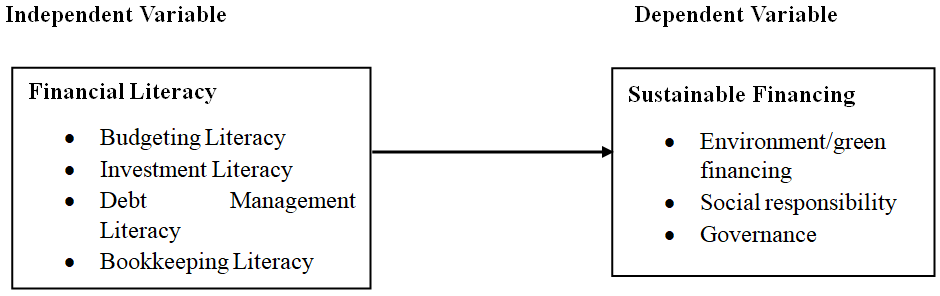
The purpose of the conceptual framework is to facilitate the description of study variables, concepts, and help map relationships among them as depicted in Figure 1. This study hypothesizes that management committee financial literacy linearly and directly influences sustainable financing in dairy cooperatives in Kenya.

Methodology
This study employed a descriptive and explanatory research design, which assumes both qualitative and quantitative attributes, as guided by the positivist research philosophy, which entails a scientific model based on empirical research, where various concepts, like hypotheses and objectives, can be formulated and tabulated in its paradigm. The reason for a descriptive design is that it helps to systematically obtain information to describe a situation, phenomenon, or population. Moreso, Skidmore (2023), says that a descriptive design answers the when, what, where, and how questions around the study problem, not why. The unit of analysis was dairy cooperative societies, and the unit of observation for the study was chief executive officers, since they are mandated with the responsibility of leadership. The data was analyzed using both descriptive and inferential statistics. Cronbach’s alpha was used to test for the internal reliability of each variable used in the study. Data analysis was done using descriptive statistics, correlation, and regression analysis. The study used simple regression analysis to analyze the relationship between management committee financial literacy and sustainable financing in dairy cooperatives in Kenya.
Reliability Test
According to Carroll (2023), the universal rule of Cronbach’s alpha is that 0.70 and above is good, 0.80 is better, and 0.90 and above is the best. A result below 0,70 is insufficient. Reliability of all constructs representing the dependent variable (sustainable financing in dairy cooperatives) and the independent variable (management committee financial literacy) attracted a Cronbach alpha statistic of more than 0.7. Therefore, based on the coefficient values in Table 1, the items tested were deemed reliable for this study.
Descriptive Statistics for Financial Literacy
The study objective was to examine the relationship between management committee financial literacy and sustainable financing in dairy cooperatives in Kenya. Table 2 presents the percentages, means, and standard deviation statistics relating to the information measuring the respondents’ level of agreement as to how the given indicators of management committee financial literacy influenced sustainable financing in dairy cooperatives in Kenya.
1 represents strongly disagree (SD), 2 disagree (D), 3 neutral (N), 4 agree (A), and 5 strongly agree (SA).
A relatively balanced distribution of responses is observed regarding the understanding of how to prepare a financial budget for the cooperative. While 22.5% of respondents strongly agree and another 22.5% agree, suggesting nearly half are confident in this skill, a no Table 3 3.4% (16.7% strongly disagree and 16.7% disagree) indicate a lack of understanding. The remaining 21.7% are neutral, which may point to uncertainty or limited experience with budgeting practices.
Confidence increases slightly when it comes to tracking actual spending against the budget. A total of 47.5% of respondents either agree (22.5%) or strongly agree (25.0%) with the statement, suggesting that nearly half feel capable of performing this task. On the other hand, 32.5% (15.8% strongly disagree and 16.7% disagree) express a lack of ability in this area, and 20.0% remain neutral, indicating that financial monitoring skills could still be strengthened.
Responses about the committee’s review and approval of budgets suggest a moderate level of engagement. While 45.8% of respondents agree (22.5%) or strongly agree (23.3%) that budgets are reviewed regularly, 34.2% (16.7% strongly disagree and 17.5% disagree) do not perceive this to be the case. A fifth of the respondents (20%) are neutral, highlighting the possibility of inconsistent practices or limited awareness among members regarding budget oversight processes.
When asked about understanding basic investment principles such as return on investment, risk, and diversification, 45% of respondents express agreement (22.5% agree and 22.5% strongly agree), indicating a moderate level of financial literacy. However, 34.1% (15.8% strongly disagree and 18.3% disagree) admit to lacking this understanding, while 20.8% remain neutral. This reflects a need for improved investment education within the cooperative.
The ability to evaluate the financial viability of investment proposals appears moderately strong, with 45.8% of respondents agreeing (25.0%) or strongly agreeing (20.8%) that they can perform this task. Meanwhile, 31.6% (15.8% strongly disagree and 15.8% disagree) do not feel confident in their evaluation skills, and 22.5% remain neutral. These figures suggest a notable portion of members would benefit from more practical exposure or training in financial analysis.
On the cooperative's capacity to make informed investment decisions, 47.5% of respondents agree (25.8%) or strongly agree (21.7%), which shows a reasonable level of confidence in the decision-making process. Nevertheless, 31.6% (15.8% strongly disagree and 15.8% disagree) express doubt, and 20.8% are neutral, pointing to a potential lack of transparency or member involvement in investment processes.
Understanding how loans and interest affect the cooperative’s finances seems relatively strong, with 48.4% of respondents indicating agreement (24.2%) or strong agreement (24.2%). However, 32.5% (15.8% strongly disagree and 16.7% disagree) still lack clarity in this area, and 19.2% are neutral, revealing opportunities for enhanced member education on loan management and financial sustainability.
Awareness of the cooperative’s debt obligations and repayment schedules is similar, with 48.4% of respondents agreeing (24.2%) or strongly agreeing (24.2%). Despite this, 32.5% (15.8% strongly disagree and 16.7% disagree) express a lack of awareness, while 19.2% are neutral. These responses imply that while a fair number of members are informed, a significant portion remains unaware of critical financial commitments.
On whether the cooperative uses debt strategically and responsibly, 49.1% of respondents agree (25.8%) or strongly agree (23.3%), which is encouraging. Still, 34.9% (15.8% strongly disagree and 18.3% disagree) indicate skepticism or lack of knowledge, while 16.7% are neutral. This suggests that strategic debt management practices should be communicated more clearly and inclusively.
Understanding how to record and classify financial transactions garners relatively high confidence, with 49.2% of respondents agreeing (26.7%) or strongly agreeing (22.5%). Yet, 31.6% (15.8% strongly disagree and 15.8% disagree) still lack this knowledge, and 19.2% are neutral, highlighting a need for practical bookkeeping skills development.
The ability to interpret basic financial records like income statements and ledgers is affirmed by 47.5% of respondents (26.7% agree and 20.8% strongly agree). However, 31.6% express disagreement (15.8% strongly and 15.8% disagree), and 20% remain neutral, suggesting that while some members are confident in financial interpretation, a considerable group requires additional training.
Bookkeeping practices in the cooperative are generally viewed positively, with 47.5% of respondents agreeing (22.5%) or strongly agreeing (25.0%) that they are accurate and timely. Nevertheless, 33.4% (16.7% strongly disagree and 16.7% disagree) are not convinced, and 19.2% are neutral, indicating room for improvement in transparency, consistency, or visibility of bookkeeping operations.
Descriptive statistics for sustainable financing were evaluated using a Likert scale:
1 represents strongly disagree (SD), 2 disagree (D), 3 neutral (N), 4 agree (A), and 5 strongly agree (SA).
The data presents perceptions of respondents on the cooperative’s commitment to environmental sustainability, social responsibility, and good governance. Regarding environmental sustainability, responses were mixed, with only around 41.6% agreeing or strongly agreeing that the cooperative invests in environmentally sustainable projects such as solar or biogas. Similarly, about 41.7% agreed that green financing options like green bonds or credits are considered in funding decisions, though a notable portion also disagreed, indicating possible gaps in either practice or communication. When it comes to promoting efficient water and energy use, the cooperative received slightly higher support, with 42.5% agreeing or strongly agreeing, though a combined 35.9% still disagreed or strongly disagreed. On the social front, the cooperative was seen somewhat more positively. Support for community healthcare initiatives and education or training programs drew agreement from around 43% and 45% of respondents respectively, showing a moderate level of confidence in the cooperative’s community support efforts. The cooperative’s role in creating employment was among the most positively viewed, with nearly half (49.2%) of respondents agreeing or strongly agreeing. Financial transparency and anti-corruption measures were also relatively well-regarded, with 47.5% and 48.3% respectively expressing agreement. However, each statement still had at least 30% of respondents expressing disagreement or neutrality, suggesting room for improvement in communication, implementation, or awareness of the cooperative’s efforts in sustainability, social welfare, and governance.
Regression analysis of Management Committee Financial Literacy and Sustainable Financing
The first objective was to find out the influence of management committee financial literacy on sustainable financing. The hypothesis of the study was:
H01: Management committee financial literacy has no significant effect on sustainable financing in dairy cooperative societies in Kenya
In Table 4, inspiring a shared vision has an R-squared of 0.240, implying that financial literacy accounts for 24% of the variation in sustainable financing.
The findings on the ANOVA, as shown in Table 5, indicate that F = 37.275, p = 0.000, which is less than 0.05, implying that the model summary is statistically significant.
Based on the regression coefficients in Table 6, there is a statistically significant positive relationship between financial literacy and sustainable financing, ( )
)
The results show that sustainable financing will rise by 0.370 units for every unit increase in financial literacy. The regression equation is given as:
 |
Y = Sustainable Financing and X1 = Financial Literacy
In conclusion basing on the findings, the study revealed that management committees with higher financial literacy levels are more likely to make informed financial decisions leading to improved sustainable financing at 95% confidence level. Thus the study accepted the alternative hypothesis and concluded that financial literacy of the management committees significantly influenced sustainable financing.
Based on the findings, the study recommends that dairy cooperatives societies prioritize capacity building initiatives that will enhance the financial literacy of their management committees. Many members still lack a comprehensive understanding of budgeting, investments evaluation and financial monitoring. Introduction of structured training programs and workshops, with continuous development initiatives should be instituted to equip the committee members with practical skills in budgeting, financial planning, and strategic financial decision making. Such interventions will empower the committees to effectively oversee financial matters, evaluate viability of investment proposals and ultimately make informed decisions that enhance financial sustainability.
| [1] | Ludenyi, E. (2023, April 14). Challenges Facing Dairy Farming in Kenya: Case Study. Bizhack Kenya. https://bizhack.co.ke/challenges-facing-dairy-farming-in-kenya/. | ||
| In article | |||
| [2] | Koyi, D. N. P. (2020). Role of dairy cooperative societies in sustainable dairy development in kenya. Https:// www.semanticscholar.org/paper/role-of-dairy-cooperative-societies-in-sustainable-koyi/ 392be05b5985f815 7b97987 60613d fd10923aad7. | ||
| In article | |||
| [3] | Cato, M. S. (2022). Sustainable Finance: Using the Power of Money to Change the World. Springer Nature. | ||
| In article | |||
| [4] | Ruchi, R. (2020). Financial Literacy Among Working Women: Need of the Hour. Nitya Publications. | ||
| In article | |||
| [5] | Segovia‐Vargas, M. J., Miranda‐García, I. M., & Oquendo‐Torres, F. A. (2023). Sustainable finance: The role of savings and credit cooperatives in Ecuador. Annals of Public and Cooperative Economics, 94(3), 951–980. | ||
| In article | View Article | ||
| [6] | Adeyemi, B. (2020, July 27). Financial literacy and the audit committee. Business Day NG. https:// businessday.ng/ columnist/article/financial-literacy-and-the-audit-committee-3/. | ||
| In article | |||
| [7] | Ziuznys, A. (2022). Investment Analysis: 4 Types Explained with Examples. https://coresignal.com/blog/investment-analysis/. | ||
| In article | |||
| [8] | Dortch, R. A. (2022). How to Learn Financial Literacy: Financial Literacy, Your Business, and Your Health. Amazon Digital Services LLC - Kdp. | ||
| In article | |||
| [9] | Gupta, D. P. K. (2021a). The Impact of Financial Literacy on Investment Decisions. Ashok Yakkaldevi. | ||
| In article | |||
| [10] | Fortuna, C. P. (2021). Budgeting Practices: Its Impact on the Profitability of Small and Medium Enterprises in Isabela. Universal Journal of Accounting and Finance, 9, 336–346. | ||
| In article | View Article | ||
| [11] | Schubert, H., & Kirsten, S. M. (2021). Effect of Budgeting Control on the Financial Performance of SMEs in Germany. Journal of Finance and Accounting, 5(2), Article 2. https://stratfordjournals.org/journals/index.php/journal-of-accounting/article/view/812. | ||
| In article | |||
| [12] | Ngina, K. N. (2020). Influence of Financial Literacy on Financial Management Practices: A Survey of Dairy Farmers Managed by K-Unity Sacco in Limuru Sub County [Thesis, KeMU]. http://repository.kemu.ac.ke/handle/123456789/901. | ||
| In article | |||
| [13] | Chebet, M., & Kennedy, O. B. M. (2019). Effect of budgeting on financial sustainability of dairy co-operative societies in uasin gishu county, kenya. 6(4). | ||
| In article | |||
| [14] | Mbwambo, H., Magoma, A., Gasper, L., & Mwasha, N. (2022). Financial Literacy, Investment, and Savings Decisions Among Government Institutions’ Workers in Mwanza, Tanzania. AFRICAN JOURNAL OF APPLIED RESEARCH, 8(1), Article 1. Https://www.ajaronline.com/index.php/AJAR/article/view/448. | ||
| In article | |||
| [15] | Kiaritha, H. (2023). Effect of Investment Policy on the Financial Performance of Savings and Credit Cooperative Societies (SACCOs) in the Banking Sector in Kenya. | ||
| In article | |||
| [16] | Mberia, C., & Wachira, K. (2021). Influence of budgeting and debt management literacy training on the financial performance of Equity Bank trained women self-help groups in Machakos Town, Kenya. International Journal of Entrepreneurship and Project Management, 6(1), 1–11. | ||
| In article | View Article | ||
| [17] | Ismanto, H., & Pebruary, S. (2022). How Debt Literate and Financial Literacy Enhance Smes Performance: The Intervening Role of Financial Experience (pp. 281–295). | ||
| In article | View Article | ||
| [18] | Gabriella, O., Enete, A., Okoye, C., Ume, C., & Chukwuemeka, O. (2024). Impact of credit access of farmers in cooperative societies on financial performance: The predictive effect of financial literacy. International Journal of Social Economics. | ||
| In article | |||
| [19] | Metto, W. K. (2020). The Relationship between Member Financial Literacy and Loan Repayment in Savings and Credit Co-Operative Societies in Uasin-Gishu County, Kenya. International Journal of Community and Cooperative Studies, 8(1), 9–22. | ||
| In article | View Article | ||
| [20] | Trombetta, M. (2023). Accounting and Finance Literacy and Entrepreneurship: An Exploratory Study. Journal of Accounting and Public Policy, 42(2), 107078. | ||
| In article | View Article | ||
| [21] | Putri, Z. R., & Witono, B. (2022). Analysis of Accounting Knowledge, Financial Literacy, and Product Innovation on MSME Performance. 5(11). | ||
| In article | |||
| [22] | Rwinikiza, M., & Twesigye, D. (2023). Effect of Financial Inclusion on Performance of Agrico-Operatives in Rwamagana District. A Case of CORICYA. Journal of Finance and Accounting, 7(8), Article 8. | ||
| In article | View Article | ||
| [23] | Thadeus, O. O., Simiyu, G., & Ombaba, M. (2023). Accounting Practices, Financial Literacy And Financial Performance Of Micro, Small And Medium Enterprises. Journal of Business and Management Review, 4(9), Article 9. | ||
| In article | View Article | ||
Published with license by Science and Education Publishing, Copyright © 2025 Mburu Munyambu Zachariah, Esther Gicheru, Lucy Ngare and Denis Kamau Muthoni
 This work is licensed under a Creative Commons Attribution 4.0 International License. To view a copy of this license, visit
http://creativecommons.org/licenses/by/4.0/
This work is licensed under a Creative Commons Attribution 4.0 International License. To view a copy of this license, visit
http://creativecommons.org/licenses/by/4.0/
| [1] | Ludenyi, E. (2023, April 14). Challenges Facing Dairy Farming in Kenya: Case Study. Bizhack Kenya. https://bizhack.co.ke/challenges-facing-dairy-farming-in-kenya/. | ||
| In article | |||
| [2] | Koyi, D. N. P. (2020). Role of dairy cooperative societies in sustainable dairy development in kenya. Https:// www.semanticscholar.org/paper/role-of-dairy-cooperative-societies-in-sustainable-koyi/ 392be05b5985f815 7b97987 60613d fd10923aad7. | ||
| In article | |||
| [3] | Cato, M. S. (2022). Sustainable Finance: Using the Power of Money to Change the World. Springer Nature. | ||
| In article | |||
| [4] | Ruchi, R. (2020). Financial Literacy Among Working Women: Need of the Hour. Nitya Publications. | ||
| In article | |||
| [5] | Segovia‐Vargas, M. J., Miranda‐García, I. M., & Oquendo‐Torres, F. A. (2023). Sustainable finance: The role of savings and credit cooperatives in Ecuador. Annals of Public and Cooperative Economics, 94(3), 951–980. | ||
| In article | View Article | ||
| [6] | Adeyemi, B. (2020, July 27). Financial literacy and the audit committee. Business Day NG. https:// businessday.ng/ columnist/article/financial-literacy-and-the-audit-committee-3/. | ||
| In article | |||
| [7] | Ziuznys, A. (2022). Investment Analysis: 4 Types Explained with Examples. https://coresignal.com/blog/investment-analysis/. | ||
| In article | |||
| [8] | Dortch, R. A. (2022). How to Learn Financial Literacy: Financial Literacy, Your Business, and Your Health. Amazon Digital Services LLC - Kdp. | ||
| In article | |||
| [9] | Gupta, D. P. K. (2021a). The Impact of Financial Literacy on Investment Decisions. Ashok Yakkaldevi. | ||
| In article | |||
| [10] | Fortuna, C. P. (2021). Budgeting Practices: Its Impact on the Profitability of Small and Medium Enterprises in Isabela. Universal Journal of Accounting and Finance, 9, 336–346. | ||
| In article | View Article | ||
| [11] | Schubert, H., & Kirsten, S. M. (2021). Effect of Budgeting Control on the Financial Performance of SMEs in Germany. Journal of Finance and Accounting, 5(2), Article 2. https://stratfordjournals.org/journals/index.php/journal-of-accounting/article/view/812. | ||
| In article | |||
| [12] | Ngina, K. N. (2020). Influence of Financial Literacy on Financial Management Practices: A Survey of Dairy Farmers Managed by K-Unity Sacco in Limuru Sub County [Thesis, KeMU]. http://repository.kemu.ac.ke/handle/123456789/901. | ||
| In article | |||
| [13] | Chebet, M., & Kennedy, O. B. M. (2019). Effect of budgeting on financial sustainability of dairy co-operative societies in uasin gishu county, kenya. 6(4). | ||
| In article | |||
| [14] | Mbwambo, H., Magoma, A., Gasper, L., & Mwasha, N. (2022). Financial Literacy, Investment, and Savings Decisions Among Government Institutions’ Workers in Mwanza, Tanzania. AFRICAN JOURNAL OF APPLIED RESEARCH, 8(1), Article 1. Https://www.ajaronline.com/index.php/AJAR/article/view/448. | ||
| In article | |||
| [15] | Kiaritha, H. (2023). Effect of Investment Policy on the Financial Performance of Savings and Credit Cooperative Societies (SACCOs) in the Banking Sector in Kenya. | ||
| In article | |||
| [16] | Mberia, C., & Wachira, K. (2021). Influence of budgeting and debt management literacy training on the financial performance of Equity Bank trained women self-help groups in Machakos Town, Kenya. International Journal of Entrepreneurship and Project Management, 6(1), 1–11. | ||
| In article | View Article | ||
| [17] | Ismanto, H., & Pebruary, S. (2022). How Debt Literate and Financial Literacy Enhance Smes Performance: The Intervening Role of Financial Experience (pp. 281–295). | ||
| In article | View Article | ||
| [18] | Gabriella, O., Enete, A., Okoye, C., Ume, C., & Chukwuemeka, O. (2024). Impact of credit access of farmers in cooperative societies on financial performance: The predictive effect of financial literacy. International Journal of Social Economics. | ||
| In article | |||
| [19] | Metto, W. K. (2020). The Relationship between Member Financial Literacy and Loan Repayment in Savings and Credit Co-Operative Societies in Uasin-Gishu County, Kenya. International Journal of Community and Cooperative Studies, 8(1), 9–22. | ||
| In article | View Article | ||
| [20] | Trombetta, M. (2023). Accounting and Finance Literacy and Entrepreneurship: An Exploratory Study. Journal of Accounting and Public Policy, 42(2), 107078. | ||
| In article | View Article | ||
| [21] | Putri, Z. R., & Witono, B. (2022). Analysis of Accounting Knowledge, Financial Literacy, and Product Innovation on MSME Performance. 5(11). | ||
| In article | |||
| [22] | Rwinikiza, M., & Twesigye, D. (2023). Effect of Financial Inclusion on Performance of Agrico-Operatives in Rwamagana District. A Case of CORICYA. Journal of Finance and Accounting, 7(8), Article 8. | ||
| In article | View Article | ||
| [23] | Thadeus, O. O., Simiyu, G., & Ombaba, M. (2023). Accounting Practices, Financial Literacy And Financial Performance Of Micro, Small And Medium Enterprises. Journal of Business and Management Review, 4(9), Article 9. | ||
| In article | View Article | ||