Audit quality integrates the dual probability of detection (auditor competence) and revelation (auditor independence). This research focuses on auditor competence, a black box whose exploration is not yet subjected to intense scientific activity. The paper undertakes to identify the overall performance factors capable of predicting auditor competence. The use of a partial least squares’ regression technique makes it possible to highlight the functional and behavioral component characteristics as decisive factors determining the prediction of material mistatements detection.
Is it necessary to assess auditor’s competence? The highly technical and even elitist nature 1 of the independent audit profession characterises the answer that the accounting literature seems to have given to this question so far. Even though, as in any profession, “incompetence” or “lack of competence” can play a determining role in the assessment of the audited items and factors and significantly increase audit risk, the auditor’s ability to detect a material mistatement in the accounts he audits receives only relatively marginal theoretical treatment 2 The literature essentially focuses on the auditor’s independence in response to the global publicity that successive financial scandals have given it. If prior literature considers the dual probability of detection and revelation as determinants of audit quality 3, competence still plays the role of "accompanying", which still makes it a black box in the field of audit quality, reduced for the majority of studies to the analysis of the conditions and determinants of revelation / independence 2.
Two main arguments put forward in the literature explain this choice. First, even if the crucial role that competence plays in the quality of the “audit outcome” is not ignored 3 there is a tendency to automatically assume that the auditor is competent. Several studies, for example, highlight the “great professional” 4, the “great technician” 5, 6, the “expert” 7 that is the auditor. The various protocols and training modules that determine access to the profession of auditor, as well as the structural organisation of audit firms, are considered as systemic mechanisms for automating and regulating competence. The studies that address the issue emphasize this observation by pointing out the role of the technological tool deployed during the audit mission as a decisive factor of competence 8, 9. Consequently, prior literature considers that the difficulty for the auditor lies not in the detection capacity, but above all in the revelation capacity 10. It is thus implicitly accepted that the auditor is more likely to be influenced by external and internal factors that could compromise his independence than to fail to detect a material error in the accounts he audits.
As relevant as it may be, this concept suffers from a fragmentary and simplistic vision of competence. It is reduced to an attribute included in the interactions between professional requirements and the personal qualifications of auditors 11 (in particular their academic training profile, their experience, or the technological tools used during auditing missions). The competent auditor is considered to be someone who has undergone academic training leading to obtaining a qualification in «Expert-comptable» in French-speaking systems, or to qualifications issued by the certified public accountant or the Association of chartered certified accountants in Anglo-Saxon systems. In addition to this training, there are years of experience in the practice of auditing. The main limitation of this concept lies in the standardisation of competence, its reduction to two supposedly acquired factors, and the difficult possibility of calling them into question once they have been acquired. Competence is not a uniform piece of data that can be claimed on the basis of considerations adopted a priori, such as training and experience alone. A qualified/graduated auditor following this approach will always detect material errors. Conversely, an unqualified/graduated auditor will not be able to do so. This conception limits the scope of understanding and exercising of competence 12. Knowledge is renewed in its design, its acquisition protocol and its dynamics, calling into question its acquisition once and for all. Also, in addition to technology, the environment can play a decisive role in determining the auditor's level of competence.
This level seems to be assimilated to a combination of factors relating to technical skills, communication skills, leadership assets and learning and motivation assets 13. The specificity of organisations and their individual or team working methods, as well as the context of the exercise of a profession and the environment 14, 15, 16 are all factors which remain particularly unexplored in auditing, but which can determine the level of competence of the auditor.
Our research focuses on the assessment of the auditor's overall competence and seeks to explore the factors that determine it. Its originality lies in the broadening of the understanding of the concept of competence and the factors that characterise it in the assessment of audit quality. The study redefines the auditor's competence in its overall form as a complex social factor that includes the classic components of academic training and experience, factors to which are added other factors relating to the circumstances in which the competence is exercised and the environment 12. This position is specific because by analysing competence from a broader and more dynamic perspective, it allows us to explore new dimensions in auditing, inspired by knowledge in human resources management. It thus considers competence as a black box to be explored, rather than a confirmed acquisition of accounting professionals.
In the first section of the paper, we develop the performance factors inspired by social and human resources management sciences in order to provide a theoretical basis accounting a priori for competent individuals. The synthesis carried out leads to a cross-referencing of all the factors identified with the characteristics, choices and actions of the auditor during his audit engagement. The second section of the article describes the methodological approach used. The third section is dedicated to the presentation and discussion of the results obtained.
Competence, understood in its global sense, is one of the most valued resources of the individual 17. It is a polysemic attribute that characterises the capacity of an individual to act correctly when facing his duties and responsibilities. Reference 18 defines it as the set formed by the knowledge, skills, and faculties of an individual applied to practice. As such, global competence can be considered, in the sense that Reference 19 conceives it, as an attribute presenting a behavioral, functional and social characteristic.
2.1. The behavioural Component of Overall CompetenceThis first component of the concept of overall performance refers to individual traits, particularly cognitive and intellectual, which determine the quality of the result of an action undertaken by an individual. It can be broken down into two main points: the assets of experience and technical competence 13.
Daily practice can lead to the long-term mastery of aspects of a profession, due to the similarity of these aspects to past events and the way in which they were handled. Reference 20 considers that experience acquired in work practice is a prerequisite for the construction of skills and the development of know-how. It allows the use of all the acquired knowledge due to the continuous exercise of a profession over a given period of time, to resolve practical problems, or to perform specific tasks at work. This is cumulative learning. In this sense, according to Reference 21, it is understood as situated and accumulated during professional activities, and therefore as an important aspect of competence and its development. Experience thus makes it possible to give meaning to situations encountered in daily life, and particularly in working environments 22 and to use these meanings for the resolution of probable future problems presenting a similarity to the situations experienced, or likely to obey a previously adopted therapy.
Experience also constitutes a factor of competence through its ability to develop in the experienced individual the faculties of reaction and anticipation, the ability to create and maintain working relationships within and outside an organization, the ability to collaborate easily or work in team. According to Reference 13, these qualities can only be acquired through practical contact and experience with similar cases and facts. For Polanyi Reference 23, knowledge acquired through experience, unlike that considered general acquired through school education, is a type of specific knowledge required for employment, sufficiently practical and tacit. This knowledge can validly constitute a bridge between formal knowledge and its practical implementation. Even if it is difficult to determine from how many years of experience one can be considered competent, it remains important to emphasize the importance of tacit and informal learning provided by experience. In addition to the number of years of experience, according to Reference 12, there is physical availability to modulate spaces for the development of reduced working hours and remote working, as well as psychological commitment to work, resulting in a constant desire to optimise one's efforts and the desire to always want to do the best possible.
Finally, it is acknowledged that age 17, and the individual's personal history 24 play an important role in the configuration of skills acquired through experience 17. They participate in particular in the acquisition of practical skills and knowledge in professions and specific tasks, in the acquisition of knowledge related to the work community and the organisation, and finally in the acquisition of knowledge necessary for self-assessment both in the way of working and in the way of acting.
According to Reference 25, competence refers to what an individual knows and can do in ideal circumstances. Knowledge is considered here as a determining cognitive element of competence. This fundamental modality of competence integrates three fundamental aspects: First, the competent individual must demonstrate strong analytical thinking. He must be able to construct dialectical reasoning on a given question, in order to arrive at a reasoned conclusion, having taken into account the different components and aspects of the question. To this strong analytical thinking, it is appropriate to add conceptual thinking adapted to the circumstance requiring the competence. The competent stakeholder must have theoretical mastery of the concepts surrounding the exercise of the requested competence, and have the qualities required to be able to manipulate these concepts in their abstract form before any immersion in reality. Analytical and conceptual thinking are the first cognitive assets for identifying competence according to reference 19.
Then, Reference 18 considers technical expertise as one of the main cognitive attributes characteristic of competence. The competent individual, as they record in a dictionary of competence, has the technical skills necessary to issue an informed opinion or judgment in a given situation. This technician attribute allows him to propose the optimal solution to a problem posed, but also to manage the steps leading to the full realisation of the proposed solution. Reference 26 considers technical knowledge as a direct and sustainable competitive advantage. It is even considered by Reference 27 as the individual's best resource. Because it can be multifaceted, Reference 13 notes that in a context of a knowledge-based economy, the possession of multidisciplinary cognitive technical knowledge is a major asset for the management of organisational assets.
Behavioral competence attributes finally allow to have the required motivation to accomplish a task, and to renew it each time the accomplishment of the task proves necessary. Motivation in support of cognitive factors. It allows the auditor to keep his knowledge up to date, while remaining willing to learn from his experiences. It also allows to transmit knowledge in the ongoing training of employees. According to Reference 18, this particular characteristic is materialised by the supervision of the professional development of others from a position of power conferred by technical cognitive attributes. Motivation renews knowledge and facilitates its use in the supervision and coordination of work teams and the transmission of leadership.
2.2. The Fuctional Component of Overall CompetenceCompetence can also be considered as the result of a social compromise in relation to specific duties 28. This perspective of study considers competence as an attribute determined dualy, by the institutional context and environment, but also by the immediate work environment.
Because it defines its rules of governance and institutionalises them, society plays a role in defining and evaluating the individual's competence. According to Reference 19, beyond the fact that individuals do not choose the content and quality of the training they receive but undergo it, most professions are today supervised by professional orders that define competence, subordinating the entrance into a profession to the fulfillment of the criteria they themselves choose. Competence can be considered here as the ability of stakeholders to negotiate their integration into established professional and institutional orders and associations, and manage the tensions that compliance with the rules can pose in relation to other forms of local, regional or organisational regulations. However, mechanisms must be found to ensure a constant renewal of the knowledge and good practices of the people integrated over time
Competence can therefore be considered as the result of a qualification to be exercised, dated and localised 28. Reference 29 considers for example the case of teachers belonging to recognised constituted groups called “level groups”. According to her, the structuring of these professional groups presents an organisational efficiency, methods of action which have an effect on the concrete tasks of the teacher and his efficiency.
The training context is also a central determining aspect of the acquisition of technical skills. Reference 30 defined the criteria that characterise an ideal technical training context leading to the acquisition of the skill. They identify the availability and fluidity of information for learning combined with computer methods and online training 31, the use of multimedia training tools and recent production of lessons given by experienced people and personalized monitoring of learners.
Reference 12 identifies six parameters for the understanding of competence in a specific functional situation: "equipment to be used... to transform a material (and/or information)... by operating a local ordering of tasks... in certain working conditions... taking into account performance indicators... and in a given cultural environment". Competence in a work situation is the combined mastery of these different factors. In a specific case, it is a matter of being able to choose the appropriate tool to process it, of adding value to the available and given information, of arranging and sequencing in time the different tasks to be accomplished to process the case according to their homogeneity/heterogeneity, of creating optimal working conditions that allow the case to be processed and the result to be assessed according to the concrete performance criteria previously defined, in a work environment that promotes values. Competence is therefore essentially situational, and can only be observed in the context of a real function during which the actors are generally called upon to interact, or even often to “interdecide”. It integrates all of these components and constitutes the final outcome once they have been arranged together by the competent actor.
2.3. Social Competence or Co-competenceCo-competence is understood as a form of collective competence 20, 21, 22, 23, 24 25, 26, 24, 28 29, 30, 31, 32. It relates to attitudes and behaviors in a task-related situation, towards oneself and towards teammates. Beyond the combination of individual skills, this vision defends the idea that "since work is generally carried out in a team and the individual carries it out with collaborators, the result cannot be the result of his or her intervention alone, but the consequence of collective interventions, including those of other actors". Competence is then defined by the level of communication and exchange of information between actors on a given issue, as well as the attitudes and behaviors that characterise collaborative relationships 33. Even when they undergo the same training and have a homogeneous level of qualification when hired, individuals do not assimilate the reality of work in the same way. The level of coordination that completes communication between actors, allows the identification of specific expertise within a group and ensures their efficient integration. The contributions of each participant in the process of carrying out a task must also be taken into account in the definition of competence, because they are integrated into a form of balance of contributions 34. Competence includes the ability to work with, in a coordinated set of work schedules and physical, psychological and intellectual contribution. Reference 35 specifies that the participation of each member in the confrontation of ideas and contributions leads to the emergence of new knowledge favorable to individual competence
2.4. The Theoretical Profile of Overall Competent AuditorFrom the analysis of stated skill characteristics, it is possible to draw up a profile of a competent auditor. Two major factors emerge: Experience and proven technical training assets, and satisfaction with the requirements set by the environment.
A trained and experienced auditor
The above developments reveal the fundamental idea that a competent auditor is an auditor who has acquired the training and experience required to carry out financial audits. This idea is defended by Reference 36. Reference 37 emphasizes that a competent auditor must have sufficient knowledge, solid training, the qualification and experience required to conduct a financial audit mission. These characteristics are so important that he calls on the state to promote them. The competent auditor must therefore be able to demonstrate training in accounting and auditing techniques, the acquisition of the knowledge that constitutes the training modules, and have sufficiently tested this knowledge with professional practice in the field. In this sense, he must have participated in audit missions, observed their complexity, and this in several different work situations. According to Reference 13, this knowledge shapes the auditor's mind and gives him a strong capacity to anticipate, identify or detect material errors present in the audited accounts. Reference 38 argue that the auditor's experience level can influence audit quality, and even the cost of capital.
Then, we can associate with Reference 18 technical expertise with experience. It is this expertise that helps to inform the auditor's opinion in determining materiality thresholds, risk analysis, choosing and obtaining audit evidence, analyzing it and using it. A competent auditor therefore has the necessary technical expertise. The aspect of transmission, an integral part of competence, is also highlighted by Reference 18 in what they call professional development. The auditor must be able to transmit, train the members of his team, and lead them in the action of the audit. The link with experience emerges from this concept. The auditor builds his competence by acquiring it during audit missions, but also by transmitting it to junior members of his audit team.
The definition of a relevant audit programme and compliance to regulations
To be competent, an auditor must be able to be flexible. This constraint involves recognising the specificity of each audit mission, and defining a relevant audit program for each mission. The program must therefore integrate the choice and definition of the equipment necessary for the mission and the methods of their deployment. As such, he must be able to choose the appropriate technological tool, among the existing high-performance tools. The auditor must also plan the tasks to be carried out and sequence them, define performance objectives and mobilise these resources towards achieving set objectives 12.
Membership in the professional order can be understood as a factor of competence, the order itself being considered as an instance where competence is supervised and even stimulated. This membership, generally obligatory to practice, subjects professional accountants to the observance of rules that are combined with other rules, issued by the political regulators of the profession, and even of the organization (audit office) to which they belong. Competence is perceived as the capacity to re (reconcile) all of these rules in each work situation 39
Building collective competence
Finally, a competent auditor should be co-competent, in the sense of the collective competence of Reference 20 Audit missions are generally carried out in teams, and the audit outcome cannot be the result of the auditor's individual intervention alone. Competence is reflected here in the way in which the auditor exchanges and communicates on issues relevant to his mission; and the coordination of teams 40, so as to ensure that an acceptable level of homogeneity is maintained in procedures, choices, decisions and conclusions. This homogeneity guarantees the integration of team members and provides them with a certain balance 34.

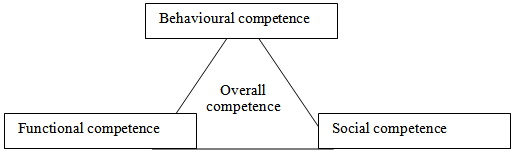
This portrait can be summarised in three main characteristics, embracing competence in its dynamic and analytical form, which we call overall competence. A cognitive competence due to acquired technical expertise and experience, a social competence due to co-competence and team competence, and finally an institutional competence due to membership and the level of alignment with the regulatory constraints of professional organizations. The figure below, inspired by the holistic model of competence of Reference 20, provides a synthetic representation of the profile of an auditor with global competence.
This section discusses the method adopted to assess the relevance of the theoretical model presented. It is divided into three sections: the proposal of an integrated model for predicting the auditor's overall competence, the choice of actors, the data collected and their analysis technique.
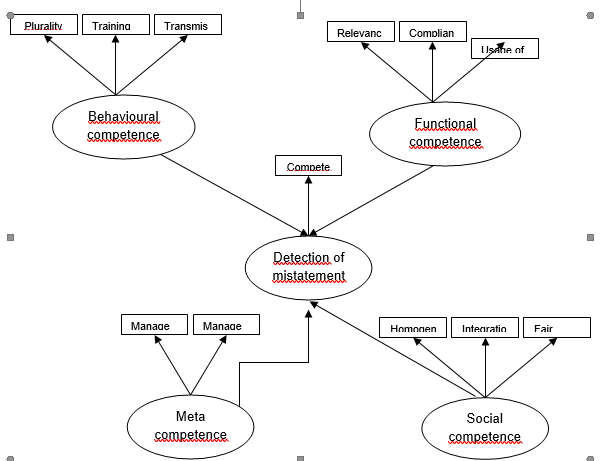
3.1. An Integrated Model Auditor Competence-Audit QualityTo analyse the determining variables of the auditor's competence according to the theoretical factors identified, an analytical framework is proposed. It summarises the different categories of skills discussed. The study aims at explaining and predict the auditor's ability to detect anomalies by three constructs characteristic of overall competence (behavioral, functional and social competence). To these three latent factors, we associate the meta-competence variables 41, which integrate the consideration of uncertainty and the environment by the auditor in the evaluation of the items under audit, errors/frauds and their materiality.

To assess the auditor's overall competence based on the theoretical model developed, data were obtained from questionnaires submitted to auditors practicing in Cameroon, and having already detected anomalies in their client's accounts, and issued an unfavorable audit opinion on the basis of these anomalies. This approach aims to isolate the interference of an auditor’s independence problem in the assessment of competence. Its relevance of this choice lies in the theory's conception of the auditor's competence, that is his ability to detect anomalies in the accounts 3.If non-detection cannot be considered an indicator of "incompetence" (the accounts may actually have no anomalies), detection on the other hand can be considered an indicator of "competence" in the sense of the literature 42. The sample of our study does not include any female accountants, which faithfully reflects the structure of the total population consisting of more than 200 members, generally male. The sample consists of 80 individuals. This choice is relevant for our study, precisely because of its still partially exploratory nature 43.
The following table summarises the measurement of the variables of the model
The 7-level Likert scale was chosen because of its compatibility with partial linear regression methods using exploratory models 44.
The proposed analysis model is evaluated through partial least squares regression method, relevant when the relationships between the variables are not yet well established, and the study is still at an exploratory stage 45. For its validation, the inner and outer models are examined.
4.1. The Validity of the Outer ModelReference 46 suggests the use of Cronbach's alpha as a tool to measure the composite reliability of the outer model or measurement model. The estimated model is accepted when this indicator is greater than 0.7 for each of the manifest variables. The following table shows its value for the variables concerned.
All variables present a sufficient level of reliability, except for the variable "meta competence" which does not satisfy this condition. This trend is confirmed by the analysis of the convergent and discriminant validities which are insufficient for the variable concerned, in the sense of Reference 46.
However, the model shows a satisfactory quality of fit, with a goodness of fit higher than the reference value of 0.5 43.
The internal model presents an interesting R2 of 0.624, which is a satisfactory level for a partial least square model, as shown in the table below. The model thus allows to explain more than 50 percent of the variance in auditor competence.
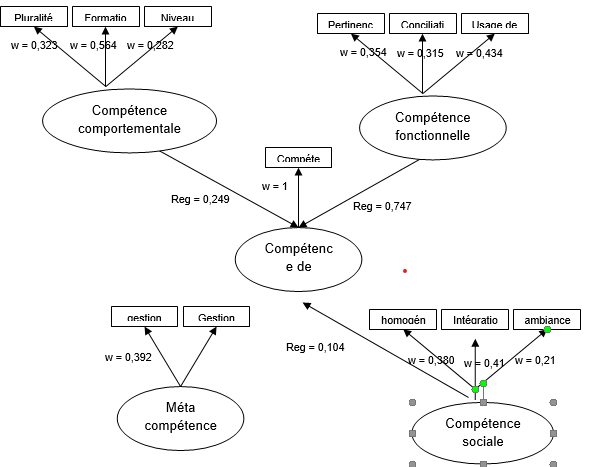
The analysis of econometric regressions presents the coefficients associated with the paths (Path) of the internal model. The figure below summarizes all the relationships established between the variables after regressions.
As a reminder, the variable "meta competence" was isolated from the model, due to the insufficient quality of its adjustment to the rest of the model (measurement and structural), and the insufficient internal reliability of its manifest variables. The estimated model that follows clearly shows the isolation of this construct.
Functional competence presents the most important contribution in explaining the auditor's competence (regression coefficient = 0.74). As a reminder, functional competence relates to the factors of defining a good audit plan, observing regulatory requirements, and using technology in carrying out audit missions. The analysis of the contributions highlights the determining role played by technology. This result is in line with the growing interest that is given by both practitioners and researchers to the technological tool in conducting audit missions 47, 48.


However, the variables “definition of a relevant audit plan” and the regulatory compliance variable also have a significant weight. This can be explained by the decisive nature of planning and compliance with regulations, in an audit environment such as that of Cameroon with characteristics of deviance and compliance 49. The ability to detect anomalies therefore mainly involves a combination of 3 factors characterising functional competence.
Behavioral competence related to training and experience also makes a significant contribution to the explanation of auditor competence. The significance of this variable is consistent with previous work on that issue
3, 4, 5, 6, 7 8, 9, 10, 11, 12, 13. The weights of the associated variables are respectively 0.32; 0.54 and 0.28 for the indicators’ plurality of experience, training and ability to transmit to juniors.
The two other forms of competence studied contribute to a low level (social competence, correlation coefficient = 0.1) or not at all (meta competence) in the explanation of the auditor's competence. This can perhaps be explained by the non-existence of formal circuits for the development of the factors considered, auditing remaining a developing profession in Cameroon as indicated by the Report of the Order of Auditors/chartered accountants of Cameroon in 2023. A different context could give rise to a different analysis for these variables.
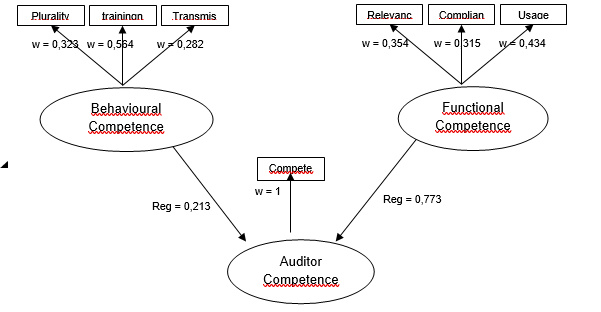
The simplified analysis model, after resampling, takes the following form:
This model simplifies the understanding of the previous model. It clearly highlights the regression coefficients of the two latent variables significant in explaining auditor dependence. The mistatement detection ability is therefore particularly explained by the combination of functional and behavioral skills constructs. Their contribution can be summarized in a bar chart showing the weight of each significant construct.
4.3. Implication of ResultsThe results suggest the decisive role played by functional factors of competence in the ability to detect material errors during an audit engagement. This factor can be modulated at two levels. First at the level of audit offices, the audit market in Cameroon being mainly composed of networked related auditors 50. The parent representations, already aware of international good practices, can harmonise these practices across the entire network in terms of defining an audit program, and in the technological assistance necessary in conducting the mission. Such an approach would have the merit of raising the level of competence of the auditor. Compliance with a homogeneous audit program modeled on international models coupled with the adoption of the necessary technological tool can, for example, constitute one of the conditions for integration into an auditor network. Recent work has focused more on this technological aspect, with the emergence in the field of auditing of the use of tools such as artificial intelligence 50 or robotics 51, 52
Secondly, the professional order can, through continuing education; training and learning, introduce auditors to good practices in planning, or raise their awareness of the importance and applicability of the technological tool for auditing. The merit of this approach lies in the unifying and regulatory role that the order plays in a legal jurisdiction. The impact would thus have a wider scope. It would be interesting to know in a future research work how the technological tool influences professional organizations as well as their professional and legal deployment.
The auditor's overall competence constitutes a black box that this article set out to explore. Based on the principles of competence developed in human sciences, the three components of competence were modeled, and the model estimated using the partial least squares regression method. The results showed that functional competence is the decisive factor explaining the detection of anomalies in audited accounts. The results also, in accordance with the literature, showed the importance of training and experience in the sense of 37.
Auditor competence remains a major issue, to which particular attention must be paid, as well as auditor independence, to achieve audit quality 2. With technological advances, interesting aspects deserve to be studied as part of this investment. Recent tools deployed in the audit context such as artificial intelligence or robotics are aspects that can contribute to better penetrating the black box that is auditor competence, and even improve the quality of the audit as a whole.
| [1] | Carrera, N., Gutiérrez, I., & Carmona, S. Gender, the state and the audit profession: evidence from Spain (194288). European Accounting Review, 10(4), 803–815. 2001. | ||
| In article | View Article | ||
| [2] | Hottegindre G. & Lesage C. Un mauvais auditeur: Manque d’indépendance et/ou de compétence ? Etude exploratoire des motifs de condamnation des commissaires aux comptes sur le marché de l’audit en France. Comptabilité-Contrôle-Audi t, vol. 15, no 2, 87-112. 2009. | ||
| In article | View Article | ||
| [3] | De Angelo L.E. Auditor size and audit quality. Journal of Accounting and Economics, 3 (3), 183-199. 1981. | ||
| In article | View Article | ||
| [4] | Jerman, L. & Raone, J. Ethnographie des journées d’intégration dans un grand cabinet d’audit. Annales des Mines - Gérer et comprendre, 134, 24-36. 2018. | ||
| In article | View Article | ||
| [5] | Pentland B. T. Will auditors take over the world? Program, technique and the verification of everything, Accounting, Organizations and Society, 25(3), 307-312. 2000. | ||
| In article | View Article | ||
| [6] | Lenz, R., & O’Regan, D. J. The global internal audit standards – old wine in new bottles? edpacs, Vol. 69 (3),1–28. 2024. | ||
| In article | View Article | ||
| [7] | Huang Y., Li N., Zhang J., Zhou X. The Economic Consequences of Heightened Materiality Uncertainty: An Auditing Perspective. The Accounting Review; 1-25. 2024. | ||
| In article | |||
| [8] | Feliciano, C., & Quick, R. Innovative Information Technology in Auditing: Auditors’ Perceptions of Future Importance and Current Auditor Expertise. Accounting in Europe, 19 (2), 311–331. 2022. | ||
| In article | View Article | ||
| [9] | Muterera J. Developing a measurement instrument for technical and analytical skills in auditing for enhanced fraud detection, Finance & Accounting Journal, 5(2).2024a. | ||
| In article | |||
| [10] | Omer T. C., Shelley M. K., Thompson A. M. Investors' Response to Revelations of Prior Uncorrected Misstatements, AUDITING: A Journal of Practice & Theory. 31(4), 167–192. 2012. | ||
| In article | View Article | ||
| [11] | Sandberg, J. Competence: the basis for a smart workforce, in: R. Gerber and C. Lankshear (Eds) Training for a Smart Workforce, pp. 47 – 72 (London: Routledge). 2000. | ||
| In article | |||
| [12] | Everaere C. La compétence: un compromis multidimensionnel fragile, Gestion 2000, 17 (4), 1-19. 2000. | ||
| In article | View Article | ||
| [13] | Nikitina T., Lapina I. Creating and managing knowledge towards managerial competence development in contemporary business environment, Knowledge Management Research and Practice, 17 (1), 96-107. 2019. | ||
| In article | View Article | ||
| [14] | Derwik, P., HellströM, D., & Karlsson, S. Manager competences in logistics and supply chain practice. Journal of Business Research, 69 (11), 4820–4825. 2016. | ||
| In article | View Article | ||
| [15] | Guðmundsson, A. H. What are the success factors for project leaders in virtual teams? MPM-program final project. Reykjavík, Iceland: Reykjavik University. 2012. | ||
| In article | |||
| [16] | UrošEvić, S., & Grahova, M. Knowledge, skills and competences required for organization management. Economics Management Information Technology, 3 (2), 93–103, 2014. | ||
| In article | |||
| [17] | Paloniemi S. Experience, competence and workplace learning, Journal of Workplace Learning, 18 (7/8), 439-450, 2006. | ||
| In article | View Article | ||
| [18] | Spencer, L. M., & Spencer, S. M. Competence at work: Models for superior performance. New York: JohnWiley & Sons, Inc, 1993. | ||
| In article | |||
| [19] | Eraut M. Concepts of competence, Journal of Interprofessional Care, 12 (2), 127-139. 1998. | ||
| In article | View Article | ||
| [20] | Delamare F. L. D., Winterton J. What is competence? Human Resource development International, 8 (1), 27-46. 2005. | ||
| In article | View Article | ||
| [21] | Boud, D. Work and learning: some challenges for practice”, in Poikela, E. (Ed.), Osaaminenja, 2005. | ||
| In article | |||
| [22] | Marsick, V.J. and Watkins, K.E. Informal and Incidental Learning in the Workplace, Routledge, London, 1990. | ||
| In article | |||
| [23] | Polanyi, M. The Tacit Dimension, Doubleday, New York, NY, 1966. | ||
| In article | |||
| [24] | Olesen, H.S. Professional identity as learning processes in life histories, Journal of Workplace Learning, 13 (7/8), 290-297. 2001. | ||
| In article | View Article | ||
| [25] | Messick, S. The psychology of educational measurement, Journal of Educational Measurement, 21, 215-228. 1984. | ||
| In article | View Article | ||
| [26] | Ishak, N. B., Eze, U. C., & Ling, L. S. Integrating knowledge management and human resource management for sustainable performance. Journal of Organizational Knowledge Management, 1–13. 2010. | ||
| In article | View Article | ||
| [27] | Sumi, J. Human resource management and knowledge management: Revisiting challenges of integration. International Journal of Management & Business Studies, l1, 56–60. 2011. | ||
| In article | |||
| [28] | Oiry E., D’Iribarne A. La notion de compétence: continuités et changements par rapport à la notion de qualification, Sociologie du Travail, 43 (1), 49-66. 2001. | ||
| In article | View Article | ||
| [29] | Demailly L. La qualification ou la compétence professionnelle des enseignants, Sociologie du travail, 29 (1), 59-69. 1987. | ||
| In article | View Article | ||
| [30] | Meylani R., Bitter G., Legacy J. Desirable characteristics of an ideal online learning environment, Journal of Education and Social Research, 45 (1), Feedback. 2015. | ||
| In article | View Article | ||
| [31] | Inan, F.A., Lowther, D.L. Factors affecting technology integration in K-12 classrooms: a path model. Educational Technology Research and Development, 58, 137–154. 2010. | ||
| In article | View Article | ||
| [32] | Hamel, G. and Prahalad, C. K. Competing for the Future (Cambridge, MA: Harvard Business School Press). 1994. | ||
| In article | |||
| [33] | Klarner P et Raisch S. Move to the beat: Rhythms of change and firm performance, Academy of Management Journal, Vol. 56 (1), 160-184, 2013. | ||
| In article | View Article | ||
| [34] | Brulhart F., Favoreu C., Loufrani-Fedida S. L’influence de la compétence collective sur la performance d’équipe: analyse du rôle modérateur du leadership partagé et du coaching, Management International, 23 (4), 149-164. | ||
| In article | View Article | ||
| [35] | Hoegl M., Gemuenden H. G. Teamwork quality and the success of innovative projects: A theoretical concept and empirical evidence, Organization Science, 12 (4), 435-449. 2001. | ||
| In article | View Article | ||
| [36] | Richard C. Why can’t be competent and independent: A French case study, European Accounting Review, 15 (2), 153-179. 2006. | ||
| In article | View Article | ||
| [37] | Flint D., Philosophy and Principles of Auditing, Macmillan Education, London, 198. 2006. | ||
| In article | |||
| [38] | Xu H., Yang X., Liu J. Signing auditors' experience gap and the cost of capital: Evidence from China, International Journal of Auditing; 28 (1), 62-82. 2023. | ||
| In article | View Article | ||
| [39] | Simunic, D. A., Ye, M., & Zhang, P. The Joint Effects of Multiple Legal System Characteristics on Auditing Standards and Auditor. Behavior. Contemporary Accounting Research, 34 (1), 7–38. 2016. | ||
| In article | View Article | ||
| [40] | Proell C. A., Ricci M. A., Trotman K. T., Zhou Y. How workplace identities and team management practices affect distributed team auditors' willingness to speak up 41 (1), 562-590.2024. | ||
| In article | View Article | ||
| [41] | Cheetham, G. and Chivers, G. The reflective (and competent) practitioner: a model of professional competence which seeks to harmonise the reflective practitioner and competence-based approaches, Journal of European Industrial Training, 22 (7), 267 – 27. 1998. | ||
| In article | View Article | ||
| [42] | Muterera J. The auditor self-efficacy scale: measuring confidence in technical skills, technological adaptation, and interpersonal communication, Finance & Accounting Research Journal, Vol.6 No 3, 331-346, 2024b. | ||
| In article | View Article | ||
| [43] | Tenenhaus, M., Vinzi, V. E., Chatelin, Y.-M., & Lauro, C. PLS path modeling. Computational Statistics & Data Analysis, 48 (1), 159-205. 2005. | ||
| In article | View Article | ||
| [44] | Sekaran, U., & Bougie, R. Research Methods for Business. Wiley. 2016. | ||
| In article | |||
| [45] | Chin W.W. The partial least squares approach to structural equation modeling. In G.A. Marcoulides (Ed.), Modern methods for business research. 295-336. Mahwah,NJ: Lawrence, 1998. | ||
| In article | |||
| [46] | Fernandes, V. En quoi l’approche PLS est-elle une méthode a (re)-découvrir pour les chercheurs en management? M@n@gement, 15 (1), 102-123. 2012. | ||
| In article | View Article | ||
| [47] | Salijeni G., Samsonova-Taddei A., Turle S. Big Data and changes in audit technology: contemplating a research agenda, Accounting and Business Research, 49 (1), 95-119. 2019. | ||
| In article | View Article | ||
| [48] | Vasarhelyi M. A., Romero S. Technology in audit assignments: a case study, Managerial Auditing Journal, 9 (4), 350-365. 2014. | ||
| In article | View Article | ||
| [49] | Ngantchou et Hanko. La prédiction des situations de dépendance de l’auditeur: Une étude empirique en contexte Camerounais, Gestion 2000, 38 (4), 85-112. 2021. | ||
| In article | View Article | ||
| [50] | Vitali S et Giulani V. Emerging digital technologies and auditing firms: Opportunities and challenges, International journal of accounting information systems 53, 100676, 2024. | ||
| In article | View Article | ||
| [51] | Ashok M L et Divyashree. Emerging trend in accounting: an analysis of impact of robotics in accounting, reporting, and auditing of business and financial information, International journal of Business Analytics and Intelligence, 7 (2), 28-34. 2019. | ||
| In article | View Article | ||
| [52] | Tiron-Tudor A, Lacurezeanu R, Bresfelean V P, Dontu A N. Perspectives on how robotic process automation is transforming accounting and auditing services, accounting perspectives, 23 (1), 7-38. 2024. | ||
| In article | View Article | ||
Published with license by Science and Education Publishing, Copyright © 2025 Osée Hanko
 This work is licensed under a Creative Commons Attribution 4.0 International License. To view a copy of this license, visit
http://creativecommons.org/licenses/by/4.0/
This work is licensed under a Creative Commons Attribution 4.0 International License. To view a copy of this license, visit
http://creativecommons.org/licenses/by/4.0/
| [1] | Carrera, N., Gutiérrez, I., & Carmona, S. Gender, the state and the audit profession: evidence from Spain (194288). European Accounting Review, 10(4), 803–815. 2001. | ||
| In article | View Article | ||
| [2] | Hottegindre G. & Lesage C. Un mauvais auditeur: Manque d’indépendance et/ou de compétence ? Etude exploratoire des motifs de condamnation des commissaires aux comptes sur le marché de l’audit en France. Comptabilité-Contrôle-Audi t, vol. 15, no 2, 87-112. 2009. | ||
| In article | View Article | ||
| [3] | De Angelo L.E. Auditor size and audit quality. Journal of Accounting and Economics, 3 (3), 183-199. 1981. | ||
| In article | View Article | ||
| [4] | Jerman, L. & Raone, J. Ethnographie des journées d’intégration dans un grand cabinet d’audit. Annales des Mines - Gérer et comprendre, 134, 24-36. 2018. | ||
| In article | View Article | ||
| [5] | Pentland B. T. Will auditors take over the world? Program, technique and the verification of everything, Accounting, Organizations and Society, 25(3), 307-312. 2000. | ||
| In article | View Article | ||
| [6] | Lenz, R., & O’Regan, D. J. The global internal audit standards – old wine in new bottles? edpacs, Vol. 69 (3),1–28. 2024. | ||
| In article | View Article | ||
| [7] | Huang Y., Li N., Zhang J., Zhou X. The Economic Consequences of Heightened Materiality Uncertainty: An Auditing Perspective. The Accounting Review; 1-25. 2024. | ||
| In article | |||
| [8] | Feliciano, C., & Quick, R. Innovative Information Technology in Auditing: Auditors’ Perceptions of Future Importance and Current Auditor Expertise. Accounting in Europe, 19 (2), 311–331. 2022. | ||
| In article | View Article | ||
| [9] | Muterera J. Developing a measurement instrument for technical and analytical skills in auditing for enhanced fraud detection, Finance & Accounting Journal, 5(2).2024a. | ||
| In article | |||
| [10] | Omer T. C., Shelley M. K., Thompson A. M. Investors' Response to Revelations of Prior Uncorrected Misstatements, AUDITING: A Journal of Practice & Theory. 31(4), 167–192. 2012. | ||
| In article | View Article | ||
| [11] | Sandberg, J. Competence: the basis for a smart workforce, in: R. Gerber and C. Lankshear (Eds) Training for a Smart Workforce, pp. 47 – 72 (London: Routledge). 2000. | ||
| In article | |||
| [12] | Everaere C. La compétence: un compromis multidimensionnel fragile, Gestion 2000, 17 (4), 1-19. 2000. | ||
| In article | View Article | ||
| [13] | Nikitina T., Lapina I. Creating and managing knowledge towards managerial competence development in contemporary business environment, Knowledge Management Research and Practice, 17 (1), 96-107. 2019. | ||
| In article | View Article | ||
| [14] | Derwik, P., HellströM, D., & Karlsson, S. Manager competences in logistics and supply chain practice. Journal of Business Research, 69 (11), 4820–4825. 2016. | ||
| In article | View Article | ||
| [15] | Guðmundsson, A. H. What are the success factors for project leaders in virtual teams? MPM-program final project. Reykjavík, Iceland: Reykjavik University. 2012. | ||
| In article | |||
| [16] | UrošEvić, S., & Grahova, M. Knowledge, skills and competences required for organization management. Economics Management Information Technology, 3 (2), 93–103, 2014. | ||
| In article | |||
| [17] | Paloniemi S. Experience, competence and workplace learning, Journal of Workplace Learning, 18 (7/8), 439-450, 2006. | ||
| In article | View Article | ||
| [18] | Spencer, L. M., & Spencer, S. M. Competence at work: Models for superior performance. New York: JohnWiley & Sons, Inc, 1993. | ||
| In article | |||
| [19] | Eraut M. Concepts of competence, Journal of Interprofessional Care, 12 (2), 127-139. 1998. | ||
| In article | View Article | ||
| [20] | Delamare F. L. D., Winterton J. What is competence? Human Resource development International, 8 (1), 27-46. 2005. | ||
| In article | View Article | ||
| [21] | Boud, D. Work and learning: some challenges for practice”, in Poikela, E. (Ed.), Osaaminenja, 2005. | ||
| In article | |||
| [22] | Marsick, V.J. and Watkins, K.E. Informal and Incidental Learning in the Workplace, Routledge, London, 1990. | ||
| In article | |||
| [23] | Polanyi, M. The Tacit Dimension, Doubleday, New York, NY, 1966. | ||
| In article | |||
| [24] | Olesen, H.S. Professional identity as learning processes in life histories, Journal of Workplace Learning, 13 (7/8), 290-297. 2001. | ||
| In article | View Article | ||
| [25] | Messick, S. The psychology of educational measurement, Journal of Educational Measurement, 21, 215-228. 1984. | ||
| In article | View Article | ||
| [26] | Ishak, N. B., Eze, U. C., & Ling, L. S. Integrating knowledge management and human resource management for sustainable performance. Journal of Organizational Knowledge Management, 1–13. 2010. | ||
| In article | View Article | ||
| [27] | Sumi, J. Human resource management and knowledge management: Revisiting challenges of integration. International Journal of Management & Business Studies, l1, 56–60. 2011. | ||
| In article | |||
| [28] | Oiry E., D’Iribarne A. La notion de compétence: continuités et changements par rapport à la notion de qualification, Sociologie du Travail, 43 (1), 49-66. 2001. | ||
| In article | View Article | ||
| [29] | Demailly L. La qualification ou la compétence professionnelle des enseignants, Sociologie du travail, 29 (1), 59-69. 1987. | ||
| In article | View Article | ||
| [30] | Meylani R., Bitter G., Legacy J. Desirable characteristics of an ideal online learning environment, Journal of Education and Social Research, 45 (1), Feedback. 2015. | ||
| In article | View Article | ||
| [31] | Inan, F.A., Lowther, D.L. Factors affecting technology integration in K-12 classrooms: a path model. Educational Technology Research and Development, 58, 137–154. 2010. | ||
| In article | View Article | ||
| [32] | Hamel, G. and Prahalad, C. K. Competing for the Future (Cambridge, MA: Harvard Business School Press). 1994. | ||
| In article | |||
| [33] | Klarner P et Raisch S. Move to the beat: Rhythms of change and firm performance, Academy of Management Journal, Vol. 56 (1), 160-184, 2013. | ||
| In article | View Article | ||
| [34] | Brulhart F., Favoreu C., Loufrani-Fedida S. L’influence de la compétence collective sur la performance d’équipe: analyse du rôle modérateur du leadership partagé et du coaching, Management International, 23 (4), 149-164. | ||
| In article | View Article | ||
| [35] | Hoegl M., Gemuenden H. G. Teamwork quality and the success of innovative projects: A theoretical concept and empirical evidence, Organization Science, 12 (4), 435-449. 2001. | ||
| In article | View Article | ||
| [36] | Richard C. Why can’t be competent and independent: A French case study, European Accounting Review, 15 (2), 153-179. 2006. | ||
| In article | View Article | ||
| [37] | Flint D., Philosophy and Principles of Auditing, Macmillan Education, London, 198. 2006. | ||
| In article | |||
| [38] | Xu H., Yang X., Liu J. Signing auditors' experience gap and the cost of capital: Evidence from China, International Journal of Auditing; 28 (1), 62-82. 2023. | ||
| In article | View Article | ||
| [39] | Simunic, D. A., Ye, M., & Zhang, P. The Joint Effects of Multiple Legal System Characteristics on Auditing Standards and Auditor. Behavior. Contemporary Accounting Research, 34 (1), 7–38. 2016. | ||
| In article | View Article | ||
| [40] | Proell C. A., Ricci M. A., Trotman K. T., Zhou Y. How workplace identities and team management practices affect distributed team auditors' willingness to speak up 41 (1), 562-590.2024. | ||
| In article | View Article | ||
| [41] | Cheetham, G. and Chivers, G. The reflective (and competent) practitioner: a model of professional competence which seeks to harmonise the reflective practitioner and competence-based approaches, Journal of European Industrial Training, 22 (7), 267 – 27. 1998. | ||
| In article | View Article | ||
| [42] | Muterera J. The auditor self-efficacy scale: measuring confidence in technical skills, technological adaptation, and interpersonal communication, Finance & Accounting Research Journal, Vol.6 No 3, 331-346, 2024b. | ||
| In article | View Article | ||
| [43] | Tenenhaus, M., Vinzi, V. E., Chatelin, Y.-M., & Lauro, C. PLS path modeling. Computational Statistics & Data Analysis, 48 (1), 159-205. 2005. | ||
| In article | View Article | ||
| [44] | Sekaran, U., & Bougie, R. Research Methods for Business. Wiley. 2016. | ||
| In article | |||
| [45] | Chin W.W. The partial least squares approach to structural equation modeling. In G.A. Marcoulides (Ed.), Modern methods for business research. 295-336. Mahwah,NJ: Lawrence, 1998. | ||
| In article | |||
| [46] | Fernandes, V. En quoi l’approche PLS est-elle une méthode a (re)-découvrir pour les chercheurs en management? M@n@gement, 15 (1), 102-123. 2012. | ||
| In article | View Article | ||
| [47] | Salijeni G., Samsonova-Taddei A., Turle S. Big Data and changes in audit technology: contemplating a research agenda, Accounting and Business Research, 49 (1), 95-119. 2019. | ||
| In article | View Article | ||
| [48] | Vasarhelyi M. A., Romero S. Technology in audit assignments: a case study, Managerial Auditing Journal, 9 (4), 350-365. 2014. | ||
| In article | View Article | ||
| [49] | Ngantchou et Hanko. La prédiction des situations de dépendance de l’auditeur: Une étude empirique en contexte Camerounais, Gestion 2000, 38 (4), 85-112. 2021. | ||
| In article | View Article | ||
| [50] | Vitali S et Giulani V. Emerging digital technologies and auditing firms: Opportunities and challenges, International journal of accounting information systems 53, 100676, 2024. | ||
| In article | View Article | ||
| [51] | Ashok M L et Divyashree. Emerging trend in accounting: an analysis of impact of robotics in accounting, reporting, and auditing of business and financial information, International journal of Business Analytics and Intelligence, 7 (2), 28-34. 2019. | ||
| In article | View Article | ||
| [52] | Tiron-Tudor A, Lacurezeanu R, Bresfelean V P, Dontu A N. Perspectives on how robotic process automation is transforming accounting and auditing services, accounting perspectives, 23 (1), 7-38. 2024. | ||
| In article | View Article | ||