This study evaluates the accuracy of monthly MODIS Terra and Aqua Collection 6.1 Level 3 aerosol optical depth (AOD) products- combining Dark Target and Deep Blue algorithms at 550 nm- against ground-based AERONET Version 3 Level 2 measurements at eight active stations located in and near arid regions. Satellite and AERONET monthly AOD values were compared using linear regression. Results show strong correlations for both platforms: Terra (r = 0.844, R² = 0.712) and Aqua (r = 0.828, R² = 0.685). Both sensors exhibit similar positive biases relative to AERONET (+0.083 for Terra, +0.082 for Aqua), indicating that MODIS tends to overestimate AOD. Terra shows slightly greater overestimation but better captures monthly variability than Aqua. Performance varies notably by station, likely reflecting differences in local aerosol composition, surface reflectance, coastal versus desert heterogeneity, and spatial mismatches between point-based AERONET measurements and MODIS's coarser 1° grid cells. Overall, MODIS monthly AOD products provide valuable data for regional-scale aerosol monitoring in dust-prone Middle Eastern environments. However, the study emphasizes that station-specific calibration and cautious interpretation are necessary when applying coarse-resolution MODIS data to localized dust and air-quality assessments, given the observed spatial variability in accuracy.
Aerosols constitute a multiphase system consisting of solid and liquid particles suspended in the atmosphere, alongside gas phase carriers, with dimensions ranging from 0.001 to 100μm 1, 2, 3. Atmospheric aerosols play a critical role in influencing climate, visibility, cloud microphysics, atmospheric chemistry, and human health (Manavi et al., 2025; Omokpariola, 2025 4. Exposure to elevated aerosol concentrations is linked to adverse health outcomes- especially respiratory and cardiovascular disease- because ultrafine particles can reach the deep lung and enter the bloodstream, increasing risks such as heart disease and cancer 5. Aerosol optical depth (AOD), also called Aerosol Optical Thickness (AOT), is a critical metric that is extensively utilized for assessing atmospheric aerosol loading 6, 7, 8. AOD quantifies the column-integrated attenuation of solar radiation due to aerosols, and therefore, is directly impacting dust monitoring, visibility assessments, air quality evaluation, and climate studies in arid and semi-arid regions. Therefore, monitoring aerosol loading, optical properties, types, and source regions is essential for both environmental management and public health policy. In arid and semi-arid regions, mineral dust is the predominant contributor to AOD; however, marine aerosols, urban pollution, industrial emissions, transported smoke, and mixed aerosol types can also significantly affect AOD values.
The Middle East is one of the world’s most important dust-affected regions, as it lies within the global dust belt and contains major dust source areas, including the Arabian Desert, Mesopotamian plains, Rub’ al Khali, and adjacent arid basins. This region routinely experiences influence from mineral dust, mixed desert–urban aerosols, marine particles, and regional transport phenomena. Previous regional studies have shown that the Middle East experiences high spatial and temporal AOD variability due to natural dust sources, transboundary transport, industrial emissions, and mixed aerosol regimes 9, 10, 11, 12. It has been noted that the Middle East is strongly influenced by natural aerosol sources, transboundary dust from Africa and Asia, marine aerosols, and anthropogenic emissions 2.
Both ground measurements and satellite measurements are used for AOD monitoring. Ground-based measurements provide accurate aerosol observations but are spatially limited, whereas satellite remote sensing offers extensive spatial and temporal coverage for regional and global AOD assessments 13, 14. AOD is a critical ground and satellite-derived metric for quantifying atmospheric aerosol presence. MODIS, onboard NASA’s Terra and Aqua satellites, is among the most widely used instruments for aerosol monitoring. Terra provides a morning overpass at 10:30am and Aqua an afternoon overpass at 13:30pm, enabling comparison of platform-dependent AOD retrievals. MODIS aerosol retrievals use both Dark Target (DT) and Deep Blue (DB) approaches (Ali & Assiri, 2019; Elshora, 2023; Li, Shi, & Sun, 2020; Sayer et al., 2014; Wei, Li, Peng, & Sun, 2019). Dark Target performs better over vegetated and darker surfaces, while Deep Blue is designed to improve retrievals over bright surfaces such as deserts. This is particularly important for the Middle East, where high surface reflectance creates major challenges for aerosol retrieval. Myriad studies revealed that satellite driven AOD data such as that from MODIS and MISR is strongly affected by surface brightness 1, 15, 16, aerosol regime, and station location. Previous studies have compared MODIS AOD with AERONET across the Middle East and nearby regions, generally finding moderate-to-strong correlations alongside site-specific biases 2, 17, 18.
Although several studies have compared MODIS, MISR, OMI, and AERONET observations over the Middle East and North Africa 9, 10, 12, 19, 20, 21, 22, the performance of MODIS Terra and Aqua monthly products at individual AERONET stations remains important for regional dust and air-quality applications. Monthly Level-3 MODIS products are widely used because they are easy to access, computationally efficient, and suitable for climatological and trend studies. However, they have a coarse spatial resolution of 1° × 1°, which may smooth local aerosol variability and produce differences when compared with point-based AERONET observations. The objective of this study is therefore to evaluate MODIS Terra and Aqua monthly AOD products against AERONET observations at eight dust-affected Middle Eastern and adjacent arid-region stations. The analysis uses MODIS monthly Level-3 products from Google Earth Engine, AERONET wavelength-adjusted AOD at 550 nm, and regression-based comparison metrics derived from station-level monthly paired data.
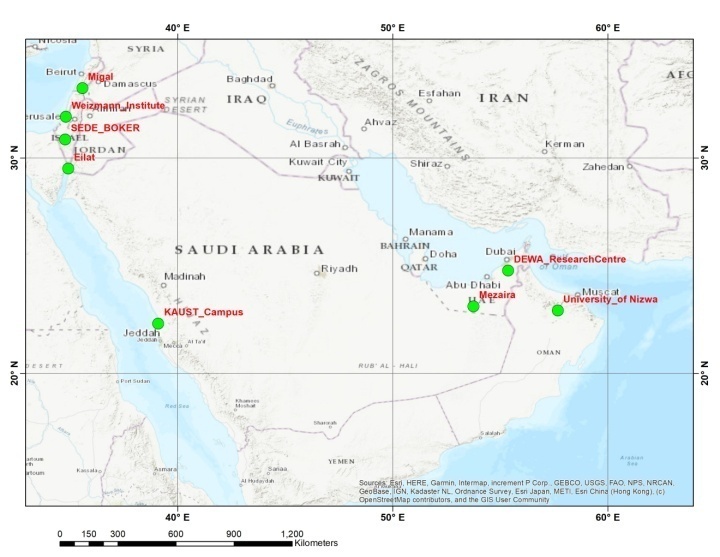
The study includes eight active AERONET stations spanning a range of aerosol and surface settings, including desert, coastal, urban, semi-arid, and mixed regimes.
AERONET is network of ground-based sun photometers which measure atmospheric aerosol properties. AERONET provides continuous cloud-screened observations of spectral aerosol optical depth (AOD), precipitable water, and inversion aerosol products in diverse aerosol regimes, using solar-powered CIMEL Electronique spectral radiometer. The radiometer measures Sun and sky radiances at a number of fixed wavelengths within the visible and near-infrared spectrum 23, 24. This study uses AERONET AOD measured at 500nm wavelength.

Table 1 identifies the eight stations and their respective analysis periods, including the pooled “All AERONET Stations” comparison and station-level regression analysis (see Annex for complete Table).
MODIS Terra and Aqua monthly AOD data were obtained from Google Earth Engine using the Collection 6.1 monthly Level-3 atmosphere products, MODIS/061/MOD08_M3 for Terra and MODIS/061/MYD08_M3 for Aqua. The extracted variable was the monthly mean combined DT and DB (DTB) AOD at 550 nm over land and ocean. These monthly products have a spatial resolution of 1° × 1°. DTB product is generally recommended for long-term AOD studies over land. Collection 6.1 (C6.1) was introduced by The MODIS Adaptive Processing System (MODAPS) in 2017, through reprocessing and improvement of Collection 6.0. Both MODIS TERRRA and AQUA data were processed and available from 2000 and 2002 respectively 25. C6.1 was produced to address issues that were encountered in previous versions. One of the main advantages of C6.1 is the availability and maturity of the combined Dark Target–Deep Blue AOD product (DTB). DT is traditionally strong over darker vegetated surfaces and ocean, while DB was developed to improve aerosol retrieval over brighter land surfaces 26. For arid and semi-arid regions such as Qatar and the Arabian Peninsula, the combined DT–DB AOD product is often more appropriate than relying on DT alone because it increases usable coverage over bright desert and urban surfaces. Independent evaluation also supports the use of Collection 6.1 monthly AOD products. A study evaluating Terra and Aqua MODIS C6.1 Level-3 aerosol products against AERONET measurements at 431 sites found that the C6.1 MODIS AOD retrievals were generally well correlated with AERONET, and that the combined DTB product was strongly recommended for regional and global scale aerosol studies 27. In addition to that C6.1 has: improved monthly aerosol quality, as it reduces spurious monthly grid-cell values from isolated daily retrievals; and Reduced cloud contamination in monthly data 27, 28, 29. The combined DTB modification applies specifically to monthly AOD dataset. This study uses monthly DTB AOD produced by MODIS 550nm wavelength.
For each AERONET station, the station latitude and longitude were used in GEE to extract the corresponding monthly MODIS grid-cell AOD. The extracted Terra and Aqua monthly AOD time series were then paired with monthly AERONET AOD values for the same station and month.
3.2. AERONET AOD and Wavelength AdjustmentAERONET provides high-quality ground-based sun photometer measurements of spectral AOD. AERONET is a widely used reference network for satellite aerosol validation, with AOD measurements typically available at wavelengths such as 440, 500, 670/675, 870, and 1020 nm.
Because MODIS AOD is reported at 550 nm, AERONET AOD at 500 nm was converted to 550 nm using the Ångström exponent calculated from 440 and 870 nm AOD. The wavelength conversion followed the standard power-law relationship:
 | (1) |
where  is the AERONET-adjusted AOD at 550 nm,
  is AERONET AOD at 500 nm, and
  is the Ångström exponent (AE) between 440 and 870 nm:
 | (2) |
This adjustment is commonly used to standardize AOD values from different sensors to a common wavelength using AERONET 500 nm AOD and AE (440–870).
3.3. Regression AnalysisThe comparison between MODIS and AERONET was conducted using linear regression for each station and for all stations combined. The regression analysis quantified the strength and form of the relationship between MODIS monthly AOD and AERONET-adjusted monthly AOD at 550 nm. The main regression indicators were Pearson correlation coefficient  , coefficient of determination
  , adjusted coefficient of determination
  and regression slope, intercept, and number of monthly paired observations.
The general regression model was expressed as:
where  is MODIS Terra or Aqua AOD at 550 nm,
  is AERONET-adjusted AOD at 550 nm,
  is the intercept,
  is the slope, and
  is the residual error term.
The adjusted coefficient of determination  is calculated using coefficient of determination
  as follows:
 | (3) |
where:
 | (4) |
where:
 = number of observations
 = number of independent variables (predictors)
 = coefficient of determination
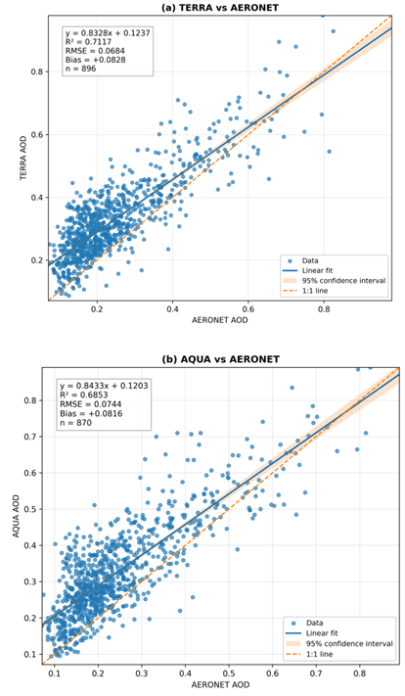
The pooled regression results, shown in Figure 2, depict strong agreement between monthly MODIS AOD and AERONET AOD across all eight stations. Terra achieved ,
,  , slope = 0.833, intercept = 0.1237, and N = 896. Aqua achieved
 ,
,  , slope = 0.8433, intercept = 0.1203, and N = 870, as shown in Table 2.

Overall, both MODIS products show strong positive agreement with AERONET, but TERRA has slightly higher R² and lower RMSE, while AQUA has a slightly lower mean positive bias.
These results indicate that both MODIS platforms captured the main monthly AOD variability observed by AERONET. Terra showed slightly stronger pooled agreement than Aqua, although the difference was modest. The overall performance is consistent with previous Middle Eastern AOD validation studies 17, which report moderate-to-strong MODIS–AERONET correlations but station-dependent performance, Table (due to surface reflectance, aerosol loading, and mixed aerosol types.
Both Terra and Aqua overestimate the AERONET AOD by as they have positive bias. Terra achieves higher bias (+0.083 vis-à-vis +0.082 of Aqua) despite it has higher R2 than Aqua (0.7117 and 0.685 respectively). Bias quantifies the average systematic offset, whereas R2 evaluates how well the satellite product reproduces the temporal variability of AERONET AOD. Thus, Terra has slightly higher average overestimation, but it captures the monthly AOD variability slightly better than Aqua. Overall, this almost similar mean bias for all stations of Terra and Aqua indicates that, on the regional scale, both MODIS products have a similar tendency to retrieve higher AOD than ground-based AERONET.
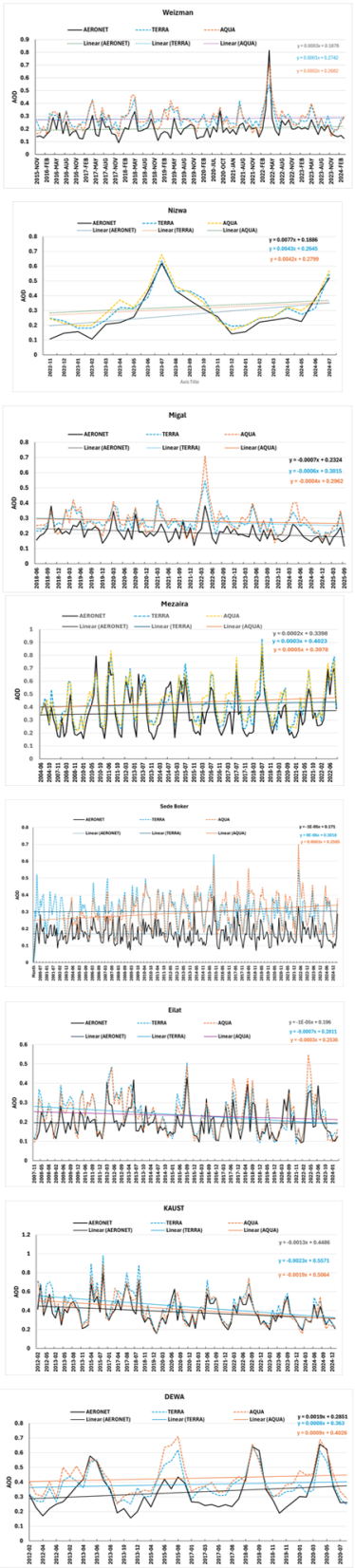
4.2. Station-level PerformanceFigure 3 compares monthly AERONET-adjusted AOD at 550 nm with MODIS Terra and Aqua AOD for the eight selected stations.

Figure 3 shows that MODIS Terra and Aqua reproduced the main temporal variability observed by AERONET, especially during high-AOD episodes associated with dust or mixed aerosol loading in summer. Temporal agreement was strongest at Nizwa, Mezaira, KAUST, and DEWA, where both products captured most major aerosol peaks. Larger discrepancies appeared at Sede Boker, Eilat, and MIGAL, where MODIS often reported higher AOD than AERONET or amplified selected events. These differences likely reflect bright desert surface reflectance, coastal and land–sea heterogeneity, local aerosol variability, and the mismatch between point-based AERONET observations and 1° MODIS monthly grid cells. Overall, the comparison shows that MODIS Terra and Aqua are useful for regional monthly AOD monitoring, but station-specific validation remains important for local dust or air-quality interpretation.
Regression analysis has been conducted for all eight stations individual eight stations, and results are shown in Table 3 below (see Annex for complete Table).
The strongest MODIS–AERONET agreement was observed at Nizwa (University of Nizwa), where both Terra and Aqua showed very high correlations and high  values. Terra achieved
 ,
,  , and slope 1.075, while Aqua achieved
  ,
,  and slope 1.002. This strong agreement may reflect the station’s short record and corresponding small sample size (N = 21), which can inflate apparent consistency between MODIS monthly AOD and AERONET AOD at this station. Mezaira also showed strong and balanced performance for both sensors, with nearly identical Terra and Aqua correlations. This is important because Mezaira is located in an arid desert environment where aerosol loading is strongly influenced by dust. The good agreement suggests that monthly MODIS combined Dark Target/Deep Blue retrievals are effective at representing regional-scale aerosol variability in this dust-dominated environment.
KAUST and DEWA also showed strong performance. KAUST had a particularly strong Terra relationship ( ,
, ), while DEWA showed good agreement for Terra (
 ,
, ) and moderate-to-strong agreement for Aqua (
 ,
, ). These stations are located in environments where desert dust, coastal influence, urban emissions, and industrial sources may interact. The good agreement suggests that monthly MODIS AOD is able to capture broad aerosol variability despite mixed aerosol conditions. Weizmann Institute showed moderate agreement, with Aqua outperforming Terra. MIGAL, Eilat, and Sede Boker showed weaker regression performance, particularly in terms of slope and
 . These stations are located in complex eastern Mediterranean, Red Sea, or desert-margin environments where local aerosol variability may not be well represented by a 1° MODIS grid cell. The weaker slopes at Eilat and Sede Boker suggest that MODIS monthly AOD may compress the range of AOD variability relative to AERONET, especially under higher aerosol loading or localized aerosol events.
The bias results of the regression analysis, shown in Table 4, show the deviation of MODIS values from the measured AERONET values at every station.
The largest bias occurs at Sede Boker, with Terra = +0.134 and Aqua = +0.131. This suggests strong MODIS overestimation over this desert/arid environment, probably linked to retrieval difficulty over bright surfaces, surface reflectance uncertainty, dust contamination, and mixed aerosol conditions. The lowest biases occur at Eilat and University of Nizwa. Eilat shows very small and balanced bias values, Terra = +0.040 and Aqua = +0.038, suggesting better satellite–AERONET agreement. University of Nizwa also shows relatively low bias, especially for Terra (+0.039). There are some station-specific differences between Terra and Aqua. At KAUST, Aqua performs better, with a much lower bias (+0.027) compared with Terra (+0.059). At DEWA, however, Terra performs better, with bias +0.052, while Aqua has a larger bias +0.095. For Weizmann Institute, MIGAL, Mezaira, and Sede Boker, the Terra and Aqua biases are relatively close.
In summary, both MODIS Terra and Aqua systematically overestimate AERONET AOD, but the magnitude of overestimation varies by station. The strongest overestimation occurs over desert/arid stations, especially Sede Boker, while better agreement is found at Eilat, University of Nizwa, and KAUST. At the all-station level, Terra and Aqua show nearly the same bias, but station-by-station performance differs, indicating that local surface type and aerosol conditions strongly influence MODIS AOD accuracy.
4.3. Terra Versus Aqua ComparisonAt the pooled level, Terra performed slightly better than Aqua, with higher correlation, R², and slope. However, this difference was not consistent across stations. Aqua outperformed Terra at Weizmann Institute, University of Nizwa, and Eilat, whereas Terra performed better at KAUST, DEWA, MIGAL, and Sede Boker. Mezaira showed nearly identical results for both platforms. This station-dependent Terra–Aqua pattern is consistent with previous studies 9, 12 showing that differences between the two platforms may result from overpass time, cloud screening, aerosol diurnal variability, surface reflectance, viewing geometry, and calibration. Farahat also reported that Terra and Aqua can exhibit different long-term behavior over Middle Eastern and North African stations, regardless of location.
The strong overall MODIS–AERONET correlations show that monthly MODIS Terra and Aqua AOD products are useful for regional aerosol monitoring in dust-affected Middle Eastern environments. However, because MOD08_M3 and MYD08_M3 represent total column AOD rather than mineral dust AOD alone, the results should be interpreted as “dust-influenced AOD” or “AOD in dust-prone environments” unless a dust-screening approach is applied using AE, fine-mode fraction, or other aerosol-type indicators.
The Middle East is influenced by multiple aerosol sources, including mineral dust, marine aerosols, industrial emissions, urban pollution, and transported particles. As a result, high AOD at a station does not necessarily indicate dust alone. However, at arid stations such as Mezaira, Nizwa, Sede Boker, and Eilat, coarse-mode dust is likely a major contributor during high-AOD periods, particularly in spring and summer. Across the region, seasonal AOD peaks generally occur in the warm months because of stronger dust activity, surface heating, and regional winds 2, 9, 12.
5.2. Effect of Spatial Scale MismatchA key limitation is the spatial mismatch between AERONET and monthly MODIS Level-3 products 30, 31. AERONET provides point measurements, whereas MOD08_M3 and MYD08_M3 represent 1° grid cells. At Middle Eastern latitudes, a single grid cell can span urban areas, deserts, coastlines, mountains, or mixed land–sea surfaces. This broad spatial averaging can smooth localized dust plumes and urban aerosol peaks, reducing agreement with station-based observations.
This limitation is especially important at coastal or topographically complex sites such as Eilat, KAUST, DEWA, and Weizmann Institute, as well as at desert-margin stations such as Sede Boker. At these locations, local aerosol conditions measured by AERONET may differ substantially from the broader MODIS grid-cell mean. As a result, coarse satellite resolution can dilute local high-AOD plumes by averaging them with nearby lower-AOD areas, creating differences from point-based AERONET observations 2.
5.3. Retrieval Challenges Over Bright Desert SurfacesMODIS aerosol retrieval over the Middle East is challenging because bright desert surfaces reduce aerosol–surface contrast. Deep Blue was developed for bright surfaces, whereas Dark Target performs better over darker vegetated land. Although the combined Dark Target/Deep Blue product improves spatial coverage, retrieval uncertainty remains elevated over arid and heterogeneous landscapes. Previous work has also shown that MODIS retrieval accuracy is affected by surface reflectance, water adjacency, aerosol model assumptions, cloud masking, and instrument calibration 9, 12, 19, 27.
The weaker agreement at Sede Boker, Eilat, and MIGAL may partly reflect these retrieval challenges. These sites may also have lower average AOD than desert-core stations, which makes relative retrieval errors more influential. Under low-AOD conditions, even small absolute differences between MODIS and AERONET can substantially affect the regression slope and R².
5.4. Implications for Air Quality and Dust MonitoringThe results support the use of monthly MODIS AOD products for regional dust and aerosol monitoring in the Middle East. MOD08_M3 and MYD08_M3 are particularly useful for climatology, long-term monthly variability, and station-based comparison studies. However, because of their monthly averaging and 1° spatial resolution, they are less suitable for detecting short-lived dust events, sharp urban pollution gradients, or local aerosol variability 31.
For air-quality applications, MODIS AOD should be interpreted alongside meteorological variables such as wind speed, boundary-layer height, relative humidity, surface temperature, and precipitation. Because AOD measures column aerosol loading rather than surface PM concentration, their relationship can vary substantially with vertical aerosol distribution and meteorological conditions. Accordingly, monthly MODIS AOD is best used as a regional aerosol indicator rather than a direct proxy for ground-level particulate matter.
This study evaluated monthly 1° MODIS Terra and Aqua aerosol optical depth products from Google Earth Engine against AERONET observations at eight stations across the Middle East and adjacent arid regions. For spectral consistency, AERONET AOD at 500 nm was converted to 550 nm using the Ångström exponent derived from the 440–870 nm wavelength pair, allowing direct comparison with MODIS AOD at 550 nm.
Both MODIS Terra and Aqua reproduced monthly AERONET AOD variability with strong overall agreement. In the pooled analysis, Terra performed slightly better (r = 0.844, R² = 0.712) than Aqua (r = 0.828, R² = 0.685), indicating that both products are suitable for regional-scale aerosol monitoring, with Terra capturing monthly variability somewhat more effectively. Station-level performance varied substantially. Agreement was strongest at the University of Nizwa, Mezaira, KAUST, and DEWA, and weaker at Sede Boker, Eilat, and MIGAL. These differences underscore the influence of local surface and atmospheric conditions on satellite AOD retrieval accuracy. Lower performance at some stations likely reflects the coarse 1° MODIS resolution, point-to-grid mismatch with AERONET observations, bright desert surfaces, coastal land–sea effects, terrain heterogeneity, and mixed aerosol regimes. As a result, MODIS grid-cell averages can differ from local AERONET measurements, especially where aerosol loading or surface conditions vary sharply over short distances. Overall, the results confirm that MOD08_M3 and MYD08_M3 monthly AOD products are valuable for regional aerosol and dust climatology studies over the Middle East and adjacent arid regions. However, they should be used cautiously for local dust-event detection or direct air-quality interpretation because monthly 1° products smooth short-lived aerosol events and do not directly represent near-surface particulate matter concentrations. Future work should expand the validation with additional metrics such as RMSE, mean bias, relative mean bias, and expected-error analysis. Seasonal stratification could also help identify when MODIS retrievals perform best or worst under different aerosol and meteorological conditions. Dust-specific filtering using AE(440–870), fine-mode fraction, or AERONET inversion products would further distinguish total column AOD from mineral dust-dominated loading and strengthen dust-focused interpretations of MODIS AOD.
| [1] | Chen, A., et al., Surface albedo regulates aerosol direct climate effect. Nature Communications, 2024. 15(1): p. 7816. | ||
| In article | View Article PubMed | ||
| [2] | Rezaei-Nokandeh, N., et al., Aerosol optical depth trends and variability over the Middle East from MODIS, MISR, OMI, and AERONET observations. Scientific Reports, 2025. 15(1): p. 41908. | ||
| In article | View Article PubMed | ||
| [3] | Zhang, Y. and Y. Han, Direct measurement techniques for atmospheric aerosol: Physical properties review. Atmospheric Environment, 2025. 344: p. 121034. | ||
| In article | View Article | ||
| [4] | Panda, S., et al., Chemical characterisation of fine aerosols in a smart city on the east coast of India: Seasonal variability and its impact on visibility impairment. Journal of Earth System Science, 2023. 132(1): p. 30. | ||
| In article | View Article | ||
| [5] | Wang, Z., et al., Acute health impacts of airborne particles estimated from satellite remote sensing. Environment international, 2013. 51: p. 150-159. | ||
| In article | View Article PubMed | ||
| [6] | Bilal, M., J.E. Nichol, and M. Nazeer, Validation of Aqua-MODIS C051 and C006 operational aerosol products using AERONET measurements over Pakistan. IEEE Journal of Selected Topics in Applied Earth Observations and Remote Sensing, 2015. 9(5): p. 2074-2080. | ||
| In article | View Article | ||
| [7] | Ali, M.A. and M. Assiri, Analysis of AOD from MODIS-Merged DT–DB Products Over the Arabian Peninsula: MA Ali, M. Assiri. Earth Systems and Environment, 2019. 3(3): p. 625-636. | ||
| In article | View Article | ||
| [8] | Ginoux, P., Prospero, J. M., Gill, T. E., Hsu, N. C., Zhao, M. , Global-scale attribution of anthropogenic and natural dust sources and their emission rates based on MODIS Deep Blue aerosol products. Reviews of Geophysics, 2012. 50. | ||
| In article | View Article | ||
| [9] | Farahat, A. Comparative analysis of MODIS, MISR, and AERONET climatology over the Middle East and North Africa. in Annales Geophysicae. 2019. Copernicus Publications Göttingen, Germany. | ||
| In article | View Article | ||
| [10] | Basart, S., et al., Aerosol characterization in Northern Africa, Northeastern Atlantic, Mediterranean basin and Middle East from direct-sun AERONET observations. Atmospheric Chemistry and Physics, 2009. 9(21): p. 8265-8282. | ||
| In article | View Article | ||
| [11] | El-Nadry, M., et al., Urban health related air quality indicators over the Middle East and North Africa countries using multiple satellites and AERONET data. Remote Sensing, 2019. 11(18): p. 2096. | ||
| In article | View Article | ||
| [12] | Farahat, A., et al. Analysis of aerosol absorption properties and transport over North Africa and the Middle East using AERONET data. in Annales Geophysicae. 2016. Copernicus Publications Göttingen, Germany. | ||
| In article | View Article | ||
| [13] | Liaqut, A., S. Tariq, and I. Younes, A study on optical properties, classification, and transport of aerosols during the smog period over South Asia using remote sensing. Environmental Science and Pollution Research, 2023. 30(26): p. 69096-69121. | ||
| In article | View Article PubMed | ||
| [14] | Dash, J. and B.O. Ogutu, Recent advances in space-borne optical remote sensing systems for monitoring global terrestrial ecosystems. Progress in Physical Geography, 2016. 40(2): p. 322-351. | ||
| In article | View Article | ||
| [15] | Seidel, F. and C. Popp, Critical surface albedo and its implications to aerosol remote sensing. Atmospheric Measurement Techniques, 2012. 5(7): p. 1653-1665. | ||
| In article | View Article | ||
| [16] | Andrews, E., et al., Comparison of AOD, AAOD and column single scattering albedo from AERONET retrievals and in situ profiling measurements. Atmospheric Chemistry and Physics, 2017. 17(9): p. 6041-6072. | ||
| In article | View Article | ||
| [17] | Berhane, S.A., et al., A comprehensive analysis of AOD and its species from reanalysis data over the middle east and North Africa regions: Evaluation of model performance using machine learning techniques. Earth Systems and Environment, 2025. 9(4): p. 3683-3708. | ||
| In article | View Article | ||
| [18] | Sheel, V., R.P. Guleria, and S. Ramachandran, Global and regional evaluation of a global model simulated AODs with AERONET and MODIS observations. International Journal of Climatology, 2017. 38: p. 269-289. | ||
| In article | View Article | ||
| [19] | Omokpariola, D.O., Spatiotemporal analysis of atmospheric aerosols in African environments using MERRA-2 data (1980–2024): Impacts on climate extremes. Iscience, 2025. 28(8). | ||
| In article | View Article PubMed | ||
| [20] | Xu, H., et al., A consistent aerosol optical depth (AOD) dataset over mainland China by integration of several AOD products. Atmospheric Environment, 2015. 114: p. 48-56. | ||
| In article | View Article | ||
| [21] | Bibi, H., et al., Intercomparison of MODIS, MISR, OMI, and CALIPSO aerosol optical depth retrievals for four locations on the Indo-Gangetic plains and validation against AERONET data. Atmospheric Environment, 2015. 111: p. 113-126. | ||
| In article | View Article | ||
| [22] | Kahn, R.A., Gaitley, B. J., Martonchik, J. V., Diner, D. J., Crean, K. A., & Holben, B., Multiangle Imaging Spectroradiometer (MISR) global aerosol optical depth validation based on 2 years of coincident Aerosol Robotic Network (AERONET) observations. . Journal of Geophysical Research: Atmospheres, 2005. 110(D10). | ||
| In article | View Article | ||
| [23] | Holben, B.N., Eck, T. F., Slutsker, I. A., Tanre, D., Buis, J. P., Setzer, A., ... & Smirnov, A AERONET—A federated instrument network and data archive for aerosol characterization. . Remote sensing of environment, 1998. 1(66): p. 1-16. | ||
| In article | View Article | ||
| [24] | Smirnov, A., Holben, B. N., Eck, T. F., Dubovik, O., & Slutsker, I., Cloud-screening and quality control algorithms for the AERONET database. . Remote sensing of environment, 2000. 73(3)(3): p. 337-349. | ||
| In article | View Article | ||
| [25] | NASA, MODIS Standard Collection 6.1 Update, in Collection 6.1 (061) Executive Summary, A.D.T.I. Products, Editor. 2026. | ||
| In article | |||
| [26] | Hsu, N.C., Jeong, M. J., Bettenhausen, C., Sayer, A. M., Hansell, R., Seftor, C. S., ... & Tsay, S. C., Enhanced Deep Blue aerosol retrieval algorithm: The second generation. Journal of Geophysical Research: Atmospheres, 2013. 118(16): p. 9296-9315. | ||
| In article | View Article | ||
| [27] | Wei, J., et al., Performance of MODIS Collection 6.1 Level 3 aerosol products in spatial-temporal variations over land. Atmospheric Environment, 2019. 206: p. 30-44. | ||
| In article | View Article | ||
| [28] | Wang, Y., et al., Evaluation and comparison of MODIS Collection 6.1 aerosol optical depth against AERONET over regions in China with multifarious underlying surfaces. Atmospheric Environment, 2019. 200: p. 280-301. | ||
| In article | View Article | ||
| [29] | Wei, J., et al., MODIS Collection 6.1 aerosol optical depth products over land and ocean: validation and comparison. Atmospheric Environment, 2019. 201: p. 428-440. | ||
| In article | View Article | ||
| [30] | Virtanen, T.H., Kolmonen, P., Sogacheva, L., Rodríguez, E., Saponaro, G., & de Leeuw, G., Collocation mismatch uncertainties in satellite aerosol retrieval validation. . Atmospheric Measurement Techniques, 2018(11(2)): p. 925 - 938. | ||
| In article | View Article | ||
| [31] | Schutgens, N., Tsyro, S., Gryspeerdt, E., Goto, D., Weigum, N., Schulz, M., & Stier, P., On the spatio-temporal representativeness of observations. Atmospheric Chemistry and Physics, 2017. 17(16): p. 9761-9780. | ||
| In article | View Article | ||
Published with license by Science and Education Publishing, Copyright © 2026 Yasir E. Mohieldeen, Ranya Elsheikh and Sarra Ouerghi
 This work is licensed under a Creative Commons Attribution 4.0 International License. To view a copy of this license, visit
http://creativecommons.org/licenses/by/4.0/
This work is licensed under a Creative Commons Attribution 4.0 International License. To view a copy of this license, visit
http://creativecommons.org/licenses/by/4.0/
| [1] | Chen, A., et al., Surface albedo regulates aerosol direct climate effect. Nature Communications, 2024. 15(1): p. 7816. | ||
| In article | View Article PubMed | ||
| [2] | Rezaei-Nokandeh, N., et al., Aerosol optical depth trends and variability over the Middle East from MODIS, MISR, OMI, and AERONET observations. Scientific Reports, 2025. 15(1): p. 41908. | ||
| In article | View Article PubMed | ||
| [3] | Zhang, Y. and Y. Han, Direct measurement techniques for atmospheric aerosol: Physical properties review. Atmospheric Environment, 2025. 344: p. 121034. | ||
| In article | View Article | ||
| [4] | Panda, S., et al., Chemical characterisation of fine aerosols in a smart city on the east coast of India: Seasonal variability and its impact on visibility impairment. Journal of Earth System Science, 2023. 132(1): p. 30. | ||
| In article | View Article | ||
| [5] | Wang, Z., et al., Acute health impacts of airborne particles estimated from satellite remote sensing. Environment international, 2013. 51: p. 150-159. | ||
| In article | View Article PubMed | ||
| [6] | Bilal, M., J.E. Nichol, and M. Nazeer, Validation of Aqua-MODIS C051 and C006 operational aerosol products using AERONET measurements over Pakistan. IEEE Journal of Selected Topics in Applied Earth Observations and Remote Sensing, 2015. 9(5): p. 2074-2080. | ||
| In article | View Article | ||
| [7] | Ali, M.A. and M. Assiri, Analysis of AOD from MODIS-Merged DT–DB Products Over the Arabian Peninsula: MA Ali, M. Assiri. Earth Systems and Environment, 2019. 3(3): p. 625-636. | ||
| In article | View Article | ||
| [8] | Ginoux, P., Prospero, J. M., Gill, T. E., Hsu, N. C., Zhao, M. , Global-scale attribution of anthropogenic and natural dust sources and their emission rates based on MODIS Deep Blue aerosol products. Reviews of Geophysics, 2012. 50. | ||
| In article | View Article | ||
| [9] | Farahat, A. Comparative analysis of MODIS, MISR, and AERONET climatology over the Middle East and North Africa. in Annales Geophysicae. 2019. Copernicus Publications Göttingen, Germany. | ||
| In article | View Article | ||
| [10] | Basart, S., et al., Aerosol characterization in Northern Africa, Northeastern Atlantic, Mediterranean basin and Middle East from direct-sun AERONET observations. Atmospheric Chemistry and Physics, 2009. 9(21): p. 8265-8282. | ||
| In article | View Article | ||
| [11] | El-Nadry, M., et al., Urban health related air quality indicators over the Middle East and North Africa countries using multiple satellites and AERONET data. Remote Sensing, 2019. 11(18): p. 2096. | ||
| In article | View Article | ||
| [12] | Farahat, A., et al. Analysis of aerosol absorption properties and transport over North Africa and the Middle East using AERONET data. in Annales Geophysicae. 2016. Copernicus Publications Göttingen, Germany. | ||
| In article | View Article | ||
| [13] | Liaqut, A., S. Tariq, and I. Younes, A study on optical properties, classification, and transport of aerosols during the smog period over South Asia using remote sensing. Environmental Science and Pollution Research, 2023. 30(26): p. 69096-69121. | ||
| In article | View Article PubMed | ||
| [14] | Dash, J. and B.O. Ogutu, Recent advances in space-borne optical remote sensing systems for monitoring global terrestrial ecosystems. Progress in Physical Geography, 2016. 40(2): p. 322-351. | ||
| In article | View Article | ||
| [15] | Seidel, F. and C. Popp, Critical surface albedo and its implications to aerosol remote sensing. Atmospheric Measurement Techniques, 2012. 5(7): p. 1653-1665. | ||
| In article | View Article | ||
| [16] | Andrews, E., et al., Comparison of AOD, AAOD and column single scattering albedo from AERONET retrievals and in situ profiling measurements. Atmospheric Chemistry and Physics, 2017. 17(9): p. 6041-6072. | ||
| In article | View Article | ||
| [17] | Berhane, S.A., et al., A comprehensive analysis of AOD and its species from reanalysis data over the middle east and North Africa regions: Evaluation of model performance using machine learning techniques. Earth Systems and Environment, 2025. 9(4): p. 3683-3708. | ||
| In article | View Article | ||
| [18] | Sheel, V., R.P. Guleria, and S. Ramachandran, Global and regional evaluation of a global model simulated AODs with AERONET and MODIS observations. International Journal of Climatology, 2017. 38: p. 269-289. | ||
| In article | View Article | ||
| [19] | Omokpariola, D.O., Spatiotemporal analysis of atmospheric aerosols in African environments using MERRA-2 data (1980–2024): Impacts on climate extremes. Iscience, 2025. 28(8). | ||
| In article | View Article PubMed | ||
| [20] | Xu, H., et al., A consistent aerosol optical depth (AOD) dataset over mainland China by integration of several AOD products. Atmospheric Environment, 2015. 114: p. 48-56. | ||
| In article | View Article | ||
| [21] | Bibi, H., et al., Intercomparison of MODIS, MISR, OMI, and CALIPSO aerosol optical depth retrievals for four locations on the Indo-Gangetic plains and validation against AERONET data. Atmospheric Environment, 2015. 111: p. 113-126. | ||
| In article | View Article | ||
| [22] | Kahn, R.A., Gaitley, B. J., Martonchik, J. V., Diner, D. J., Crean, K. A., & Holben, B., Multiangle Imaging Spectroradiometer (MISR) global aerosol optical depth validation based on 2 years of coincident Aerosol Robotic Network (AERONET) observations. . Journal of Geophysical Research: Atmospheres, 2005. 110(D10). | ||
| In article | View Article | ||
| [23] | Holben, B.N., Eck, T. F., Slutsker, I. A., Tanre, D., Buis, J. P., Setzer, A., ... & Smirnov, A AERONET—A federated instrument network and data archive for aerosol characterization. . Remote sensing of environment, 1998. 1(66): p. 1-16. | ||
| In article | View Article | ||
| [24] | Smirnov, A., Holben, B. N., Eck, T. F., Dubovik, O., & Slutsker, I., Cloud-screening and quality control algorithms for the AERONET database. . Remote sensing of environment, 2000. 73(3)(3): p. 337-349. | ||
| In article | View Article | ||
| [25] | NASA, MODIS Standard Collection 6.1 Update, in Collection 6.1 (061) Executive Summary, A.D.T.I. Products, Editor. 2026. | ||
| In article | |||
| [26] | Hsu, N.C., Jeong, M. J., Bettenhausen, C., Sayer, A. M., Hansell, R., Seftor, C. S., ... & Tsay, S. C., Enhanced Deep Blue aerosol retrieval algorithm: The second generation. Journal of Geophysical Research: Atmospheres, 2013. 118(16): p. 9296-9315. | ||
| In article | View Article | ||
| [27] | Wei, J., et al., Performance of MODIS Collection 6.1 Level 3 aerosol products in spatial-temporal variations over land. Atmospheric Environment, 2019. 206: p. 30-44. | ||
| In article | View Article | ||
| [28] | Wang, Y., et al., Evaluation and comparison of MODIS Collection 6.1 aerosol optical depth against AERONET over regions in China with multifarious underlying surfaces. Atmospheric Environment, 2019. 200: p. 280-301. | ||
| In article | View Article | ||
| [29] | Wei, J., et al., MODIS Collection 6.1 aerosol optical depth products over land and ocean: validation and comparison. Atmospheric Environment, 2019. 201: p. 428-440. | ||
| In article | View Article | ||
| [30] | Virtanen, T.H., Kolmonen, P., Sogacheva, L., Rodríguez, E., Saponaro, G., & de Leeuw, G., Collocation mismatch uncertainties in satellite aerosol retrieval validation. . Atmospheric Measurement Techniques, 2018(11(2)): p. 925 - 938. | ||
| In article | View Article | ||
| [31] | Schutgens, N., Tsyro, S., Gryspeerdt, E., Goto, D., Weigum, N., Schulz, M., & Stier, P., On the spatio-temporal representativeness of observations. Atmospheric Chemistry and Physics, 2017. 17(16): p. 9761-9780. | ||
| In article | View Article | ||