Tin mining has resulted in persistent contamination of soils by potentially toxic elements (PTEs), posing significant ecological and human health risks in many mining regions of Nigeria. Native weed species that naturally colonize contaminated sites may provide a sustainable and cost-effective approach for phytoremediation. This study evaluated the phytoremediation potential of five dominant native weed species (Cyperus bipartitus, Spermacoce verticillata, Festuca rubra, Tithonia diversifolia, and Ipomoea asarifolia) growing on active mining, abandoned mining, and non-mining soils in Jos North, Plateau State, Nigeria. Rhizosphere soils and plant tissues were analyzed for Cd, Pb, Zn, As, and Ni using Atomic Absorption Spectrophotometry (AAS), while phytoremediation performance was assessed using biological accumulation coefficient (BAC), bioconcentration factor (BCF), and translocation factor (TF). Nickel had the highest mean soil concentration, followed by Cd, Zn, As, and Pb. Significant differences (p < 0.05) were observed in PTE concentrations, BAC, BCF, and TF among weed species, plant tissues, and site conditions, indicating species-specific metal uptake, accumulation, and translocation patterns. Cyperus bipartitus and control-site populations of Spermacoce verticillata, Ipomoea asarifolia, and Tithonia diversifolia exhibited notable Pb phytoextraction potential, whereas Festuca rubra, Spermacoce verticillata, and Ipomoea asarifolia demonstrated effective Zn phytoextraction in mining-impacted soils. In contrast, Festuca rubra showed Cd phytostabilization potential, while Cyperus bipartitus, Ipomoea asarifolia, and Tithonia diversifolia displayed metal-specific phytostabilization capacities for Zn, As, Ni, and Pb depending on site conditions. Principal component analysis revealed that mining activities predominantly influenced the spatial distribution of potentially toxic elements, with Ni and Pb emerging as the principal indicators of mining-derived contamination. These findings demonstrated that dominant native weeds employ diverse, site-dependent remediation strategies that enhance their adaptation to heterogeneous contamination. Overall, the identified native weed species represent promising candidates for metal-specific and multi-metal phytoremediation of mining-impacted landscapes. The study provides baseline evidence to support the selection of indigenous plants for ecological restoration, sustainable management of contaminated soils, and remediation planning in tin mining regions of Nigeria and similar tropical environments.
Mining activities are a major source of potentially toxic elements (PTEs) in terrestrial ecosystems and remain an important environmental challenge in several mineral-producing regions worldwide. The extraction and processing of mineral resources release PTEs and metal (loid)s such as cadmium (Cd), lead (Pb), arsenic (As), zinc (Zn), and nickel (Ni) into surrounding soils, where their persistence, non-biodegradability, and potential toxicity threaten soil quality, ecosystem functions, agricultural productivity, and human health through food-chain transfer 1 2. Consequently, sustainable management of mining-contaminated soils has become a global environmental priority.
The Jos-North in Plateau state, North-Central Nigeria is one of the country's principal tin-mining regions 3 4. The region has experienced decades of intensive mining, leaving numerous active and abandoned mine sites with little or no ecological restoration 4 5. Previous studies around the region have reported elevated concentrations of PTEs in soils, water bodies, vegetables, fish, and medicinal plants within mining-impacted communities, indicating continued environmental contamination and potential human exposure 6 7. These legacy contaminants continue to impair human and soil health as well as environmental quality, highlighting the urgent need for practical and sustainable remediation strategies suitable for resource-limited settings.
Among available remediation technologies, phytoremediation has gained considerable attention because it utilizes plants to extract, stabilize, or immobilize contaminants while improving soil structure and ecological functions. Compared with conventional physicochemical remediation methods, phytoremediation is relatively inexpensive, environmentally sustainable, and particularly suitable for large contaminated areas where financial and technical resources are limited 8 9. Native plant species are especially attractive for phytoremediation because they are naturally adapted to local environmental conditions, produce substantial biomass, tolerate environmental stress, and readily colonize degraded landscapes 2 5. Depending on their capacity to accumulate and translocate metals to harvestable shoots or retain them within root tissues, native plants may function as phytoextractor or phytostabilizer, respectively 2 10.
Although numerous studies have evaluated metal accumulation in cultivated crops 4 and selected plant species 7, however field-based assessments of the phytoremediation potential of indigenous weed species 2 in Nigerian mining environments remain limited 5. This knowledge gap constrains the identification of suitable native plants for ecological restoration of contaminated mine lands, particularly under the heterogeneous contamination conditions typical of the Jos Plateau.
This study hypothesized that dominant native weed species naturally growing across active mining, abandoned mining, and non-mining soils exhibit species-specific and site-dependent differences in PTE uptake, accumulation, and translocation, enabling them to function as effective phytoextractors or phytostabilizers for different metals. Therefore, this study evaluated the phytoremediation potential of five dominant native weed species by determining the concentrations of Cd, Pb, Zn, As, and Ni in rhizosphere soils and plant tissues and assessing their bioaccumulation coefficient (BAC), bioconcentration factor (BCF), and translocation factor (TF). The findings will provide baseline information for selecting indigenous species for metal-specific and multi-metal phytoremediation and contribute to evidence-based ecological restoration and sustainable management of mining-impacted soils in Jos-North Plateau and similar tropical mining landscapes.
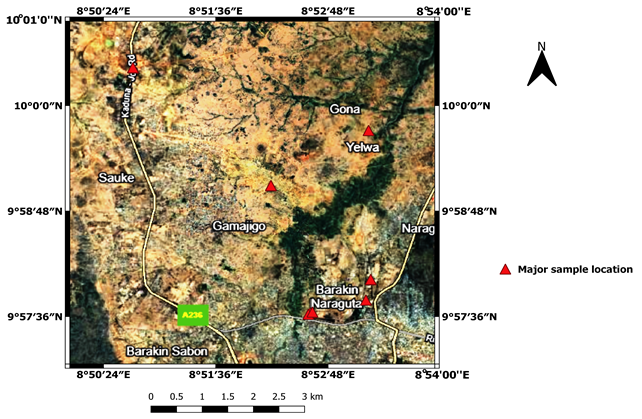
The study area covers Jos North Local Government Area, Plateau state, North-Central Nigeria. It lies on Jos Plateau at an average height of about 1,200-1,300 metres above sea level and is characterized by distinct rainy (April-October) and dry (November-March) seasons. The mean annual rainfall ranges between 1,200 and 1,500mm, while its average temperature varies between 18oC and 28oC. The area is underlain by granitic rock and is historically recognized for extensive tin and columbite mining, leading to numerous active and abandoned mines. Four sites identified by preliminary survey as major mining and farming or grazing sites except for the control site, where no mining but only farming or grazing occurs were randomly chosen for the study. As indicated in Figure 1, the study area comprised of two active mining sites, where mining activities were on going at time of sample collection, namely Bida Bidi (N09°59'05.4", E08°52'11.4") and Hwoll Zangam (N09°59'43.0", E08°53'14.0"). It also included an abandoned mining site at Farin Lamba (N10°00'25.7",E08°50'43.0"), where mining stopped more than six months prior to sampling and a non-mining control site at University of Jos Permanent Site (N09°57'47.2",E08°53'12.3"), located appropriately 7km from the mining sites, were used as the study areas 11.

Representative sampling across selected weed species and the study areas was achieved using factorial sampling arrangement 12, involving five dominant weed species, three biological replicates and four study sites adopted, giving a total of sixty (60) weed samples and their corresponding rhizosphere soil samples. The dominant weeds were determined using squared meter quadrat comprised of ten toss 13. Based on the criteria of species that demonstrated higher relative density, rapid growth and substantial biomass (average size) 2, five dominant weeds namely Cyperus bipartitus (Slender flat sedge), Spermacoce verticillata (Shubby false Bottom weed), Festuca rubra (Red Fescues), Tithonia diversifolia (Mexican sunflower) and Ipomoea asarifolia (Morning glory) were selected, identified and their respective vouchers (JUHN23000659, JUHN23000662, JUHN23000661, JUHN23000664 and JUHN23000663 ) deposited at the Department of Plant Science and Biotechnology, University of Jos. Jos, Nigeria. The selected dominant weed species and corresponding rhizosphere soils of about 2000g were randomly excavated at about 20-30cm depth and carefully collected in triplicates with their intact roots using digger and big hole . Plant and rhizosphere soil samples were collected during the peak rainy season (August–September), when weed growth was at its maximum, to facilitate reliable species identification and assessment of metal accumulation under active growth conditions.
2.3. Metal AnalysisTo evaluate Cd, Pb, Zn, As and Ni concentrations, collected weed samples were washed with distilled water; leaves, shoot and root were carefully separated by plucking. The weed parts and their rhizosphere soils were air-dried at room temperature for 72 hours and oven dried at 65o C for 48 hours to constant weights 2. Dried samples were pulverized separately using clean porcelain mortar and pestle to obtain particle less than 0.2mm. A 0.5g portion of homogenized plant and soil samples were respectively wet digested in mixture of analytical grade concentrated nitric acid and perchloric acid (3:1 volume to volume ratio), on a digestion block, heated at about 120oC for 2 hours , until white fumes appeared 14. After cooling to room temperature, the digests were diluted with deionized water to final volume of 50mL and filtered through Whatman No. 42 filter paper 15. The concentrations of Cd, Pb, Zn, As and Ni were determined in the filtrate using flame atomic absorption spectrophotometer (Model Buck Scientific 210 VGP), following instrument calibration with appropriate standard solutions according to manufacturer’s instruction.
2.4. Data AnalysisThe ability of the selected weed species to absorb or immobilize the PTEs in soil was assessed using three phytoremediation indices, namely Bioconcentration Factor (BCF), Biological accumulation Coefficient (BAC) and Translocation Factor (TF) defined by the following equations (1-3)
 | (1) |
 | (2) |
 |
 |
 | (3) |
The PTEs concentrations represent Potentially Toxic Elements mean concentrations expressed in mg per sample kg (mg/kg).
The principal component analysis (PCA) was performed using soil and weed metal concentrations to identify key variation sources and species group patterns. Descriptive statistics of the PTEs (Cd, Pb, Zn, As and Ni) were expressed as mean ± standard error (SE). Two-way analysis of variance (ANOVA) was used to evaluate the effects of sites, weed species and tissues at p < 0.05, followed by post-hoc tests. Statistical analysis were performed using SPSS and Microsoft Excel.
The floristic analysis illustrated in Table 1 revealed the selected dominant weed species belonging to five different families including four herbs and one shrub.
The studied sites showed some limited and uneven weed species diversity in the mining sites compared to the non-mining area. As shown in Table 1, the Cyperus bipartitus and Festuca rubra were present only in the studied active mining soil but absent in the abandoned mine and non-mining soils at the time of the study. Species with preferential abundant growth on contaminated sites but limited occurrence in uncontaminated soil, suggest they possess adaptive advantages and potentials for successful colonization and remediation in contaminated soil 2. Tithonia diversifolia was absent in the active mines but present at both the abandoned mine and non-mining soils. The observed limited vegetation diversities could be due to disturbance arising from mining activities 13. Additionally, limited natural weed colonization may be attributed to the differences in soil nature and contamination influenced by age and orientations of the sites, as well as the extreme soil characteristics that hinder the establishment of adapted species elsewhere 21. Hence, the identified dominant weed species persisted in the studied areas, due to adaptations that allowed them thrive in the disturbed and unmined sites.
Cyperus bipartitus is an annual sedge characterized with V-shaped leaves, short lifecycle and dense fibrous roots. Although phytoremediation studies on C. bipartitus remain limited, a closely related Cyperus rotundus of the genus Cyperus, was previously reported to promote phytostabilization, through rhizosphere microbe mediated immobilization of heavy metals 22, thus supporting contaminated soil remediation potential of the genus Cyperus .
Spermacoce verticillata is a perennial semi-woody herb, with leaves arranged in opposite pattern and flowers occuring in small terminal clusters. Its ability to readily colonize nutrient deficient, disturbed and open habitats, suggests good ecological adaptation for early stage soil stabilization and degraded land re-vegetation, during initial stages of mine land restoration 23.
Tithonia diversifolia is a perennial shrub, having large leaves and conspicuous orange inflorescences that readily colonize degraded soils, roadsides and mining spoils. Its high biomass, tolerance to elevated concentrations of potentially toxic elements and ability to accumulate as well as translocate selected metals vary with soil properties, metal type and its developmental stage 24.
Ipomoea asarifolia is a perennial creeping herb, with ovate leaves and funnel shaped flowers, and it commonly colonizes nutrient deficient, compacted and disturbed lands. Previously, I. asarifolia demonstrated potentials of accumulating significant amount of Pb and others heavy metals, but may also exhibit limited shoot translocation depending on soil properties and metal content 25. Hence, its phytoremediation capacity may vary between phytoextraction and phytostabilization under some conditions.
Festuca rubra is a perennial grass possessing persistent fibrous root, tolerance for nutrient deficient soil, acidic and compacted soils. It establishes a dense root mat that reduces erosion and dust emission on spoil heaps as well as previously demonstrated reasonable tolerance to some heavy metals and suitable for phytostabilization of contaminated soil 26.
The morphological and ecological characteristics as well as the reported metal tolerance of these selected dominant weeds further provided the basis for subsequent evaluation of their bioaccumulation activities for Cd, Pb, Zn, As and Ni in this study.
3.2. Metal Specific BehaviourThe Cd content in rhizosphere soils ranged from 8.50mg/kg to 55.00mg/kg and were significantly higher than all parts of weeds growing on them, except Festuca rubra associated rhizosphere soil with Cd (8.50mg/kg) significantly lower than Cd accumulation in its root (28.00mg/kg) and shoot (19.47mg/kg). Both active and abandoned mining (ranged 8.50-36.16mg/kg) as well as non-mining (28.70-55.00mg/kg) rhizosphere soils were significantly contaminated with Cd, as seen in Table 2.
Further comparison of the observed rhizosphere soil Cd concentrations across the active and abandoned mining soils as well as the non-mining control soil, with the Cd global soil limits shown in Table 3, indicated that the studied rhizosphere soil Cd exceeded the global standard soil Cd threshold (1.00mg/kg) and are within the threshold of highly contaminated soil (>6.00mg/kg) 10.
Therefore, Cd pollution was widespread throughout the rhizosphere soils across both mining and non-mining areas and not limited to the mining areas only. Higher Cd content of non-mining rhizosphere soil compared to the mining soil may also indicates possible site specific geochemical Cd enrichment, likely from natural weathering of Cd rich underlying parent materials, agricultural activities, soil organic matter and speciation as well as long-range atmospheric deposition 27 28.
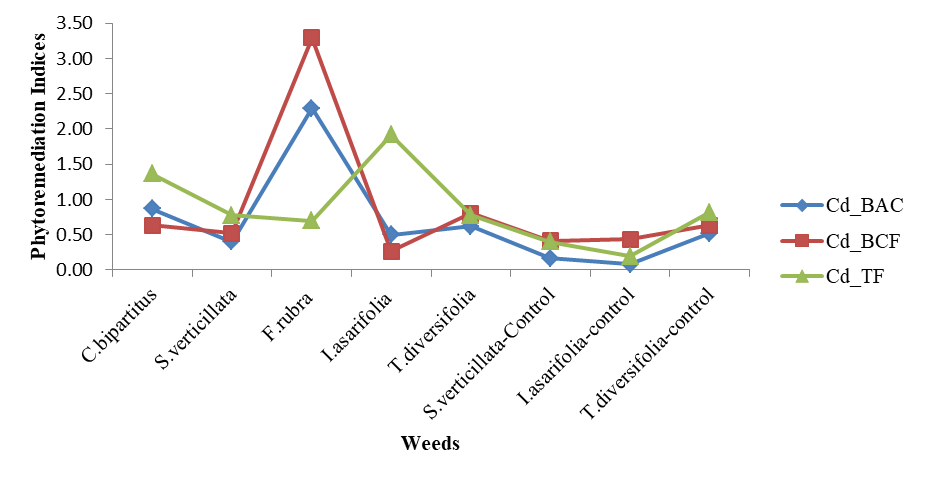
Additionally, Cd accumulation significantly varied (P<0.05) across studied weed species parts as shown on Table 2. Cyperus bipartitus and Ipomoea asarifolia growing at mining soil sites respectively exhibited significantly higher Cd shoot accumulation (24.48 mg/kg and 14.72mg/kg) than their roots (17.93mg/kg and 7.69mg/kg). Although both weed species exhibit efficient metal translocation (TF >1), their BCF and BAC values below unity (<1) as seen in Figure 2, indicate restricted Cd uptake from the mining soil and poor phytoextraction potential on the studied mining soil.

Festuca rubra demonstrated significant higher root Cd accumulation (28.00mg/kg) than in its rhizosphere soil (8.50mg/kg), suggesting an efficient Cd root uptake. Thus, Figure 2 also shows F. rubra exhibited notable biological accumulation coefficient (BAC) and bioconcentration factors (BCF) >1 but limited translocation (TF<1). Therefore, F. rubra is potentially a phytostabilizer candidate, suitable for stabilizing or immobilizing Cd in the rhizosphere soil, minimizing contamination of shoot biomass and desirable for reducing environmental risk of Cd mobility 29. Similar Cd root-retention strategies of F.rubra was previously associated with species-specific detoxification and root sequestration mechanisms, thereby reducing metal mobility and protecting photosynthesis active organs 26 30. Also the perennial growth pattern, extensive root system and preferential Cd sequestration in the root of F.rubra support its suitability as phytostabilizer species, making it desirable for long term reduction of Cd bioavailability in contaminated soils 26 31.
Across the studied samples, lead (Pb) distributions demonstrated uptake and translocation patterns that are species dependent. The rhizosphere soils Pb level ranged from 11.62mg/kg to 31.50mg/kg across the mined and non-mine soils as seen in Table 4 and was within the global standard threshold (<40.00mg/Kg) for Pb uncontaminated soil shown in Table 3. However, given that soil Pb levels within regulatory permissible threshold, may still be bioavailable, negatively impact soil organisms and accumulate in plant tissues, as well as contaminate food chains 41 42. There is the need to assess plant-based remediation strategies with potentials of mitigating the subtle Pb contamination ecological risks.
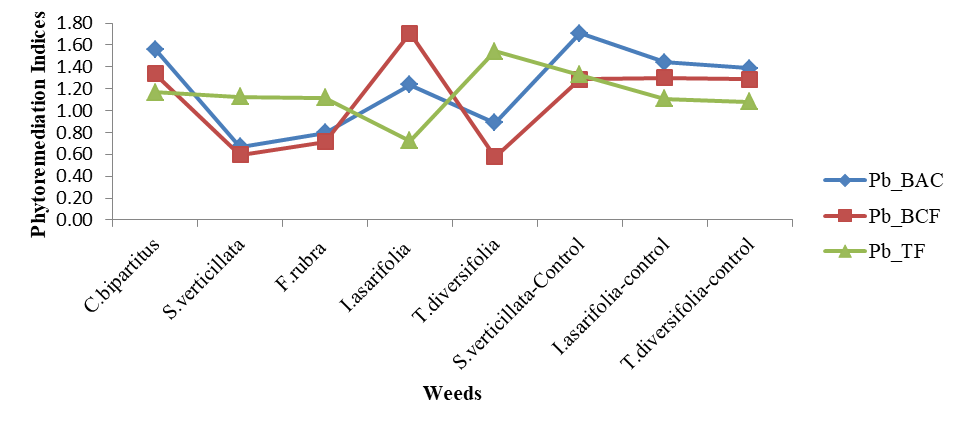
Table 4 indicates Cyperus bipartitus, control soil growing Spermacoce verticillata and Tithonia diversifolia respectively demonstrated progressive Pb increase up take from soil ( 13.61,17.00, 16.46) mg/kg to root (18.21, 21.86, 21.14) mg/kg and shoot (21.25, 29.04, 22.84) mg/kg. Also, as seen in Table 4, the dominant Pb accumulation in leaves of S. verticillata and T. diversifolia on control soil , respectively showed a pattern of Pb in their leaves (29.90 and 24.55) mg/kg > shoots (29.04 and 22.84)mg/kg > roots (21.86 and 21.14) mg/kg. Additionally, C. bipartitus, control soil growing S. verticillata, I. asarifolia and T. diversifolia demonstrated effective Pb uptake (BAC and BCF>1), and efficient translocation (TF>1) as seen in Figure 3, thereby showing potential for phytoextraction.

Although a closely related Cyperus rotundus in the same genus as C. bipartitus , was primarily reported as a phytostabilizer through rhizosphere-mediated metal immobilization 22. The Pb accumulation pattern observed in C. bipartitus suggest that phytoremediation strategies may differ among species within the genus. The relatively inconspicuous leaf structures observed in C. bipartitus may partly explain its comparatively limited vegetative growth, as reflected in its respective mean above-ground (28.00cm) and below-ground (17.00cm) sizes as shown in Table 1. However, plant sizes may also be influenced by species specific growth characteristics and site conditions. Notably, I. asarifolia on active mining soil, exhibited Pb root accumulation (19.86 mg/kg) that exceeded shoot levels (14.35mg/kg), but higher leaf concentration (22.16mg/kg), demonstrating effective root Pb uptake (BCF and BAC >1) but limited shoot translocation (TF<1) as illustrated in Figure 3, thus exhibiting potentials for phytostabilization. The observed Pb accumulation patterns have been reported in metal-tolerant plants, where Pb is largely immobilized through root cell wall adsorption, complexation with phytochelatins and organic ligands, as well as sequestration into root vacuoles, thereby restricting translocation to shoots and minimizing metal-induced toxicity 43 44. Similarly, 25 identified I. asarifolia as a metal-tolerant species with phytostabilization potential in gold mine wastes, supporting the view that this species preferentially retains potentially toxic elements within the root system under mining conditions rather than facilitating extensive translocation to aerial tissue. Although Pb was reported to commonly exhibit poor mobility and largely retained in plant roots 45, however Figure 3 shows efficient Pb redistribution (TF>1) in the tissues of C. bipartitus, S. verticillata, T. diversifolia and control I. asarifolia , reflecting their potentials for Pb phytoextraction and consistent with previous reports, suggesting, some accumulator weeds can under favourable physiological conditions, translocate and accumulate Pb in their above ground tissues 29 43 46. However, due to some of these weed species especially T. diversifolia, being grazed to varying degrees by livestock and commonly utilized as fodder, their use for phytoremediation should be accompanied by strict biomass management such as controlled incineration, measures, ensure safe handling and disposal of contaminated biomass to prevent livestock access to it and forestall transfer of accumulated metals into the food chain 47 48.
Table 5 shows Zn concentrations in rhizosphere soils ranged from 11.08-22.38mg/kg at non-mining control soil and 8.75-35.98mg/kg at mining soil sites respectively. Given that the ranges were within global soil Zn threshold (<90mg/kg) as seen in Table 2, rhizosphere soil Zn were moderately distribution across the studied sites. However, notable tissue-specific Zn variation was shown, with maximum Zn accumulations pattern follows, roots of I. asarifolia (38.66 mg/kg) > shoots of F. rubra (37.87 mg/kg) > leaves of T. diversifolia (36.82 mg/kg). Leaf Zn content was not assessed in C.bipartitus and F. rubra due to distinct leaf absence.
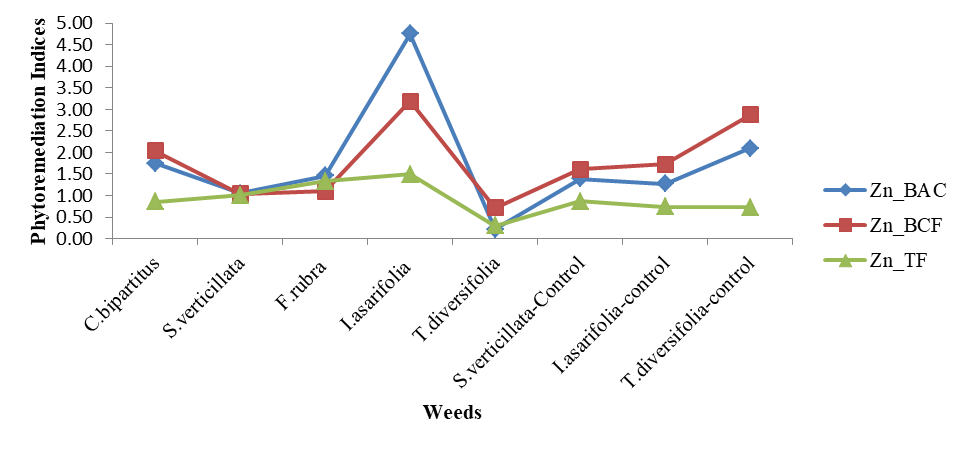
Further assessment of Zn bioaccumulation, showed S. verticillata, F. rubra and I. asarifolia on mining soil , exhibited BAC, BCF and TF values >1, illustrated in Figure 4, indicating efficient Zn uptake and translocation tendency as Zn phytoextraction capable plants.

Similar Zn accumulation patterns to the findings of this study have been reported for weeds and grasses colonizing mining sites, which was suggested to be likely due to their high biomass, nutrient demand and rapid growth rates 49 50. In contrast, Figure 4 indicates C.bipartitus from mining soil as well as S. verticillata, I. asarifolia, and T. diversifolia on non-mining soils showed BAC and BCF > 1 but TF < 1. Indicating these species showed Zn substantial accumulation at their roots with limited translocation to above ground tissues of the weeds and have potential Zn phytostabilization, restricting Zn mobility and bioavailability. Phytostabilization of Zn often result from its sequestration in plant roots, restricted xylem uptake, or adaptive exclusion mechanisms under metal stress 49 51. The observed Zn accumulation patterns of this study indicate that the dominant weeds possess complementary phytoremediation strategies, with some species favoring phytoextraction through efficient uptake and translocation, whereas others promote phytostabilization by restricting Zn movement to the shoots. These contrasting strategies enhance the potential application of native vegetation for sustainable management of Zn in mining-affected ecosystems. It also emphasizes the importance of species selection according to site-specific remediation objectives. Since Zn is an essential element required by living organisms, efficient Zn accumulation may also reflects normal nutrient acquisition and homeostasis. Although the studied rhizosphere soil Zn were below the global Zn standard threshold, they currently may not require active Zn remediation but the identified weed species may serve as sentinel plants for biomonitoring Zn bioavailability or as candidate species for remediation should future anthropogenic activities cause increased Zn contamination. These findings align with studies from other mining-impacted ecosystems in Africa and Asia, where native grasses often display selective accumulation of essential metals such as Zn 52 53. Therefore the elevated Zn in above ground biomass of weeds reinforces the potential application of studied native weeds in site-specific Zn remediation strategies.
Nickel (Ni) is also essential micronutrients in plants and animals, but become toxic at elevated concentrations. Table 6 shows in addition to Ni accumulation in the selected weed parts varying remarkably, Ni at the rhizosphere soils of F. rubra (151.04mg/kg) and C.bipartitus (66.88mg/kg) growing naturally on active mining sites, notably exceeds Ni averages for global soils (20.00-50.00mg/kg) and common agricultural soils (18.00-21.00mg/kg) as well as surpasses regulatory threshold of 50.00mg/kg for uncontaminated soil as illustrated in Table 3. Suggesting the Ni contamination in rhizosphere soil of active mining site growing F.rubra and C. bipartitus may pose likely ecological and health risks, warranting further risk and remediation assessments 54.
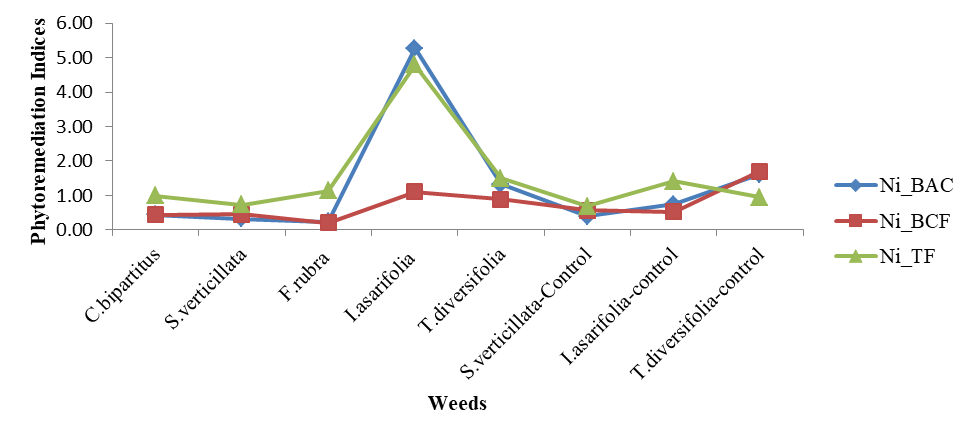
Also despite the relatively low rhizosphere Ni concentration (10.62 mg /kg) at the mining site as seen in Table 6, I. asarifolia showed efficient Ni uptake into its root ( BAC=1.04, BCF= 3.11) ,but restricted translocation to its aerial tissues (TF=0.33) as illustrated in Figure 6, indicating preferential root sequestration and phytostabilization potential.
In contrast, at the non-mining soil, despite growing in soil with higher Ni concentration (38.30 mg /kg), Figure 5 indicates rhizosphere soil Ni uptake by I. asarifolia was reduced (BAC=0.74, BCF= 0.53) but shoot translocation was enhanced (TF= 1.14), suggesting altered internal metal partitioning rather than increased uptake. This pattern shows I.asarifolia demonstrate environment dependent remediation approach, consistent with its phytostabilization potentials indicated by BCF>1 with TF <1 , while phytoextraction potential is shown by TF>1. Figure 6 further shows T. diversifolia from the abandoned mines exhibited moderate root accumulation (BCF= 0.89) but efficient shoot enrichment (BAC= 1.33 and TF= 1.50), indicating good phytoextraction potential. In contrast, the T. diversifolia from non-mining soils accumulated more Ni in roots (BCF=1.70, BAC= 1.61), but showed limited shoot translocation (TF = 0.95) as seen in Figure 6, suggesting greater suitability for phytostabilization. Hence T. diversifolia adapts its Ni uptake and distribution based on environmental conditions. The observed contrasting behaviours may reflect possible differences in Ni bioavailability, rhizosphere chemistry, and physiological regulation between sites. Increased Ni shoot transport (TF>1) observed in abandoned mine plants may arise from enhanced xylem transport of absorbed Ni to harvestable shoots 43. While greater root retention in non-mining weeds may result from increased sequestration of Ni within root cell walls and vacuoles, likely serving as a tolerance mechanism that minimizes metal toxicity 55.

Table 7 indicates arsenic (As) contamination varied significantly(P<0.05) across studied rhizosphere soils of active and abandoned mining and control soils, ranging from 4.67–33.80 mg/kg and mostly beyond widely reported global As contaminated soil threshold (3.00 to 8.00mg/kg) 10.
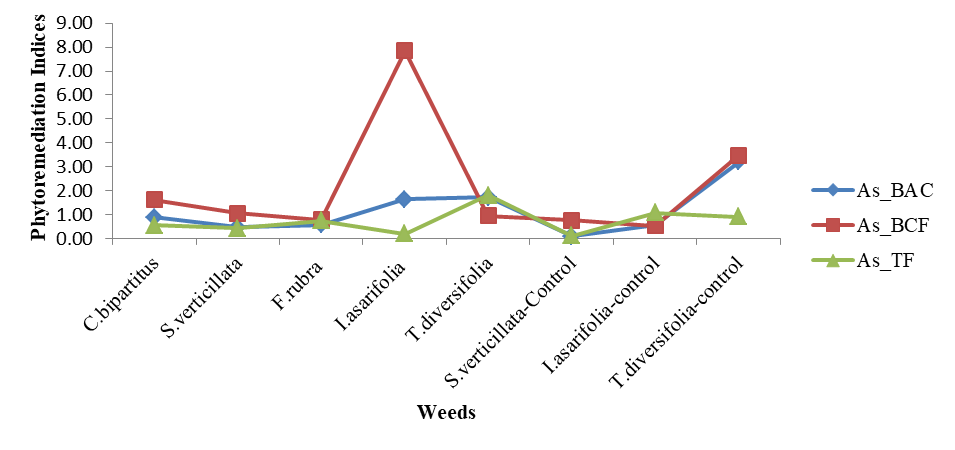
The unexpectedly high As levels in non-mining rhizosphere soils of S. verticillata (33.80mg/kg), I. asarifolia (33.80mg/kg) and T. diversifolia (4.67mg/kg), suggest likely natural presence, plant mediated concentration as well as stabilization of As in the studied control rhizosphere soils, rather than from mining or anthropogenic contamination 56. The observed significantly elevated As concentration in active mining rhizosphere soil compared to those of abandoned sites indicate on-going or active mining may alter soil As exposure, due to increase As mobilization by oxygen addition and soil disturbance processes 57. Furthermore, significantly high (P<0.05) accumulation of As was observed mainly in roots of active mine C. bipartitus (27.04 mg/kg), I.asarifolia (28.91mg/kg) and non-mining soil growing T. diversifolia (16.30mg/kg) as seen in Table 7. The active mine C. bipartitus , I.asarifolia and non-mining soil growing T. diversifolia also demonstrated enhanced As root accumulation (BCF and BAC >1), but showed restricted shoot translocation (TF <1) as seen in Figure 6, suggesting their respective suitability for site-specific phytostabilization remediation strategy.

Similar phytostabilization pattern was reported in I. asarifolia grown on As containing substrates, where root As levels exceed shoot concentrations up to twenty fold, supported by microbial processes that alter As mobility and speciation 25.
Furthermore, Figure 6 shows notable contrast in As bioaccumulation pattern in T. diversifolia on abandoned mining soil (BAC>1, TF>1), indicating efficient translocation of absorbed As to above-ground tissues despite relatively low root enrichment, suggests that the species functions predominantly as a potential phytoextractor of arsenic under mining conditions. Whereas under non-mining conditions it functioned primarily as a phytostabilizer through enhanced root accumulation (BAC and BCF > 1) and restricted shoot translocation (TF < 1). Such functional adaptability may improve its suitability for soil arsenic remediation across heterogeneous contaminated landscapes. These findings are consistent with previous reports on arsenic tolerant plant species, which demonstrates that tolerant plant species can shift between phytoextraction and phytostabilization depending on arsenic bioavailability, soil properties, and physiological regulation 58. Specifically, the present findings agree with the report of 59, showing the phytoremediation behaviour of T. diversifolia is not fixed but varies with environmental conditions, contaminant type, and soil characteristics. The observed enhanced As root uptake and restricted shoot translocation may arise from phosphate transporter mediated As (V) uptake and subsequent root vascular sequestration, a common detoxification strategy that limits shoot translocation and results to As retention in root tissues 57. Additionally, plant species differ in arsenic uptake, translocation and detoxification depending on species-specific transporters, reduction to arsenite (As [III]), complexation with thiol ligands (glutathione and phytochelatins), vacuolar sequestration, and root-to-shoot partitioning 60. Also, remediation performance of T. diversifolia is supported by its robustness, rapid biomass production, and tolerance to contaminated soils 61, making it a strong candidate for large-scale remediation in tropical environments. It also implies the As enriched biomass must be properly managed to prevent secondary contamination.
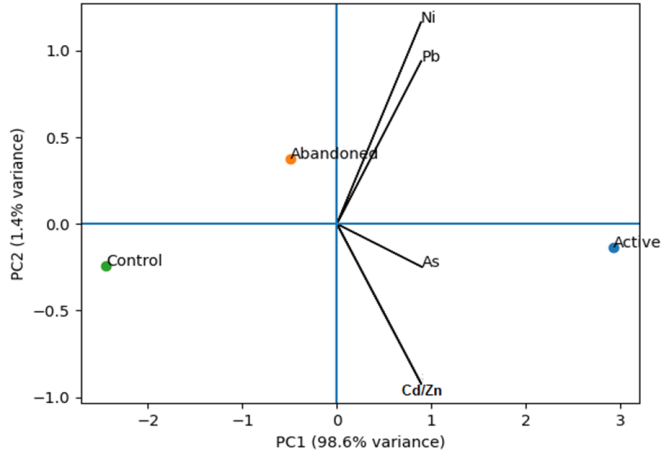
3.3. Principal Component AnalysisTo determine possible relationships of the studied potentially toxic elements (PTEs) and their spatial distribution, the Principal Component Analysis (PCA) was performed. Figure 7 illustrated the Principal Component 1 (PC1) accounted for 98.6% of the total variance, suggesting that spatial variation in concentrations of PTE was predominantly associated with mining-related activities 62.

Also Figure 7 showed the close clustering of Ni and Pb suggests a common source and similar geochemical behaviour, consistent with their co-occurrence in tin mining environments 63. In contrast, the separation of Zn, Cd and As from Ni and Pb along Principal Component 2 (PC2) shows differences in their distribution patterns, environmental behaviour and controlling geochemical processes 64. The intermediate position of the abandoned mine between the active mining and non-mining sites indicates partial ecological recovery following mining cessation, although residual contamination remains evident 52. Likewise, the clear distinction of mining and non-mining sites along PC1 agrees with previous findings that PCA effectively distinguishes active, abandoned and uncontaminated tin-mining soils based on heavy metal composition 5. Ni exhibited the strongest contamination gradient, followed by Pb, suggesting that these metals contributed most to the spatial variability associated with active mining and may serve as useful indicators of mining-derived contamination in the study area 65. Their positive association further suggests a common mining-related source, consistent with previous studies reporting that PCA groups metals originating from similar mining activities and mineral assemblages 66. In contrast, Zn and Cd displayed negative loadings on PC1, indicating their distinct distribution patterns may reflect relatively greater environmental mobility and bioavailability than Ni and Pb 29. Arsenic showed moderate association with the active mining sites, suggesting that its distribution was influenced by both geogenic processes and mining activities 60. These PCA results are consistent with previous reports 62 63 on mining-impacted soils, where Ni and Pb exhibited strong association with mining-related contamination, while Zn, Cd and As showed distinct loading patterns reflecting differences in geochemical behaviour and environmental mobility.
This study evaluated the phytoremediation potential of dominant native weed species growing in active mining, abandoned mining, and non-mining soils in Jos North, Plateau State, Nigeria. The findings demonstrated that both legacy mining activities and natural geogenic enrichment have significantly influenced the distribution and accumulation of potentially toxic elements (PTEs) in rhizosphere soils and associated vegetation. The investigated weed species exhibited distinct, site-dependent remediation strategies, reflecting their physiological adaptability to varying contamination levels and environmental conditions. Among the studied species, Festuca rubra showed promising potential for Cd phytostabilization and Zn phytoextraction, while Cyperus bipartitus was identified as a potential Pb phytoextractor and Zn as well as As phytostabilizer. Spermacoce verticillata, Ipomoea asarifolia, and Tithonia diversifolia displayed considerable flexibility in metal uptake and translocation, functioning either as phytoextractors or phytostabilizers depending on the metal species and site conditions. This site-specific behaviour highlights their suitability for application in remediation of heterogeneous multi-metal contaminated environments. Overall, the results indicate that Festuca rubra, Cyperus bipartitus, Spermacoce verticillata, Ipomoea asarifolia, and Tithonia diversifolia are promising indigenous candidates for phytoremediation of mining-impacted soils. However, the generally limited Cd accumulation observed across most species suggests that phytoremediation of Cd-contaminated sites may require integration with complementary remediation technologies to enhance remediation efficiency. Multivariate analysis confirmed that mining activities primarily controlled the distribution of potentially toxic elements, with Ni and Pb emerging as the dominant indicators of mining-derived contamination across the study sites. This study provides new evidence on the adaptive accumulation strategies of native weed species under contrasting environmental conditions and offers a scientific basis for selecting appropriate species for site-specific phytoremediation of multi-metal contaminated mining landscapes. Future studies to evaluate the long-term field performance, metal removal efficiency, biomass productivity, as well as underlying physiological and molecular mechanisms governing metal tolerance and accumulation will be beneficial in facilitating large-scale phytoremediation applications.
The research was supported by TETFund Institutional Based Research (IBR) grant. Reference Number: 026.
Authors declare that they have no conflicts of interest.
| [1] | Mustapha, L.S., Obayomi, O.V. and Obayomi, K.S., "A comprehensive review on potential heavy metals in the environment: Persistence, bioaccumulation, ecotoxicology, and agricultural impacts," Ecological Frontiers, 46(2), 434-449,April 2026. | ||
| In article | View Article | ||
| [2] | Wang, B., Hou, J., Wu, X., Niu, X. and Zhou, F., "Assessing phytoremediation potential: Dominant plants in soils impacted by polymetal(loid)lic mining," Processes, 12 (4). 833. April 2024. | ||
| In article | View Article | ||
| [3] | Ogezi, A.E., Nigerian Tin and Associated Ores and Minerals: Nature, Geology, History, Exploration, Mining, Processing, Uses, Environment and Man. African Centre for Sustainable Environment and Resources Development, Jos, 2021, 111-128. | ||
| In article | |||
| [4] | Oiganji, E., Ichor, J., Unimke, J.U. and Lenka, R.Z., "Levels and human health risk assessment of heavy metals in some vegetables in farmers' fields, Jos North, Plateau State, Nigeria," Journal of Applied Sciences and Environmental Management, 28 (11). 3551-3557. November 2024. | ||
| In article | View Article | ||
| [5] | Nenman, D.V., Jildawa, D., Abel, A., Adiya, O.A. and Mathias, A.L., "Phytoremediation of heavy metals by some naturally grown and cultivated plants on and around abandoned mine areas of Barkin Ladi LGA of Plateau State, Nigeria," Nigerian Research Journal of Chemical Sciences, 11 (1). 61-80. 2023. | ||
| In article | |||
| [6] | Okonkwo, F.O., Danladi, B., Jonathan, B., Ibrahim, A.A. and Nvau, J.B., "Settlements adjoining tin mines in Plateau State are exposed to higher concentrations of heavy metals," International Journal of Biochemistry, Bioinformatics and Biotechnology Studies, 7 (1). 16-25. January 2022. | ||
| In article | |||
| [7] | Mafulul, S.G., Joel, E.B. and Gushit, J., "Heavy metal content of selected readily available commercial medicinal plants in Jos Plateau and their potential human health risk," GSC Biological and Pharmaceutical Sciences, 26 (2). 206-221. February 2024. | ||
| In article | View Article | ||
| [8] | Kumar, A., Tripti, Raj, D., Maiti, S.K., Maleva, M. and Borisova, G., "Soil Pollution and Plant Efficiency Indices for Phytoremediation of Heavy Metal (loid) s: Two-Decade Study (2002–2021)", Metals, 12 (8), 1330. August 2022. | ||
| In article | View Article | ||
| [9] | Mohamed, H.I., Ullah, I., Toor, M.D., Tanveer, N.A., Din, M.M.U., Basit, A., Sultan, Y., Muhammad, M. and Rehman, M.U., "Heavy metals toxicity in plants: Understanding mechanisms and developing coping strategies for remediation: A review," BioResources and Bioprocessing, 12 (1). 95. July 2025. | ||
| In article | View Article PubMed | ||
| [10] | Siyar, R., Doulati Ardejani, F., Norouzi, P., Maghsoudy, S., Yavarzadeh, M., Taherdangkoo, R. and Butscher, C., "Phytoremediation Potential of Native Hyperaccumulator Plants Growing on Heavy Metal-Contaminated Soil of Khatunabad Copper Smelter and Refinery, Iran", Water, 14 (22), 1-19, November 2022. | ||
| In article | View Article | ||
| [11] | Adesipo, A.A., Akinbiola, S., Awotoye, O.O., Salami, A.T. and Freese, D., "Impact of mining on the floristic association of gold mined sites in Southwest Nigeria," BMC Ecology, 20 (1). 1-13. February 2020. | ||
| In article | View Article PubMed | ||
| [12] | Okonofua, E. S., Lasisi, K. H. and Atikpo, E., "Factorial design study of total petroleum contaminated soil treatment using land farming technique", Sustainable Environment Research, 31 (1), 5. February 2021. | ||
| In article | View Article | ||
| [13] | Shakeel, T., Shah, G. M., Zeb, B. S., Gul, I., Bibi, S., Hussain, Z. and Irshad, M., "Phytoremediation potential and vegetation assessment of plant species growing on multi-metals contaminated coal mining site", Environmental Research Communications, 6 (5), 055006. May 2024. | ||
| In article | View Article | ||
| [14] | Badr, N., Faraj, M., Mohamed, A., Alshelmani, N., El-Kailany, R. and Bobtana, F., "Evaluation of the phytoremediation performance of Hammada scoparia and Halocnemum strobilaceum for Cu, Fe, Zn and Cr accumulation from the industrial area in Benghazi, Libya," Journal of Medicinal and Chemical Sciences, 3. 138-144. March 2020. | ||
| In article | |||
| [15] | Salawu, M.O., Sunday, E.T. and Oloyede, H.O.B., "Bioaccumulative activity of Ludwigia peploides on heavy metals-contaminated water", Environmental Technology & Innovation, 10, 324-334. May 2018. | ||
| In article | View Article | ||
| [16] | Tucker, C.G., Cyperus bipartitus, in Jepson Flora Project (eds.) Jepson eFlora, University of California, Berkeley, 2012 [Online] Available: . [Accessed February 8, 2026]. | ||
| In article | |||
| [17] | Akobundu, I.O. and Agyakwa, C.W., A Handbook of West African Weeds, International Institute of Tropical Agriculture, Ibadan, 1998, 564. | ||
| In article | |||
| [18] | Muoghalu, J.I., "Growth, reproduction and resource allocation of Tithonia diversifolia and Tithonia rotundifolia," Weed Research, 48 (2). 157-162. April 2008. | ||
| In article | View Article | ||
| [19] | World Flora Online Consortium, "Ipomoea asarifolia (Desr.) Roem. & Schult.," World Flora Online. [Online]. Available: . [Accessed February 9, 2026]. | ||
| In article | |||
| [20] | Walsh, R. A., "Festuca rubra, red fescue", Fire Effects Information System, 1 (1), 1-25, January 1995. [Online]. Available: U.S. Department of Agriculture Forest Service, https:// research. fs.usda.gov/ feis/species-reviews/fesrub. [Accessed June 16, 2026]. | ||
| In article | |||
| [21] | Oujdi, M., Chafik, Y., Boukroute, A., Bourgerie, S., Sena-Velez, M., Morabito, D. and Addi, M., "Exploring Phytoremediation Potential: A Comprehensive Study of Flora Inventory and Soil Heavy Metal Contents in the Northeastern Mining Districts of Morocco", Plants, 13 (13), 1811. June 2024. | ||
| In article | View Article PubMed | ||
| [22] | Rohmanna, N. A., Agustina, L., Saputra, R. A., Sari, N., Noor, I. and Majid, Z. A. N. M., "Enhancing phytoremediation of heavy metals: A comprehensive review of performance microorganism-assisted Cyperus rotundus L.", Journal of Ecological Engineering, 26 (6), 118-129. April 2025. | ||
| In article | View Article PubMed | ||
| [23] | Castilho, J., Forti, V.A. and Monquero, P.A., "Biology and non-chemical management of Spermacoce verticillata and Spermacoce densiflora," Renewable Agriculture and Food Systems, 37 (2). 103-112. April 2022. | ||
| In article | View Article | ||
| [24] | Ayesa, S.A., Chukwuka, K.S. and Odeyemi, O.O., "Tolerance of Tithonia diversifolia and Chromolaena odorata in heavy metal simulated-polluted soils and three selected dumpsites," Toxicology Reports, 5. 1134-1139. December 2018. | ||
| In article | View Article PubMed | ||
| [25] | Costa, H.S.C., de Souza, E.S., Dias, Y.N., Melo, L.C.A. and Fernandes, A.R., "Phytoremediator potential of Ipomoea asarifolia in gold mine waste treated with iron-impregnated biochar," Minerals, 12 (2). 150. January 2022. | ||
| In article | View Article | ||
| [26] | Wyszkowska, J., Boros-Lajszner, E. and Kucharski, J., "Calorific value of Festuca rubra biomass in the phytostabilization of soil contaminated with nickel, cobalt and cadmium which disrupt the microbiological and biochemical properties of soil," Energies, 15 (9). 3445. May 2022. | ||
| In article | View Article | ||
| [27] | Liu, Y., Liu, C., Song, C., Chen, Z., Guan, H., Xing, D., Gao, T., Sun, J., Ning, Z. and Xiao, T., "Geochemical factors controlling the mobilization of geogenic cadmium in soils developed on carbonate bedrocks in Southwest China", Geoderma, 437, 116606. November 2023. | ||
| In article | View Article | ||
| [28] | Zhang, N., Lv, C., Li, Y., Panagos, P., Ballabio, C., Man, J., Gu, X., Zhao, F.J., Wang, P., Liu, X. and Qian, Y., "Geochemical-integrated machine learning approach predicts the distribution of cadmium speciation in European and Chinese topsoils," Communications Earth & Environment, 6 (1). 548. August 2025. | ||
| In article | View Article | ||
| [29] | Huang, W., Zhang, C., Zhu, B., Liu, X., Xiao, H., Liu, S. and Shao, H., "Systematic evaluation of plant metals/metalloids accumulation efficiency: a global synthesis of bioaccumulation and translocation factors", Frontiers in Plant Science, 16, 1602951. June 2025. | ||
| In article | View Article PubMed | ||
| [30] | Kamal, M. A. and Alali, A. F., "Kinetic modeling of heavy metal uptake and translocation in Brassica juncea L. for phytoremediation engineering", Discover Environment, 3 (1), 296. December 2025. | ||
| In article | View Article | ||
| [31] | Simon, L., "Stabilization of metals in acidic mine spoil with amendments and red fescue (Festuca rubra L.) growth", Environmental Geochemistry and Health, 27 (4), 289-300. December 2005. | ||
| In article | View Article PubMed | ||
| [32] | Thalassinos, G., Petropoulos, S.A., Grammenou, A. and Antoniadis, V., "Potentially toxic elements: A review on their soil behavior and plant attenuation mechanisms against their toxicity," Agriculture, 13 (9). 1684. August 2023. | ||
| In article | View Article | ||
| [33] | Nieder, R. and Benbi, D.K., "Potentially toxic elements in the environment – A review of sources, sinks, pathways and mitigation measures," Reviews on Environmental Health, 39 (3). 561-575. May 2023. | ||
| In article | View Article PubMed | ||
| [34] | Yu, H., Li, C., Yan, J., Ma, Y., Zhou, X., Yu, W., Kan, H., Meng, Q., Xie, R. and Dong, P., "A review on adsorption characteristics and influencing mechanism of heavy metals in farmland soil," RSC Advances, 13. 3505-3519. January 2023. | ||
| In article | View Article PubMed | ||
| [35] | Thalassinos, G., Petropoulos, S.A., Grammenou, A. and Antoniadis, V., "Potentially toxic elements: A review on their soil behavior and plant attenuation mechanisms against their toxicity," Agriculture, 13 (9). 1684. August 2023. | ||
| In article | View Article | ||
| [36] | EFSA Panel on Contaminants in the Food Chain (CONTAM), "Update of the risk assessment of nickel in food and drinking water," EFSA Journal, 18 (11). e06268. November 2020. | ||
| In article | View Article PubMed | ||
| [37] | Silva, E.D.B., Farnezi, M.M.D.M., Santos, L.L.D., Silva, A.C., Grazziotti, P.H., Alleoni, L.R.F., Horák-Terra, I., Nascimento, S.A.D. and Uane, B.G., "Nickel Effects on Growth and Phytolith Yield of Grasses in Contaminated Soils", Soil Systems, 8 (1), 1-12, January 2024. | ||
| In article | View Article | ||
| [38] | Wan, Y., Liu, J., Zhuang, Z., Wang, Q. and Li, H., "Heavy Metals in Agricultural Soils: Sources, Influencing Factors, and Remediation Strategies", Toxics, 12 (1), 1-24, January 2024. | ||
| In article | View Article PubMed | ||
| [39] | Adewumi, A.J., Ogundele, O.D. and Villaseñor, M.G., "Hidden hazards in urban soils: A meta-analysis review of global heavy metal contamination (2010–2022), sources and its ecological and health consequences," Cogent Engineering. Article 2293239. December 2023. | ||
| In article | View Article | ||
| [40] | Hou, Y., Zhao, Y., Lu, J., Wei, Q., Zang, L. and Zhao, X., "Environmental contamination and health risk assessment of potentially toxic trace metal elements in soils near gold mines – A global meta-analysis," Environmental Pollution, 330. 121803. August 2023. | ||
| In article | View Article PubMed | ||
| [41] | Oorts, K., Smolders, E., Lanno, R. and Chowdhury, M. J., "Bioavailability and ecotoxicity of lead in soil: Implications for setting ecological soil quality standards", Environmental Toxicology and Chemistry, 40 (7), 1948-1961. March 2021. | ||
| In article | View Article PubMed | ||
| [42] | Morales-Silva, T., Silva, B.C. and Faria, L.D., "Soil contamination with permissible levels of lead negatively affects the community of plant-associated insects: A case study with kale," Environmental Pollution, 304. 119143. July 2022. | ||
| In article | View Article PubMed | ||
| [43] | Ali, H., Khan, E. and Sajad, M.A., "Phytoremediation of heavy metals—Concepts and applications," Chemosphere, 91 (7). 869-881. May 2013. | ||
| In article | View Article PubMed | ||
| [44] | Egendorf, S. P., Groffman, P., Moore, G. and Cheng, Z., "The limits of lead (Pb) phytoextraction and possibilities of phytostabilization in contaminated soil: a critical review", International Journal of Phytoremediation, 22 (9), 916-930. July 2020. | ||
| In article | View Article PubMed | ||
| [45] | Amorim, H.C., Hurtarte, L.C., Vergütz, L., Silva, I.R., Costa, O.D., Pacheco, A.A. and Fontes, M.P., "Lead speciation and availability affected by plants in a contaminated soil," Chemosphere, 285. 131468. December 2021. | ||
| In article | View Article PubMed | ||
| [46] | Tőzsér, D., Horváth, R., Simon, E. and Magura, T., "Heavy metal uptake by plant parts of Populus species: a meta-analysis", Environmental Science and Pollution Research, 30 (26), 69416-69430. May 2023. | ||
| In article | View Article PubMed | ||
| [47] | Yan, A., Wang, Y., Tan, S.N., Mohd Yusof, M.L., Ghosh, S. and Chen, Z., "Phytoremediation: A promising approach for revegetation of heavy metal-polluted land," Frontiers in Plant Science, 11. 359. April 2020. | ||
| In article | View Article PubMed | ||
| [48] | Sipos, B., Bibi, D., Magura, T., Tóthmérész, B. and Simon, E., "High phytoremediation and translocation potential of an invasive weed species (Amaranthus retroflexus) in Europe in metal-contaminated areas", Environmental Monitoring and Assessment, 195 (6), 1-15, June 2023. | ||
| In article | View Article PubMed | ||
| [49] | Hasnaoui, S.E., Fahr, M., Keller, C., Levard, C., Angeletti, B., Chaurand, P., Triqui, Z.E.A., Guedira, A., Rhazi, L., Colin, F. and Smouni, A., "Screening of native plants growing on a Pb/Zn mining area in eastern Morocco: Perspectives for phytoremediation", Plants, 9 (11), 1458. October 2020. | ||
| In article | View Article PubMed | ||
| [50] | Korzeniowska, J. and Stanislawska-Glubiak, E., "The phytoremediation potential of local wild grass versus cultivated grass species for zinc-contaminated soil", Agronomy, 13 (1), 160. January 2023. | ||
| In article | View Article | ||
| [51] | Shahid, M., Dumat, C., Khalid, S., Schreck, E., Xiong, T. and Niazi, N. K., "Foliar heavy metal uptake, toxicity and detoxification in plants: A comparison of foliar and root metal uptake", Journal of Hazardous Materials, 325, 36–58. March 2017. | ||
| In article | View Article PubMed | ||
| [52] | Diallo, A., Hasnaoui, S.E., Dallahi, Y., Smouni, A. and Fahr, M., "Native plant species growing on the abandoned Zaida lead/zinc mine site in Morocco: Phytoremediation potential for biomonitoring perspective," PLoS ONE, 19 (6). e0305053. June 2024. | ||
| In article | View Article PubMed | ||
| [53] | Rios, C. O., Siqueira-Silva, A. I. and Pereira, E. G., "Revegetation of mining-impacted sites with a tropical native grass: constraints of climate seasonality and trace-element accumulation", Journal of Environmental Management, 326, 116655. January 2023. | ||
| In article | View Article PubMed | ||
| [54] | Vischetti, C., Marini, E., Casucci, C. and De Bernardi, A., "Nickel in the Environment: Bioremediation Techniques for Soils with Low or Moderate Contamination in European Union", Environments, 9 (10), 1-14, October 2022. | ||
| In article | View Article | ||
| [55] | Mahar, A., Wang, P., Ali, A., Awasthi, M.K., Lahori, A.H., Wang, Q., Li, R. and Zhang, Z., "Challenges and opportunities in the phytoremediation of heavy metals contaminated soils: A review," Ecotoxicology and Environmental Safety, 126. 111-121. April 2016. | ||
| In article | View Article PubMed | ||
| [56] | Rahman, M. A., Khan, S. A., Ahmed, F. and Islam, M. S., "Arsenic contamination and risk: A comprehensive assessment of environmental and health implications", Journal of Hazardous Materials, 452, 131213. May 2023. | ||
| In article | |||
| [57] | Zhao, F.J., McGrath, S.P. and Meharg, A.A., "Arsenic uptake and metabolism in plants," New Phytologist, 181 (4). 777-794. March 2009. | ||
| In article | View Article PubMed | ||
| [58] | Patel, K. S., Pandey, P. K., Martín-Ramos, P., Corns, W. T., Varol, S., Bhattacharya, P. and Zhu, Y., "A review on arsenic in the environment: bio-accumulation, remediation, and disposal", RSC Advances, 13 (22), 14914-14929. May 2023. | ||
| In article | View Article PubMed | ||
| [59] | Ogunremi, O.O., Amubieya, O.F., Ogunkunle, C.O. and Fatoba, P.O., "Efficacy of biochar on the phytoremediation potential of Tithonia diversifolia on spent oil-contaminated soil," BMC Environmental Science, 2 (1). 12. 2025. | ||
| In article | View Article | ||
| [60] | Bali, A.S. and Sidhu, G.P.S., "Arsenic acquisition, toxicity and tolerance in plants—From physiology to remediation: A review," Chemosphere, 283. 131050. October 2021. | ||
| In article | View Article PubMed | ||
| [61] | Kekere, O., Ademoye, A. M., Kareem, I. A. and Ekundayo, T. O., "Assessment of Tithonia diversifolia with mycorrhizal bioaugmentation in phytoremediation of lead and zinc polluted soils", African Journal of Applied Research, 6 (1), 1-12. March 2020. | ||
| In article | |||
| [62] | Xiao, R., Wang, S., Li, R., Wang, J. and Zhang, Z., "Source identification and ecological risk assessment of heavy metals in mining-impacted soils using multivariate statistical analysis," Ecotoxicology and Environmental Safety, 252. 114612. March 2023. | ||
| In article | |||
| [63] | Zhang, C., Yu, Z.G., Zeng, G.M., Jiang, M., Yang, Z.Z., Cui, F., Zhu, M.Y., Shen, L.Q. and Hu, L., "Effects of soil properties and heavy metal contamination on microbial diversity in mining areas revealed by PCA and multivariate analysis," Science of the Total Environment, 755. 142740. February 2021. | ||
| In article | |||
| [64] | Kumar, A., Jigyasu, D.K., Subrahmanyam, G., Mondal, R., Shabnam, A.A., Cabral-Pinto, M.M.S., Malyan, S.K., Chaturvedi, A.K., Gupta, D.K., Fagodiya, R.K. and Khan, S.A., "Nickel in terrestrial biota: Comprehensive review on contamination, toxicity, tolerance and its remediation approaches", Chemosphere, 275, 129996. July 2021. | ||
| In article | View Article PubMed | ||
| [65] | Rehman, K., Fatima, F., Waheed, I. and Akash, M. S. H., "Prevalence of exposure of heavy metals and their impact on health consequences", Journal of Cellular Biochemistry, 119 (1), 157–184. June 2017. | ||
| In article | View Article PubMed | ||
| [66] | Li, Z., Ma, Z., van der Kuijp, T. J., Yuan, Z. and Huang, L., "A review of soil heavy metal pollution from mines and smelters in China: Health risk assessment and control strategies", Journal of Cleaner Production, 356, 131873. July 2022. | ||
| In article | |||
Published with license by Science and Education Publishing, Copyright © 2026 Olumuyiwa A. Olorunyomi, Simon G. Mafulul, Ayodeji E. Olorunyomi, Peace O. Abaya, Segun A. Olomu and Samuel Y. Gazuwa
 This work is licensed under a Creative Commons Attribution 4.0 International License. To view a copy of this license, visit
http://creativecommons.org/licenses/by/4.0/
This work is licensed under a Creative Commons Attribution 4.0 International License. To view a copy of this license, visit
http://creativecommons.org/licenses/by/4.0/
| [1] | Mustapha, L.S., Obayomi, O.V. and Obayomi, K.S., "A comprehensive review on potential heavy metals in the environment: Persistence, bioaccumulation, ecotoxicology, and agricultural impacts," Ecological Frontiers, 46(2), 434-449,April 2026. | ||
| In article | View Article | ||
| [2] | Wang, B., Hou, J., Wu, X., Niu, X. and Zhou, F., "Assessing phytoremediation potential: Dominant plants in soils impacted by polymetal(loid)lic mining," Processes, 12 (4). 833. April 2024. | ||
| In article | View Article | ||
| [3] | Ogezi, A.E., Nigerian Tin and Associated Ores and Minerals: Nature, Geology, History, Exploration, Mining, Processing, Uses, Environment and Man. African Centre for Sustainable Environment and Resources Development, Jos, 2021, 111-128. | ||
| In article | |||
| [4] | Oiganji, E., Ichor, J., Unimke, J.U. and Lenka, R.Z., "Levels and human health risk assessment of heavy metals in some vegetables in farmers' fields, Jos North, Plateau State, Nigeria," Journal of Applied Sciences and Environmental Management, 28 (11). 3551-3557. November 2024. | ||
| In article | View Article | ||
| [5] | Nenman, D.V., Jildawa, D., Abel, A., Adiya, O.A. and Mathias, A.L., "Phytoremediation of heavy metals by some naturally grown and cultivated plants on and around abandoned mine areas of Barkin Ladi LGA of Plateau State, Nigeria," Nigerian Research Journal of Chemical Sciences, 11 (1). 61-80. 2023. | ||
| In article | |||
| [6] | Okonkwo, F.O., Danladi, B., Jonathan, B., Ibrahim, A.A. and Nvau, J.B., "Settlements adjoining tin mines in Plateau State are exposed to higher concentrations of heavy metals," International Journal of Biochemistry, Bioinformatics and Biotechnology Studies, 7 (1). 16-25. January 2022. | ||
| In article | |||
| [7] | Mafulul, S.G., Joel, E.B. and Gushit, J., "Heavy metal content of selected readily available commercial medicinal plants in Jos Plateau and their potential human health risk," GSC Biological and Pharmaceutical Sciences, 26 (2). 206-221. February 2024. | ||
| In article | View Article | ||
| [8] | Kumar, A., Tripti, Raj, D., Maiti, S.K., Maleva, M. and Borisova, G., "Soil Pollution and Plant Efficiency Indices for Phytoremediation of Heavy Metal (loid) s: Two-Decade Study (2002–2021)", Metals, 12 (8), 1330. August 2022. | ||
| In article | View Article | ||
| [9] | Mohamed, H.I., Ullah, I., Toor, M.D., Tanveer, N.A., Din, M.M.U., Basit, A., Sultan, Y., Muhammad, M. and Rehman, M.U., "Heavy metals toxicity in plants: Understanding mechanisms and developing coping strategies for remediation: A review," BioResources and Bioprocessing, 12 (1). 95. July 2025. | ||
| In article | View Article PubMed | ||
| [10] | Siyar, R., Doulati Ardejani, F., Norouzi, P., Maghsoudy, S., Yavarzadeh, M., Taherdangkoo, R. and Butscher, C., "Phytoremediation Potential of Native Hyperaccumulator Plants Growing on Heavy Metal-Contaminated Soil of Khatunabad Copper Smelter and Refinery, Iran", Water, 14 (22), 1-19, November 2022. | ||
| In article | View Article | ||
| [11] | Adesipo, A.A., Akinbiola, S., Awotoye, O.O., Salami, A.T. and Freese, D., "Impact of mining on the floristic association of gold mined sites in Southwest Nigeria," BMC Ecology, 20 (1). 1-13. February 2020. | ||
| In article | View Article PubMed | ||
| [12] | Okonofua, E. S., Lasisi, K. H. and Atikpo, E., "Factorial design study of total petroleum contaminated soil treatment using land farming technique", Sustainable Environment Research, 31 (1), 5. February 2021. | ||
| In article | View Article | ||
| [13] | Shakeel, T., Shah, G. M., Zeb, B. S., Gul, I., Bibi, S., Hussain, Z. and Irshad, M., "Phytoremediation potential and vegetation assessment of plant species growing on multi-metals contaminated coal mining site", Environmental Research Communications, 6 (5), 055006. May 2024. | ||
| In article | View Article | ||
| [14] | Badr, N., Faraj, M., Mohamed, A., Alshelmani, N., El-Kailany, R. and Bobtana, F., "Evaluation of the phytoremediation performance of Hammada scoparia and Halocnemum strobilaceum for Cu, Fe, Zn and Cr accumulation from the industrial area in Benghazi, Libya," Journal of Medicinal and Chemical Sciences, 3. 138-144. March 2020. | ||
| In article | |||
| [15] | Salawu, M.O., Sunday, E.T. and Oloyede, H.O.B., "Bioaccumulative activity of Ludwigia peploides on heavy metals-contaminated water", Environmental Technology & Innovation, 10, 324-334. May 2018. | ||
| In article | View Article | ||
| [16] | Tucker, C.G., Cyperus bipartitus, in Jepson Flora Project (eds.) Jepson eFlora, University of California, Berkeley, 2012 [Online] Available: . [Accessed February 8, 2026]. | ||
| In article | |||
| [17] | Akobundu, I.O. and Agyakwa, C.W., A Handbook of West African Weeds, International Institute of Tropical Agriculture, Ibadan, 1998, 564. | ||
| In article | |||
| [18] | Muoghalu, J.I., "Growth, reproduction and resource allocation of Tithonia diversifolia and Tithonia rotundifolia," Weed Research, 48 (2). 157-162. April 2008. | ||
| In article | View Article | ||
| [19] | World Flora Online Consortium, "Ipomoea asarifolia (Desr.) Roem. & Schult.," World Flora Online. [Online]. Available: . [Accessed February 9, 2026]. | ||
| In article | |||
| [20] | Walsh, R. A., "Festuca rubra, red fescue", Fire Effects Information System, 1 (1), 1-25, January 1995. [Online]. Available: U.S. Department of Agriculture Forest Service, https:// research. fs.usda.gov/ feis/species-reviews/fesrub. [Accessed June 16, 2026]. | ||
| In article | |||
| [21] | Oujdi, M., Chafik, Y., Boukroute, A., Bourgerie, S., Sena-Velez, M., Morabito, D. and Addi, M., "Exploring Phytoremediation Potential: A Comprehensive Study of Flora Inventory and Soil Heavy Metal Contents in the Northeastern Mining Districts of Morocco", Plants, 13 (13), 1811. June 2024. | ||
| In article | View Article PubMed | ||
| [22] | Rohmanna, N. A., Agustina, L., Saputra, R. A., Sari, N., Noor, I. and Majid, Z. A. N. M., "Enhancing phytoremediation of heavy metals: A comprehensive review of performance microorganism-assisted Cyperus rotundus L.", Journal of Ecological Engineering, 26 (6), 118-129. April 2025. | ||
| In article | View Article PubMed | ||
| [23] | Castilho, J., Forti, V.A. and Monquero, P.A., "Biology and non-chemical management of Spermacoce verticillata and Spermacoce densiflora," Renewable Agriculture and Food Systems, 37 (2). 103-112. April 2022. | ||
| In article | View Article | ||
| [24] | Ayesa, S.A., Chukwuka, K.S. and Odeyemi, O.O., "Tolerance of Tithonia diversifolia and Chromolaena odorata in heavy metal simulated-polluted soils and three selected dumpsites," Toxicology Reports, 5. 1134-1139. December 2018. | ||
| In article | View Article PubMed | ||
| [25] | Costa, H.S.C., de Souza, E.S., Dias, Y.N., Melo, L.C.A. and Fernandes, A.R., "Phytoremediator potential of Ipomoea asarifolia in gold mine waste treated with iron-impregnated biochar," Minerals, 12 (2). 150. January 2022. | ||
| In article | View Article | ||
| [26] | Wyszkowska, J., Boros-Lajszner, E. and Kucharski, J., "Calorific value of Festuca rubra biomass in the phytostabilization of soil contaminated with nickel, cobalt and cadmium which disrupt the microbiological and biochemical properties of soil," Energies, 15 (9). 3445. May 2022. | ||
| In article | View Article | ||
| [27] | Liu, Y., Liu, C., Song, C., Chen, Z., Guan, H., Xing, D., Gao, T., Sun, J., Ning, Z. and Xiao, T., "Geochemical factors controlling the mobilization of geogenic cadmium in soils developed on carbonate bedrocks in Southwest China", Geoderma, 437, 116606. November 2023. | ||
| In article | View Article | ||
| [28] | Zhang, N., Lv, C., Li, Y., Panagos, P., Ballabio, C., Man, J., Gu, X., Zhao, F.J., Wang, P., Liu, X. and Qian, Y., "Geochemical-integrated machine learning approach predicts the distribution of cadmium speciation in European and Chinese topsoils," Communications Earth & Environment, 6 (1). 548. August 2025. | ||
| In article | View Article | ||
| [29] | Huang, W., Zhang, C., Zhu, B., Liu, X., Xiao, H., Liu, S. and Shao, H., "Systematic evaluation of plant metals/metalloids accumulation efficiency: a global synthesis of bioaccumulation and translocation factors", Frontiers in Plant Science, 16, 1602951. June 2025. | ||
| In article | View Article PubMed | ||
| [30] | Kamal, M. A. and Alali, A. F., "Kinetic modeling of heavy metal uptake and translocation in Brassica juncea L. for phytoremediation engineering", Discover Environment, 3 (1), 296. December 2025. | ||
| In article | View Article | ||
| [31] | Simon, L., "Stabilization of metals in acidic mine spoil with amendments and red fescue (Festuca rubra L.) growth", Environmental Geochemistry and Health, 27 (4), 289-300. December 2005. | ||
| In article | View Article PubMed | ||
| [32] | Thalassinos, G., Petropoulos, S.A., Grammenou, A. and Antoniadis, V., "Potentially toxic elements: A review on their soil behavior and plant attenuation mechanisms against their toxicity," Agriculture, 13 (9). 1684. August 2023. | ||
| In article | View Article | ||
| [33] | Nieder, R. and Benbi, D.K., "Potentially toxic elements in the environment – A review of sources, sinks, pathways and mitigation measures," Reviews on Environmental Health, 39 (3). 561-575. May 2023. | ||
| In article | View Article PubMed | ||
| [34] | Yu, H., Li, C., Yan, J., Ma, Y., Zhou, X., Yu, W., Kan, H., Meng, Q., Xie, R. and Dong, P., "A review on adsorption characteristics and influencing mechanism of heavy metals in farmland soil," RSC Advances, 13. 3505-3519. January 2023. | ||
| In article | View Article PubMed | ||
| [35] | Thalassinos, G., Petropoulos, S.A., Grammenou, A. and Antoniadis, V., "Potentially toxic elements: A review on their soil behavior and plant attenuation mechanisms against their toxicity," Agriculture, 13 (9). 1684. August 2023. | ||
| In article | View Article | ||
| [36] | EFSA Panel on Contaminants in the Food Chain (CONTAM), "Update of the risk assessment of nickel in food and drinking water," EFSA Journal, 18 (11). e06268. November 2020. | ||
| In article | View Article PubMed | ||
| [37] | Silva, E.D.B., Farnezi, M.M.D.M., Santos, L.L.D., Silva, A.C., Grazziotti, P.H., Alleoni, L.R.F., Horák-Terra, I., Nascimento, S.A.D. and Uane, B.G., "Nickel Effects on Growth and Phytolith Yield of Grasses in Contaminated Soils", Soil Systems, 8 (1), 1-12, January 2024. | ||
| In article | View Article | ||
| [38] | Wan, Y., Liu, J., Zhuang, Z., Wang, Q. and Li, H., "Heavy Metals in Agricultural Soils: Sources, Influencing Factors, and Remediation Strategies", Toxics, 12 (1), 1-24, January 2024. | ||
| In article | View Article PubMed | ||
| [39] | Adewumi, A.J., Ogundele, O.D. and Villaseñor, M.G., "Hidden hazards in urban soils: A meta-analysis review of global heavy metal contamination (2010–2022), sources and its ecological and health consequences," Cogent Engineering. Article 2293239. December 2023. | ||
| In article | View Article | ||
| [40] | Hou, Y., Zhao, Y., Lu, J., Wei, Q., Zang, L. and Zhao, X., "Environmental contamination and health risk assessment of potentially toxic trace metal elements in soils near gold mines – A global meta-analysis," Environmental Pollution, 330. 121803. August 2023. | ||
| In article | View Article PubMed | ||
| [41] | Oorts, K., Smolders, E., Lanno, R. and Chowdhury, M. J., "Bioavailability and ecotoxicity of lead in soil: Implications for setting ecological soil quality standards", Environmental Toxicology and Chemistry, 40 (7), 1948-1961. March 2021. | ||
| In article | View Article PubMed | ||
| [42] | Morales-Silva, T., Silva, B.C. and Faria, L.D., "Soil contamination with permissible levels of lead negatively affects the community of plant-associated insects: A case study with kale," Environmental Pollution, 304. 119143. July 2022. | ||
| In article | View Article PubMed | ||
| [43] | Ali, H., Khan, E. and Sajad, M.A., "Phytoremediation of heavy metals—Concepts and applications," Chemosphere, 91 (7). 869-881. May 2013. | ||
| In article | View Article PubMed | ||
| [44] | Egendorf, S. P., Groffman, P., Moore, G. and Cheng, Z., "The limits of lead (Pb) phytoextraction and possibilities of phytostabilization in contaminated soil: a critical review", International Journal of Phytoremediation, 22 (9), 916-930. July 2020. | ||
| In article | View Article PubMed | ||
| [45] | Amorim, H.C., Hurtarte, L.C., Vergütz, L., Silva, I.R., Costa, O.D., Pacheco, A.A. and Fontes, M.P., "Lead speciation and availability affected by plants in a contaminated soil," Chemosphere, 285. 131468. December 2021. | ||
| In article | View Article PubMed | ||
| [46] | Tőzsér, D., Horváth, R., Simon, E. and Magura, T., "Heavy metal uptake by plant parts of Populus species: a meta-analysis", Environmental Science and Pollution Research, 30 (26), 69416-69430. May 2023. | ||
| In article | View Article PubMed | ||
| [47] | Yan, A., Wang, Y., Tan, S.N., Mohd Yusof, M.L., Ghosh, S. and Chen, Z., "Phytoremediation: A promising approach for revegetation of heavy metal-polluted land," Frontiers in Plant Science, 11. 359. April 2020. | ||
| In article | View Article PubMed | ||
| [48] | Sipos, B., Bibi, D., Magura, T., Tóthmérész, B. and Simon, E., "High phytoremediation and translocation potential of an invasive weed species (Amaranthus retroflexus) in Europe in metal-contaminated areas", Environmental Monitoring and Assessment, 195 (6), 1-15, June 2023. | ||
| In article | View Article PubMed | ||
| [49] | Hasnaoui, S.E., Fahr, M., Keller, C., Levard, C., Angeletti, B., Chaurand, P., Triqui, Z.E.A., Guedira, A., Rhazi, L., Colin, F. and Smouni, A., "Screening of native plants growing on a Pb/Zn mining area in eastern Morocco: Perspectives for phytoremediation", Plants, 9 (11), 1458. October 2020. | ||
| In article | View Article PubMed | ||
| [50] | Korzeniowska, J. and Stanislawska-Glubiak, E., "The phytoremediation potential of local wild grass versus cultivated grass species for zinc-contaminated soil", Agronomy, 13 (1), 160. January 2023. | ||
| In article | View Article | ||
| [51] | Shahid, M., Dumat, C., Khalid, S., Schreck, E., Xiong, T. and Niazi, N. K., "Foliar heavy metal uptake, toxicity and detoxification in plants: A comparison of foliar and root metal uptake", Journal of Hazardous Materials, 325, 36–58. March 2017. | ||
| In article | View Article PubMed | ||
| [52] | Diallo, A., Hasnaoui, S.E., Dallahi, Y., Smouni, A. and Fahr, M., "Native plant species growing on the abandoned Zaida lead/zinc mine site in Morocco: Phytoremediation potential for biomonitoring perspective," PLoS ONE, 19 (6). e0305053. June 2024. | ||
| In article | View Article PubMed | ||
| [53] | Rios, C. O., Siqueira-Silva, A. I. and Pereira, E. G., "Revegetation of mining-impacted sites with a tropical native grass: constraints of climate seasonality and trace-element accumulation", Journal of Environmental Management, 326, 116655. January 2023. | ||
| In article | View Article PubMed | ||
| [54] | Vischetti, C., Marini, E., Casucci, C. and De Bernardi, A., "Nickel in the Environment: Bioremediation Techniques for Soils with Low or Moderate Contamination in European Union", Environments, 9 (10), 1-14, October 2022. | ||
| In article | View Article | ||
| [55] | Mahar, A., Wang, P., Ali, A., Awasthi, M.K., Lahori, A.H., Wang, Q., Li, R. and Zhang, Z., "Challenges and opportunities in the phytoremediation of heavy metals contaminated soils: A review," Ecotoxicology and Environmental Safety, 126. 111-121. April 2016. | ||
| In article | View Article PubMed | ||
| [56] | Rahman, M. A., Khan, S. A., Ahmed, F. and Islam, M. S., "Arsenic contamination and risk: A comprehensive assessment of environmental and health implications", Journal of Hazardous Materials, 452, 131213. May 2023. | ||
| In article | |||
| [57] | Zhao, F.J., McGrath, S.P. and Meharg, A.A., "Arsenic uptake and metabolism in plants," New Phytologist, 181 (4). 777-794. March 2009. | ||
| In article | View Article PubMed | ||
| [58] | Patel, K. S., Pandey, P. K., Martín-Ramos, P., Corns, W. T., Varol, S., Bhattacharya, P. and Zhu, Y., "A review on arsenic in the environment: bio-accumulation, remediation, and disposal", RSC Advances, 13 (22), 14914-14929. May 2023. | ||
| In article | View Article PubMed | ||
| [59] | Ogunremi, O.O., Amubieya, O.F., Ogunkunle, C.O. and Fatoba, P.O., "Efficacy of biochar on the phytoremediation potential of Tithonia diversifolia on spent oil-contaminated soil," BMC Environmental Science, 2 (1). 12. 2025. | ||
| In article | View Article | ||
| [60] | Bali, A.S. and Sidhu, G.P.S., "Arsenic acquisition, toxicity and tolerance in plants—From physiology to remediation: A review," Chemosphere, 283. 131050. October 2021. | ||
| In article | View Article PubMed | ||
| [61] | Kekere, O., Ademoye, A. M., Kareem, I. A. and Ekundayo, T. O., "Assessment of Tithonia diversifolia with mycorrhizal bioaugmentation in phytoremediation of lead and zinc polluted soils", African Journal of Applied Research, 6 (1), 1-12. March 2020. | ||
| In article | |||
| [62] | Xiao, R., Wang, S., Li, R., Wang, J. and Zhang, Z., "Source identification and ecological risk assessment of heavy metals in mining-impacted soils using multivariate statistical analysis," Ecotoxicology and Environmental Safety, 252. 114612. March 2023. | ||
| In article | |||
| [63] | Zhang, C., Yu, Z.G., Zeng, G.M., Jiang, M., Yang, Z.Z., Cui, F., Zhu, M.Y., Shen, L.Q. and Hu, L., "Effects of soil properties and heavy metal contamination on microbial diversity in mining areas revealed by PCA and multivariate analysis," Science of the Total Environment, 755. 142740. February 2021. | ||
| In article | |||
| [64] | Kumar, A., Jigyasu, D.K., Subrahmanyam, G., Mondal, R., Shabnam, A.A., Cabral-Pinto, M.M.S., Malyan, S.K., Chaturvedi, A.K., Gupta, D.K., Fagodiya, R.K. and Khan, S.A., "Nickel in terrestrial biota: Comprehensive review on contamination, toxicity, tolerance and its remediation approaches", Chemosphere, 275, 129996. July 2021. | ||
| In article | View Article PubMed | ||
| [65] | Rehman, K., Fatima, F., Waheed, I. and Akash, M. S. H., "Prevalence of exposure of heavy metals and their impact on health consequences", Journal of Cellular Biochemistry, 119 (1), 157–184. June 2017. | ||
| In article | View Article PubMed | ||
| [66] | Li, Z., Ma, Z., van der Kuijp, T. J., Yuan, Z. and Huang, L., "A review of soil heavy metal pollution from mines and smelters in China: Health risk assessment and control strategies", Journal of Cleaner Production, 356, 131873. July 2022. | ||
| In article | |||