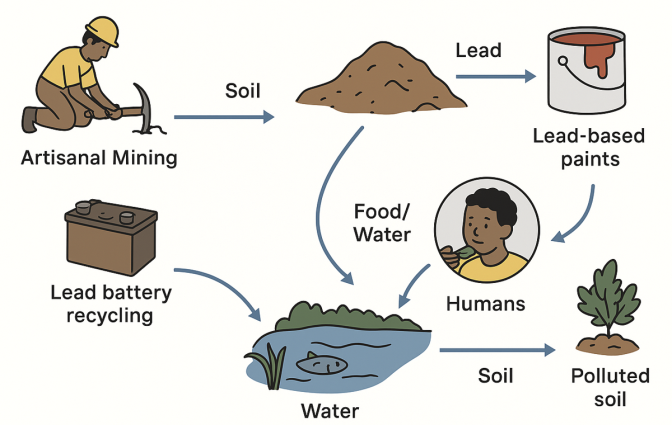
Lead exposure is an underrecognized but urgent public health and environmental threat in Niger, where environmental monitoring, epidemiological data, and regulatory controls are virtually absent. Drawing on evidence from West Africa, this review identifies major sources and pathways of exposure, including artisanal mining, informal lead‒acid battery recycling, lead-based paints, contaminated consumer goods, and polluted water and soils, which are linked to severe and irreversible health impacts, particularly among children and informal sector workers. Regional case studies from Nigeria, Ghana, and Senegal reveal the scale of contamination and its neurodevelopmental, cardiovascular, renal, and ecological consequences, underscoring likely parallels in Niger. The review highlights critical gaps in research, policy, and public awareness and proposes a framework for national action: establishing baseline environmental and biomonitoring, mapping informal sector activities, and adapting proven interventions from neighboring countries. Without swift, coordinated measures, lead will remain a pervasive yet preventable source of long-term harm to health, productivity, and environmental integrity in Niger. Future efforts should prioritize the creation of a national lead surveillance system, community education initiatives, and multisectoral collaboration to translate evidence into effective policy and sustainable public health action.
Lead exposure remains a critically underaddressed public health and environmental issue in many low- and middle-income countries (LMICs), including those in West Africa. In Niger, the problem is compounded by limited environmental monitoring, insufficient public health data, and an absence of enforceable regulatory frameworks. Although the toxic effects of lead, particularly its neurodevelopmental impacts on children, are well documented globally, local awareness and research remain sparse. This situation creates an invisible but persistent public health threat, especially in informal and unregulated sectors such as artisanal mining, household-based battery recycling, and paint or toy manufacturing.
This literature review focuses on lead as a chemical of concern and aims to situate the issue of lead exposure within the broader context of Niger, using regional evidence from West Africa, where country-specific data are lacking. Lead was chosen for this review because of its severe and irreversible health effects, widespread sources of exposure in unregulated environments, and the alarming research and policy gaps that persist in the region. While Niger does not have substantial direct research on lead contamination, neighbouring countries such as Nigeria and Ghana provide relevant case studies and environmental health data that can offer important lessons and transferable insights.
The review synthesizes available evidence on lead exposure pathways, known health and environmental effects, informal sector dynamics, and policy responses, or a lack thereof. It also identifies major research gaps and proposes areas of investigation that could support a better understanding of the hidden burden of lead in Niger and contribute to an emerging research and policy agenda that prioritizes environmental health protection.
Lead (Pb) is a naturally occurring heavy metal with an atomic number of 82 and is recognized for its high density, softness, low melting point, and malleability 1. From a chemical standpoint, lead predominantly exists in the +2 oxidation state and readily forms covalent compounds, including halides, oxides, and chalcogenides 2. These characteristics have made lead useful in a wide array of industrial applications, from lead-acid batteries and radiation shielding to semiconductors and perovskite-based technologies 3. It is also valued for its electrochemical properties and ability to absorb ionizing radiation, which further expands its utility in the construction, automotive, and medical sectors 4.
Despite its widespread industrial utility, the persistence of lead in the environment and its potent toxicity pose a global public health challenge. It is ranked among the ten chemicals of major public health concern by the World Health Organization (WHO) 5, 6. While the global use of lead has declined in some sectors, particularly with the elimination of leaded gasoline, its continued presence in legacy infrastructure, industrial processes, and poorly regulated consumer products ensures ongoing exposure risks 7.
Contextually, lead is highly relevant to environmental health discussions in West Africa, where informal and industrial activities have led to widespread environmental contamination. The chemical stability and low biodegradability of metals indicate that they persist in soil, dust, and water long after their initial release. This persistence, combined with minimal regulatory enforcement and limited public health infrastructure, creates high-risk environments for lead exposure, especially in marginalized or impoverished communities.
The prevalence of lead in artisanal industries, such as mining and informal recycling, highlights the intersection between chemical properties and socioeconomic dynamics. In such settings, lead availability, recyclability, and commercial value incentivize its continued use, even in the absence of adequate safety protocols. Consequently, understanding the chemical behaviour of lead and its pathways into human systems is critical for developing context-specific mitigation strategies that are both scientifically sound and socioeconomically viable.
Lead exposure stems from a complex array of sources, many of which are rooted in socioeconomic, industrial, and informal sector activities. In West Africa, particularly Nigeria, artisanal gold mining, informal e-waste recycling, and the use of lead-based paints constitute primary sources of environmental contamination 8. The 2010 Zamfara crisis in northwestern Nigeria remains one of the most tragic examples, where artisanal gold ore processing resulted in exceptionally high soil lead levels, leading to hundreds of child fatalities 9, 10. Lead exposure in such settings typically occurs through incidental ingestion or inhalation of contaminated dust and soil, with additional pathways including polluted water and adulterated food 10.
Occupational sources of lead exposure are equally significant. Miners, automobile mechanics, farmers, and waste workers are particularly at risk due to frequent contact with lead-containing materials in the absence of adequate protective measures 8. Less obvious yet increasingly recognized sources include tobacco products, herbal or traditional medicines, and imported spices, items that are frequently used but seldom regulated for lead content in LMICs 8.
The informal economy plays a crucial but hazardous role in perpetuating lead exposure. Activities such as artisanal mining, informal e-waste processing, and the trade of leaded gasoline persist with minimal regulatory oversight 11. Informal e-waste recycling, in particular, exposes workers and nearby residents to toxic metals, including lead, through practices such as open burning and manual dismantling 12. These operations often involve vulnerable groups, including women and children, thereby compounding health risks and contributing to long-term environmental degradation 13.
In sub-Saharan Africa, the burden of lead exposure is exacerbated by weak governance, limited monitoring infrastructure, and socioeconomic constraints. Neurodevelopmental impacts on children, including deficits in memory, attention, language development, and executive functioning, have been documented as a result of lead exposure from mining and e-waste sources 14. These effects are not only medically irreversible but also socially and economically damaging, particularly in settings where access to healthcare and educational support is limited.
While the West African context reflects acute vulnerability, lead exposure is not confined to the region. Globally, lead‒acid batteries account for approximately 80% of lead use, with large in-use stocks found even in highly industrialized countries 15. Although recycling processes have improved in the formal sector, lead-based paints remain a major contributor to exposure, especially in countries with lax regulation, where paint concentrations still exceed safe limits 16. Other emerging global sources include contaminated consumer products such as cookware, spices, cosmetics, and cultural powders, particularly among immigrant and refugee populations in high-income countries 17.
Taken together, these insights underscore the need for a comprehensive, multisectoral inventory of lead sources, one that not only identifies industrial and informal contributors but also integrates emerging consumer product risks. Effective mitigation will depend on strengthened regulatory frameworks, improved occupational safety measures, and robust community-level awareness and engagement strategies.
Lead exposure in Niger is likely to occur through multiple, interacting pathways, many of which have been documented in other West African settings where similar socioeconomic and environmental conditions prevail.
Young children are particularly vulnerable to hand-to-mouth ingestion of lead-contaminated dust and soil, which is a common risk in areas around informal battery recycling or e-waste dumping sites. Soil samples from Nigerian cities, including Lagos and Ibadan, revealed lead levels far exceeding safe thresholds and closely linked higher soil contamination to elevated blood lead levels in children aged 1-6 years (mean BLL ~10.6 μg/dL; up to 52 μg/dL) 18.
Individuals working in informal sectors, such as artisanal gold mining, battery dismantling, and electronic repairs, are frequently exposed through inhalation and dermal contact. Informal used lead-acid battery (ULAB) recycling sites in Ghana, Nigeria, and Cameroon have reported soil lead concentrations as high as 140,000 mg/kg, with neighbouring communities showing levels of approximately 2,600 mg/kg 19. Studies have reported blood lead levels above 40 μg/dL among Nigerian battery recyclers 20, 21.
Lead contamination also affects drinking water. A study of rural water systems in Ghana, Mali, and Niger reported that 60% of tap and borehole samples contained lead, with 9% exceeding WHO guidelines (mean ~8 μg/L) 22. In mining areas in southeastern Nigeria, water sampling revealed extremely acidic conditions and lead levels of up to 11.4 mg/L, exceeding WHO limits by several magnitudes 23.
Crops grown in contaminated soils, particularly in regions near mining or heavy waste disposal areas, can accumulate high lead levels. In Nigeria’s oil and mining areas, analysis revealed lead levels ranging from 2.4 to 9.1 μg/g in vegetables such as okra and pumpkin leaves, which are significantly higher than the background levels 24.
The cumulative impact of these exposure pathways manifests in severe health and ecological consequences, as shown in Figure 1. Even low-level exposure has been linked to reduced IQ, behavioural disorders, and delayed kidney and neurological function in children 23. These effects are particularly devastating in regions with limited access to healthcare and educational support. Adults exposed through prolonged occupational contact often experience hypertension, kidney damage, reproductive toxicity, and cardiovascular complications 25.
Soil and water contamination generated by informal recycling, mining, and burning of e-waste degrades ecosystems and reduces agricultural productivity. In Ghana’s Agbogbloshie, e-waste burning has increased the amount of soil to hundreds of times above safety limits, contaminating not only the environment but also food sources such as fish and vegetables 26.
Globally, the phase-out of lead in gasoline and paint has led to reduced exposure. However, in West Africa, regulatory progress has been uneven. While countries such as Ghana have begun implementing standards for lead in paint, enforcement remains weak.
Niger lacks a national standard for lead in consumer products or occupational exposure limits. There is no national registry of contaminated sites or consistent health screening for exposed populations. The absence of policy frameworks and enforcement mechanisms exacerbates exposure risks 27.
Some promising interventions from other countries include Nigeria's ban on leaded gasoline and targeted cleanup of contaminated mining sites 13, as well as public awareness campaigns and NGO-led lead paint testing in Ghana and Senegal. These approaches offer models that could be adapted for use in Niger.
There is a critical lack of national data on lead levels in air, soil, and biological samples in Niger. No epidemiological studies have been conducted to assess health outcomes associated with lead exposure. Furthermore, Niger has no specific regulatory frameworks governing lead use, and public awareness of the risks of lead remains limited.
Research priorities should focus on conducting baseline environmental and biomonitoring studies, mapping informal sector activities and their associated health risks, and developing a comprehensive national lead exposure policy. Adapting to successful interventions from neighbouring countries may also prove effective in addressing these challenges.
Lead exposure in Niger represents an underrecognized yet urgent environmental and public health challenge. Although local data remain scarce, regional trends and evidence from neighboring West African countries indicate that vulnerable populations, including children, informal workers, and mining communities, are likely exposed to unregulated and preventable lead sources. Addressing this emerging crisis requires a comprehensive, coordinated approach that goes beyond isolated interventions.
To effectively protect public health, Niger should establish a national lead surveillance program to generate reliable environmental and biomonitoring data and track exposure trends over time. Sustained community education and awareness initiatives are equally critical to inform households, schools, and informal sector workers about lead hazards and promote safer practices. In parallel, multisectoral collaboration among health authorities, environmental agencies, industry, civil society, and academia is essential to ensure coherent policy design, enforcement, and resource mobilization.
By implementing these measures alongside stronger regulatory frameworks and evidence-based interventions, Niger can prevent future contamination, safeguard children’s neurodevelopment, and preserve environmental integrity. Proactive national action today will yield long-term health, social, and economic benefits for generations to come.
This research did not receive any specific grant from funding agencies in the public, commercial, or not-for-profit sectors.
The author declares no conflict of interest.
Not applicable.
Not applicable.
Not applicable.
| [1] | Boldyrev M. Lead: properties, history, and applications. WikiJournal of Science. 2018; 1(2) :1-23. | ||
| In article | View Article | ||
| [2] | Swadźba-Kwaśny M. Lead: Inorganic Chemistry. Encyclopedia of Inorganic and Bioinorganic Chemistry. p. 1-24. | ||
| In article | View Article | ||
| [3] | Li X, Wang, J., & Chen, Y. Advances in lead-based materials for energy and electronic applications. Materials Today, Chemistry. 2022; 23, 100678. | ||
| In article | View Article | ||
| [4] | Zhu H, Patel, S., & Kim, J. Advances in lead applications: Electrochemical and radiation shielding properties in modern industries. Materials Science & Engineering. 2023; 112(2), 567–578. | ||
| In article | |||
| [5] | Al-Attar AM, Al-Saadi, A. A., & Al-Khateeb, A. A. Environmental and health impacts of lead exposure: A comprehensive review. Environmental Science and Pollution Research. 2022; 29(15), 22000–22015. | ||
| In article | |||
| [6] | Shrivastava SR, & Shrivastava, P. S. (2024). Lead toxicity and public health: An urgent global concern. International Journal of Environmental Health. 2024: 19(1), 45-58. | ||
| In article | |||
| [7] | Lacerda LD, Ribeiro, M. L., & Silva, T. A. Legacy lead contamination and ongoing exposure risks: A global perspective. Science of the Total Environment. 2023; 870, 161456. | ||
| In article | |||
| [8] | Obeng-Gyasi E. Sources of lead exposure in West Africa. Sci. 2022; 4(3):33. | ||
| In article | View Article | ||
| [9] | Dooyema CA, Neri A, Lo YC, Durant J, Dargan PI, Swarthout T, Biya O, Gidado SO, Haladu S, Gwarzo NS, Nguku PM, Akpan H, Idris S, Bashir AM, Brown MJ. Outbreak of fatal childhood lead poisoning related to artisanal gold mining in Nigeria. Environmental Health Perspectives. 2012; 120(4), 601–607. | ||
| In article | View Article PubMed | ||
| [10] | Plumlee GS, Durant JT, Morman SA, Neri A, Wolf RE, Dooyema CA, Hageman PL, Lowers HA, Fernette GL, Meeker GP, Benzel WM, Driscoll RL, Berry CJ, Crock JG, Goldstein HL, Adams M, Bartrem CL, Tirima S, Behbod B, Linder IV, Brown MJ. Linking Geological and Health Sciences to Assess Childhood Lead Poisoning from Artisanal Gold Mining in Nigeria. Environmental Health Perspectives. 2013; 121(6): 744-50. | ||
| In article | View Article PubMed | ||
| [11] | Basu N, Ayelo PA, Djogbénou LS, Kedoté M, Lawin H, Tohon H, Oloruntoba EO, Adebisi NA, Cazabon D, Fobil J, Robins T, Fayomi B. Occupational and environmental health risks associated with informal sector activities—Selected case studies from West Africa. NEW SOLUTIONS: A Journal of Environmental and Occupational Health Policy. 2016; 26(2): 253-70. | ||
| In article | View Article PubMed | ||
| [12] | Agamuthu P, Awasthi AK. Improving electronic waste processing by the informal sector to enhance sustainability. Waste Management & Research. 2020; 38(9): 921-2. | ||
| In article | View Article PubMed | ||
| [13] | Perkins DN, Brune Drisse MN, Nxele T, Sly PD. E-waste: a global hazard. Ann Glob Health. 2014; 80(4): 286-95. | ||
| In article | View Article PubMed | ||
| [14] | Dórea JG. Neurodevelopment and exposure to neurotoxic metal(loid)s in environments polluted by mining, metal scrapping and smelters, and e-waste recycling in low and middle-income countries. Environmental Research. 2021; 197: 111124. | ||
| In article | View Article PubMed | ||
| [15] | Ando S, Murakami S, Yamatomi J. Material Flow/Stock Analysis of Lead in Japan. Journal of MMIJ. 2010; 126: 482-9. | ||
| In article | View Article | ||
| [16] | O'Connor D, Hou D, Ye J, Zhang Y, Ok YS, Song Y, Coulon F, Peng T, Tian L. Lead-based paint remains a major public health concern: A critical review of global production, trade, use, exposure, health risk, and implications. Environ Int. 2018; 121(Pt 1): 85-101. | ||
| In article | View Article PubMed | ||
| [17] | Porterfield K, Hore P, Whittaker SG, Fellows KM, Mohllajee A, Azimi-Gaylon S, Watson B, Grant I, Fuller R. A Snapshot of Lead in Consumer Products Across Four US Jurisdictions. Environmental Health Perspectives. 2024; 132(7): 075002. | ||
| In article | View Article PubMed | ||
| [18] | Adeyi AA, Babalola BA. Lead and Cadmium Levels in Residential Soils of Lagos and Ibadan, Nigeria. J Health Pollut. 2017; 7(13): 42-55. | ||
| In article | View Article PubMed | ||
| [19] | Gottesfeld P, Were FH, Adogame L, Gharbi S, San D, Nota MM, Kuepouo G. Soil contamination from lead battery manufacturing and recycling in seven African countries. Environmental Research. 2018; 161: 609-14. | ||
| In article | View Article PubMed | ||
| [20] | Chowdhury KIA, Nurunnahar S, Kabir ML, Islam MT, Baker M, Islam MS, Rahman M, Hasan A, Sikder A, Kwong LH, Binkhorst GK, Nash E, Keith J, McCartor A, Luby SP, Forsyth JE. Child lead exposure near abandoned lead acid battery recycling sites in a residential community in Bangladesh: Risk factors and the impact of soil remediation on blood lead levels. Environmental Research. 2021; 194: 110689. | ||
| In article | View Article PubMed | ||
| [21] | Kassy CW, Ochie NC, Ogugua IJ, Aniemenam CR, Aniwada CE, Aguwa EN. Comparison of knowledge of occupational hazards of lead exposure and blood lead estimation among roadside and organized panel beaters in Enugu metropolis, Nigeria. Pan Afr Med J. 2021; 40: 47. | ||
| In article | View Article PubMed | ||
| [22] | Fisher MB, Guo AZ, Tracy JW, Prasad SK, Cronk RD, Browning EG, Liang KR, Kelly ER, Bartram JK. Occurrence of Lead and Other Toxic Metals Derived from Drinking-Water Systems in Three West African Countries. Environmental Health Perspectives. 2021; 129(4): 047012. | ||
| In article | View Article PubMed | ||
| [23] | Obasi PN, Akudinobi BB. Potential health risk and levels of heavy metals in water resources of lead–zinc mining communities of Abakaliki, southeast Nigeria. Applied Water Science. 2020; 10(7): 184. | ||
| In article | View Article | ||
| [24] | Alasia DD. Lead Exposure Risk and Toxicity: A Review of Situational Trends in Nigeria. Journal of Environment Pollution and Human Health. 2019; 7(2): 78-99. | ||
| In article | |||
| [25] | Kim MG, Ryoo JH, Chang SJ, Kim CB, Park JK, Koh SB, Ahn YS. Blood Lead Levels and Cause-Specific Mortality of Inorganic Lead-Exposed Workers in South Korea. PLoS One. 2015; 10(10): e0140360. | ||
| In article | View Article PubMed | ||
| [26] | Püschel P, Agbeko KM, Amoabeng-Nti AA, Arko-Mensah J, Bertram J, Fobil JN, Waldschmidt S, Löhndorf K, Schettgen T, Lakemeyer M. Lead exposure by E-waste disposal and recycling in Agbogbloshie, Ghana. International Journal of Hygiene and Environmental Health. 2024; 259: 114375. | ||
| In article | View Article PubMed | ||
| [27] | Bonnifield RS. Addressing the Global Lead Poisoning Crisis to Ensure Thriving Childhoods and Lifelong Health. Center for Global Development; 2023. | ||
| In article | |||
Published with license by Science and Education Publishing, Copyright © 2025 Nasser Hassane Adamou
 This work is licensed under a Creative Commons Attribution 4.0 International License. To view a copy of this license, visit
http://creativecommons.org/licenses/by/4.0/
This work is licensed under a Creative Commons Attribution 4.0 International License. To view a copy of this license, visit
http://creativecommons.org/licenses/by/4.0/
| [1] | Boldyrev M. Lead: properties, history, and applications. WikiJournal of Science. 2018; 1(2) :1-23. | ||
| In article | View Article | ||
| [2] | Swadźba-Kwaśny M. Lead: Inorganic Chemistry. Encyclopedia of Inorganic and Bioinorganic Chemistry. p. 1-24. | ||
| In article | View Article | ||
| [3] | Li X, Wang, J., & Chen, Y. Advances in lead-based materials for energy and electronic applications. Materials Today, Chemistry. 2022; 23, 100678. | ||
| In article | View Article | ||
| [4] | Zhu H, Patel, S., & Kim, J. Advances in lead applications: Electrochemical and radiation shielding properties in modern industries. Materials Science & Engineering. 2023; 112(2), 567–578. | ||
| In article | |||
| [5] | Al-Attar AM, Al-Saadi, A. A., & Al-Khateeb, A. A. Environmental and health impacts of lead exposure: A comprehensive review. Environmental Science and Pollution Research. 2022; 29(15), 22000–22015. | ||
| In article | |||
| [6] | Shrivastava SR, & Shrivastava, P. S. (2024). Lead toxicity and public health: An urgent global concern. International Journal of Environmental Health. 2024: 19(1), 45-58. | ||
| In article | |||
| [7] | Lacerda LD, Ribeiro, M. L., & Silva, T. A. Legacy lead contamination and ongoing exposure risks: A global perspective. Science of the Total Environment. 2023; 870, 161456. | ||
| In article | |||
| [8] | Obeng-Gyasi E. Sources of lead exposure in West Africa. Sci. 2022; 4(3):33. | ||
| In article | View Article | ||
| [9] | Dooyema CA, Neri A, Lo YC, Durant J, Dargan PI, Swarthout T, Biya O, Gidado SO, Haladu S, Gwarzo NS, Nguku PM, Akpan H, Idris S, Bashir AM, Brown MJ. Outbreak of fatal childhood lead poisoning related to artisanal gold mining in Nigeria. Environmental Health Perspectives. 2012; 120(4), 601–607. | ||
| In article | View Article PubMed | ||
| [10] | Plumlee GS, Durant JT, Morman SA, Neri A, Wolf RE, Dooyema CA, Hageman PL, Lowers HA, Fernette GL, Meeker GP, Benzel WM, Driscoll RL, Berry CJ, Crock JG, Goldstein HL, Adams M, Bartrem CL, Tirima S, Behbod B, Linder IV, Brown MJ. Linking Geological and Health Sciences to Assess Childhood Lead Poisoning from Artisanal Gold Mining in Nigeria. Environmental Health Perspectives. 2013; 121(6): 744-50. | ||
| In article | View Article PubMed | ||
| [11] | Basu N, Ayelo PA, Djogbénou LS, Kedoté M, Lawin H, Tohon H, Oloruntoba EO, Adebisi NA, Cazabon D, Fobil J, Robins T, Fayomi B. Occupational and environmental health risks associated with informal sector activities—Selected case studies from West Africa. NEW SOLUTIONS: A Journal of Environmental and Occupational Health Policy. 2016; 26(2): 253-70. | ||
| In article | View Article PubMed | ||
| [12] | Agamuthu P, Awasthi AK. Improving electronic waste processing by the informal sector to enhance sustainability. Waste Management & Research. 2020; 38(9): 921-2. | ||
| In article | View Article PubMed | ||
| [13] | Perkins DN, Brune Drisse MN, Nxele T, Sly PD. E-waste: a global hazard. Ann Glob Health. 2014; 80(4): 286-95. | ||
| In article | View Article PubMed | ||
| [14] | Dórea JG. Neurodevelopment and exposure to neurotoxic metal(loid)s in environments polluted by mining, metal scrapping and smelters, and e-waste recycling in low and middle-income countries. Environmental Research. 2021; 197: 111124. | ||
| In article | View Article PubMed | ||
| [15] | Ando S, Murakami S, Yamatomi J. Material Flow/Stock Analysis of Lead in Japan. Journal of MMIJ. 2010; 126: 482-9. | ||
| In article | View Article | ||
| [16] | O'Connor D, Hou D, Ye J, Zhang Y, Ok YS, Song Y, Coulon F, Peng T, Tian L. Lead-based paint remains a major public health concern: A critical review of global production, trade, use, exposure, health risk, and implications. Environ Int. 2018; 121(Pt 1): 85-101. | ||
| In article | View Article PubMed | ||
| [17] | Porterfield K, Hore P, Whittaker SG, Fellows KM, Mohllajee A, Azimi-Gaylon S, Watson B, Grant I, Fuller R. A Snapshot of Lead in Consumer Products Across Four US Jurisdictions. Environmental Health Perspectives. 2024; 132(7): 075002. | ||
| In article | View Article PubMed | ||
| [18] | Adeyi AA, Babalola BA. Lead and Cadmium Levels in Residential Soils of Lagos and Ibadan, Nigeria. J Health Pollut. 2017; 7(13): 42-55. | ||
| In article | View Article PubMed | ||
| [19] | Gottesfeld P, Were FH, Adogame L, Gharbi S, San D, Nota MM, Kuepouo G. Soil contamination from lead battery manufacturing and recycling in seven African countries. Environmental Research. 2018; 161: 609-14. | ||
| In article | View Article PubMed | ||
| [20] | Chowdhury KIA, Nurunnahar S, Kabir ML, Islam MT, Baker M, Islam MS, Rahman M, Hasan A, Sikder A, Kwong LH, Binkhorst GK, Nash E, Keith J, McCartor A, Luby SP, Forsyth JE. Child lead exposure near abandoned lead acid battery recycling sites in a residential community in Bangladesh: Risk factors and the impact of soil remediation on blood lead levels. Environmental Research. 2021; 194: 110689. | ||
| In article | View Article PubMed | ||
| [21] | Kassy CW, Ochie NC, Ogugua IJ, Aniemenam CR, Aniwada CE, Aguwa EN. Comparison of knowledge of occupational hazards of lead exposure and blood lead estimation among roadside and organized panel beaters in Enugu metropolis, Nigeria. Pan Afr Med J. 2021; 40: 47. | ||
| In article | View Article PubMed | ||
| [22] | Fisher MB, Guo AZ, Tracy JW, Prasad SK, Cronk RD, Browning EG, Liang KR, Kelly ER, Bartram JK. Occurrence of Lead and Other Toxic Metals Derived from Drinking-Water Systems in Three West African Countries. Environmental Health Perspectives. 2021; 129(4): 047012. | ||
| In article | View Article PubMed | ||
| [23] | Obasi PN, Akudinobi BB. Potential health risk and levels of heavy metals in water resources of lead–zinc mining communities of Abakaliki, southeast Nigeria. Applied Water Science. 2020; 10(7): 184. | ||
| In article | View Article | ||
| [24] | Alasia DD. Lead Exposure Risk and Toxicity: A Review of Situational Trends in Nigeria. Journal of Environment Pollution and Human Health. 2019; 7(2): 78-99. | ||
| In article | |||
| [25] | Kim MG, Ryoo JH, Chang SJ, Kim CB, Park JK, Koh SB, Ahn YS. Blood Lead Levels and Cause-Specific Mortality of Inorganic Lead-Exposed Workers in South Korea. PLoS One. 2015; 10(10): e0140360. | ||
| In article | View Article PubMed | ||
| [26] | Püschel P, Agbeko KM, Amoabeng-Nti AA, Arko-Mensah J, Bertram J, Fobil JN, Waldschmidt S, Löhndorf K, Schettgen T, Lakemeyer M. Lead exposure by E-waste disposal and recycling in Agbogbloshie, Ghana. International Journal of Hygiene and Environmental Health. 2024; 259: 114375. | ||
| In article | View Article PubMed | ||
| [27] | Bonnifield RS. Addressing the Global Lead Poisoning Crisis to Ensure Thriving Childhoods and Lifelong Health. Center for Global Development; 2023. | ||
| In article | |||