Like developing countries, particularly in Sub-Saharan Africa, Benin still faces limited access to basic and improved sanitation services. However, water consumption and, consequently, wastewater production continue to grow in line with population increases, especially in urban areas. In this context, wastewater is often discharged into the environment untreated, threatening public health and compromising ecosystem integrity. This work assessed the physico-chemical and organic pollution of the mixed wastewater discharged by the storm sewers into Cotonou Lagoon, providing data to efficiently manage effluent treatment. Monthly samples were collected at three sewers outlets (S1, S3 and S3) over an annual cycle. Temperature, pH, electric conductivity (EC) and dissolved oxygen were measured in situ, while turbidity, suspended matter (SM), ammoniacal nitrogen, nitrites, nitrates, orthophosphates, sulphates and chemical oxygen demand (COD) were analysed by molecular absorption spectrophotometry standard methods. The Biological oxygen demand (BOD5) was assessed by the oxiTop manometric method. Results showed that the wastewaters were highly mineralised exceeding the recommended limit (EC > 2.5 mS cm-1), with high turbidity associated with an elevated concentration in SM, reaching 120 mg L-1. They were also loaded with nutrients, particularly nitrogen and orthophosphates out of standards limits, which could contribute to eutrophication in the receiving. Dissolved oxygen levels are consequently low (< 5 mg L-1), while BOD5 and COD values indicated moderate organic pollution, which was moderately biodegradable according to the biodegradability index (BI) global mean varying from 3.11 (S3) to 4.24 (S1). The studied wastewater quality varied significantly across seasons, with the most polluted yet readily biodegradable wastewater observed during the LDS (BI = 2.31±0.90). Principal component analysis highlighted two main wastewater classes: those enriched in nitrogenous and organic loads with low DO and low BI, which were associated with the LDS and those dominated by phosphorus loads, low pH, particularly linked to the SRS. These findings demonstrate that untreated wastewaters discharged into Cotonou Lagoon carry substantial nutrient and organic loads, underscoring the urgent need for effective wastewater treatment before discharge to preserve lagoon ecosystem integrity.
Worldwide, about 10% of total freshwater consumption is attributed to routine human use, including drinking, sanitation, hygiene, and other domestic purposes 1. Water consumption continues to grow mainly due to population increase, rapid urbanisation and lifestyle modernisation. Consequently, the volume of wastewater discharged into the environment is rising 2, 3, 4. This situation is particularly critical in developing countries, especially in Sub-Saharan Africa, where access to basic and improved sanitation services remains quite limited 5. In such contexts, inadequate sanitation infrastructure often leads to the direct release of untreated or poorly treated wastewater into freshwater and marine ecosystems, threatening public health and compromising ecosystem integrity 5, 6, 7.
In Benin, wastewater management remains limited, with most initiatives still at the planning stage and only a few operational sewage treatment plants 8. Even in Cotonou, the economic capital and most town-planned city, there is no specific wastewater sewer system, and only 32.3% of the population manages wastewater adequately through a self-built system 9. As a result, large volumes of raw wastewater (from 67.7% of the population) are discharged onto courtyards, streets, or into the gutters and storm sewers 8. Like other developing cities, at Cotonou, stormwater drains collect uncontrolled rejection, including domestic grey and black wastewater, industrial effluents and solid waste, resulting in a mixture of raw effluent 7 that is directly released into the Cotonou Lagoon, Nokoue Lake and the Atlantic Ocean 10, 11, in violation of the guidelines of the World Health Organisation 12 and Benin’s standards 13.
This study focused on the case of Cotonou lagoon, which connects Nokoue lake to the Atlantic Ocean, and is permanently impacted by effluent from several main sewers 14, 15, 16. Previous studies on wastewater in Cotonou, were mostly sporadic 10, 16, 17 and did not address temporal variations in physico-chemical and organic quality. This work thus aimed to assess the physico-chemical and organic pollution level of the mixed wastewater discharged by the main sewers into Cotonou Lagoon over an annual cycle, providing data to guide the planning and design of targeted treatment methods and plants.
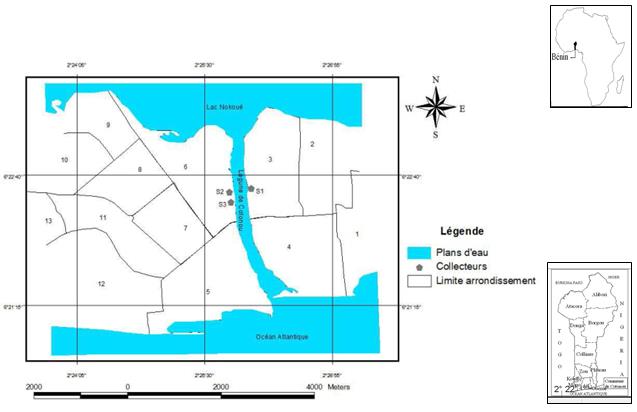
The current study was conducted in Cotonou, the economic capital of Benin, located between latitudes 6°20’ and 6°23’N and longitudes 2°22’ and 2°30’E. The city is naturally bordered by Nokoué Lake to the north and the Atlantic Ocean to the south, with the two connected by the Cotonou Lagoon (Figure 1). This 4 km-long lagoon serves as the outlet of numerous stormwater drains and sewers, while also receives continuous flows of raw wastewater from various human activities.
Cotonou city is located in a subequatorial climate zone characterised by four distinct seasons: a long dry season (LDS) from December to March, a long rainy season (LRS) from April to July, a short dry season (SDS) from August to September and a short rainy season (SRS) from October to November 18.

Wastewater samples were collected near the discharge points of three main sewers (S1, S2, S3) flowing into Cotonou Lagoon. The sewers were selected based on their size and the level of human pressure on them (Table 1). Sampling was made monthly throughout an entire year to account for seasonal variations.
Temperature, pH, and electric conductivity (EC) of the studied waters were measured in situ using a multiprocessing portable conductivity meter, WTWpH/cond 340i/SET. Dissolved oxygen (DO) was assessed with a portable oximeter, WTW oxi 340i/SET.
Wastewater samples were collected in sterile polyethylene bottles, previously rinsed with sampled water, at midstream of the sewers to minimise edge effects and to obtain representative conditions. Immediately after collection, the bottles were kept in a portable frozen tank, transported to the laboratory on the same day, and stored at 4°C until analysis 19.
Water turbidity and suspended matters (SM) were measured using colourimetric methods with a HACH DR890 colourimeter. Ammoniacal nitrogen (N-NH3), nitrites (NO2-), nitrates (NO3-), orthophosphates (PO43-), sulphates (SO42-), and chemical oxygen demand (COD) were also measured colourimetrically using a molecular absorption spectrophotometer, HACH DR5000. Biological oxygen demand (BOD5) was determined by the respirometric method with an OxiTop® BOD-meter over a five-days incubation period. All analyses were performed according to the "Standard Methods for the Examination of Water and Wastewater", as approved by the United States Environmental Protection Agency (US EPA) (Table 2) 20 following strict QA/QC protocols to ensure data reliability. Field instruments were calibrated before each sampling using manufacturer-recommended standard solutions. Fields blanks, laboratory blanks, and sample duplicates were included at a rate of approximately 10% of total samples to monitor potential contamination and analytical precision.
The biodegradability of the studied waters was assessed by calculating the biodegradability index (BI), defined as the ratio of COD to BOD5 (BI = COD/BOD5) 19.
The surveyed wastewater quality parameters were compared among stations and seasons, using one-way analysis of variance (ANOVA 1), after verifying data normality with Shapiro-Wilk test and homogeneity of variance with Levene test, followed by Tukey’s HSD post-hoc in case of significant difference. When normality and homogeneity conditions were not fulfilled, the non-parametric Kruskal-Wallis test was carried out followed by pairwise comparisons using the Mann-Whitney U test in case of need.
A Spearman rank correlation test was carried out to identify the relationship among the studied parameters. Furthermore, a principal component analysis (PCA) was performed to identify the variables that contributed more to the variation in the studied wastewater quality.
All the statistical tests were performed using the statistical software Statistica 6.0 package (StatSoft Inc, Tulsa, USA).
The mean values and ranges of the studied parameters recorded at each sampling station are presented in Table 3. Among the analysed parameters, only electrical conductivity (EC) (H = 14.17; 0.00), ammoniacal nitrogen (N-NH3) (F = 4.05; p = 0.03) and COD (H = 6.00; p = 0.04) showed significant variations between stations. The highest EC values were recorded at stations S2 and S3. Regarding N-NH3, the highest concentration was observed at station S2, while the COD values were higher at stations S1 and S2 compared to station 3.
On the other hand, all the studied parameters exhibited significant seasonal variations (p < 0.05) except for EC and orthophosphates, which did not vary significantly among seasons (p > 0.05) (Table 4). Overall, the long dry season (LDS) displayed the highest values for most monitored parameters, except for dissolved oxygen (DO) and nitrites (N-NO2-).
The Temperature was lower during the short dry season (SDS) compared to the other seasons. pH remained slightly acidic in all the seasons, but was higher and thus closer to neutrality during the long seasons (LDS and LRS) than during the short ones (SDS and SRS). A similar trend was observed for sulphate concentrations. As for the DO, the highest levels were recorded during the SDS and LRS compared to the LDS and SRS. Turbidity and suspended matters (SM) followed an opposite trend, with their lowest mean values recorded during the LDS and SRS.
Regarding nitrogenous compounds, the highest mean concentrations of ammoniacal nitrogen and nitrates were recorded during the LDS, whereas nitrites concentrations peaked during the LRS. Finally, both BOD5 and DCO values were markedly higher during the LDS compared to the other seasons.
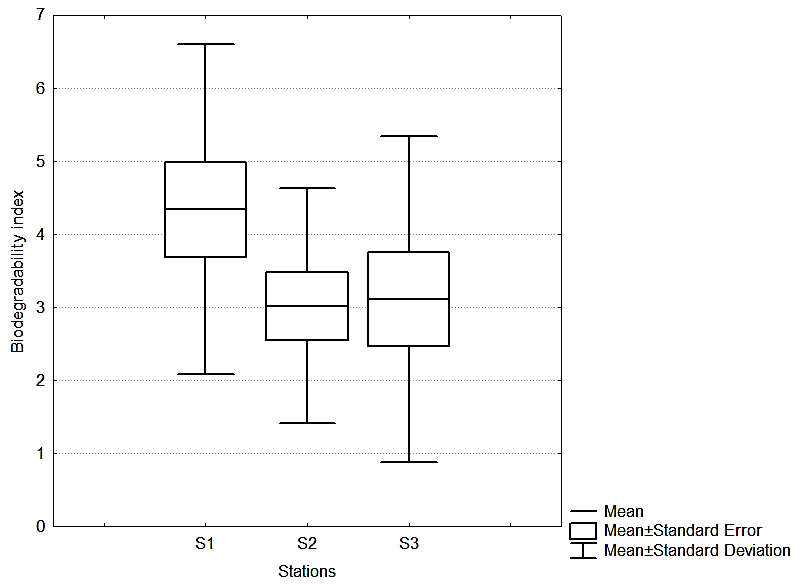
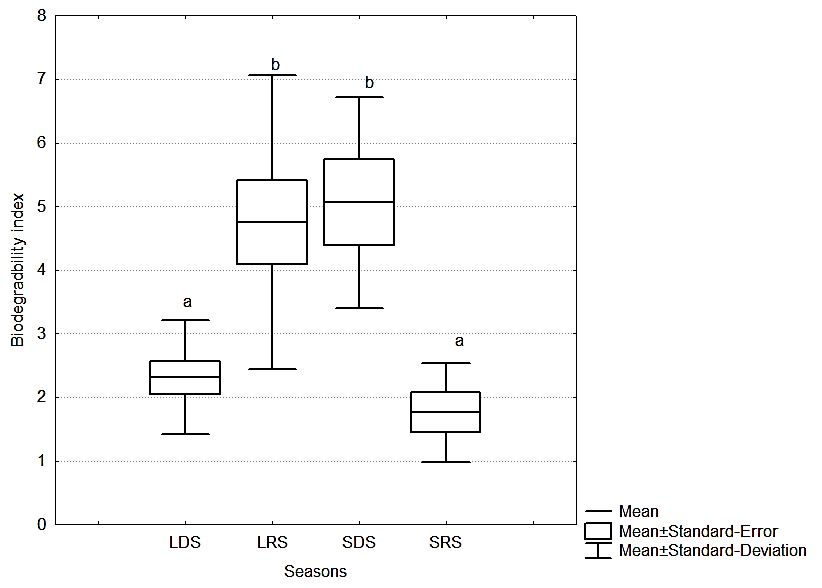
The variation of the biodegradability index (BI) of the studied wastewaters among the sampling stations and across seasons is presented in Figures 2 and 3, respectively. No significant difference was noticed among stations (F = 1.36; p = 0.27). Nonetheless, the BI values ranged from 1.36 to 7.80 at S1, from 1.31 to 6.29 at S2 and from 1.13 to 9.18 at S3. In contrast, BI varied significantly among seasons (H = 18.40; p = 0.00). Higher BI values were recorded during the LRS (BI ranging from 1.77 to 9.18) and the SDS (BI ranging from 2.90 to 7.80) compared to the LDS (BI ranging from 1.31 to 4.24) and the SRS (BI ranging from 1.13 to 2.76), indicating a seasonal influence on the biodegradability of the wastewater.
Correlation analysis between physico-chemical parameters revealed significant positive and negative relationships among many variables, as shown in Table 5.
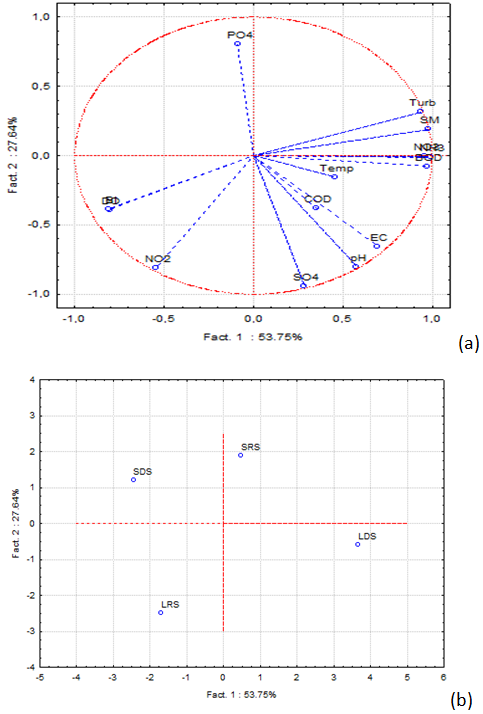
The PCA results indicated that the first two principal components (F1 and F2) together explain 81.39% of the variance in the measured parameters, with contributions of 53.75% and 27.64% for F1 and F2, respectively (Figure 4a). The projection of the water quality parameters in the factorial design (FI-F2) (Figure 4.a), highlights a strong positive correlation of Turbidity (0.94), SM (0.98), N-NH3 (0.99), N-NO3- (0.96) and BOD5 (0.97) with F1, whereas the DO (0.81) and the BI (-0.81) are correlated negatively with this component. For F2, only PO43- (0.80) displays a positive correlation, while pH (-0.80), N-NO2- (-0.81) and SO42- (-0.94) are negatively correlated.
When seasons are considered as groups (Figure 4.b), the LDS and SDS exhibit positive and negative correlations with the component F1, respectively, whereas the LRS and SRS show negative and positive correlations with F2, respectively.


The wastewaters discharged through storm sewers into the Cotonou Lagoon showed relatively similar quality across the different outlets, although some seasonal variations were noticed.
The mean temperature values are within the recommended limit of 30°C, as specified by wastewater discharge standards 21, 22, 23. These values were comparable to those reported for raw wastewater in Abidjan, Côte d’Ivoire 24 and in Adétikopé, Togo 25. With respect to pH, the investigated effluents were slightly acidic, in contrast to the pH values reported for wastewaters reported in Abidjan, Côte d’Ivoire 24, Ouargla, Algeria 26, Oujda 27 and Ben Sergao at Agadir 28, Morocco, as well as Abomey-Calavi, Benin 29, which were globally alkaline. Nevertheless, on average, the recorded pH values fell within the permissible range of 6 to 9, set by effluent release guidelines 13, 30, during the LDS and LRS but exceeded this range during the SDS and SRS. Based on this pH range, the studied effluents are therefore more favourable to the survival and growth of microorganisms involved in the degradation of organic loads during the LDS and LRS 31, 32.
The recorded EC values exceeded the recommended limit of 2.5 mS cm-1, indicating that the prospected wastewaters are highly mineralised, as commonly reported for urban effluents in Africa 33, 34, 35, 36, 37. Dissolved oxygen (DO) levels were low and generally below the 5 mg L-1 threshold required for aquatic life protection, a trend also observed in urban effluents 38. Accordingly, the studied effluents appear unfavourable both to the degradation of organic loads and to the survival of aquatic fauna 39. Furthermore, this low oxygen level, combined with the temperature above 20°C 19, may promote the development of anaerobic microorganisms, particularly sulphite-reducing bacteria 14. These microorganisms can generate hydrogen sulphide (H2S) from sulphur compounds, producing the unpleasant odours frequently associated with the effluents 40, 41. A wide turbidity was registered for the studied wastewaters. Turbidity showed a strong positive correlation with suspended matter (SM) concentration (r = 0.96), which reached 120 mg L-1, almost four times higher than the threshold of 35 mg L-1 set by Beninese standards 13. This high SM load, generally due to both organic and inorganic particles 42, considerably reduces water transparency and, consequently, impairs photosynthetic activity, decreasing dissolved oxygen levels 27, 39, 42, 43. This is further highlighted by the significant negative correlations observed between DO and turbidity (r = -0.67) as well as between DO and SM (r = -0.65). The discharge of such wastewater, heavily loaded with SM, could therefore trigger similar effects in the receiving aquatic ecosystem by reducing primary production. Additionally, high SM concentrations can directly impair fish respiration by clogging their gills 19.
All the aforementioned parameters (EC, turbidity, SM and OD) highlight the unsuitability of the studied effluents for direct discharge into the environment without prior treatment. This is further supported by the concentrations of nutrient parameters. In fact, although nitrogenous minerals were found in low concentrations in the wastewater, they still pose a potential threat to the receiving environment. In particular, during the LDS and SRS, the release of the effluents with nitrogen levels exceeding 10 to 15 mg L-1 13, 44, could lead to significant ecological and public health impacts 46, 47. Among the nitrogenous species monitored, ammonia nitrogen showed the highest concentrations, likely due to the low DO levels (negatively correlated with the ammonia concentration, r = -0.54), which create quasi-anaerobic conditions unfavourable to oxidation reactions in the studied waters 47. Since ammonia nitrogen is toxic for fish in its unionised form (NH3) 48, 49, 50, its high concentration in the investigated wastewaters represents a potential hazard to the biota of the receiving ecosystem. Orthophosphates concentrations were slightly above the discharge limit for phosphorus into sensitive environments (1-2 mg L-1) 13. When combined with the nitrogen level, the recorded phosphorus concentrations suggest that effluent release could increase the risk of eutrophication events in the Cotonou lagoon 51, 52, 53. In addition, the high sulphate concentrations recorded (exceeding 20 mg L-1 and reaching up to 292 mg L-1) may also indirectly contribute to eutrophication in the receiving ecosystem by promoting sulphate reduction and subsequent phosphorus release from sediments 54. Elevated sulphate levels can also exert direct adverse effects on aquatic organisms, including disruptions in osmoregulation, reproduction and embryonic development 55, 56.
The assessment of organic load and the wastewater biodegradability requires the determination of both BOD5 and COD 19, 57. In this study, the mean values obtained for these two parameters were lower than those generally reported for urban effluents in other cities such as Abomey-Calavi in Benin 29, Abidjan in Côte d’Ivoire 24, Biskra in Algeria 42, Blantyre in Malawi 58, Sidi Kacem 59 and Sidi Yahia 60 in Morocco.
The moderate BOD5 and COD levels recorded may partly reflect dilution by stormwater in the combined sewer system sampled, particularly during the rainy seasons when the lowest values were observed 61. Nevertheless, both BOD5 and COD exceeded the limit of 25 mg O2 L-1 and 125 mg O2 L-1, respectively, recommended by the Beninese discharge standards 13. These parameters are critical for selecting a suitable wastewater treatment method, since they are used to assess the biodegradability index (BI), defined as the COD/BOD5 ratio 19, 35. The BI mean values recorded at the sampling stations ranged between 3 and 5, indicating that the studied wastewaters are moderately biodegradable and can therefore be treated using biological processes 19. This suggests that the accumulation of organic pollutants from the effluents in the receiving water body may be limited, depending on the self-purification capacity of the lagoon.
Biodegradability, however, varied significantly across seasons (p < 0.05). Wastewaters were readily biodegradable during the LDS and SRS (BI < 3), moderately biodegradable during the LRS (3 < BI < 5), and poorly biodegradable during the SDS (BI > 5). Seasonal variations in BI closely reflected changes in BOD5, as shown by their negative correlation (r = -0.67). The highest BOD5 values, comparable to those reported for the household greywater in Cotonou 17, corresponded to the lowest BI and were recorded in the LDS and the SRS. This indicates a strong domestic wastewater contribution, rich in biodegradable matter, likely linked to continuous household effluent discharges into drains and sewers in Cotonou. In contrast, very low BOD5 levels associated with the highest BI were noticed during the LRS and SDS, suggesting a predominance of non-biodegradable inputs, probably coming from the industrial effluents 17, various solid wastes leachates, or petroleum hydrocarbons discharged into the urban sewers 62.
The PCA results highlighted the correlation among parameters and helped further characterise the studied wastewaters across seasons. The first principal axis (F1) reflected high concentrations of biodegradable organic matter and nitrogenous loads coupled with low DO and low BI values, particularly characterising the LDS. The second axis (F2) pointed up effluents with elevated phosphorus loads and low pH, especially during the SRS. Accordingly, two main classes of wastewater could be distinguished in the surveyed sewers: (i) those enriched in nitrogenous and organic loads, and (ii) those dominated by phosphorus-related pollution. From a treatment perspective, these PCA results call for a seasonal operational strategy consisting of prioritize biological nitrogen removal during dry seasons and, focusing on phosphorus control during rainy seasons.
The results of this study revealed that the mixed wastewaters released into Cotonou Lagoon through storm sewers are highly mineralised with relatively high nitrogen and phosphorus content, turbid and loaded with suspended matters. They contain an important organic load which is moderately biodegradable. The pollution level of the effluents varied across seasons, with the most polluted yet readily biodegradable waters recorded during the LDS. On the other hand, wastewater quality was mainly influenced by mineral and organic pollutants, as well as DO levels during dry seasons, whereas, in rainy seasons, it was much more determined by pH and phosphorus. Most of the monitored quality parameters exhibited some values above discharge standards. These findings highlight the urgent need for seasonally adapted treatment of these effluents prior to their discharge into coastal waters, in order to prevent eutrophication_driven ecological imbalance and biodiversity decline. Furthuremore, the moderate range of DOB5 and COD characterising the studied wastewater, partly due to stormwater mixture, suggests the design of a separate collection system in order to concentrate the organic load required for treatment system operation.
The authors honor the memory of Professor Emile Didier Fiogbé, whose guidance, dedication and insight were invaluable to this study.
| [1] | WWAP, Wastewater: The Untapped Resource. United Nations World Water Development Report, UNESCO Publishing: Paris, 2017. | ||
| In article | |||
| [2] | Corcoran, E., Nellemann, C., Baker, E., Bos, R., Osborn, D. and Savelli, H. (eds), Sick Water? The Central Role of Wastewater Management in Sustainable Development. A Rapid Response Assessment. United Nations Environment Programme, UN‐HABITAT, GRID‐Arendal, 2010. | ||
| In article | |||
| [3] | Koop, S. H. A. and van Leeuwen, C. J., The challenges of water, waste and climate change in cities. Environ. Dev. Sustain., 19, 385-418, 2017. | ||
| In article | View Article | ||
| [4] | UNEP, Wastewater -Turning Problem to Solution. A UNEP Rapid Response Assessment, Nairobi, 2023. | ||
| In article | |||
| [5] | AfDB, UNEP and GRID‐Arendal. Sanitation and Wastewater Atlas of Africa. Abidjan, Nairobi, Arendal, 2020. | ||
| In article | |||
| [6] | Nansubuga, I., Banadda, N., Verstraete, W. and Rabaey, K., A review of sustainable sanitation systems in Africa. Rev. Environ. Sci. Biotechnol., 15, 465-478, 2016. | ||
| In article | View Article | ||
| [7] | UN-Water, Sustainable Development Goal 6 synthesis report on water and sanitation, United Nations, Geneva, Switzerland, 199 p, 2018. | ||
| In article | |||
| [8] | GIZ, SFD (Lite) Report-Grand Cotonou, Bénin. GIZ, 2024. | ||
| In article | |||
| [9] | INSAE and ICF, Enquête Démographique et de Santé au Bénin, 2017-2018. Cotonou, Bénin et Rockville, Maryland, USA, 675p, 2019. | ||
| In article | |||
| [10] | Onifadé, S., Baba-Moussa, F., Aïna, M., Noumavo, P. A. and Toukourou, F., Physico-chemical and bacteriological characterization of surface waters (well, pond and lagoon) and industrial wastewater in Cotonou City (Benin). Int. J. Sci. Environ. Technol., 6(2), 1001-1018, 2017. | ||
| In article | |||
| [11] | Adanlokonon, E. A. S., Kanhounnon, W. G., Chabi, B. C., Adjahouinou, D. C., Koumolou, L., Bonou, B., Fiogbe, E. D. and Edorh, P. A., Physicochemical and microbiological characterization of effluents from the “Centre Hospitalier Universitaire de la Mère et de l’Enfant Lagune (CHU MEL)” discharged in the Cotonou lagoon, Benin. Int. J. Biol. Chem. Sci., 12, 1955-1964, 2018 | ||
| In article | View Article | ||
| [12] | WHO, Safe management of wastes from health-care activities, 2nd ed., Department of Public Health, Environmental and Social Determinants of Health, Geneva, 2014. | ||
| In article | |||
| [13] | République du Bénin, Décret n°2001-109 du 4 avril 2001 fixant les normes de qualité des eaux résiduaires en République du Bénin. Journal Officiel de la République du Bénin, 2001. | ||
| In article | |||
| [14] | Adjahouinou, D. C., Yehouénou, B., Liady, M. N. D., Fiogbé, E. D., Caractérisation bactériologique des eaux résiduaires brutes de la ville de Cotonou (Bénin). J. Appl. Biosci., 78, 6705-6713, 2014a. | ||
| In article | View Article | ||
| [15] | Adjahouinou, D. C., Lagnika, M., Tossavi, N. D., Fiogbé, E. D., Fecal contamination level of Cotonou Lagoon waters (Benin, West Africa). Int. J. Multidiscip. Curr. Res. 3, 245-250, 2015. | ||
| In article | |||
| [16] | Bokossa, H. K. J., Adanlokonon, E. A. S., Toffa, D., Johnson, H., Edorth, P., Fiogbe, E. D. and Johnson, R. C. Assessment of physicochemical and metal concentrations in wastewater from the industrial zone of Cotonou, Benin. Int. J. Environ. Clim. Change, 12(11), 1053-1064, 2022. | ||
| In article | View Article | ||
| [17] | Daouda, M. M. A., Hounkpè, S. P., Djihouessi, M. B., Akowanou, A. V. O., Aïna, M. P. and Drogui, P. Physicochemical assessment of urban wastewater of Cotonou (Benin). Water Sci. Technol., 83(6), 1499-1510, 2021. | ||
| In article | View Article PubMed | ||
| [18] | Adam, K. S. and Boko, M., Le Bénin. Les Editions du Flamboyant, EDICEF,Vanves, Cedex, 1993. | ||
| In article | |||
| [19] | Rodier, J., Legube, B. and Merlet, N., L’Analyse de l’eau : contrôle et interprétation, 10th ed., Dunod, Paris, 1190 p, 2016. | ||
| In article | |||
| [20] | APHA, AWWA and WEF, Standard Methods for the Examination of Water and Wastewater, 23th ed., APHA Press, Washington, DC, 1796 p, 2017. | ||
| In article | |||
| [21] | DEEC, Eaux usées: Normes de rejets. Norme sénégalaise NS 05-061 Juillet 2001. DEEC, 27 p, 2001. | ||
| In article | |||
| [22] | JORA. Normes de rejets dans le milieu récepteur. Journal Officiel de la République Algérienne, 46, 7-12, 2003. | ||
| In article | |||
| [23] | MATEE, Décret n°2-04-553 du 24 janvier 2005 relatif aux déversements, écoulements, rejets, dépôts directs ou indirects dans les eaux superficielles ou souterraines. Ministère de l’Aménagement, du Territoire, de l’Eau et de l’Environnement, Maroc, 2005. | ||
| In article | |||
| [24] | Gnagne, Y. A., Yapo, B. O., Meite, L., Kouame, V. K., Gadji, A. A., Mambo, V. and Houenou, P., Caractérisation physico-chimique et bactériologique des eaux usées brutes du réseau d’égout de la ville d’Abidjan. Int. J. Biol. Chem. Sci. 9(2), 1082-1093, 2015. | ||
| In article | View Article | ||
| [25] | Gbekley, E. H., Komi, K., Houedakor, K. Z., Poli, S., Kpoezou, K., Adjalo, D. K., Zinsou-Klassou, K., Tchacondo, T., Ameyapoh, Y., Adjoussi, P., The Physico-Chemical and Bacteriological Characterization of Domestic Wastewater in Adétikopé (Togo, West Africa), Sustainability, 15(13787) 2023. | ||
| In article | View Article | ||
| [26] | Hamdi, W., Youcefi, M., Touil, Y., Bougrinat, R., Ferhi, N. and Ould El Hadj, M. D., Contribution à l’étude de quelques caractéristiques physico-chimiques et hygiéniques des eaux usées issues de rejets de certaines localités de la cuvette de Ouargla (Algérie). Algerian J. Arid Environ., 2(1), 56-63, 2012. | ||
| In article | |||
| [27] | Rassam, A., Chaouch, A., Bourkhiss, B., Ouhssine, M., Lakhlifi, T., Bourkhiss, M. and El Watik, L., Caractéristiques physico-chimiques des eaux usées brutes de la ville d’Oujda (Maroc). Tech. Lab., 7(28), 70-78, 2012. | ||
| In article | |||
| [28] | Mimouni, R., Yacoubi, B. and Eddabra, R., Qualité physico-chimique des eaux usées purifiées par infiltration-percolation: cas de la station de Ben Sergao après dix ans de fonctionnement (Maroc), Rev. Microbiol. Ind. San Environn., 5(1), 101-114, 2011. | ||
| In article | |||
| [29] | Aina, M. P., Djihouessi, B., Vissin, E. W., Kpondjo, N. M., Gbèdo, V. and Sohounhloué, K. C. D., Caractérisation des eaux usées domestiques et dimensionnement d’une station pilote par lagunage à Abomey-Calavi, Bénin, ISCA J. Eng. Sci., 1(1), 45-50, 2012. | ||
| In article | |||
| [30] | FEPA, Effluent Discharge Standard, Lagos. Federal Environmental Protection Agency, 1988. | ||
| In article | |||
| [31] | Xu, Y.-N. and Chen, Y. Advances in heavy metal removal by sulphate-reducing bacteria. Water Sci. Technol. 2020, 81(9), 1797–1827. | ||
| In article | View Article PubMed | ||
| [32] | Marić, A.-K., Sudar, M., Findrik Blažević, Z. and Vuković Domanovac, M., Methanogenesis - General Principles and Application in Wastewater Remediation, Energies, 17(5374), 2024. | ||
| In article | View Article | ||
| [33] | N’diaye, A. D., Kankou, M. O. S. A. O., Lo, B., Namr, K. I. Caractérisation de la pollution bactériologique des effluents de la ville de Nouakchott, irrigués dans le périmètre maraîcher de Sebkha. Int. J. Biol. Chem. Sci., 5(2), 748-754, 2011. | ||
| In article | View Article | ||
| [34] | N’diaye, A. D., Kankou, M. O. S. A. O., Lo, B. and Namr, K. I. Caractérisation des nutriments azotés et phosphatés contenus dans les effluents de la ville de Nouakchott. ScienceLib Mersenne, 3, 15, 2011. | ||
| In article | |||
| [35] | Boutayeb, M., Bouzidi, A. and Fekhaoui, M., Étude de la qualité physico-chimique des eaux usées brutes de cinq villes de la région de la Chaouia-Ouardigha (Maroc), Bulletin de l’Institut Scientifique, Rabat, section Sciences de la Vie, 34 (2), 145-150, 2012. | ||
| In article | |||
| [36] | El Hachemi, O., El Halouani, H., Meziane, M., Torrens, A., Salgot, M. and Sbaa, M., Performances épuratrices dans une station de traitement des eaux usées par lagunage en climat désertique (oasis de Figuig - Maroc) : aspect bactérien et organique. Rev. Microbiol. Ind. San Environn., 6(1), 84-97, 2012. | ||
| In article | |||
| [37] | El Khokh, K., Kbibch, A., El Kharrim, K. and Belghyti, D. Evaluation de la charge polluante des eaux usées de la ville de Mechraa Belksiri (Gharb, Maroc). ScienceLib Mersenne, 4(14), 2012. | ||
| In article | |||
| [38] | Fatoki, S. O., Gogwana, P., and Ogunfowokan, A. O. Pollution assessment in the Keiskamma River and in the impoundment downstream. Water SA, 29(3), 183-187, 2003. | ||
| In article | View Article | ||
| [39] | Saïda, B., Houda, A., Khadija, A., Hassan, E.-R., Urban effluent pollution from the Mghogha flow of the West margin of the Mediterranean Sea (Morocco). Afr. J. Environ. Sci. Technol., 2(5), 116-122, 2008. | ||
| In article | |||
| [40] | Hamoda, M. F. and Alshalahi, S. F., Assessment of hydrogen sulfide emission in a wastewater pumping station. Environ. Monit. Assess.193(352), 2021. | ||
| In article | View Article PubMed | ||
| [41] | Sinharoy, A., Kim, S. H. and Chung, C. M., Effect of variation in temperature on malodor generation from different units of a wastewater treatment plant. Environ. Sci. Pollut. Res., 32, 8035-8052, 2025. | ||
| In article | View Article PubMed | ||
| [42] | Lynda, S., Rachid, R., Houria, B. and Mohammed-Reda, D., Survey of the physico-chemical quality of the wastewaters of Biskra city rejected in Chabat Roba, Messdour and Wadi Z’ommor (Algeria). Afr. J. Environ. Sci. Technol., 2(8), 231-238, 2008. | ||
| In article | |||
| [43] | El Khokh, K., Belghyti, D., El Kharrim, K., Kbibch, A., Chentoufi, M. and Belghyti, R., Caractérisation physico-chimique des eaux usées urbaines de la ville de Mechraa Belksiri (Gharb, Maroc). ScienceLib Mersenne, 3(110205), 2011. | ||
| In article | |||
| [44] | CEE, Directive du Conseil du 21 mai 1991 relative au traitement des eaux urbaines résiduaires, 91/271/CEE, 13p, 1991. | ||
| In article | |||
| [45] | Amir, H. M., Ali, R. M. and Farham, K., Nitrogen removal from wastewater in a continuous flow sequencing batch reactor, Pak. J. Biol. Sci., 7(11), 1880-883, 2004. | ||
| In article | View Article | ||
| [46] | Ferreira, A., Melkonyan, L., Carapinha, S., Ribeiro, B., Figueiredo, D., Avetisova, G. and Gouveia, L., Biostimulant and biopesticide potential of microalgae growing in piggery wastewater, Environ. Adv., 4(100062), 2021. | ||
| In article | View Article | ||
| [47] | Adjahouinou, D. C., Liady, N. D. and Fiogbé, E. D., Diversité phytoplanctonique et niveau de pollution des eaux du collecteur de Dantokpa (Cotonou, Bénin), Int. J. Biol. Chem. Sci., 6(5), 1938-1949, 2012. | ||
| In article | View Article | ||
| [48] | Das, P. C., Ayyappan, S., Jena, J. K. and Das, B. K., Acute toxicity of ammonia and sub-lethal effects on selected haematological and enzymatic parameters of mrigal, Cirrhinus mrigala (Hamilton), Aquac. Res., 35(2), 134-143, 2004. | ||
| In article | View Article | ||
| [49] | Kim, J. H., Cho, J. H., Kim, S. R. and Hur, Y. B., Toxic effects of waterborne ammonia exposure on hematological parameters, oxidative stress and stress indicators of juvenile hybrid grouper, Epinephelus lanceolatus♂ × E. fuscoguttatus♀, Environ. Toxicol. Pharmacol., 80(103453), 2020. | ||
| In article | View Article PubMed | ||
| [50] | Mondal, N., Kaur, J., and Ghosh, A., Ammonia toxicity tolerance and behavioural response in Zebrafish. Discover Toxicol., 2(3), 1-14, 2025. | ||
| In article | View Article | ||
| [51] | Elser, J. J., Bracken, M. E., Cleland, E. E., Gruner, D. S., Harpole, W. S., Hillebrand, H., Ngai, J. T., Seabloom, E. W., Shurin, J. B., and Smith, J. E., Global analysis of nitrogen and phosphorus limitation of primary producers in freshwater, marine and terrestrial ecosystems, Ecol. Lett., 10(12), 1135-1142, 2007. | ||
| In article | View Article PubMed | ||
| [52] | Conley, D. J., Paerl, H. W., Howarth, R. W., Boesch, D. F., Seitzinger, S. P., Havens, K. E., Lancelot, C. and Likens, G. E., Controlling eutrophication: nitrogen and phosphorus, Science, 323(5917), 1014-1015, 2009. | ||
| In article | View Article PubMed | ||
| [53] | Paerl, H. W., Plaas, H. E., Nelson, L. M., Korbobo, A. S., Cheshire, J. H., Yue, L. and Preece, F. E., Dual nitrogen and phosphorus reductions are needed for long-term mitigation of eutrophication and harmful cyanobacterial blooms in the hydrologically-variable San Francisco Bay Delta, CA, Sci. Total Environ., 957(177499), 2024. | ||
| In article | View Article PubMed | ||
| [54] | Zhou, C., Peng, Y., Chen, L., Yu, M., Zhou, M., Xu, R., Zhang, L., Zhang, S., Xu, X., Zhang, L. and Wang, G., Rapidly increasing sulfate concentration: a hidden promoter of eutrophication in shallow lakes, Biogeosciences, 19, 4351-4360, 2022. | ||
| In article | View Article | ||
| [55] | Bhatt, S., Dasgupta, S., Gupta, S., Sahu, N. P., Vattiringal, V. J. R. and Varghese, T., Effect of sulfate on the osmoregulatory and physio-biochemical responses of GIFT (Oreochromis niloticus) juveniles reared in potassium-deficient medium saline waters, Environ. Sci. Pollut. Res., 31, 18636-18655, 2024. | ||
| In article | View Article PubMed | ||
| [56] | Mäkinen, M., Hu, X., Karjalainen, J. Differences in sulfate sensitivity of early development between brackish and freshwater coregonines, Int. J. Limnol., 60(24), 1-11, 2024. | ||
| In article | View Article | ||
| [57] | Aguilar-Torrejón, J. A., Balderas-Hernández, P., Roa-Morales, G., Barrera-Díaz, C. E., Rodríguez-Torres, I. and Torres-Blancas, T., Relationship, importance, and development of analytical techniques: COD, BOD, and TOC in water-An overview through time, SN Appl. Sci., 5, 118, 2024. | ||
| In article | View Article | ||
| [58] | Chipofya, V., Kraslawski, A. and Avramenko, Y., Comparison of pollutant levels in effluent from wastewater treatment plants in Blantyre, Malawi, Int. J. Water Resour. Environ. Eng., 2(4), 79-86, 2010. | ||
| In article | |||
| [59] | El Rhaouat, O., El Kherrati, I., El Khayyat, F., Chiguer, H., Ezziani, K., Ibeda, A., Fareh, M., Saidi, Y., El Kharim, K. and Belghyti, D., Physico-chemical evaluation of urban wastewater of the town of Sidi Kacem, Comput. Water Energy Environ. Eng., 3, 30-35, 2014. | ||
| In article | View Article | ||
| [60] | Fatima, B. H., El Bayoudi, M., El Khayyat, F., El Kharrim, K., Sadek, S. and Belghyti, D., Physicochemical analysis of the wastewater of Tiflet Wadi (Sidi Yahia, Morocco), Basic Res. J. Soil Environ. Sci., 2(3), 19-22, 2014. | ||
| In article | |||
| [61] | Makuwa, S., Tlou, M., Fosso-Kankeu, E. and Green, E., The effects of dry versus wet season on the performance of a wastewater treatment plant in North West Province, South Africa, Water SA, 48(1), 40-49, 2022. | ||
| In article | View Article | ||
| [62] | Adjahouinou, D. C., and Fiogbé, E. D. Concentrations of heavy metals in raw wastewaters of Cotonou city (Benin), J. Biodivers. Environ. Sci., 5(2), 534-541, 2014b. | ||
| In article | |||
Published with license by Science and Education Publishing, Copyright © 2025 Dogbè Clément Adjahouinou, Chaim Vivien Doto, Elias Alexandre Sètondji Adanlokonon, Fouad Zouhir and Mouhamadou Nourou Dine Liady
 This work is licensed under a Creative Commons Attribution 4.0 International License. To view a copy of this license, visit
http://creativecommons.org/licenses/by/4.0/
This work is licensed under a Creative Commons Attribution 4.0 International License. To view a copy of this license, visit
http://creativecommons.org/licenses/by/4.0/
| [1] | WWAP, Wastewater: The Untapped Resource. United Nations World Water Development Report, UNESCO Publishing: Paris, 2017. | ||
| In article | |||
| [2] | Corcoran, E., Nellemann, C., Baker, E., Bos, R., Osborn, D. and Savelli, H. (eds), Sick Water? The Central Role of Wastewater Management in Sustainable Development. A Rapid Response Assessment. United Nations Environment Programme, UN‐HABITAT, GRID‐Arendal, 2010. | ||
| In article | |||
| [3] | Koop, S. H. A. and van Leeuwen, C. J., The challenges of water, waste and climate change in cities. Environ. Dev. Sustain., 19, 385-418, 2017. | ||
| In article | View Article | ||
| [4] | UNEP, Wastewater -Turning Problem to Solution. A UNEP Rapid Response Assessment, Nairobi, 2023. | ||
| In article | |||
| [5] | AfDB, UNEP and GRID‐Arendal. Sanitation and Wastewater Atlas of Africa. Abidjan, Nairobi, Arendal, 2020. | ||
| In article | |||
| [6] | Nansubuga, I., Banadda, N., Verstraete, W. and Rabaey, K., A review of sustainable sanitation systems in Africa. Rev. Environ. Sci. Biotechnol., 15, 465-478, 2016. | ||
| In article | View Article | ||
| [7] | UN-Water, Sustainable Development Goal 6 synthesis report on water and sanitation, United Nations, Geneva, Switzerland, 199 p, 2018. | ||
| In article | |||
| [8] | GIZ, SFD (Lite) Report-Grand Cotonou, Bénin. GIZ, 2024. | ||
| In article | |||
| [9] | INSAE and ICF, Enquête Démographique et de Santé au Bénin, 2017-2018. Cotonou, Bénin et Rockville, Maryland, USA, 675p, 2019. | ||
| In article | |||
| [10] | Onifadé, S., Baba-Moussa, F., Aïna, M., Noumavo, P. A. and Toukourou, F., Physico-chemical and bacteriological characterization of surface waters (well, pond and lagoon) and industrial wastewater in Cotonou City (Benin). Int. J. Sci. Environ. Technol., 6(2), 1001-1018, 2017. | ||
| In article | |||
| [11] | Adanlokonon, E. A. S., Kanhounnon, W. G., Chabi, B. C., Adjahouinou, D. C., Koumolou, L., Bonou, B., Fiogbe, E. D. and Edorh, P. A., Physicochemical and microbiological characterization of effluents from the “Centre Hospitalier Universitaire de la Mère et de l’Enfant Lagune (CHU MEL)” discharged in the Cotonou lagoon, Benin. Int. J. Biol. Chem. Sci., 12, 1955-1964, 2018 | ||
| In article | View Article | ||
| [12] | WHO, Safe management of wastes from health-care activities, 2nd ed., Department of Public Health, Environmental and Social Determinants of Health, Geneva, 2014. | ||
| In article | |||
| [13] | République du Bénin, Décret n°2001-109 du 4 avril 2001 fixant les normes de qualité des eaux résiduaires en République du Bénin. Journal Officiel de la République du Bénin, 2001. | ||
| In article | |||
| [14] | Adjahouinou, D. C., Yehouénou, B., Liady, M. N. D., Fiogbé, E. D., Caractérisation bactériologique des eaux résiduaires brutes de la ville de Cotonou (Bénin). J. Appl. Biosci., 78, 6705-6713, 2014a. | ||
| In article | View Article | ||
| [15] | Adjahouinou, D. C., Lagnika, M., Tossavi, N. D., Fiogbé, E. D., Fecal contamination level of Cotonou Lagoon waters (Benin, West Africa). Int. J. Multidiscip. Curr. Res. 3, 245-250, 2015. | ||
| In article | |||
| [16] | Bokossa, H. K. J., Adanlokonon, E. A. S., Toffa, D., Johnson, H., Edorth, P., Fiogbe, E. D. and Johnson, R. C. Assessment of physicochemical and metal concentrations in wastewater from the industrial zone of Cotonou, Benin. Int. J. Environ. Clim. Change, 12(11), 1053-1064, 2022. | ||
| In article | View Article | ||
| [17] | Daouda, M. M. A., Hounkpè, S. P., Djihouessi, M. B., Akowanou, A. V. O., Aïna, M. P. and Drogui, P. Physicochemical assessment of urban wastewater of Cotonou (Benin). Water Sci. Technol., 83(6), 1499-1510, 2021. | ||
| In article | View Article PubMed | ||
| [18] | Adam, K. S. and Boko, M., Le Bénin. Les Editions du Flamboyant, EDICEF,Vanves, Cedex, 1993. | ||
| In article | |||
| [19] | Rodier, J., Legube, B. and Merlet, N., L’Analyse de l’eau : contrôle et interprétation, 10th ed., Dunod, Paris, 1190 p, 2016. | ||
| In article | |||
| [20] | APHA, AWWA and WEF, Standard Methods for the Examination of Water and Wastewater, 23th ed., APHA Press, Washington, DC, 1796 p, 2017. | ||
| In article | |||
| [21] | DEEC, Eaux usées: Normes de rejets. Norme sénégalaise NS 05-061 Juillet 2001. DEEC, 27 p, 2001. | ||
| In article | |||
| [22] | JORA. Normes de rejets dans le milieu récepteur. Journal Officiel de la République Algérienne, 46, 7-12, 2003. | ||
| In article | |||
| [23] | MATEE, Décret n°2-04-553 du 24 janvier 2005 relatif aux déversements, écoulements, rejets, dépôts directs ou indirects dans les eaux superficielles ou souterraines. Ministère de l’Aménagement, du Territoire, de l’Eau et de l’Environnement, Maroc, 2005. | ||
| In article | |||
| [24] | Gnagne, Y. A., Yapo, B. O., Meite, L., Kouame, V. K., Gadji, A. A., Mambo, V. and Houenou, P., Caractérisation physico-chimique et bactériologique des eaux usées brutes du réseau d’égout de la ville d’Abidjan. Int. J. Biol. Chem. Sci. 9(2), 1082-1093, 2015. | ||
| In article | View Article | ||
| [25] | Gbekley, E. H., Komi, K., Houedakor, K. Z., Poli, S., Kpoezou, K., Adjalo, D. K., Zinsou-Klassou, K., Tchacondo, T., Ameyapoh, Y., Adjoussi, P., The Physico-Chemical and Bacteriological Characterization of Domestic Wastewater in Adétikopé (Togo, West Africa), Sustainability, 15(13787) 2023. | ||
| In article | View Article | ||
| [26] | Hamdi, W., Youcefi, M., Touil, Y., Bougrinat, R., Ferhi, N. and Ould El Hadj, M. D., Contribution à l’étude de quelques caractéristiques physico-chimiques et hygiéniques des eaux usées issues de rejets de certaines localités de la cuvette de Ouargla (Algérie). Algerian J. Arid Environ., 2(1), 56-63, 2012. | ||
| In article | |||
| [27] | Rassam, A., Chaouch, A., Bourkhiss, B., Ouhssine, M., Lakhlifi, T., Bourkhiss, M. and El Watik, L., Caractéristiques physico-chimiques des eaux usées brutes de la ville d’Oujda (Maroc). Tech. Lab., 7(28), 70-78, 2012. | ||
| In article | |||
| [28] | Mimouni, R., Yacoubi, B. and Eddabra, R., Qualité physico-chimique des eaux usées purifiées par infiltration-percolation: cas de la station de Ben Sergao après dix ans de fonctionnement (Maroc), Rev. Microbiol. Ind. San Environn., 5(1), 101-114, 2011. | ||
| In article | |||
| [29] | Aina, M. P., Djihouessi, B., Vissin, E. W., Kpondjo, N. M., Gbèdo, V. and Sohounhloué, K. C. D., Caractérisation des eaux usées domestiques et dimensionnement d’une station pilote par lagunage à Abomey-Calavi, Bénin, ISCA J. Eng. Sci., 1(1), 45-50, 2012. | ||
| In article | |||
| [30] | FEPA, Effluent Discharge Standard, Lagos. Federal Environmental Protection Agency, 1988. | ||
| In article | |||
| [31] | Xu, Y.-N. and Chen, Y. Advances in heavy metal removal by sulphate-reducing bacteria. Water Sci. Technol. 2020, 81(9), 1797–1827. | ||
| In article | View Article PubMed | ||
| [32] | Marić, A.-K., Sudar, M., Findrik Blažević, Z. and Vuković Domanovac, M., Methanogenesis - General Principles and Application in Wastewater Remediation, Energies, 17(5374), 2024. | ||
| In article | View Article | ||
| [33] | N’diaye, A. D., Kankou, M. O. S. A. O., Lo, B., Namr, K. I. Caractérisation de la pollution bactériologique des effluents de la ville de Nouakchott, irrigués dans le périmètre maraîcher de Sebkha. Int. J. Biol. Chem. Sci., 5(2), 748-754, 2011. | ||
| In article | View Article | ||
| [34] | N’diaye, A. D., Kankou, M. O. S. A. O., Lo, B. and Namr, K. I. Caractérisation des nutriments azotés et phosphatés contenus dans les effluents de la ville de Nouakchott. ScienceLib Mersenne, 3, 15, 2011. | ||
| In article | |||
| [35] | Boutayeb, M., Bouzidi, A. and Fekhaoui, M., Étude de la qualité physico-chimique des eaux usées brutes de cinq villes de la région de la Chaouia-Ouardigha (Maroc), Bulletin de l’Institut Scientifique, Rabat, section Sciences de la Vie, 34 (2), 145-150, 2012. | ||
| In article | |||
| [36] | El Hachemi, O., El Halouani, H., Meziane, M., Torrens, A., Salgot, M. and Sbaa, M., Performances épuratrices dans une station de traitement des eaux usées par lagunage en climat désertique (oasis de Figuig - Maroc) : aspect bactérien et organique. Rev. Microbiol. Ind. San Environn., 6(1), 84-97, 2012. | ||
| In article | |||
| [37] | El Khokh, K., Kbibch, A., El Kharrim, K. and Belghyti, D. Evaluation de la charge polluante des eaux usées de la ville de Mechraa Belksiri (Gharb, Maroc). ScienceLib Mersenne, 4(14), 2012. | ||
| In article | |||
| [38] | Fatoki, S. O., Gogwana, P., and Ogunfowokan, A. O. Pollution assessment in the Keiskamma River and in the impoundment downstream. Water SA, 29(3), 183-187, 2003. | ||
| In article | View Article | ||
| [39] | Saïda, B., Houda, A., Khadija, A., Hassan, E.-R., Urban effluent pollution from the Mghogha flow of the West margin of the Mediterranean Sea (Morocco). Afr. J. Environ. Sci. Technol., 2(5), 116-122, 2008. | ||
| In article | |||
| [40] | Hamoda, M. F. and Alshalahi, S. F., Assessment of hydrogen sulfide emission in a wastewater pumping station. Environ. Monit. Assess.193(352), 2021. | ||
| In article | View Article PubMed | ||
| [41] | Sinharoy, A., Kim, S. H. and Chung, C. M., Effect of variation in temperature on malodor generation from different units of a wastewater treatment plant. Environ. Sci. Pollut. Res., 32, 8035-8052, 2025. | ||
| In article | View Article PubMed | ||
| [42] | Lynda, S., Rachid, R., Houria, B. and Mohammed-Reda, D., Survey of the physico-chemical quality of the wastewaters of Biskra city rejected in Chabat Roba, Messdour and Wadi Z’ommor (Algeria). Afr. J. Environ. Sci. Technol., 2(8), 231-238, 2008. | ||
| In article | |||
| [43] | El Khokh, K., Belghyti, D., El Kharrim, K., Kbibch, A., Chentoufi, M. and Belghyti, R., Caractérisation physico-chimique des eaux usées urbaines de la ville de Mechraa Belksiri (Gharb, Maroc). ScienceLib Mersenne, 3(110205), 2011. | ||
| In article | |||
| [44] | CEE, Directive du Conseil du 21 mai 1991 relative au traitement des eaux urbaines résiduaires, 91/271/CEE, 13p, 1991. | ||
| In article | |||
| [45] | Amir, H. M., Ali, R. M. and Farham, K., Nitrogen removal from wastewater in a continuous flow sequencing batch reactor, Pak. J. Biol. Sci., 7(11), 1880-883, 2004. | ||
| In article | View Article | ||
| [46] | Ferreira, A., Melkonyan, L., Carapinha, S., Ribeiro, B., Figueiredo, D., Avetisova, G. and Gouveia, L., Biostimulant and biopesticide potential of microalgae growing in piggery wastewater, Environ. Adv., 4(100062), 2021. | ||
| In article | View Article | ||
| [47] | Adjahouinou, D. C., Liady, N. D. and Fiogbé, E. D., Diversité phytoplanctonique et niveau de pollution des eaux du collecteur de Dantokpa (Cotonou, Bénin), Int. J. Biol. Chem. Sci., 6(5), 1938-1949, 2012. | ||
| In article | View Article | ||
| [48] | Das, P. C., Ayyappan, S., Jena, J. K. and Das, B. K., Acute toxicity of ammonia and sub-lethal effects on selected haematological and enzymatic parameters of mrigal, Cirrhinus mrigala (Hamilton), Aquac. Res., 35(2), 134-143, 2004. | ||
| In article | View Article | ||
| [49] | Kim, J. H., Cho, J. H., Kim, S. R. and Hur, Y. B., Toxic effects of waterborne ammonia exposure on hematological parameters, oxidative stress and stress indicators of juvenile hybrid grouper, Epinephelus lanceolatus♂ × E. fuscoguttatus♀, Environ. Toxicol. Pharmacol., 80(103453), 2020. | ||
| In article | View Article PubMed | ||
| [50] | Mondal, N., Kaur, J., and Ghosh, A., Ammonia toxicity tolerance and behavioural response in Zebrafish. Discover Toxicol., 2(3), 1-14, 2025. | ||
| In article | View Article | ||
| [51] | Elser, J. J., Bracken, M. E., Cleland, E. E., Gruner, D. S., Harpole, W. S., Hillebrand, H., Ngai, J. T., Seabloom, E. W., Shurin, J. B., and Smith, J. E., Global analysis of nitrogen and phosphorus limitation of primary producers in freshwater, marine and terrestrial ecosystems, Ecol. Lett., 10(12), 1135-1142, 2007. | ||
| In article | View Article PubMed | ||
| [52] | Conley, D. J., Paerl, H. W., Howarth, R. W., Boesch, D. F., Seitzinger, S. P., Havens, K. E., Lancelot, C. and Likens, G. E., Controlling eutrophication: nitrogen and phosphorus, Science, 323(5917), 1014-1015, 2009. | ||
| In article | View Article PubMed | ||
| [53] | Paerl, H. W., Plaas, H. E., Nelson, L. M., Korbobo, A. S., Cheshire, J. H., Yue, L. and Preece, F. E., Dual nitrogen and phosphorus reductions are needed for long-term mitigation of eutrophication and harmful cyanobacterial blooms in the hydrologically-variable San Francisco Bay Delta, CA, Sci. Total Environ., 957(177499), 2024. | ||
| In article | View Article PubMed | ||
| [54] | Zhou, C., Peng, Y., Chen, L., Yu, M., Zhou, M., Xu, R., Zhang, L., Zhang, S., Xu, X., Zhang, L. and Wang, G., Rapidly increasing sulfate concentration: a hidden promoter of eutrophication in shallow lakes, Biogeosciences, 19, 4351-4360, 2022. | ||
| In article | View Article | ||
| [55] | Bhatt, S., Dasgupta, S., Gupta, S., Sahu, N. P., Vattiringal, V. J. R. and Varghese, T., Effect of sulfate on the osmoregulatory and physio-biochemical responses of GIFT (Oreochromis niloticus) juveniles reared in potassium-deficient medium saline waters, Environ. Sci. Pollut. Res., 31, 18636-18655, 2024. | ||
| In article | View Article PubMed | ||
| [56] | Mäkinen, M., Hu, X., Karjalainen, J. Differences in sulfate sensitivity of early development between brackish and freshwater coregonines, Int. J. Limnol., 60(24), 1-11, 2024. | ||
| In article | View Article | ||
| [57] | Aguilar-Torrejón, J. A., Balderas-Hernández, P., Roa-Morales, G., Barrera-Díaz, C. E., Rodríguez-Torres, I. and Torres-Blancas, T., Relationship, importance, and development of analytical techniques: COD, BOD, and TOC in water-An overview through time, SN Appl. Sci., 5, 118, 2024. | ||
| In article | View Article | ||
| [58] | Chipofya, V., Kraslawski, A. and Avramenko, Y., Comparison of pollutant levels in effluent from wastewater treatment plants in Blantyre, Malawi, Int. J. Water Resour. Environ. Eng., 2(4), 79-86, 2010. | ||
| In article | |||
| [59] | El Rhaouat, O., El Kherrati, I., El Khayyat, F., Chiguer, H., Ezziani, K., Ibeda, A., Fareh, M., Saidi, Y., El Kharim, K. and Belghyti, D., Physico-chemical evaluation of urban wastewater of the town of Sidi Kacem, Comput. Water Energy Environ. Eng., 3, 30-35, 2014. | ||
| In article | View Article | ||
| [60] | Fatima, B. H., El Bayoudi, M., El Khayyat, F., El Kharrim, K., Sadek, S. and Belghyti, D., Physicochemical analysis of the wastewater of Tiflet Wadi (Sidi Yahia, Morocco), Basic Res. J. Soil Environ. Sci., 2(3), 19-22, 2014. | ||
| In article | |||
| [61] | Makuwa, S., Tlou, M., Fosso-Kankeu, E. and Green, E., The effects of dry versus wet season on the performance of a wastewater treatment plant in North West Province, South Africa, Water SA, 48(1), 40-49, 2022. | ||
| In article | View Article | ||
| [62] | Adjahouinou, D. C., and Fiogbé, E. D. Concentrations of heavy metals in raw wastewaters of Cotonou city (Benin), J. Biodivers. Environ. Sci., 5(2), 534-541, 2014b. | ||
| In article | |||