The use of veterinary antibiotics in food-producing animals leads to development of residues in animal derived products (meat, milk, eggs, poultry and pork) if used irrationally and illegally. Many factors influence the occurrence of residues in animal products, such as pharmacokinetic characteristics of antibiotics, disease status of animal, improper withdrawal period, and extra label use of antibiotics. Even trace number of residues in food of animal origin leads to public health impacts to the consumer. The major public health significances of drug residue are development of antibiotic resistance, hypersensitivity reaction, carcinogenicity, alteration of intestinal normal flora. and inhibition of fermentation in dairy industries. The adoption of strict regulatory measures, the advancement of bio-control solutions, the application of alternative approaches and hygienic practices along with the use of stepwise detection techniques are effective strategies to safeguard public health and preserve the efficacy of existing antibiotics for future medical use. However, data on the prevalence of veterinary antibiotic residues remain scarce, particularly in developing nations, such as Ethiopia, despite their significant implications for both public and animal health. Hence, the objectives of this paper are to bridge information gap regarding antibiotic residue, impacts on public health and approaches for its mitigation of its occurrence based on elucidation of the magnitude of the problem and applying the risk management strategies and also enhancing the awareness of animal health professionals with regard to industrial, microbiological and toxicological effects of veterinary antibiotics.
Antibiotics are the substances that are either produced naturally by living organisms or synthesized in laboratories, or developed through semi-synthetic modifications, particularly for new antibiotics. They are classified based on their effects as either bactericidal (killing microorganisms) or bacteriostatic (inhibiting microbial growth). Additionally, antibiotics are categorized by their spectrum of activity as either narrow or broad 1.
Veterinary antibiotic residues mainly known as parent compounds and metabolites of veterinary drugs in consumable animal products. Consumption of food contaminated with such residues at concentrations exceeding standard residual limits may lead to development of serious health effects in humans. Animal-derived foods from livestock treated with veterinary medicines often contain pharmacologically active compounds, their breakdown products and metabolites 2. Antibiotics are among the most widely used veterinary drugs, serving therapeutic, prophylactic, and growth-promoting purposes in dairy animals. As a result, they may appear in milk and other animal products as residues over prolonged exposure 3. Antimicrobial drugs are commonly used to treat, prevent, and control infections while also enhancing animal growth, and feed efficiency 4.
The intensification of livestock production in recent decades has led to an increased reliance on veterinary medicinal products, particularly anti-infective drugs 5. The antimicrobials very often used in food-producing animals are beta-lactams, tetracyclines, aminoglycosides and sulfonamides 6. Residues are defined as pharmacologically active substances, including active principles, excipients, degradation products and their metabolites, that remain in animal-derived food products following the administration of veterinary medicines 7. Moreover, these residues are undesirable substances of chemical or biological nature that persist in food due to unsupervised use of the medicines in livestock sector 8.
Under normal physiological conditions, administered drugs are metabolized and excreted to facilitate detoxification and elimination, primarily through urine and to a lesser extent, feces. However, these substances can also be found in milk, eggs, and meat 9. The presence of antibiotic residues in animal products is attributed to various factors, including the misuse of antibiotics in livestock, their use for disease prevention, failure to observe withdrawal periods, illegal antibiotic use, and their application as growth promoters 10. The indiscriminate use of veterinary drugs, driven by limited scientific awareness and a focus on economic gains in animal husbandry, results in presence of drug residues in animal-derived food products 11. Among veterinary medicinal products, antibacterial drugs and hormonal growth promoters are the primary contaminants of animal-derived foods 12. Residues of veterinary drugs pose a major global challenge in food safety and contamination 13.
The presence of antibiotic residues in animal-derived foods raises several human health concerns. These risks include toxic effects, the transfer of antibiotic-resistant bacteria to humans, carcinogenicity, mutagenicity, nephrotoxicity, hepatotoxicity, bone marrow toxicity, immunosuppression, and allergic reactions 14. Effective control of antibiotic residues in animal products requires proper prescription and administration of veterinary drugs, strict adherence to withdrawal periods, and the application of screening and confirmatory detection methods 15. These reasons make it important to effectively control antibiotic residues, and therefore, regulatory authorities have enacted maximum residue limits (MRLs) for animal-derived food products 16. Despite the growing concerns and public health implications of antibiotic residues in animal-derived foods, particularly in developing countries, there is limited data on their prevalence, and magnitude. Therefore, the objective of this paper aims to:
√ Identify the key factors contributing to veterinary antibiotic residues in animal products.
√ Review the potential public health risks associated with antibiotic residues.
√ Discuss available detection methods for identifying antibiotic residues.
√ Outline strategies for mitigating veterinary antibiotic residues in food products.
The presence of antibiotic residues in animal products can result from various factors, including the misuse of antibiotics in food animals, disease prevention practices, non-compliance with withdrawal periods, illegal antibiotic use and their application as growth promoters, among others 17.
The term pharmacokinetics refers to movement of a drug from its administration site to the place of its pharmacologic activity and its elimination from the body. The rate of the movement of antibiotics in body system affects either its retention inside tissue or clearance rate from body. Factors affecting the pharmacokinetics of antibiotics include absorption from the site of administration into the bloodstream, distribution to various parts of the body, including the site of action and rate of elimination from the body by metabolism or excretion of unchanged drug 18.
Absorption of antibiotics
It is the process through which a compound moves from its site of administration into the bloodstream. Factors influencing this process include cell membrane properties, drug characteristics, route of administration and the animal's physio-pathological state. The rate of drug absorption is typically indicated by the peak plasma concentration and the time taken to reach the maximum concentration 19.
Distribution of antibiotics
It is the process by which a drug is transported to various tissues and organs. Regardless of the route of administration, once a drug enters systemic circulation, it is distributed throughout the body to reach its site of action. This process is influenced by four key factors, i.e., the drug's physicochemical properties, the concentration gradient between blood and tissue, the ratio of blood flow to tissue mass and the affinity of the drug for tissue constituents and serum proteins. Only the free (unbound) fraction of the drug can exit circulation, distribute within the body and exert its pharmacological effect, and this process is defined by the volume of distribution 20.
Biotransformation (metabolism) of antibiotics
The gut wall, lungs, kidney and plasma are mainly involved in drug metabolism. However, the liver, being the most metabolically active tissue per unit weight, plays a primary role in drug metabolism. Other factors responsible for its contribution include its large size, perfusion by blood carrying drugs absorbed from the gut (enterohepatic circulation), and the significantly higher concentration of drug-metabolizing enzymes compared to other organs. The largest family of membrane-bound, non-specific, mixed-function enzymes is called the cytochrome P450 system in the liver are involved in the metabolism of endogenous and exogenous compounds 21.
Excretion of antibiotics (Elimination)
Drug excretion is closely linked to creatinine clearance. In cases of impaired renal function, urine drug levels decrease below the therapeutic range, while serum concentrations rise to potentially toxic levels. Thus, its efficacy is limited in the setting of renal impairment, with an associated greater risk of toxic effects and adverse reactions 22.
The use of a drug in a manner not explicitly stated on its label is referred to as extra-label or off-label drug use. This practice is regulated by the Food and Drug Administration (FDA) under the Animal Medicinal Drug Use Clarification Act (AMDUCA) of 1994 23. The administration of extra-label antibiotic treatments, including different dosage forms, route of administration, target species, treatment duration and frequency beyond the approved label specifications, is a significant contributor to development of antibiotic residues. This is primarily due to the absence of established withdrawal periods for substances used beyond their legislated label indications, potentially leading to residues in animal-derived food products 24.
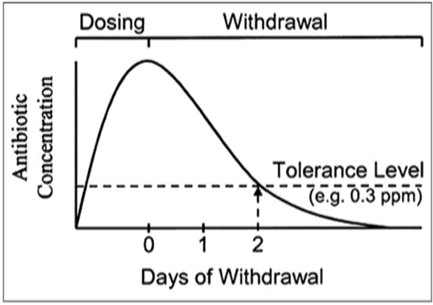
Miscalculation of withholding times can lead to antibiotic residues, with financial implications for the dairy producer and public health implications for consumers. Administration of drug preparations to food producing animals must be accompanied with the veterinarian alerting the owners to the necessity of withholding animals from market or slaughter during or following the treatment period. The Figure 1 illustrates the decline in antibiotic concentration over time after dosing, well below the tolerance threshold during withdrawal period. Withdrawal period of medication is necessary so that volatile or illegal levels of drug residue above tolerance level are avoided in meat, milk, and eggs marketed for human consumption thereby safeguarding humans from unnecessary exposure to antimicrobials 25.

The disease status of an animal can alter the pharmacokinetics of administered drugs, potentially affecting residue levels in animal-derived products. This can occur either when the disease affects the metabolic system (and consequently drug metabolism), or when the presence of infection and inflammation causes the drug to accumulate in affected tissues. For instance, in cattle with acutely inflamed mastitis quarters, apramycin accumulates in these tissues, reaching concentrations up to ten times higher than normal levels recorded from cows without mastitis. Ketoprofen levels in milk increase during clinical mastitis where there is an influx of serum components into the udder 27.
2.2. Major Veterinary Antibiotic Residues in Food of Animal OriginThe beta-lactam antibiotics, including the penicillins, cephalosporins, carbapenems and others, make up the largest share of antibiotics used in most countries 28. Beta-lactam antibiotics are broad spectrum antibiotics interfering with cell wall synthesis, used generally to treat Gram-positive and Gram-negative bacterial infections. Among the beta-lactam antibiotics, penicillins and cephalosporins form the major category used in veterinary medicine and are frequently used for the treatment of animals, globally. The residues of these antibiotics in milk cause problems in dairy industries and human health hazards 29.
Penicillin residues are not inactivated at pasteurization temperature or on drying and may cause allergic reaction manifested by skin rashes in very sensitive individuals at very low concentration in milk as effect of heat on antibiotic residue studied 30. Cross reactivity observed between penicillins and cephalosporins can lead to development of allergic reactions. Approximately 4 % of patients with a history of penicillin allergy experience an anaphylaxis reaction to a cephalosporin and patients with a history of a penicillin related allergic event have increased risk of a reaction when given a sulfonamide or a cephalosporin 31, 32.
Aminoglycosides were the first class of antibiotics identified through the systematic screening of natural product sources for antibacterial activity. Aminoglycosides are usually used synergistically with beta-lactams for the treatment of serious infections due to Gram- positive and Gram-negative bacteria. They act by binding to the A site of the 30 S small ribosomal subunit, inhibiting translation process in protein synthesis 33.
In humans, the nephrotoxicity of aminoglycosides is associated with small portions of the drug being accumulated in the renal cortex and leading to reversible renal impairment. In addition to nephrotoxicity, aminoglycosides can cause irreversible ototoxicity that occurs both in dose-dependent and idiosyncratic manner 34. Certain animal studies have demonstrated that reactive oxygen species may contribute to specific ototoxicity 35.
The tetracyclines are broad spectrum antibiotics active against Mycoplasma, Chlamydophila, and Rickettsia. Tetracyclines exhibit bacteriostatic activity, though the widespread emergence of acquired resistance among bacteria has significantly reduced their efficacy. Fraction of tetracyclines excreted in bile gets reabsorbed through entero-hepatic circulation, and may persist in the body for a long time after administration. The rate of metabolism of tetracyclines in cows has been estimated to 25-75% and a significant percentage of the administrated tetracyclines are excreted in bovine milk. If these antibiotics are improperly administered or if the withdrawal period for treated cows is not observed, the parent drug and its metabolites may persist in milk, posing potential health risks to consumers 36.
Tetracyclines can cross the placenta and enter the fetal circulation and amniotic fluid. In comparison with the maternal circulation, tetracycline concentrations in umbilical cord plasma and amniotic fluid are 60% and 20% respectively. Relatively high concentrations of these drugs also are found in breast milk. Children receiving tetracyclines for long or short duration may develop permanent brown discoloration of the teeth. The larger the amount received relative to body weight, the more intense the enamel discoloration. The exposure of pregnant women to tetracyclines may lead to tooth discoloration in their children 37.
Sulfonamides, among the oldest classes of antimicrobials, have been utilized in food animal production for over six decades. Sulfonamides continue to be used in cattle, swine and poultry; however, their utilization has declined in certain jurisdictions. A recent study conducted across 25 European countries identified sulfonamides as the third most commonly used class of antimicrobials in veterinary medicine, with 11% of the total sales of veterinary antimicrobial drugs across Europe in 2011, following tetracyclines, and penicillins. Resistance to sulfonamides has been reported 38.
Adverse drug reactions to sulfonamides in humans are common, with approximately half of reported cases presenting as skin reactions. These reactions can vary in severity, ranging from mild rashes to severe toxidermia, and toxic epidermal necrolysis 39.
2.3. Public Health Implications of Antibiotic ResiduesThe residues of antibacterial may present pharmacological, toxicological, microbiological and immune-pathological health risks for humans. These hazards can be categorized in to two types as direct-short term hazards and indirect-long term hazards, according to duration of exposure to residues and the time onset of health effects. Direct health hazards arise from the excretion of antibiotics in milk, potentially leading to adverse health effects. Despite their low concentrations in milk, β-lactam antibiotics can trigger immediate hypersensitivity reactions in sensitized individuals upon consumption. Indirect and long-term hazards arise from prolonged exposure to antibiotic residues, leading to potential effects such as carcinogenicity, teratogenicity, and reproductive toxicity. Chronic exposure to these residues in milk may also alter the drug resistance of intestinal microflora 40.
The emergence of antimicrobial resistance resulting from the use of antimicrobials is a significant public health concern globally, in both human and veterinary medicine. According to the Centre for Disease Control and Prevention (CDC), resistant strains of three micro-organisms causing human illness mainly Salmonella spp., Campylobacter spp. and Escherichia coli are linked to the use of antibiotics in animals 41. Resistant microorganism can get access to human, either through direct contact or indirectly via milk, meat, and or egg 42.
Bacteria of animal origin can either integrate into the human endogenous flora or contribute to the existing reservoir of resistance genes. Resistance to most traditional, regulatory-approved, or naturally-occurring food antibiotic agents is difficult to characterize because of the lack of a precise definition for such resistance. Functionally, antimicrobial resistance is characterized by the failure of a specific antibiotic treatment. In a laboratory context, it is defined by a “Minimal Inhibitory Concentration” (MIC) value exceeding a predetermined threshold, which may not necessarily correspond to clinical outcomes. A microorganism is considered resistant if it shows a significantly lower susceptibility as compared to the original isolate or a group of sensitive strains. Resistance can result from mutations in housekeeping structural or regulatory genes, or alternatively, horizontal acquisition of foreign genetic information 43.
Antibiotic resistance gene
The transfer of antimicrobial resistance from animals to humans is of recognized concern. Notably, the indiscriminate use of antibiotics in livestock production has been linked to the emergence and proliferation of antibiotic resistance in human population.
Resistant bacteria
Numerous highly resistant bacterial strains have emerged in recent years. For instance, Methicillin-resistant Staphylococcus aureus (MRSA), resistant to multiple β-lactam antibiotics, was first identified in swine in 2005, with subsequent transmission to humans. Similarly, extended-spectrum β-lactamase (ESBL)-producing bacteria, resistant to penicillins and third- and fourth-generation cephalosporins, have been linked to excessive antibiotic use in poultry farming, with a significant proportion of animals found to carry these resistant strains. Additionally, enterohemorrhagic Escherichia coli (EHEC), a toxin-producing pathogen, has developed multiple antibiotic resistance genes, further complicating treatment strategies 44.
Antibiotic hypersensitivity is defined as an immune-mediated response to antibiotic agent in a sensitized patient and antibiotic allergy is restricted to a reaction mediated by immunoglobulin E(IgE). Exposure of human beings to antibiotic residue in animal products may produce allergic or anaphylactic reactions in susceptible and sensitized individuals (particularly, with sulphonamides and penicillin) 45.
Drug induced allergic reactions may occur acutely (within 60 min), sub acutely (1-24 h) or as latent responses (1 day to several weeks). The acute and some sub-acute disorders are often due to Type I IgE-mediated reactions and, more rarely, due to immunoglobulin G(IgG) antibodies (Type II). Immune complex disorders (Type III) are much rarer. Type IV (cell mediated) responses develop more slowly. The primary disorders associated with antibiotic residues include various hypersensitivity reactions classified into four types. Type I reactions, such as anaphylactic shock, asthma and angioneurotic edema that occur immediately. Type II reactions, including hemolytic anemia and agranulocytosis, involve antibody-mediated cytotoxicity. Type III reactions, such as serum sickness and allergic vasculitis, result from immune complex deposition, while Type IV reactions develop as allergic dermatitis due to delayed hypersensitivity. Approximately, 10% of the human population report hypersensitive to certain substances, like Penicillin. However, the extent of hypersensitivity to these drugs in animals remains unknown 46.
The disruption of normal intestinal microbiota is a significant adverse effect associated with antibiotic residues in human food. The consumption of trace levels of antimicrobial residues in foods from animal origin may have consequences on the indigenous human intestinal micro flora 47. The broad-spectrum antimicrobials may adversely affect a wide range of intestinal flora and consequently cause gastrointestinal disturbance 48. The gut bacteria act as a barrier to- prevent incoming pathogenic bacteria from becoming established and causing disease. Antibiotics can decrease or selectively eliminate the population of beneficial bacteria. The extent of disturbances in the ecological balance between host and microorganisms mainly depends on the spectrum of the antimicrobial agent, the dose, pharmacokinetic and pharmacodynamic properties, along with in-vivo inactivation of the agent 49.
There have been increasing concerns that drugs as well as environmental chemicals may poses potential hazards to the human population by production of gene mutations or chromosome aberrations. Toxic and allergic reactions in humans and animals caused by tetracyclines have been observed at therapeutic doses, though prolonged intake of tetracycline residues present in the broiler meat has detrimental effects on teeth and bones in growing children 50.
Aplastic anemia can occur in susceptible individuals exposed to chloramphenicol (CAM) residues in animals treated with CAM. Due to the toxicity of chloramphenicol, including its association with aplastic anemia and bone marrow suppression, its use in food-producing animals, particularly lactating cows and laying birds, has been banned in many countries after recommendations of the World Health Organization (WHO). Additionally, the potential carcinogenic risk of chloramphenicol residues is linked to their ability to interact with or covalently bind to various intracellular components, including proteins, DNA, RNA, glycogen, phospholipids, and glutathione 51.
The significant presence of antimicrobials in food may influence starter cultures in food industries. The presence of antimicrobial in milk and yoghurt production may inhibit bacterial fermentation process and cause problems for producers and subsequent losses in the food industry and loss of consumer confidence 52.
2.4. Detection of Antibiotic Residues in Food of Animal OriginWith the emerging concern regarding anti-bacterial resistance, allergic reactions and perturbation of normal intestinal microflora, several analytical methods have been developed to determine levels of antibiotic residues in meat products and other food of animal origin. Different methods and assays for the detection of residues of antimicrobials, mostly in cow milk, have been developed and validated, whereas few studies have been carried out till now for detection of residues in sheep and goat milk. The analytical methods for antibiotics detection can be divided into two groups, namely screening and confirmatory 53. Advantages and disadvantages of various analytical techniques for antibiotic residue detection in food are summarized in Table 1.
Screening methods are primarily used to obtain semi-quantitative measurements and viable because of the low possibility of false-positive data, easy operation, quick analysis period, cost effectiveness and good selectivity. The most commonly applied screening techniques for detection of antibiotics include immunoassays, microbiological inhibition assays and reporter gene assays 54.
Immunoassays
This method mainly based upon a binding reaction between a compound and an antibody. The Enzyme-Linked Immunosorbent Assay (ELISA) is the most widely used immunoassay for antibiotic analysis. It is a common serological technique for the detection of antigens and antibodies. ELISA is categorized into two main types: direct ELISA and indirect ELISA. Direct ELISA utilizes monoclonal antibodies to detect a specific antigen, whereas indirect ELISA is employed to identify specific antibodies within a sample, such as serum 55. Recent reviews have demonstrated the use of ELISA for the analysis of β-lactam antibiotics wherein, the sample is incubated with specific antibodies, leading to the formation of an analyte-antibody binding complex. The extent of this binding correlates with the antibiotic concentration in the sample and is subsequently measured to determine the antibiotic content, by adding a fluorescent label 56.
Microbiological inhibition assays
They are primarily based on the reaction between bacteria and the antibiotic present in the sample. The tube test consists of a growth medium inoculated with a bacterium, supplemented with a pH indicator. If no specific antibiotics are present, the bacteria start to grow and produce acid, which will cause a detectable color change. If antibiotics are present that inhibit bacterial growth, no color change will occur. A key advantage of microbiological tests over immunoassays and confirmatory methods is their ability to detect any antibiotic compound exhibiting antibacterial activity. Furthermore, these tests have the potential to cover the broad antibiotic spectrum within a single assay 57.
Reporter gene assays
It consists of a genetically modified bacterium, containing an inducible promoter, responsive to a particular antibiotic, coupled to a reporter gene. Based on the presence or absence of responsive antibiotics, the reporter gene induces a fluorescent signal or the gene affects the transcription to produce or inhibit a signaling process 58.
Samples testing positive are analyzed using various physical and chemical confirmation techniques, such as liquid chromatography, Ultraviolet detection and fluorimetry, or combined with mass spectrometry and high-performance liquid chromatography. Comparative evaluation of advantages and disadvantages of both, screening and confirmatory analytical techniques to detect antibiotic residues have shown in Table 1. These methods are designed to comply with the performance criteria, which are verified during the required validation studies before being used for statutory control, in accordance with Decision 2002/657/EC 59.
High Performance Liquid Chromatography (HPLC)
This technique is used to estimate the quantities of antibiotic residues in food products with good sensitivity and specificity. HPLC has been used in the detection of sulphonamides, tetracyclines and beta-lactams and macrolides in food of animal origin 60.
Liquid Chromatography (LC) - Mass Spectrometry (MS)
It is the most preferred method for detecting antimicrobials that are highly polar, non-volatile and heat-sensitive, that operates through an efficient system in which the mass spectrometry component ionizes molecules and analyzes them based on their mass-to-charge ratio 61.
Confirmatory analysis is often assumed to provide unequivocal identification of a compound, suggesting definitive proof of its presence. However, the accuracy of identification depends on various factors, including the measurement technique, sample preparation and the quantity and nature of product ions. Thus, the possibility of false-positive results cannot be entirely eliminated. It has only recently been recognized that antibiotic use in veterinary medicine, along with the presence of low antibiotic levels in food products and the environment, significantly contributes to the emergence of antibiotic resistance 62.
An illustration includes the analysis of beta-lactams in poultry production. A main bottleneck in beta-lactam analysis is that some penicillin antibiotics are unstable (mainly ampicillin, amoxicillin, penicillin G and penicillin V) and that some cephalosporins, including ceftiofur, are known to rapidly metabolize after intra-muscular administration. Methods need to be developed that include a broad spectrum of beta-lactam antibiotics and that not only detect the administered drug, but are also able to detect metabolites including protein bound residues in order to monitor off-label use 63. The presence of antibiotic residues in developing countries (mainly in African countries) is extremely high as compared to developed countries and this trend is attributed to the lack of legislation and application and improper prescription and use of veterinary antibiotics 10.
2.5. Situation of Antibiotic Residues in EthiopiaIn many African countries, antibiotics are often used indiscriminately for treating bacterial infections or as feed additives for livestock and poultry. The ongoing threat of antibiotic contamination is one of the biggest challenges to public health that is faced the human population globally. These residues spread rapidly, irrespective of geographical, economical, or legal differences between countries 17.
In Ethiopia, regulatory oversight of veterinary drug use by government authorities is limited and the information on rational drug use is inadequate. Misuse of antibiotics is prevalent across various sectors, including veterinary and public health. On top, there is a lack of awareness and preparedness among regulatory authorities and producers about the risks related to the indiscriminate use of antibiotics in livestock production and its potential impact on consumers. Food animals slaughtered for domestic and export purposes are not screened for the presence of residues in any of the slaughterhouses of many countries. The country lacks formal control mechanisms to safeguard consumers from exposure to harmful drug residues in meat and milk products. A total of 384 samples were investigated for tetracycline residues, reported that71.3% had detectable oxytetracycline levels. Moreover, 93.8%, 37.5%, and 82.1% was found positive for oxytetracycline among the meat samples collected from the Addis Ababa, Debre Zeit, and Nazareth slaughterhouses, respectively. The mean levels of oxytetracycline in muscle from the three slaughterhouses were as follows: Addis Ababa, 108.34μg/kg; Nazareth, 64.85μg/kg; and Debre Zeit, 15.916μg/kg. Regarding kidney samples, oxytetracycline levels were found to be 99.02μg/ kg in Addis Ababa, 109.35μg/kg in Nazareth, and 112.53μg/kg in Debre Zeit 64.
Another study conducted reported that oxytetracycline and penicillin G residues were predominantly found in foods of animal origin due imprudent use of antibiotics in dairy farms of Nazareth 65. Based on their report, out of 400 samples 48 (12 %) milk samples were positive for antibiotic residues in bulk milk of cows in Nazareth dairy farms. The mean residue level of oxytetracycline was 125.25µg/l and that of penicillin G was 4.52µg/l. Oxytetracycline and penicillin G in all samples were in the ranges of 45 -192 µg/l and 0-28 µg/l concentrations, respectively. The antibiotic residue positive samples which showed residues of oxytetracycline above the established maximum residue limit of 100µg/l were 40 (83.33%), whereas for penicillin G, the number of samples above the maximum residue limit of 4µg/l, were 8(16.66%).
2.6. Possible Approaches Toward Mitigating Antibiotic ResiduesVaccination has long been a fundamental strategy for preventing infectious diseases, particularly in food-producing animals, due to several advantages, such as cost-effectiveness, ease of administration, high efficacy, broad-spectrum protection against multiple pathogens (such as viruses, bacteria, mycoplasma, and parasites) and a strong safety profile for workers, animals and the environment, with minimal risk of food residue contamination. Adjuvants are sometimes included with vaccines to enhance the immune response. Various delivery systems or routes of administration are used to administer the vaccine into the animal. Veterinarians should ensure that animals are immunized against vaccinable foodborne zoonoses like brucellosis; anthrax etc. The prevention of foodborne zoonoses through animal intervention is more cost effective when compared to prevention in humans 43.
Alternative practices in health management programs, implemented by veterinary and other healthcare professionals, aim to reduce infectious disease outbreaks by employing non-antibiotic interventions early in animals. Currently, seven types of antibiotic alternatives-plant bioactives (essential oils, condensed tannins), phages, vaccines, probiotics, antimicrobial peptides, acidifiers, and oligosaccharides have demonstrated antibacterial, antifungal, antiviral, anti-inflammatory, antiparasitic, antioxidant, and immunomodulatory properties 66. The rationale is to promote healthy animals that do not become ill and are, thus, unlikely to be treated with antibiotic agent. Several current approaches are available. These non-antibiotic approaches have led to a need to establish performance standards for regulatory and commercial purposes 67.
Source-control is the primary measure to eliminate contamination, and reduce antibiotic consumption in livestock production, which can effectively prevent antibiotics from entering soils 68. Efficient diagnosis and treatment of animal disease is other approach that has been reported in the prevention and control of zoonoses. Diseased animals on farms should be identified promptly by veterinarians and treated accordingly to reduce risk of passing such diseases to humans via their products. Moreover, the responsible use of antibiotics is based on guidelines that promote proper, appropriate, prudent and judicious antibiotic use in both veterinary and human medicine. These guidelines are consistent across the medical and agricultural sectors 69.
Appropriate dosage and route of administration of antimicrobials is also one of a critical way in minimizing antibiotic residues in food of animal origin. Clinical efficacy depends not only on the susceptibility of the pathogen to the selected drug but also on the ability of the drug to penetrate and remain active at the site of infection. Prohibition of antibiotics with established toxicity (i.e., chloramphenicol, furazolidone, nitrofurazone, sulfonamides, and fluoroquinolones) and those which are more likely to induce direct or cross-resistance to antibiotics 10. Host related factors like low immunity, pregnancy, age, and allergies should be considered in order to avoid undesirable effects on the health of the animal. It is also very important to consider species, and route of administration. Local treatment should be preferred to systemic treatment when the infection is localized and accessible by topical products. Administration of drugs via intramuscular and intravenous injections are preferable to oral administration to avoid disturbance of the normal gut flora when systemic treatment is necessary 70.
Monitoring and surveillance of antimicrobial residue is widely applied in developed and high-income countries. Government and stake holders are involved in routine monitoring of farms for observance of withdrawal periods and slaughter houses and food industries for drug residues. Under the monitoring program, randomly selected samples from the general animal population are collected based on statistical sampling methods. The surveillance program focuses on obtaining samples from animals suspected to contain volatile drug residues in their tissues 71. It is necessary to confirm the presence and concentration of detected antimicrobial residues, and identify the specific antimicrobial within a class using quantitative testing methods 72.
Extensive use of veterinary antibiotics as growth promoters in animal feed with extra label use results in the threat for development of new resistant strains of bacteria, drug allergy and hypersensitivity reaction, alteration of normal intestinal microflora and other adverse effects including teratogenic, mutagenic and carcinogenic effects. Implementing stringent control strategies, including the development of bio-control measures, alternative approaches, good hygienic practices, and advanced detection techniques, is essential to safeguarding public health and preserving the effectiveness of existing antibiotics for future clinical use. Moreover, these approaches promote animal production systems with reduced occurrence of antibiotic residues in food of animal origin and development of antibiotic resistance in pathogens and other related risks. Due to export and import of live food animals and foods of animal origin between most countries, antibiotic residues affecting the food supply of one country becomes a potential problem for other country. Thus, based on the information mentioned in the review and conclusive remarks, the following recommendations are forwarded:
v Rapid screening methods should be developed for detecting and segregating samples containing above maximum residual levels of antibiotics.
v Antibiotic use in food producing animals should be reduced by improving animal health and their welfare.
v Bio-control measures and ethno-veterinary practices should be developed and implemented to promote sustainable disease management.
v Use of proper processing techniques to inactivate the antibiotic residue, e.g. refrigeration, pasteurization, activated charcoal, and UV irradiation should be implemented.
v Antibiotics should not be used as growth promoters in animals.
v Further research should be conducted regarding antibiotic residue in food of animal origin in Ethiopia so that it may help in designing the mitigating approaches.
We are highly thankful to Prof. Dr. R. K. Narayan for going through the manuscript and for his valuable suggestions. This manuscript is dedicated to all the Scientists who made significant contribution in the field of antibiotic residues.
All the authors contributed during the preparation of the manuscript.
Authors declare that there was no conflict of interest.
No financial support was received from any organization.
| [1] | Currens, G.C., Microbial Natural Product Drug Discovery Through Systematic Sampling of Diverse Texas Soils, University of North Texas Health Science Center at Fort Worth, 2021. | ||
| In article | |||
| [2] | Tesfaye, R.A. and Motuma, R.H., Review on the antimicrobial resistance and its effects on public health, International Journal of Medical Parasitology and Epidemiology Sciences, 5(2), 57-61, 2024. | ||
| In article | View Article | ||
| [3] | Wassenaar, T.M., Use of antimicrobial agents in veterinary medicine and implications for human health, Critical Reviews in Microbiology, 31(3), 155-169, 2005. | ||
| In article | View Article PubMed | ||
| [4] | Hosain, M.Z., Kabir, S.L. and Kamal, M.M., Antimicrobial uses for livestock production in developing countries, Veterinary World, 14(1), 210, 2021. | ||
| In article | View Article PubMed | ||
| [5] | Grande, J.M., Orozco-Valor, P.M., Liébana, M.S., Sarasola, J.H., Birds of prey in agricultural landscapes: The role of agriculture expansion and intensification, Birds of Prey: Biology and Conservation in the XXI Century, 197-228, 2018. | ||
| In article | View Article | ||
| [6] | Liu, J., Yu, F., Call, D.R., Mills, D.A., Zhang, A., Zhao, Z., On-farm soil resistome is modified after treating dairy calves with the antibiotic florfenicol, Science of the Total Environment, 750, 141694, 2021. | ||
| In article | View Article PubMed | ||
| [7] | EFSA Panel on Biological Hazards (BIOHAZ), Koutsoumanis, K., Allende, A., Alvarez‐Ordóñez, A., Bolton, D., Bover‐Cid, S., Chemaly, M., Davies, R., De Cesare, A., Herman, L. and Hilbert, F., Maximum levels of cross‐contamination for 24 antimicrobial active substances in non‐target feed. Part 1: Methodology, general data gaps and uncertainties, EFSA Journal, 19(10), e06852, 2021. | ||
| In article | View Article PubMed | ||
| [8] | Batiha, G.E.S., Hussein, D.E., Algammal, A.M., George, T.T., Jeandet, P., Al-Snafi, A.E., Tiwari, A., Pagnossa, J.P., Lima, C.M., Thorat, N.D., Zahoor, M., Application of natural antimicrobials in food preservation: Recent views, Food Control, 126, 108066, 2021. | ||
| In article | View Article | ||
| [9] | Tesfaye, S., A review on the antimicrobial residues and their health impacts in Ethiopia, International Journal of Microbiological Research, 10(3), 139-147, 2019. | ||
| In article | |||
| [10] | Arsène, M.M.J., Davares, A.K.L., Viktorovna, P.I., Andreevna, S.L., Sarra, S., Khelifi, I.,Sergueïevna, D.M., The public health issue of antibiotic residues in food and feed: Causes, consequences, and potential solutions,Veterinary World, 15(3), 662, 2022. | ||
| In article | View Article PubMed | ||
| [11] | Li, S., Zhang, Q., Chen, M., Zhang, X., Liu, P., Determination of veterinary drug residues in food of animal origin: Sample preparation methods and analytical techniques, Journal of Liquid Chromatography & Related Technologies, 43(17-18), 701-724, 2020. | ||
| In article | View Article | ||
| [12] | Al-Safi, S.M., Al-Bayati, H.B., Al-Dawah, N.K., Mehdy, S.S., Effects of Antibiotic residues in animal products on human health and environments, Kufa Journal for Veterinary Medical Sciences, 11(1), 52-56, 2020. | ||
| In article | View Article | ||
| [13] | Rana, M.S., Lee, S.Y., Kang, H.J., Hur, S.J., Reducing veterinary drug residues in animal products: A review, Food Science of Animal Resources, 39(5), 687, 2019. | ||
| In article | View Article PubMed | ||
| [14] | Treiber, F.M. and Beranek-Knauer, H., Antimicrobial residues in food from animal origin—A review of the literature focusing on products collected in stores and markets worldwide, Antibiotics, 10(5), 534, 2021. | ||
| In article | View Article PubMed | ||
| [15] | Bacanli, M. and Başaran, N., Importance of antibiotic residues in animal food, Food and Chemical Toxicology, 125, 462-466, 2019. | ||
| In article | View Article PubMed | ||
| [16] | Ghimpețeanu, O.M., Pogurschi, E.N., Popa, D.C., Dragomir, N., Drăgotoiu, T., Mihai, O.D., Petcu, C.D., Antibiotic use in livestock and residues in food—A public health threat: A review, Foods, 11(10), 1430, 2022. | ||
| In article | View Article PubMed | ||
| [17] | Hassan, M.M., El Zowalaty, M.E., Lundkvist, Å., Järhult, J.D., Nayem, M.R.K., Tanzin, A.Z., Badsha, M.R., Khan, S.A., Ashour, H.M., Residual antimicrobial agents in food originating from animals, Trends in Food Science & Technology, 111, 141-150, 2021. | ||
| In article | View Article PubMed | ||
| [18] | Waller, D.G., Sampson, A. and Hitchings, A., Medical Pharmacology and Therapeutics E-Book, Elsevier Health Sciences, 2021. | ||
| In article | |||
| [19] | Dahlgren, D. and Lennernäs, H., Intestinal permeability and drug absorption: Predictive experimental, computational and in vivo approaches, Pharmaceutics, 11(8), 411, 2019. | ||
| In article | View Article PubMed | ||
| [20] | Derendorf, H. and Schmidt, S., Rowland and Tozer's Clinical Pharmacokinetics and Pharmacodynamics: Concepts and Applications, 2019. | ||
| In article | |||
| [21] | Lakshmanan, M., Drug metabolism, Introduction to Basics of Pharmacology and Toxicology: Volume 1: General and Molecular Pharmacology: Principles of Drug Action, 99-116, 2019. | ||
| In article | View Article | ||
| [22] | Lalande, L., Charpiat, B., Leboucher, G., Tod, M., Consequences of renal failure on non-renal clearance of drugs, Clinical Pharmacokinetics, 53, 521-532, 2014. | ||
| In article | View Article PubMed | ||
| [23] | U.S. Food and Drug Administration, Animal Medicinal Drug Use Clarification Act (AMDUCA) of 1994, Available at: [Accessed 20 March 2025]. | ||
| In article | |||
| [24] | Baptiste, K.E. and Pokludová, L., Mass Medications: Prophylaxis and Metaphylaxis, Cascade and Off-label Use, Treatment Guidelines and Antimicrobial Stewardship, Antimicrobials in Livestock 1: Regulation, Science, Practice: A European Perspective, 167-193, 2020. | ||
| In article | View Article | ||
| [25] | Russ, K., The public health implications of antibiotic use in dairy cattle and management strategies to ensure their judicious use, 2011. | ||
| In article | |||
| [26] | Naves Aroeira, C., Feddern, V., Gressler, V., Contreras-Castillo, C.J., Hopkins, D.L., Growth promoters in cattle and pigs: A review of legislation and implications for human health, Food Reviews International, 39(5), 2507-2529, 2023. | ||
| In article | View Article | ||
| [27] | Greene, J.M. and Martinez, M.N., Using simulations to explore the potential effect of disease and inflammation on the frequency of violative flunixin residues in cattle, Journal of Veterinary Pharmacology and Therapeutics, 2023. | ||
| In article | View Article PubMed | ||
| [28] | Nag, P., Sadani, K., Mohapatra, S., Mukherji, S., Mukherji, S., Evanescent wave optical fiber sensors using enzymatic hydrolysis on nanostructured polyaniline for detection of β-lactam antibiotics in food and environment, Analytical Chemistry, 93(4), 2299-2308, 2021. | ||
| In article | View Article PubMed | ||
| [29] | Narendrakumar, L., Chakraborty, M., Kumari, S., Paul, D., Das, B., β-Lactam potentiators to re-sensitize resistant pathogens: Discovery, development, clinical use and the way forward, Frontiers in Microbiology, 13, 1092556, 2023. | ||
| In article | View Article PubMed | ||
| [30] | Aytenfsu, S., Mamo, G., Kebede, B., Review on chemical residues in milk and their public health concern in Ethiopia, Journal of Nutrition & Food Science, 6(4), 1-1, 2016. | ||
| In article | View Article | ||
| [31] | Chaudhry, S.B., Veve, M.P., Wagner, J.L., Cephalosporins: a focus on side chains and β-lactam cross-reactivity, Pharmacy, 7(3), 103, 2019. | ||
| In article | View Article PubMed | ||
| [32] | Macy, E., Why was there ever a warning not to use cephalosporins in the setting of a penicillin 'allergy'? The Journal of Allergy and Clinical Immunology: In Practice, 9(11), 3929-3933, 2021. | ||
| In article | View Article PubMed | ||
| [33] | Rahman, M. and Sarker, S.D., Antimicrobial natural products,Annual Reports in Medicinal Chemistry, 55, 77-113, 2020. | ||
| In article | View Article PubMed | ||
| [34] | Ponticelli, C. and Glassock, R.J., Prevention of complications from use of conventional immunosuppressants: a critical review, Journal of Nephrology, 32, 851-870, 2019. | ||
| In article | View Article PubMed | ||
| [35] | Klocke, C. and Lein, P.J., Evidence implicating non-dioxin-like congeners as the key mediators of polychlorinated biphenyl (PCB) developmental neurotoxicity, International Journal of Molecular Sciences, 21(3), 1013, 2020. | ||
| In article | View Article PubMed | ||
| [36] | Baran, A., Kwiatkowska, A., Potocki, L., Antibiotics and bacterial resistance—A short story of an endless arms race, International Journal of Molecular Sciences, 24(6), 5777, 2023. | ||
| In article | View Article PubMed | ||
| [37] | Ansari, J., Carvalho, B., Shafer, S.L., Flood, P., Pharmacokinetics and pharmacodynamics of drugs commonly used in pregnancy and parturition, Anesthesia and Analgesia, 122(3), 786-804, 2016. | ||
| In article | View Article PubMed | ||
| [38] | Zheng, Y., Fan, L., Dong, Y., Li, D., Zhao, L., Yuan, X., Wang, L., Zhao, S., Determination of sulfonamide residues in livestock and poultry manure using carbon nanotube extraction combined with UPLC-MS/MS, Food Analytical Methods, 14, 641-652, 2021. | ||
| In article | View Article | ||
| [39] | Alagawany, M. and Abd El-Hack, M.E., Natural Feed Additives Used in the Poultry Industry, Bentham Science Publishers, 2020. | ||
| In article | View Article | ||
| [40] | Bhoomika, P.T., Kadwalia, A., Jaiswal, S., Rani, B., Patel, P.K., Antibiotic residues in animal products and its effect on human health, The Pharma Innovation Journal, 8(4), 03-06, 2019. | ||
| In article | |||
| [41] | Serrano, P., Responsible use of antibiotics in aquaculture, FAO Fisheries Technical Paper, 469, 12-97, 2005. | ||
| In article | |||
| [42] | Ahmad, I., Malak, H.A., Abulreesh, H.H., Environmental antimicrobial resistance and its drivers: a potential threat to public health, Journal of Global Antimicrobial Resistance, 27, 101-111, 2021. | ||
| In article | View Article PubMed | ||
| [43] | Addis, M., A review on antibiotic resistance and its implication on the food chain, Journal of Food Science, 42, 9-11, 2015. | ||
| In article | |||
| [44] | Sharma, B., Srivastava, M.K., Gosvami, M., Jain, U., Superbugs: The Nightmare Bacteria, 11(5), 765-773, 2021. | ||
| In article | View Article | ||
| [45] | Huang, V., Clayton, N.A. and Welker, K.H., Glycopeptide hypersensitivity and adverse reactions, Pharmacy, 8(2), 70, 2020. | ||
| In article | View Article PubMed | ||
| [46] | Mia, S., Antimicrobial residue in food and its public health hazard: A review, 2020. | ||
| In article | |||
| [47] | Falowo, A.B. and Akimoladun, O.F., Veterinary drug residues in meat and meat products: Occurrence, detection, and implications, Veterinary Medicine and Pharmaceuticals, 3, 194, 2019. | ||
| In article | |||
| [48] | Landers, T.F., Cohen, B., Wittum, T.E.,Larson, E.L., A review of antibiotic use in food animals: Perspective, policy, and potential, Public Health Reports, 127(1), 4-22, 2012. | ||
| In article | View Article PubMed | ||
| [49] | Kyuchukova, R., Antibiotic residues and human health hazard-A Review, Bulgarian Journal of Agricultural Science, 26(3), 664-668, 2020. | ||
| In article | |||
| [50] | Jayalakshmi, K., Paramasivam, M., Sasikala, M., Tamilam, T.V., Sumithra, A., Review on antibiotic residues in animal products and its impact on environments and human health, Journal of Entomology and Zoology Studies, 5(3), 1446-1451, 2017. | ||
| In article | |||
| [51] | Fangama, M.I.M., Prevalence of antibiotics residues in meat and application of (HACCP) in Khartoum State, Doctoral dissertation, Sudan University of Science and Technology, 2019. | ||
| In article | |||
| [52] | Beyene, T. and Tesega, B., Rational veterinary drug use: Its significance in public health, Journal of Veterinary Medicine and Animal Health, 6(12), 302-308, 2014. | ||
| In article | |||
| [53] | Rahman, M.S., Hassan, M.M.,Chowdhury, S., Determination of antibiotic residues in milk and assessment of human health risk in Bangladesh, Heliyon, 7(8), e07739, 2021. | ||
| In article | View Article PubMed | ||
| [54] | Tsagkaris, A.S., Pulkrabova, J.,Hajslova, J., Optical screening methods for pesticide residue detection in food matrices: Advances and emerging analytical trends, Foods, 10(1), 88, 2021. | ||
| In article | View Article PubMed | ||
| [55] | Wang, Z., Mi, T., Beier, R.C., Zhang, H., Sheng, Y., Shi, W., Zhang, S.,Shen, J., Hapten synthesis, monoclonal antibody production and development of a competitive indirect enzyme-linked immunosorbent assay for erythromycin in milk, Food Chemistry, 171, 98-107, 2015. | ||
| In article | View Article PubMed | ||
| [56] | Tarannum, N., Khatoon, S., Dzantiev, B.B., Perspective and application of molecular imprinting approach for antibiotic detection in food and environmental samples: A critical review, Food Control, 118, 107381, 2020. | ||
| In article | View Article | ||
| [57] | Ibrahim, I.G., Khalafalla, A.E., Yarsan, E., Altintas, L., Tumer, I., Methods for screening veterinary drug residues in animal products: A review, Sudan Journal of Veterinary Research, 31, 1-9, 2016. | ||
| In article | |||
| [58] | Hao, N. and O'Shea, E.K., Signal-dependent dynamics of transcription factor translocation controls gene expression, Nature Structural & Molecular Biology, 19(1), 31-39, 2012. | ||
| In article | View Article PubMed | ||
| [59] | O’Mahony, J., Clarke, L., Whelan, M., O’Kennedy, R., Lehotay, S.J.,Danaher, M., The use of ultra-high pressure liquid chromatography with tandem mass spectrometric detection in the analysis of agrochemical residues and mycotoxins in food—challenges and applications, Journal of Chromatography A, 1292, 83-95, 2013. | ||
| In article | View Article PubMed | ||
| [60] | Magalhães, D., Freitas, A., Pouca, A.S.V., Barbosa, J. and Ramos, F., The use of ultra-high-pressure-liquid-chromatography tandem time-of-flight mass spectrometry as a confirmatory method in drug residue analysis: Application to the determination of antibiotics in piglet liver, Journal of Chromatography B, 1153, 122264, 2020. | ||
| In article | View Article PubMed | ||
| [61] | Brown, Z.Z., Mapelli, C., Farasat, I., Shoultz, A.V., Johnson, S.A., Orvieto, F., Santoprete, A., Bianchi, E., McCracken, A.B., Chen, K., Zhu, X., Multiple synthetic routes to the mini-protein omomyc and coiled-coil domain truncations, The Journal of Organic Chemistry, 85(3), 1466-1475, 2019. | ||
| In article | View Article PubMed | ||
| [62] | Kumar, N., Sharma, G., Leahy, E., Shome, B.R., Bandyopadhyay, S., Deka, R.P., Shome, R., Dey, T.K., Lindahl, J.F., Understanding antibiotic usage on small-scale dairy farms in the Indian states of Assam and Haryana using a mixed-methods approach—Outcomes and challenges, Antibiotics, 10(9), 1124, 2021. | ||
| In article | View Article PubMed | ||
| [63] | Pokludová, L., Molecular biology perspective of susceptibility and resistance in main target pathogens in the respective species and antimicrobials of concern, Antimicrobials in Livestock 1: Regulation, Science, Practice: A European Perspective, 2020. | ||
| In article | View Article | ||
| [64] | Dugassa, J. and Shukuri, N., Review on antibiotic resistance and its mechanism of development, Journal of Health, Medicine and Nursing, 1(3), 1-17, 2017. | ||
| In article | |||
| [65] | Abebew, D., Belihu, K., Zewde, G., Detection and determination of oxytetracycline and penicillin G antibiotic residue levels in bovine bulk milk from Nazareth dairy farms, Ethiopia, Ethiopian Veterinary Journal, 18(1), 1-15, 2014. | ||
| In article | |||
| [66] | Tian, M., He, X.M., Feng, Y.Z., Wang, W.T., Chen, H.S., Gong, M., Liu, D., Clarke, J.L., Eerde, A., Pollution by antibiotics and antimicrobial resistance in livestock and poultry manure in China, and countermeasures, Antibiotics, 10, 539, 2021. | ||
| In article | View Article PubMed | ||
| [67] | Helliwell, R., Morris, C., Raman, S., Antibiotic stewardship and its implications for agricultural animal-human relationships: Insights from an intensive dairy farm in England, Journal of Rural Studies, 78, 447-456, 2020. | ||
| In article | View Article | ||
| [68] | Fang, L., Chen, C., Li, S., Ye, P., Shi, Y., Sharma, G., Chen, X., A comprehensive and global evaluation of residual antibiotics in agricultural soils: Accumulation, potential ecological risks, and attenuation strategies, Ecotoxicology and Environmental Safety, 262, 115175, 2023. | ||
| In article | View Article PubMed | ||
| [69] | Beyene, T., Veterinary drug residues in food-animal products: Its risk factors and potential effects on public health, Journal of Veterinary Science & Technology, 7(1), 1-7, 2016. | ||
| In article | |||
| [70] | Qadri, K., Ganguly, S., Praveen, P.K., Antibiotic resistance in animals against various diseases: A review of importance in veterinary microbiology and clinical veterinary medicine, International Journal of Bioassays, 4, 4296-4298, 2015. | ||
| In article | |||
| [71] | Garza, M., Mohan, C.V., Brunton, L., Wieland, B., Häsler, B., Typology of interventions for antimicrobial use and antimicrobial resistance in aquaculture systems in low-and middle-income countries, International Journal of Antimicrobial Agents, 59(1), 106495, 2022. | ||
| In article | View Article PubMed | ||
| [72] | Ronquillo, M.G. and Hernandez, J.C.A., Antibiotic and synthetic growth promoters in animal diets: Review of impact and analytical methods, Food Control, 72, 255-267, 2017. | ||
| In article | View Article | ||
Published with license by Science and Education Publishing, Copyright © 2025 Mahendra Pal, Ravindra Zende, Alemayehu Bekele, Tesfaye Rebuma, Tamasgen Ragasa, Aishwarya Nair and Pallavi Kanthe
 This work is licensed under a Creative Commons Attribution 4.0 International License. To view a copy of this license, visit
http://creativecommons.org/licenses/by/4.0/
This work is licensed under a Creative Commons Attribution 4.0 International License. To view a copy of this license, visit
http://creativecommons.org/licenses/by/4.0/
| [1] | Currens, G.C., Microbial Natural Product Drug Discovery Through Systematic Sampling of Diverse Texas Soils, University of North Texas Health Science Center at Fort Worth, 2021. | ||
| In article | |||
| [2] | Tesfaye, R.A. and Motuma, R.H., Review on the antimicrobial resistance and its effects on public health, International Journal of Medical Parasitology and Epidemiology Sciences, 5(2), 57-61, 2024. | ||
| In article | View Article | ||
| [3] | Wassenaar, T.M., Use of antimicrobial agents in veterinary medicine and implications for human health, Critical Reviews in Microbiology, 31(3), 155-169, 2005. | ||
| In article | View Article PubMed | ||
| [4] | Hosain, M.Z., Kabir, S.L. and Kamal, M.M., Antimicrobial uses for livestock production in developing countries, Veterinary World, 14(1), 210, 2021. | ||
| In article | View Article PubMed | ||
| [5] | Grande, J.M., Orozco-Valor, P.M., Liébana, M.S., Sarasola, J.H., Birds of prey in agricultural landscapes: The role of agriculture expansion and intensification, Birds of Prey: Biology and Conservation in the XXI Century, 197-228, 2018. | ||
| In article | View Article | ||
| [6] | Liu, J., Yu, F., Call, D.R., Mills, D.A., Zhang, A., Zhao, Z., On-farm soil resistome is modified after treating dairy calves with the antibiotic florfenicol, Science of the Total Environment, 750, 141694, 2021. | ||
| In article | View Article PubMed | ||
| [7] | EFSA Panel on Biological Hazards (BIOHAZ), Koutsoumanis, K., Allende, A., Alvarez‐Ordóñez, A., Bolton, D., Bover‐Cid, S., Chemaly, M., Davies, R., De Cesare, A., Herman, L. and Hilbert, F., Maximum levels of cross‐contamination for 24 antimicrobial active substances in non‐target feed. Part 1: Methodology, general data gaps and uncertainties, EFSA Journal, 19(10), e06852, 2021. | ||
| In article | View Article PubMed | ||
| [8] | Batiha, G.E.S., Hussein, D.E., Algammal, A.M., George, T.T., Jeandet, P., Al-Snafi, A.E., Tiwari, A., Pagnossa, J.P., Lima, C.M., Thorat, N.D., Zahoor, M., Application of natural antimicrobials in food preservation: Recent views, Food Control, 126, 108066, 2021. | ||
| In article | View Article | ||
| [9] | Tesfaye, S., A review on the antimicrobial residues and their health impacts in Ethiopia, International Journal of Microbiological Research, 10(3), 139-147, 2019. | ||
| In article | |||
| [10] | Arsène, M.M.J., Davares, A.K.L., Viktorovna, P.I., Andreevna, S.L., Sarra, S., Khelifi, I.,Sergueïevna, D.M., The public health issue of antibiotic residues in food and feed: Causes, consequences, and potential solutions,Veterinary World, 15(3), 662, 2022. | ||
| In article | View Article PubMed | ||
| [11] | Li, S., Zhang, Q., Chen, M., Zhang, X., Liu, P., Determination of veterinary drug residues in food of animal origin: Sample preparation methods and analytical techniques, Journal of Liquid Chromatography & Related Technologies, 43(17-18), 701-724, 2020. | ||
| In article | View Article | ||
| [12] | Al-Safi, S.M., Al-Bayati, H.B., Al-Dawah, N.K., Mehdy, S.S., Effects of Antibiotic residues in animal products on human health and environments, Kufa Journal for Veterinary Medical Sciences, 11(1), 52-56, 2020. | ||
| In article | View Article | ||
| [13] | Rana, M.S., Lee, S.Y., Kang, H.J., Hur, S.J., Reducing veterinary drug residues in animal products: A review, Food Science of Animal Resources, 39(5), 687, 2019. | ||
| In article | View Article PubMed | ||
| [14] | Treiber, F.M. and Beranek-Knauer, H., Antimicrobial residues in food from animal origin—A review of the literature focusing on products collected in stores and markets worldwide, Antibiotics, 10(5), 534, 2021. | ||
| In article | View Article PubMed | ||
| [15] | Bacanli, M. and Başaran, N., Importance of antibiotic residues in animal food, Food and Chemical Toxicology, 125, 462-466, 2019. | ||
| In article | View Article PubMed | ||
| [16] | Ghimpețeanu, O.M., Pogurschi, E.N., Popa, D.C., Dragomir, N., Drăgotoiu, T., Mihai, O.D., Petcu, C.D., Antibiotic use in livestock and residues in food—A public health threat: A review, Foods, 11(10), 1430, 2022. | ||
| In article | View Article PubMed | ||
| [17] | Hassan, M.M., El Zowalaty, M.E., Lundkvist, Å., Järhult, J.D., Nayem, M.R.K., Tanzin, A.Z., Badsha, M.R., Khan, S.A., Ashour, H.M., Residual antimicrobial agents in food originating from animals, Trends in Food Science & Technology, 111, 141-150, 2021. | ||
| In article | View Article PubMed | ||
| [18] | Waller, D.G., Sampson, A. and Hitchings, A., Medical Pharmacology and Therapeutics E-Book, Elsevier Health Sciences, 2021. | ||
| In article | |||
| [19] | Dahlgren, D. and Lennernäs, H., Intestinal permeability and drug absorption: Predictive experimental, computational and in vivo approaches, Pharmaceutics, 11(8), 411, 2019. | ||
| In article | View Article PubMed | ||
| [20] | Derendorf, H. and Schmidt, S., Rowland and Tozer's Clinical Pharmacokinetics and Pharmacodynamics: Concepts and Applications, 2019. | ||
| In article | |||
| [21] | Lakshmanan, M., Drug metabolism, Introduction to Basics of Pharmacology and Toxicology: Volume 1: General and Molecular Pharmacology: Principles of Drug Action, 99-116, 2019. | ||
| In article | View Article | ||
| [22] | Lalande, L., Charpiat, B., Leboucher, G., Tod, M., Consequences of renal failure on non-renal clearance of drugs, Clinical Pharmacokinetics, 53, 521-532, 2014. | ||
| In article | View Article PubMed | ||
| [23] | U.S. Food and Drug Administration, Animal Medicinal Drug Use Clarification Act (AMDUCA) of 1994, Available at: [Accessed 20 March 2025]. | ||
| In article | |||
| [24] | Baptiste, K.E. and Pokludová, L., Mass Medications: Prophylaxis and Metaphylaxis, Cascade and Off-label Use, Treatment Guidelines and Antimicrobial Stewardship, Antimicrobials in Livestock 1: Regulation, Science, Practice: A European Perspective, 167-193, 2020. | ||
| In article | View Article | ||
| [25] | Russ, K., The public health implications of antibiotic use in dairy cattle and management strategies to ensure their judicious use, 2011. | ||
| In article | |||
| [26] | Naves Aroeira, C., Feddern, V., Gressler, V., Contreras-Castillo, C.J., Hopkins, D.L., Growth promoters in cattle and pigs: A review of legislation and implications for human health, Food Reviews International, 39(5), 2507-2529, 2023. | ||
| In article | View Article | ||
| [27] | Greene, J.M. and Martinez, M.N., Using simulations to explore the potential effect of disease and inflammation on the frequency of violative flunixin residues in cattle, Journal of Veterinary Pharmacology and Therapeutics, 2023. | ||
| In article | View Article PubMed | ||
| [28] | Nag, P., Sadani, K., Mohapatra, S., Mukherji, S., Mukherji, S., Evanescent wave optical fiber sensors using enzymatic hydrolysis on nanostructured polyaniline for detection of β-lactam antibiotics in food and environment, Analytical Chemistry, 93(4), 2299-2308, 2021. | ||
| In article | View Article PubMed | ||
| [29] | Narendrakumar, L., Chakraborty, M., Kumari, S., Paul, D., Das, B., β-Lactam potentiators to re-sensitize resistant pathogens: Discovery, development, clinical use and the way forward, Frontiers in Microbiology, 13, 1092556, 2023. | ||
| In article | View Article PubMed | ||
| [30] | Aytenfsu, S., Mamo, G., Kebede, B., Review on chemical residues in milk and their public health concern in Ethiopia, Journal of Nutrition & Food Science, 6(4), 1-1, 2016. | ||
| In article | View Article | ||
| [31] | Chaudhry, S.B., Veve, M.P., Wagner, J.L., Cephalosporins: a focus on side chains and β-lactam cross-reactivity, Pharmacy, 7(3), 103, 2019. | ||
| In article | View Article PubMed | ||
| [32] | Macy, E., Why was there ever a warning not to use cephalosporins in the setting of a penicillin 'allergy'? The Journal of Allergy and Clinical Immunology: In Practice, 9(11), 3929-3933, 2021. | ||
| In article | View Article PubMed | ||
| [33] | Rahman, M. and Sarker, S.D., Antimicrobial natural products,Annual Reports in Medicinal Chemistry, 55, 77-113, 2020. | ||
| In article | View Article PubMed | ||
| [34] | Ponticelli, C. and Glassock, R.J., Prevention of complications from use of conventional immunosuppressants: a critical review, Journal of Nephrology, 32, 851-870, 2019. | ||
| In article | View Article PubMed | ||
| [35] | Klocke, C. and Lein, P.J., Evidence implicating non-dioxin-like congeners as the key mediators of polychlorinated biphenyl (PCB) developmental neurotoxicity, International Journal of Molecular Sciences, 21(3), 1013, 2020. | ||
| In article | View Article PubMed | ||
| [36] | Baran, A., Kwiatkowska, A., Potocki, L., Antibiotics and bacterial resistance—A short story of an endless arms race, International Journal of Molecular Sciences, 24(6), 5777, 2023. | ||
| In article | View Article PubMed | ||
| [37] | Ansari, J., Carvalho, B., Shafer, S.L., Flood, P., Pharmacokinetics and pharmacodynamics of drugs commonly used in pregnancy and parturition, Anesthesia and Analgesia, 122(3), 786-804, 2016. | ||
| In article | View Article PubMed | ||
| [38] | Zheng, Y., Fan, L., Dong, Y., Li, D., Zhao, L., Yuan, X., Wang, L., Zhao, S., Determination of sulfonamide residues in livestock and poultry manure using carbon nanotube extraction combined with UPLC-MS/MS, Food Analytical Methods, 14, 641-652, 2021. | ||
| In article | View Article | ||
| [39] | Alagawany, M. and Abd El-Hack, M.E., Natural Feed Additives Used in the Poultry Industry, Bentham Science Publishers, 2020. | ||
| In article | View Article | ||
| [40] | Bhoomika, P.T., Kadwalia, A., Jaiswal, S., Rani, B., Patel, P.K., Antibiotic residues in animal products and its effect on human health, The Pharma Innovation Journal, 8(4), 03-06, 2019. | ||
| In article | |||
| [41] | Serrano, P., Responsible use of antibiotics in aquaculture, FAO Fisheries Technical Paper, 469, 12-97, 2005. | ||
| In article | |||
| [42] | Ahmad, I., Malak, H.A., Abulreesh, H.H., Environmental antimicrobial resistance and its drivers: a potential threat to public health, Journal of Global Antimicrobial Resistance, 27, 101-111, 2021. | ||
| In article | View Article PubMed | ||
| [43] | Addis, M., A review on antibiotic resistance and its implication on the food chain, Journal of Food Science, 42, 9-11, 2015. | ||
| In article | |||
| [44] | Sharma, B., Srivastava, M.K., Gosvami, M., Jain, U., Superbugs: The Nightmare Bacteria, 11(5), 765-773, 2021. | ||
| In article | View Article | ||
| [45] | Huang, V., Clayton, N.A. and Welker, K.H., Glycopeptide hypersensitivity and adverse reactions, Pharmacy, 8(2), 70, 2020. | ||
| In article | View Article PubMed | ||
| [46] | Mia, S., Antimicrobial residue in food and its public health hazard: A review, 2020. | ||
| In article | |||
| [47] | Falowo, A.B. and Akimoladun, O.F., Veterinary drug residues in meat and meat products: Occurrence, detection, and implications, Veterinary Medicine and Pharmaceuticals, 3, 194, 2019. | ||
| In article | |||
| [48] | Landers, T.F., Cohen, B., Wittum, T.E.,Larson, E.L., A review of antibiotic use in food animals: Perspective, policy, and potential, Public Health Reports, 127(1), 4-22, 2012. | ||
| In article | View Article PubMed | ||
| [49] | Kyuchukova, R., Antibiotic residues and human health hazard-A Review, Bulgarian Journal of Agricultural Science, 26(3), 664-668, 2020. | ||
| In article | |||
| [50] | Jayalakshmi, K., Paramasivam, M., Sasikala, M., Tamilam, T.V., Sumithra, A., Review on antibiotic residues in animal products and its impact on environments and human health, Journal of Entomology and Zoology Studies, 5(3), 1446-1451, 2017. | ||
| In article | |||
| [51] | Fangama, M.I.M., Prevalence of antibiotics residues in meat and application of (HACCP) in Khartoum State, Doctoral dissertation, Sudan University of Science and Technology, 2019. | ||
| In article | |||
| [52] | Beyene, T. and Tesega, B., Rational veterinary drug use: Its significance in public health, Journal of Veterinary Medicine and Animal Health, 6(12), 302-308, 2014. | ||
| In article | |||
| [53] | Rahman, M.S., Hassan, M.M.,Chowdhury, S., Determination of antibiotic residues in milk and assessment of human health risk in Bangladesh, Heliyon, 7(8), e07739, 2021. | ||
| In article | View Article PubMed | ||
| [54] | Tsagkaris, A.S., Pulkrabova, J.,Hajslova, J., Optical screening methods for pesticide residue detection in food matrices: Advances and emerging analytical trends, Foods, 10(1), 88, 2021. | ||
| In article | View Article PubMed | ||
| [55] | Wang, Z., Mi, T., Beier, R.C., Zhang, H., Sheng, Y., Shi, W., Zhang, S.,Shen, J., Hapten synthesis, monoclonal antibody production and development of a competitive indirect enzyme-linked immunosorbent assay for erythromycin in milk, Food Chemistry, 171, 98-107, 2015. | ||
| In article | View Article PubMed | ||
| [56] | Tarannum, N., Khatoon, S., Dzantiev, B.B., Perspective and application of molecular imprinting approach for antibiotic detection in food and environmental samples: A critical review, Food Control, 118, 107381, 2020. | ||
| In article | View Article | ||
| [57] | Ibrahim, I.G., Khalafalla, A.E., Yarsan, E., Altintas, L., Tumer, I., Methods for screening veterinary drug residues in animal products: A review, Sudan Journal of Veterinary Research, 31, 1-9, 2016. | ||
| In article | |||
| [58] | Hao, N. and O'Shea, E.K., Signal-dependent dynamics of transcription factor translocation controls gene expression, Nature Structural & Molecular Biology, 19(1), 31-39, 2012. | ||
| In article | View Article PubMed | ||
| [59] | O’Mahony, J., Clarke, L., Whelan, M., O’Kennedy, R., Lehotay, S.J.,Danaher, M., The use of ultra-high pressure liquid chromatography with tandem mass spectrometric detection in the analysis of agrochemical residues and mycotoxins in food—challenges and applications, Journal of Chromatography A, 1292, 83-95, 2013. | ||
| In article | View Article PubMed | ||
| [60] | Magalhães, D., Freitas, A., Pouca, A.S.V., Barbosa, J. and Ramos, F., The use of ultra-high-pressure-liquid-chromatography tandem time-of-flight mass spectrometry as a confirmatory method in drug residue analysis: Application to the determination of antibiotics in piglet liver, Journal of Chromatography B, 1153, 122264, 2020. | ||
| In article | View Article PubMed | ||
| [61] | Brown, Z.Z., Mapelli, C., Farasat, I., Shoultz, A.V., Johnson, S.A., Orvieto, F., Santoprete, A., Bianchi, E., McCracken, A.B., Chen, K., Zhu, X., Multiple synthetic routes to the mini-protein omomyc and coiled-coil domain truncations, The Journal of Organic Chemistry, 85(3), 1466-1475, 2019. | ||
| In article | View Article PubMed | ||
| [62] | Kumar, N., Sharma, G., Leahy, E., Shome, B.R., Bandyopadhyay, S., Deka, R.P., Shome, R., Dey, T.K., Lindahl, J.F., Understanding antibiotic usage on small-scale dairy farms in the Indian states of Assam and Haryana using a mixed-methods approach—Outcomes and challenges, Antibiotics, 10(9), 1124, 2021. | ||
| In article | View Article PubMed | ||
| [63] | Pokludová, L., Molecular biology perspective of susceptibility and resistance in main target pathogens in the respective species and antimicrobials of concern, Antimicrobials in Livestock 1: Regulation, Science, Practice: A European Perspective, 2020. | ||
| In article | View Article | ||
| [64] | Dugassa, J. and Shukuri, N., Review on antibiotic resistance and its mechanism of development, Journal of Health, Medicine and Nursing, 1(3), 1-17, 2017. | ||
| In article | |||
| [65] | Abebew, D., Belihu, K., Zewde, G., Detection and determination of oxytetracycline and penicillin G antibiotic residue levels in bovine bulk milk from Nazareth dairy farms, Ethiopia, Ethiopian Veterinary Journal, 18(1), 1-15, 2014. | ||
| In article | |||
| [66] | Tian, M., He, X.M., Feng, Y.Z., Wang, W.T., Chen, H.S., Gong, M., Liu, D., Clarke, J.L., Eerde, A., Pollution by antibiotics and antimicrobial resistance in livestock and poultry manure in China, and countermeasures, Antibiotics, 10, 539, 2021. | ||
| In article | View Article PubMed | ||
| [67] | Helliwell, R., Morris, C., Raman, S., Antibiotic stewardship and its implications for agricultural animal-human relationships: Insights from an intensive dairy farm in England, Journal of Rural Studies, 78, 447-456, 2020. | ||
| In article | View Article | ||
| [68] | Fang, L., Chen, C., Li, S., Ye, P., Shi, Y., Sharma, G., Chen, X., A comprehensive and global evaluation of residual antibiotics in agricultural soils: Accumulation, potential ecological risks, and attenuation strategies, Ecotoxicology and Environmental Safety, 262, 115175, 2023. | ||
| In article | View Article PubMed | ||
| [69] | Beyene, T., Veterinary drug residues in food-animal products: Its risk factors and potential effects on public health, Journal of Veterinary Science & Technology, 7(1), 1-7, 2016. | ||
| In article | |||
| [70] | Qadri, K., Ganguly, S., Praveen, P.K., Antibiotic resistance in animals against various diseases: A review of importance in veterinary microbiology and clinical veterinary medicine, International Journal of Bioassays, 4, 4296-4298, 2015. | ||
| In article | |||
| [71] | Garza, M., Mohan, C.V., Brunton, L., Wieland, B., Häsler, B., Typology of interventions for antimicrobial use and antimicrobial resistance in aquaculture systems in low-and middle-income countries, International Journal of Antimicrobial Agents, 59(1), 106495, 2022. | ||
| In article | View Article PubMed | ||
| [72] | Ronquillo, M.G. and Hernandez, J.C.A., Antibiotic and synthetic growth promoters in animal diets: Review of impact and analytical methods, Food Control, 72, 255-267, 2017. | ||
| In article | View Article | ||