The progress of technology in the world is persistently increasing the volume of waste electrical and electronic equipment (WEEE). In Togo, the national production of WEEE is growing rapidly, 6,400 tons in 2016 and 7,500 in 2019. In order to have local data on WEEE, this study has been carried out to know their composition and volume in the District Autonome du Grand Lomé (DAGL) and the city of Kara. To master the composition of WEEE, the study dealt with households, public and private services, WEEE traders, repairers and then collectors. Considering the volume, the study took into consideration households, public and private services and then EEE traders. To achieve our goal, the holder survey method has been adopted. Survey forms were designed following the slightly modified Directive 2012/19/EU. The Kobocollect application facilitated data collection. These data were processed by the IBM-SPSS Statistics 25 application. The production ratios and the volume of WEEE were determined. The results obtained show that the WEEE produced are part of those of the 10 categories of Directive 2012/19/EU. The production ratios in the DAGL and the city of Kara are respectively 0.39 and 11.38 kg/inhabitant in households, 0.026 and 15.43 kg/service then 1.38 and 152.6 kg/EEE trader. Among the respondents in 2023, 1.8 tons of WEEE were generated in the DAGL and 18.7 tons in Kara. Extrapolation of the results shows that at the household level, 853 tons of WEEE were generated in the DAGL and 1834 tons in Kara. This study made it possible to know the composition of WEEE and their volume in the DAGL and the city of Kara. These results could be a decision-making tool for local authorities for better WEEE management.
According to the European Union Directive 2002/96/EC, 2003 on Waste Electrical and Electronic Equipment (WEEE), electrical and electronic equipment (EEE) is any equipment originating from electric power or electromagnetic fields, and the production equipment, transfer and measurement of these powers and fields, and designed to be used at a voltage not exceeding 1,000 volts in alternating power and 1,500 volts in direct power. According to the same directive, WEEE is defined as electrical and electronic equipment constituting waste (any substance or object which the holder discards or is required to discard under the national provisions in force 1) including all components, sub-assemblies and consumable forming an integral part of the product at the time of disposal.
Directive 2002/96/EC, 2003, classified EEE into ten categories. Excluded from this Directive are equipment related to the protection of the essential security interests of the Member States, weapons, munitions and war material. The categories of WEEE therefore fall under those of EEE: Large household appliances; Small household appliances; Information technology and telecommunications equipment; Consumer equipment; Lighting equipment; Electrical and electronic tools (except large fixed industrial tools); Toys, leisure and sports equipment; Medical devices (except all implanted and infected products); Monitoring and control instruments; Automatic dispensers.
Different methods can be applied to know the volume of WEEE 2: The Common Method (CM), described in Commission Implementing Regulation (EU) 2017/699 of 18 April 2017 3 according to which the deposit is calculated, in each EU Member State, from data on the quantities of products placed on the market historically and on the total duration of ownership of these products; The method based on the results of holder surveys, aimed at estimating the transfer rates per inhabitant, household, or company, for different types of devices, and using this rate to induce a deposit at the national or even regional level; Finally, the work of WONE and ROCHAT on the Technical Report on the status of e-waste management in Senegal also made it possible to deduce the volume of WEEE: the volume of WEEE produced is done by taking into account annual transfers from one state category to another, more outdated state category, thus, their estimate is based on the addition of new allocations of the initial categories (new, second-hand, recovered) including:
√ Those moving from new state categories to the waste batch;
√ Those moving from second-hand state categories to the waste batch;
√ Those from recycled categories (parts and objects) to waste.
From this hypothesis, one can write the equation for the annual balance of waste produced for the EEE: 
F: Global annual Flow, F0: Initial flow, Fn: Flow of transfer from new EEE categories to waste, Fsm: Flow of transfer from second-hand EEE categories to waste and Fr: Flow from recycled categories to waste 4. Through these different methods of assessing the volume of WEEE, different authors have been able to assess global and national production of WEEE. Thus, 44.7 million tons of WEEE were produced worldwide in 2016, including 2,235,000 tons in Africa, 11,309,100 tons in America, 18,192,900 in Asia, 12,292,500 in Europe and 715,200 in Oceania 5. In 2019, the work of Forti et al showed that the world produced approximately 53.6 million tons, including 2,900,000 tons in Africa, 13,100,000 tons in America, 24,900,000 in Asia, 12,000,000 tons in Europe and 700,000 in Oceania. From 2016 to 2019, global WEEE production increased by 17%, with 30% in Africa, 17% in America, and 37% in Asia; Europe and Oceania experienced a decrease of 2.4% and 2.13%, respectively. In 2019, most WEEE was produced in Asia (24.9 Mt), while the continent producing the most WEEE in kg per capita was Europe (16.2 kg per capita) 6. WEEE production was 16,765.6 tons/year in Douala, Cameroon 7. WEEE production in West Africa in 2016 was 6,400 tons in Togo, 8,200 tons in Benin, 11,000 tons in Burkina Faso, 22,000 tons in Ivory Coast, 39,000 tons in Ghana, and 277,000 tons in Nigeria 8. In 2019, these productions were 7,500 tons in Togo, 9,400 tons in Benin, 13,000 tons in Burkina Faso, 30,000 tons in Ivory Coast, 53,000 tons in Ghana, and 461,000 tons in Nigeria 6. From 2016 to 2019, there was an increase in WEEE production in these countries: 17.2% in Togo, 14.6% in Benin, 18.2% in Burkina Faso, 36.4% in Côte d'Ivoire, 36% in Ghana and 66.4% in Nigeria. This increase varies from one country to another. Countries with a high industrialization index from 2016 to 2019 had a high increase in WEEE production: Nigeria (0.5635 in 2016 and 0.6133 in 2019), Côte d'Ivoire (0.5776 in 2016 and 0.5811 in 2019), Ghana (0.5850 in 2016 and 0.5859 in 2019) 9.
In Togo, the data available on WEEE are at the national level. It is necessary to make local data available to the authorities. In Lomé, the consumption of EEE is growing rapidly 10. This consumption could be as high in Kara. The autonomous port of Lomé is a reception and transit point for this obsolete equipment in developed countries. The reuse of this equipment, almost at the end of its life, increases the volume of waste produced in Togo. The management of this waste remains informal and the stakeholders involved such as repairers, collectors and recyclers do not really take profit of it. These stakeholders are unaware of the toxic dangers contained in these types of waste. To better manage these types of waste, knowledge of their composition and deposits is important. Hence the need for this study.
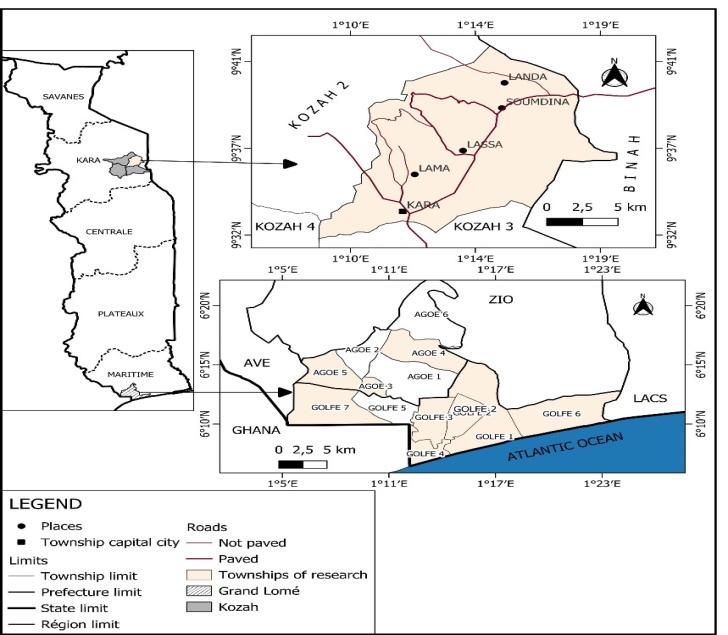
Study area

The study locations concerned the DAGL and the city of Kara. The choice of these cities is based on the following criteria: the number of the population, the concentration of economic activities, the presence of state and private services and the concentration of industrial activities. Indeed, the DAGL and the city of Kara are among the most populated localities in Togo with a population of 2,188,376 inhabitants in the DAGL and 161,176 inhabitants in the city of Kara 11, the study could therefore concern a large number of people and targeted structures: traders selling EEE, households, state and private services, repairers; the high economic activity carried out in those cities could the cause of the high presence of EEE and as a result the presence of WEEE.
The DAGL, the capital of Togo, is located in the Southwest of Togo on the coast precisely at 06°07’ North latitude, 01°11’ East longitude. The DAGL is bounded to the Northeast by the Zio Valley, to the West by Ghana, and to the South by the Atlantic Ocean 12. The city of Kara is approximately 406 km from Lomé. It is between the parallels 9° and 10° North latitude and between 1° and 1° 30’ East longitude. Its initial name is “Lama-Kara”, a Lama village located near the bridge crossing the River Kara 13.
The collection was done in two phases: the first phase concerned the composition of WEEE and the study was carried out in 2022 in the city of Kara and in the commune of Golfe 1 d’DAGL. The second phase concerned the quantification of WEEE in 2/3 of the 13 townships of the DAGL: Golfe 1, Golfe 2, Golfe 3, Golfe 4, Golfe 6, Golfe 7, Agoè-Nyivé 2, Agoè-Nyivé 4 and Agoè-Nyivé 5 and the city of Kara.
Study Data
This study laid emphasis on two types of data: qualitative and quantitative data (discrete and continuous). These data concerned the information received from the respondents and the results of their processing.
Sampling and data collection method
Sample size in households
Table 1 shows that the number of districts considered is practically identical whether in the commune of Golfe 1 or in the city of Kara with regard to the composition of WEEE. With regard to the volume of WEEE, the number of townships in the city of Lomé being 9, the numbers of districts, concessions, households, and people, taken into account by this study, are more important in the DAGL than in Kara. The total number of concessions planned was not taken into account by the study in the two localities during the two campaigns. These gaps are due to the unavailability of certain standings, in particular high standings. This 1 also shows that there is a large gap between the numbers of households in the two localities, same observation on the numbers of people. This observation could be due to the concentration of households and people in the DAGL concessions more than in Kara.
Table 2 shows that the number of each structure is higher in Golfe 1 or in the DAGL than in Kara during the two campaigns: composition and volume of WEEE. This observation may be due to the more important economic character in Lomé than in Kara and particularly to the large number of neighborhoods in the DAGL than in Kara during the campaign of the volume of WEEE. The large gap between these numbers could impact the different ratios of production of WEEE.
To obtain the data on the composition of EEE or WEEE in Golfe 1 and in Kara and the volume of WEEE in the DAGL and in Kara, the survey sheets were developed using the European standard called directive 2012/19/EU 14 slightly modified to take into account the new EEE appearing on the market.
EEE or WEEE have been grouped into ten categories: large household appliances, small household appliances, IT and telecommunications equipment, consumer equipment and photovoltaic panels, lighting equipment, electrical and electronic tools (except large fixed industrial tools), toys, leisure and sports equipment, medical devices (except all implanted or infected products), monitoring and control instruments, vending machines. Codes have been assigned, and presented in Table 3, to each name of an EEE.
The data collection is done using survey forms. They include a series of questions that allow data to be collected. Six fundamental questions are asked to the different stakeholders to access this data:
√ What types of EEE are present at the stakeholder?
√ What is the number of each type of EEE available?
√ Which ones are functional or not?
√ Which ones are abandoned because they are obsolete or not?
√ How often is each EEE present at the stakeholder replaced?
√ How does each stakeholder manage non-functional EEE that has reached the end of its life?
The Kobocollect application facilitated the collection and compilation of data. The IBM SPSS Statistics 25 application enabled the management of this data.
Different types of EEE or WEEE Frequency availability
The data collected allowed to calculate the ratio  of presence of a type of EEE or WEEE in the households or research areas surveyed using the formula (1): (
 1)
1)
 is the total number of the same type of EEE or WEEE present in households or research area
 and
and  is the total number of people in households or structures. The quantity of WEEE
Volume of EEE and WEEE
These data were used to calculate the production ratio  of a type of WEEE among households or structures surveyed using the formula (2):
  (2)
(2)
 is the production ratio of a type of WEEE considered among households or structures,
  is the total number of the same type of EEE abandoned among households or structures,
  is the total number of people among households or structures and
  the average mass of a type of EEE established by Forti et al. 15.
The ratio R of WEEE production in a city is given by the formula (3):  (3)
(3)
 is the total number of EEE abandoned among households or structures in the city,
  is the number of people taken into account by the survey in the city and
  is the average mass of a type of WEEE.
Not having the number of each structure in the cities, the induction of WEEE production mainly focused on households: the total quantity Q of WEEE produced in each city is determined by the formula 4: Q = NR (4).
N is the number of inhabitants of the city and R is the WEEE production ratio of the city.
These different methods made it possible to obtain the results of this study.
Composition of WEEE
EEE or WEEE presence ratio
The presence ratios of each EEE or WEEE are determined at the level of each actor. Depending on their respective ratios, the EEE or WEEE are grouped into four classes: the EEE or WEEE with a presence ratio greater than or equal to  are classified in the class of the most represented EEE or WEEE, those whose ratios are in the interval
  are classified in the class of the moderately represented EEE or WEEE, those whose ratios are in the interval
  are considered as the weakly represented EEE or WEEE and finally those whose ratios are less than
  are considered as the very weakly represented EEE or WEEE.
Among EEE traders, two classes are identified: the most represented EEE and the moderately represented EEE. These EEE are recorded in Table 4. These EEE come from most of the ten categories except the medical device categories. It would therefore be appropriate to find these EEE in households and services.
At the household level, Table 5 shows that the four defined WEEE classes are present. It can be seen that all the EEE encountered at the merchants are found in households and are mainly encountered in the classes of WEEE that are moderately and weakly represented, whether in Golfe 1 or in Kara. The WEEE belonging to the class of WEEE that are most represented are cell phones, lamps and post radios that also belong to the class of EEE that are most represented at the merchants. This observation reflects the habits in the uses of these EEE and their short lifespan. Apart from medical devices, the other categories are found at households. This could lead us to predict that households would be the potential generators of WEEE.
At the level of public and private services, one can realize in Table 6 that the different WEEE are found in the classes of the most used and moderately used WEEE. Some WEEE found in households are also found in services. The category of medical devices completes the other categories in services. This is due to the presence of fertilization tests found in medical practices. We also note that the most WEEE found in this structure are in the category of computer and telecommunications equipment and that of lighting equipment. The services could therefore follow households in the generation of WEEE.
Table 7 shows that, whether in Golfe 1 or Kara, most of the spoiled EEE ends up at repairers for repair. We note that the categories of EEE most received by repairers are large and small household appliances, computer and telecommunications equipment, consumer equipment and photovoltaic panels, and then lighting equipment. There are two situations for these EEE: either they are repaired and returned to the owners or they are not repairable. The non-repairable EEE are either returned to the owners or stored at the repairers who dismantle them in order to use the parts obtained for the repair of other spoiled EEE. Thus, our method of evaluating the volume of WEEE did not take into account the WEEE generated by the repairers. Since the non-repairable EEE is disassembled, its average mass is not upheld.
Whether in Gulf 1 or in Kara, Table 8 shows that most WEEE is received by collectors. The most received WEEE are categories of large and small household appliances, computer and telecommunications equipment, consumer equipment and photovoltaic panels and then lighting equipment. It is the metals that interest collectors more. Once the WEEE is dismantled, the unwanted parts are thrown into landfills. These parts of WEEE are not taken into account in the volume of WEEE given the evaluation method of this study.
This phase allowed to know the EEE sold and the WEEE generated in Gulf 1 and in the city of Kara. The categories of EEE sold are found in households and services which are the potential generators of WEEE. The categories of WEEE most generated are large and small household appliances, computer and telecommunications equipment, consumer equipment and photovoltaic panels and then lighting equipment. To better manage WEEE, its composition and volume must be known. Since the composition of WEEE is known in Golfe 1 and Kara, it is therefore important to know its volume in these two locations.
WEEE Production
WEEE Production Ratio
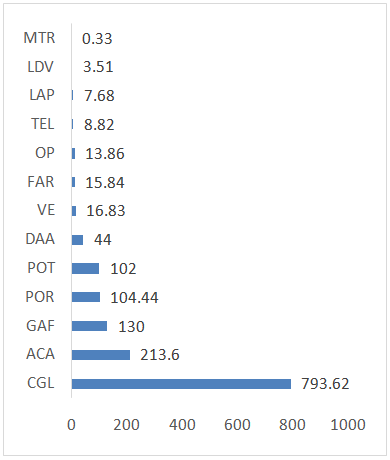
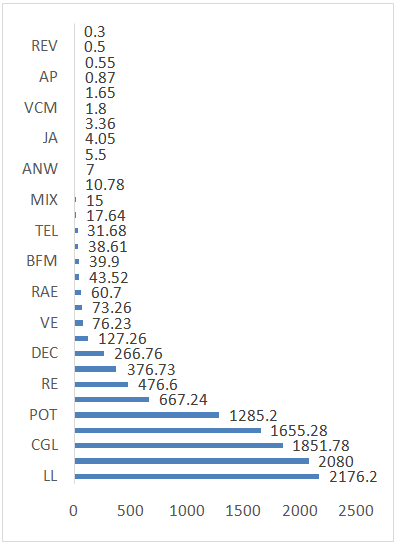
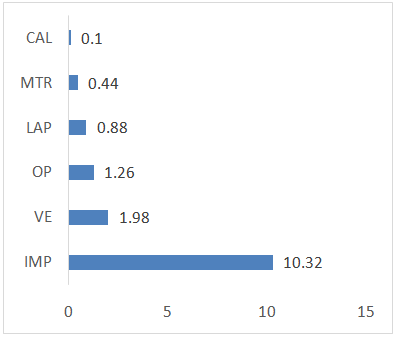
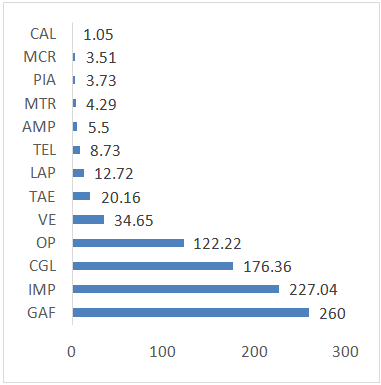
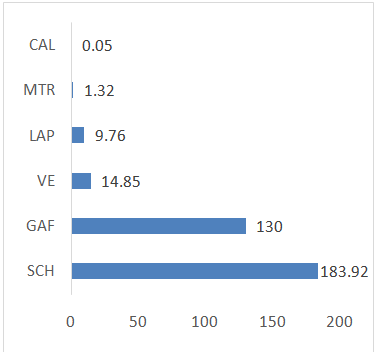
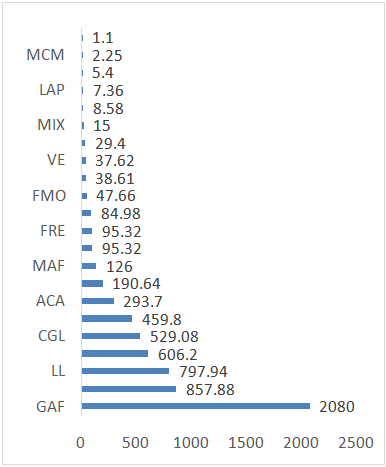
The volume of each WEEE is determined by EEE traders, households and state and private services. The different ratios are presented in the figures.
Generally speaking, the most produced WEEE in volume by households in both localities are: washing machines, large refrigerators, freezers, dryers and television sets, electric cookers, electric stoves, radios, decoders and computers (figure 2 and figure 3). Their volumes vary from 100 kg to 2200 kg. These WEEE are classified into 4 categories: large household appliances, small household appliances, consumer equipment and photovoltaic panels, then computer and telecommunications equipment. A selective collection could be made on these categories of WEEE for their better management.


At the level of services, large refrigeration appliances, printers, freezers, computers are the WEEE most produced in volume. Their volumes vary between 100 kg and 300 kg (figure 4 and figure 5). These WEEE are categories of large household appliances then computer and telecommunications equipment. This production is especially more noticed in Kara and this could be due to the fact that the services are more concentrated in few districts in the DAGL. The number of services per district being 11, all of these districts of the DAGL where the services are concentrated did not have the chance to be taken into account by this study.


Among EEE traders, the highest volumes of WEEE are those of large refrigerators, electric cookers, washing machines, dishwashers, freezers, dryers, air conditioning units, electric stoves, fufu machines. Their volumes are between 100 kg and 3000 kg (figure 6 and figure 7). These WEEE belong more to the category of large household appliances. They are more produced in Kara and this could be due to their movement from Lomé to Kara. The state of the road is not too good, the jolts could damage these EEE before reaching the destination.


Whether at the level of households or services or traders, the high volume of certain WEEE, found in small numbers, can be explained by the fact that the average mass of the EEE from which the WEEE comes is high. This is the case, for example, of large refrigeration appliances with an average mass of 132 kg, and of freezers with an average mass of 44.09 kg. The total production of WEEE in each city is recorded in Table 9.
According to Table 9, the volume of WEEE is 1.8 tons in the DAGL Lomé in 2023 and 18.7 tons in Kara. The total number of inhabitants in the DAGL and Kara being respectively equal to 2,188,376 and 161,176 11, the extrapolation of the results made it possible to know the production of WEEE in the two cities: approximately 853 tons in the DAGL and 1,834 tons in Kara. It can be seen that the production of WEEE in Kara is approximately 2 times higher than that of Lomé. This result can be explained by the WEEE recovery activities. It could be that there is a higher WEEE recovery activity in DAGL than in Kara. In DAGL, many children can be seen in dumps and in neighborhoods looking for scrap metal, which is hardly noticed in Kara. Another fact could explain this result: the jolts on the roads, when moving the EEE to the interior of the country, could damage the EEE, thus reducing their lifespan.
The ever increasing production and consumption of EEE generate significant quantities of WEEE in the world. The consumption of EEE in Togo is becoming increasingly high, leading to a high production of WEEE. The unavailability of specific laws to manage WEEE brings about disorder in the management of these types of waste. Though there are regulations in the management of these WEEE, being aware of their composition and volume is important.
Through this study, the WEEE produced in Togo are classified in the categories defined by Directive 2012/19/EU and improved by other WEEE that are not there but found on the market. The categories of WEEE most encountered in the two locations of this study are large household appliances, small household appliances, computer and telecommunications equipment, consumer equipment and photovoltaic panels, lighting equipment. With this research, one has a clear idea of the production ratios respectively in the DAGL and in Kara: 0.39 kg/inhabitant and 11.38 kg/inhabitant at the household level, 0.026 kg/service and 15.43 kg/service then 1.38 kg/trader and 152.6 kg/trader. The volume of WEEE produced in the DAGL and in Kara are respectively 853.5 tons and 1834.2 tons.
The mastery of the composition and volume of WEEE in the DAGL and in Kara not only constitutes a database for the authorities, but also an asset for their better management. The recovery of precious metals from these WEEE could preserve mining resources for the future generation and the recovery of toxic metals from these WEEE could protect the environment and the health of populations.
{1}. Most represented EEE or WEEE
{2}. EEE or WEEE moderately represented
{3}. EEE or WEEE weakly represented
{4}. EEE or WEEE very weakly represented
| [1] | 75/442/ CEE, «Council Directive of 15 July 1975 on waste». | ||
| In article | |||
| [2] | D. Rochat, A. Haarman, et E. Raverdy, «WEEE deposit study. Phase 2 report – Modeling and action plan (household WEEE and similar).», 2021. | ||
| In article | |||
| [3] | Implementing Regulation (EU) 2017/699, «COMMISSION IMPLEMENTING REGULATION (EU) 2017/699 of 18 April 2017 establishing a common method for calculating the weight of electrical and electronic equipment (EEE) placed on the market of each Member State and a common method for calculating the quantity of waste electrical and electronic equipment (WEEE) produced, by weight, in each Member State.» 2017. | ||
| In article | |||
| [4] | S. S. WONE et D. ROCHAT, «Technical report on the state of e-waste management in Senegal», 2009. | ||
| In article | |||
| [5] | International Labour Office, Geneva, «Policy paper – Global Dialogue Forum on Decent Work in Electrical and Electronic Waste Management Geneva, 9-11 April 2019». | ||
| In article | |||
| [6] | V. Forti, C. P. Baldé, R. Kuehr, et G. Bel, «Monitoring global e-waste for 2020 : Quantities, flows and opportunities for the circular economy. United Nations University (UNU)/United Nations Institute for Training and Research (UNITAR) – SCYCLE Programme co-administered by the International Telecommunication Union (ITU) and the International Solid Waste Association (ISWA), Bonn/Geneva/Rotterdam », p. 123, 2020. | ||
| In article | |||
| [7] | A. D. Tchoupou, E. Ngnikam, et M. Yelkouni, « Contribution to improving the management of household electrical and electronic equipment waste in Cameroon : the case of the city of Douala », Waste Sci. Technol., no N°73, 2017. | ||
| In article | |||
| [8] | C. P. Baldé, V. Forti, V. Gray, R. Kuehr, et P. Stegmann, «Monitoring Global Waste Electrical and Electronic Equipment 2017». 2017. | ||
| In article | |||
| [9] | African Development Bank, «Africa Industrialization Index 2022», African Development Bank. | ||
| In article | |||
| [10] | N. M. GNANE, «Management of electronic waste and environmental issues in Togo», ResearchGate, vol. 2, no 009 December 2017, p. 24, 2017. | ||
| In article | |||
| [11] | National Institute of Statistics and Economic and Demographic Studies, «5th General Population and Housing Census (RGPH-5) of Togo of November 2022», 2022. | ||
| In article | |||
| [12] | K. E. Koledzi, G. Baba, G. Feuillade, et M. Guy, «Physical Characterization of Urban Solid Waste in Lomé, Togo, in the Perspective of Decentralized Composting in Neighborhoods», Environ. Eng. Dev., vol. N°59-March 2011, p. 7865, mars 2011. | ||
| In article | View Article | ||
| [13] | M. Bonnah, « Physicochemical characterization of household solid waste in Kara: assessment of the per capita ratio and optimization of the technical management system», Lomé, Togo, 2018. | ||
| In article | |||
| [14] | 2012/19/UE, «Directive 2012/19/EU of the European Parliament and of the Council of 4 July 2012 on waste electrical and electronic equipment (WEEE) (recast)». | ||
| In article | |||
| [15] | V. Forti, C. P. Baldé, et R. Kuehr, «E-waste Statistics: Guidelines on Classifications, Reporting and Indicators, second edition. United Nations University, ViE – SCYCLE, Bonn, Germany.» 2018. | ||
| In article | |||
Published with license by Science and Education Publishing, Copyright © 2024 Kodzovi YAKAOU and Kwamivi Nyonuwosro SEGBEAYA
 This work is licensed under a Creative Commons Attribution 4.0 International License. To view a copy of this license, visit
https://creativecommons.org/licenses/by/4.0/
This work is licensed under a Creative Commons Attribution 4.0 International License. To view a copy of this license, visit
https://creativecommons.org/licenses/by/4.0/
| [1] | 75/442/ CEE, «Council Directive of 15 July 1975 on waste». | ||
| In article | |||
| [2] | D. Rochat, A. Haarman, et E. Raverdy, «WEEE deposit study. Phase 2 report – Modeling and action plan (household WEEE and similar).», 2021. | ||
| In article | |||
| [3] | Implementing Regulation (EU) 2017/699, «COMMISSION IMPLEMENTING REGULATION (EU) 2017/699 of 18 April 2017 establishing a common method for calculating the weight of electrical and electronic equipment (EEE) placed on the market of each Member State and a common method for calculating the quantity of waste electrical and electronic equipment (WEEE) produced, by weight, in each Member State.» 2017. | ||
| In article | |||
| [4] | S. S. WONE et D. ROCHAT, «Technical report on the state of e-waste management in Senegal», 2009. | ||
| In article | |||
| [5] | International Labour Office, Geneva, «Policy paper – Global Dialogue Forum on Decent Work in Electrical and Electronic Waste Management Geneva, 9-11 April 2019». | ||
| In article | |||
| [6] | V. Forti, C. P. Baldé, R. Kuehr, et G. Bel, «Monitoring global e-waste for 2020 : Quantities, flows and opportunities for the circular economy. United Nations University (UNU)/United Nations Institute for Training and Research (UNITAR) – SCYCLE Programme co-administered by the International Telecommunication Union (ITU) and the International Solid Waste Association (ISWA), Bonn/Geneva/Rotterdam », p. 123, 2020. | ||
| In article | |||
| [7] | A. D. Tchoupou, E. Ngnikam, et M. Yelkouni, « Contribution to improving the management of household electrical and electronic equipment waste in Cameroon : the case of the city of Douala », Waste Sci. Technol., no N°73, 2017. | ||
| In article | |||
| [8] | C. P. Baldé, V. Forti, V. Gray, R. Kuehr, et P. Stegmann, «Monitoring Global Waste Electrical and Electronic Equipment 2017». 2017. | ||
| In article | |||
| [9] | African Development Bank, «Africa Industrialization Index 2022», African Development Bank. | ||
| In article | |||
| [10] | N. M. GNANE, «Management of electronic waste and environmental issues in Togo», ResearchGate, vol. 2, no 009 December 2017, p. 24, 2017. | ||
| In article | |||
| [11] | National Institute of Statistics and Economic and Demographic Studies, «5th General Population and Housing Census (RGPH-5) of Togo of November 2022», 2022. | ||
| In article | |||
| [12] | K. E. Koledzi, G. Baba, G. Feuillade, et M. Guy, «Physical Characterization of Urban Solid Waste in Lomé, Togo, in the Perspective of Decentralized Composting in Neighborhoods», Environ. Eng. Dev., vol. N°59-March 2011, p. 7865, mars 2011. | ||
| In article | View Article | ||
| [13] | M. Bonnah, « Physicochemical characterization of household solid waste in Kara: assessment of the per capita ratio and optimization of the technical management system», Lomé, Togo, 2018. | ||
| In article | |||
| [14] | 2012/19/UE, «Directive 2012/19/EU of the European Parliament and of the Council of 4 July 2012 on waste electrical and electronic equipment (WEEE) (recast)». | ||
| In article | |||
| [15] | V. Forti, C. P. Baldé, et R. Kuehr, «E-waste Statistics: Guidelines on Classifications, Reporting and Indicators, second edition. United Nations University, ViE – SCYCLE, Bonn, Germany.» 2018. | ||
| In article | |||