Cements contain traces of natural radionuclides because the raw materials originate from the earth’s crust. Elevated levels of natural radioactivity can have harmful health effects on living tissues. This study aimed at establishing the radiological safety of cements used in Kenya by quantifying gamma ray-emitting natural radionuclides present in the cements. A Sodium Iodide Thallium-doped gamma ray spectrometer was used in counting gamma rays emitted by 40K and progenies of 238U and 232Th in the selected cement brands. The average activity concentrations and radiation safety indicators of selected cement brands were determined and compared with global averages. The activity concentrations of 238U, 232Th, and 40K were estimated using gamma-ray photopeak energies of 214Pb at 352 KeV, 212Pb at 239KeV and 1460 KeV respectively. The average activity concentrations 232Th, 238U, and 40K were found to be 52.70±3.3, 35.88±4.3, and 432.31±50.7 BqKg-1. The absorbed dose rate of most cement samples was higher than the world average of 59nGhy-1. Cement class and clinker content determined the amounts of primordial radionuclides. Values of indoor and outdoor hazard indices, annual effective dose rates and radium equivalent activity were within stipulated safety limits. These metrics of radiation hazard indicators were within safety limits, and therefore, there is no significant radiation risk linked to the use and handling of the cements used in Kenya.
Radiation is the release of energy in particulate or wave form by unstable atoms. Ionizing radiation can cause damage to living tissues if it exceeds certain limits 1. Major sources of ionizing radiation are naturally occurring radioactive materials (NORMs) which can be found in materials of earth’s crust origin such as soils, rocks and water 2. Construction and building industry often utilize sand, rocks (aggregates), water and cement. Among these components, cement is the main binding material. Cement is manufactured using raw materials that are extracted from limestone through quarrying 3. Recent studies 4, 5, 6 show that building materials may have high concentration of radioactive matter. For instance, a study on sand caried out from a region in Machakos county reported high concentration of NORMs to the levels of 1850 BqKg-1 for 40K against the world average, 420 BqKg-1 4. Although cement concrete structures have shielding effects from external radiation 7, radionuclides present in the structure’s building materials contribute to indoor radiation exposure through emission of gaseous radionuclides of thoron and radon decay series 8. Even though there is existing radiological information about sand, rocks and soil in Kenya and worldwide 4, 5, 6, 8, there is limited radiological information about cements used in Kenya. This study aimed at determining activity concentration of natural radionuclides in selected cement brand samples by gamma-ray spectroscopy. The radiological hazard indicators such as radium equivalent (Raeq), absorbed dose rate(D), annual effective dose rate (AED), internal hazard (Hin) and external hazard (Hex) indices were also computed. These parameters are useful in assessment of radiological safety due to gamma ray exposure in cemented structures.
A total of 7 cement brands were collected from different depots for construction materials. The samples were wrapped in an Aluminum foil and then oven-dried at 110°C for 24hrs to remove moisture 8. The samples were measured, packed in airtight containers with lids reinforced with aluminum foil and stored for at least 30 days to achieve secular equilibrium 9. Gamma ray counting for each sample was done by placing the samples on a NaITi gamma detector enclosed in a lead shield for 28,796 seconds to accumulate sufficient gamma ray counts 8. From the spectrums obtained, gamma ray spectroscopy and quantitative analysis was carried out for 238U, 232Th, and 40K using gamma-ray photopeak energies of 214Pb at 352 KeV, 212Pb at 239KeV and 1460 KeV respectively.
2.2. Sample ClassificationSix of the brands were type CEM IV and one was CEM II. Table 1 shows the different classes of Portland composite cement (pcc) analyzed in this study with content of Portland composite cement 10. The cement brands were coded as CT1, CT2, CT3, CT4, CT5, CT6 and CT7 and three samples were measured for each cement brand.
A lead shielded NaI (Ti) gamma ray spectrometry system comprising of a Thallium activated Sodium Iodide detector crystal, built in integrated high voltage power converter (up to 1200V), amplifier, signal processing electronics and a multichannel analyzer (MCA) software for data acquisition, visualization and storage in a computer was used in the gamma ray counting 11. Atoms in the crystal interact with an energy photon causing excitation which leads to energy release wherein the system converts it to a measurable electrical signal yielding a spectrum over a given duration.
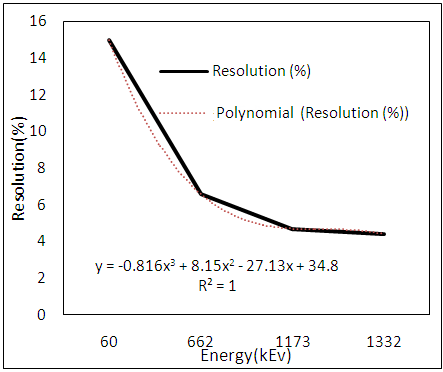
Energy calibration was carried out using peaks of known gamma ray energies from a multi-nuclide source consisting of standard sources namely, Am-241 at 60keV, Cs-137 at 662keV, Co-60 at 1173 keV and Co-60 at 1332keV. For the standard sources, the detector resolution was determined using full width at half maxima (FWHM) given by equation 1 11 while the resolution curve is given in Figure 2.
 | (1) |
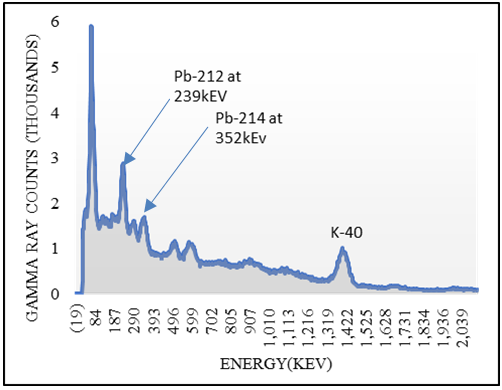
From Figure 1, the detector resolution decreased with increase in photon energy. This implies that lower energy photo peaks were more resolved compared to higher energy ones as shown in the spectrum of one of the cement samples in Figure 2.


The background radiation counts were obtained through gamma ray counting of a sample of deionized water under the same conditions as the cement samples. The net count resulting from the sample was obtained by subtracting the counts of deionized water from those of the sample counted over the same duration 11.
2.4. Calculation of Radiological ParametersThe activity concentration for each radionuclide in the cement samples was computed using equation 2 1.
 | (2) |
Where, A, I and M are the activity concentration, Intensity and mass of the sample, s, respectively while  and
and  are emission probabilities and detection efficiencies respectively. The Radium equivalent, which considers that 1Bq/Kg of 226Ra, 0.7Bq/Kg of 232Th and 13Bq/Kg of 40K produce equivalent dose rates as in equation 3 6
 | (3) |
Where ARa, ATh, and Ak are the respective activities Bq Kg-1 of 226Ra, 232Th and 40K in cement samples. The safety standard for construction materials requires that the Raeq< 370 Bq/kg.
The annual effective dose (AED) was estimated considering conversion coefficient of 0.7Sv/Gy between absorbed dose (D) in air and human effective dose and adult outdoor occupancy of 0.6 8. This yields an approximate dose received by the Kenyan population contributed by building cement. It’s important to split the dose into indoor and outdoor annual effective doses for occupancy factors of 0.6 and 0.4 respectively. The two doses are calculated using equations 4 and 5 12.
 | (4) |
 | (5) |
The absorbed dose rate which refers to the amount of radioactive energy deposited per unit mass was computed using equation 6 below 10.
 | (6) |
The hazard indices indicate the radiological safety index of a material and were calculated using following equations 7 and 8 13.
 | (7) |
 | (8) |
Wherein, ARa, ATh and AK are the activity concentrations of 238U, 232Th and 40K respectively.
The results are discussed based on two main categories namely; activity concentrations and radiation safety parameters.
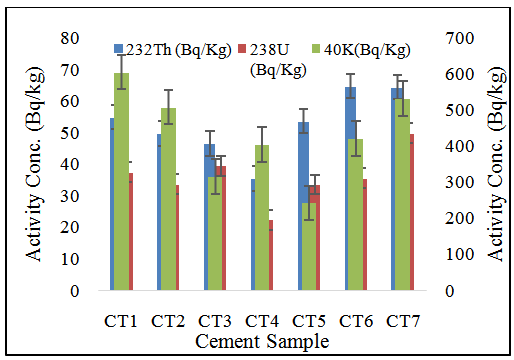
3.1. Activity ConcentrationsThe activities concentration levels of the radionuclides in the cement samples are shown in Figure 3 below. The activity concentration of 232Th ranged from 35.3±2.8 to 64.7±3.7 Bq. Kg-1 with a mean of 52.7±3.2 Bq. Kg-1 while 238U ranged from 22.1±3.4 to 49.7±5.0 Bq. Kg-1 with a mean of 35.8±4.3 Bq. Kg-1. Concentrations of 40K were in the range of 241.2±43.2 to 604.9±57.2 Bq. Kg-1 with a mean of 432Bq/kg. Based on these results, the average activity of 232Th slightly exceeded the world average of 45Bq/kg while 40K and 238U were within world average values of 420 Bq/kg and 35Bq/kg respectively 1.

Worth noting, concentrations of 232Th were the same in CT6 and CT7 while activity of 238U was similar in both CT2 and CT5. These similarities can be attributed to the source of raw materials or the cement brands belonging to the same class. This may imply that the two companies source the raw materials from the same location to produce the two brands of cements. Variations in the concentrations of 238U, 232Th and 40K among different cement brands could be ascribed to the geological and geochemical background, compression strength and clinker composition 8, 10, 13, 14.
Related studies in Kenya and other countries also have shown that building materials have elevated levels of natural radionuclides. For instance, the activity concentration in both sand and rock samples measured analyzed from Kitui, Kenya had the highest concentration of 40K at 812±40.46 Bq/kg and 782±39.1 Bq/kg 5 and 4 also reported high levels of radionuclides in sand collected from a region in Machakos County. In addition, a study in Ortum area in Kenya reported activity concentration of soils and rocks with levels above those found in this study 6. In a review of sources of background radiation in environment, 14 noted that study in Nigeria also found a variation of natural radioactivity based on the rock types. These studies are a proof of high level of radioactivity in building materials as they are of earth’s crust origin. They are examples of an explanation why the activity concentrations of some radionuclides in the cement samples were higher than the world averages.

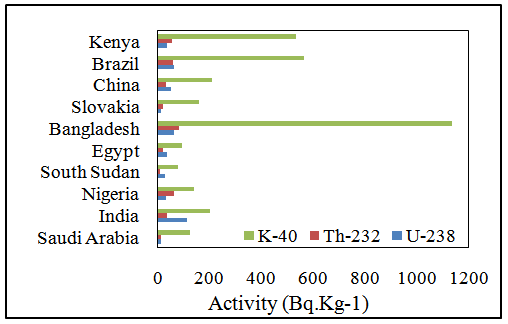
A comparison of radiation levels of cements in other countries 15 with findings of this study is shown in the Figure 4.
From the above comparison, the concentration of 40K is the highest in all cement samples. Noticeably, 40K activity in cements in Bangladesh are the highest with 1133Bq/Kg followed by Brazil, then Kenya, China, India, and Slovakia. 238U concentration is highest in cements used in India with 111.2 Bq/Kg. From this comparison, it is clear that radionuclide concentration in materials of earth’s crust origin vary with geography.
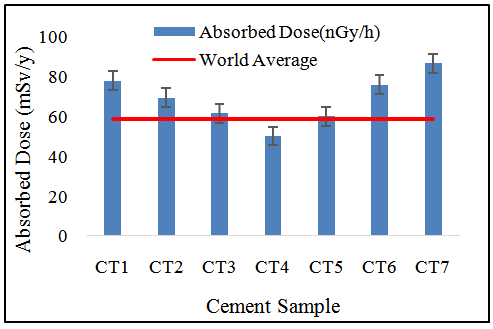
3.3. Absorbed Dose and Annual Effective RatesAs shown in Figure 5, the absorbed dose rate values exceeded significantly the world average of 60nGy/h except for cement samples CT3 to CT5. The average dose rate was 68.76±6.2 nGy/h and it ranged from 50.21±5.2 nGy/h for CT4 to 86.7±7.1 nGy/h for CT7. However, the values were within the global range of 18 to 93nGyh-1.

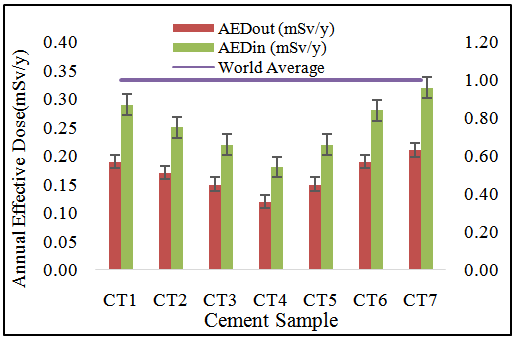
The average indoor AED was 0.25 mSv/y and was in the range of 0.18±0.02 mSv/y and 0.32±0.03 mSv/y. Moreover, the average outdoor AED was 0.17±0.03 mSv/y and it ranged between 0.12±0.03 mSv/y and 0.21±0.04 mSv/y. Since the indoor occupancy factor for the Kenyan population is greater than the outdoor, i.e., 0.6 vs 0.4, the indoor AED was greater than the outdoor AED in all cement samples. Nonetheless, both outdoor and indoor AED were lower than the world average of 1mSv/y as shown in Figure 6 16.

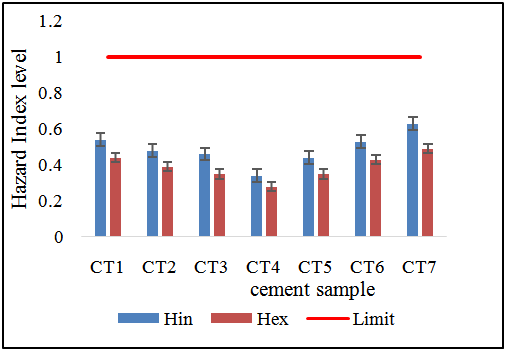
Radiological safety of materials containing primordial radionuclides is assessed by Radium equivalent activity (Raeq) and hazard indices. The mean internal and external radiation hazard indices were less than unity, i.e., 0.49±0.05 and 0.39±0.03 respectively as shown in Figure 7.

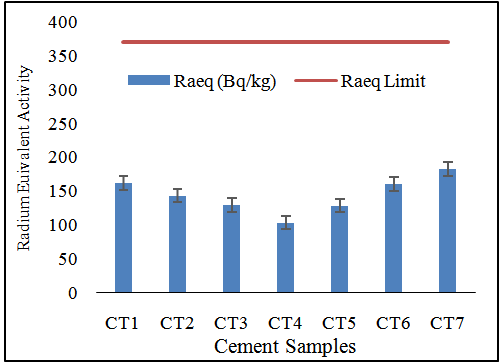
The average Raeq index was 182.3±14.8 Bq. Kg-1 which is less than the world average of 370 Bq. Kg-1 defined the International Commission for Radiological Protection (ICRP) 13. As shown in Figure 8, none of the cement samples exceeded 370 Bq. Kg-1.

Based on figures 7 and 8, the cements do not pose a risk as all samples had an equivalent activity less than the safe limit.
The radiation safety of common cements used for building and construction purposes in Kenya has been assessed through radiometric analysis. Results showed that the radium equivalent activity concentration of all cement samples was less than the world average of 370Bq/kg. Also, the radiation hazard indicators were less than unity and therefore no radiation hazard is linked to the use of the cements. Further, the cement class has an impact on the level of activity concentration owing to raw material content. Although 4 out of the 7 cement brands exceeded the world average absorbed dose rate, radium equivalent activity and hazard indices were within safety limits. Based on these findings, cements used in Kenya do not pose a radiation hazard. Nonetheless, regular radiometric analysis is recommended even using other advanced gamma spectroscopy methods to keep a check on radiation levels of building cements.
The authors are grateful to the department of Physical Sciences, South Eastern Kenya University for providing them with the gamma ray spectrometry system.
The authors declare no competing interests.
| [1] | UNSCEAR. (2008). Sources and Effects of Ionizing Radiation Annex B. New York: United Nations Publication. | ||
| In article | |||
| [2] | Y. Raghu, R. Ravisankar, A. Chandrasekaran, P. Vijayagopal, & B. Venkatraman. (2015). Assessment of natural radioactivity and radiological hazards in building materials used in the Tiruvannamalai District, Tamilnadu, India, using a statistical approach. Journal of Taibah University for Science, 523-533. | ||
| In article | View Article | ||
| [3] | Larfage. (2020). Manufacturing process. Retrieved 02 05, 2019, from Lafarge: | ||
| In article | |||
| [4] | https://www.lafarge.co.ke/2_2_3-Manufacturing_process. | ||
| In article | View Article PubMed | ||
| [5] | Lucia, N., Daniel, K., Calford, O., & Margaret, W. (2020). Assessment of Levels of Natural Radioactivity in Sand Samples Collected from Ekalakala in Machakos County, Kenya. The Scientific World Journal, 1-11. | ||
| In article | View Article PubMed | ||
| [6] | Mastitsi, M, Linturi, J, Kebwaro,J & Kirago L (2019). Radiometric Survey of the Tyaa River Sand Mine in Kitui, Kenya. Radaition Protection Dosimetry, 1-8. | ||
| In article | View Article PubMed | ||
| [7] | Wanjala F, Hashim, N, Otwoma, D, Nyambura,C, Kebwaro J, Mauring A, Bartilol, J, and Chege, M (2019). Human Exposure to Background Radiation in Ortum, Kenya. Radiation Protection Dosimetry, 98-108 | ||
| In article | View Article | ||
| [8] | Saleh, E., Mohammed, A., & El-Fiki, S. (2021). Radiological and gamma-ray shielding parameters of cement raw materials samples used in Yemen. Eur. Phys. J. Plus 136. | ||
| In article | View Article PubMed | ||
| [9] | Otwoma, D., Patel, J., Bartilol, S., & Mustapha, A. (2013). Estimation of annual effective dose and radiation hazards due to natural radionuclides in Mount Homa, southwestern Kenya. Radiation protection dosimetry, 1-8. | ||
| In article | |||
| [10] | El-Taher, S. A. (2016). Gamma Spectroscopic Analysis and Associated Radiation Hazards Parameters of Cement Used in Saudi Arabia. Journal of Environmental Science and Technology, 239. | ||
| In article | |||
| [11] | Muyiwa, A. (2020, October). Retrieved from structville.com: | ||
| In article | |||
| [12] | ORTEC. (2021). Masetro-32 Software User Manual. ORTEC. | ||
| In article | View Article PubMed | ||
| [13] | Mahmoud, K. R. (2007). Radionuclide content of local and imported cements used in Egypt. Journal of Radiological Protection, 69. | ||
| In article | |||
| [14] | Palaščáková, A. E. (2013). Assessment of Natural Radioactivity Levels of Cements and Cement Composites in the Slovak Republic. International Journal of Environmental Research and Public Health ISSN 1660-4601, 7166. | ||
| In article | View Article | ||
| [15] | Abdu,H, Khan, A & Pathan, J (2019). Review on Studies in Natural Background Radiation. Radiation Protection and Environment, 215-222. | ||
| In article | View Article PubMed | ||
| [16] | Adriana, E., & Lenka, P. (2013). Assessment of Natural Radioactivity Levels of Cements and Cement Composites in the Slovak Republic. International Journal of Environmental Research and Public Health, 7165-7179. | ||
| In article | |||
| [17] | ICRP, 2007. The 2007 Recommendations of the International Commission on Radiological Protection. ICRP Publication 103. Ann. ICRP 37 (2-4). | ||
| In article | |||
Published with license by Science and Education Publishing, Copyright © 2023 Vincent Mulwa, J.M Linturi and Martin Riara
 This work is licensed under a Creative Commons Attribution 4.0 International License. To view a copy of this license, visit
http://creativecommons.org/licenses/by/4.0/
This work is licensed under a Creative Commons Attribution 4.0 International License. To view a copy of this license, visit
http://creativecommons.org/licenses/by/4.0/
| [1] | UNSCEAR. (2008). Sources and Effects of Ionizing Radiation Annex B. New York: United Nations Publication. | ||
| In article | |||
| [2] | Y. Raghu, R. Ravisankar, A. Chandrasekaran, P. Vijayagopal, & B. Venkatraman. (2015). Assessment of natural radioactivity and radiological hazards in building materials used in the Tiruvannamalai District, Tamilnadu, India, using a statistical approach. Journal of Taibah University for Science, 523-533. | ||
| In article | View Article | ||
| [3] | Larfage. (2020). Manufacturing process. Retrieved 02 05, 2019, from Lafarge: | ||
| In article | |||
| [4] | https://www.lafarge.co.ke/2_2_3-Manufacturing_process. | ||
| In article | View Article PubMed | ||
| [5] | Lucia, N., Daniel, K., Calford, O., & Margaret, W. (2020). Assessment of Levels of Natural Radioactivity in Sand Samples Collected from Ekalakala in Machakos County, Kenya. The Scientific World Journal, 1-11. | ||
| In article | View Article PubMed | ||
| [6] | Mastitsi, M, Linturi, J, Kebwaro,J & Kirago L (2019). Radiometric Survey of the Tyaa River Sand Mine in Kitui, Kenya. Radaition Protection Dosimetry, 1-8. | ||
| In article | View Article PubMed | ||
| [7] | Wanjala F, Hashim, N, Otwoma, D, Nyambura,C, Kebwaro J, Mauring A, Bartilol, J, and Chege, M (2019). Human Exposure to Background Radiation in Ortum, Kenya. Radiation Protection Dosimetry, 98-108 | ||
| In article | View Article | ||
| [8] | Saleh, E., Mohammed, A., & El-Fiki, S. (2021). Radiological and gamma-ray shielding parameters of cement raw materials samples used in Yemen. Eur. Phys. J. Plus 136. | ||
| In article | View Article PubMed | ||
| [9] | Otwoma, D., Patel, J., Bartilol, S., & Mustapha, A. (2013). Estimation of annual effective dose and radiation hazards due to natural radionuclides in Mount Homa, southwestern Kenya. Radiation protection dosimetry, 1-8. | ||
| In article | |||
| [10] | El-Taher, S. A. (2016). Gamma Spectroscopic Analysis and Associated Radiation Hazards Parameters of Cement Used in Saudi Arabia. Journal of Environmental Science and Technology, 239. | ||
| In article | |||
| [11] | Muyiwa, A. (2020, October). Retrieved from structville.com: | ||
| In article | |||
| [12] | ORTEC. (2021). Masetro-32 Software User Manual. ORTEC. | ||
| In article | View Article PubMed | ||
| [13] | Mahmoud, K. R. (2007). Radionuclide content of local and imported cements used in Egypt. Journal of Radiological Protection, 69. | ||
| In article | |||
| [14] | Palaščáková, A. E. (2013). Assessment of Natural Radioactivity Levels of Cements and Cement Composites in the Slovak Republic. International Journal of Environmental Research and Public Health ISSN 1660-4601, 7166. | ||
| In article | View Article | ||
| [15] | Abdu,H, Khan, A & Pathan, J (2019). Review on Studies in Natural Background Radiation. Radiation Protection and Environment, 215-222. | ||
| In article | View Article PubMed | ||
| [16] | Adriana, E., & Lenka, P. (2013). Assessment of Natural Radioactivity Levels of Cements and Cement Composites in the Slovak Republic. International Journal of Environmental Research and Public Health, 7165-7179. | ||
| In article | |||
| [17] | ICRP, 2007. The 2007 Recommendations of the International Commission on Radiological Protection. ICRP Publication 103. Ann. ICRP 37 (2-4). | ||
| In article | |||