This study systematically maps the professional trajectories of Bachelor of Science in Information Technology (BSIT) graduates from the College of Information Technology Education (CITE) at Nueva Vizcaya State University, Bayombong Campus, aiming to cover the period from 2021 to 2025. Employing a concurrent mixed-methods research design, the study triangulates quantitative performance metrics with qualitative thematic insights. Data were collected through Google Forms surveys and Messenger-based outreach, followed by rigorous manual cleaning and processing in a Google Colab environment using Pandas. Exploratory Data Analysis (EDA) and visualization through Matplotlib and Seaborn were utilized to identify longitudinal trends. Results indicate a resilient employability profile, with a peak employment rate of 77.61% in 2022 and a significant recovery in job relevance reaching 73.8% in 2024. The findings reveal a balanced absorption across both public and private sectors, with graduates successfully securing specialized roles in software engineering, technical support, and public sector IT management. The study concludes that the BSIT program maintains high market responsiveness and supports Sustainable Development Goals 4 (Quality Education) and 8 (Decent Work and Economic Growth). Recommendations focus on institutionalizing a permanent, data-driven Alumni Engagement Ecosystem and an Industry-Alumni Advisory Board to maintain a continuous feedback loop for curriculum enhancement and strategic resource allocation.
The landscape of higher education is increasingly emphasizing the need for institutions to ensure that graduates are securing employment in their respective fields. Establishing a reliable connection with graduates of the College of Information Technology Education (CITE) programs in Nueva Vizcaya State University (NVSU) Bayombong Campus remains a persistent hurdle to achieving data-driven improvement. Currently, the process is plagued by a lack of concrete data, leaving administrators with little more than anecdotal evidence to support their reports.
Graduate tracing is a fundamental requirement for maintaining educational standards and ensuring institutional accountability within the Philippine higher education landscape. Tracer research is a widely used approach in educational institutions to track graduates and inform institutional improvement. These systems enable universities to align instructional resources with national standards and global benchmarks, making evidence-based decisions that link academic preparation with workforce expectations 1, 2, 3. Recent technological advances in alumni management systems have further enhanced data reliability and accessibility, improving institutional engagement with graduates 4.
Modern tracer studies have evolved into sophisticated digital ecosystems characterized by features that prioritize real-time data governance, user-centered engagement, and automated longitudinal monitoring. According to Yunanto et al. 5 and Babu et al. 6, the primary functionality of these web-based applications is the transition from manual record-keeping to efficient, automated data collection that ensures high accuracy in tracking graduate trajectories over time. Beyond simple data storage, contemporary platforms integrate strategic features such as interactive alumni engagement interfaces and entrepreneurial networking tools, which Politis et al. 7 and Rubejes-Silva 8 identify as essential for fostering long-term institutional relationships. Furthermore, the capacity for continuous, evidence-based analysis feature highlighted by Carillo et al. 9 and Kherani et al. 4—enables the systematic assessment of employability trends and the generation of structured accountability reports. Finally, as noted by Leow et al. 10 and Jaiswal et al. 11, the integration of streamlined digital interfaces and social connectivity features serves to eliminate the inefficiencies of fragmented tracing, providing the real-time insights necessary for data-driven curriculum evaluation and institutional strategic planning.
Graduate tracer studies are integral to achieving global and national development goals by ensuring that higher education remains a catalyst for socio-economic mobility, directly supporting Sustainable Development Goals 4 and 8 12. Within the Philippine academic landscape, this alignment is operationalized through the CHED ACHIEVE Agenda, which mandates the documentation of graduate outcomes as a metric for institutional quality and curricular relevance 13. By integrating tracer data into the university’s Research and Development (R&D) Agenda, institutions can transform raw employment statistics into actionable intelligence, fulfilling the mandate for evidence-based strategic planning and continuous program improvement 14.
This study has the following objectives:
1. To establish a longitudinal performance baseline by evaluating the employment rates and workforce absorption of BSIT graduates over a five-year period.
2. To analyze the degree of alignment between the BSIT curriculum and actual workplace demands by measuring job relevance and specialized role attainment.
3. To map the sectoral distribution and industrial versatility of graduates to determine the program's responsiveness to both public and private sector ICT needs.
This study adopts a concurrent mixed-methods research design to systematically map the professional trajectories of BSIT graduates and evaluate the efficacy of existing Graduate Tracing Systems (GTS). Quantitative data is primarily generated through structured Google Forms surveys, Messenger-based chat contacts, and institutional benchmarking against peer alumni hubs, focusing on measurable performance baselines such as employability rates, job relevance, and sectoral distribution. To ensure the integrity of the findings, the researchers conducted Exploratory Data Analysis (EDA), utilizing the Google Colab environment for its collaborative and high-performance computing capabilities. This process began with rigorous manual data cleaning to address inconsistencies in alumni entries, followed using Pandas for structured manipulation of the tabular datasets. To derive meaningful insights from the numerical data, Matplotlib and Seaborn are employed for advanced data visualization, allowing for the clear identification of labor market trends across specialized fields like software development and network administration.
To provide a more granular understanding of these metrics, the methodology incorporates qualitative layers through semi-structured interviews and direct observation at career networking events. This multi-channel approach allows for the collection of nuanced narratives regarding skill gaps and the practical challenges of post-graduate transition that surveys alone may overlook. By triangulating the visualized statistical data with thematic insights from personal career experiences, the research establishes a robust evidence base to inform curriculum enhancements and strategic resource allocation, ensuring the CITE remains aligned with the evolving demands of the global IT industry.
This section offers a clear and insightful analysis, demonstrating how the findings contribute to the research questions posed, addressing any unexpected outcomes, and suggesting directions for future research.
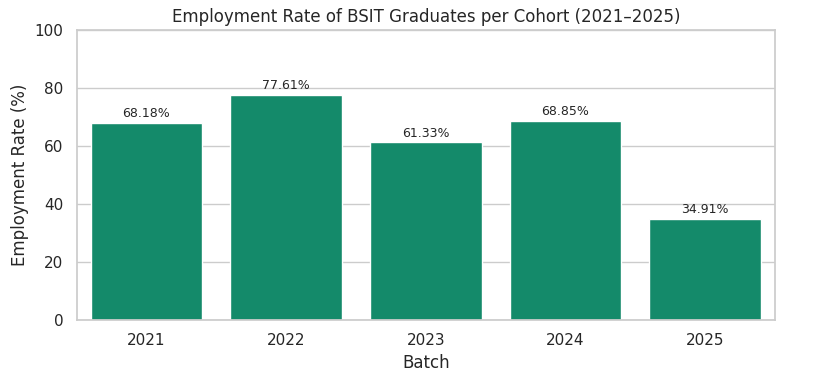
3.1. Employment Rate of GraduatesThe employment status of BSIT graduate cohorts from 2021 to 2025 demonstrates a strong and encouraging pattern of employability. Tracer study results reveal that most cohorts achieved employment levels reflecting the program’s capacity to prepare graduates who can enter the workforce and secure positions across multiple sectors, including public administration, education, finance, healthcare, IT services, and business process outsourcing. This trend suggests that the curriculum remains aligned with industry expectations and that graduates possess both the technical and transferable skills valued in the labor market.

In Figure 1 reveals a sustained trajectory of graduate success, peaking with the 2022 cohort at 77.61%, which underscores a strong responsiveness to the burgeoning demand for IT services. While the 2023 cohort saw a slight dip to 61.33% due to diversifying career pathways such as freelancing and self-employment, the 2024 cohort demonstrated a resilience recovery to 68.85%, reinforcing the program’s consistent ability to produce market-ready professionals. Although the 2025 cohort’s initial rate of 34.91% reflects a typical early-stage labor market transition, historical trends suggest this figure will rise as placement decisions finalize. Collectively, these data points—visually summarized in the accompanying bar chart—provide compelling evidence of longitudinal employability and industry alignment, directly supporting the program’s objectives by documenting a robust and reliable performance baseline.
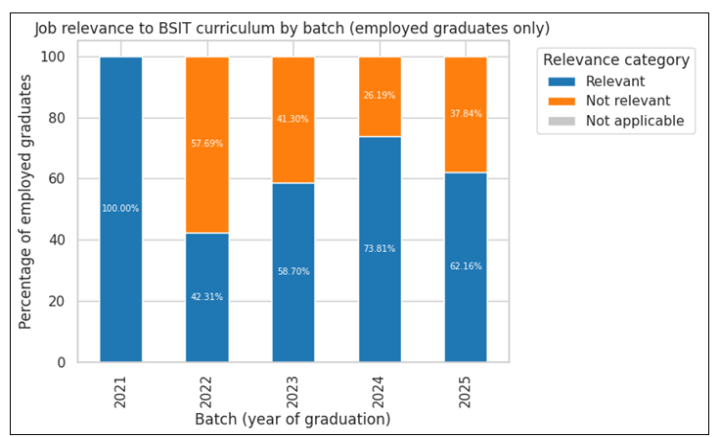
3.2. Job RelevanceThe analysis shows how well the BSIT curriculum helps graduates get jobs related to their studies. While the overall batch distributions include unemployed and non-respondents, focusing solely on those who are currently employed removes noise and offers a more accurate view of actual workplace alignment. The resulting trends show meaningful variations across the five graduation cohorts, and these variations illuminate the evolving linkage between BSIT training and labor market pathways.

In Figure 2 the longitudinal analysis of job relevance across the five cohorts highlights a resilient alignment between the BSIT curriculum and industry demands, characterized by a fluctuating but ultimately upward trajectory. While the 2021 cohort achieved a perfect 100% relevance rate. The 2022 cohort represent a significant outlier, with job relevance falling sharply to 42.3%, as many graduates transitioned into service-oriented roles like retail and microfinance—likely a reflection of post-pandemic economic constraints. However, a robust recovery followed, with relevance rates climbing to 58.7% in 2023 and reaching a peak of 73.8% in 2024, as graduates successfully secured specialized positions in software engineering, technical support, and public sector IT management. This positive trend persists into the emerging 2025 cohort, which already reports 62.2% relevance among early hires, collectively demonstrating that despite temporary market shifts, the BSIT program consistently equips students with core competencies that are highly valued and readily absorbed by the information-driven labor market.
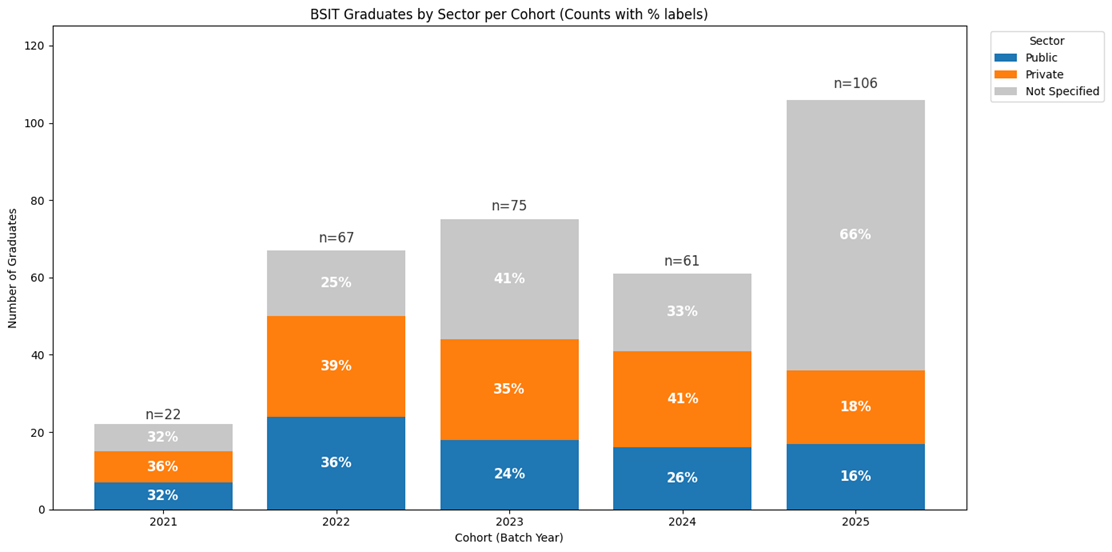
3.3. Type of Company or OrganizationThe chart below presents the employment sector distribution of BSIT graduates from Batch 2021 to Batch 2025, based on recorded tracer data. It illustrates the number of graduates employed in the Public sector, Private sector, and those whose sector information is Not Specified, with percentage labels included for each segment.

In Figure 3 the five-year sectoral distribution of BSIT graduates reveals a robust and versatile curriculum that successfully caters to both government and industry requirements, evidenced by the balanced absorption across the public and private sectors. In earlier cohorts, such as 2021 and 2022, graduates in the 2021 cohort were split between private enterprises (X%) and public institutions (Y%), while the 2022 cohort showed a similar distribution (A% private, B% public) demonstrating strong alignment with digitalization initiatives and corporate technical needs. While more recent batches show a rising "Not Specified" category—reaching 66% in 2025—this is attributed to documentation gaps typical of early-stage transitions rather than a decline in marketability. Despite these reporting gaps, the private sector remains a dominant employer, peaking at 26% in 2024, while the public sector maintains a stable presence, reinforcing the program's success in producing adaptable professionals capable of supporting diverse ICT infrastructures.
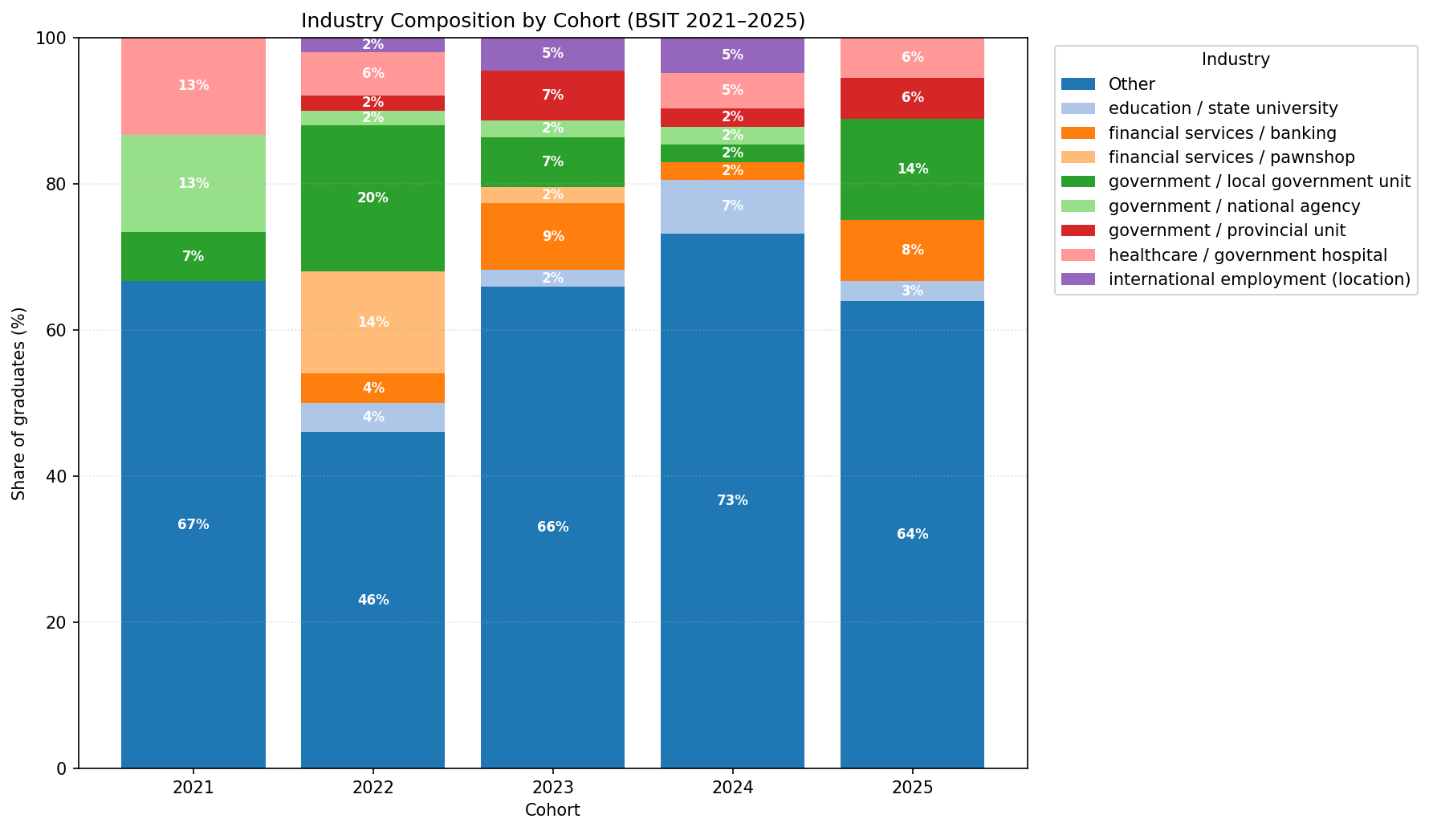
3.4. Field of EmploymentThe longitudinal distribution of BSIT graduates across employment industries from 2021 to 2025 highlights a versatile workforce capable of integrating into a broad spectrum of sectors, with a significant majority consistently falling under the "Other" category (ranging from 46% to 73%). This dominant segment underscores the program's adaptability, as graduates permeate various niche industries that collectively represent the largest share of employment. Beyond this diversified placement, public sector engagement emerges as a primary and stable trend, with local government units and national agencies consistently serving as the second-strongest employer base, peaking at a combined 34% in 2022. These public sector roles, alongside steady intake from the education (up to 9%), financial services (up to 8%), and healthcare (up to 6%) sectors, reinforce the program’s alignment with essential institutional information management needs. While international employment remains a recurring but minor pathway, the overall data reflects a healthy convergence of academic training and labor market demand, providing strong evidence of graduate adaptability and sustained employability.
Summary
The five-year longitudinal analysis of BSIT graduate outcomes from 2021 to 2025 demonstrates a resilient and adaptable program, characterized by strong workforce absorption and a progressive recovery in job relevance following post-pandemic shifts. While employment rates peaked at 77.61% in 2022 and showed institutional resilience through 2024, the degree of curricular alignment also trended upward, reaching 73.8% relevance as graduates secured specialized roles in software engineering and technical management. Sectoral data reveals a balanced distribution between the public and private sectors, with graduates effectively supporting diverse ICT infrastructures in government, education, and finance. Despite temporary data gaps in the emerging 2025 cohort, the overall findings provide a robust performance baseline of sustained employability and industry responsiveness, directly validating the program’s quality and its strategic alignment with global labor market demands.
The longitudinal assessment of the BSIT program from 2021 to 2025 establishes a compelling narrative of institutional resilience and market responsiveness. The data confirms that the program consistently produces graduates who are not only readily absorbed by the workforce—peaking at a 77.61% employment rate—but are also increasingly securing roles that directly utilize their specialized technical training. Despite the economic volatility of the post-pandemic era, the program has demonstrated a successful recovery in job relevance, reaching a high of 73.8% in 2024. Furthermore, the balanced distribution of alumni across public and private sectors underscores a versatile curriculum that meets the digitalization needs of government agencies and the technical demands of private industry alike. Collectively, these findings provide a robust, data-driven performance baseline that validates the program's quality, proving that the College of Information Technology Education is effectively bridging the gap between academic preparation and global labor market requirements. This study provides a data-driven basis for improving educational assessment and designing effective alumni tracking systems that align curriculum outcomes with labor market needs.
To sustain this trajectory of excellence and strengthen graduate outcomes, the College should transition to a permanent, data-driven Alumni Engagement Ecosystem by appointing a dedicated coordinator and a student-led "Trace Team" to maintain a centralized, cloud-based tracking portal. This system should integrate formal survey data with real-time professional insights from platforms like LinkedIn and Messenger to bridge existing documentation gaps. To improve longitudinal response rates, the college should implement an incentivized engagement strategy, by offering alumni exclusive access to digital resources and professional development opportunities in exchange for their participation. Furthermore, establishing a formal Industry-Alumni Advisory Board will institutionalize a continuous feedback loop, ensuring that technical training and resource allocation remain strictly aligned with the evolving digitalization needs of the modern workforce.
Deepest gratitude is extended to the University Administration, led by President Wilfredo A. Dumale, Jr., for their unwavering support and for providing the institutional framework necessary to realize this study. Sincere appreciation is likewise expressed to the Research Study Team for their seamless cooperation and collective dedication to the project’s objectives. Furthermore, profound thanks are due to the Alumni for their invaluable participation as respondents were essential to the success of this research.
| [1] | Quitevis, M. C. (2019). Tracer study of Information Technology graduates: A basis for curriculum enhancement. International Journal of Computing Sciences Research, 3(2), 45–58. | ||
| In article | |||
| [2] | Cuadra, L. J., Aure, A. J. C., & Rivera, G. L. (2019). Performance of business graduates in the licensure examination: A tracer study. Journal of Social Sciences and Humanities, 5(1), 12–25. | ||
| In article | |||
| [3] | Dela Cruz, R. S. (2022). Bridging the gap: Evaluating the alignment of Information Technology curricula with industry 4.0 demands in the Philippines [Unpublished doctoral dissertation]. Philippine Normal University. | ||
| In article | |||
| [4] | Kherani, A. N., Memon, S., & Shaikh, A. (2025). Digital transformation in higher education: Implementing automated alumni tracking and engagement systems. International Journal of Educational Technology and Learning, 19(2), 104–118. | ||
| In article | |||
| [5] | Yunanto, P. W., Rosyid, H. A., Ducha, N., & Mi’roj, I. Z. (2021). Web-based tracer study application for monitoring graduate outcomes. IOP Conference Series: Materials Science and Engineering, 1098, 052107. | ||
| In article | View Article | ||
| [6] | Babu, P., Deepadharshini, G., Priya, S. D., & Janani, A. (2022). Automated alumni data tracking system. International Journal of Health Sciences, 6(S8), 9978. | ||
| In article | View Article | ||
| [7] | Politis, D., Aaboen, L., & Eide, A. E. (2024). Re-viewing entrepreneurial universities through alumni engagement. Small Business Economics, 63, 655–671. | ||
| In article | View Article | ||
| [8] | Rubejes-Silva, S. M. (2024). Bridging the gap between universities and alumni: A user-centered evaluation of a digital alumni engagement platform. Journal of Innovative Technology Convergence, 6(2). | ||
| In article | View Article | ||
| [9] | Carillo, A. D. A., Orquesta, R. D., Bugao, D. A., & Estioco, M. M. (2025). Graduate outcomes and employability study of BS Information Technology alumni: A tracer analysis from 2019 to 2024. International Journal on Science and Technology (IJSAT), 16(4). https://www.ijsat.org/papers/2025/4/9404.pdf. | ||
| In article | View Article | ||
| [10] | Leow, A., Tan, L., & Lim, H. (2021). The role of social influence in alumni engagement: Examining behavioural intention and digital platform usage. International Journal of Research and Innovation in Social Science. https:// rsisinternational.org/ journals/ijriss/articles/the-role-of-social-influence-in-alumni-engagement-examining-behavioural-intention-and-digital-platform-usage/. | ||
| In article | |||
| [11] | Jaiswal, S., Gaud, S., Ansari, S., & Gaikwad, R. (2021). Alumni tracking system. International Research Journal of Engineering and Technology (IRJET), 8(4), 2490–2492. https:// www.irjet.net/ archives/V8/i4/IRJET-V8I490.pdf. | ||
| In article | |||
| [12] | United Nations. (2015). Transforming our world: The 2030 agenda for sustainable development. https://sdgs.un.org/goals. | ||
| In article | |||
| [13] | Commission on Higher Education. (2024). The ACHIEVE agenda: Strengthening higher education through quality assurance and global competitiveness. https://www.ched.gov.ph. | ||
| In article | |||
| [14] | Nueva Vizcaya State University. (2022). College of Information Technology Education (CITE) R&D agenda: Strategic pathways for digital transformation and alumni tracking. NVSU Internal Publication. | ||
| In article | |||
Published with license by Science and Education Publishing, Copyright © 2026 Bartolome Laarnie O., Bisquera Carmelo Alejo D., Robles Michael John R., Segundo Carlita G., Tito Paul Louie L. and Wais Armilyn H.
 This work is licensed under a Creative Commons Attribution 4.0 International License. To view a copy of this license, visit
http://creativecommons.org/licenses/by/4.0/
This work is licensed under a Creative Commons Attribution 4.0 International License. To view a copy of this license, visit
http://creativecommons.org/licenses/by/4.0/
| [1] | Quitevis, M. C. (2019). Tracer study of Information Technology graduates: A basis for curriculum enhancement. International Journal of Computing Sciences Research, 3(2), 45–58. | ||
| In article | |||
| [2] | Cuadra, L. J., Aure, A. J. C., & Rivera, G. L. (2019). Performance of business graduates in the licensure examination: A tracer study. Journal of Social Sciences and Humanities, 5(1), 12–25. | ||
| In article | |||
| [3] | Dela Cruz, R. S. (2022). Bridging the gap: Evaluating the alignment of Information Technology curricula with industry 4.0 demands in the Philippines [Unpublished doctoral dissertation]. Philippine Normal University. | ||
| In article | |||
| [4] | Kherani, A. N., Memon, S., & Shaikh, A. (2025). Digital transformation in higher education: Implementing automated alumni tracking and engagement systems. International Journal of Educational Technology and Learning, 19(2), 104–118. | ||
| In article | |||
| [5] | Yunanto, P. W., Rosyid, H. A., Ducha, N., & Mi’roj, I. Z. (2021). Web-based tracer study application for monitoring graduate outcomes. IOP Conference Series: Materials Science and Engineering, 1098, 052107. | ||
| In article | View Article | ||
| [6] | Babu, P., Deepadharshini, G., Priya, S. D., & Janani, A. (2022). Automated alumni data tracking system. International Journal of Health Sciences, 6(S8), 9978. | ||
| In article | View Article | ||
| [7] | Politis, D., Aaboen, L., & Eide, A. E. (2024). Re-viewing entrepreneurial universities through alumni engagement. Small Business Economics, 63, 655–671. | ||
| In article | View Article | ||
| [8] | Rubejes-Silva, S. M. (2024). Bridging the gap between universities and alumni: A user-centered evaluation of a digital alumni engagement platform. Journal of Innovative Technology Convergence, 6(2). | ||
| In article | View Article | ||
| [9] | Carillo, A. D. A., Orquesta, R. D., Bugao, D. A., & Estioco, M. M. (2025). Graduate outcomes and employability study of BS Information Technology alumni: A tracer analysis from 2019 to 2024. International Journal on Science and Technology (IJSAT), 16(4). https://www.ijsat.org/papers/2025/4/9404.pdf. | ||
| In article | View Article | ||
| [10] | Leow, A., Tan, L., & Lim, H. (2021). The role of social influence in alumni engagement: Examining behavioural intention and digital platform usage. International Journal of Research and Innovation in Social Science. https:// rsisinternational.org/ journals/ijriss/articles/the-role-of-social-influence-in-alumni-engagement-examining-behavioural-intention-and-digital-platform-usage/. | ||
| In article | |||
| [11] | Jaiswal, S., Gaud, S., Ansari, S., & Gaikwad, R. (2021). Alumni tracking system. International Research Journal of Engineering and Technology (IRJET), 8(4), 2490–2492. https:// www.irjet.net/ archives/V8/i4/IRJET-V8I490.pdf. | ||
| In article | |||
| [12] | United Nations. (2015). Transforming our world: The 2030 agenda for sustainable development. https://sdgs.un.org/goals. | ||
| In article | |||
| [13] | Commission on Higher Education. (2024). The ACHIEVE agenda: Strengthening higher education through quality assurance and global competitiveness. https://www.ched.gov.ph. | ||
| In article | |||
| [14] | Nueva Vizcaya State University. (2022). College of Information Technology Education (CITE) R&D agenda: Strategic pathways for digital transformation and alumni tracking. NVSU Internal Publication. | ||
| In article | |||