Modern applications rely heavily on HTTP-based communication for microservices, third-party integrations, and backend services. Inefficient management of HTTP connections often leads to high latency, resource exhaustion, and reduced throughput. Optimizing HTTP connection pool settings is one of the most effective ways to enhance application performance and stability.
With the growth of microservices architectures, applications no longer perform all operations internally. Instead, they depend on multiple downstream APIs for data retrieval, authentication, and business logic. Every such network call involves establishing and maintaining an HTTP connection can introduce latency if not managed efficiently.
Each new connection requires a TCP handshake, mandatory TLS/SSL negotiation for HTTPS connections (as is standard in modern applications), and resource allocation on both client and server. If these connections are created and destroyed for every request, the cumulative overhead becomes significant—especially in high-throughput environments like API gateways, web applications, or backend microservices.
API latency is one of the most visible performance indicators for both end-users and system operators. High latency not only slows down response times but can cascade through dependent services, amplifying system-wide delays. For customer-facing applications, even a small latency increase (for example, 100ms per call) can degrade user experience and reduce conversions. For backend services, latency directly affects throughput, CPU utilization, and infrastructure costs.
2.1. Why HTTP Connection Pool Optimization MattersOptimizing HTTP connection pool settings minimizes these latency bottlenecks by reusing existing TCP connections instead of creating new ones for each request. This reduces round-trip times, lowers CPU usage, and improves response predictability. A well-tuned connection pool allows the application to handle more requests concurrently without scaling hardware resources, ensuring high performance under varying load conditions.
In essence, connection pooling transforms network performance from a potential bottleneck into a competitive advantage—allowing systems to operate faster, more reliably, and more cost-effectively.
An HTTP connection pool is a managed cache of reusable TCP connections that sit between an application (client) and a downstream server (service). Instead of creating and closing a new connection for every HTTP request, a connection pool keeps existing connections alive for reuse by future requests to the same host.
3.1. Lifecycle of a HTTP Connection in the Pool1. Initialization
When the application starts or makes its first HTTP call, a pool manager (such as Apache Http Client’s Pooling Http Client Connection Manager or Java’s Http Client) initializes a small set of connections.
2. Connection Acquisition
When a new request is made, the pool checks for available (idle) connections for the target host:
• If an idle connection exists, it is reused immediately.
• If not, and the pool has not reached its maximum size, a new connection is created.
• If the pool is full, the request waits in a queue until a connection becomes available.
3. Request Execution
The HTTP request is sent over the selected connection, which remains open throughout the transaction.
4. Connection Release
Once the response is fully read, the connection is returned to the pool for reuse, unless it’s stale or closed by the server.
5. Idle Connection Management
Connections that remain unused for too long are closed to free up system resources. This is governed by idle timeout policies.
6. Pool Eviction and Validation
The pool periodically validates active connections to remove broken or expired ones, ensuring only healthy connections are reused.
3.2. Advantages of Pooled HTTP ConnectionsReduced connection setup overhead (fewer TCP/TLS handshakes).
Stable latency under load, as connections are already warmed up.
Improved concurrency, since multiple threads can share a pool efficiently.
Reduced resource consumption, avoiding repeated socket creation.
Tuning the right parameters ensures optimal performance without overloading the system or downstream servers.
4.1. Max Total HTTP ConnectionsMaximum number of connections the pool can maintain across all hosts.
• Performance Impact: It determines the overall parallelism the client can achieve. Too low causes blocking; too high increases memory usage.
• Tuning Guidance: Set based on concurrent request volume and thread count. Typically 2–3x the number of concurrent worker threads.
4.2. Max HTTP Connections Per RouteMaximum number of connections to a specific host (route).
• Performance Impact: Controls load distribution to a specific downstream service.
• Tuning Guidance: Tune per endpoint; match downstream service capacity.
4.3. HTTP Connection TimeoutTime allowed to establish a new connection.
• Performance Impact: Long values can cause thread blocking; short values trigger retries.
• Tuning Guidance: Use 1–5 seconds in internal networks; longer for remote APIs.
4.4. Socket TimeoutTime to wait for a response after connection is established.
• Performance Impact: Too low causes premature timeouts; too high delays error detection.
• Tuning Guidance: Tune based on expected downstream response time + buffer (e.g., 2× average latency).
4.5. Idle HTTP Connection TimeoutDuration a connection can remain idle before being closed.
• Performance Impact: Prevents resource leakage and stale connections.
• Tuning Guidance: Typically 30–60 seconds for most APIs
4.6. Keep-Alive DurationHow long a connection stays open for reuse before it’s closed.
• Performance Impact: Longer duration reduces connection churn; too long may retain dead sockets.
• Tuning Guidance: 30–120 seconds, or align with server Keep-Alive header.
4.7. HTTP Connection Request TimeoutMaximum wait time for a connection from the pool when all are busy.
• Performance Impact: Prevents thread starvation under load.
• Tuning Guidance: 500–2000 ms recommended, depending on concurrency.
4.8. Eviction PolicyDetermines when idle or expired connections are cleaned up.
• Performance Impact: Improves stability under fluctuating loads.
• Tuning Guidance: Enable periodic validation (e.g., every 30 seconds).
4.9. Validation on Borrow/ReturnWhether to check if a connection is still alive before reuse.
• Performance Impact: Prevents reuse of stale connections but adds minor overhead.
• Tuning Guidance: Enable for long-lived pools or flaky networks.
Optimizing connection pool settings can significantly improve performance in the following ways:
• Throughput Increase: Applications handle higher request volumes without scaling infrastructure.
• Reduced Latency: Reusing warm connections minimizes handshake overhead.
• Stability Under Load: Prevents thread starvation and connection thrashing.
• Cost Efficiency: Optimized pools reduce the need for additional compute resources.
Case studies and benchmarks consistently show performance gains of 20-40% throughput improvements after proper tuning. The real-world implementation (see Section 7) confirms this behavior.
• Align with Workload: Tune maximum connections based on expected request concurrency and peak traffic patterns.
• Respect Downstream Limits: Match pool size with backend service capacity to avoid overloading downstream systems.
• Monitor Metrics: Continuously observe connection utilization, latency, error rates, and timeout exceptions.
• Environment-Specific Tuning: Use different configurations for development, staging, and production workloads.
• Fail-Fast Strategy: Configure reasonable timeouts to detect failures quickly and trigger retries or fallbacks.
During performance tuning activities in a production environment, targeted optimizations were implemented to our HTTP connection pool configuration. The system was previously operating with conservative connection limits and a short keep-alive interval, which led to frequent connection churn and elevated latency under load.
The following configuration changes were introduced:
Max Connections Per Route: Increased from 50 to 250
Max Total Connections: Increased from 250 to 1000
Keep-Alive Duration: Increased from 1 second to 30 seconds
These adjustments enabled more efficient reuse of existing TCP connections, reduced the need for frequent connection establishments, and allowed the application to handle a larger number of concurrent requests more effectively.
Observed Results
After deployment and monitoring in production, the following performance improvements were recorded:
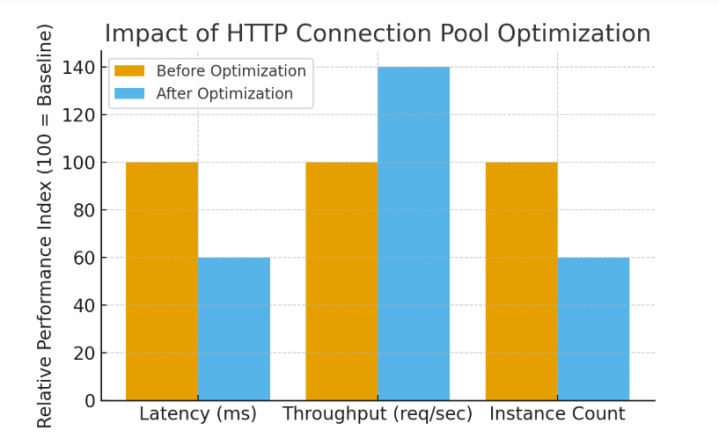
Average API latency decreased by approximately 40%, leading to noticeably faster response times.
Overall throughput increased by 40%, allowing the system to process a significantly higher number of requests per second.
Production instance count was reduced by 40%, as each instance could now handle more load efficiently due to reduced connection overhead.
The following chart visualizes the impact of the optimization on key performance indicators:

The performance improvements can be directly attributed to better utilization of persistent connections and reduced connection setup overhead. Increasing the connection pool size ensured adequate parallelism for concurrent traffic bursts, while extending the keep-alive duration minimized the latency cost associated with new TCP and SSL handshakes.
In addition to raw performance gains, the optimization also improved infrastructure efficiency, as fewer compute instances were needed to handle the same workload. This translated into both cost savings and greater system stability under high load conditions.
• Java (Apache HttpClient, OkHttp, Spring RestTemplate/WebClient)
• Built-in pooling with configurable max connections and timeouts.
• .NET HttpClientFactory
• Provides automatic connection pooling and lifetime management.
• Node.js (Axios, Got, Native HTTP/2)
• Supports connection reuse and configurable agent pooling.
• TestNG framework for Concurrency Testing.
• Monitoring Tools: APMs like Dynatrace, New Relic, Prometheus + Grafana provide insights into pool behavior.
• High-Traffic APIs: Handling thousands of concurrent API calls with minimal latency.
• Microservices Communication: Reducing network overhead between services.
• Cloud-Native Applications: Optimizing limited container resources (CPU/memory).
• Third-Party Integrations: Maintaining stability when external APIs enforce rate limits.
HTTP connection pooling is a critical performance lever for modern applications. Properly optimized pool settings lead to:
• Improved scalability and throughput.
• Lower infrastructure costs.
• More resilient and responsive systems.
A systematic approach—monitoring, tuning, and aligning settings with real-world workloads—ensures applications achieve maximum efficiency and stability.
| [1] | Fielding, R. T., & Reschke, J. (2014). Hypertext Transfer Protocol (HTTP/1.1): Semantics and Content. RFC 7231, Internet Engineering Task Force (IETF). https:/ datatracker. ietf.org/doc/html/rfc7231. | ||
| In article | View Article | ||
| [2] | Reschke, J. (2014). Hypertext Transfer Protocol (HTTP/1.1): Persistent Connections. RFC 7230, Internet Engineering Task Force (IETF). https://datatracker.ietf.org/doc/html/rfc7230. | ||
| In article | |||
| [3] | Google Cloud Architecture Framework (2023). Performance Efficiency – API Design and Optimization. https:// cloud. google.com/ architecture/framework/performance. | ||
| In article | |||
| [4] | AWS Architecture Blog (2022). Optimizing API performance using persistent connections and connection pooling. https://aws.amazon.com/blogs/architecture. | ||
| In article | |||
| [5] | Netflix Tech Blog (2021). Reducing Latency in Microservice Communication at Scale. https:// netflixtechblog.com | ||
| In article | |||
| [6] | Spring Framework Documentation (2024). RestTemplate and WebClient Connection Pool Tuning Guide. https:// docs.spring.io/ spring-framework/reference/integration/rest-clients.html. | ||
| In article | |||
| [7] | Akamai Technologies (2023). The Impact of Latency on Web Application Performance. https:// www.akamai.com/ resources/ research. | ||
| In article | |||
| [8] | Datadog Engineering Blog (2023). Diagnosing and Tuning HTTP Connection Pools in High-Traffic APIs. https:// www. datadoghq.com/ blog/engineering/. | ||
| In article | |||
| [9] | Jafar Inamdar, “Concurrency Testing Using TestNG Framework”, Journal of Computer Sciences and Applications, 2025, Vol. 13, No. 1, 37-40. https://pubs.sciepub.com/jcsa/13/1/4/. | ||
| In article | View Article | ||
Published with license by Science and Education Publishing, Copyright © 2025 Jafar Inamdar
 This work is licensed under a Creative Commons Attribution 4.0 International License. To view a copy of this license, visit
http://creativecommons.org/licenses/by/4.0/
This work is licensed under a Creative Commons Attribution 4.0 International License. To view a copy of this license, visit
http://creativecommons.org/licenses/by/4.0/
| [1] | Fielding, R. T., & Reschke, J. (2014). Hypertext Transfer Protocol (HTTP/1.1): Semantics and Content. RFC 7231, Internet Engineering Task Force (IETF). https:/ datatracker. ietf.org/doc/html/rfc7231. | ||
| In article | View Article | ||
| [2] | Reschke, J. (2014). Hypertext Transfer Protocol (HTTP/1.1): Persistent Connections. RFC 7230, Internet Engineering Task Force (IETF). https://datatracker.ietf.org/doc/html/rfc7230. | ||
| In article | |||
| [3] | Google Cloud Architecture Framework (2023). Performance Efficiency – API Design and Optimization. https:// cloud. google.com/ architecture/framework/performance. | ||
| In article | |||
| [4] | AWS Architecture Blog (2022). Optimizing API performance using persistent connections and connection pooling. https://aws.amazon.com/blogs/architecture. | ||
| In article | |||
| [5] | Netflix Tech Blog (2021). Reducing Latency in Microservice Communication at Scale. https:// netflixtechblog.com | ||
| In article | |||
| [6] | Spring Framework Documentation (2024). RestTemplate and WebClient Connection Pool Tuning Guide. https:// docs.spring.io/ spring-framework/reference/integration/rest-clients.html. | ||
| In article | |||
| [7] | Akamai Technologies (2023). The Impact of Latency on Web Application Performance. https:// www.akamai.com/ resources/ research. | ||
| In article | |||
| [8] | Datadog Engineering Blog (2023). Diagnosing and Tuning HTTP Connection Pools in High-Traffic APIs. https:// www. datadoghq.com/ blog/engineering/. | ||
| In article | |||
| [9] | Jafar Inamdar, “Concurrency Testing Using TestNG Framework”, Journal of Computer Sciences and Applications, 2025, Vol. 13, No. 1, 37-40. https://pubs.sciepub.com/jcsa/13/1/4/. | ||
| In article | View Article | ||