The positive trend in acceptability among advancing year levels suggests a concept of progressive user engagement, emphasizing the significance of strategic onboarding and continuous user engagement initiatives. Through observation, it has been noted that students display a lack of enthusiasm and participation during programs, especially when organized by student leaders. The attendance records further suffer, as some students either do not attend or, in more concerning instances, falsify their presence. this study is a descriptive-inferential approach. Descriptive statistics will be utilized to present fundamental characteristics of the data, offering simple summaries about the sample and measures. The results, as determined by the Kruskal-Wallis analysis of acceptability among different courses (BSA, BSHM, and BTLED), uncover opportunities for optimization. Recognizing that each academic discipline may have unique preferences, tailoring specific features or providing targeted support to the BSA group could further enhance overall system acceptance. Campus organizations such as the Student Government Organization demonstrate particularly high acceptability, emphasizing the system's positive impact within specific groups. The Technology Acceptance Model (TAM) has been proven to be a theoretical model to explain students’ acceptance, which was based on perceived usefulness and perceived ease of use, and will be applied.
Student attendance in higher education institutions is a factor that impacts academic performance 1. In higher education institutions, student participation in the classroom is directly related to their academic performance 2. The regular attendance system continued in the educational system where the instructor announced the name of every single student and marked the attendance, causing time wastage during address time 3. The attendance or attendance system is a recording or provision of information on a person's presence which indicates that the person has provided information about his presence and absence. It is stated in the form of an attendance report 4. Attendance records are one of the main administrative roles on campuses. Therefore, several technologies can be used in an attendance system, including barcode, radio frequency identification (RFID), fingerprint, and faceprint 5. Attending activities organized by the university or institution is one of the important criteria students must fulfill for multiple purposes. Whether it is by attending classes or other activities, the main concern is focused on recording students’ attendance 6.
With traditional attendance tracking methods being time-consuming and inefficient, QR codes have become increasingly popular as a quick and efficient alternative 7. A QR-based attendance system is a modern way of tracking attendance in schools, universities, and other organizations. It uses QR codes to identify students, teachers, and other staff members, making it a fast and efficient way to keep track of attendance 8. Attendance monitoring system is an essential element in all organizations and is considered as an integral part of efficient organizational information systems 9. QR code as an attendance checker was environment-friendly, cost-effective, user-friendly, innovative, very fast, and readable codes 10. Wireless attendance monitoring system is a system developed to track student attendance during school days 11.
Managing attendance during events organized by student leaders presents a formidable challenge. The conventional method of handwritten attendance is vulnerable to inaccuracies, as students may easily manipulate their presence by signing in and leaving early. In response to this challenge, this study seeks to evaluate the feasibility and acceptance of QR Code Recognition technology for tracking attendance at school events, specifically from the perspective of student leaders with their advisers.
Recognizing the need for a more reliable and efficient attendance tracking system, this study explores the feasibility and acceptability of utilizing QR Code Recognition technology for school events from the perspective of student leaders. By addressing the issue of dishonesty in attendance reporting, the implementation of QR Code Recognition aims to enhance the accuracy and integrity of attendance records, ultimately fostering a more transparent and accountable environment within the university community.
Quirino State University, Maddela Campus, has implemented a QR-based identification system for all students, serving as their gateway to access the university premises. Dr. Winston G. Domingo, a proficient programmer and IT specialist within the university, played a pivotal role in programming and implementing this QR-based recognition system. The foundation of this study is rooted in the QR ID system developed by Dr. Domingo, and its potential extension holds significant promise for the benefit of student leaders at the university.
Through observation, it has been noted that students display a lack of enthusiasm and participation during programs especially when organized by student leaders. The attendance records further suffer, as some students either do not attend or in more concerning instances, falsify their presence. This lack of cooperation is driven by the perception that their attendance cannot be accurately tracked, and students believe that student leaders lack the authority to mark them absent. The proposal for the acceptability of QR Code recognition serves as a strategic tool to address these challenges, providing student leaders with the means to accurately track every student's attendance and maintain correct records within the university and their respective organizations.
1.1. Research QuestionsThis study aims to determine the level of acceptance of QR Code Recognition as Attendance Monitoring on School Activities: Student organization officers.
Specifically, the study seeks to answer the following questions:
1. What is the profile of the respondents in terms of;
a. Sex
b. Course
c. Year level, and
d. Campus Organization involved?
2. What is the level of acceptance of the developed QR Code Recognition attendance system based on?
a. Perceive Usefulness;
b. Perceive ease of use;
c. Behavioral intention of use?
3. Is there a significant difference in the developed system when grouped according to profile?
4. Difference in the Level of Acceptance across the 3 domains (Perceive Usefulness, Perceive Ease of Use, Behavioral Intention of Use)?
1.2. Research hypothesisThere is no significant difference in the developed computerized system for the student leaders from Quirino State University – Maddela Campus.
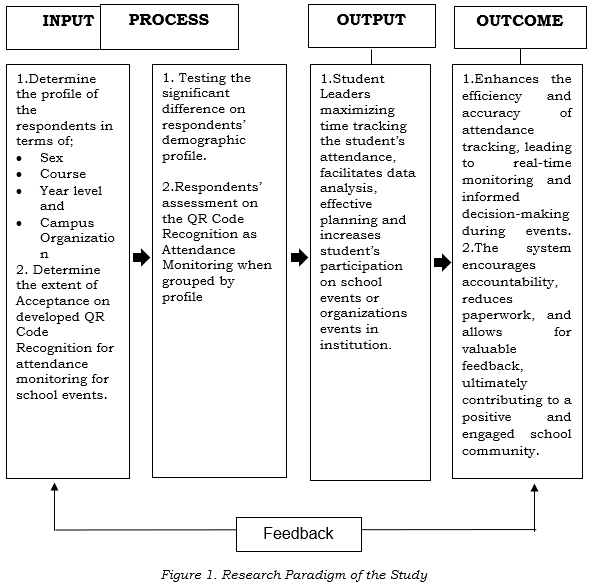
1.3. Research ParadigmFigure 1 The research paradigm of the study illustrates how the study will be conducted. The required input data will include the demographic profile of the respondents in terms of sex, course, and organizational involvement within the institution, with a focus on performance expectancy, effort expectancy, social influence, facilitating conditions, and behavioral intentions.
These data will undergo hypothesis testing to identify significant differences in demographic assessments when using QR Code Recognition as attendance monitoring, grouped by profile. Additionally, the study aims to assess respondents' levels of acceptance across five subdomains. The results are expected to enhance the efficiency and accuracy of attendance tracking, enabling real-time monitoring and informed decision-making during events for the student leaders in charge.
The student leaders are expected to become more reliable in attendance monitoring and enhance the usage of technology, thereby promoting the development of a smart organization/campus. This outcome will provide valuable feedback on the concept of associating a basic efficiency assessment with individual profile characteristics

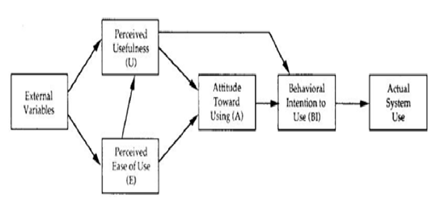
Figure 2. The Technology Acceptance Model, developed by Davis (1989), was one of the most popular research models to predict the use and acceptance of information systems and technology by individual users. In the TAM model, there are two factors, perceived usefulness and perceived ease of use were relevant in computer use behaviors. Davis defines perceived usefulness as the prospective user’s subjective probability that using a specific application system will enhance his or her job or life performance. With the ever-increasing development of technology and its integration into users’ private and professional lives, a decision regarding its acceptance or rejection still remains an open question. A respectable amount of work dealing with the technology acceptance model (TAM), from its first appearance more than a quarter of a century ago, clearly indicates the popularity of the model in the field of technology acceptance 12. The TAM is a model that is widely used to understand the IT adoption and usage process accordingly, and the reason for its popularity is that the model clarifies variances like behavioral intention (BI) relevant to IT appropriation and use over a broad range of settings. The model's main factors for system use were perceived usefulness (PU) and perceived ease of use (PEOU) 13, 14.
The research design for this study was a descriptive-inferential approach. Descriptive statistics will be utilized to present fundamental characteristics of the data, offering simple summaries about the sample and measures. Meanwhile, inferential statistics will be employed to draw conclusions and make generalizations about a larger population based on the collected data. This design is well-suited for investigating the acceptability of QR Code Recognition for Attendance Monitoring among student leaders, assessing the benefits and drawbacks of the system, and describing the profile of student leaders in terms of sex, course, and school organization involvement.
The study explored potential interactions between the independent variable (student leader profiles) and the dependent variable (level of proficiency and acceptability of the QR Code Recognition system). Hypotheses are formulated to test the significance of these relationships. By adopting a descriptive-inferential design, the research seeks to provide valuable insights into the implementation and reception of QR Code Recognition for attendance monitoring in the context of student leadership at Quirino State University- Maddela Campus.
2.1. Research TechniquesThis study employed a survey technique. The survey is defined as the collection of information from a sample of individuals through their responses to questions. This type of research allows for a variety of methods to student leaders, collect data, and utilize various methods of instrumentation.
This study employed a two-part survey questionnaire as its primary research technique. The questionnaires may be self-administered and will encompass a series of items aligned with the research aims. A letter accompanying the questionnaire will be provided to the respondents, seeking their participation and obtaining consent. The letter will also elucidate the research objectives, the purpose for which their data will be used, and the procedures for treating the data in accordance with privacy and ethical considerations.
The first part of the survey collected data on the profile of the respondents, including information on sex, year level, course, and organization involvement. These variables have been identified by the researcher as potential factors that may influence other collected data.
The second part of the survey focused on gathering data regarding the proficiency level of the respondents. This section comprises five subparts, specifically: Perceive of Use, Perceive-ease of Use, and Behavioral Intention of Use. These questions are adapted from the Technology Acceptance Model developed by Davis 13.
2.3. Respondents and Sampling ProcedureThe respondents for this study consist of 77 student leaders elected during the 1st Semester of the academic year 2023-2024 at Quirino State University-Maddela Campus. These student leaders were selected as they offer a diverse representation of leadership within the student body, providing a well-rounded perspective on the acceptability of QR Code Recognition for attendance monitoring in school events and programs. The sampling procedure involves a comprehensive inclusion of all elected student leaders during the specified semester, ensuring that various leadership roles, courses, and organizational affiliations are represented in the study. This approach captured a holistic view of the student leaders' perspectives and experiences related to the implementation of the QR Code Recognition system.
Data processing was performed with ethical considerations. Microsoft Excel will be used for the initial tally and coding of data gathered. It will then be imported to the Statistical Package for Social Sciences (SPSS) for the data analysis since the specific objectives of the study require sophisticated tools.
The data were treated using these statistical methods and tests:
1. Frequency Count and Percentage were used to describe the profile of the respondents as to the sex, year level, course, and organization involvement.
2. Weighted Mean was used to describe the respondents’ level of acceptance of QR Code Recognition as Attendance monitoring across the five domains.
Table 2 presents the profile of 56 student officers within the university using quota samplings in terms of sex, year level, course and organization involve. These 56 respondents were subjected to equitable distribution per perimeter.
Table 3 presents demographic information, showcasing that 58.8% of the respondents are men, while 49.2% are women. In terms of academic courses, 40.7% are enrolled in the College of Agriculture, 37.3% in the College of Hospitality Management, and 22.0% in the College of Teacher Education.
Examining the distribution across academic years, 42.4% are in their third year, 40.7% in their second year, 11.9% in their fourth year, and 5.1% in their first year. Regarding organizational involvement, 20.3% participate in the College of Agriculture Student Council, 16.9% in the Hotelier and Restaurant Association, 18.6% in the Student Teacher Association, 11.9% in the Young Student Farmer Organization, 11.9% in the Movement for the Advancement of Youth Ancestry League, 10.2% in the Socio-Cultural Group, and 10.2% in the Student Government.
Level of acceptance of the developed QR Code Recognition attendance system
Table 3 presents the respondents' level of acceptance in terms of (1) Perceived Usefulness, (2) Perceived Ease of Use, and (3) Behavioral Usefulness. Skills are herein lifted from the survey questionnaire using the Technology Acceptance Model developed by Davis (1989) 13, 14.
Table 4 shows that the comprehensive evaluation of the developed QR Code system reveals a robust and widespread acceptance among respondents across various dimensions. Notably, the Perceived Usefulness aspect underscores the system's pivotal role in efficiently summarizing attendance, improving monitoring processes, and contributing to heightened productivity and effectiveness. The high mean of 3.58 in this domain attests to the participants' strong endorsement of the system's utility. Likewise, the Perceived Ease of Use component underscores the system's user-friendly nature, with a mean of 3.57, reflecting the ease with which respondents can operate the system and obtain attendance summaries effortlessly. The Behavioral Intention to Use dimension further substantiates the positive reception, as respondents express a resolute commitment to utilizing the system for diverse school events, predicting continued usage in future activities, and incorporating it into attendance monitoring plans. The substantial mean of 3.68 in this category highlights a proactive and enthusiastic intention among respondents to integrate the developed QR Code system into their educational activities. Considering the overall perspective, the mean for Overall Acceptance stands at 3.61, reinforcing the notion that the respondents highly endorse the developed QR Code system. This collective approval is further emphasized by the qualitative interpretation placing the system in the "Highly Accepted" category according to the legend. Additionally, the low Standard Deviation across the dataset indicates a consistent and coherent pattern of acceptance among the participants, reinforcing the reliability and uniformity of the positive feedback received. In essence, these findings suggest that the developed QR Code system is not only appreciated for its perceived usefulness, ease of use, and behavioral intention but also enjoys a high level of consensus and consistency among the respondents, solidifying its positive reception.
Information quality has a indirect impact on customer buying decision through perceive ease of use customer 15. impact of advancement of technology, competitive pressure, and user expectation on continues digital disruption using perceive ease of use role as a mediator 16.
Difference in the Level of Acceptance when grouped by Profile
Table 4 present the nonparametric test results reveal an exploration of the asymptotic difference in respondent's acceptance of QR Code Recognition as an attendance monitoring system across various demographic profiles, including sex, course, year level, and organization involvement within the university.
Table 5 examines the significance of variations in the acceptance levels of the QR Code Recognition system among student organization officers, categorized by their respective courses; Bachelor of Science in Agriculture (BSA), Bachelor of Science in Hospitality Management(BSHM), Bachelor of Technology in Livelihood Education (BTLED). The mean rank analysis assigns average rankings to each course group, such as the BSA group with an average rank of 21.05. The H= 10.782, serves as a critical test statistic determining whether the acceptance samples stem from the same distribution.
Consequently, the decision to "Reject Ho" is made, indicating compelling evidence for significant differences in the acceptability of the QR Code Recognition system among student organization officers based on their courses
Table 6 presents the results of pairwise comparisons examining the respondent's level of acceptability of the QR Code Recognition system for attendance monitoring across three courses: BSA, BSHM, and BTLED. The test statistics and significance levels for each pair are provided for insight into the observed differences. The comparison between BSA and BSHM yields a test statistic of -10.224 with a p=0.087. Although the p-value exceeds the common significance level of 0.05, suggesting a lack of statistical significance, the relatively low test statistic indicates a potential difference in acceptability. However, this difference does not reach statistical significance at the 0.05 level. In contrast, the comparison between BSA and BTLED reveals a substantial test statistic of -16.475 with a very low p=0.001. This points to a statistically significant difference in acceptability levels, with respondents from BSA demonstrating lower acceptability compared to those from BTLED. The comparison between BSHM and BTLED results in a test statistic of -6.252 and a p= 0.288. Despite the negative test statistic suggesting a potential difference in acceptability, the lack of statistical significance (p-value > 0.05) indicates that any observed difference between BSHM and BTLED is not statistically meaningful.
These findings offer valuable insights into the nuanced variations in acceptance levels across the different courses, shedding light on the diverse perspectives of student organization officers regarding the attendance monitoring system.
Table 7 presents the Kruskal-Wallis test results assessing the significance of differences in the level of acceptability of the QR Code Recognition system among student organization officers based on their respective year levels (1st year, 2nd year, 3rd year, 4th year). The table provides the mean ranks, H-statistic, significance level (Sig.), and decision for the test. The mean rank analysis reveals varying levels of acceptance across the different year levels. Notably, the 4th-year students have the highest mean rank of 38.86, indicating the highest average acceptance, while 1st-year students have the lowest mean rank of 15.00, suggesting comparatively lower acceptance. The H-statistic, which is 4.445, is associated with a p= 0.217. Since the p-value exceeds the commonly used significance level of 0.05, the decision is to "Fail to reject Ho" (null hypothesis). This implies that there is insufficient evidence to conclude that there are significant differences in the acceptability of the QR Code Recognition system among student organization officers based on their year levels. The decision not to reject the null hypothesis (Ho) implies a lack of statistical evidence supporting significant variations in acceptance levels across different academic years.
Table 8 outlines examining the significance of differences in the level of acceptability of the QR Code Recognition system among student organization officers based on their respective organizations (RSO-SG, YSFO, CACS, HRA, SCG, MAYA, STA). The table includes mean ranks, H-statistic, significance level (Sig.), and the decision for the test. The mean rank analysis illustrates variations in acceptance levels across the different student organizations. Notably, SCG has the highest mean rank of 44.75, indicating the highest average acceptance, while YSFO has the lowest mean rank of 13.86, suggesting comparatively lower acceptance. Since H=15.511 and p= 0.017, the p-value is less than the commonly used significance level of 0.05, the decision is to "Fail to reject Ho" (null hypothesis). This implies that there is insufficient evidence to conclude that there are significant differences in the acceptability of the QR Code Recognition system among student organization officers based on their respective organizations. Kruskal-Wallis test results suggest that the acceptability levels of the QR Code Recognition system do not differ significantly among the various student organizations (RSO-SG, YSFO, CACS, HRA, SCG, MAYA, STA). The decision not to reject the null hypothesis (Ho) indicates a lack of statistical evidence supporting significant variations in acceptance levels across different student organizations.
The technology acceptance model is a widely used model to investigate whether users will accept or refuse a new technology 17. Acceptance type, educational satisfaction, usage enjoyment, and usage experience are the factors that impact perceived usefulness, and educational satisfaction and usage enjoyment impact perceived ease of use as well 18. System quality affects usefulness, service quality effect on usefulness, information quality effect on usefulness, system quality effect user satisfaction, service quality effect on user satisfaction, information quality effect on user satisfaction, and usefulness effect on user satisfaction 19. Decision support, information quality, and real-time reporting are the most significant system characteristics influencing end users' perceived impact and their usage 20
Difference in the Level of Acceptance across the 3 domains (Perceive Usefulness, Perceive-ease of Use, Behavioral Intention of Use)
Table 9 and Table 10 present the nonparametric results on the respondents' level of acceptability across three domains: Perceived Usefulness (PU), Perceived Ease of Use (PEU), and Behavioral Intention to Use (BIU). These tables provide the results of the Technology Acceptance Model (TAM) through the application of the Friedman Analysis and Wilcoxon test. These tests aim to unveil the actual usage of the developed QR Code system for attendance monitoring by student leaders during school activities and events
Information quality, service quality and system quality and perceived usefulness individually determine students’ satisfaction of a QR Code Recognition as Attendance Monitoring on School Activities. The general structural model, which included QR Code Recognition as Attendance Monitoring on School Activities self-efficacy, subjective norm, system accessibility, perceived usefulness, perceived ease of use, attitude, and behavioral intention to use e-learning, was developed based on the technology acceptance model (TAM).
The effects of the relative advantages, complexity, trialability, observability, perceived compatibility, and perceived enjoyment on the perceived usefulness have a strong impact 21. Technology Acceptance Model (TAM) has been proven to be a theoretical model to explain students’ acceptance which are perceived usefulness and perceived ease of use will be applied 22. TAM provides a useful theoretical model to help understand and explain users’ acceptance. Results also indicate that efficiency, playfulness, and students’ degree of satisfaction are factors that positively influence the original TAM variables and students’ acceptance of this technology 23.
The study reveals a significant level of acceptance for the developed system, particularly in the Perceived Ease of Use component. The mean score of 3.57 underscores the system's user-friendly design, indicating that respondents find it easy to navigate and operate. This positive perception suggests that the system aligns well with users' expectations for a seamless and effortless experience. The results, as determined by the Kruskal-Wallis analysis of acceptability among different courses (BSA, BSHM and BTLED) uncovers opportunities for optimization. Recognizing that each academic discipline may have unique preferences, tailoring specific features or providing targeted support to the BSA group could further enhance overall system acceptance. This positive approach ensures that the system is attuned to the diverse needs of students across various courses, fostering a positive user experience for all. The exploration of acceptability across campus organizations unveils positive variations. Campus organizations such as Student Government Organization demonstrate particularly high acceptability, emphasizing the system's positive impact within specific groups. Leveraging these positive organizational sentiments can inform strategies to enhance user engagement, foster positive interactions, and further optimize the system for diverse organizational contexts.
The developed QR Code system has positive response to the Perceived Ease of Use component underscores the importance of a universal user-friendly design, emphasizing intuitive navigation for users with diverse technological backgrounds. Furthermore, the variations in acceptability across different courses introduce the concept of tailoring technological solutions to meet course-specific needs, acknowledging unique preferences within disciplines of the students on school activities and events. The positive trend in acceptability among advancing year levels suggests a concept of progressive user engagement, emphasizing the significance of strategic onboarding and continuous user engagement initiatives. Additionally, the study highlights the importance of inclusive organizational integration, ensuring that the system seamlessly integrates into diverse campus organizations for a positive reception and engagement across various student groups. Overall, these conceptual findings offer a comprehensive roadmap for developers and stakeholders to optimize current systems and inform the design of future technological solutions, fostering a positive and inclusive technological ecosystem within educational institutions.
This study holds the potential to capture the attention of the institution and administrators, urging them to consider policies and programs that are not only relevant but also impactful and responsive to the diverse needs of stakeholders. Consequently, the following enhanced recommendations are put forward. The university should strategically deploy QR code scanners and desktops in areas where activities frequently take place, including the University gymnasium, function halls in each department, the administration conference venue, and organization offices. Expanding the QR Code system to daily operations, such as monitoring the attendance and effectiveness of student leaders in their respective offices, would further optimize its utility. Additionally, leveraging the existing QR Code scanner at the entrance gate for attendance monitoring, the university can enhance its technological infrastructure by deploying smart gadgets and technology throughout the entire campus. To realize this vision of a smart campus, it is imperative for the university to allocate a budget for these gadgets, thereby facilitating a seamless transition towards an advanced and technology-driven educational environment.
The researchers would like to express their heartfelt gratitude to the individuals who contributed to the completion of this study. Their expertise and insights were crucial to the success of this research.
Special thanks are due to the Student Government and Student Organizations, who took part in the implementation of this project. Their collaborative efforts and insightful feedback greatly enhanced the quality of this study.
The researchers are also grateful to the Quirino State University Maddela Campus, for providing the necessary resources and facilities that were essential for conducting this research.
Finally, to the family and friends for their unwavering support and encouragement throughout this journey. Their understanding and patience were deeply appreciated.
| [1] | K. J. Liew and T. H. Tan, “QR Code-Based Student Attendance System,” 2nd Asia Conference on Computers and Communications (ACCC), pp. 10–14, Sep. 2021. | ||
| In article | View Article PubMed | ||
| [2] | A. Nuhi, A. Memeti, F. Imeri, and B. Cico, “Smart Attendance System using QR Code,” 9th Mediterranean Conference on Embedded Computing (MECO), pp. 1–4, Jun. 2020. | ||
| In article | View Article | ||
| [3] | S. Mishra, C. Kumar, A. Ali, and J. Bala, “Online Attendance Monitoring System using QR code (OAMS),” 2021 2nd International Conference on Intelligent Engineering and Management (ICIEM), Apr. 2021. | ||
| In article | View Article | ||
| [4] | A. Iskandar, R. Rahim, H. Matturungan, and N. Mansyur, “Web-based STMIK AKBA Student Attendance Information System by making QR codes an auxiliary medium,” Ceddi Journal of Information System and Technology, vol. 1, no. 2, pp. 24–29, Dec. 2022. | ||
| In article | View Article | ||
| [5] | D. Eridani, E. D. Widianto, I. P. Windasari, W. B. Bawono, and N. F. Gunarto, “Internet of things based attendance system design and development in a smart classroom,” Indonesian Journal of Electrical Engineering and Computer Science, vol. 23, no. 3, p. 1432, Sep. 2021. | ||
| In article | View Article | ||
| [6] | R. A. J. Gining, S. S. M. Fauzi, I. M. Ayub, M. N. F. Jamaluddin, I. Puspitasari, and O. Okfalisa, “Design and development of activity attendance monitoring system based on RFID,” Indonesian Journal of Electrical Engineering and Computer Science, vol. 17, no. 1, p. 500, Jan. 2020. | ||
| In article | View Article | ||
| [7] | M. S. Mohammed and K. A. Zidan, “Enhancing attendance tracking using animated QR codes: a case study,” Indonesian Journal of Electrical Engineering and Computer Science, vol. 31, no. 3, p. 1716, Sep. 2023. | ||
| In article | View Article | ||
| [8] | S. Raut, P. Bhure, P. Bariye, and A. Nandeshwar, “QR CODE BASED ATTENDANCE SYSTEM,” International Research Journal of Modernization in Engineering Technology and Science, Jun. 2023. | ||
| In article | |||
| [9] | [A. Khan, N. Jhanjhi, and M. Humayun, “Secure smart and remote multipurpose attendance monitoring system,” EAI Endorsed Transactions on Energy Web, p. 164583, Jul. 2018. | ||
| In article | View Article | ||
| [10] | J. Carreon, “The Features of Quick Response (QR) Code as an Attendance Monitoring System: Its Acceptability and Implication to Classroom,” ACEID2019 Conference Proceedings, Jan. 2019, Available: https:// www.academia.edu/ 39708387/ The_ Features_ of_Quick_ Response_QR_ Code_as_an_ Attendance_ Monitoring_System_ Its_Acceptability_and_Implication_to_Classroom. | ||
| In article | |||
| [11] | [E. N. O. Amora, K. V. Romero, R. C. Amoguis, J. E. Olandria, E. N. Olandria, and A. M. J. Bernales, “Web-Based Attendance Monitoring System,” International Multidisciplinary Research Journal, vol. 2, no. 4, pp. 145–152, Dec. 2020. | ||
| In article | View Article | ||
| [12] | N. Marangunić and A. Granić, “Technology acceptance model: a literature review from 1986 to 2013,” Universal Access in the Information Society, vol. 14, no. 1, pp. 81–95, Feb. 2014. | ||
| In article | View Article | ||
| [13] | F. D. Davis and A. Granić, The technology acceptance model. 2024. | ||
| In article | View Article | ||
| [14] | J. D. Bryan and T. Zuva, “A review on TAM and TOE framework progression and how these models integrate,” 2021. Available: https:// api.semanticscholar.org/ CorpusID:236608524 | ||
| In article | View Article | ||
| [15] | A. A. W. P. Tyas and N. Nurhasanah, “PENGARUH KEPERCAYAAN, KUALITAS INFORMASI TERHADAP KEPUTUSAN PEMBELIAN MELALUI KEMUDAHAN PADA SITUS JUAL BELI ONLINE,” Jurnal Ekonomi : Journal Og Economic (2019), vol. 10, no. 1, Jul. 2019. | ||
| In article | |||
| [16] | S. Addison, “Impact of advancement of technology, competitive pressure, user expectation on continuous digital disruption: mediating role of perceive ease of use,” Open Journal of Business and Management, vol. 09, no. 04, pp. 2013–1079, Jan. 2021. | ||
| In article | View Article | ||
| [17] | A. M. Aburbeian, A. Y. Owda, and M. Owda, “A Technology Acceptance Model survey of the metaverse prospects,” AI, vol. 3, no. 2, pp. 285–302, Apr. 2022. | ||
| In article | View Article | ||
| [18] | [E. S. Park and M. S. Park, “Factors of the Technology Acceptance Model for Construction IT,” Applied Sciences, vol. 10, no. 22, p. 8299, Nov. 2020. | ||
| In article | View Article | ||
| [19] | D. M. K. Nugraheni and S. F. Bayastura, “Analysis of factors that influence satisfaction and usefulness for attendance system with the Delone & McLean model (case study: attendance system at Diponegoro University),” Journal of Physics Conference Series, vol. 1943, no. 1, p. 012108, Jul. 2021. | ||
| In article | View Article | ||
| [20] | I. S. Nasir, A. H. Mousa, and I. L. H. Alsammak, “SMUPI-BIS: a synthesis model for users’ perceived impact of business intelligence systems,” Indonesian Journal of Electrical Engineering and Computer Science, vol. 21, no. 3, p. 1856, Mar. 2021. | ||
| In article | View Article | ||
| [21] | W. M. Al-Rahmi et al., “Integrating Technology acceptance Model with Innovation Diffusion Theory: An Empirical investigation on students’ intention to use E-Learning systems,” IEEE Access, vol. 7, pp. 26797–26809, Jan. 2019. | ||
| In article | View Article | ||
| [22] | D. Dhagarra, M. Goswami, and G. Kumar, “Impact of trust and privacy concerns on technology acceptance in healthcare: An Indian perspective,” International Journal of Medical Informatics, vol. 141, p. 104164, Sep. 2020. | ||
| In article | View Article PubMed | ||
| [23] | R. Estriegana, J.-A. Medina-Merodio, and R. Barchino, “Student acceptance of virtual laboratory and practical work: An extension of the technology acceptance model,” Computers & Education, vol. 135, pp. 1–14, Jul. 2019. | ||
| In article | View Article | ||
Published with license by Science and Education Publishing, Copyright © 2025 Winston G. Domingo Dit, Charmaine Ruth G Abella Maed and Rishelle B. Nucaza Mdb
 This work is licensed under a Creative Commons Attribution 4.0 International License. To view a copy of this license, visit
http://creativecommons.org/licenses/by/4.0/
This work is licensed under a Creative Commons Attribution 4.0 International License. To view a copy of this license, visit
http://creativecommons.org/licenses/by/4.0/
| [1] | K. J. Liew and T. H. Tan, “QR Code-Based Student Attendance System,” 2nd Asia Conference on Computers and Communications (ACCC), pp. 10–14, Sep. 2021. | ||
| In article | View Article PubMed | ||
| [2] | A. Nuhi, A. Memeti, F. Imeri, and B. Cico, “Smart Attendance System using QR Code,” 9th Mediterranean Conference on Embedded Computing (MECO), pp. 1–4, Jun. 2020. | ||
| In article | View Article | ||
| [3] | S. Mishra, C. Kumar, A. Ali, and J. Bala, “Online Attendance Monitoring System using QR code (OAMS),” 2021 2nd International Conference on Intelligent Engineering and Management (ICIEM), Apr. 2021. | ||
| In article | View Article | ||
| [4] | A. Iskandar, R. Rahim, H. Matturungan, and N. Mansyur, “Web-based STMIK AKBA Student Attendance Information System by making QR codes an auxiliary medium,” Ceddi Journal of Information System and Technology, vol. 1, no. 2, pp. 24–29, Dec. 2022. | ||
| In article | View Article | ||
| [5] | D. Eridani, E. D. Widianto, I. P. Windasari, W. B. Bawono, and N. F. Gunarto, “Internet of things based attendance system design and development in a smart classroom,” Indonesian Journal of Electrical Engineering and Computer Science, vol. 23, no. 3, p. 1432, Sep. 2021. | ||
| In article | View Article | ||
| [6] | R. A. J. Gining, S. S. M. Fauzi, I. M. Ayub, M. N. F. Jamaluddin, I. Puspitasari, and O. Okfalisa, “Design and development of activity attendance monitoring system based on RFID,” Indonesian Journal of Electrical Engineering and Computer Science, vol. 17, no. 1, p. 500, Jan. 2020. | ||
| In article | View Article | ||
| [7] | M. S. Mohammed and K. A. Zidan, “Enhancing attendance tracking using animated QR codes: a case study,” Indonesian Journal of Electrical Engineering and Computer Science, vol. 31, no. 3, p. 1716, Sep. 2023. | ||
| In article | View Article | ||
| [8] | S. Raut, P. Bhure, P. Bariye, and A. Nandeshwar, “QR CODE BASED ATTENDANCE SYSTEM,” International Research Journal of Modernization in Engineering Technology and Science, Jun. 2023. | ||
| In article | |||
| [9] | [A. Khan, N. Jhanjhi, and M. Humayun, “Secure smart and remote multipurpose attendance monitoring system,” EAI Endorsed Transactions on Energy Web, p. 164583, Jul. 2018. | ||
| In article | View Article | ||
| [10] | J. Carreon, “The Features of Quick Response (QR) Code as an Attendance Monitoring System: Its Acceptability and Implication to Classroom,” ACEID2019 Conference Proceedings, Jan. 2019, Available: https:// www.academia.edu/ 39708387/ The_ Features_ of_Quick_ Response_QR_ Code_as_an_ Attendance_ Monitoring_System_ Its_Acceptability_and_Implication_to_Classroom. | ||
| In article | |||
| [11] | [E. N. O. Amora, K. V. Romero, R. C. Amoguis, J. E. Olandria, E. N. Olandria, and A. M. J. Bernales, “Web-Based Attendance Monitoring System,” International Multidisciplinary Research Journal, vol. 2, no. 4, pp. 145–152, Dec. 2020. | ||
| In article | View Article | ||
| [12] | N. Marangunić and A. Granić, “Technology acceptance model: a literature review from 1986 to 2013,” Universal Access in the Information Society, vol. 14, no. 1, pp. 81–95, Feb. 2014. | ||
| In article | View Article | ||
| [13] | F. D. Davis and A. Granić, The technology acceptance model. 2024. | ||
| In article | View Article | ||
| [14] | J. D. Bryan and T. Zuva, “A review on TAM and TOE framework progression and how these models integrate,” 2021. Available: https:// api.semanticscholar.org/ CorpusID:236608524 | ||
| In article | View Article | ||
| [15] | A. A. W. P. Tyas and N. Nurhasanah, “PENGARUH KEPERCAYAAN, KUALITAS INFORMASI TERHADAP KEPUTUSAN PEMBELIAN MELALUI KEMUDAHAN PADA SITUS JUAL BELI ONLINE,” Jurnal Ekonomi : Journal Og Economic (2019), vol. 10, no. 1, Jul. 2019. | ||
| In article | |||
| [16] | S. Addison, “Impact of advancement of technology, competitive pressure, user expectation on continuous digital disruption: mediating role of perceive ease of use,” Open Journal of Business and Management, vol. 09, no. 04, pp. 2013–1079, Jan. 2021. | ||
| In article | View Article | ||
| [17] | A. M. Aburbeian, A. Y. Owda, and M. Owda, “A Technology Acceptance Model survey of the metaverse prospects,” AI, vol. 3, no. 2, pp. 285–302, Apr. 2022. | ||
| In article | View Article | ||
| [18] | [E. S. Park and M. S. Park, “Factors of the Technology Acceptance Model for Construction IT,” Applied Sciences, vol. 10, no. 22, p. 8299, Nov. 2020. | ||
| In article | View Article | ||
| [19] | D. M. K. Nugraheni and S. F. Bayastura, “Analysis of factors that influence satisfaction and usefulness for attendance system with the Delone & McLean model (case study: attendance system at Diponegoro University),” Journal of Physics Conference Series, vol. 1943, no. 1, p. 012108, Jul. 2021. | ||
| In article | View Article | ||
| [20] | I. S. Nasir, A. H. Mousa, and I. L. H. Alsammak, “SMUPI-BIS: a synthesis model for users’ perceived impact of business intelligence systems,” Indonesian Journal of Electrical Engineering and Computer Science, vol. 21, no. 3, p. 1856, Mar. 2021. | ||
| In article | View Article | ||
| [21] | W. M. Al-Rahmi et al., “Integrating Technology acceptance Model with Innovation Diffusion Theory: An Empirical investigation on students’ intention to use E-Learning systems,” IEEE Access, vol. 7, pp. 26797–26809, Jan. 2019. | ||
| In article | View Article | ||
| [22] | D. Dhagarra, M. Goswami, and G. Kumar, “Impact of trust and privacy concerns on technology acceptance in healthcare: An Indian perspective,” International Journal of Medical Informatics, vol. 141, p. 104164, Sep. 2020. | ||
| In article | View Article PubMed | ||
| [23] | R. Estriegana, J.-A. Medina-Merodio, and R. Barchino, “Student acceptance of virtual laboratory and practical work: An extension of the technology acceptance model,” Computers & Education, vol. 135, pp. 1–14, Jul. 2019. | ||
| In article | View Article | ||