 OPEN ACCESS
  PEER-REVIEWED
The Influence of Education on Cancer Pain Reduction: A Systematic Review
Paulo Marques1, , Patrícia Gonçalves2, Elisabete Meira3, Nícia Pereira4, Ana Sousa5
1Center for Health Technology and Services Research (CINTESIS), Nursing School of Porto, Porto, Portugal
2Magalhães Lemos Hospital, Porto, Portugal
3Ave Alto Hospital, Guimarães, Portugal
4Porto, Portugal
5Plastic Surgery Clinic Artlaser, Porto, Portugal
Abstract
Aims: This literature review aims to assess the contribution of pain education in reducing cancer pain. Methods and sample: An electronic search of articles was performed in CINAHL and MEDLINE with Full Text, from 2003 to 2013, using the EBSCOhost motor search at the Porto Nursing School. The studies were selected obeying search limits 'find all my search terms', 'full text', 'adult', ‘portuguese’, ‘english’ and ‘french’ languages, 'Randomised Control Trials', based on the following inclusion criteria: articles whose participants are patients with cancer pain admitted to medical and surgical units or outpatient services, articles whose intervention includes education on pain and articles which report the implications of intervention in cancer pain intensity. Results: Five studies with a high level of evidence were included in the review. Four studies reported a reduction in pain intensity after intervention, three of them with statistically significant pain reduction. Conclusions: Education can be an important resource for the reduction of pain intensity, and can be implemented by different health professionals, particularly nurses. Its implementation is recommended for the reduction of this specific type of pain. Implications for practice: It is hoped that our findings will increase nurses’ awareness of the importance of involving patients in their own care; Pain education may improve patient’s ability to manage their own pain.
At a glance: Figures
Keywords: cancer, neoplasms, pain management, education, nursing
Journal of Cancer Research and Treatment, 2015 3 (1),
pp 6-10.
DOI: 10.12691/jcrt-3-1-2
Received November 28, 2014; Revised January 10, 2015; Accepted January 13, 2015
Copyright © 2015 Science and Education Publishing. All Rights Reserved.Cite this article:
- Marques, Paulo, et al. "The Influence of Education on Cancer Pain Reduction: A Systematic Review." Journal of Cancer Research and Treatment 3.1 (2015): 6-10.
- Marques, P. , Gonçalves, P. , Meira, E. , Pereira, N. , & Sousa, A. (2015). The Influence of Education on Cancer Pain Reduction: A Systematic Review. Journal of Cancer Research and Treatment, 3(1), 6-10.
- Marques, Paulo, Patrícia Gonçalves, Elisabete Meira, Nícia Pereira, and Ana Sousa. "The Influence of Education on Cancer Pain Reduction: A Systematic Review." Journal of Cancer Research and Treatment 3, no. 1 (2015): 6-10.
| Import into BibTeX | Import into EndNote | Import into RefMan | Import into RefWorks |
1. Introduction
Nowadays, the most consensual definition of pain explains this phenomenon as an unpleasant sensory and emotional experience associated with actual or potential tissue damage, or described in terms of such damage [1], and a “symptom that accompanies, in general terms, most pathological situations that require health care” [2]. In this way, it corresponds to a core aspect of the nursing practice.
In the field of health, controlling pain is the duty of all professionals, for which reason they are required to adopt preventive measures and treatment regarding this important issue, for everyone who is under their care, in order to contribute towards their well-being, reducing morbidity and humanizing health care [3].
In spite of the progress made in the diagnosis and treatment of cancer, this pathology continues to generate great discomfort and suffering, due to the physical, emotional, spiritual and emotional wear associated to treatment(s) and the very symptoms caused by this disease [4]. And with regard to this aspect, cancer pain is established as one of the most relevant symptoms, defined in the International [5] as “(…) dull, hurting, aching, frightful or unbearable pain sensation with attach of intensive sensations of pain accompanied by sleep difficulties, irritability, depression, suffering, isolation hopelessness and helplessness”.
According to [6], the pain associated to this condition is a grave source of distress for the over ten million people, who are diagnosed some form of cancer annually around the world. Although the pain is not necessarily unavoidable for everyone with cancer, the presence of this symptom is common. Approximately one third of adults actively receiving cancer treatment and two thirds of those with malignant cancer in an advanced state suffer from pain. Its importance is quite evident due to the fact that the World Health Organisation recognises that access to treatment of cancer pain is an ethical imperative and a right of the patient with cancer, and plays a decisive role in reducing expectation of the inevitable painful suffering pain associated to the disease [7].
Several circumstances lead towards a decrease in the duration of hospital inpatient care, which is one of the most noticeable trends in current health policies, so that the patient and the respective family play an increasingly active role in the different fields of care, for example in pain management. In this sense, the investment on educating patients suffering cancer pain and their carers appears to be a key aspect to effectively manage this type of pain [4]. Educating consists in teaching: giving knowledge of something to somebody [5], and this transmission of knowledge can be performed by providing information, instructions, guidance or advice.
In Portugal, the professional nurse society argues that education, training and learning strategies with regard to pain are essential in order to develop good practices in the different health contexts [8], which is in line with the guidelines on pain management related to cancer in adults. [9] underline that the first step for effective pain management should respect the education of the patient by a multidisciplinary team, allowing him to understand the nature of pain, its treatment and his own role in its management.
Due to the nature and importance of the problem, an interest arose in studying the influence of education regarding pain on reducing cancer pain, also because this was an area of autonomous activity of nursing professionals. The purpose of this systematic review of the literature was to determine how effectively educational intervention on pain contributed towards reducing cancer pain.
2. Methodology
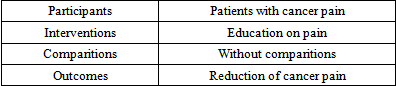
The strategy used for the systematic review was elaborating a PICO (Population, Intervention, Comparison and Outcomes – Table 1) question: “does education on pain contribute towards reducing pain in patients suffering from cancer pain?”. In order to perform this systematic review of the literature, we performed a digital search for articles, on the 17th February 2014, using the EBSCOhost search engine from Porto Nursing School, selecting the following databases: CINAHL and MEDLINE with full text.


 PowerPoint Slide
 Larger image(png format)
 View current table in a new window
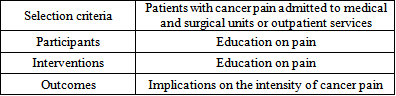
The key terms used were: Cancer (title) and Pain (title) and Management (abstract) and Education (abstract) and Nursing (entire text), with the Boolean operator and, as described, taking into account the search parameters ‘find all my search terms’, ‘full text’, ‘adults’, in the ‘Portuguese’, ‘English’ or ‘French’ language and with a higher level of evidence, namely Randomised Control Trials (RCT), ‘published between 2003 and 2013’. Then, a range of criteria for inclusion was used for the final identification of the sample, according to Table 2.

 PowerPoint Slide
 Larger image(png format)
 View current table in a new window
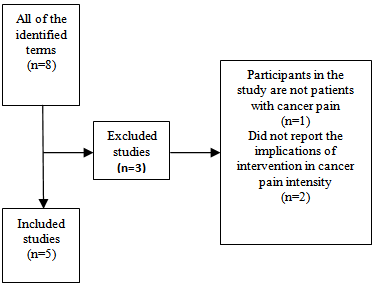
During the first stage eight articles were selected, whose abstract was read and, whenever necessary, the full text. On applying the defined inclusion criteria, three articles were excluded (one because it did not relate to patients with cancer pain and two because they did not report the implications of the intervention on cancer pain intensity), whereby five articles remained and constitute the sample of this study. This process is depicted in the following Figure.

 PowerPoint Slide
 Larger image(png format)
3. Results
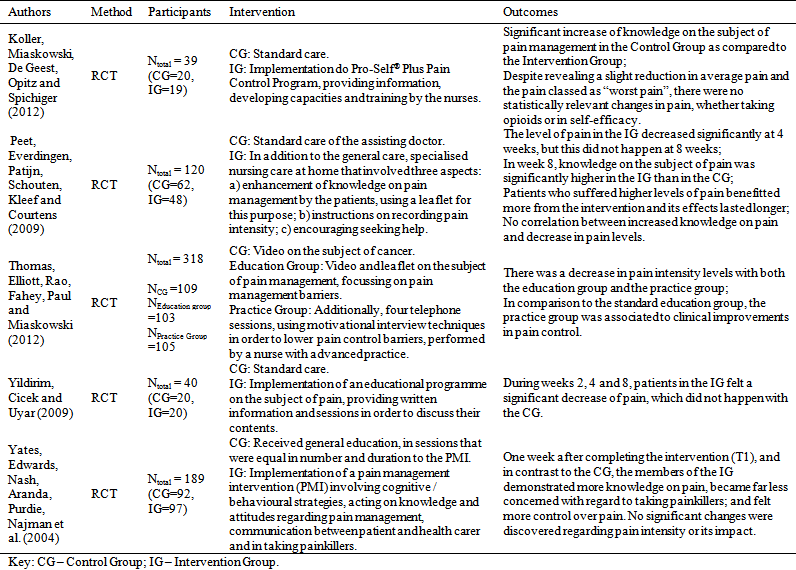
The review performed allowed five articles to be identified (Table 3), which, according to the levels of evidence classification of the [10], is assigned a level of evidence II, corresponding to one of the highest levels. After applying the Critical Appraisal Tool Randomized Trial [10], it was agreed that all articles have a high quality level.
The clinical trials reported in this review were performed in different countries: Germany [11], The Netherlands [12], USA [13]; Turkey [14]; and Australia [15]. The number of participants ranged between 39 and 318, with an average age of about 60, whereby the total study sample amounted to 706 participants. In four researches, the participants were recruited from outpatient services [11, 12, 13, 15] and in the other the participants were obtained from an inpatient hospital unit [14]. In the five articles under analysis, the participants were diagnosed with different cancers, with distinct levels of pain, before the intervention took place. In the studies analysed, the intervention of education on pain essentially touched upon two aspects: a) pain management; and b) barriers to pain management. Interventions were performed by means of providing information, instructions and guidance/advice. Interventions were performed at least in two sessions and, sometimes, with recourse to additional sessions via telephone [11, 13, 15].
The assessment of pain intensity was performed using different instruments, such as: a) numeric pain scale [11, 12, 14]; b) Brief Pain Inventory [13, 15]; and c) McGill Pain Questionnaire [14].
Of the five researches included in this systematic review, four reported reduction in intensity of pain associated to the intervention [11, 12, 13, 14], though in [11] this reduction was not statistically significant. However, in the research performed by [15] no reduction occurred in pain intensity after the intervention.

 PowerPoint Slide
 Larger image(png format)
 View current table in a new window
4. Discussion
The reference [16] advocates that the education of patients, carers and health professionals is essential in order to obtain positive results in the field of pain management. It even considers that educating the patient is an effective strategy for reducing intensity of pain. The meta-analysis developed by [17] points in the same direction, concluding that interventions in the field of education significantly improved knowledge and positive attitudes towards pain and analgesics, as well as reducing the intensity of pain. Although four of the five articles analysed reported a reduction in pain intensity associated to the intervention (three of them with a statistically significant reduction), it is not possible to undeniably state, that these are the conclusions of this review, seeing that the interventions implemented do not relate exclusively to education, which constitutes a serious limitation on the research.
In the analysis of the five selected articles, we see that all of them approach education on pain control as part of a pain management programme. According to The reference [18], pain management programmes are the treatment of choice for people suffering persistent pain that interferes in their quality of life. These programmes consider two essential dimensions: education and guided practices. Education contemplates information about the principles of treatment, the physiology of pain, psychosocial aspects of pain, exercise, promoting the functional capacity of the person and the difficulties with self-management of pain. Guided practice, in turn, consists in setting goals and working towards them, identifying and changing unhelpful beliefs and ways of thinking, relaxation and changing habits which contribute towards disability [18].
In this perspective and taking into account that all the articles examined did consider both dimensions underlying pain management programmes (education and guided practice), we cannot state that the decrease in the intensity of reported pain is exclusively due to education, since it is likely that the guided practice may have also contributed towards that purpose. However, we can say, in view of the results of this review that educational activity on the subject of pain seems to interfere in reducing perceived intensity.
Following examination of the research that has resulted in a clinical reduction of pain intensity, we see that in the research of [11] that reduction was not statistically significant. The authors sought to assess the reliability and outcomes of the Pro-Self® Plus Pain Control Program, in Germany. This programme was developed and initially tested in the USA, via the RCT by [19], on a sample of 174 cancer patients and, as opposed to what happened in the [11] research, reported a significant decrease in pain intensity in the experimental group in contrast to the control group. The fact that the same outcome did not occur in the abovementioned research by [11], may be related to the low number of participants (n=39).
Educational activity seeking to promote knowledge and favourable attitudes in relation to cancer pain have been widely studied, whereby the majority of research report to a combination of: a) a learning session (20-40 minutes); b) provision of written material and, occasionally, c) providing audio-visual material to be seen later at home [18]. According to [9], patients should be educated employing both spoken and written strategies, and it is important to reinforce the information frequently. The analysis of the articles included in this review underscore the relevance of spoken information, providing written documents and using audio-visual means, such as videos.
Also according to [9], education on pain should involve three fundamental fields, which are: a) general overview, which include defining pain, understanding the causes of pain, the importance of early and appropriate treatment, describing pain and using a pain rating scale; b) pharmacological management, encompassing general knowledge about medication used for pain relief, understanding myths and fears related to this matter and controlling the related side effects; and c) non-pharmacological management of pain, which consists in looking into the various existing modalities of non-pharmacological intervention. In the articles analysed, the presence of the definition and causes of pain, pharmacological treatment, myths and fears regarding pain management, strategies to overcome pain control barriers; non-pharmacological and pain assessment and monitoring are noticeable.
Another relevant fact that should be noted is that the research analysed do not assess pain alone, but also anxiety, depression, pain management barriers, self-efficacy, fatigue, general well-being, quality of life and functional capacity, which attests to the multidimensional nature of pain and its importance in order to manage pain.
Despite its acknowledgment that the evidence increasingly points to the importance of education and cognitive-behavioural interventions in relieving pain and adhering to the therapeutic regimen [20], that education should be based on a multidisciplinary approach and constant interaction between the patient, carers and health care professionals.
5. Conclusion
According to the study performed, we can say that education about pain seems to be an important resource in order to reduce cancer pain, and should be included in its treatment.
The challenges involved in caring for these patients are considerable. Because of this review, we are convinced of the need to continue investing in this area with more and better research, but also of the need to apply existing knowledge, in medical practice, which would lead to considerable improvements in people’s health. In Portugal, for example, there is still a long road ahead, for it is necessary to ascertain the general and specific aspects of the Portuguese population, in order to perform the required cultural adjustments. Education should be considered a relevant component, contributing towards promoting the control of cancer pain.
6. Implications for Practice
• It is hoped that our findings will increase nurses’ awareness of the importance of involving patients in their own care, making them active participants in their treatment.
• Pain education may improve patient’s ability to manage their own pain, which can lead to pain reduction.
• More research needs to be carried out on other aspects (beyond the lack of knowledge) that may influence patient’s ability to manage their own pain.
Acknowledgement
We would like to thank the translator James Taylor Sinclair, for his contribution within the scope of this work.
References
| [1] | International Association for the Study of Pain [IASP], 2012. IASP Taxonomy, [Consulted on December 2013]. Available online: <URL: http://www.iasp-pain.org/Education/Content.aspx?ItemNumber=1698&navItemNumber=576#Pain | ||
 In article In article | |||
| [2] | Health Directorate-General [DGS], 2003. Pain as the 5th vital sign. Systematic registration of pain intensity. DGS, Lisbon. | ||
| In article | |||
| [3] | Health Directorate-General [DGS], 2008. National program for pain control. DGS, Lisbon. | ||
| In article | |||
| [4] | Ducci, A.J., Pimenta, C.A.M., 2003. Educational programs and cancer pain. Revista Brasileira de Cancerologia 49(3), 185-192. | ||
| In article | |||
| [5] | International Council of Nurses. International Classification for Nursing Practice [ICNP] (2013 release). [Online] [Consulted March 2014]. Available online: URL:http://www.icn.ch/images/stories/documents/pillars/Practice/icnp/translations/icnp-English translation.pdf. | ||
| In article | |||
| [6] | International Association for the Study of Pain [IASP]. Global Year Against Cancer Pain 2008-2009 (updated 2014). [Consulted on February 2014]. Available online: URL:http://www.iasp-pain.org/Advocacy/GYAP.aspx?ItemNumber=772. | ||
| In article | |||
| [7] | Folhas, G., Oliveira, C., Rato, C., França, C., Ferreira, A.C., 2007. Massage and relaxation for cancer pain relief: project «wellness». Dor 15(1), 37-40. | ||
| In article | |||
| [8] | Council of Nurses, 2008. Pain – Good practice guidance guide. Association of Nurses, Lisbon. | ||
| In article | |||
| [9] | Broadfield, L., Banerjee, S., Jewers, H., Pollett, A.J., Simpson, J., 2005. Guidelines for the Management of Cancer-Related Pain in Adults. Supportive Care Cancer Site Team, Cancer Care Nova Scotia. | ||
| In article | |||
| [10] | The Joanna Briggs Institute, 2011. Joanna Briggs Institute Reviewers’ Manual, 2011 edition. The Joanna Briggs Institute. | ||
| In article | |||
| [11] | Koller, A., Miaskowski, C., De Geest, S., Opitz, O., Spichiger, E., 2013. Results of a randomized controlled pilot study of a self-management intervention for cancer pain. European Journal of Oncology Nursing 17, 284-291. | ||
| In article | |||
| [12] | Peet E.H., Everdingen, M., Patijn, J., Schouten, H.C., Kleef, M., Courtens, A.M., 2009. Randomized Clinical Trial of an Intensive Nursing-based Pain Education Program for Cancer Outpatients Suffering from Pain. Support Care Cancer 17, 1089-1099. | ||
| In article | |||
| [13] | Thomas, M.L., Elliott, J.E., Rao, S.M., Fahey, K.F., Paul, S.M., Miaskowski, C., 2012. A Randomized, Clinical Trial of Education or Motivational-Interviewing-Based Coaching Compared to Usual Care to Improve Cancer Pain Management. Oncology Nursing Forum 39(1), 39-49. | ||
| In article | |||
| [14] | Yildirim, Y.K., Cicek, F., Uyar, M., 2009. Effects of Pain Education Program on Pain Intensity, Pain Treatment Satisfaction, and Barriers in Turkish Cancer Patients. Pain Management Nursing 10(4), 220-228. | ||
| In article | |||
| [15] | Yates, P., Edwards, E., Nash, R., Aranda, S., Purdie, D., Najman, J. [et al.], 2004. A randomized controlled trial of a nurse-administered educational intervention for improving cancer pain management in ambulatory settings. Patient Education and Counseling 53, 227-237. | ||
| In article | |||
| [16] | The British Pain Society, 2010. Cancer Pain Management A perspective from the British Pain Society, supported by the Association for Palliative Medicine and the Royal College of General Practitioners. The British Pain Society, London. | ||
| In article | |||
| [17] | Bennett, M.I., Bagnall, A.M., José Closs S., 2009. How effective are patient-based educational interventions in the management of cancer pain? Systematic review and meta-analysis. Pain 143(3), 192-199. | ||
| In article | |||
| [18] | The British Pain Society, 2007. Recommended Guidelines For Pain Management Programmes For Adults. The British Pain Society, London. | ||
| In article | |||
| [19] | Miaskowski, C., Dodd, M., West, C., Schumacher, K., Paul, S.M., Tripathy, D. et al. 2004. Randomized Clinical Trial of the Effectiveness of a Self-Care Intervention to Improve Cancer Pain Management. Journal of Clinical Oncology 22(9), 1713-1720. | ||
| In article | |||
| [20] | Scottish Intercollegiate Guidelines Network, 2008. Control of Pain in Adults with Cancer A National Clinical Guideline. Scottish Intercollegiate Guidelines Network, Edinburgh. | ||
| In article | |||

 CiteULike
 Mendeley
 StumbleUpon
 Delicious
 Facebook
 Twitter
 LinkedIn
 Print
Print