Despite the significant role of weighbridge projects in enforcing axle load regulations, concerns about inefficiencies, delays, and inadequate stakeholder engagement persist. These obstacles prompt inquiries regarding managerial practices that facilitate or obstruct the attainment of these initiatives. This study examined the effect of project management approaches on the performance of weighbridge projects in Kenya to fill the existing research gap. The investigation sought to evaluate the effect of technology adoption, resource allocation, compliance to regulatory frameworks and stakeholder engagement on performance of weighbridge projects in Kenya. A descriptive approach to research was utilized. The study targeted the 5 weighbridge projects in Kenya with a population of 157 members of the management team of the weighbridge projects in the country. The study used a sample of 113 participants obtained by Yamane’s formula. To gather first-hand information, semi-structured questionnaires were used. Analysis was conducted using SPSS. The analysis included descriptive statistics and inferential statistical methods of correlation and regression analysis. The findings revealed that technology adoption, resource allocation, compliance to regulatory frameworks and stakeholder engagement had a favorable and notable impact on Kenyan weighbridge operations' performance. Based on these findings, it is recommended that weighbridge projects prioritize the adoption of advanced technologies to enhance operational efficiency. Additionally, adequate resource allocation, especially in terms of finances and skilled personnel, should be ensured to support smooth operations. Project managers should also maintain strict compliance with regulatory frameworks to ensure safety, legal adherence, and sustainability. Furthermore, stakeholder engagement should be actively fostered through transparent communication and involvement in decision-making processes.
Weighbridge projects constitute critical infrastructure interventions designed to enforce axle-load regulations, safeguard road networks from premature deterioration, and promote road safety across transportation corridors. By systematically weighing heavy vehicles at strategic checkpoints, these facilities prevent overloading, which accounts for up to 40 % of road damage in many developing economies 1, 2. Effective weighbridge operations therefore contribute directly to reduced maintenance costs, enhanced fair trade, and lower accident rates linked to overloaded trucks 3. In Kenya, where the road transport sector carries over 90% of freight and passengers, the performance of weighbridge projects directly influences national economic competitiveness and the longevity of multi-billion-shilling road investments under the Kenya National Highways Authority (KeNHA).
Project performance in this context is conceptualised as the degree to which weighbridge initiatives achieve their intended outcomes within defined constraints of time, cost, quality, and scope 4. 5 operationalises performance through three core indicators: operational efficiency (timely throughput and minimal delays), stakeholder satisfaction, and measurable contribution to road safety. These metrics are especially salient for weighbridge projects because they operate at the intersection of enforcement, technology, and public service delivery.
Project management practices constitute the structured application of knowledge, skills, tools, and techniques to meet project requirements 5. Contemporary scholarship identifies four interrelated practices (technology adoption, resource allocation, compliance with regulatory frameworks, and stakeholder engagement) as pivotal determinants of infrastructure project success 6, 7. Technology adoption encompasses the integration of automated Weigh-in-Motion (WIM) systems, real-time data analytics, and digital monitoring platforms that reduce human error and processing time. Resource allocation involves the strategic distribution of financial, human, and material assets to ensure uninterrupted operations. Compliance with regulatory frameworks refers to adherence to the Kenya Traffic Act (CAP 403), environmental standards, and occupational safety requirements. Stakeholder engagement entails transparent communication and participatory decision-making with transporters, local communities, KeNHA, and regulatory agencies 8, 9.
Internationally, countries that have institutionalised these practices report superior weighbridge performance. In the United States and Germany, widespread deployment of high-speed WIM technology, coupled with robust resource planning and multi-agency coordination, has produced compliance rates exceeding 95 % and significant reductions in road maintenance expenditure 10. Conversely, emerging economies such as Uganda and Tanzania continue to experience variable outcomes owing to fragmented technology uptake, resource constraints, and limited stakeholder involvement, resulting in persistent overloading and frequent station downtime 11, 12.
In Kenya, KeNHA assumed responsibility for weighbridge management following the Kenya Roads Act (2007) and fully privatised operations in March 2012 after endemic corruption under direct civil-service administration. Five cyclical three-year concession projects now oversee eleven static weighbridge stations clustered across the country: Mariakani–Mtwapa–Dongo Kundu, Athi River–Juja–Isinya, Gilgil–Mai Mahiu, Webuye, and Busia–Rongo 13. Despite this structural reform, performance gaps persist. KeNHA reports recurrent axle-load violations, prolonged vehicle queues, equipment breakdowns, and inconsistent enforcement that undermine road safety and inflate rehabilitation costs 13, 14. Although the Northern Corridor Transport Improvement Project demonstrated gains through partial automation, broader challenges of corruption, funding shortfalls, and weak inter-stakeholder coordination continue to erode outcomes 15, 16.
Several inefficiencies have undermined the effectiveness of weighbridge projects in Kenya such as long vehicle throughput times, long queue lengths at weighbridge stations and delays in inspection turnaround times. Such performance gaps have significant effect on the ability of weighbridge stations to enforce regulations effectively and ensure road safety 14. A key aspect here is the effectiveness of the venture oversight strategies in these weighbridge operations that might be used to deal with these issues. But current management practices appear to be insufficient to achieve satisfactory performance.
While prior studies have examined isolated aspects of road infrastructure management in Kenya 17, 18, 19, none have systematically investigated how the combined effect of technology adoption, resource allocation, regulatory compliance, and stakeholder engagement influences weighbridge project performance within the unique contractual and regulatory environment of KeNHA concessions. This knowledge gap is particularly acute given the impending expiry of current three-year cycles and the government’s commitment to scale weighbridge modernization under the Big Four Agenda and Vision 2030. The present study therefore addresses this gap by empirically examining the relationship between these four project management practices and the performance of weighbridge projects in Kenya, thereby providing evidence-based guidance for policy makers, concessionaires, and regulators seeking to optimize future contract cycles and enhance national road asset sustainability. The study was guided by the following specific objectives:
i. To assess the effect of technology adoption on performance of weighbridge projects in Kenya.
ii. To examine the effect of resource allocation of weighbridge projects performance in Kenya.
iii. To establish the effect of compliance to regulatory frameworks on performance of weighbridge projects in Kenya.
iv. To determine the effect of stakeholder engagement on weighbridge projects performance in Kenya.
The research is based on four theories: Resource-Based View of the Firm, Institutional Theory, Theory of Diffusion of Innovations and the Stakeholder Theory.
3.1. Theory of Diffusion of InnovationsThe Theory of Diffusion of Innovations, originally proposed by 20 and refined in subsequent editions 21, describes how new ideas, technologies, or practices spread within a social system over time. Diffusion is defined as “the process in which an innovation is communicated through certain channels over time among the members of a social system” 21. The theory identifies four main elements: the innovation itself, communication channels, time, and the social system. Innovations are adopted through a five-stage process (knowledge, persuasion, decision, implementation, and confirmation) while adopter categories range from innovators to laggards based on innovativeness.
Key attributes influencing adoption rates include relative advantage, compatibility, complexity, trialability, and observability 21. The theory has been widely applied in technology adoption studies, including project management contexts where innovations such as automated systems enhance efficiency 22, 23. In weighbridge projects, DOI theory supports the variable of technology adoption by explaining how automated Weigh-in-Motion (WIM) systems, data analytics, and real-time monitoring diffuse among project teams and operators. Successful diffusion reduces uncertainty, accelerates implementation, and improves operational precision, ultimately contributing to better project performance in terms of efficiency and compliance 24, 25.
Despite its strengths, the theory has limitations, including assumptions of adopter homogeneity and a linear model that may overlook recursive adaptation or contextual barriers in developing economies like Kenya, such as infrastructure deficits or regulatory support 26. Nonetheless, DOI provides a robust framework for understanding technology integration in weighbridge operations.
3.2. Resource-Based View TheoryThe Resource-Based View (RBV) theory, pioneered by 27 and formalized by 28, posits that firms achieve sustained competitive advantage through unique, valuable, rare, inimitable, and non-substitutable (VRIN) resources. 28 emphasized that internal resources are more critical for performance than external market factors. Resources must meet VRIN criteria to generate superior outcomes, with 29 adding heterogeneity and immobility as prerequisites for sustained advantage.
In project management, RBV underscores efficient resource allocation as a driver of performance by optimizing financial, human, and physical assets 30. For weighbridge projects in Kenya, RBV explains how strategic deployment of budgets, skilled personnel, and reliable equipment enables operational continuity, rapid response to challenges, and enhanced enforcement capabilities. Effective allocation mitigates delays and cost overruns, fostering competitive edge in regulatory compliance and road safety outcomes.
Critiques of RBV include its tautological nature and limited predictive power in dynamic environments 32, 33. However, the theory remains valuable for weighbridge contexts where resource constraints are prevalent, guiding managers to prioritize VRIN assets for project success.
3.3. Institutional TheoryInstitutional Theory, rooted in 33 and advanced by 34 and 36, explains how organizations conform to institutional environments to gain legitimacy, stability, and survival. 34 introduced isomorphism: coercive (regulatory pressures), mimetic (imitation under uncertainty), and normative (professionalization) mechanisms drive organizational similarity.
In regulated sectors, the theory elucidates compliance with frameworks as a legitimacy-seeking behavior 35. For weighbridge projects, Institutional Theory supports the variable of compliance with regulatory frameworks by highlighting how adherence to the Kenya Traffic Act, environmental laws, and safety standards secures public trust, avoids penalties, and standardizes operations across stations. Coercive pressures from KeNHA and normative influences from professional bodies promote uniform practices, enhancing sustainability and performance 36.
Critics note its deterministic view and under emphasis on agency or resistance 37, 38. In Kenya’s context, however, the theory effectively frames how regulatory alignment mitigates risks and fosters operational credibility.
3.4. Stakeholder TheoryStakeholder Theory, introduced by 39, asserts that organizations must manage relationships with all entities affecting or affected by their activities, including internal (employees) and external (communities, regulators, transporters) stakeholders. Freeman emphasized ethical management and balancing interests to enhance value creation and long-term success 40. Effective engagement fosters cooperation, reduces conflicts, and aligns project goals with stakeholder expectations 41.
In infrastructure projects, the theory highlights participatory decision-making and transparent communication. For Kenyan weighbridge projects, Stakeholder Theory underpins engagement by explaining how involving transporters, local communities, and agencies improves compliance, reduces resistance and boosts satisfaction. Active participation ensures mutual benefits, such as fair enforcement and community support, directly enhancing performance metrics like stakeholder satisfaction and road safety.
The theory supports the view that prioritizing stakeholder interests leads to superior outcomes, though it requires careful management of power imbalances.
This gives the overview of the link connecting the investigation's variables as found by previous researchers in their studies. Thereafter, the research gaps inherent are identified which are to be closed by this research.
4.1. Technology Adoption and Project Performance24 examined the effect of technology integration on the performance of 150 manufacturing firms in Egypt using a survey approach. The study found that technology adoption improved efficiency, accuracy, and cost savings. However, its focus on manufacturing firms in one country limits the generalizability of the findings to other sectors and geographical contexts.
25 examined the influence of project management practices, including technology adoption, on the implementation of 128 Machakos County government projects. Using a descriptive research design, the study established that technology significantly influenced project implementation. However, reliance on self-reported data from project managers and the focus on a single county limited the wider applicability of the findings.
4.2. Resource Allocation and Project Performance42 investigated the effect of resource allocation on government-funded projects in Ghana using surveys and interviews with project managers and stakeholders. Effective resource allocation was associated with timely project completion and improved project outputs. However, reliance on self-reported information created a potential risk of respondent bias.
43 examined the relationship between resource allocation and performance among 50 SMEs in Pakistan. The findings indicated that effective financial resource allocation enhanced financial and operational performance. However, the small sample size limited the generalizability of the findings to larger and more diverse organizations.
4.3. Compliance to Regulatory Frameworks and Project Performance44 examined the relationship between regulatory frameworks and the performance of 50 agricultural cooperatives using a quantitative approach. The findings showed that effective regulatory frameworks improved operational efficiency and profitability. However, the relatively small sample and focus on agricultural cooperatives limited the applicability of the findings to other sectors.
45 investigated the effect of regulatory frameworks on 30 African telecommunications companies over five years. The study found that clear and supportive regulatory frameworks were associated with improved financial performance and customer satisfaction. However, the study gave limited attention to other performance dimensions, such as innovation and technological advancement.
4.4. Stakeholder Engagement and Project Performance46 examined stakeholder engagement in Public-Private Partnership (PPP) projects in Sub-Saharan Africa. The study found that early stakeholder involvement improved adherence to project schedules and budgets. However, reliance on self-reported information increased the possibility of respondent bias.
42 examined stakeholder engagement and construction project performance in Ghana using a mixed-methods approach. The findings showed that effective communication, consultation, and stakeholder participation reduced conflicts and improved project efficiency. However, the study's focus on construction projects limits its applicability to projects in other sectors.
47 examined stakeholder engagement in large-scale infrastructure projects in China using a survey approach. The study established that information sharing and stakeholder participation improved project quality and stakeholder satisfaction. However, reliance mainly on responses from project executives may have excluded the perspectives of other important stakeholder groups.
4.5. Research GapsThe empirical review reveals consistent positive links between project management practices and performance across contexts.
Technology adoption enhances efficiency, accuracy, and outcomes in manufacturing 24 and Kenyan public projects 25. Resource allocation drives timely delivery and superior results in government-funded initiatives 42 and SMEs (Ali & Anwar, 2022). Regulatory compliance improves operational efficiency, profitability, and financial performance when frameworks are supportive 44, 45. Stakeholder engagement reduces conflicts, improves adherence to schedules/budgets, and boosts quality and satisfaction in PPPs, construction, and infrastructure projects 42, 46, 47.
Key gaps include sector-specific focus (manufacturing/retail), geographical limitations (Egypt, Vietnam, Ghana), reliance on self-reported data with bias risks, small/narrow samples, and absence of integrated multi-variable studies on weighbridge projects in Kenya’s unique privatized concession model. This research addresses these by examining all four practices simultaneously within Kenya’s national weighbridge operations using a broader, stratified sample and robust quantitative analysis.
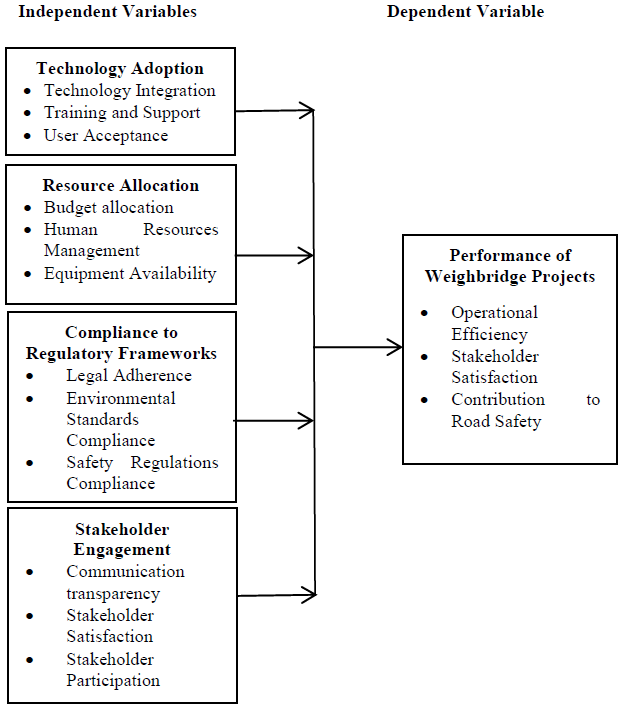
4.6. Conceptual FrameworkIn this study, the framework adopted (Figure 1) shows the connection between management practices categorized into four specific independent variables (technology adoption, resource allocation, compliance to regulatory frameworks, and involvement with stakeholders), and the success of weighbridge operations in Kenya.
This study adopted a descriptive research design. The target population comprised all management team members working directly on the five active weighbridge concession projects managed under the Kenya National Highways Authority (KeNHA). These projects cover eleven static weighbridge stations clustered across five geographic clusters: Mariakani–Mtwapa–Dongo Kundu, Athi River–Juja–Isinya, Gilgil–Mai Mahiu, Webuye, and Busia–Rongo. Official KeNHA records indicated a total of 157 management personnel (project managers, operations supervisors, technical officers, compliance officers, and finance/administration staff) actively involved in the planning, execution, monitoring, and reporting of weighbridge operations during the 2025 contract cycle.
A sample size of 113 respondents was determined using 48 formula. A stratified random sampling was employed to ensure proportional representation from each of the five concession clusters. Primary data were collected using a structured, self-administered questionnaire containing both closed-ended Likert-scale items (1 = Strongly Disagree to 5 = Strongly Agree) and limited open-ended questions for qualitative insights. Data collection occurred between June and August 2025 after obtaining NACOSTI research clearance, institutional ethical approval from Kenyatta University, and written permission from KeNHA. Questionnaires were distributed physically and electronically (via secure links) with clear instructions and assurance of anonymity and confidentiality. Data were analysed using SPSS version 27. Descriptive statistics (means, standard deviations, frequencies) summarised respondent profiles and variable perceptions. Inferential statistics included Pearson correlation to examine bivariate relationships and multiple linear regression to test the combined and individual effects of the independent variables on performance. Ethical considerations included voluntary participation, informed consent, data confidentiality, and non-disclosure of individual identities throughout the research process.
As shown in Table 1, 87.6% of the 113 surveys that were issued were filled out and returned, with 99 of those forms being returned. Half of the people who take part in a descriptive study should respond, according to 49, 50. The attained response rate of 87.6% exceeds the minimal tolerable standard, signifying a substantial level of engagement.
This section provides a descriptive analysis of the study variables; technology adoption, resource allocation, compliance to regulatory frameworks, stakeholder engagement and performance. The descriptive statistics summarize the features of the study variables, expressed by the mean and standard deviation.
The results on technology adoption in weighbridge projects indicate a generally positive reception of technological advancements. The average rating for every assertion was 4.01, with a SD of 1.153, signifying a predominantly elevated level of agreement among respondents regarding the adoption of technology in weighbridge projects, although there was some variability in individual responses.
The results on resource allocation revealed generally positive perceptions from the respondents. The average score for allocation of resources was 4.04, with an SD of 1.137, signifying that participants largely concurred with the claims regarding the allocation of resources, although there was moderate variation in responses.
The findings reveal a generally positive adherence to legal, environmental, and safety requirements within the weighbridge projects. The overall mean score for compliance with regulatory frameworks was 4.07, with a SD of 1.011, demonstrating that responders predominantly concurred with the remarks pertaining to regulatory compliance, although there was some variation in responses.
The outcomes reveal generally high levels of agreement among the respondents regarding stakeholder engagement in weighbridge projects. Overall, the mean score across all stakeholder engagement statements was 4.11, with a SD of 1.006, indicating that respondents generally agreed with the stakeholder engagement statements, while showing some variation in responses.
Overall, the mean performance score was 3.82, with a SD of 1.135, demonstrating that participants predominantly concurred with the comments assessing the efficacy of weighbridge initiatives, although there was some variation in responses across the different performance indicators.
6.3. Correlation AnalysisThe research study aimed to establish the association between project management approaches and the performance of weighbridge projects. The findings of the correlation analysis are displayed in Table 3.
The correlation analysis revealed strong positive relationships between project management practices and the performance of weighbridge projects in Kenya (all p < 0.001).
Technology adoption showed the strongest association with performance (r = 0.818), indicating that greater integration of automated systems, data analytics, and real-time monitoring significantly enhances operational efficiency and overall project effectiveness. This aligns with prior studies by 24, 25, which linked technology integration to improved efficiency and outcomes.
Resource allocation exhibited a substantial positive correlation with performance (r = 0.713), suggesting that effective distribution of financial, human, and material resources directly contributes to better project results. These findings are consistent with 30, who highlighted the critical role of proper resource management in project success.
Compliance with regulatory frameworks demonstrated a strong positive correlation with performance (r = 0.698), underscoring that adherence to legal, safety, and environmental standards supports operational effectiveness and risk mitigation. This result echoes 3, 11.
Stakeholder engagement recorded a high positive correlation with performance (r = 0.758), confirming that proactive communication, involvement, and collaboration with key stakeholders (transporters, communities, regulators) markedly improve project performance by reducing conflicts and aligning expectations. These observations are supported by 51.
6.4. Regression AnalysisA regression analysis was performed to investigate the relationships between the independent variables (technology adoption, resource allocation, compliance with regulatory frameworks, and stakeholder engagement) and the performance of weighbridge projects. A multiple linear regression model was applied to assess the combined effect of these project management practices on project performance. The analysis generated regression coefficients, standard errors, p-values, the coefficient of determination (R²), and the F-statistic to evaluate the explanatory power and overall significance of the model.
The results indicated an adjusted R2 of 0.721 which implied that project management practices (technology adoption, resource allocation, compliance to regulatory frameworks, and stakeholder engagement) explained 72.1% of the total variation in performance. This also implied that 27.9% of the variation in performance was explained by other factors other than project management practices.
The ANOVA results indicate that the overall regression model is highly significant (F (4, 94) = 64.377, p < 0.001). This confirms that the four project management practices collectively explain a statistically significant portion of the variance in weighbridge project performance, rejecting the null hypothesis that the model has no explanatory power.
The regression results confirmed that all four project management practices significantly and positively predict the performance of weighbridge projects in Kenya (p < 0.05 for all).
Technology adoption had a positive and statistically significant effect on project performance (β = 0.412, p = 0.003). This indicates that increased technology adoption was associated with improved project performance, while holding the other variables constant. The finding demonstrates the importance of automated systems, data analytics, and real-time monitoring in enhancing operational efficiency, reducing errors, and supporting informed decision-making. This finding is consistent with 24, 25, who established a positive relationship between technology adoption and organizational or project performance. In the context of weighbridge projects, technologies such as Weigh-in-Motion systems can facilitate efficient monitoring, reduce delays and violations, and contribute to improved road safety and stakeholder satisfaction.
Stakeholder engagement also had a positive and statistically significant effect on project performance (β = 0.380, p = 0.004). This implies that greater stakeholder engagement was associated with improved project performance, while holding the other variables constant. Effective involvement, communication, and collaboration with transporters, communities, regulators, and other relevant stakeholders can enhance transparency, reduce resistance, and promote alignment of expectations. The finding is consistent with 51, who emphasized the importance of stakeholder participation and communication in successful project implementation.
Compliance with regulatory frameworks had a positive and statistically significant effect on project performance (β = 0.263, p = 0.017). This suggests that improved compliance with relevant regulatory requirements was associated with improved project performance, while holding the other variables constant. Compliance with applicable traffic, environmental, and safety requirements can strengthen project legitimacy, reduce regulatory and operational risks, and promote effective implementation. The finding is consistent with 11, who demonstrated the importance of regulatory compliance in supporting organizational and project performance.
Resource allocation similarly had a positive and statistically significant effect on project performance (β = 0.203, p = 0.045). This indicates that improvements in resource allocation were associated with improved project performance, while holding the other variables constant. Effective allocation and management of financial, human, and physical resources can support timely implementation, efficient operations, and achievement of project objectives. This finding is consistent with 30, who highlighted the importance of adequate and effective resource allocation in enhancing project performance.
Overall, these findings suggest that joint effect of project management practices significantly and positively influence performance.
Hence the resultant overall regression model;
Performance = -1.290 + 0.412 Technology Adoption + 0.203 Resource Allocation + 0.263 Compliance to Regulatory Frameworks + 0.380 Stakeholder Engagement
The study concludes that effective project management practices significantly enhance the performance of weighbridge projects in Kenya.
Technology adoption substantially improves operational efficiency, decision-making, and overall facility effectiveness through automated systems and data collection tools, underscoring its critical role in consistent project success. Resource allocation directly influences project outcomes, with adequate financial resources, skilled staffing, and high-quality materials enabling smooth operations, timely responses to challenges, and optimized performance.
Compliance with regulatory frameworks (legal, environmental, and safety standards) is essential for smooth execution, sustainability, risk mitigation, and legitimacy, making it a top priority for project managers. Stakeholder engagement, through proactive communication and collaboration with transporters, communities, and government entities, fosters cooperation, addresses concerns, reduces resistance, and markedly improves project efficacy and outcomes.
Recommendations include:
1. Accelerating deployment of high-speed Weigh-in-Motion systems, real-time monitoring, reliable sensors, and enhanced CCTV to reduce human intervention and improve accuracy.
2. Strengthening resource management through disciplined budgeting, proactive maintenance, audits, and ongoing training in technology and anti-corruption.
3. Enhancing regulatory compliance via better inter-agency coordination, regular audits, updated training, and stricter penalties.
Deepening stakeholder engagement through transparent platforms, regular consultations, and responsive feedback to foster cooperation and shared responsibility.
| [1] | Wang, H. (2020). Heavy vehicle overloading and road damage: A global review. International Journal of Transportation Science and Technology, 9(4), 345–356. | ||
| In article | |||
| [2] | Kumar, S., & Gupta, R. (2019). Road infrastructure deterioration due to overloading. International Journal of Civil Engineering, 7(2), 112–120. | ||
| In article | |||
| [3] | Smith, J., & Brown, L. (2021). Impact of axle load control on road safety. Transport Research Journal, 18(2), 99–112. | ||
| In article | |||
| [4] | Project Management Institute (PMI). (2014). A guide to the project management body of knowledge (PMBOK guide) (5th ed.). PMI. | ||
| In article | |||
| [5] | Kerzner, H. (2017). Project management: A systems approach to planning, scheduling, and controlling (12th ed.). Wiley. | ||
| In article | |||
| [6] | Alsaadi, S., & Norhayatizakuan, A. (2021). Critical success factors in infrastructure project management. Journal of Construction Engineering and Management, 147(6), 04021045. | ||
| In article | |||
| [7] | Abidi, H., & Dullaert, W. (2020). Project management practices and infrastructure performance: A systematic review. International Journal of Project Management, 38(5), 310–322. | ||
| In article | |||
| [8] | Gichuhi, D., & Gatere, A. (2017). Stakeholder participation and performance of public projects in Kenya. International Academic Journal of Information Sciences and Project Management, 2(1), 456–472. | ||
| In article | |||
| [9] | Freeman, R. E., & McVea, J. (2021). A stakeholder approach to strategic management. Cambridge University Press. | ||
| In article | |||
| [10] | Johnson, G., & Whittington, R. (2019). Exploring strategy (12th ed.). Pearson. | ||
| In article | |||
| [11] | Mwangi, S., & Ochieng, D. (2020). Performance challenges in East African weighbridge systems. Transport Policy Journal, 25(1), 44–52. | ||
| In article | |||
| [12] | Kigundu, M. (2019). Challenges in weighbridge operations in East Africa. African Transport Journal, 11(3), 78–90. | ||
| In article | |||
| [13] | Kenya National Highways Authority (KeNHA). (2022). Annual report on weighbridge operations. Nairobi: KeNHA. | ||
| In article | |||
| [14] | Omondi, M., & Mwangi, J. (2021). Operational inefficiencies in weighbridge stations in Kenya. Journal of Transport and Logistics, 8(2), 67–82. | ||
| In article | |||
| [15] | Kariuki, P. (2020). Public-private partnerships in Kenya’s road sector: Challenges and opportunities. African Development Review, 32(2), 215–228. | ||
| In article | |||
| [16] | Mwangi, J., & Ngugi, P. (2018). Corruption and infrastructure development in Kenya. Journal of African Development Studies, 10(2), 33–48. | ||
| In article | |||
| [17] | Wandiri, M., & James, R. (2020). Stakeholder engagement in road infrastructure projects in Kenya. Journal of Infrastructure Development, 12(2), 89–102. | ||
| In article | |||
| [18] | Mwangi, S., & Wanjohi, P. (2022). Stakeholder involvement and infrastructure project performance. International Journal of Project Planning, 9(1), 23–37. | ||
| In article | |||
| [19] | Karanja, P., & Mutua, J. (2021). Project management practices and performance of road infrastructure projects in Kenya. Journal of Infrastructure Development, 13(1), 45–59. | ||
| In article | |||
| [20] | Rogers, E.M. (1962) Diffusion of Innovations. Free Press, New York. | ||
| In article | |||
| [21] | Rogers, E. M. (2003). Diffusion of innovations (5th ed.). Free Press. | ||
| In article | |||
| [22] | Sahin, I. (2006). Detailed review of Rogers’ diffusion of innovations theory. Educational Technology & Society, 9(2), 14–23. | ||
| In article | |||
| [23] | Miranda, S., Farias, J., & Rabelo, L. (2016). Innovation adoption in project management. Journal of Technology Management, 11(2), 90–105. | ||
| In article | |||
| [24] | Aboelmaged, M. G. (2018). The drivers of sustainable manufacturing practices in Egyptian SMEs and their impact on competitive capabilities. Journal of Cleaner Production, 175, 207–221. | ||
| In article | View Article | ||
| [25] | Ngundo, J., & James, R. (2018). Project management practices and implementation of county projects in Kenya. International Journal of Project Management, 36(4), 512–524. | ||
| In article | |||
| [26] | Greenhalgh, T., Robert, G., Macfarlane, F., Bate, P., & Kyriakidou, O. (2004). Diffusion of innovations in service organizations. Milbank Quarterly, 82(4), 581–629. | ||
| In article | View Article PubMed | ||
| [27] | Wernerfelt, B. (1984) The Resource-Based View of the Firm. Strategic Management Journal, 5, 171-180. | ||
| In article | View Article | ||
| [28] | Barney, J. B. (1991). Firm Resources and Sustained Competitive Advantage. Journal of Management, 17, 99-120. | ||
| In article | View Article | ||
| [29] | Peteraf, M.A. (1993) The Cornerstones of Competitive Advantage: A Resource-Based View. Strategic Management Journal, 14, 179-191. | ||
| In article | View Article | ||
| [30] | Nguyen, L. D., & Chileshe, N. (2018). Resource allocation and project success in construction projects. Engineering, Construction and Architectural Management, 25(5), 576–593. | ||
| In article | |||
| [31] | Priem, R.L. and Butler, J.E. (2001) Is the Resource-Based “View” a Useful Perspective for Strategic Management Research? Academy of Management Review, 26, 22-40. | ||
| In article | View Article | ||
| [32] | Foss, N.J. and Knudsen, T. (2003) The Resource-Based Tangle: Towards a Sustainable Explanation of Competitive Advantage. Managerial and Decision Economics, 24, 291-307. | ||
| In article | View Article | ||
| [33] | Meyer, J. W., & Rowan, B. (1977). Institutionalized organizations: Formal structure as myth and ceremony. American Journal of Sociology, 83(2), 340–363. | ||
| In article | View Article PubMed | ||
| [34] | DiMaggio, P. J., & Powell, W. W. (1983). The iron cage revisited: Institutional isomorphism and collective rationality. American Sociological Review, 48(2), 147–160. | ||
| In article | View Article PubMed | ||
| [35] | Scott, W.R. (1995) Institutions and Organizations. SAGE Publications, Thousand Oaks. | ||
| In article | |||
| [36] | Burdon, S., Mooney, G., & Al-Kilidar, H. (2020). Institutional theory and regulatory compliance in infrastructure projects. Public Administration Review, 80(3), 450–462. | ||
| In article | |||
| [37] | Oliver, C. (1991). Strategic responses to institutional processes. Academy of Management Review, 16(1), 145–179. | ||
| In article | View Article PubMed | ||
| [38] | Hirsch P, Lounsbury M (1997) Ending the family quarrel – Towards a reconciliation of “old” and “new” institutionalisms. Am Behav Sci 40(4):406–418 | ||
| In article | View Article | ||
| [39] | Freeman, R. E. (1984). Strategic management: A stakeholder approach. Pitman. | ||
| In article | |||
| [40] | Freeman, R. E. E., & McVea, J. (2001). A Stakeholder Approach to Strategic Management. Social Science Research Network. | ||
| In article | View Article | ||
| [41] | Chinyio, E., & Olomolaiye, P. (2020). Construction stakeholder management. Wiley-Blackwell. | ||
| In article | |||
| [42] | Agyemang, F. G., Aboagye, E., & Mensah, J. (2021). Resource allocation and project performance in public sector projects in Ghana. International Journal of Project Management, 39(4), 456–468. | ||
| In article | |||
| [43] | Ali, B. J., & Anwar, G. (2022). The impact of resource allocation on business performance: Evidence from SMEs in Pakistan. International Journal of Engineering, Business and Management, 6(1), 12–20. | ||
| In article | |||
| [44] | Mwangi, S., & Ochieng, D. (2022). Regulatory compliance and performance of agricultural cooperatives in Kenya. Journal of Agribusiness Management, 14(1), 65–78. | ||
| In article | |||
| [45] | Johnson, G., & Whittington, R. (2023). Regulatory environments and firm performance in Africa. Journal of African Business, 24(2), 150–168. | ||
| In article | |||
| [46] | Nyarko, K., & Bortey, E. (2020). Stakeholder engagement in PPP projects in Sub-Saharan Africa. International Journal of Project Organisation and Management, 12(3), 234–250. | ||
| In article | |||
| [47] | Mok, K. Y., & Yang, J. (2022). Stakeholder management in large infrastructure projects. International Journal of Project Management, 40(3), 215–228. | ||
| In article | |||
| [48] | Yamane, Y. (1967). Mathematical Formulae for Sample Size Determination. | ||
| In article | |||
| [49] | Mugenda, O.M. and Mugenda, A.G. (2003) Research Methods, Quantitative and Qualitative Approaches. ACT, Nairobi. | ||
| In article | |||
| [50] | Kothari, C. R. (2004). Research methodology: Methods and techniques (2nd ed.). New Age International. | ||
| In article | |||
| [51] | Mambwe, M., Mwanaumo, E., & Nsefu, M. (2020). Stakeholder engagement in infrastructure projects. International Journal of Construction Management, 20(6), 567–579. | ||
| In article | |||
Published with license by Science and Education Publishing, Copyright © 2026 Davis Ndinya and Prof. Rosemary James (PhD)
 This work is licensed under a Creative Commons Attribution 4.0 International License. To view a copy of this license, visit
http://creativecommons.org/licenses/by/4.0/
| [1] | Wang, H. (2020). Heavy vehicle overloading and road damage: A global review. International Journal of Transportation Science and Technology, 9(4), 345–356. | ||
| In article | |||
| [2] | Kumar, S., & Gupta, R. (2019). Road infrastructure deterioration due to overloading. International Journal of Civil Engineering, 7(2), 112–120. | ||
| In article | |||
| [3] | Smith, J., & Brown, L. (2021). Impact of axle load control on road safety. Transport Research Journal, 18(2), 99–112. | ||
| In article | |||
| [4] | Project Management Institute (PMI). (2014). A guide to the project management body of knowledge (PMBOK guide) (5th ed.). PMI. | ||
| In article | |||
| [5] | Kerzner, H. (2017). Project management: A systems approach to planning, scheduling, and controlling (12th ed.). Wiley. | ||
| In article | |||
| [6] | Alsaadi, S., & Norhayatizakuan, A. (2021). Critical success factors in infrastructure project management. Journal of Construction Engineering and Management, 147(6), 04021045. | ||
| In article | |||
| [7] | Abidi, H., & Dullaert, W. (2020). Project management practices and infrastructure performance: A systematic review. International Journal of Project Management, 38(5), 310–322. | ||
| In article | |||
| [8] | Gichuhi, D., & Gatere, A. (2017). Stakeholder participation and performance of public projects in Kenya. International Academic Journal of Information Sciences and Project Management, 2(1), 456–472. | ||
| In article | |||
| [9] | Freeman, R. E., & McVea, J. (2021). A stakeholder approach to strategic management. Cambridge University Press. | ||
| In article | |||
| [10] | Johnson, G., & Whittington, R. (2019). Exploring strategy (12th ed.). Pearson. | ||
| In article | |||
| [11] | Mwangi, S., & Ochieng, D. (2020). Performance challenges in East African weighbridge systems. Transport Policy Journal, 25(1), 44–52. | ||
| In article | |||
| [12] | Kigundu, M. (2019). Challenges in weighbridge operations in East Africa. African Transport Journal, 11(3), 78–90. | ||
| In article | |||
| [13] | Kenya National Highways Authority (KeNHA). (2022). Annual report on weighbridge operations. Nairobi: KeNHA. | ||
| In article | |||
| [14] | Omondi, M., & Mwangi, J. (2021). Operational inefficiencies in weighbridge stations in Kenya. Journal of Transport and Logistics, 8(2), 67–82. | ||
| In article | |||
| [15] | Kariuki, P. (2020). Public-private partnerships in Kenya’s road sector: Challenges and opportunities. African Development Review, 32(2), 215–228. | ||
| In article | |||
| [16] | Mwangi, J., & Ngugi, P. (2018). Corruption and infrastructure development in Kenya. Journal of African Development Studies, 10(2), 33–48. | ||
| In article | |||
| [17] | Wandiri, M., & James, R. (2020). Stakeholder engagement in road infrastructure projects in Kenya. Journal of Infrastructure Development, 12(2), 89–102. | ||
| In article | |||
| [18] | Mwangi, S., & Wanjohi, P. (2022). Stakeholder involvement and infrastructure project performance. International Journal of Project Planning, 9(1), 23–37. | ||
| In article | |||
| [19] | Karanja, P., & Mutua, J. (2021). Project management practices and performance of road infrastructure projects in Kenya. Journal of Infrastructure Development, 13(1), 45–59. | ||
| In article | |||
| [20] | Rogers, E.M. (1962) Diffusion of Innovations. Free Press, New York. | ||
| In article | |||
| [21] | Rogers, E. M. (2003). Diffusion of innovations (5th ed.). Free Press. | ||
| In article | |||
| [22] | Sahin, I. (2006). Detailed review of Rogers’ diffusion of innovations theory. Educational Technology & Society, 9(2), 14–23. | ||
| In article | |||
| [23] | Miranda, S., Farias, J., & Rabelo, L. (2016). Innovation adoption in project management. Journal of Technology Management, 11(2), 90–105. | ||
| In article | |||
| [24] | Aboelmaged, M. G. (2018). The drivers of sustainable manufacturing practices in Egyptian SMEs and their impact on competitive capabilities. Journal of Cleaner Production, 175, 207–221. | ||
| In article | View Article | ||
| [25] | Ngundo, J., & James, R. (2018). Project management practices and implementation of county projects in Kenya. International Journal of Project Management, 36(4), 512–524. | ||
| In article | |||
| [26] | Greenhalgh, T., Robert, G., Macfarlane, F., Bate, P., & Kyriakidou, O. (2004). Diffusion of innovations in service organizations. Milbank Quarterly, 82(4), 581–629. | ||
| In article | View Article PubMed | ||
| [27] | Wernerfelt, B. (1984) The Resource-Based View of the Firm. Strategic Management Journal, 5, 171-180. | ||
| In article | View Article | ||
| [28] | Barney, J. B. (1991). Firm Resources and Sustained Competitive Advantage. Journal of Management, 17, 99-120. | ||
| In article | View Article | ||
| [29] | Peteraf, M.A. (1993) The Cornerstones of Competitive Advantage: A Resource-Based View. Strategic Management Journal, 14, 179-191. | ||
| In article | View Article | ||
| [30] | Nguyen, L. D., & Chileshe, N. (2018). Resource allocation and project success in construction projects. Engineering, Construction and Architectural Management, 25(5), 576–593. | ||
| In article | |||
| [31] | Priem, R.L. and Butler, J.E. (2001) Is the Resource-Based “View” a Useful Perspective for Strategic Management Research? Academy of Management Review, 26, 22-40. | ||
| In article | View Article | ||
| [32] | Foss, N.J. and Knudsen, T. (2003) The Resource-Based Tangle: Towards a Sustainable Explanation of Competitive Advantage. Managerial and Decision Economics, 24, 291-307. | ||
| In article | View Article | ||
| [33] | Meyer, J. W., & Rowan, B. (1977). Institutionalized organizations: Formal structure as myth and ceremony. American Journal of Sociology, 83(2), 340–363. | ||
| In article | View Article PubMed | ||
| [34] | DiMaggio, P. J., & Powell, W. W. (1983). The iron cage revisited: Institutional isomorphism and collective rationality. American Sociological Review, 48(2), 147–160. | ||
| In article | View Article PubMed | ||
| [35] | Scott, W.R. (1995) Institutions and Organizations. SAGE Publications, Thousand Oaks. | ||
| In article | |||
| [36] | Burdon, S., Mooney, G., & Al-Kilidar, H. (2020). Institutional theory and regulatory compliance in infrastructure projects. Public Administration Review, 80(3), 450–462. | ||
| In article | |||
| [37] | Oliver, C. (1991). Strategic responses to institutional processes. Academy of Management Review, 16(1), 145–179. | ||
| In article | View Article PubMed | ||
| [38] | Hirsch P, Lounsbury M (1997) Ending the family quarrel – Towards a reconciliation of “old” and “new” institutionalisms. Am Behav Sci 40(4):406–418 | ||
| In article | View Article | ||
| [39] | Freeman, R. E. (1984). Strategic management: A stakeholder approach. Pitman. | ||
| In article | |||
| [40] | Freeman, R. E. E., & McVea, J. (2001). A Stakeholder Approach to Strategic Management. Social Science Research Network. | ||
| In article | View Article | ||
| [41] | Chinyio, E., & Olomolaiye, P. (2020). Construction stakeholder management. Wiley-Blackwell. | ||
| In article | |||
| [42] | Agyemang, F. G., Aboagye, E., & Mensah, J. (2021). Resource allocation and project performance in public sector projects in Ghana. International Journal of Project Management, 39(4), 456–468. | ||
| In article | |||
| [43] | Ali, B. J., & Anwar, G. (2022). The impact of resource allocation on business performance: Evidence from SMEs in Pakistan. International Journal of Engineering, Business and Management, 6(1), 12–20. | ||
| In article | |||
| [44] | Mwangi, S., & Ochieng, D. (2022). Regulatory compliance and performance of agricultural cooperatives in Kenya. Journal of Agribusiness Management, 14(1), 65–78. | ||
| In article | |||
| [45] | Johnson, G., & Whittington, R. (2023). Regulatory environments and firm performance in Africa. Journal of African Business, 24(2), 150–168. | ||
| In article | |||
| [46] | Nyarko, K., & Bortey, E. (2020). Stakeholder engagement in PPP projects in Sub-Saharan Africa. International Journal of Project Organisation and Management, 12(3), 234–250. | ||
| In article | |||
| [47] | Mok, K. Y., & Yang, J. (2022). Stakeholder management in large infrastructure projects. International Journal of Project Management, 40(3), 215–228. | ||
| In article | |||
| [48] | Yamane, Y. (1967). Mathematical Formulae for Sample Size Determination. | ||
| In article | |||
| [49] | Mugenda, O.M. and Mugenda, A.G. (2003) Research Methods, Quantitative and Qualitative Approaches. ACT, Nairobi. | ||
| In article | |||
| [50] | Kothari, C. R. (2004). Research methodology: Methods and techniques (2nd ed.). New Age International. | ||
| In article | |||
| [51] | Mambwe, M., Mwanaumo, E., & Nsefu, M. (2020). Stakeholder engagement in infrastructure projects. International Journal of Construction Management, 20(6), 567–579. | ||
| In article | |||