This article first examines the forms and key success factors of local managerial innovations. It then analyzes the contribution of these innovations to the local development process in Mali. The study adopts a qualitative and exploratory approach based on a multiple case study. The results reveal that the managerial innovations implemented by the six communes of the Bamako district take various forms. They highlight several key success factors, three of which are essential in the Malian context: the political will and technical skills of managers, the availability of resources, and incentive or support measures. The results also show that, despite their diversity, these innovations contribute only modestly to the local development process, and more specifically to improving the socio-economic well-being of local communities.
Since the 1990s, Mali, like many other sub-Saharan countries, has embarked on decentralization reforms. In this context, traditional managerial practices characterized by bureaucracy, rigidity, and top-down structures are being called into question 1. Furthermore, the capacity of local governments to address multiple crises 2, significant financial and budgetary constraints 3, 4, and to promote sustainable local development is being put to the test.
Public management innovation is presented as a potential solution to these challenges. It constitutes a form of public innovation 5, 6. Its emergence coincides with post-New Public Management (Post-NPM) practices 7, 8. It is considered one of the drivers of modernization in the public sector 9. It has been introduced in the local public sector to optimize resources and improve the quality of citizen services 1. In this context, it is seen as a driver of sustainable local development, improving the quality of life for local residents.
As for the concept of local development, it emerged in rural, marginalized, and isolated communities that did not benefit from local public initiatives related to growth and development 10. It is presented as a new opportunity for the least developed countries, particularly those in West Africa 11. However, it should be noted that its emergence varies from one context to another 12, and is also not easily transferable 11.
Several studies show that, when adapted, local managerial innovation practices can have a significant impact on the functioning and organizational structures of local governments 1 and, consequently, contribute to local development by improving the socioeconomic well-being of the region 13. However, in the context of local communities in the Sahel and sub-Saharan Africa, not only is research addressing the links between managerial innovation and local development scarce, but these communities also face significant climatic, economic, and socio-political challenges. This article addresses these gaps by answering the following questions:
Q: What are the forms and key success factors of the managerial innovations implemented by municipal authorities?
Q: How can these innovations contribute to local development in the Malian context?
To address these questions, following the introduction, this article is divided into four sections. The first section presents a review of the literature. The second section outlines the research methodology. The third section focuses on the main findings. The fourth section presents the discussion. Finally, the study concludes.
Innovation is a concept whose origins can be traced back to the work of Schumpeter 14. Subsequently, research on innovation focused solely on the technological dimension has proliferated. For example, the findings of the study by 15, reveal more than 12,000 scientific articles addressing the term “technological innovation,” compared to more than 100 addressing other forms of innovation. Based on these findings, the authors decided to focus their analysis on types of innovation that are not technological in nature 16.
Publications introducing new terms such as “administrative” or “organizational” innovation have proliferated 16, 17, 18. More specifically, the origins of the concept of managerial innovation coincide with the work of authors such as in 19, 20. Since this concept is a multidimensional phenomenon 9, it has been the subject of numerous studies 15, 16.
2.2. Outlines and Theoretical Framework of Public Managerial InnovationAs mentioned above, public management innovation is multidimensional 9. There is a wealth of research on this type of innovation 1, 16, 21, 22, 23, 24, 25. However, reference 22 noted that most of this research mainly focused on the local public sector 1, 24. In this regard, reference 23 introduces the concept of “New Territorial Public Management.”
There is a wealth of research on the factors underlying local managerial innovations 24, 26, 25. For example, reference 24 highlight several key success factors for local managerial innovations, including environmental and contextual factors, organizational factors, factors related to the innovation process itself, and individual factors related to leadership.
Furthermore, local managerial innovation beyond its polysemic and multidimensional nature draws on several theoretical frameworks. Reference 27 proposed the neo-institutional theory, which is based on the adaptation of organizations to their institutional environment through isomorphism and legitimacy. As for 28, they analyze the nature of territorial managerial innovation from the perspective of agency theory, in order to highlight the relationships among stakeholders who may not share the same core interests. Reference 29 propose public choice theory to understand political behavior based on the individual preferences of those involved in the process within local governments.
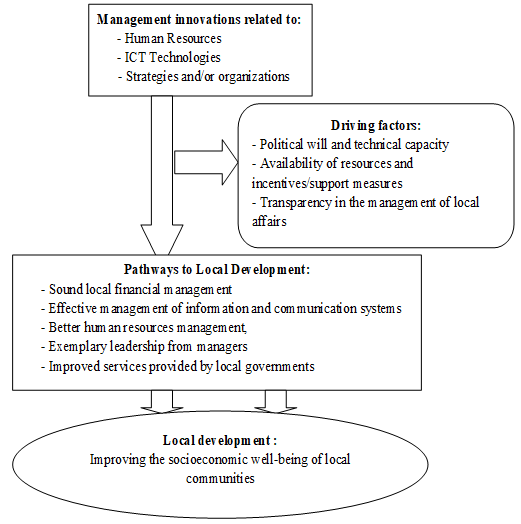
2.3. Links between Managerial Innovation and Local DevelopmentResearch on the role of innovation in the process of territorial development is not a recent phenomenon 30. Indeed, reference 4 emphasize that managerial innovation serves as a lever for improving local public performance. It is one of the fundamental conditions for development 31. Its purpose is to contribute to local development and, more specifically, to improve the economic and social well-being of local populations. There are multiple paths to achieving this, which can be summarized as follows: sound local financial management, effective management of information and communication systems, improved human resource management, managerial leadership, and a better range of services offered by local governments.
This study takes a qualitative approach to explore the perceptions of participants involved in managerial innovation and local development processes. This approach is relevant because it provides rich, well-supported descriptions and explanations of the processes, grounded in a local context 32. The field strategy is based on multiple case studies. This type of strategy allows for an in-depth analysis of a phenomenon to understand its specific characteristics and complexity 33, while also ensuring that the results can be generalized and reducing selection biases 34.
3.2. Sampling, Data Collection, and Analysis ProtocolData collection took place between December 2025 and July 2026. The six municipalities of the Bamako district were selected as study sites. These municipalities were chosen using the theoretical sampling method 35, notably because they have been the subject of numerous publications and their financial resources are significantly greater than those of the other municipalities.
For data collection, a triangulation of methods and participants' discourse was used. This triangulation helps ensure the validity of the results 33. It also provides a stronger justification for the conceptual frameworks and hypotheses 34. Indeed, in addition to a literature review (websites, official documents, press reviews), semi-structured interviews 36, were conducted with key informants, focusing on the interview guide. This guide comprised three main themes. The first theme concerned forms of local managerial innovation. The second theme addressed the key success factors of local managerial innovations. The final theme focused on the contribution of innovations to the local development process.
Respondents were selected using the theoretical sampling method 35. This approach made it possible to identify key informants for this study. A total of sixty-two (62) semi-structured interviews were conducted. Each semi-structured interview lasted between 60 and 90 minutes. All interviews were recorded and notes were taken, and they were subsequently transcribed. The data underwent qualitative and thematic content analysis following the four stages outlined by Vaismoradi et al. 37, namely: (1) initialization; (2) construction; (3) rectification; and (4) finalization. The analysis utilized percentage-based techniques.
Decentralization in Mali, like in other Sahelian countries, emerged from the institutional reforms of the 1990s, following widespread public dissatisfaction with central government agencies and their style of governance 38. It led to the reorganization of local government units in the Republic of Mali as follows: the commune, the circle, the region, and the district (Article 1, Law No. 2017-052 of October 2, 2017). As for the District of Bamako, it is divided into six communes. Table 1 presents the six cases based on the 2009 General Population and Housing Census.
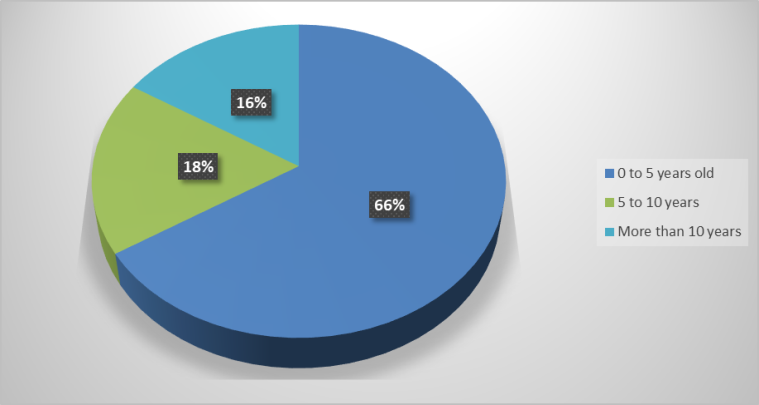
4.2. Profile of RespondentsThe results show that the majority of respondents are mayors and deputy mayors (25.81% of respondents) or local government technicians (22.58% of respondents) (Table 2). This finding can be explained by the technical nature of the questions asked and the respondents’ involvement in managerial innovation and development processes. In addition, the results show that the majority of respondents have at least ten (10) years of experience (84% of respondents) (Figure 1).

According to the respondents, several types of managerial innovations are being implemented within their municipal communities (Table 3).
The field study reveals a wide range of managerial innovations implemented in the six (06) municipal authorities. In total, three (03) types of innovations were identified: human resources-related innovations, ICT-focused innovations, and innovations based on strategies and/or organizational structures.
The results of the field study in the six municipalities examined reveal models of managerial innovation focused on human resources. For example, respondents highlighted training and capacity-building initiatives, as well as other models of human resources innovation, as demonstrated by the three excerpts below:
“In recent years, several capacity-building sessions have been organized for elected officials, government representatives, civil society organizations, and decentralized government agencies… in the field of management. We are doing everything we can to ensure the continuity of these training programs.” (Site E)
“It is through training programs, workshops, and capacity-building initiatives that we will be able to enhance our staff’s skills and, in turn, create frameworks for local development” (Site D)
“Our managers demonstrate great adaptability and often act as mediators to resolve conflicts among staff members, because the community’s development depends on it” (Site C)
However, some respondents pointed out that these training programs or capacity-building initiatives are intended solely for elected officials, thereby excluding other stakeholders. In addition, other respondents lamented the lack of support measures or incentives associated with the training programs, as well as the disconnect between the training and local realities, as illustrated by the two excerpts below:
“Training sessions are usually organized exclusively for elected officials. We’ve always brought this to the attention of the relevant authorities, but unfortunately, it’s always the same story nothing changes.” (Site F)
“There are no support measures, so it’s hard to make time for all the training sessions, even though we know they’re important and necessary for our careers. Also, it’s very important to tailor the training content to the needs and realities of the municipality; otherwise, it will be a waste of time and financial resources” (Site H)
The results of the field study reveal managerial innovations related to ICT (information and communication technology) in certain municipal groups (Municipalities 1, 2, 3, and 6), as demonstrated by the excerpts below:
“Today, the urban municipalities in the Bamako district have either a website or a Facebook page for disseminating information, with the aim of facilitating the sharing of information both internally and with the public” (Site H)
“To my knowledge, all municipalities in the Bamako district have implemented digital systems that allow residents to pay taxes via mobile money” (Site B)
On the other hand, some respondents highlighted several limitations, including those related to resources, a shortage of computers, unexpected power outages, lack of computer maintenance, or connection issues:
“It’s sad to say, but we face frequent outages, poor computer maintenance, connection issues, and there aren’t enough computers for everyone.” (Site A)
The findings highlight examples of legislative and regulatory measures related to strategic and/or organizational innovations. For instance, the legislation provides for collective planning in cases involving the living conditions of local populations or issues related to land use planning or the environment, as well as annual public debates on municipal budgets. However, the interviews conducted reveal that public participation in strategies or organizational structures related to local development is largely lacking, or even nonexistent, often resulting in the stalling of municipal projects, as demonstrated by the two excerpts below:
“It’s true that the laws call for ongoing consultation with local communities regarding the functioning of local governments. But in practice, such local consultation is rare due to a lack of financial resources.” (Site A)
“There is virtually no relationship between local residents and their municipal council members. In other words, council members are not in the habit of consulting residents on development strategies. This situation leads some citizens to try to block the municipality’s development projects by using their influence” (Site E).
“Most citizens are unaware of their rights and responsibilities. They know very little about how local governments operate if not to say that they don’t attach enough importance to it.” (Site B).
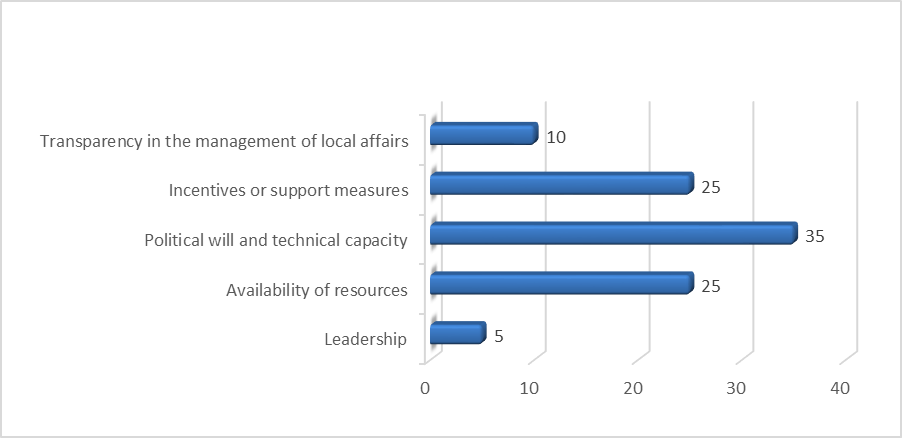
4.4. Factors Contributing to the Success of Managerial Innovations in the Six MunicipalitiesThe results highlight multiple key factors for the success of managerial innovations. However, three essential factors stand out in the Malian context: the political will and technical capacity of managers (35%), the availability of resources (25%), and incentives or support measures (25%) (Figure 2).

The findings regarding the contribution of managerial innovations to local development focus on five key areas: sound local financial management, improved human resources management, effective management of information and communication systems, managerial leadership, and improved service delivery by local governments.
Field research conducted in the six municipalities under study shows that the managerial innovations implemented have had little impact on local financial management. While these innovations have led to the introduction of a few new budget management mechanisms, they have not resulted in increased revenue or reduced capital expenditures, as the excerpts below demonstrate:
“We’re doing the best we can. There are too many expenses to cover. Unfortunately, the town hall’s internal resources are far from sufficient to cover the community’s expenses” (Site A)
“In 2024, the town hall had planned for capital expenditures of over a billion, but it only spent 214 million. Given this situation, it’s very difficult to achieve any kind of development” (Site G)
In addition, the results reveal a lack of transparency in the financial management of municipalities:
“It’s sad, but we have to admit that our municipalities’ financial resources aren’t being used properly if we’re being honest.” (Site F)
All respondents emphasized the importance of human resources in the context of the managerial innovation initiatives underway in the six municipalities:
“The success of any innovation requires higher-quality human resources capable of taking action to promote sustainable local development” (Site D)
Similarly, other respondents emphasized the importance of human resources management in improving the local development process:
“Effective human resources management can be a key driver of local organizational performance. When we talk about performance, we’re talking about development” (Site A)
However, the results reveal average and even poor human resources management, which consequently has little impact on local development strategies, as demonstrated in the excerpt below:
“Nepotism has gone too far. Some elected officials run our municipalities as if they were family property. For example, there are enough qualified staff to carry out activities related to the municipality’s development, but unfortunately, employees are not always hired as they should be. More often than not, holding staff accountable for their duties remains a serious problem. This situation strains relationships among staff and frequently leads to conflicts. Yet it is very difficult to achieve genuine development without harmony among colleagues and peace” (Site D)
The interviewees placed particular emphasis on the critical importance of information and communication systems in local development strategies:
“In the pursuit of performance, information systems particularly ICT are important tools, especially for financial services in our communities” (Site G)
“Communication helps build trust among stakeholders. This trust is essential to community development processes” (Site D)
“Teamwork requires communication; without it, there can be no innovation or development” (Site A)
However, the results of the field study reveal a low level of communication:
“Often, official information that should be accessible to everyone information that can help the community function smoothly remains confidential” (Site C)
“We have a serious problem with information sharing. Information isn’t provided in a timely manner. Often, some people are informed about a situation, while at the same time others are not, and this lack of information undermines collaboration” (Site F)
The findings of this research highlight the importance of managerial leadership (both political and administrative) in driving managerial innovation and, consequently, in achieving the ultimate goal of local development: improving the living conditions of communities:
“Political will and the enthusiasm of administrative staff are essential prerequisites for the implementation of new practices” (Site D)
“Elected officials and government executives in local governments play a key role in driving territorial reforms. The contribution and leadership of each of these individuals are essential to the development of the municipality” (Site B)
Similarly, the results highlight examples of leadership behavior (Municipalities 1, 4, and 6), as demonstrated by the three excerpts below:
“I usually use participatory management, because it’s important to give all stakeholders a voice before making a decision” (Site A)
“We must avoid imposing our will at all costs, especially since we have the opportunity to give our employees a certain amount of responsibility, while ensuring that the municipality’s operations run smoothly” (Site B)
“For me, empowering employees is crucial. This will allow them to play a major role in achieving our goals. However, it’s important to know how to guide them back on track when necessary” (Site E)
On the other hand, other respondents lamented the lack of support from policymakers for local social initiatives:
“We are in a situation where elected officials are significantly underinvolved. They generally have difficulty maintaining good relationships with city hall staff, as well as with stakeholders in development processes” (Site D)
Similarly, some respondents highlighted the inconsistency in managerial practices between national and local policymakers, pointing to a problem with leadership or communication:
“More often than not, our municipalities suffer from a lack of interaction between stakeholders at the national and local levels; without that, there can be no local development.” (Site D)
It is clear from the majority of the interviews conducted that, overall, managerial innovations contribute moderately to improving the provision of services to citizens and, consequently, to local development. For example, in the area of basic services (legalization of diplomas and other certificates, issuance of birth certificates), local residents most often complain about the high costs of the services provided, as shown in the excerpt below:
“When we talk about innovation and the smooth running of the municipality, we need financial resources; yet most of our fellow citizens complain about the cost of our services. That’s understandable some simply don’t have enough money but for others, it’s more a matter of unwillingness, and that’s something we cannot tolerate.” (Site A)
In the sanitation sector, household waste management is largely the responsibility of private companies rather than municipal authorities, which often results in poor service for residents:
“We are involved in household waste management, but in reality, it is the economic interest groups (EIGs) that handle waste collection. Unfortunately, these small businesses are more interested in their profits than in truly improving the environment.” (Site C)
The findings revolve around three key points. First, the findings demonstrate a variety of managerial innovations implemented by the six municipalities in the Bamako district: human resources; information and communication systems; and strategies and/or organizational structures. These findings support the view of authors such as in 1, 39, 21, that there are multiple managerial innovations within public organizations, particularly local governments. Second, the findings reveal multiple factors contributing to the success of local managerial innovations: the political will and technical capacity of managers; the availability of resources; incentives or support measures; transparency in the management of local affairs; and leadership. These findings are consistent with those of authors such in 3, 40, 41, who have highlighted factors driving public managerial innovation, such as human, technical, environmental, contextual, and organizational factors.
Third, the results show that the impact of innovations on the local development process is mixed. On the one hand, the managerial innovations implemented by the six municipalities studied have generally facilitated the adoption of new management systems or ICT technologies 42. As a significant example, internal communication within the six municipalities has improved significantly thanks to new technological tools and administrative social networks 1. These findings are consistent with those of 43, who emphasize that communication can improve coordination among stakeholders; or those of 44, who view it as another strategy for local engagement; or those of 45, who argue that it could help mitigate the drawbacks associated with uncertainty and change; or those of 46, who note that it appears to be a factor in preventing and/or reducing negative organizational deviance. On the other hand, the managerial innovations implemented by the six municipalities studied have had little impact on improving the economic and social well-being of local populations, particularly in terms of the services offered to citizens. This situation can be explained by the fact that these municipalities, in their pursuit of territorial development or local development 12, frequently face a shortage of resources 22, particularly human, natural, and financial resources. Similarly, the findings reveal shortcomings related to policy and decision-making issues at the municipal council level, leading to inappropriate political and administrative leadership 47. “The ineffectiveness of local managerial innovations regarding local development strategies can also be explained by a lack of cooperation and interaction among stakeholders, causing the region to remain a passive space that is subject to the changes and constraints of its external environment” 48.
The objective of this study was to understand and explain new management practices and their contribution to local development processes in the Sahelian context, particularly within municipal governments in Mali. Our findings reveal a variety of managerial innovations being implemented in Malian municipalities. These innovations relate to human resources, ICT technologies, and strategies and/or organizational structures. Our findings also show that while these innovations certainly represent progress and have consequently facilitated the implementation of new management, communication, IT, and other systems, they do not contribute significantly to local development processes in Mali. This situation can be explained by the fact that local management innovations, like other public innovations, continue to face several obstacles, such as a lack of resources, weak incentives or support measures, a lack of political will, technical limitations, and a lack of transparency in the management of affairs (particularly corruption).
The recommendations in this article are based on the summary of results presented in Figure 3 below:
In terms of managerial implications, our research helps identify forms of local managerial innovation. It provides local managers, local actors, and other stakeholders with a framework for analyzing their practices and methods, with the aim of improving them and, consequently, influencing local development. From a scientific perspective, research on local managerial innovation and local development, particularly in the sub-Saharan context, is scarce. Our research helps to fill this gap to some extent. In addition, our research has contributed to expanding our understanding of the concepts of local managerial innovation and local development.
The findings of this study are based on a case-study methodology and are therefore subject to limitations in terms of generalizability. In terms of future research, we should aim to expand the study to all local governments in Mali.
No potential conflict of interest was reported by the author(s)
No funding was received
The data supporting the conclusions of this study are presented in the main article
The research process complied with the ethical standards of the University of Social Sciences and Management in Bamako (USSGB). Ethical considerations were taken into account from the start, after getting approval from the Research Ethics Approval Committee under reference 2025_CURES_121, dated December 02, 2025. The research was carried out strictly following the rules for protecting participants' rights, in line with the Helsinki Declaration. Human participants gave their verbal consent for the use of their data.
Author contributions: Mahamadou Sidibe: Writing– original draft, Software, Methodology, Investigation, Formal analysis. Bakary Koné: Data curation, Conceptualization. Soboua Thera: Writing– review & Editing, Supervision.
| [1] | Cohard, P. et Bories-Azeau, I. (2021). Caractérisation des innovations managériales dans les collectivités territoriales. Gestion et management public, 9 / n° 2(2), 57-77. | ||
| In article | View Article | ||
| [2] | Uster, A., Vigoda-Gadot, E., & Cohen, N. (2026). Local Civic Engagement in Turbulent Times: Trust in Governance, Managerial Quality, Ethnicity, and Education During Polycrises. Public Performance & Management Review, 49(1), 81–110. | ||
| In article | View Article | ||
| [3] | Favoreu, C., & Carassus, D. (2022). Dynamics of Managerial Innovation. In: Farazmand, A. (eds) Global Encyclopedia of Public Administration, Public Policy, and Governance. Springer, Cham. | ||
| In article | View Article | ||
| [4] | Favoreu, C., Maurel, C., Queyroi, Y. & Marin, P. (2020). Les déterminants des différents types d’innovation publique locale: une analyse nationale multi facteurs. Management international / International Management / Gestiòn Internacional, 24(4), 34–47. | ||
| In article | View Article | ||
| [5] | Liarte, I., Criado, J. I., & Alcaide-Muñoz, L. (2025). Determinants of Public Sector Innovation: A Comparative Study of Spanish Local Governments. International Journal of Public Administration, 1–16. | ||
| In article | View Article | ||
| [6] | Criado, J. I., Alcaide-Muñoz, L., & Liarte, I. (2023). Two decades of public sector innovation: building an analytical framework from a systematic literature review of types, strategies, conditions, and results. Public Management Review, 27(3), 623–652. | ||
| In article | View Article | ||
| [7] | Knox, S., Marin-Cadavid, C., & Oziri, V. (2024). Stakeholder engagement-as-practice in public sector innovation. International Public Management Journal, 28(1), 153–168. | ||
| In article | View Article | ||
| [8] | Christensen, T., and P. Lægreid. (2022). “Taking Stock: New Public Management (NPM) and post-NPM Reforms – Trends and Challenges.” Pp. 38–49 in Handbook on the Politics of Public Administration, edited by A. Ladner and F. Sager. Cheltenham: Edward Elgar Publishing Limited. | ||
| In article | View Article PubMed | ||
| [9] | Frimousse, S. et Peretti, J.-M. (2022). L’innovation managériale dans les organisations publiques. Question(s) de management, 39(2), 147-206. | ||
| In article | View Article | ||
| [10] | Angeon, V., & Callois, J. M. (2005). «Fondements théoriques du développement local: quels apports du capital social et de l’économie de proximité?», Économie et institutions, 6-7| 19-50. | ||
| In article | View Article | ||
| [11] | Leloup, F., Moyart, L. et Pecqueur, B. (2003). Le développement local en Afrique de l'Ouest: quelle(s) réalité(s) possible(s) ? Mondes en développement, no 124(4), 95-112. | ||
| In article | View Article | ||
| [12] | Moussaoui, K. & Arabi, K. (2014). Le rôle des collectivités territoriales dans le développement local à l’ère des réformes en Algérie. Le cas des communes de Bejaia. Économie et Solidarités, 44(1-2), 122–133. | ||
| In article | View Article | ||
| [13] | Torre, A. (2015). Théorie du développement territorial. Géographie, économie, société, 17(3), 273-288. | ||
| In article | View Article | ||
| [14] | Schumpeter, J.A. (1976). Capitalism, Socialism and Democracy (1st ed.). Routledge. | ||
| In article | |||
| [15] | Birkinshaw, J., & Mol, M. (2006). How management innovation happens. MIT Sloan Management Review, 47(4), 81-88. | ||
| In article | |||
| [16] | Le Roy, F., Robert, M. et Giuliani, P. (2013). L'innovation managériale Généalogie, défis et perspectives. Revue française de gestion, 235(6), 77-90. | ||
| In article | View Article | ||
| [17] | Evan, W. M. (1966). Retard organisationnel. Human Organization, 25(1), 51–53. | ||
| In article | View Article | ||
| [18] | Evan, W. M., & Black, G. (1967). Innovation in Business Organizations: Some Factors Associated with Success or Failure of Staff Proposals. The Journal of Business, 40(4), 519–530. http://www.jstor.org/stable/2351633. | ||
| In article | View Article PubMed | ||
| [19] | Mintzberg, H. (1973). The nature of managerial work, Harper & Row, University of Michigan - 298 pages ISBN: 0060445564, 9780060445560. | ||
| In article | |||
| [20] | Kimberly, J.R. (1981) Managerial Innovation. In: Nystrom, P.C. and Starbuck, W.H., Eds., Handbook of Organizational Design, Oxford University Press, New York, Vol. 1, 84-104. | ||
| In article | |||
| [21] | Favoreu, C., Maurel, C., Carassus, D. & Marin, P. (2019). Influence and Complementarity of Follow-on Managerial Innovations within a Public Organization. Public Organiz Rev 19, 345–365. | ||
| In article | View Article | ||
| [22] | DE Vries, H., Bekkers, V. and Tummers, L. (2016), Innovation in the public sector: a systematic review and future research agenda. Public Admin, 94: 146-166. | ||
| In article | View Article | ||
| [23] | Dupuis, J. (2015). Le cadre dirigeant public, entre logique de gestion et logique managériale Les cadres dirigeants territoriaux au cœur du nouveau management territorial. Revue française de gestion, 251(6), 149-164. | ||
| In article | View Article | ||
| [24] | Carassus, D., Favoreu, C., Gardey, D., et Maurel, C. (2014a). «Les déterminants de l’adoption et de la mise en œuvre d’un management par la performance: application aux collectivités locales françaises», Finance Contrôle Stratégie [En ligne], 17-1. | ||
| In article | View Article | ||
| [25] | Walker, R. M. (2006). Innovation type and diffusion: An empirical analysis of local government. Public administration, 84 (2), 311 – 335. | ||
| In article | View Article | ||
| [26] | Damanpour, F., & Schneider, M. (2009). «Characteristics of Innovation and Innovation Adoption in Public Organizations: Assessing the Role of Managers». Journal of Public Administration Research and Theory, 19, 3, p. 495-522. | ||
| In article | View Article | ||
| [27] | DiMaggio, P.J. and Powell, W.W. (1983) The Iron Cage Revisited: Institutional Isomorphism and Collective Rationality in Organizational Fields. American Sociological Review, 48, 147-160. | ||
| In article | View Article PubMed | ||
| [28] | Hill, C.W.L. and Jones, T.M. (1992), Stakeholder-agency theory. Journal of Management Studies, 29: 131-154. | ||
| In article | View Article | ||
| [29] | Buchnan., J. & Tullock., G. (1965). The Calculus of consent: logical foundations of a constitutional democracy. Ann Arbor Paperbacks. University of Michigan Press. | ||
| In article | |||
| [30] | Moulaert, F., & Nussbaumer, J. (2005). The Social Region: Beyond the Territorial Dynamics of the Learning Economy: Beyond the Territorial Dynamics of the Learning Economy. European Urban and Regional Studies, 12(1), 45-64. | ||
| In article | View Article | ||
| [31] | Pecqueur B., (1989), Le développement local, Paris, Syros, collection Alternatives économiques. | ||
| In article | |||
| [32] | Miles, M. B. et Huberman, A. M. (2003). Analyse des données qualitatives, Traduction de la 2e édition américaine par Hlady-Rispal, Martine. Révision scientifique de Jean-Jacques Bonniol (2e Édition) De Boeck. 626 pages. | ||
| In article | |||
| [33] | Yin, R.K. (2003). Case study research: design and methods. Thousand Oaks, Calif.: Sage Publications. | ||
| In article | |||
| [34] | Eisenhardt, K. M. (1989). Building theories from case study research. Academy of management review, 14(4), 532-550. | ||
| In article | View Article | ||
| [35] | Hlady Rispal, M. (2002). La méthode des cas: Application à la recherche en gestion. De Boeck Supérieur. | ||
| In article | View Article | ||
| [36] | Fossey, E., Harvey, C., McDermott, F., & Davidson, L. (2002). Understanding and evaluating qualitative research. Australian and New Zealand Journal of Psychiatry, 36, 717-732. | ||
| In article | View Article PubMed | ||
| [37] | Vaismoradi, M., Jones, J., Turunen, H., and Snelgrove, S. (2016). Theme development in qualitative content analysis and thematic analysis. Journal of Nursing Education and Practice 6: 100–10. | ||
| In article | View Article | ||
| [38] | Hilhorst T. (2008) Le rôle des instances locales de gouvernance dans la gestion des ressources naturelles au Mali, au Burkina Faso et au Niger. KIT Working Papers Series G1. Amsterdam: KIT. | ||
| In article | |||
| [39] | Buchheim, L., Krieger, A. & Arndt, S. (2020). Innovation types in public sector organizations: a systematic review of the literature. Manag Rev Q 70, 509–533. | ||
| In article | View Article | ||
| [40] | Carassus, D., Favoreu, C. & Gardey, D. (2014b). Factors that Determine or Influence Managerial Innovation in Public Contexts: The Case of Local Performance Management. Public Organiz Rev 14, 245–266. | ||
| In article | View Article | ||
| [41] | Borins, S. (2014). The persistence of innovation in government. Washington, DC: Brookings Institution Press with Ash Center for Democratic Governance and Innovation. Pages: 230. | ||
| In article | |||
| [42] | International Monetary Fund (IMF). (2020). Perspectives économiques régionales: Afrique Subsaharienne COVID-19: une menace sans précédent pour le développement. Édition française. ISBN: 9781513538532. | ||
| In article | |||
| [43] | Limani, E., Hajdari, L., Limani, B., & Krasniqi, J. (2024). Enhancing stakeholder engagement: Using the communication perspective to identify and enhance stakeholder communication in place management. Cogent Business & Management, 11(1). | ||
| In article | View Article | ||
| [44] | Fernandez, S. and Rainey, H.G. (2006), Managing Successful Organizational Change in the Public Sector. Public Administration Review, 66: 168-176. | ||
| In article | View Article | ||
| [45] | Damanpour F. & Schneider. M. (2006). « Phases of the Adoption of Innovation in Organizations: Effects of Environment », Organization and top Managers”, British journal of Management, vol. 17, p. 215-236. | ||
| In article | View Article | ||
| [46] | Carassus, D., Favoreu, C., Gardey, D. & Marin, P. (2012). La caractérisation et le management des déviances organisationnelles liées à la mise en œuvre d’une démarche de performance publique: application au contexte public local français. Management international / International Management / Gestiòn Internacional, 16(3), 102–117. | ||
| In article | View Article | ||
| [47] | Borins S (2002), "Leadership and innovation in the public sector". Leadership & Organization Development Journal, Vol. 23 No. 8 pp. 467–476. | ||
| In article | View Article | ||
| [48] | Mol M.J. & Birkinshaw J. (2009). The sources of management innovation: When firms introduce new management practices. Journal of business research, 12(62), 1269-1280 ISSN 0148-2963. | ||
| In article | View Article | ||
Published with license by Science and Education Publishing, Copyright © 2026 Mahamadou Sidibe, Bakary Koné and Soboua Thera
 This work is licensed under a Creative Commons Attribution 4.0 International License. To view a copy of this license, visit
http://creativecommons.org/licenses/by/4.0/
This work is licensed under a Creative Commons Attribution 4.0 International License. To view a copy of this license, visit
http://creativecommons.org/licenses/by/4.0/
| [1] | Cohard, P. et Bories-Azeau, I. (2021). Caractérisation des innovations managériales dans les collectivités territoriales. Gestion et management public, 9 / n° 2(2), 57-77. | ||
| In article | View Article | ||
| [2] | Uster, A., Vigoda-Gadot, E., & Cohen, N. (2026). Local Civic Engagement in Turbulent Times: Trust in Governance, Managerial Quality, Ethnicity, and Education During Polycrises. Public Performance & Management Review, 49(1), 81–110. | ||
| In article | View Article | ||
| [3] | Favoreu, C., & Carassus, D. (2022). Dynamics of Managerial Innovation. In: Farazmand, A. (eds) Global Encyclopedia of Public Administration, Public Policy, and Governance. Springer, Cham. | ||
| In article | View Article | ||
| [4] | Favoreu, C., Maurel, C., Queyroi, Y. & Marin, P. (2020). Les déterminants des différents types d’innovation publique locale: une analyse nationale multi facteurs. Management international / International Management / Gestiòn Internacional, 24(4), 34–47. | ||
| In article | View Article | ||
| [5] | Liarte, I., Criado, J. I., & Alcaide-Muñoz, L. (2025). Determinants of Public Sector Innovation: A Comparative Study of Spanish Local Governments. International Journal of Public Administration, 1–16. | ||
| In article | View Article | ||
| [6] | Criado, J. I., Alcaide-Muñoz, L., & Liarte, I. (2023). Two decades of public sector innovation: building an analytical framework from a systematic literature review of types, strategies, conditions, and results. Public Management Review, 27(3), 623–652. | ||
| In article | View Article | ||
| [7] | Knox, S., Marin-Cadavid, C., & Oziri, V. (2024). Stakeholder engagement-as-practice in public sector innovation. International Public Management Journal, 28(1), 153–168. | ||
| In article | View Article | ||
| [8] | Christensen, T., and P. Lægreid. (2022). “Taking Stock: New Public Management (NPM) and post-NPM Reforms – Trends and Challenges.” Pp. 38–49 in Handbook on the Politics of Public Administration, edited by A. Ladner and F. Sager. Cheltenham: Edward Elgar Publishing Limited. | ||
| In article | View Article PubMed | ||
| [9] | Frimousse, S. et Peretti, J.-M. (2022). L’innovation managériale dans les organisations publiques. Question(s) de management, 39(2), 147-206. | ||
| In article | View Article | ||
| [10] | Angeon, V., & Callois, J. M. (2005). «Fondements théoriques du développement local: quels apports du capital social et de l’économie de proximité?», Économie et institutions, 6-7| 19-50. | ||
| In article | View Article | ||
| [11] | Leloup, F., Moyart, L. et Pecqueur, B. (2003). Le développement local en Afrique de l'Ouest: quelle(s) réalité(s) possible(s) ? Mondes en développement, no 124(4), 95-112. | ||
| In article | View Article | ||
| [12] | Moussaoui, K. & Arabi, K. (2014). Le rôle des collectivités territoriales dans le développement local à l’ère des réformes en Algérie. Le cas des communes de Bejaia. Économie et Solidarités, 44(1-2), 122–133. | ||
| In article | View Article | ||
| [13] | Torre, A. (2015). Théorie du développement territorial. Géographie, économie, société, 17(3), 273-288. | ||
| In article | View Article | ||
| [14] | Schumpeter, J.A. (1976). Capitalism, Socialism and Democracy (1st ed.). Routledge. | ||
| In article | |||
| [15] | Birkinshaw, J., & Mol, M. (2006). How management innovation happens. MIT Sloan Management Review, 47(4), 81-88. | ||
| In article | |||
| [16] | Le Roy, F., Robert, M. et Giuliani, P. (2013). L'innovation managériale Généalogie, défis et perspectives. Revue française de gestion, 235(6), 77-90. | ||
| In article | View Article | ||
| [17] | Evan, W. M. (1966). Retard organisationnel. Human Organization, 25(1), 51–53. | ||
| In article | View Article | ||
| [18] | Evan, W. M., & Black, G. (1967). Innovation in Business Organizations: Some Factors Associated with Success or Failure of Staff Proposals. The Journal of Business, 40(4), 519–530. http://www.jstor.org/stable/2351633. | ||
| In article | View Article PubMed | ||
| [19] | Mintzberg, H. (1973). The nature of managerial work, Harper & Row, University of Michigan - 298 pages ISBN: 0060445564, 9780060445560. | ||
| In article | |||
| [20] | Kimberly, J.R. (1981) Managerial Innovation. In: Nystrom, P.C. and Starbuck, W.H., Eds., Handbook of Organizational Design, Oxford University Press, New York, Vol. 1, 84-104. | ||
| In article | |||
| [21] | Favoreu, C., Maurel, C., Carassus, D. & Marin, P. (2019). Influence and Complementarity of Follow-on Managerial Innovations within a Public Organization. Public Organiz Rev 19, 345–365. | ||
| In article | View Article | ||
| [22] | DE Vries, H., Bekkers, V. and Tummers, L. (2016), Innovation in the public sector: a systematic review and future research agenda. Public Admin, 94: 146-166. | ||
| In article | View Article | ||
| [23] | Dupuis, J. (2015). Le cadre dirigeant public, entre logique de gestion et logique managériale Les cadres dirigeants territoriaux au cœur du nouveau management territorial. Revue française de gestion, 251(6), 149-164. | ||
| In article | View Article | ||
| [24] | Carassus, D., Favoreu, C., Gardey, D., et Maurel, C. (2014a). «Les déterminants de l’adoption et de la mise en œuvre d’un management par la performance: application aux collectivités locales françaises», Finance Contrôle Stratégie [En ligne], 17-1. | ||
| In article | View Article | ||
| [25] | Walker, R. M. (2006). Innovation type and diffusion: An empirical analysis of local government. Public administration, 84 (2), 311 – 335. | ||
| In article | View Article | ||
| [26] | Damanpour, F., & Schneider, M. (2009). «Characteristics of Innovation and Innovation Adoption in Public Organizations: Assessing the Role of Managers». Journal of Public Administration Research and Theory, 19, 3, p. 495-522. | ||
| In article | View Article | ||
| [27] | DiMaggio, P.J. and Powell, W.W. (1983) The Iron Cage Revisited: Institutional Isomorphism and Collective Rationality in Organizational Fields. American Sociological Review, 48, 147-160. | ||
| In article | View Article PubMed | ||
| [28] | Hill, C.W.L. and Jones, T.M. (1992), Stakeholder-agency theory. Journal of Management Studies, 29: 131-154. | ||
| In article | View Article | ||
| [29] | Buchnan., J. & Tullock., G. (1965). The Calculus of consent: logical foundations of a constitutional democracy. Ann Arbor Paperbacks. University of Michigan Press. | ||
| In article | |||
| [30] | Moulaert, F., & Nussbaumer, J. (2005). The Social Region: Beyond the Territorial Dynamics of the Learning Economy: Beyond the Territorial Dynamics of the Learning Economy. European Urban and Regional Studies, 12(1), 45-64. | ||
| In article | View Article | ||
| [31] | Pecqueur B., (1989), Le développement local, Paris, Syros, collection Alternatives économiques. | ||
| In article | |||
| [32] | Miles, M. B. et Huberman, A. M. (2003). Analyse des données qualitatives, Traduction de la 2e édition américaine par Hlady-Rispal, Martine. Révision scientifique de Jean-Jacques Bonniol (2e Édition) De Boeck. 626 pages. | ||
| In article | |||
| [33] | Yin, R.K. (2003). Case study research: design and methods. Thousand Oaks, Calif.: Sage Publications. | ||
| In article | |||
| [34] | Eisenhardt, K. M. (1989). Building theories from case study research. Academy of management review, 14(4), 532-550. | ||
| In article | View Article | ||
| [35] | Hlady Rispal, M. (2002). La méthode des cas: Application à la recherche en gestion. De Boeck Supérieur. | ||
| In article | View Article | ||
| [36] | Fossey, E., Harvey, C., McDermott, F., & Davidson, L. (2002). Understanding and evaluating qualitative research. Australian and New Zealand Journal of Psychiatry, 36, 717-732. | ||
| In article | View Article PubMed | ||
| [37] | Vaismoradi, M., Jones, J., Turunen, H., and Snelgrove, S. (2016). Theme development in qualitative content analysis and thematic analysis. Journal of Nursing Education and Practice 6: 100–10. | ||
| In article | View Article | ||
| [38] | Hilhorst T. (2008) Le rôle des instances locales de gouvernance dans la gestion des ressources naturelles au Mali, au Burkina Faso et au Niger. KIT Working Papers Series G1. Amsterdam: KIT. | ||
| In article | |||
| [39] | Buchheim, L., Krieger, A. & Arndt, S. (2020). Innovation types in public sector organizations: a systematic review of the literature. Manag Rev Q 70, 509–533. | ||
| In article | View Article | ||
| [40] | Carassus, D., Favoreu, C. & Gardey, D. (2014b). Factors that Determine or Influence Managerial Innovation in Public Contexts: The Case of Local Performance Management. Public Organiz Rev 14, 245–266. | ||
| In article | View Article | ||
| [41] | Borins, S. (2014). The persistence of innovation in government. Washington, DC: Brookings Institution Press with Ash Center for Democratic Governance and Innovation. Pages: 230. | ||
| In article | |||
| [42] | International Monetary Fund (IMF). (2020). Perspectives économiques régionales: Afrique Subsaharienne COVID-19: une menace sans précédent pour le développement. Édition française. ISBN: 9781513538532. | ||
| In article | |||
| [43] | Limani, E., Hajdari, L., Limani, B., & Krasniqi, J. (2024). Enhancing stakeholder engagement: Using the communication perspective to identify and enhance stakeholder communication in place management. Cogent Business & Management, 11(1). | ||
| In article | View Article | ||
| [44] | Fernandez, S. and Rainey, H.G. (2006), Managing Successful Organizational Change in the Public Sector. Public Administration Review, 66: 168-176. | ||
| In article | View Article | ||
| [45] | Damanpour F. & Schneider. M. (2006). « Phases of the Adoption of Innovation in Organizations: Effects of Environment », Organization and top Managers”, British journal of Management, vol. 17, p. 215-236. | ||
| In article | View Article | ||
| [46] | Carassus, D., Favoreu, C., Gardey, D. & Marin, P. (2012). La caractérisation et le management des déviances organisationnelles liées à la mise en œuvre d’une démarche de performance publique: application au contexte public local français. Management international / International Management / Gestiòn Internacional, 16(3), 102–117. | ||
| In article | View Article | ||
| [47] | Borins S (2002), "Leadership and innovation in the public sector". Leadership & Organization Development Journal, Vol. 23 No. 8 pp. 467–476. | ||
| In article | View Article | ||
| [48] | Mol M.J. & Birkinshaw J. (2009). The sources of management innovation: When firms introduce new management practices. Journal of business research, 12(62), 1269-1280 ISSN 0148-2963. | ||
| In article | View Article | ||