Youths form the largest part of Kenyan population and this is more evident in Isiolo County. Due to the many challenges that are posed by youth unemployment, and the need to empower the youthful population, the government has initiated various projects to solve this problem. But it has been realized that these well thought government funded youth projects intended to solve this perilous matter barely give the intended results to positively impact and empower the youths of this country. In reference to this issue, this research was centering its attention on the examination of strategic leadership and the resultant impact on the performance of selected government-funded youth initiatives within Isiolo County, located in the country of Kenya. The research was conducted under the guidance of the subsequent four particular goals: to establish the effect of strategic direction, strategic execution, ethical considerations and strategic control on the organizational performance of selected government-funded youth projects in Isiolo County, Kenya. The research design used in the study was descriptive. One hundred and twenty youth groups that have benefited from government-funded youth projects during the previous five years, from 2018 to 2023, was the focus of the study. Descriptive and inferential statistics were used to analyze data. Regression of coefficients showed that strategic direction, strategic execution, ethical consideration and strategic control had a positive and significant effect with organizational performance of selected government-funded youth projects. The study recommends that strategic leaders should consider engaging more on determining strategic direction to enhance organizational performance of selected government-funded youth projects. The youth projects should enhance the competencies of the members of management through training. Training could a good method to equip members with knowledge and skills in strategic planning. The youth projects should also consider having a clear mission statement and strategic objectives that the employees will understand easily.
Globally, the population of youths is growing at an increasing rate. It is approximated that there are 1.3 billion youths in the world, 1.This number is expected to increase to 1.8 billion youth worldwide by the year 2030 according to the United Nations Population Fund (UNFPA) report of 2019, 2. In addition, International Labour Organization estimates that approximately 60 percent of the youth population globally is unemployed, 1. Numerous governments and government-affiliated businesses have implemented a range of youth development and enabling initiatives and programs with the goal of exposing young people to surroundings that are supportive and empowering, in response to the steady rise in the number of youth 3. Youth development and empowerment have been proposed as one of the most effective strategies for preventing and addressing youth problems, 4.
In the USA, a multitude of initiatives aimed at the development of young individuals have been actively functioning for an extensive period of time. The Corporation for National and Community Services (CNCS) provides great opportunities for engaging young people in volunteering and civic services through the AmeriCorps and Volunteer Generation Fund programs 5. To assist youths living with disabilities, the Social Security Administration (SSA) has espoused and refined mechanisms based on the standards established by the National Collaborative on Workforce and Disability for Youth (NCWD/Y) to promote positive transitions from adolescence to adulthood for youth living with disabilities who are currently receiving Supplemental Security Income (SSI) and also those who are at risk of receiving these benefits, 6.
Australia has been rated as the country with the most effective and successful youth empowerment programs according to the Global Youth Wellbeing Index of 2019, 2. The country’s Central Australian Youth Link-Up Program (CAYLUP), a project which provides recreational and diversionary programs aimed at keeping the youths busy, engaged, and out of trouble, has been rated as the most effective and efficient. The triumph of these initiatives has been attributed to the proficient integration of technology and prompt allocation of funds. In India, the National Service Scheme (NSS) and the Rajiv Gandhi National Institute of Youth Development (RGNIYD) have made it easier to improve initiatives for the advancement of younger people. These two establishments strive to not only prepare young Indians for novel prospects but also to provide them with the tools necessary to confront life's obstacles with assurance.
In November 2018, South Africa implemented a National Youth Policy (NYP), marking a significant achievement in tackling the various issues faced by the youth population. These challenges encompass the scarcity of employment prospects, poverty, limited capacity to initiate entrepreneurial ventures, vulnerability to criminal behavior, and limited access to governmental services, among other concerns, 2. A Public-Private Partnership (PPP) involving the National Treasury, Yellowwoods Social Investments, the Provincial Government of Gauteng, The MasterCard Foundation, The Rockefeller Foundation, the Michael and Susan Dell Foundation, JP Morgan, the DG Murray Trust, the First Rand Empowerment Foundation, the Ford Foundation, and USAID enabled the launch of the Harambee Youth Employment Accelerator (HYEA), one of these programs. The period of 2011–2021 has been designated for the project's implementation. The project provides employment and go-between services to partner organizations in addition to teaching young South Africans seeking jobs in preparedness and competence for the workforce. This ensures that young prospective employees threatened with long-term unemployment are integrated into the formal economy, 7.
In Kenya the following has been done; for instance, the National Youth Service (NYS) was established in 1964; The Youth Enterprise Development Fund (YEDF) was officially announced on December 8, 2006; Founded in 2007, it is a state business under the jurisdiction of the Ministry of Public Service, Gender and Youth Affairs. Subsequently, it underwent a transformation and became a State Corporation on the 11th of May, 2007. In the year 2009, Kazi Kwa Vijana (KKV) was established. Moreover, the Kenya Youth Employment and Skills Program (K-YES) was established in 2010; Kenya Youth Employment and Opportunities Project (KYEOP) established in 2011; Kazi Mtaani Project initiated in 2020; among others, 8. All these programs were established to help solve the challenges of Kenyan youths which includes unemployment, lack of business capital and skills, and marginalization, among others. All these initiatives aim to effectively engage the young population through skills training, empowerment and instilling discipline that is necessary to succeed in life.
1.1. Statement of the ProblemThe efficacy of youth collectives in Kenya has not reached its maximum potential in all of the 47 Counties, 9. Statistics show that irrespective of the government’s efforts to fund youth projects in an effort to empower and create employment for the youth, majority of the youth groups end up reporting subpar results and consequently only last for few months in operation before ultimately collapsing 10. Reports from the 11 have revealed that among the five projects financed for the youth, merely two demonstrate the fortitude to sustain business operations in the long run 11. Underfunding, poor program design and execution, government bureaucracy, high cost of doing business, and poor project leadership is seen as the major threats to the success and sustainability of youth projects in developing countries like Kenya 12. This scenario of poor performance among youth groups in the country warranted the need of developing sustainable solutions so as to address the recurring patterns of poverty and unemployment among youths in rural Kenya 13.
A key component of any organization's successful operation in the complex and ever-changing 21st-century environment is generally acknowledged to be effective strategic leadership 14. Most empirical studies pinpoint that strategic leadership actions significantly and positively influence organizational performance. For instance, research studies conducted by 15 in Jordan, 16 in Nigeria as well as 8 in Kenya concluded that strategic leadership positively influence organization performance. All these reviewed studies focused on the formal organizations, thus instigating a need of a similar kind of research study to be conducted in the informal sector.
This study aimed to bridge the methodological, contextual, and conceptual gaps that the examined studies introduced. Therefore, the goal of this research project was to examine how strategic leadership affects the effectiveness of youth programs financed by the government in Isiolo County, Kenya.
1.2. Research Objectivesi. To investigate the effect of strategic direction on the organizational performance of selected government-funded youth projects in Isiolo County, Kenya;
ii. To examine the effect of strategic execution on the organizational performance of selected government-funded youth projects in Isiolo County, Kenya;
iii. To establish the effect of ethical considerations on the organizational performance of selected government-funded youth projects in Isiolo County, Kenya; and
iv. To determine the effect of strategic control on the organizational performance of selected government-funded youth projects in Isiolo County, Kenya.
The framework was formulated by 17 with the intention of assisting corporations in evaluating their performance by utilizing both monetary and non-monetary information. The BSC was devised to incorporate daily operational endeavors with the enterprise's strategy and vision, enhance internal and external interactions, and oversee business performance in relation to strategic goals 18. It provides relevant financial and non-financial information to support effective business administration, 19. It is used to support the right behaviors within an organization by separating four distinct areas that must be examined in measuring the performance of an organization, 17. These viewpoints encompass the aspects of clients, internal operational procedures, knowledge and advancement, and financial matters, 17. The model aligns the four perspectives with the organization's mission and vision to aid in performance improvement 18.
The customer perspective is concerned with how the firm's offerings meet the needs of the clients and other stakeholders 20. Depending on the situation, these needs change, and businesses must focus on sustainably meeting them. When evaluating learning and growth, strategic leaders must develop an institutional capability to continuously encourage innovative ways of adding value to existing products and services to satisfy the customers' needs 18 When focusing on internal business processes, there is a need to assess all the procedures that a strategic leader has to focus on to satisfy the target population. It has to spell out the strategic leadership procedures that an organization must work on to contain the desires of people who consume our services. The financial performance perspective shows whether a firm's execution adds value to topmost growth through a quantitative analysis of past figures 15.
This study considered the youth as the end users of the services offered by the government, and they had to give feedback regarding their satisfaction levels. The organizational performance of government-funded youth projects was measured in learning and development and internal business procedures. Learning and development looked at in terms of the successful installation of employability skills, beneficiary satisfaction, and sustainability of the projects. Internal business processes examined through the financial performance of these youth funded groups. Therefore, the balance score card model instrumental in underpinning performance as the dependent variable of this present research study.
This principle was propagated by 21. It suggests that strategic leadership has to focus on top leaders as the appropriate ingredient to embrace and take complete obligation in the organization 22. According to this theory, strategic leaders shape the establishment of mission and vision and inspire the formulation and execution of sustainable competitive strategies in their various institutions' short-run as well as in the long run 23.
The top leaders can influence their followers to help attain the agreed goals and objectives of an organization, 24. This enhances organizational viability while maintaining flexibility in adjusting to new changes arising from internal and external environments. 22 postulated that the entire organization relies on the organization's top leadership for crucial activities like putting strategic direction, execution, developing strategic control systems and procedures, and establishing proper ethical practices. Therefore, this theory proposed that strategic leaders must have the intellectual capabilities to lead these activities in any organization.
The strategic leadership theory was used in this study to illustrate how strategic leadership affects an organization's performance. Strategic leadership not only provides direction in an organization but also takes part in executing the pre-set plans to increase productivity in an organization 15. The study at hand finds great pertinence in the theory of strategic leadership, as it presents an all-inclusive framework for comprehending the manner in which the actions of leaders can exert influence on the overall performance of an organization, 24. By examining the key concepts and principles of strategic leadership, this study aims to identify the specific strategies and tactics that leaders can employ to improve organizational performance 5. Moreover, strategic leadership is essential for developing a shared vision and aligning the efforts of all stakeholders towards a common goal 25. The pertinence of the theory of strategic leadership to the current investigation had prompted its thorough examination in order to support the independent variables utilized in this research. Specifically, the strategic leadership theory was anchored to the strategic direction as well as the strategic execution variables.
This theory was propagated by 21. According to this theory, strategic control is a special kind of management process that helps top-level management to continuously monitor all strategic management activities and stop any potential deviations. According to 26, intentional strategic outcomes—measures of an organization's performance including revenue, profit, and the number of clients it serves—are monitored as part of the practice of strategic control as it currently exists. In addition, strategic controls are linked to internal and external variables, 26. However, the insufficiency of these two variables lies in their failure to integrate the fundamental elements that encapsulate and fortify an organization's strategic circumstances. These fundamental factors encompass strategic focus, competitive advantage, and the formulation and execution of strategy 26.
27 postulated that the top-level managers of a firm must have a complete understanding of all the current happenings within the organization by carrying out strategy tracking to determine whether the set objectives of their organization have been achieved. Strategic control acts as the means for instilling confidence in the top management as much as it does at the other levels of the organization. Therefore, strategic control encompasses all high-level operations that keep an eye on the development of plans and the desired organization's growth, offering timely opportunities for appropriate action in the event of deviations.
The theory known as the Five Factor Theory of Strategic Control holds great significance in the realm of research pertaining to strategic leadership and organizational performance of Government-Funded Youth Projects in Isiolo County, Kenya. This theory provided a comprehensive framework for evaluating the effectiveness of strategic control in driving organizational performance 5. By examining the five key factors that operationalize strategic control, this theory helps to identify the specific actions and strategies that leaders can employ to improve organizational performance in government-funded youth projects.
Moreover, this theory assists in the identification of critical success factors, which are essential for achieving organizational goals and objectives. By developing clear objectives and performance measures, leaders can align the efforts of all stakeholders towards a common goal and track progress towards achieving desired outcomes, 24. Additionally, the establishment of policies and procedures, feedback and control systems, and the allocation of resources are critical factors in ensuring the efficient and effective implementation of strategic plans, 5. Consequently, this theory was pertinent to the research because it provided a thorough framework for understanding the several elements that affect the effectiveness of youth projects supported by the government in Isiolo County, Kenya. Through the application of this theory, the impact of strategic control on organizational performance is examined in this research study in order to pinpoint the critical success factors and offer insightful advice to leaders looking to improve their strategic leadership abilities in this particular setting. The five-factor theory of strategic control therefore helped in underscoring the strategic control variable which was used in this study.
In the 1990s, Ansoff and Sullivan proposed the environment dependence theory (EDT) 28. According to this hypothesis, an organization's ability to predict and respond to changes in its external environment enhances its performance. It also promoted the idea that traditional managerial techniques and market dynamics are essential components that reduce environmental uncertainty and enhance performance. This theory is substantiated by two overarching theories: open systems and institutional, 16.
According to the open system theory, there is a mutual interdependence between the firm's internal and external environments, 7. Thus, top leaders must have a good understanding of what is happening within the organization as well as what is happening outside the organization, 13. Top executives must understand how external environmental factors affect internal organizational characteristics and how these factors ultimately affect the success of the company as a whole 29. According to institutional theory, the environment pressures the organization, resulting in various responses as they strive for legitimacy to survive and prosper, 6. As participants within an institution, it is imperative for strategic leaders to develop, execute, and oversee the suitable strategic reactions.
The theory of Environment Dependency holds significance in the current study as it offers a valuable framework for comprehending how the efficacy of strategic leadership in attaining organizational objectives can be affected by both external and internal environments, 27. In the context of government-funded youth projects, the Environment Dependency Theory can help strategic leaders to define acceptable ethical practices that are aligned with the expectations and values of their stakeholders, 27. By understanding the external and internal environments, leaders can anticipate the challenges and opportunities that may arise and develop proactive strategies to respond to them 28.
Moreover, this theory emphasizes the importance of flexibility and adaptability in response to changing environmental factors 15. Strategic leaders must be able to identify and respond to the unique needs and expectations of their stakeholders to achieve optimal performance 30. By clearly defining acceptable ethical practices, leaders can build trust and credibility with their stakeholders, which is critical for maintaining long-term relationships and achieving sustainable outcomes 26 It is relevant to this study as the theory provides a comprehensive approach to understanding the influence of environmental factors on the effectiveness of strategic leadership in government-funded youth projects. By applying the principles of this theory, leaders can improve their ethical decision-making processes and ultimately enhance organizational performance, 7. The environmental dependence theory therefore helped in underpinning one of the independent variables, ethical consideration.
2.2. Empirical Literature Review31 conducted a research investigation to determine the impact of strategic leadership methodologies on the operational efficiency of non-profit entities located in the region of Nairobi County, Kenya. The study's target population consisted of 1475 non-profit organizations in Nairobi County. For quantitative data, survey questionnaires were used, and for qualitative data, interview guides were used. Regarding the strategic direction variable, the study's findings have demonstrated a positive relationship between determining an organization's strategic orientation and its effectiveness. The findings show that if non-profit making leaders establish the strategic direction of their companies, they are more likely to intensely enhance organizational performance 31. This study however exhibited a clear conceptual gap with reference to what the current study did. The study was conducted in the non-profit-making institutions in Nairobi County which are distinct from government-funded youth projects. This puts a difference between what was currently known and what needs to be known in order to advance the strategic performance of government-funded youth projects.
32 undertook an investigation with the aim of ascertaining the impact of strategic orientation on the operational efficiency of tourism organizations owned by the government. Utilizing a cross-sectional survey approach, the study collected data that encompassed both quantitative and qualitative aspects. In an effort to obtain a comprehensive understanding of the impact that strategic orientation has on organizational performance, data was gathered from persons holding management and non-managerial roles. Four hundred and twenty people made up the study's sample size, which led to a 78% response rate. Data was gathered via questionnaires. The research findings reveal that strategic orientation exerted a significant influence on the operational efficacy of tourism agencies 32.The current study focused only on top-level managers as they are the primary people involved in formulating and translating plans into daily actions and decisions that impact customers and employees in an organization. With a focus on the top management the current research bridged the knowledge gap by deeply gathering and analyzing information from the decision makers in the projects.
27 conducted a study to find out how the application of a strategy affected the academic performance of Kenyan national schools. This study used a descriptive research design with the goal of giving readers a complete understanding of the topic. The school principals who were deliberately selected from a pool of 103 national schools in Kenya made up the target group for this inquiry. A comprehensive methodology was used to guarantee a thorough analysis. Questionnaires were distributed as part of the data collection procedure, and multiple linear regression analysis and descriptive statistics were used to analyze the information gathered. The investigation's conclusions showed a favorable relationship between the tactics' application and the academic success national schools demonstrated. The research gap of the investigation lies in the fact that it confined itself to national schools, which generally receive ample financial support from both the government and parents in the form of school fees, and are administered by principals who possess extensive experience in strategic management. A study should be conducted to validate the findings in all the other cadres of secondary schools in Kenya. The current study was conducted among youth groups whose membership and leadership may lack experience in strategic leadership, and most often, may not be highly educated.
33 conducted a study on the execution of strategies and its impact on a company's performance. The researcher utilized a qualitative investigation in the manufacturing sector of Nigeria, with the objective of determining the role of strategy execution in performance. The study aimed to uncover how the perception of strategy execution by the top management team influenced the overall performance of the organization. A qualitative research design was employed, involving a sample of eleven interviewees, consisting of five directors and six other members of the top management team from various departments of Jupiter Group, one of Africa's largest manufacturing conglomerates, serving as a case study. The research indicated that the responsibility for all matters related to strategy execution in the case study firm rested solely with the top-level management, led by its founder and president, which aligned with existing theory, 33. Furthermore, the findings indicated the importance of effectively communicating and ensuring the understanding of the strategy being executed by the top management. One limitation of this study is the difficulty in generalizing the findings to other firms due to its case study nature. Future studies could consider employing a quantitative or mixed method approach to investigate the issues surrounding strategy execution and a company's performance. Additionally, including a larger sample of interviewees from various firms and industries would help validate the findings. To address these gaps, the current study adopted a descriptive survey research design in an industry comprising multiple firms and collect data from a large sample.
In a research project carried out in Brazil, 5 investigated, from a resource-based viewpoint, how strategic control systems affected organizational performance. As a case study, the study concentrated on Metallurgical Multinational, a Brazilian company. The study's goal was to investigate the possibility of controls playing an interactive, proactive, and multifunctional role. The top-level managers of the organization were the study's target group, and a descriptive research approach was used. Unstructured interviews were used to gather data. The results of the research discovered a mutually beneficial competition between the diagnostic and interactive utilization of management controls. These two approaches mutually contribute to the growth of the capacity, resulting in positive organizational performance, 5. Additionally, the findings demonstrated an indirect relationship between management control systems and performance. However, it is imperative to note that this study's main limitation lies in its focus on a multinational firm as a case study, which restricts the generalizability of the findings without conducting additional studies in other organizational segments. The findings might differ if multiple firms of varying sizes were included. It is also essential to look at other business procedures and factors that might have an effect on performance. The current study intends to involve multiple enterprises of varying sizes within the same industry in an attempt to overcome these disparities. Additionally, this research specifically examined strategic control alongside three other variables, namely strategic direction, ethical considerations, and strategy execution. Furthermore, the study was conducted within the local Kenyan context.
The impact of strategic control on the operational efficacy of Kenyan mission hospitals was investigated by 29. A descriptive cross-sectional survey was the research methodology used in this study. According to the Kenya Medical Directory, the target population was made up of senior management staff members from 58 mission hospitals in Kenya. The research revealed that Kenyan mission hospitals have put in place systems to modify their strategic plans as needed 29. Furthermore, the results indicated that strategic control exerts a significant positive influence on the operational effectiveness of mission hospitals in Kenya. One constraint of this study is its exclusive focus on mission hospitals, which typically possess ample financial resources and are expected to exhibit substantial adherence to Christian principles. It would be advantageous to conduct a similar inquiry in public hospitals, which frequently encounter financial difficulties. The present study were carried out in the public sector, with specific emphasis on the youth development subsector, which commonly experiences insufficient funding. This research endeavor aimed to bridge the prevailing research gap.
34 conducted research on how moral leadership affected workers' output in Kenyan commercial banks. The study employed a cross-sectional descriptive research design, utilizing self-administered questionnaires to gather primary data. The study found that ethical leadership resulted in improved employee performance through improved manager-employee relationships, preventing corruption, and improving employee attitudes toward the organization 34. The study suggested that strong corporate governance structures and a strict code of conduct are essential for achieving ethical leadership. The study's restriction to the banking industry was noted as a research gap, and it was suggested that a comparable investigation be carried out in the public sector. The current study focused on the public sector which was complement this study and give what missing.
13 carried out a study in Kenya with the aim of examining the impact of discipline management on the work output of personnel in Turkana County’s County education office. Examining the effects of disciplinary management on worker performance in Kenya was the study's main goal. A survey was employed in the investigation to gather primary data from a subgroup of 171 employees. Additionally, SPSS and multiple linear regression analysis were used to assemble and evaluate both numerical and descriptive data. The investigation's findings showed that employees' positions advanced as a consequence of the application of disciplinary management 13. Apart from the contextual gap, this study singly focused on the code of conduct (disciplinary management) which is an indicator of ethical concern. The current study was exclusively focus on among other variables, the ethical considerations as a determinant of organizational performance of government-funded youth projects while taking into account the group behavioural conduct, adherence to set group rules, compliance to returns, and group’s financial behaviour as its primary indicators.
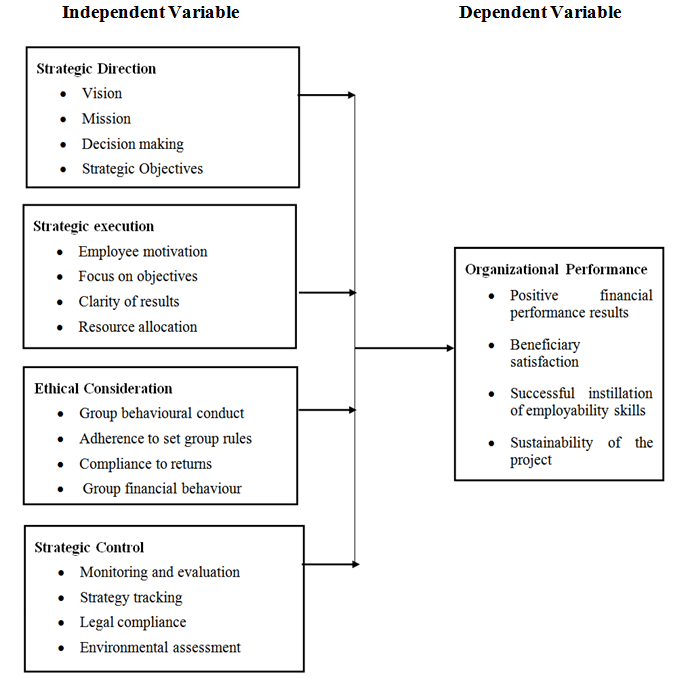
2.3. Conceptual FrameworkFigure 1 shows the study's conceptual framework which shows the interrelation between the independent variable and the dependent variable.
The research design used in the study was descriptive. One hundred and twenty youth groups that have benefited from government-funded youth projects during the previous five years, from 2018 to 2023, was the focus of the study. Stratified random sampling was used to calculate the sample size. This approach led into having a sample size of 92 youth groups which took part in this present research study. The research utilized primary data that was gathered through the implementation of questionnaires that integrate the Likert scale. A preliminary examination was conducted to establish the reliability and uniformity of the research instruments. Several diagnostic tests such the test for normality, test for multicollinearity, F test as well as the coefficient of determination tests was carried before running the multiple linear regression model guiding this study. Descriptive tests as well as the Pearson’s correlation tests was conducted on the data. Ultimately, the multiple linear regression model was conducted and the p-value from the model used to answer the research questions guiding this study.
The key study independent variables were strategic direction, strategic execution, ethical consideration and strategic control and dependent variable was organizational performance.
The study analyzed the effect of strategic direction on organizational performance of selected government-funded youth projects in Isiolo County, Kenya where a rating scale from 1 to 5 was provided; 1= strongly disagree, 2= disagree, 3= neutral, 4= agree, 5= strongly agree. The results were shown in Table 1.
The results showed that majority of the respondents agreed with the statement that the vision statement is clear and comprehensive in explaining what their organization represents (mean=3.88, std.dev=1.21). This infers that most youth projects had clear vision. The results further showed that majority of the respondents agreed with the statement that the mission statement is clear and comprehensive in explaining what their organization represents (mean=3.62, std.dev=1.22). This infers that most youth projects had clear mission statement. The results showed that majority of the respondents agreed with the statement that youths and other parties of interest are involved in decision making for major issues in their organization (mean=3.64, std.dev=1.25). This infers that the youth project leaders would involve other youths on major decision making.
In addition, results showed that majority of the respondent agreed with the statement that the strategic objectives in their organization was clear and outlined the desired outcomes and results that the organization aimed to accomplish in the long-term (mean=3.64, Std.dev=1.14). This infers that the youth projects had clear strategic objectives. The overall mean was 3.70 while the standard deviation was 1.21. This implied that majority of the respondents agreed with the statements on strategic direction. The study findings agreed with 31 who found that strategic direction had a significant effect on the operational efficiency. The study findings also agreed with 32 whose findings revealed that strategic orientation exerted a significant influence on the operational efficacy of tourism agencies.
The study analyzed the effect of strategic execution on organizational performance of selected government-funded youth projects in Isiolo County, Kenya where a rating scale from 1 to 5 was provided; 1= strongly disagree, 2= disagree, 3= neutral, 4= agree, 5= strongly agree. The results were shown in Table 2.
The results showed that majority of the respondents agreed with the statement that employees are well motivated appreciated and compensated for their contributions towards meeting the objectives of the organization (mean=4.24, std.dev=0.64). This infers that the youth projects employees are well motivated to continue working for the project. Results further showed that majority of the respondents agreed with the statement that the leadership of their organization does not divert from the set objectives or be influenced by politics of the area or any other external factor (mean=4.14, std.dev=0.68). This infers that the youth projects leadership do not divert form the main objective of the project. In addition, results further showed that majority of the respondents agreed with the statement that the desired results in their organization have been clearly defined and articulated for easier understanding (mean=4.20, std.dev=0.97). This infers that the youth projects had defined their results for their employees to understand.
Further results showed that majority of the respondents agreed with the statement that the available resources in their organization are effectively assigned and distributed to different activities within the organization to help achieve organization’s objectives desired results in their organization have been clearly defined and articulated for easier understanding (mean=4.20, std.dev=1.27). This infers that the organizations were able to use the available resources for the organization objectives so as to achieve the desired results. The overall mean was 4.18 while the standard deviation was 1.28. This implied that majority of the respondents agreed with the statements on strategic execution. The study findings agreed with 33 who found that execution of strategies had positive impact on a company's performance. The study findings also agreed with 35, who demonstrated that organizational performance is strongly impacted by strategic leadership, with strategic execution acting as a partly mediating factor in this relationship.
The study analyzed the effect of ethical considerations on organizational performance of selected government-funded youth projects in Isiolo County, Kenya where a rating scale from 1 to 5 was provided; 1= strongly disagree, 2= disagree, 3= neutral, 4= agree, 5= strongly agree. The results were shown in Table 3.
Results showed that majority of the respondents agreed with the statement that the group behavioural conduct of the staff in their organization was in accordance with the organizations’ set code of conduct (mean=3.50, std.dev=0.97). This infers that youth projects had a conduct that was in line with organizations’ set code of conduct. Results further showed that majority of the respondents agreed with the statement that their organization had clear and well-known set group rules that all the staff adhere to (mean=3.81, std.dev=1.20). This infers that youth projects. Further results showed that majority of the respondents agreed with the statement that all staff and stakeholders in their organization filed their returns and complied to other government set procedures of operation (mean=4.08, std.dev=0.85). This infers that youth project management encouraged their members to comply with the government rules.
In addition, results were clear that majority of the respondents agreed with the statement that employee’s financial behaviour and trends show transparency and accountability of assets and acquired wealth (mean=4.11, std.dev=1.20). this infers that the employees of the youth projects were transparent and accountable. The overall mean was 3.88 while the standard deviation was 1.05. This implied that majority of the respondents agreed with the statements on ethical considerations. The study findings agreed with 34 who found that ethical leadership resulted in improved employee performance through improved manager-employee relationships, preventing corruption, and improving employee attitudes toward the organization. The study findings also agreed with 36 who demonstrated that there was a noteworthy and favourable correlation observed between the ethical practices in business and the overall performance of employees.
The study analyzed the effect of strategic control on organizational performance of selected government-funded youth projects in Isiolo County, Kenya where a rating scale from 1 to 5 was provided; 1= strongly disagree, 2= disagree, 3= neutral, 4= agree, 5= strongly agree. The results were shown in Table 4.
Results showed that majority of the respondents agreed with the statement that continuous monitoring and evaluation was done to all strategic interventions by their organization to assess impacts and ensure their compliance to the determined organizational path (mean=3.95, std.dev=1.07). This infers that project managers of the youth projects encouraged monitoring and evaluation of projects. Further results showed that majority of the respondents agreed with the statement that their organization systematically tracked and assessed the implementation of strategic objectives, actions, and milestones to ensure they are aligned with the overall strategic (mean=3.85, std.dev=1.31). This infers that the youth project management were able to track and assess the implementation of strategic objectives. In addition, results showed that majority of the respondents agreed with the statement that their organization systematically tracked and assesses the implementation of strategic objectives, actions, and milestones to ensure they are aligned with the overall strategic (mean=4.01, std.dev=1.20).
Further results showed that majority of the respondents agreed with the statement that environmental impact assessments are done to before initiating development projects in their organization to ensure no harm is done and assure sustainability (mean=3.33, std.dev=1.16). This infers that project management of the youth project did EIA before conducting any project. The overall mean was 3.79 while the standard deviation was 1.18. This implied that majority of the respondents agreed with the statements on strategic control. The study findings agreed with 29 whose results indicated that strategic control exerts a significant positive influence on the operational effectiveness of mission hospitals in Kenya. The study findings agreed with 37 who found that strategy control had signficant effect on organizational performance.
The study analyzed the organizational performance of selected government-funded youth projects in Isiolo County, Kenya where a rating scale from 1 to 5 was provided; 1= strongly disagree, 2= disagree, 3= neutral, 4= agree, 5= strongly agree. The results were shown in Table 5.
Results showed that majority of the respondents agreed with the statement that services delivered by the government to their organization have led to increase in positive financial performance results of this youth group (mean=3.96, std.dev=0.76). This infers that the services that the youth projects received from the government led to increase in projects performance. Further results were clear that majority of the respondents agreed with the statement that strategic leadership and performance had led to increased beneficiary satisfaction among the members of their organization (mean=3.98, std.dev=1.10). This infers that the stable leadership of the youth projects led to satisfaction of the project beneficiary. In addition, results showed that majority of the respondents agreed with the statement that youths from the organization who have benefited from government-funded youth projects are more employable. (mean=4.34, std.dev=0.65). This infers that government-funded youth projects led to lots of employment.
Further results were clear that majority of the respondents agreed with the statement that their organization can continue to address the needs and aspirations of young people, deliver desired outcomes, and maintain its positive effects over time even without external support (mean=4.31, std.dev=0.82). This infer that the government-funded youth projects were able to deliver desired outcomes even without external support. The overall mean was 4.15 while the standard deviation was 0.83. This implied that majority of the respondents agreed with the statements on organizational performance. The study findings agreed with 31 who indicated that the performance of youth funded NGOs in Kenya was increasing.
4.2. Regression AnalysisAs per Zikmund et al., (2010) regression model helps one to get better understanding of how typical value of the dependent variable changes when any one of the independent variables is varied while the other independent variable is held constant or fixed. Regression analysis was done to determine the relationship between the independent variables (strategic direction, strategic execution, ethical consideration and strategic control) and dependent variable (organizational performance).
Results showed that the R was 0.849. This implies that strategic leadership had a strong correlation with organizational performance of selected government-funded youth projects. In addition, the R square was 0.721. This infers that strategic direction, strategic execution, ethical consideration and strategic control explain 72.1% of the variations in the dependent variable which was organizational performance of selected government-funded youth projects.
To determine the strategic direction as a predictor for organizational performance the ANOVA was computed.
Table 7 indicated that strategic leadership practices were a good predictor of organizational performance as represented by an F statistic of 48.357 and the reported p value of 0.000, which was less than the conventional probability of 0.05 significance level. This implies that the strategic leadership practices have statistically significant effect on organizational performance at a 95% confidence level. The study findings agreed with 35 who demonstrated that organizational performance is strongly impacted by strategic leadership.
Empirical Model
Optimal Model
Y = 0.230X1+ 0.155X2+ 0.378X3 + 0.249X4
Where;
Y = Organizational performance (dependent variable)
X1 = strategic direction
X2 = strategic execution
X3 = ethical considerations
X4 = strategic control
ε = Error terms
Regression of coefficients showed that strategic direction had a positive and significant effect with organizational performance of selected government-funded youth projects (β=0.230, p=0.011). This infers that improvement in strategic direction by one unit would lead to improvement in organizational performance of selected government-funded youth projects by 0.230 units. The study findings agreed with 31 who found that strategic direction had a significant effect on the operational efficiency. The study findings also agreed with 32 whose findings revealed that strategic orientation exerted a significant influence on the operational efficacy of tourism agencies. Further results showed that strategic execution had a positive and significant effect with organizational performance of selected government-funded youth projects (β=0.155, p=0.046). This infers that improvement in strategic execution by one unit would lead to improvement in organizational performance of selected government-funded youth projects by 0.155 units. The study findings agreed with 33 who found that execution of strategies had positive impact on a company's performance. The study findings also agreed with 35, who demonstrated that organizational performance is strongly impacted by strategic leadership, with strategic execution acting as a partly mediating factor in this relationship.
In addition, results showed that ethical consideration had a positive and significant effect with organizational performance of selected government-funded youth projects (β=0.378, p=0.046). This infers that improvement in ethical consideration by one unit would lead to improvement in organizational performance of selected government-funded youth projects by 0.378 units. The study findings agreed with 34 who found that ethical leadership resulted in improved employee performance through improved manager-employee relationships, preventing corruption, and improving employee attitudes toward the organization. The study findings also agreed with 36 who demonstrated that there was a noteworthy and favorable correlation observed between the ethical practices in business and the overall performance of employees.
Further results showed that strategic control had a positive and significant effect with organizational performance of selected government-funded youth projects (β=0.249, p=0.005). This infers that improvement in strategic control by one unit would lead to improvement in organizational performance of selected government-funded youth projects by 0.249 units. The study findings agreed with 29 whose results indicated that strategic control exerts a significant positive influence on the operational effectiveness of mission hospitals in Kenya. The study findings agreed with 37 who found that strategy control had signficant effect on organizational performance.
The study concluded that strategic direction had a positive and significant effect with organizational performance of selected government-funded youth projects. Therefore, determining strategic direction is a critical variable in strategic leadership practice and is a significant contributor in improving the organizational performance of selected government-funded youth projects. Having a clear mission and vision statement would enhance the performance of the projects.
The study concluded that strategic execution had a positive and significant effect with organizational performance of selected government-funded youth projects. Therefore, determining strategic execution is a critical variable in strategic leadership practice and is a significant contributor in improving the organizational performance of selected government-funded youth projects. Effectively assignment and distribution of resources to different activities within the organization help achieve organization’s objectives desired results in the organization.
The study concluded that ethical considerations had a positive and significant effect with organizational performance of selected government-funded youth projects Therefore determining ethical considerations is a critical variable in strategic leadership practice and is a significant contributor in improving the organizational performance of selected government-funded youth projects. In addition, more ethical practices are needed to enhance reputation of these organizations.
The study concluded that strategic control had a positive and significant effect with organizational performance of selected government-funded youth projects. Therefore, determining strategic control is a critical variable in strategic leadership practice and is a significant contributor in improving the organizational performance of selected government-funded youth projects. In addition, systematically tracking and assessing the implementation of strategic objectives helped the youth projects to aligned with the overall strategic plan.
The study recommends that strategic leaders should consider engaging more on determining strategic direction to enhance organizational performance of selected government-funded youth projects. The youth projects should enhance the competencies of the members of management through training. Training could a good method to equip members with knowledge and skills in strategic planning. The youth projects should also consider having a clear mission statement and strategic objectives that the employees will understand easily. This will enhance their performance.
Consequently, youth projects should enhance their strategy execution capability. This should be done through actions including by leaders checking progress of work against agreed upon targets, reassuring time schedules and deadlines, and preparing detailed plans on how to accomplish important task. It is recommended that youth projects should ensure that their employees are well prepared for change. This can be done through training of the employees to new business techniques, involving the employees in the preparation of strategic plans. This can be done through training of the employees to new techniques, involving the employees in the preparation of strategic plans. By doing so the leaders will be able to manage employee expectations and hence reduce the culture of employee resistance to change which affects strategy execution.
Strategic leaders should treat ethical considerations with the seriousness it desires as it was found to be significant contributors in organizational performance. Leaders of the youth projects should always base their decision on moral justification based on reality rather than merely an agreed-upon set of morals and values by an individual. The youth projects should also promote conduct based on integrity and trust.
The youth projects should proactively apply effective control systems in strategy management so as to ensure intended results are realized and any deviations corrected. The youth projects management should also set clear and specific goals and objectives that align with the organization's overall strategy.
| [1] | ILO. (2020). The Youth Employment Crisis: Time for Action. International labour organization. Geneva. | ||
| In article | |||
| [2] | Crispin, A. (2019). Positive youth development across cultures: Introduction to the special issue. In Child & Youth Care Forum. Springer US, 48(1), 147-153. | ||
| In article | View Article | ||
| [3] | World Bank. (2017). World Bank. Retrieved from World Free of Poverty: Operations, Evaluation Department: worldbank.org/ worldbankeconomicreviewwww.bublew.com/news/1679355. | ||
| In article | |||
| [4] | Edokpolor, J. E., & Owenvbiugie, R. O. (2017). Technical and Vocational Education and Training Skills: An Antidote for Job Creation and Sustainable Development of Nigerian Economy. Journal of problems of education in the 21st century, 75(6), 535-549. | ||
| In article | View Article | ||
| [5] | Clarissa, J. (2015). The Influence of Strategic Control Systems on Organizational Performance by the Resource-Based View Perspective: A Metallurgist Case Study. Journal of Applied Environmental and Biological Sciences, 6(8), 105-114. Retrieved from https://www.researchgate.net/publication/302547381. | ||
| In article | |||
| [6] | Fraker, T., Arif, M., & Allison, T. (2018). The Youth Transition Demonstration Project In Miami, Florida: Design, Implementation, And Three-Year Impacts. Journal of Vocational Rehabilitation, 48(1), 79-91. | ||
| In article | View Article | ||
| [7] | Banu, S., & Chandran, M. (2019). Impact of Human Capital Management on Organizational Performance- A Study with Reference to Private Sector Banks. International journal of innovative technology and exploring engineering, 8(7), 1-13. | ||
| In article | |||
| [8] | Jaleha, A. A., & Machuki, V. N. (2018). Strategic Leadership and Organizational Performance: A Critical Review of Literature. European Scientific Journal, 14(35), 165-173. | ||
| In article | View Article | ||
| [9] | Kiyana, M. D., & Gitonga, A. K. (2018). Determinants of Youth Enterprise Development Funded Projects Performance in Isiolo County. International Academic Journal of Information Science and Project Management, 3(2), 189-207. | ||
| In article | |||
| [10] | KIPPRA. (2016). Unemployment in Kenya: A Situational Analysis and What Needs to be Done, Nairobi, Kenya. National Economic and Social Council (NESC). | ||
| In article | |||
| [11] | KNBS. (2019). Kenya Demographic and Health Survey . Retrieved from Kenya National Bureau of statistics. | ||
| In article | |||
| [12] | Waithira, M., Karani, A. K., & Kabaya, C. N. (n.d.). Socio-Demographic Determinants of Satisfaction With Training Process Among Final Year Nursing Students At Kenya Medical Training College. | ||
| In article | |||
| [13] | Apalia, E. A. (2017). Effects of Discipline Management on Employee Performance in an Organization: The Case of County Education Office Human Resource Department, Turkana County. International academic journal of human resource and business administration, 2(3), 1-18. | ||
| In article | |||
| [14] | Ngala, F., & Mbogo, R. (2019). Managing youth unemployment in developing economies: An analysis of post-graduate students’ learning preferences in Kenya. IRA International Journal of Education and Multidisciplinary Studies, 15(1), 1-15. | ||
| In article | View Article | ||
| [15] | Alhyasat, W. M., & Sharif, Z. M. (2018). The Relationship Between Strategic Leadership and Organization Performance In Jordan Industrial Estates Company. AIP conference proceedings, 1(1), 1-10. | ||
| In article | View Article | ||
| [16] | Hauwa’u, S. A. (2021). Impact of Entrepreneurship Development on Poverty Alleviation of Small and Medium Enterprises in Kaduna State. Journal of Managemnet Science, 4(1), 1-12. | ||
| In article | |||
| [17] | Kaplan, R., & Norton, P. (1992). The Balanced Scorecard-Measures That Drive Performance. Harvard Business Review, 70(1), 71-79. | ||
| In article | |||
| [18] | Quesado, P. (2018). Advantages and Contributions in the Balanced Scorecard Implementation. Journal of Intangible Capital, 14(1), 39-48. | ||
| In article | View Article | ||
| [19] | Kitonga, Bichanga, & Muema. (2016). European Journal of Business and Management Research, 5(6), 28-38. Retrieved from https://www.researchgate.net/publication/344787880 | ||
| In article | |||
| [20] | Kungu, Kahuthia, & Kinyua. (2020). Analysis of the Effect of Strategic Direction on Performance of Motor Vehicle Assembly Firms in Nairobi City County, Kenya. International Journal of Managerial Studies and Research, 8(8), 82-94. | ||
| In article | View Article | ||
| [21] | Selznick, (1984); Leadership in Administration. A sociological interpretation, Berkeley. University of California Press. | ||
| In article | |||
| [22] | Mihelic, K. K., & Tekavcic, M. (2018). Ethical Leadership. International journal of management and information systems, 1(4), 31-41. | ||
| In article | |||
| [23] | Munyao, S. M., Chiroma, N. H., & Ongeti, W. J. (2020). Effects Of Strategic Direction on The Performance of Africa Inland Church Theological Training Institutions In Kenya. International Journal Of Science And Research Publications, 10(3), 45-59. | ||
| In article | |||
| [24] | Bose, E. N., & Ndegwa, P. (2019). Strategic Leadership and Organizational Performance of Directorate of Criminal Investigations in Nairobi County, Kenya. International journal of current aspects, 3(5), 166-185. | ||
| In article | View Article | ||
| [25] | Muthimi, J. K., & Kilika, J. M. (2018). Leadership Strategy, Behavioural Focus and Firm Performance: A Review Of Literature. International Business Research, 11(11), 79-87. | ||
| In article | View Article | ||
| [26] | Moberg, P. J. (2017). Linking Conflict Strategy to the Five-Factor Model: Theoretical and Empirical Foundations. International Journal of Conflict Management, 12(1), 46-71. | ||
| In article | View Article | ||
| [27] | Gakenia, C., Katuse, P., & Kiriri, P. (2017). Influence of Strategy Execution on Academic Performance of National Schools in Kenya. Journal of Business and Management, 7(1), 25-40. | ||
| In article | View Article | ||
| [28] | Ansoff, H. I., & Sullivan, P. A. (1993). Optimizing Profitability in Turbulent Environments: A Formula for Strategic Success. Long Range Planning, 26(5), 11-23. | ||
| In article | View Article | ||
| [29] | Gaturu, P. (2017). Influence of Strategic Control on Organizational Performance of Mission Hospitals in Kenya. International Journal of Business and Management Invention, 6(11), 68-76. Retrieved from https:// www.researchgate.net/ publication/320306940. | ||
| In article | View Article | ||
| [30] | Nyong'a, T. M., & Maina, R. (2019). Influence of Strategic Leadership on Strategy Implementation at Kenya Revenue Authority Southern Region in Kenya. International Academic Journal of Human Resource and Business Administration, 3(5), 128-159. | ||
| In article | |||
| [31] | Kitonga. (2017). Doctoral Thesis of Jomo Kenyatta University Of Agriculture and Technology, Kenya, 1-120. | ||
| In article | |||
| [32] | Tavakoli, I., & Perks, K.J. (2001). The development of a strategic control system for the management of strategic change. Strategic Change, 10 (5), 297-305. | ||
| In article | View Article | ||
| [33] | Iheanachor, O. (2022). Effects of Financial Management on the Performance of Small and Medium Enterprises in Nigeria. International Journal of Management, Economics and Social Sciences, 11(1), 15-29. Retrieved from https:// www.ijmess.com/ volumes/volume-XI-2022/issue-I-03-2022/full-2.pdf. | ||
| In article | |||
| [34] | Musyimi, S. (2016). Perceived effects of ethical leadership on employee performance among commercial banks in kenya. Unpublished research project of university of nairobi, 1-102. | ||
| In article | |||
| [35] | Miriti, J. B. (2021). Strategic Leadership, Strategy Execution and Organizational Performance: A Survey of Savings And Credit Cooperatives In Kenya. Unpublished Doctoral Thesis, Kenya Methodist University, 1-150. | ||
| In article | |||
| [36] | Samak, V. (2017). The Development of Self Esteem in Children. Systematic Review and Meta- Analysis, 13(1), 81-93. | ||
| In article | |||
| [37] | Odhiambo, T. (2017). Influence of Strategy Control on Organization Performance: A Survey of Hotels in Kisumu. Unpublished Research Project, Maseno University. | ||
| In article | |||
Published with license by Science and Education Publishing, Copyright © 2024 James Lowasa Eris and Janet Muthimi
 This work is licensed under a Creative Commons Attribution 4.0 International License. To view a copy of this license, visit
https://creativecommons.org/licenses/by/4.0/
This work is licensed under a Creative Commons Attribution 4.0 International License. To view a copy of this license, visit
https://creativecommons.org/licenses/by/4.0/
| [1] | ILO. (2020). The Youth Employment Crisis: Time for Action. International labour organization. Geneva. | ||
| In article | |||
| [2] | Crispin, A. (2019). Positive youth development across cultures: Introduction to the special issue. In Child & Youth Care Forum. Springer US, 48(1), 147-153. | ||
| In article | View Article | ||
| [3] | World Bank. (2017). World Bank. Retrieved from World Free of Poverty: Operations, Evaluation Department: worldbank.org/ worldbankeconomicreviewwww.bublew.com/news/1679355. | ||
| In article | |||
| [4] | Edokpolor, J. E., & Owenvbiugie, R. O. (2017). Technical and Vocational Education and Training Skills: An Antidote for Job Creation and Sustainable Development of Nigerian Economy. Journal of problems of education in the 21st century, 75(6), 535-549. | ||
| In article | View Article | ||
| [5] | Clarissa, J. (2015). The Influence of Strategic Control Systems on Organizational Performance by the Resource-Based View Perspective: A Metallurgist Case Study. Journal of Applied Environmental and Biological Sciences, 6(8), 105-114. Retrieved from https://www.researchgate.net/publication/302547381. | ||
| In article | |||
| [6] | Fraker, T., Arif, M., & Allison, T. (2018). The Youth Transition Demonstration Project In Miami, Florida: Design, Implementation, And Three-Year Impacts. Journal of Vocational Rehabilitation, 48(1), 79-91. | ||
| In article | View Article | ||
| [7] | Banu, S., & Chandran, M. (2019). Impact of Human Capital Management on Organizational Performance- A Study with Reference to Private Sector Banks. International journal of innovative technology and exploring engineering, 8(7), 1-13. | ||
| In article | |||
| [8] | Jaleha, A. A., & Machuki, V. N. (2018). Strategic Leadership and Organizational Performance: A Critical Review of Literature. European Scientific Journal, 14(35), 165-173. | ||
| In article | View Article | ||
| [9] | Kiyana, M. D., & Gitonga, A. K. (2018). Determinants of Youth Enterprise Development Funded Projects Performance in Isiolo County. International Academic Journal of Information Science and Project Management, 3(2), 189-207. | ||
| In article | |||
| [10] | KIPPRA. (2016). Unemployment in Kenya: A Situational Analysis and What Needs to be Done, Nairobi, Kenya. National Economic and Social Council (NESC). | ||
| In article | |||
| [11] | KNBS. (2019). Kenya Demographic and Health Survey . Retrieved from Kenya National Bureau of statistics. | ||
| In article | |||
| [12] | Waithira, M., Karani, A. K., & Kabaya, C. N. (n.d.). Socio-Demographic Determinants of Satisfaction With Training Process Among Final Year Nursing Students At Kenya Medical Training College. | ||
| In article | |||
| [13] | Apalia, E. A. (2017). Effects of Discipline Management on Employee Performance in an Organization: The Case of County Education Office Human Resource Department, Turkana County. International academic journal of human resource and business administration, 2(3), 1-18. | ||
| In article | |||
| [14] | Ngala, F., & Mbogo, R. (2019). Managing youth unemployment in developing economies: An analysis of post-graduate students’ learning preferences in Kenya. IRA International Journal of Education and Multidisciplinary Studies, 15(1), 1-15. | ||
| In article | View Article | ||
| [15] | Alhyasat, W. M., & Sharif, Z. M. (2018). The Relationship Between Strategic Leadership and Organization Performance In Jordan Industrial Estates Company. AIP conference proceedings, 1(1), 1-10. | ||
| In article | View Article | ||
| [16] | Hauwa’u, S. A. (2021). Impact of Entrepreneurship Development on Poverty Alleviation of Small and Medium Enterprises in Kaduna State. Journal of Managemnet Science, 4(1), 1-12. | ||
| In article | |||
| [17] | Kaplan, R., & Norton, P. (1992). The Balanced Scorecard-Measures That Drive Performance. Harvard Business Review, 70(1), 71-79. | ||
| In article | |||
| [18] | Quesado, P. (2018). Advantages and Contributions in the Balanced Scorecard Implementation. Journal of Intangible Capital, 14(1), 39-48. | ||
| In article | View Article | ||
| [19] | Kitonga, Bichanga, & Muema. (2016). European Journal of Business and Management Research, 5(6), 28-38. Retrieved from https://www.researchgate.net/publication/344787880 | ||
| In article | |||
| [20] | Kungu, Kahuthia, & Kinyua. (2020). Analysis of the Effect of Strategic Direction on Performance of Motor Vehicle Assembly Firms in Nairobi City County, Kenya. International Journal of Managerial Studies and Research, 8(8), 82-94. | ||
| In article | View Article | ||
| [21] | Selznick, (1984); Leadership in Administration. A sociological interpretation, Berkeley. University of California Press. | ||
| In article | |||
| [22] | Mihelic, K. K., & Tekavcic, M. (2018). Ethical Leadership. International journal of management and information systems, 1(4), 31-41. | ||
| In article | |||
| [23] | Munyao, S. M., Chiroma, N. H., & Ongeti, W. J. (2020). Effects Of Strategic Direction on The Performance of Africa Inland Church Theological Training Institutions In Kenya. International Journal Of Science And Research Publications, 10(3), 45-59. | ||
| In article | |||
| [24] | Bose, E. N., & Ndegwa, P. (2019). Strategic Leadership and Organizational Performance of Directorate of Criminal Investigations in Nairobi County, Kenya. International journal of current aspects, 3(5), 166-185. | ||
| In article | View Article | ||
| [25] | Muthimi, J. K., & Kilika, J. M. (2018). Leadership Strategy, Behavioural Focus and Firm Performance: A Review Of Literature. International Business Research, 11(11), 79-87. | ||
| In article | View Article | ||
| [26] | Moberg, P. J. (2017). Linking Conflict Strategy to the Five-Factor Model: Theoretical and Empirical Foundations. International Journal of Conflict Management, 12(1), 46-71. | ||
| In article | View Article | ||
| [27] | Gakenia, C., Katuse, P., & Kiriri, P. (2017). Influence of Strategy Execution on Academic Performance of National Schools in Kenya. Journal of Business and Management, 7(1), 25-40. | ||
| In article | View Article | ||
| [28] | Ansoff, H. I., & Sullivan, P. A. (1993). Optimizing Profitability in Turbulent Environments: A Formula for Strategic Success. Long Range Planning, 26(5), 11-23. | ||
| In article | View Article | ||
| [29] | Gaturu, P. (2017). Influence of Strategic Control on Organizational Performance of Mission Hospitals in Kenya. International Journal of Business and Management Invention, 6(11), 68-76. Retrieved from https:// www.researchgate.net/ publication/320306940. | ||
| In article | View Article | ||
| [30] | Nyong'a, T. M., & Maina, R. (2019). Influence of Strategic Leadership on Strategy Implementation at Kenya Revenue Authority Southern Region in Kenya. International Academic Journal of Human Resource and Business Administration, 3(5), 128-159. | ||
| In article | |||
| [31] | Kitonga. (2017). Doctoral Thesis of Jomo Kenyatta University Of Agriculture and Technology, Kenya, 1-120. | ||
| In article | |||
| [32] | Tavakoli, I., & Perks, K.J. (2001). The development of a strategic control system for the management of strategic change. Strategic Change, 10 (5), 297-305. | ||
| In article | View Article | ||
| [33] | Iheanachor, O. (2022). Effects of Financial Management on the Performance of Small and Medium Enterprises in Nigeria. International Journal of Management, Economics and Social Sciences, 11(1), 15-29. Retrieved from https:// www.ijmess.com/ volumes/volume-XI-2022/issue-I-03-2022/full-2.pdf. | ||
| In article | |||
| [34] | Musyimi, S. (2016). Perceived effects of ethical leadership on employee performance among commercial banks in kenya. Unpublished research project of university of nairobi, 1-102. | ||
| In article | |||
| [35] | Miriti, J. B. (2021). Strategic Leadership, Strategy Execution and Organizational Performance: A Survey of Savings And Credit Cooperatives In Kenya. Unpublished Doctoral Thesis, Kenya Methodist University, 1-150. | ||
| In article | |||
| [36] | Samak, V. (2017). The Development of Self Esteem in Children. Systematic Review and Meta- Analysis, 13(1), 81-93. | ||
| In article | |||
| [37] | Odhiambo, T. (2017). Influence of Strategy Control on Organization Performance: A Survey of Hotels in Kisumu. Unpublished Research Project, Maseno University. | ||
| In article | |||