Vegetation as a sink of air pollutants is well known and models have been developed to describe the processes involved. Vegetation as a sink for air pollutants in one of the most polluted cities in the world, Lahore, Pakistan, has not yet been documented. Lahore is known as the ‘Garden City’ and a model was developed to estimate the role of green urban spaces (GUS) as a sink for air pollutants in the city. Several GUSs in Lahore were described, and tree and leaf area (LA) dimensions were measured. This information formed the vegetation input of the model. The deposition fluxes of the gaseous pollutants and the dry and wet deposition of particulate matter were calculated and then applied to the LA of the GUSs. The precipitated and absorbed quantities of pollutants were contrasted with the amount present in the atmosphere. It was found that even relatively small GUSs have a significant ability to reducethe atmosphericpollutant concentrations. However, when extrapolating these findings to the urban area of Lahore at large, this impact reduces significantly due to the lack of GUSs in Lahore. The pollution generated by the city of Lahore far exceeds what the existing vegetation can accommodate. The existing vegetation of the city therefore needs to be protected, and the area of GUSs increased because without such spaces the city is even worse off. The prevailing atmospheric conditions during the winter monthsdoes however, limit the effectiveness of the role of vegetation as a sink for air pollutants.
Air pollution in Lahore, Pakistan, is among the worst in the world.The city features consistently in the top ten most polluted cities according to IQAir 1. However, the city also has the reputation of being the “garden city” 2. This is based on the perception that the city has many parks and gardens. By world standards,though,the amount of green open space in the city falls well short of the world standard for sustainable urban ecosystems 3. At the same time it is also urbanising at a rapid rate with a population growth rate of 4 % and an area growth rate of 7 % 4.
The benefits of green urban spaces (GUS) are well recognised as discussed extensively by 5, 6, and particularly with respect to air pollution removal 7, 8, 9, 10. Despite the role GUS play in the removal of air pollutants, little information is available as to how this would apply to Lahore, particularly given the intensity of air pollution in the city. Several authors have looked at the resilience of urban vegetation in Lahore in the presence of high levels of pollution 11, 12. Reference 13 looked the localised effect of some tree species on the improvement of the particulate matter smaller than 2.5 µm (PM2.5) on an ad-hock basis but did not extend it to larger areas of the city and other pollutants.
Reference 14 described several approaches to assess the potential of phytoremediation of outdoor air pollutants which consisted of extensive and very detailed plant physiological observations addressing the absorption of gases. Other observations consisted of extensive outdoor observations of dust collections on urban trees. One approach not covered explicitly by 14 is a modelling approach covering the gaseous absorption and dry and wet deposition. This approach can quantify the effect of GUS on air pollution by estimatingthe level pollutant removal by GUS. One such model is the iTree model from USDA Forest Service “a state-of-the-art, peer-reviewed software suite from the USDA Forest Service that provides urban and rural forestry analysis and benefits assessment tools. The i-Tree tools can help strengthen forest management and advocacy efforts by quantifying forest structure and the environmental benefits that trees provide.” 15. The model requiresinput in the form of vegetation and landscape parameters. However, applying this model to Lahore requires verified and formatted datasets for air pollution as well as meteorology, andthose data sets are not available for Lahore in the current version of the model. Also user generated inputs are very limited for the iTree model.
The basis for the iTree model is the UFORE (Urban Forrest Effects) model developed by 16 which is supported by extensive descriptions of model processes and a data collection manual 17. This model consists of five sub-models of which two were deemed relevant to apply to the situation in Lahore. These are:
UFORE-A: A model describing the anatomy of the urban forestwhich quantifies urban forest structure (e.g., species composition, tree density, tree health, leaf area, leaf and tree biomass) based on field data.
UFORE-D: Modelling dry deposition of air pollution quantifying the hourly amount of pollution removed by the urban forest and associated percent improvement in air quality over time. Pollution removal is calculated for ozone (O3), sulphur dioxide (SO2),nitrogen dioxide (NO2),carbon monoxide (CO), PM2.5and particulate matter smaller than 10 µm (PM10) based on field, pollution concentration, and meteorological data.
These two sub-models have been well documented and are also described by 18, 19 and further in the iTree guide 15. The descriptions in the respective references providedenough detail to develop a few Excel® spreadsheets to calculate tree parametersand, more importantly, the fluxes driving the absorbance and thedry and wet depositions of air pollutants by the vegetation. These spreadsheets were used to simulate the effect of GUS on the remediation of air pollution in Lahore, Pakistan,for a 2 yearperiod. For that period,extensive air pollution data was availableand during that period vegetation estimates of severalpark areas were obtained.
From this work,the size of the sink of GUS forcommon air pollutants in one of the most polluted cities of the world was estimated. This paper describes the GUS, the spreadsheet models and the results of the remediation modelling in the context of ambient air pollution levels in Lahore.
GUS descriptions
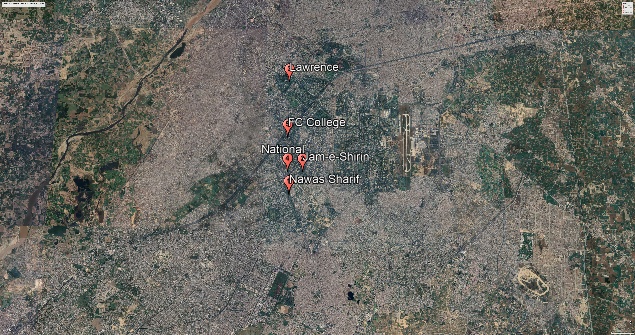
Four parks (Nawas Sharif (1), Jam-e-Shirin (2), Lawrence (3) and National Park (4)) and one part of the campus of FC College (5)in Lahore, Pakistan were selected for the assessment of the vegetation. The location of those areas is presented in Figure 1.

The effort was focussed on areas where there was a large selection of trees, and sizeable shrubs. The size of the areas was: 2.91, 2.41, 4.24, 0.89 and 13.0 ha respectively. In each of the areas the number of trees was counted, the height of a sample of similar sized trees was determined by taking a digital photograph with a reference markat a known height attached to the tree. From these photos the tree diameter at breast height (DBH) or at a height of 1.35 m 17, the tree height and the crown dimensions (height and width) were determined using the number of pixels and the scale factor (pixels/cm). This wasderived from the height of the reference mark in the photograph as the number of pixels and its real height in centimetres. By looking up through the canopy a rough estimate of the intercepted light as a fraction (S) was also determined. For example, if the sky could not be seen S = 0.95, and when about 50% of the view was occupied by the visible sky, S was 0.5.
The crown light exposure (i.e. number of sides of each tree receiving light from above) (CLE) was determined.
In the campus area more detailed measurements of the trees were carried out. This consisted of cutting several branches from certain trees and determining the volume of the branches (estimated length x width x height), the number of leaves and the size of the leaves. For the size, the leaves were divided into several groups based on size. For each group, a typical leaf area was determined by taking photos of those leaves, and then determining the area of those leaves using ImageJ® software. The total leaf area from the branch was determined by multiplying the area of the respective leaves by the number of the leaves in each group. After the volume of the tree canopy was estimated from its shape, the total leaf area of the tree was determined by multiplying the leaf area of the branch with the ratio of the total estimated tree canopy volume and the volume of the branches. This approach provided us with a rough comparison between estimating leaf area (LA) of the whole tree using established equations 17 and what was actually present. Reference 20 used a high-lift truck and cutting out an fixed volume of the tree canopy to establish the LA equations. We used individual branches.
An estimate of the total area of GUS in Lahore as a fraction of the total urban area of Lahore was done using Google Earth (GE) and ImageJ®. First, the urban area of Lahore was estimated from GE which was assumed to be bordered by the following well-known features in Lahore: the river Ravi, the Hudiara drain, Barki Road and the RingRoad. The high-resolutionimage of the area from GE was exported and had a resolution of 43m2 per pixel. In ImageJ® the GE image was imported, and the colours separated into a red, green and blue image. The red image was used to estimate the GUS. Using the threshold and the binary option, the GUS were made black, and then with the particle analysis option of ImageJ®, the size of all the black area was calculated. By altering the threshold, the size of the areas changed but by using known vegetated areas in Lahore as a reference,a realistic representation of the GUS areas could be determined. A range for the GUS, indicated by GUS1 and GUS2 was used. Only areas larger than 0.1 ha were counted in this process.
Ambient air quality monitoring
The ambient air quality at Forman Christian College (FCC), Lahore (Lat:31.5206 and Long: 74.3368) has been monitored now for several years. The system employed is a Haz-Scanner system from Environmental Device Corporation (EDC), USA. It is located on the campus of FCC in the residential area of the campus, about 500 m from major arterial roads. The air pollution parameters monitored wereparticulate matter with a particle size of < 2.5 um (PM2.5), and particulate matter with a particle size of < 10 um(PM10) using 90° infra-red (IR) light scattering systems.For carbon dioxide (CO2), CO, NO2, SO2, O3 Alpha Sense® sensors were used, while for the temperature and the relative humidity (RH) an HTM2500LF sensor was used. Wind speed and direction and rainfall were obtained with standard EDC equipment.The data was recorded every ten minutes. For the gaseous absorption and the dry deposition of the PM2.5 and the PM10, hourly averages were used, while for the wet deposition daily averages were used. The system has been serviced and calibrated every year by the manufacturer according to USEPA standards.
Period of interest
The period for the study was determined by the availability of air pollution data which started in early September 2022 until the end of June 2023, then again from the beginning of October 2023 until the beginning of June 2024. This period covered the autumn (Oct – Nov), winter (Dec - Feb) and spring (March – May) periods, typically periods of the worst air pollution. During the summers the pollution is greatly reduced, and air pollution data collected by the EDC Haz-Scanner system was not available for that period.
GUS
A proper and accurate description of the GUSis very important when the model is usedto estimate the potential of the GUSto function as an air pollutant sink. Every tree in the designated area of the GUSwas located, counted, described and measured. The description of the general area (the park-scape) was based on tree cover percentage, landuse, percentage of groundcover in the park-scape described by areas covered by building, bitumen, other types of pavements, bare soil, scrubs, grass and water.
For each of the trees in the GUSthe following parameters are required:DBH, amount of light intercepted (S), height and the width of the crown and CLE.
In the processes involved in the removal of air pollutants by vegetation, the leaf area (LA) is very important and/or the total dry-weight leaf biomass (TDLB). Reference 20, 21 developed and presented many regression equations for deciduous species of America 20, and other more diverse regions 21. Very good correlations were found by them between DBH, TDLB and LA. When based on DBH the equations took the form of equation 1:
 | (1) |
And when based on crown parameters, the form of equation 2:
 | (2) |
Where Y = LA (m2) or TDLB (g), X = DBH (cm), S the shading factor (fraction light intercepted by foliated tree crowns), H = crown height (m), D = average crown diameter (m) and C = the outer surface of the tree crown ( ). Reference 20 published a list of the constants in the two equations for a great number of trees. The assumption here is that the constants derived for trees in USA, can also be applied to describe the trees in the GUS of Lahore.
Overlapping crowns affected the LA and can be accommodated through the crown light exposureCLE values which range from 0 to 5 20. In practice most trees were in the category 4 and 5, hence no further distinction was made in the CLE.
The LA was a significant input variable for the flux model. LA was considered constant for the period under consideration and for a given place hence it was a single constant input, reflecting the entire LA of the GUS in theflux model.
Flux model
The model is similar in approach as the iTree model as described in detail 16. The equations describing the process of diffusion and precipitations are presented and discussed by 16. This sub-model, analogous to the UFORE-D model by 16 describes the absorption of several gaseous air pollutants (SO2, NO2 and O3)by the leaves as well as the dry and wet deposition processesof the PM2.5 and PM10.
The dry deposition is described as the flux (F, g.m-2.s-1) which is the product of the concentration of the pollutants in the air (C, in g.m-3) and the deposition velocity Vd in m.s-1.
 | (3) |
The deposition velocity is the inverse sum of the aerodynamic resistance (Ra) and the quasi-laminar boundary layer (Rb) and the canopy (Rc) resistances 22 (Eq. 4):
 | (4) |
Aerodynamic resistance
The aerodynamic resistance (Ra) was calculated as described by 16 (Eq. 5):
 | (5) |
where u(z) is the wind speed (m.s-1) at a height (z, in m) while the u* is the friction velocity (m.s-1).This friction velocity (u*) is governed by, among other things,the stability of the atmosphere at a given time.
The stability of the atmosphere is determined by the vertical profile of the air temperature, or the lapse rate (LR) compared to the adiabatic lapse rate (ALR) of the temperature 23.
Three different conditions are considered for atmospheric stabilities:
• Unstable: This typically occurs during daytime, when the land surface is heated by incoming solar radiation which in turn heats up the air above it. This creates vertical motion, and the heat flux is directed upward.
• Stable: This typically occurs typically during the night, when outgoing radiation dominates, air is cooled from below and air density increases closer to the ground. This condition limits the vertical motion of air and heat flux is directed downward.
• Neutral: This condition is somewhere between the stable and the unstable conditions, considered to occur around sunset or sun-down or under heavy clouding and/or strong winds. In this condition the vertical motions of air are not affected significantly, and heat flux is zero.
The friction velocity (u*) is calculated as follows (Eq. 6):
 | (6) |
where k = von Karman constant (0.4), d = displacement height (m), zo = roughness length (m),  = stability for momentum and L = the Monin-Obukhov (MO) stability length.
The MO stability length (L) can be estimated in many ways, some rather complex, others more straight forward. Simply stated the MO length reflects the height at which turbulence is generated more by buoyancy of the air than by wind shear. By definition L is usually negative in the daytime and at night L becomes positive while at dawn and at dusk L passes through zero 24.
Other atmospheric stability classes such as the Pasquill stability classes are more common and can be determined according to 25. The various Pasquill classes can be related to MO stability length according to 26. While a range of MO lengths is given, in the calculations the L_mean was used.
For the unstable condition (L<0) the  (stability for momentum) is calculated using Eq. 7.
 | (7) |
Where X = (1 – 28 z L-1)0.25
For stable conditions (L>0) the friction velocity is calculated using Eq. 8.
 | (8) |
where CDN = k (ln (z/z0)-1; u02 = (4.7 a g ) T-1; g = 9.81 m.s-1;
  = 0.09 (1 – 0.5 N2); T = air temperature (K˚); and N = fraction of opaque cloud cover 27.
So the determination of the stability classes depends on the wind speed, the solar radiation, and the time of day (day time, dawn/dusk or night time). In the model, the time of sunrise and sunrise was determined for Lahore for a given day 28 which according to 26 attracts a stability class of D. Then, according to wind speed and solar radiation the Pasquill classes were allocated for every hour and the associated MO stability length.
Quasi-laminar boundary layer resistance
The quasi-laminar boundary layer resistance (Rb) describes the resistance to the flow of vapour or heat. This laminar boundary-layer flow occurs when a moving fluid, like air, comes in contact with a solid surface and it has a resistance to vapour flow. This resistance (Rb) is calculated using Eq.9.
 | (9) |
Where k = von Karman constant (0.4), Sc = Schmith number (0.2 – 6, usually 1), and Pr = the Prantl number (0.7 – 0.9, usually 0.85) 29.
Canopy resistances
Once the gases, such as SO2, NO2, and O3 arrive at the tree canopy or the leaf surface they need to overcome the canopy resistance (Rc) to enter the leaves. These resistances were modelled asdescribed by 22. The canopy resistance has three components: the stomatal resistance (rs), mesophyll resistance (rm) and then the cuticular resistance (rt) such that (Eq. 10)
 | (10) |
The rm for the various gases was presented by Novak (2020) with the following values: 0, 10 and 100 s.m-1 for SO2, O3 and NO2 respectively. The rt for SO2, O3 and NO2 was 8,000, 10,000 and 20,000 s.m-1 respectively.
The calculation of the stomatal resistance (rs) was significantly more involved, aspresented by 22. The rs is dependent on the air temperature, the wind speed, the photosynthetically active radiation (PAR), the leaf area (LA), the vapour deficit, the level of water stress as well as the ratio of molecular diffusivity of the respective gases SO2, O3 and NO2 and water. Because the air temperature, the wind speed and PAR varies during the day, the rs varies accordingly over time.The PAR was obtained from 30.
Once the Rc was calculated it was combined with Ra and Rb to calculate the Vd using eq. 7. The Vd(m.s-1) was then multiplied by the actual concentration (g.m-3) of the respective pollutants to determine the flux (F) (g.m-2.s-1) using equation 6.
Dry deposition of PM
The dry deposition Vd of PM was determined from average values obtained from the literature 31, 32, 33, for PM10,Vd= 0.032 m.s-1 and for PM2.5Vd= 0.0032 m.s-1. TheVd was then multiplied by the concentration to give the flux (g.m-2.s-1), which was then multiplied with a certain time period (day, month, year) to give the total mass of the PM removed through dry deposition per day, month or year.
Wet deposition of particulate matter
The wet deposition of the PM is associated with the rainfall, and rainfall intensity which result in a scavenging efficiency (SE) 34. Reference 34 developed equations that describe the SE as a function of type of PM, rainfall (P, mm), as well as concentrations of the pollutant before the rain (C, µg.m-3), these were expressed as follows:
 | (14) |
 | (15) |
These equations were applied to the period of interest. Daily rainfall data of Lahore city for that period were obtained from the United States National Oceanic and Atmospheric Administration (NOOA) website 35. The concentration of the PM was changed from an hourly mean to a daily mean for this section.
Volatile organic compounds
Volatile organic compounds (VOC), particularly isoprene and monoterpene, also need to be considered in this context. Similarly to the SO2, NO2, O3 gases, the VOC emissions were determined as discussed 19. They are highly dependent on windspeed, air temperature, solar radiation and PAR. Reference 29 published emissions factors of isoprene and monoterpene for more than a 1000 individual trees specie in North America. They ranged from 0 to 70 and 0 to 8 umol.m2.s-1 for isoprene and monoterpene respectively. We are not aware that such values exist for local trees, and so we used 37 and 3.8 umol.m2.s-1 for isoprene and monoterpene respectively being in the top 5% of the published values.
SO2 and NO2 wet deposition
The wet deposition of both SO2 and NO2 in form of acid rain is not considered in this work. Rainfall during the winter months in Lahore is very limited given the climatic conditions, and as will be seen even the wash out of PM during rainfall events is minor, hence the wash out of SO2 and NO2 is not considered here. Workers such as 36 when comparing wet and dry deposition of SO2 in a semi-arid environment confirmed this as they found that the latter far outweighed the former.
GUS
Parts of several parks and the campus of FCCU in Lahore were assessed and the vegetation described and measured. A summary of the results of those measurements including the GUS and the Lahore Urban Area (LUA) are presented in Table 1.
The area covered in each park as part of this study was about 5 – 20 % of the total area of the parks and the campus. The areas selected in each park and the campus were based on a visual assessment, containing a mix of typical park-scape attributes such as pathways, scrubs, furniture, water features and many trees. The focus of the assessment of parts of the parks and the campus was on trees which is obviously only a part, albeitsignificant, of the vegetation in the GUS. The species typically encountered consisted of species such as Peepal tree (Ficus regligiosa), Shisham (Dalbergia sisso), Jaman (Syzygiumcumini), Beri pata (Fernandoaadenophylla), Arjun (Terminalia Arjune), Gaub (Diospyros malabarica), Neem (Azadirachta indica) and others. These trees are commonly found in the parks of Lahore as described by 37.Forty-five to 90 % of the areas assessed, was covered by trees. The range in DBH was 0.15 to 1.2 m, the height of the trees ranged from about 4 m to 14 m.The largest amount of sun intercepted was about 0.95, while the lowest was about 0.4. The assessment of the parks was done in the June – August 2024, while the FCC campus was assessed in April – May 2024 hence most deciduous trees were in full canopy. The deciduous nature of some trees would render them not effective in removing pollutants during the winter months when the high levels of pollution occur. It was not determined what percentage of the trees were deciduous.
The total LA based on the CS was 95528 m2, and based on the DBH was 298305 m2. Two approaches to calculate the LA have been presented by 20, one based on the DBH and S and the other on the CS and S. Both yield a different LA; hence we presented the range of LAs here. Reference 20 whose equations we used, found a better R2(0.91) when using the CS method compared the DBH method for which he found a R2 of 0.64. Reference 38 found that DBH alone accounted for 75 to 97 % of the variation in the LA in an oak-hickory forest. In our surveyed areas there is a great variety of species present hence the variation in DBH and the CS method of estimating the LA.
When comparing the LA derived using the Novak equations and estimated from our own leaf area estimates the best regression fit (R2 = 0.93) was obtained when using the DBH method of estimating the LA. The CS method performed very poorly due to several odd-shaped trees. The LA used in the flux model, was derived from the DBH.
Reference 38 referred to the work of 39 who found for broad leaf forests a leaf surface area of 4 to 6 m2/m2. In our case that ratio ranged from 1.13 m2/m2 for the more open park scape (National Park) to 2.58 m2/m2 for the more densely treed park scape (Jam-e Shirin Park) using the DBH method for LA estimation.
The fraction of GUS of the LUA ranged from 0.98 (GUS1) to 1.7 % (GUS2). This fraction is based on the entire urban area, recognising that in many neighbourhoods one would struggle to find even a small area dedicated to GUS. In other neighbourhoods of Lahore, typically the more affluent neighbourhoods,more areas are identified as GUS.
Ambient weather and air quality at FC College in Lahore
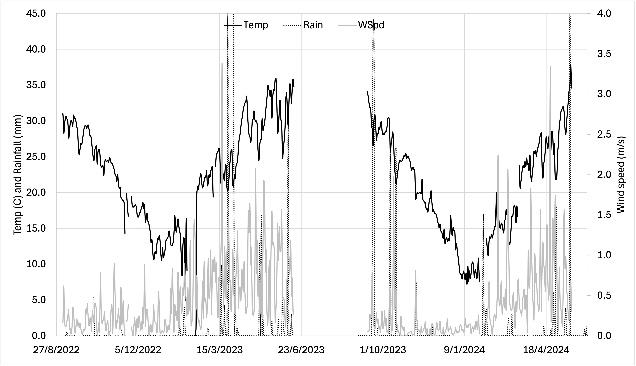
The mean daily ambient air temperature, rainfall and windspeed recorded at FCC in Lahore for the period under consideration (3 Sept 2022 – 10 June 2023, and 12 Sept 2023 – 19 May 2024) are presented in the following figure.

The ambient weather conditions during the study period were typical of the weather in Lahore, where the climate is classified as BSh according to the Köppen classification system, which is described as a subtropical steppe climate 40. During the winter months there is very little wind which also typical of the weather of the Indo-Gangetic Plain around November to February 41.
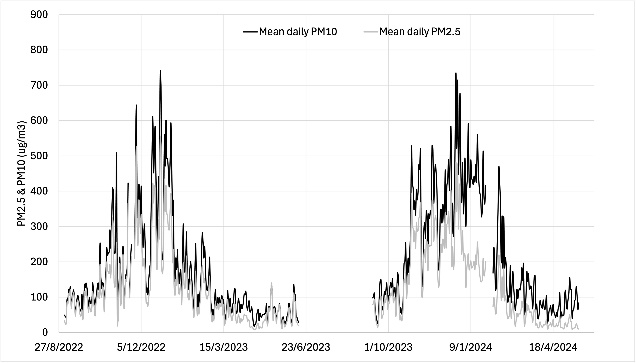
The mean daily PM2.5 and PM10 measured at the FCC for the same periodsare presented in Figure 3.

Clearly the most pollution occurred during the winter months but considering the WHO guidelines for air quality, the PM2.5 levels exceeded WHO guideline of 15 ug/m3 42 for a calendar year even during the less polluted months of the year.
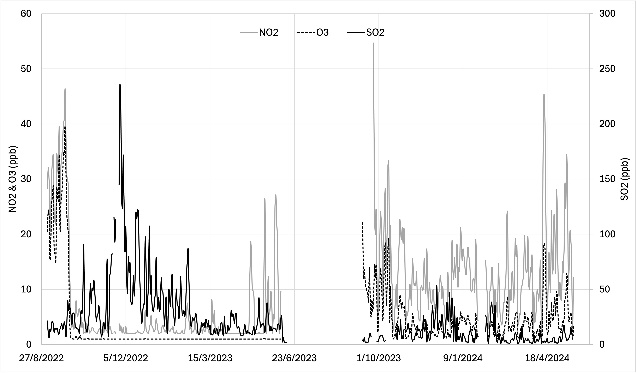
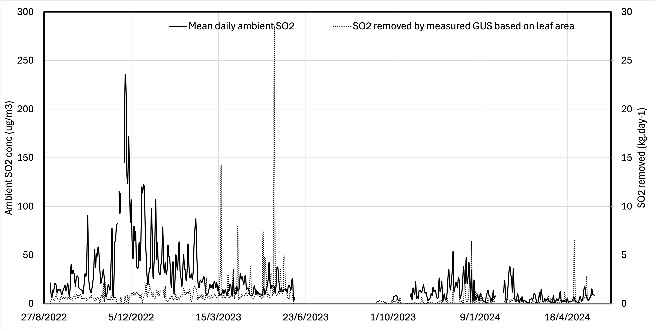
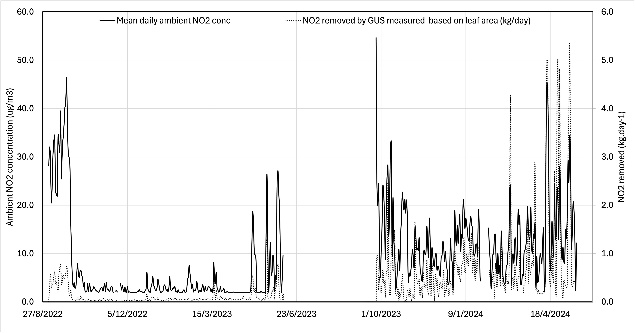
Other pollutants such as NO2, SO2 and O3 measured with the FCC air quality monitor in Lahore are presented in Figure 4.

The NO2 and O3 levels were relatively high coming out of the summer, but then moving into the winter months in 2022/23the SO2 levels started to increase, reaching a climax in early December 2023 and then gradually declining again towards the hotter part of the year.Until June 2024, this pattern was not repeated in 2023/24 when the NO2 was higher. The O3 levels were elevated coming out of summer and going into the summer both in 2023 and 2024.
Model outputs
The GUS description, the atmospheric conditions and the ambient air pollution parameters for the periodsbetween 3/9/22 and 19/5/24 as presented in the previous section formed the input for the modelling component.
The amount of the SO2 and NO2 removed from the atmosphere by absorption by the tree canopies are presented in Figure 5 and Figure 6 respectively.

Of interest is the lack of SO2 and NO2 removal by the vegetation during the winter months even though the ambient levels were high, certainly for the SO2 in 2023.Earlier or later in the year the removal is more significant. The deposition velocities for both the NO2 and SO2 are governed by the stability classes. Based on the time of the day, the wind speed and the solar radiation the Obukhov length (L) was calculated which was usually negative (L<0) during the day indicating unstable conditions while at night L > 0 indicating stable conditions. As is shown in Figure 3, the wind speed is low during the winter months in Lahore while earlier or later in the year, particularly during May, Lahore is more prone to violent convection storms, particularly during the night, following high temperatures during the day 43. Analysis of the timing of the wind speed confirmed that higher winds were more common during the night compared to the day. Higher wind speeds at night introduced more neutral conditions (Class D) instead of stable conditions (Class F) which influenced the deposition velocity (Vd), hence the flux.Reference 7 in his study on vegetation as a sink for atmospheric pollutants found a strong positive correlation between the uptake of ozone and windspeed in their experimental setup. As they increased wind speed transpiration rates and CO2 uptake also increased which directly led to a higher uptake of pollutants.

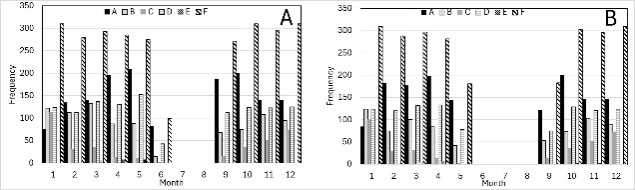
The timing of the various stability classes throughout the year, except the summer, is presented in the following Figure 7. The timing is presented as the number of hourly observations of a given stability class (A – F) occurring during a given month for the two years.

Stability class, F, which is the most stable class was by far the most prominent class in both years, but particularly during the colder winter months, as the weather warmed up, the number of times stability class A, the most unstable class, occurred increased. Stable conditions are detrimental for the dispersal of the air pollution, hence the stability patterns would explain the prominence of the air pollution during the winter months.
The calculated removal of SO2 and NO2 was determined by the calculated deposition velocity (Vd) multiplied by the ambient concentration of the pollutants (NO2 and SO2). Accordingly,Vd was calculated being on average 0.003 – 0.004 m.sec-1 which agreed well with the values obtained by 18 who found Vd values of 0.0037 and 0.0055 m.sec-1 for NO2 and SO2 respectively.
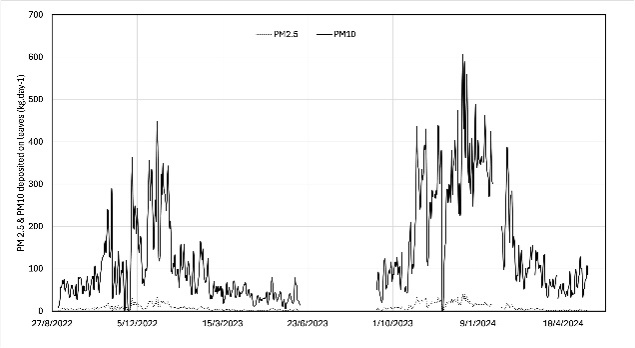
The removal of PM2.5 and PM10 from the atmosphere by dry deposition is presented in Figure 8.

Also, here the dry deposition of the PM2.5 and PM10 was based on the ambient concentrations multiplied by the Vd. The Vd of the PM2.5 and PM10 were not calculated but taken from 32, being 0.0032 and 0.032 m.sec-1 respectively. Reference 18 assumed a value of Vd of PM10 of 0.0064.
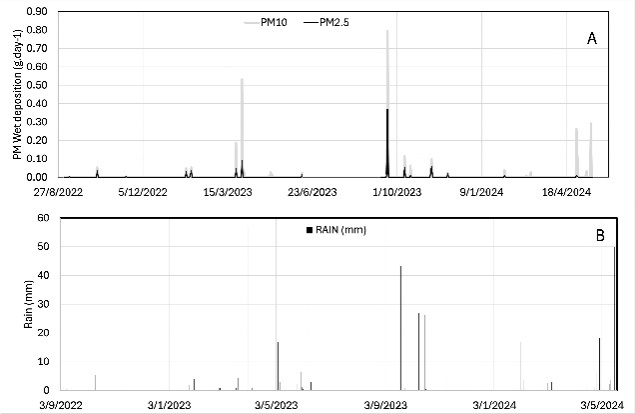
The wet deposition of both PM10 and PM2.5 that occurs during rainfall is presented in Figure 9 This wet deposition is not dependent on the LA of the parks but solely on the rainfall and the pollutant concentration and the size of the area where the rainfall is received..

Here the wet deposition was based on the product of the ambient concentration and scavenging efficiency based on the published data by 34 which was based on the rainfall and the level of pollution before the rain. Scavenging efficiencies were described by 34 as polynomial functions with rainfall and level of pollution as dependent parameters. It was found the application of these factors published were only valid for pollution levels not exceeding 150 ug.m3. When the pollution levels exceeded those amounts, the polynomials would be trending downwards and eventually become negative. In our case when the pollution levels exceeded 150 ug.m-3 the polynomial factors would not change from the values obtained for 150 ug.m-3.
VOCs
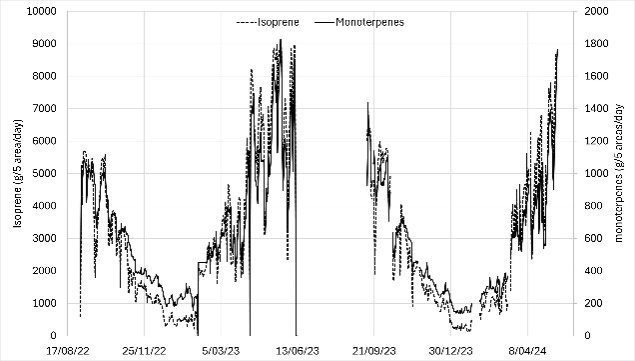
The emissions of VOCs (isoprene and monoterpene) over the two years are presented in Figure 10.

The emissions of VOCs are highest during the warm summer months whileduring the colder winter months the VOC emissions are at their minimum. The VOCs together with NOx are involved in the formation of ozone (O3) via a complex nonlinear photochemistry 44. This becomestypically more significant during the warmer months of the year as VOC’s concentration as well as the solar radiation increases. However,during the warmer months, the air quality in Lahore is of much less concern due to ambient atmospheric conditions, particularly the planetary boundary height layer (PBHL). The PBHL indicates the thickness of the layer closest to the surface of the earth where mixing of the air masses can occur and where the bulk of the air pollutants can be found. The thickness varies depending on the atmospheric conditions which are in turn governed by the times of the year. Typically in Lahore the PBHL drops to zero meters at night during the winter months while in the summer it can reach up to 2000 - 4000 m high 45.
Total pollutant removal
From the modelling effort, the impact of the fivegreen areas on the removal of pollutants in Lahore was estimated as follows. From the sum of the calculated daily flux of the respective pollutants over the period of observation (3 Sept 2022 – 15May2024) the total weight removed of the respective pollutants was calculated and expressed of the percentage of the total weight of the pollutants present in the atmosphere. This is presented in Table 2.To determine the effect of GUS in Lahore, the impact of the sections of the parks was extrapolated to the larger GUS1 and GUS2 (see Table 1). The area of the parks and the FCCU area was 23.4 ha, while the area of Lahore was54402 ha, while the height of the PBHL is assumed to be 100 m. This gives a volume of 234 x 105m3and 54402 x 106 m3 for the 5 green areas and Lahore respectively. To these volumes,ambient concentrations apply from which the total weight of the pollutants present could be calculatedandare also presented in Table 2.
The PBLHis normally established with the use of a radiosonde balloon according to the method of 46.Such balloons are not being released by the relevant Department in Lahore, hence we need to obtain the PBLH from other means such the GDAS meteorological information (GDAS) and CAMS 47. The PBLH is variable throughout the day and varies between 0 m at night and 2500 m at midday according 45. According to the CAMS observations the average PBLH is around 60 m during the winter months with little variation during the day, but significantly higher (3000 m) during the summer months 47. Combining the GDAS and the CAMS PBLHs an average PBLH of 100 m was assumed, being fully aware that changes to the PBLH affect the total sum of the pollutants present in the atmosphere. On the other hand, the PBLH is indirectly reflected in the concentrations of the PM2.5 and PM10because they show a strong diurnal pattern based on emission variations but also on surface temperature variations which strongly influence the PBLH.

The vegetation in the parks and the FCCU area removed 4 %, 7 %, 21 % and 225 % of SO2, NO2, PM2.5 and PM10 respectively compared to what was present in the atmosphere. So, some of pollution is clearly removed due to absorption and dry deposition using the assumed input parameters with PM10 largely being removed from the atmosphere. This shows the potential of the vegetation to play a role in cleaning the air. Reference 10 discussed the various factors influencing the role of the vegetation in air pollution removal. They noted the range of deposition velocity(Vd) used by various groups of 0.002 – 35.7 cm.s-1 whereas the magnitude was a function of the various vegetation parameters. Based on the work of 31, 32, 33 we used 0.032 and 0.0032 m.s-1 for PM10 and PM2.5respectively. ChangingtheVdwould have an immediate effect on the amount of PM deposited on the leaf areas. Incidentally themagnitude of 0.032 m.s-1we used, was supported by a study conducted on the campus of FCC (not published) where the amount of dust settling on hard impervious surfaces was tracked over a period of 2 months. The mean ambient PM10 concentration measured in the vicinity of those surfaces was 124 ug/m3 while the mean weight of dust in the form of total suspended particles(TSP) settling on the surfaces was 256 mg.m2.day-1. Thisresultedin a calculated flux of 0.0296 m.sec-1. For the TSP we did not distinguish between PM2.5 and PM10.
The deposited mass of the pollutants by and on the vegetation is significant compared to the mass suspended in the space above the parks and the campus. However,the impact of GUS reduces substantially when extrapolated to the metropolitan area of Lahore which has so little GUS. When the vegetated areas are extrapolated to GUS1 and GUS2, and the entire volume above the city is considered, then the amount of pollution removed by GUS2 is only 0.07 %, 0.1 %, 0.36 % and 3.7 % for NO2, SO2, PM2.5 and PM10respectively. This means that the pollution produced by the citizens of Lahore overwhelms the ability of the vegetation to remove these pollutants. Despite the ability of the vegetation to remove pollutants, it is clearly not enough. The GUS2 of the LUA was measured as 1.7% (see Table 2). If that was to increase to 10 % through a significant investment in creating green urban spaces populated with non-deciduous trees the absorbed pollution levels could, over time, become significant.
Reference 48 measured pollution levels in Lahore in a detailed study in different areas of Lahore and concluded that congestion was the culprit in areas where high levels of PM10 were measured. Incidentally, those areas also coincide with neighbourhoods where vegetation is virtually non-existent (GUS = 0.3 %). Lower pollution levels were found in areas where also more vegetation (GUS = 19 – 25 %) is present which could support the findings presented in this paper.
In the current version of the model, there has not been an allowance for the impact of air pollution on the photosynthesis rates or efficiencies as reported by 49. They found for all species,except one, a significant effect of the elevated pollution levels on the photosynthetic rates. The mean pollutions rate they encountered in the city of Warsaw was 44.0 and 25.5 ug/m3for PM10 and PM2.5 respectively which is substantially lower than the levels encountered in Lahore as shown in this study. The impact of such high levels of pollution will have undoubtedly an effect of the photosynthetic rates but this needs to be quantified for the local conditions.
Reference 50 in their study on the fifth season in the country of Pakistan highlighted some of the solutions to the growing incidence of smog in the city of Lahore, these included the growing of trees. The figure included the number of 348,000 ha of trees planted through the Clean Green Initiative. While the actual area could be disputed, the Environmental Protection Agency of Punjab, Pakistan does see the need to increase the area planted to trees, or rather the creation of woodland in and around the major cities as stated in their policy on controlling smog 51. The purpose of planting these trees as described in the policy is to “fix carbon and other noxious elements.”
This study has gone to some length to establish what the potential is when trees are planted in anenvironment burdened by severe air pollution. While the potential is present, a few other observations should be made. The lack of wind and limited hours of daylight during the period with the worst pollution limits the uptake of the pollutants to only a few hours per day.This limits the effectiveness of the vegetation as a sink. An increase in wind velocity during other times significantly increased the ability of the plants to absorb the gaseous pollutants but unfortunately this rarely happens during the winter months(Dec – Feb) which is normal for the Indo-Gangetic Plain 41. An increase in the LA increases the opportunity for PM to settle down through dry deposition. Deciduous trees that lose their leaves during the worst pollution period (i.e. winter) negate the benefits of vegetation for this form of removal of PM. For vegetation for pollution removal to be most beneficial, they should be non-deciduous.
The application of an air pollution model that incorporates the interaction with vegetation is essential if the effect of vegetation on air pollution is to be quantified. The preliminary results are in line with other reported values.
The determination of the LA is a significant factor in the outcome of the model. The flux is multiplied by the LA to determine the total quantity of pollutants removed or deposited. Changes in the LA directly impact the model outcomes. The LA was determined in the summer with the understanding that several of the tree species are deciduous which would affect the LA during the coldest months, the months with typically the highest pollution levels. It will need to be verified how the LA is affected during the winter months.
The outcome of the modelling efforts clearly illustrates that vegetation can absorb a significant amount of pollutants. However, despite the contribution the vegetation makes in terms of absorption and dry deposition of pollutants, the levels of pollution generated by the cityof Lahore and the amount of vegetation in the city in terms of GUS, are such that little in-roads are made in combating air pollution. The modelling shows that environmental conditions during the winter months are also not very conducive for the uptake of air pollutants due to the absence of wind hence limiting the effectiveness of the role of vegetation as a sink. Dry deposition is not affected by the absence of wind.
This greater understanding of the role of vegetation in the city of Lahore in the context of pollution management should assist the policy makers of Punjab to make more informed decisions in the allocation, magnitude and the protection of green urban spaces. A local study such as this could be helpful in that decision making process.
| [1] | IQAir. https:// world-air-quality-ranking. [Accessed 17 Oct 2023]. | ||
| In article | |||
| [2] | Alam, R., Shirazi, A. S. A., Bhalli, M. N., Zia, S. Spatial distribution of urban green spaces in Lahore, Pakistan: a case study of Gulberg town. Pak. J of Sc 66, 3. 2014. | ||
| In article | |||
| [3] | UN-Habitat. Urban planning for city leaders. Pmss/ Getelectronicversion. Aspx [Accessed: 23 April 2024]. | ||
| In article | |||
| [4] | Ahsan, M., Arif, M.M., Adeel, A., Sheikh, N.B. Transformation from Green to Brown: A Geospatial Analysis of Urban Expansion, Urban Heat Environment, and Agriculture Land use Conversion Global Challenges & Regional Science. Vol 5. March 2026. | ||
| In article | View Article | ||
| [5] | Lee, A. C. K., Maheswaran, R. The health benefits of urban green spaces: a review of the evidence. J Of Public Health, 33: 212–222. 2010. | ||
| In article | View Article PubMed | ||
| [6] | Zupancic, T., Westmacott, C., Bulthuis, M. The impact of green space on heat and air pollution in urban communities. A meta-narrative systematic review. David Suzuki Foundation, Vancouver BC, Canada. 2015. | ||
| In article | |||
| [7] | Hill, A. C. Vegetation: a sink for atmospheric pollutants. J of the Air Pol Cont Ass, 21: 341-346. 1971. | ||
| In article | View Article PubMed | ||
| [8] | Ozedemir, H. Mitigation impact of roadside trees on fine particle pollution. Sci of the Tot Env 659: 1176-1185. 2019. | ||
| In article | View Article PubMed | ||
| [9] | Isaifan, R., Alsalama, T., Muammer, K. Mitigation of urban air pollution with green vegetation for sustainable cities: A Review. Int J Of Global Warming. 25. 498. 2012 | ||
| In article | View Article | ||
| [10] | Linden, J., Gustafsson, M., Uddlingm, J., Watne, Å., Pleijel, H. Air pollution removal through deposition on urban vegetation: the importance of vegetation characteristics. Urban Forestry & Urban Greening 81: 127843.2023. | ||
| In article | View Article | ||
| [11] | Asif, Z.; Ma,W.Assessing the air pollution tolerance index of urban plantation: a case study conducted along high-traffic roadways. Atmosphere 15, 659. 2024. | ||
| In article | View Article | ||
| [12] | Rasool, A., Sohaib, M., Tayyab, M., Bajwa, A. A., Majeed, M., Munam, B., Faisal, S., Khairdin, A., Khalid, S., Komal H., Malik, S. M., & Bilal, M. Ecological evaluation of dominant roadside plants through APTI and API for sustainable green belt development in cosmopolitan city (Lahore) of Pakistan. Scientific Reports 15: 10496. 2025. | ||
| In article | View Article PubMed | ||
| [13] | Ahmad, M., Munir, M., Samra, S., Ali,Z., Safdar, S., Iqbal, R., Mahmood, H., Ahmad, I., Akram, M. I., Ditta, A., Ali, A., A., Elsadek, M. F., Daraz, U. Role of native trees in mitigation of fine particulate matter (PM2.5) to improve air quality. Pol. J. Environ. Stud. Vol. 34, No. 4, 4557-4565. 2025. | ||
| In article | View Article | ||
| [14] | Agarwal, P., Sarkar, M., Chakraborty, B., Banerjee, T. Phytoremediation of Air Pollutants: Prospects and Challenges. In Phytomanagement of Polluted Sites. Editor(s): V. Pandey, K. Bauddh, Elsevier. Pages 221-241. 2019. | ||
| In article | View Article PubMed | ||
| [15] | I-Tree. . 2023. [Accessed 12 May 2023]. | ||
| In article | |||
| [16] | Nowak, D. J., Civerolo, K. L., Rao, S. T., Sistla, G., Luley, C. J., Crane, D. E. A modeling study of the impact of urban trees on ozone. Atm Env. 34: 1601-1613. 2000. | ||
| In article | View Article | ||
| [17] | Nowak, D. J., Crane, D. E., Stevens, J. C., Hoehn, R. E. The urban forest effects (UFORE) model: field data collection manual. USDA Forest Service, Northeastern Research Station, 5 Moon Library, SUNY-ESF, Syracuse, NY. 2003. | ||
| In article | |||
| [18] | Nowak, D. J., Mchale, P. J., Ibarra, M., Crane, D., Stevens, J. C., Luley, C. J. Modelling the effect of urban vegetation on air pollution. In air pollution modelling and its application XII. S. E. Gryning, et al. Eds. Springer Science, New York. 1998. | ||
| In article | View Article | ||
| [19] | Nowak, D. J., Crane, D. E. The urban forest effects (UFORE) model: quantifying urban forest structure and functions. In: M. Hansen and T. Burk [Eds.], Proceedings: Integrated tools for natural resources inventories in the 21st century. IUFRO Conference, 16-20 August 1998, Boise, ID. General Technical Report NC-212, U.S. Department Of Agriculture, Forest Service, North Central Research Station, St. Paul, MN. Pp. 714-720. 2000. | ||
| In article | |||
| [20] | Nowak, D. J. Estimating leaf area and leaf biomass of open-grown deciduous Urban Trees. Forest Sci. 42: 504-507. 1996. | ||
| In article | View Article | ||
| [21] | Chave, J., Andalo, C., Brown, S., Cairns, M.A., Chambers, J.Q., Eamus, D., Folster, H., Fromard, F., Higuchi, N., Kira, T., Lescure, J.P., Nelson, B. W., Ogawa, H., Puig., H. Riera, B., Yamakure, T. Tree allometry and improved estimation of carbon stocksand balance in tropical forests. Oecologia 145: 87–99. 2005. | ||
| In article | View Article PubMed | ||
| [22] | Baldocchi, D. D., Hicks, B. B., Camara, P. A canopy stomatal resistance model for gaseous deposition to vegetated surfaces. Atm Env. 21, 91-101. 1987. | ||
| In article | View Article | ||
| [23] | Nugent, A., Decou, D., Russell, S., Karamperidou, C. Atmospheric processes and phenomena. University Of Hawai’I Pressbook. 2023. | ||
| In article | |||
| [24] | Wikipedia. https:// En.Wikipedia.Org/ Wiki/ Monin%E2% 80%93Obukhov_Length. 2023 [Accessed 10 May 2023]. | ||
| In article | |||
| [25] | Schnelle, K. B. Jr., Atmospheric Diffusion Modelling Encyclopedia of Physical Science and Technology (pp.679-705) Dec 2003. | ||
| In article | View Article | ||
| [26] | Essa, K. S. M., Embaby, N. M., Kozae, A.M., Mubarak, F., Kamel, I. Estimation of seasonal atmospheric stability and mixing height by using different schemes. In Proceedings VIII Radiation Physics & Protection Conference, 13-15 November 2006, Beni Sueif - Fayoum, Egypt. 2006. | ||
| In article | |||
| [27] | Venkatram, A. Estimating the Monin-Obukhov length in the stable boundary layer for dispersion calculations. Boundary-Layer Meteorology. 19: 481-485. 1980. | ||
| In article | View Article | ||
| [28] | Timeanddate, https:// Sun/Pakistan/ Lahore. 2023 [Accessed 10 May 2023]. | ||
| In article | |||
| [29] | Nowak, D. J. Understanding i-tree: summary of programs and methods. General Technical Report NRS-200. Madison, WI: U.S. Department Of Agriculture, Forest Service, Northern Research Station. | ||
| In article | |||
| [30] | Energydata.https://Energydata.Info/Dataset/Pakistan-Solar-Radiation-Measurement-Data. 2023 [Accessed 20 Nov 2023]. | ||
| In article | |||
| [31] | Lovett, G. M. Atmospheric deposition of nutrients and pollutants in North America: an ecological perspective.EcolApplic. 4: 629-650. 1994. | ||
| In article | View Article | ||
| [32] | Wu, Y., Liu, J., Zhai, J., Cong, L., Wang, Y., Ma, W., et al. Comparison of dry and wet deposition of particulate matter in near-surface waters during summer.Plos ONE 13: E0199241. 2018. | ||
| In article | View Article PubMed | ||
| [33] | Feng, H., Ying, D., Bin, A., Blake, C., Shuchao, Y., Zhuolin, Y., Kai, K.,. Lei, L., Ziaodong, G. Vegetation-related dry deposition of global PM2.5 from satellite observations J. Geogr. Sci. 32, 589-604.2022. | ||
| In article | View Article | ||
| [34] | Zhou, B., Liu, D., Yan, W. A simple new method for calculating precipitation scavenging effect on particulate matter: Based on five-year data in eastern China. Atm 12, 759. 2021. | ||
| In article | View Article | ||
| [35] | NOAA. . 2023 [Accessed 10 May 2023]. | ||
| In article | |||
| [36] | Ali-Khodja, H., Kebabi, B., Assessment of wet and dry deposition of SO2 attributable to a sulfuric acid plant at Annaba, Algeria. Environment International, Vol 24 (7): 799-807. Oct 1998. | ||
| In article | View Article | ||
| [37] | Siddiqui, S., Shirazi, S. A., Ali, A. A floristic analysis of selected parks in Lahore, Pakistan. J of the Punjab Uni Hist Soc. 29: 182-195. 2016. | ||
| In article | |||
| [38] | Monk, C. D., Child, G. I., Nicholson, S. A. Biomass, litter and leaf surface area estimates of an oak-hickory forest.Oikos 21: 138-141. 1970. | ||
| In article | View Article | ||
| [39] | Tadaki, Y. Some discussions on the leaf biomass of forest stands and trees. - Bull. Gov. For. Exp. Sta. Tokyo 184: 135-161. 1966. | ||
| In article | |||
| [40] | Weather Atlas. En/Pakistan/ Lahore-Climate. 2024. Accessed 29 Feb 2024. | ||
| In article | |||
| [41] | Ojha, N., Sharma, A., Kumar, M. et al. On the widespread enhancement in fine particulate matter across the Indo-Gangetic plain towards winter. Sci Rep 10, 5862. 2020. | ||
| In article | View Article PubMed | ||
| [42] | WHO. WHO global air quality guidelines. Particulate matter (PM2.5 and PM10), ozone, nitrogen dioxide, sulfur dioxide and carbon monoxide. Geneva: World Health Organization. 2021. | ||
| In article | |||
| [43] | Imran, A. I., Zaman, Q., Rasul, G., Mahmood, A.An analytical study of variations in the monsoon patterns over Pakistan. Pakistan Journal of Meteorology 10 (20) - Jan 2014. | ||
| In article | |||
| [44] | Silman, S. Overview: Tropospheric ozone, smog and ozone-NOx-VOC sensitivity.https://websites.umich.edu/~sillman/Sillman-webOZONE.pdf. 2023. [Accessed: 15 May 2023]. | ||
| In article | |||
| [45] | GDAS.Meteorological data for Lahore. https:// www.ncei.noaa.gov/products/weather-climate-models/global-data-assimilation. 2025. [Accessed 15 Apil 2025]. | ||
| In article | |||
| [46] | Liu, S., andLiang, X. Observed diurnal cycle climatology of planetary boundary layer height. J. Climate, 23, 5790–5809, 2010. | ||
| In article | View Article | ||
| [47] | CAMS Atmospheric conditions for Lahore. CAMS-Wekeo Copernicus Data Viewer. https://wekeo.copernicus.eu/data? 2025 [Accessed 15 April 2025]. | ||
| In article | |||
| [48] | Khanum, F., Chaudhry, M. N., Skouteris, G., Saroj, D., Kumar, P. Chemical composition and source characterization of pm10 in urban areas of Lahore, Pakistan. Indoor and Built Env. 30: 924-937. 2021. | ||
| In article | View Article | ||
| [49] | Popeka, R., Przybysza A., Gawrońskaa H., Klamkowskic, K., Gawrońskia, S. Impact of particulate matter accumulation on the photosynthetic apparatus t of roadside woody plants growing in the urban conditions. Ecotoxicology and Environmental Safety 163 (2018) 56–62. 2018. | ||
| In article | View Article PubMed | ||
| [50] | Majeed, R., Anjum, M. S., Imad-ud-din, M., Malik, S., Anwar, M. N., Anwar, B., Khokhar, M. F. Solving the mysteries of Lahore smog: the fifth season in the country. Front. Sustain. Cities 5: 1314426. 2024. | ||
| In article | View Article | ||
| [51] | EPA. Environment Protection Department Policy on controlling smog. Environment Protection Department. Available online at: https://epd.punjab.gov.pk/system/files/CM%20Punjab%20Smog%20Mitigation%20Plan%202024_FD_11102024.pdf. 2017. Accessed 22 Sept 2025. | ||
| In article | |||
Published with license by Science and Education Publishing, Copyright © 2026 Derk Bakker, Ariba Ashgar, Ehtisham Gill and Sima Saleem
 This work is licensed under a Creative Commons Attribution 4.0 International License. To view a copy of this license, visit
http://creativecommons.org/licenses/by/4.0/
This work is licensed under a Creative Commons Attribution 4.0 International License. To view a copy of this license, visit
http://creativecommons.org/licenses/by/4.0/
| [1] | IQAir. https:// world-air-quality-ranking. [Accessed 17 Oct 2023]. | ||
| In article | |||
| [2] | Alam, R., Shirazi, A. S. A., Bhalli, M. N., Zia, S. Spatial distribution of urban green spaces in Lahore, Pakistan: a case study of Gulberg town. Pak. J of Sc 66, 3. 2014. | ||
| In article | |||
| [3] | UN-Habitat. Urban planning for city leaders. Pmss/ Getelectronicversion. Aspx [Accessed: 23 April 2024]. | ||
| In article | |||
| [4] | Ahsan, M., Arif, M.M., Adeel, A., Sheikh, N.B. Transformation from Green to Brown: A Geospatial Analysis of Urban Expansion, Urban Heat Environment, and Agriculture Land use Conversion Global Challenges & Regional Science. Vol 5. March 2026. | ||
| In article | View Article | ||
| [5] | Lee, A. C. K., Maheswaran, R. The health benefits of urban green spaces: a review of the evidence. J Of Public Health, 33: 212–222. 2010. | ||
| In article | View Article PubMed | ||
| [6] | Zupancic, T., Westmacott, C., Bulthuis, M. The impact of green space on heat and air pollution in urban communities. A meta-narrative systematic review. David Suzuki Foundation, Vancouver BC, Canada. 2015. | ||
| In article | |||
| [7] | Hill, A. C. Vegetation: a sink for atmospheric pollutants. J of the Air Pol Cont Ass, 21: 341-346. 1971. | ||
| In article | View Article PubMed | ||
| [8] | Ozedemir, H. Mitigation impact of roadside trees on fine particle pollution. Sci of the Tot Env 659: 1176-1185. 2019. | ||
| In article | View Article PubMed | ||
| [9] | Isaifan, R., Alsalama, T., Muammer, K. Mitigation of urban air pollution with green vegetation for sustainable cities: A Review. Int J Of Global Warming. 25. 498. 2012 | ||
| In article | View Article | ||
| [10] | Linden, J., Gustafsson, M., Uddlingm, J., Watne, Å., Pleijel, H. Air pollution removal through deposition on urban vegetation: the importance of vegetation characteristics. Urban Forestry & Urban Greening 81: 127843.2023. | ||
| In article | View Article | ||
| [11] | Asif, Z.; Ma,W.Assessing the air pollution tolerance index of urban plantation: a case study conducted along high-traffic roadways. Atmosphere 15, 659. 2024. | ||
| In article | View Article | ||
| [12] | Rasool, A., Sohaib, M., Tayyab, M., Bajwa, A. A., Majeed, M., Munam, B., Faisal, S., Khairdin, A., Khalid, S., Komal H., Malik, S. M., & Bilal, M. Ecological evaluation of dominant roadside plants through APTI and API for sustainable green belt development in cosmopolitan city (Lahore) of Pakistan. Scientific Reports 15: 10496. 2025. | ||
| In article | View Article PubMed | ||
| [13] | Ahmad, M., Munir, M., Samra, S., Ali,Z., Safdar, S., Iqbal, R., Mahmood, H., Ahmad, I., Akram, M. I., Ditta, A., Ali, A., A., Elsadek, M. F., Daraz, U. Role of native trees in mitigation of fine particulate matter (PM2.5) to improve air quality. Pol. J. Environ. Stud. Vol. 34, No. 4, 4557-4565. 2025. | ||
| In article | View Article | ||
| [14] | Agarwal, P., Sarkar, M., Chakraborty, B., Banerjee, T. Phytoremediation of Air Pollutants: Prospects and Challenges. In Phytomanagement of Polluted Sites. Editor(s): V. Pandey, K. Bauddh, Elsevier. Pages 221-241. 2019. | ||
| In article | View Article PubMed | ||
| [15] | I-Tree. . 2023. [Accessed 12 May 2023]. | ||
| In article | |||
| [16] | Nowak, D. J., Civerolo, K. L., Rao, S. T., Sistla, G., Luley, C. J., Crane, D. E. A modeling study of the impact of urban trees on ozone. Atm Env. 34: 1601-1613. 2000. | ||
| In article | View Article | ||
| [17] | Nowak, D. J., Crane, D. E., Stevens, J. C., Hoehn, R. E. The urban forest effects (UFORE) model: field data collection manual. USDA Forest Service, Northeastern Research Station, 5 Moon Library, SUNY-ESF, Syracuse, NY. 2003. | ||
| In article | |||
| [18] | Nowak, D. J., Mchale, P. J., Ibarra, M., Crane, D., Stevens, J. C., Luley, C. J. Modelling the effect of urban vegetation on air pollution. In air pollution modelling and its application XII. S. E. Gryning, et al. Eds. Springer Science, New York. 1998. | ||
| In article | View Article | ||
| [19] | Nowak, D. J., Crane, D. E. The urban forest effects (UFORE) model: quantifying urban forest structure and functions. In: M. Hansen and T. Burk [Eds.], Proceedings: Integrated tools for natural resources inventories in the 21st century. IUFRO Conference, 16-20 August 1998, Boise, ID. General Technical Report NC-212, U.S. Department Of Agriculture, Forest Service, North Central Research Station, St. Paul, MN. Pp. 714-720. 2000. | ||
| In article | |||
| [20] | Nowak, D. J. Estimating leaf area and leaf biomass of open-grown deciduous Urban Trees. Forest Sci. 42: 504-507. 1996. | ||
| In article | View Article | ||
| [21] | Chave, J., Andalo, C., Brown, S., Cairns, M.A., Chambers, J.Q., Eamus, D., Folster, H., Fromard, F., Higuchi, N., Kira, T., Lescure, J.P., Nelson, B. W., Ogawa, H., Puig., H. Riera, B., Yamakure, T. Tree allometry and improved estimation of carbon stocksand balance in tropical forests. Oecologia 145: 87–99. 2005. | ||
| In article | View Article PubMed | ||
| [22] | Baldocchi, D. D., Hicks, B. B., Camara, P. A canopy stomatal resistance model for gaseous deposition to vegetated surfaces. Atm Env. 21, 91-101. 1987. | ||
| In article | View Article | ||
| [23] | Nugent, A., Decou, D., Russell, S., Karamperidou, C. Atmospheric processes and phenomena. University Of Hawai’I Pressbook. 2023. | ||
| In article | |||
| [24] | Wikipedia. https:// En.Wikipedia.Org/ Wiki/ Monin%E2% 80%93Obukhov_Length. 2023 [Accessed 10 May 2023]. | ||
| In article | |||
| [25] | Schnelle, K. B. Jr., Atmospheric Diffusion Modelling Encyclopedia of Physical Science and Technology (pp.679-705) Dec 2003. | ||
| In article | View Article | ||
| [26] | Essa, K. S. M., Embaby, N. M., Kozae, A.M., Mubarak, F., Kamel, I. Estimation of seasonal atmospheric stability and mixing height by using different schemes. In Proceedings VIII Radiation Physics & Protection Conference, 13-15 November 2006, Beni Sueif - Fayoum, Egypt. 2006. | ||
| In article | |||
| [27] | Venkatram, A. Estimating the Monin-Obukhov length in the stable boundary layer for dispersion calculations. Boundary-Layer Meteorology. 19: 481-485. 1980. | ||
| In article | View Article | ||
| [28] | Timeanddate, https:// Sun/Pakistan/ Lahore. 2023 [Accessed 10 May 2023]. | ||
| In article | |||
| [29] | Nowak, D. J. Understanding i-tree: summary of programs and methods. General Technical Report NRS-200. Madison, WI: U.S. Department Of Agriculture, Forest Service, Northern Research Station. | ||
| In article | |||
| [30] | Energydata.https://Energydata.Info/Dataset/Pakistan-Solar-Radiation-Measurement-Data. 2023 [Accessed 20 Nov 2023]. | ||
| In article | |||
| [31] | Lovett, G. M. Atmospheric deposition of nutrients and pollutants in North America: an ecological perspective.EcolApplic. 4: 629-650. 1994. | ||
| In article | View Article | ||
| [32] | Wu, Y., Liu, J., Zhai, J., Cong, L., Wang, Y., Ma, W., et al. Comparison of dry and wet deposition of particulate matter in near-surface waters during summer.Plos ONE 13: E0199241. 2018. | ||
| In article | View Article PubMed | ||
| [33] | Feng, H., Ying, D., Bin, A., Blake, C., Shuchao, Y., Zhuolin, Y., Kai, K.,. Lei, L., Ziaodong, G. Vegetation-related dry deposition of global PM2.5 from satellite observations J. Geogr. Sci. 32, 589-604.2022. | ||
| In article | View Article | ||
| [34] | Zhou, B., Liu, D., Yan, W. A simple new method for calculating precipitation scavenging effect on particulate matter: Based on five-year data in eastern China. Atm 12, 759. 2021. | ||
| In article | View Article | ||
| [35] | NOAA. . 2023 [Accessed 10 May 2023]. | ||
| In article | |||
| [36] | Ali-Khodja, H., Kebabi, B., Assessment of wet and dry deposition of SO2 attributable to a sulfuric acid plant at Annaba, Algeria. Environment International, Vol 24 (7): 799-807. Oct 1998. | ||
| In article | View Article | ||
| [37] | Siddiqui, S., Shirazi, S. A., Ali, A. A floristic analysis of selected parks in Lahore, Pakistan. J of the Punjab Uni Hist Soc. 29: 182-195. 2016. | ||
| In article | |||
| [38] | Monk, C. D., Child, G. I., Nicholson, S. A. Biomass, litter and leaf surface area estimates of an oak-hickory forest.Oikos 21: 138-141. 1970. | ||
| In article | View Article | ||
| [39] | Tadaki, Y. Some discussions on the leaf biomass of forest stands and trees. - Bull. Gov. For. Exp. Sta. Tokyo 184: 135-161. 1966. | ||
| In article | |||
| [40] | Weather Atlas. En/Pakistan/ Lahore-Climate. 2024. Accessed 29 Feb 2024. | ||
| In article | |||
| [41] | Ojha, N., Sharma, A., Kumar, M. et al. On the widespread enhancement in fine particulate matter across the Indo-Gangetic plain towards winter. Sci Rep 10, 5862. 2020. | ||
| In article | View Article PubMed | ||
| [42] | WHO. WHO global air quality guidelines. Particulate matter (PM2.5 and PM10), ozone, nitrogen dioxide, sulfur dioxide and carbon monoxide. Geneva: World Health Organization. 2021. | ||
| In article | |||
| [43] | Imran, A. I., Zaman, Q., Rasul, G., Mahmood, A.An analytical study of variations in the monsoon patterns over Pakistan. Pakistan Journal of Meteorology 10 (20) - Jan 2014. | ||
| In article | |||
| [44] | Silman, S. Overview: Tropospheric ozone, smog and ozone-NOx-VOC sensitivity.https://websites.umich.edu/~sillman/Sillman-webOZONE.pdf. 2023. [Accessed: 15 May 2023]. | ||
| In article | |||
| [45] | GDAS.Meteorological data for Lahore. https:// www.ncei.noaa.gov/products/weather-climate-models/global-data-assimilation. 2025. [Accessed 15 Apil 2025]. | ||
| In article | |||
| [46] | Liu, S., andLiang, X. Observed diurnal cycle climatology of planetary boundary layer height. J. Climate, 23, 5790–5809, 2010. | ||
| In article | View Article | ||
| [47] | CAMS Atmospheric conditions for Lahore. CAMS-Wekeo Copernicus Data Viewer. https://wekeo.copernicus.eu/data? 2025 [Accessed 15 April 2025]. | ||
| In article | |||
| [48] | Khanum, F., Chaudhry, M. N., Skouteris, G., Saroj, D., Kumar, P. Chemical composition and source characterization of pm10 in urban areas of Lahore, Pakistan. Indoor and Built Env. 30: 924-937. 2021. | ||
| In article | View Article | ||
| [49] | Popeka, R., Przybysza A., Gawrońskaa H., Klamkowskic, K., Gawrońskia, S. Impact of particulate matter accumulation on the photosynthetic apparatus t of roadside woody plants growing in the urban conditions. Ecotoxicology and Environmental Safety 163 (2018) 56–62. 2018. | ||
| In article | View Article PubMed | ||
| [50] | Majeed, R., Anjum, M. S., Imad-ud-din, M., Malik, S., Anwar, M. N., Anwar, B., Khokhar, M. F. Solving the mysteries of Lahore smog: the fifth season in the country. Front. Sustain. Cities 5: 1314426. 2024. | ||
| In article | View Article | ||
| [51] | EPA. Environment Protection Department Policy on controlling smog. Environment Protection Department. Available online at: https://epd.punjab.gov.pk/system/files/CM%20Punjab%20Smog%20Mitigation%20Plan%202024_FD_11102024.pdf. 2017. Accessed 22 Sept 2025. | ||
| In article | |||