sciepub.com
 Quick Submission

Studies on Bioremediation of Lead by Lead-resistant Microorganisms
Chandana N1, , K Divya Sai Laxmi2, P. Hari Prasad Reddy2, K. Narasimhulu2
1Department of Civil Engineering, Vnr Vignana Jyothi Institute of Engineering & Technology, Bachupally, Nizampet (SO), Hyderabad
2Department of Civil Engineering, Department of Biotechnology, National Institute of Technology Warangal, Warangal-504006, Andhra Pradesh, India
Abstract
Environmental contamination by toxic metals is a serious problem worldwide due to their incremental accumulation in the food chain and continued persistence in the ecosystem. Conventional technologies, such as ion exchange or lime precipitation, are often ineffective and/or expensive, particularly for the removal of heavy metal ions. The use of microorganisms to destroy, or reduce the concentration of, hazardous waste on a contaminated site is called bioremediation. Such a biological treatment system has various applications, including, cleanup of contaminated sites such as water, soils, sludge, and waste streams. In the present study, bacteria are isolated from effluent collected from an industry located around Hyderabad. An indigenous microbial specie that have high resistance to Lead have been isolated from the wastewater sample which was characterized and identified as Staphylococcus species. Maximum Lead tolerance up to 1000mg/l was evidenced by isolated staphylococcus species, Effect of pH on Lead degradation by Staphylococcus shows the rate of Lead removal was maximum at pH 6, optimum temperature of 30°C and incubation time at 48 hours. Effect of initial metal concentration on Lead degradation by Staphylococcus shows the rate of Lead degradation was constantly high until 300 mg/l and then after it decreased. Under optimum process conditions Staphylococcus is able to degrade Lead up to 83% in 48 hours..
Keywords: bioremediation, lead resistant bacteria, industrial bioremediation, industrial effluent toxicity
Copyright © 2016 Science and Education Publishing. All Rights Reserved.Cite this article:
- Chandana N, K Divya Sai Laxmi, P. Hari Prasad Reddy, K. Narasimhulu. Studies on Bioremediation of Lead by Lead-resistant Microorganisms. Journal of Applied & Environmental Microbiology. Vol. 4, No. 5, 2016, pp 88-92. http://pubs.sciepub.com/jaem/4/5/1
- N, Chandana, et al. "Studies on Bioremediation of Lead by Lead-resistant Microorganisms." Journal of Applied & Environmental Microbiology 4.5 (2016): 88-92.
- N, C. , Laxmi, K. D. S. , Reddy, P. H. P. , & Narasimhulu, K. (2016). Studies on Bioremediation of Lead by Lead-resistant Microorganisms. Journal of Applied & Environmental Microbiology, 4(5), 88-92.
- N, Chandana, K Divya Sai Laxmi, P. Hari Prasad Reddy, and K. Narasimhulu. "Studies on Bioremediation of Lead by Lead-resistant Microorganisms." Journal of Applied & Environmental Microbiology 4, no. 5 (2016): 88-92.
| Import into BibTeX | Import into EndNote | Import into RefMan | Import into RefWorks |
At a glance: Figures
1. Introduction
Heavy metals contamination in water is a widespread problem throughout the world which results from industrial use and processing of their ores. These heavy metals have a harmful effect on humans and the environment. Living system requires special transport and handling mechanisms to sustain from toxic metals. Some of these metals are useful to us in low concentrations but are highly toxic at higher concentrations.
Heavy metal pollution is mainly due to rapid urbanization, evolution of metal based industries and other developmental activities. The sources of these metals include metal plating, mining by-product, pesticide wastes, chemical wastes, coal based wastes, industrial wastes, gasoline, nuclear wastes and mineral leaching. They are present in these industrial effluents and need to be removed before discharging to natural land or water and as well as to the environment. Industrial effluents discharged directly in to the environment without undergoing treatment pose a serious problem to the aquatic as well as animal life.
Almost all the traditional physicochemical methods such as adsorption, ion exchange, membrane filtration etc., do not provide effective solutions for the elimination of metals from industrial effluents as they are not so effective and also cost high. But microbial bioremediation is an effective approach for elimination of heavy metals like Cadmium, Lead and Zinc from industrial effluents. Bioremediation is the use of living organisms, primarily microorganisms, to degrade environmental contaminants into less toxic forms. Using bioremediation, bacteria could process these toxic compounds into harmless ones which would provide an alternative option for detoxifying this contaminant in the environment.
2. Materials and Methods
2.1. Sample Collection and Isolation of Lead Resistant BacteriaSample was procured from a free flowing wastewater stream contaminated with industrial wastes in Hyderabad. The samples were collected in polyethylene bottles. A small volume of dilute microbial mixture containing around 30 to 300 cells is transferred to the center of an agar plate and spread evenly over the surface with a sterile bent-glass rod. The dispersed cells develop into isolated colonies.
2.2. Microbial Assay, Biochemical Test and Morphological CharacterizationThe obtained microbial colonies are further sub-cultured to acclimatize them with lead concentration. The media for bacterial culture is supplemented with increasing amount of lead typically starting with 10mg/l and gradually increasing it to 150mg/l by repeated sub-culturing. Individual microbial species of 250µl is streaked separately and incubated for 72 hours to screen out bacteria which can resist these metals at a higher concentration level.
2.3. Characterization of Isolated BacteriaThe isolated strain needs to be characterized in order to identify the genus of the bacteria. It was done by morphological characteristics examination and several biochemical tests.
2.4. Minimum Inhibitory Concentration TestIt is the lowest concentration of an antimicrobial agent that inhibits the visible growth of any microorganism after an overnight incubation. 500, 1000 and 1500 mg/L concentrations of lead was added to the media and then inoculated with the isolated species and incubated for 24 h at 37°C in an incubator. After incubating for 24 hours the growth pattern of the inoculated microbes can be found. Thus the minimum inhibitory or maximum sustainable concentration can be found.
2.5. Batch Experiment StudiesDifferent batch experiments are carried out by One Factor at a Time (OFAT) method to evaluate the effect of parameters incubation time, pH, temperature and metal concentration on lead removal. All the batch experiment studies were carried out in conical flasks incubated in a rotating shaker incubator. An initial Lead concentration of 300mg/l, pH of 6, temperature 30°C and an inoculum percentage of 10% was maintained in the culture medium for all experiments which were incubated for 2 days i.e., 48 hours.
2.6. Removal of Lead at Different Incubation TimeBatch experiment study was carried out to evaluate the effect of incubation time on lead removal efficiency by the isolated bacteria. The tests were carried out at different incubation time ranging from 1, 2, 3, 4 & 5 days. The initial lead concentration in the media was 300mg/l set at pH 6. These conical flasks containing the media were incubated in a rotary shaker at 30°C for different contact time. Samples are withdrawn at specific time intervals and centrifuged at 6000 rpm for 10 minutes. Supernatant was analyzed for residual metal ion concentration.
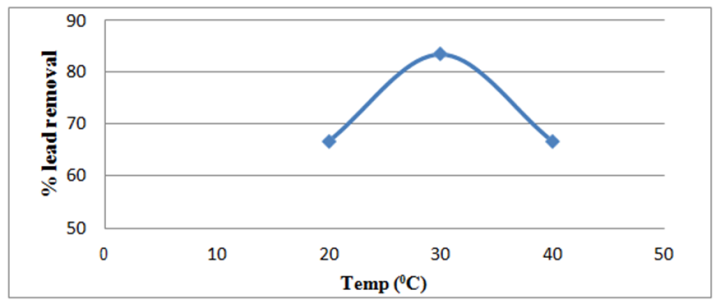
2.7. Removal of Lead at Different TemperatureBatch experiment study was carried out to evaluate the effect of temperature on lead removal efficiency by the isolated bacteria. The tests were carried out over a temperature range of 20, 30, 40°C. The lead concentration in the media was 300 mg/l. These conical flasks containing the media set at pH 6 were incubated in a rotary shaker for 48 hours at different temperatures (Figure 2). Samples are withdrawn at specific time intervals and centrifuged at 6000 rpm for 10 minutes. Supernatant was analyzed for residual metal ion concentration.
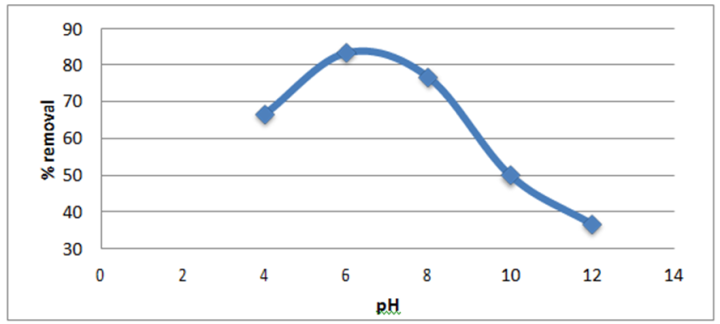
2.8. Removal of Lead at Different pHBatch experiment study was carried out to evaluate the effect of pH on lead removal efficiency by the isolated bacteria. The tests were carried out over a pH range of 4,6,8,10,12 as shown in Figure 3. The lead concentration in the media was 300mg/l. These conical flasks.
Containing the media set at different pH were incubated in a rotary shaker for 48 hours at 30°C. Samples are withdrawn at specific time intervals and centrifuged at 6000 rpm for 10 minutes. Supernatant was analyzed for residual metal ion concentration.
2.9. Removal of Lead at Different Lead ConcentrationBatch experiment study was carried out to evaluate the effect of metal concentration on lead removal efficiency by the isolated bacteria. The tests were carried out over a concentration range of 100, 200, 300, 400, 500 mg/l.
2.10. Metal AnalysisThe samples were analyzed using SMART spectro. It is a portable, microprocessor controlled direct reading, and single beam spectrophotometer. It has a quartz halogen bulb as light source with a minimum life expectancy of 1000hours and with a wavelength range of 350 - 1000 nm. Results are displayed directly in units of concentration. Lead test reagent system is pre calibrated in the instrument.
3. Result and Discussions
3.1. Isolation of Microbes from the SampleThe bacterial species was isolated using spread plate technique. After incubating the inoculated agar plates in an incubator for 1 day at 30°C, cream colored colonies were observed on the agar plates.
3.2. Characterization of Isolated BacteriaMorphological and biochemical tests are done for the isolated strain in order to identify the genus of the bacteria. The results of these tests are as shown in the following table. From the above results it can be observed that these characteristic are similar to Staphylococcous genus which is a gram positive, coccous, resistant to novobiocin and catalase producing bacteria.
 |
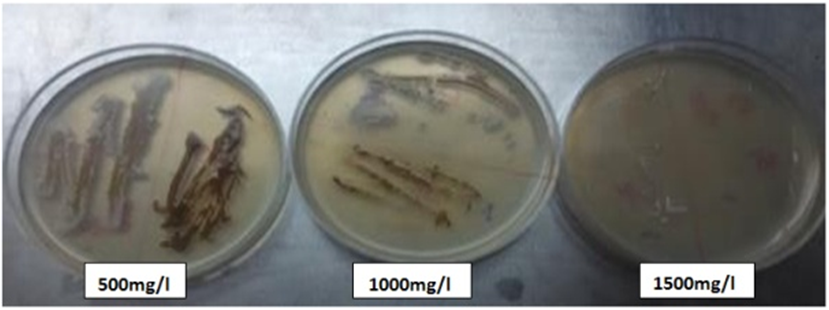
500, 1000 and 1500 mg/L concentrations of lead was added to the media and then inoculated with the isolated species and incubated for 24 h at 37°C in an incubator. After incubating for 24 hours the growth pattern of the inoculated microbes was found as follows From the Figure 1 it is clearly seen that the isolated bacteria can grow in the presence of lead. At 500 mg/l the growth was very dense and some of the colonies even survived at 1000mg/l but at 1500 mg/l the growth was inhibited. This implies that the maximum tolerance limit of lead concentration was 1000mg/l.

 Download as

Batch experiments were carried out to evaluate the effect of different parameters such as pH, temperature, incubation time and initial metal concentration on lead removal. Batch studies for Lead bioremediation are performed by One Factor At a Time (OFAT) method. In this method one parameter is varied by keeping other parameters constant. Sothe constant values chosen for the parameters pH, temperature, initial metal concentration and incubation time are 6 (unaltered pH of the solution), 30°C (room temperature), 300 mg/l and 48 hours respectively.
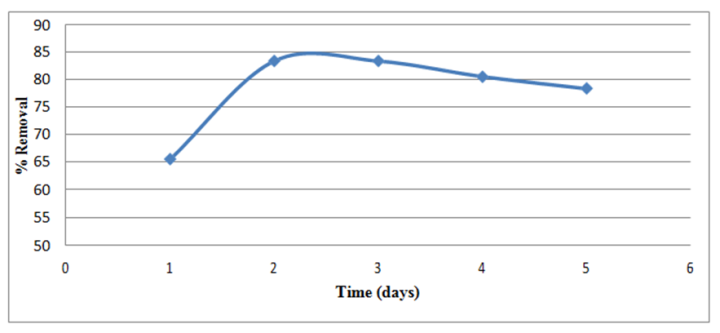
3.5. Effect of TimeThe bioremediation experiments for Lead removal are carried out for different incubation times. Figure 2 shows the effect of incubation time on bioremediation of Lead keeping other factors such as pH 6, temperature 30 °C and initial metal concentration of 300mg/l as constant for all the experiments. It was observed that Lead removal is increased from 24 - 48 hours and then there was no significant increase until 72 hours, but after 96 hours it gradually decreased.
 Download as
The temperature ranges were selected as 30 ± 10, nearer values to room temperature. The effect of temperature on bioremediation of Lead. The other factors such as time, pH and initial metal concentration are taken as 48 hours, 6 and 300mg/l respectively for all the experiments. It was observed that temperature impacted greatly in bioremediation of Lead. The optimum range of temperature for bioremediation of Lead was 30°C. At higher and lower temperatures Lead removal was minimal. It may be due to changes in enzymes activity at higher and lower temperatures that are responsible for Lead degradation.
 Download as
A general trend observed for different biomass and the metals is that, the metal uptake is negligible at very low pH values (1 to 2). So the pH range was taken as 4 to 12. Batch studies were performed by varying pH from 4 to 12 (Figure 3). Figure 4 shows the effect of pH on bioremediation of Lead. The other factors such as time, temperature and initial metal concentration are taken as 48 hours, 30°C and 300 mg/l respectively for all the experiment It indicates that there was a minimal Lead removal at lower and higher pH values where as there was good removal of Lead at a pH range of 6-8. The reduction in removal of Lead at higher and lower pH conditions may be due to the changes in the enzyme activity that mediates the Lead reduction.
 Download as
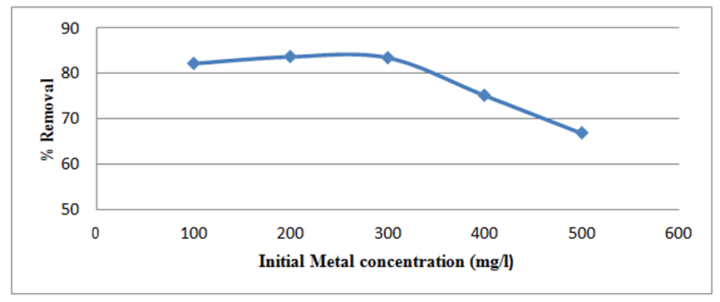
From the MIC test it can be seen that at 500 mg/l the growth was maximum. So for batch studies an initial concentration range was set at subsequent values less than 500 mg/l starting from 100 mg/l. Figure 5 shows the effect of initial metal concentration on bioremediation of Lead. The other factors such as pH, temperature and incubation time are taken as 6, 30°C and 48 hours respectively for all the experiments. The bioremediation experiments for Lead removal are carried out for different metal concentrations (Figure 5). It was observed that Lead removal increased from 100 to 300mg/l and then there was a decrease in the efficiency. This decrease in efficiency may be due to the inhibitory effect of lead on the bacteria.
 Download as
4. Conclusions and Recommendations
Batch studies are carried out with the isolated bacterial species at various operating parameters such as pH, time, temperature and initial metal concentration, to know the optimal range of each parameter for Lead removal. Thus pH in the range of 4-12, temperature in the range of 20-40°C, initial metal concentration in the range of 100 - 500 mg/l, incubation time in the range of 24-120 hours are taken as variable ranges. This data helps to optimize the maximum growth condition for the identified species in Lead environment.
Further, detailed investigations of Lead, The phylogenetic analysis of isolated strain has to be done. Efficiency of isolated species for abatement of Lead for real waste water needs to be studied, Efficiency of immobilized Lead resistant bacteria in the process needs to be examined.
References
| [1] | DaBrowski A., Hubicki Z., PodkoScielnyP. (2004). “Selective removal of the heavy metal ions from waters and industrial wastewaters by ion-exchange method”Department of Theoretical Chemistry, Maria Curie Skłodowska University, Poland, Chemosphere 56 91-106. | ||
 In article In article | View Article | ||
| [2] | JabbariNezhadKermani A., FaeziGhasemi M., Khosravan A., Farahmand, Shakibaie M. R. (2010). “Cadmium Bioremediation by metal resistant mutated bacteria isolated from active sludge of industrial effluent”, Department of Microbiology, Islamic Azad University, Iran, Iran. J. Environ. Health. Sci. Eng., Vol. 7, No. 4, pp. 279-286. | ||
| In article | |||
| [3] | AdebowaleAdeniji (2004). a report on “Bioremediation of Arsenic, Chromium, Lead, and Mercury” National Network of Environmental Management Studies | ||
| In article | |||
| [4] | Amini M., Younesi H., Bahramifar N., Lorestani A.A.Z., Ghorbani F., Danesh, A., and Sharifzadeh M. (2008).“Application of response surface methodology for optimization of lead biosorption in an aqueous solution by Aspergillus Niger”Journal of Hazardous Materials, 154, 694-702. | ||
| In article | View Article PubMed | ||
| [5] | Amir HosseinMahvi, DariushNaghipour, ForughVaezi (2005). “Teawaste as An Adsorbent for Heavy Metal Removal from Industrial Wastewaters” Department of Environmental Health Engineering, Tehran University of Medical Sciences, American Journal of Applied Sciences 2 (1): 372-375. | ||
| In article | |||
| [6] | Anish Saini, Rohini Kumar M (2013). “Remediation of lead (Pb) by a novel Klebsiella sp. isolated from tannery effluent of Ranipet, Vellore district” African Journal of Biotechnology, Vol. 12(32), pp. 5069-5074. | ||
| In article | View Article | ||
| [7] | Anushree Malik (2004). “Metal bioremediation through growing cells” Department of Applied Chemistry, Utsunomiya University japan, Environment International 30, 261-278. | ||
| In article | View Article | ||
| [8] | Bernard E., Jimoh A.,Odigure J.O. (2013.) “Heavy Metals Removal from Industrial Wastewater by Activated Carbon Prepared from Coconut Shell” Department of Chemical Engineering, Federal University of Technology, Research Journal of Chemical Sciences Vol. 3(8), 3-9. | ||
| In article | |||
| [9] | Divya Singh, Archana Tiwari, Richa Gupta. (2012). “Phytoremediation of lead from wastewater using aquatic plants” School of Biotechnology, Rajiv Gandhi Proudyogiki Vishwavidyalaya, Madhya Pradesh, India, Journal of Agricultural Technology Vol. 8(1): 1-11. | ||
| In article | |||
| [10] | Feza Geyikc, ErdalKılıc, Semra¸ oruhc, SerminElevli (2012). “Modelling of lead adsorption from industrial sludge leachate on red mud by using RSM and ANN” OndokuzMayis University, Chemical Eng. Dept., Samsun, Turkiye Chemical Engineering Journal 183 (2012) 53- 59. | ||
| In article | View Article | ||
 CiteULike
 Mendeley
 StumbleUpon
 Delicious
 Facebook
 Twitter
 LinkedIn