 OPEN ACCESS
  PEER-REVIEWED
Isolation and Characterization of Pathogenic Fungi from Vitis Vinifera from the Historical Site Agra Fort
Aindrila Saha1, , Srijani Chakraborty1, Subhadeep Dutta1, Sankalita Chakraborty1, Sudipta Pal1, Arup Kumar Mitra1
1Department Of Microbiology, St. Xavier’s College, Kolkata 30, Mother Teresa Sarani (Park Street), Kolkata, West Bengal, India
Abstract
Vitis vinifera or common grape vine is familiar enough to the human race owing to its industrial importance. This plant can survive for 350-400 years. The plant under consideration is a historical one because wine has been extracted from this plant since the period of the Mughal emperor Jahangir in 1630. In medieval India, under the rule of the Mughals, the city of Agra flourished. The Mughals continued to live in the Agra Fort for years where they had a unique vineyard in the name of Anguri Bagh built by Jahangir in 1630. In the present day, the sole remnants happen to be one or two plants, which too are badly infected with pathogenic fungi. Three such detached leaves were collected and the organism isolated was found to be Guignardia sp. Characters on the basis of reproductive structures were established, as well as the SPM (suspended particulate matter) count was determined and compared with the control, which indicated substantial air pollution. Fungicide bioassay was performed and the reduction in percentage germination and germ tube length on application of the fungicide was 14.49% and 24.14 μm respectively in absence of sugar, and 88.46% and 9.8 μm respectively in presence of sugar.
At a glance: Figures
Keywords: Anguri Bagh, acid rain, Vitis vinifera, Guignardia, Agra Fort, Blitox, Koch’s postulates
Journal of Applied & Environmental Microbiology, 2014 2 (1),
pp 28-30.
DOI: 10.12691/jaem-2-1-6
Received January 15, 2014; Revised January 25, 2014; Accepted February 09, 2014
Copyright © 2013 Science and Education Publishing. All Rights Reserved.Cite this article:
- Saha, Aindrila, et al. "Isolation and Characterization of Pathogenic Fungi from Vitis Vinifera from the Historical Site Agra Fort." Journal of Applied & Environmental Microbiology 2.1 (2014): 28-30.
- Saha, A. , Chakraborty, S. , Dutta, S. , Chakraborty, S. , Pal, S. , & Mitra, A. K. (2014). Isolation and Characterization of Pathogenic Fungi from Vitis Vinifera from the Historical Site Agra Fort. Journal of Applied & Environmental Microbiology, 2(1), 28-30.
- Saha, Aindrila, Srijani Chakraborty, Subhadeep Dutta, Sankalita Chakraborty, Sudipta Pal, and Arup Kumar Mitra. "Isolation and Characterization of Pathogenic Fungi from Vitis Vinifera from the Historical Site Agra Fort." Journal of Applied & Environmental Microbiology 2, no. 1 (2014): 28-30.
| Import into BibTeX | Import into EndNote | Import into RefMan | Import into RefWorks |
1. Introduction
Shah Jehan built Anguri Bagh or the Garden of Grapes in 1637 in Agra Fort. The garden was known for harvesting choicest of grapes and flowers throughout the year. It was designed to be a pleasant retreat or the paradise garden for the royal ladies and ensured their privacy. The soil of this garden was procured from Kashmir to augment the plantation of grapes. In the present scenario there are only two grape vines left out of all which unfortunately are infected. Acid rain in Agra has been one of the threats due to Mathura oil refinery and 325 iron foundries and 3 railway shunting yards [1]. Acid rain is a form of precipitation that is unusually acidic, meaning that it possesses elevated levels of hydrogen ions and it contains a mixture of sulfuric and nitric acids depending upon the relative quantities of oxides of sulphur and nitrogen emissions [2]. It can have harmful effects on plants, animals, aquatic animals and infrastructure. Various microorganisms and microbial processes get affected because of changes in soil properties due to acid rain [3]. One major problem is the dominance of fungal population who prefer the acidic ambience. In our study, we speculate the presence of Guiganardia sp, a common grape pathogen [4] based on microscopical studies. Fungicides such as fludioxonil, pyrimethanil and pyrimethanil and imazalil used together has been found effective against the Guignardia citricarpa causing citrus black spot (CBS) disease in Murcot, Valencia and lemon plants [5]. The incidence of CBS reduced from 76.8%, 79.6%, and 69.5 % to 6.8%. 7.1% and 5.5% in Murcott, Valencia and Lemon respectively. Blitox (dicopper chloride trihydroxide) used in our study with various combinations such as in presence or absence of sugar and fungicides based on the approach given by Saurov et al for combating Mycovellosiella in Syzygium samarangense [6].We found the reduction in percentage germination and germ tube length on application of the fungicide as 14.49% and 24.14 μm respectively in absence of sugar, and 88.46% and 9.8 μm respectively in presence of sugar Hence, spraying fungicide at an optimum concentration can be carried out with the consent of the Agra Fort authorities. We can opt for cryopreservation of the germ plasm [7], liming of the soil [8] and use of leaf litter ash [9] to increase the alkalinity of acidic soil. Thus preserving vegetation, fields, shrubs which defines the history of the site is as important as preserving buildings, sculptures or monuments.
2. Materials and Methods
2.1. Sample Collection and Preliminary AnalysisThe infected grape leaves which had fallen were collected. The leaves were brought to the laboratory and the area was measured and the weight was measured to calculate SPM (Suspended Particulate Matter). To calculate SPM the initial weight was taken and then the leaves were washed with distilled water and was allowed to dry overnight. Then the weight of the leaf was taken the other day and the water which was used to wash the leaf was utilized for water analysis.
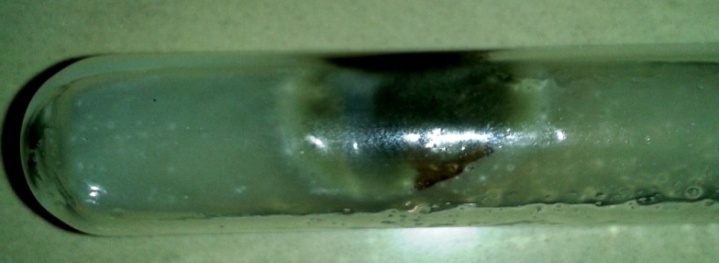
2.2. Isolation of the PathogenAs the pH was acidic it was speculated that fungal pathogen are most likely to be present so for their isolation we made PDA (Potato Dextrose Agar) slants and sections of the infected leaf was inoculated under aseptic conditions. Fungal growth started appearing after 10 days in the inoculated slants.
2.3. Microscopic Study of the Isolated PathogenThe mycelia growth of the mold was taken with the help of a loop and then teased on a slide containing Lacto phenol cotton blue. The slide was covered with the help of a cover slip and was observed under the microscope at 400X.
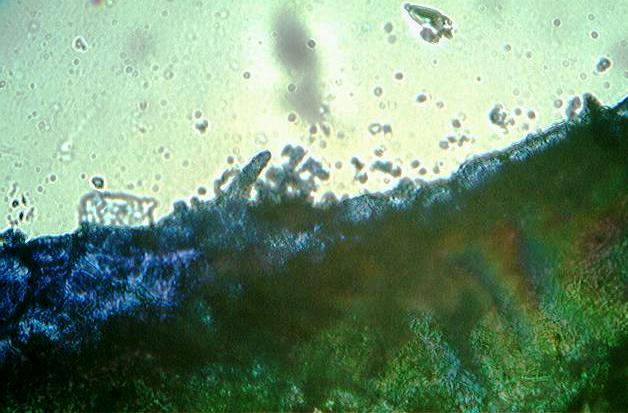
2.4. Leaf SectioningThe infected leaves were carefully sectioned, stained with lacto phenol cotton blue and observed under the microscope to look for any trace of infection. The pictures are given below.
2.5. Preparation of Spore Suspension and Re-Inoculation in a Healthy Grape Leaf to Validate Koch’s PostulateThe spore suspension was prepared with the tube where dark greenish growth was observed with a white outline grown in PDA slant tubes. Sterile water was poured in the tube so that the fungal growth was submerged under the water. The sporulated area was scratched with a clean inoculating needle. The suspension was filtered with a muslin clothe.
The inoculums density of the spore suspension was measured under hemocytometer, which was calculated as 1.4x 10⁵ spores/cc of inoculums.
One leaf was taken and was divided into four quadrants. One was for control and the other was treated as spore suspension.
Five drops each of 20 µl of sterile water was taken in each quadrant of leaf-1 that served as control and kept in a moist chamber; likewise five drops each of 20 µl of the spore suspension were given in each quadrant of leaf-2 as experimental and kept in a moist chamber in the same manner.
2.6. Fungicide Bioassay

 PowerPoint Slide
 Larger image(png format)
 View current table in a new window
The spore suspension of the potential pathogen was prepared from the slants containing fungal spores by washing the surface with sterile water and then sieving out the resulting solution. The spore suspension was used to obtain the spore density by using haemocytometer. Dextrose sugar solution of 6% was prepared in 10 ml of sterile water. Fungicide (Blitox) solution prepared with a concentration of 0.2%. Four grease free slides were labeled as spore + water (s + w), water + spore + fungicide (W + s + f), sugar+ spore+ fungicide (s + s + f) and spore + sugar+ water. (s + s + w).
3. Results and Discussion
3.1. Result of Sample Collection and Preliminary Analysis |
Electrical conductance = 52.25 S.m-1
pH= 5.6
3.3. Result of Isolation of Pathogen
 PowerPoint Slide
 Larger image(png format)

 and the macroconidia from the fungal pathogen isolated) PowerPoint Slide
PowerPoint Slide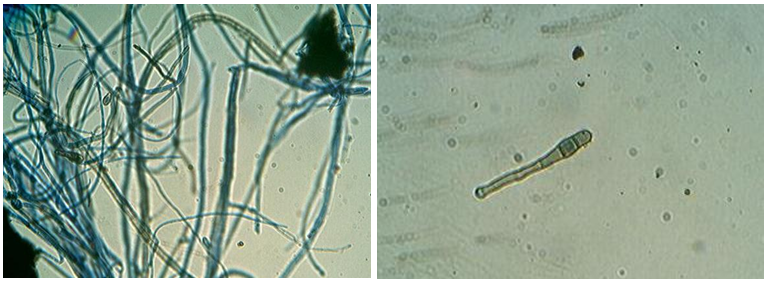 Larger image(png format)

 PowerPoint Slide
 Larger image(png format)
 Control leaf showing no spots and the experimental showing distinct spots after 24 hours of incubation) PowerPoint Slide
PowerPoint Slide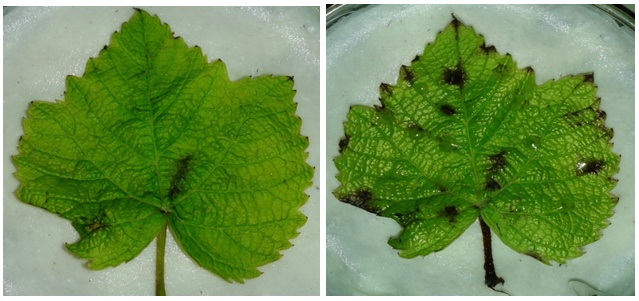 Larger image(png format)
Table 2. Showing the inoculum density, percentage density, standard error against mean percentage germination, average germ tube length and the standard error of the mean of the average germ tube length

 PowerPoint Slide
 Larger image(png format)
 View current table in a new window
4. Discussion
The SPM count was compared with that of the control which indicated substantial air pollution. Also the characters of the fungi and the nature of infection, reproductive structures suggest the involvement of Guignardia sp, a common pathogen of grape vines. Fungicide bioassay was performed, the reduction in percentage germination and germ tube length on application of the fungicide was 14.49% and 24.14 μm respectively in absence of sugar, and 88.46% and 9.8 μm respectively in presence of sugar indicating that the fungicide can be used as a potent inhibit of the pathogenic fungi.
Various methods can be adopted to maintain the existing germ plasm by cryopreservation ,liming of the soil to maintain the correct pH of the soil and if not enough then leaf litter alkalinit for neutralizing soil acidity can be carried out for amelioration.
5. Conclusion
The acidification of the soil(pH 5.6) due to the acid rain condition prevailing has brought significantly hastened the growth of fungus showing where microscopic analysis and reproductive structure matches with the profile of Guignardia, a common grape vine pathogen. Hence if we find suitable measures to control the acidification then these two remaining historical plants can be conserved.
Acknowledgement
We would like to thank our respected Head of the Department, Dr. Arup Kumar Mitra for guiding us throughout our work and all the other faculty members who helped us to successfully complete the study. We would also like to thank the staffs and guides in charge of Agra Fort to give us the chance to carry out the study.
Statement of Competing Interest
The authors have no competing interests.
References
| [1] | Sharma J.S, Sharma D.N “Atmospheric Contamination of Archaeological Monuments in the Agra Region (INDIA).” Atmospheric Pollution 20 (1982): 31-40. | ||
 In article In article | |||
| [2] | Singh Anita, Agrawal Madhoolika “Acid rain and its ecological consequences.” Journal Of Environmental Biology 29 (1) (2008): 15-24. | ||
| In article | |||
| [3] | Strayer. F, Lin Chyi-Jiin, Martin Alexander “Effect of Simulated Acid Rain on Nitrification and Nitrogen Mineralization in Forest Soils”. Journal of Environmental Quality 10 (1981): 547-551. | ||
| In article | CrossRef | ||
| [4] | Sosnowski M.R, Emmett R.W “Eradication of Black Rot (Guignardi bidwellii) from Grapevines by drastic pruning”. Plant pathology (61) (2012): 1093-1102. | ||
| In article | CrossRef | ||
| [5] | Agostini J.P, Adeskaveg J.E “Effect Of Fungicides and Storage Conditions On Postharvest Development Of Citrus Black Spot and Guignardia citricarpa in fruit tissues”. The American Phytopathological Society” (90) (2006): 1419-1424. | ||
| In article | |||
| [6] | Sett Saurov, Mita Avitjit “antifungal activity of Aegialitis rotundifolia extract against pathogenic fungi mycovellosiella”. World Journal Of Pharmaceutical Research (3) (2013): 403-417. | ||
| In article | |||
| [7] | Wang Qiaochun, Gafny Ron, Sahar Nachman “Cryopreservation of grapevine (Vitis vinifera L.) embryogenic cell suspensions by encapsulation-dehydration and subsequent plant regeneration” PlantScience 162 (2002): 551-558. | ||
| In article | CrossRef | ||
| [8] | Muse J, Mitchell C. 1995. “Paper mill boiler ash and lime by-products as soil liming materials’’. Agron. J. 87: 432-43. | ||
| In article | CrossRef | ||
| [9] | A. D. Noble, Irene Zenneck, P. J. Randall. “Leaf Litter ash alkalinity and neutralization of soil acidity”. Plant and Soil 179 (1996): 293. | ||
| In article | CrossRef | ||

 CiteULike
 Mendeley
 StumbleUpon
 Delicious
 Facebook
 Twitter
 LinkedIn
 Print
Print