Pest bird intrusion into British Columbia (BC) dairy farms has become increasingly problematic in recent years due to changes in agricultural land use practices and habitat disruption. These birds are reservoirs of diverse microbial agents that can contribute to the transmission of zoonotic and livestock diseases, including avian influenza and Salmonellosis. In addition to health impacts on both humans and livestock, pest bird fecal contamination of livestock feed results in substantial economic losses, with estimates exceeding US$14.7 million annually across the Pacific Northwest (PNW) dairy industry. Given the direct implications for animal, environmental, and human health, as well as subsequent economic impacts, accessible microbial monitoring strategies are needed to support a One-Health approach to farm biosecurity. This study employed an in-silico method for microbial identification and source tracking to assess pest bird fecal contamination in a dairy farm in Agassiz, BC. Water trough, bedding, and cattle feed samples were collected, and DNA extracted. High-purity DNA was sequenced using the Oxford Nanopore MinION® platform, followed by metagenomic analysis to identify microbial taxa and assess contamination sources. Bacterial taxa consistent with avian fecal microbiomes such as Escherichia, Salmonella, and Pseudomonas spp. were detected in dairy farm samples. Comparative microbial profiling revealed strong similarity between goose fecal samples and cattle feed, suggesting shared microbial signatures. The avian‑specific GFD genetic marker further confirmed the presence of avian fecal DNA in cattle feed and select water samples, indicating avian-origin contamination within the farm environment. Overall, these findings demonstrate that combined metagenomic and MST approaches provide an effective framework for rapidly identifying avian fecal contamination in dairy farm settings. This integrated workflow supports proactive biosecurity measures, reduces risks of pathogen transmission, and contributes to sustainable livestock management under a One-Health paradigm.
In recent decades, global farming practices have become increasingly industrialized, decreasing the number and variety of farms, while increasing farm sizes, within North America, the cumulative cropland footprint has increased by around 17% between 1996 and 2021 1, 2. In the Pacific Northwest (PNW) dairy farming industry, for example, the number of individual dairies has shrunk while the size of remaining dairy farms and cattle herds has increased over the past decades 2, 3. As a result of, natural ecological habitats are often eliminated, forcing wild birds to integrate into agricultural habitats, leading to their increased presence and infestations within these settings. Wild birds (native and invasive) that inhabit human and livestock habitats and compete for valuable resources, posing a threat to property, agriculture, and public health are classified as pest birds. Species such as Canada geese (Branta canadensis), European starlings (Sturnus vulgaris), house sparrows (Passer domesticus), and gulls (Larus spp.) frequently occupy open sheds, barns, and feed storage areas, where they forage on the high-energy cattle feed, but also defecate indiscriminately, introducing microbial contaminants of potential health significance 3. Birds are known natural hosts and vectors of a range of pathogenic bacteria such as Mycobacterium avium paratuberculosis (MAP), Escherichia coli, Salmonella enterica and Campylobacter jejuni, fungi (Aspergillus and Candida spp.), parasites (Giardia and Cryptosporidium spp.) and viruses (avian influenza A H5N1) 4, 5, 6, 7. Additionally, they indirectly affect cattle welfare, including depleting of energy-dense components of livestock feed, are a cause of feed spoilage, aversive cow behaviors, and disease outbreaks 3, 4. This present study focused on bacterial pathogens due to their prevalence in bird feces, their known pathogenicity (including dissemination of antibiotic resistance genes), and the One-Health impact they pose. Because bird movement is uninhibited by borders, they can transport pathogens across large geographical distances, disseminating and transmitting these microorganisms to other animal species as they share breeding and feeding locations visited by other wildlife. Ruminant diseases such as Johne’s disease can be transmitted from pest birds harboring MAP which causes diarrhea and weight loss, is incurable, and may lead to death in ruminants. Dairies with higher numbers of pest birds were more likely to report Johne’s disease in their herds 3. Researchers documented birds that were positive for MAP on farms with MAP-infected cattle 8. Pest birds in dairy farm settings interact frequently with livestock, their feed, water troughs, posing a significant threat to disease transmission to both farmstock (mastitis by E. coli) and their handlers, with foodborne illnesses such as salmonellosis (Salmonella spp. and Campylobacter spp. being the leading causes of human bacterial gastroenteritis worldwide 1, 8. The potential of wild birds to act as hosts and carriers of zoonoses and arthropod vectors of emerging concern has been realized to pose a public health threat not only to animal populations but humans as well 3, 9, 10, 11. Additionally, due to their unique physiology and behavior, such as high metabolic rates and low body mass required for flight, pest birds defecate frequently and indiscriminately throughout the farm 12. Furthermore, pest birds’ migratory behavior means defecation cannot be easily confined by traditional constraints or simple mitigation tactics such as fencing, accentuating the risk of pathogenic contamination and possibly disease transmission over long distances 12. A recent study found that second to Europe, North America had a large distribution of wild bird associated pathogens (WBAPs), with a range of ecological drivers 6. As such, due to the widespread geographical distribution of WBAPs, it is pertinent to appropriately identify sources of microbial contaminants, as some non-pathogenic strains can be found naturally within the microbiome. As such, microbial source tracking (MST) to pinpoint pathogenic contaminations from pest birds in dairy settings is vital to further develop best management practices (BMPs) to reduce their occurrences 6.
1.1. MSTMicrobial source tracking is considered the most commonly employed method to track the source of fecal contaminants in an environment. The technique uses biochemical, culture, and molecular analyses to discriminate between human and zoogenic origins and sources of fecal contaminants 13. Although MST can be utilized for various microbes, including fungi and viruses, it is most commonly used for bacterial pathogens due to the simplicity of their genomes and the abundance of information regarding pathogenicity. Presently, there are two major MST approaches: library-dependent, that identifies an isolate by comparing it against a genome library with bacterial strains from known fecal sources. However, the method faces the drawback of being reliant on consensus sequences which are difficult to obtain due to natural genetic variability 14. On the other hand, library-independent MST involve various molecular genotypic techniques for identifying host-specific genetic markers within environmental samples 15. Although library-independent approach does not rely on consensus sequences of target microbes, it requires genetic markers with high degree of accuracy, exclusivity, and prevalence of the marker are essential to the success of MST. When a genetic marker lacks accuracy and exclusivity, the resulting attribution of pathogen host will be unreliable, whereas a lack of marker prevalence will impede host identification when the quantity of contaminants is scarce 7. In this present study, we employed metagenomic analysis for microbial identification utilizing the next-generation sequencing platform MinION® (Oxford Nanopore) and a library-independent approach for MST utilizing a SYBR® green fluorescence (GF) marker GFD 7, 16, 17.
To identify avian-specific bacteria, several avian feces-specific genetic markers derived using SYBR® green fluorescence marker (GF) have been developed in previous studies 7. Namely, a Fusobacterium spp. associated marker sequence named GFB, a Catellicoccus marimammalium associated marker sequence GFC, and a Helicobacter spp. associated sequence named GFD 7. The three markers have been utilized in traditional quantitative polymerase chain reaction (qPCR) assays to compare fecal DNA extractions of various hosts, including several avian species, ruminants, and humans. The qPCR amplification results revealed varying percentages of amplifications across different specie with the GFD marker producing highest levels of avian specificity and DNA sensitivity 7, 14. A subsequent study used GFD markers to identify avian fecal pollution in wastewater samples determined a 97% avian host specificity for GFD markers across both study locations, validating GFD as more reliable for avian microbial source tracking 7, 14.
The objective of the present study was to determine the prevalence of pest-birds as vectors of microbial contamination in a dairy farm setting in Agassiz, British Columbia. To do so, the study establishes an in silico approach of DNA microbial identification and source tracking using both liquid and solid environmental samples. Specifically, the study attempts to form taxonomical identities of the microbial contaminants within the dairy farm samples and identify avian contribution towards fecal contamination through microbial source tracking. The study hypothesized that pest bird fecal contamination is prevalent throughout BC dairy farms and can be accurately monitored using a thorough in silico genetic approach of microbial identification and source tracking for dairy farm water, bedding, and feed samples. The variety of dairy farm samples would allow for the assessment of methodology viability as well as the robustness of the in silico genetic approach to microbial analysis within a dairy farm setting.
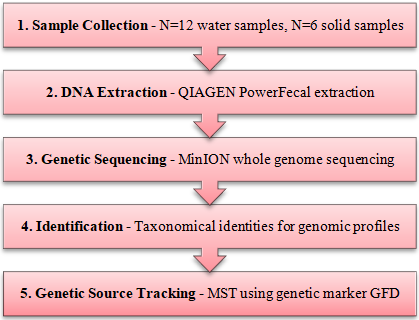
The project investigated microbial presence within a dairy farm in Agassiz, BC. First, water and biomass samples were collected. Water samples pertained to a control sample from an active water trough with livestock presence, followed by two experimental water trough samples away from livestock, one with a lid, and one without. Meanwhile solid samples included a cattle feed sample within the open-air barn where the cattle reside, alongside a control sample of goose feces as a benchmark sample for avian fecal matter. Following sample collection, DNA extraction was carried out, with genomic DNA extracted from the collected samples. Then, the experiment was followed by genomic sequencing using the MinION® sequencing platform. Lastly, the obtained DNA sequences were analyzed through metagenomic identification and MST to determine microbial presence and avian contribution.

The environmental samples utilized within this project were collected from a dairy farm in Agassiz, British Columbia from May, 2023 until February, 2025. Additionally, positive control samples of goose feces were collected separately on occasions on March 11th, 2024 and March 5th, 2025 from TWU campus location frequented by Canada geese. All sample types were collected in triplicate using sterile techniques, wearing protective clothing (coverall, nitrile gloves, and plastic shoe covers) throughout the study.
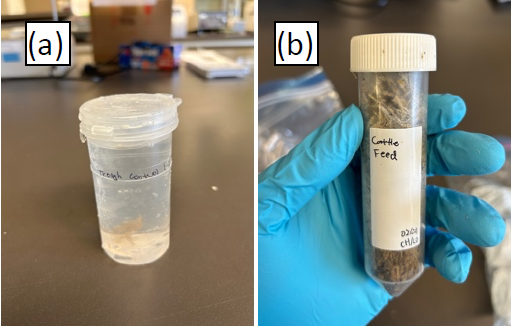
Water samples: collected from 3 trough locations as follows: controls from a clean (n=3), freshwater trough (n=3), and two water troughs exposed to avian fecal contamination, one covered (n=3), one uncovered (n=3). Sterile containers were gently submerged six inches below the water surface at a 45º tilt to collect 100ml of water.
Biomass samples: 10g each of cattle feed (n=3) and goose feces (n=3) were collected using a sterile tweezer for each to avoid cross contamination, and stored into sterile 50ml centrifuge tubes.
Transport & Processing: Following collection, all containers were immediately sealed, stored in plastic bags on ice and transported to the BSL-2 laboratory for processing within 24 hours.

Solid samples were diluted with peptone buffered water (PBW) at 10% weight to volume ratio and incubated at 37ºC overnight to cultivate microbial culture. Following which, 100ml of the incubated solutions were decanted into sterile containers. 100ml Water samples and 100ml extracted PBW solutions were filtered through 0.2 µm filter membranes using vacuum filtration (Pall Laboratory Manifold). Following filtration, the membranes were rolled and inserted into QIAGEN PowerBead® Pro tubes for DNA extraction following methodology adapted from the kit (QIAGEN Allprep® PowerFecal® Pro DNA/RNA extraction kit) 18. Briefly, the tubes containing the filter membrane were vortexed to lyse and release the existing genetic material. The tubes were spun down and the resulting crude DNA was extracted and suspended in 100µl RNase-free water.
Following genomic DNA extraction, µDrop DNA quantification analysis was carried out to determine purity and concentration of the genomic DNA. 2 µl DNA micro drops were placed on a µDrop plate before the absorbance measure at A260/A280 nm wavelength were taken to determine the purity of the DNA sample. Samples were considered pure only if an A260/A280 ratio was between 1.7 and 2.1, otherwise the sample was considered impure with proteins and RNA contaminants, in which case, the DNA will be discarded and the extraction will be repeated.
Once high purity genomic DNA was obtained from the environmental samples, DNA sequencing libraries were prepared using Oxford Nanopore MinION® Rapid Barcode Sequencing kit 19. Each environmental DNA sample were attributed to a unique barcode, to prevent cross contamination during DNA sequencing. The libraries were lysed and ligated with the corresponding barcodes before being pooled and deposited onto magnetic beads to further purify the DNA sample. Following five rounds of wash, the supernatant DNA solution was removed and integrated with loading beads and buffers for the sequencing experiment.
Sequencing involved preparation of MinION® flow cells. Before insertion of any sequencing reagents, the flow cells were checked using the MinKNOW™ sequencing software, where a minimum of 800 nanopores were required for high throughput sequencing. Following flow-cell check, the flow cell was flushed using a buffer solution. Thereafter, the sequencing buffer and prepared DNA sequencing library were injected into the flow cell. Using the MinKNOW™ software, whole genome sequencing experiment was selected and initiated to sequence data collection for a period of 18-24 hours. The resulting DNA sequencing data were used for subsequent genetic analysis.
Metagenomics identification were performed using the EPI2ME™ (Oxford Nanopore Technologies) sequence analysis platform. The subsequent taxonomical identities were then compiled to generate bacterial profiles for each environmental sample. Additionally, the DNA sequence data were then imported into Geneious Prime® (Dotmatics) for MST. The DNA sequence for the avian fecal genetic marker GFD was imported into the Geneious Prime® and aligned with the obtained dairy farm DNA samples for discovery of marker presence. To verify exclusivity of the GFD marker, marker sequence alignment was carried out for both goose fecal DNA as well as laboratory E. coli and S. aureus DNA.
A total of twelve water samples were collected between two sampling events between February and April 2024. Additionally, three bedding samples, three feed samples, and three goose fecal control samples were collected and analyzed through various sampling events between May, 2023 until March, 2025. During the experiments one control water trough sample, one water trough with lid sample, and one water trough without lid sample were concentrated and utilized for DNA extraction and sequencing, while the cattle feed and goose fecal samples were all utilized for DNA extraction and sequencing.
The assessment of the sequencing output of MinION® whole genome barcode sequencing showcased high throughput of successful sequences, with the laboratory control E. coli and S. aureus sample yielding more than 80,000 sequencing reads. Furthermore, the successful sequences obtained through the MinION® sequencing machine was successfully classified through the EPI2ME metagenomic analysis, yielding high proportion of genomic identities (Table 1).
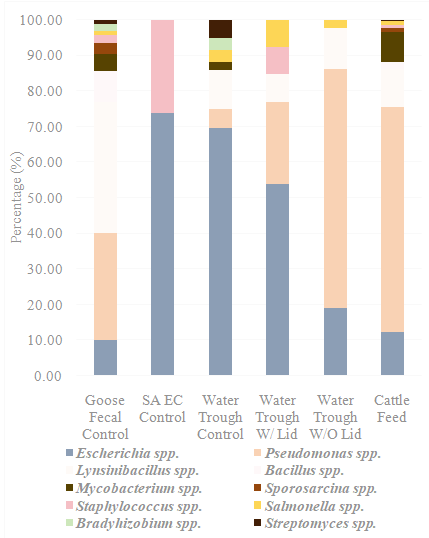
The classified DNA reads were employed to determine the taxonomical identities of the microbial content within each sample. The validity of the metagenomic identification was identified using a combined E. coli and S. aureus sample, where the classified reads were identified to be 25% S. aureus and 75% E. coli. The bacterial profile of other environmental samples were subsequently constructed using the obtained sequences, revealing high proportions of Lynsinibacillus spp., Pseudomonas spp., and Escherichia spp., being the most prevalent throughout all samples. Additionally, species such as Salmonella spp., Bradyhizobium spp., and Mycobacterium spp. were also identified across several environmental samples in smaller quantities (Figure 3).

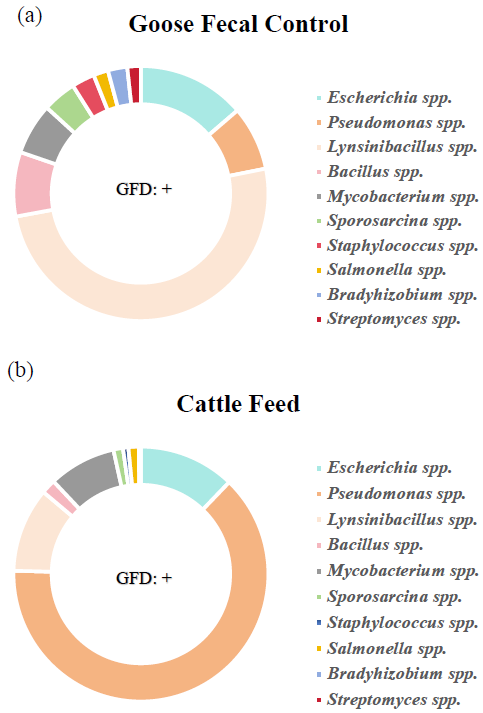
The construction of bacterial profiles enabled parallel comparisons between environmental and avian samples to determine overlap within microbial species. Using goose fecal sample as a positive control, the bacterial profiles were compared, revealing similarity between goose fecal sample and the cattle feed sample in terms of microbial species. Between the two bacterial profiles, the identity of the most abundant strains of microbes are identical, including Escherichia spp., Pseudomonas spp., Lynsinibacillus spp. Bacillus spp., Mycobacterium spp., Sporosarcina spp., Staphylococcus spp., Bradyhizobium spp., and Streptomyces spp.. Furthermore, genetic sequence alignment analysis using GFD avian fecal marker were carried out to determine source of contamination positive alignment within the goose fecal sample as well as the cattle feed sample, indicating presence of avian fecal DNA (Figure 4).
MST using GFD marker determined positive alignment hits within goose fecal control sample, water trough control sample, and cattle feed sample, indicating presence of avian fecal DNA within all three samples.

Pest birds are known reservoirs of a variety of pathogens that can affect cattle and human health, and contaminate the environment. As such, pest bird infestation of dairy farms poses dire One-Health outcomes. In this current study, the overall findings suggest the presence of avian fecal microbes within the dairy farm setting, which demonstrates the risk of microbial contamination as a result of pest bird infestation. As observed by the 2023 H5N1 avian influenza outbreak that impacted both human and cattle populations, avian microbial contamination poses a serious threat of avian-related diseases and infections that can impact the dairy industry. As such, early recognition and mitigation of pest-bird infestation is pertinent to minimize incidences of infection transmission within dairy farms and prevent potential outbreak events. Furthermore, due to the nature of dairy farms having an overlap of ecological niches between wildlife, livestock, and humans, mitigation strategies need to be precise and timely in order to minimize the impact of microbial contamination and related One-Health implications 20. As such, precise and rapid detection of avian microbial contamination within dairy farms should be the first step within a comprehensive mitigation strategy that protects the wellbeing of animals, humans, and the environment in tandem within dairy farm settings.
4.1. Sequencing Validity and OutputThe research was able to successfully obtain DNA sequencing data from agricultural samples using the MinION® platform, allowing for downstream epigenetic analysis (Table 1) 16. To ensure sequence validity, control samples of bacterial strains of E. coli and S. aureus were sequenced as a control group, yielding high-purity DNA and large proportions of classified sequence reads (Table 1). Out of the dairy farm samples, water samples covered or uncovered yielded significantly less DNA sequence reads compared to cattle feed samples, showing that cattle feed harbors drastically more microbes compared to water samples (Table 1). Perhaps due to the abundance in nutrients in cattle feed, higher microbial density increases the risks of microbial transmission.
4.2. Taxonomical IdentificationThe taxonomical identification of the farm samples identified fecal bacterial species such as Escherichia spp., Pseudomonas spp., Staphylococcus spp., and Salmonella spp., some of which pose significant pathogenic and zoonotic potential within dairy farm environments. Due to the constant human-livestock interaction within dairy farms, cattle infected with avian-borne bacteria like Salmonella spp. can lead to zoonotic transmission of diseases through either direct contact, or indirect transmission through feed, water, bedding, bodily fluids, or dairy products 1, 22. Pest birds are known to reside within cattle barns where they forage on available feed and defecate within these premises indiscriminately.
The observed gastrointestinal pathogens like Salmonella spp. and Escherichia spp. in cattle farm feed and water samples can be attributed to bird feces (Figure 3). Contaminated feed and water are known vehicles of pathogen transmission and carry the risks for disease outbreaks within the dairy farm 1, 22. In fact, pest bird transmission of pathogens to livestock is a known threat within the dairy farm industry. As pest-birds forage on open cattle feed, contamination is inevitable. Accessible cattle feed encourages pest-bird infestation within dairy farms, where microbial contamination from pest birds can lead to significant feed spoilage and economic loss. A 2019 study in the state of Washington estimated feed spoilage loss of US$14.7 million annually 3. The same study suggests that E. coli and Salmonella spp. are prime agents for cattle feed contamination from pest bird infestations, both of which were identified within the dairy farm feed samples in this current study. Compared to Canadian goose fecal sample (~10% of 2923 reads), the cattle feed sample (~12% of 2744 reads) yielded similar levels of E. coli reads, suggesting significant levels of contamination, posing significant risks to feed spoilage (Table 1, Figure 3).
Beyond economic damage and operational disruptions, Salmonella spp. is also one of the most problematic bacterial infectious agents in dairy farms, causing a range of clinical diseases ranging from salmonellosis, septicemia, pneumonia, and reproductive losses in dairy herds 23. In one longitudinal study, over the span of a year, more than 90% out of 110 dairy farms in the United States yielded a positive Salmonella spp. fecal sample, showing the widespread prevalence of Salmonella contamination in dairy farm settings 23. Within the present study, all dairy farm samples were shown to contain Salmonella spp. of varying proportions, with the highest distribution being in the covered water trough sample at around 8% (Figure 3).
Furthermore, the water trough control sample and the cattle feed sample both showed the presence of Mycobacterium spp., a known contaminants from pest bird fecal matter, its presence within the goose fecal sample suggest pest birds to be a likely source of the contamination (Figure 4). Although specific subspecies of the Mycobacterium spp. cannot be determined using the present technology, pest birds like the European starling and house sparrows are proven carriers of MAP 8. Alongside Canada goose, European starlings and house sparrows were the most common pest bird species observed at the dairy farm, as such, the presence of Mycobacterium spp. within dairy farm samples opens the possibility of Johne’s disease 8. The two environmental samples without Mycobacterium spp. are the inactive water troughs with stagnant water and no livestock presence. The lack of livestock interaction and old, stagnant water may have resulted in low viable bacterial presence that were below the necessary threshold for the MinION® technology to detect, leading to scant sequencing reads and lack of bacterial identifications 16.
The construction of bacterial profiles further allowed for the parallel comparison between different environmental samples to discover trends and similarities. Notably, the comparison between Canadian goose feces, utilized as a pest bird control sample, and cattle feed revealed high similarity within the bacterial content of the two samples. Between the two samples, the predominant bacterial strains such as Escherichia spp., Pseudomonas spp., Lynsinibacillus spp., Mycobacterium spp., and Salmonella spp. were found in both samples, however, the proportions of each strain differ between the two populations (Figure 4). These differences in proportion can be attributed to several factors. For one, although Canadian goose is considered a common pest bird within the PNW, it was not the most observed pest birds within the sample area. During the present study, European starling and house sparrows were the most commonly observed pest birds throughout the dairy farm. Despite this, Canada goose feces were used as the positive control since it is much more reliable to track and collect fresh Canada goose feces in large enough quantities for whole genome sequencing. Due to Canada goose being largely herbivore while European starling and house sparrows are opportunistic omnivores, the bacterial profile of Canadian goose is likely different, accounting for some of the detected differences in the detected bacterial profile 8. Moreover, the differences in the environment from which the two samples were taken also contributed to the differences in bacterial profile. The cattle feed was supplied in open surfaces within close proximity to the cattle for them to eat, exposing the food to different cattle but also environmental elements. Food samples were therefore more prone to bacterial presence making it ideal for bacterial contamination. Moreover, the composition of the feed provides abundant substrate for bacterial nutrient allowing their propagations. In contrast, when goose fecal samples were collected, the contained fecal bacteria was not given the chance for secondary propagation with added nutrients as it was within the dairy farm setting, thus causing the proportions of various bacterial strains to differ from those found within the cattle feed samples. However, since pest birds have unique microbiomes due to their unique diet, the fecal bacteria they harbor is not found naturally in cattle feed, such as E. coli, Salmonella spp., Pseudomonas spp., and Mycobacterium spp., among many others. As such, the presence of such bacterial combination within the feed sample strongly attest to the pest bird fecal contamination within dairy farms 12, 20, 21, 24.
4.3. Microbial Source TrackingFollowing the comparison and the high similarity observed between the goose fecal bacterial profile and the dairy farm cattle feed sample, further MST using genetic marker alignment further implicated pest birds as a source of bacterial contamination (Figure 4). The procedure utilized the avian-specific fecal DNA marker GFD to determine the source of contamination. Compared to similar genetic markers GFB and GFC, GFD was utilized due to previous studies showing drastically higher avian DNA sensitivity at 57% compared to 8% and 17% respectively, meaning 57% of all avian fecal DNA are correctly detected within a sample 15. Moreover, since GFD marker also have a >99% specificity for avian fecal DNA, it is therefore an optimal marker for accurate detection of avian fecal contamination 15. To verify the validity and exclusivity of the GFD marker, the marker was used to align with both laboratory control E. coli and S. aureus DNA sample as well as the goose fecal sample. The results indicated a positive alignment hit within the goose fecal sample, while no alignment was detected within the laboratory bacterial samples, showing correct avian fecal DNA detection using the GFD marker.
Following marker verification, the marker was aligned with the dairy farm DNA sequences to determine the presence of avian fecal DNA, returning positive alignments for the cattle feed sample alongside the water trough control sample within the main barn, indicating avian fecal contamination (Table 2). The prevalence of avian fecal contamination within the dairy farm samples is consistent with previous findings, which surveyed dairy farmers within the PNW, and reported estimations of infestations of up to 10,000 birds per day 3. The same study also implicated pest bird contamination of cattle feed as a prominent issue, causing hinderances to dairy farm safety and financial viability due to the consequential feed spoilage 3. Moreover, the confirmation of avian fecal contamination coupled with the high similarity observed between the bacterial profile of the goose fecal sample and the cattle feed sample provides indictive evidence for pest bird fecal contamination of cattle feed within dairy farm settings.
4.4. Future DirectionsDespite the informative findings of the current study, there were still several limitations regarding DNA sequencing consistency and marker for MST that require further investigation.
Traditionally, qPCR is utilized in conjunction with genetic markers for MST, where successful amplifications of marker primers will indicate the presence of target microbial hosts within the DNA sample 7. However, qPCR alone is incapable of simultaneously identifying the microbial strain alongside the source of microbial contamination. In order to streamline this process, the present study employed a next-generation sequencing platform, such as the portable MinION® platform (Oxford Nanopore), to simultaneously sequence and identify environmental DNA samples. Although the MinION® sequencing platform has demonstrated potential for rapid microbial water quality analysis due to its modularity and cost-efficiency, its sequencing output quality is highly dependent on sample quality and equipment conditions. In environmental samples when samples conditions vary, the DNA output quality will also be inconsistent. In terms of equipment conditions, sequencing quality is highly reliant on flow cell quality, where flow cells degrade through every experiment, while being easily damaged if sample quality is subpar, making initial experiments yielding higher sequence output compared to later experiments. Low sequencing output such as the two water trough samples (with and without lid) could result in misrepresentation of the taxonomical profiles, potentially inflating minor taxonomical variations into large percentages, skewing bacterial presence within a taxonomical profile. As such, although promising, the sequencing quality of the MinION® platform in the present study was inconsistent dependent on flow cell and sample conditions. In future studies, perhaps a more robust platform can be explored to improve sequence quality without compromising on the functionality of next-generation sequencing platforms.
In terms of MST markers, the GFD avian fecal genetic marker has been shown to have exceptionally high host-specificity, yet one of its major drawbacks is the relatively limited host-prevalence 10. Host-prevalence refers to the abundance of marker material within a host. The GFD marker is derived from Helicobacter spp. in avian fecal microbiome. Consequently, although hyper-specific, it translates to relatively low prevalence and, thus, low sensitivity, causing potential false negatives within certain samples 15. To alleviate this drawback, future MST experiments could involve an increase in the quantity or concentration of environmental DNA in sequencing experiments to compensate marker sensitivity for a more accurate determination of pest bird contamination. Alternatively, other DNA analysis techniques with higher sensitivity can be utilized to supplement DNA analysis in cases with low microbial loads, such as PCR amplification 7. Furthermore, although the present study was able to draw connections between environmental microbes and avian hosts, further work can explore approaches to determine species-specific origin of different microbes to the degree of species. In future studies, multiple databases would be evaluated for sequence comparison to determine microbial sequences with explicit origins, such as BacWGSTdb, to further the understanding of specific host origins of various environmental contaminants, allowing for accurate assessment of the scope of avian contamination within dairy farm settings 25. Although promising, the existing databases like BacWGSTdb are often outdated, incomplete, and region-specific, rendering low application value for the present study within the PNW.
Overall, the current study demonstrated as a proof-of-concept study in determining a method for detecting the scope of pest bird contamination within dairy farm settings. The developed workflow was concise and rapid, with potential for in-field utilization. The microbial identification and source tracking accomplished through the current protocol were able to determine the identity of the contaminants and the source of contamination within dairy farm samples, implicating pest birds as a likely candidate. Nonetheless, additional research is necessary to increase consistency and specificity within host attribution of dairy farm contaminants. The most promising approach will involve the expansive utilization of combined genetic marker analysis and database sequence comparison to truly complete comprehensive in silico MST and establish the explicit impact of pest bird infestation on dairy farm microbial contaminations.
A special thank you to Trinity Western University, Faculty of Natural and Applied Sciences, Department of Biology where the work was performed. We thank Dr. Karen Lo for the technical support operating the MinION® sequencing platform. We also acknowledge the Murdock Charitable Trust and Templeton Foundation for funding this project. Lastly, we thank the Holberg Farm Ltd. for providing access to their farm where sampling was conducted.
| [1] | Smith, O. M., Edworthy, A., Taylor, J. M., Jones, M. S., Tormanen, A., Kennedy, C. M., Fu, Z., Latimer, C. E., Cornell, K. A., Michelotti, L. A., Sato, C., Northfield, T., Snyder, W. E., & Owen, J. P. (2020). “Agricultural intensification heightens food safety risks posed by wild birds.” Journal of Applied Ecology, 57(11), 2246–2257. | ||
| In article | View Article | ||
| [2] | Carter, S., Morford, S. L., Tack, J. D., Lark, T. J., Aragon, N. U., Allred, B. W., Twidwell, D., & Naugle, D. E. (2025). Annual cultivated extent and agricultural land use expansion across the central grasslands of North America, 1996–2021. Ecological Indicators, 178, 113968. | ||
| In article | View Article | ||
| [3] | Elser, J. L., Adams Progar, A. L., Steensma, K. M. M., Caskin, T. P., Kerr, S. R., & Shwiff, S. P. (2019). “Economic and livestock health impacts of birds on dairies: Evidence from a survey of Washington dairy operators.” PLOS ONE, 14(9). | ||
| In article | View Article PubMed | ||
| [4] | Mostafa, A., Naguib, M. M., Nogales, A., Barre, R. S., Stewart, J. P., García-Sastre, A., & Martinez-Sobrido, L. (2024). Avian influenza A (H5N1) virus in dairy cattle: Origin, evolution, and cross-species transmission. mBio, 15(12), e02542-24. | ||
| In article | View Article PubMed | ||
| [5] | Scallan, E. (2011). “Foodborne Illness Acquired in the United States (Reply).” Emerging Infectious Diseases, 17(7), 1339–1340. | ||
| In article | View Article PubMed | ||
| [6] | Qiu, Y., Lv, C., Chen, J., Sun, Y., Tang, T., Zhang, Y., Yang, Y., Wang, G., Xu, Q., Zhang, X., Hong, F., Hay, S. I., Fang, L., & Liu, W. (2025). The global distribution and diversity of wild-bird-associated pathogens: An integrated data analysis and modeling study. Med, 6(4), 100553. | ||
| In article | View Article PubMed | ||
| [7] | Green, H. C., Dick, L. K., Gilpin, B., Samadpour, M., & Field, K. G. (2012). “Genetic Markers for Rapid PCR-Based Identification of Gull, Canada Goose, Duck, and Chicken Fecal Contamination in Water.” Applied and Environmental Microbiology, 78(2), 503–510. | ||
| In article | View Article PubMed | ||
| [8] | Corn, J. L., Manning, E. J. B., Sreevatsan, S., & Fischer, J. R. (2005). “Isolation of Mycobacterium avium subsp. Paratuberculosis from Free-Ranging Birds and Mammals on Livestock Premises.” Applied and Environmental Microbiology, 71(11), 6963–6967. | ||
| In article | View Article PubMed | ||
| [9] | Reed, K. D., Meece, J. K., Henkel, J. S., & Shukla, S. K. (2003). Birds, Migration and Emerging Zoonoses: West Nile Virus, Lyme Disease, Influenza A and Enteropathogens. Clinical Medicine & Research, 1(1), 5–12. | ||
| In article | View Article PubMed | ||
| [10] | Hubálek, Z. (2004). An Annotated Checklist Of Pathogenic Microorganisms Associated With Migratory Birds. Journal of Wildlife Diseases, 40(4), 639–659. | ||
| In article | View Article PubMed | ||
| [11] | Jourdain, E., Gauthier-Clerc, M., Bicout, D., & Sabatier, P. (2007). Bird Migration Routes and Risk for Pathogen Dispersion into Western Mediterranean Wetlands. Emerging Infectious Diseases, 13(3), 365–372. | ||
| In article | View Article PubMed | ||
| [12] | Pao, S., Hagens, B. E., Kim, C., Wildeus, S., Ettinger, M. R., Wilson, M. D., Watts, B. D., Whitley, N. C., Porto-Fett, A. C. S., Schwarz, J. G., Kaseloo, P., Ren, S., Long, W., Li, H., & Luchansky, J. B. (2014). “Prevalence and molecular analyses of Campylobacter jejuni and Salmonella spp. In co-grazing small ruminants and wild-living birds.” Livestock Science, 160, 163–171. | ||
| In article | View Article | ||
| [13] | Paruch, A. M., & Paruch, L. (2024). Current status of microbial source tracking applications in constructed wetlands serving as nature-based solutions for water management and wastewater treatment. Environmental Pollution, 351, 124076. | ||
| In article | View Article PubMed | ||
| [14] | Ahmed, W., Staley, C., Sadowsky, M. J., Gyawali, P., Sidhu, J. P. S., Palmer, A., Beale, D. J., & Toze, S. (2015). “Toolbox Approaches Using Molecular Markers and 16S rRNA Gene Amplicon Data Sets for Identification of Fecal Pollution in Surface Water.” Applied and Environmental Microbiology, 81(20), 7067–7077. | ||
| In article | View Article PubMed | ||
| [15] | Ahmed, W., Harwood, V. J., Nguyen, K., Young, S., Hamilton, K., & Toze, S. (2016). “Utility of Helicobacter spp. Associated GFD markers for detecting avian fecal pollution in natural waters of two continents.” Water Research, 88, 613–622. | ||
| In article | View Article PubMed | ||
| [16] | Werner, D., Acharya, K., Blackburn, A., Zan, R., Plaimart, J., Allen, B., Mgana, S. M., Sabai, S. M., Halla, F. F., Massawa, S. M., Haile, A. T., Hiruy, A. M., Mohammed, J., Vinitnantharat, S., Thongsamer, T., Pantha, K., Mota Filho, C. R., & Lopes, B. C. (2022). “MinION Nanopore Sequencing Accelerates Progress towards Ubiquitous Genetics in Water Research.” Water, 14(16), 2491. | ||
| In article | View Article | ||
| [17] | Kang, M., Yang, J., Kim, S., Park, J., Kim, M., & Park, W. (2022). “Occurrence of antibiotic resistance genes and multidrug-resistant bacteria during wastewater treatment processes.” Science of The Total Environment, 811, 152331. | ||
| In article | View Article PubMed | ||
| [18] | QIAGEN. (2022). AllPrep® PowerFecal® Pro DNA/RNA Kit Handbook. | ||
| In article | |||
| [19] | Oxford Nanopore Technologies. (2025). Rapid Sequencing DNA V14 Barcoding Kit (SQK-RBK114.24 or SQK-RBK114.96) | ||
| In article | |||
| [20] | Abd El-Ghany, W. A. (2021). “Pseudomonas aeruginosa infection of avian origin: Zoonosis and one health implications.” Veterinary World, 2155–2159. | ||
| In article | View Article PubMed | ||
| [21] | Yuan, Y., Liang, B., Jiang, B., Zhu, L., Wang, T., Li, Y., Liu, J., Guo, X., Ji, X., & Sun, Y. (2021). “Migratory wild birds carrying multidrug-resistant Escherichia coli as potential transmitters of antimicrobial resistance in China.” PLOS ONE, 16(12), e0261444. | ||
| In article | View Article PubMed | ||
| [22] | Holzhauer, M., & Wennink, G. J. (2023). Zoonotic risks of pathogens from dairy cattle and their milk-borne transmission. Journal of Dairy Research, 90(4), 325–331. | ||
| In article | View Article PubMed | ||
| [23] | Holschbach, C. L., & Peek, S. F. (2018). Salmonella in Dairy Cattle. Veterinary Clinics of North America: Food Animal Practice, 34(1), 133–154. | ||
| In article | View Article PubMed | ||
| [24] | Pennycott, T. W., Park, A., & Mather, H. A. (2006). “Isolation of different serovars of Salmonella enterica from wild birds in Great Britain between 1995 and 2003.” Veterinary Record, 158(24), 817–820. | ||
| In article | View Article PubMed | ||
| [25] | Ruan, Z., & Feng, Y. (2016). “BacWGSTdb, a database for genotyping and source tracking bacterial pathogens.” Nucleic Acids Research, 44(D1), D682–D687. | ||
| In article | View Article PubMed | ||
Published with license by Science and Education Publishing, Copyright © 2026 Chengzhe He and Laura A. Onyango
 This work is licensed under a Creative Commons Attribution 4.0 International License. To view a copy of this license, visit
http://creativecommons.org/licenses/by/4.0/
This work is licensed under a Creative Commons Attribution 4.0 International License. To view a copy of this license, visit
http://creativecommons.org/licenses/by/4.0/
| [1] | Smith, O. M., Edworthy, A., Taylor, J. M., Jones, M. S., Tormanen, A., Kennedy, C. M., Fu, Z., Latimer, C. E., Cornell, K. A., Michelotti, L. A., Sato, C., Northfield, T., Snyder, W. E., & Owen, J. P. (2020). “Agricultural intensification heightens food safety risks posed by wild birds.” Journal of Applied Ecology, 57(11), 2246–2257. | ||
| In article | View Article | ||
| [2] | Carter, S., Morford, S. L., Tack, J. D., Lark, T. J., Aragon, N. U., Allred, B. W., Twidwell, D., & Naugle, D. E. (2025). Annual cultivated extent and agricultural land use expansion across the central grasslands of North America, 1996–2021. Ecological Indicators, 178, 113968. | ||
| In article | View Article | ||
| [3] | Elser, J. L., Adams Progar, A. L., Steensma, K. M. M., Caskin, T. P., Kerr, S. R., & Shwiff, S. P. (2019). “Economic and livestock health impacts of birds on dairies: Evidence from a survey of Washington dairy operators.” PLOS ONE, 14(9). | ||
| In article | View Article PubMed | ||
| [4] | Mostafa, A., Naguib, M. M., Nogales, A., Barre, R. S., Stewart, J. P., García-Sastre, A., & Martinez-Sobrido, L. (2024). Avian influenza A (H5N1) virus in dairy cattle: Origin, evolution, and cross-species transmission. mBio, 15(12), e02542-24. | ||
| In article | View Article PubMed | ||
| [5] | Scallan, E. (2011). “Foodborne Illness Acquired in the United States (Reply).” Emerging Infectious Diseases, 17(7), 1339–1340. | ||
| In article | View Article PubMed | ||
| [6] | Qiu, Y., Lv, C., Chen, J., Sun, Y., Tang, T., Zhang, Y., Yang, Y., Wang, G., Xu, Q., Zhang, X., Hong, F., Hay, S. I., Fang, L., & Liu, W. (2025). The global distribution and diversity of wild-bird-associated pathogens: An integrated data analysis and modeling study. Med, 6(4), 100553. | ||
| In article | View Article PubMed | ||
| [7] | Green, H. C., Dick, L. K., Gilpin, B., Samadpour, M., & Field, K. G. (2012). “Genetic Markers for Rapid PCR-Based Identification of Gull, Canada Goose, Duck, and Chicken Fecal Contamination in Water.” Applied and Environmental Microbiology, 78(2), 503–510. | ||
| In article | View Article PubMed | ||
| [8] | Corn, J. L., Manning, E. J. B., Sreevatsan, S., & Fischer, J. R. (2005). “Isolation of Mycobacterium avium subsp. Paratuberculosis from Free-Ranging Birds and Mammals on Livestock Premises.” Applied and Environmental Microbiology, 71(11), 6963–6967. | ||
| In article | View Article PubMed | ||
| [9] | Reed, K. D., Meece, J. K., Henkel, J. S., & Shukla, S. K. (2003). Birds, Migration and Emerging Zoonoses: West Nile Virus, Lyme Disease, Influenza A and Enteropathogens. Clinical Medicine & Research, 1(1), 5–12. | ||
| In article | View Article PubMed | ||
| [10] | Hubálek, Z. (2004). An Annotated Checklist Of Pathogenic Microorganisms Associated With Migratory Birds. Journal of Wildlife Diseases, 40(4), 639–659. | ||
| In article | View Article PubMed | ||
| [11] | Jourdain, E., Gauthier-Clerc, M., Bicout, D., & Sabatier, P. (2007). Bird Migration Routes and Risk for Pathogen Dispersion into Western Mediterranean Wetlands. Emerging Infectious Diseases, 13(3), 365–372. | ||
| In article | View Article PubMed | ||
| [12] | Pao, S., Hagens, B. E., Kim, C., Wildeus, S., Ettinger, M. R., Wilson, M. D., Watts, B. D., Whitley, N. C., Porto-Fett, A. C. S., Schwarz, J. G., Kaseloo, P., Ren, S., Long, W., Li, H., & Luchansky, J. B. (2014). “Prevalence and molecular analyses of Campylobacter jejuni and Salmonella spp. In co-grazing small ruminants and wild-living birds.” Livestock Science, 160, 163–171. | ||
| In article | View Article | ||
| [13] | Paruch, A. M., & Paruch, L. (2024). Current status of microbial source tracking applications in constructed wetlands serving as nature-based solutions for water management and wastewater treatment. Environmental Pollution, 351, 124076. | ||
| In article | View Article PubMed | ||
| [14] | Ahmed, W., Staley, C., Sadowsky, M. J., Gyawali, P., Sidhu, J. P. S., Palmer, A., Beale, D. J., & Toze, S. (2015). “Toolbox Approaches Using Molecular Markers and 16S rRNA Gene Amplicon Data Sets for Identification of Fecal Pollution in Surface Water.” Applied and Environmental Microbiology, 81(20), 7067–7077. | ||
| In article | View Article PubMed | ||
| [15] | Ahmed, W., Harwood, V. J., Nguyen, K., Young, S., Hamilton, K., & Toze, S. (2016). “Utility of Helicobacter spp. Associated GFD markers for detecting avian fecal pollution in natural waters of two continents.” Water Research, 88, 613–622. | ||
| In article | View Article PubMed | ||
| [16] | Werner, D., Acharya, K., Blackburn, A., Zan, R., Plaimart, J., Allen, B., Mgana, S. M., Sabai, S. M., Halla, F. F., Massawa, S. M., Haile, A. T., Hiruy, A. M., Mohammed, J., Vinitnantharat, S., Thongsamer, T., Pantha, K., Mota Filho, C. R., & Lopes, B. C. (2022). “MinION Nanopore Sequencing Accelerates Progress towards Ubiquitous Genetics in Water Research.” Water, 14(16), 2491. | ||
| In article | View Article | ||
| [17] | Kang, M., Yang, J., Kim, S., Park, J., Kim, M., & Park, W. (2022). “Occurrence of antibiotic resistance genes and multidrug-resistant bacteria during wastewater treatment processes.” Science of The Total Environment, 811, 152331. | ||
| In article | View Article PubMed | ||
| [18] | QIAGEN. (2022). AllPrep® PowerFecal® Pro DNA/RNA Kit Handbook. | ||
| In article | |||
| [19] | Oxford Nanopore Technologies. (2025). Rapid Sequencing DNA V14 Barcoding Kit (SQK-RBK114.24 or SQK-RBK114.96) | ||
| In article | |||
| [20] | Abd El-Ghany, W. A. (2021). “Pseudomonas aeruginosa infection of avian origin: Zoonosis and one health implications.” Veterinary World, 2155–2159. | ||
| In article | View Article PubMed | ||
| [21] | Yuan, Y., Liang, B., Jiang, B., Zhu, L., Wang, T., Li, Y., Liu, J., Guo, X., Ji, X., & Sun, Y. (2021). “Migratory wild birds carrying multidrug-resistant Escherichia coli as potential transmitters of antimicrobial resistance in China.” PLOS ONE, 16(12), e0261444. | ||
| In article | View Article PubMed | ||
| [22] | Holzhauer, M., & Wennink, G. J. (2023). Zoonotic risks of pathogens from dairy cattle and their milk-borne transmission. Journal of Dairy Research, 90(4), 325–331. | ||
| In article | View Article PubMed | ||
| [23] | Holschbach, C. L., & Peek, S. F. (2018). Salmonella in Dairy Cattle. Veterinary Clinics of North America: Food Animal Practice, 34(1), 133–154. | ||
| In article | View Article PubMed | ||
| [24] | Pennycott, T. W., Park, A., & Mather, H. A. (2006). “Isolation of different serovars of Salmonella enterica from wild birds in Great Britain between 1995 and 2003.” Veterinary Record, 158(24), 817–820. | ||
| In article | View Article PubMed | ||
| [25] | Ruan, Z., & Feng, Y. (2016). “BacWGSTdb, a database for genotyping and source tracking bacterial pathogens.” Nucleic Acids Research, 44(D1), D682–D687. | ||
| In article | View Article PubMed | ||