Adobe is a building material with high thermal inertia, but it is characterised by low mechanical strength, whether in compression or flexure, due to poor water resistance. Modern stabilisation techniques make it possible to significantly increase the ductility of these adobe units. In the literature, the improvement of the mechanical properties of adobe bricks through the incorporation of fibres, such as kenaf, has been experimentally demonstrated. Sampling-based analysis is extremely time-consuming and costly. A numerical simulation approach enables the optimal selection of composite adobe components to achieve superior ductility. This article presents a numerical study on the periodic asymptotic homogenisation of a clayey sand/kenaf composite intended for the manufacture of load-bearing earth bricks. The results reveal two distinct regimes: a quasi-isotropic dilute regime for volume fractions (Vf)≤ 15%, and a concentrated regime with marked anisotropy for Vf>15%. The shear modulus GXY is the most sensitive to the dosage and is quasi-proportional to the Young’s modulus of the fiber. The local von Mises stress reaches its absolute maximum at Vf=20%, marking the upper limit of the recommended practical range, which is |7-20%| (0.58-1.91 wt.%). Finally, our model’s predictions are validated by comparison with other methods and experimental results from the literature.
Facing a climate emergency, the construction sector is called upon to drastically reduce its CO2 emissions: it alone accounts for nearly 39 % of global greenhouse gas emissions 1. Bio-based materials derived from renewable plant-based resources represent a promising response to this challenge: low embodied energy, carbon-neutral or even carbon-negative balance, and locally available resources 2, 3. Raw earth, used for millennia as a building material, offers major ecological and socio-economic advantages: abundance, low cost, natural hygrothermal regulation, and implementation accessible without industrial equipment 4, 5. More than 30 % of the world population currently lives in earth constructions, a proportion exceeding 50 % in some developing countries 4.
The main limitations of raw earth bricks (adobe) are their intrinsic brittleness (low tensile and shear strength) and water sensitivity. The incorporation of short plant fibres into the earth matrix is an ancient and effective technique to address these weaknesses, as it improves ductility, limits shrinkage cracking, and increases resistance to dynamic loading 4. Recent studies have shown significant compressive and flexural strength gains through the addition of sisal fibres 6, jute 7, coir (coconut fibre) 8, and kenaf 9, 10. Kenaf (Hibiscus cannabinus), a fast-growing plant widespread in the Sahel and West Africa, is particularly promising: its fibres exhibit tensile strength of  and a high elastic modulus (
 for a fibre bundle) 9, 10, 11, making it one of the stiffest plant reinforcements locally available.
Adding plant fibres to a clay matrix simultaneously improves compressive strength, flexural strength, and post-cracking ductility, while reducing thermal conductivity 9, 12, 13. These gains, achieved at low mass dosages, result from two complementary mechanisms: crack bridging, which delays failure, and the reduction of macroporosity, which homogenises the microstructure 14, 15.
The literature on fibre-reinforced bricks is essentially experimental: most studies characterise macroscopic properties (compressive, flexural and impact strength) of brick specimens as a function of fibre dosage and length 4, 6, 7, 8. Sanchez et al. 16 measured the mechanical properties of adobe masonry for building rehabilitation; Millogo et al. 9 characterised the properties of clayey sand from Burkina Faso and its kenaf fibres, quantifying the compressive strength gain. However, few works address multi-scale numerical modelling of these composites: the relationship between microstructural properties (volume fraction, inclusion geometry, matrix/fibre stiffness contrast) and the effective properties of the brick remains poorly elucidated. Most existing models use phenomenological approaches or Voigt/Reuss mixing rules that do not capture microstructural effects 17. Research on kenaf-reinforced composites is attracting increasing attention owing to their excellent properties and their favourable ecological profile. Building on these findings, the present study investigates bricks composed of kenaf fibres and clayey sand.
In standard homogenisation techniques for fibre-matrix composites, the fibres are assumed to have uniform circular cross-sections, allowing for a single-fibre representative volume element (RVE) approach. This assumption is not applicable to plant fibres, such as kenaf, which exhibit variations in radius and length. Our approach introduces a novel modelling method based on integrating fibre bundles that correspond to the total fibre content within the volume. Consequently, the analysis shifts from considering individual fibre counts to the quantity of fibres represented by the necessary fibre bundles. This modelling strategy, inspired by the single-inclusion periodic-cell concept of 18, is motivated by research demonstrating that periodic and random microstructures yield equivalent results at moderate volume fractions 19, 20. It constitutes an original contribution of the present work.
The periodic asymptotic homogenisation method (PAH) provides a rigorous mathematical framework for bridging the microstructural and macrostructural scales 18, 21. Unlike Mori-Tanaka or mixing-law approaches, PAH provides: (i) the exact effective stiffness tensor for a given periodic microstructure, and (ii) local stress and strain fields within the microstructure (localisation), enabling identification of micro-cracking risk zones 18, 22. The method has been successfully applied to synthetic fibre composites (CFRP 23, short fibres 24, 25) and to biological composites (cellulosic fibre networks 26). Its application to earth/plant-fibre composites remains largely unexplored to date 2, 4.
Multi-scale modelling of these composites requires an explicit representation of the microstructure at the pattern scale ( ), combined with rigorous homogenisation at the brick scale (
 ). The quality of periodic boundary conditions (PBC) is critical 22, 27: inaccurate PBCs (unmatched nodes at opposite boundaries) lead to null or erroneous results. Several approaches exist for numerical PAH implementation 24, 25: commercial software (ABAQUS, COMSOL) or dedicated codes; the present study adopts a dedicated Python code coupled to the Gmsh API 28, ensuring complete control of the pipeline (meshing, assembly, solving, localisation).
Previous works on this composite considered fixed volume fractions and regular meshes. The present paper proposes an original approach that:
• introduces the number of elementary fibres as a physically grounded control parameter, from which the bundle radius and volume fraction are analytically derived; varying the fibre density within the brick thus corresponds to varying the bundle size within the reference volume;
• uses a Gmsh globally conforming unstructured mesh ensuring exact PBCs by construction;
• analyses 15 volume fractions ranging from  to

The aim of this article is to predict the mechanical parameters or the effective stiffness tensor of sandy clay/kenaf composites in order to assist manufacturing engineers in the brick-production process.
To this end, this article first introduces the definition of the homogenisation problem for a periodic medium, then establishes the relationship between the elasticity tensor, the shear modulus, and the 2D elasticity coefficients calculated on the Representative Volume Element (RVE). We then present the associated finite element numerical experiment, followed by a critical analysis and in-depth discussion, before finally concluding the study with a summary and an outlook for future research.
Asymptotic homogenisation is a rigorous mathematical method for determining the effective behaviour of a periodic heterogeneous material from the knowledge of its microstructure. It was independently developed in the 1970s–1980s by Bensoussan et al 29, then by Sanchez-Palencia 30, and formalised from a finite element standpoint by Guedes et al 31.
2.1.Problem DefinitionThe central idea rests on the introduction of a small parameter  representing the ratio between the characteristic size of the microstructure
 and that of the macroscopic structure L.
The ratio between the characteristic dimension of the pattern and that of the brick defines the parameter  :
 | (1) |
The condition  justifies the use of the periodic asymptotic homogenisation method (PAH) 18, 21. When
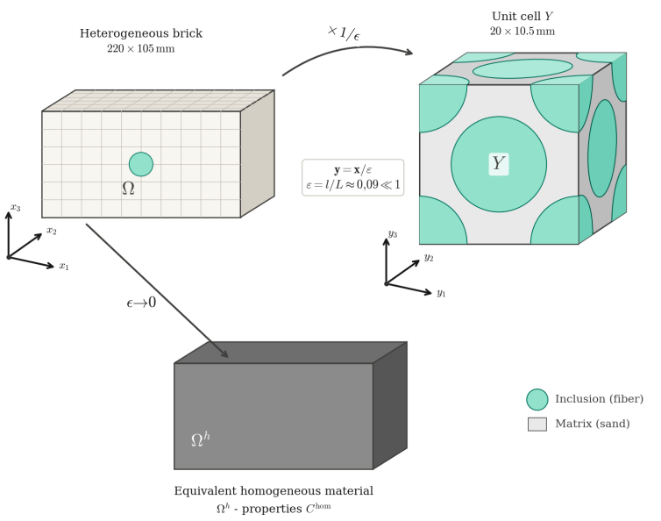
 (Figure 1), the displacement field
 converges (in the weak
 sense) towards a macroscopic field solution of an elasticity problem with a homogenised tensor
 32, 33.
This approach has been successfully applied to fibre composites 18, 21, porous materials 34, lattice structures 35, and more recently to materials combining cementitious binders with natural reinforcements 36. We assumed the kenaf fibre/clayey sand mixture to be sufficiently homogeneous to justify treating the composite brick as a homogeneous medium for the purposes of the present 2D study.

Two coordinate systems are defined in the plane, under the plane-stress assumption:
•  : macroscopic coordinates, associated with the global domain
 with characteristic dimensions
 ; they describe the position of a point within the equivalent homogeneous structure;
•  : microscopic coordinates, associated with the unit cell
 with characteristic dimensions
 ; they describe the position of a point within the periodic microstructure.
The elasticity tensor is Y-periodic:
 | (2) |
Assuming small deformations and static equilibrium, the linear elasticity problem reads 18:

with boundary conditions:
 | (6) |
where  and
 are the components of the Cauchy stress and strain tensors;
 and
 are the components of the body force and displacement fields;
 and
 are the prescribed displacements and surface tractions on boundaries
 and
 of
 , with
 and
 ;
 is the outward normal to
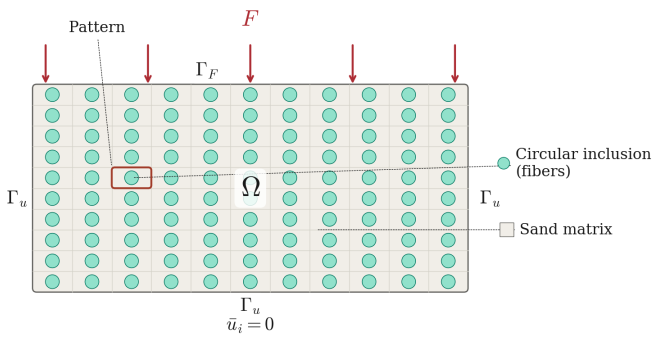
 (see Figure 2).

The periodicity of the microstructure introduces two coupled coordinate systems:  (macroscopic, brick scale
 ) and
 (microscopic, cell scale
 ), related by 18:
 | (7) |
The elasticity tensor  is Y-periodic in
 : its components do not depend on the macroscopic coordinates
 but oscillate rapidly at the microstructure scale
 18, 21.
The displacement solution field  is approximated by an asymptotic expansion in
 18:
 | (8) |
where the terms  ,
 , are Y-periodic functions called order-
 correctors. The strain and stress tensors admit similar expansions obtained by substituting (8)into relations (4)and (5) and using rule(7):
Substituting (10) into the equilibrium equation (3) and grouping by powers of  , a hierarchy of differential equations is obtained 18:
From the  -order equation (11) and the constitutive law, one deduces that
 is independent of
 , which implies 18:
 | (14) |
In other words,
•  is independent of the microscopic coordinates:
 ; it is the homogenised macroscopic displacement field;
•  is the first-order corrector; it represents the microscopic fluctuations superimposed on the macroscopic field.
 | (15) |
where  is the corrector field, components of the first-order displacement tensor, Y-periodic and zero-mean over
 .
We define the space of admissible periodic virtual displacements as:
 | (16) |
where  denotes the Sobolev space of displacement fields taking values in
 that are square-integrable, along with their first derivatives, over
 29, 32:
 | (17) |
The  -periodicity condition imposes:
 | (18) |
where  denotes the
 -th vector of the canonical basis of
 and
 is an integer representing the number of translation periods 29, 32. That is,
 takes identical values on opposite boundaries of
 . Substituting (15) into the
 order equation (12), the components
 are solutions of the variational problem 18:
In plane stress, three independent linear systems are solved: ; their solutions constitute the correctors
 ,
 and
 .Once the correctors
 are computed, the homogenised stiffness tensor
 is obtained by integration over the unit cell
 18:
 | (20) |
 contains complete information on the effective mechanical behaviour: it is constant over the entire macroscopic domain
 and depends only on the geometry of cell
 and local properties
 .The macroscopic displacement field
 is then solution of the homogenised elasticity problem 18:
 | (21) |
in which the original heterogeneous material has been substituted by a homogeneous equivalent material of stiffness  . The determination of the macroscopic displacement field corresponds to the solution
 of the variational problem
 | (22) |
where  is the set of continuous and sufficiently regular functions, zero-valued in
 .
The numerical resolution of (22) is thus independent of  : it does not see microstructural details, considerably reducing the number of degrees of freedom compared to the original problem (3) 18, 21.
For , higher-order correctors are negligible compared to the first-order term 18. The conventional approximation retains only:
 | (23) |
The solution  is obtained by numerical resolution of problem (22) over the macroscopic domain
 .
The numerical implementation of the PAH follows the formulation of 18, 21. The mesh consists of three-node triangular elements (T3), also known as P1 Lagrange elements. Each triangle  is defined by its three nodes
 ,
 ,
 and its six nodal degrees of freedom. For each triangular element T3 of the mesh, the deformation field is linked to the nodal displacements by the kinematic matrix
 , of partial derivatives of the interpolation functions:
 | (24) |
where  is the deformations vector of the element
 in Voigt notation
 ,
 the vector of nodal displacements, and
 the tensor of rigidity of the phase of the element
 (kenaf or clayey sand) in plane constraints 37, 38.
The discretisation of the problem of cell (19) leads to a global linear system:
 | (25) |
where  is the periodic global stiffness matrix,
 the number of free degrees of freedom after condensation,
 the vector of nodal correctors of the
 mode, and
 the unit loading vector associated with the mode
 21, 29. Periodic boundary conditions are imposed via slave/master condensation on pairs of matched nodes at opposite edges:
 |
Once the three systems (25) are solved, the tensor  is obtained by quadrature over the cell 18, 31:
 | (27) |
where  is the area of element
 ,
 is the total area of the cell, ..is the Kronecker delta, and
 is the
 -th component of the corrector in element
 18. The microstructural strain and stress fields (discrete localization) are reconstructed by 31:
 |
where  is the imposed macroscopic strain and
 is the
 identity matrix. These fields allow for the calculation of the local Von Mises stress
 at the kenaf/clayey sand interface, an indicator of the risk of micro-cracking 18, 22.
The three systems (25) ( ) are solved using a sparse direct solver applied to the sparse matrices generated during assembly; the sparse structure of
 (local connectivity of T3 elements) is exploited to minimise memory usage and computation time 18. The complete numerical code is implemented in Python 3 and relies on the Gmsh Python API 28 for generating conforming periodic meshes. This API provides full programmatic access to the meshing engine without requiring the graphical user interface: geometry, Boolean operations, and refinement fields are defined entirely through Python function calls.
In continuum mechanics, the elastic behaviour of a material is fully described by its stiffness tensor  37. For a heterogeneous composite, homogenisation yields the effective tensor
 , which replaces the heterogeneous material with an equivalent homogeneous medium 18, 29. This section establishes the relationship between
 and the classical engineering constants (
 ,
 ,
 ,
 ), which serve as the parameters directly used for structural design.
 under Plane Stress
Under plane stress, the homogenised stiffness tensor  is a
 matrix in Voigt notation
 37, 38. For a composite with two axes of symmetry, which is the case for the rectangular cell with a centred circular inclusion, anisotropic elasticity theory predicts the orthotropic form 18, 22:
 | (30) |
where:
•  and
 are the directional stiffness moduli along
 and
 ;
•  is the coupling term between tension and lateral contraction;
•  is the shear stiffness modulus in the
 -plane;
•  due to orthotropic symmetry.
These off-diagonal terms would couple the normal and shear modes; such coupling is precluded by the two-fold symmetry of the microstructure 37. The Maxwell–Betti symmetry relationship dictates 38:
 | (31) |
which reduces the number of independent moduli under plane stress conditions to four: ,
 ,
 , and
 (or
 , as one is derived from the other via (31)).
 to Engineering Modulus
The flexibility tensor  is obtained by analytical inversion from the block
 37, 38:
 | (32) |
The inversion of the  block of
 (30) leads to explicit relationships 18:
 |
where the determinant of the block  is:
 | (36) |
Physical significance.
•  : the transverse modulus is inversely proportional to
 ; in the concentrated regime,
 leads to
 , hence the explosive increase in
 at high volume fractions 18, 19.
•  : shear behaviour is governed entirely by the single component
 , without coupling to normal modes (a consequence of orthotropy) 37, 38.
•  : the Poisson’s ratio depends on the ratio
 ; the quasi-invariance of
 observed in this study implies that
 decreases primarily due to the increase in
 with
 18, 29, 38.
The four independent moduli do not contain the same information regarding the microstructure:
 governed by geometric confinement
 ; virtually insensitive to
 in the concentrated regime 19.
 practically proportional to
 ; the only modulus that allows for distinguishing between fibre choices 22, 27.
 exclusive signature of the matrix; independent of
 and
 : an original result of the present study, consistent with the theoretical prediction of Bensoussan et al. 29.
 decreases steadily with
 ; derived from
 and
 via (35) 38.
This information hierarchy justifies focusing the comparative study of fibres on ,
 , and
 . These are the three quantities that contain the most information regarding the effect of fibre choice and volume fraction.
This section implements the numerical experimentation on the representative volume element (RVE) to validate the theoretical formulation, using the Gmsh API for meshing and the finite element method (FEM) for resolution. Periodic boundary conditions are incorporated to solve the local problems and extract the localisation fields required for computing the homogenised properties.
4.1. Material PropertiesThe matrix consists of clayey sand classified as USCS SC 39, with a Young’s modulus  MPa and a Poisson’s ratio
 . This value corresponds to the midpoint of the
 range for loose clayey sands 40, 41, 42. The reinforcement is an equivalent bundle of kenaf fibres with a Young’s modulus
 and a Poisson’s ratio
 9, 10, 11. The stiffness contrast ratio
 justifies the PAH approach 18.
The modelled brick is a rectangle with dimensions , which are standard dimensions for compressed earth bricks used in Togo 12, 43. It is composed of
 identical patterns or unit cells with dimensions
 (Fig. 2). The pattern is the unit cell
 of the periodic medium; it is the smallest geometric unit that, through periodic repetition in both directions, reconstructs the complete brick. Each pattern contains a single circular inclusion which is the kenaf bundle with radius
 centered within a clayey sand matrix. This approach is defined by the following sequence: the radius of the elementary fibre
 10] is determined by the plant biology; the number of elementary fibres
 , the sole control parameter is defined and the equivalent bundle radius
 and the volume fraction
 are then derived from this.
 | (37) |
where  is the proportionality coefficient calculated analytically by:
 | (38) |
where  is the area of the pattern and
 is the cross-sectional area of the fibre.
When the equivalent beam radius approaches half the height of the pattern, either  , the inclusion spans the entire height of the pattern and comes into contact with the top and bottom edges. This configuration corresponds to the model’s geometric packing limit:
 | (39) |
Beyond this value, inclusions from adjacent patterns geometrically overlap: periodicity is no longer maintained, and the model loses its physical validity.
The Gmsh computational domain covers the entire brick  mm to ensure mesh conformity at the boundaries for periodic matching; however, the effective properties
 are those of the pattern
 , independent of the brick size 18, 29.
While the number of individual fibres  and consequently the volume fraction
 , govern the theoretical formulation of our approach, for the practitioner, the quantity that can be measured during mixing is the mass of fibres added to a given amount of clayey sand. It is therefore necessary to establish the correspondence between the two formulations in order to make the model results directly applicable on site. Thus, the relationship between the volume fraction
 and the mass fraction
 is established based on the densities of the two phases:
 | (40) |
and vice vers:
 | (41) |
where
 and
 are the mass of the kenaf and the mass of the clayey sand, respectively;
 g/cm³ 44 is the apparent density of bulk kenaf;
 g/cm³ 40, 41 is the bulk density of the compacted clayey sand.
By adopting  g/cm³ and
 g/cm³ (most frequently cited value for compacted clayey sand), the relationship between
 ,
 , and
 is given in Table 1 for the key fractions:
 | (42) |
The localisation procedure constitutes the inverse operation of homogenisation: knowing the macroscopic displacement field  and the correctors
 , it allows reconstructing the strain and stress fields inside the microstructure, cell
 scale at any point
 of
 18, 21.
In plane stress, the discrete approximations of microscopic fields for each element  of the mesh read:
 |
where  is the kinematic matrix of element T3,
 its elasticity tensor,
 the corrector value at the element nodes, and
 the homogenised macroscopic strain. Physically, the term
 represents the localisation tensor: it redistributes the macroscopic strain between the kenaf and clayey sand phases according to their respective stiffnesses.
To assess the risk of local plastification or micro-cracking, the Von Mises stress is computed from fields (44):
 |
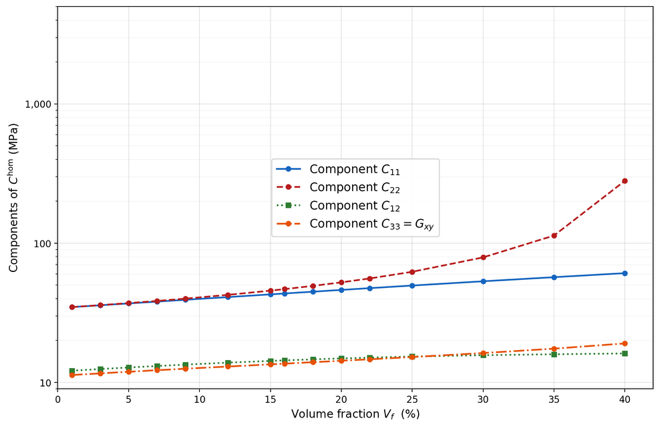
Figures 3 presents the four independent components of the homogenised stiffness tensor  under plane stress conditions for the 15 volume fractions. The off-diagonal coupling terms satisfy max
 MPa over the entire range, i.e less than
 times
 . These residual values represent the numerical noise of the sparse solver and confirm the orthotropic symmetry predicted by the two-axis symmetry geometry of the pattern 18, 22. The Voigt form(30) is thus numerically validated.

 Asymptotic homogenisation
The engineering moduli are derived from the homogenised stiffness tensor  by analytically inverting the
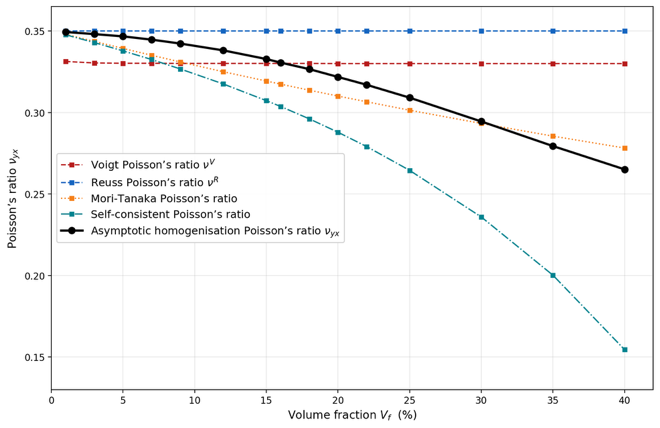
 block (33-36). Figures 3 and 4 (coefficient
 , components
 and
 ) illustrate the evolution of these moduli as a function of volume fraction. The results reveal two distinct regimes separated at
 , which is consistent with the transition observed in unidirectional composites between the dilute and concentrated inclusion behaviors 19, 45. The coefficient
 , calculated using the PAH and Eshelby-based techniques 45, is compared and found to decrease with
 (Figure 4). This is consistent with the results of Penta et al. 46.
The Maxwell–Betti reciprocity relation is verified numerically 38:
 | (46) |
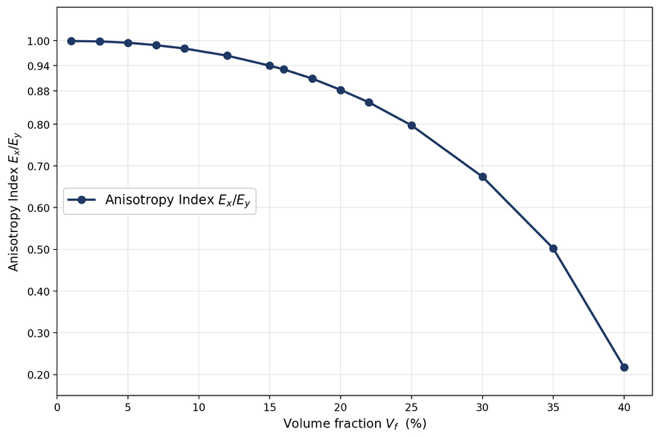
The ratio  constitutes an anisotropy index of the composite, which measures the difference in stiffness between the two principal directions and allows the two behavioural regimes to be defined. For volume fractions between
 and
 where
 , the regime is considered dilute; the brick exhibits quasi-isotropic behaviour and can be sized without regard to the installation direction. (see Figure5). Beyond
 where the
 ratio decreases from 0.93 at
 to 0.22 at
 , the regime is termed concentrated and the brick exhibits anisotropic behaviour; consequently, the laying direction becomes a design parameter in its own right 37, 38.


The reinforcement efficiency is quantified by the relative gain in the transverse Young’s modulus:
 | (47) |
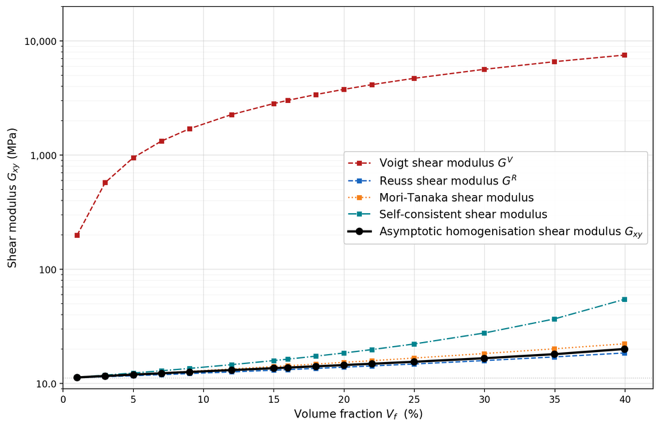
The shear modulus defined by relation (34) exhibits the lowest sensitivity to fibre content, with a ratio of only 1.78 between the  level where
 MPa and the
 level where
 MPa(see Figure 6). In the same figure, the shear modulus
 is compared with shear moduli determined by other methods based on the Eshelby model, in accordance with the work of Penta et al. 46.
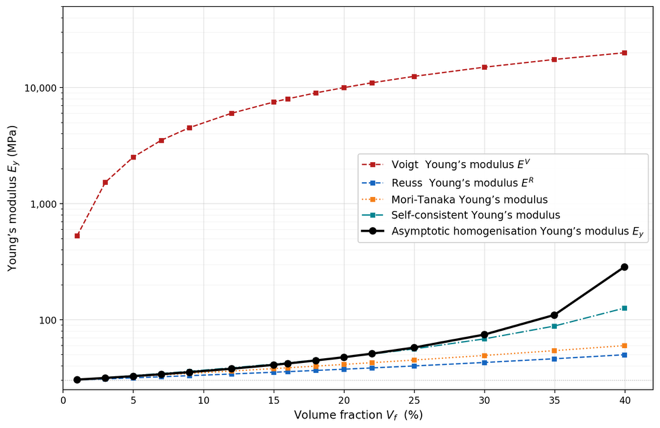
A necessary condition for any homogenisation result is the verification of the Voigt and Reuss bounds 29, 47:
 | (48) |
where, for a two-phase composite under plane stress:
 |
The Mori-Tanaka bulk 48, 49, 50 and shear moduli are expressed as follows:
 with

 where

then the transverse Young's modulus and Poisson's ratio by:


Figure 7 verifies inequality (48) for the 15 volume fractions. The proximity of  to the Reuss bound confirms a series-like behaviour; the compliant clayey sand matrix governs the overall response even at the highest volume fractions, consistent with the matrix-dominated regime identified byPinho-da-Cruz et al. 18 for composites with high stiffness contrast. The transverse Young’s modulus is compared with Young’s moduli calculated using other methods based on the Eshelby model, as done by Penta et al. 46.
The ratio  represents the composite’s anisotropy index; it equals 1 for an in-plane isotropic material and decreases towards 0 as
 dominates
 . Over the range studied:
 | (53) |
This decrease is not uniform. It is negligible in the dilute regime ( for
 ) and accelerates sharply in the concentrated regime, as shown in Figure 7. The transition at
 therefore also marks the threshold beyond which anisotropy becomes a design parameter that must be taken into account.
This anisotropy stems directly from the rectangular shape of the unit cell, with dimensions  such that
 . Indeed, for a given volume fraction, the radius of the equivalent beam
 is the same in both directions; however, the residual matrix layer between the inclusion and the unit cell boundary is thinner in the
 direction than in the
 direction:
 | (54) |
The  direction therefore saturates first. Consequently,
 increases faster than
 , resulting in
 at high volume fractions 18, 19.
By way of illustration, at  where
 :
 |
This extreme ratio explains the drop in  to
 at
 .

The pattern aspect ratio  is a key design parameter of this approach. A square pattern (
 ) would yield
 , hence
 and
 : the composite would be in-plane isotropic for all volume fractions 18.
Conversely, an  ratio greater than 1 generates controlled anisotropy. The higher this ratio, the earlier the anisotropy appears (at low
 ) and the more pronounced it is at high volume fractions. For the
 mm brick, the choice of
 results in an
 ratio of
 ; this ratio, rather than the fibre modulus, is the primary cause of the observed anisotropy.
The ratio  is the selection criterion for the practical zone.
• At :
 ; the behaviour is virtually isotropic, and the brick can be laid in any orientation;
• A :
 ; the anisotropy is moderate (
 for
 ) and still compatible with simplified design methods;
• Above :
 . The anisotropy requires explicit consideratin of the laying direction in structural calculations, which is incompatible with vernacular construction practices 37, 38 (local artisanal practices 12, 14).
This analysis confirms that the choice of pattern geometry ( ) is a more decisive factor regarding anisotropy than the choice of fibre.
The transverse Young’s modulus  increases quasi-linearly from
 MPa at
 to 40.8 MPa at
 (see figure 3, component
 ), representing gains of
 to
 compared to pure clayey sand (47). This linear increase is consistent with Eshelby’s theory of dilute inclusions 45, which predicts:
 | (57) |
where  is a concentration factor depending on the contrast
 and the shape of the inclusion.
For the dilute regime, characterised by volume fractions ranging from 1% to 15%, the gain achieved is mechanical in nature. The gain of +1.6% to +36% is attributable to the intrinsic stiffness of the kenaf bundles. This result is experimentally reproducible: Millogo et al. 12 measured comparable gains in compressive strength for compressed earth blocks (CEBs) from Burkina Faso, and Ouedraogo et al. 13 obtained analogous results with adobe bricks reinforced with fonio straw. This gain can be directly applied in civil engineering, using volume fractions achievable through manual mixing.  becomes the sole governing parameter for axial loads.
 reaches 275.6 MPa at
 (see Figure 3, component
 ), representing an increase of +818.8% compared to pure clayey sand. This non-linear amplification stems from geometric confinement: as
 approaches
 , the residual clayey sand layer between adjacent bundles narrows, significantly stiffening the
 -direction 18, 19. However, this gain is essentially geometric in origin and, beyond
 is physically unattainable via mixing, thus representing a theoretical limit of the model.
The shear modulus  is the modulus most sensitive to fibre content, showing a ratio of over
 between
 where
 MPa and
 where
 MPa (see Figure 6). At
 ,
 reaches
 MPa, representing an increase of more than twenty-fold compared to pure clayey sand, for which
 MPa. This high sensitivity is characteristic of composites with high stiffness contrast (
 ) and single circular inclusions 22, 27.
The increase in the shear modulus  is quasi-linear across the entire range of
 , unlike the transverse Young's modulus
 , which exhibits continuously accelerating growth, with a marked change in slope beyond
 . This behavior is explained by the fact that
 : the shear component of the tensor proves to be virtually insensitive to the intrinsic stiffness of the fibre and depends primarily on the shear modulus of the sandy matrix and the volume fraction of the reinforcement, rather than on the nature of the reinforcement itself. For bricks subjected to seismic loads or lateral forces such as wind and earth pressure, the shear modulus
 rather than the transverse Young's modulus
 is the decisive design parameter 40, 41. This finding highlights the value of plant-fiber reinforcement for structures located in seismic or wind-prone areas, provided a moderate to high dosage (
 ) is used: the gain in
 remains marginal below this threshold (
 at
 , compared to
 at
 and
 at
 ) 9, 13. Furthermore, the fact that
 is insensitive to the type of fiber allows for the selection of locally most abundant resources without compromising shear performance.
 : Original Result
The analysis of Figure 3 shows that the  component of the homogenised stiffness tensor increases from 34.70 MPa (at
 ) to 279.90 MPa (at
 ), a factor of approximately 8.07, whereas the
 component increases by a factor of more than 1.75. Both diagonal components thus increase steadily with the volume fraction
 , but in an asymmetric manner. This increasing asymmetry, observed at volume fractions above 25%, is a direct consequence of the rectangular shape of the unit cell. The dimension
 is smaller than
 , such that the inclusion saturates the
 -direction first, leading to greater stiffening of the
 component. A square unit cell (
 ) would yield
 and thus transversely isotropic behaviour for all volume fractions 18. Unlike the other components, the
 component remains nearly constant across the entire range of volume fractions. More precisely,
 increases slowly from
 MPa at
 to 16.13 MPa at
 , representing an increase of more than a factor of 1.3. The ratio
 drops sharply from 0.349 to 0.058, physically reflecting the fact that Poisson coupling becomes increasingly negligible relative to directional stiffness as the composite becomes more concentrated. This behaviour promotes the stability of the brick under load, as it limits the transverse deformations that cause longitudinal cracking 40. This novel result demonstrates that the tension/lateral contraction coupling is governed exclusively by the matrix, independently of the fibre volume fraction. It is consistent with the theoretical prediction that the off-diagonal terms of
 converge to the matrix values in the dilute limit 18, 29. The present study extends this result well beyond the dilute regime. This result has a direct implication for modelling. The
 component can be estimated using the clayey sand matrix alone (
 MPa) with an error of less than 30% regardless of the volume fraction, which considerably simplifies model calibration in the absence of experimental measurements.
Recommended practical range
Based on the numerical results, the range  offers the best compromise for civil engineering applications, a choice justified by:
• The mechanical gain of +13% to +58% in the transverse Young’s modulus  is consistent with experimental measurements by Millogo et al. 12 on kenaf/clayey sand compressed earth blocks (CEBs) from Burkina Faso, and with those for sisal-reinforced adobe 6. This gain is achievable with a dosage of 1% to 3% by mass (assuming
 ), a range compatible with manual mixing 13.
• The condition  ensures quasi-isotropic behaviour, which simplifies structural sizing and avoids directional strength characteristics that would complicate installation. Beyond 20%, the increasing anisotropy (
 ) would require the installation direction to be explicitly accounted for in structural calculations a requirement incompatible with vernacular construction practices.
• Below 20%, Von Mises stress concentrations at the kenaf/clayey sand interface remain moderate. The risk of premature delamination and micro-cracking is low 18, 22. Beyond this level,  concentrations at the inclusion poles increase sharply, a precursor to interfacial damage.
• A fibre content of 7% to 20% by volume corresponds to approximately 1% to 3% by mass a range confirmed to be compatible with manual mixing and good dispersion of the fibre bundles 4, 13. Ouedraogo et al. 4 achieved the best mechanical performance at 0.2%–0.4% by mass, either  3%–6% by volume, thereby validating the order of magnitude of the recommended range.
This work presented an original periodic asymptotic homogenisation (PAH) method applied to the clayey sand/kenaf composite, based on an area-conservation equivalence between  elementary fibres of radius
 and a single equivalent bundle of radius
 such that
 . This construction inspired by the periodic cell of Pinho-da-Cruz et al. 18 and motivated by the demonstrated equivalence between periodic and random microstructures 19, 20 constitutes the study’s central conceptual contribution. The relationship
 with
 makes it possible to set the volume fraction a priori based solely on the integer
 , without remeshing. Agreement between the geometric fraction and the fraction based on actual areas (T3) is verified to within
 across the 15 volume fractions. The Gmsh mesh of the entire
 mm brick, comprising 90,000 T3 triangular elements, ensures node-to-node matching at opposite edges and thus exact periodic boundary conditions 22. This choice eliminates the interpolation error systematically introduced by projection-based matching methods.
Despite a factor exceeding  in the
 component of the homogenised stiffness tensor, the
 component remains virtually constant across the entire range of volume fractions. This result demonstrates that the tension/lateral contraction coupling is an exclusive signature of the clayey sand matrix, independent of the fibre dosage and type 18, 29. In contrast, the shear modulus
 exhibits one of the least pronounced increases within the homogenised tensor, with a ratio of only 1.78 between
 (
 MPa) and
 (
 MPa) compared to a ratio of
 for
 over the same range. Thus, it is
 , rather than
 , that proves to be the most sensitive to fiber content. The transition at
 separates a quasi-isotropic dilute regime if
 from an anisotropic concentrated regime. The range
 offers the best compromise, with stiffness gains ranging from
 to
 in the transverse modulus
 .
The results are obtained within the framework of linear elasticity; ductility and toughness cannot be directly determined using the asymptotic homogenisation method. The mechanical properties of the matrix ( MPa,
 ) are reference values from the literature 40, 41 rather than values measured on the soil from the Ouatchi Plateau; a sensitivity analysis regarding
 MPa and a local measurement are recommended. All Voigt–Reuss bounds are satisfied across the 15 fractions 48, confirming the thermodynamic consistency of the calculations. Extending the work to other fibres, geometrically optimising the pattern, and experimentally validating the approach using bricks manufactured in Togo are the priorities for the next stage of this research. We propose resuming our 3D work at a later stage.
| [1] | 99 UNEP, 2021 Global Status Report for Buildings and Construction: Towards a Zero‐Emission, Efficient and Resilient Buildings and Construction Sector, United Nations Environment Programme, Nairobi, 2021. | ||
| In article | |||
| [2] | K. Saini, V.A. Matsagar, V.R. Kodur, Recent advances in the use of natural fibers in civil engineering structures, Constr. Build. Mater., vol. 411, 134364, 2024. | ||
| In article | View Article | ||
| [3] | P. Raja, V. Murugan, S. Ravichandran, L. Behera, R.A. Mensah, S. Mani, A. Kasi, K.B.N. Balasubramanian, G. Sas, H. Vahabi, O. Das, A review of sustainable bio-based insulation materials for energy-efficient buildings, Macromol. Mater. Eng., vol. 308(10), 2300086, 2023. | ||
| In article | View Article | ||
| [4] | G. Araya-Letelier, F.C. Antico, M. Carrasco, C. Burbano-Garcia, C. Váldez, G. Cáceres, Adobe blocks reinforced with natural fibers: A review, Constr. Build. Mater., vol. 273, 121786, 2021. | ||
| In article | |||
| [5] | E. Quagliarini, S. Lenci, The influence of natural stabilizers and natural fibers on the mechanical properties of ancient Roman adobe bricks, J. Cult. Heritage, vol. 11(3), pp. 309–314, 2010. | ||
| In article | View Article | ||
| [6] | T. Nigussie, M.K. Chandrasekar, M. Zewdie, Improvement of mechanical properties of adobe brick reinforced with sisal fiber, Discover Materials, vol. 5, 2025. | ||
| In article | View Article | ||
| [7] | G. Araya-Letelier, H. González-Calderón, S. Kunze, C. Burbano-Garcia, U. Reidel, C. Sandoval, F. Bas, Waste-based natural fiber reinforcement of adobe mixtures: Physical, mechanical, damage and durability performance assessment, J. Clean. Prod., vol. 273, 122806, 2020. | ||
| In article | View Article | ||
| [8] | N. Kumar, V. Mehta, S. Kumar, J.P. Singh, R. Kumar, S. Sharma, S.P. Dwivedi, D. Kozak, J. Lozanovic, M. Abbas, An investigation of various properties of hybrid bricks using natural fibres and waste fibre-based materials, J. Sandw. Struct. Mater., vol. 26(5–6), pp. 519–540, 2024. | ||
| In article | View Article | ||
| [9] | Y. Millogo, J.-E. Aubert, E. Hamard, J.-C. Morel, How properties of kenaf fibres from Burkina Faso contribute to the reinforcement of earth blocks, Materials (MDPI), vol. 8(5), pp. 2332–2345, 2015. | ||
| In article | View Article PubMed | ||
| [10] | R. Mahjoub, J.M. Yatim, A.R.M. Sam, S.H. Hashemi, Tensile properties of kenaf fibre due to various conditions of chemical fibre surface modifications, Constr. Build. Mater., vol. 55, pp. 103–113, 2014. | ||
| In article | View Article | ||
| [11] | G. Wang, B. Chen, H. Luo, R.A. Gustafson, Tensile properties of four types of individual cellulosic fibres, Wood fibre Sci., vol. 43(4), pp. 353–364, 2011. | ||
| In article | |||
| [12] | Y. Millogo, J.-C. Morel, J.-E. Aubert, K. Ghavami, Experimental analysis of pressed adobe blocks reinforced with Hibiscus cannabinus fibres, Constr. Build. Mater., vol. 52, pp. 71–78, 2014. | ||
| In article | View Article | ||
| [13] | M. Ouedraogo, K. Dao, Y. Millogo, J.-E. Aubert, A. Messan, M. Seynou, L. Zerbo, M. Gomina, Physical, thermal and mechanical properties of adobes stabilized with fonio (Digitaria exilis) straw, J. Build. Eng., vol. 23, pp. 250–258, 2019. | ||
| In article | View Article | ||
| [14] | A. Laborel-Préneron, J.-E. Aubert, C. Magniont, A. Bertron, C. Tribout, Plant aggregates and fibres in earth construction materials: a review, Constr. Build. Mater., vol. 111, pp. 719–734, 2016. | ||
| In article | View Article | ||
| [15] | G. C. Bailly, Y. El Mendili, A. Konin, E. Khoury, Advancing earth-based construction: a comprehensive review, Eng., vol. 5(2), pp. 750–783, 2024. | ||
| In article | View Article | ||
| [16] | A. Sánchez, H. Varum, T. Martins, J. Fernández, Mechanical properties of adobe masonry for the rehabilitation of buildings, Constr. Build. Mater., vol. 333, 127330, 2022. | ||
| In article | View Article | ||
| [17] | N. Fantuzzi, J. Trovalusci, R. Luciano, Multiscale analysis of anisotropic materials with hexagonal microstructure as micropolar continua, Int. J. Multiscale Comput. Eng., vol. 18(2), pp. 265–284, 2020. | ||
| In article | View Article | ||
| [18] | J. Pinho-da-Cruz, J.A. Oliveira, F. Teixeira-Dias, Asymptotic homogenisation in linear elasticity. Part I: Mathematical formulation and finite element modelling, Comput. Mater. Sci., vol. 45(4), pp. 1073–1080, 2009. | ||
| In article | View Article | ||
| [19] | L. Bouaoune, Y. Brunet, A. El Moumen, T. Kanit, H. Mazouz, Random versus periodic microstructures for elasticity of fibres reinforced composites, Compos. Part B: Eng., vol. 103, pp. 68–73, 2016. | ||
| In article | View Article | ||
| [20] | D. Trias, J. Costa, J.A. Mayugo, J.E. Hurtado, Random models versus periodic models for fibre reinforced composites, Comput. Mater. Sci., vol. 38(2), pp. 316–324, 2006. | ||
| In article | View Article | ||
| [21] | J.A. Oliveira, J. Pinho-da-Cruz, F. Teixeira-Dias, Asymptotic homogenisation in linear elasticity. Part II: Finite element procedures and multiscale applications, Comput. Mater. Sci., vol. 45(4), pp. 1081–1096, 2009. | ||
| In article | View Article | ||
| [22] | A. Drago, M.-J. Pindera, Micro-macromechanical analysis of heterogeneous materials: Macroscopically homogeneous vs periodic microstructures, Compos. Sci. Technol., vol. 67(6), pp. 1243–1263, 2007. | ||
| In article | View Article | ||
| [23] | N. Zhang, S. Gao, M. Song, Y. Chen, X. Zhao, J. Liang, J. Feng, A multiscale study of CFRP based on asymptotic homogenization with application to mechanical analysis of composite pressure vessels, Polymers, vol. 14(14), 2817, 2022. | ||
| In article | View Article PubMed | ||
| [24] | S. L. Omairey, P. D. Dunning, S. Sriramula, Development of an ABAQUS plugin tool for periodic RVE homogenisation, Eng. Comput., vol. 35(2), pp. 567–577, 2019. | ||
| In article | View Article | ||
| [25] | M. Katouzian, S. Vlase, C. Itu, M. L. Scutaru, Calculation of homogenized mechanical coefficients of fiber-reinforced composite using finite element method, Materials (MDPI), vol. 17(6), art. 1334, 2024. | ||
| In article | View Article PubMed | ||
| [26] | E. Bosco, R.H.J. Peerlings, M.G.D. Geers, Asymptotic homogenization of hygro-thermo-mechanical properties of fibrous networks, Int. J. Solids Struct., vol. 115, pp. 180–189, 2017. | ||
| In article | View Article | ||
| [27] | S. Yin, Z. He, M.-J. Pindera, A new hybrid homogenization theory for periodic composites with random fibre distributions, Compos. Struct., vol. 269, art. 113997, 2021. | ||
| In article | View Article | ||
| [28] | C. Geuzaine, J.-F. Remacle, Gmsh: A 3-D finite element mesh generator with built-in pre- and post-processing facilities, Int. J. Numer. Methods Eng., vol. 79(11), pp. 1309–1331, 2009. | ||
| In article | View Article | ||
| [29] | A. Bensoussan, J.-L. Lions, G. Papanicolaou, Asymptotic Analysis for Periodic Structures, North-Holland, Amsterdam, 1978. | ||
| In article | |||
| [30] | E. Sanchez-Palencia, Non-Homogeneous Media and Vibration Theory, vol. 127 of Lecture Notes in Physics, Springer-Verlag, Berlin, 1980. | ||
| In article | |||
| [31] | J.M. Guedes, N. Kikuchi, Preprocessing and postprocessing for materials based on the homogenization method with adaptive finite element methods, Comput. Methods Appl. Mech. Eng., vol. 83(2), pp. 143–198, 1990. | ||
| In article | View Article | ||
| [32] | G. Allaire, Homogenization and two-scale convergence, SIAM J. Math. Anal., vol. 23(6), pp. 1482–1518, 1992. | ||
| In article | View Article | ||
| [33] | D. Cioranescu, P. Donato, An Introduction to Homogenization, Oxford Lecture Series in Mathematics and Its Applications, vol. 17, Oxford University Press, Oxford, 1999. | ||
| In article | View Article | ||
| [34] | S.J. Hollister, N. Kikuchi, A comparison of homogenization and standard mechanics analyses for periodic porous composites, Comput. Mech., vol. 10(2), pp. 73–95, 1992. | ||
| In article | View Article | ||
| [35] | D. Caillerie, Homogénéisation des matériaux à structure périodique, École d’été, Méthodes asymptotiques en mécanique, Quiberon, septembre 2012, Grenoble INP – UJF – CNRS, Laboratoire 3SR, 2012. | ||
| In article | |||
| [36] | E. Bosco, R. Claessens, A. S. J. Suiker, Multi-scale prediction of chemo-mechanical properties of concrete materials through asymptotic homogenization, Cem. Concr. Res., vol. 128, art. 105929, 2020. | ||
| In article | View Article | ||
| [37] | S. G. Lekhnitskii, Theory of Elasticity of an Anisotropic Body, Mir Publishers, Moscou, 1981. | ||
| In article | |||
| [38] | R. M. Jones, Mechanics of Composite Materials, 2e éd., Taylor & Francis, Philadelphia, 1999. ISBN 978-1-56032-712-7. | ||
| In article | |||
| [39] | ASTM International, Standard Practice for Classification of Soils for Engineering Purposes (Unified Soil Classification System), ASTM D2487-17e1, West Conshohocken (PA), 2017. | ||
| In article | |||
| [40] | J.E. Bowles, Foundation Analysis and Design, 5e éd., McGraw-Hill, New York, 1996. ISBN: 978-0-07-912247-6. | ||
| In article | |||
| [41] | B.M. Das, Principles of Geotechnical Engineering, 7e éd., Cengage Learning, Stamford (CT), 2010. ISBN: 978-0-495-41130-7. | ||
| In article | |||
| [42] | A. Kezdi, Handbook of Soil Mechanics, vol. 1, Elsevier, Amsterdam, 1974. | ||
| In article | |||
| [43] | A. B. Laibi, P. Poullain, N. Leklou, M. Gomina, D. K. C. Sohounhloué, Influence of the kenaf fibre length on the mechanical and thermal properties of Compressed Earth Blocks (CEB), KSCE J. Civ. Eng., vol. 22(2), pp. 785–793, 2018. | ||
| In article | View Article | ||
| [44] | Z. Y. Lim, A. Putra, M. J. M. Nor, M. Y. Yaakob, Sound absorption performance of natural kenaf fibres, Appl. Acoust., vol. 130, pp. 107–114, 2018. | ||
| In article | View Article | ||
| [45] | J.D. Eshelby, The determination of the elastic field of an ellipsoidal inclusion, and related problems, Proc. R. Soc. A, vol. 241, pp. 376–396, 1957. | ||
| In article | View Article | ||
| [46] | R. Penta and A. Gerisch, Investigation of the potential of asymptotic homogenization for elastic composites via a three-dimensional computational study, Computing and Visualization in Science, vol. 17, no. 4, pp. 185–201, 2015. | ||
| In article | View Article | ||
| [47] | R. Hill, The elastic behaviour of a crystalline aggregate, Proc. Phys. Soc. A, vol. 65(5), pp. 349–354, 1952. | ||
| In article | View Article | ||
| [48] | T.Mori and K. Tanaka, Average stress in matrix and average elastic energy of materials with misfitting inclusions, Acta Metall., vol.21(5), pp.571-574, 1973. | ||
| In article | View Article | ||
| [49] | Y. Benveniste, A new approach to the application of Mori–Tanaka’s theory in composite materials, Mech. Mater., vol. 6(2), pp. 147–157, 1987. | ||
| In article | View Article | ||
| [50] | G. J. Weng, The theoretical connection between Mori–Tanaka’s theory and the Hashin–Shtrikman–Walpole bounds, Int. J. Eng. Sci., vol. 28(11), pp. 1111–1120, 1990. | ||
| In article | View Article | ||
Published with license by Science and Education Publishing, Copyright © 2026 Komi Mawulom Zabouh, Kossi Atchonouglo, Edo-Owodou Ayeleh and Yao Koumekpo
 This work is licensed under a Creative Commons Attribution 4.0 International License. To view a copy of this license, visit
http://creativecommons.org/licenses/by/4.0/
| [1] | 99 UNEP, 2021 Global Status Report for Buildings and Construction: Towards a Zero‐Emission, Efficient and Resilient Buildings and Construction Sector, United Nations Environment Programme, Nairobi, 2021. | ||
| In article | |||
| [2] | K. Saini, V.A. Matsagar, V.R. Kodur, Recent advances in the use of natural fibers in civil engineering structures, Constr. Build. Mater., vol. 411, 134364, 2024. | ||
| In article | View Article | ||
| [3] | P. Raja, V. Murugan, S. Ravichandran, L. Behera, R.A. Mensah, S. Mani, A. Kasi, K.B.N. Balasubramanian, G. Sas, H. Vahabi, O. Das, A review of sustainable bio-based insulation materials for energy-efficient buildings, Macromol. Mater. Eng., vol. 308(10), 2300086, 2023. | ||
| In article | View Article | ||
| [4] | G. Araya-Letelier, F.C. Antico, M. Carrasco, C. Burbano-Garcia, C. Váldez, G. Cáceres, Adobe blocks reinforced with natural fibers: A review, Constr. Build. Mater., vol. 273, 121786, 2021. | ||
| In article | |||
| [5] | E. Quagliarini, S. Lenci, The influence of natural stabilizers and natural fibers on the mechanical properties of ancient Roman adobe bricks, J. Cult. Heritage, vol. 11(3), pp. 309–314, 2010. | ||
| In article | View Article | ||
| [6] | T. Nigussie, M.K. Chandrasekar, M. Zewdie, Improvement of mechanical properties of adobe brick reinforced with sisal fiber, Discover Materials, vol. 5, 2025. | ||
| In article | View Article | ||
| [7] | G. Araya-Letelier, H. González-Calderón, S. Kunze, C. Burbano-Garcia, U. Reidel, C. Sandoval, F. Bas, Waste-based natural fiber reinforcement of adobe mixtures: Physical, mechanical, damage and durability performance assessment, J. Clean. Prod., vol. 273, 122806, 2020. | ||
| In article | View Article | ||
| [8] | N. Kumar, V. Mehta, S. Kumar, J.P. Singh, R. Kumar, S. Sharma, S.P. Dwivedi, D. Kozak, J. Lozanovic, M. Abbas, An investigation of various properties of hybrid bricks using natural fibres and waste fibre-based materials, J. Sandw. Struct. Mater., vol. 26(5–6), pp. 519–540, 2024. | ||
| In article | View Article | ||
| [9] | Y. Millogo, J.-E. Aubert, E. Hamard, J.-C. Morel, How properties of kenaf fibres from Burkina Faso contribute to the reinforcement of earth blocks, Materials (MDPI), vol. 8(5), pp. 2332–2345, 2015. | ||
| In article | View Article PubMed | ||
| [10] | R. Mahjoub, J.M. Yatim, A.R.M. Sam, S.H. Hashemi, Tensile properties of kenaf fibre due to various conditions of chemical fibre surface modifications, Constr. Build. Mater., vol. 55, pp. 103–113, 2014. | ||
| In article | View Article | ||
| [11] | G. Wang, B. Chen, H. Luo, R.A. Gustafson, Tensile properties of four types of individual cellulosic fibres, Wood fibre Sci., vol. 43(4), pp. 353–364, 2011. | ||
| In article | |||
| [12] | Y. Millogo, J.-C. Morel, J.-E. Aubert, K. Ghavami, Experimental analysis of pressed adobe blocks reinforced with Hibiscus cannabinus fibres, Constr. Build. Mater., vol. 52, pp. 71–78, 2014. | ||
| In article | View Article | ||
| [13] | M. Ouedraogo, K. Dao, Y. Millogo, J.-E. Aubert, A. Messan, M. Seynou, L. Zerbo, M. Gomina, Physical, thermal and mechanical properties of adobes stabilized with fonio (Digitaria exilis) straw, J. Build. Eng., vol. 23, pp. 250–258, 2019. | ||
| In article | View Article | ||
| [14] | A. Laborel-Préneron, J.-E. Aubert, C. Magniont, A. Bertron, C. Tribout, Plant aggregates and fibres in earth construction materials: a review, Constr. Build. Mater., vol. 111, pp. 719–734, 2016. | ||
| In article | View Article | ||
| [15] | G. C. Bailly, Y. El Mendili, A. Konin, E. Khoury, Advancing earth-based construction: a comprehensive review, Eng., vol. 5(2), pp. 750–783, 2024. | ||
| In article | View Article | ||
| [16] | A. Sánchez, H. Varum, T. Martins, J. Fernández, Mechanical properties of adobe masonry for the rehabilitation of buildings, Constr. Build. Mater., vol. 333, 127330, 2022. | ||
| In article | View Article | ||
| [17] | N. Fantuzzi, J. Trovalusci, R. Luciano, Multiscale analysis of anisotropic materials with hexagonal microstructure as micropolar continua, Int. J. Multiscale Comput. Eng., vol. 18(2), pp. 265–284, 2020. | ||
| In article | View Article | ||
| [18] | J. Pinho-da-Cruz, J.A. Oliveira, F. Teixeira-Dias, Asymptotic homogenisation in linear elasticity. Part I: Mathematical formulation and finite element modelling, Comput. Mater. Sci., vol. 45(4), pp. 1073–1080, 2009. | ||
| In article | View Article | ||
| [19] | L. Bouaoune, Y. Brunet, A. El Moumen, T. Kanit, H. Mazouz, Random versus periodic microstructures for elasticity of fibres reinforced composites, Compos. Part B: Eng., vol. 103, pp. 68–73, 2016. | ||
| In article | View Article | ||
| [20] | D. Trias, J. Costa, J.A. Mayugo, J.E. Hurtado, Random models versus periodic models for fibre reinforced composites, Comput. Mater. Sci., vol. 38(2), pp. 316–324, 2006. | ||
| In article | View Article | ||
| [21] | J.A. Oliveira, J. Pinho-da-Cruz, F. Teixeira-Dias, Asymptotic homogenisation in linear elasticity. Part II: Finite element procedures and multiscale applications, Comput. Mater. Sci., vol. 45(4), pp. 1081–1096, 2009. | ||
| In article | View Article | ||
| [22] | A. Drago, M.-J. Pindera, Micro-macromechanical analysis of heterogeneous materials: Macroscopically homogeneous vs periodic microstructures, Compos. Sci. Technol., vol. 67(6), pp. 1243–1263, 2007. | ||
| In article | View Article | ||
| [23] | N. Zhang, S. Gao, M. Song, Y. Chen, X. Zhao, J. Liang, J. Feng, A multiscale study of CFRP based on asymptotic homogenization with application to mechanical analysis of composite pressure vessels, Polymers, vol. 14(14), 2817, 2022. | ||
| In article | View Article PubMed | ||
| [24] | S. L. Omairey, P. D. Dunning, S. Sriramula, Development of an ABAQUS plugin tool for periodic RVE homogenisation, Eng. Comput., vol. 35(2), pp. 567–577, 2019. | ||
| In article | View Article | ||
| [25] | M. Katouzian, S. Vlase, C. Itu, M. L. Scutaru, Calculation of homogenized mechanical coefficients of fiber-reinforced composite using finite element method, Materials (MDPI), vol. 17(6), art. 1334, 2024. | ||
| In article | View Article PubMed | ||
| [26] | E. Bosco, R.H.J. Peerlings, M.G.D. Geers, Asymptotic homogenization of hygro-thermo-mechanical properties of fibrous networks, Int. J. Solids Struct., vol. 115, pp. 180–189, 2017. | ||
| In article | View Article | ||
| [27] | S. Yin, Z. He, M.-J. Pindera, A new hybrid homogenization theory for periodic composites with random fibre distributions, Compos. Struct., vol. 269, art. 113997, 2021. | ||
| In article | View Article | ||
| [28] | C. Geuzaine, J.-F. Remacle, Gmsh: A 3-D finite element mesh generator with built-in pre- and post-processing facilities, Int. J. Numer. Methods Eng., vol. 79(11), pp. 1309–1331, 2009. | ||
| In article | View Article | ||
| [29] | A. Bensoussan, J.-L. Lions, G. Papanicolaou, Asymptotic Analysis for Periodic Structures, North-Holland, Amsterdam, 1978. | ||
| In article | |||
| [30] | E. Sanchez-Palencia, Non-Homogeneous Media and Vibration Theory, vol. 127 of Lecture Notes in Physics, Springer-Verlag, Berlin, 1980. | ||
| In article | |||
| [31] | J.M. Guedes, N. Kikuchi, Preprocessing and postprocessing for materials based on the homogenization method with adaptive finite element methods, Comput. Methods Appl. Mech. Eng., vol. 83(2), pp. 143–198, 1990. | ||
| In article | View Article | ||
| [32] | G. Allaire, Homogenization and two-scale convergence, SIAM J. Math. Anal., vol. 23(6), pp. 1482–1518, 1992. | ||
| In article | View Article | ||
| [33] | D. Cioranescu, P. Donato, An Introduction to Homogenization, Oxford Lecture Series in Mathematics and Its Applications, vol. 17, Oxford University Press, Oxford, 1999. | ||
| In article | View Article | ||
| [34] | S.J. Hollister, N. Kikuchi, A comparison of homogenization and standard mechanics analyses for periodic porous composites, Comput. Mech., vol. 10(2), pp. 73–95, 1992. | ||
| In article | View Article | ||
| [35] | D. Caillerie, Homogénéisation des matériaux à structure périodique, École d’été, Méthodes asymptotiques en mécanique, Quiberon, septembre 2012, Grenoble INP – UJF – CNRS, Laboratoire 3SR, 2012. | ||
| In article | |||
| [36] | E. Bosco, R. Claessens, A. S. J. Suiker, Multi-scale prediction of chemo-mechanical properties of concrete materials through asymptotic homogenization, Cem. Concr. Res., vol. 128, art. 105929, 2020. | ||
| In article | View Article | ||
| [37] | S. G. Lekhnitskii, Theory of Elasticity of an Anisotropic Body, Mir Publishers, Moscou, 1981. | ||
| In article | |||
| [38] | R. M. Jones, Mechanics of Composite Materials, 2e éd., Taylor & Francis, Philadelphia, 1999. ISBN 978-1-56032-712-7. | ||
| In article | |||
| [39] | ASTM International, Standard Practice for Classification of Soils for Engineering Purposes (Unified Soil Classification System), ASTM D2487-17e1, West Conshohocken (PA), 2017. | ||
| In article | |||
| [40] | J.E. Bowles, Foundation Analysis and Design, 5e éd., McGraw-Hill, New York, 1996. ISBN: 978-0-07-912247-6. | ||
| In article | |||
| [41] | B.M. Das, Principles of Geotechnical Engineering, 7e éd., Cengage Learning, Stamford (CT), 2010. ISBN: 978-0-495-41130-7. | ||
| In article | |||
| [42] | A. Kezdi, Handbook of Soil Mechanics, vol. 1, Elsevier, Amsterdam, 1974. | ||
| In article | |||
| [43] | A. B. Laibi, P. Poullain, N. Leklou, M. Gomina, D. K. C. Sohounhloué, Influence of the kenaf fibre length on the mechanical and thermal properties of Compressed Earth Blocks (CEB), KSCE J. Civ. Eng., vol. 22(2), pp. 785–793, 2018. | ||
| In article | View Article | ||
| [44] | Z. Y. Lim, A. Putra, M. J. M. Nor, M. Y. Yaakob, Sound absorption performance of natural kenaf fibres, Appl. Acoust., vol. 130, pp. 107–114, 2018. | ||
| In article | View Article | ||
| [45] | J.D. Eshelby, The determination of the elastic field of an ellipsoidal inclusion, and related problems, Proc. R. Soc. A, vol. 241, pp. 376–396, 1957. | ||
| In article | View Article | ||
| [46] | R. Penta and A. Gerisch, Investigation of the potential of asymptotic homogenization for elastic composites via a three-dimensional computational study, Computing and Visualization in Science, vol. 17, no. 4, pp. 185–201, 2015. | ||
| In article | View Article | ||
| [47] | R. Hill, The elastic behaviour of a crystalline aggregate, Proc. Phys. Soc. A, vol. 65(5), pp. 349–354, 1952. | ||
| In article | View Article | ||
| [48] | T.Mori and K. Tanaka, Average stress in matrix and average elastic energy of materials with misfitting inclusions, Acta Metall., vol.21(5), pp.571-574, 1973. | ||
| In article | View Article | ||
| [49] | Y. Benveniste, A new approach to the application of Mori–Tanaka’s theory in composite materials, Mech. Mater., vol. 6(2), pp. 147–157, 1987. | ||
| In article | View Article | ||
| [50] | G. J. Weng, The theoretical connection between Mori–Tanaka’s theory and the Hashin–Shtrikman–Walpole bounds, Int. J. Eng. Sci., vol. 28(11), pp. 1111–1120, 1990. | ||
| In article | View Article | ||