This work provides an overview of single and multilayer dielectric stacks and their applications, with focus on the fundamental physics of interference. This understanding is crucial for designing materials that can precisely manipulate reflected electromagnetic energy, either by maximizing or minimizing its value. Computational codes for studying single and multilayer dielectrics have been developed and validated by accurately reproducing results from the literature. These codes are user-friendly and can be used to explore new configurations for these devices.
Multilayer dielectric films have multiple practical applications, from antireflecting coatings for lens in photography and solar cells, to devices presenting a high reflectivity, working as mirrors in laser cavities. To lay the groundwork for a complete analysis of these multilayer systems, it is essential to first understand the behavior of their most basic component
This work investigates first the reflectance for the simple case of a single layer film, using a multiple-wave sum approach. The fundamental process of wave interference for this case is carefully analyzed, in such way an intuitive comprehension and quantitative results are attained. A simple computational code using free software is presented, which reproduces well-known results. Then, for more complicated structures such as the double, triple, and multilayer dielectric films, it is used the matrix formalism approach. Another code that computes reflectance for dielectric structures with an arbitrary number of layers and lengths is developed. This tool was tested using well known results from the literature.
The principal goals of this work are to review this topic and to offer new, free computational tools that allow users to test known results and also study new configurations for these structures.
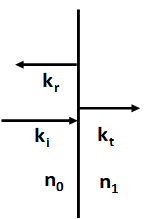
The following is a well-known result that will be extensively used in this work; when electromagnetic radiation propagating through an optical medium characterized by an index of refraction n0, arrives to an interface with another optical medium with index value n1, the incident energy is partially reflected and transmitted (or refracted), see Figure 1.

The study is restricted to the simple case of normal incidence, a configuration with significant practical applications. The vectors k in figure 1 represent the wave vectors that indicate the direction of propagation of the respective fields. The modulus is k=2π ∕ λ , where λ is the wavelength of the radiation in the corresponding medium. The electric and magnetic field vectors lie in a plane whose normal is parallel to the direction of propagation.
The incident light is characterized by the complex amplitude of the electric field, Ei. Assuming that the incident radiation is propagating from the left to the right, through the medium n0, the relations between the amplitudes of the reflected, Er, transmitted, Et, and incident fields are given by the well-known reflection and transmission coefficients that, for the case of normal incidence take the form 1:
Observe in Equations (1) and (2) the use of two subindexes in the notation of the coefficients, indicating the interface, where the first of them specifies the medium by which the incident light is propagating. Since we are considering normal incidence, the value of the coefficients hold for both possible cases of polarization, transversal electric (TE) and transversal magnetic (TM), 1.
 | (1) |
 | (2) |
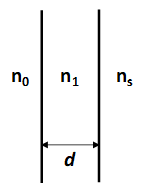
The Equations (1) and (2) are valid for the case of two semi-infinite media. When a second interface is present, for example, the case of a single layer with length d, multiple reflection arises. In figure (2) a schematic is shown. The symbol ns indicates the index of refraction of the substrate.

The incident field arriving on the interface n0-n1 will be reflected and transmitted. But in this case the transmitted light suffers partial reflection at the interface n1-ns, returning to the interface n1-n0, where is partially transmitted and reflected. The transmitted part must be added to the reflected field, along with the additional contributions arising from further multiple (infinite) reflection and transmission processes at both interfaces. We can write the first few terms of the total reflected field at the interface n0-n1 as follows:
 | (3) |
Where the first term represents the amplitude of electric field reflected at the interface as obtained from Equation (1). The second term is the contribution of the transmitted field at the first interface, which travels a distance d, is reflected at the interface n1-ns and returns all the way back to be finally transmitted at the first interface. The coefficients r1s, r01, and t10 can be obtained from Eqs. (1) and (2) with the appropriate values of the indices of refraction. Note the factor , to take account of the phase change of the field due the go-back travel in the layer. It is important to remember here that d must be smaller than the coherence length of the light. The following terms can be obtained by a similar reasoning. We can rearrange Eq. (3) as:
 (4)
(4)
The sum in the brackets can be written as a geometric series, provided that the common ratio  is less than one, which is true in this case, and Eq. (4) takes the form:
 | (5) |
The factor in parentheses in Eq. (5) can be understood as an effective reflexion coefficient at the interface n0-n1, symbolized as r.
The material and length of the layer can be manipulated so as to either reinforce or diminish the reflection for a particular wavelength. For example, if we intend to design an antireflection coating for a camera lens or solar cell, the mathematical condition should be:
 | (6) |
Now, we explore Eq. (6) to find the physical conditions to be satisfied by the layer. After some basic algebra, we can write Eq. (6) as:
 | (7) |
Writing explicitly the reflections and transmission coefficients and after some more algebra we obtain:
 | (8) |
We consider now that the values of n0 and ns are given, and our task is to find the appropriate values of n1 and d. Since the second term of Eq. (8) is real, so should be the first. There are then two possibilities for the exponential term, to be plus or minus one.
For most of the practical cases, the idea is to eliminate reflection from a substrate of glass with ns ~ 1.52 for light incident from air, n0 ~1. The practical approach is to consider a value of index of refraction of the layer, or coating, n1 of some intermediate value. Thus, it is considered; n0<n1 <ns. Hence, to make both sides of Eq. (8) compatible, the exponential term should satisfy:
 | (9) |
From Eq. (9) the condition for the length of the anti-reflecting coating is:
 | (10) |
With m being zero or an integer positive number. We see that d is an odd multiple of λ ∕4.
From condition imposed by Eq. (9), we can rewrite Eq. (8) as:
 | (11) |
Solving for n1 we obtain:
 | (12) |
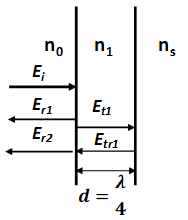
The result obtained can be physically interpreted through a visualization of the interference process, see fig. 3, where Ei represents the amplitude of the incident electric field.

Part of the energy carried by Ei is reflected at the first interface (n0-n1), producing a wave whose amplitude is Er1 and a phase change respect to Ei of π radians, as n0 <n1. The partially transmited wave travels back and forth (Et1 and Etr1) trough the layer, and is transmited at the first interface, producing a wave with amplitude Er2, with a phase change of π radians at the interface n1 – ns (n1 <ns) plus another π radians due to the λ/2 total path length of the layer. In this way, the phase diference between Er1 and Er2 is an odd multiple of π, which results in destructive interference between these waves. Further reflections follow the same path and the reflected wave is cancelled out at the specifc wavelength λ set in Eq. (10).
For example, to design a antireflecting coating for glass with a value of ns ~ 1.52, and considering n0 =1 (air), n1 should be, according to Eq.(12), of ~ 1.22. Unfortunatelly, most transparent dielectric materials found in nature have refractive indices greater than 1.3. We can choose as layer the magnesium fluoride, MgF2, with n1 =1.38, a 13% greater than the ideal value given by Eq. (12).
To analyze these results, a code was written using free software Scilab 2 where the expression r is computed as a function of λ (see appendix I). Then the reflectance, R, defined as the quotient between the reflected to the incident electromagnetic energy, can be computed as:
 | (13) |
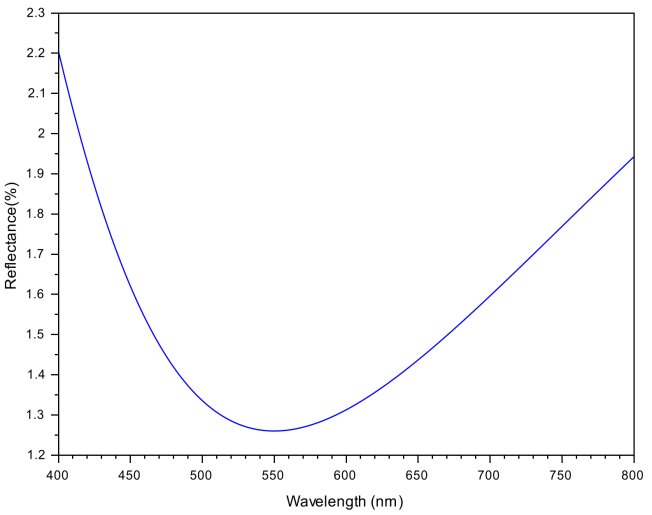
The graphic in Figure 4 shows R (in percent units) as a function of the wavelength for a single layer of MgF2. The length of the layer, d is λ/4. As for the center wavelength, it was chosen to be the center of the visible spectrum which in vacuum has the approximate value λ0= 550 nm.
We see from the figure that the minimum value of the reflectance is approximately 1.25 %, which is observed at a wavelength of 550 nm, as expected. The maximum value observed of R is 2.20% at the low extreme of the spectrum. Without coating the value of R at the interface air-glass is 4%.
On the other side, to achieve a high degree of reflectance, the condition r = 1 should be investigated. A meticulous mathematical analysis, however, reveals this condition to be physically unattainable, as it requires a null value of the refraction index ns. A valid strategy in this case is to add a quarter-wavelength layer with n1 >ns, (and of course, n1 >n0) so that the overall phase shift between successive reflected waves is 2π radianes, which provides constructive interference. The code can be run with values n1 = 1.69 (which is a typical value for a coating of aluminum oxide) and ns = 1.52. The reflectance at λ0= 550 nm is ~ 9.3%, nearly double that of the uncoated material.

Reflectance and the spectral profile can be tailored to improve the results obtained with a single layer by designing multilayer dielectric stacks with different values of the refractive indices. The methodology for this will be discussed in the following section.
A multi-layer dielectric structure can be employed to, for example, achieve a larger region of reduced reflectance compared to the results presented in Fig. 4. Also, it can be designed to achieve high reflectance values, up to 99%, over broad range of visible electromagnetic spectrum. Double, triple and N-layer structures are used. Since the mathematical treatment for N-layer dielectrics using multiple reflections is very involved, it is used the matrix formalism 1. The relation between the amplitudes of the electric and magnetic fields at both sides of a N-layer dielectric is mathematically described by:
 | (14) |
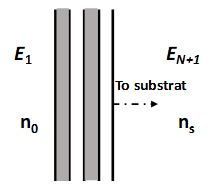
Where EN+1/E1, HN+1/H1, are the amplitudes of the total electric and magnetic fields at the output/input of the multilayer dielectric structure, respectively, see Figure 5.

The 2x2 matrixes, M, relate the fields at each side of the layers, and for normal incidence have the general mathematical structure:
 | (15) |
Where n and d represent the index of refraction and length of the layer, respectively, and Y is the admittance, calculated as:
 | (16) |
Where ε0 and µ0 are the permittivity and permeability of free space, respectively.
The electric fields in equation (14) are explicitly written as:
 | (17) |
 | (18) |
Where the index i, r and t stand for incident, reflected and transmitted, respectively. The reflection and transmission coefficients for the multilayer structure are calculated as:
 | (19) |
 | (20) |
It was written a code using scilab that calculates the reflection and transmission coefficients and the reflectance and transmittance for this structures based on Eqs.(14)-(20) (see appendix II). The code has enough versatility to calculate the coefficients for an arbitrary number of layers with an arbitrary length for each layer.
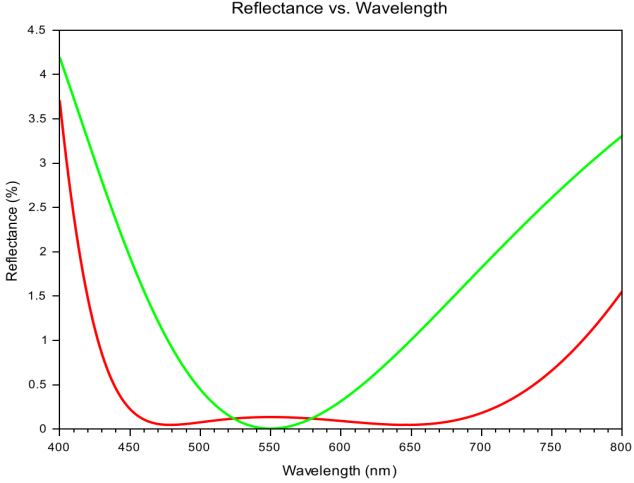
4.1. The Two and Three LayerIn order to obtain anti-reflexion coatings with better performances than observed in the single layer, two and three-layer dielectric structure were developed. In particular, the anti-reflecting coatings with two and three layers showed in 3 were tested with our code. The specification for the two-layer AR reflexion coating is: Air/λ∕4-MgF2 (n1=1.38) / λ∕4-Al2O3 (n2=1.69) / glass(ns=1.52), meaning that first layer is a quarter-wavelength magnesium fluoride with index n1 and the second layer is composed by quarter-wavelength aluminium oxide with index n2, then, it was considered a substrate of glass with index ns. For the three-layer AR reflexion coating; Air/λ∕4-MgF2(n1=1.38)/λ∕2-ZrO2 (n2=2.05) / λ∕4-CeF3 (n3=1.64) / glass (ns=1.52), i.e., a first layer identical to the former case, then a medium-wavelength Zirconium dioxide layer, followed by a quarter-wavelength Cerium fluoride layer. In Figure 6 it is shown the reflectance obtained through our code for the double and triple structure.

The results are in very good agreement with the results presented in 3.
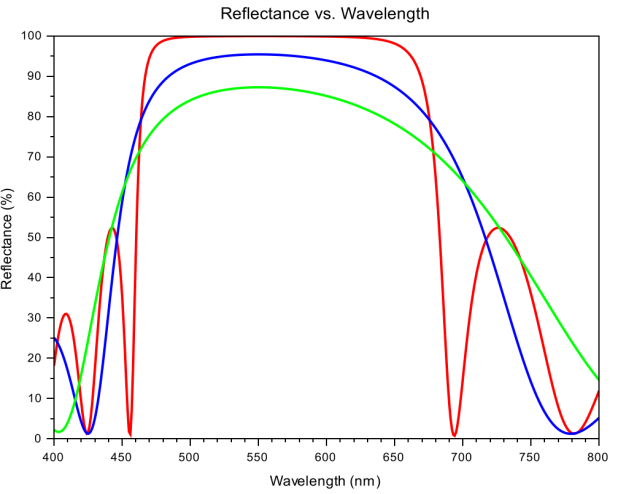
4.2. The N LayerFor certain applications, as cavity resonators for lasers, high values of reflectance are needed. It is used a stack of alternate layers of high index, nH, and low index nL. All the layers being of quarter-wavelength thickness. In fig.(7) the results of the code for reflectance of multilayer dielectric stacks as presented in 4, with five, seven and fifteen layers with nH= 2.3 and nL = 1.35 are shown. The results are in very good agreement with those presented in the aforementioned reference. Similar structures and results are presented in 1 and 5.

It can be seen from the figure that reflectance becomes higher and smoother across the spectra as the number of stacks increases.
In this work, single and multilayer dielectric stacks have been studied. Application for both high and low reflecting materials over a broadband spectrum have been demonstrated. A computer code to study these properties has been developed. The results obtained by this code show a very good agreement with those found in the literature.
clear;
clc;
lambda=400:1:800;// Wavelengths in nm
n=[1,1.38,1.52];// refraction index of air, layer and substrate, respectively
d=550/(1.38*4);//thick layer in nm
// Calculate reflection and transmission coefficients
fori=1:length(n)-1
r(i)=(n(i)-n(i+1))/(n(i)+n(i+1));// Reflectioncoefficients
end
fori=1:length(n)-2
tlr(i)=2*n(i)/(n(i)+n(i+1));// Transmission coefficients (left to right)
trl(i)=2*n(i+1)/(n(i)+n(i+1));// Transmission coefficients (right to left)
end
// Pre-allocate the output array
re=zeros(1,length(lambda));
// Loop through lambda values and calculate re
fori=1:length(lambda)
re(i)=r(1)+(1/(1+r(1)*r(2)*exp(%i*2*2*%pi*d*n(2)/ lambda(i))))*tlr(1)*r(2)*trl(1)*exp(%i*2*2*%pi*d*n(2)/(lambda(i)));
end
//Calculate the product of re and its complex conjugate (magnitude squared)
re_conj_prod=re.*conj(re);
// Plot the result
plot(lambda,100*re_conj_prod);
xlabel("Wavelength (nm)");
ylabel("Reflectance(%)");
clear;
clc;
// Define the properties of the multilayer structure
d_layers=[550/4,550/2,550/4];// thickness of each layer in nm (as a vector), considering vacuum wavelength. For real thickness, divide by the corresponding refraction index
n_layers=[1.38,2.05,1.64];// refraction index of the layers (excluding incident and substrate)
n_incident=1;// refraction index of the incident medium (air)
n_substrate=1.52;// refraction index of the substrate
n=[n_incident,n_layers,n_substrate];// Combine all refraction indices
num_layers=length(d_layers);// Number of layers
lambda=400:1:800;// Wavelengths in nm
Yo=377*n_incident;// Admittance of the first medium (air)
Ys=377*n_substrate;// Admittance of the substrate
// Initialize lists to store M matrices for each layer and each lambda
M_values_list=list();
r_values=[];// Initialize a vector to store reflection coefficients
t_values=[];// Initialize a vector to store transmission coefficients
// Loop through lambda values
fori=1:length(lambda)
current_lambda=lambda(i);// Get the current lambda value
// Initialize the total transfer matrix M as the identity matrix
M_total=eye(2,2);
// Generate and multiply the characteristic matrix for each layer
fork=1:num_layers
arg=2*%pi*d_layers(k)/current_lambda;
nk=n_layers(k);// refraction index of the current layer
Yk=nk*377;// Admittance of the current layer
Mk=[cos(arg),%i*sin(arg)/Yk;
%i*Yk*sin(arg),cos(arg)];
// Multiply the current layer's matrix with the total matrix
M_total=M_total*Mk;
end
// The total transfer matrix M now includes all layers
M=M_total;
M_values_list($+1)=M;
// Solving for r and t from the matrix equation:
a=M(1,1)+M(1,2)*Ys;
b=M(2,1)+M(2,2)*Ys;
// Solve the system of linear equations for r and t
A=[1,-a;-Yo,-b];// Corrected the second equation
B=[-1;-Yo];// Corrected the second element
XT=linsolve(A,B);// XT will be [r; t]
r=XT(1);
t=XT(2);
// Store the calculated reflection and transmission coefficients
r_values($+1)=r;
t_values($+1)=t;
end
// Calculate Reflectance (R) and Transmittance (T)
R_values=real(r_values.*conj(r_values));
T_values=real((Ys/Yo)*t_values.*conj(t_values));
// Plot Reflectance vs. Wavelength
//subplot(2, 1, 1);
plot(lambda,100*R_values,'g','linewidth',2);
xlabel("Wavelength (nm)");
ylabel("Reflectance (%)");
title("Reflectance vs. Wavelength");
// Plot Transmittance vs. Wavelength
//subplot(2, 1, 2);
//plot(lambda, T_values);
//xlabel("Wavelength (nm)");
//ylabel("Transmittance (T)");
//title("Transmittance vs. Wavelength");
| [1] | Hecht.E. Optics 5nd edition. Pearson, 2017. | ||
| In article | |||
| [2] | https://www.scilab.org/.[Accessed June18, 2025]. | ||
| In article | |||
| [3] | S. Chattopadhyay, Y.F. Huang, Y.J. Jen, A. Ganguly, K.H. CheL.C. Chen, “Anti-reflecting and photonic nanostructures,” Materials Science and Engineering R,Volume 69, Issues 1–3, 20 June 2010, Pages 1-35. | ||
| In article | View Article | ||
| [4] | Fowles G. R. Introduction to modern Optics 2nd edition. Dover Publications, 1989. | ||
| In article | |||
| [5] | Kassap S. O. Optoelectronics and Photonics, principles and Practices 2nd edition. Pearson, 2013. | ||
| In article | |||
Published with license by Science and Education Publishing, Copyright © 2025 Fulvio Andres Callegari
 This work is licensed under a Creative Commons Attribution 4.0 International License. To view a copy of this license, visit
http://creativecommons.org/licenses/by/4.0/
This work is licensed under a Creative Commons Attribution 4.0 International License. To view a copy of this license, visit
http://creativecommons.org/licenses/by/4.0/
| [1] | Hecht.E. Optics 5nd edition. Pearson, 2017. | ||
| In article | |||
| [2] | https://www.scilab.org/.[Accessed June18, 2025]. | ||
| In article | |||
| [3] | S. Chattopadhyay, Y.F. Huang, Y.J. Jen, A. Ganguly, K.H. CheL.C. Chen, “Anti-reflecting and photonic nanostructures,” Materials Science and Engineering R,Volume 69, Issues 1–3, 20 June 2010, Pages 1-35. | ||
| In article | View Article | ||
| [4] | Fowles G. R. Introduction to modern Optics 2nd edition. Dover Publications, 1989. | ||
| In article | |||
| [5] | Kassap S. O. Optoelectronics and Photonics, principles and Practices 2nd edition. Pearson, 2013. | ||
| In article | |||