Free space optics (FSO) is a promising technology, enabling high-speed data transmission despite challenging and unpredictable atmospheric conditions. However, its performance remains highly dependent on the propagation environment and the type of optical pulse used. This present work analyzes the reception performance of FSO systems employing soliton microcombs with wavelength division multiplexing (WDM) and polarization shift keying (PolSK) modulation across various pulse profiles. The study focuses on comparison of the impact of pulse shaping namely Gaussian, Sech, Super-Gaussian, and Lorentzian profiles on key reception parameters such as Bit Error Rate (BER), received power, Q-factor, and eye diagram opening, under realistic atmospheric conditions including turbulence () and pointing errors. Results reveal that the Sech-shaped microcombs consistently offer superior performance, with larger eye openings (± 2.5 A), higher received power (28.5 dBm), Q-factors exceeding 12.5, and BERs below 10−9 for a total generated bandwidth of ~12.5 THz, even under non-ideal alignment. The Gaussian profile follows closely, while Lorentzian and Super-Gaussian pulses exhibit significant performance degradation. The analysis also shows that optimizing receiver aperture diameter (40–60 cm) and beam divergence (0.25 mrad) enhances resilience to turbulence and alignment jitter. This study highlights the importance of pulse-profile design in soliton-based multi-wavelength FSO systems and provides actionable insights for optimizing waveform generation in spectrally efficient optical wireless links.
In recent years, the exponential growth of mobile data traffic fueled by the rise of multimedia applications and the widespread adoption of smart devices has placed unprecedented pressure on wireless communication infrastructure. Existing Radio Frequency (RF) and microwave systems are increasingly challenged in meeting the demands for high data rates, ultra-low latency, and reliable coverage. To address these limitations, Free-Space Optical (FSO) communication has emerged as a promising complementary solution, offering key advantages such as license-free operation, extremely high bandwidth, inherent physical-layer security, and immunity to electromagnetic interference 1, 2. These features position FSO links as strong candidates for next-generation wireless networks, particularly when high throughput and minimal interference are required. However, the performance and reliability of FSO systems are inherently tied to both system-level and environmental factors. On the design side, parameters such as aperture diameter and beam divergence angle play critical roles in power collection and beam alignment. Externally, FSO links are highly sensitive to atmospheric effects such as fog, rain, dust, turbulence, scintillation, and multipath fading 3, 4 These impairments can lead to severe fluctuations in received power and induce bit errors if not properly mitigated. Consequently, future wireless communication architectures must integrate FSO technologies with robust design strategies including adaptive optics, optimized receiver geometries, and dynamic channel modeling to maintain performance across diverse deployment scenarios. With its ability to support high-capacity, low-latency links in spectrally congested environments, FSO stands at the forefront of enabling next-generation ubiquitous connectivity 5. Recent advances in Free-Space Optical (FSO) communication have focused not only on overcoming atmospheric impairments but also on enhancing system capacity and resilience through architectural and modula- tion innovations. Among these, reception-side parameters such as aperture diameter, beam divergence, and pointing accuracy has been shown to critically influence the Signal- to-Noise Ratio (SNR), Bit Error Rate (BER), and overall system robustness. Optimizing these parameters is essential for maintaining link quality, especially under turbulence and misalignment conditions 6. To meet the growing demand for high-throughput links, Wavelength Division Multiplexing (WDM) has been widely adopted in FSO systems. WDM enables parallel transmission of multiple data streams, significantly increasing spectral efficiency. Recent studies have demonstrated the integration of optical frequency combs, particularly soliton microcombs, as highly stable and spectrally flat multi-wavelength sources for WDM-FSO architectures 7, 8. These microcombs, generated via micro-ring resonators, offer compactness, low phase noise, and tun- able repetition rates, making them ideal for dense channel multiplexing in turbulent environments. In parallel, Polarization Shift Keying (PolSK) has emerged as a robust modulation technique for FSO links. By encoding information in orthogonal polarization states, PolSK enhances immunity to amplitude fluctuations and cross-channel interference. Comparative analyses have shown that PolSK outperforms traditional schemes like OOK and ASK in terms of BER under moderate to strong turbulence 9, 10. Moreover, its compatibility with WDM systems allows for scalable and spectrally efficient implementation Despite these advancements, the combined impact of pulse shaping, microcomb generation, and reception geometry on system performance particularly under pointing errors remains underexplored. While some works have addressed the influence of beam divergence and aperture size on BER and eye diagram quality 6, few have investigated how different temporal pulse profiles (e.g., Gaussian, Sech, Super-Gaussian, Lorentzian) generated for soliton microcombs affect the reception dynamics in FSO-WDM-PolSK systems. In this context, the present study aims to evaluate the impact of soliton microcombs generated by various pulse shapes on key reception parameters including eye diagram opening, BER, and Q-factor in a WDM-PolSK FSO system subject to pointing errors. By bridging pulse shaping theory with practical receiver-side constraints, this work seeks to identify optimal waveform configurations that enhance system resilience and spectral efficiency under realistic deployment conditions. In what follows, we present the theoretical foundations of our work, in section 2 including soliton microcomb generation, pulse shape parameterization, and the modeling of atmospheric turbulence combined with pointing errors. in section 3, we expose and compare our results with the existing literature to highlight the influence of pulse profiles on reception quality in FSO systems. The section 4 is devoted to the conclusions on this present study.
The generation of soliton microcombs using micro-ring resonators marks a breakthrough in optical communications and integrated photonics. This process harnesses the complex interplay between Kerr nonlinearity and dispersion confinement, modeled by the Lugiato Lefever equation (LLE). In its normalized form, the LLE describes the slow evolution of the intracavity field envelope Ψ(t, τ ) where t is the slow time, describing the evolution of the field envelope over successive cavity round trips and τ is the fast time, a retarded time variable that resolves the field envelope within a single cavity round trip. The governing equation for the LLE is given by (1):
 | (1) |
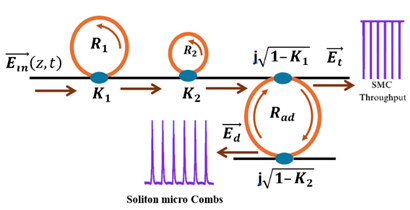
where α is the normalized detuning between the pump laser and the cavity resonance, the term  account for group-velocity dispersion, i|Ψ|2 represents Kerr nonlinearity, and F is the normalized pump amplitude 11. With an appropriate balance of pump power and detuning, modulational instability evolves into a stable regime where dissipative Kerr soli tons emerge. These solitons exhibit a temporal pulse shaped envelope and, in the frequency domain, form an equidistant comb defined by the resonator’s free spectral range and soliton pulse duration 12. Such microcombs have been experimentally realized in high-Q silicon nitride and crystalline resonators. Their integration at the chip scale enables a variety of photonic applications, including precise optical frequency references, high-speed broadband communication, and coherent data transmission within compact photonic circuits 13. In this study, a pair of micro-ring resonators is cascaded in series, with each resonator engineered to operate at targeted resonance frequencies. Leveraging their intrinsic nonlinear characteristics, the system facilitates the generation of solitons within the optical domain. To further control and optimize spectral output, an integrated add/drop filter is employe as shown Figure , enabling precise selection and management of specific wavelengths produced by the resonator system.

In this study, we focus on four distinct pulse shapes, each playing a pivotal role in nonlinear optics and signal processing by shaping the propagation dynamics within the micro-resonators. These initial optical pulses are injected into the system through the first micro-ring resonator. We considered Gaussian, super-Gaussian, hyperbolic secant, and Lorentzian, defined respectively by (2), (3), (4) and (5) 14, 15:
 | (2) |
 | (3) |
where , determines the sharpness of the pulse edges
 | (4) |
 | (5) |
Here, E0 denotes the amplitude of the electric field, Z represents the position of the electromagnetic wave at time t along the propagation axis, LD refers to the dispersion length characterizing pulse broadening, and ω0 signifies the central (carrier) angular frequency of the pulse. In the micro ring resonator configuration examined, the injection of an optical pulse into the waveguide initiates resonance between the outputs of the two serially coupled rings. The normalized expression for the transmitted optical field following its propagation through a single resonator, accounting for both dispersive and nonlinear effects intrinsic to the device by (6) 8, 16, 17
 |
 | (6) |
k denotes the coupling coefficient, and x = exp(L/2) rep- resents the round-trip loss coefficient, where L = 2πR is the length of the waveguide and α is the linear absorption coefficient. The total phase shift ϕ is the sum of the linear component  = kLn0 and the nonlinear component
  =kLn2E2, where En represents the amplitude of the input electric field. The output field from the first micro-ring resonator acts as the input to the second, which exhibits comparable wave propagation dynamics (6) 8. After multiple round-trips in the first ring, strong Kerr nonlinearities and dispersive interactions generate a broadband, spectrally disordered output. This signal, once coupled into the second resonator, undergoes resonant spectral filtering that compresses its bandwidth. The resulting output shows enhanced temporal coherence and a markedly reduced Full Width at Half Maximum (FWHM), facilitating high-quality soliton microcomb formation. An add/drop filter is positioned at the output of the second ring to isolate and extract the soliton microcombs. The mathematical expressions governing the optical field at the filter output are provided in (7), (8), where Et denotes the impulse response of the throughput port and Ed corresponds to that of the drop port.
 | (7) |
 | (8) |
In the proposed architecture, soliton microcomb generation Constitutes a foundational step for building high performance optical communication systems. These frequency combs are produced using micro-ring resonators operating in the anomalous dispersion regime, governed by the normalized Lugiato-Lefever Equation (LLE) (6) 11.
The resulting combs consist of equidistant spectral lines in the frequency domain, offering high coherence and exceptional temporal stability 18. Each comb line serves as a stable optical carrier for data transmission. Prior to multiplexing, information is encoded individually onto each carrier using Polarization Shift Keying (PolSK), a modulation technique in which digital bits are represented by two orthogonal polarization states commonly horizontal and vertical 18, 19. Owing to its resilience against amplitude fluctuations and phase noise, PolSK is particularly suited for free-space optical (FSO) systems and integrated pho- tonic platforms. To further enhance bandwidth utilization and increase overall system throughput, Wavelength Division Multiplexing (WDM) is employed 20, 21. In this scheme, each WDM channel corresponds to a distinct comb line, carrying an independent PolSK-modulated data stream. This integrated approach combining microcomb generation, vectorial PolSK modulation, and WDM multiplexing offers a scalable, energy-efficient, and robust solution for high - capacity optical communications in both FSO environments and chip-based systems.
2.3. Analysis of Pulse Shape Effects for PAOPR-Based SimulationThe Peak-to-Average Optical Power Ratio (PAOPR) is a essential metric for evaluating performance in optical communication systems, particularly with regard to signal integrity and transmission efficiency 22. It measures the ratio between the maximum instantaneous optical power and the average effective power of a transmitted signal, offering valuable insight into its dynamic range and susceptibility to nonlinear distortion. The formal expression for PAOPR is provided in Equation (10), as originally defined in prior literature (9) 23, 24:
 | (9) |
With Ppeak the maximum optical power, Ppeak= PN.pr (ak = 1) the average optical power transmitted, pr (ak = 1) the probability of transmitting a bit “1”, and PN the average optical power over a period Tb. In order to compare the performance of the different pulse shapes, the PAOPR increase factor is defined as follows by (10) 23, 24:
 | (10) |
Where PAOPRref and le PAOPR obtained with non-returnto-zero (NRZ) signalling and a rectangular pulse shape (PNref = 1). It is important to note that the ΓPAOPR
depends only on the characteristics of the pulse shape follows 23, 24. The value of ΓPAOPR for the four analyzed pulse shapes are respectively defined by the following expressions:
• Gaussian pulse: the ΓPAOPRg is given by (11):
 | (11) |
erf(.) is the error function.
• Super Gaussian pulse: the ΓPAOPRsg is given by (12):
 | (12) |
• Hyperbolic secant pulse: the ΓPAOPRs is given by (13):
 | (13) |
• Lorentzian pulse: the ΓPAOPRl is given by (14):
 | (14) |
where ξ is duty cycle of,  ξ
ξ 
For a same magnitude of duty cycle, for instance ξ = 1, ΓPAOPR ≈ 34, 10, 40 and 13 respectively for a Gaussian, a Super-Gaussian, a Lorentzian and a Secant hyperbolic pulse shape.
2.4. Mathematical Model of Turbulence with Pointing ErrorTo characterize the turbulence in our channel, we use the Gamma-Gamma model, which has a probability density function (PDF) that can be used to accurately model environments with low, medium and high turbulence. Its PDF is defined by (15) 25, 26:
 | (15) |
where KP (x) is the modified Bessel function of the second kind, Γ (x) is the Euler Gamma function, α is the effective number of small-scale turbulences and β is the effective number of large-scale turbulences. The values of α and β are given by (16) and (17) 26.
 | (16) |
 | (17) |
with σ2 scintillation index, this parameter is essential for determining the nature of the turbulence in a given environment. It enables us to assess the strength of turbulence in an environment. it expression is given by (18) 26.
 | (18) |
we have Lp the path length, k the wavenumber  and
and  the refractive index structure parameter. The Bit Error Rate (BER) is a critical metric for evaluating the performance of communication systems. It quantifies the likelihood of a bit being received incorrectly relative to the originally transmitted bit. Mathematically, BER is defined as the ratio of the number of erroneous bits to the total number of transmitted bits 27, 28. This parameter serves as a direct measure of system reliability and robustness, especially in the presence of noise, interference, and other channel impairments 21. In this context, we consider Polarization Shift Keying (PolSK) as the modulation technique, where information is encoded in the polarization state of the optical signal 10, 21. The BER for the PolSK modulation format is given by the following expression The BER in the PolSK modulation format is represented by (19) 9, 21:
 | (19) |
For a given PolSK modulation scheme, with the duty cycle, the value of the signal-to-noise ratio is defined by (20) 29, 30:
 | (20) |
Where, P overall efficiency, PI0 the input power, R is the responsivity of the photodetector and σ the noise, a function of turbulence. Then, we incorporate the pointing error into our model. The pointing effect is modeled as a multiplicative attenuation of the signal caused by misalignment. We introduce a random loss factor h [0,1], with probability density given by (21):
 | (21) |
Where:
— 0 ≤ h ≤ A0
— A0 is the maximum loss in the absence of pointing
error (typically < 1)
— , is the ratio between the beam radius at the receiver and the standard deviation of the pointing jitter
  We assume propagation over a distance L. The radius
  of the beam in the plane of the receiver (in the presence of divergence θ) is written as
  = L θ.
Taking into account the pointing error, γ(I) instantaneous SNR is given by (22)
 | (22) |
According to (19) and (22), the BER is given by (23):
 | (23) |
The final distribution of the received intensity I is obtained as the multiplicative convolution of the Gamma-Gamma fading distribution and the pointing error distribution. 26, 31, 32, 33, 34. It defined by (24)
 | (24) |
The instantaneous BER value as a function of channel turbulence is then given by (25) then (26):
 | (25) |
 | (26) |
To facilitate the resolution of Equation (26), the com- plementary error function erfc(x) and the modified Bessel function of the second kind KP (x) are replaced by their representations in terms of the Meijer G-function 35, de- fined respectively by (27) and (28):
 | (27) |
 | (28) |
Based on the integral formula for the product of Meijer G-functions as described in 35, the result of evaluating the integral for the PolSK modulation is given by (29):
 | (29) |
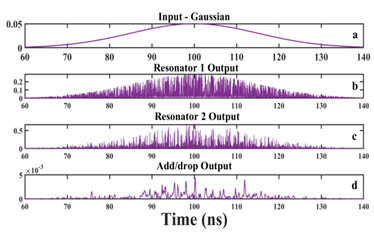
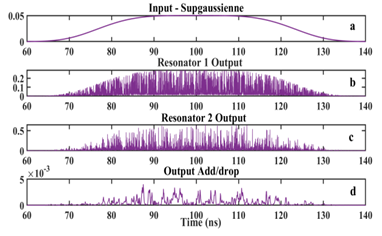
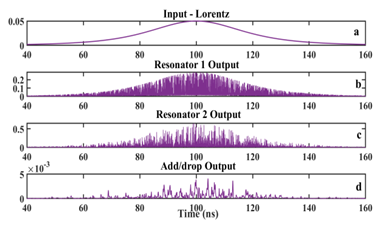
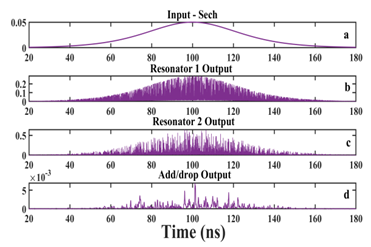
An optical pulse Gaussian, Super-Gaussian, Hyperbolic Secant (Sech) or Lorentzian profile is inputted into the first ring. The rings are characterized by the following parameters power of 500 mW, and central wavelength λ0 = 1550 nm, K1 = K2 = 0.85, n0 = 3.34 (InGaAsP/InP), Aeff = 25 µm2,α = 0.5 dB.mm−1, γ = 0.05, n2 = 3.2 10−17m2/W. Each input profile induces chaotic time-domain signals in the first ring (R1). The second ring (R2) acts as a filter, suppressing chaos, while the add/drop filter extracts stable temporal solitons. Figure 2, Figure 3, Figure 4 and Figure 5 illustrate the multi-soliton generation process, revealing that the broadband signal originates within the first ring resonator R1. In contrast, resonator R2 serves as a spectral filter, compressing the bandwidth and reducing the group velocity. The key stages include: (a) input soliton pulse, (b) spectral broadening, (c) bandwidth compression and filtering in R2, and (d) temporal soliton.


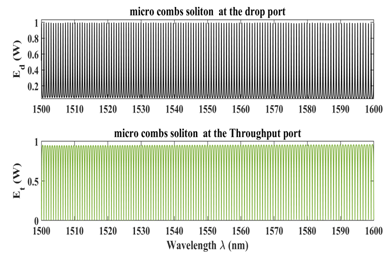
Among the evaluated pulse profiles, the Sech pulse ex-hibits the broadest spectral expansion, outperforming Gaussian, super-Gaussian, and Lorentzian shapes. It generates temporal solitons with the most favorable Full Width at Half Maximum (FWHM) of approximately 0.105 ns, corresponding to a spectral width of 9.5 GHz. The add/drop filter enforces frequency-domain mode structuring, delivering consistent output regardless of the input pulse shape. The Free Spectral Range (FSR), precisely measured at 95.3024 GHz, is dictated by the resonator geometry and plays a crucial role in mode selection and soliton dynamics. According to Figure 6, the Sech pulse produces 132 soliton micro- combs across the 1500 – 1600 nm wavelength range at both the drop and through ports, yielding a total bandwidth of ∆f  12.5 THz. Thehyperbolic secant (Sech) pulse profile offers superior performance in soliton microcomb generation, as it naturally satisfies the equilibrium conditions required for dissipative Kerr solitons in the anomalous dispersion regime 12. This configuration enhances spectral efficiency, optimizes available bandwidth, and supports effective wavelength division multiplexing (WDM), thereby reducing inter-channel interference and increasing carrier capacity within the same bandwidth envelope.
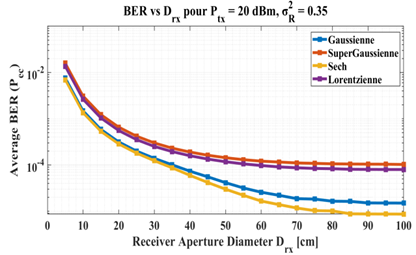
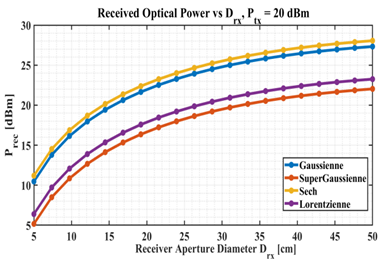
In FSO communication, the receiver aperture diameter plays a crucial role in deciding the optical power collected at the receiver. A larger aperture improves the system’s ability to capture optical signals, especially in the existence of beam divergence and atmospheric turbulence 6. As can be seen in Figure 7 BER decreases almost exponentially as the diameter of the receiving lens increases, thanks to better power collection and therefore a higher SNR. As expected, as the diameter increases, so does the received power (Prec), rising from 10 dBm to 27–28 dBm for the best profiles. This improvement stems from the fact that a larger receiver diameter collects more incident optical power due to its greater sur- face area. This directly enhances the geometric gain, thereby improving the overall power budget at the receiver end. As Figure 8 indicates, among the shapings studied, the Sech profile consistently has the lowest BER and the highest received power (up to ~ 28.5 dBm at 50 cm), followed very closely by the Gaussian (~27.5 dBm), while the Lorentzian and super-Gaussian profiles suffer from greater losses at the periphery and display Prec of ~ 23 dBm and 22 dBm respectively, as well as higher BERs (the super-Gaussian peaking at around 10−4 for large diameters).Beyond 50–60cm, the improvement in BER and power is marginal, which suggests that a receiver diameter of 40–60cm and Sech shaping should be preferred to optimize the cost/performance trade- off in FSO WDM–PolSK links under moderate turbulence (). This is because a larger receiver diameter collects more incident optical power due to its greater surface area, which directly enhances the geometric gain and improves the overall power budget. However, past a certain threshold, this gain saturates, making further increases less effective, while disproportionately increasing system complexity and cost.


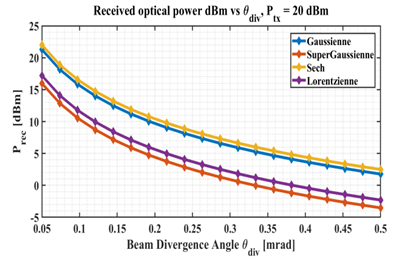
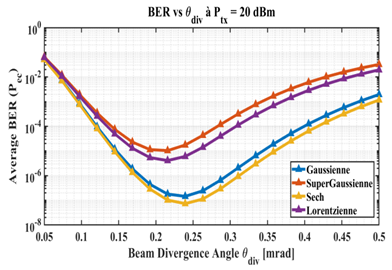
It is evident from Figure 9 The received power diminishes rapidly as the divergence angle increases, with pulse profiles ranked from best to worst performance as follows: Sech > Gaussian > Lorentzian > Super-Gaussian. The Lorentzian and Super-Gaussian profiles are penalized by, respectively, overly extended wings and excessively wide plateaus, which scatter significant energy outside the receiver aperture. As Figure 10 depicted, average BER exhibits an inverted U- shaped trend, elevated levels (<10−2) are observed at very low divergence angles (<0.1 mrad), driven by turbulence and pointing jitter, minimal values (10−7– 10−6) occur near 0.20 – 0.27 mrad due to effective aperture averaging, and BER rises again (>10−3) beyond 0.35 mrad, primarily due to degraded SNR from insufficient received power. This situation is attributed to the high beam divergence at such angles, significantly reducing the power density at the re- ceiver aperture. Since the aperture diameter remains fixed, an increasing portion of the transmitted energy is no longer captured, diminishing the usable power budget.
As a consequence, the received signal becomes more susceptible to thermal noise and atmospheric fluctuations, limiting the system’s ability to accurately decode the transmitted symbols. This energy deficit undermines the robustness of the FSO link, despite partial mitigation of scintillation effects.
Among all profiles, Sech and Gaussian pulses yield the lowest BERs at optimum divergence, with Lorentzian trailing slightly and Super-Gaussian consistently underperforming. Consequently, a divergence angle of approximately 0.25 mrad, combined with a Sech pulse, represents the most effective compromise among divergence, received power, and turbulence resilience. Experimental results corroborate that FSO systems with narrower divergence angles deliver superior performance provided that beam tracking remains precise 36. Dynamically adjust the divergence or modify the transmitter/receiver diameter according to atmospheric conditions to optimize the reception parameters of the FSO- WDM- PoLSK link.

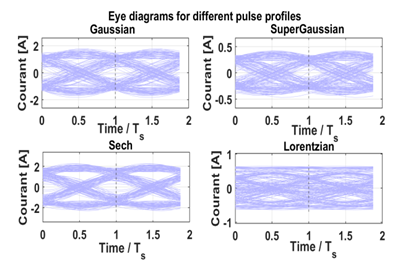
The analysis of pulse shapes through their associated eye diagrams reveals marked disparities in terms of noise robustness, temporal stability, and sensitivity to intersymbol interference (ISI). As highlighted in Figure 11, the Gaussian profile stands out with a wide vertical opening ( and a generous horizontal aperture (~0.5Ts), indicating a high noise margin, low timing jitter, and well-controlled ISI due to its balanced spectral response. The Super-Gaussian profile, in contrast, exhibits a reduced vertical opening (
 and a slightly narrower horizontal span (∼ 0.4Ts).
While its sharper transitions enhance timing precision, they come at the cost of lower amplitude and diminished resilience to channel impairments. The sech (hyperbolic secant) profile provides the most advantageous configuration, combining a superior vertical eye opening ( with a horizontal width comparable to that of the Gaussian (~ 0.5Ts). This makes it an optimal trade-off between energy efficiency and ISI mitigation. Conversely, the Lorentzian profile shows the weakest performance, characterized by a limited vertical aperture (
 and a very narrow horizontal opening (< 0.3Ts), symptomatic of significant timing jitter and temporal spreading caused by its long-tailed impulse response. Notably, the sech profile’s larger eye opening directly correlates with enhanced signal quality, as evidenced by a high Q-factor (~12.5) and clear logical level separation, yielding a bit error rate (BER) below 10−9. This extremely low BER confirms excellent transmission fidelity, with negligible bit-level impairments. From a receiver design perspective, optimizations such as increasing the receiver aperture diameter and reducing the beam divergence angle significantly enhance collected power, thereby improving the vertical eye opening (through higher SNR) and reducing jitter-induced sampling uncertainty.

The generation of soliton microcombs presents substantial advantages for free-space optical (FSO) communication systems, particularly in terms of spectral efficiency and energy conservation 23, 37. Their inherent propagation stability makes solitons ideal for mitigating the adverse effects of atmospheric turbulence and dynamic channel conditions. In this study, microcombs are generated using micro-ring resonators, which play a pivotal role in producing coherent and stable solitonic waveforms. These structures offer strong optical confinement and tunability across narrow frequency bands. Key parameters such as Free Spectral Range (FSR) and Full Width at Half Maximum (FWHM) are precisely controlled 38, enabling tailored frequency structuring and consistent mode formation. Significantly, the hyperbolic secant (Sech) pulse profile proves optimal for initiating soliton microcomb generation. As demonstrated by 39, this pulse shape naturally satisfies the equilibrium conditions required by dissipative Kerr solitons in the anomalous dispersion regime, maintaining a stable balance between dispersion and Kerr nonlinearity. The FWHM, a defining parameter of the Sech pulse, directly supports the formation of solitons and enhances comb stability. Micro-ring resonators further facilitate miniaturization, allowing integration into compact and energy-efficient platforms without sacrificing performance 38, 40. This methodology aligns with prior validated designs coupling ring resonators with add/drop filters 8, enabling precise control over FSR and FWHM and enhancing system-level efficiency. Both FSR and FWHM are crucial for ensuring high-quality optical transmission. A well-defined FSR enables dense wavelength division multiplexing (DWDM), expanding channel capacity while minimizing spectral overlap 41. A narrow FWHM improves wavelength discrimination, reducing inter-channel interference and preserving signal integrity even under turbulent transmission conditions. To ensure compliance with ITU-T DWDM standards (G.694.1), the comb is confined to the standard C+L band (1530–1625nm), avoiding extended S or U bands that require non-standard components. The 1550nm transmission window ( 193THz), central to the comb spectrum, offers low fog attenuation and supports Class 1 eye-safe operation at elevated powers 42, 43, 44. This facilitates long-range, low-risk communication links. Widely adopted technologies such as InP-based lasers and EDFLs, while moderately priced, remain highly compatible with this spectral band 42, 45. To harness the full spectral and spatial capacity of the generated microcombs, the modulation scheme is critically selected. As highlighted in 46, adaptation to source characteristics is essential for maintaining optimal channel performance. In this context, Polarization Shift Keying (PolSK) modulation is employed during the early characterization phase due to its robustness against polarization-mode distortion and atmospheric fluctuations 9, 47. PolSK encodes data using orthogonal polarization states, enabling dense information mapping onto individual comb lines with high spectral compactness. Upon successful validation under PolSK, the system transitions to full-scale operation using Wavelength Division Multiplexing (WDM). Each comb line serves as an independent carrier within a tightly spaced optical grid, leveraging the fine spectral structuring and stability of the soliton combs to maximize throughput and channel utilization. This combined PolSK- WDM approach ensures a flexible and resilient framework for high-capacity, turbulence-tolerant FSO communication systems. Building on the spectral and structural advantages conferred by soliton microcomb generation, it becomes essential to examine how receiver-side parameters influence overall system performance. Among these, the receiver’s aperture diameter plays a pivotal role in determining signal collection efficiency and spatial coupling under turbulent conditions. About the effect of Receiver’s Aperture Diameter, our results quantitatively confirm and refine the central role of receiver optics and beam shaping in free-space optical (FSO) communication links, in strong agreement with both foundational and recent literature. Increasing the receiver aperture diameter significantly enhances the received power (Prec), with a gain of approximately 17 dB between 5 cm and 50 cm for instance, from ~ 11 dBm to ~ 28 dBm with a Sech beam profile. This gain is attributed to the aperture averaging effect, which allows a larger portion of the beam to be collected, thereby mitigating the impact of scintillation and beam wander. This trend is well documented, notably by 48, and validated by NASA field measurements over a 4.5 km link, where increasing Prec from 10 to 25 dBm reduced the BER from ~ 10−2 to ~ 10−9 49. More recently, 50 demonstrated that increasing the receiver diameter under moderate turbulence improves BER up to a saturation point, while 51 proposed an optimization method for aper- ture sizing to enhance link robustness Beyond 40–50 cm, the growth in Prec slows significantly, as most of the optical spot is already captured, making further gains marginal. This saturation effect has been observed experimentally by 52 and numerically by 53, who reported a BER drop from ~ 10−2 to ~ 10−9 for a partially coherent Gaussian beam as the aperture increased from 5 to 30 cm. This improvement in Prec directly translates into a marked reduction in bit error rate (BER), due to a higher photon signal-to-noise ratio. Beam profile also plays a critical role, the Sech profile yields the best performance, combining maximum received power (~ 28.5 dBm at ~ 50 cm) with minimal BER (~ 5×10⁻⁵) thanks to its optimal trade-off between central intensity and peripheral losses, as supported by several beam shaping stud- ies 10−9 26. In contrast, Lorentzian and super-Gaussian profiles, which are more spread out or have broader wings, suffer from aperture losses ( Prec ~ 23 dBm and ~ 22 dBm, respectively) and exhibit higher BERs up to 4×10⁻⁴. Re- cent work by 54 also showed that dynamic beam shaping can maintain BER < 4×10⁻⁷ in indoor FSO environments, while 55 proposed adaptive beamwidth control using intelligent reflecting surfaces (IRS) to improve pointing error tolerance. In the context of high-speed WDM-PolSK systems, these receiver parameters are essential for optimizing link design. In summary, our results provide a fine-grained numerical validation of known experimental and theoretical trends, while offering concrete recommendations for system design under moderate turbulence ( ) notably, adopting a receiver diameter between 40 and 60 cm and a Sech or slightly Gaussian beam profile. While aperture diam- eter governs the receiver’s ability to capture incident optical energy, the effectiveness of this process is intricately linked to the beam divergence angle. A comprehensive understanding of how divergence affects beam footprint, alignment tolerance, and spatial dispersion further enriches the optimization strategy for FSO link design. Regarding The effect of Beam Divergence Angle, our results align closely with existing literature and unveil practical opportunities for system optimization through adaptive divergence strategies and judicious pulse profile selection. Specifically, they underscore an optimal divergence angle near 0.25 mrad, where the bit error rate (BER) reaches a minimum (~ 10−7) while preserving sufficient received power. This value corroborates recommendations found in prior studies. 56 demonstrated that, for short-range untracked optical links, divergences of several tenths of a milliradian enhance robustness without necessitating active beam tracking. Similarly, 57 emphasized the benefits of Variable-Beam Divergence Angle (VBDA) techniques, which adaptively modulate the beam between 0.1 and 1 mrad to balance scintillation effects and atmospheric attenuation. Our performance curves reinforce the superior efficiency of the Sech pulse profile, which slightly outperforms Gaussian pulses and significantly surpasses the super-Gaussian, echoing the findings of 58, 59. These works revealed that moderate-wing profiles better exploit aperture averaging mechanisms than those with extended plateaus. Moreover, our identified optimal divergence remains comfortably below the maximum tolerable limit up to 15 mrad under turbulent conditions outlined by 60 to maintain a target BER of 10−9, providing a valuable margin of resilience against atmospheric fluctuations. On a practical front, these findings advocate the deployment of adaptive beam control mechanisms capable of tuning divergence angles between 0.15 and 0.35 mrad, contingent on scintillation and pointing jitter. Preference should be given to Sech or Gaussian profiles, with partially coherent beams also considered to further suppress scintillation. Finally, a moderate increase in receiver aperture diameter can ease divergence constraints without degrading BER an approach validated by numerous studies on long-distance aperture averaging.
This study investigated the impact of soliton microcomb generated pulse shapes on the reception performance of FSO–WDM–PolSK systems under atmospheric turbulence and pointing errors. Among the evaluated profiles, the sech (hyperbolic secant) pulse emerged as the most effective, yielding the most robust microcomb structure with a FWHM of 0.105 ns and a FSR of 95,30 GHz. Its spectral footprint supports a total comb bandwidth of ∆f assuming a fixed repetition rate spacing (FSR), making it ideally suited for dense WDM transmission. The sech profile consistently demonstrated superior reception metrics: highest received power (28.5 dBm), widest eye opening (
 , a Q-factor above 12.5, and BERs below 10−9, even under moderate turbulence (
 and misalignment conditions. The Gaussian profile offered stable performance with slightly reduced capacity, while Lorentzian and Super-Gaussian pulses showed lower resilience, suffering from energy spreading and greater susceptibility to jitter and ISI. Moreover, the results underline the importance of optimizing receiver geometry. A diameter of 40–60 cm and a beam divergence around 0.25 mrad proved to be the most effective configuration, balancing received power, BER, and system complexity. In summary, sech-shaped microcombs, coupled with carefully tuned reception parameters, offer a powerful strategy for deploying high-capacity, turbulence-resilient FSO–WDM–PolSK links in practical scenarios. Future work will build upon the sech-shaped pulse format, leveraging its spectral compactness and resilience to nonlinear distortions to further enhance system robustness under dynamic channel conditions.
| [1] | M. A. Khalighi and M. Uysal, “Survey on Free Space Optical Communication: A Communication Theory Perspective,” IEEE Communications Surveys & Tutorials, vol. 16, no. 4, pp. 2231–2258, 2014. | ||
| In article | View Article | ||
| [2] | I. I. Kim, B. McArthur, and E. J. Korevaar, “Comparison of laser beam propagation at 785nm and 1550nm in fog and haze for optical wireless communications,” in Optical Wireless Communications III, SPIE, Feb. 2001, pp.26–37. | ||
| In article | View Article | ||
| [3] | M. R. Hayal, B. B. Yousif, and M. A. Azim, “Performance Enhancement of DWDM-FSO Optical Fiber Communication Systems Based on Hybrid Modulation Techniques under Atmospheric Turbulence Channel,” Photonics, vol. 8, no. 11, Art. no. 11, Nov. 2021. | ||
| In article | View Article | ||
| [4] | H. Singh, R. Miglani, N. Mittal, G. S. Gaba,M. Masud, and S. Aljahdali, “Design and Anal- ysis of Commercially Viable Free-Space Optical Communication Link for Diverse Beam Divergence Profiles,” Frontiers in Physics, vol. 9, Dec. 2021. | ||
| In article | View Article | ||
| [5] | M. E. Morocho-Cayamcela, H. Lee, and W. Lim, “Ma- chine learning for 5G/B5G mobile and wireless communications: Potential, limitations, and future directions,” IEEE Access, vol. 7, pp.137184–137206, 2019. | ||
| In article | View Article | ||
| [6] | Chaudhary, P. Bansal, and M. Lumb, “Effect of beam divergence on WDM-FSO transmission system,” International Journal of Computer Applications, vol. 93, no. 1, pp.28–32, 2014. | ||
| In article | View Article | ||
| [7] | R. Atta, A. K. Pathak, A. Das, N. Sarkar, B. Dutta, and A. S. Patra, “A 100Gbps integrated fiber-FSO data transmission system based on WDM techniques employing optical frequency comb lines,” Optical and Quantum Electronics, vol. 56, no. 6, p.946, Apr.2024. | ||
| In article | View Article | ||
| [8] | A. Shahidinejad, “Soliton Pulse Generation for WDM-Based Free Space Optics Communication Using Microring Resonators,” Journal of Optical Communications, vol. 42, no. 1, pp.59–64, Jan. 2021. | ||
| In article | View Article | ||
| [9] | J. Jeyaseelan, D. S. Kumar, and B. E. Caroline, “PolSK and ASK Modulation Techniques Based BER Analysis of WDM-FSO System for Under Turbulence Conditions,” Wireless Personal Communications, vol. 103, no. 4, pp.3221–3237, Dec.2018. | ||
| In article | View Article | ||
| [10] | D. Kone´, K. A. Kamenan, and A. Kamagate´, “Improving FSO link performance using PolSK modulation,” Physical Science International Journal, vol. 28, no. 24–40, p.PSIJ-115250, 2024. | ||
| In article | View Article | ||
| [11] | L. A. Lugiato and R. Lefever, “Spatial dissipative struc- tures in passive optical systems,” Physical Review Letters, vol. 58, no. 21, pp.2209–2211, 1987. | ||
| In article | View Article PubMed | ||
| [12] | T. Herr et al., “Temporal solitons in optical microresonators,” Nature Photonics, vol. 8, no. 2, pp.145–152, Feb.2014. | ||
| In article | View Article | ||
| [13] | T. J. Kippenberg, A. L. Gaeta, M. Lipson, andM. L. Gorodetsky, “Dissipative Kerr solitons in op tical microresonators,” Science, vol. 361, no. 6402, p.eaan8083, Aug.2018. | ||
| In article | View Article PubMed | ||
| [14] | C. W. S. Conover, “Effects of pulse shape on strongly driven two-level systems,” Physical Re- view A, vol. 84, no. 6, p.063416, Dec.2011. | ||
| In article | View Article | ||
| [15] | I. S. Mihov and N. V. Vitanov, “Pulse shape effects in qubit dynamics demonstrated on an IBM quantum computer,” arXiv: 2301.10004, Aug.26, 2023. | ||
| In article | View Article | ||
| [16] | A. Afroozeh, I. S. Amiri, M. A. Jalil, M. Kouhnavard, J. Ali, and P. P. Yupapin, “Multi Soliton Generation for Enhance Optical Communication,” Advanced Materials Research, vol. 83, pp.136–140, Jul.2011. | ||
| In article | View Article | ||
| [17] | I. S. Amiri, J. Ali, and P. P. Yupapin, “Enhancement of FSR and finesse using add/drop filter and Panda ring resonator systems,” International Journal of Modern Physics B, vol. 26, no. 04, p.1250034, Feb.2012. | ||
| In article | View Article | ||
| [18] | W. Shao et al., “Terabit FSO communication based on a soliton microcomb,” Photonics Research, vol. 10, no. 12, pp.2802–2808, Dec.2022. | ||
| In article | View Article | ||
| [19] | Y.-Q. Hong and S.-K. Han, “Polarization-dependent SOA-based PolSK modulation for turbulence-robust FSO communication,” Optics Express, vol. 29, no. 10, pp.15587–15594, 2021. | ||
| In article | View Article PubMed | ||
| [20] | A. K. M. S. J. Choyon and R. Chowdhury, “Design of 16×40Gbps hybrid PDM-WDM FSO communication system and its performance comparison with the traditional model under diverse weather condi- tions of Bangladesh,” Journal of Optical Communi- cations, vol. 44, no. s1, pp.s1521–s1533, Feb.2024. | ||
| In article | View Article | ||
| [21] | Z. Ghassemlooy, W. Popoola,and S. Rajb- handari, Optical wireless communications: system and channel modelling with Mat lab®. CRC Press, 2019. [Online]. Available https:// www. taylorfrancis.com/ books/mono/10.1201/9781315151724. | ||
| In article | View Article | ||
| [22] | Y. A. Zenhom, E. K. I. Hamad, M. Alghassab, and M. M. Elnabawy, “Optical-OFDM VLC System: Peak-to-Average Power Ratio Enhancement and Performance Evaluation,” Sensors, vol. 24, no. 10, Art. no.10, Jan. 2024. | ||
| In article | View Article PubMed | ||
| [23] | J. M. G. Balsells, A. Jurado-Navas, M. Castillo-Vazquez, A. Moreno-Garrido, and A. Puerta-Notario, “Advantages of solitonic shape pulses for full-optical wireless communication links,” Chinese Optics Letters, vol. 10, no. 4, p.040101, 2012. | ||
| In article | View Article | ||
| [24] | M. Matsumoto et al., “An alternative access technology for next generation networks based on full-optical wireless communication links,” in First ITU-T Kaleido- scope Academic Conference, IEEE, 2008, pp.221228. [Online] Available: https://ieeexplore. ieee.org/abstract/document/4542269/, Accessed: May.15, 2025. | ||
| In article | |||
| [25] | O. Alsulami, A. T. Hussein, M. T. Alresheedi, and J. M. Elmirghani, “Optical wireless communication systems, a survey,” arXiv: 1812.11544, 2018. [Online]. Available: https:// arxiv.org/ abs/1812.11544. | ||
| In article | |||
| [26] | L. C. Andrews and R. L. Phillips, Laser beam propagation through random media, 2nd ed. SPIE Press, 2005. [Online]. Available: https://stars.library.ucf.edu/scopus2000/3722/Accessed: May.16, 2025. | ||
| In article | |||
| [27] | A. H. Okilly and J. Baek, “Optimal Design Analysis with Simulation and Experimental Performance Investigation of High-Power Density Telecom PFC Converters,” Applied Sciences, vol. 11, no. 17, p.7911, 2021. | ||
| In article | View Article | ||
| [28] | M. Singh and J. Malhotra, “Performance Comparison of Different Modulation Schemes in High-Speed MDM Based Radio Over FSO Transmission Link Under the Effect of Atmospheric Turbulence Using Aperture Averaging,” Wireless Personal Communications, vol. 111, no. 2, pp.825–842, Mar.2020. | ||
| In article | View Article | ||
| [29] | D. Kone´, N. M.Mene´, and A. Kamagate´, “Wavelength-division multiplexing (WDM) FSO communications with soliton microcombs,” Journal of Modern Optics, vol. 71, no. 7–8, pp. 240–254, May2024. | ||
| In article | View Article | ||
| [30] | B. K.Saw, V. Janyani, and G. Singh, “Coherent-Circular Polarized Shift Keying Modulation Analysis over Malaga Distribution and Distribution with Pointing Errors in Free Space Optical Communication,” Optical and Quantum Electronics, vol. 55, no. 13, p. 1135, Dec. 2023. | ||
| In article | View Article | ||
| [31] | A. Al-Habash, L. C.Andrews, and R. L.Phillips, “Mathematical model for the irradiance probability density function of a laser beam propagating through turbulent media,” Optical Engineering, vol. 40, no. 8, pp. 1554–1562, Aug. 2001. | ||
| In article | View Article | ||
| [32] | N. D.Chatzidiamantis, G. K.Karagiannidis, and D. S.Michalopoulos, “On the distribution of the sum of gamma-gamma variates and application in MIMO optical wireless systems,” in GLOBE- COM2009 – IEEE Global Telecommunications Conference, IEEE, 2009, pp. 1–6. [Online]. Avail-able: https:// ieeexplore.ieee.org/ abstract/ document/ 5425871// (Accessed: Jun. 9, 2025). | ||
| In article | View Article | ||
| [33] | A. A. Farid and S. Hranilovic, “Outage capacity optimization for free-space optical links with pointing errors,” Journal of Lightwave Technology, vol. 25, no. 7, pp.1702–1710, 2007. | ||
| In article | View Article | ||
| [34] | S. Navidpour, M. Uysal, and M. Kavehrad, “BER Performance of Free-Space Optical Transmission with Spatial Diversity,” IEEE Transactions on Wireless Communications, vol. 6, no. 8, pp.2813–2819, Aug.2007. | ||
| In article | View Article | ||
| [35] | Wolfram Functions Site, “Meijer G functions,” Available:: http://functions.wolfram.com/PDF/MeijerG pdf. | ||
| In article | |||
| [36] | A. K. Majumdar and J. C. Ricklin, Free-space Laser communications: principles and advances, vol. 2. Springer, 2010. [Online]. Available: https:// books.google.com/ books? hl=fr&lr= &id=-wj39a3oTecC,, Accessed: Jun.10, 2025. | ||
| In article | |||
| [37] | B. Dutta, B. Kuiri, R. Atta, N. Sarkar, and A. S. Patra, “Numerical evaluation of bidirectional high-speed data transmission over turbulence tolerable FSO link employing WDM-OAM multiplex- ing and DP-QPSK modulation techniques,” Optics Communications, vol. 546, p.129753, Nov.2023. | ||
| In article | View Article | ||
| [38] | W. Wang, L. Wang, and W. Zhang, “Advances in soliton microcomb generation,” Advanced Photonics, vol. 2, no. 3, p.034001, Jun.2020. | ||
| In article | View Article | ||
| [39] | S. Fujii et al., “Dissipative Kerr soliton microcombs for FEC-free optical communications over 100 channels,” Optics Express, vol. 30, no. 2, pp.1351–1364, Jan.2022. | ||
| In article | View Article PubMed | ||
| [40] | Y. R. Bawankar and A. Singh, “Microring resonators based applications in silicon photonics–a review,” in 5th Conference on Information and Communication Technology (CICT), IEEE, 2021, pp.1–6. [Online]. Available: https://ieeexplore. ieee.org/ abstract/document/9672427/, Accessed: May.14, 2025. | ||
| In article | View Article | ||
| [41] | C. Sun et al., “Tunable narrow-band single-channel add-drop integrated optical filter with ultrawide FSR,” PhotoniX, vol. 3, no. 1, p.12, Apr.2022. | ||
| In article | View Article | ||
| [42] | T. Aoki et al., “High-power high-beam-quality 1550-nm-wavelength InP-based photonic-crystal surface-emitting laser,” in Novel In-Plane Semiconductor Lasers XXIV, SPIE, Mar.2025, p.PC133850Y. | ||
| In article | View Article | ||
| [43] | C. Bai, J. Wang, S. Zhou, R. Rao, and T. Wang, “Performance of Free Space Optical Communication Link under foggy weather regarding different wavelengths,” in 3rd International Symposium on Automation, Information and Computing, 2022. [Online]. Available: https:// www.scitepress.org/ Papers/ 2022/ 119462/ 119462.pdf, Accessed: Jul.14, 2025. | ||
| In article | View Article | ||
| [44] | M. H. Langaroodi, “Conception et performances d’une liaison de communication optique en espace libre de 1550nm,” Master’s thesis, Jan.2010. | ||
| In article | |||
| [45] | T. Stakelon et al., “Reliability of single-mode and multi-mode high-power semiconductor lasers at eye-safe wavelengths,” in High-Power Diode Laser Technology and Applications VII, SPIE, 2009, pp.368–374. [Online]. Available: https:// www. spiedigitallibrary. org/ conference- proceedings-of-spie/ 7198/ 719819/, Accessed: Jul.14, 2025. | ||
| In article | View Article | ||
| [46] | S. Jia et al., “150Gbit/s 1km high-sensitivity FSO communication outfield demonstration based on a soliton microcomb,” Optics Express, vol. 30, no. 20, pp.35300–35310, Sep.2022. | ||
| In article | View Article PubMed | ||
| [47] | “Revue internationale des syste`mes de communication : vol. 32, no. 12,” Wiley Online Library. [Online]. Available: https:// onlinelibrary.wiley.com / toc/10991131/32/12, Accessed: Jul.15, 2025. | ||
| In article | |||
| [48] | S. Lyke, “Statistiques de l’e´nergie recue pour l’espace libre optical channels,” Master’s thesis, Jan. 2010. | ||
| In article | |||
| [49] | J. Kiriazes et al., “Performance of a 10Gbps FSO System Implementing Novel Beam Tracking a Dynamic Buffering Modem,” in IEEE Photonics Society 2012 Summer Topical Meetings, 2012. [Online]. Available: https:// ntrs.nasa.gov/ api/citations/ 20120008737/downloads/ 20120008737. pdf, Accessed: Jul.6, 2025. | ||
| In article | |||
| [50] | S. Mukherjee, S. Paul, and S. Mazumdar, “BER performance analysis of MWIR and SWIR FSO links utilizing aperture averaging technique considering turbulence and various visibility situations with pointing errors,” Journal of Optical Communications, vol. 45, no. s1, pp.s2531–s2542, Jun. 2024. | ||
| In article | View Article | ||
| [51] | H. Singh, N. Mittal, and K. A. Ogudo, “Optimizing the receiver aperture parameters of free space optical (FSO) link for performance enhancement,” AIP H. Singh, N. Mittal, and K. A. Ogudo, “Optimizing the receiver aperture parameters of free space optical (FSO) link for performance enhancement,” AIP. | ||
| In article | |||
| [52] | H. Yuksel and C. C. Davis, “A geometrical optics approach for modeling aperture averaging in free space optical communication applications,” in Atmospheric Optical Modeling, Measurement, and Simulation II, SPIE, 2006, pp.15–26. [Online]. Available: https://www.spiedigitallibrary. org/conference-proceedings-of-spie/ 6303/630302/, Accessed: Jul.6, 2025. | ||
| In article | |||
| [53] | I. E. Lee, Z. Ghassemlooy, W. P. Ng, and M.-A. Khalighi, “Reducing pointing errors in free-space optical communication links over turbulences with a partially coherent Gaussian beam,” in ICC Workshops 2016, IEEE, 2016, pp.163–168. [Online]. Available:https://ieeexplore.ieee.org/abstract/document/7503782https://ieeexplore.ieee.org/abstract/document/7503782//, Accessed: Jul.6, 2025. | ||
| In article | View Article | ||
| [54] | S. Liverman et al., “Dynamic indoor free-space optical communication enabled by beam steering and beam shaping,” Applied Optics, vol. 62, no. 9, pp.2367–2375,Mar.2023. | ||
| In article | View Article PubMed | ||
| [55] | J.-H. Noh and B. Lee, “Phase-shift design and channel modeling for focused beams in IRS-assisted FSO systems,” IEEE Transactions on Vehicular Technology, vol. 72, no. 8, pp.10971–10976, 2023. | ||
| In article | View Article | ||
| [56] | Z. Zhao, R. Liao, and Y. Zhang, “Impacts of laser beam diverging angle on free-space optical communications,” in IEEE Aerospace Conference, 2011, p.10. | ||
| In article | View Article | ||
| [57] | G. Zhang et al., “A Review of Variable-Beam Divergence Angle FSO Communication Systems,” Photonics, vol. 10, no. 7, Art. no.7, Jul.2023. | ||
| In article | View Article | ||
| [58] | R. Harada, N. Shibata, S. Kaneko, T. Imai, J.-I. Kani, and T. Yoshida, “Adaptive beam divergence for expanding range of link distance in FSO with moving nodes toward 6G,” IEEE Photonics Technology Letters, vol. 34, no. 20, pp.1061–1064, 2022. | ||
| In article | View Article | ||
| [59] | H.-M. Park, Y.-J. Hyun, and S.-K. Han, “Adaptive Beam Divergence Control to Mitigate Scintillation Effect Caused by Pointing Error in Vertical FSO Transmissions,” Sensors, vol. 23, no. 11, Art. no.11, Jan.2023. | ||
| In article | View Article PubMed | ||
| [60] | A. S. El-Wakeel, N. A. Mohammed, and M. H. Aly, “Free space optical communications system performance under atmospheric scattering and turbulence for 850 and 1550nm operation,” Applied Optics, vol. 55, no. 26, pp.7276–7286, Sep.2016. | ||
| In article | View Article PubMed | ||
Published with license by Science and Education Publishing, Copyright © 2025 Amadou Soumahoro, Douatia Koné and Aladji Kamagaté
 This work is licensed under a Creative Commons Attribution 4.0 International License. To view a copy of this license, visit
http://creativecommons.org/licenses/by/4.0/
This work is licensed under a Creative Commons Attribution 4.0 International License. To view a copy of this license, visit
http://creativecommons.org/licenses/by/4.0/
| [1] | M. A. Khalighi and M. Uysal, “Survey on Free Space Optical Communication: A Communication Theory Perspective,” IEEE Communications Surveys & Tutorials, vol. 16, no. 4, pp. 2231–2258, 2014. | ||
| In article | View Article | ||
| [2] | I. I. Kim, B. McArthur, and E. J. Korevaar, “Comparison of laser beam propagation at 785nm and 1550nm in fog and haze for optical wireless communications,” in Optical Wireless Communications III, SPIE, Feb. 2001, pp.26–37. | ||
| In article | View Article | ||
| [3] | M. R. Hayal, B. B. Yousif, and M. A. Azim, “Performance Enhancement of DWDM-FSO Optical Fiber Communication Systems Based on Hybrid Modulation Techniques under Atmospheric Turbulence Channel,” Photonics, vol. 8, no. 11, Art. no. 11, Nov. 2021. | ||
| In article | View Article | ||
| [4] | H. Singh, R. Miglani, N. Mittal, G. S. Gaba,M. Masud, and S. Aljahdali, “Design and Anal- ysis of Commercially Viable Free-Space Optical Communication Link for Diverse Beam Divergence Profiles,” Frontiers in Physics, vol. 9, Dec. 2021. | ||
| In article | View Article | ||
| [5] | M. E. Morocho-Cayamcela, H. Lee, and W. Lim, “Ma- chine learning for 5G/B5G mobile and wireless communications: Potential, limitations, and future directions,” IEEE Access, vol. 7, pp.137184–137206, 2019. | ||
| In article | View Article | ||
| [6] | Chaudhary, P. Bansal, and M. Lumb, “Effect of beam divergence on WDM-FSO transmission system,” International Journal of Computer Applications, vol. 93, no. 1, pp.28–32, 2014. | ||
| In article | View Article | ||
| [7] | R. Atta, A. K. Pathak, A. Das, N. Sarkar, B. Dutta, and A. S. Patra, “A 100Gbps integrated fiber-FSO data transmission system based on WDM techniques employing optical frequency comb lines,” Optical and Quantum Electronics, vol. 56, no. 6, p.946, Apr.2024. | ||
| In article | View Article | ||
| [8] | A. Shahidinejad, “Soliton Pulse Generation for WDM-Based Free Space Optics Communication Using Microring Resonators,” Journal of Optical Communications, vol. 42, no. 1, pp.59–64, Jan. 2021. | ||
| In article | View Article | ||
| [9] | J. Jeyaseelan, D. S. Kumar, and B. E. Caroline, “PolSK and ASK Modulation Techniques Based BER Analysis of WDM-FSO System for Under Turbulence Conditions,” Wireless Personal Communications, vol. 103, no. 4, pp.3221–3237, Dec.2018. | ||
| In article | View Article | ||
| [10] | D. Kone´, K. A. Kamenan, and A. Kamagate´, “Improving FSO link performance using PolSK modulation,” Physical Science International Journal, vol. 28, no. 24–40, p.PSIJ-115250, 2024. | ||
| In article | View Article | ||
| [11] | L. A. Lugiato and R. Lefever, “Spatial dissipative struc- tures in passive optical systems,” Physical Review Letters, vol. 58, no. 21, pp.2209–2211, 1987. | ||
| In article | View Article PubMed | ||
| [12] | T. Herr et al., “Temporal solitons in optical microresonators,” Nature Photonics, vol. 8, no. 2, pp.145–152, Feb.2014. | ||
| In article | View Article | ||
| [13] | T. J. Kippenberg, A. L. Gaeta, M. Lipson, andM. L. Gorodetsky, “Dissipative Kerr solitons in op tical microresonators,” Science, vol. 361, no. 6402, p.eaan8083, Aug.2018. | ||
| In article | View Article PubMed | ||
| [14] | C. W. S. Conover, “Effects of pulse shape on strongly driven two-level systems,” Physical Re- view A, vol. 84, no. 6, p.063416, Dec.2011. | ||
| In article | View Article | ||
| [15] | I. S. Mihov and N. V. Vitanov, “Pulse shape effects in qubit dynamics demonstrated on an IBM quantum computer,” arXiv: 2301.10004, Aug.26, 2023. | ||
| In article | View Article | ||
| [16] | A. Afroozeh, I. S. Amiri, M. A. Jalil, M. Kouhnavard, J. Ali, and P. P. Yupapin, “Multi Soliton Generation for Enhance Optical Communication,” Advanced Materials Research, vol. 83, pp.136–140, Jul.2011. | ||
| In article | View Article | ||
| [17] | I. S. Amiri, J. Ali, and P. P. Yupapin, “Enhancement of FSR and finesse using add/drop filter and Panda ring resonator systems,” International Journal of Modern Physics B, vol. 26, no. 04, p.1250034, Feb.2012. | ||
| In article | View Article | ||
| [18] | W. Shao et al., “Terabit FSO communication based on a soliton microcomb,” Photonics Research, vol. 10, no. 12, pp.2802–2808, Dec.2022. | ||
| In article | View Article | ||
| [19] | Y.-Q. Hong and S.-K. Han, “Polarization-dependent SOA-based PolSK modulation for turbulence-robust FSO communication,” Optics Express, vol. 29, no. 10, pp.15587–15594, 2021. | ||
| In article | View Article PubMed | ||
| [20] | A. K. M. S. J. Choyon and R. Chowdhury, “Design of 16×40Gbps hybrid PDM-WDM FSO communication system and its performance comparison with the traditional model under diverse weather condi- tions of Bangladesh,” Journal of Optical Communi- cations, vol. 44, no. s1, pp.s1521–s1533, Feb.2024. | ||
| In article | View Article | ||
| [21] | Z. Ghassemlooy, W. Popoola,and S. Rajb- handari, Optical wireless communications: system and channel modelling with Mat lab®. CRC Press, 2019. [Online]. Available https:// www. taylorfrancis.com/ books/mono/10.1201/9781315151724. | ||
| In article | View Article | ||
| [22] | Y. A. Zenhom, E. K. I. Hamad, M. Alghassab, and M. M. Elnabawy, “Optical-OFDM VLC System: Peak-to-Average Power Ratio Enhancement and Performance Evaluation,” Sensors, vol. 24, no. 10, Art. no.10, Jan. 2024. | ||
| In article | View Article PubMed | ||
| [23] | J. M. G. Balsells, A. Jurado-Navas, M. Castillo-Vazquez, A. Moreno-Garrido, and A. Puerta-Notario, “Advantages of solitonic shape pulses for full-optical wireless communication links,” Chinese Optics Letters, vol. 10, no. 4, p.040101, 2012. | ||
| In article | View Article | ||
| [24] | M. Matsumoto et al., “An alternative access technology for next generation networks based on full-optical wireless communication links,” in First ITU-T Kaleido- scope Academic Conference, IEEE, 2008, pp.221228. [Online] Available: https://ieeexplore. ieee.org/abstract/document/4542269/, Accessed: May.15, 2025. | ||
| In article | |||
| [25] | O. Alsulami, A. T. Hussein, M. T. Alresheedi, and J. M. Elmirghani, “Optical wireless communication systems, a survey,” arXiv: 1812.11544, 2018. [Online]. Available: https:// arxiv.org/ abs/1812.11544. | ||
| In article | |||
| [26] | L. C. Andrews and R. L. Phillips, Laser beam propagation through random media, 2nd ed. SPIE Press, 2005. [Online]. Available: https://stars.library.ucf.edu/scopus2000/3722/Accessed: May.16, 2025. | ||
| In article | |||
| [27] | A. H. Okilly and J. Baek, “Optimal Design Analysis with Simulation and Experimental Performance Investigation of High-Power Density Telecom PFC Converters,” Applied Sciences, vol. 11, no. 17, p.7911, 2021. | ||
| In article | View Article | ||
| [28] | M. Singh and J. Malhotra, “Performance Comparison of Different Modulation Schemes in High-Speed MDM Based Radio Over FSO Transmission Link Under the Effect of Atmospheric Turbulence Using Aperture Averaging,” Wireless Personal Communications, vol. 111, no. 2, pp.825–842, Mar.2020. | ||
| In article | View Article | ||
| [29] | D. Kone´, N. M.Mene´, and A. Kamagate´, “Wavelength-division multiplexing (WDM) FSO communications with soliton microcombs,” Journal of Modern Optics, vol. 71, no. 7–8, pp. 240–254, May2024. | ||
| In article | View Article | ||
| [30] | B. K.Saw, V. Janyani, and G. Singh, “Coherent-Circular Polarized Shift Keying Modulation Analysis over Malaga Distribution and Distribution with Pointing Errors in Free Space Optical Communication,” Optical and Quantum Electronics, vol. 55, no. 13, p. 1135, Dec. 2023. | ||
| In article | View Article | ||
| [31] | A. Al-Habash, L. C.Andrews, and R. L.Phillips, “Mathematical model for the irradiance probability density function of a laser beam propagating through turbulent media,” Optical Engineering, vol. 40, no. 8, pp. 1554–1562, Aug. 2001. | ||
| In article | View Article | ||
| [32] | N. D.Chatzidiamantis, G. K.Karagiannidis, and D. S.Michalopoulos, “On the distribution of the sum of gamma-gamma variates and application in MIMO optical wireless systems,” in GLOBE- COM2009 – IEEE Global Telecommunications Conference, IEEE, 2009, pp. 1–6. [Online]. Avail-able: https:// ieeexplore.ieee.org/ abstract/ document/ 5425871// (Accessed: Jun. 9, 2025). | ||
| In article | View Article | ||
| [33] | A. A. Farid and S. Hranilovic, “Outage capacity optimization for free-space optical links with pointing errors,” Journal of Lightwave Technology, vol. 25, no. 7, pp.1702–1710, 2007. | ||
| In article | View Article | ||
| [34] | S. Navidpour, M. Uysal, and M. Kavehrad, “BER Performance of Free-Space Optical Transmission with Spatial Diversity,” IEEE Transactions on Wireless Communications, vol. 6, no. 8, pp.2813–2819, Aug.2007. | ||
| In article | View Article | ||
| [35] | Wolfram Functions Site, “Meijer G functions,” Available:: http://functions.wolfram.com/PDF/MeijerG pdf. | ||
| In article | |||
| [36] | A. K. Majumdar and J. C. Ricklin, Free-space Laser communications: principles and advances, vol. 2. Springer, 2010. [Online]. Available: https:// books.google.com/ books? hl=fr&lr= &id=-wj39a3oTecC,, Accessed: Jun.10, 2025. | ||
| In article | |||
| [37] | B. Dutta, B. Kuiri, R. Atta, N. Sarkar, and A. S. Patra, “Numerical evaluation of bidirectional high-speed data transmission over turbulence tolerable FSO link employing WDM-OAM multiplex- ing and DP-QPSK modulation techniques,” Optics Communications, vol. 546, p.129753, Nov.2023. | ||
| In article | View Article | ||
| [38] | W. Wang, L. Wang, and W. Zhang, “Advances in soliton microcomb generation,” Advanced Photonics, vol. 2, no. 3, p.034001, Jun.2020. | ||
| In article | View Article | ||
| [39] | S. Fujii et al., “Dissipative Kerr soliton microcombs for FEC-free optical communications over 100 channels,” Optics Express, vol. 30, no. 2, pp.1351–1364, Jan.2022. | ||
| In article | View Article PubMed | ||
| [40] | Y. R. Bawankar and A. Singh, “Microring resonators based applications in silicon photonics–a review,” in 5th Conference on Information and Communication Technology (CICT), IEEE, 2021, pp.1–6. [Online]. Available: https://ieeexplore. ieee.org/ abstract/document/9672427/, Accessed: May.14, 2025. | ||
| In article | View Article | ||
| [41] | C. Sun et al., “Tunable narrow-band single-channel add-drop integrated optical filter with ultrawide FSR,” PhotoniX, vol. 3, no. 1, p.12, Apr.2022. | ||
| In article | View Article | ||
| [42] | T. Aoki et al., “High-power high-beam-quality 1550-nm-wavelength InP-based photonic-crystal surface-emitting laser,” in Novel In-Plane Semiconductor Lasers XXIV, SPIE, Mar.2025, p.PC133850Y. | ||
| In article | View Article | ||
| [43] | C. Bai, J. Wang, S. Zhou, R. Rao, and T. Wang, “Performance of Free Space Optical Communication Link under foggy weather regarding different wavelengths,” in 3rd International Symposium on Automation, Information and Computing, 2022. [Online]. Available: https:// www.scitepress.org/ Papers/ 2022/ 119462/ 119462.pdf, Accessed: Jul.14, 2025. | ||
| In article | View Article | ||
| [44] | M. H. Langaroodi, “Conception et performances d’une liaison de communication optique en espace libre de 1550nm,” Master’s thesis, Jan.2010. | ||
| In article | |||
| [45] | T. Stakelon et al., “Reliability of single-mode and multi-mode high-power semiconductor lasers at eye-safe wavelengths,” in High-Power Diode Laser Technology and Applications VII, SPIE, 2009, pp.368–374. [Online]. Available: https:// www. spiedigitallibrary. org/ conference- proceedings-of-spie/ 7198/ 719819/, Accessed: Jul.14, 2025. | ||
| In article | View Article | ||
| [46] | S. Jia et al., “150Gbit/s 1km high-sensitivity FSO communication outfield demonstration based on a soliton microcomb,” Optics Express, vol. 30, no. 20, pp.35300–35310, Sep.2022. | ||
| In article | View Article PubMed | ||
| [47] | “Revue internationale des syste`mes de communication : vol. 32, no. 12,” Wiley Online Library. [Online]. Available: https:// onlinelibrary.wiley.com / toc/10991131/32/12, Accessed: Jul.15, 2025. | ||
| In article | |||
| [48] | S. Lyke, “Statistiques de l’e´nergie recue pour l’espace libre optical channels,” Master’s thesis, Jan. 2010. | ||
| In article | |||
| [49] | J. Kiriazes et al., “Performance of a 10Gbps FSO System Implementing Novel Beam Tracking a Dynamic Buffering Modem,” in IEEE Photonics Society 2012 Summer Topical Meetings, 2012. [Online]. Available: https:// ntrs.nasa.gov/ api/citations/ 20120008737/downloads/ 20120008737. pdf, Accessed: Jul.6, 2025. | ||
| In article | |||
| [50] | S. Mukherjee, S. Paul, and S. Mazumdar, “BER performance analysis of MWIR and SWIR FSO links utilizing aperture averaging technique considering turbulence and various visibility situations with pointing errors,” Journal of Optical Communications, vol. 45, no. s1, pp.s2531–s2542, Jun. 2024. | ||
| In article | View Article | ||
| [51] | H. Singh, N. Mittal, and K. A. Ogudo, “Optimizing the receiver aperture parameters of free space optical (FSO) link for performance enhancement,” AIP H. Singh, N. Mittal, and K. A. Ogudo, “Optimizing the receiver aperture parameters of free space optical (FSO) link for performance enhancement,” AIP. | ||
| In article | |||
| [52] | H. Yuksel and C. C. Davis, “A geometrical optics approach for modeling aperture averaging in free space optical communication applications,” in Atmospheric Optical Modeling, Measurement, and Simulation II, SPIE, 2006, pp.15–26. [Online]. Available: https://www.spiedigitallibrary. org/conference-proceedings-of-spie/ 6303/630302/, Accessed: Jul.6, 2025. | ||
| In article | |||
| [53] | I. E. Lee, Z. Ghassemlooy, W. P. Ng, and M.-A. Khalighi, “Reducing pointing errors in free-space optical communication links over turbulences with a partially coherent Gaussian beam,” in ICC Workshops 2016, IEEE, 2016, pp.163–168. [Online]. Available:https://ieeexplore.ieee.org/abstract/document/7503782https://ieeexplore.ieee.org/abstract/document/7503782//, Accessed: Jul.6, 2025. | ||
| In article | View Article | ||
| [54] | S. Liverman et al., “Dynamic indoor free-space optical communication enabled by beam steering and beam shaping,” Applied Optics, vol. 62, no. 9, pp.2367–2375,Mar.2023. | ||
| In article | View Article PubMed | ||
| [55] | J.-H. Noh and B. Lee, “Phase-shift design and channel modeling for focused beams in IRS-assisted FSO systems,” IEEE Transactions on Vehicular Technology, vol. 72, no. 8, pp.10971–10976, 2023. | ||
| In article | View Article | ||
| [56] | Z. Zhao, R. Liao, and Y. Zhang, “Impacts of laser beam diverging angle on free-space optical communications,” in IEEE Aerospace Conference, 2011, p.10. | ||
| In article | View Article | ||
| [57] | G. Zhang et al., “A Review of Variable-Beam Divergence Angle FSO Communication Systems,” Photonics, vol. 10, no. 7, Art. no.7, Jul.2023. | ||
| In article | View Article | ||
| [58] | R. Harada, N. Shibata, S. Kaneko, T. Imai, J.-I. Kani, and T. Yoshida, “Adaptive beam divergence for expanding range of link distance in FSO with moving nodes toward 6G,” IEEE Photonics Technology Letters, vol. 34, no. 20, pp.1061–1064, 2022. | ||
| In article | View Article | ||
| [59] | H.-M. Park, Y.-J. Hyun, and S.-K. Han, “Adaptive Beam Divergence Control to Mitigate Scintillation Effect Caused by Pointing Error in Vertical FSO Transmissions,” Sensors, vol. 23, no. 11, Art. no.11, Jan.2023. | ||
| In article | View Article PubMed | ||
| [60] | A. S. El-Wakeel, N. A. Mohammed, and M. H. Aly, “Free space optical communications system performance under atmospheric scattering and turbulence for 850 and 1550nm operation,” Applied Optics, vol. 55, no. 26, pp.7276–7286, Sep.2016. | ||
| In article | View Article PubMed | ||