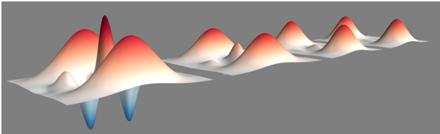
This study lights on the phenomenon of quantum decoherence when Biphoton and Schrödinger cat states are evolve. The primary focus of the work is to explore and analyze the phenomenon of decoherence by virtue of the insightful representations on the way of deriving the Wigner function for the considered states. A crucial aspect of this work involves shedding light on the behaviour of Biphoton and Schrödinger cat states with the same spatial modes and similar theoretical tomography. By considering the influence of an external environment, we further extend our exploration of decoherence, aiming to understand how environment as a factor, impact the stability and coherence of these quantum states.
The Quantum entanglement is a fundamental phe-nomenon in quantum physics that has opened up count-less avenues for futuristic quantum technologies such as quantum information 1, 2, 3, 4, quantum computing 5, 6, 7, and quantum metrology 8, 9, 10. As photon can carry quantum information over long distances with the highest speed 11, the entanglement of photon systems is most important for advancing these technologies 2, 11, 12, the biphoton is an entangled state of two photons and it is a promising state of approach for realizing theoretical analysis 13, 14, 15. However, in any experimental setup, the interaction of photon systems with the environment inevitably causes decoherence 16, 17, which diminishes the intrinsic coherence between the constituents of the system 16. This undesired process was first explained by H. Dieter Zeh in 1970 18 and later explored by Wojciech Zurek in the 1980s 19, 20. To convey desired information through an entangled photon pair, we must design experiments that minimize decoherence.
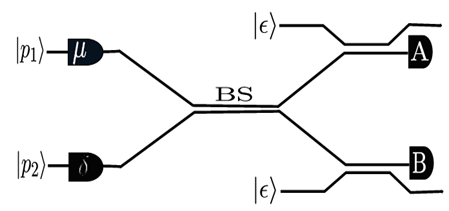
The significance of this study is to express the ir-reversible loss of quantum coherence in biphoton and Schödinger cat states. For this, We have imagined a modified Hong-Ou-Mandel (HOM) interferometer and exploited a simplified method for simulating the Wigner function (se Figure 1). In HOM interferometer, two highly correlated photons are fed into a 50:50 beam splitter (BS). The photons are then either detected in a single detector or less frequently in two separate detectors simultaneously, as evidenced by the HOM dip (a rigorous proof of this statement) 21, 22, 23. The most convenient technique to produce a highly correlated and nonseparable two-photon state is the spontaneous parametric down-conversion (SPDC) process 24, 25, 26. In this robust process, a coherent pump beam is fed into a non-linear medium 27 (say BBO crystal), as a result the emergence of two highly correlated photons, is due to the amalgamation of the characteristics of the pump beam and the non-linear medium 22, 25, 26, 27. If proper phase-matching conditions are implemented, the quadrature variables yield utterly non-Gaussian behavior, which recognize the non-classicality of the entangled system 22, 27, 28.
Theoretically, the Wigner representation 29, more precisely the Wigner quasi-probability distribution 30, is sufficient to analyze and illustrate the arcane behaviour of quantum superposition and entanglement 16, 31. In general, to manifest the characteristics of an entangled system, we explicitly increase the dimensions of the contextual Hilbert space 32, 33, 34, whereas the Wigner representation is itself integrated with entanglement in phase space 30, 35. Most importantly, the epistemology of the acquisition of negative values by the Wigner function, distinctly confirms the non-classical behaviour of the state to be considered and significantly indicates the quantum entanglement 35, 36. Here we are deliberately harnessing the sufficient Wigner approach due to its precisely rooted theory 37, which can easily be imposed in the entangled system without underlying the elaborate theoretical perspectives.

Suppose, a continuous pump beam having monochro-matic, polarized, and degenerated fields, the general two-photon state expressed as 22, 38, 39,
 (1)
(1)
where 𝐹+ is the normalized momentum distribution of the pump beam, F− is the phase matching function and 𝑝𝑖 the Transverse Momentum (TM) vector of the i-th photon. Here, 𝐩± = p𝟏 ± 𝐩𝟐 depict the sum and differences of momentum coordinates. The term 𝐹(𝑝) in equation (1) provides explicit information on the quantum superposi- tion and coherence between the photons in the momentum space. Once we find out the correlation between the spa-tially transverse and canonically conjugate coordinates of the state, the Fourier transform directly measures the Wigner function over the phase space 30, 40.
Here, we have employed a tomography called a direct measurement technique of the Wigner function 22, especially, to define the TM quadrature variables over the phase space 30, which are defined after minor alteration on the formal structure of HOM interferometer 22, as aforementioned.
Let us consider Figure 1, showing a patterned HOM interferometer, and imagine, photons derived by the SPDC process enter through the two distinct input arms of the interferometer. Where a photon of state |𝑝1⟩ faces a variation of 𝜇 in position and the photon of state |𝑝2⟩ faces the momentum variation of 𝛿. These photons pass through a 50:50 beam splitter where they interact physically, and form a biphoton state, and fly toward detectors A and/or B individually or compositely. Theoretically, after position and momentum translation, the state vector of the two-photon system is given by 22
 (2)
(2)
After passing through the BS, the biphoton state will be 22, 38, 39,
 (3)
(3)
Now, suppose the system interacts with the environ-ment (imagined photon bath) indicated by the state vector
 (4)
(4)
Let us consider the case when photons travel through different paths A and B only,
 (5)
(5)
After exhaustive calculations 41 (important steps of calculations are given in Refs 22, 38, 39 and supplementary materials of Refs 22, the coincident probability is mathematically interpreted as
 (6)
(6)
where 𝐹 (𝛾, 𝜏) is theoretically outlined decoherence fac-tor in which 𝛾 is the bandwidth of the transmission arm and 𝜏 decoherence period.
Now, one of the quadrature variable normalized to unity in real part of the equation (6) we get, for a quadra-ture say y,
 (7)
(7)
and for another photon in a different quadrature, say x,
 (8)
(8)
Therefore, the coincidence probability reads to be
 (9)
(9)


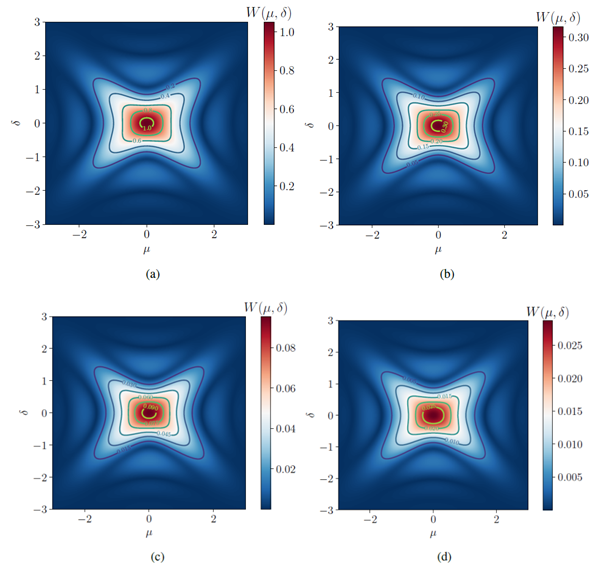
To determine the Wigner distribution function for biphoton state (see Figure 4) we insert the pump beam pr file for the phase-matching function  phase-matching condition
  and coherence phase factor
  in the equation (7), where 𝜔𝑝 is beam width, 𝑘 is wave vector, 𝐿 is the length of non-linear crystal and 𝛼 is the square root of average photon numbers. To get the coincidence probability rate we used equation (9).
So far, we have focused on the biphoton state, in which we were deeply concerned the state vector alone rather than individual basis vectors of the system 16. Conversely, in the Schrödinger cat state, each basis vector is to be considered with a composite state vector 31. These two states have conceptually distinct structures; hence, we have examined the Schrödinger cat state along with a biphoton.
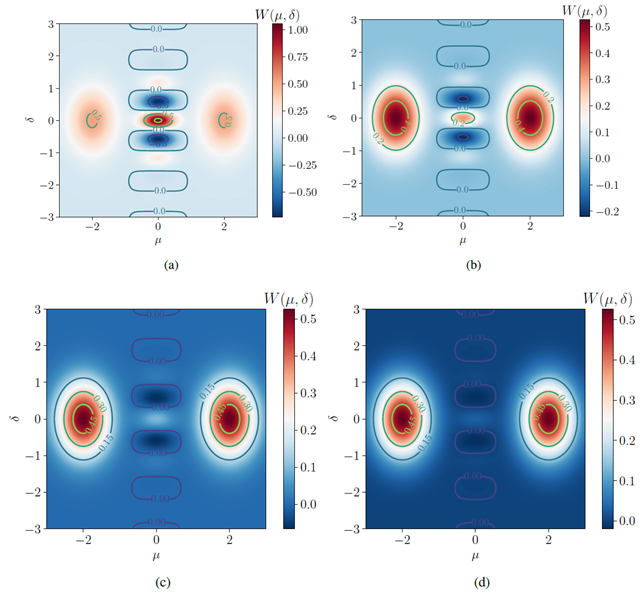
In principle, the Schrödinger cat state is a well-known classical coherent quantum state 31. It is a quantum superposition of multiple quasi-classical coherent states. Mathematically, its Wigner function can acquire nega- tive values (see figure 5) which indicates the quantum su-perposition or interference among its constituents 16, 31. To calculate the Wigner distribution of the Schrödinger cat state, we conceived a Gaussian pump profile that divided onto two coherent waves and added as a coherent sum to create a pure state. Experimentally, it can be determined by using a spatial light modulator (SLM). We implement the difference Δ𝑝 = 𝛼  in TM quadrature for numerical calculations 22 and use equation (8) to get the Wigner distribution, and by equation (9), we calculated the coincidence probability rate.
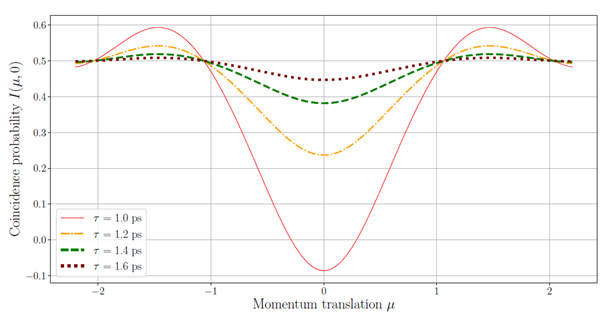
Figure 2 depicts the coincidence probability of the biphoton state as a function of position quadrature and decoherence time. Initially, the coincidence probability is above 60%. However, as the environment interacts with the system, the coincidence rate drops to 50% in the wings. The length of the HOM dip indicates the simultaneity of two photons in two detectors, while the width expresses the magnitude of interference 42. The probability rate exhibits a non-Gaussian pattern, indicating the non-locality of the state 23.
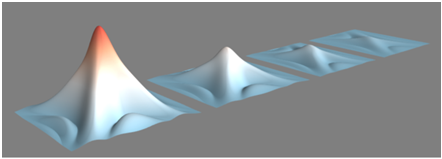
Figure 4 represents the Wigner probability density of biphoton state and Figure 6 depicts the density of proba-bility amplitude for the biphoton entanglement more analytically via contours. It shows that as far as the system interacts with the photon bath, it loses its robustness of entanglement. The probability amplitude gradually decreases in some sub-picoseconds, but it does not completely vanish, meaning that the individual entity remains partially inseparable. Figure 4(a) displays the probability amplitude of the Wigner distribution function of the system before it interacts with the environment.


Figure 6(b) and Figure 6(c) demonstrate that the interaction of the environment gradually reduces the amplitude of the omnipresent spatiotemporal coherence of the system. Finally, Figure 6(d) shows the dominance of decoherence and also the vestige of entanglement until the HOM dip disappears.
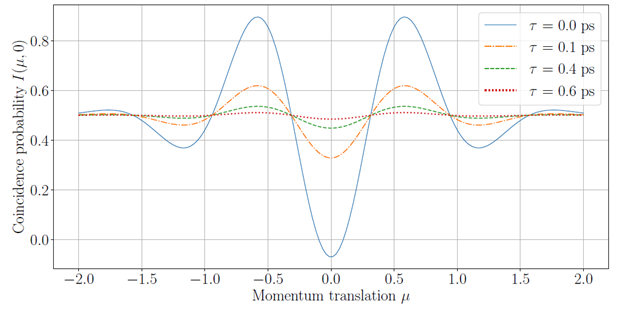
The Schrödinger cat state is a manifestation of nonlo-cal realism in the realm of quantum mechanics 31. This state is essential to demonstrate the non-classical corre-lation between two photons 16, 31. Figure 5 exhibits remarkable interference patterns resulting from quantum superposition, which inevitably diminish due to deco-herence. In figure 3, the coincidence probability of the Schrödinger cat state concerning momentum translation is shown for different times. The interaction with the en-vironment causes the HOM dip to decrease, leading to a weakening of the quantum correlation from 90% to 50%within certain time intervals.
Figure 7 provides a more detailed representation of the Schrödinger cat state via the contour surface of its Wigner distribution. In figure 7(a), the red sports indicate the state of the two photons in distinct detectors, while the dark red spot at the centre with two blue spots indicates the interference between the photons. The blue spots signify the negative part of the Wigner distribution function. Figure 7(b) and (c) demonstrate how decoherence reduces the interference between the photons. In contrast, Figure 7(d) shows that the cat state evolves into a classical mixture or a mixed state of the sum of two classically coherent states.
Figure 2 and Figure 3 provide a quantitative analysis of the biphoton state and Schrödinger cat state, respectively, shedding light on their quantum properties. The coincidence rate for the Schrödinger cat state decreases more rapidly compared to the biphoton state, indicating a faster loss of coherence due to environmental interactions. Moreover, the interference pattern observed in the biphoton state is more pronounced than in the Schrödinger cat state. One possible explanation for this difference is that the entities in the biphoton state are one-to-one correlated, while in the Schrödinger cat state, they are more rapidly separable. This behaviour could be attributed to the non-local nature of the biphoton entanglement 14.
At first glance, one may assume that the theoretical analogies of a biphoton entangled system should guide the selection of entangled states for quantum technologies. However, the ultimate confirmation of this notion lies in the hands of experimentalists who can put these theories to the test in the laboratory. After all, in the realm of quantum mechanics, theory and experiment are two sides of the same coin, and the success of one ultimately depends on the success of the other.
The concern of this work is to explore the decoherence in phase-space via the most valuable phase space distribution function, the Wigner quasi-probability distribution function to taking into account its recent use on quantum technological enhancement to analytically visualization approach, e.g., IBM quantum 43, 44, 45 or Google’s Cirq 46 open cloud platforms, as Qumode 44 studies. This study has advantages like the methods being theoretical, but in parallel to experiments, the direct measurement technique of the Wigner function can provide new ideas to study more complex quantum modes 44.
The main motivation is to spread this insightful scheme for multiple degrees of freedom. Here we have taken for the representation of the behaviour of Quantum Decoherence. It may also be useful to study angular mo- mentum 47 or the characterization of multi-particle en-tangled states 48. The proposed work has a limitation in that experimental verification of the results requires com-plex hardware architectures for verification.


In the realm of microscopic scales, decoherence is an ever-present in ubiquitous form of environmental inter-action. Its behaviour can manifest in various and peculiar ways; a precise understanding of its spasticities is crucial. To this end, we undertook a comprehensive analysis of the coincident probability rate of biphoton and cat states using a patterned HOM interferometer and using numerical simulations of the stochastic theory of the Wigner approach. from the SPDC scheme to direct measurement techniques of the Wigner function allowed us to explore a picture of quantum interference which is being affected by decoherence. It is clear, as far as decoherence persists the coincidence rate declined and the interference pattern for the photons faded out. It can directly cause of difficulties in extracting the information associated with the system, e.g., in quantum computing.
Our study revealed that the peaks of the coincidence rate affected slowly over sub-picoseconds intervals, but remarkably, the one-to-one correspondence between the photons partially persisted indefinitely. It suggests that the information assigned to the photon system will endure even in the presence of quantum decoherence. Which has fascinating implications for entangled states. We also addressed the seemingly inevitable behaviour the HOM dip and offered a concise and intuitive explanation. Finally, one can conclude that the biphoton state is more ambitious than the Schrödinger cat state when compared interference patterns through the Wigner functions.
These methods are not only useful when considering multi-photon states, but they also have numerous implications in quantum optics and quantum information processing.
The authors acknowledge the Department of Physics, SSJ Campus Almora, where this work is performed.
We, the authors, declare that this work is an original report of our research, has been written by us, and has not been submitted for any previous report or else. The theoretical work has been almost entirely done by us; the collaborative contributions have been indicated clearly and acknowledged. Due references have been provided on all supporting literature and resources. Simulations were performed on Arch Linux for its high customizability and performance efficiency. For mathematical calculations and visualization, we used the Python programming language. we found the basic codes from the Python Software Foundation: https://www.python.org. Also, we utilized the necessary Python packages and informative source code from the following links:
NumPy: https://numpy.org
SciPy: https://scipy.org
SymPy: https://sympy.org
Matplotlib: https://matplotlib.org
Mayavi: https://docs.enthought.com/mayavi/mayavi/
Codes used in the work are available from the authors at a reasonable request.
Competing Interests: The authors declare that the no competing interests.
Consent for publication: Not applicable
Funding: There has been no significant financial support for this work.
Conflict of interest: The authors declare no conflicts of interest.
Ethics approval: Not applicable.
Data availability: No datasets were generated or ana-lyzed during the current study.
Consent to participate: Not applicable.
Authors’ contributions: Nandan Singh Bisht exhorts defining the problem of the study and advises exploiting the Wigner approach. Simanshu Kumar executed theoretical works and simulations to determine and explore the results. To prepare the draft, both authors contributed equally. The whole work was performed under the supervision of Nandan Singh Bisht.
| [1] | Bennett, C. H. & DiVincenzo, D. P., Quantum in- information and computation, nature 404, 247–255 (2000). | ||
| In article | View Article PubMed | ||
| [2] | Slussarenko, S. & Pryde, G. J., Photonic quantum information processing: A concise review, Applied Physics Reviews 6 (2019). | ||
| In article | View Article | ||
| [3] | Zhang, H., Ji, Z., Wang, H. & Wu, W., Survey on quantum information security, China Communications 16, 1–36 (2019). | ||
| In article | View Article | ||
| [4] | Horodecki, M., Oppenheim, J. & Winter, A., Partial quantum information, Nature 436, 673–676 (2005). | ||
| In article | View Article PubMed | ||
| [5] | Knill, E., Quantum computing, Nature 463, 441–443 (2010). | ||
| In article | View Article PubMed | ||
| [6] | Walther, P. et al., Experimental one-way quantum computing, Nature 434, 169–176 (2005). | ||
| In article | View Article PubMed | ||
| [7] | Gyongyosi, L. & Imre, S., A survey on quantum computing technology, Computer Science Review 31, 51–71 (2019). | ||
| In article | View Article | ||
| [8] | Giovannetti, V., Lloyd, S. & Maccone, L., Quantum metrology, Physical review letters 96, 010401 (2006). | ||
| In article | View Article PubMed | ||
| [9] | Giovannetti, V., Lloyd, S. & Maccone, L., Advances in quantum metrology, Nature photonics 5, 222–229 (2011). | ||
| In article | View Article | ||
| [10] | Taylor, M. A. & Bowen, W. P., Quantum metrology and its application in biology, Physics Reports 615, 1–59 (2016). | ||
| In article | View Article | ||
| [11] | Takeuchi, S., Recent progress in single-photon and entangled-photon generation and applications, Japanese Journal of Applied Physics 53, 030101 (2014). | ||
| In article | View Article | ||
| [12] | Oka, H., Two-photon absorption by spectrally shaped entangled photons, Physical Review A 97, 033814 (2018). | ||
| In article | View Article | ||
| [13] | Christandl, M., The structure of bipartite quantum states-insights from group theory and cryptography, arXiv preprint quant-ph/0604183 (2006). | ||
| In article | |||
| [14] | Nadal, C., Majumdar, S. N. & Vergassola, M., Statistical distribution of quantum entanglement for a random bipartite state, Journal of Statistical Physics 142, 403–438 (2011). | ||
| In article | View Article | ||
| [15] | Masanes, L., All bipartite entangled states are useful for information processing, Physical Review Letters 96, 150501 (2006). | ||
| In article | View Article PubMed | ||
| [16] | Schlosshauer, M., Quantum decoherence, Physics Reports 831, 1–57 (2019). | ||
| In article | View Article | ||
| [17] | Hornberger, K., in Entanglement and Decoherence: Foundations and Modern Trends 221–276 (Springer, 2009). | ||
| In article | |||
| [18] | Zeh, H. D., On the interpretation of measurement in quantum theory, Foundations of Physics 1, 69– 76 (1970). | ||
| In article | View Article | ||
| [19] | Zurek, W. H., Pointer basis of quantum apparatus: Into what mixture does the wave packet collapse?, Physical review D 24, 1516 (1981). | ||
| In article | View Article | ||
| [20] | Zurek, W. H., Environment-induced superselection rules, Physical review D 26, 1862 (1982). | ||
| In article | View Article | ||
| [21] | Hong, C.K., Ou, Z.Y. & Mandel, L., Measurement of subpicosecond time intervals between two photons by interference, Physical review letters 59, 2044 (1987). | ||
| In article | View Article PubMed | ||
| [22] | Douce, T. et al., Direct measurement of the biphoton Wigner function through two-photon interference, Scientific reports 3, 3530 (2013). | ||
| In article | View Article PubMed | ||
| [23] | Gerrits, T. et al., Spectral correlation measurements at the Hong-Ou-Mandel interference dip, Physical Review A 91, 013830 (2015). | ||
| In article | View Article | ||
| [24] | Harris, S., Oshman, M. & Byer, R., Observation of tunable optical parametric fluorescence, Physical Review Letters 18, 732 (1967). | ||
| In article | View Article | ||
| [25] | Couteau, C., Spontaneous parametric down-conversion, Contemporary Physics 59, 291–304 (2018). | ||
| In article | View Article | ||
| [26] | Kitaeva, G. K. & Penin, A. N., Spontaneous parametric down-conversion, Journal of Experimental and Theoretical Physics Letters 82, 350–355 (2005). | ||
| In article | View Article | ||
| [27] | Boyd, R. W., Gaeta, A. L. & Giese, E., in Springer Handbook of Atomic, Molecular, and Optical Physics 1097–1110 (Springer, 2008). | ||
| In article | |||
| [28] | Ziane, M. & El Baz, M., in Advances in Quantum Communication and Information 47 (IntechOpen, 2019). | ||
| In article | |||
| [29] | Wigner, E., On the quantum correction for thermodynamic equilibrium, Physical review 40, 749 (1932). | ||
| In article | View Article | ||
| [30] | Zachos, C., Fairlie, D. & Curtright, T., Quantum mechanics in phase space: an overview with se- selected papers (2005). | ||
| In article | View Article | ||
| [31] | Gerry, C. & Knight, P., Quantum superpositions and Schrödinger cat states in quantum optics, American Journal of Physics 65, 964–974 (1997). | ||
| In article | View Article | ||
| [32] | Schlosshauer, M. A., Decoherence: and the quantum-to-classical transition (Springer Science & Business Media, 2007). | ||
| In article | |||
| [33] | Kalsoom, H., Ali, M. A., Idrees, M., Agar-wal, P. & Arif, M., New Post Quantum Ana-logues of Hermite–Hadamard Type Inequalities for Interval-Valued Convex Functions, Mathematical Problems in Engineering 2021, 5529650 (2021). | ||
| In article | View Article | ||
| [34] | Hamza, A. E., Shehata, E. M. & Agarwal, P., in Computational Mathematics and Variational Analysis 121–134 (Springer, 2020). | ||
| In article | View Article | ||
| [35] | Walschaers, M., Fabre, C., Parigi, V. & Treps, N., Entanglement and Wigner function negativity of multimode non-Gaussian states, Physical review letters 119,183601 2017). | ||
| In article | View Article PubMed | ||
| [36] | Kenfack, A. & Życzkowski, K., Negativity of the Wigner function as an indicator of non- classicality, Journal of Optics B: Quantum and Semiclassical Optics 6, 396 (2004). | ||
| In article | View Article | ||
| [37] | Nedjalkov, M., Querlioz, D, Dollfus, P & Kosina, H., Wigner function approach, Nano-Electronic Devices: Semiclassical and Quantum Transport Modeling, 289–358 (2011). | ||
| In article | View Article | ||
| [38] | Walborn, S., De Oliveira, A., Pádua, S & Monken, C., Multimode hong-ou-mandel interference, Physical review letters 90, 143601 (2003). | ||
| In article | View Article PubMed | ||
| [39] | Walborn, S. P., Monken, C., Pádua, S & Ribeiro, P. S., Spatial correlations in parametric down-conversion, Physics Reports 495, 87–139 (2010). | ||
| In article | View Article | ||
| [40] | Singh, R. P., Roychowdhury, S. & Jaiswal, V. K., Non-axial nature of an optical vortex and Wigner function, Optics communications 274, 281–285 (2007). | ||
| In article | View Article | ||
| [41] | Ali, M. A. et al., New quantum boundaries for quantum Simpson’s and quantum Newton’s type inequalities for preinvex functions, Advances in Difference Equations 2021, 64 (2021). | ||
| In article | View Article | ||
| [42] | Wang, S., Liu, C.-X., Li, J. & Wang, Q., Research on the Hong-Ou-Mandel interference with two independent sources, Scientific Reports 9, 3854 (2019). | ||
| In article | View Article PubMed | ||
| [43] | Javadi-Abhari, A. et al., Quantum computing with Qiskit, arXiv preprint arXiv: 2405. 08810 (2024). | ||
| In article | |||
| [44] | Stavenger, T. J. et al., C2qa-bosonic qiskit in 2022 IEEE High Performance Extreme Computing Conference (HPEC) (2022), 1–8. | ||
| In article | View Article | ||
| [45] | Bourassa, J. E. et al., Fast simulation of bosonic qubits via Gaussian functions in phase space, PRX Quantum 2, 040315 2021). | ||
| In article | View Article | ||
| [46] | Younis, E. & Iancu, C., Quantum circuit optimization and transpilation via parameterized circuit instantiation in 2022 IEEE International Conference on Quantum Computing and Engineering (QCE) (2022), 465–475. | ||
| In article | View Article | ||
| [47] | Padgett, M., Orbital angular momentum of single photons: revealing quantum fundamentals, Philosophical Transactions A 382, 20230327 (2024). | ||
| In article | View Article PubMed | ||
| [48] | Ji, Z., Zhang, H. & Wang, H., Quantum private comparison protocols with a number of multi-particle entangled states, IEEE Access 7, 44613–44621 (2019). | ||
| In article | View Article | ||
Published with license by Science and Education Publishing, Copyright © 2025 Simanshu Kumar and Nandan S Bisht
 This work is licensed under a Creative Commons Attribution 4.0 International License. To view a copy of this license, visit
http://creativecommons.org/licenses/by/4.0/
This work is licensed under a Creative Commons Attribution 4.0 International License. To view a copy of this license, visit
http://creativecommons.org/licenses/by/4.0/
| [1] | Bennett, C. H. & DiVincenzo, D. P., Quantum in- information and computation, nature 404, 247–255 (2000). | ||
| In article | View Article PubMed | ||
| [2] | Slussarenko, S. & Pryde, G. J., Photonic quantum information processing: A concise review, Applied Physics Reviews 6 (2019). | ||
| In article | View Article | ||
| [3] | Zhang, H., Ji, Z., Wang, H. & Wu, W., Survey on quantum information security, China Communications 16, 1–36 (2019). | ||
| In article | View Article | ||
| [4] | Horodecki, M., Oppenheim, J. & Winter, A., Partial quantum information, Nature 436, 673–676 (2005). | ||
| In article | View Article PubMed | ||
| [5] | Knill, E., Quantum computing, Nature 463, 441–443 (2010). | ||
| In article | View Article PubMed | ||
| [6] | Walther, P. et al., Experimental one-way quantum computing, Nature 434, 169–176 (2005). | ||
| In article | View Article PubMed | ||
| [7] | Gyongyosi, L. & Imre, S., A survey on quantum computing technology, Computer Science Review 31, 51–71 (2019). | ||
| In article | View Article | ||
| [8] | Giovannetti, V., Lloyd, S. & Maccone, L., Quantum metrology, Physical review letters 96, 010401 (2006). | ||
| In article | View Article PubMed | ||
| [9] | Giovannetti, V., Lloyd, S. & Maccone, L., Advances in quantum metrology, Nature photonics 5, 222–229 (2011). | ||
| In article | View Article | ||
| [10] | Taylor, M. A. & Bowen, W. P., Quantum metrology and its application in biology, Physics Reports 615, 1–59 (2016). | ||
| In article | View Article | ||
| [11] | Takeuchi, S., Recent progress in single-photon and entangled-photon generation and applications, Japanese Journal of Applied Physics 53, 030101 (2014). | ||
| In article | View Article | ||
| [12] | Oka, H., Two-photon absorption by spectrally shaped entangled photons, Physical Review A 97, 033814 (2018). | ||
| In article | View Article | ||
| [13] | Christandl, M., The structure of bipartite quantum states-insights from group theory and cryptography, arXiv preprint quant-ph/0604183 (2006). | ||
| In article | |||
| [14] | Nadal, C., Majumdar, S. N. & Vergassola, M., Statistical distribution of quantum entanglement for a random bipartite state, Journal of Statistical Physics 142, 403–438 (2011). | ||
| In article | View Article | ||
| [15] | Masanes, L., All bipartite entangled states are useful for information processing, Physical Review Letters 96, 150501 (2006). | ||
| In article | View Article PubMed | ||
| [16] | Schlosshauer, M., Quantum decoherence, Physics Reports 831, 1–57 (2019). | ||
| In article | View Article | ||
| [17] | Hornberger, K., in Entanglement and Decoherence: Foundations and Modern Trends 221–276 (Springer, 2009). | ||
| In article | |||
| [18] | Zeh, H. D., On the interpretation of measurement in quantum theory, Foundations of Physics 1, 69– 76 (1970). | ||
| In article | View Article | ||
| [19] | Zurek, W. H., Pointer basis of quantum apparatus: Into what mixture does the wave packet collapse?, Physical review D 24, 1516 (1981). | ||
| In article | View Article | ||
| [20] | Zurek, W. H., Environment-induced superselection rules, Physical review D 26, 1862 (1982). | ||
| In article | View Article | ||
| [21] | Hong, C.K., Ou, Z.Y. & Mandel, L., Measurement of subpicosecond time intervals between two photons by interference, Physical review letters 59, 2044 (1987). | ||
| In article | View Article PubMed | ||
| [22] | Douce, T. et al., Direct measurement of the biphoton Wigner function through two-photon interference, Scientific reports 3, 3530 (2013). | ||
| In article | View Article PubMed | ||
| [23] | Gerrits, T. et al., Spectral correlation measurements at the Hong-Ou-Mandel interference dip, Physical Review A 91, 013830 (2015). | ||
| In article | View Article | ||
| [24] | Harris, S., Oshman, M. & Byer, R., Observation of tunable optical parametric fluorescence, Physical Review Letters 18, 732 (1967). | ||
| In article | View Article | ||
| [25] | Couteau, C., Spontaneous parametric down-conversion, Contemporary Physics 59, 291–304 (2018). | ||
| In article | View Article | ||
| [26] | Kitaeva, G. K. & Penin, A. N., Spontaneous parametric down-conversion, Journal of Experimental and Theoretical Physics Letters 82, 350–355 (2005). | ||
| In article | View Article | ||
| [27] | Boyd, R. W., Gaeta, A. L. & Giese, E., in Springer Handbook of Atomic, Molecular, and Optical Physics 1097–1110 (Springer, 2008). | ||
| In article | |||
| [28] | Ziane, M. & El Baz, M., in Advances in Quantum Communication and Information 47 (IntechOpen, 2019). | ||
| In article | |||
| [29] | Wigner, E., On the quantum correction for thermodynamic equilibrium, Physical review 40, 749 (1932). | ||
| In article | View Article | ||
| [30] | Zachos, C., Fairlie, D. & Curtright, T., Quantum mechanics in phase space: an overview with se- selected papers (2005). | ||
| In article | View Article | ||
| [31] | Gerry, C. & Knight, P., Quantum superpositions and Schrödinger cat states in quantum optics, American Journal of Physics 65, 964–974 (1997). | ||
| In article | View Article | ||
| [32] | Schlosshauer, M. A., Decoherence: and the quantum-to-classical transition (Springer Science & Business Media, 2007). | ||
| In article | |||
| [33] | Kalsoom, H., Ali, M. A., Idrees, M., Agar-wal, P. & Arif, M., New Post Quantum Ana-logues of Hermite–Hadamard Type Inequalities for Interval-Valued Convex Functions, Mathematical Problems in Engineering 2021, 5529650 (2021). | ||
| In article | View Article | ||
| [34] | Hamza, A. E., Shehata, E. M. & Agarwal, P., in Computational Mathematics and Variational Analysis 121–134 (Springer, 2020). | ||
| In article | View Article | ||
| [35] | Walschaers, M., Fabre, C., Parigi, V. & Treps, N., Entanglement and Wigner function negativity of multimode non-Gaussian states, Physical review letters 119,183601 2017). | ||
| In article | View Article PubMed | ||
| [36] | Kenfack, A. & Życzkowski, K., Negativity of the Wigner function as an indicator of non- classicality, Journal of Optics B: Quantum and Semiclassical Optics 6, 396 (2004). | ||
| In article | View Article | ||
| [37] | Nedjalkov, M., Querlioz, D, Dollfus, P & Kosina, H., Wigner function approach, Nano-Electronic Devices: Semiclassical and Quantum Transport Modeling, 289–358 (2011). | ||
| In article | View Article | ||
| [38] | Walborn, S., De Oliveira, A., Pádua, S & Monken, C., Multimode hong-ou-mandel interference, Physical review letters 90, 143601 (2003). | ||
| In article | View Article PubMed | ||
| [39] | Walborn, S. P., Monken, C., Pádua, S & Ribeiro, P. S., Spatial correlations in parametric down-conversion, Physics Reports 495, 87–139 (2010). | ||
| In article | View Article | ||
| [40] | Singh, R. P., Roychowdhury, S. & Jaiswal, V. K., Non-axial nature of an optical vortex and Wigner function, Optics communications 274, 281–285 (2007). | ||
| In article | View Article | ||
| [41] | Ali, M. A. et al., New quantum boundaries for quantum Simpson’s and quantum Newton’s type inequalities for preinvex functions, Advances in Difference Equations 2021, 64 (2021). | ||
| In article | View Article | ||
| [42] | Wang, S., Liu, C.-X., Li, J. & Wang, Q., Research on the Hong-Ou-Mandel interference with two independent sources, Scientific Reports 9, 3854 (2019). | ||
| In article | View Article PubMed | ||
| [43] | Javadi-Abhari, A. et al., Quantum computing with Qiskit, arXiv preprint arXiv: 2405. 08810 (2024). | ||
| In article | |||
| [44] | Stavenger, T. J. et al., C2qa-bosonic qiskit in 2022 IEEE High Performance Extreme Computing Conference (HPEC) (2022), 1–8. | ||
| In article | View Article | ||
| [45] | Bourassa, J. E. et al., Fast simulation of bosonic qubits via Gaussian functions in phase space, PRX Quantum 2, 040315 2021). | ||
| In article | View Article | ||
| [46] | Younis, E. & Iancu, C., Quantum circuit optimization and transpilation via parameterized circuit instantiation in 2022 IEEE International Conference on Quantum Computing and Engineering (QCE) (2022), 465–475. | ||
| In article | View Article | ||
| [47] | Padgett, M., Orbital angular momentum of single photons: revealing quantum fundamentals, Philosophical Transactions A 382, 20230327 (2024). | ||
| In article | View Article PubMed | ||
| [48] | Ji, Z., Zhang, H. & Wang, H., Quantum private comparison protocols with a number of multi-particle entangled states, IEEE Access 7, 44613–44621 (2019). | ||
| In article | View Article | ||