In this work, germanium doped cesium tin triiodide (CsSnI3-Ge) perovskite thin films, incorporated with a 5mole% germanium (Ge) concentration were deposited on fluorine doped tin (IV) oxide (FTO) substrates using spin coating technique and the films were synthesized under different spin coating speeds. Ge was used as a dopant to curb the problem of the rapid oxidation of tin (II) ions (Sn2+) to tin (IV) ions (Sn4+) in the presence of oxygen. Optical measurements were done using ultraviolet visible (UV-Vis) spectrophotometer, structural measurements were carried out using an X-ray diffraction (XRD) machine and the morphological analysis was done using a scanning electron microscope (SEM). The CsSnI3-Ge layer deposited at a spin coating speed of 4000 revolutions per minute(rpm) displayed the highest absorbance with a band gap value in the range of 2.85 eV to 3.36 eV which was higher than the ideal value of ~1.5 eV. Structural analysis on the different CsSnI3-Ge films displayed a consistent orthorhombic structure across all samples and SEM images revealed almost identical crystallite sizes. Generally, the perovskite film synthesized by spin coating speed of 4000 rpm displayed higher absorbance, higher crystallinity and a possibly uniform film morphology making it the optimal layer for solar cell applications.
Mankind has been looking for a source of energy that is commercially viable and environmentally sustainable for many years. The current global demand for power is at 16 TW and is estimated to increase beyond 30 TW by 2050 1. Therefore, intense research is being carried out to get power generation systems to cover this expected demand. Most of the energy consumed is produced from non-renewable resources such as coal, petroleum, uranium, and natural gas which leads to their depletion at a faster rate causing a series of environmental problems 2. It is now confirmed that the burning of fossil fuels alone cannot cover the expected hike in energy demand. It has been proposed that renewable energy sources offer an alternative for power generation that include nuclear, tidal, hydropower, geothermal, wind and solar energies 3.
Due to their direct sunlight-to-electricity conversion, photovoltaic (PV) solar cells are a promising and preferred choice for power generation among researchers. Solar energy as opposed to wind or hydropower is not location dependent and is available almost anywhere on earth. The direct conversion of sunlight to electricity by solar panels makes them a suitable choice as opposed to wind and hydropower which depend on kinetic energy conversion to electric energy, an energy transfer process which is prone to losses. Solar energy is still evolving, and a lot of research is being conducted to improve their efficiency, stability and cost reduction. In this work, perovskites are investigated owing to their cost effectiveness and high efficiency. However, their long-term stability is still something to be looked at.
Perovskites are compounds that have ABX3 as their general formula. A, B and X are three different species where A and B are cations and X is an anion. Perovskite materials have a broad absorption range when it comes to the solar spectrum with just a thin layer of material making them greatly efficient. The vast potential of perovskite solar cells (PSCs) is evident since their power conversion efficiency (PCE) has risen gradually from 3.8% to 25.2% in the last decade, while other technologies took nearly 30 years to witness this milestone 1. PSCs can be synthesized in laboratories using wet chemical techniques with the help of simple low-cost techniques, such as spin coating, dip coating, screen printing, dual source evaporation techniques, etc. 1. Despite all the merits, poor device stability, short lifetime, and toxicity of lead are creating hindrances in the path of commercialization of PSCs.
Among the several low-toxicity cations that have been proposed for replacing lead in perovskites, Sn based perovskites have shown the highest efficiency (PCE > 14%) and are gravitating towards 20% PCE 4. Cesium-based all-inorganic PSCs have attracted increasing attention due to their advantage of superior thermal and phase stability 5. The perovskite layer is the vital part of the PSC and is formed when a solution containing the perovskite sample is placed onto the electron transport layer (ETL) or hole transport layer (HTL) and permitted to crystallize. This perovskite layer serves as the main material for light absorption in the device, it absorbs light consequently generating electron-hole pairs. In this work, cesium tin triiodide (CsSnI3) perovskite is doped with Ge to exert control over charge carrier lifetime, Sn oxidation and defect density recombination which results to improved stability for solar cell applications 6. In this study the synthesis of CsSnI3-Ge was done via a low-cost solution mixing process followed by spin coating for deposition.
Commercial FTO-coated glass substrates formed the foundational base for deposition and the essential chemical components in this study included cesium (II) iodide powder, tin (II) iodide powder, and Ge powder. These materials were crucial for the desired perovskite structure. Solvents such as dimethylformamide (DMF), dimethyl sulfoxide (DMSO) and chlorobenzene played integral roles in solution preparation and film processing. Distilled water, ethanol and acetone were indispensable for cleaning throughout the synthesis process. A magnetic stirrer aided in solution mixing, a vacuum oven was used for drying and a spin coater ensured uniform substrate coating of the perovskite.
2.2. MethodologyBefore deposition, the FTO substrates underwent a multi-stage cleaning process. First, the substrates surfaces were wiped using a clean residue free wipe dipped in acetone to remove any dust, dirt and fingerprint. This was followed by further cleaning using ethanol to remove organic contaminants like grease and oil. The substrates were then rinsed with distilled water to remove any residue that remained from the organic solvents. Finally, they were dried for 15 minutes in a vacuum oven at a low temperature of 50°C to avoid possible damage to the FTO substrate coatings.
CsSnI3-Ge solution was obtained by combining 0.65 g ± 0.01 g CsI, 0.93 g ± 0.01 g SnI2 powders and a 5mole% Ge concentration which is equivalent to 0.036 g ± 0.001 g of Ge powder and dissolved them in 15 ml DMF and DMSO mixed solution mixed at 1:2 ratio. The solution was stirred well for complete dissolution using a magnetic stirrer at 80°C.100 µL of the resultant CsSnI3-Ge solution was then spin coated onto each of the three FTO substrates with a single spin cycle rotation with speeds of 2000 rpm, 3000 rpm and 4000 rpm respectively for 60 seconds each. 100 µL of antisolvent chlorobenzene was applied 20 seconds before the end of each spin cycle followed by drying of the films in a vacuum oven at room temperature for 30 minutes. Annealing of the films was done at 120°C for 30 minutes.
The optical properties of the deposited films were measured using the UV-Vis spectrophotometer located at the department of Physics at Egerton University to analyze optical absorbance. The XRD patterns of the three perovskite films were obtained using a Rigaku Ultima IV X-ray diffractometer at the University of Michigan with Cu-Kα radiation (40 kV/ 44 mA) of wavelength λ = 1.5406 Å at an angle 2θ. The SEM images were captured using a FEI Nova 200 Nano lab system located at the University of Michigan under a 20,000 X magnification.
A material’s photoconductivity depends on how much light energy is absorbed by the material 7. Therefore, absorptivity is crucial in the electricity production process. In this investigation, CsSnI3-Ge layer was deposited via spin coating at three distinct speeds of 2000 rpm, 3000 rpm and 4000 rpm on FTO glass substrates at a fixed time of 60 seconds.
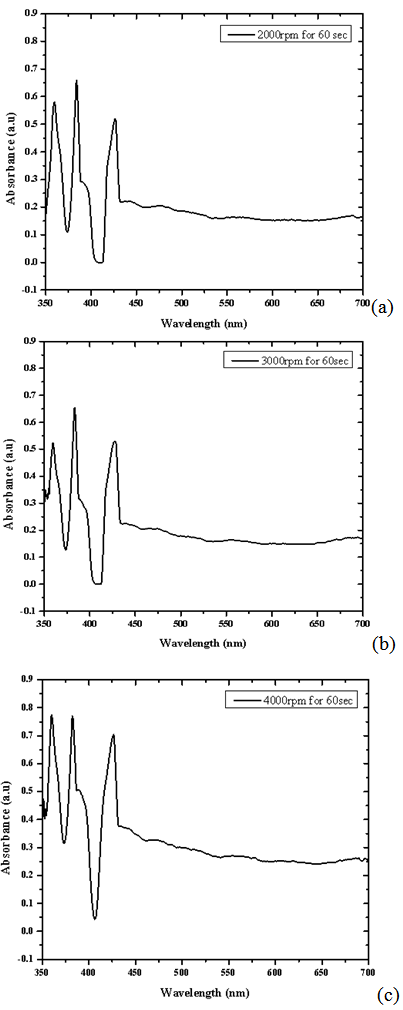
The graphical representations of the optical absorbance of the CsSnI3-Ge layer measured as a function of wavelength show a strong absorption peak in the visible light spectrum for all the three samples and then drops above 500 nm wavelength. This is in close agreement with the absorption range of perovskites which is between 400-750 nm and decreases above 600 nm 8. Absorption is noted to be higher at shorter wavelengths as compared to longer wavelengths in all the layers. The strong absorption peaks can be attributed to direct band transitions of electrons from the valence band to the conduction band in relation to the band gap energy of the material 9. This agrees with the theoretical relationship between wavelength (λ) and bang gap energies 10:
 | (1) |
Where  is the Planck’s constant, c the speed of light and
  the band gap of the material. As a result, the strong absorption peaks observed at the specific wavelengths could correspond to the band gap energy of the material. One of the products from the possible Sn oxidation in the perovskite layer is SnI4 and 11 identified its unique absorption spectra. The strong SnI4 peaks tend to appear at about 380 nm wavelength which can further explain the strong peaks appearing at about the same wavelength in this study. These peaks are consistent in all the figures and could suggest the presence of SnI4 in all three films.
The absorbance spectrums displayed in the figures generally show that CsSnI3-Ge perovskite is a good absorber of photons. Figure 1 (a) represents the absorbance spectrum of the CsSnI3-Ge perovskite layer deposited at a spin coating speed of 2000 rpm. Absorbance is high at lower wavelengths between 350-450 nm then drops (<0.2 a. u) at 450 nm and remains constant above 500 nm wavelength. The suspected yellow phase perovskite determined from the band gap value is said to only absorb light at shorter wavelengths 12 which can explain the blue shift in the peaks of these perovskite films. The sharp peaks observed at the lower wavelengths for all the three films could suggest the presence of other phases corresponding to the additional peaks also found from the XRD findings.
The thin film deposited at 3000 rpm spin coating speed displays an almost similar absorbance spectrum as the 2000 rpm thin film as is seen in figure 1 (b). Absorbance is high at lower wavelengths of below 450 nm drops above 460 nm and remains nearly constant above 500 nm. Both layers (2000 rpm, 3000 rpm thin films) display a high absorbance of approximately 0.66 a.u in the lower region of visible light range. Spin coating speed affects the thickness of the thin films 13 however, the difference in thickness between the two films is negligible. This accounts for their nearly identical absorption spectra at spin coating rotational speeds of 2000 and 3000 rpm.

Figure 1 (c) displays the absorbance spectrum of the CsSnI3-Ge thin films deposited at a spin coating speed of 4000 rpm. This speed displays a relatively high absorbance of approximately 0.77 a. u in the visible light region. Absorbance is relatively high in the 350-450 nm range with the display of high intensity peaks. It then drops above 450nm and then remains nearly constant above 500 nm (<0.3 a. u). It has been shown that the absorbance of tin-based perovskites is easily influenced by the film thickness and the crystal quality of the perovskite 14. These reasons could have resulted in peak intensities variations at different speeds.
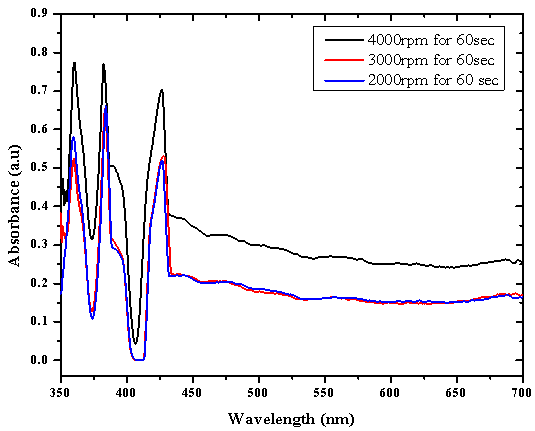
The absorbance spectrum of the thin film resultant from 3000 rpm speed had a slightly lower absorbance though with a similar trend as the 2000 rpm counterpart thin film. This was why they exhibited almost identical thickness. It was suggested that the spin coating speed of 2000 rpm and 3000 rpm have negligible influence on variation of thickness in CsSnI3-Ge thin film. Comparing all three samples, it can be suggested that the layers produced at speeds of 2000 rpm and 3000 rpm display the lowest absorbance across the visible light spectrum because they formed thicker films due to lower speeds. The layers have a chance of suffering from scattering losses causing the low absorption 13. It was also suggested that scattering losses may also be caused by the roughness and non-uniform surfaces of the resultant 2000 rpm and 3000 rpm speed layers as seen in the SEM images in figure 5 (a) and 5 (b).
Finally, the thin film deposited at 4000 rpm speed displayed the highest absorbance as compared to the other two samples seen in figure 2. Smoother films attract higher absorbance because there is enhanced light trapping as there is minimal light scattering at the surface of the film 15. This could explain the higher absorbance of the layer deposited at 4000 rpm speed compared to its counterparts as a result. Therefore, higher speeds possibly result in thinner, smoother films. Additionally, thinner films have less material, which means there are fewer opportunities for light to be scattered or reflected within the film. As a result, more light is absorbed by the material. Perovskites are expected to be good absorbers of light hence the sample with the highest absorption is preferred. In this study, the CsSnI3-Ge thin film resulting from the 4000 rpm spin speed is the optimal film.

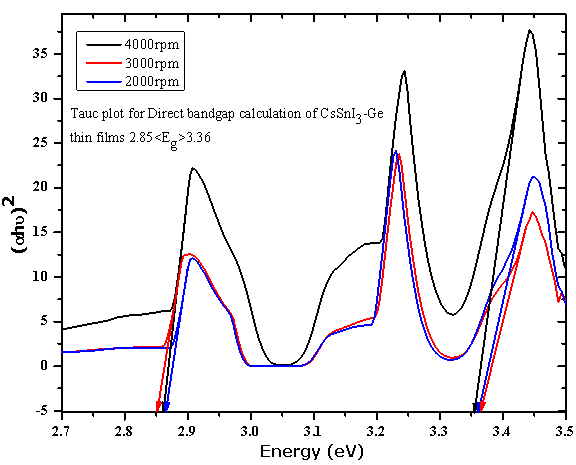
The band gap of the three perovskite films deposited at different spin coating speeds of 2000 rpm, 3000 rpm and 4000 rpm were determined via the Tauc plot using the Tauc relation:
 | (2) |
Where  is the photon energy, α the absorption coefficient,
  the material’s dependent constant and
  the optical bandgap of the material. The absorption coefficient was obtained using equation (3):
 | (3) |
A graph of  was plotted as a function of
  as shown in figure 3. The bandgap was determined by extrapolating the linear region(s) of the curve. The point where the lines intercepted the x-axis is the band gap.

Analysis suggested that all the films display almost similar band gap values that lie between 2.85 eV to 3.36 eV. This observation suggested that spin coating speeds had no serious influence or impact on the band gap of the CsSnI3-Ge thin films. However, these values are higher than the reported literature values at ~ 1.5 eV 16. This higher band gap could be attributed to the partial doping with Ge which may have not fully dissolved in the DMF/DMSO solution and may have caused the native oxidation of Sn2+ vacancies to Sn4+ leading to the generation of Ge rich regions forming p-type orientations. The ideal band gap for most single-junction solar cells has a range of 1.5 eV to 2.4 eV based on the Shockley–Queisser limit. It is important to note that band gap can be easily tuned by adjusting parameters like doping and temperature during deposition. Tenability is possible since tin trihalide perovskites are also known to have large band gaps which in turn lead to a low absorption capacity 12.
Yellow phase compounds are characterized by large band gaps which could be the reason behind the huge band gap range (2.85 eV to 3.36 eV) for the perovskite in this study. This is in close agreement with the reported band gap value of 2.99 eV of yellow orthorhombic CsSnI3 perovskite phase, indicating that the structure could have undergone phase transition at some point 12. CsSnI3 can also completely convert into a non-perovskite phase, Cs2SnI6 under storage in air for short periods of 48 hours or less which is also yellow in color 17, 29 making this another possible reason for the wider band gap in this study. However, the band gap of Cs2SnI6 is 1.48 eV which is narrower than the value in this study further suggesting the formation of the yellow orthorhombic CsSnI3 perovskite phase and elimination of the possibility of the Cs2SnI6 phase formation.
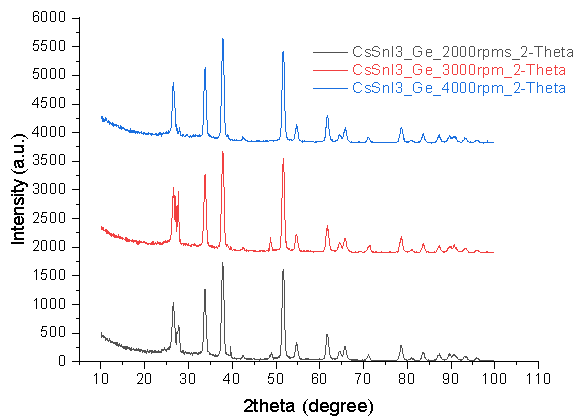
3.2. Structural Analysis of CsSnI3-Ge thin filmsFigure 4 is an XRD pattern of the three samples deposited at different spin coating speeds of 2000 rpm, 3000 rpm and 4000 rpm. The successful synthesis of the perovskite structures was confirmed by the sharp peaks which correspond to specific planes in the crystal structures. Higher peaks are as a result of a greater degree of crystallinity and the sharpness of the peaks can also indicate the crystallinity degree. Nearly all the peaks from the samples at different spin speeds of 2000 rpm, 3000 rpm and 4000 rpm have similar diffraction planes indicating that they might all have a similar crystalline phase. This shows that the change in spin coating speeds did not alter the crystal structure of the perovskite. However, there are two missing peaks in the 4000 rpm sample that are present in the 2000 rpm and 3000 rpm samples. These peaks are positioned at approximately 27.6° and 48.7° 2θ angles. This can be attributed to the higher kinetic energy experienced at higher speeds which may have altered the preferred orientation of the crystals within the film 23. This induced the alignment of crystals in a specific direction which may have resulted in the suppression of the peaks in the 4000 rpm sample pattern.
CsSnI3 is a unique phase change perovskite and can exist in four polymorphic phases including the black tetragonal (Bβ), black cubic (Bα), black orthorhombic (Bγ) and yellow orthorhombic (Yγ). On air exposure, the Bγ phase can change to the Yγ phase due to the oxidation of Sn 18. Peaks of about 27° and 29°are known to correspond to Bγ CsSnI3 phase of the (202) plane 19 therefore, in this study the 26.5° and 27.6° peak angles could suggest the presence of CsSnI3 perovskite. However, only three of the characteristic peak angles reported for the Bγ CsSnI3 20 match the peak angles in this study which could suggest the presence of a different phase. It can be concluded that the observed XRD patterns for all the three thin films synthesized at different spin coating speeds seen in figure 4 are in good agreement with the reported orthorhombic structure of yellow CsSnI3 with space group pnma 21. They also found that the Yγ CsSnI3 polymorph is the most stable at room temperature when exposed to organic solvents as compared to the Bγ CsSnI3 polymorph. This also corresponds to the suspected structure determined during band gap calculation in section 3.1.2. These results further confirm the presence of the Yγ CsSnI3 crystal structure.
The reported characteristic peaks of CsI and SnI2 are about 12.8° and 27.6° respectively 22. In this study, no intensity peak is observed at 12.8° but there is a high intensity peak at about 27.6°. This could mean that there was an excess of SnI2 residue due to the incomplete solubility of Ge where a complete reaction with SnI2 was expected. On the other hand, the existence of no peak at around 12.8° could mean that there were no residues left of CsI. The additional short peaks could suggest the presence of other phases 23. Nearly all the peaks from the samples at different spin coating speeds of 2000 rpm, 3000 rpm and 4000 rpm have similar intensities with the 4000 rpm thin film displaying slightly higher intensity peaks. Higher intensity peaks correspond to better/higher crystallinity which is preferred because device stability is highly dependent on the crystallinity of the perovskite layer 24. It can be concluded that higher speeds promote crystal growth as seen from the increased intensity of the peaks with an increase in spin coating speeds.

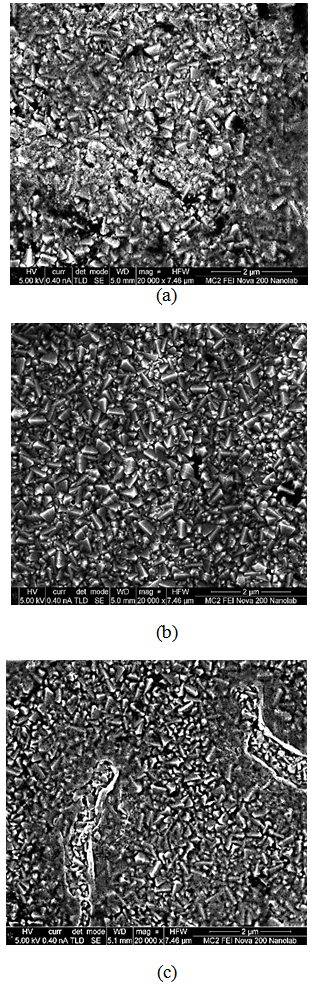
The morphological analysis of the surface of the three films synthesized at different spin coating speeds of 2000 rpm, 3000 rpm and 4000 rpm were determined using SEM yielding the images displayed in figures 5 (a), 5 (b) and 5(c). During measurement, the operating conditions for the imaging remained consistent for all the three samples. The accelerating voltage 5.00 kV and a beam current of 0.40 nA with a working distance (WD) of 5.0 -5.1 mm were maintained for all the samples. The film crystals and sizes are equally and evenly distributed. All the three top view SEM images displayed rhombic shaped crystallites. However, the SEM images for the three samples were found to have slightly different morphologies which is evidence that spin coating speed affects the morphology of thin films.
From the images shown in figure 5 (a), (b) and (c) there is no significant difference in crystal size. Due to the incomplete solubility of Ge, the resultant CsSnI3 perovskite phase possibly undergoes oxidation from Sn2+ to Sn4+ during crystallization. This oxidation could lead to incomplete surface coverage 25. It can also be seen that spin coating speed has an impact on the uniformity of the CsSnI3-Ge perovskite layer. Morphology control in Sn based perovskites can be challenging because of their rapid oxidation. The 2000 rpm layer appears to have incomplete surface coverage with layer grains as seen in figure 5 (a). The surface also appears to be relatively rough and is likely thicker making it more prone to agglomeration. The 3000 rpm layer appears smoother and more compact in comparison to the 2000 rpm layer. The crystals seem more refined and there are fewer visible gaps. The increased centrifugal force may have resulted in the film’s improved uniformity because of the rapid spread. This also results in the formation of a thinner film which agrees with literature findings 13 that higher speeds result to thinner films 28. However, some regions in this layer show particle agglomeration where large clusters were visible with irregularities in distribution as seen in figure 5 (b).
In the third and last image which represents the highest spin coating speed of 4000 rpm, the surface appears more uniform as compared to the other two samples mentioned above, an indication that high speeds result in more uniform films. This is because of the faster nucleation and crystallization associated with high speeds 26. Therefore, the surface could appear smooth with less visible grain boundaries as can be seen in figure 5 (c). The smoother surface and thinner film may result from rapid solvent removal and improved solution spreading during synthesis. In solar cells, smother surfaces lead to improved charge transport and reduced charge recombination consequently minimizing leakage current 27. Therefore, it is critical to achieve a smooth perovskite surface. Among the three samples highlighted in this study, the 4000 rpm layer possibly resulted in a smoother layer.

This research successfully investigated the optical, structural and morphological analysis of the CsSnI3-Ge perovskite thin films spin coated at different speeds. The CsSnI3-Ge thin films absorption spectra reveal that spin coating speed has an effect on absorbance with the 4000 rpm thickness layer displaying the highest absorbance among the three investigated speeds. The band gap of the films was revealed to be in the range of 2.85 eV to 3.36 eV which is higher than the reported value of ~1.5 eV and this is attributed to the incomplete Ge incorporation into the CsSnI3 perovskite which can exist in different phases. From this study, the band gap value corresponded to the Yγ CsSnI3 perovskite phase. The XRD analysis revealed the presence of an orthorhombic phase which corresponds to the Yγ structure obtained from the optical measurements of the thin films. There is a possible presence of additional phases seen from the additional XRD peaks. The additional peaks may have resulted from defects or a thin layer of metal oxide on the surface of the film. The 4000 rpm layer displays the highest intensity peaks corresponding to better crystallinity, suggesting that higher speeds promote crystal growth.
The morphological analysis of the CsSnI3-Ge films shows incomplete surface coverage resulting from the oxidation of Sn2+ to Sn4+ during crystallization due to the partial solubility of Ge powder. No significant difference in crystallite sizes is observed from the images for the different spin coating speeds. However, the surface of the 4000 rpm is likely smoother, thinner and more uniform as compared to the other two surfaces suggesting that higher speeds result in smoother, more uniform thin films. In this study, the CsSnI3-Ge film deposited at 4000 rpm was selected as a potential candidate for fabricating a perovskite- based solar cell. Due to equipment limitations we were unable to conduct atomic force microscopy (AFM) measurements to determine the surface roughness of the films but it is recommended in future studies. An inert atmosphere or an all-vacuum environment is also recommended for the synthesis of Sn based perovskites in future research. This is to prevent the rapid native oxidation of Sn2+, in turn minimizing the phase inconsistencies for enhanced solar cell performance. Alternative synthesis routes for Ge doping should also be explored to attain an ideal band gap value for maximum absorption.
This work was carried out with a grant in the UNESCO-TWAS program, ‘‘Seed Grant for African Principal Investigators,’’ financed by the German Federal Ministry of Education and Research (BMBF) grant agreement No. 4500474973. The views expressed herein do not necessarily represent those of UNESCO-TWAS or BMBF.
The authors declare that they have no competing interests.
a.uAbsorbance units
DMFDimethylformamide
DMSODimethyl sulfoxide
FTOFlourine doped tin (IV) oxide
PCEPower conversion efficiency
PSCPerovskite solar cell
PVPhotovoltaic
RpmRevolutions per minute
SEMScanning electron microscope
UV-VISUltraviolet visible spectroscopy
WDWorking distance
XRDX-ray diffraction
| [1] | Roy, P., Sinha, N. K., Tiwari, S., & Khare, A., “A review on perovskite solar cells: Evolution of architecture, fabrication techniques, commercialization issues and status”, Solar Energy, 198, 665-688. 2020. | ||
| In article | View Article | ||
| [2] | Sathiyan, G., Wang, H., Chen, C., Miao, Y., Zhai, M., & Cheng, M., “Impact of fluorine substitution in organic functional materials for perovskite solar cell”, Dyes and Pigments, 198, 110029. 2022. | ||
| In article | View Article | ||
| [3] | Abas, N., Kalair, A., & Khan, N., “Review of fossil fuels and future energy technologies”, Futures, 69, 31-49. 2015. | ||
| In article | View Article | ||
| [4] | Jiang, X., Li, H., Zhou, Q., Wei, Q., Wei, M., Jiang, L., ... & Ning, Z., “One-step synthesis of SnI2·(DMSO) x adducts for high-performance tin perovskite solar cells”, Journal of the American Chemical Society, 143(29), 10970-10976. 2021. | ||
| In article | View Article PubMed | ||
| [5] | Zeng, Q., Zhang, X., Liu, C., Feng, T., Chen, Z., Zhang, W., ... & Yang, B., “Inorganic CsPbI2Br perovskite solar cells: the progress and perspective”, Solar Rrl, 3(1), 1800239. 2019. | ||
| In article | View Article | ||
| [6] | Seyed-Talebi, S. M., & Beheshtian, J., “Lead-free inorganic cesium tin-germanium triiodide perovskites for photovoltaic application”, International Journal of Energy and Power Engineering, 15(6), 252-257. 2021. | ||
| In article | |||
| [7] | Hossain, M. K., Toki, G. I., Kuddus, A., Rubel, M. H. K., Hossain, M. M., Bencherif, H., ... & Mushtaq, M., “An extensive study on multiple ETL and HTL layers to design and simulation of high-performance lead-free CsSnCl3-based perovskite solar cells”, Scientific Reports, 13(1), 2521. 2023. | ||
| In article | View Article PubMed | ||
| [8] | Chen, L. C., Chen, J. C., Chen, C. C., & Wu, C. G., “Fabrication and properties of high-efficiency perovskite/PCBM organic solar cells”, Nanoscale research letters, 10, 1-5. 2015. | ||
| In article | View Article PubMed | ||
| [9] | Parves, S., Mina, S., Nahid, F., Hussain, K. M. A., & Habib, A., “Optical and structural properties of vacuum evaporated tin oxide (SnO2) thin films”, Research gate. 2020. | ||
| In article | |||
| [10] | Vasconcelos, H. C., Meirelles, M., Özmenteş, R., & Korkut, A., “Vacuum Ultraviolet Spectroscopic Analysis of Structural Phases in TiO2 Sol–Gel Thin Films”, Coatings, 15(1), 19. 2024. | ||
| In article | View Article | ||
| [11] | Leijtens, T., Prasanna, R., Gold-Parker, A., Toney, M. F., & McGehee, M. D., “Mechanism of tin oxidation and stabilization by lead substitution in tin halide perovskites”, ACS Energy Letters, 2(9), 2159-2165. 2017. | ||
| In article | View Article | ||
| [12] | Nematov, D. D., Burkhonzoda, A. S., Kurboniyon, M. S., Zafari, U., Kholmurodov, K. T., Brik, M. G., ... & Shokir, F., “The Effect of Phase Changes on Optoelectronic Properties of Lead-Free CsSnI3 Perovskites”, Journal of Electronic Materials, 1-11. 2025. | ||
| In article | View Article | ||
| [13] | Yan, Y., Zhou, P., Zhang, S. X., Guo, X. G., & Guo, D. M., “Effect of substrate curvature on thickness distribution of polydimethylsiloxane thin film in spin coating process”, Chinese physics B, 27(6), 068104. 2018. | ||
| In article | View Article | ||
| [14] | Wu, T., Liu, X., Luo, X., Lin, X., Cui, D., Wang, Y., ... & Han, L., “Lead-free tin perovskite solar cells”, Joule, 5(4), 863-886. 2021. | ||
| In article | View Article | ||
| [15] | Kumar, A., Pandey, N., Punetha, D., Saha, R., Choudhary, S., & Chakrabarti, S., “Reduced graphene oxide (rGO)-CsSnI3 nanocomposites: a cost-effective technique to improve the structural and optical properties for optoelectronic device applications”, In Organic, Hybrid, and Perovskite Photovoltaics XXIV (Vol. 12660, pp. 63-72). SPIE. 2023. | ||
| In article | View Article | ||
| [16] | Chen, M., Ju, M. G., Garces, H. F., Carl, A. D., Ono, L. K., Hawash, Z., ... & Padture, N. P., “Highly stable and efficient all-inorganic lead-free perovskite solar cells with native-oxide passivation”, Nature communications, 10(1), 16. 2019. | ||
| In article | View Article PubMed | ||
| [17] | Qiu, X., Cao, B., Yuan, S., Chen, X., Qiu, Z., Jiang, Y., ... & Kanatzidis, M. G., “From unstable CsSnI3 to air-stable Cs2SnI6: A lead-free perovskite solar cell light absorber with bandgap of 1.48 eV and high absorption coefficient”, Solar Energy Materials and Solar Cells, 159, 227-234. 2017. | ||
| In article | View Article | ||
| [18] | Chung, I., Song, J. H., Im, J., Androulakis, J., Malliakas, C. D., Li, H., ... & Kanatzidis, M. G., “CsSnI3: semiconductor or metal? High electrical conductivity and strong near-infrared photoluminescence from a single material. High hole mobility and phase-transitions”, Journal of the american chemical society, 134(20), 8579-8587. 2012. | ||
| In article | View Article PubMed | ||
| [19] | Minj, S., Shukla, N., & Tiwari, S., “Fabrication and characterization of CsSnI3 perovskite layer for solar cell applications”, In Women in Optics and Photonics in India 2022 (Vol. 12638, p. 1263802). SPIE. 2023. | ||
| In article | View Article | ||
| [20] | Howlader, A. H., Li, F., & Zheng, R., “Nanorod-like nanocrystalline CsSnI3 and CNT composite thin film–based hybrid photodetector”, Emergent Materials, 5(6), 1925-1943. 2022. | ||
| In article | View Article | ||
| [21] | Zhang, J., Yu, C., Wang, L., Li, Y., Ren, Y., & Shum, K., “Energy barrier at the N719-dye/CsSnI3 interface for photogenerated holes in dye-sensitized solar cells”, Scientific reports, 4(1), 6954. 2014. | ||
| In article | View Article PubMed | ||
| [22] | Zhu, P., Chen, C., Gu, S., Lin, R., & Zhu, J., “CsSnI3 Solar Cells via an Evaporation‐Assisted Solution Method”, Solar RRL, 2(4), 1700224. 2018. | ||
| In article | View Article | ||
| [23] | Sutton, R. J., Filip, M. R., Haghighirad, A. A., Sakai, N., Wenger, B., Giustino, F., & Snaith, H. J., “Cubic or orthorhombic? Revealing the crystal structure of metastable black-phase CsPbI3 by theory and experiment”, ACS Energy Letters, 3(8), 1787-1794. 2018. | ||
| In article | View Article | ||
| [24] | Fakharuddin, A., Di Giacomo, F., Ahmed, I., Wali, Q., Brown, T. M., & Jose, R., “Role of morphology and crystallinity of nanorod and planar electron transport layers on the performance and long term durability of perovskite solar cells”, Journal of Power Sources, 283, 61-67. 2015. | ||
| In article | View Article | ||
| [25] | Liu, X., Wang, Y., Wu, T., He, X., Meng, X., Barbaud, J., ... & Han, L., “Efficient and stable tin perovskite solar cells enabled by amorphous-polycrystalline structure”, Nature communications, 11(1), 2678. 2020. | ||
| In article | View Article PubMed | ||
| [26] | Osman, M. M., Almutairi, Z., & Almuzaiqer, R., “Effect of spin coating speeds on electrical and optical characteristic of perovskite SrTiO3 thin films prepared by sol-gel method”, Results in Engineering, 24, 103046. 2024. | ||
| In article | View Article | ||
| [27] | Qu, Z., Zhao, Y., Ma, F., Mei, L., Chen, X. K., Zhou, H., ... & You, J., “Enhanced charge carrier transport and defects mitigation of passivation layer for efficient perovskite solar cells”, Nature Communications, 15(1), 8620. 2024. | ||
| In article | View Article PubMed | ||
| [28] | Mendhe, Avinash C., Spin coating: Easy technique for thin films, Simple Chemical Methods for Thin Film Deposition, Synthesis and Applications. Singapore: Springer Nature Singapore, 2023. 387-424. | ||
| In article | View Article | ||
| [29] | Kontos, A. G., Kaltzoglou, A., Siranidi, E., Palles, D., Angeli, G. K., Arfanis, M. K., ... & Falaras, P, “Structural stability, vibrational properties, and photoluminescence in CsSnI3 perovskite upon the addition of SnF2”, Inorganic chemistry, 56(1), 84-91. 2017. | ||
| In article | View Article PubMed | ||
Published with license by Science and Education Publishing, Copyright © 2025 Marion Mogusu, Duke Oeba and Cliff Mosiori
 This work is licensed under a Creative Commons Attribution 4.0 International License. To view a copy of this license, visit
http://creativecommons.org/licenses/by/4.0/
This work is licensed under a Creative Commons Attribution 4.0 International License. To view a copy of this license, visit
http://creativecommons.org/licenses/by/4.0/
| [1] | Roy, P., Sinha, N. K., Tiwari, S., & Khare, A., “A review on perovskite solar cells: Evolution of architecture, fabrication techniques, commercialization issues and status”, Solar Energy, 198, 665-688. 2020. | ||
| In article | View Article | ||
| [2] | Sathiyan, G., Wang, H., Chen, C., Miao, Y., Zhai, M., & Cheng, M., “Impact of fluorine substitution in organic functional materials for perovskite solar cell”, Dyes and Pigments, 198, 110029. 2022. | ||
| In article | View Article | ||
| [3] | Abas, N., Kalair, A., & Khan, N., “Review of fossil fuels and future energy technologies”, Futures, 69, 31-49. 2015. | ||
| In article | View Article | ||
| [4] | Jiang, X., Li, H., Zhou, Q., Wei, Q., Wei, M., Jiang, L., ... & Ning, Z., “One-step synthesis of SnI2·(DMSO) x adducts for high-performance tin perovskite solar cells”, Journal of the American Chemical Society, 143(29), 10970-10976. 2021. | ||
| In article | View Article PubMed | ||
| [5] | Zeng, Q., Zhang, X., Liu, C., Feng, T., Chen, Z., Zhang, W., ... & Yang, B., “Inorganic CsPbI2Br perovskite solar cells: the progress and perspective”, Solar Rrl, 3(1), 1800239. 2019. | ||
| In article | View Article | ||
| [6] | Seyed-Talebi, S. M., & Beheshtian, J., “Lead-free inorganic cesium tin-germanium triiodide perovskites for photovoltaic application”, International Journal of Energy and Power Engineering, 15(6), 252-257. 2021. | ||
| In article | |||
| [7] | Hossain, M. K., Toki, G. I., Kuddus, A., Rubel, M. H. K., Hossain, M. M., Bencherif, H., ... & Mushtaq, M., “An extensive study on multiple ETL and HTL layers to design and simulation of high-performance lead-free CsSnCl3-based perovskite solar cells”, Scientific Reports, 13(1), 2521. 2023. | ||
| In article | View Article PubMed | ||
| [8] | Chen, L. C., Chen, J. C., Chen, C. C., & Wu, C. G., “Fabrication and properties of high-efficiency perovskite/PCBM organic solar cells”, Nanoscale research letters, 10, 1-5. 2015. | ||
| In article | View Article PubMed | ||
| [9] | Parves, S., Mina, S., Nahid, F., Hussain, K. M. A., & Habib, A., “Optical and structural properties of vacuum evaporated tin oxide (SnO2) thin films”, Research gate. 2020. | ||
| In article | |||
| [10] | Vasconcelos, H. C., Meirelles, M., Özmenteş, R., & Korkut, A., “Vacuum Ultraviolet Spectroscopic Analysis of Structural Phases in TiO2 Sol–Gel Thin Films”, Coatings, 15(1), 19. 2024. | ||
| In article | View Article | ||
| [11] | Leijtens, T., Prasanna, R., Gold-Parker, A., Toney, M. F., & McGehee, M. D., “Mechanism of tin oxidation and stabilization by lead substitution in tin halide perovskites”, ACS Energy Letters, 2(9), 2159-2165. 2017. | ||
| In article | View Article | ||
| [12] | Nematov, D. D., Burkhonzoda, A. S., Kurboniyon, M. S., Zafari, U., Kholmurodov, K. T., Brik, M. G., ... & Shokir, F., “The Effect of Phase Changes on Optoelectronic Properties of Lead-Free CsSnI3 Perovskites”, Journal of Electronic Materials, 1-11. 2025. | ||
| In article | View Article | ||
| [13] | Yan, Y., Zhou, P., Zhang, S. X., Guo, X. G., & Guo, D. M., “Effect of substrate curvature on thickness distribution of polydimethylsiloxane thin film in spin coating process”, Chinese physics B, 27(6), 068104. 2018. | ||
| In article | View Article | ||
| [14] | Wu, T., Liu, X., Luo, X., Lin, X., Cui, D., Wang, Y., ... & Han, L., “Lead-free tin perovskite solar cells”, Joule, 5(4), 863-886. 2021. | ||
| In article | View Article | ||
| [15] | Kumar, A., Pandey, N., Punetha, D., Saha, R., Choudhary, S., & Chakrabarti, S., “Reduced graphene oxide (rGO)-CsSnI3 nanocomposites: a cost-effective technique to improve the structural and optical properties for optoelectronic device applications”, In Organic, Hybrid, and Perovskite Photovoltaics XXIV (Vol. 12660, pp. 63-72). SPIE. 2023. | ||
| In article | View Article | ||
| [16] | Chen, M., Ju, M. G., Garces, H. F., Carl, A. D., Ono, L. K., Hawash, Z., ... & Padture, N. P., “Highly stable and efficient all-inorganic lead-free perovskite solar cells with native-oxide passivation”, Nature communications, 10(1), 16. 2019. | ||
| In article | View Article PubMed | ||
| [17] | Qiu, X., Cao, B., Yuan, S., Chen, X., Qiu, Z., Jiang, Y., ... & Kanatzidis, M. G., “From unstable CsSnI3 to air-stable Cs2SnI6: A lead-free perovskite solar cell light absorber with bandgap of 1.48 eV and high absorption coefficient”, Solar Energy Materials and Solar Cells, 159, 227-234. 2017. | ||
| In article | View Article | ||
| [18] | Chung, I., Song, J. H., Im, J., Androulakis, J., Malliakas, C. D., Li, H., ... & Kanatzidis, M. G., “CsSnI3: semiconductor or metal? High electrical conductivity and strong near-infrared photoluminescence from a single material. High hole mobility and phase-transitions”, Journal of the american chemical society, 134(20), 8579-8587. 2012. | ||
| In article | View Article PubMed | ||
| [19] | Minj, S., Shukla, N., & Tiwari, S., “Fabrication and characterization of CsSnI3 perovskite layer for solar cell applications”, In Women in Optics and Photonics in India 2022 (Vol. 12638, p. 1263802). SPIE. 2023. | ||
| In article | View Article | ||
| [20] | Howlader, A. H., Li, F., & Zheng, R., “Nanorod-like nanocrystalline CsSnI3 and CNT composite thin film–based hybrid photodetector”, Emergent Materials, 5(6), 1925-1943. 2022. | ||
| In article | View Article | ||
| [21] | Zhang, J., Yu, C., Wang, L., Li, Y., Ren, Y., & Shum, K., “Energy barrier at the N719-dye/CsSnI3 interface for photogenerated holes in dye-sensitized solar cells”, Scientific reports, 4(1), 6954. 2014. | ||
| In article | View Article PubMed | ||
| [22] | Zhu, P., Chen, C., Gu, S., Lin, R., & Zhu, J., “CsSnI3 Solar Cells via an Evaporation‐Assisted Solution Method”, Solar RRL, 2(4), 1700224. 2018. | ||
| In article | View Article | ||
| [23] | Sutton, R. J., Filip, M. R., Haghighirad, A. A., Sakai, N., Wenger, B., Giustino, F., & Snaith, H. J., “Cubic or orthorhombic? Revealing the crystal structure of metastable black-phase CsPbI3 by theory and experiment”, ACS Energy Letters, 3(8), 1787-1794. 2018. | ||
| In article | View Article | ||
| [24] | Fakharuddin, A., Di Giacomo, F., Ahmed, I., Wali, Q., Brown, T. M., & Jose, R., “Role of morphology and crystallinity of nanorod and planar electron transport layers on the performance and long term durability of perovskite solar cells”, Journal of Power Sources, 283, 61-67. 2015. | ||
| In article | View Article | ||
| [25] | Liu, X., Wang, Y., Wu, T., He, X., Meng, X., Barbaud, J., ... & Han, L., “Efficient and stable tin perovskite solar cells enabled by amorphous-polycrystalline structure”, Nature communications, 11(1), 2678. 2020. | ||
| In article | View Article PubMed | ||
| [26] | Osman, M. M., Almutairi, Z., & Almuzaiqer, R., “Effect of spin coating speeds on electrical and optical characteristic of perovskite SrTiO3 thin films prepared by sol-gel method”, Results in Engineering, 24, 103046. 2024. | ||
| In article | View Article | ||
| [27] | Qu, Z., Zhao, Y., Ma, F., Mei, L., Chen, X. K., Zhou, H., ... & You, J., “Enhanced charge carrier transport and defects mitigation of passivation layer for efficient perovskite solar cells”, Nature Communications, 15(1), 8620. 2024. | ||
| In article | View Article PubMed | ||
| [28] | Mendhe, Avinash C., Spin coating: Easy technique for thin films, Simple Chemical Methods for Thin Film Deposition, Synthesis and Applications. Singapore: Springer Nature Singapore, 2023. 387-424. | ||
| In article | View Article | ||
| [29] | Kontos, A. G., Kaltzoglou, A., Siranidi, E., Palles, D., Angeli, G. K., Arfanis, M. K., ... & Falaras, P, “Structural stability, vibrational properties, and photoluminescence in CsSnI3 perovskite upon the addition of SnF2”, Inorganic chemistry, 56(1), 84-91. 2017. | ||
| In article | View Article PubMed | ||