Some important factors affecting the photoelectric conversion efficiency of solar cells consists of shunt resistance ( ), series resistance (
 ) and capacitance (
 ). In order to improve the performance of silicon solar cell, it is essential either to characterize these parameters or to modify them by using external factors during the operation of the solar cell. In this work we investigate theoretically the behavior of shunt resistance, series resistance and capacitance when illuminated silicon solar cell is irradiated with low energy electrons emitted from Pm-147. By varying the fluence of incident particles up to the value of 3.1010 cm-2 we observed an increase in capacitance and a decrease in shunt resistance and series resistance which induces an improvement in the performance of the solar cell. It appeared that the illuminated PV cell in steady state irradiated by low energy electrons behaves like a PV cell in the absence of irradiation but whose electrical parameters vary depending on the fluence of incident particles.
For over six decades, it has been possible to convert particles emitted from radioactive decay into electrical energy using semiconductors as absorber materials 1. The basic principle of direct nuclear-to-electric energy conversion involves absorbing nuclear particles in a semiconductor, creating electron-hole pairs (charge carriers), and then separating those charge carriers within the semiconductor using electric field within the junction 2. Given that semiconductor lattice damage occurs when beta-particle energy exceeds ~300 keV, Promethium-147 (147Pm) is selected due to its beta particles, which have an average kinetic energy of 62.5 KeV. Series resistance and shunt resistance significantly impact the performance of solar cells. The selection of raw materials and improper control of industrial process conditions greatly influence the resistance of batteries which in turn affects the efficiency of solar cells 3, 4, 5. Therefore enhancing solar cells performance is directly related to a better understanding of some key parameters and the technological processes involved in designing these optoelectronic devices 6, or the use of external factors 7 to improve the performance of the solar cell during its operation. This present work examines the impact of low energy electrons radiation on the series resistance ( ), shunt resistance (
 ), and capacitance (
 ) of an illuminated silicon solar cell. The goal is to show how these electrical parameters are affected by the incident beta flux. To achieve this, the dependence of electrical parameters on the incident beta flux is determined. Then, using expression from 8, we derived finals expressions for
 ,
, ,
,  and finally produce equivalent electrical circuit.
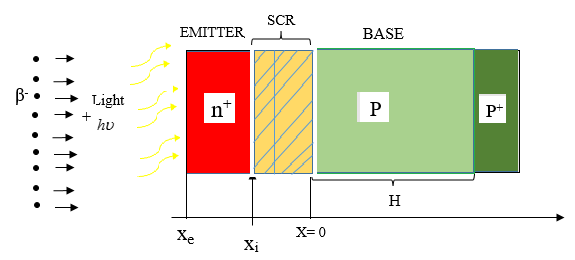
In our study, we consider a polycrystalline silicon solar cell under multispectral illumination and irradiated by beta electrons from a Pm-147 source. Figure 1 shows the cross-section of an n+-p-p+ silicon solar cell, where β- is beta particle emitted from radioactive isotopes (Pm-147). The n+ doped region is emitter (Nd = 2.1018 cm-3), p doped region is base (Na = 5.1016 cm-3) and p+ is the rear region in contact with the base which is responsible for the back surface field.

Where Xi is junction position, Xe is front side of solar cell position and H is the base thickness.
Considering the beta spectrum of Pm-147 we assume that the beta radiation will generate charge carriers in the emitter, in the space charge region (SCR) and also in the base. As for solar illumination, it only generates the charge carriers in the base. Considering the small thicknesses of the emitter and space charge region (SCR), we will simply assume that the open circuit voltage of the entire cell is equal to that of the base of the cell. We also consider that only beta particles having energy equal to that of the average energy generate the charge carriers. By solving the minority-carrier diffusion equation in each of the three parts of the solar cell we can obtain the analytical expression of total current density ( ), short-circuit current density (
 ), beta-photovoltage (
 ), open circuit voltage (
 ) and then, shunt resistance (Rsh), series resistance (
 ) and capacitance (
 ) of the solar cell.
• In the emitter
In the emitter, the minority charge carriers are holes and are essentially generated by the beta electrons. So the minority-carrier diffusion equation is given by:
 | (1) |
 , is hole concentration with nuclear radiation, respectively, Dp refers to hole diffusion coefficient, and G(x) refers to the electron-hole generation rate. The expression of G(x) is derived from 9
 | (2) |
Where E, is the kinetic energy of beta particles, α is absorption coefficient, ϕ is incident beta flux, R is reflection coefficient, and ε is the average energy necessary for production of an electron-hole pair. The expression of ε, is given by 10
 | (3) |
(Eg) is the bandgap of semiconductor. The boundaries conditions for the equation (1) are given by the following equations:
• In the front side of the emitter
 | (4) |
• In the rear side of the emitter
 | (5) |
 Is the surface recombination velocity.
  refers to hole diffusion coefficient and it value is
  = 2.66cm2/s
Taking into account these previous boundaries conditions we derived the expression of current density
 | (6) |
And the short circuit current (JEsc) in emitter is then given by:
 | (7) |
• In the base
In the base, the minority charge carriers are electrons and are generated by both beta electrons and solar illumination. So the minority-carrier diffusion equation is given by:
 | (8) |
Where G2(x) is given by:
 | (9) |
The coefficients ai and bi are obtained from the modeling of the generation rate by considering the entire spectrum of solar radiation under air mass AM 1.5. The boundaries conditions for the equation (8) are given by:
 | (10) |
And
 | (11) |
Sf is junction dynamic velocity and Sb is recombination velocity at the rear side of the base.  Refers to electron diffusion coefficient and it value is:
  = 27cm2/s
The current density in the base is derived from this following expression
 | (12) |
And the short circuit current is given by:
 | (13) |
• In the space charge region (SCR)
The charge carriers generated in depletion region are drawn out of this area very quickly due to the electric field 11. Thus, the current density ( ) and short circuit current
  can be given by:
 | (14) |
• For entire solar cell
Concerning the current density ( ) and short circuit current (
 ) we assume that it is the sum of current density and the sum of short circuit current from the three regions and it can be expressed by:
 | (15) |
And
 | (16) |
From Boltzmann approximation the expression of voltage is derived:
 | (17) |
The open circuit voltage ( ) is given from this following expression
  for
for  (18)
(18)
 ), Series Resistance (
 ) and Capacitance (
 ) and Conversion Efficiency
• Expression of shunt resistance ( )
)
The shunt resistance is due to manufacturing defects and also lightly by poor solar cell design 12. The shunt resistance comes from the recombination of charge carriers in volume, surface (hanging links and manufacturing technology) and possible short circuits at the junction of the photovoltaic cell. It is also indicative of a good quality of a solar cell because when it is large (respectively small), the leakage current through the solar cell is low (respectively large) 6, it also due to the contamination of the silver aluminum paste on the positive surface 3. In fact, the shunt resistance corresponds to poorly identified phenomena. These effects are difficult to model correctly because they are nonlinear, unsymmetrical and unstable in nature. It appears on the curves of the J-V characteristics that when we are in the zone near short-circuit, the cell behaves like an ideal current generator (horizontal characteristic). On the other hand, beyond short-circuit, the cell behaves like a current generator i.e. as a current source in derivation with the shunt resistance of the solar cell.
So the dependence of Rsh on incident beta flux can be derived from 8, and it expression is given by:
 | (19) |
• Expression of series resistance ( )
)
The series resistance is caused by the movement of electrons through the emitter and the base of a solar cell, the contact resistance between the metal contact and the silicon and the resistance of metal grids at the front and the rear of the solar cell 12. Like all other known generators of electrical power, solar cells possess some internal series resistance. This internal series resistance is so important as to determine the current-voltage characteristic of most of these power generators. This is, however, not the case with the solar cells 13. It appears on the curves of J-V characteristics that when we are in the zone near the open circuit (low values of  ), the cell behaves like an ideal voltage generator (vertical characteristic). However, in the vicinity of the open circuit, the cell behaves like a real voltage generator i.e. a voltage source in series with the series resistance of the cell. Thus, beyond the open circuit, the J-V characteristic is not vertical but oblique as we highlight it later on Figure 3.
 | (20) |
• Expression of Capacitance (C)
By its structure, the junction of the solar cell behaves like a capacitor of capacity  depending on the width of the space charge region (SCR). From the expression of the density of the charge carriers in the base and that of the charge carriers beta-generated in the SCR, we can evaluate the quantity Q of charge (electrons) stored at the junction:
 | (21) |
In this expression, q refers to single electron charge,  represent the total density of charge carriers at the junction, A is the junction area and W is SCR width. The expression of the SCR capacitance is given by classical relationship:
 | (22) |
Where  is the voltage delivered by solar cell across the junction.
Taking into account the expression of shunt resistance ( ) given by (19), it appears that (
 ) depend on incident beta flux. So, the dependence of (
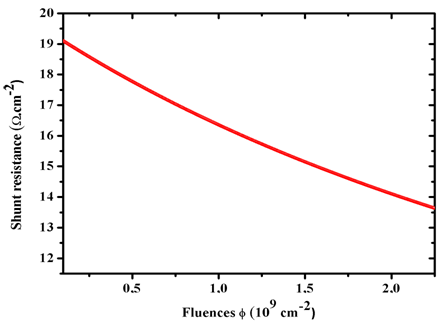
 ) on incident beta flux can be plotted. The figure 2 below show the effect of the incident beta flux on the solar cell shunt resistance.

We notice in this Figure 2 that the shunt resistance decreases with increasing incident particles fluence. This decrease of the shunt resistance reflects the appearance of a leakage current which increases with the fluence. This phenomenon can be explained by the fact that the increase in the fluence lead to an increase in the number of charge carriers (electrons) crossing at the junction and consequently the number of carriers likely to recombine at the junction. If the number of charge carriers that recombine at the junction increases, the leakage current increases which will lead to a decrease of the shunt resistance.
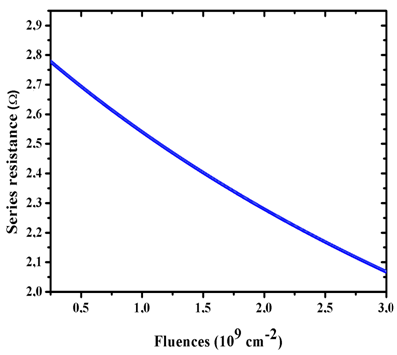
3.2. Effect of Incident Beta Flux on Series ResistanceIn this section we present in figure 3 the dependence of series resistance on the incident beta flux.
We observe on this figure that the series resistance decreases with the increase in the incident beta flux. This suggests an increase in the open circuit voltage, which is in accordance with the observations made in our previous work 14. Far from representing a decrease of the loss of charged carrier in the bulk with the increase of the incident beta flux, the decrease of the series resistance is in reality the consequence of the increase in the concentration of carriers in the bulk with the increase in the incident beta flux. Indeed, if there are more charge carriers in the bulk, the ratio of the number of carriers likely to recombine decrease and consequently the series resistance decrease. However, this decrease of the series resistance represents a good sign in terms of improving the PV cell performances, as it means an increase in open circuit voltage.

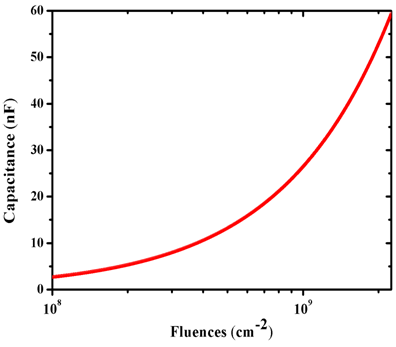
Equation (22) induces the fact that the capacitance ( ) depends on the incident beta flux. We present in figure 5, the capacitance (
 ) versus the flux of incident beta (log scale).

We notice that the capacitance of the SCR increases strongly with the increase in the incident beta flux. Contrary to what you might think, the increase of the capacity of SCR doesn’t mean an improvement of the quality of the junction. It results of the increase of carrier’s generation inside the SCR with increase of beta flux. However this increase has a positive influence on the global PV cell performances for, it means the increase of charged carriers crossing the junction to participate to the photocurrent.
3.3. Equivalent Electrical Circuit of the Illuminated PV Cell Under Low Energy ElectronsIn this section, we propose an equivalent electrical circuit of the PV cell under irradiation from the different results obtained above.
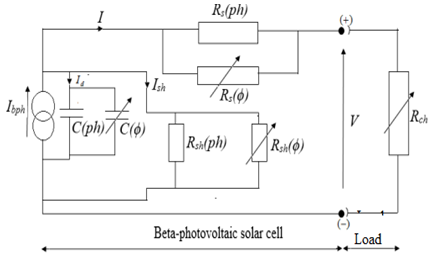
First, we saw that the shunt resistance decreased with the increase in the incident beta fluence, so the equivalent shunt resistance  is lower than the shunt resistance in the absence of irradiation and it corresponds to the bypass association of the shunt resistance in the absence of irradiation and a resistance induced by irradiation. From a mathematical point of view, we therefore have:
 | (23) |
Second, we showed that the series resistance decreases with the increase in the incident beta flux, so the equivalent series resistance  is lower than the series resistance in the absence of irradiation and it corresponds to the bypass association of the series resistance in the absence of irradiation and a resistance induced by irradiation, it value is determines from the following expression:
 | (24) |
Finally, we were able to show that the capacitance of the cell increased with the increase in the incident beta flux, which means that the equivalent capacitance is greater than the capacitance in the absence of irradiation, it corresponds to a bypass association of the capacitance in the absence of irradiation and that induced by irradiation. So we have:
 | (25) |
So the corresponding equivalent electrical circuit of an illuminated PV cell under low energy electrons can therefore be illustrated as shown in Figure 5.

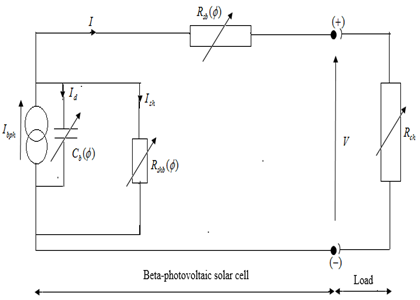
Thus, taking into account the different associations (series and bypass) in our equivalent electrical circuit we produce a reduced equivalent electrical circuit, which we represent in Figure 6.

It emerges from Figure 5 and Figure 6 that the illuminated PV cell in steady state under low energy electrons behaves like a PV cell in the absence of irradiation but whose electrical parameters are variable.
The foregoing discussion illuminates the effect of low energy electrons emitted from Pm-147 on capacitance, series and shunt resistances of an illuminated silicon PV cell. We showed that shunt resistance as well as series resistance increase with the increase in incident beta fluence contrary to capacitance which increase with the increase in incident beta fluence. Through the resolution of continuity equation we established the expressions of capacitance, series and shunt resistances as a function of incident beta fluence. From the evolution of the studied electrical parameters ( ), we produced the equivalent electrical circuits of the illuminated PV cell under irradiation. The decrease in series resistance as well as the decrease in shunt resistance observed mean that the cogeneration (light with low energy electrons) compensates the losses of the charge carriers at the surface, at the grain boundaries as well as at the level of the collecting electrodes and increases the number of carriers likely to be recombine when crossing the junction. The increase in capacitance mean that low energy electrons increase the number of charged carriers likely to be stored in the SCR. Considering those previous results we can confirm that the low energy beta radiation has a positive influence on the performance of an illuminated solar cell.
The study demonstrates that low energy electron radiation significantly impacts the electrical parameters of silicon solar cells. Understanding these effects is crucial for optimizing the design and performance of solar cells in environments exposed to such radiation.
The authors wish to thank International Science Program (ISP) for funding our research group and allowing conducting these works.
| [1] | P. Rappaport, “The electron-voltaic effect in p-n junctions induced by beta-particle bombardment”, Physical Review, vol. 93, pp. 246–247, 1954. | ||
| In article | View Article | ||
| [2] | Sergey I. Maximenko, Jim E. Moore, Chaffra A. Affouda and Phillip p. Jenkins ‘‘optimal semiconductors for 3H and 63Ni Betavoltaics’’ Scientific Reports (2019) 9:10892. | ||
| In article | View Article PubMed | ||
| [3] | Yue Wang, Xue Li, and Chunjie Wang ‘‘the Study of Resistance and Relative Mechanism of the Low Efficiency Single Silicon Solar Cell’’ 7th International Conference on Management, Education and Information (MEICI 2017). Advances in Intelligent Systems Research, volume 156. | ||
| In article | View Article | ||
| [4] | Priyanka Singh, Nuggehalli M. Ravindra ‘‘Analysis of series and shunt resistance in silicon solar cells using single and double exponential models’’ Emerging Materials Research Volume 1 Issue EMR1, Pages 33–38. | ||
| In article | View Article | ||
| [5] | M. Fortes, E. comesana, J. A. Rodriguez, P. Otero, A. J. Garcia Loureiro‘‘Impact of Series and Shunt resistances in amorphous silicon thin film Solar cells’’ Solar Energy 100(2014)114-123. | ||
| In article | View Article | ||
| [6] | Gokhan Sahin, Genber Kerimli, Fabe Idrissa Barro, Moustapha Sane, Mehmet Hakki Alma ‘‘Performance of conversion efficiency of a crystalline silicon Solar cell with base doping density’’ Results in Physics 7(2017) 4264-4268. | ||
| In article | View Article | ||
| [7] | M. D. Abbott, T. Trupke, H. P. Hartmann, R. Gupta, and O. Breitenstein, “Laser isolation of shunted regions in industrial solar cells,”Progress in Photovoltaics: Research and Applications, vol.15, no.7, pp.613–620, 2007. | ||
| In article | View Article | ||
| [8] | Abdul Kareem, M.S. and Saravanan, M. (2016) A New Method for Accurate Estimation of PV Module Parameters and Extraction of Maximum Power Point under Varying Environmental Conditions. Turkish Journal of Electrical Engineering and Computer Sciences, 24, 2028-2041. | ||
| In article | View Article | ||
| [9] | L. C. Olsen, “Beta irradiation of silicon juction devices:effects on diffusion length,” IEEE Transactions on Nuclear Science, vol.19, pp. 375-381, 1972. | ||
| In article | View Article | ||
| [10] | Claude A. Klein, ‘‘Bandgap Dependence and Related Features of Radiation Ionization Energies in Semiconductors’’ J. Appl. Phys. 39, 2029 (1968). | ||
| In article | View Article | ||
| [11] | Kai Wu, Changhong Dai, Hang Guo ‘‘A Theoretical Study on Silicon Betavoltaics using Ni-63’’ Proceedings of the 2011 6th IEEE International Conference on Nano/Micro Engineered and Molecular Systems February 20-23, 2011, Kaohsiung, Taiwan. | ||
| In article | View Article | ||
| [12] | Mbodji, S., Ly, I., Diallo, H.L., Dione, M.M., Diasse, O. and Sissoko, G. (2012) Modeling Study of N+/P Solar Cell Resistances from Single I-V Characteristic Curve Considering the Junction Recombination Velocity (Sf). Research Journal of Applied Sciences, Engineering and Technology, 4, 1-7. | ||
| In article | |||
| [13] | Martin Wolf and Hans Rauschenbach ‘‘Series Resistance Effects on Solar Cell Measurements’’ Advanced Energy Conversion. Vol. 3, pp. 455-479. Pergamon Press, 1963. Printed in Great Britain. | ||
| In article | View Article | ||
| [14] | Guy Serge Tchouadep, E. K. Tchédré , I. Sourabié , I. Zerbo , and Martial Zoungrana1 ‘‘Modelling the Influence of Low Energy Electrons Emitted from Pm-147 on the Performance of a Silicon PV Cell’’ International Journal of Innovation and Applied Studies ISSN 2028-9324 Vol. 36 No. 1 Apr. 2022, pp. 205-212 © 2022 Innovative Space of Scientific Research Journals http://www.ijias.issr-journals.org/. | ||
| In article | |||
Published with license by Science and Education Publishing, Copyright © 2024 Tchouadep Guy Serge, Kpéli Esso Ehanam Tchedre, Soro Boubacar, Compaore Wendlassida Patrice, Zerbo Issa and Zoungrana Martial
 This work is licensed under a Creative Commons Attribution 4.0 International License. To view a copy of this license, visit
https://creativecommons.org/licenses/by/4.0/
This work is licensed under a Creative Commons Attribution 4.0 International License. To view a copy of this license, visit
https://creativecommons.org/licenses/by/4.0/
| [1] | P. Rappaport, “The electron-voltaic effect in p-n junctions induced by beta-particle bombardment”, Physical Review, vol. 93, pp. 246–247, 1954. | ||
| In article | View Article | ||
| [2] | Sergey I. Maximenko, Jim E. Moore, Chaffra A. Affouda and Phillip p. Jenkins ‘‘optimal semiconductors for 3H and 63Ni Betavoltaics’’ Scientific Reports (2019) 9:10892. | ||
| In article | View Article PubMed | ||
| [3] | Yue Wang, Xue Li, and Chunjie Wang ‘‘the Study of Resistance and Relative Mechanism of the Low Efficiency Single Silicon Solar Cell’’ 7th International Conference on Management, Education and Information (MEICI 2017). Advances in Intelligent Systems Research, volume 156. | ||
| In article | View Article | ||
| [4] | Priyanka Singh, Nuggehalli M. Ravindra ‘‘Analysis of series and shunt resistance in silicon solar cells using single and double exponential models’’ Emerging Materials Research Volume 1 Issue EMR1, Pages 33–38. | ||
| In article | View Article | ||
| [5] | M. Fortes, E. comesana, J. A. Rodriguez, P. Otero, A. J. Garcia Loureiro‘‘Impact of Series and Shunt resistances in amorphous silicon thin film Solar cells’’ Solar Energy 100(2014)114-123. | ||
| In article | View Article | ||
| [6] | Gokhan Sahin, Genber Kerimli, Fabe Idrissa Barro, Moustapha Sane, Mehmet Hakki Alma ‘‘Performance of conversion efficiency of a crystalline silicon Solar cell with base doping density’’ Results in Physics 7(2017) 4264-4268. | ||
| In article | View Article | ||
| [7] | M. D. Abbott, T. Trupke, H. P. Hartmann, R. Gupta, and O. Breitenstein, “Laser isolation of shunted regions in industrial solar cells,”Progress in Photovoltaics: Research and Applications, vol.15, no.7, pp.613–620, 2007. | ||
| In article | View Article | ||
| [8] | Abdul Kareem, M.S. and Saravanan, M. (2016) A New Method for Accurate Estimation of PV Module Parameters and Extraction of Maximum Power Point under Varying Environmental Conditions. Turkish Journal of Electrical Engineering and Computer Sciences, 24, 2028-2041. | ||
| In article | View Article | ||
| [9] | L. C. Olsen, “Beta irradiation of silicon juction devices:effects on diffusion length,” IEEE Transactions on Nuclear Science, vol.19, pp. 375-381, 1972. | ||
| In article | View Article | ||
| [10] | Claude A. Klein, ‘‘Bandgap Dependence and Related Features of Radiation Ionization Energies in Semiconductors’’ J. Appl. Phys. 39, 2029 (1968). | ||
| In article | View Article | ||
| [11] | Kai Wu, Changhong Dai, Hang Guo ‘‘A Theoretical Study on Silicon Betavoltaics using Ni-63’’ Proceedings of the 2011 6th IEEE International Conference on Nano/Micro Engineered and Molecular Systems February 20-23, 2011, Kaohsiung, Taiwan. | ||
| In article | View Article | ||
| [12] | Mbodji, S., Ly, I., Diallo, H.L., Dione, M.M., Diasse, O. and Sissoko, G. (2012) Modeling Study of N+/P Solar Cell Resistances from Single I-V Characteristic Curve Considering the Junction Recombination Velocity (Sf). Research Journal of Applied Sciences, Engineering and Technology, 4, 1-7. | ||
| In article | |||
| [13] | Martin Wolf and Hans Rauschenbach ‘‘Series Resistance Effects on Solar Cell Measurements’’ Advanced Energy Conversion. Vol. 3, pp. 455-479. Pergamon Press, 1963. Printed in Great Britain. | ||
| In article | View Article | ||
| [14] | Guy Serge Tchouadep, E. K. Tchédré , I. Sourabié , I. Zerbo , and Martial Zoungrana1 ‘‘Modelling the Influence of Low Energy Electrons Emitted from Pm-147 on the Performance of a Silicon PV Cell’’ International Journal of Innovation and Applied Studies ISSN 2028-9324 Vol. 36 No. 1 Apr. 2022, pp. 205-212 © 2022 Innovative Space of Scientific Research Journals http://www.ijias.issr-journals.org/. | ||
| In article | |||