This article shows the relationship of crystal formation to electron orbiting patterns based on a symmetrical orthogonal arrangement of protons and neutrons in the nucleus of an atom. Based on the orthogonal structures, an electron orbiting model is developed whereby the electron orbiting patterns group elements in accordance to the Periodic Table. This theory is further strengthened when it is found that crystal structures are directly related to magnetic fields produced by the electron orbiting patterns.
As outlined in a published article titled “An Orthogonal Mechanical Model of Stable Nuclei 1,” it was shown that protons and neutrons are arranged in an orthogonal manner. In that article, an electron orbiting arrangement about the orthogonal axes was developed which adapted the mechanical models to the Periodic Table. A second article published by the same author in 2022 2 demonstrated the commonality of orbiting electron schemes across several Groups of the Periodic Table. This article is an expansion of the second article and demonstrates how a crystal structure is formed based on magnetic fields produced from the orbiting electrons.
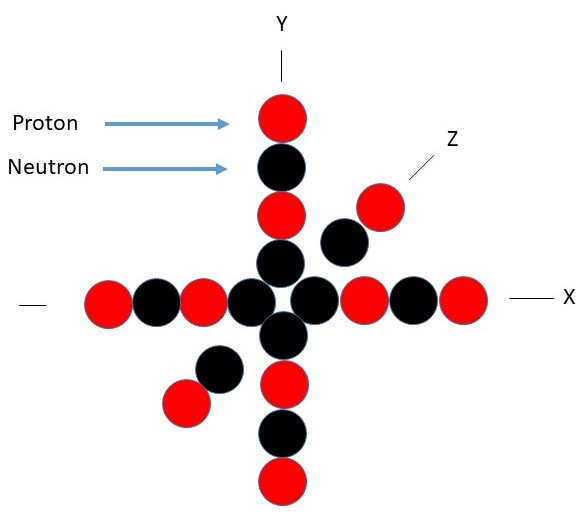
Figure 1 is an example of an orthogonal structure in which the nucleons of neon are symmetrically arranged on the x, y and z axes. To further validate this and other orthogonal patterns, one could assume an electron orbiting arrangement on the orthogonal axes to see how well the pattern adapts chemical elements to the Periodic Table.
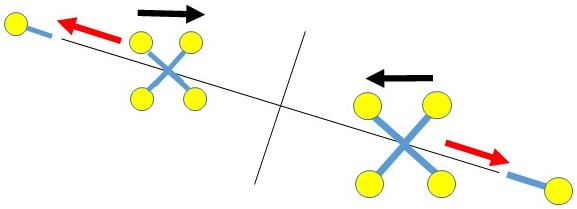
Given the orthogonal arrangements, electrons orbit perpendicular to the x and y axes, whereby the electrons on one side orbit in the opposite direction of those on the other side for each axis. Each electron is connected to a nucleon on its respective axis by an energy string (perhaps made up of photons). Figure 2 shows two quadrupoles rotating in opposite directions on a single axis. For neon, there are two non-rotating monopoles, one on each end of the axis. Using the right hand rule (fingers pointing in the direction of the electron flow and the thumb pointing in the direction of magnetic flow), one can visualize magnetic fields flowing in the opposite direction on each side of the x-axis as shown by red arrows.


As will be shown, this magnetic flow is key to the formation of crystals.
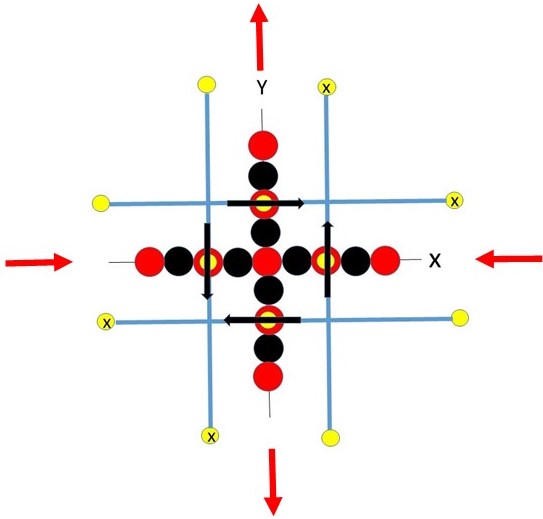
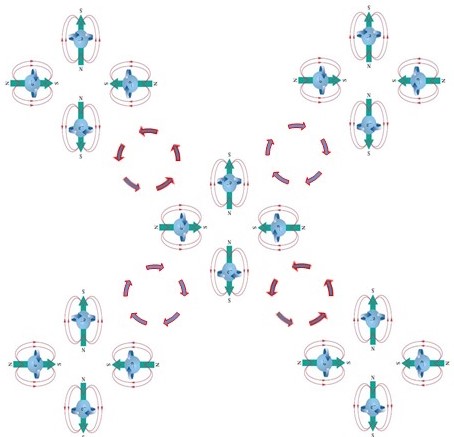
Figure 3 is a top view of four quadrupoles rotating and meshing together on two axes. For this to work, electrons can’t be orbiting on the z-axis. The number of electrons are limited to four on any given plane. The red arrows show the direction of the magnetic fields produced by the orbiting electrons.

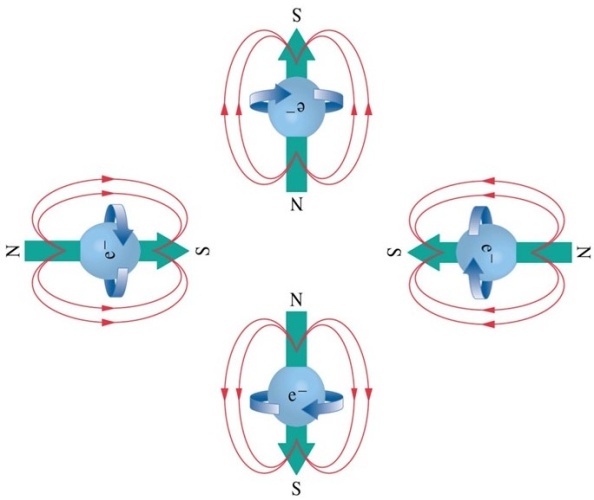
Figure 4 is another top view showing electron flow direction and the resulting magnetic field.
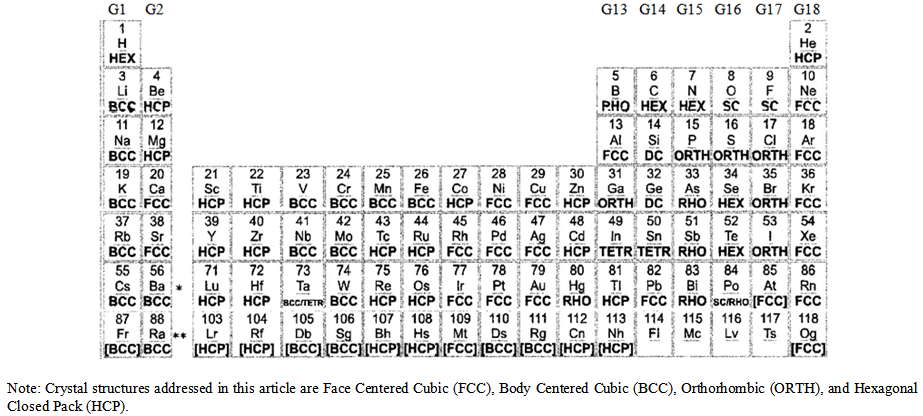
The horizontal rows of the Periodic Table are called periods. Each vertical column (or Group) in the Table makes up a related group of elements based on their chemical behavior. This section will cover orbiting electron patterns using the Periodic Table overlaid with corresponding crystal structures as shown in Figure 5.
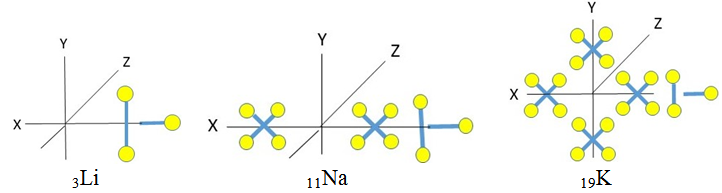
Figure 6 shows the electron orbit pattern for the Group 1 alkali metals; lithium, sodium and potassium.


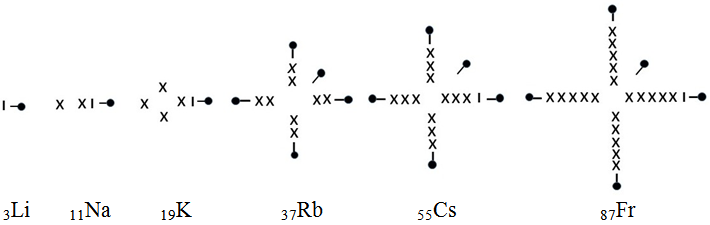
For lithium, there is one electron (monopole) next to two electrons orbiting opposite each other (dipole) on the x-axis. For sodium, there are two quadrupoles orbiting on each end of the x-axis and the same pattern as lithium on the x-axis. For potassium, there are four quadrupoles evenly spread out on the x and y axes with the lithium pattern on the x-axis. As will be shown, this monopole and dipole pattern can be seen in the whole group with the exception of hydrogen which has only one electron and rubidium which has an electron orbiting pattern similar to the Group 17 elements. The dipole/monopole pattern found in most of the elements of Group 1 could explain why the elements in this group have common chemical characteristics.
To establish a reasonable scheme to demonstrate how orbiting patterns progress through the Periods and Groups of the Periodic Table, it’s best to think in terms of balance, stability and symmetry. As a scheme is completed, one can use a boot strap method to go back over the Groups and Periods and adjust the orbiting patterns to a best fit. This leads to an excellent understanding of how grouped elements relate to each other and how crystals form and possibly how molecules are formed through covalent bonding.
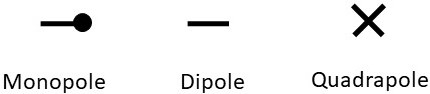
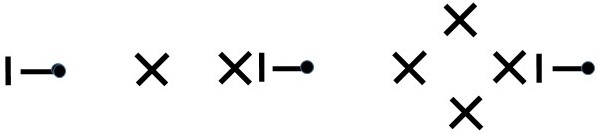
To facilitate generating electron configurations and saving space, the following nomenclature is used.

For example, Figure 6 would look like that in Figure 8.

Figure 9 shows the electron configurations for Group 1 elements lithium through francium
With the exception of rubidium, notice the symmetrical arrangement of the quadrupoles in each element of Group 1 along with the lithium configuration (dipole and monopole). A monopole is placed on the z-axis for cesium and Francium. It was found that in the higher elements, monopoles exist on the z-axis. When going through various schemes and generating electron configurations, it was found that when a quadrupole and a dipole or a quadrupole and a quadrupole are next to each other, a monopole is required on that side of the axis.
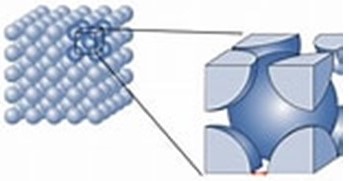
The crystal structure for the Group 1 elements is Body Centered Cubic (BCC). Its structure is shown in Figure 10.
Although Francium’s structure is uncertain, it is predicted to be BCC. Given the similar electron configuration of the other Group 1 elements, one can easily agree with that prediction. As will be shown later, because of the similar electron configuration to the Group 17 elements, rubidium would most likely be orthorhombic.
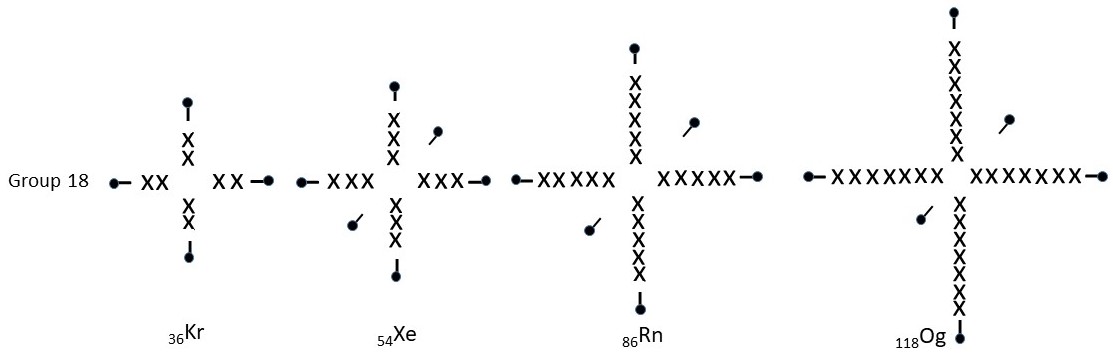
The next group to be analyzed is the inert or Nobel gases (Group 18) as shown in Figure 11a & Figure 11 b.


The symmetrical relationships of the quadrupoles along with the monopoles demonstrate stability. A quantum mechanical system of particles confined spatially can only take on certain discrete values of energy, called energy levels. Given the configurations in Group 18, each electron rotation along one axis has the same energy level as its counterpart on the other three axes. Using the right hand rule where rotating electrons generate a magnetic field, and the energy level for each axis being the same due to the symmetrical arrangements, the interaction of the four fields would in essence cancel each other and could explain why the gases are inert. This hints at the possibility that magnetic fields play a role in combining elements into molecules.
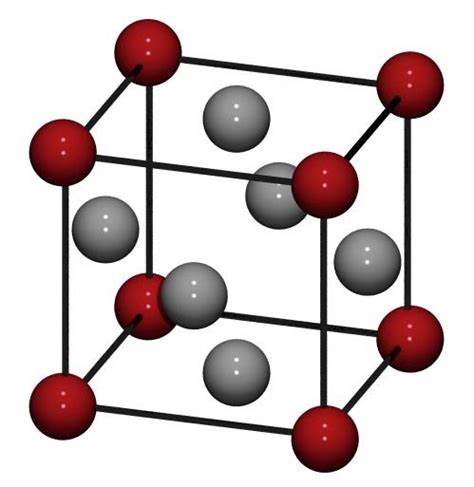
This could also explain why the crystalline structures of neon through radon and the predicted structure for oganesson are cubic in nature, and in fact a Face Centered Cubic (FCC) as illustrated in Figure 12.

Figure 13 shows the interaction between the magnetic forces of atoms in an FCC structure.

As shown, the direction of the magnetic fields of one atom matches up with the direction of the magnetic fields of the closest atom. The red circles show the magnetic flow for all five atoms. The magnetic forces keep them together, yet other atomic forces keep them separated to create a face centered cubic. This structure will wrap around until a box or cube is formed. The top, bottom and sides will match up perfectly.
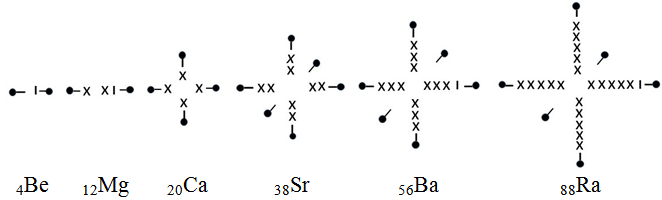
Figure 14 shows the electron configuration for Group 2 (beryllium through radium, Periods 4-7).

Calcium and strontium have symmetrical structures similar to those found in Group 18. Electron orbiting structures seem to form symmetrical structures when possible. Otherwise, the two monopoles on the y-axis of calcium and on the z-axis of strontium would be replaced by a dipole on the x-axis and agree with the others in that group. This explains why their crystal structures are Face Centered Cubic the same found in Group 18. This is an example where crystal structure can be used to validate or identify electron configuration or vice versa. Beryllium, magnesium, barium and radon have a dipole on the x axis as a common characteristic. Barium and radon have similar structures as the Group 1 elements cesium and francium and are Body Centric Cubic structures. The extra electron on the z-axis doesn’t seem to affect the crystalline shape.
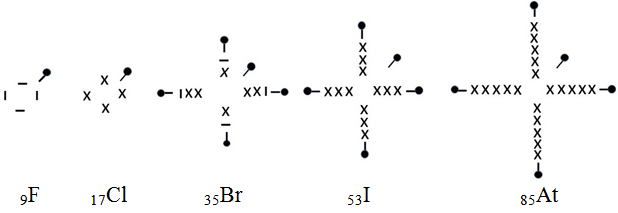
Group 17 configurations are shown in Figure 15. They all have orthorhombic crystal structures except for bromine. The atomic number for astatine is also orthorhombic (not as suggested in the Periodic Table). Tennessine is most likely orthorhombic as well. Going back to rubidium (Figure 9), its structure is similar to those in Group 17 and suggests that rubidium’s crystal structure is indeed orthorhombic not BCC.

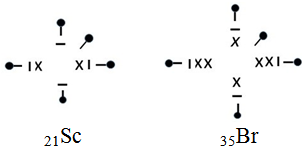
But now, looking at bromine, “What would its crystal structure be?” Figure 16 shows a comparison between scandium and bromine.

Scandium has a hexagonal closed pack (HCP) crystal structure. Given that the two electron configurations are similar, bromine most likely would have the same crystal structure. This prediction assumes that scandium’s HCP structure is correct.
It is difficult to predict stable crystal structures based on knowledge of the chemical composition alone. Scientists such as and others in the early part of the last century realized the association of chemical bonding to orbiting electrons and other interatomic forces including magnetic fields. The Face Centered Cubic crystalline structure in Figure 13 demonstrates symmetrical bonding from magnetic fields generated by electrons orbiting in opposite directions on each of the x and y axes. The other crystal structures depend on asymmetrical arrangements of electron orbits whereby the strength of the magnetic fields vary on each axis and includes the effects of having one or two monopoles on the z axis. For example, the difference between iodine in Group 17 and zenon in Group 18 is that the iodine z-axis has one monopole as opposed to two on the zenon z-axis. This difference is enough to form FCC crystals in Group 18 and orthorhombic crystals in Group 17. This electron orbiting model is based on an orthogonal arrangement of protons and neutrons. These electron orbiting patterns group elements in accordance to the Periodic Table using the orthogonal arrangements. Given that one can group elements in accordance to the Periodic table based on electron orbiting patterns, lends credence to the theory that nucleons are arranged in an orthogonal manner in the nucleus. This theory is further strengthened when we find that crystal structures can be associated to electron orbiting patterns. The nucleon arrangements along with the electron orbiting patterns and associated crystal structures go hand-in-hand and opens the door for pushing the understanding of nuclear physics beyond the standard mode (BSM).
| [1] | Cottrell, Dana. An Orthogonal Mechanical Model of Stable Nuclei, International Journal of Physics, Volume 9, 2021, Issue 1. | ||
| In article | View Article | ||
| [2] | Dana George Cottrell. (2022) Electron Orbiting Patterns, Innovation in Science and Technology 2022-11-07, https:// www.paradigmpress.org/ist/article/view/302. | ||
| In article | |||
| [3] | IUPAC Periodic Table of the Elements, International Union of Pure and Applied Physics, 1 December 2018. | ||
| In article | |||
Published with license by Science and Education Publishing, Copyright © 2024 Dana George Cottrell
 This work is licensed under a Creative Commons Attribution 4.0 International License. To view a copy of this license, visit
https://creativecommons.org/licenses/by/4.0/
This work is licensed under a Creative Commons Attribution 4.0 International License. To view a copy of this license, visit
https://creativecommons.org/licenses/by/4.0/
| [1] | Cottrell, Dana. An Orthogonal Mechanical Model of Stable Nuclei, International Journal of Physics, Volume 9, 2021, Issue 1. | ||
| In article | View Article | ||
| [2] | Dana George Cottrell. (2022) Electron Orbiting Patterns, Innovation in Science and Technology 2022-11-07, https:// www.paradigmpress.org/ist/article/view/302. | ||
| In article | |||
| [3] | IUPAC Periodic Table of the Elements, International Union of Pure and Applied Physics, 1 December 2018. | ||
| In article | |||