A thorough mathematic analysis was conducted to the negative energy solutions to the Dirac equation in a complex plane due to the fact that the solutions are vectors of complex number. An opposite vector with negative energy state was identified when a vector with positive energy state was defined in a complex plane. We concluded that any opposite vectors in a complex plane must have opposite energy state because their vector heads move always in opposite direction. We configured an electron as a small ball with dimetric vectors instead of a structureless mass point. Based on the new electron configuration, we explained the particle wave duality as the feature of electron’s spinvector in motion, explained the reason for the electrons with half spin quantum number. And we concluded that de Broglie’s standing waves theory would be more rational than the interpretation by current quantum theory.
The Dirac equation, a wave equation, formulated by physicist Paul Dirac 1 in 1928, describes relativistic quantum mechanics for spin-1/2 fermions, such as electrons and quarks. The equation combined quantum theory and special relativity to describe the behavior of an electron moving at a relativistic speed. The equation would allow whole atoms to be treated in a manner consistent with Einstein's relativity theory 2, 3. It was the first theory to account fully for special relativity in the context of quantum mechanics. And it was validated by accounting for the fine details of the hydrogen spectrum in a completely rigorous way.
But the equation introduced a problem, the unique feature that the equation could have two possible energy solutions, one for an electron with positive energy state, and the other for an electron with negative energy state. While the classical physics insisted on that the energy of a particle must always be positive. When interpreting the negative energy solutions of the equation, Dirac initially considered these solutions as problematic. But in 1930 he postulated a theoretical model of the vacuum, the Dirac sea 4, as an infinite sea of particles with negative energy quantum states for relativistic electrons (traveling near the speed of light). And then in 1931, he further postulated the existence of antimatter which referred to the positron as an "anti-electron" 5. According to Dirac’s hole theory, the negative energy states of particles are already filled in a "sea" of fermions extending from negative to positive energy. When a positive energy particle is created, it leaves behind a "hole" in the sea, which can be interpreted as the creation of an antiparticle with positive energy, the positrons. Enrico Fermi, Niels Bohr and Wolfgang Pauli were skeptical about the Dirac hole theory at that time. But in 1932 the discovery of the positron by Carl Anderson 6 validate the hole theory.
Though the peculiar problem of one electron with both positive energy state and negative energy state is not a big problem when an isolated electron is taken into consideration, because its energy is conserved, and negative-energy electrons may be left out. While difficulties arise when effects of the electromagnetic field are considered, because a positive-energy electron would be able to radiate energy by continuously emitting photons, a process that could continue without limit, which would cause the electron to descend into the nuclear center and to crash. In physical reality, it is crystal clear that electrons do not behave in that way at any circumstances.
And the Dirac’s hole theory also suggests that every particle in the universe has a corresponding antiparticle, or “hole” that behaviors as if it were a particle with the opposite charge and spin. One of the criticisms of Dirac’s hole theory is that it does not explain why there is such a large asymmetry between matter and antimatter in the universe. While the theory predicts that matter and antimatter should be created in equal amounts, observations suggest that there is much more matter than antimatter in the universe. Another criticism is that the theory does not consider the fact that particles and antiparticles can annihilate each other when they come into contact, releasing energy in the process. This suggests that the “holes” in the theory may not actually exist as physical entities.
The meaning of the Dirac equation is not so simple as we might think. Since its formulation, its meaning has changed from a relativistic wave equation for an electron to a classical field equation. it went from being a relativistic ‘update’ of the Schrodinger equation in the calculation of energy levels in atoms (basically of hydrogen) to become one of the cornerstones of the most successful quantum field theory, quantum electrodynamics (QED) 7, 8. From which an electron-positron quantum field is derived-the Dirac field. And even some states [9-11] 9 of negative masses were developed based on Dirac’s negative energy interpretation.
It is important to note that the Dirac’s interpretation of negative energy solutions as antiparticles moving forward in time, which is a mathematical construct that has been highly successful in describing particle physics. However, the concept of an antiparticle coexisting with a particle within same atom is not directly observable in our everyday experience. Though experimental evidence for the existence of antiparticles has been found through various high-energy physics experiments, confirming the predictions made by the Dirac equation. And up to now another interpretation proposed by Feynman-Stuckelberg 12, 13 that the negative energy solution can describe a negative energy particle which propagates backward in time has never been investigated yet. In this article we will try to investigate the approach for a particle moving backwards with negative energy in the electron.
The Schrodinger equation for a massive free particle without potential energy involved, is represented as Equation 1.
 Eq.1
Eq.1
It reveals kinetic energy equals the square of the momentum operator divided by twice the mass, which is the non-relativistic.
Because relativity treats space and time as a whole, relativistic generalization of this equation requires that space and time derivatives must enter symmetrically as they do in the Maxwell equations that govern the behavior of light, the equations must be differentially of the same order in space and time. In relativity, the momentum and the energies are the space and time parts of a spacetime vector, the four-momentum, and they are related by the relativistically invariant relation as Equation 2. Dirac formulated his equation starting from a Klein-Gordon type equation written in terms of a relativistic Hamiltonian, and Branson 14 described Dirac’s deduction process as below.
 Eq.2
Eq.2
Or
 |
 |
The concept to use the relativistic energy equation (without external electromagnetic field involved) is extended with the replacement of  by
by  .
.
 |
The operators of energy and momentum are plugged into the above equation,
 |
 |
And the equation is written in terms of a 2-component spinor  , it is clearly headed toward being second order in the time derivative. As with Maxwell’s equation, which is first order when described in terms of the field tensor, a new equation is modified into a first order equation in terms of a quantity derived from
  , after a new wave function is defined:
 |
 |
Now a new equation is converted with four components which satisfy the equations, including the two components of  and the two components of
  .
.
 |
 |
The sum and the difference of the two above equations are taken as below:
 |
 |
Now the equation is again rewritten in terms of  =
= +
+ and
and  =
=  -
- , and is ordered as a matrix equation, finally the Dirac Equation is represented as Eq. 3.
 |
 |
 |
 Eq.3
Eq.3
In the Dirac equation, the new coefficients  = (
= ( ,
,  ) = (
) = ( ,
,  ,
,  ,
,  ) are introduced, which must be determined. The simplest solution for the
  , that satisfies these anticommutation relations, are 4 × 4 unitary matrices. We will use the following representation for the
  matrices:
 |
where  denotes a 2 × 2 identity matrix, 0 represents a 2 × 2 null matrix, and the
  are the Pauli spin matrices:
 |
The gamma matrices in full are as below:
 |
 |
 |
 |
Same as Schrodinger equation, the simplest solutions of the Dirac equation are those for a free particle. Each component of the Dirac spinor represents a state of a free particle at rest. And the free particle solution can be written as a constant spinor times the usual free particle exponential.
 Eq.4
Eq.4
To simplify the process further, let’s take the simple case as the free particle at rest. This is just the  = 0 case of the solution above, so the energy equation gives
  . The Dirac equation can now be used.
 |
 |
 |
 |
 |
 |
Once the first component as spin-up along the z axis is defined, the solutions for four eigen spinors are as below, where N is the normalization factor:
 Eq.5
Eq.5
 Eq.6
Eq.6
 Eq.7
Eq.7
 Eq.8
Eq.8
The first and third have spin-up while the second and fourth have spin-down. The first and second are positive energy solutions while the third and fourth are negative energy solutions.
For a free particle with momentum  , We have another four solutions, where
  is the normalization factor:
To describe the negative energy states, Dirac 4 postulated that an electron in a positive energy state was produced from the vacuum accompanied by a hole with negative energy, the hole corresponded to a physical antiparticle, the positron, with charge +e.
 Eq.9
Eq.9
 Eq.10
Eq.10
 Eq.11
Eq.11
 Eq.12
Eq.12
Before attempting to explain these negative energy solutions to Dirac equation, let’s review some of the basic mathematics of a moving particle on a circle unit in complex plane 15. The point of the vector head of vector  is on the unit circle at angle θ in complex plane as described in Figure 1.

If the vector head is treated as a particle moving around the unit circle at angular speed ω, we can visualize that the trajectory of the moving particle is just the circle, if the unit circle is moving along the x axis at speed of 𝒗 while the particle is rotating around the circle at the same time, then the trajectory of the moving particle is a wave represented as Figure 2, and with wave function:

For the convenience of further explanation, we take a small ball center as the coordinate origin in the real space, set the unit circle on the xoy plane, and let the ball spin around the z axis at angular speed ω in clockwise direction as Figure 3. If the ball travels at speed 𝒗 along the x axis, we can easily identify the trajectory of the vector  head as the same wave as Figure 2. Because the rotation of the vector is caused by a spin object, the ball, we call this specially rotating vector as a spinvector. A spinvector in motion must generate a wave accordingly, which was the theory we developed to explain the particle-wave duality previously [16-18] 16.

Now let’s revisit the positive energy and negative solutions to the Dirac equation as described as Eq. 5 and Eq. 7 in complex plane from spinvector perspective, since the solutions are the vectors of complex number. At any specific time, the wave function represents the position of the vector head of the spinvector instead of the position of a spin object. If we define the positive solution for a vector in the electron below and apply the energy operator to positive energy solution according to the Schrodinger equation.
 |
 |
For the negative energy state, the energy operator shall have same result.
 |
Therefore, the simplest solution to the negative energy state shall be:
 |
 |
Obviously, the position of the vector with negative energy state in the electron in complex plane is described as Figure 4. The two vectors shall have a phase difference of π. In other words, any vector opposite to the vector with positive energy state must have a negative energy state in complex plane. If we treat the two vectors as an integral, they are just opposite vectors in direction or simply dimetric vectors.

However, when we compare the solution directly from Dirac equation for negative energy state at rest, the vector is a complex conjugate vector.
 |
For a free a particle (vector) at rest, the solution directly from the Dirac equation shall be same as the solution from the energy operator approach from mathematical deduction. Therefore, we simply derive,
 |
 |
 |
 |
 |
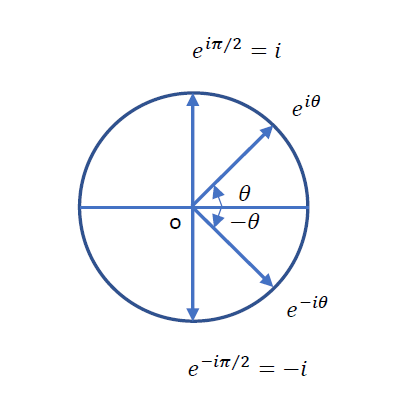
Before identifying the positions of the vectors with positive and negative energy states, let’s check the special points on the unit circle as Figure 5.
Apparently one vector is at  , while the other is at
  . The spinvectors in an electron at rest shall have the same phase difference π as illustrated in Figure 6. The spinvectors are also as diametric vectors. This phase difference π is the condition to ensure the two vectors with opposite energy states in the same electron. Or simply the diametric vectors in any electron must have opposite energy states.


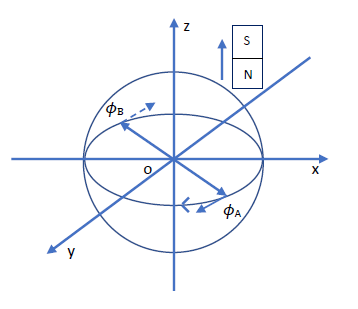
To correlate the relation between the rotating direction of diametric vectors and spin (up and down) direction, it is rational for us to review the definition of spin direction first. If one measures the spin along a vertical axis (z axis), electrons are described as "spin-up" or "spin-down", based on the magnetic moment pointing up or down, respectively. Or the spin direction is simply the direction to which the S pole pointing, while the magnetic moment is induced by the spin of an electron.
Again, we treat an electron as a small ball instead of a mass point, but with dimetric electric vectors as an integral or two opposite electric spinvectors, with its center located at the coordinate origin in a real space, and set the unit circle at xoy plane. If the diametric vectors rotate (spin) in clockwise direction, according to the electromagnetic theory, the induced magnetic moment will point to z+ direction as spin-up as illustrated in Figure 7. During the same electron spin motion, the two vector heads will always move in opposite directions.

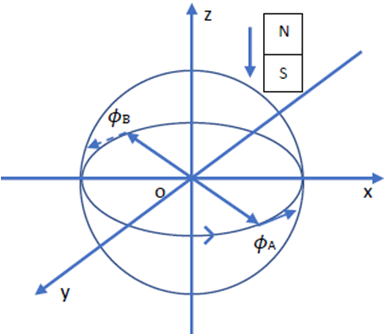
If the diametric vectors rotate in counterclockwise direction, the induced magnetic moment will point to z- direction as spin-down as illustrated in Figure 8.
Based on the above analysis, we can conclude that the electron wave is generated as the trajectory of its spinvector in motion, or due to its electric vector rotating while in motion. If one of its spinvector is in positive energy state, its opposite spinvector must be in negative energy state, because at any moment their moving directions during the same electron spin motion are always in opposite direction. The negative energy solutions to Dirac equation only suggest the existence of the diametric vectors in an electron. Because there is no positron existing in any atom at all, both the Schrodinger equation and the Dirac equation shall only describe the wave function relevant to electron’s motion features, but not motion of positrons.

Since it is clear why there are negative energy solutions to Dirac equation, it is natural for us to explore what the actual structure or configuration of the electron is to ensure the features required, diametric electric vectors. Based on the deduction process above, the negative charge must be located at its center with quantity of electric charge, , -e, about 1.602×10⁻¹⁹ C, while there are two diametric pin holes with electric field directions pointing towards its negative charge center to form the diametric vectors to meet our requirement as represented in Figure 9. The electron body shall be composed of electrically neutral material which we believe is the same material as of Higgs particle.
When Susskind 19 described the deduction process of Pauli spin matrix, he articulated that “two orthogonal states of spin direction are physically distinct and mutually exclusive. If the spin is in one of these states, it cannot be (has zero probability to be) in the other one. This idea applies to all quantum systems, not just spin”. We applied same logics to the energy states, positive or negative, for the diametric vectors in an electron, they are always in the opposite energy states. The different energy states only describe the moving directions of the vector heads, or only describe the different wave phases of the trajectories of the two spinvectors in the same electron. The negative energy state in a state space doesn’t mean that the actual energy quantity is negative in real space.
He emphasized that “the directions spin-up and spin-down are not orthogonal in real space, even though their associated state-vectors are orthogonal in state space”. It is same for the electron’s energy state vectors, their vector directions are not physically orthogonal in real space, but orthogonal in state space.
Based on the deduction process for the configuration of electron’s diametric vectors, we can easily visualize that the waves generated by the spinvectors in motion are always in a fixed phase π on the wave plane. Obviously, they have same wave features as Standing waves as Figure 10.

de Broglie once applied the innovative idea of matter waves to the structure of the atom. He postulated that electrons rotate the nucleus as standing waves. He illustrated that when electrons behave as standing waves, they no longer emit energy in the form of radiation (since this applies to particles). Therefore, de Broglie's standing waves theory provided a strong support for – electrons rotate the nucleus in 'stationary states' and do not emit energy. Furthermore, he also explained that the circumference of an electron orbit is quantized, which means an integral multiple of the wavelength of the electron wave. This is interpreted by the following equation:
 |
 |
 |
 |
 |
Therefore, de Broglie's standing waves theory supported that angular momentum of an electron is quantized.
Since there are two spinvectors in an electron, the contribution of each spinvector to the angular momentum and magnetic moment is exactly equal.
 |
 |
When the electron is at energy level  ,
,  , which is same as the definition of spin quantum number 20.
We think that our electron configuration with dimetric vectors provides a strong support to de Broglie's standing waves theory, which is in alignment with Bohr's theory on atom structure. The new electron configuration clearly explains why the electron has spin quantum number, 1/2. The half spin quantum number is attributed to the existence of diametric vectors. The electron will return to its original configuration after spin degree π. In other words, each spinvector only need to rotate half circle to its original configuration, while according to current quantum theory the electron must spin degree 4π to its original configuration.
Based don Dirac equation, we can predict that all the fermions with half spin quantum number shall have a same dimetric vector configuration no matter what electric charge properties are. And we think it is more rational for the standing waves theory based on electron’s configuration with dimetric vectors than the current quantum theory to explain the particle-wave duality and intrinsic angular momentum of the electron. The electron’s configuration with dimetric vectors also provide a strong theoretical support for our previous works on atom and nuclei configurations. 21
Our interpretation of negative energy solutions to Dirac equation is completely based on mathematical analysis. The negative energy state only indicates an opposite motion direction of a vector head for one of the diametric vectors (spinvectors) with a phase difference of π compared to the other spinvector with positive energy state in an electron. The deduction process is sound and logic from both mathematics and physics perspective.
According to Feynman’s proposal 12 that the negative energy solution describes a negative energy particle propagating backward in time, or a positive energy particle moving forward in time, while our interpretation suggests that the negative energy solution describes a vector head in an electron moving backward in space compared to a vector head in the same electron moving forward in space.
Our new electron configuration is the natural exploration result directly from the theoretical evidence of diametric vectors in an electron based on the mathematical deduction from negative energy solutions to the Dirac equation. The configuration can explain the unique feature of particle-wave duality of quantum particles, it can easily explain the half spin quantum number while the current theory just explains it as an intrinsic property without rational explanation. As to the material to form the electron mass, we think it is the same electric neutral material as Higgs particle.
Apparently our interpretation attributes the negative energy solutions to Dirac equation as the existence of diametric vectors in an electron is more rational than the interpretation of negative energy solutions as the existence of positrons or antimatters.
Though our new interpretation and the electron configuration can explain many mysterious features of quantum mechanics. It still needs further thorough theoretical investigation and experimental verification for our proposal to be a valid theory and a natural reality of quantum particles.
| [1] | P.A.M. Dirac, “The Quantum Theory of the Electron” Proceedings of the Royal Society of London A. 117(778): p610-624(1928). | ||
| In article | View Article | ||
| [2] | P.W. Atkins, Quanta: A handbook of concepts. Oxford University Press, p52. ISBN 978-0-19-855493-6. c1974. | ||
| In article | |||
| [3] | W. Greiner, Relativistic Quantum Mechanics. Wave Equations (3rd Edition). Springer Verlag. ISBN 978-3-5406-74573. C2000. | ||
| In article | |||
| [4] | P.A.M. Dirac, “A theory of electrons and protons” Proceedings of the Royal Society of London A. 126(801): p360-365(1930). | ||
| In article | View Article | ||
| [5] | P.A.M. Dirac, “Quantised singularities in the electromagnetic field” Proceedings of the Royal Society of London A. 133(821): p67-72(1931). | ||
| In article | View Article | ||
| [6] | C.D. Anderson, “The Positive Electron” . 43(6): p491-494(1933). | ||
| In article | View Article | ||
| [7] | R.P. Feynman, “Space-Time Approach to Quantum Electrodynamics”. Physical Review. 76(6): p769-789(1949). | ||
| In article | View Article | ||
| [8] | R.P. Feynman, “Mathematical Formulation of the Quantum Theory of Electromagnetic Interaction”. Physical Review. 80(3): p440-457(1950).H. Bondi, “Negative Mass in General Relativity”. Rev. Mod. Phys. 29(2): p423-428(1957). | ||
| In article | View Article | ||
| [9] | H. Bondi, “Negative Mass in General Relativity”. Rev. Mod. Phys. 29(2): p423-428(1957). | ||
| In article | View Article | ||
| [10] | W.B. Bonner, “Negative Mass in General Relativity”. General Relativity and Gravitation. 21(11): p1143-1157(1989). | ||
| In article | View Article | ||
| [11] | R. Hammond, “Negative mass”. European J. of Physics. 36(2): 025004 (2015). | ||
| In article | View Article | ||
| [12] | R.P. Feynman, “The Theory of Positrons”. Phys. Rev. 76: p749-759(1949). | ||
| In article | View Article | ||
| [13] | E.C.G. Stueckelberg. “La Mecanique du point materiel en theorie de relativite et en theorie des quanta”. Helv. Phys. Acta 15: p23-37(1942). | ||
| In article | |||
| [14] | J. Branson, Quantum Physics (UCSD Physics 130). . | ||
| In article | |||
| [15] | T. Needham, Visual Complex Analysis, Oxford University Press. ISBN 978-0-19-286892-3. c1997. | ||
| In article | |||
| [16] | Zhonglin BO, “New explanation of double-slit interference with single quantum based on the theory of spin vector in motion behaving particle-wave duality”. SSRN. (2022). | ||
| In article | |||
| [17] | Zhonglin BO, “A New Physics Description of Planetary Motion-Spinvector Motion I” International Journal of Physics, 10(4): p236-241(2022). | ||
| In article | View Article | ||
| [18] | Zhonglin BO, “Reinvestigation of Heisenberg’s Uncertainty Principle and a New Deduction of Schrodinger Equation-Spinvector Motion II” International Journal of Physics, 11(2): p81-87(2023). | ||
| In article | View Article | ||
| [19] | L. Susskind; A. Friedman, Quantum Mechanics: The Theoretical Minimum. Basic Books. ISBN-13: 978-0465036677. c2014. | ||
| In article | |||
| [20] | M. Jammer, The conceptual development of quantum mechanics: The history of modern physics. Thomas Publishers. . | ||
| In article | |||
| [21] | Zhonglin BO, “New Atom Configuration Based on Proton and Electron as Electric Monopole Pairs and Exploration of Quarks and Higgs particle” International Journal of Physics, 9(6): p269-274(2021). | ||
| In article | |||
Published with license by Science and Education Publishing, Copyright © 2023 Zhonglin BO
 This work is licensed under a Creative Commons Attribution 4.0 International License. To view a copy of this license, visit
https://creativecommons.org/licenses/by/4.0/
This work is licensed under a Creative Commons Attribution 4.0 International License. To view a copy of this license, visit
https://creativecommons.org/licenses/by/4.0/
| [1] | P.A.M. Dirac, “The Quantum Theory of the Electron” Proceedings of the Royal Society of London A. 117(778): p610-624(1928). | ||
| In article | View Article | ||
| [2] | P.W. Atkins, Quanta: A handbook of concepts. Oxford University Press, p52. ISBN 978-0-19-855493-6. c1974. | ||
| In article | |||
| [3] | W. Greiner, Relativistic Quantum Mechanics. Wave Equations (3rd Edition). Springer Verlag. ISBN 978-3-5406-74573. C2000. | ||
| In article | |||
| [4] | P.A.M. Dirac, “A theory of electrons and protons” Proceedings of the Royal Society of London A. 126(801): p360-365(1930). | ||
| In article | View Article | ||
| [5] | P.A.M. Dirac, “Quantised singularities in the electromagnetic field” Proceedings of the Royal Society of London A. 133(821): p67-72(1931). | ||
| In article | View Article | ||
| [6] | C.D. Anderson, “The Positive Electron” . 43(6): p491-494(1933). | ||
| In article | View Article | ||
| [7] | R.P. Feynman, “Space-Time Approach to Quantum Electrodynamics”. Physical Review. 76(6): p769-789(1949). | ||
| In article | View Article | ||
| [8] | R.P. Feynman, “Mathematical Formulation of the Quantum Theory of Electromagnetic Interaction”. Physical Review. 80(3): p440-457(1950).H. Bondi, “Negative Mass in General Relativity”. Rev. Mod. Phys. 29(2): p423-428(1957). | ||
| In article | View Article | ||
| [9] | H. Bondi, “Negative Mass in General Relativity”. Rev. Mod. Phys. 29(2): p423-428(1957). | ||
| In article | View Article | ||
| [10] | W.B. Bonner, “Negative Mass in General Relativity”. General Relativity and Gravitation. 21(11): p1143-1157(1989). | ||
| In article | View Article | ||
| [11] | R. Hammond, “Negative mass”. European J. of Physics. 36(2): 025004 (2015). | ||
| In article | View Article | ||
| [12] | R.P. Feynman, “The Theory of Positrons”. Phys. Rev. 76: p749-759(1949). | ||
| In article | View Article | ||
| [13] | E.C.G. Stueckelberg. “La Mecanique du point materiel en theorie de relativite et en theorie des quanta”. Helv. Phys. Acta 15: p23-37(1942). | ||
| In article | |||
| [14] | J. Branson, Quantum Physics (UCSD Physics 130). . | ||
| In article | |||
| [15] | T. Needham, Visual Complex Analysis, Oxford University Press. ISBN 978-0-19-286892-3. c1997. | ||
| In article | |||
| [16] | Zhonglin BO, “New explanation of double-slit interference with single quantum based on the theory of spin vector in motion behaving particle-wave duality”. SSRN. (2022). | ||
| In article | |||
| [17] | Zhonglin BO, “A New Physics Description of Planetary Motion-Spinvector Motion I” International Journal of Physics, 10(4): p236-241(2022). | ||
| In article | View Article | ||
| [18] | Zhonglin BO, “Reinvestigation of Heisenberg’s Uncertainty Principle and a New Deduction of Schrodinger Equation-Spinvector Motion II” International Journal of Physics, 11(2): p81-87(2023). | ||
| In article | View Article | ||
| [19] | L. Susskind; A. Friedman, Quantum Mechanics: The Theoretical Minimum. Basic Books. ISBN-13: 978-0465036677. c2014. | ||
| In article | |||
| [20] | M. Jammer, The conceptual development of quantum mechanics: The history of modern physics. Thomas Publishers. . | ||
| In article | |||
| [21] | Zhonglin BO, “New Atom Configuration Based on Proton and Electron as Electric Monopole Pairs and Exploration of Quarks and Higgs particle” International Journal of Physics, 9(6): p269-274(2021). | ||
| In article | |||