 OPEN ACCESS
  PEER-REVIEWED
Impact of ADP on GDP in Bangladesh: A Cointegration Approach
Mahi Uddin1, , Niaz Murshed Chowdhury2, Mudabber Ahmed3
1Lecturer in Economics, Chibbari M. A. Motaleb College, Satkania, Chittagong, Bangladesh
2Graduate Research Assistant, Department of Economics, South Dakota State University, Brookings, USA
3Professor, Departmentof Economics, University of Chittagong, Chittagong, Bangladesh
Abstract
The main purpose of this paper is to introduce and interpret the relation between governments Annual Development Programme (ADP) and economic growth. ADP traditionally holds the main structure of Bangladesh economy. We consider ADP is the main determinant of Gross Domestic Product (GDP) in Bangladesh and also consider the Gross Capital Formation (GCF) for more reliable results. This paper uses various econometric tools where time series analysis is gained main focus to find out the proper result. According to our result, there is a positive impact of ADP on economic development. Findings point out that keeping the high level of public planning in Bangladesh together with improvement in institutional surroundings would be beneficial for economic growth. It has been widely documented that ADP can promote economic growth, when it is efficiently handled by the authority.
At a glance: Figures
Keywords: Annual Development Program, Gross Capital Formation, Gross Domestic Product, Economic Growth, Time Series Analysis
International Journal of Econometrics and Financial Management, 2015 3 (2),
pp 44-56.
DOI: 10.12691/ijefm-3-2-1
Received December 01, 2014; Revised December 29, 2014; Accepted January 04, 2015
Copyright © 2013 Science and Education Publishing. All Rights Reserved.Cite this article:
- Uddin, Mahi, Niaz Murshed Chowdhury, and Mudabber Ahmed. "Impact of ADP on GDP in Bangladesh: A Cointegration Approach." International Journal of Econometrics and Financial Management 3.2 (2015): 44-56.
- Uddin, M. , Chowdhury, N. M. , & Ahmed, M. (2015). Impact of ADP on GDP in Bangladesh: A Cointegration Approach. International Journal of Econometrics and Financial Management, 3(2), 44-56.
- Uddin, Mahi, Niaz Murshed Chowdhury, and Mudabber Ahmed. "Impact of ADP on GDP in Bangladesh: A Cointegration Approach." International Journal of Econometrics and Financial Management 3, no. 2 (2015): 44-56.
| Import into BibTeX | Import into EndNote | Import into RefMan | Import into RefWorks |
1. Introduction
Most of the expert and economists favor high and efficient government planning because they think that it ensures and contributes to enlarging GDP. Planning is one of the main components of public budget. Investment is one of the main components of aggregate demand. It plays an important role on economic growth. Public investment is fully conducted by the government. By development plan, the government can improve economic situation of the country. Currently, we observed that government budget and private investment simultaneously plays great role to rapid economic growth. Both the public and private investments are required to boost up real GDP where ADP (main part of public investment) has a big share compared to private investment. Bangladesh is small country but over populated. Its economy is rapidly improving based on market. Most of the indicators of development show their positive reaction since 1971. According to Wikipedia, Bangladesh has made significant strides in its economic sector performance since independence in 1971. The economy has improved vastly after 1990s. Stable political situation is main reason behind it. The economic activity is directly related with some non-economic factors. After 1990s, we have experienced an average growth rate above 4% per year. Though we have improved a lot but the vicious circles of underdevelopment remain alive.
Most of the characteristics of public investment are present in ADP. So we can consider ADP as public investment. If we consider the maintenance system of ADP then we can say ADP is fully handled by government. We know that ADP is fully conducted by government. In the same way ADP is also conducted by government controlling, supervising, allocating, organizing system of ADP follow the same procedure of public investment system. Actually ADP and public investment are not different. Public investment is directly familiar in developed countries. They mainly conduct the different types of public investment for different sectors. On the other side, some developed countries conduct public investment without doing differentiate. Though public investment is organized in different ways but the aim and objects are the same for all countries. In this view, public investment in other countries and ADP in Bangladesh are the same matter or same thing. Both are played similar role on development process of any country. Therefore, by comparing and contrasting both public investment and ADP, we can conclude both are same. The tiny difference of public investment and ADP is ignorable due to size and economic culture of an economy. In Bangladesh perspective, we consider the ADP is the main proxy of public investment. Finally, we can come to infer that ADP is the public investment in our country.
Dornbush, Fischer and Startz provide most common definition of investment. According to them, Investment means additions to the physical stock of capital (i.e. building, machinery, construction of factories additions to firm’s inventories). According to Mankiw, investment consists of goods bought for future use. In the view of Eric Doviak, investment consists of goods that firms and household purchase for future use as opposed to present use. Public investment is defined broadly to include all government spending in the ‘core’ infrastructure sectors which enhance the productivity of physical capital, land, transportation, power sectors, human infrastructure or those services that raise the productivity of labour (health, education, nutrition), rather than just capital expenditures as traditionally defined in official statistics (Emmanual Jimenz, 1995). Public investment is one kind of government expenditure. Edward Anderson, Paolo de Renzio and Stephanie Levy (2006) define public investment as public expenditure that adds to the public physical capital stock. This would include the building of roads, ports, schools, hospitals etc. This corresponds to the definition of public investment in national accounts data, namely capital expenditure. Public investment relates to mainly infrastructural expenditure. By the United Nations (2009) Public investment takes the form of infrastructural outlays – for roads and rail networks, ports, bridges, energy-generating plants, telecommunications structures, water and sanitation networks, government buildings- which can have a productive life of several decades. Although Xiaobo Zhang and Shenggen Fan (2000) do not define public investment directly but they describe the public investment goods are roads, education, irrigation, electrification, rural telephones and agricultural R&D capital generated by government investment. Sometimes public investment can mix with private investment.
Most of the time roads, water and sanitation networks and municipal swimming pools are publicly funded and provided. Adds directly to public capital is also known as public investment (Pantelis Kalaitzidakis and Sarantis Kalyvitisy, 2003). That kind of investment is known as public investment which is conducted by the government for the people. Investments undertaken by all public administrations are known as public investment. In other words, investment in highways and roads, hydraulic infrastructures, urban structures, ports and airports are the productive public investment (Roberto Leon Gonzalez and Daniel Montolio, 2011). On the other side, according to Eric peree and Timo Valila (2008) only investment directly financed from budget of the government- at the central or sub-national level- qualifies as public investment.
Public investment is the most important and fundamental potential factor of economic growth. It can play a vital role to ameliorate the economic situation and level of economic development of Bangladesh like other countries. Public investment influences economic growth in different ways. Recently, the spontaneous impact of public investment is lively discussed topic because of its positive impact on economic growth and other indicators of economic development. Public investment can influence positively the different sectors of an economy that aggregately augment the economic growth. Theoretically, we can say public investment multiplier increases national income of a nation in different levels with different ways. Public investment can reduce the evil effect of different negative factors of an economy like poverty, inequality, discrimination and so on. On the other hand, public investment has a positive impact on different positive sector of an economy such as income, private investment, infrastructure, science, technology, savings and others. To solve the problems of basic human needs (food, shelter, cloth, health and education) of a country, public investment can play a long term vital role. Public investment is fully organized by government, that’s why it always on the favour of mass population. Public investment always highlights the welfare of public that is fully absence in private investment.
In Bangladesh perspective, the importance of public investment is relatively high compared to other developing country. Due to low infrastructure, the return of public investment is not satisfactory and still not clear.
It is very important to know whether public investment and economic growth are related to each other especially in Bangladesh perspective or not.
In fine we can say that there is clearly a need for studying the relationship between public investment and growth in the context of Bangladesh using the most recent data and employing the new econometric technique.
For any economy like Bangladesh, public investment is the vital factor of the development. Public investment can positively promote the all macroeconomic variable as well as micro. It is important to find out the contribution of public investment in Bangladesh perspective. The vital objective of the study is to find out the role of public investment on the overall economy of Bangladesh. Here we can specify some objectives given below:
1. Analyze the impact of ADP on GDP
2. To find the co-integrated relationship between ADP and GDP
3. To find the direction of causality between ADP and GDP
4. To suggest the government to ensure and improve economic situation on the basis of analyzing result.
2. Literature Survey
Planning was first formally introduced in former USSR in 1928. Planning used as a safeguard in that socialistic country while rest of the world mainly USA faced great depression in around 1930. Effect of public investment on economic growth is recently a sound topic for developing countries as well as others. Separately public investment and growth are lively discussed economic topics. Growth mainly depends on public investment. We are going to find out the relation between growth and public investment. In previous time, a large of consonant inquiry has done on that theme. Here we try to eclectic delineate some of them.
William E. Cullison (1993) used a simplified version of Granger- Granger – Causility test to determine that relation. He used a simulating var model to test statistically significant impacts. Then, he draws an attention that uses past data to simulate future events. He Concluded that the results of the study, however imply that government spending on education and labor training and perhaps also civilian safety have statistically and numerically significant effects on future economic growth. The VAR simulations with education, labor training and civilian safety spending express effects so firm. Robert Kuttner (1992) argues, the economy is adhering in a round resulting from the excesses of the 1980s with slow growth, stagnant wages, inadequate productive investment and institutional trauma. In such an economy, reducing government outlay as a policy of increasing investment and growth will backfire. Finally he states a situation that the slow growth trap will not yield to an austerity cure. The proper remedy is to restore investment by relying primarily on public expenditure. An IMF working paper prepared by Benedict Clements, Rina Bhattacharya and ToanQue Nguyen (2003) examined the channels through which external debt affects growth in perspective of low income countries. Special attention is given to the indirect effects of external debt on growth via its impact on public investment. The impact of the urbanization ratio on public investment is ambiguous. The openness indicator is included as an explanatory variable because more open economies often compete for foreign direct investment by among other things, trying to invest more in infrastructure. Thus, there is likely to be a positive relationship between openness and public investment ratio.
After discussion on external debt they finally precise it also has indirect effects on growth through its effects on public investment. Their core findings suggest that substantial reduction in the stock of external debt projected for highly indebted poor countries (HIPCs) would directly increase per capita income growth by about 1 percent per annum. Reduction in external debt service could also allow an indirect boost to growth through their effects on public investment. Emranul Haque and Richard Kneller (2008) examine the growth effects of public investment in the presence of corruption in developing countries and also focus on the effect of corruption on public investment. They concluded that corruption increases the size of plan but reduces its effects on economic growth. Then they suggest that the policies to deter corruption and to increase the efficiency of public investment could give very positive impulses to economic growth. Ejoz Ghani and Muslehud Din (2006) try to find the impact of public investment on economic growth. They are using the vector autoregressive (VAR) approach with the help of data (1973-2004) Pakistan. They concluded that both private investment and public consumption positively influence output. However, public consumption turns out to be insignificant, public investment has a negative sign, though it is insignificant. Pooloo Zainah (2009) recently discusses the role of public investment in promoting economic growth in an African island country Mauritius over the period 1970-2006. Dynamic econometric technique is used, namely a vector Error correction model (VECM) to analyze the effects. The link between public capitals and private investment is measured by transport and communication infrastructure and economic performance that has been analyzed in a multivariate dynamic framework allowing for feedbacks. Results from the analysis reveal that both public and private have been important elements although not as important as the other types of capital (in the progress of the Mauritian economy). In summary, they found that public capital has significant contribution on economic performance more specifically on economic growth.
Alfredo M. Pereira and Maria de Fatima Pinho (2006) address the positive effect of public investment on economic performance in Portugal. Their analysis follows a vector auto-regressive (VAR) approach that considered various types of variables like output (Y), employment (I) private investment (IP) and public sector investment in durable goods (ig) and using data for the period of 1976- 2003. In order to determine the effects of public investment they use the impulse functions associated to the estimated VAR models. Therefore, cuts in these two types of public investment, would have negative long-term budgetary effects as well as negative long-term budgetary effects. Clearly not all public investment is created equal. Era Dabla-Narris, Jim Brumby, Annette Kyobe, Zac mills and chiris Papageorgiou (2011) analyze ‘investing in public investment’ under IMF, covering 71 countries including 40 low income countries, arguments for significantly boosting in physical and social infrastructure to achieve sustained growth rest on the high returns to investment in capital scarce environments and the pressing deficiencies in these areas. They conclude that, The efficiency of the public investment process is proxied by constructing indices that aggregate indicators, to reflect institutional arrangements that can deliver the required growth benefits of scaled-up investment and also investigate different dimensions of the investment management process.
Subarna Pal (2008) addresses on ‘does public investment boost economic growth?’ Their findings showed that the consideration of the growth equation estimates clearly the effect of both public investment and its square terms are significant. A comparison of the Indian estimates with those available for the USA and the UK economies is also revealing and highlights the role of governance on the effect of public investment. Richard H. claria (1993) presents a neoclassical model of international capital flows, public investment and economic growth. This model of optimal economic growth in perfect international capital mobility and that features the sluggish convergence to the steady state evident in the data. The estimated relationship between productivity and public capital is quite similar across countries. Finally, he concluded that there is a structural relationship between public capital and productivity (GDP).
Eduardo Cavallo and christion Daude (2008) test empirically the linkages between public and private investments using a dataset for a large sample of developing countries over almost three decades and find that a strong and robust crowding out effect. That seems to be the norm rather than the exception, both across regions and over time as well as for a variety of econometric specifications and estimation methods. Supporting of the rationale underlying that conditionality that public investment is not enough to crowd in private investment and thus, money spent on public works could easily go to waste or have undesired adverse effects on the private sector. The relationship between public and private investment has been focusing in the literature since early 1980s and stilla discussable subject. The main question explored by researchers is whether public and private investments have a different impact on economic growth. Assuming the aggregate production function is the economy is given by F(k,G) where k is the private capital stock and G is public capital (e.g. infrastructure) with standard INADA condition, implies that public capital increases the marginal productivity of public capital. It also explained by Cobb- Douglas function. Here, they implicitly assume that public investment is a non rival good. Analyzing data shows a negative and significant impact of public investment on the private investment rate. Behind of this relation is that in some countries public investment is wasteful associated with corruption, government stability, bureaucratic quality, low and order and political conflict. But public infrastructure has a positive effect on private investment. Finally, they conclude that public investment would still have a positive effect on growth although it might not be the optimal use of resources from a social welfare viewpoint and public investment in developing countries in not a blessing or a curse, it is “mixed blessing.”
Syed Adnan Haider Ali shah Bukhari, Liaqat Ali and Mahparasaddaqat (2007) have been studied to investigate whether there exists a long-term dynamic relationship between public investment and economic growth with heterogeneous dynamic panel data from Singapore, Taiwan and Korea. They looked into this relation empirically during the period 1971-2000, by using Granger causality test on panel data and on individual country data as well. Wadudsaad and Kamelkalakech (2009) inquired the growth effects of government expenditure in Lebanon over a period from 1962-2007, with a particular focus on sectorial expenditures using a multivariate cointegration analysis. Government expenditures on education, defense, health and agriculture are regressed in an attempt to estimate their impact on economic growth. Finally, they suggest that, the educational sector should be favoured in order to enhance growth. Pedro Brinca (2006) analyzes the impact of public investment in Sweden with the help of VAR approach mainly, solo model production function and granger causality analysis. He covers the period from 1962 to 2003, for a total of 42 observations. This econometric result suggests the existence of an indirect of the growth rate of public investment in GDP through the growth rate of private investment as well as a feedback mechanism between the growth rate of GDP and private investment.
3. Data and Methodology
There are a lot of factors that impact our GDP; Public investment is one of them. In order to, find out the probable relationship between economic growth and public investment by using multiple regression models and other econometric method.
This study analyzes the impact of public investment with other relevant component on economic growth of Bangladesh. We know that, the general purpose of multiple regression method is to know more about the proper relationship between some explanatory variable and exogenous variable and a dependent variable or endogenous variable. We also use others econometric method such as time series analysis. The econometric tools such as unit root test, cointegration test, Granger Causality etc will be used where possible. We use annual data for the period from the fiscal year 1972/73 to 2010/2011. We will use secondary data that are collected from different sources. All data are time series data. All variables are measured in millions of us dollar in constant price.
Data are the main base for any kind of research. In the third world, data of economic indicators are not fully reliable, available and transparent. Bangladesh is also not different from like other developing countries. Some data are clearly vague such as same data but from different sources are inconsistent. That’s why, careful attention was implied during self-complied period. Here, data are to be used in this analysis will be standard and reliable because of all sources of data are well known, recognized, widely used and accepted by government and others. So, data, which will be used in this study, must be reliable.
The preliminary object of these empirical investigations was to find out the relation among three variables namely annual development program, gross capital formation and gross domestic product. Here annual development program and gross capital formation are the determinant of gross domestic product. To do this we specify a four variable model and the implied theoretical model is as follows-
 |
Considering the above function in context of multiple regressions, the evaluation of the above function can be done on the basis of following equation.
 |
To complete the specification of the econometric model, we consider the form of algebraic or linear relationship among the economic variables. In this model, GDP was depicted as a linear function of public investment. The corresponding econometric model is
 |
The random error e counts for the many factors which affect GDP that we have omitted from this simple model and it also include the intrinsic and random behavior in economic activity.
3.1. Variable Definitions and Data Sources1. GDP: Gross Domestic Product (GDP) at purchaser's prices is the sum of gross value added by all resident producers in the economy plus any product taxes and minus any subsidies not included in the value of the products. It is calculated without making deductions for depreciation of fabricated assets or for depletion and degradation of natural resources. Data are in constant 2000 U.S. dollars. Dollar figures for GDP are converted from domestic currencies using 2000 official exchange rates. For a few countries where the official exchange rate does not reflect the rate effectively applied to actual foreign exchange transactions, an alternative conversion factor is used.
Source: World Bank national accounts data, and OECD National Accounts data files.
2. ADP: Actually, Annual Development Program (ADP) is considered as public investment. ADP is an organized list of projects in various sectors. ADP is prepared on the basis of a year’s development budget and approved by the parliament. To covert it Crore taka to us dollar we use the average exchange rate with base year 2000/2001.
Source: Implementation Monitoring and Evaluation division, ministry of planning, government of Bangladesh and self compiled
3. GCF: Gross Capital Formation (GCF) that is formerly gross domestic investment and it consists of outlays on additions to the fixed assets of the economy plus net changes in the level of inventories. Fixed assets include land improvements (fences, ditches, drains, and so on); plant, machinery, and equipment purchases; and the construction of roads, railways, and the like, including schools, offices, hospitals, private residential dwellings, and commercial and industrial buildings. Inventories are stocks of goods held by firms to meet temporary or unexpected fluctuations in production or sales, and "work in progress." According to the 1993 SNA, net acquisitions of valuables are also considered capital formation. Data are in constant 2000 U.S. dollars.
Source: World Bank national accounts data, and OECD National Accounts data files.
3.2. Expected Signs of the Estimated Coefficients1.  ; Autonomous GDP when ADP and GCF are zero though it is not very important
2.  ; if ADP increase then the GDP must be increased
3.  ; if GCF increase then the GDP is also increased
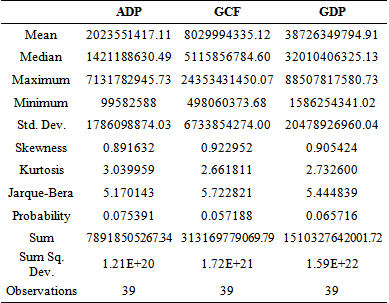
With the help of E-views, the descriptive statistics of ADP, GCF, GDP are as follows:


 PowerPoint Slide
 Larger image(png format)
 View current table in a new window
All data are in US dollars
According to above table we can say that the frequency distributions of all variables are not normal. We know Skewness is a measure of a distribution, and skewness values of all variables are pretty much nearer to zero. The kurtosis values of all variables are closed to 3 that indicate that the distributions of all variables are normal. Kurtosis measures the peakedness or flatness of a distribution. Kurtosis value of ADP indicates that it is leptokurtic distribution and the other two variables (GDP and GCF) are platy kurtic distribution.
4. Analysis of Regression Results
Finally we consider the following model because of economic significance.
 |
This study proceeds with the OLS method.
Estimated results with Ordinary Least Square method has been reported in Table 2.

 PowerPoint Slide
 Larger image(png format)
 View current table in a new window

 PowerPoint Slide
 Larger image(png format)
 View current table in a new window
From, E-views results we can say that the coefficients of all explanatory variables are positive which make economic sense. The constant coefficient is also making an economic sense although it is not necessary to consider statistically meaningful. The general meaning of constant coefficient indicates that if ADP and GCF are zero then we will enjoy 14439454875.46 units GDP. It is equivalent to autonomous GDP. Coefficient of ADP and GCF indicate that the 1 unit increases of ADP and GCF ensure the GDP also increase 1.292874 and 2.698719 unit respectively. It makes economic sense but we need to consider it statistically.
4.1. T-Test, F-Test, R2 vs. Adjusted R2and R2& F4.1.1. T Test
From t-statistics and probability value we can test ADP and GCF significantly affect GDP or not. Now, we can set null and alternate hypothesis as follows-
 |
Here, we see that the probability value of coefficient of ADP and GCF are 0.03 and 0.00 respectively, which are less than 0.05 where the level of significance is 5%. We can reject null. So, ADP and GCF are significantly influencing GDP.
4.1.2. F-Test
Now, we proceed for joint significance test or overall significance test. Using F-test can check this. If the p-value of F statistic is less than 5% we reject null and accept alternate hypothesis.
Here, 
 |
In our result, p-value of F statistics is 0.00. So, we can reject null, it means that ADP and GCF jointly can influence GDP. By considering an important relationship between R2 and F (Gujarati, p-258) we can draw same conclusion.
4.1.3. R2 vs. Adjusted R2
R2 Measures the proportion of the variation in the GDP that is explained by variations in the ADP and GCF. In our regression model, 99.7349% of the total variation was explained.
Adjusted R2 is a measure the proportion of the variance in the GDP that is explained by variations in the ADP and GCF. Here, our regression model shows that 99.7201% of the variance is explained. It is need to report because it ‘corrects’ for adding more variables to a regression. Adjusted R2 indicates that if we add more explanatory variables, it will lead greater R2. So, it is reasonable that adjusted R2<R2.
4.1.4. R2 And F
In any regression process, another important matter is the coefficient of determination R2 that is a measure of ‘goodness of fit’. In another word, it is a summery measure that tells how well the sample of our regression line fits the data. Here, the value of R2 of 0.997349 means that about 99% of the variation in the GDP is explained by ADP and GCF. F test is also indicates the same direction. It suggests that the sample regression line fits the data very well which greater than conventional value of 0.60.
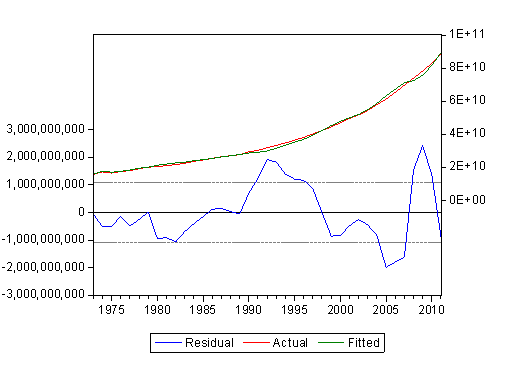
4.2. Actual, Fitted and Residual GraphWe can represent graphically the effective value of the dependent variable, its estimated value and errors in regression

 PowerPoint Slide
 Larger image(png format)
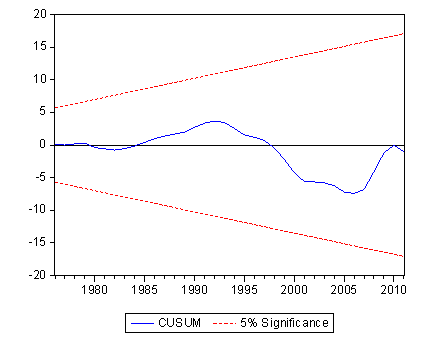
The most used tests of stability are CUSUM tests. The tests of equation stability and of estimated values are represented below-

 PowerPoint Slide
 Larger image(png format)
CUSUM test is based on cumulative sum of the equation errors in regression. E-views directly represent graphically the cumulative sum of errors together with critical lines of 5%. Parameters of the equation are not considered stable if the whole sum of recursive errors gets outside the two critical lines. In our model, the equation parameters are stable because the whole sum of recursive errors does not cross the two critical lines.
4.4. Variance Analysis TestAccording to ANOVA (Analysis Of Variance) table, the value of F statistic is 96.90957 and probability value is 0.00. It is indicate that R2 is statistically significant.

 PowerPoint Slide
 Larger image(png format)
 View current table in a new window
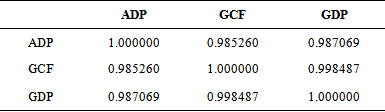
Multicollinearity is a statistical phenomenon in which two or more predictor variables in a multiple regression model are highly correlated. In this situation the coefficient estimates may change erratically in response to small changes in the model or the data.
Correlation matrix is one of the best techniques to detect multicollinearity. Now let’s have a look at the following correlation matrix.

 PowerPoint Slide
 Larger image(png format)
 View current table in a new window
The correlation matrix shows a very high collinearity among all variables. This suggests that it may be difficult to separate effects of one variable from another variable. So, we can conclude from our correlation matrix the variables are highly correlated and all values are greater than conventional level.
According to Gujarati, do nothing is the main solution. But formally to solve this problem we can use different ways such as avoid dummy variable trap, get more data, restrictions on parameters, dropping variables etc. But for simplicity we do not go through that way.
4.6. Normality Test (Jarque –Bera Test)With the normality assumption, the OLS estimators are minimum variance estimators in the entire class of unbiased estimators.
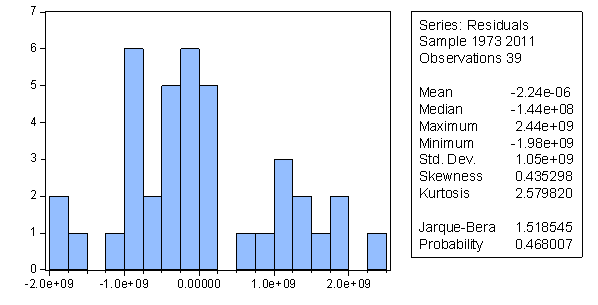
A histogram of residuals is a simple graphic device that is used to learn something about the shape of the probability density function (pdf) of a random variable. Frequency and residuals are shown in vertical axis and horizontal axis respectively. If we mentally superimpose the bell shaped normal distribution curve on the histogram, then we can assume about normality. The following graph (figure 3), we can say our considering distribution is normal. According to Gujarati, it is always a good practice to plot the histogram of the residuals as a rough and ready method of testing for the normality assumption
We can compute Jarque-Bera test statistic using the following rule: JB=n[S 2/6+ (K-3)2/24].
Where, n= sample size, s= skewness coefficient and k= kurtosis coefficient. If s=0 and k=3 then the value of the J-B statistic is expected to be 0. In our model, the JB value is 1.51. The 5% critical value from a chi-square distribution with 3 degrees of freedom is 7.815 and 1% critical value is 11.345. because of 1.51< 7.815 and 1.51<11.345 so there is insufficient evidence from residuals to conclude that the normal distribution assumption is unreasonable at the 5% and 1% level of significance

 PowerPoint Slide
 Larger image(png format)
The presence of heteroscedasticity is potentially a serious problem and the researcher need to whether it is present in a given situation. The main consequences of heteroskadasticity are losing BLUE property, increasing type-2 error and may lead wrong prediction. So, it is important to find out whether there is any heteroscedasticity problem. To test heteroscedasticity, we use graphical method, Breusch Pagan Godfrey test and the white test.
4.7.1. Graphical Method
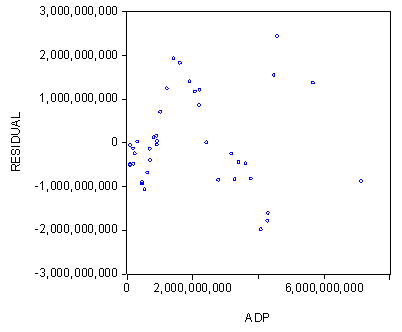
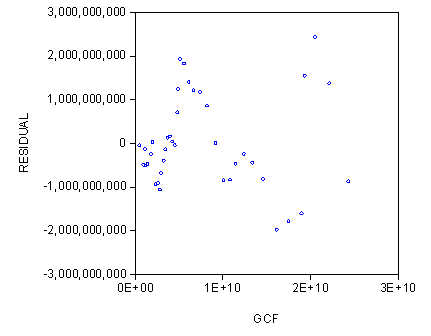
If the errors are homoscedastic, there should be no patterns of any sort in the residuals. If the errors are heteroscedastic, they may tend to exhibit grater variation in some systematic way. In our model, we suspect that the variance increases as ADP and GCF increase. Two plots of the least squares residuals against ADP and GCF appears in below-

 PowerPoint Slide
 Larger image(png format)
 PowerPoint Slide
 Larger image(png format)
4.7.2. Breusch–Pagan-Godfrey Test
Here the null and alternative hypotheses are;
Ho: There is no heteroskedasticity
Ha: There is heteroskedasticity problem
The formula of the Breusch-Pagan-Godfrey test shows as follows:

) PowerPoint Slide
PowerPoint Slide Larger image(png format)
 View current table in a new window
 |
Where χ2 shows chi-square distribution with (s-1) degrees of freedom. Our observed χ2 = 13.32. If the computed value of χ2 exceeds the critical value of Chi- Square at the chosen level of significance, we can reject the hypothesis of homoscedasticity; otherwise does not reject it. In our model, chi-square value is 13.31590 with 2 df the 5% and 1% critical chi square value are 5.99147 and 9.21034 which are less than computed chi-square. Therefore, we reject the hypothesis of homoscedasticity.
4.7.3. White Test

 PowerPoint Slide
 Larger image(png format)
 View current table in a new window
In our model, df=5 since there are 5 regressors in the auxiliary regression which is shown in table. If the calculated chi-square value exceeds the critical  value at the chosen level of significance then we can conclude there is heteroscedasticity. Our calculated
  value is 21.48(obs* R2) With 5 df. The 5% and 1% critical value for degrees of freedom 5 are 11.0705 and 15.086. So, we can conclude on the basis of the white test, that there is heteroscedasticity.
4.7.4. Remedy of Heteroscedasticity
We use white Heteroscedasticity -Consistent Standard Errors and Covariance. Now, we compare our estimation output from the uncorrected OLS regression with the heteroscedasticity consistent covariance output. Note that in our model the coefficients are the same but uncorrected standard error is smaller. It means that the heteroscedasticity consistent covariance method has reduced the size of the t-statistics for the coefficients. It helps us to avoid incorrect values for test statistics in the presence of heteroscedasticity.
4.8. Test for AutocorrelationThe presence of autocorrelation the OLS estimators are still linear unbiased as well as consistent and asymptotically normally distributed, but they are no longer efficient. Therefore, we have to consider autocorrelation is present or not in our model.
4.8.1. Durbin Watson Test

 PowerPoint Slide
 Larger image(png format)
 View current table in a new window
In the absence of software that computes a p-value, a test known as the bounds test, can be used partially overcome the problem. Durbin & Watson considered two other statics dl & du whose probability distribution do not depend on the explanatory variables.
 |
That is, irrespective of the explanatory variables in the model under consideration will be bounded by an upper bound du and 0 a lower bound dl. If d <dL, then H0 is rejected and d >du indicates null is not rejected. Our regression model is qualified by all these assumptions. So, we can use Durbin-Watson test. The test procedure is as follows:
 (No Autocorrelation)
And, H1: p>0 (Positive Autocorrelation)
In our model, calculated value of d=0.561985, against for n=39, k=2 and α=5%, the lower bound  =1.382 and an upper bound
  =1.597 at 5% level of significance. So we can reject H0 because of d<
 , At 1% level of significance also gives same decision.
We conclude that, there is an evidence of positive first order serial correlation. For reducing this problem, we can apply “Cochrane-Orcutt” iterative procedure to estimate ρ, where, ρ is known as the coefficient of auto-covariance. After that we can have a conclusion with the help of EGLS technique.
4.8.2. Breusch- Godfrey Serial Correlation LM Test
Due to some limitations of Durbin-Watson d test, statistician T.S. Breusch and L.G. Godfrey jointly introduce a general test for testing autocorrelation, which is known as BG, or LM test. We consider for testing for serially correlated errors are derived from a general set of hypothesis testing principles that produce Lagrange Multiplier (LM) tests. In this test whether errors are one period apart are correlated. Here, we test the
 |
 Significantly different from zero. If et and et-1 correlated then,
Here, p is an unknown parameter and vt is another random error term. In our model, regression equation
 |
By replacing 
 |
Assuming that  is independent of
  , one-way to test whether
  and
and  are correlated is to test the null hypothesis
  and alternative hypothesis H1: p≠0
Rejecting null at conventional significance levels (here, 5% and 1%) indicate that the errors are serially correlated.
LM test can be written as the simple expression t*R2 where t is the number of observations and R2 is the goodness of fit statistic from an auxiliary regression. If null hypothesis is true then LM has an approximate chi square distribution. We include lag 2 in our E-views operation. In our model, LM= obs*R2 =25.60890 and chi square critical values are 7.815 and 11.345 at the 5% and 1% level of significance. Here, LM > chi square critical. So, we can reject the null hypothesis on the basis of our result. It means that autocorrelation exists. Alternatively, we can reject null by examining the p-value for LM= 25.60890 which is 0.00. Since, p-cal< 0.05 and 0.01. So, we can reject the null and we can conclude that residuals are serially correlated.
4.9. Specification Test4.9.1. Reset Test
This test is proceed as follows-
We have specified and estimated the equation-
 |
Let, (b1, b2, b3) be the LS estimates and let,
 |
 Is obtain and then consider the following artificial model-
 |
Now, if δ1 is statistically insignificant then it can be conclude that there is no misspecification with omitted variables and wrong functional form. Rejection of null hypothesis implies that the original model is inadequate and can be improved when

) PowerPoint Slide
PowerPoint Slide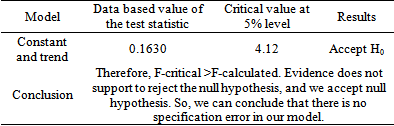 Larger image(png format)
 View current table in a new window
From our model the calculated value of F is 0.1630 and at the 5% and 1% level of significance with J=1 and df=n-k=39-4=35 the critical values are 4.12 and 7.42 respectively. Here, . So, we cannot reject the null of no misspecification.
4.9.2. Wald Test
According to Wald test we can draw the same conclusion. Since the p-values are 0.00. Therefore, we have no sufficient evidence to accept the hypothesis that the coefficients of these variables are zero.
5.Time Series Analysis
To ensure a reliable regression analysis we have to consider the used time series data whether stationary or not. To avoid a spurious regression result, we need to know that the variables are cointegrated at all. This probability is assessed in this analysis.
5.1.Stationary IssuesA random time series is said to be stationary if its mean and variance constant over time and the value of covariance between two time periods depends only the distance between the two time periods and not on the actual time at which the variance is computed (Gujarti, 1995). In order to check for time series properties stationary of the variables, the widely applied unit root test such as Augmented Dccky –Fuller (1981) and Philips-Perrron (1988) tests have been used.
5.2. Nature of Our VariablesIn our model we use time series data. To make a proper regression we need to cheek the stationary and nonstationary properties of our variables. There are several way to find out it. The main ways are-
1. Graphical presentation
2. Correlogram
3. Unit root test
5.2.1. Graphical Presentation
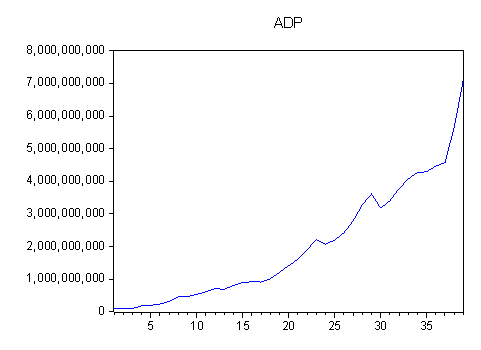
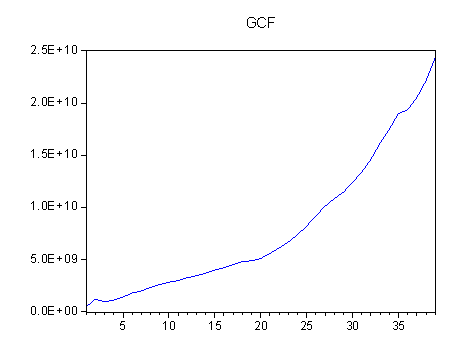
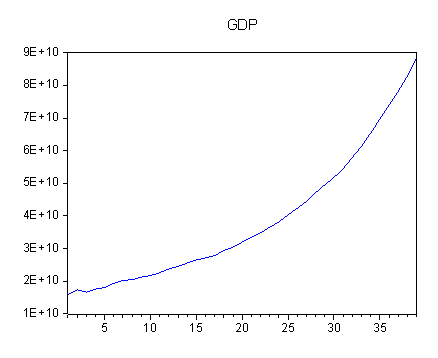
From graph we can say a series is stationary or not. If the graph shows the mean reversion property then we can say this series is nonstationary. Graphical presentations of ADP, GCF and GDP are given below

 PowerPoint Slide
 Larger image(png format)
 PowerPoint Slide
 Larger image(png format)
 PowerPoint Slide
 Larger image(png format)
Observing all the variables we can conclude that all variables are non stationary
5.2.2. Correlogram
For a specific series, correlogram shows the ACF (Augmented Correlation Function) values at many lags. ACF shows the correlations of different lags. Such as, GDPt may be correlated with GDPt-1 but not with directly GDPt-2. With the help of ACF, we can identify the nature of the series. For example, long decaying ACF values indicate that the series is non stationary
5.2.3. Unit Root Test
5.2.3.1. Augmented Dickey Fuller Test(ADF)
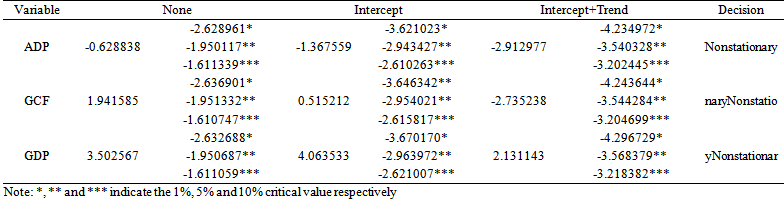
In the Dickey-Fuller test it is assumed that the error term is uncorrelated. But in case the error terms are correlated, Dickey and Fuller(1979) have developed a test, known as the Augmented Dickey-Fuller test. In ADF we still test null hypothesis what is “there is an unit root” and the ADF test follows the same asymptotic distribution as the DF statistic, so the same critical values can be used. So, we can reject the null hypothesis when |t-value|>|τcri|, otherwise H0 can be accepted. In general, by testing null hypothesis against alternative, the unit root test can be rejected if the t test statistic is negatively less than the critical value tabulated. The significance levels for all critical values are 1%, 5% and 10%. We cannot reject null of a unit root since; the p value is too high. To figure out the order of integration and to test the stationarity, unit root test will be carried out using the ADF test for all respective variables.

 PowerPoint Slide
 Larger image(png format)
 View current table in a new window
Due to mixed result of different unit root tests the decision about model and the question of stationarity of data comes next. The answer to this question involves an assessment of the trade-off between the loss of efficiency and loss of information. A model specified with levels, when time serieses are nonstationary, will generate estimate that may be spurious. On the other hand a model specified with difference, when serieses are nonstationary will generate estimates that are efficient but will ignore potential long run relationships. Sims (1980a) and Doan (2000), recommend against differencing even if the variable contains a unit root because it throws away information concerning the co-movement of variables. Fuller (1976) shows that differencing produces no gain in asymptotic efficiency even if it is appropriate. Although we conduct unit root tests and got mixed result but following Sims and Doan, the present study uses levels rather than difference of the variables involved.
5.4. Co-Integration Test5.4.1. Unit Root Test on Residuals/ Engle Granger Test/ Augmented Engle Granger Test
If the residual series of the regression has a unit root then this regression result will spurious where used variables are not integrated of order zero, I(0). We will operate different test for unit root on the residuals that can be used to know cointegrating relationship. Here, we consider ADF test only.
We can set the null and alternate hypotheses are-
H0: The series are not cointegrated=residuals are non-stationary.
H1: The series are cointegrated=residuals are stationary
Augmented Dickey-Fuller test for residual series of regression at level

 PowerPoint Slide
 Larger image(png format)
 View current table in a new window
In our model, we use nonstationary variables and the estimated residual shows the non stationary property at 1% and 5% critical value. But at 10% critical value it is stationary. So, we can draw a conclusion that GDP, ADP and GCF are not co-integrated at 1% and 5% critical value and regression result is spurious. There is no long run equilibrium relationship among GDP, ADP and GCF. But if we consider the 10% level critical value all variables are co-integrated and there is a long run equilibrium relationship among them that indicates that our regression is not spurious.
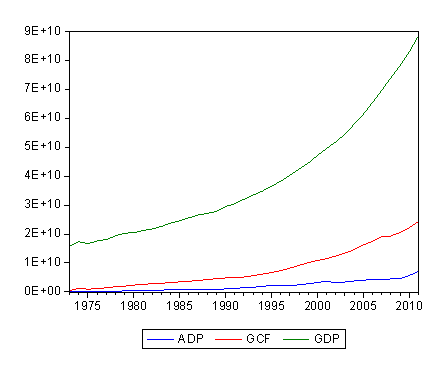
5.4.2. Visual Examination
Cointegration means the long run relationship between non-stationary time series. There If two or more series are individually non-stationary (have to be integrated of the same order), but there exists their linear combination which is stationary - we called these series are cointegrated. Visual inspection of the series are expected to be cointegrated is always a good idea.

 PowerPoint Slide
 Larger image(png format)
In this graph all variables show the same upward trend. We can say all variables are cointegrated.
5.4.3. Johansen Cointegration Test

 PowerPoint Slide
 Larger image(png format)
 View current table in a new window
In our Johansen Cointegration test results of both Trace and Maximum Eigenvalue tests suggest the existence of three cointegrating relationships among the variables in the series at 5% level of significance. This implies that the series under consideration are driven by three common trends. Therefore, our regression is reliable and estimated result is not spurious.
5.4.4. Pair-wise Granger Causality Tests
From our result comparing calculated p-value at the 5% level of significance we can say that, GDP does Granger cause ADP, GDP does Granger cause GCF, GCF does Granger cause ADP where lag is default and that is 2.
5.5. Executive FindingsWe examined different types of statistical properties for our model. According to regression result, we concluded that the probability value of ADP and GCF are satisfactory at the level of significance 5%. That means ADP and GCF are significantly impact GDP. ANOVA model refers that goodness of fit is statistically significant. Graphical method makes the decision that the model is normally distributed. Graphical test indicates our model is not free from heteroscedasticity. That’s why we consider the remedy. In the time series data autocorrelation is widely used term. Durbin Watson test ensures the statistically significant evidence of positive first order serial correlation. We use Likelihood Ratio test to assess the specification of our model. In both cases the results indicate that the model is well specified. The RESET test concludes that our model does not contain any major problem of incorrect functional form and omitted variables. To ensure the efficiency of any regression analysis we have to consider the used time series data whether stationary or not. To find out the stationary properties we use ADF that indicates a mixed result. Because of mixed result of stationary, we discussed about trade-off between loss of efficiency and loss of information. Due to non-stationary results, it has a scope of spurious regression and no economic meanings. Although rule of thumb indicates the spurious regression but the formal test does not ensure it. Unit root test on residuals is used as test for Cointegration. This result implies that the all series under consideration are driven by common trends. In addition, we assess the pair wise causality. After carefully analyzing of the whole results, we can come up a decision that there is a long run relationship between public investment and economic growth. Coefficient of ADP and GCF indicate that the 1-unit increases of ADP and GCF ensure the GDP also increase by 1.292874 and 2.698719 units respectively. Finally, we can say that public investment has a positive impact on economics growth of Bangladesh. So, we can enhance our economic growth by ensuring adequate public investment.
6. Conclusions and Policy Implications
In fine, it is notable that by the econometric technique we examine the casual and practical relationship between public investment and economic growth of Bangladesh. We applied appropriate econometric test, process into the data from 1972 to 2011 to show the relationship. The results indicate that public investment (mainly we consider ADP as a proxy of public investment) has significant effects on economic growth of Bangladesh. So, the government’s action and policies are necessary to unleash economic growth by way of implementing ADP properly. Here it should be mentioned that the political stability, transparency guarantee to abolish corruption, skilled workforce, and developed infrastructure are essential to maintain the standard rate of implementing ADP as well as growth of ADP. If the government can ensure these necessary steps, ADP will impact more positively in our economic growth.
The authority should take some necessary steps to prevent the problems related to public investment as we found an effective relationship between public investment and Economic growth in Bangladesh. Political institutions and actors should be more compromising and consolidate democracy with stable situation for the economic development of the country. The administrative structure should be more accountable and transparent to achieve a good governance system that restrains corruption. The government should enforce monitoring and evaluation procedures in establishing the infrastructures that can ensure more implementation status of ADP. We should also emphasize human resource development through practical education and training programs. We believe that if government considers it then economic growth will enhance.
The econometric model we developed for this study that may suffer from a number of shortcomings due to lack of proper information. Therefore, some venues for future research may be considered. They are as follows:
This study uses annual time series data, which may mask some important dynamic aspects. An analysis based on quarterly or monthly data should certainly be more enriching. But availability of monthly data for Bangladesh would continue to be a major stumbling block at least in the foreseeable future. An important driving force of future research in time series analysis is the advance in high-volume data acquisition. Further work could apply the methodologies developed for this study to a range of other developing countries. However, the estimation equations should be constructed to fit the specific public finance structure in each country. Further studies using different conditions for public investment, for example, different types of dummy could add significant insight on the effects of economic growth in our country. Moreover, from our literature review, it is observed that public investment can crowd in and increase private investment. Proper and accurate data will be available in future and must it be analyzed properly and efficiently. But the special features of the data, such as large sample sizes, heavy tails, unequally spaced observations, and mixtures of multivariate discrete and continuous variables, can easily render existing methods inadequate. Analyses of these types of data will certainly influence the directions of future research.
Acknowledgements
We owe a great deal of gratitude to our honorable teacher and research supervisor Professor Dr. Mudabber Ahmed, Economics Department, University of Chittagong. He offered us constant guidance and many insightful and constructive observations throughout the study. His support, encouragement and availability to discuss ideas and problems have contributed much in completing this work. He always kept us on task and pointing out us back to our research paper objectives. We really appreciate for his patience and high efficiency in guiding us in a proper way in conducting this research. His friendly guidance and cooperation which is very rare inspired us to successfully complete the whole work timely.
References
| [1] | Ahmed, H. A., Uddin, G. S. and Awrangajeb, N. U. H. (2010) “Growth, Public and Private Investment in Bangladesh: An Empirical Analysis” Conference paper on Business Competencies in a Changing Global Environment 2010, Organized by South East University, Dhaka, Bangladesh and Global Business and Management Forum (USA). | ||
 In article In article | |||
| [2] | Ahmed, S. (2010), Problems of ADP Implementation in Bangladesh: An Analytical Review, A Dissertation Paper of MAGD, Institute of Governance Studies, BRAC University, Dhaka, Bangladesh. | ||
| In article | |||
| [3] | Anderson, E., Renzio, P. de and Levy, S. (2006) “The role of public investment in poverty reduction: Theories, evidence and methods”, Working Paper 263, Overseas Development Institute, London SE 1 7 JD, UK. | ||
| In article | |||
| [4] | Barro, R. J., and X. Sala-i-Martin, (1999) Economic Growth, Cambridge, MA: The MIT Press. | ||
| In article | |||
| [5] | Benefits of public investment in the nations road infrastructure, Australian Automobile Association Report, Update of The Allen Consulting Group (1993) and DoTaRs (2002). | ||
| In article | |||
| [6] | Brinca, P. (2006) “The impact of public investment in Sweden a VAR approach” Msc thesis in Economics, Stockholm University, Stockholm, Sweden. | ||
| In article | |||
| [7] | Bukhari, S. A., Ali, L. and Saddaqat, M. (2007) “Public investment and Economic Growth in the three little dragons: Evidence from heterogeneous dynamic panel data” International Journal of Business and Information, Volume 2, Number 1, June 2007, pp. 57-79. | ||
| In article | |||
| [8] | Baltagi, Badi H., Kao, Chihwa. (2000): Nonstationary Panels, Cointegration in Panels and Dynamic Panels: A Survey, Center for Policy Research, WorskingPaper No. 16, New York. | ||
| In article | |||
| [9] | Cavallo, E. and Daude, C. (2008) “Public investment in developing countries: a blessing or a curse?” Working paper number 648, Research Department, Inter-American Development Bank, Washington, DC 20577, USA. | ||
| In article | |||
| [10] | Carter, R Hill, William e. Griffiths and Guay C. Lim, Principle of Econometrics, Fourth Edition, John Wiley & Sons, Inc., 111 River Street, Hoboken. | ||
| In article | |||
| [11] | Clarida, R. H. (1993) “International capital mobility and Public investment and Economic growth” NBER Working Paper Series, Working Paper No. 4506, National Bureau of Economic Research, Cambridge, MA 02138. | ||
| In article | |||
| [12] | Clements, B., Bhattacharya, R. and Nguyen, T. Q. (2003) “External debt, Public investment and Growth in low income countries” IMF Working Paper WP/03/249, Fiscal Affairs Department, International Monetary Fund. | ||
| In article | |||
| [13] | Cullision, W. E. (1993) “Public investment and Economic Growth” Economic Quarterly, Volume 79/4 Fall 1993, Federal Reserve Bank of Richmond, pp. 19-33 Different reports of Implementation Monitoring and Evaluation Division (IMED), Bangladesh Government. | ||
| In article | |||
| [14] | Costa, J. da Silva, R. W. Ellson, and R. C. Martin (1987) Public Capital, Regional Output and Developments: Some Empirical Evidence. Journal of Regional Science 27: 3, 419-437. | ||
| In article | CrossRef | ||
| [15] | Deno, K. T. (1988) The Effect of Public Capital on U.S. Manufacturing Activity: 1970 to 1978. Southern Economic Journal 55: 1, 400-411. | ||
| In article | CrossRef | ||
| [16] | Doan, T. A. (2000), Rats, User’s Guide, Estima, Evanston, IL.E-views users guide i and ii. | ||
| In article | |||
| [17] | Eberts, R. W. (1986) Estimating the Contribution of Urban Public Infrastructure to Regional Growth. Federal Reserve Bank of Cleveland. (Working Paper No. 8610) | ||
| In article | |||
| [18] | Fuller, W. A. (1976). Introduction to Statistical Time Series. New York: Willey. | ||
| In article | |||
| [19] | Ghani, E. and Uddin, M. (2006) “The impact of Public investment on Economic Growth in Pakistan” The Pakistan Development Review, 45: 1 (Spring 2006) pp. 87-98. | ||
| In article | |||
| [20] | Gonzalez, R. L. and Montolio, D. (2011) “Growth, Convergence and Public Investment A Bayesian Model Averaging Approach”. | ||
| In article | |||
| [21] | Gerd S, Ana C, and Funke, K Public Investment and Public-Private Partnerships, International Monetary Fund, pp. 21-36. | ||
| In article | |||
| [22] | Gregory, N Mankiw (2002), Economic Policy Institute, Briefing Paper # 34A, USA Macroeconomics, 5th edition, Worth Publishers. | ||
| In article | |||
| [23] | Gujarati, Damoder N. Basic Econometrics, Fourth Edition, McGraw-Hill Higher Education. | ||
| In article | |||
| [24] | Haque, M. E. and Kneller, R. (2008) “Public investment and Growth : the rule of corruption” Discussion Paper Series Number 098, Centre for Growth & Business Cycle Research, University of Manshester, Manchester. | ||
| In article | |||
| [25] | Hsiao, Cheng: Analysis of Panel Data, Second Edition, Cambridge University Press, New York, 2003. | ||
| In article | CrossRef | ||
| [26] | http://en.wikipedia.org/wiki/Economy_of_Bangladesh#p-search 81 | ||
| In article | |||
| [27] | http://www.investorwords.com/2599/investment.html#ixzz1UQ8VvErw Hussain, Z. (2009) Is Bangladesh getting public investment right?, World Bank | ||
| In article | |||
| [28] | Jimenz, E. (1995) “Human and physical infrastructure: public investment and pricing polices in developing countries” Hand book of development economics, PP. 2774-2836, Volume 3 Edited by J. Behrman and T. N. Srinivasan Elsevier Science B. V 1995. | ||
| In article | |||
| [29] | “Investing in Public investment: An index of public investment efficiency” IMF Working Paper WP/11/37, Strategy, Policy and Review Department, International Monetary Fund. | ||
| In article | |||
| [30] | James. B and Srinivasan, T.N B. V 1995 pricing polices in developing countries” Hand book of development economics, PP. 2774-2836, Volume 3 Elsevier Science B. V 1995. | ||
| In article | |||
| [31] | kalaitzidakis, P. and kalyvitisy, S. (2003) “Financing New public investment and or maintenance in public capital for long run growth” Canadian Studies Program, Department of Foreign Affairs and International Trade, Canada. | ||
| In article | |||
| [32] | Kamps, Christophe: The Dynamic Macroeconomic Effects of Public Capital, Theory and Evidence for OECD countries, Springer, New York, 2004. | ||
| In article | |||
| [33] | Keynes, J. M &Kuttner, R. (1992) “The Collected Writings of John Maynard Keynes” Vol. xxvii, edited by D. Moggridge (London: Macmillan, 1980), pp. 264-419 “The slow growth trap and the public investment cure”. | ||
| In article | |||
| [34] | Kappeler, A and Valila, T. (2007) “Composition of Public Investment and Fiscal Federalism: Panel Data Evidence from Europe” economics and financial report 2007/02, European investment bank. | ||
| In article | |||
| [35] | Kuttner, R. (1992) “The slow growth trap and the public investment cure” The Economic Policy Institute, Briefing Paper # 34A, USA. | ||
| In article | |||
| [36] | Uddin, M & Aziz, S (2014) Effect of Public Investment on Economic Growth in Bangladesh: An Econometric Analysis "Journal of Economics and Sustainable Development. | ||
| In article | |||
| [37] | Naqvi, N. H. (2002) Crowding-in or Crowding out? Modeling the Relationship between Public and Private Fixed Capital Formation using Co-Integration Analysis, The Case of Pakistan 1964-2000. The Pakistan Development Review, 41: 3, 255-276. | ||
| In article | |||
| [38] | Pal, S. (2008) “Does public investment boost economic growth? Evidence from an open economy macro model for India” Cardiff Economics Working Papers E2008/24, Cardiff CF10 3 EU, United Kingdom. | ||
| In article | |||
| [39] | Pereira, A. M. and Pinho, M. D. F. (2006) “Public investment and budgetary consolidation in Portugal” Working Paper number 41, College of William & Mary, Department of Economics, Williamsburg, VA 23187-8795, USA. | ||
| In article | |||
| [40] | Peree, E. and Valila, T. (2008) “A primer on public investment in Europe”. | ||
| In article | |||
| [41] | Public Investment Draft Paper (May 2009), National 5-year plan (2010-2014), Public Investment Development Committee, Republic of Iraq. | ||
| In article | |||
| [42] | Romer, Paul M. (1998) Increasing Returns and Long-run Growth, Journal of Political Economy 94: 5 (October), pp. 1002-1037 Sims, C. A. (1980a). “Macroeconomics and Reality” Econometrica, 48 (10), pp. 1-48. | ||
| In article | |||
| [43] | Saad, W. and Kalakech, K. (2009) “The nature of government expenditure and its impact on sustainable economic growth” Middle Eastern Finance & Economics, Issue 4 (2009), EuroJournals Publishing, Inc. 2009, pp. 38-47. | ||
| In article | |||
| [44] | Sims, C. A. (1980a). “Macroeconomics and Reality” Econometrica, 48 (10), pp. 1-48. | ||
| In article | CrossRef | ||
| [45] | Sturm, J.E.: Public Capital Expenditures inOECD Countries: The Causes and Impact of the Decline in Public Capital Spending, Edward Elgar, Cheltenham, 1998. | ||
| In article | |||
| [46] | The Daily Ittefaq (10 April 2011), Dhaka, Bangladesh. | ||
| In article | |||
| [47] | Zainah, P. (2009) “The role of public investment in promoting economic growth: A case study of Mauritious” Services Sector Development and Impact on Poverty Thematic Working Group, TIPS Project, Trade and Industrial Policy Strategies, Pointes-Aux-Sables, Mauritius. | ||
| In article | |||
| [48] | Zhang, X. and Fan, S. (2000) “Public investment and regional inequality in rural china” EPTD discussion paper no. 71, Washington, DC 20006 USA. | ||
| In article | |||

 CiteULike
 Mendeley
 StumbleUpon
 Delicious
 Facebook
 Twitter
 LinkedIn
 Print
Print