Background In dentistry, interest in computer-aided design and computer-aided manufacturing (CAD/CAM) over traditional denture fabrication systems is increasing. However, few studies have compared the physiochemical and biological properties of different fabrication methods. Therefore, the aim of this study was to evaluate and compare the physicochemical properties of different denture materials in terms of surface roughness and Candida albicans adhesion on the basis of polymerization methods and 3D print orientation. Methods Four types of resin disks were prepared: autopolymerization, heat-activated polymerization, milling, and 3D printing. The surface roughness and water contact angle were measured via a profilometer and the sessile drop method. After C. albicans inoculation, microbial adhesion was measured by scanning electron microscope (SEM), a crystal violet assay, and an alcian blue assay. To further investigate the relationship between surface roughness and microbial adhesion, 3D-printed resin was fabricated at different build orientations. The resins were printed at 0, 45, and 90-degrees to modulate different surface roughness and the same experimental set was used. The cell wall thickness of each group was measured via confocal laser scanning microscopy (CLSM). For statistical analysis, one-way ANOVA and Tukey’s post hoc tests were performed. Results The 3D-printed group presented the greatest adhesion with the highest roughness parameters (Ra, Rdq). The milled group presented the lowest adhesion with the lowest surface roughness values. (p < 0.05) Among the 3D-printed samples with different build orientations, the 0-degree presented the lowest surface roughness and the lowest microbial adhesion. (p < 0.05) Microbial adhesion was less related to average roughness and more related to microroughness. The cell wall thickness showed no difference between the groups. (p < 0.05) Conclusion Microbial adhesion is significantly affected by fabrication methods and build orientation. Milled and 0-degree 3D printed resins provide improved options with the potential to minimize Candida albicans adhesion with the lowest surface roughness. Due to their relatively high surface roughness and microbial adhesion, 3D-printed resins with different printing orientations require care and further modifications. This study aims to provide a deeper understanding of surface morphology and microbial adhesion and lead to novel approaches to prevent and manage intraoral infections.
Oral candidiasis is one of the most common fungal infections, often related to dentures and the edentulous population 1, 2. Denture stomatitis has a multifactorial etiology including ill-fitting dentures, poor denture maintenance, and suboptimal oral hygiene 1. Among these factors are the biofilm formation of C. albicans on the denture surfaces. According to previous studies, a greater number of C. albicans were detected on the intaglio surface of the denture, than on the patient’s mucosa, implying that the dentures can act as a reservoir and a source of infection that poses a significant threat to patient health 3, 4. C. albicans biofilm formation also results in increased virulence due to enhanced resistance to treatment, particularly when it acts synergistically with other species in a commensalism 5. In particular, elderly patients with limited dexterity for self-care and health management may be at greater risk of local and systemic fungal infections such as pneumonia, emphasizing the importance of biofilm management in dentures 6.
Resin is a commonly used material to fabricate dentures with a porous and rough surface, on which C. albicans can easily attach and form biofilms 7, 8. The presence of biofilms impedes the complete removal of pathogens and enables quick regrowth of pathogens at previously infected sites 9, 10, 11, 12, 13. There are several factors influencing the formation and ease of biofilm removal, including surface characteristics, thickness, and elasticity 14, 15. These factors are often dependent on the material used to fabricate the denture 16. Heat-activated polymerization was the most common method used to manufacture dentures. However, with the advent of computer-aided design (CAD) and computer-aided manufacturing (CAM) technology, more clinicians and dental technicians have utilized subtractive and additive resin fabrication methods for denture fabrication 17, 18. Each method of resin production presents various surface characteristics, leading to difference in microbial growth.
According to previous studies, the average surface roughness (Ra) is commonly used to describe surface roughness 19, 20, 21. However, its limited ability to accurately represent intricate surface patterns has led to the need for additional parameters 22, 23. Previous studies have reported mixed results regarding the relationship between multiple surface roughness parameters and microbial adhesion, emphasizing the need for further research. Notably, the build orientation of 3D-printed resin has been associated with various susceptibility levels to microbial attachment 24, 25. The build orientation determines the direction and configuration of the layers, resulting in a unique surface geometry and roughness 26. However, the relationship between roughness and microbial attachment remains inconclusive, necessitating further investigation into the connection between build orientation, surface roughness, and microbial adhesion.
This research aims to evaluate the amount of microbial adhesion on different denture resin surfaces and its relationship with surface roughness. Four alternative fabrication methods, including autopolymerization, heat-activated polymerization, milling, and 3D printing, were tested, followed by 3D-printed resin at different build orientations to modulate surface roughness. The null hypotheses were that different resin fabrication methods would not influence C. albicans adhesion, and that the build orientation would not influence the surface roughness or microbial adhesion.
Fabrication of the resin samples
Denture resin disk samples were designed via using CAD software (Meshmixer, Autodesk, San Rafael, CA, USA) with dimensions of 10mm in diameter and 3mm in thickness. The disks were then saved as standard tessellation language (STL) files for milling (Pink PMMA BLOCK, Huge Dental, Walnut, CA, USA), and 3D printing (Denture Plus ARUM 5.0, ARUM Dentistry, Daejeon, Korea).
Resin patterns were made with the same STL file to make autopolymerization (PressLT, Scheftner, Mainz, Germany), and heat-activated polymerization (DON 2000, Retec GmbH, Rosbach, Germany) resin disks. Resin sample disks were manufactured as manufacturer’s instruction via conventional flasking and pressure packing techniques. All samples were then ground down to 2 mm thickness and immersed in distilled water for 24 h to minimize monomer residues. The samples were then sterilized by Ethylene Oxide sterilization 9.
Surface Characterization
The surface roughness of each resin was measured via a confocal laser scanning microscope (CLSM; LSM800, Carl Zeiss, Oberkochen, Germany) with the ISO 4287 standard. Five points were taken from each sample. The average roughness (Ra) and root mean square slope of the assessed profile (Rdq) values were measured. To evaluate hydrophilicity, the sessile drop method was utilized with distilled water. Each drop was horizontally photographed (Nikon, Nikon Instech Co., Ltd., Kanagawa, Japan) and the contact angle was analyzed using image analysis software (ImageJ, National Institutes of Health, Bethesda, MD, USA)
Microbial Inoculum
Each resin disk was placed in a 24-well plate and inoculated with 2 ml of C. albicans (KCTC 7270) suspension (1x  cells/ml). C. albicans was cultured in yeast malt broth (0.3% yeast extract, 0.3% Malt extract, 0.5% peptone, 1% dextrose concentration). Each sample was aerobically cultured for 24 h at 37°C 27.
Biofilm assessment
To visually confirm growth in each group by scanning electron microscopy (SEM) after 24 hours of inoculation, the samples were fixed with 1 ml of 4% paraformaldehyde for 4 hours and rinsed three times with 1 ml of phosphate buffered saline (PBS) for 15 minutes. Then, the samples were fixed with 1 ml of 1% osmium tetroxide for 60 min and washed with 1 mL of PBS for 15 min. The samples were further dehydrated in successively increasing concentrations of 70%, 80%, 90%, 95%, and 100% ethanol. The resin samples were then treated in 1 mL of 100% hexamethyldisilazane for 20 minutes. The samples were then platinum coated and examined at 10–kV voltage via SEM (S-4700, Hitachi Ltd., Tokyo, Japan) 27.
After 24 h of biofilm formation, the biofilm on each resin sample were quantified via a crystal violet assay. 28 The samples were stained with 1% (w/v) crystal violet solution (HMDS, Sigma-Aldrich, St. Louis, MO, USA) for 10 min in the dark. The samples were then gently rinsed 3 times with PBS to remove excess dye. The samples were subjected to bright field imaging via a stereomicroscope (Leica S6D, Leica, Wetzlar, Germany). The crystal violet dye bound to the biofilm was dissolved in a destaining buffer of ethanol-water (50: 50, v/v). The optical density of the dissolved dye was measured via a microplate reader (Epoch 2, Bio-Tek, Winooski, VT, USA) at 595 nm.
After biofilm formation for 24 h, the samples were stained with alcian blue solution (HMDS, Sigma-Aldrich) for 10 min in the dark. The samples were then gently washed 2 times with PBS to remove excess dye. The samples were subjected to bright field imaging by stereomicroscope. The remaining dye was extracted using a 3% acetic acid solution. The optical density of the dissolved dye was measured via a microplate reader at 620 nm 29.
Build orientation modulation
To further investigate the influence of surface roughness, disks were printed at different build angle. A total of 24 disks of the same size were designed via the same CAD software at build angles of 0, 45, and 90-degrees. Disks were fabricated by the same 3D printer (Denture Plus ARUM 5.0, ARUM Dentistry, Daejeon, Korea). The surface roughness was measured via confocal laser scanning microscopy with the ISO 4287 standard, with 8 points for each sample. The average Roughness (Ra) and root mean square slope of the assessed profile (Rdq) values of the measurements were obtained. For the biofilm formation assay, each resin disks were inoculated with C. albicans as previously described. A crystal violet assay was performed to assess microbial adhesion.
Staining and visualization of biofilms via CLSM
The biofilms on the resin disks were stained in PBS containing 250 μg/mL Concanavalin A (Sigma-Aldrich, St. Louis, USA), and 25 μg/mL Hoechst (Sigma-Aldrich, St. Louis, USA) for 30 min at room temperature in the dark. 30, 31 Each sample was then washed with PBS three times and placed upside down on glass bottom confocal dishes (SPL Life Sciences, Pocheon-si, South Korea) with BacLight mounting oil (Thermo Fisher Scientific, Waltham, MA, USA). Images were obtained via CLSM (LSM980, Carl Zeiss, Oberkochen, Germany) in the 519 nm and 432 nm excitation ranges. The images were processed, and the cell wall thickness was measured via ZEN (Carl Zeiss, Oberkochen, Germany). A minimum of 10 walls were measured per group.
Statistics
The significance of differences among the groups was analyzed via one-way analysis of variance (ANOVA) with Tukey’s test for multiple comparisons (α=.05) via the GraphPad Prism 9 (GraphPad, San Diego, CA, USA) program.
Physiochemical surface characterization
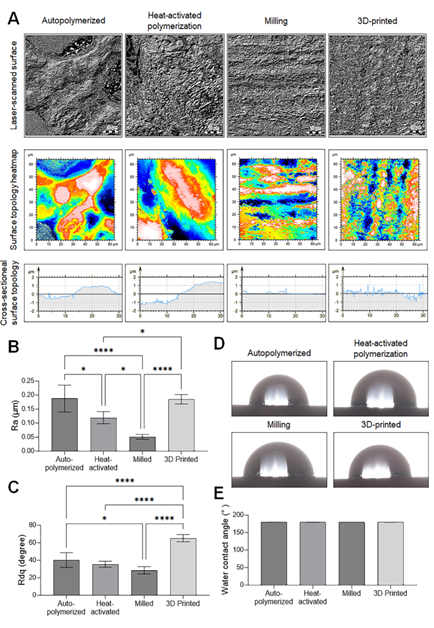
To analyze the surface roughness and topology of the resin samples fabricated via the four different methods, 3D surface scanning via confocal microscopy was performed. A surface topology heatmap and cross-sectional profile curve revealed that the 3D printed groups presented a highly intricate surface pattern of erratic variation in height (Figure 1A). This complexity manifested as a highly irregular pattern of prominences and depressions, leading to a surface with high microroughness (Figure 1A). The autopolymerized and the heat-activated polymerized groups presented relatively smoother surfaces (Figure 1A). The milled group presented consistently defined contours with little variation in surface topography (Figure 1A). Despite the presence of prominent peaks and valleys, with the exception of the 3D-printed group, did not exhibit significant microirregularities (Figure 1 A). The average Roughness (Ra) and root mean square slope of the assessed profile (Rdq) of ISO 4287 were quantified for each group. The autopolymerized and 3D-printed groups showed the highest Ra values. The Ra value of the heat-activated polymerized group was ranged in between, and the milled group presented the lowest Ra value (p < 0.05) (Figure 1B). For Rdq value, the 3D-printed group presented the highest Rdq value, and the milled group showed the lowest Rdq value (p < 0.05). There was no significant difference in the Rdq value between the autopolymerized group and that of the heat-activated polymerized group (p > 0.05) (Figure 1 C).
The hydrophilicity of the different groups was compared via water contact angle analysis. However, there was no statistically significant difference in the water contact among the groups. (Figure 1D and Figure 1E)
Resin type dependent biofilm proliferation
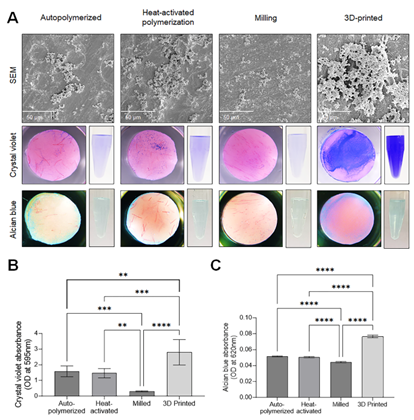
To visually confirm the growth of C. albicans, all four groups of resin samples were imaged via SEM. Large clusters of C. albicans were observed on the 3D printed groups, whereas only a sparse presence of C. albicans was observed on the milled groups (Figure 2A). The amounts of C. albicans bound to the autopolymerized and heat-activated polymerization groups were similar, ranging between the 3D-printed and milled groups (Figure 2A). The total biomass of C. albicans bound to different resin samples was determined via a crystal violet assay. The 3D-printed groups exhibited widespread contamination, whereas the milled group presented the lowest contamination (Figure 2A). The contamination areas of the autopolymerized and heat-activated polymerization groups were similar, ranging between the 3D-printed and milled groups (Figure 2A). Similarly, the optical density (OD) values of the autopolymerized and heat-activated polymerized groups were not significantly different (p > 0.05). The OD value of the milled resin was significantly lower than that of the other three groups (p< 0.05). The OD value of the 3D-printed resin was significantly greater than that of the other three groups (p< 0.05) (Figure 2B).
Next, the carbohydrate content in the biofilm was evaluated via an alcian blue assay. Both bright field images and OD value-based quantification data revealed significantly greater carbohydrate contents in the 3D-printed groups and significantly lower carbohydrate contents in the milled groups than in the other groups (Figure 2A and 2C). The carbohydrate contents of the autopolymerized and heat-activated polymerization groups were similar (p > 0.05), ranging between the 3D-printed and milled groups (Figure 2A and 2C).
Printing orientation dependent biofilm growth
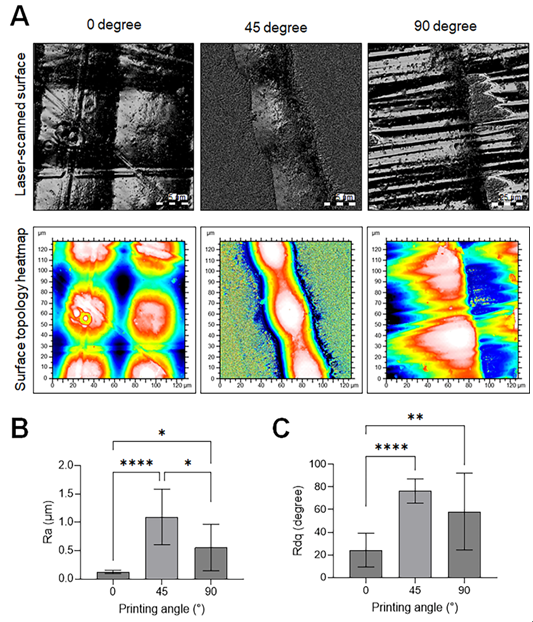
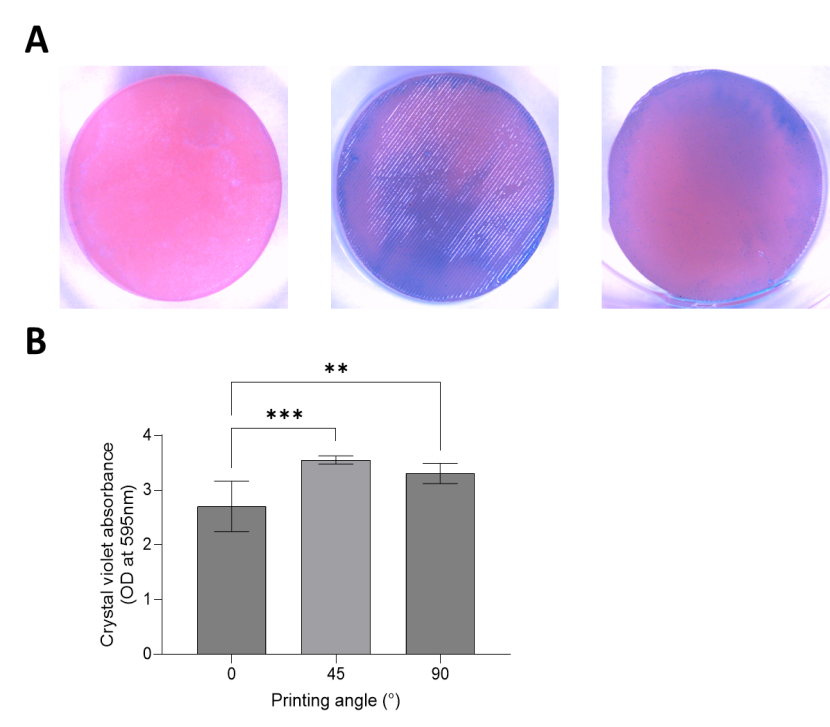
On the basis of these previous results, this study hypothesized that the surface roughness of differently fabricated resins is the key factor for the surface binding and proliferation of C. albicans. Therefore, a test was performed to evaluate whether printing orientation-dependent modulation of surface roughness can reduce or enhance C. albicans binding and proliferation. The 3D surface analysis revealed the lowest Ra value in the 0-degree orientation group and the highest Ra value in the 45-degree orientation group (Figure 3A and 3B). With respect to surface complexity, the 0-degree group presented the lowest Rdq value, and 45-degree group showed highest Rdq value (p < 0.05) (Figure 3C). As expected, the results of crystal violet staining results revealed that the 0-degree groups, which had the smoothest surfaces, presented the lowest level of contamination, whereas the 45-degree groups, which had the roughest surfaces, presented the highest level of contamination. However, there was no significant difference in C. albicans contamination between the 45-degree and 90-degree groups (p > 0.05) (Figure 4).
Cell wall thickness measurement and visualization by CLSM
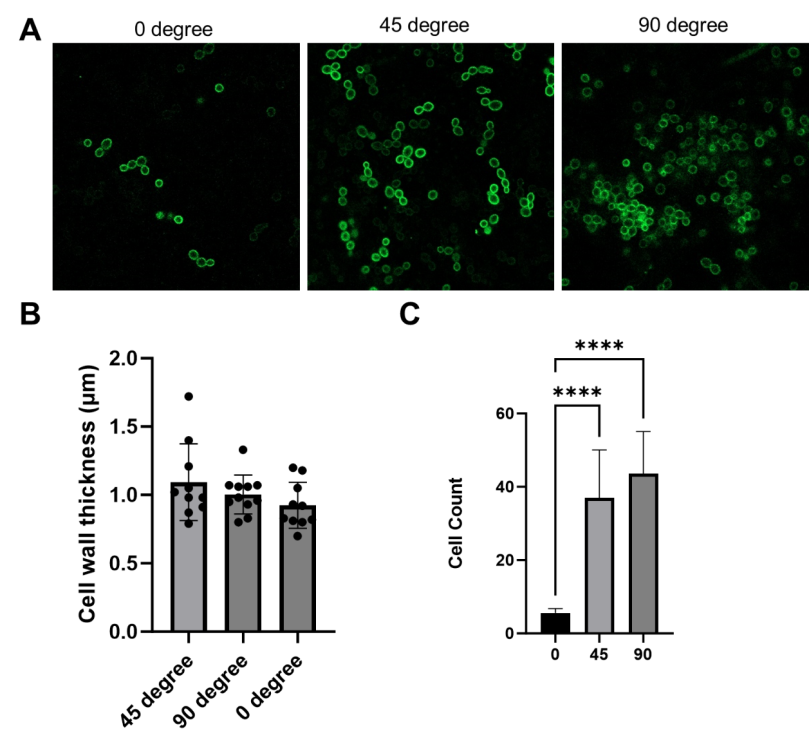
The cell wall thickness did not differ among the 3D-printed groups (Fig 5 B). Visual inspection and counting of the cells in each group revealed findings consistent with previous results, where the 0-degree group presented a lower level of microbial adhesion, whereas the 45-degree and 90-degree groups presented the higher levels. (Figure5A and 5C)


The aim of this study was to evaluate the surface roughness and microbial adhesion of resin surfaces fabricated via different methods and build orientations. The first hypothesis that there is no difference between the resin groups fabricated by different methods was rejected, as the milled group presented the lowest Ra, Rdq, and microbial adhesion. The highest Ra, Rdq, and microbial adhesion were found in the 3D-printed group. The second hypothesis was also rejected, as the 0-degree group presented lower Ra, Rdq, and microbial adhesion values. The findings are consistent with those of previous studies.
Among the different characteristics, previous research has demonstrated that the level of growth is directly proportional to the roughness of the surface 19. Surface roughness was found to play an important role in the initial adherence of bacteria and could act as a buffer to shear forces applied to biofilms 20. In this study, the arithmetic average roughness (Ra) and root mean square slope of the assessed profile (Rdq) values were analyzed. The Ra value is widely used to describe surface roughness 21. Compared with those of the other groups, the Ra value of the milled resin was the lowest, implying a smoother surface. However, the Ra value of the 3D-printed resin was comparable to that of the autopolymerized group, which highlights the limitations of Ra as the sole parameter for explaining variations in microbial adhesion.
The Ra value is defined as the absolute average relative to the base length which presents general description of the surface roughness but provides little information on the microstructure of the surface. Consequently, even if two surfaces display distinctive characteristics, the average could be similar which could be a possible explanation for the lack of difference between the autopolymerized and the 3D-printed groups 32, 33. Furthermore, according to previous studies, biofilm formation and bacterial growth heavily depend on the microroughness of the surface, which cannot be accurately reflected by the Ra values 22, 34.
Therefore, this study focused on the Rdq value, which is defined as the root mean square slope of the assessed profile. The Rdq value better reflects the complexity of the surface and its microroughness. The Rdq value properly coincided well with the C. albicans growth and biofilm formation results. With a higher Rdq value and more complex surface, the 3D-printed resin had the highest C. albicans adhesion. With a lower Rdq value, and hence smoother surface, the milled resin showed less adhesion. The profile curve of the surface topography results further illustrates the results. The 3D-printed resin presented extreme microroughness with highly varied heights on its surface. Autopolymerized and heat-activated polymerized resin showed mild elevation and depression that lacked pronounced irregularities. The milled group presented a relatively smooth surface with little variation. The results revealed that the microstructures of the surfaces varied among the groups, and could lead to different levels of microbial attachment.
Further study was performed to reveal the relationship between surface roughness and microbial adhesion. According to a previous study, printing orientation does not influence the level of microbial adhesion {Li, 2022 #91}. On the other hand, Yacob et al. revealed that the printing orientation is crucial to microbial adhesion, with 0-degree showing the least amount of adhesion {Yacob, 2023 #73}. This study further revealed that microbial adhesion is related to the printing orientation, with the 0-degree group showing the least amount of adhesion compared with the 45- and 90-degree groups. A previous study reported that even with lower a Ra value, greater level of microbial adhesion was observed. Multiple factors including surface energy, absorbance level, and hydrophobicity have been identified to explain this discrepancy {Silva, 2023 #94}. As mentioned, this study focused on subsidiary surface roughness parameters to evaluate this relationship. The 45-degree and 90-degree groups had no significant difference in microbial adhesion, despite the lower Ra value of the 90-degree group. The 45- and 90-degree groups presented similar Rdq values, and similar levels of microsurface complexity. Therefore, although the Ra value is commonly used to describe surface roughness, it has several limitations, and subsidiary parameters such as Rdq values could be used as auxiliary tools to describe resin surface characteristics and more accurately predict microbial adhesion.
The cell wall could be an important indicator of antifungal agent resistance. With a thicker cell wall, antifungal agents cannot penetrate the wall and can be activated. There was no difference in cell wall thickness in this study. However, the CLSM results revealed greater number of Concanavalin A-stained cells in the 45- and 90-degree printed resins, which could potentially indicate thicker biofilms and greater resistance. Further studies are needed to establish a meaningful relationship between the surface roughness level, microbial adhesion level and cell wall thickness.
In this study, the resin samples were unpolished to simulate the intaglio surface of the denture, since the intaglio surface often cannot be polished. The low adherence of C. albicans to milled and 0-degree 3D printed resin poses a certain advantage to patients with limited dexterity by minimizing the number of initial colonizers. However, despite their low adherence, microbial adhesion is inevitable, and a high emphasis on proper maintenance should be imposed. Owning to the characteristics of the patient population, denture wearers often lack the ability to mechanically clean their prosthesis and are left to chemical cleansing alone. However, traditional chemical cleaning alone is often insufficient for removing mature biofilms due to their resistance 10, 35. Lee et al. presented a new chemical method for cleaning dentures, with significant potential to properly maintain patients’ oral health 27. Further innovative and easily accessible ways to maintain the oral health of denture patients properly are needed.
The limitations of this study includ that denture have more complex structures that resin disk samples do and that further considerations should be taken in place before they can be applied in clinical situations. Additionally, various factors influencing growth and biofilm development other than roughness should be considered. Finally, due to such a variant way of fabricating 3D-printed resin, the 3D-printed resin discussed in this paper could not be the represented. Biofilm formation is significant but not the only factor to consider when choosing the material for denture manufacture. However, this research aims to provide valuable guidance to clinicians in their decision-making process by examining biofilm formation on different denture resin surfaces.
Fabrication methods and printing orientation significantly affect surface roughness and microbial adhesion. The relatively smooth micro- and macroroughness of the milled and 0-degree printed resins were advantages over those of conventional and other 3D-printed resins. More precautions should be taken in the case of 45- and 90-degree printed resins because of their greater susceptibility to C. albicans fungal colonization and possibly greater resistance to antifungal agents due to thicker cell walls.
In addition to the Ra value, the Rdq value could be used to more accurately describe the surface morphology of denture resins and possibly explain the different levels of microbial adhesion. This study aims to provide valuable data on the surface morphology of different resins and C. albicans adhesion with respect to different parameters. A deeper understanding of C. albicans biofilm formation with respect to surface roughness can lead to better and novel approaches in preventing and managing denture stomatitis in clinical practice.
ANOVA: one-way analysis of variance; CAD/CAM: Computer-aided design and computer-aided manufacturing; CLSM: Confocal laser Scanning Microscopy; OD: Optical density; PBS: phosphate buffered saline; SEM: Scanning electron microscope; STL: Standard tessellation language;
| [1] | Gendreau L, Loewy ZG: Epidemiology and etiology of denture stomatitis. J Prosthodont 2011, 20(4): 251-260. | ||
| In article | View Article PubMed | ||
| [2] | Skupien JA, Valentini F, Boscato N, Pereira-Cenci T: Prevention and treatment of Candida colonization on denture liners: a systematic review. J Prosthet Dent 2013, 110(5): 356-362. | ||
| In article | View Article PubMed | ||
| [3] | Fanello S, Bouchara JP, Sauteron M, Delbos V, Parot E, Marot-Leblond A, Moalic E, Flohicc AML, Brangerd B: Predictive value of oral colonization by Candida yeasts for the onset of a nosocomial infection in elderly hospitalized patients. J Med Microbiol 2006, 55(Pt 2): 223-228. | ||
| In article | View Article PubMed | ||
| [4] | Davenport JC: The oral distribution of candida in denture stomatitis. Br Dent J 1970, 129(4): 151-156. | ||
| In article | View Article PubMed | ||
| [5] | Lemberg C, Martinez de San Vicente K, Fróis-Martins R, Altmeier S, Tran VDT, Mertens S, Amorim-Vaz S, Rai LS, d'Enfert C, Pagni M et al: Candida albicans commensalism in the oral mucosa is favoured by limited virulence and metabolic adaptation. PLoS Pathog 2022, 18(4): e1010012. | ||
| In article | View Article PubMed | ||
| [6] | Iinuma T, Arai Y, Abe Y, Takayama M, Fukumoto M, Fukui Y, Iwase T, Takebayashi T, Hirose N, Gionhaku N et al: Denture wearing during sleep doubles the risk of pneumonia in the very elderly. J Dent Res 2015, 94(3 Suppl): 28s-36s. | ||
| In article | View Article PubMed | ||
| [7] | Radford DR, Sweet SP, Challacombe SJ, Walter JD: Adherence of Candida albicans to denture-base materials with different surface finishes. J Dent 1998, 26(7): 577-583. | ||
| In article | View Article PubMed | ||
| [8] | Radford DR, Challacombe SJ, Walter JD: Denture plaque and adherence of Candida albicans to denture-base materials in vivo and in vitro. Crit Rev Oral Biol Med 1999, 10(1): 99-116. | ||
| In article | View Article PubMed | ||
| [9] | Lee EH, Ahn JS, Lim YJ, Kwon HB, Kim MJ: Effect of post-curing time on the color stability and related properties of a tooth-colored 3D-printed resin material. J Mech Behav Biomed Mater 2022, 126: 104993. | ||
| In article | View Article PubMed | ||
| [10] | Sardi JCO, Scorzoni L, Bernardi T, Fusco-Almeida AM, Mendes Giannini MJS: Candida species: current epidemiology, pathogenicity, biofilm formation, natural antifungal products and new therapeutic options. J Med Microbiol 2013, 62(Pt 1):10-24. | ||
| In article | View Article PubMed | ||
| [11] | Işeri U, Uludamar A, Ozkan YK: Effectiveness of different cleaning agents on the adherence of Candida albicans to acrylic denture base resin. Gerodontology 2011, 28(4): 271-276. | ||
| In article | View Article PubMed | ||
| [12] | Nalbant AD, Kalkanci A, Filiz B, Kustimur S: Effectiveness of different cleaning agents against the colonization of Candida spp and the in vitro detection of the adherence of these yeast cells to denture acrylic surfaces. Yonsei Med J 2008, 49(4): 647-654. | ||
| In article | View Article PubMed | ||
| [13] | Alam M, Jagger R, Vowles R, Moran J: Comparative stain removal properties of four commercially available denture cleaning products: an in vitro study. Int J Dent Hyg 2011, 9(1): 37-42. | ||
| In article | View Article PubMed | ||
| [14] | Wells M, Schneider R, Bhattarai B, Currie H, Chavez B, Christopher G, Rumbaugh K, Gordon V: Perspective: The viscoelastic properties of biofilm infections and mechanical interactions with phagocytic immune cells. Front Cell Infect Microbiol 2023, 13: 1102199. | ||
| In article | View Article PubMed | ||
| [15] | Peterson BW, He Y, Ren Y, Zerdoum A, Libera MR, Sharma PK, van Winkelhoff AJ, Neut D, Stoodley P, van der Mei HC et al: Viscoelasticity of biofilms and their recalcitrance to mechanical and chemical challenges. FEMS Microbiol Rev 2015, 39(2): 234-245. | ||
| In article | View Article PubMed | ||
| [16] | Al-Qahtani AS, Tulbah HI, Binhasan M, Abbasi MS, Ahmed N, Shabib S, Farooq I, Aldahian N, Nisar SS, Tanveer SA et al: Surface Properties of Polymer Resins Fabricated with Subtractive and Additive Manufacturing Techniques. Polymers (Basel) 2021, 13(23). | ||
| In article | View Article PubMed | ||
| [17] | Singh S, Palaskar JN, Mittal S: Comparative evaluation of surface porosities in conventional heat polymerized acrylic resin cured by water bath and microwave energy with microwavable acrylic resin cured by microwave energy. Contemp Clin Dent 2013, 4(2): 147-151. | ||
| In article | View Article PubMed | ||
| [18] | Prpić V, Schauperl Z, Ćatić A, Dulčić N, Čimić S: Comparison of Mechanical Properties of 3D-Printed, CAD/CAM, and Conventional Denture Base Materials. J Prosthodont 2020, 29(6): 524-528. | ||
| In article | View Article PubMed | ||
| [19] | Zheng S, Bawazir M, Dhall A, Kim HE, He L, Heo J, Hwang G: Implication of Surface Properties, Bacterial Motility, and Hydrodynamic Conditions on Bacterial Surface Sensing and Their Initial Adhesion. Front Bioeng Biotechnol 2021, 9: 643722. | ||
| In article | View Article PubMed | ||
| [20] | Park JW, Song CW, Jung JH, Ahn SJ, Ferracane JL: The effects of surface roughness of composite resin on biofilm formation of Streptococcus mutans in the presence of saliva. Oper Dent 2012, 37(5): 532-539. | ||
| In article | View Article PubMed | ||
| [21] | Radford DR, Watson TF, Walter JD, Challacombe SJ: The effects of surface machining on heat cured acrylic resin and two soft denture base materials: a scanning electron microscope and confocal microscope evaluation. J Prosthet Dent 1997, 78(2): 200-208. | ||
| In article | View Article PubMed | ||
| [22] | Salerno M, Itri A, Frezzato M, Rebaudi A: Surface microstructure of dental implants before and after insertion: an in vitro study by means of scanning probe microscopy. Implant Dent 2015, 24(3): 248-255. | ||
| In article | View Article PubMed | ||
| [23] | Holban A-M, Farcasiu C, Andrei O-C, Grumezescu AM, Farcasiu A-T: Surface Modification to Modulate Microbial Biofilms—Applications in Dental Medicine. Materials 2021, 14(22): 6994. | ||
| In article | View Article PubMed | ||
| [24] | Shim JS, Kim J-E, Jeong SH, Choi YJ, Ryu JJ: Printing accuracy, mechanical properties, surface characteristics, and microbial adhesion of 3D-printed resins with various printing orientations. The Journal of Prosthetic Dentistry 2020, 124(4): 468-475. | ||
| In article | View Article PubMed | ||
| [25] | Li P, Fernandez PK, Spintzyk S, Schmidt F, Beuer F, Unkovskiy A: Effect of additive manufacturing method and build angle on surface characteristics and Candida albicans adhesion to 3D printed denture base polymers. J Dent 2022, 116: 103889. | ||
| In article | View Article PubMed | ||
| [26] | Yacob N, Ahmad NA, Safii SH, Yunus N, Abdul Razak F: Is microbial adhesion affected by the build orientation of a 3-dimensionally printed denture base resin? J Prosthet Dent 2023, 130(1): 131.e131-131.e137. | ||
| In article | View Article PubMed | ||
| [27] | Lee EH, Jeon YH, An SJ, Deng YH, Kwon HB, Lim YJ, Kong H, Kim MJ: Removal effect of Candida albicans biofilms from the PMMA resin surface by using a manganese oxide nanozyme-doped diatom microbubbler. Heliyon 2022, 8(12): e12290. | ||
| In article | View Article PubMed | ||
| [28] | Lee E-H, Seo Y, Kwon H-B, Yim Y-J, Kong H, Kim M-J: The biofilm removal effect of MnO2-diatom microbubbler from the dental prosthetic surfaces: In vitro study. jkap 2020, 58(1): 14-22. | ||
| In article | View Article | ||
| [29] | Mei Y, Jiang T, Zou Y, Wang Y, Zhou J, Li J, Liu L, Tan J, Wei L, Li J et al: FDA Approved Drug Library Screening Identifies Robenidine as a Repositionable Antifungal. Front Microbiol 2020, 11: 996. | ||
| In article | View Article PubMed | ||
| [30] | Yang Y, Wang C, Zhuge Y, Zhang J, Xu K, Zhang Q, Zhang H, Chen H, Chu M, Jia C: Photodynamic Antifungal Activity of Hypocrellin A Against Candida albicans. Front Microbiol 2019, 10: 1810. | ||
| In article | View Article PubMed | ||
| [31] | Al-Shammery HA, Bubb NL, Youngson CC, Fasbinder DJ, Wood DJ: The use of confocal microscopy to assess surface roughness of two milled CAD-CAM ceramics following two polishing techniques. Dent Mater 2007, 23(6): 736-741. | ||
| In article | View Article PubMed | ||
| [32] | Perera-Costa D, Bruque JM, González-Martín ML, Gómez-García AC, Vadillo-Rodríguez V: Studying the influence of surface topography on bacterial adhesion using spatially organized microtopographic surface patterns. Langmuir 2014, 30(16): 4633-4641. | ||
| In article | View Article PubMed | ||
| [33] | Perni S, Prokopovich P: Micropatterning with conical features can control bacterial adhesion on silicone. Soft Matter 2013, 9(6): 1844-1851. | ||
| In article | View Article | ||
| [34] | Holban AM, Farcasiu C, Andrei OC, Grumezescu AM, Farcasiu AT: Surface Modification to Modulate Microbial Biofilms-Applications in Dental Medicine. Materials (Basel) 2021, 14(22). | ||
| In article | View Article PubMed | ||
| [35] | Chandra J, Mukherjee PK, Leidich SD, Faddoul FF, Hoyer LL, Douglas LJ, Ghannoum MA: Antifungal resistance of candidal biofilms formed on denture acrylic in vitro. J Dent Res 2001, 80(3): 903-908. | ||
| In article | View Article PubMed | ||
Published with license by Science and Education Publishing, Copyright © 2025 Fahad K. Alwithinani and Nouf Al Humayyani
 This work is licensed under a Creative Commons Attribution 4.0 International License. To view a copy of this license, visit
http://creativecommons.org/licenses/by/4.0/
This work is licensed under a Creative Commons Attribution 4.0 International License. To view a copy of this license, visit
http://creativecommons.org/licenses/by/4.0/
| [1] | Gendreau L, Loewy ZG: Epidemiology and etiology of denture stomatitis. J Prosthodont 2011, 20(4): 251-260. | ||
| In article | View Article PubMed | ||
| [2] | Skupien JA, Valentini F, Boscato N, Pereira-Cenci T: Prevention and treatment of Candida colonization on denture liners: a systematic review. J Prosthet Dent 2013, 110(5): 356-362. | ||
| In article | View Article PubMed | ||
| [3] | Fanello S, Bouchara JP, Sauteron M, Delbos V, Parot E, Marot-Leblond A, Moalic E, Flohicc AML, Brangerd B: Predictive value of oral colonization by Candida yeasts for the onset of a nosocomial infection in elderly hospitalized patients. J Med Microbiol 2006, 55(Pt 2): 223-228. | ||
| In article | View Article PubMed | ||
| [4] | Davenport JC: The oral distribution of candida in denture stomatitis. Br Dent J 1970, 129(4): 151-156. | ||
| In article | View Article PubMed | ||
| [5] | Lemberg C, Martinez de San Vicente K, Fróis-Martins R, Altmeier S, Tran VDT, Mertens S, Amorim-Vaz S, Rai LS, d'Enfert C, Pagni M et al: Candida albicans commensalism in the oral mucosa is favoured by limited virulence and metabolic adaptation. PLoS Pathog 2022, 18(4): e1010012. | ||
| In article | View Article PubMed | ||
| [6] | Iinuma T, Arai Y, Abe Y, Takayama M, Fukumoto M, Fukui Y, Iwase T, Takebayashi T, Hirose N, Gionhaku N et al: Denture wearing during sleep doubles the risk of pneumonia in the very elderly. J Dent Res 2015, 94(3 Suppl): 28s-36s. | ||
| In article | View Article PubMed | ||
| [7] | Radford DR, Sweet SP, Challacombe SJ, Walter JD: Adherence of Candida albicans to denture-base materials with different surface finishes. J Dent 1998, 26(7): 577-583. | ||
| In article | View Article PubMed | ||
| [8] | Radford DR, Challacombe SJ, Walter JD: Denture plaque and adherence of Candida albicans to denture-base materials in vivo and in vitro. Crit Rev Oral Biol Med 1999, 10(1): 99-116. | ||
| In article | View Article PubMed | ||
| [9] | Lee EH, Ahn JS, Lim YJ, Kwon HB, Kim MJ: Effect of post-curing time on the color stability and related properties of a tooth-colored 3D-printed resin material. J Mech Behav Biomed Mater 2022, 126: 104993. | ||
| In article | View Article PubMed | ||
| [10] | Sardi JCO, Scorzoni L, Bernardi T, Fusco-Almeida AM, Mendes Giannini MJS: Candida species: current epidemiology, pathogenicity, biofilm formation, natural antifungal products and new therapeutic options. J Med Microbiol 2013, 62(Pt 1):10-24. | ||
| In article | View Article PubMed | ||
| [11] | Işeri U, Uludamar A, Ozkan YK: Effectiveness of different cleaning agents on the adherence of Candida albicans to acrylic denture base resin. Gerodontology 2011, 28(4): 271-276. | ||
| In article | View Article PubMed | ||
| [12] | Nalbant AD, Kalkanci A, Filiz B, Kustimur S: Effectiveness of different cleaning agents against the colonization of Candida spp and the in vitro detection of the adherence of these yeast cells to denture acrylic surfaces. Yonsei Med J 2008, 49(4): 647-654. | ||
| In article | View Article PubMed | ||
| [13] | Alam M, Jagger R, Vowles R, Moran J: Comparative stain removal properties of four commercially available denture cleaning products: an in vitro study. Int J Dent Hyg 2011, 9(1): 37-42. | ||
| In article | View Article PubMed | ||
| [14] | Wells M, Schneider R, Bhattarai B, Currie H, Chavez B, Christopher G, Rumbaugh K, Gordon V: Perspective: The viscoelastic properties of biofilm infections and mechanical interactions with phagocytic immune cells. Front Cell Infect Microbiol 2023, 13: 1102199. | ||
| In article | View Article PubMed | ||
| [15] | Peterson BW, He Y, Ren Y, Zerdoum A, Libera MR, Sharma PK, van Winkelhoff AJ, Neut D, Stoodley P, van der Mei HC et al: Viscoelasticity of biofilms and their recalcitrance to mechanical and chemical challenges. FEMS Microbiol Rev 2015, 39(2): 234-245. | ||
| In article | View Article PubMed | ||
| [16] | Al-Qahtani AS, Tulbah HI, Binhasan M, Abbasi MS, Ahmed N, Shabib S, Farooq I, Aldahian N, Nisar SS, Tanveer SA et al: Surface Properties of Polymer Resins Fabricated with Subtractive and Additive Manufacturing Techniques. Polymers (Basel) 2021, 13(23). | ||
| In article | View Article PubMed | ||
| [17] | Singh S, Palaskar JN, Mittal S: Comparative evaluation of surface porosities in conventional heat polymerized acrylic resin cured by water bath and microwave energy with microwavable acrylic resin cured by microwave energy. Contemp Clin Dent 2013, 4(2): 147-151. | ||
| In article | View Article PubMed | ||
| [18] | Prpić V, Schauperl Z, Ćatić A, Dulčić N, Čimić S: Comparison of Mechanical Properties of 3D-Printed, CAD/CAM, and Conventional Denture Base Materials. J Prosthodont 2020, 29(6): 524-528. | ||
| In article | View Article PubMed | ||
| [19] | Zheng S, Bawazir M, Dhall A, Kim HE, He L, Heo J, Hwang G: Implication of Surface Properties, Bacterial Motility, and Hydrodynamic Conditions on Bacterial Surface Sensing and Their Initial Adhesion. Front Bioeng Biotechnol 2021, 9: 643722. | ||
| In article | View Article PubMed | ||
| [20] | Park JW, Song CW, Jung JH, Ahn SJ, Ferracane JL: The effects of surface roughness of composite resin on biofilm formation of Streptococcus mutans in the presence of saliva. Oper Dent 2012, 37(5): 532-539. | ||
| In article | View Article PubMed | ||
| [21] | Radford DR, Watson TF, Walter JD, Challacombe SJ: The effects of surface machining on heat cured acrylic resin and two soft denture base materials: a scanning electron microscope and confocal microscope evaluation. J Prosthet Dent 1997, 78(2): 200-208. | ||
| In article | View Article PubMed | ||
| [22] | Salerno M, Itri A, Frezzato M, Rebaudi A: Surface microstructure of dental implants before and after insertion: an in vitro study by means of scanning probe microscopy. Implant Dent 2015, 24(3): 248-255. | ||
| In article | View Article PubMed | ||
| [23] | Holban A-M, Farcasiu C, Andrei O-C, Grumezescu AM, Farcasiu A-T: Surface Modification to Modulate Microbial Biofilms—Applications in Dental Medicine. Materials 2021, 14(22): 6994. | ||
| In article | View Article PubMed | ||
| [24] | Shim JS, Kim J-E, Jeong SH, Choi YJ, Ryu JJ: Printing accuracy, mechanical properties, surface characteristics, and microbial adhesion of 3D-printed resins with various printing orientations. The Journal of Prosthetic Dentistry 2020, 124(4): 468-475. | ||
| In article | View Article PubMed | ||
| [25] | Li P, Fernandez PK, Spintzyk S, Schmidt F, Beuer F, Unkovskiy A: Effect of additive manufacturing method and build angle on surface characteristics and Candida albicans adhesion to 3D printed denture base polymers. J Dent 2022, 116: 103889. | ||
| In article | View Article PubMed | ||
| [26] | Yacob N, Ahmad NA, Safii SH, Yunus N, Abdul Razak F: Is microbial adhesion affected by the build orientation of a 3-dimensionally printed denture base resin? J Prosthet Dent 2023, 130(1): 131.e131-131.e137. | ||
| In article | View Article PubMed | ||
| [27] | Lee EH, Jeon YH, An SJ, Deng YH, Kwon HB, Lim YJ, Kong H, Kim MJ: Removal effect of Candida albicans biofilms from the PMMA resin surface by using a manganese oxide nanozyme-doped diatom microbubbler. Heliyon 2022, 8(12): e12290. | ||
| In article | View Article PubMed | ||
| [28] | Lee E-H, Seo Y, Kwon H-B, Yim Y-J, Kong H, Kim M-J: The biofilm removal effect of MnO2-diatom microbubbler from the dental prosthetic surfaces: In vitro study. jkap 2020, 58(1): 14-22. | ||
| In article | View Article | ||
| [29] | Mei Y, Jiang T, Zou Y, Wang Y, Zhou J, Li J, Liu L, Tan J, Wei L, Li J et al: FDA Approved Drug Library Screening Identifies Robenidine as a Repositionable Antifungal. Front Microbiol 2020, 11: 996. | ||
| In article | View Article PubMed | ||
| [30] | Yang Y, Wang C, Zhuge Y, Zhang J, Xu K, Zhang Q, Zhang H, Chen H, Chu M, Jia C: Photodynamic Antifungal Activity of Hypocrellin A Against Candida albicans. Front Microbiol 2019, 10: 1810. | ||
| In article | View Article PubMed | ||
| [31] | Al-Shammery HA, Bubb NL, Youngson CC, Fasbinder DJ, Wood DJ: The use of confocal microscopy to assess surface roughness of two milled CAD-CAM ceramics following two polishing techniques. Dent Mater 2007, 23(6): 736-741. | ||
| In article | View Article PubMed | ||
| [32] | Perera-Costa D, Bruque JM, González-Martín ML, Gómez-García AC, Vadillo-Rodríguez V: Studying the influence of surface topography on bacterial adhesion using spatially organized microtopographic surface patterns. Langmuir 2014, 30(16): 4633-4641. | ||
| In article | View Article PubMed | ||
| [33] | Perni S, Prokopovich P: Micropatterning with conical features can control bacterial adhesion on silicone. Soft Matter 2013, 9(6): 1844-1851. | ||
| In article | View Article | ||
| [34] | Holban AM, Farcasiu C, Andrei OC, Grumezescu AM, Farcasiu AT: Surface Modification to Modulate Microbial Biofilms-Applications in Dental Medicine. Materials (Basel) 2021, 14(22). | ||
| In article | View Article PubMed | ||
| [35] | Chandra J, Mukherjee PK, Leidich SD, Faddoul FF, Hoyer LL, Douglas LJ, Ghannoum MA: Antifungal resistance of candidal biofilms formed on denture acrylic in vitro. J Dent Res 2001, 80(3): 903-908. | ||
| In article | View Article PubMed | ||