The stability of removable full dentures is critical for successful prosthetic rehabilitation in all clinical settings. Overdentures offer an interesting alternative, especially when additional retention mechanisms are required to improve masticatory efficiency, stability and delay ridge reduction. Abutment teeth are essential for transmitting masticatory forces, preserving alveolar bone, mucosa and proprioception. Complete mandibular dentures with retention systems require adequate support, and implant treatment may be considered when significant resorption compromises stability and retention. Pre-implant clinical evaluation factors include the patient's general condition, bone status, and financial situation. Dental implant therapy and piezography are both viable options for improving denture stability, with piezography focusing on muscle balance through appropriate denture tooth placement. The use of piezographic impressions to utilize the neutral zone for mandibular denture stability is well established, with studies demonstrating improved fit, comfort, and phonation clarity compared to conventional techniques.
The primary concern of a completely edentulous patient undergoing prosthetic treatment is whether their dentures will be retentive. This retention is linked to various factors, primarily physical. The phenomena that condition the relationships between the prostheses and the supporting surface have been studied for a long time. Housset distinguished, within the framework of a balance triad, sustentation, stabilization, and retention, qualities sought in any prosthetic restoration. 1
The design of a removable prosthesis to restore complete edentulism, particularly in the mandible, represents a challenge due to the frequent dissatisfaction of patients regarding its stability. The main concern expressed is the lack of retention and stability, leading to limited masticatory function and, consequently, treatment failure. This problem is even more pronounced in the presence of mandibular ridge atrophy. With the resorption of the alveolar ridge, the points of muscular attachment are brought onto or near the crest, resulting in the disappearance of the vestibular sulcus and a narrowing of the width of the residual ridge. 2
The therapeutic solutions to this problem of prosthetic instability in the edentulous mandible are as follows:
• Tooth-supported overdenture prosthesis with retention systems;
• Implant-supported overdenture prosthesis;
• The piezographic technique; 2
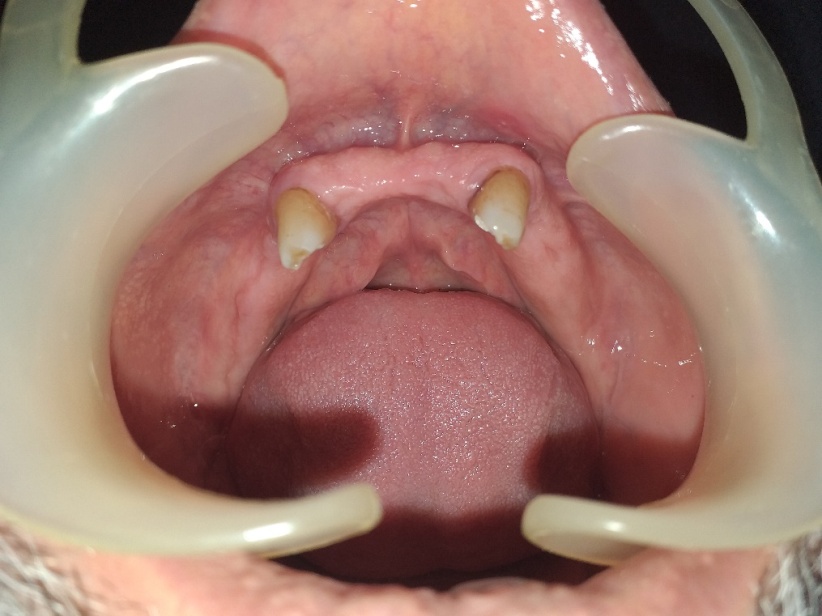
A 58-year-old male patient was referred to the Department of Removable Prosthodontics in Casablanca, Morocco, for the rehabilitation of his maxillary and mandibular arches. The intraoral examination revealed partial edentulism in the maxilla and subtotal edentulism in the mandible, with teeth 33 and 43 still present. These teeth exhibited good periodontal support and no mobility, and the anterior ridge showed no undercut. (Figure 1)


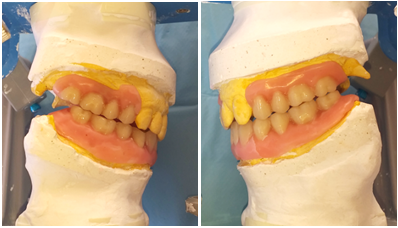
The pre-prosthetic study phase is a crucial step, enabling the analysis and validation of the prosthetic plan from both aesthetic and functional perspectives. By mounting the study models on an articulator, the inter-arch relationship can be analyzed, and the required prosthetic height can be assessed to implement additional retention measures. (Figure 2)
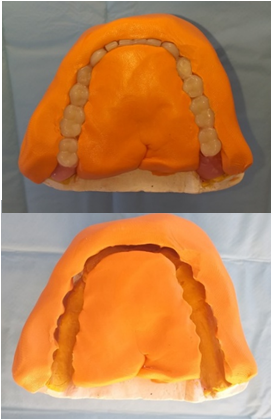
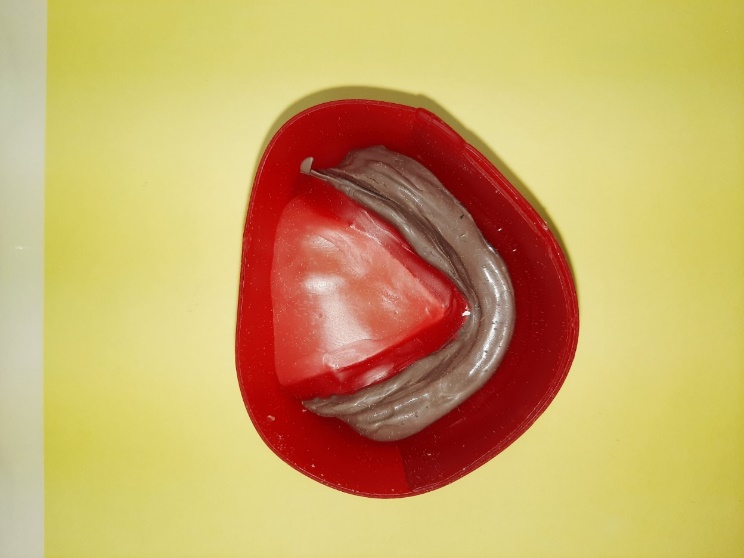
Diagnostic waxes were used to validate the aesthetic outcome and to create vestibular and lingual silicone matrix (Figure 3). These matrices were designed to evaluate the available prosthetic space, referencing the ideal profiles of the prosthetic surfaces. Additionally, they helped assess the feasibility of incorporating the entire attachment system without interfering with the lingual profile and anterior teeth. Given the quality of the periodontium and the favorable bone level of the residual mandibular teeth, we decided on a tooth-supported prosthesis with two Rhein 83 ball attachments on teeth 33 and 43 in the mandible.

Pre-prosthetic phase: Endodontic preparation followed by watertight obturation of 33 and 43.
Prosthetic phase:
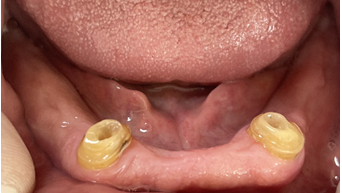
Tooth preparation by removing the crowns provides a more favorable lever system. The teeth are reduced to 1 or 2 mm above the marginal gingiva. 3 (Figure 4)
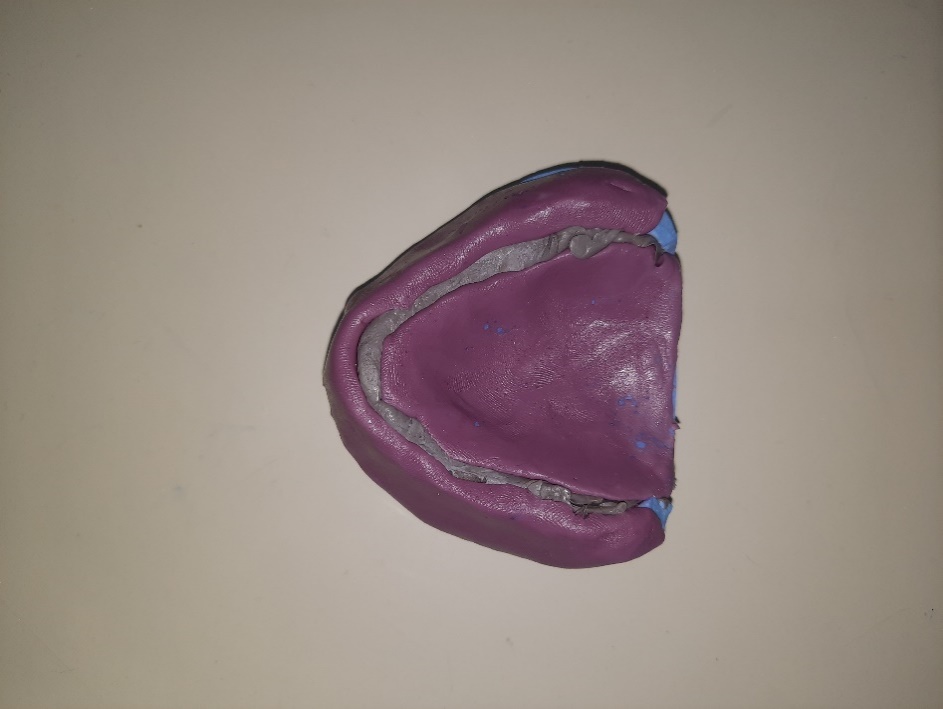
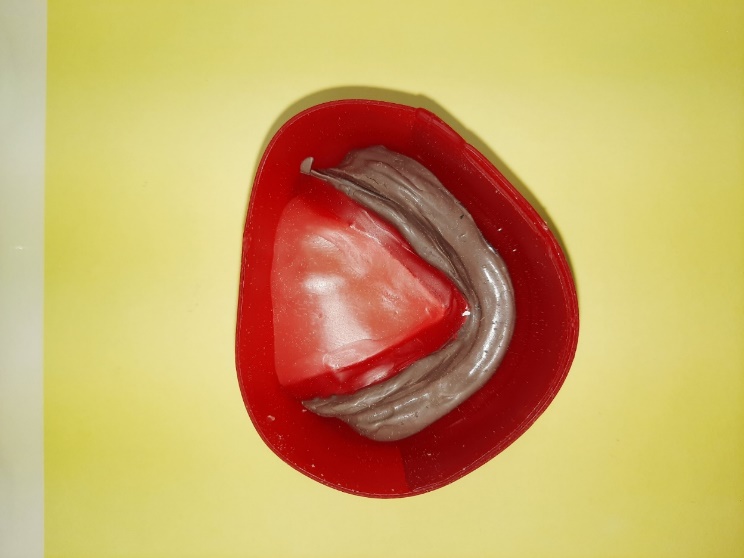
Impression of the housings is made using the classic double-mix technique (Figure 5).
The osteo-fibro-mucosal bearing surfaces were imprinted with mucostatic plaster using a commercially available impression tray, after filling the canal orifices with Vaseline Cotton pellets.
The next step was to fit the copings with attachments in the patient’s mouth, once they had been produced in the laboratory. (Figure 6)
A secondary impression entraining the copings was made using a medium-viscosity polysulfide (Permlastic® regular) and an individual impression tray spaced opposite the copings and adjusted at ridge level. (Figure 7)


After insertion, the prosthesis is tried in with the attachments in place to check spacing. Occlusal pressure must not cause any instability of the mandibular prosthesis.
The attachments are secured in the chair. The intrados of the prosthesis is hollowed out opposite the attachments. The two clevises on the male parts are cemented with glass ionomer cement.
Double spacing is provided by a small piece of glove to avoid any interposition of the pink resin around the matrix (sheets of dental dam can also be used). Self-curing resin is deposited in the future location of the female part of the attachment, then the mandibular prosthesis is placed in the mouth. Once the self-curing resin had set, excess resin was removed. A bite check and occlusal balancing were then carried out.
The results obtained on the day of insertion are maintained over time by restoring good oral and dental hygiene and observing regular check-ups.
The patient was 55 years old and in good general health. The endo-buccal examination showed a bimaxillary edentulous tooth, with significant resorption in the mandibular arch.
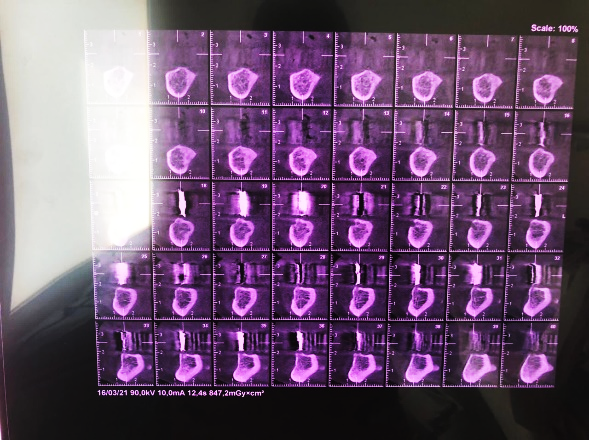
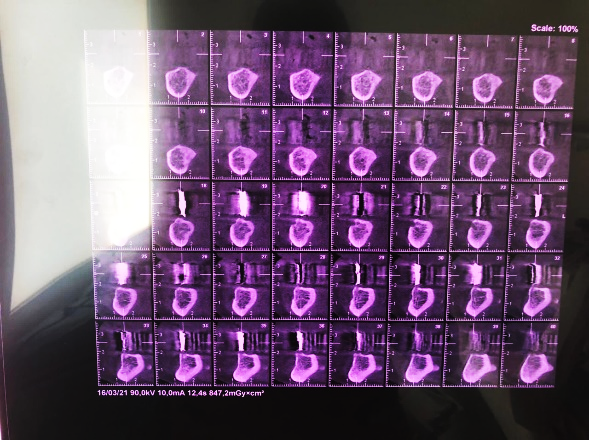
The patient's old prosthesis with radiopaque ZOE elements was used as a radiological guide, and the patient wore her prosthesis during the radiological examinations. (Figure 8)
They enable the ideal axis of the future prosthesis to be visualized, and consequently the ideal axis of the implant (s). (Figure 9)


The radio-opaque material is removed from the imaging guide; the existing wells are validated or modified.
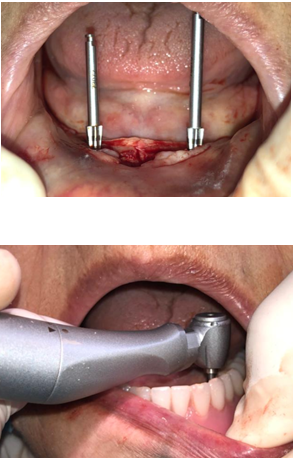
The guide is hollowed out at the surgical site: this allows it to be positioned without interference and also enables the surgical site to be visualized. (Figure 10)
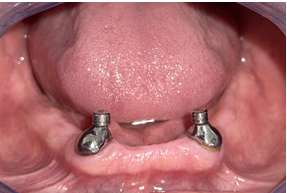
After osseointegration of the implants, the healing screws were removed and the male parts of the attachments were screwed onto the implants. (Figure 11)
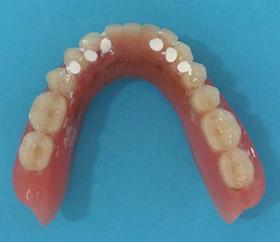
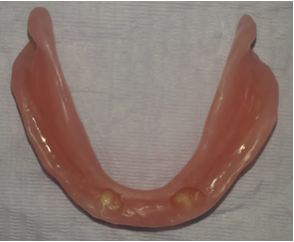
The prosthetic intrados opposite the male parts has been hollowed out to leave space for the female parts and the resin that secures them to the intrados of the mandibular prosthesis. (Figure 12)


Subsequently, the female parts are repositioned on the male parts, separated by dike sheets. The female parts are secured to the intrados by self-curing resin. (Figure 13)
The patient was 60 years old and in good general health. Endo-buccal examination showed a bimaxillary edentulous jaw, significant resorption in the mandibular arch, Sanguiolo class IV. (Figure 14)


The mandibular piezographic impression finds its indication in this clinical situation, we have chosen phonation as the vector of piezographic modeling in this case.
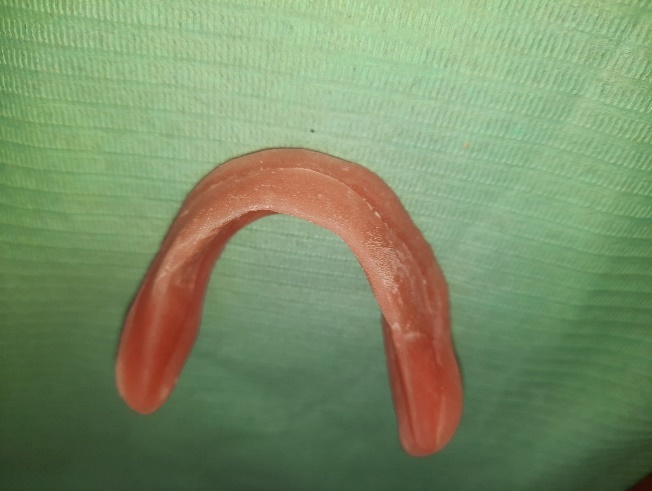
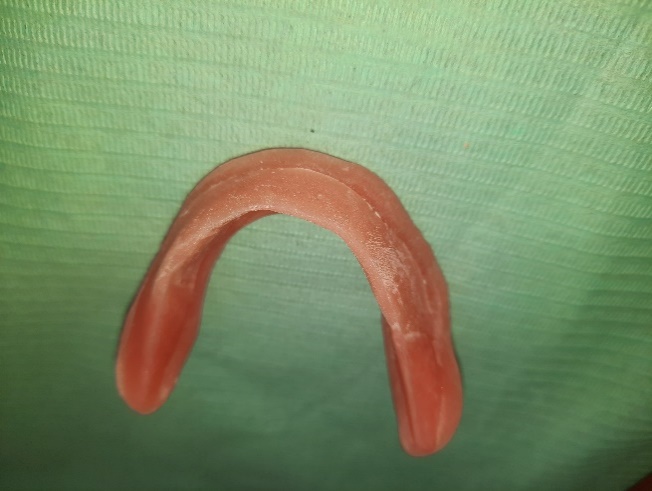
We have chosen a piezographic base in the form of an individual impression tray with a Brill blade bead (Figure 15). This base must be reduced so as not to interfere with the play of the paraprosthetic organs. 4
We check that the base:
■ Has the necessary extensions: sublingual region, retro-molar niches.
■ Does not interfere with movements of the tongue and orbiculo-buccinatory strap.
■ Release the posterior region of the retro-molar trigones.
■ Does not interfere with the patient's ability to speak with this base.
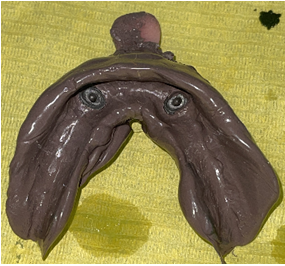
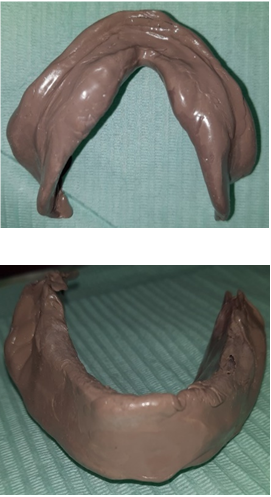
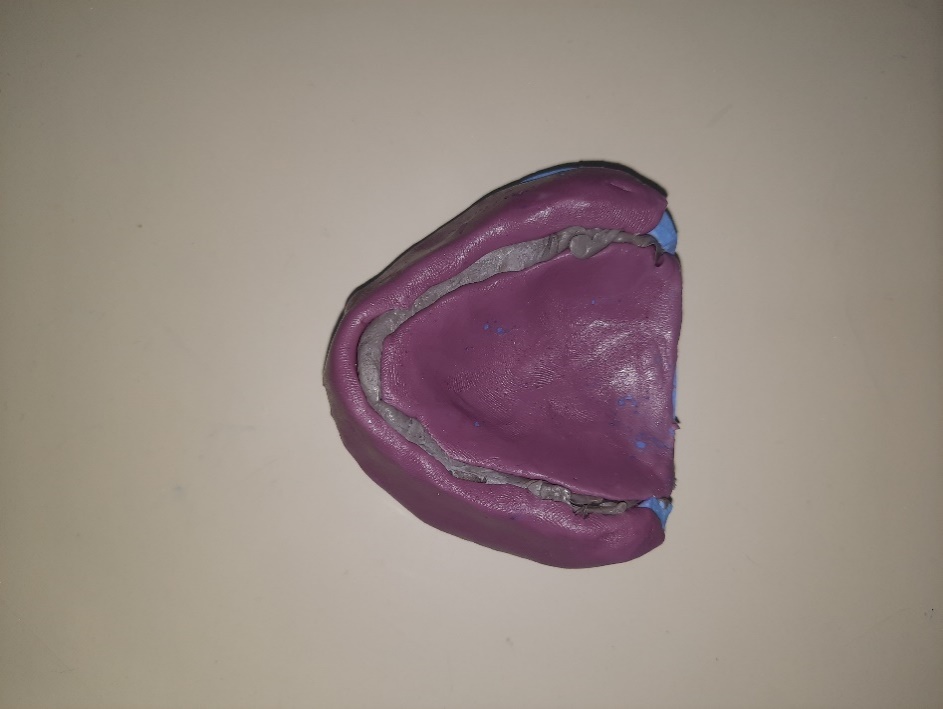
Medium-viscosity polysulfide (Permlastic Regular®) was used for this impression. This material offers good flow properties. It has a sufficiently long setting time to allow the musculature to set périphérique 5. The patient was asked to pronounce the following phonemes: “SIS” repeated six times and “SO” once, to shape the buccinator region. Then, to sculpt the anterior mandibular region, the phonemes “TE” “DE” “SE” “ME”and “PE”. In this way, polysulfide was added in small quantities from the piriform eminence to the anterior region, until the various anatomical structures were recorded. (Figure 16) 6

The prosthetic occlusal plane in piezography obeys a mandibular predetermination and not a maxillary one, as is customary.
• Posteriorly, on the lingual side, this plane is located at the junction between the papillary and smooth mucosa.
• On the posterior vestibular side: it is located at the convexity of the horizontal buccinator fibers during lip protrusion.
• Anterior: this plane is parallel to the free edge of the lower lip and responds to aesthetic and phonetic standards.
After forming (Figure 17), the impression is poured. Before demolding the impression, high-viscosity silicone vestibular and lingual matrix are made to be applied to the polished stabilizing surfaces at occlusal plane level 7. (Figure 18).

Regardless of the clinical setting, the prosthetic stability in a removable complete prosthesis is essential to the success of any prosthetic rehabilitation. Patients' quality of life is greatly enhanced by the comfort it offers, as it guarantees the restoration of various oral functions that are adversely affected by tooth loss, as well as the prosthesis's biological and psychological integration. 8
An interesting substitute for conventional completely removable prostheses is overdentures, particularly in cases when extra retention mechanisms are needed. Mastication becomes more effective, prosthesis stability is enhanced, and residual ridge reduction can be delayed. 9. Abutment teeth are essential for transferring masticatory forces, which protects the alveolar bone and mucosa underneath. Since the periodontal ligament's receptors are still intact, they also help to preserve proprioception. 10.
A multitude of factors determine whether a patient is a good candidate for root-supported prosthesis therapy. Studying the distribution, quantity, and type of teeth is necessary since they affect the stability of the prosthesis. 11. Maintaining the teeth in symmetrical locations along the sagittal median axis is the most advantageous position from a biomechanical perspective. The most common situation is the retention of one or both canines or premolars. 11. Canines are often used as abutments for overdentures due to their lengthy roots, position in the arch, and propensity to live the longest. 9.
When overdentures with retention systems are used, the mandibular complete denture must supply all prosthetic support; residual teeth, whose sole purpose is to serve as extra retention for the conventional complete denture, cannot play any role in this regard. Because of this, the mandibular complete prosthesis needs to be made in compliance with the traditional guidelines for the detachable full prosthesis. 12, 13.
In case of significant resorption compromising the prosthetic stability and retention, treatment with the implant can be envisaged. According to the McGill consensus, the minimal treatment for total mandibular edentulousness is a removable prosthesis retained by two symphyseal implants. 14
The implant option cannot be systematically offered to all patients; during the pre-implant clinical examination, many factors should be highlighted: the patient's general condition, bone stock and financial situation 15. The success rate of an implant-supported total denture is important in the mandible thanks to the quality of the compact bone. The durability of treatment with an implant-supported complete denture is directly dependent on the design and development of a perfectly balanced and integrated complete removable prosthesis, as well as on the placement of the implants and the choice of complementary retention elements that offer axial play (vertical translation) and/or angular clearance (distal rotation) to take into account the difference of tissue depressions existing between the fibromucosa of the edentulous crest and the implant 16.
Nowadays, the dental implant therapy may be a treatment of choice for improving the denture stability and retention. However, piezography technique is also considered to be an important alternative approach to patients complaining of unstable dentures, particularly when implant therapy is not feasible. The aim of this technique is to construct a denture in muscle balance through physiologically appropriate denture tooth arrangement. 4
The use of piezographic impressions to improve the stability of mandibular prostheses by exploiting the neutral zone is well established 17. The term “neutral zone concept” was coined by Bersein and Schiesser in 1976 18. A number of studies have highlighted the advantages of exploiting neutral space by piezography. Stromerg and Hichey showed a better adaptation to piezographic prostheses than to those made in the conventional way 19. The results of a clinical study by Fahmy and Khayat showed better comfort and clarity of phonation with prostheses placed in the neutral space, compared with conventional techniques 20.
As Klein notes, piezography has certain limitations. It cannot remove wrinkles or restore a youthful profile, and it requires vestibulo-lingual reduction of teeth and occlusal surfaces when the prosthetic corridor is very narrow. 4
The use of various techniques to optimize the prosthetic balance of a mandibular complete removable prosthesis can offer very encouraging results, provided that all the elements required for successful treatment are present: patient motivation, a study phase that is essential for establishing the indication, rigor in implementation, and a maintenance phase that is essential for lasting results.
| [1] | Hue, O. and Berteretche, M. (2004) Prothèse Complète. Réalité clinique: Solutions thérapeutiques. Quintessence International, Paris. | ||
| In article | |||
| [2] | Fajri, L., Benfdil, F., El Mohtarim, B., El Wady, W., & Abdedine, A. (2009). La prothèse complète mandibulaire: stabilité et rétention. Actualités odonto-stomatologiques, (247), 267-286. | ||
| In article | View Article | ||
| [3] | Schuch, C., Pinheiro de Moraes, A., Sarkis-Onofre, R., Pereira-Cenci, T. and Boscato, N. (2013) An Alternative Method for the Fabrication of a Root-Supported Overdenture: A Clinical Report. Journal of Prosthetic Dentistry, 109, 1-4. | ||
| In article | View Article PubMed | ||
| [4] | Rokhssi, H. Abdelkoui, A. Merzouk, N. Benfdil, F. The piezographic impression technique in daily practice. EDP Sciences, AOS 2018. | ||
| In article | |||
| [5] | C. Ohkubo, H. Shimpo, A.Tokue, EJ. Park, TH. Kim. Complete denture fabrication using piezography and CAD-CAM: A clinical report. J Prosthet Dent. 2018 119(3):334-338. | ||
| In article | View Article PubMed | ||
| [6] | Yaala, M. B., Aguir, Y. M., Labidi, A., Bekri, S., & Mansour, L. (2022). Association de la piézographie et de l’implantologie dans la gestion d’un cas d’édentement complet mandibulaire à crête résorbée. African Journal of Dentistry & Implantology, (22). | ||
| In article | |||
| [7] | Nabid A, Bouziane M, Boulefa A, Daoud FZ. Matérialisation de l’espace prothétique mandibulaire en gérodontologie. Strateg. Proth 2010; 10, 3: 197-203. | ||
| In article | |||
| [8] | Guessous, D. F., Regragui, A., Merzouk, N., Benfdil, F. (2018). Comment garantir la stabilité prothétique en prothèse amovible complète (PAC) conventionnelle?. Actualités Odonto-Stomatologiques, (289), 5. | ||
| In article | View Article | ||
| [9] | Ettinger, R.L. and Qian, F. (2014) Incidence of Attachment Loss of Canines in an Overdenture Population. Journal of Prosthetic Dentistry, 112, 1356-1363. | ||
| In article | View Article PubMed | ||
| [10] | Mercouriadis-Howald, A., Rollier, N., Tada, S., McKenna, G., Igarashi, K. and Schimmel, M. (2018) Loss of Natural Abutment Teeth with Cast Copings Retaining Overdentures: A Systematic Review and Meta-Analysis. Journal of Prosthodontic Research, 62, 407-415. | ||
| In article | View Article PubMed | ||
| [11] | Rignon-Bret, C.H. (2008) Attachement et prothèses complètes supra radiculaires et supra-implantaires. Édition Cdp. | ||
| In article | |||
| [12] | Rignon-Bret, C.H. and Rignon-Bret, J.M. (2004) Prothèse amovible complète prothèse immédiate prothèse supraradiculaire et implantaire. Collection JPIO, Edition CdP. | ||
| In article | |||
| [13] | Scherer, M. and Campagni, W. (2011) An Accelerated Clinical Chairside Technique for Casting Overdenture Attachment Copings. Journal of Prosthetic Dentistry, 106, 337-339. | ||
| In article | View Article PubMed | ||
| [14] | Fajri, L., Berrada, S., Abdedine, A. (2008). L'apport de l'exploration clinique dans le choix et l'orientation de la thérapeutique prothétique chez l'édenté complet. Revue d'odonto-stomatologie (Paris), 37(2), 91-107. | ||
| In article | |||
| [15] | T. toquet -La prothèse adjointe complète supra-implantaire mandibulaire: données actuelles et protocole de réalisation. Le fil dentaire 2009. | ||
| In article | |||
| [16] | C. Rignon-Bret, F. Descamp, E. Bernaudin, M. Bloch, A. Hadida A: Stratégie de traitement en prothèse amovible complète supra-implantaire mandibulaire. Réalités cliniques 2003; 14(2): 141-159. | ||
| In article | |||
| [17] | Porwal A, Sasaki K. Current status of the neutral zone. A litterature review. J Prosthet Dent 2013; 109: 129-34. | ||
| In article | View Article PubMed | ||
| [18] | Philip GB, Thomas V, Rajapur A, Gupta A, Jeetendra S. The neutral zone. Dent Impact 2013; 5(2): 105-108. | ||
| In article | |||
| [19] | Stromberg WR, Hickey JC. Comparison of physiologically and manually formed dentures bases. J Prosthet Dent 1965; 15: 213- 26. | ||
| In article | View Article PubMed | ||
| [20] | Fahmy FM, Khayat DU. A study of the importance of the neutral zone in complete dentures. J Prosthet Dent 1990; 64: 459-62. | ||
| In article | View Article PubMed | ||
Published with license by Science and Education Publishing, Copyright © 2024 Rabab Elabdouli, Fatima Zahra Ghazzar and Samira Bellemkhannate
 This work is licensed under a Creative Commons Attribution 4.0 International License. To view a copy of this license, visit
https://creativecommons.org/licenses/by/4.0/
This work is licensed under a Creative Commons Attribution 4.0 International License. To view a copy of this license, visit
https://creativecommons.org/licenses/by/4.0/
| [1] | Hue, O. and Berteretche, M. (2004) Prothèse Complète. Réalité clinique: Solutions thérapeutiques. Quintessence International, Paris. | ||
| In article | |||
| [2] | Fajri, L., Benfdil, F., El Mohtarim, B., El Wady, W., & Abdedine, A. (2009). La prothèse complète mandibulaire: stabilité et rétention. Actualités odonto-stomatologiques, (247), 267-286. | ||
| In article | View Article | ||
| [3] | Schuch, C., Pinheiro de Moraes, A., Sarkis-Onofre, R., Pereira-Cenci, T. and Boscato, N. (2013) An Alternative Method for the Fabrication of a Root-Supported Overdenture: A Clinical Report. Journal of Prosthetic Dentistry, 109, 1-4. | ||
| In article | View Article PubMed | ||
| [4] | Rokhssi, H. Abdelkoui, A. Merzouk, N. Benfdil, F. The piezographic impression technique in daily practice. EDP Sciences, AOS 2018. | ||
| In article | |||
| [5] | C. Ohkubo, H. Shimpo, A.Tokue, EJ. Park, TH. Kim. Complete denture fabrication using piezography and CAD-CAM: A clinical report. J Prosthet Dent. 2018 119(3):334-338. | ||
| In article | View Article PubMed | ||
| [6] | Yaala, M. B., Aguir, Y. M., Labidi, A., Bekri, S., & Mansour, L. (2022). Association de la piézographie et de l’implantologie dans la gestion d’un cas d’édentement complet mandibulaire à crête résorbée. African Journal of Dentistry & Implantology, (22). | ||
| In article | |||
| [7] | Nabid A, Bouziane M, Boulefa A, Daoud FZ. Matérialisation de l’espace prothétique mandibulaire en gérodontologie. Strateg. Proth 2010; 10, 3: 197-203. | ||
| In article | |||
| [8] | Guessous, D. F., Regragui, A., Merzouk, N., Benfdil, F. (2018). Comment garantir la stabilité prothétique en prothèse amovible complète (PAC) conventionnelle?. Actualités Odonto-Stomatologiques, (289), 5. | ||
| In article | View Article | ||
| [9] | Ettinger, R.L. and Qian, F. (2014) Incidence of Attachment Loss of Canines in an Overdenture Population. Journal of Prosthetic Dentistry, 112, 1356-1363. | ||
| In article | View Article PubMed | ||
| [10] | Mercouriadis-Howald, A., Rollier, N., Tada, S., McKenna, G., Igarashi, K. and Schimmel, M. (2018) Loss of Natural Abutment Teeth with Cast Copings Retaining Overdentures: A Systematic Review and Meta-Analysis. Journal of Prosthodontic Research, 62, 407-415. | ||
| In article | View Article PubMed | ||
| [11] | Rignon-Bret, C.H. (2008) Attachement et prothèses complètes supra radiculaires et supra-implantaires. Édition Cdp. | ||
| In article | |||
| [12] | Rignon-Bret, C.H. and Rignon-Bret, J.M. (2004) Prothèse amovible complète prothèse immédiate prothèse supraradiculaire et implantaire. Collection JPIO, Edition CdP. | ||
| In article | |||
| [13] | Scherer, M. and Campagni, W. (2011) An Accelerated Clinical Chairside Technique for Casting Overdenture Attachment Copings. Journal of Prosthetic Dentistry, 106, 337-339. | ||
| In article | View Article PubMed | ||
| [14] | Fajri, L., Berrada, S., Abdedine, A. (2008). L'apport de l'exploration clinique dans le choix et l'orientation de la thérapeutique prothétique chez l'édenté complet. Revue d'odonto-stomatologie (Paris), 37(2), 91-107. | ||
| In article | |||
| [15] | T. toquet -La prothèse adjointe complète supra-implantaire mandibulaire: données actuelles et protocole de réalisation. Le fil dentaire 2009. | ||
| In article | |||
| [16] | C. Rignon-Bret, F. Descamp, E. Bernaudin, M. Bloch, A. Hadida A: Stratégie de traitement en prothèse amovible complète supra-implantaire mandibulaire. Réalités cliniques 2003; 14(2): 141-159. | ||
| In article | |||
| [17] | Porwal A, Sasaki K. Current status of the neutral zone. A litterature review. J Prosthet Dent 2013; 109: 129-34. | ||
| In article | View Article PubMed | ||
| [18] | Philip GB, Thomas V, Rajapur A, Gupta A, Jeetendra S. The neutral zone. Dent Impact 2013; 5(2): 105-108. | ||
| In article | |||
| [19] | Stromberg WR, Hickey JC. Comparison of physiologically and manually formed dentures bases. J Prosthet Dent 1965; 15: 213- 26. | ||
| In article | View Article PubMed | ||
| [20] | Fahmy FM, Khayat DU. A study of the importance of the neutral zone in complete dentures. J Prosthet Dent 1990; 64: 459-62. | ||
| In article | View Article PubMed | ||