 OPEN ACCESS
  PEER-REVIEWED
Ridge Augmentation Procedure Using Connective Tissue Graft in Esthetic Zone - A Case Report
Srinivasan Sivaprakasam1, Vijay Karuppiah1, , Ramaprabha Govindaraj1
1Division of Periodontia, Rajah Muthiah Dental College and Hospital, Annamalai University
Abstract
A common issue in tooth replacement is the ability to reestablish normal form and architecture of the hard and soft tissues before prosthesis. This is especially challenging in the anterior zone, where the replacement of a missing tooth must not only function, but esthetically match the contours of the hard and soft tissue of the adjacent natural dentition. A case report has been presented over here for a patient with class III alveolar ridge defect in the maxillary anterior region corrected with soft tissue ridge augmentation using connective tissue graft followed by a metal ceramic fixed prosthesis for the replacement of missing upper central incisor.
At a glance: Figures
Keywords: soft tissue ridge augmentation, connective tissue, fixed partial denture
International Journal of Dental Sciences and Research, 2013 1 (2),
pp 45-47.
DOI: 10.12691/ijdsr-1-2-5
Received October 26, 2013; Revised November 10, 2013; Accepted November 15, 2013
Copyright © 2013 Science and Education Publishing. All Rights Reserved.Cite this article:
- Sivaprakasam, Srinivasan, Vijay Karuppiah, and Ramaprabha Govindaraj. "Ridge Augmentation Procedure Using Connective Tissue Graft in Esthetic Zone - A Case Report." International Journal of Dental Sciences and Research 1.2 (2013): 45-47.
- Sivaprakasam, S. , Karuppiah, V. , & Govindaraj, R. (2013). Ridge Augmentation Procedure Using Connective Tissue Graft in Esthetic Zone - A Case Report. International Journal of Dental Sciences and Research, 1(2), 45-47.
- Sivaprakasam, Srinivasan, Vijay Karuppiah, and Ramaprabha Govindaraj. "Ridge Augmentation Procedure Using Connective Tissue Graft in Esthetic Zone - A Case Report." International Journal of Dental Sciences and Research 1, no. 2 (2013): 45-47.
| Import into BibTeX | Import into EndNote | Import into RefMan | Import into RefWorks |
1. Introduction
Alveolar bone resorption is the normal physiologic response following tooth removal. Residual ridge defects present important challenges for aesthetic dentistry [1]. Prosthetic tissue replacement has been one method of replacing tissue loss. Alternatively, surgical soft-tissue augmentation techniques have been effective in developing soft-tissue architectures that facilitate aesthetic restorations. Soft-tissue ridge augmentations using palatal grafts have been thoroughly documented in the management of residual ridge deformities [2].
Seibert (1983) classified three types of ridge deformities,
1. Class I: Bucco-lingual loss of tissue contour with a normal apicocoronal height.
2. Class II: Apico-coronal loss of tissue with normal bucco-lingual contour.
3. Class III: A combination of bucco-lingual and apico-coronal loss.
Abrams et al studied the prevalence of anterior ridge deformities in the mandibular and maxillary arches of partially edentulous patients and reported the presence of defects in 91% of the cases. Class III defects were the most prevalent (55.8%), followed by Class I defects (32.8%) and Class II defects (2.9%) [3].
2. Treatment Options Based on Defect Classification and Type of Donor Tissue
Connective tissue grafts give excellent color match of the surrounding tissue, due to good blood supply well received by the recipient site. They can be well stabilized by periosteal suturing. The ridge augmentations with connective tissue have stability ranging from 7 to 12 years [4]. This case report describes the use of subepithelial connective tissue graft technique to correct buccolingual loss of contour with normal apicocoronal height. The procedure enhanced the final prosthetic restoration, fixed partial denture, significantly improving resortation esthetics.


 PowerPoint Slide
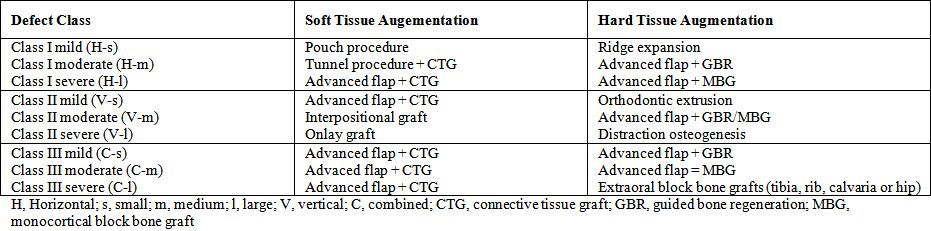 Larger image(png format)
 View current table in a new window
3. Case Presentation
A patient by name Meenakshi age 35 reported to our dental outpatient Department of Periodontics, Rajah Muthiah Dental College and Hospital with the chief complaint of replacing her missing anterior teeth 21. Her past dental history revealed that she had a history of trauma three years back, following which the teeth were extracted.
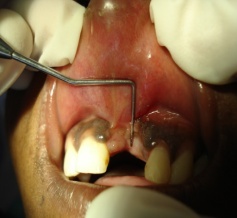
A thorough clinical and radiographic examination revealed a Siebert’s Class III defect in the edentulous region. She presented with a moderate horizontal and a severe vertical ridge defect and there was a short clinical crown in relation to 11 (Figure 1). Since the patient elected not to have an implant instead go for conventional fixed partial denture, augmenting the defect with soft tissue graft was decided. Routine introral periapical radiograph, and blood investigations was done and was found to be normal. Further examination revealed that patient’s palate had sufficient tissue thickness to serve as a donor site.

 PowerPoint Slide
 Larger image(png format)

4. Surgical Procedure
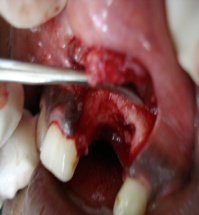
Local anaesthesia was given in relation to upper anterior region and upper right palatal region. Following adequate anesthesia,two vertical realising incision was made in relation to mesial and distal aspect of 21. Both the vertical incisions are connected by a palatal incision. A full thickness flap was raised (Figure 2).

 PowerPoint Slide
 Larger image(png format)
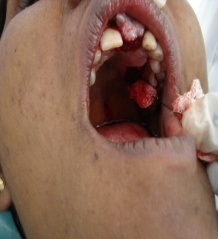
A connective tissue graft measuring about 7mm x 5mm x 4mm was obtained from upper right; palatal Region. (Figure 3).

 PowerPoint Slide
 Larger image(png format)
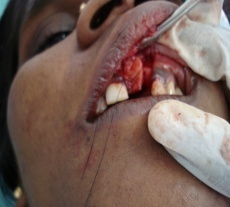
Then the graft was positioned in the recipient site and it was secured by suturing with the flap. Then the flap was approximated by interrupted sutures along the vertical releasing incision and palatal aspect (Figure 4).

 PowerPoint Slide
 Larger image(png format)
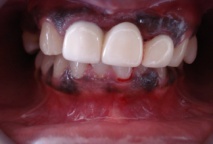
Periodontal pack was given followed by post operative instructions. Temporary removable partial denture was given. The patient was asked to report after one week. During the follow up period the healing was satisfactory and the sutures were removed. After three months considerable gain in the ridge both apicocoronally and buccolingualy was obtained. Fixed partial denture was done in relation to 11, 21, 22. Reasonable esthetic appearance was obtained (Figure 5).

 PowerPoint Slide
 Larger image(png format)
5. Discussion
Alveolar ridge defects occur when the loss of teeth results in a dimensional loss of bone and soft tissue surrounding the alveolus. The extent of dimensional loss is related to the shape of the underlying bone present at the time of tooth removal.
Prosthetic treatment of localized alveolar ridge defect with a fixed prosthesis is associated with aesthetic problems like black interdental triangles and technical problems like difficulty to design aesthetic pontic. In the present case, the loss of ridge width was more evident with a little loss of ridge height; hence, an autogenous connective tissue graft was used to augment the ridge defect [5]. A connective tissue graft has a better chance of survival than free grafts over poor or non-vascularized areas such as a bone graft or a non-resorbable membrane.
Important factors to be considered for the long-term success of connective tissue transplants include primary fixation of the graft, the possibility of revascularization, and revitalization from the receptor site. Close contact to a well-vascularized receptor site positively influences the prognosis of such grafts. A subepithelial connective tissue graft between the split thickness flap and the alveolar ridge with its periosteum and connective tissue covering has a much better chance of survival than free grafts over poor or non-vascularized areas such as a bone graft or a non-resorbable membrane [6].
6. Conclusion
Connective tissue graft has high vascularity and esthetically appealing. However disadvantages such as the need for second operating site, resultant patient morbidity, the possibility of not being able to obtain a sufficient material and also obtaining the connective tissue graft needs technical skill. This clinical report suggests that soft tissue augmentation with autogenous connective tissue graft from the palate, in conjunction with a Fixed partial denture, is a viable treatment to provide esthetically acceptable contours to the alveolar ridge and an effective restoration.
References
| [1] | Schropp L, Wenzel A, Kostopoulos L, et al. Bone healing and soft tissue contour changes following single-tooth extraction: a clinical and radiographic 12-month prospective study. Int J Periodontics Restorative Dent. 2003;23:313-323. | ||
 In article In article | PubMed | ||
| [2] | Gasparini DO. Double-fold connective tissue pedicle graft: a novel approach for ridge augmentation. Int J Pedodontics Restorative Dent 2004;24:280-7. | ||
| In article | PubMed | ||
| [3] | Abrams H, Kopczyk R, Kaplan A. Incidence of anterior ridge deformities in partially edentulous patients. J Prosthet Comp Contin Dent Educ Dent 1993; 12; 548-561. | ||
| In article | |||
| [4] | Mishra N, Singh BP, Rao J, Rastogi P. Improving prosthetic prognosis by connective tissue ridge augmentation of alveolar ridge. Indian J Dent Res 2010;21: 129-31. | ||
| In article | CrossRef PubMed | ||
| [5] | Alaap D. Shah et al., Esthetic localized soft tissue ridge augmentation in a fixed partial denture – a case report. Journal of dental sciences. Volume 3 Issue 1, 11-13. | ||
| In article | |||
| [6] | Khoury F, Happe A. The palatal subepithelial connective tissue flap method for soft tissue management to cover maxillary defects: a clinical report. Int J Oral MaxillofacImplants 2000;15:415-8. | ||
| In article | PubMed | ||

 CiteULike
 Mendeley
 StumbleUpon
 Delicious
 Facebook
 Twitter
 LinkedIn
 Print
Print