Carcinoma of the breast is the most common public health concern in women globally. Early diagnosis of breast carcinoma reduces the disease burden. Serum S100A8/A9, a calcium-binding protein involved in tumorigenesis, may be a useful biomarker for breast cancer diagnosis, and this study investigated its comparison with CA15-3. This cross-sectional comparative study, conducted from March 2021 to February 2022, involved 74 clinically suspected cases of breast carcinoma at Department of Laboratory Medicine in Bangabandhu Sheikh Mujib Medical University Dhaka, Bangladesh. Patients were categorized into Group I (breast carcinoma) and Group II (benign breast tumor) based on histopathology reports. After informed consent, 5.0 ml of venous blood was collected for serum S100A8/A9 and CA 15-3 estimation, which were then serologically assessed using ELISA and chemiluminescence methods. This study found that breast carcinoma patients had statistically significant (P ≤ 0.001) higher mean levels of S100A8/A9 (7.14 ± 3.11 μg/mL) and CA 15-3 (50.73 ± 112.9 U/mL) compared to S100A8/A9 (4.14 ± 1.93 μg/mL) and for CA 15-3 (10.76 ± 3.43 U/mL) for benign breast tumour. The receiver operating characteristic (ROC) analysis indicated that the optimal cut-off value for serum S100A8/A9 was 4.61, with a sensitivity of 78.4% and specificity of 70.3%, yielding an area under the curve (AUC) of 0.789. Similarly, the cut-off value for CA 15-3 was 11.85, with a sensitivity of 70.3% and specificity of 64.9%, and an AUC of 0.743. With significant levels of sensitivity and specificity, serum S100A8/A9 levels emerge as a valuable diagnostic tool for identifying breast carcinoma.
Breast carcinoma represents a significant global health challenge for women, contributing to increased mortality rates worldwide 1, 2. In 2020 alone, 2.3 million women were diagnosed with breast carcinoma, resulting in 0.685 million deaths globally 3. Within the last five years, the prevalence rate of breast carcinoma among females in Bangladesh has reached 38.35% 4. Tumour markers, substances or molecules produced by tumours or the host's reaction to them, play a crucial role in diagnosing breast carcinoma 5. Commonly utilized markers include CA 15-3, CA 27.29, carcinoembryonic antigen (CEA), estrogen receptor (ER), progesterone receptor (PR), and human epidermal growth factor receptor 2 (HER2) 6. Among these, ER, PR, HER2, and CA 15-3 are widely employed, with ER, PR, and HER2 being tissue-based biomarkers, and CA 15-3 being a serum marker 7, 8. CA 15-3, also known as MUC-1, is a glycoprotein associated with epithelial tissue 9, 10. Although it is elevated in breast carcinoma patients, its utility in detecting early-stage or localized breast cancer is limited, and it may also increase in lung, ovarian, and benign breast diseases 8, 11. In recent studies, serum S100A8/A9, or calprotectin, has emerged as a promising biomarker for breast cancer diagnosis. S100A8/A9, a calcium-binding protein secreted by immune cells, stimulates immune responses and promotes breast carcinoma progression by activating key signaling pathways 12, 13, 14. Unlike CA 15-3, S100A8/A9 shows higher sensitivity and specificity, particularly in ductal cell carcinoma cases. Research suggests that while CA 15-3 levels correlate positively with larger tumour sizes, S100A8/A9 levels increase in smaller tumours 15, 16, 17. Sensitivity and specificity of S100A8/A9 surpass those of CA 15-3, with S100A8/A9 demonstrating 100% sensitivity and specificity in ductal cell carcinoma cases, compared to 65.7% sensitivity and 76.6% specificity for CA 15-3 18, 19, 20. This study aims to assess the effectiveness of serum S100A8/A9 compared to CA 15-3 in diagnosing breast carcinoma, potentially offering a more reliable diagnostic tool for early detection and intervention.
This cross-sectional study took place in the Department of Laboratory Medicine, BSMMU, Department of Surgery and Pathology of Bangabandhu Sheikh Mujib Medical University (BSMMU) and National Institute of Cancer Research & Hospital (NICRH), Dhaka. Following ethical approval from the Institutional Review Board (IRB), patients with suspected breast lumps visiting the outpatient departments of Surgery at BSMMU and NICRH were selected based on history taking and physical examination, guided by surgeons. Inclusion and exclusion criteria were applied before enrollment. A semi-structured questionnaire was developed and patients were provided with a comprehensive explanation of the study's aims, objectives, and the necessity of investigations. Informed written consent was obtained from each participant. Data collection involved face-to-face interviews conducted by the researcher. Clinical examinations, including tumor size, site, consistency, and lymph node involvement, were performed by senior doctors and residents of surgery at BSMMU and NICRH. Demographic information such as age, sex, marital status, height, and weight was recorded for each patient. Patients suspected of breast carcinoma underwent core or excisional biopsy before surgery. Breast tissues were fixed in 10% formalin and sent to the Department of Pathology at BSMMU and NICRH. Tissues were stained with Hematoxylin & Eosin, and biopsy reports were prepared by histopathologists, detailing histological types and grading (I-III). Patients were then categorized into two groups: Group-I comprised those with breast carcinoma, while Group-II included patients with benign breast tumors. Prior to surgery, approximately 5.0 ml of venous blood was collected from each subject into a red screw-capped tube. Serum S100A8/A9 levels were assessed using an ELISA reader with a commercially available kit. CA 15-3 levels were measured using a Beckman Coulter Access 2 based on chemiluminescence immunoassay principles. Both tests were conducted at the Department of Laboratory Medicine, BSMMU. Statistical analysis was performed using SPSS version 26. Data were expressed as mean values, median, and standard deviation, and checked for normal distribution. The Mann-Whitney-U test was employed to compare independent groups in nonparametric data. ROC curves were utilized to illustrate the relationship between clinical sensitivity and specificity for various test cut-offs. A p-value of <0.05 was considered statistically significant.
Out of the total 74 study subjects, 37 patients diagnosed with breast carcinoma were assigned to Group I, while the remaining 37 patients with benign breast tumors were categorized as Group II, based on histopathology reports. Table 1 displays the serum levels of S100A8/A9 and CA 15-3 in both groups. Group I subject exhibited mean (± SD) levels of serum S100A8/A9 and CA15-3 at 7.14 (± 3.11) μg/mL and 50.73 (± 112.9) U/mL respectively. In contrast, Group II subjects showed mean (± SD) levels of serum S100A8/A9 and CA 15-3 at 4.14 (± 1.93) μg/mL and 10.76 (± 3.43) U/mL respectively. Median levels of serum S100A8/A9 and CA15-3 for Group I were 7 μg/mL and 16 U/mL, while for Group II, they were 3.79 μg/mL and 11 U/mL respectively. Significant differences were noted in serum S100A8/A9 and CA 15-3 levels between the two groups, with P-values ≤ 0.001.
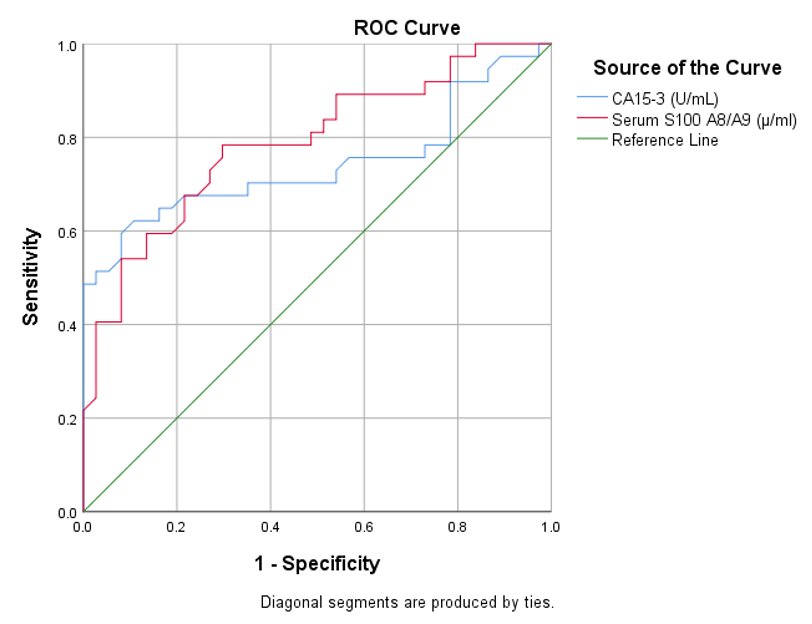
Table 2 presents the AUC of the ROC curve, with values of 0.789 (95% CI; 0.686-0.892) for serum S100A8/A9 and 0.743 (95% CI; 0.623-0.862) for CA 15-3. The optimal cutoff points for serum S100A8/A9 and CA 15-3 as diagnostic biomarkers for detecting breast carcinoma were determined as 4.61 μg/mL and 11.85 U/mL respectively. At this cutoff point, the sensitivity of serum S100A8/A9 was 78.4%, with a specificity of 70.3%, while for CA 15-3, the sensitivity and specificity were 70.3% and 64.9% respectively.
Figure 1 illustrates the area under the ROC curve (AUC), which was 0.789 (95% CI; 0.686-0.892) for serum S100A8/A9 and 0.743 (95% CI; 0.623-0.862) for CA 15-3.

This study showed that the mean (±SD) value of serum S100A8/A9 was 7.14 (±3.11) μg/mL in breast carcinoma patients and 4.14 (±1.93) μg/mL in benign breast tumour patients. The level of serum S100A8/A9 was significantly higher in patients with breast carcinoma compared to benign breast tumour patients. This difference was statistically significant (p=0.001). In a study the level of S100A8/9 was found significantly higher in patients compared to healthy controls (P<0.0001) 14. This study showed that the mean (±SD) value of CA 15-3 was 50.73 (± 112.9) U/mL in breast carcinoma patients and 10.76 (± 3.43) U/mL in patients with benign breast tumour. This difference was statistically significant (P<0.001). In another study it has shown that the mean (±SD) value of CA 15-3 in breast carcinoma and benign breast tumour patients were 27.3 (±18.0) U/mL and 10.6 (± 3.3) U/mL respectively and statistically significant (p<0.001) 13. In another study it has found the mean (±SD) value of CA 15-3 was 29.02 (±1.79) U/mL in breast carcinoma patients and 13.78 (±1.24) U/mL in benign breast tumour. The difference was statistically significant (p<0.050) 21. The results of the present study closely resemble with findings of these studies. The receiver-operating characteristics (ROC) curve of serum S100A8/A9 and CA 15-3 for the diagnosis of breast carcinoma was depicted in this study. The area under the curve (AUC) for predicting the patients with breast carcinoma was 0.789 (95% CI; 0.686-0.892) for serum S100A8/A9 and 0.743 (95%CI; 0.623-0.862) for CA 15-3. In a study it has showed that AUC was 1.000 (95% CI; 1.000-1.000) for serum S100A8/A9 and 0.6276 (95%CI; 0.483-0.797) for CA 15-3 14. In another study it was found that AUC of CA 15-3 was 0.629 (95%CI; 0.526-0.723) for diagnosis of breast carcinoma 22. The present study result is not consistent with previous studies. These variations may be due to the dissimilarity of the study subject selection. In this study, the study subjects both had disease. No healthy control was included. Using the receiver-operating characteristics (ROC) curve the potential cut-off value to diagnosed breast carcinoma patients was calculated. An optimal cut-off value of serum S100A8/A9 and CA 15-3 was found 4.61 μg/mL and 11.85 U/mL respectively. This was determined by the ROC curve to see the sensitivity and specificity of the test. In this study, sensitivity and specificity of serum S100A8/A9 was found 78.4% and 70.3% at cut-off point 4.61 μg/mL. In a study it was found a cut-off point of serum S100A8/A9 for diagnosis of breast carcinoma was 1.835 ng/mL, with sensitivity and specificity of 100% 14. This finding is not consistent with the present study. Because of study subjects of the current study had disease, no healthy control was included in this study. It also may be due to different cut-off values, sample size variations or demographic variables. The current study showed that CA 15-3 had 70.3% sensitivity and 64.9% specificity at a cut-off value of 11.85 U/mL. A study was found that the serum CA 15-3 concentrations of the control subjects and breast carcinoma patients showed sensitivity and specificity of 76.1% and 100%, respectively at a cut-off value >35U/mL 23. Another study showed that the cut-off value of CA 15-3 was 14.54 U/ml by ROC analysis. The sensitivity of CA 15–3 was 82.1% and specificity was 47.3% 24. The values are not consistent with the present study. It may be due to different cut-off values, sample size variation, dissimilarity of study subject selection or demographic variables. According to this study, it was demonstrated that a significant difference in serum S100A8/A9 level was found in breast carcinoma and benign breast tumour patients. Serum S100A8/A9 also had better AUC with higher sensitivity and specificity than CA 15-3. Serum S100A8/A9 is a better diagnostic marker than CA 15-3 in the diagnosis of breast carcinoma.
Serum S100A8/A9 has better AUC with higher sensitivity and specificity than CA 15-3 in breast carcinoma patients. Serum S100A8/A9 may be considered as an important biomarker for the diagnosis of breast carcinoma.
The authors express their gratitude to the authorities of the Department of Surgery and Pathology at BSMMU and NICRH, as well as the Department of Laboratory Medicine at BSMMU, for their valuable cooperation throughout the sample collection and laboratory procedures. Additionally, heartfelt appreciation is extended to the study participants for their active and enthusiastic involvement in the research.
No conflict of interest relevant to this article was re-ported.
| [1] | Akram M, Iqbal M, Daniyal M, Khan AU. Awareness and current knowledge of breast cancer. Biological research. 2017 Dec; 50(1): 1-23. | ||
| In article | View Article PubMed | ||
| [2] | Momenimovahed Z, Salehiniya H. Epidemiological characteristics of and risk factors for breast cancer in the world. Breast Cancer: Targets and Therapy. 2019; 11: 151. | ||
| In article | View Article PubMed | ||
| [3] | World Health Organization (WHO), 2021. Breast cancer. Available from https:// www.who.int/ news-room/fact-sheets/detail/breast-cancer. [Accessed May. 2, 2021]. | ||
| In article | |||
| [4] | World Health Organization (WHO), 2021. International Agency for research on cancer, Globocan, 2020. Available from https://gco.iarc.fr/. [Accessed May. 2, 2021]. | ||
| In article | |||
| [5] | Diamandis EP, editor. Tumor markers: physiology, pathobiology, technology, and clinical applications. Amer. Assoc. for Clinical Chemistry; 2002. | ||
| In article | |||
| [6] | Donepudi MS, Kondapalli K, Amos SJ, Venkanteshan P. Breast cancer statistics and markers. Journal of cancer research and therapeutics. 2014 Jul 1; 10(3): 506. | ||
| In article | View Article PubMed | ||
| [7] | Duffy MJ, Shering S, Sherry F, McDermott E, O'higgins N. CA 15–3: a prognostic marker in breast cancer. The International journal of biological markers. 2000 Oct; 15(4): 330-3. | ||
| In article | View Article PubMed | ||
| [8] | Duffy MJ, Evoy D, McDermott EW. CA 15-3: uses and limitation as a biomarker for breast cancer. Clinica chimica acta. 2010 Dec 14; 411(23-24): 1869-74. | ||
| In article | View Article PubMed | ||
| [9] | Hattrup CL, Gendler SJ. Structure and function of the cell surface (tethered) mucins. Annu. Rev. Physiol.. 2008 Mar 17; 70: 431-57. | ||
| In article | View Article PubMed | ||
| [10] | Kufe DW. Mucins in cancer: function, prognosis and therapy. Nature Reviews Cancer. 2009 Dec; 9(12): 874-85. | ||
| In article | View Article PubMed | ||
| [11] | Shering SG, Sherry F, McDermott EW, O'Higgins NJ, Duffy MJ. Preoperative CA 15‐3 concentrations predict outcome of patients with breast carcinoma. Cancer: Interdisciplinary International Journal of the American Cancer Society. 1998 Dec 15; 83(12): 2521-7. | ||
| In article | View Article | ||
| [12] | Wild D, editor. The immunoassay handbook: theory and applications of ligand binding, ELISA and related techniques. Newnes; 2013 Jan 21. | ||
| In article | |||
| [13] | Kamil AN, Saleh BO, Alani KH. Dyslipidemia and CA15-3 serum level in Iraqi Women with Breast Tumor: A Comparative Study. Journal of the Faculty of Medicine Baghdad. 2018 Dec 31; 60(3): 160-5. | ||
| In article | View Article | ||
| [14] | Khorrami S, Tavakoli M, Safari E. Clinical value of serum S100A8/A9 and CA15-3 in the diagnosis of breast cancer. Iranian journal of pathology. 2019; 14(2): 104. | ||
| In article | View Article PubMed | ||
| [15] | Nakatani Y, Yamazaki M, Chazin WJ, Yui S. Regulation of S100A8/A9 (calprotectin) binding to tumor cells by zinc ion and its implication for apoptosis-inducing activity. Mediators of inflammation. 2005 Oct 24; 2005(5): 280-92. | ||
| In article | View Article PubMed | ||
| [16] | Lim SY, Yuzhalin AE, Gordon-Weeks AN, Muschel RJ. Tumor-infiltratingmonocytes/macrophages promote tumor invasion and migration by upregulating S100A8 and S100A9 expression in cancer cells. Oncogene. 2016 Nov; 35(44): 5735-45. | ||
| In article | View Article PubMed | ||
| [17] | Drews-Elger K, Iorns E, Dias A, Miller P, Ward TM, Dean S, Clarke J, Campion-Flora A, Rodrigues DN, Reis-Filho JS, Rae JM. Infiltrating S100A8+ myeloid cells promote metastatic spread of human breast cancer and predict poor clinical outcome. Breast cancer research and treatment. 2014 Nov; 148(1): 41-59. | ||
| In article | View Article PubMed | ||
| [18] | Goh JY, Feng M, Wang W, Oguz G, Yatim SM, Lee PL, Bao Y, Lim TH, Wang P, Tam WL, Kodahl AR. Chromosome 1q21. 3 amplification is a trackable biomarker and actionable target for breast cancer recurrence. Nature medicine. 2017 Nov; 23(11): 1319-30. | ||
| In article | View Article PubMed | ||
| [19] | Khammanivong A, Sorenson BS, Ross KF, Dickerson EB, Hasina R, Lingen MW, Herzberg MC. Involvement of calprotectin (S100A8/A9) in molecular pathways associated with HNSCC. Oncotarget. 2016 Mar 22; 7(12): 14029. | ||
| In article | View Article PubMed | ||
| [20] | Kandylis K, Vassilomanolakis M, Baziotis N, Papadimitriou A, Tsoussis S, Ferderigou A, Efremidis AP. Diagnostic significance of the tumour markers CEA, CA 15–3 and CA 125 in malignant effusions in breast cancer. Annals of Oncology. 1990 Nov 1; 1(6): 435-8. | ||
| In article | View Article PubMed | ||
| [21] | Hashim ZM. The significance of CA15-3 in breast cancer patients and its relationship to HER-2 receptor status. International Journal of Immunopathology and Pharmacology. 2014 Jan; 27(1): 45-51. | ||
| In article | View Article PubMed | ||
| [22] | Giovanella L, Ceriani L, Giardina G, Bardelli D, Tanzi F, Garancini S. Serum cytokeratin fragment 21.1 (CYFRA 21.1) as tumour marker for breast cancer: comparison with carbohydrate antigen 15.3 (CA 15.3) and carcinoembryonic antigen (CEA). | ||
| In article | |||
| [23] | MT AF, Darko E, Addai BW. The use of carbohydrate antigen (CA) 15-3 as a tumor marker in detecting breast cancer. Pakistan Journal of Biological Sciences: PJBS. 2008 Aug 1; 11(15): 1945-8. | ||
| In article | View Article PubMed | ||
| [24] | Uygur MM, Gümüş M. The utility of serum tumor markers CEA and CA 15–3 for breast cancer prognosis and their association with clinicopathological parameters. Cancer Treatment and Research Communications. 2021 Jan 1; 28: 100402. | ||
| In article | View Article PubMed | ||
Published with license by Science and Education Publishing, Copyright © 2025 Rifat Mahbuba Rob, Amit Kumar Pramanik, Sheuly Ferdoushi, Chitra Das, Debatosh Paul, Joysree Das Joya, Md. Saiful Islam and Mst. Shaila Yesmin
 This work is licensed under a Creative Commons Attribution 4.0 International License. To view a copy of this license, visit
http://creativecommons.org/licenses/by/4.0/
This work is licensed under a Creative Commons Attribution 4.0 International License. To view a copy of this license, visit
http://creativecommons.org/licenses/by/4.0/
| [1] | Akram M, Iqbal M, Daniyal M, Khan AU. Awareness and current knowledge of breast cancer. Biological research. 2017 Dec; 50(1): 1-23. | ||
| In article | View Article PubMed | ||
| [2] | Momenimovahed Z, Salehiniya H. Epidemiological characteristics of and risk factors for breast cancer in the world. Breast Cancer: Targets and Therapy. 2019; 11: 151. | ||
| In article | View Article PubMed | ||
| [3] | World Health Organization (WHO), 2021. Breast cancer. Available from https:// www.who.int/ news-room/fact-sheets/detail/breast-cancer. [Accessed May. 2, 2021]. | ||
| In article | |||
| [4] | World Health Organization (WHO), 2021. International Agency for research on cancer, Globocan, 2020. Available from https://gco.iarc.fr/. [Accessed May. 2, 2021]. | ||
| In article | |||
| [5] | Diamandis EP, editor. Tumor markers: physiology, pathobiology, technology, and clinical applications. Amer. Assoc. for Clinical Chemistry; 2002. | ||
| In article | |||
| [6] | Donepudi MS, Kondapalli K, Amos SJ, Venkanteshan P. Breast cancer statistics and markers. Journal of cancer research and therapeutics. 2014 Jul 1; 10(3): 506. | ||
| In article | View Article PubMed | ||
| [7] | Duffy MJ, Shering S, Sherry F, McDermott E, O'higgins N. CA 15–3: a prognostic marker in breast cancer. The International journal of biological markers. 2000 Oct; 15(4): 330-3. | ||
| In article | View Article PubMed | ||
| [8] | Duffy MJ, Evoy D, McDermott EW. CA 15-3: uses and limitation as a biomarker for breast cancer. Clinica chimica acta. 2010 Dec 14; 411(23-24): 1869-74. | ||
| In article | View Article PubMed | ||
| [9] | Hattrup CL, Gendler SJ. Structure and function of the cell surface (tethered) mucins. Annu. Rev. Physiol.. 2008 Mar 17; 70: 431-57. | ||
| In article | View Article PubMed | ||
| [10] | Kufe DW. Mucins in cancer: function, prognosis and therapy. Nature Reviews Cancer. 2009 Dec; 9(12): 874-85. | ||
| In article | View Article PubMed | ||
| [11] | Shering SG, Sherry F, McDermott EW, O'Higgins NJ, Duffy MJ. Preoperative CA 15‐3 concentrations predict outcome of patients with breast carcinoma. Cancer: Interdisciplinary International Journal of the American Cancer Society. 1998 Dec 15; 83(12): 2521-7. | ||
| In article | View Article | ||
| [12] | Wild D, editor. The immunoassay handbook: theory and applications of ligand binding, ELISA and related techniques. Newnes; 2013 Jan 21. | ||
| In article | |||
| [13] | Kamil AN, Saleh BO, Alani KH. Dyslipidemia and CA15-3 serum level in Iraqi Women with Breast Tumor: A Comparative Study. Journal of the Faculty of Medicine Baghdad. 2018 Dec 31; 60(3): 160-5. | ||
| In article | View Article | ||
| [14] | Khorrami S, Tavakoli M, Safari E. Clinical value of serum S100A8/A9 and CA15-3 in the diagnosis of breast cancer. Iranian journal of pathology. 2019; 14(2): 104. | ||
| In article | View Article PubMed | ||
| [15] | Nakatani Y, Yamazaki M, Chazin WJ, Yui S. Regulation of S100A8/A9 (calprotectin) binding to tumor cells by zinc ion and its implication for apoptosis-inducing activity. Mediators of inflammation. 2005 Oct 24; 2005(5): 280-92. | ||
| In article | View Article PubMed | ||
| [16] | Lim SY, Yuzhalin AE, Gordon-Weeks AN, Muschel RJ. Tumor-infiltratingmonocytes/macrophages promote tumor invasion and migration by upregulating S100A8 and S100A9 expression in cancer cells. Oncogene. 2016 Nov; 35(44): 5735-45. | ||
| In article | View Article PubMed | ||
| [17] | Drews-Elger K, Iorns E, Dias A, Miller P, Ward TM, Dean S, Clarke J, Campion-Flora A, Rodrigues DN, Reis-Filho JS, Rae JM. Infiltrating S100A8+ myeloid cells promote metastatic spread of human breast cancer and predict poor clinical outcome. Breast cancer research and treatment. 2014 Nov; 148(1): 41-59. | ||
| In article | View Article PubMed | ||
| [18] | Goh JY, Feng M, Wang W, Oguz G, Yatim SM, Lee PL, Bao Y, Lim TH, Wang P, Tam WL, Kodahl AR. Chromosome 1q21. 3 amplification is a trackable biomarker and actionable target for breast cancer recurrence. Nature medicine. 2017 Nov; 23(11): 1319-30. | ||
| In article | View Article PubMed | ||
| [19] | Khammanivong A, Sorenson BS, Ross KF, Dickerson EB, Hasina R, Lingen MW, Herzberg MC. Involvement of calprotectin (S100A8/A9) in molecular pathways associated with HNSCC. Oncotarget. 2016 Mar 22; 7(12): 14029. | ||
| In article | View Article PubMed | ||
| [20] | Kandylis K, Vassilomanolakis M, Baziotis N, Papadimitriou A, Tsoussis S, Ferderigou A, Efremidis AP. Diagnostic significance of the tumour markers CEA, CA 15–3 and CA 125 in malignant effusions in breast cancer. Annals of Oncology. 1990 Nov 1; 1(6): 435-8. | ||
| In article | View Article PubMed | ||
| [21] | Hashim ZM. The significance of CA15-3 in breast cancer patients and its relationship to HER-2 receptor status. International Journal of Immunopathology and Pharmacology. 2014 Jan; 27(1): 45-51. | ||
| In article | View Article PubMed | ||
| [22] | Giovanella L, Ceriani L, Giardina G, Bardelli D, Tanzi F, Garancini S. Serum cytokeratin fragment 21.1 (CYFRA 21.1) as tumour marker for breast cancer: comparison with carbohydrate antigen 15.3 (CA 15.3) and carcinoembryonic antigen (CEA). | ||
| In article | |||
| [23] | MT AF, Darko E, Addai BW. The use of carbohydrate antigen (CA) 15-3 as a tumor marker in detecting breast cancer. Pakistan Journal of Biological Sciences: PJBS. 2008 Aug 1; 11(15): 1945-8. | ||
| In article | View Article PubMed | ||
| [24] | Uygur MM, Gümüş M. The utility of serum tumor markers CEA and CA 15–3 for breast cancer prognosis and their association with clinicopathological parameters. Cancer Treatment and Research Communications. 2021 Jan 1; 28: 100402. | ||
| In article | View Article PubMed | ||