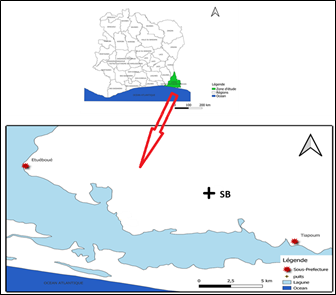
This study focuses on 13 samples from the SB well of Birisso, in the eastern onshore part of the Ivorian sedimentary basin, born from the opening of the South Atlantic during the Cretaceous. It combines lithology, binocular mineralogy and morphoscopy of quartz grains to reconstitute the depositional environments. The shaft shows four units with decreasing grain size upwards: purplish sands and clays at the base, fine sands with ferruginous sandstone, bitumen and marl in the middle, then a lateritic armour at the top. Quartz dominates (76.42%), followed by iron oxides (15.81%), while pyrite, glauconite, bitumen and carbonaceous debris are present in small quantities. The association glauconite-pyrite-organic matter indicates a shallow marine environment, first oxidizing then becoming reductive, sign of a marine transgression. Quartz grains are mostly blunt and shiny (60%), so they are transported by water over a long distance. The roundabouts (30%) reveal a wind input, and the angular grains (10%) a river transport. The sediments are thus of continental origin, resulting from aqueous and wind processes. The shallow marine environment, first oxidizing (glauconite) then becoming reductive and anoxic during a transgression (pyrite, bitumen), received continental sediments transported by water and wind, with variations in transport energy. Sedimentation is therefore complex and polyphasic, with alternations of transgression and regression, and the presence of zircons and phosphates opens up economic prospects.
The coastal sedimentary basin of Côte d'Ivoire is a major geological structure, whose history is intrinsically linked to the fragmentation of the supercontinent Gondwana in the Early Cretaceous. This mechanism of stretching the earth’s crust led to the birth of the South Atlantic Ocean, separating Africa from South America and giving shape to this coastal depression. The coastal sedimentary basin of Côte d'Ivoire is part of the vast West African sedimentary complex extending from Morocco to Angola 1. It has long been recognized for its significant potential in natural resources, particularly mineral, energy and groundwater resources. From the 19th century, oil sand mining and geological prospecting campaigns were carried out. The pioneering work of the Bureau de Recherches Géologiques et Minières (BRGM) has highlighted the mineral richness of the eastern zone, with the discovery of gold and diamond deposits in the Tiapoum region. These efforts have established a fundamental knowledge of the structure, sedimentology and facies of the basin. This study aims to update the resource potential in the eastern (onshore) zone of the Ivorian sedimentary basin while relying on the lithology, mineralogy and morphioscopy of quartz grains in the sediments to highlight the different deposition modes associated with them. The results obtained are discussed under the aspects of detailed understanding conditions of past geological dynamics.
1.1. Well Location
Located in West Africa, Côte d'Ivoire has generally a relatively flat and gently sloping relief, consisting of plains and plateaus, except for the western mountainous region of the country and a hydrography with four (4) large rivers that cross it. The Ivorian territory, with an area of 322,462 km 2, consists of two distinct geological units: a vast Precambrian basement (representing 97.5% of the country) and a sedimentary basin of secondary-tertiary age, less extensive (2.5% of the territory), whose existence is linked to the opening of the Atlantic Ocean. The Ivorian sedimentary basin, located south of the country along the Atlantic coast, is an "open" basin formed 106 million years ago by the opening of the South Atlantic. It is characterized by three major Ivorian accidents ( 2, 3, 4), (Saint-Paul fault, Romanche fault, Trou-Sans-Fond) and is divided into five parallel zones. With an area of 30,000 km 2, it includes a land part (onshore) and a marine part (offshore), ( 5, 6). The onshore part, a narrow crescent of 8,000 km 2, is crossed by the Lagoons fault, separating the "Continental Terminal" formations to the north (clays, sands, sandstone) from the quaternary deposits to the south. According to the work of PETROCI and BEICIP, ( 7, 8) the offshore part, which is more extensive, is subdivided into the San Pedro margin (shallow basement, steep continental shelf) and the Abidjan margin (deep basement, area of the main hydrocarbon discoveries)
The equipment used in this work consists mainly of drill cuttings from the Birisso site.
2.2. Study MethodsThe methodological approach consisted of conducting lithological, mineralogical, and morphoscopic analyses.
Lithological analysis begins with the sampling of 150 g of sediment per side, treated to break up the matrix and eliminate organic matter. The washing is carried out on a column of sieves (250 μm, 100 μm, 63 μm) under running water with a slight stirring, until a clear water is obtained. The rejections from each sieve are then collected, oven-dried, and observed under a binocular lens.
Mineralogical analysis consists of identifying, using a binocular lens, certain accessory or non-accessory minerals, such as glauconite, pyrite, carbonaceous debris, bitumen, zircon, phosphates, feldspars, muscovite, oxides, or silicates, likely to provide information about the repository environment
It consists of studying the shape and appearance of grains under a binocular lens. This is a visual assessment of the shape and appearance of sediment particles, which provides information on sediment wear and the nature of the transport agent. This study is carried out on grains from 500 to 250 μm in diameter ( 9, 10). Using the visual chart of 11, we distinguish angular grains (very angular, subangular) to rounded (sub-rounded, rounded and very rounded).

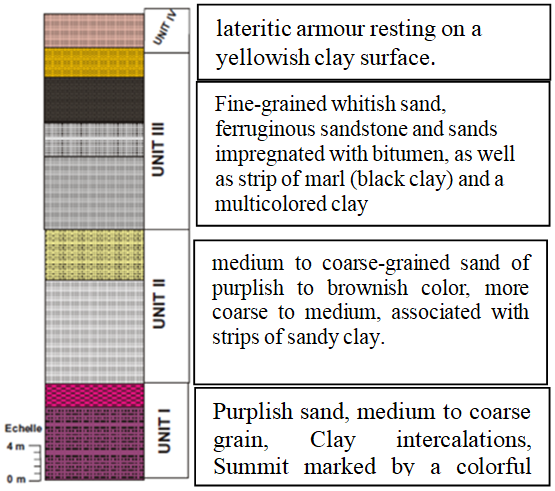
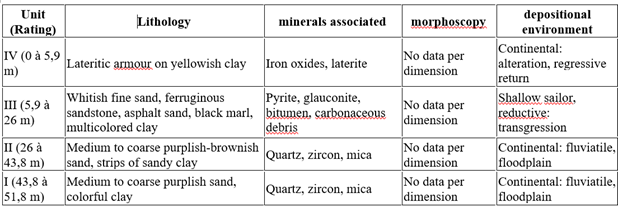
Depending on the direction of sedimentation, four (4) units were identified based on particle size (Figure 2). The grain size decreases from bottom to top. Unit I (51.80 m to 43.80 m) is composed of medium-grained to coarse-grained purplish sand, interspersed with clay at its base, and ends with a multicolored clay at the top. Unit II (43.80 m to 26 m) begins, at its base, with medium to coarse grains of violaceous to brownish sand. It ends, at its summit, with coarse to medium sand, associated with strips of sandy clay. Unit III (25.80 m to 5.90 m) is characterized by fine-grained whitish sand, marked by the presence of ferruginous sandstone and sands impregnated with bitumen, as well as a strip of marl (black clay) and a variegated clay. Finally, unit IV (5.90 m to 0 m) consists of a lateritic cuirass resting on a yellowish clay bottom.
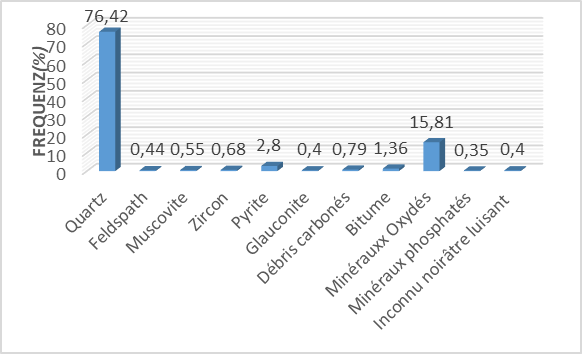
3.2. Mineralogical StudyIt consists of distributing in percentage the minerals present in 100g of sediments collected by sandy slope. The minerals that were the subject of this analysis are listed on the histograms (Figure 3).

a. Overwhelming dominance of quartz (76.42%)
Quartz constitutes the bulk of the mineral fraction, which is very abundant at more than 80%. This relative mineralogy of sediments justifies the formation of sandstones in the eastern part of the Ivorian onshore basin.
b. Oxidized minerals (15.81%)
Oxidized minerals account for 15.81% of the mineral fraction. These are mainly iron oxides and hydroxides (hematite, goethite) observed in the form of grains, coatings, and ferruginous cements. Their presence does not, in itself, constitute an indicator of the deposition medium: these phases are stable under oxidizing conditions and can be of detrital origin, superficial alteration (summit lateritic armour), or diagenetic, notably by oxidation of pyrite.
c. Redox indicator minerals (Pyrite 2.80% plus Glauconite 0.40%) (Figure 3)
Their coexistence, although contradictory (pyrite is equivalent to anoxic environment: glauconite is also equal to oxidizing to weakly reducing environment), confirms the hypothesis of a marine transgression that changed the oxidant environment into reducing one..
d. Organic matter indicators (Bitumen 1.36% plus Carbon debris 0.79%) Together, they represent about 2.15%, supporting the interpretation of an anoxic environment favorable to the preservation of organic matter.
e. Allochthonous minerals and accessories (Zircon, Muscovite, Feldspar, Phosphate minerals)
These minerals, in small proportions (less than 1% each), show a varied detrital contribution, confirming that the basin has received and preserved minerals of allochthonous origin alongside those formed in situ (pyrite, glauconite).

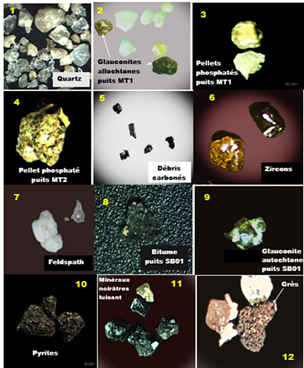
The presence of glauconite is a typical indicator of a shallow marine environment, weakly reductive to oxidative, characterized by slow sedimentation. On the other hand, pyrite, which is formed in an anoxic medium, should theoretically not coexist with glauconite. However, their association, sometimes observed, suggests that pyrite was formed after glauconite, under conditions that have become more reducing. The coexistence of glauconite, pyrite, and carbonaceous debris thus testifies to an initially oxidizing shallow marine environment, which has been transgressed. This environment has evolved into reducing conditions. The presence of bitumen and pyrite rich in ferrous iron (Fe 2+) reinforces the hypothesis of a low-energy anoxic environment, with relatively low temperatures favorable to the preservation of organic matter (Plate 1).
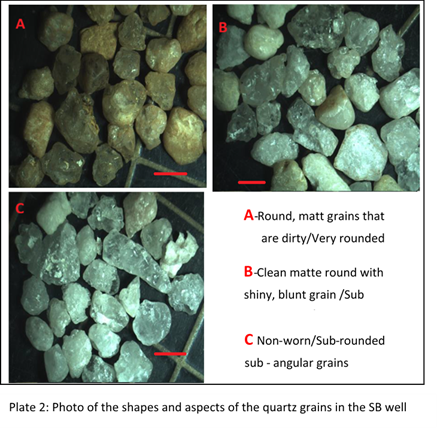
3.3. Morphoscopy of Quartz GrainsMorphoscopic analysis involves examining the shape and appearance of grains. Using the criteria for recognizing grain wear, the aim is to determine the nature of the agent and the mode of transport. Lot A (Plate 2) contains globular shapes with dominant rounded contours, the grains are very blunt with ochre to golden-brown colored surfaces reflecting a ferruginous and or clayey coating. Lot B contains the grains, which are round, matte to glossy, blunt or even lustrous. The surfaces are cleaner and lighter than batch A. It is mixed and therefore described as "clean matte" with occasional glossy facets where matt patches, which could be old shocks, coexist with gloss changes. Lot C: unworn grains, sub-rounded to subangular. The shapes are polyhedral with predominantly glassy shiny surfaces.

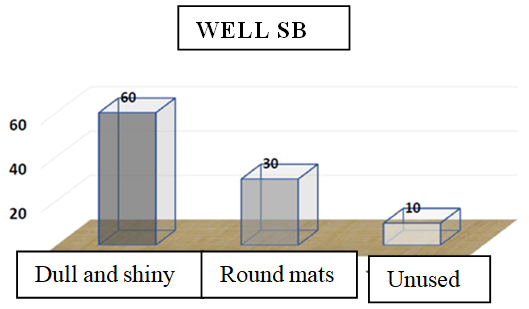
The Birisso area consists of 60% shiny blunt grains, 30% matte round grains, and 10% unworn angular grains (Figure 4).

Blunt and shiny quartz grains are carried by water over a relatively long distance. The round-mat grains, very rounded (dirty round-mat) to rounded (clean round-mat) and very blunt (60%), indicate transport over a very long distance. The transport agent is the wind reflecting wind deposits. Angular grains have recently been eroded and transported by water over a short distance in fluvial environments (10%). Birisso sediments come from the continental medium resulting from two distinct sedimentation processes. The result is an aqueous process (lagoon, river, beach) based on water and the wind process with wind as a transport agent reflecting variations in transport energy over long distances.
The sequence goes from continental (I, II) to marine transgression (III), then to continental return with the lateritic cuirass (IV) (Figure 5).
The different colourings of the sediments (arrangement of yellow-orange, pink, red) with predominance of yellow and brown along the well proves the existence of iron oxides, clay minerals, or organic matter. These stains are based on those observed mainly in the description of onshore sedimentary formations in the eastern part of the Ivorian sedimentary basin (Affoumou, 2019 12; Assalé, 2013 13). Transgression and regression movements were evident in 14. The mineralogy gives a paleoenvironment of continental type and reductive marine type in the eastern part of the Ivorian sedimentary basin. The coexistence of glauconite, pyrite, and debris in addition to deposition environments reflects a marine transgression. This is consistent with the work of 15 and 14 affirming that the simultaneous presence of pyrite, glauconite, and carbonaceous debris indicates a mixed deposition environment, reducing shallow marine under continental influence and a phase of marine transgression. Quartz is the most abundant mineral in the eastern Ivorian onshore sedimentary basin. This justifies the growth of the basin’s sandstones. Feldspars are in average quantity and are also an essential element of sandstones. The number of iron oxides or oxides increases from the continental oxidizing environment to the marine reducing environment (Birisso). This disagrees with the argument of the authors 16 in 'the comparative study of petro-sedimentary characteristics of sandstones from the Côte d'Ivoire sedimentary basin for which " The further we move away from the onshore basin (mainland), or deeper into the sedimentary basin toward the offshore (sea). The marine environment becomes increasingly reductive and disperses iron oxides ". The morphoscopic analysis of quartz grains reveals a predominance of blunt and shiny grains. These results are in agreement with those reported by 17, which associate this type of morphology with a marked influence of transport in the aquatic environment, characteristic of river dynamics. Similarly, 18, 19 and 20 specifies that the blunt and shiny appearance of grains results from prolonged transport over long distances in an aquatic environment.The abundance of iron oxides is related to three possible processes: first, it can constitute a continental detrital contribution of ferruginous grains, consistent with the purplish to brownish coloration of the sands and the ochre-brown coatings of the grains from batch A; in a series, to be a secondary oxidation of diagenetic pyrite in which ferrous iron (Fe 2+) is transformed into ferric iron (Fe 3+) during meteoric water flows or the excavation of the basin; and finally a secondary alteration related to the installation of the unit IV lateritic cuirass, which may have affected the underlying levels. The reductive nature of the marine environment is therefore based on the association of pyrite, bitumen and carbonaceous debris; in this respect, pyrite seems to be the main indicator, not oxides. The distribution of iron oxides along the well does not follow a simple continental-marine gradient. Their increase towards the Birisso marine levels does not reflect a more reducing environment, but more likely secondary oxidation of ferrous phases (pyrite) and/or enrichment related to lateritic alteration. This result qualifies the conclusion 16, which associates the increasing reductive character towards offshore with the dispersion of iron oxides; it is not necessarily in contradiction, as these authors reason about the deposition environment, whereas our observations also include post-deposition transformations.
The lithological, mineralogical and morphoscopic study of 13 samples of excavated material from the Birisso SB well highlights a succession of four units. A shallow and reductive marine interval (unit III) is bordered by continental-like deposits (fluviatile, floodplain) at the base and by a lateritic cuirass at the top. The main contribution of the study is the documentation, at a well scale, of this interval, recognized by the association of glauconite (0.40%), pyrite (2.80%), bitumen and carbonaceous debris with black marl. It is compatible with a marine transgression, already proposed in the region, and suggests an evolution towards reducing conditions. The lateritic cuirass indicates a continental alteration that may accompany a return to a regressive phase, without the dater. Quartz grains, the dominant mineral (76%), are mostly blunt-glossy (60%), which suggests a prolonged aqueous transport, with a wind contribution (round-mast, 30%) and a nearby fluvial part (angular, 10%). These interpretations remain indirect: they are based on a single well, drill cuttings, identification with a binocular microscope, and overall proportions not broken down by dimension, without dating.
| [1] | Aka, K, Quaternary sedimentation on the margin of Côte d'Ivoire: modeling test, Doctoral thesis of State in natural sciences, University of Abidjan, Abidjan, 1991, 320p. | ||
| In article | |||
| [2] | Blarez, E, The continental margin of Côte d'Ivoire-Ghana. Structure and evolution of a transforming continental margin, Doctoral thesis, Univ. Paris VI, Paris, 1986, 188p. | ||
| In article | |||
| [3] | Chierici, A, Stratigraphy, paleoenvironments and geological evolution of the Côte d'Ivoire-Ghana basin, Geology of Africa and the South Atlantic: colloquium proceedings, 1996, 117p. | ||
| In article | |||
| [4] | Djeya, K.L., Digbehi, Z.B., Affian, K., Goua, T.E., Kouamé, N.J., N'Da, L.V. & Yao, K.R, Contribution of the sedimentological and microfaunistic study to the biostratigraphic and paleoenvironmental characterization of Upper Cretaceous deposits in Côte d'Ivoire, Bioterre, International Journal of Earth Sciences, vol. 10, 2010, 38-52. | ||
| In article | |||
| [5] | Affian, K, Reciprocal impacts of oceanic and continental structures on the evolution of the West African domain (Gulf of Guinea and southern Côte d'Ivoire), Doctoral thesis 3rd cycle, Univ. Bordeaux I, Bordeaux (France), 1986, 295p. | ||
| In article | |||
| [6] | Yacé, I, Introduction to geology. The example of Côte d'Ivoire and West Africa, Éditions CEDA, Abidjan (Ivory Coast), 2002, 183p | ||
| In article | |||
| [7] | PETROCI & BEICIP, Côte d'Ivoire Petroleum Evaluation, Ministry of Mines, Abidjan (Ivory Coast), 1990, 99p. | ||
| In article | |||
| [8] | Djeya, K.L, Contribution to the biostratigraphic and paleoenvironmental study of the Albian-Maastrichtian interval in the KL-X well off Abidjan, DEA des Sciences de la Terre, option Géologie marine, UFR STRM, Univ. Cocody, Abidjan, 2009, 64p. | ||
| In article | |||
| [9] | Saaidi E. Treatise on sedimentology. Ellipses Edition, 1991, 393p. | ||
| In article | |||
| [10] | Yao, N.J-P, Sedimentological, mineralogical, geochemical and biostratigraphic characterization of the Fresco cliffs: Grand-Lahou region (Côte d'Ivoire), Single PhD thesis, Univ. F.H.B. Cocody, Abidjan, 2012, 187p. | ||
| In article | |||
| [11] | Pettijohn, F.J., Potter, P.E. & Siever, R, Sand and Sandstone, 2ème édition, Springer-Verlag, New York, 1987, 553p. | ||
| In article | View Article | ||
| [12] | Afoumou, P.C, Lithostratigraphic characterization of the Ivorian Continental Terminal: particle size and petrographic aspect of the Dabou APC drilling, Master’s thesis, Univ. F.H.B. Cocody, Abidjan, 2019, 38p. | ||
| In article | |||
| [13] | Assalé, F.Y.P, Sedimentological, palynological, geochemical and paleoenvironmental characterization of sedimentary formations related to the fault of the eastern lagoons of the Côte d'Ivoire onshore basin, Single PhD thesis, Univ. F.H.B. Cocody, Abidjan, 2013, 349p. | ||
| In article | |||
| [14] | Yao, K.C, Characterization of Cretaceous carbonate levels in the sedimentary basin of Côte d'Ivoire: petroleum interest and paleoenvironmental implication, Thèse de Doctorat Unique, Univ. F.H.B. Cocody, Abidjan, 2014, 228p. | ||
| In article | |||
| [15] | Awongo, M.-L., Stratigraphy, sedimentology and geochemistry of the black earth of the Middle and Upper Jurassic of Provence (South-East of France), Doctoral thesis, supervised by Georges Conrad, Univ. Paul Cézanne - Aix-Marseille III, [s.n.], 1984, 181p. | ||
| In article | |||
| [16] | Apie, C.A., Amani, E.M., Touré, M., Mondé, S., Aka, K. & Affian, K, Comparative study of petrosedimentary characteristics of sandstones from the Côte d'Ivoire sedimentary basin, Revue Ivoirienne des Sciences et Technologie, vol. 31, 2018, 138-160. | ||
| In article | |||
| [17] | Kra A. C ,Yao N. J.-P. Assalé F. Y. P et Aka K. Characterization of the transport dynamics of quartz grains of the mio-pliocene in the region of anyama (ivory coast): morphoscopy and exoscopy, American Journal of Innovative Research and Applied Sciences, 2020, 27-36p. | ||
| In article | |||
| [18] | Kra, A.C. Exoscopy of quartz grains for the paleogeographic reconstruction of the eastern formations of the onshore basin of Côte d'Ivoire: case of the localities of Anyama and Bonoua, Doctoral thesis, Félix Houphouët Boigny University, Cocody, Abidjan (Côte d'Ivoire), 2016, 101p. | ||
| In article | |||
| [19] | Guedé, K.É., Koffi, C.L., Atto, Y.D.S.R., Edjeme, K.A.M., Messou, N.R.A.B., Diarra, D.A. & Yao, N.J, Sedimentological and lithostratigraphic characterization of two wells in the Éboinda area, South-East of Côte d'Ivoire, European Scientific Journal, 18(36), 2022, 95p. | ||
| In article | View Article | ||
| [20] | Digbehi, Z.B., Affian, K., Mondé, S., Pothin, K.B.K. & Aka, K, Sedimentological analysis of a few facies of the Continental Terminal, BIOTERRE, Journal of Life and Earth Sciences, vol. 2, n°1, 2001, 71-84. | ||
| In article | |||
Published with license by Science and Education Publishing, Copyright © 2026 DJEYA Kouamé Leger, KOFFI Chiaye Larissa Epouse Coulibaly, TOE-BI Kahou Katel Kizito, KOFFI Djemele Akissi Tatiana, YOUGONE BI Gervais and YAO N’goran Jean Paul
 This work is licensed under a Creative Commons Attribution 4.0 International License. To view a copy of this license, visit
http://creativecommons.org/licenses/by/4.0/
| [1] | Aka, K, Quaternary sedimentation on the margin of Côte d'Ivoire: modeling test, Doctoral thesis of State in natural sciences, University of Abidjan, Abidjan, 1991, 320p. | ||
| In article | |||
| [2] | Blarez, E, The continental margin of Côte d'Ivoire-Ghana. Structure and evolution of a transforming continental margin, Doctoral thesis, Univ. Paris VI, Paris, 1986, 188p. | ||
| In article | |||
| [3] | Chierici, A, Stratigraphy, paleoenvironments and geological evolution of the Côte d'Ivoire-Ghana basin, Geology of Africa and the South Atlantic: colloquium proceedings, 1996, 117p. | ||
| In article | |||
| [4] | Djeya, K.L., Digbehi, Z.B., Affian, K., Goua, T.E., Kouamé, N.J., N'Da, L.V. & Yao, K.R, Contribution of the sedimentological and microfaunistic study to the biostratigraphic and paleoenvironmental characterization of Upper Cretaceous deposits in Côte d'Ivoire, Bioterre, International Journal of Earth Sciences, vol. 10, 2010, 38-52. | ||
| In article | |||
| [5] | Affian, K, Reciprocal impacts of oceanic and continental structures on the evolution of the West African domain (Gulf of Guinea and southern Côte d'Ivoire), Doctoral thesis 3rd cycle, Univ. Bordeaux I, Bordeaux (France), 1986, 295p. | ||
| In article | |||
| [6] | Yacé, I, Introduction to geology. The example of Côte d'Ivoire and West Africa, Éditions CEDA, Abidjan (Ivory Coast), 2002, 183p | ||
| In article | |||
| [7] | PETROCI & BEICIP, Côte d'Ivoire Petroleum Evaluation, Ministry of Mines, Abidjan (Ivory Coast), 1990, 99p. | ||
| In article | |||
| [8] | Djeya, K.L, Contribution to the biostratigraphic and paleoenvironmental study of the Albian-Maastrichtian interval in the KL-X well off Abidjan, DEA des Sciences de la Terre, option Géologie marine, UFR STRM, Univ. Cocody, Abidjan, 2009, 64p. | ||
| In article | |||
| [9] | Saaidi E. Treatise on sedimentology. Ellipses Edition, 1991, 393p. | ||
| In article | |||
| [10] | Yao, N.J-P, Sedimentological, mineralogical, geochemical and biostratigraphic characterization of the Fresco cliffs: Grand-Lahou region (Côte d'Ivoire), Single PhD thesis, Univ. F.H.B. Cocody, Abidjan, 2012, 187p. | ||
| In article | |||
| [11] | Pettijohn, F.J., Potter, P.E. & Siever, R, Sand and Sandstone, 2ème édition, Springer-Verlag, New York, 1987, 553p. | ||
| In article | View Article | ||
| [12] | Afoumou, P.C, Lithostratigraphic characterization of the Ivorian Continental Terminal: particle size and petrographic aspect of the Dabou APC drilling, Master’s thesis, Univ. F.H.B. Cocody, Abidjan, 2019, 38p. | ||
| In article | |||
| [13] | Assalé, F.Y.P, Sedimentological, palynological, geochemical and paleoenvironmental characterization of sedimentary formations related to the fault of the eastern lagoons of the Côte d'Ivoire onshore basin, Single PhD thesis, Univ. F.H.B. Cocody, Abidjan, 2013, 349p. | ||
| In article | |||
| [14] | Yao, K.C, Characterization of Cretaceous carbonate levels in the sedimentary basin of Côte d'Ivoire: petroleum interest and paleoenvironmental implication, Thèse de Doctorat Unique, Univ. F.H.B. Cocody, Abidjan, 2014, 228p. | ||
| In article | |||
| [15] | Awongo, M.-L., Stratigraphy, sedimentology and geochemistry of the black earth of the Middle and Upper Jurassic of Provence (South-East of France), Doctoral thesis, supervised by Georges Conrad, Univ. Paul Cézanne - Aix-Marseille III, [s.n.], 1984, 181p. | ||
| In article | |||
| [16] | Apie, C.A., Amani, E.M., Touré, M., Mondé, S., Aka, K. & Affian, K, Comparative study of petrosedimentary characteristics of sandstones from the Côte d'Ivoire sedimentary basin, Revue Ivoirienne des Sciences et Technologie, vol. 31, 2018, 138-160. | ||
| In article | |||
| [17] | Kra A. C ,Yao N. J.-P. Assalé F. Y. P et Aka K. Characterization of the transport dynamics of quartz grains of the mio-pliocene in the region of anyama (ivory coast): morphoscopy and exoscopy, American Journal of Innovative Research and Applied Sciences, 2020, 27-36p. | ||
| In article | |||
| [18] | Kra, A.C. Exoscopy of quartz grains for the paleogeographic reconstruction of the eastern formations of the onshore basin of Côte d'Ivoire: case of the localities of Anyama and Bonoua, Doctoral thesis, Félix Houphouët Boigny University, Cocody, Abidjan (Côte d'Ivoire), 2016, 101p. | ||
| In article | |||
| [19] | Guedé, K.É., Koffi, C.L., Atto, Y.D.S.R., Edjeme, K.A.M., Messou, N.R.A.B., Diarra, D.A. & Yao, N.J, Sedimentological and lithostratigraphic characterization of two wells in the Éboinda area, South-East of Côte d'Ivoire, European Scientific Journal, 18(36), 2022, 95p. | ||
| In article | View Article | ||
| [20] | Digbehi, Z.B., Affian, K., Mondé, S., Pothin, K.B.K. & Aka, K, Sedimentological analysis of a few facies of the Continental Terminal, BIOTERRE, Journal of Life and Earth Sciences, vol. 2, n°1, 2001, 71-84. | ||
| In article | |||