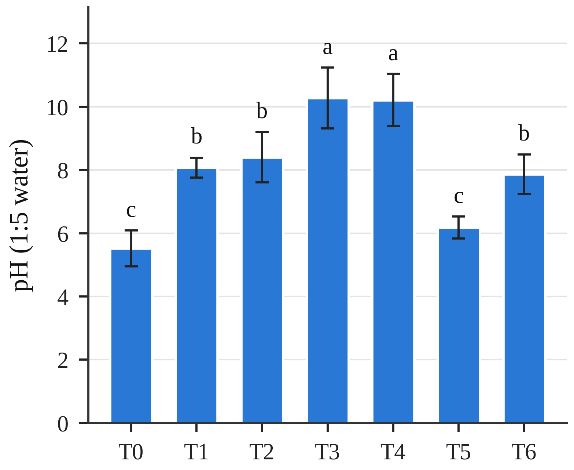
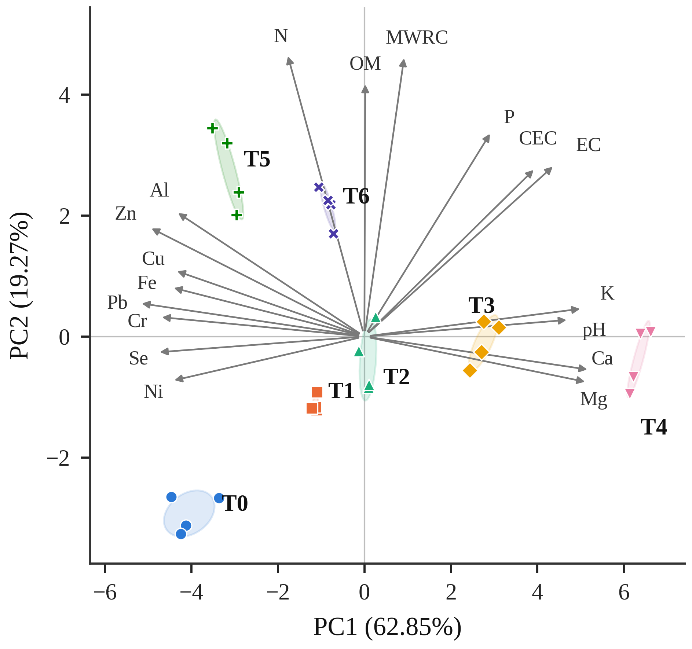
The ferralitic sandy soils of peri-urban Brazzaville (Republic of Congo) are acidic, poor in organic matter (OM) and have a low cation exchange capacity (CEC). This study evaluated, after a 14-day incubation and before any crop cultivation, the effects of seven treatments on the physico-chemical properties of such a soil: T0 (control); T1-T4, wood ash at 125, 250, 500 and 1,000 g per 5-kg pot (2.5-20% of soil mass); T5, household waste compost (100 g/pot); T6, a 1:1 (w/w) mixture of T1 and T5 soils (≈ 61 g ash + 49 g compost per 5 kg). Pots were arranged in a randomized complete block design with four replicates, and 18 variables were analysed by ANOVA (Tukey HSD) and principal component analysis (PCA). The unamended soil was moderately acid (pH 5.52), with low OM (2.17%), total N (994 mg/kg) and CEC (6.37 cmol(+)/kg). Wood ash (pH 11.0; Ca 15.5%) raised soil pH to 10.21-10.28 (T3-T4), strongly increased Ca, Mg and K, and raised EC up to 1,816 µS/cm, while TME contents decreased, mainly through dilution. Compost increased total N (up to 1,159 mg/kg in T5) and MWRC. T6 showed the most balanced measured profile: pH 7.86, MWRC 28.8% (highest value), OM 4.40%, CEC 12.11 cmol(+)/kg and N 1,093 mg/kg, with EC (1,311 µS/cm) lower than in T3-T4. All TME remained below the NF U 44-041 soil limit values. PCA retained three components (89.17% of variance): PC1 (62.85%) opposed the ash-driven mineral enrichment (Ca, Mg, K, pH, EC) to native Fe, Al and TME; PC2 (19.27%) reflected the compost-driven organic gradient (N, MWRC, OM). T6 lay between both gradients, consistent with a complementary effect of the two amendments; this should be validated by crop-response trials.
Ferralitic soils represent one of the dominant pedological units of humid intertropical Africa. Characterized by advanced ferralitic weathering of parent material, they are distinguished by accumulation of iron and aluminium as oxides and hydroxides, advanced desilicification, and progressive depletion of basic cations (Ca²⁺, Mg²⁺, K⁺) through leaching under tropical rainfall 1, 2. In the Brazzaville department (Republic of Congo), these soils predominantly display a sandy texture from the Pool Malebo alluvio-aeolian formations, combining structural constraints of sands with chemical limitations of ferrallitization (acidity, reduced CEC, macronutrient deficiency) 3, 4.
This convergence of pedological limitations directly affects the productivity of peri-urban market-gardening systems, essential for food security in Brazzaville 5, 6. Correcting acidity and enriching organic matter are urgent agronomic priorities, but the economic accessibility of mineral fertilizers and agricultural lime remains limited for small producers 7, 8. Organic and mineral amendments from local residues, namely household solid waste compost and domestic wood ash, constitute abundant, accessible alternative inputs 9, 10, 11.
Wood ash, rich in calcium, magnesium and potassium oxides and carbonates, exerts a strong alkalizing effect on acid soils through the release of hydroxyl ions upon dissolution 9, 12, 13, as confirmed on acid tropical and hydromorphic soils 14, 15. Household waste compost enriches soil with stable organic matter and mineralizable nitrogen, and improves CEC 10, 11, 16. Their effects are expected to be distinct and complementary ash acting primarily on the mineral and acid-base dimension, compost on the organic and biological dimension and their combined use has been proposed to ameliorate acid tropical soils 17, 18.
This study addresses a gap in the local literature by evaluating, through PCA on 18 physico-chemical variables, the comparative and combined effects of seven amendment treatments on ferralitic sandy soils of Brazzaville, before any crop establishment. Three specific objectives were pursued: (i) to characterize the amendments and the reference soil; (ii) to measure the changes induced by seven treatments before crop cultivation; (iii) to identify, through PCA and Pearson correlation matrix, the gradients of variation associated with both amendments.
The study was conducted at the Plant and Life Chemistry Unit (UC2V), Faculty of Science and Technology, Marien NGOUABI University, Brazzaville (4°16'S, 15°17'E, altitude 320 m). The experimental soil, a ferralitic sandy soil representative of peri-urban market garden sites, was collected from the arable layer (0-20 cm), sieved to 2 mm and homogenized before amendment incorporation. This soil falls into the Oxisols (USDA) or Ferralsols (WRB) category, from the alluvio-sandy Pool Malebo geological formations 19, 20.
2.2. Amendments UsedHousehold waste compost (HWC) was prepared in three batches (C1, C2, C3) from organic household biowaste and organic adjuvants (poultry, rabbit and sheep manure, eggshells), stabilized to physico-chemical maturity. Compost characteristics are reported as mean ± SD of the three batches (n = 3). Wood ash (WA) was collected from urban households burning untreated wood (mainly Eucalyptus spp. and Cassia siamea). Both amendments were sieved to 2 mm, air-dried and physico-chemically analyzed before incorporation.
2.3. Experimental DesignThe experimental unit was a pot containing 5 kg of air-dried soil. Seven pre-cropping treatments were applied: T0 (unamended control); T1 (125 g WA/pot, 2.5% w/w); T2 (250 g WA/pot, 5% w/w); T3 (500 g WA/pot, 10% w/w); T4 (1,000 g WA/pot, 20% w/w); T5 (100 g HWC/pot, 2% w/w); T6, a 1:1 (w/w) mixture of 2.5 kg of T1 soil and 2.5 kg of T5 soil, i.e. ≈ 61 g WA + 49 g HWC per 5-kg pot (WA:HWC mass ratio ≈ 55:45, half of the T1 and T5 doses). Field-equivalent rates were calculated as: rate (t/ha) = [amendment mass (g) / soil mass (kg)] × 10⁻³ × M, where M is the mass of soil per hectare in the 0-20 cm layer (M = 10⁴ m² × 0.20 m × ρb). With a soil bulk density ρb = 1.46 g/cm³ (M = 2,920 t/ha), T1-T4 correspond to ≈ 73, 146, 292 and 584 t/ha, T5 to ≈ 58 t/ha and T6 to ≈ 36 t/ha WA + 29 t/ha HWC. The high doses (T3-T4) exceed usual agronomic practice and were included to describe the dose–response range. The 28 pots (7 treatments × 4 replicates) were arranged in a randomized complete block design with four blocks (B1–B4), each block containing one pot of each treatment randomly assigned. Amendments were thoroughly mixed with the soil, and pots were maintained at 60% of MWRC and incubated for 14 days at room temperature (≈ 25°C) before sampling. One composite sample was collected per pot (n = 4 per treatment).
2.4. Analytical MethodspH (NF X 31-103; ISO 10390) and EC (NF X 31-113; ISO 11265) were measured in a 1:5 (w/v) soil:water suspension (10 g of soil in 50 mL of distilled water, stirred for 1 h, left to settle for 30 min and filtered). MWRC was determined by the funnel drainage method: 100 mL of distilled water (Vi) were added to 100 g of soil placed on filter paper in a funnel and allowed to drain for 5 h; the drained volume (Vf) was recorded and MWRC was calculated as Vi − Vf and expressed as % (w/w) 21. OM was determined by loss on ignition (LOI): 4 g of oven-dried soil were ignited at 1,100 °C for 2 h in a muffle furnace (Thermolyne F48055) and OM (%) was calculated from the mass loss relative to the initial dry mass; this procedure may overestimate OM in carbonate-bearing materials 22. Total Kjeldahl N was determined after sulphuric acid digestion in the presence of a catalyst, distillation and titration (NF ISO 11261). Available P was extracted by the Olsen method (0.5 M NaHCO₃, pH 8.5) and determined colorimetrically with the molybdate–ascorbic acid reagent (Murphy & Riley; NF EN ISO 6878) at λ = 660 nm. Exchangeable K and Na were extracted with 1 M ammonium acetate (pH 7) and determined by flame emission spectrometry (NF X 31-108). Pseudo-total Ca and Mg were determined in the aqua regia digest (see below) by EDTA complexometric titration: Ca + Mg at pH 10 (NH₃/NH₄Cl buffer, Eriochrome Black T indicator), Ca alone at pH 12–13 (NaOH, murexide/calcon indicator, Mg being precipitated as Mg(OH)₂), and Mg by difference. HCl-extractable Al and Fe were obtained by cold extraction with concentrated HCl (Al: 10 g of soil, 4 × 25 mL HCl; Fe: 5 g of soil, 15 mL HCl; 15 min contact) and determined spectrophotometrically with Eriochrome cyanine R at 535 nm (Al) and o-phenanthroline at 490 nm (Fe); this procedure does not measure exchangeable Al. CEC was determined at pH 7 by successive percolation with 1 N CaCl₂, 0.1 N CaCl₂ and 1 N KNO₃, followed by titration of the displaced Ca²⁺ (EDTA) and Cl⁻ (AgNO₃), and is expressed in cmol(+)/kg. Particle size was determined by the Robinson pipette method (NF X 31-107). TME (Cr, Cu, Ni, Pb, Se, Zn) were determined as pseudo-total contents after aqua regia digestion (HCl 37% : HNO₃ 65%, 3:1; 1.0 g of sample, 24 h at room temperature then 2 h at 150 °C; NF X 31-415, ISO 11466), by flame atomic absorption spectrometry (Skyray AAS6000; ISO 11047), Se being determined by hydride generation (Thermo Scientific VP100). A reagent blank was included in each analytical series, calibration used multi-level standard solutions, and the analytical error did not exceed 10% of reference values. Soil limit values refer to NF U 44-041 and compost limit values to NF U 44-051 23.
2.5. Statistical AnalysisResults are expressed as mean ± standard deviation (SD) of the four replicate pots (n = 4). Treatment effects were tested by one-way analysis of variance (ANOVA), followed by Tukey's HSD test (α = 0.05); means sharing the same letter are not significantly different. The block effect, tested in a two-way model (treatment + block), was not significant for 16 of the 18 variables (p > 0.05; significant only for OM and K) and did not change the conclusions, so one-way ANOVA results are reported. Normality of residuals and homogeneity of variances were checked with the Shapiro–Wilk and Levene/Brown–Forsythe tests; for variables showing heterogeneous variances, the treatment effect was confirmed by the non-parametric Kruskal–Wallis test (p < 0.01 for all variables). PCA was performed on the correlation matrix (variables standardized to zero mean and unit variance) of the 28 × 18 data matrix (7 treatments × 4 replicate pots; variables: pH, EC, CEC, MWRC, OM, Al, Fe, N, P, K, Ca, Mg, Cr, Cu, Ni, Pb, Se and Zn); components with eigenvalues > 1 (Kaiser criterion) were retained 24; sampling adequacy was checked with the Kaiser-Meyer-Olkin (KMO) index and Bartlett's test of sphericity. The overall treatment effect on the 18 variables was tested by a permutational multivariate analysis of variance (PERMANOVA; Euclidean distance on standardized variables, 9,999 permutations). Pearson correlation coefficients were computed on the same 28 observations (critical |r| = 0.374 at p = 0.05 and 0.479 at p = 0.01). Given the limited number of observations relative to variables, PCA was used as a descriptive tool. ANOVA and mean comparisons were performed with OriginPro 2024 (OriginLab Corporation, Northampton, MA, USA) and checked, together with the PCA, KMO, Bartlett and PERMANOVA analyses, in Python 3.11 (NumPy 2.4, SciPy 1.17, statsmodels 0.15) 25. The full data matrix and PCA outputs are provided as Supplementary Tables S1-S3.
The reference soil (Table 1) shows the typical properties of a degraded ferralitic sandy soil of the Pool Malebo department. Its sandy texture (88.6% sand) results from advanced ferrallitization concentrating quartz resistant to hydrolysis 1, 19, 20, and the low clay content (7.58%), mainly kaolinite, is consistent with advanced ferralitic pedogenesis 2. The moderately acid pH (5.52) reflects the leaching of basic cations and clay mineral hydrolysis 26, 27; at this pH, phosphorus tends to be retained on Fe/Al oxides 28, 29. The very low Ca (15 mg/kg), Mg (10 mg/kg) and exchangeable K (16.0 mg/kg), together with low OM (2.17%) and CEC (6.37 cmol(+)/kg), are characteristic of ferralitic soils cultivated without organic restitution 19. TME contents are all below the NF U 44-041 soil limit values, indicating a natural pedogeochemical background without anthropogenic contamination.
Wood ash (Table 2) has a pH of 11.0, characteristic of tropical woody biomass ash, resulting from dissolution of oxides (CaO, MgO) and carbonates (K₂CO₃) formed during domestic combustion at 400-700°C 12, 30. The exceptional richness in Ca (155,300 mg/kg) and Mg (49,600 mg/kg) reflects the species used primarily Eucalyptus spp. and Cassia siamea, known for their high divalent cation content 31. This is consistent with African data for similar hardwood ashes 32. Near-zero N content results from volatilization during combustion 13. The high EC of the ash (9,270 µS/cm) indicates a potential salinity risk at high application rates; salinity is generally considered limiting for sensitive crops when the EC of the saturated paste extract exceeds 4 dS/m (4,000 µS/cm), a value not directly comparable with 1:5 extracts 33. TME are systematically below receiving soil levels 34, 35.
3.3. Physico-Chemical Characteristics of Household Waste CompostThe mean C/N ratio of 18.52 (FAO: 15-20) is compatible with progressive N mineralization, although values approaching 20 may cause temporary N immobilization 36. The NO₃⁻/NH₄⁺ ratio (5.88) approaches but remains slightly below the maturity threshold of 6.25 37, whereas the low COD (211 mgO₂/l) indicates a largely stabilized organic matter 36. Total N (1.03%) is the only significant nitrogen source in this system: ash contains practically none (7 mg/kg). The two amendments are therefore complementary in composition: ash provides Ca, Mg, K and alkalizing power; compost provides N, OM and organic CEC. TME conform to NF U 44-051 23, 38.

Wood ash induced a dose-dependent pH increase (F(6,21) = 28.9, p < 0.001), from 5.52 (T0) to 8.07–8.40 in T1-T2 and 10.21–10.28 in T3-T4 (Table 5; Figure 1). This is attributed to the dissolution of the oxides and carbonates contained in the ash, e.g. CaO + H₂O → Ca²⁺ + 2OH⁻ and CO₃²⁻ + H₂O ⇌ HCO₃⁻ + OH⁻ 9, 12. The response levelled off above T3 (T3 and T4 not significantly different), consistent with Rolka et al. 39, Ohno & Erich 40 and Perkiömäki & Fritze 35, and with studies on acid soils in which wood or biomass ash raised pH and basic cations in a dose-dependent manner, up to pH 9.1 at the highest rates 14, 15. T1–T2 reached moderately alkaline values, whereas T3-T4 (pH > 10) are over-alkaline, which is detrimental to micronutrient availability and microbial activity 41; in a pot trial on an acid soil, biomass-ash rates above 1.25% (w/w) inhibited maize growth through combined alkaline and saline stress 14. Compost alone (T5, pH 6.18) did not differ significantly from T0. T6, which contains half of the ash of T1 and half of the compost of T5, reached pH 7.86, within the 6.5-8.0 range generally considered favourable for market-garden crops 42, 43; it did not differ significantly from T1 (8.07) and was well above T5, showing that a moderate ash dose is sufficient to correct acidity in the mixture. A specific buffering effect of compost cannot be inferred from these data.
Soil EC increased with ash dose (F(6,21) = 3,507, p < 0.001), from 148 µS/cm (T0) to 1,816 µS/cm (T4), in line with the high EC of the ash (Table 2). Compost also raised EC (T5: 1,190 µS/cm), and T6 reached 1,311 µS/cm. These values were measured in 1:5 extracts, which are more dilute than saturated-paste extracts; the corresponding ECe values would be higher, so a salinity risk for sensitive crops cannot be excluded at the highest ash doses and in T5-T6, and should be checked by ECe measurements, the EC1:5-ECe conversion factor increasing in coarse-textured soils 33, 44. pH and EC were closely correlated (r = 0.777, p < 0.001), indicating that alkalinization and salinization progressed together with the ash dose 14.

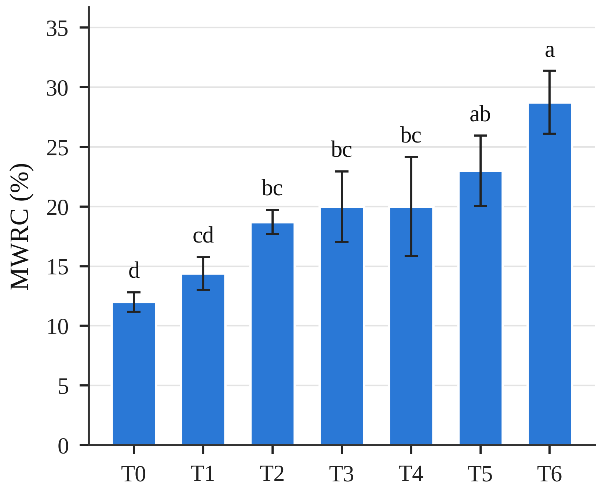
MWRC increased from 12.0% (T0) to 28.8% (T6) (F(6,21) = 18.7, p < 0.001; Table 6, Figure 2). Ash may contribute through its intrinsically high MWRC (95%) and the partial filling of macropores 45, and the effect of ash doses ≥ T2 was significant. Compost is likely to improve MWRC through its humified OM and the formation of organo-mineral microaggregates, as reviewed for compost-amended soils 46, 47, 48. T6 showed the highest MWRC (+140% relative to T0), significantly higher than T1-T4 and well above the mean of its two components T1 and T5 (18.7%), which is relevant for irrigation management in sandy soils; aggregate stability was not measured.
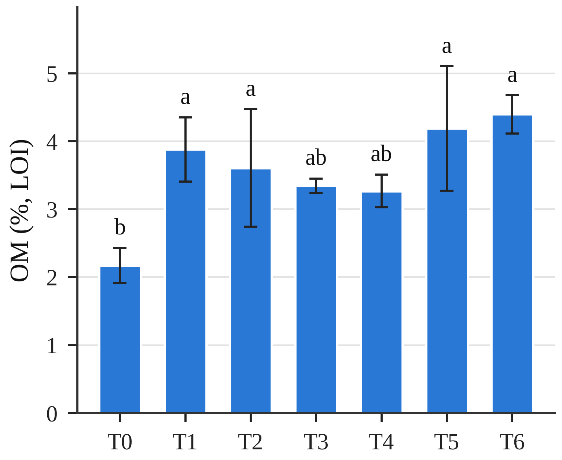
OM increased from 2.17% (T0) to 3.88-4.40% in amended soils (F(6,21) = 7.5, p < 0.001; Table 7, Figure 3); T1, T2, T5 and T6 differed significantly from T0, while T3-T4 were intermediate. For ash-only treatments, this apparent increase must be interpreted with caution: because OM was determined by LOI at 1,100 °C, the mass loss also includes CO₂ released by the carbonates of the ash (decomposed above ≈ 800 °C) and structural water of clay minerals, so that LOI overestimates OM in ash-amended soils 22. Residual unburnt carbon in the ash, not quantified here, may also contribute. Likewise, the OM measured in T5 (4.19%) exceeds the value expected from the compost input alone (≈ 2.79%), with a high variability (SD = 0.92). Compost is nevertheless expected to provide the more stable OM input, through humic compounds able to form organo-mineral complexes with Fe and Al oxides 49, 50; the lower values in T3-T4 than in T1-T2 were not significant and are not interpreted further.


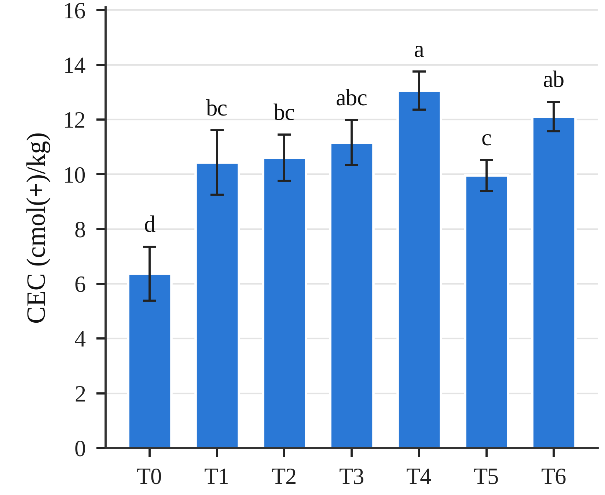
CEC increased significantly in all amended treatments (F(6,21) = 25.7, p < 0.001), from 6.37 cmol(+)/kg (T0) to 9.96–13.06 cmol(+)/kg (Table 8, Figure 4). The highest values were found in T4 (13.06) and T6 (12.11), which did not differ significantly. For ash treatments, the pH rise activates pH-dependent charges on kaolinite and OM (Al-OH → Al-O⁻ + H⁺) 42, 51, and CEC was correlated with pH (r = 0.727) and Ca (r = 0.618). For compost, humified OM (CEC = 21.84 cmol(+)/kg) contributes carboxylate and phenolate exchange sites 27, 52; CEC was also correlated with OM (r = 0.481) and MWRC (r = 0.591). The CEC of T6 (12.11) exceeded the mean of its two components T1 and T5 (10.19 cmol(+)/kg), suggesting a positive interaction between ash and compost, although T6 did not differ significantly from T1.
Ca, Mg, K and P increased with ash dose (Table 9; p < 0.001): Ca rose from 15 (T0) to 23,857 mg/kg (T4), Mg from 10 to 7,839 mg/kg, K from 16.0 to 255.0 mg/kg and P from 105.3 to 174.0 mg/kg. These increases agree with the mass balance of the ash inputs (e.g. expected Ca ≈ 3,802 and 25,896 mg/kg in T1 and T4, measured 3,487 and 23,857 mg/kg; expected K in T4 ≈ 258 mg/kg, measured 255.0 mg/kg). Total N increased mainly in the compost treatments (T5: 1,159 mg/kg, +17%; T6: 1,093 mg/kg), in agreement with the expected values (≈ 1,176 mg/kg in T5, and 1,091 mg/kg in T6 as the mean of T1 and T5), compost being the only significant N source (Table 3). As expected for a 1:1 mixture of T1 and T5 soils, T6 values were close to the mean of T1 and T5 for N, P, K and TME. HCl-extractable Fe decreased from 4,413 (T0) to 3,800 mg/kg (T4, −14%), consistent with the dilution expected from mixing 1,000 g of ash with 5 kg of soil (≈ -17%). HCl-extractable Al decreased from 30.5 to 15.0 mg/kg (-51%), which exceeds the dilution effect; since concentrated HCl also dissolves freshly precipitated hydroxides, this decrease may reflect a transformation of Al into less extractable forms at high pH, which requires speciation analysis. HCl-extractable Al is not a measure of exchangeable (potentially phytotoxic) Al; a reduction of Al toxicity at higher pH is therefore inferred from the literature rather than demonstrated, although the decrease of exchangeable Al is the main agronomic benefit of liming acid soils 28, 53, 54, 55. Al was slightly higher in T5 (36.0 mg/kg) than in T0, but the difference was not significant.
All treatments showed TME concentrations below the NF U 44-041 soil limit values (Table 10000). Ash significantly decreased TME contents at the highest doses (e.g. Pb: 14.13 → 11.05 mg/kg; Zn: 22.64 → 17.47 mg/kg in T4). Precipitation as hydroxides, carbonates or phosphates at alkaline pH reduces the mobile fraction of TME but cannot decrease their pseudo-total (aqua regia) content 56, 57, 58, 59, 60; the decrease is mainly explained by dilution of the soil by an ash whose TME contents are 2–5 times lower than those of the soil (Table 2). Dilution fully accounts for the decrease in Cr (expected 13.27, measured 13.36 mg/kg in T4), whereas Pb, Zn and Se decreased slightly more than expected (e.g. Pb: expected 12.82, measured 11.05 mg/kg), possibly due to a lower aqua-regia extractability of TME in carbonate-rich, alkaline matrices. Compost alone slightly increased Cu and Zn (T5: 14.95 and 24.46 mg/kg), in line with its higher Zn content (109 mg/kg; Table 3), but all values remained far below limit values 58, 61. Neither amendment raised TME contents above soil limit values at the tested doses. This conclusion is, however, restricted to the ash characterized here: TME contents of biomass ashes vary widely with tree species and combustion conditions 62, and household ashes can increase the phytoavailability of Al and Zn 63, so that uncontrolled use of uncharacterized ashes should be avoided.
3.5. PCA and Structure of Relationships between ParametersPCA was conducted on the 18 physico-chemical variables measured in the 28 pots (7 treatments × 4 replicates), with standardized variables (correlation matrix; Section 2.5; Supplementary Tables S1–S3) 25.

The data were suitable for factor analysis (KMO = 0.83; Bartlett's test of sphericity: χ² = 934, df = 153, p < 0.001), and PERMANOVA confirmed a strong overall treatment effect on the 18 variables (pseudo-F = 38.3, R² = 0.92, p < 0.001). Three components had eigenvalues > 1 and together explained 89.17% of the total variance (Table 11111); PC1 and PC2 accounted for 82.12% 24, 25. Communalities (h²) on the three retained components ranged from 0.71 (OM) to 0.99 (Supplementary Table S2). Three limitations should be kept in mind. First, the observation-to-variable ratio (28/18 ≈ 1.6) is low and the four replicates of a treatment are not independent individuals; the PCA is therefore used as a descriptive tool, treatment effects being tested by ANOVA and PERMANOVA. Second, standardization gives the same weight to variables with very small variation (Ni, CV = 4%; Cr, 5%) as to strongly varying ones (Ca, 116%; Mg, 124%), so that TME strongly structure PC1 although their absolute changes remain within 1–5 mg/kg, far below regulatory limits. Third, Ca, Mg and K are almost collinear (r = 0.995 for Ca/Mg and 0.971 for K/Ca), which reinforces the weight of the basic-cation pole on PC1 24.
PC1 (62.85%) is the dominant gradient. It is defined on the positive side by Ca (+0.973), Mg (+0.963), K (+0.942), pH (+0.885), EC (+0.820) and CEC (+0.738), and on the negative side by Pb (-0.972), Zn (-0.928), Se (-0.895), Cr (-0.886), Fe (-0.835) and Al (-0.813) (loadings; the sign of a component is arbitrary). The ash treatments move along PC1 in a dose-dependent manner from T1 to T4, with little change on PC2 (Figure 5). The grouping of pH, Ca, Mg, K and EC reflects the dissolution of the basic oxides, hydroxides and carbonates of the ash, i.e. its liming and potassic value, long described for wood ash 9 and confirmed on acid tropical soils, where wood ash raised pH and Ca, Mg and K in the soil solution 15; recent reviews attribute to wood ash a simultaneous effect on acidity, nutrient availability and soil buffering capacity 64. The negative correlations pH/Al (r = -0.792) and pH/Fe (r = -0.856) are consistent with the effect sought by liming acid soils, of which the decrease of exchangeable Al is the main agronomic benefit 55; however, since Al and Fe were extracted with concentrated HCl, their decrease here mainly reflects dilution and a possible transformation into less extractable forms (Section 3.4.6). Likewise, the strong negative correlations between basic cations and TME (Ca/Pb, r = -0.983; Mg/Zn, r = -0.963) do not indicate chemical immobilization, which would affect only the mobile fractions 59, 60, but the dilution of pseudo-total TME by an ash poorer in TME than the soil (Section 3.4.7).
PC2 (19.27%) is dominated by N (+0.870), MWRC (+0.864), OM (+0.785) and P (+0.632). T5 and T6 project on its positive side and T0 on its negative side, which confirms the role of compost in rebuilding the organic pool and the water reserve of sandy soils. Compost incorporation increases porosity, aggregation and water retention 48, and compost-based amendments improve soil fertility under tropical conditions 65; the correlations N/MWRC (r = 0.619), OM/MWRC (r = 0.627) and N/OM (r = 0.556) (p < 0.01) are consistent with this effect 47, 48. OM was independent of PC1 (loading = 0.004; r with pH = 0.12): ash, practically devoid of organic carbon, cannot restore the organic stock of a degraded ferralitic soil, a function fulfilled by compost. CEC occupies an intermediate position between both axes (PC1: +0.738; PC2: +0.519) and is more strongly correlated with pH (r = 0.727) and EC (r = 0.841) than with OM (r = 0.481). In kaolinitic, oxide-rich soils, a large part of the charge is pH-dependent: the rise in pH deprotonates Al–OH, Fe–OH and COOH groups and creates new exchange sites 42, 51, 55. CEC therefore benefits both from ash-induced alkalinization and from the organic charges supplied by compost. PC3 (7.05%) was mainly related to P, Fe and Cu and is not interpreted further.
T0 is positioned on the negative side of both axes (acid pH, low OM and N, higher Fe, Al and TME), characteristic of ferralitic sandy soils 66. T1-T4 progressively migrate toward the positive side of PC1, T4 reaching the extreme (maximal Ca, Mg and K), while T5 stands out on positive PC2 (N = 1,159 mg/kg); the 95% confidence ellipses of the treatment centroids are well separated (Figure 5). T6 lies above the centre of the factorial plane, combining acid correction (pH 7.86), Ca and Mg enrichment, organic enrichment (OM = 4.40%, N = 1,093 mg/kg), the highest MWRC (28.8%) and a high CEC (12.11 cmol(+)/kg), without the alkaline and saline excess of T3-T4. Similar benefits correction of acidity, increase in exchangeable bases and maintenance of microbial activity were obtained with wood-ash-amended composts on acid tropical soils of Cameroon 17, 18, and wood ash is recognized as an additive improving the agronomic quality of composts 67. By limiting the pH rise, the combination also avoids the extreme pH values that strongly alter soil bacterial abundance and community composition 68. T6 therefore shows the most balanced measured physico-chemical profile among the tested treatments; whether this translates into better crop performance requires validation through crop-response trials, as done for integrated amendments by Abdul-Aziz et al. 69.
Key correlations have potential practical implications: (i) EC/K (r = 0.820) and EC/P (r = 0.796): EC may serve as a simple screening indicator of mineral enrichment by ash, subject to local calibration; the close pH/EC correlation (r = 0.777) also indicates that the salinity risk increases with the ash dose 14. (ii) Ca/Fe (r = -0.734), Ca/Pb (r = -0.983) and Ca/Zn (r = -0.957): mainly reflect the dilution of native Fe and TME by Ca-rich ash 23, 54. (iii) Cr/Zn (r = 0.855), Ni/Zn (r = 0.715) and Cr/Ni (r = 0.590): Cr, Ni and Zn co-vary, suggesting a common geochemical behaviour, with all values below NF U 44-041 limit values 58, 70. (iv) N/MWRC (r = 0.619) and OM/MWRC (r = 0.627): consistent with the role of compost OM in improving water retention 48. In summary, ash structures PC1 (alkalinization, Ca/Mg/K inputs, dilution of Fe, Al and TME) and compost structures PC2 (N, OM and water retention). Among the treatments tested, T6 is the only one positioned favourably on both gradients.
This study evaluated, in an integrated and multivariate manner (ANOVA and PCA on 18 variables), the effects of household waste compost and wood ash on the physico-chemical properties of an acid ferralitic sandy soil from Brazzaville. Five major conclusions emerge.
First, the ferralitic soil studied combines several constraints (pH 5.52, 88.6% sand, OM 2.17%, CEC 6.37 cmol(+)/kg, very low Ca, Mg and K) that call for complementary organic and mineral inputs.
Second, wood ash (Ca = 15.5%, pH 11.0) induced a dose-dependent alkalinization (pH 5.52 to 10.21–10.28 in T3-T4), strong Ca, Mg and K enrichment and an EC increase up to 1,816 µS/cm, while HCl-extractable Fe and Al and pseudo-total TME decreased, mainly through dilution. Doses above 250 g per pot (T3–T4) led to over-alkalinization.
Third, household waste compost (OM = 31.56%, Ntot = 1.03%, C/N = 18.52) was the main source of nitrogen (T5: 1,159 mg/kg) and improved MWRC and CEC, without significantly modifying soil pH; effects on soil structure were not directly measured.
Fourth, combined treatment T6 (1:1 mixture of T1 and T5 soils, i.e. half doses of ash and compost) showed the most balanced measured profile: pH 7.86, highest MWRC (28.8%), OM 4.40%, N 1,093 mg/kg and CEC 12.11 cmol(+)/kg, without over-alkalinization; its EC (1,311 µS/cm, 1:5) remained lower than in T3–T4 but should be monitored. All TME remained below NF U 44-041 soil limit values.
Fifth, PCA revealed two main gradients: PC1 (62.85%), the alkalizing and mineral effect of the ash; PC2 (19.27%), the organic and nitrogen effect of the compost. T6 lies between both gradients, consistent with the functional complementarity of the two amendments for improving the physico-chemical fertility of peri-urban ferralitic sandy soils of Brazzaville. These pre-cropping results now need to be validated by crop-response trials and longer-term monitoring.
The authors thank the Plant and Life Chemistry Unit (UC2V) of Brazzaville, the IRSN and AMTECH Expertise Laboratories of Pointe-Noire for physico-chemical analyses, and the peri-urban households that contributed wood ash and household waste. This work is part of a doctoral thesis in environmental chemistry, Marien NGOUABI University (UMNG), Brazzaville, Republic of Congo.
| [1] | Duchaufour, P. (1983). Pedology: Pedogenesis and Soil Classification, Volume 1, 2nd edition, Masson, Paris (France), 491 p. | ||
| In article | View Article | ||
| [2] | Ondo, J. A. (2011). Vulnerability of market-gardening soils in Gabon (Libreville region): acidification and mobility of metallic elements, Doctoral Thesis, University of Provence, Provence (France), 324 p. | ||
| In article | |||
| [3] | Denis, B. (1974). Pedological map of Brazzaville–Kinkala at 1:200,000. Explanatory Note No. 52. ORSTOM, Paris. | ||
| In article | |||
| [4] | Schwartz, D. (1987). Les sols des environs de Brazzaville et leur utilisation. ORSTOM, 21, 15-17. | ||
| In article | |||
| [5] | FAO (2019). The State of Food and Agriculture 2019. FAO, Rome. | ||
| In article | |||
| [6] | Nugent, R. (2000). The impact of urban agriculture on the household and local economies. Bakker N., Dubbeling M., Gündel S., Sabel-Koshella U., de Zeeuw H. Growing cities, growing food. Urban agriculture on the policy agenda. Feldafing, Germany: Zentralstelle für Ernährung und Landwirtschaft (ZEL), 67-95. | ||
| In article | |||
| [7] | Kiribou, R., Bedadi, B., Dimobe, K., Ndemere, J., Neya, T., Ouedraogo, V., & Dejene, S. W. (2024). Urban farming system and food security in sub‐Saharan Africa: Analysis of the current status and challenges. Urban Agriculture & Regional Food Systems, 9(1), e70007. | ||
| In article | View Article | ||
| [8] | Gomiero, T., Pimentel, D., & Paoletti, M. G. (2011). Environmental impact of different agricultural management practices: conventional vs. organic agriculture. Critical reviews in plant sciences, 30(1-2), 95-124. | ||
| In article | View Article | ||
| [9] | Demeyer, A., Nkana, J. V., & Verloo, M. G. (2001). Characteristics of wood ash and influence on soil properties and nutrient uptake: an overview. Bioresource technology, 77(3), 287-295. | ||
| In article | View Article PubMed | ||
| [10] | Houenou, A. C. E., Koura, T. W., Dagbenonbakin, G. D., & Mergeal, G. (2021). Evaluation of the effectiveness of bokashis, compost and biopesticide solution on the productivity of amaranth (Amaranthus hybridus) in Southern Benin. Journal of Horticultural Science and Research, 4(1), 161-170. | ||
| In article | View Article | ||
| [11] | Kitabala, M. A., Tshala, U. J., Kalenda, M. A., Tshijika, I. M., & Mufind, K. M. (2016). Effets de différentes doses de compost sur la production et la rentabilité de la tomate (Lycopersicon esculentum Mill) dans la ville de Kolwezi, Province du Lualaba (RD Congo). Journal of Applied Biosciences, 102(1), 9669-9679. | ||
| In article | |||
| [12] | Etiégni, L., & Campbell, A. G. (1991). Physical and chemical characteristics of wood ash. Bioresource technology, 37(2), 173-178. | ||
| In article | View Article | ||
| [13] | Pitman, R. M. (2006). Wood ash use in forestry–a review of the environmental impacts. Forestry, 79(5), 563-588. | ||
| In article | View Article | ||
| [14] | Ondrasek, G., Zovko, M., Kranjčec, F., Savić, R., Romić, D., & Rengel, Z. (2021). Wood biomass fly ash ameliorates acidic, low-nutrient hydromorphic soil & reduces metal accumulation in maize. Journal of Cleaner Production, 283, 124650. | ||
| In article | View Article | ||
| [15] | Voundi Nkana, J. C., Demeyer, A., & Verloo, M. G. (2002). Effect of wood ash application on soil solution chemistry of tropical acid soils: incubation study. Bioresource Technology, 85(3), 323–325. | ||
| In article | View Article PubMed | ||
| [16] | Hargreaves, J. C., Adl, M. S., & Warman, P. R. (2008). A review of the use of composted municipal solid waste in agriculture. Agriculture, ecosystems & environment, 123(1-3), 1-14. | ||
| In article | View Article | ||
| [17] | Bougnom, B. P., Knapp, B. A., Etoa, F.-X., & Insam, H. (2011). Possible use of wood ash and compost for improving acid tropical soils. In H. Insam & B. A. Knapp (Eds.), Recycling of Biomass Ashes (pp. 87–105). Springer, Berlin. | ||
| In article | View Article | ||
| [18] | Bougnom, B. P., Mair, J., Etoa, F. X., & Insam, H. (2009). Composts with wood ash addition: A risk or a chance for ameliorating acid tropical soils? Geoderma, 153(3–4), 402–407. | ||
| In article | View Article | ||
| [19] | Nzila J.D., Yallo Mouhamed S., Watha-Ndoudy N., Nguila-Ntsoko D.P., Gakosso N.V., Banzouzi Ntondélé C.O., Kampé J.P., Louembé D. et Kimpouni V. (2018). Spatial distribution of metallic trace elements in the soils of Mayanga market garden sites in Brazzaville (Congo), Journal of Applied Biosciences, 132, 13413–13423. | ||
| In article | View Article | ||
| [20] | Nzobadila, G., Mpassi G., Ndoto A., Talani B. A., Koubouana F., Nzila J., et al. (2009). Second National Communication of the Republic of the Congo to the United Nations Framework Convention on Climate Change (UNFCCC). | ||
| In article | |||
| [21] | Kaboré-Ouédraogo, P. W., Savadogo, P. W., Ouattara, C. A. T., Savadogo, A., & Traoré, S. A. (2010). Etude de la Bio-dépollution de Sols contaminés par les Hydrocarbures au Burkina Faso. J. Soc. Ouest-Afrique. Chim., 30(January), 19–28. | ||
| In article | |||
| [22] | Hoogsteen, M. J. J., Lantinga, E. A., Bakker, E. J., Groot, J. C. J., & Tittonell, P. A. (2015). Estimating soil organic carbon through loss on ignition: effects of ignition conditions and structural water loss. European Journal of Soil Science, 66(2), 320–328. | ||
| In article | View Article | ||
| [23] | Temgoua, E., Ngnikam, E. T., Kameni, H., & Kouedeu Kameni, G. S. (2014). Valorization of household waste through composting in the city of Dschang, Cameroon. Tropicultura, 32(1), 28. | ||
| In article | |||
| [24] | Jolliffe, I. T., & Cadima, J. (2016). Principal component analysis: a review and recent developments. Philosophical Transactions of the Royal Society A, 374(2065), 20150202. | ||
| In article | View Article PubMed | ||
| [25] | Abdi, H., & Williams, L. J. (2010). Principal component analysis. Wiley interdisciplinary reviews: computational statistics, 2(4), 433-459. | ||
| In article | View Article | ||
| [26] | Ognalaga, M., Moupela, C., Mourendé, G. A., & Odjogui, P. I. O. (2016). Comparative effects of Chromolaena odorata L. King RM & HE Rob ashes and a soluble mineral fertilizer (NPK 15 15 15) on the growth and yield of guinea sorrel (Hibiscus sabdariffa L.). Tropicultura, 34(3), 242-252. | ||
| In article | |||
| [27] | Weil, R., & Brady, N. (2016). The Nature and Properties of Soils (15th ed.). Pearson, Columbus, OH. | ||
| In article | |||
| [28] | Haynes, R. J., & Mokolobate, M. S. (2001). Amelioration of Al toxicity and P deficiency in acid soils by additions of organic residues: a critical review of the phenomenon and the mechanisms involved. Nutrient cycling in agroecosystems, 59(1), 47-63. | ||
| In article | View Article | ||
| [29] | Hinsinger, P. (2001). Bioavailability of soil inorganic P in the rhizosphere as affected by root-induced chemical changes: a review. Plant and soil, 237(2), 173-195. | ||
| In article | View Article | ||
| [30] | Koubouana, F., Ifo, S. A., Loupet, L. B. M., & Ndinga, E. (2016). Diversité floristique et dynamique de reconstitution de la forêt du Parc Zoologique sous plantations à eucalyptus à Brazzaville, Congo. Int. J. Biol. Chem. Sci, 10(2), 609-619. | ||
| In article | View Article | ||
| [31] | Werkelin, J., Skrifvars, B. J., & Hupa, M. (2005). Ash-forming elements in four Scandinavian wood species. Part 1: Summer harvest. Biomass and Bioenergy, 29(6), 451-466. | ||
| In article | View Article | ||
| [32] | Ngoulou, J. R. C., Mbemba, K. M., Loubilou, M. M., Okeni, J. G., Mouko, G. D., Litebe, A. C., ... & Kaya-Kaya, P. A. C. (2025). Effect of Wood Ash on Soil Chemical Properties, Growth and Yield of Tomato (Lycopersicum esculentum) in Brazzaville, Republic of Congo. Journal of Basic and Applied Research International, 31(5), 99-109. | ||
| In article | View Article | ||
| [33] | Munns, R., & Tester, M. (2008). Mechanisms of salinity tolerance. Annu. Rev. Plant Biol., 59, 651-681. | ||
| In article | View Article PubMed | ||
| [34] | Kondratova, A. V., & Bryanin, S. V. (2021). Dynamics of heavy metals during litter decomposition in fire-affected boreal forests. Journal of Soils and Sediments, 21(11), 3682-3691. | ||
| In article | View Article | ||
| [35] | Perkiömäki, J., & Fritze, H. (2002). Short and long-term effects of wood ash on the boreal forest humus microbial community. Soil Biology and Biochemistry, 34(9), 1343-1353. | ||
| In article | View Article | ||
| [36] | Kayeye, D. B., Mulungula, P. M., & Gisele, J. C. (2013). Composting trial as a method for valorizing solid household waste in the city of Bukavu, South Kivu (DR Congo). Environment, Engineering & Development. | ||
| In article | |||
| [37] | López, M., Huerta-Pujol, O., Girón, C., & Bustamante, M. Á. (2025). Quality and characterization: understanding the meaning of compost quality. In A. Sánchez, T. Gea, X. Font, A. Artola, R. Barrena & J. Moral-Vico (Eds.), Composting: Fundamentals and Recent Advances (Ch. 10, pp. 205–245). Royal Society of Chemistry. | ||
| In article | View Article | ||
| [38] | Ntalani, H., Ndinga, A. E., Ntsatouabaka, I. G., Banzouzi Mpolo, A. V. L., & Ouamba, J. M. (2020). Trials on the valorization of biodegradable household solid waste through composting in an urban setting in Congo. Afrique Science, 16, 59-69. | ||
| In article | |||
| [39] | Rolka, E., Żołnowski, A. C., Wyszkowski, M., Zych, W., & Skorwider-Namiotko, A. (2023). Wood biomass ash (WBA) from the heat production process as a mineral amendment for improving selected soil properties. Energies, 16(13), 5110. | ||
| In article | View Article | ||
| [40] | Ohno, T., & Erich, M. S. (1990). Effect of wood ash application on soil pH and soil test nutrient levels. Agriculture, ecosystems & environment, 32(3-4), 223-239. | ||
| In article | View Article | ||
| [41] | Marschner, H. (Ed.). (2011). Marschner's mineral nutrition of higher plants. Academic press. | ||
| In article | |||
| [42] | Havlin, J. L., Tisdale, S. L., Nelson, W. L., & Beaton, J. D. (2014). Soil Fertility and Fertilizers: An Introduction to Nutrient Management (8th ed.). Pearson, Upper Saddle River, NJ. | ||
| In article | |||
| [43] | Parr, J. F., & Papendick, R. I. (1997). Soil quality: relationships and strategies for sustainable dryland farming systems. Annals of Arid Zone, 36(3), 181-191. | ||
| In article | |||
| [44] | Slavich, P. G., & Petterson, G. H. (1993). Estimating the electrical conductivity of saturated paste extracts from 1:5 soil:water suspensions and texture. Australian Journal of Soil Research, 31(1), 73–81. | ||
| In article | View Article | ||
| [45] | Hillel, D. (2003). Introduction to environmental soil physics. Elsevier. | ||
| In article | |||
| [46] | Bronick, C. J., & Lal, R. (2005). Soil structure and management: a review. Geoderma, 124(1–2), 3–22. | ||
| In article | View Article | ||
| [47] | Tisdall, J. M., & OADES, J. M. (1982). Organic matter and water‐stable aggregates in soils. Journal of soil science, 33(2), 141-163. | ||
| In article | View Article | ||
| [48] | Kranz, C. N., McLaughlin, R. A., Johnson, A., Miller, G., & Heitman, J. L. (2020). The effects of compost incorporation on soil physical properties in urban soils – A concise review. Journal of Environmental Management, 261, 110209. | ||
| In article | View Article PubMed | ||
| [49] | Lützow, M. V., Kögel‐Knabner, I., Ekschmitt, K., Matzner, E., Guggenberger, G., Marschner, B., & Flessa, H. (2006). Stabilization of organic matter in temperate soils: mechanisms and their relevance under different soil conditions–a review. European journal of soil science, 57(4), 426-445. | ||
| In article | View Article | ||
| [50] | Stockmann, U., Adams, M. A., Crawford, J. W., Field, D. J., Henakaarchchi, N., Jenkins, M., ... & Zimmermann, M. (2013). The knowns, known unknowns and unknowns of sequestration of soil organic carbon. Agriculture, Ecosystems & Environment, 164, 80-99. | ||
| In article | View Article | ||
| [51] | Oades, J. M., Gillman, G. P., Uehara, G., Hue, N. V., Van Noordwijk, M., Robertson, G. P., & Wada, K. (1989). Interactions of soil organic matter and variable-charge clays. Dynamics of soil organic matter in tropical ecosystems, 3, 69-96. | ||
| In article | |||
| [52] | Stevenson, F. J. (1994). Humus Chemistry: Genesis, Composition, Reactions (2nd ed.). John Wiley & Sons, New York. | ||
| In article | |||
| [53] | Kochian, L. V., Hoekenga, O. A., & Piñeros, M. A. (2004). How do crop plants tolerate acid soils? Mechanisms of aluminum tolerance and phosphorous efficiency. Annual Review of Plant Biology, 55, 459–493. | ||
| In article | View Article PubMed | ||
| [54] | Ritchie, G. S. P. (1989). The chemical behaviour of aluminium, hydrogen and manganese in acid soils. In A. D. Robson (Ed.), Soil Acidity and Plant Growth (pp. 1–60). Academic Press, Sydney. | ||
| In article | View Article | ||
| [55] | Holland, J. E., Bennett, A. E., Newton, A. C., et al. (2018). Liming impacts on soils, crops and biodiversity in the UK: A review. Science of the Total Environment, 610–611, 316–332. | ||
| In article | View Article PubMed | ||
| [56] | Kumpiene, J., Lagerkvist, A., & Maurice, C. (2008). Stabilization of As, Cr, Cu, Pb and Zn in soil using amendments–a review. Waste management, 28(1), 215-225. | ||
| In article | View Article PubMed | ||
| [57] | Park, J. H., Lamb, D., Paneerselvam, P., Choppala, G., Bolan, N., & Chung, J. W. (2011). Role of organic amendments on enhanced bioremediation of heavy metal (loid) contaminated soils. Journal of hazardous materials, 185(2-3), 549-574. | ||
| In article | View Article PubMed | ||
| [58] | Katebe, F. M., Colinet, G., Kyalamakasa, J. M. K., Mubemba, M. M., & Jijakli, M. H. (2024). Application of soil amendments to reduce the transfer of trace metal elements from contaminated soils of Lubumbashi (Democratic Republic of the Congo) to vegetables. Environmental Monitoring and Assessment, 196(10), 902. | ||
| In article | View Article PubMed | ||
| [59] | Bolan, N., Kunhikrishnan, A., Thangarajan, R., et al. (2014). Remediation of heavy metal(loid)s contaminated soils – To mobilize or to immobilize? Journal of Hazardous Materials, 266, 141–166. | ||
| In article | View Article PubMed | ||
| [60] | Palansooriya, K. N., Shaheen, S. M., Chen, S. S., et al. (2020). Soil amendments for immobilization of potentially toxic elements in contaminated soils: A critical review. Environment International, 134, 105046. | ||
| In article | View Article PubMed | ||
| [61] | Walker, D. J., Clemente, R., & Bernal, M. P. (2004). Contrasting effects of manure and compost on soil pH, heavy metal availability and growth of Chenopodium album L. in a soil contaminated by pyritic mine waste. Chemosphere, 57(3), 215-224. | ||
| In article | View Article PubMed | ||
| [62] | Maj, I., Niesporek, K., Płaza, P., Maier, J., & Łój, P. (2025). Biomass ash: A review of chemical compositions and management trends. Sustainability, 17(11), 4925. | ||
| In article | View Article | ||
| [63] | Pędziwiatr, A., Potysz, A., Uzarowicz, Ł., & Jonczak, J. (2026). Phytoavailability of Al and Zn in household ash-amended soils. Environmental Geochemistry and Health, 48(2), 104. | ||
| In article | View Article PubMed | ||
| [64] | Baloch, S. B., Ali, S., Bernas, J., Moudrý, J., Konvalina, P., Mushtaq, Z., ... & Mustafa, A. (2024). Wood ash application for crop production, amelioration of soil acidity and contaminated environments. Chemosphere, 357, 141865. | ||
| In article | View Article PubMed | ||
| [65] | Agegnehu, G., Srivastava, A. K., & Bird, M. I. (2017). The role of biochar and biochar-compost in improving soil quality and crop performance: A review. Applied Soil Ecology, 119, 156–170. | ||
| In article | View Article | ||
| [66] | Uwiragiye, Y., Khalaf, Q. A. W., Ali, H. M., Ngaba, M. J. Y., Yang, M., Elrys, A. S., ... & Zhou, J. (2023). Spatio-temporal variations in soil pH and aluminum toxicity in sub-saharan African croplands (1980–2050). Remote Sensing, 15(5), 1338. | ||
| In article | View Article | ||
| [67] | Barthod, J., Rumpel, C., & Dignac, M. F. (2018). Composting with additives to improve organic amendments. A review: J. Barthod et al. Agronomy for Sustainable Development, 38(2), 17. | ||
| In article | View Article | ||
| [68] | Bang-Andreasen, T., Nielsen, J. T., Voriskova, J., Heise, J., Rønn, R., Kjøller, R., ... & Jacobsen, C. S. (2017). Wood ash induced pH changes strongly affect soil bacterial numbers and community composition. Frontiers in microbiology, 8, 271559. | ||
| In article | View Article PubMed | ||
| [69] | Abdul-Aziz, A. L., Haruna, A., & Baako, A. Y. (2025). Integrating biochar, compost, and chemical fertilizer improves maize yield and soil health in the guinea savannah: evidence from two cropping seasons in Northern Ghana. Scientific Reports, 16, 2210. | ||
| In article | View Article PubMed | ||
| [70] | Nie, X., Huang, X., Li, M., Lu, Z., & Ling, X. (2024). Advances in soil amendments for remediation of heavy metal-contaminated soils: Mechanisms, impact, and futurs prospects. Toxics, 12(12), 872. | ||
| In article | View Article PubMed | ||
Published with license by Science and Education Publishing, Copyright © 2026 Ngoulou J.R.C., Mbemba K.M., Okeni-Boba G.J., Diele Mouko G.R., Pandi Moussounda R.J., Mounzika Mbombi L.F. and Bakala Ndoulou E.P.
 This work is licensed under a Creative Commons Attribution 4.0 International License. To view a copy of this license, visit
http://creativecommons.org/licenses/by/4.0/
| [1] | Duchaufour, P. (1983). Pedology: Pedogenesis and Soil Classification, Volume 1, 2nd edition, Masson, Paris (France), 491 p. | ||
| In article | View Article | ||
| [2] | Ondo, J. A. (2011). Vulnerability of market-gardening soils in Gabon (Libreville region): acidification and mobility of metallic elements, Doctoral Thesis, University of Provence, Provence (France), 324 p. | ||
| In article | |||
| [3] | Denis, B. (1974). Pedological map of Brazzaville–Kinkala at 1:200,000. Explanatory Note No. 52. ORSTOM, Paris. | ||
| In article | |||
| [4] | Schwartz, D. (1987). Les sols des environs de Brazzaville et leur utilisation. ORSTOM, 21, 15-17. | ||
| In article | |||
| [5] | FAO (2019). The State of Food and Agriculture 2019. FAO, Rome. | ||
| In article | |||
| [6] | Nugent, R. (2000). The impact of urban agriculture on the household and local economies. Bakker N., Dubbeling M., Gündel S., Sabel-Koshella U., de Zeeuw H. Growing cities, growing food. Urban agriculture on the policy agenda. Feldafing, Germany: Zentralstelle für Ernährung und Landwirtschaft (ZEL), 67-95. | ||
| In article | |||
| [7] | Kiribou, R., Bedadi, B., Dimobe, K., Ndemere, J., Neya, T., Ouedraogo, V., & Dejene, S. W. (2024). Urban farming system and food security in sub‐Saharan Africa: Analysis of the current status and challenges. Urban Agriculture & Regional Food Systems, 9(1), e70007. | ||
| In article | View Article | ||
| [8] | Gomiero, T., Pimentel, D., & Paoletti, M. G. (2011). Environmental impact of different agricultural management practices: conventional vs. organic agriculture. Critical reviews in plant sciences, 30(1-2), 95-124. | ||
| In article | View Article | ||
| [9] | Demeyer, A., Nkana, J. V., & Verloo, M. G. (2001). Characteristics of wood ash and influence on soil properties and nutrient uptake: an overview. Bioresource technology, 77(3), 287-295. | ||
| In article | View Article PubMed | ||
| [10] | Houenou, A. C. E., Koura, T. W., Dagbenonbakin, G. D., & Mergeal, G. (2021). Evaluation of the effectiveness of bokashis, compost and biopesticide solution on the productivity of amaranth (Amaranthus hybridus) in Southern Benin. Journal of Horticultural Science and Research, 4(1), 161-170. | ||
| In article | View Article | ||
| [11] | Kitabala, M. A., Tshala, U. J., Kalenda, M. A., Tshijika, I. M., & Mufind, K. M. (2016). Effets de différentes doses de compost sur la production et la rentabilité de la tomate (Lycopersicon esculentum Mill) dans la ville de Kolwezi, Province du Lualaba (RD Congo). Journal of Applied Biosciences, 102(1), 9669-9679. | ||
| In article | |||
| [12] | Etiégni, L., & Campbell, A. G. (1991). Physical and chemical characteristics of wood ash. Bioresource technology, 37(2), 173-178. | ||
| In article | View Article | ||
| [13] | Pitman, R. M. (2006). Wood ash use in forestry–a review of the environmental impacts. Forestry, 79(5), 563-588. | ||
| In article | View Article | ||
| [14] | Ondrasek, G., Zovko, M., Kranjčec, F., Savić, R., Romić, D., & Rengel, Z. (2021). Wood biomass fly ash ameliorates acidic, low-nutrient hydromorphic soil & reduces metal accumulation in maize. Journal of Cleaner Production, 283, 124650. | ||
| In article | View Article | ||
| [15] | Voundi Nkana, J. C., Demeyer, A., & Verloo, M. G. (2002). Effect of wood ash application on soil solution chemistry of tropical acid soils: incubation study. Bioresource Technology, 85(3), 323–325. | ||
| In article | View Article PubMed | ||
| [16] | Hargreaves, J. C., Adl, M. S., & Warman, P. R. (2008). A review of the use of composted municipal solid waste in agriculture. Agriculture, ecosystems & environment, 123(1-3), 1-14. | ||
| In article | View Article | ||
| [17] | Bougnom, B. P., Knapp, B. A., Etoa, F.-X., & Insam, H. (2011). Possible use of wood ash and compost for improving acid tropical soils. In H. Insam & B. A. Knapp (Eds.), Recycling of Biomass Ashes (pp. 87–105). Springer, Berlin. | ||
| In article | View Article | ||
| [18] | Bougnom, B. P., Mair, J., Etoa, F. X., & Insam, H. (2009). Composts with wood ash addition: A risk or a chance for ameliorating acid tropical soils? Geoderma, 153(3–4), 402–407. | ||
| In article | View Article | ||
| [19] | Nzila J.D., Yallo Mouhamed S., Watha-Ndoudy N., Nguila-Ntsoko D.P., Gakosso N.V., Banzouzi Ntondélé C.O., Kampé J.P., Louembé D. et Kimpouni V. (2018). Spatial distribution of metallic trace elements in the soils of Mayanga market garden sites in Brazzaville (Congo), Journal of Applied Biosciences, 132, 13413–13423. | ||
| In article | View Article | ||
| [20] | Nzobadila, G., Mpassi G., Ndoto A., Talani B. A., Koubouana F., Nzila J., et al. (2009). Second National Communication of the Republic of the Congo to the United Nations Framework Convention on Climate Change (UNFCCC). | ||
| In article | |||
| [21] | Kaboré-Ouédraogo, P. W., Savadogo, P. W., Ouattara, C. A. T., Savadogo, A., & Traoré, S. A. (2010). Etude de la Bio-dépollution de Sols contaminés par les Hydrocarbures au Burkina Faso. J. Soc. Ouest-Afrique. Chim., 30(January), 19–28. | ||
| In article | |||
| [22] | Hoogsteen, M. J. J., Lantinga, E. A., Bakker, E. J., Groot, J. C. J., & Tittonell, P. A. (2015). Estimating soil organic carbon through loss on ignition: effects of ignition conditions and structural water loss. European Journal of Soil Science, 66(2), 320–328. | ||
| In article | View Article | ||
| [23] | Temgoua, E., Ngnikam, E. T., Kameni, H., & Kouedeu Kameni, G. S. (2014). Valorization of household waste through composting in the city of Dschang, Cameroon. Tropicultura, 32(1), 28. | ||
| In article | |||
| [24] | Jolliffe, I. T., & Cadima, J. (2016). Principal component analysis: a review and recent developments. Philosophical Transactions of the Royal Society A, 374(2065), 20150202. | ||
| In article | View Article PubMed | ||
| [25] | Abdi, H., & Williams, L. J. (2010). Principal component analysis. Wiley interdisciplinary reviews: computational statistics, 2(4), 433-459. | ||
| In article | View Article | ||
| [26] | Ognalaga, M., Moupela, C., Mourendé, G. A., & Odjogui, P. I. O. (2016). Comparative effects of Chromolaena odorata L. King RM & HE Rob ashes and a soluble mineral fertilizer (NPK 15 15 15) on the growth and yield of guinea sorrel (Hibiscus sabdariffa L.). Tropicultura, 34(3), 242-252. | ||
| In article | |||
| [27] | Weil, R., & Brady, N. (2016). The Nature and Properties of Soils (15th ed.). Pearson, Columbus, OH. | ||
| In article | |||
| [28] | Haynes, R. J., & Mokolobate, M. S. (2001). Amelioration of Al toxicity and P deficiency in acid soils by additions of organic residues: a critical review of the phenomenon and the mechanisms involved. Nutrient cycling in agroecosystems, 59(1), 47-63. | ||
| In article | View Article | ||
| [29] | Hinsinger, P. (2001). Bioavailability of soil inorganic P in the rhizosphere as affected by root-induced chemical changes: a review. Plant and soil, 237(2), 173-195. | ||
| In article | View Article | ||
| [30] | Koubouana, F., Ifo, S. A., Loupet, L. B. M., & Ndinga, E. (2016). Diversité floristique et dynamique de reconstitution de la forêt du Parc Zoologique sous plantations à eucalyptus à Brazzaville, Congo. Int. J. Biol. Chem. Sci, 10(2), 609-619. | ||
| In article | View Article | ||
| [31] | Werkelin, J., Skrifvars, B. J., & Hupa, M. (2005). Ash-forming elements in four Scandinavian wood species. Part 1: Summer harvest. Biomass and Bioenergy, 29(6), 451-466. | ||
| In article | View Article | ||
| [32] | Ngoulou, J. R. C., Mbemba, K. M., Loubilou, M. M., Okeni, J. G., Mouko, G. D., Litebe, A. C., ... & Kaya-Kaya, P. A. C. (2025). Effect of Wood Ash on Soil Chemical Properties, Growth and Yield of Tomato (Lycopersicum esculentum) in Brazzaville, Republic of Congo. Journal of Basic and Applied Research International, 31(5), 99-109. | ||
| In article | View Article | ||
| [33] | Munns, R., & Tester, M. (2008). Mechanisms of salinity tolerance. Annu. Rev. Plant Biol., 59, 651-681. | ||
| In article | View Article PubMed | ||
| [34] | Kondratova, A. V., & Bryanin, S. V. (2021). Dynamics of heavy metals during litter decomposition in fire-affected boreal forests. Journal of Soils and Sediments, 21(11), 3682-3691. | ||
| In article | View Article | ||
| [35] | Perkiömäki, J., & Fritze, H. (2002). Short and long-term effects of wood ash on the boreal forest humus microbial community. Soil Biology and Biochemistry, 34(9), 1343-1353. | ||
| In article | View Article | ||
| [36] | Kayeye, D. B., Mulungula, P. M., & Gisele, J. C. (2013). Composting trial as a method for valorizing solid household waste in the city of Bukavu, South Kivu (DR Congo). Environment, Engineering & Development. | ||
| In article | |||
| [37] | López, M., Huerta-Pujol, O., Girón, C., & Bustamante, M. Á. (2025). Quality and characterization: understanding the meaning of compost quality. In A. Sánchez, T. Gea, X. Font, A. Artola, R. Barrena & J. Moral-Vico (Eds.), Composting: Fundamentals and Recent Advances (Ch. 10, pp. 205–245). Royal Society of Chemistry. | ||
| In article | View Article | ||
| [38] | Ntalani, H., Ndinga, A. E., Ntsatouabaka, I. G., Banzouzi Mpolo, A. V. L., & Ouamba, J. M. (2020). Trials on the valorization of biodegradable household solid waste through composting in an urban setting in Congo. Afrique Science, 16, 59-69. | ||
| In article | |||
| [39] | Rolka, E., Żołnowski, A. C., Wyszkowski, M., Zych, W., & Skorwider-Namiotko, A. (2023). Wood biomass ash (WBA) from the heat production process as a mineral amendment for improving selected soil properties. Energies, 16(13), 5110. | ||
| In article | View Article | ||
| [40] | Ohno, T., & Erich, M. S. (1990). Effect of wood ash application on soil pH and soil test nutrient levels. Agriculture, ecosystems & environment, 32(3-4), 223-239. | ||
| In article | View Article | ||
| [41] | Marschner, H. (Ed.). (2011). Marschner's mineral nutrition of higher plants. Academic press. | ||
| In article | |||
| [42] | Havlin, J. L., Tisdale, S. L., Nelson, W. L., & Beaton, J. D. (2014). Soil Fertility and Fertilizers: An Introduction to Nutrient Management (8th ed.). Pearson, Upper Saddle River, NJ. | ||
| In article | |||
| [43] | Parr, J. F., & Papendick, R. I. (1997). Soil quality: relationships and strategies for sustainable dryland farming systems. Annals of Arid Zone, 36(3), 181-191. | ||
| In article | |||
| [44] | Slavich, P. G., & Petterson, G. H. (1993). Estimating the electrical conductivity of saturated paste extracts from 1:5 soil:water suspensions and texture. Australian Journal of Soil Research, 31(1), 73–81. | ||
| In article | View Article | ||
| [45] | Hillel, D. (2003). Introduction to environmental soil physics. Elsevier. | ||
| In article | |||
| [46] | Bronick, C. J., & Lal, R. (2005). Soil structure and management: a review. Geoderma, 124(1–2), 3–22. | ||
| In article | View Article | ||
| [47] | Tisdall, J. M., & OADES, J. M. (1982). Organic matter and water‐stable aggregates in soils. Journal of soil science, 33(2), 141-163. | ||
| In article | View Article | ||
| [48] | Kranz, C. N., McLaughlin, R. A., Johnson, A., Miller, G., & Heitman, J. L. (2020). The effects of compost incorporation on soil physical properties in urban soils – A concise review. Journal of Environmental Management, 261, 110209. | ||
| In article | View Article PubMed | ||
| [49] | Lützow, M. V., Kögel‐Knabner, I., Ekschmitt, K., Matzner, E., Guggenberger, G., Marschner, B., & Flessa, H. (2006). Stabilization of organic matter in temperate soils: mechanisms and their relevance under different soil conditions–a review. European journal of soil science, 57(4), 426-445. | ||
| In article | View Article | ||
| [50] | Stockmann, U., Adams, M. A., Crawford, J. W., Field, D. J., Henakaarchchi, N., Jenkins, M., ... & Zimmermann, M. (2013). The knowns, known unknowns and unknowns of sequestration of soil organic carbon. Agriculture, Ecosystems & Environment, 164, 80-99. | ||
| In article | View Article | ||
| [51] | Oades, J. M., Gillman, G. P., Uehara, G., Hue, N. V., Van Noordwijk, M., Robertson, G. P., & Wada, K. (1989). Interactions of soil organic matter and variable-charge clays. Dynamics of soil organic matter in tropical ecosystems, 3, 69-96. | ||
| In article | |||
| [52] | Stevenson, F. J. (1994). Humus Chemistry: Genesis, Composition, Reactions (2nd ed.). John Wiley & Sons, New York. | ||
| In article | |||
| [53] | Kochian, L. V., Hoekenga, O. A., & Piñeros, M. A. (2004). How do crop plants tolerate acid soils? Mechanisms of aluminum tolerance and phosphorous efficiency. Annual Review of Plant Biology, 55, 459–493. | ||
| In article | View Article PubMed | ||
| [54] | Ritchie, G. S. P. (1989). The chemical behaviour of aluminium, hydrogen and manganese in acid soils. In A. D. Robson (Ed.), Soil Acidity and Plant Growth (pp. 1–60). Academic Press, Sydney. | ||
| In article | View Article | ||
| [55] | Holland, J. E., Bennett, A. E., Newton, A. C., et al. (2018). Liming impacts on soils, crops and biodiversity in the UK: A review. Science of the Total Environment, 610–611, 316–332. | ||
| In article | View Article PubMed | ||
| [56] | Kumpiene, J., Lagerkvist, A., & Maurice, C. (2008). Stabilization of As, Cr, Cu, Pb and Zn in soil using amendments–a review. Waste management, 28(1), 215-225. | ||
| In article | View Article PubMed | ||
| [57] | Park, J. H., Lamb, D., Paneerselvam, P., Choppala, G., Bolan, N., & Chung, J. W. (2011). Role of organic amendments on enhanced bioremediation of heavy metal (loid) contaminated soils. Journal of hazardous materials, 185(2-3), 549-574. | ||
| In article | View Article PubMed | ||
| [58] | Katebe, F. M., Colinet, G., Kyalamakasa, J. M. K., Mubemba, M. M., & Jijakli, M. H. (2024). Application of soil amendments to reduce the transfer of trace metal elements from contaminated soils of Lubumbashi (Democratic Republic of the Congo) to vegetables. Environmental Monitoring and Assessment, 196(10), 902. | ||
| In article | View Article PubMed | ||
| [59] | Bolan, N., Kunhikrishnan, A., Thangarajan, R., et al. (2014). Remediation of heavy metal(loid)s contaminated soils – To mobilize or to immobilize? Journal of Hazardous Materials, 266, 141–166. | ||
| In article | View Article PubMed | ||
| [60] | Palansooriya, K. N., Shaheen, S. M., Chen, S. S., et al. (2020). Soil amendments for immobilization of potentially toxic elements in contaminated soils: A critical review. Environment International, 134, 105046. | ||
| In article | View Article PubMed | ||
| [61] | Walker, D. J., Clemente, R., & Bernal, M. P. (2004). Contrasting effects of manure and compost on soil pH, heavy metal availability and growth of Chenopodium album L. in a soil contaminated by pyritic mine waste. Chemosphere, 57(3), 215-224. | ||
| In article | View Article PubMed | ||
| [62] | Maj, I., Niesporek, K., Płaza, P., Maier, J., & Łój, P. (2025). Biomass ash: A review of chemical compositions and management trends. Sustainability, 17(11), 4925. | ||
| In article | View Article | ||
| [63] | Pędziwiatr, A., Potysz, A., Uzarowicz, Ł., & Jonczak, J. (2026). Phytoavailability of Al and Zn in household ash-amended soils. Environmental Geochemistry and Health, 48(2), 104. | ||
| In article | View Article PubMed | ||
| [64] | Baloch, S. B., Ali, S., Bernas, J., Moudrý, J., Konvalina, P., Mushtaq, Z., ... & Mustafa, A. (2024). Wood ash application for crop production, amelioration of soil acidity and contaminated environments. Chemosphere, 357, 141865. | ||
| In article | View Article PubMed | ||
| [65] | Agegnehu, G., Srivastava, A. K., & Bird, M. I. (2017). The role of biochar and biochar-compost in improving soil quality and crop performance: A review. Applied Soil Ecology, 119, 156–170. | ||
| In article | View Article | ||
| [66] | Uwiragiye, Y., Khalaf, Q. A. W., Ali, H. M., Ngaba, M. J. Y., Yang, M., Elrys, A. S., ... & Zhou, J. (2023). Spatio-temporal variations in soil pH and aluminum toxicity in sub-saharan African croplands (1980–2050). Remote Sensing, 15(5), 1338. | ||
| In article | View Article | ||
| [67] | Barthod, J., Rumpel, C., & Dignac, M. F. (2018). Composting with additives to improve organic amendments. A review: J. Barthod et al. Agronomy for Sustainable Development, 38(2), 17. | ||
| In article | View Article | ||
| [68] | Bang-Andreasen, T., Nielsen, J. T., Voriskova, J., Heise, J., Rønn, R., Kjøller, R., ... & Jacobsen, C. S. (2017). Wood ash induced pH changes strongly affect soil bacterial numbers and community composition. Frontiers in microbiology, 8, 271559. | ||
| In article | View Article PubMed | ||
| [69] | Abdul-Aziz, A. L., Haruna, A., & Baako, A. Y. (2025). Integrating biochar, compost, and chemical fertilizer improves maize yield and soil health in the guinea savannah: evidence from two cropping seasons in Northern Ghana. Scientific Reports, 16, 2210. | ||
| In article | View Article PubMed | ||
| [70] | Nie, X., Huang, X., Li, M., Lu, Z., & Ling, X. (2024). Advances in soil amendments for remediation of heavy metal-contaminated soils: Mechanisms, impact, and futurs prospects. Toxics, 12(12), 872. | ||
| In article | View Article PubMed | ||