Environmental radon can be a public health concern. This is why it is crucial to know its level and to implement its monitoring. In this survey, integrated radon measurements were performed using Solid State Nuclear Track Detector’s (SSNTD) technique particularly with the LR 115 passive detector throughout the city of Boundiali. The annual soil radon concentrations obtained range from [(7± 3) to (45 ± 22)] kBq/m3 with an average of (21 ± 9) kBq/m3. In dwellings, the measured annual concentrations of this gas range from [(109 ± 49) to (741 ± 333)] Bq/m3 with an average of (328 ± 149) Bq/m3. The corresponding annual alpha effective doses received by the public range from [(3 ± 1) to (19 ± 9)] mSv with an average of (8 ± 4) mSv. Several concentrations and doses exceed the acceptable limits recommended by the World Health Organization (WHO) and the International Commission on radiological Protection (ICRP). Since radon is known as a human lung carcinogen, annual Excess Lung Cancer Risk (ELCR) per million persons for the population of this city was estimated. The average values are found between 197-623 and 262-722 using the United States Environmental Protection Agency (EPA) and the United Nations Scientific Committee on the Effects of Atomic Radiation (UNSCEAR) models respectively. The results obtained will help raise awareness among the population and advise them. These results will contribute to creating the national radon map. And they will also assist public authorities in developing a policy to mitigate radon risk in Côte d’Ivoire.
Radon-222 is a human lung carcinogen gas 1. It is a part of the decay series of the radionuclide uranium-238 present everywhere in the earth’s crust 2. Radon travels from deep within the earth’s crust to homes. It then accumulates inside houses because of the confined atmosphere, and can reach an injurious rate to our health 3.
According to the World Health Organization (WHO), the International Commission of Radiological Protection (ICRP), the International Atomic Energy Agency (IAEA) and other international organizations, it is crucial for countries to perform radon measurements for the prevention and mitigation of the risk 4. In Côte d’Ivoire, some data are being collected in order to realize a national radon mapping. The present study constitutes a modest contribution to this project in the continuity of the previous works 5, 6.
Generally, there are several factors that influence the indoor radon levels such as the site-specific geology 7. The high uranium concentration in a site suggests a high probability of high indoor radon levels in houses at this site, and granitic soils commonly contain high concentrations of uranium, with subsequent high exhalation of radon gas 8, 9. Because the geology of the north of Côte d’Ivoire is dominated by granite 10, this study aims to investigate radon concentrations both in the soils and houses of Boundiali, a city in this area where radon gas measurement has never been undertaken before.
This study was conducted in the city of Boundiali, the capital of the department with the same name, which is located in the northwest of Côte d'Ivoire at 9°32 north latitude and 6°29 west longitude. This city has approximately 93, 000 inhabitants in an area of 8.51 km2 11.
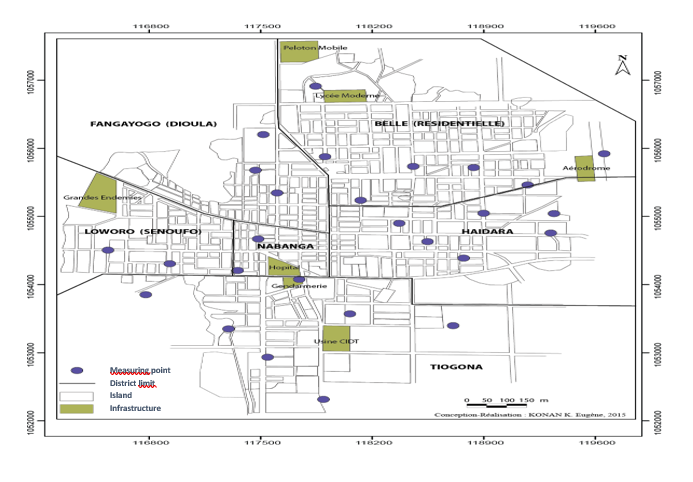
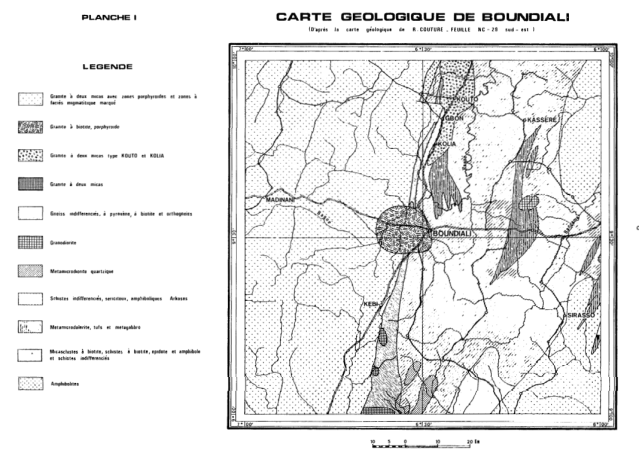
The different measurement sites were located using a GPS device (GARMIN), which made it possible to define their geographical coordinates grouped in Table 1. Figure 1 12 and Figure 2 13 show respectively maps of the city and the region of Boundiali with the different measurement sites and the geological formations consisting mainly of granites and granodiorites. But, the 26 sites were selected throughout the city by performing a regular grid sampling that provided reasonable spatial coverage.
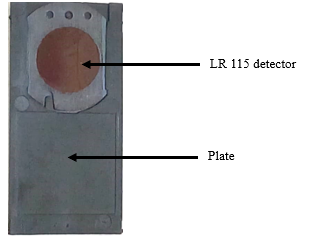
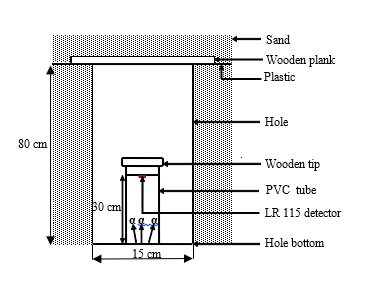
2.2. Measurement Activities and Devices DescriptionThe device used for radon measurement in the dwellings consisted of a plate on which the SSNTD LR 115 detector (commercially available, LR-115 type 2 non-strippable films manufactured by DOSIRAD, France) was attached (Figure 3). With the help of a double-sided adhesive, the plate was glued at best, on the side of a cabinet or failing that on the wall, at a height of between 1 and 2 m from the floor, slightly away from the doors and windows. The date and time of installation were recorded. Some architectural features of the house (ventilation, house floor level, and cracks in the walls) were also recorded. At the same time, the radon activity in the air of bare soil near the investigated houses was measured because the measurement of the radon emanation from the soil just below these houses could not be carried out due to a lack of adequate tools. The average distance between the soil sampling points and the corresponding dwellings was 10 m. Radon measurements in the soil were performed using a hollow PVC tube with a length of 30 cm and a diameter of 4 cm, provided with a wooden cap on which the SSNTD was fixed (Figure 4). The choice of 30 cm length for the tube allows the potential residual thoron effect as a limitation 14. The device was placed in a hole 80 cm deep and 15 cm in diameter, so that the open end of the tube was placed at the bottom of the hole. The latter was then closed with a plastic film on which a wooden plank was placed and the entire plank was covered with sand. We also recorded the date and time of installation. Plastics and wood have been used as thermal insulators. Their presence was necessary in order to overcome the problems of moisture and condensation that could occur deep in the soil. Indeed, if the detector temperature falls below the dew point (condensation temperature of water vapor), water droplets form on its sensitive face. Because, the range of radon alpha particles in water is extremely short, the formation of these droplets would distort the measurements if it occurs 15, 16.
Soil samples were taken from different horizons (layers of earth in the hole that can be distinguished, for example, by their color) in each hole to determine the porosity and particle size compositions of the soil.
All SSNTD were exposed at the different sites, in houses and soils, during each of the wet and dry seasons, for a period of time of two months at least (Table 1).


All SSNTD pieces exposed to radon were chemically etched for 120 min, under standard conditions, that are, in a NaOH solution of concentration 2.5 mol/L, set to temperature maintained at 60°C 17, 18. The alpha particle tracks revealed on their surfaces were then counted using an optical microscope.
Soil samples were analyzed to determine the total porosity and particle size compositions at the Waters-Soils-Plants Laboratory of the Agronomy Engineering School in Yamoussoukro’s (Côte d'Ivoire) Houphouët Boigny National Polytechnic Institut (INPHB).
2.4. Detector CalibrationThe CRNA radon chamber was used to determine the SSNTD-LR 115 radon calibration factor (k). Sheets of LR 115 were placed in the exposure chamber with a parallel AlphaGuard (AG) PQ2000 PRO radon detector (Saphymo®, Germany) which was used as a reference device. The AG device was used with a standard NIST-certified Rn-222 source of concentration (1.99 ± 0.93) kBq/m3 in a 101.1-liter cylindrical stainless steel calibration chamber. The standard NIST-certified source (SRM 4973) contained Ra-226 with an activity of 449 ± 6 Bq and a Rn-222 gas emanation fraction of 0.88 ± 0.01 at 21°C. An electronic pump was also used to transfer the accumulated Rn-222 gas without loss or dilution. The 222Rn concentrations (CRn) obtained in the calibration chamber were measured using the AG radon monitor. The average 222Rn concentration in the chamber was equal to 1.99 kBq/m3 for 64.33 hours.
2.5. Methods of CalculationRadon concentration was calculated by the formula:
 | (1) |
Where
CRn is radon concentration (kBqm- 3);
k the calibration factor (tracks cm- 2/kBqm- 3h);
t the exposure time (h);
ρ the track density (tracks cm- 2);
and ρ0 the background (tracks cm- 2).
The measured calibration factor values were (198 ± 89) tracks cm- 2/kBqm- 3h and (173 ± 78) tracks cm- 2/kBqm- 3h for the soil and indoor radon detectors respectively.
For each detector batch, the relative uncertainty in the radon concentration was calculated using the following formula derived from (1):
 | (2) |
where
ΔCRn is the uncertainty in the radon concentration;
Δρ the statistical uncertainty in the track density;
and Δk the uncertainty in the calibration factor.
For evaluating doses from radon exposure levels to a population, and considering the last report of UNSCEAR which states that regarding the uncertainties of risk estimation from both dosimetric and epidemiological studies, the UNSCEAR recommends keeping the value of the dose conversion factor of 9 nSv per (h Bq m−3) EEC of 222Rn, which corresponds to 1.6 mSv per mJhm-3 19.
The Excess Lung Cancer Risk (ELCR) is defined as the number of deaths per million people per year (MPY) due to lung cancer as a result of exposure to radon and its daughter products. It was determined from the epidemiological data of occupationally exposed mine workers. Although, limited data are available on lung cancer cases due to indoor radon exposure, the risks appear to be consistent with earlier estimates based on data from mine workers. Hence, to assess the lung cancer prevalence in the general population, the risk of indoor radon exposure is usually considered for mine workers. Numerous models for estimating the risk of lung cancer resulting from indoor radon exposure have been reported in the literature 20, 21. The ELCR related to radon was evaluated using graphs from UNSCEAR (United Nations Scientific Committee on the Effects of Atomic Radiations) and US-EPA (Environmental Protection Agency-USA) data as shown in Figure 5 22. There is a wide variation in the estimated values of excess lung cancer risk. The lower and higher limits of ELCR coefficients used for calculation were (0.6-1.9) MPY and (0.8-2.2) MPY per Bq/m3 for EPA and UNSCEAR models respectively.
Table 2 and Table 3 contain our main results. These are radon concentrations, factors affecting these concentrations, and risk assessment. The relatively high uncertainties of radon concentrations (40 - 48 %) are due to the radon source used during calibration process. The exposure time of the detectors was weighted equally and seasonal trends in the levels of concentrations were not observed. So, we calculated the arithmetic mean of the seasonal concentrations to obtain the annual concentration.
3.1. Soil radon ConcentrationThe highest values of radon concentrations in soils were measured at sites B24 and B25 (40 – 45 kBq/m3), and the lowest at sites B19 and B26 (7 kBq/m3). Only 15 % of locations had a concentration below 10 kBq/m3 which is the maximum limit value of radon concentration corresponding to a negligible risk. The 85 % have a concentration exceeding this limit set by the Swedish criteria, suggested by Akerblom, and used for soil radon risk classification 23. Indeed, the Sweden has a good radon mitigation policy. They succeeded, with appropriate protective measures, in significantly reducing the average concentration of radon in their houses after studies showed that this gas comes mainly from their soil 24. The average annual radon concentration in the soil of the city of Boundiali is 21 kBq/m3. Thus, radon risk in the soil of this city is moderate and therefore not negligible. This result could explain the granitic nature of this soil.
At sites B4 and B11, soil porosities are almost the same (38.74% and 36.42%), but clay and fine silt particle size compositions are higher at site B4 (128.60 g/kg and 112.20 g/kg) than at site B11 (58.60 g/kg and 67.08 g/kg). We also notice that soil radon concentration is higher at B4 (26 kBq/m3) than at B11 (14 kBq/m3). These results could demonstrate the influence of particle size distribution on soil radon emanation, indeed, the smaller the grains, the greater the radon emanation 25, 26.
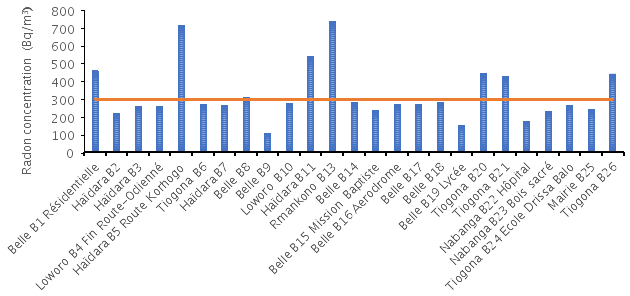
3.2. Indoor Radon and Influencing FactorsIn dwellings, according to the values listed in Table 2, annual concentrations vary from 109 Bq/m3 at site B9 to 741 Bq/m3 at site B13 with an average of 328 Bq/m3, which is higher than that of the granitic department of Cantal in France whose average value is 161 Bq/m3 27. The histogram of concentrations (Figure 6) shows that 32% (This could be slightly higher or lower if we had the data from site B12) of the obtained results exceeded the upper level of 300 Bq/m3 recommended by ICRP and WHO for immediate actions and 68% below this level 28.
At site B25, we have the greatest soil radon concentration (45 kBq/m3), but indoor radon concentration is one of the smallest there (243 Bq/m3). This could be due to the high floor level of the house and the low porosity of the soil (34%).
At site B5, the soil radon concentration is one of the smallest (16 kBq/m3)), but the indoor radon concentration is one of the greatest (714 Bq/m3). May be because ventilation inside the house is medium, there are cracks in the wall and the floor level of the house is low.
The correlation between the soil and indoor radon concentrations is fairly good for only 20% of the measurement sites and poor for the rest. This result might be due to the soil radon that was not measured in the soil directly beneath the houses.
Based on the results in Table 2 and Table 3 and those from literature review, the elevated indoor radon concentrations could be due to soil radon concentrations, cracks in the walls, poor indoor ventilation, low level of floor in contact with the the ground, and soil porosity 29.
The corresponding annual effective doses received by the public varied from 3 to 19 mSv with an average of 8 mSv. 28 % (This could be slightly different if we had the data of B12) of the values obtained exceeded the ICRP annual limit of 10 mSv 30.
Excess lung cancer risks (ELCR) have been estimated for a lifetime age of 70 years using the risk coefficients recommended by the UNSCEAR and EPA. The ELCR values per MPY were considerable. Among 1 million people, 65 to 1408 with an average of 197-623 and 87 to 1630 with an average of 262-722 could be victims of death due to lung cancer from radon exposure each year at Boundiali according to the EPA and UNSCEAR models respectively. It is evident from these results that the excess lung cancer risks calculated using the risk coefficients recommended by the EPA and UNSCEAR respectively differs from one another for identical indoor radon activity concentrations. As previously mentioned, this variation can be due to diverse assumed parameters.

In this study, the results of integrated measurements carried out in the city of Boundiali show a significant presence of radon. Some values of concentrations of this gas in houses and soils exceeded the standards recommended by the ICRP and WHO regarding the limits in the air and the soil. This could be due to the granitic nature of the soil on the one hand but also to its porosity and particle size composition and the architectural characteristics of houses such as the floor levels on the ground, cracks in the walls, and poor indoor ventilation. However, further investigations using an active detector are necessary and crucial at all sites where high radon concentrations were measured in order to determine radon prone-areas. In addition, the population and the public authorities should be informed about the existence of this gas so that they can take appropriate measures to protect people and reduce the risk that it poses. This study must be extended throughout the country to cover more areas with a particular focus on risk areas such as those with granitic soils. The ultimate goal is to establish a national radon mapping to prevent and mitigate this risk.
The authors would like to thank the International Atomic Energy Agency (IAEA) that supported the experimental phase of this study within the framework of a Technical Cooperation among Developing Countries (TCDC-AFRA/RAF 0038) project entitled “Radon gas monitoring in Côte d’Ivoire”.
Agba Dabo Salif Ignace did detectors exposure and analysis and he conceived and wrote up the article. All the co-authors did the article proofreading. Gogon Bogbe Douo Huberson and Anouan Koutoua Joseph did data collection. Koua Aka Antonin did the supervision of detectors exposure and data collection. Mounir Aïtziane collaborated to detectors analysis and Zohra Lounis Mokrani supervised detectors analysis.
The data used in this article are available from the corresponding author upon request.
Competing Interests: The authors declare that there are no competing interests.
Ethics approval: This article does not contain any studies involving human or animal subjects.
| [1] | WHO (2023). Radon. [Accessed Jun. 20, 2026]. | ||
| In article | |||
| [2] | US-EPA (2025). Where does radon come from? [Accessed Jun. 21, 2026]. | ||
| In article | |||
| [3] | Yan Liu, Cong Fu, Yuchen Li, Wei Xu, Ziheng Huang, Yanging Xu (2025). Uncovering Hidden dangers in urban housing: Sources of indoor radon and associated health risks. Journal of Environmental Management, Volume 387, 125899. | ||
| In article | View Article PubMed | ||
| [4] | IAEA (2014). Radiation Protection and Safety of Radiation Sources: International Basic Safety Standards. IAEA Safety Standards. [Accessed April 20, 2026]. | ||
| In article | |||
| [5] | N’guessan, K. J. F. (2014). Impact du radon sur la santé de la population du district d’Abidjan. Cas de la commune d’Abobo. Master 2 de Rayonnement-Matière-Modélisation, Université Félix Houphouët Boigny, Abidjan, Côte d’Ivoire. | ||
| In article | |||
| [6] | Nonka, G.R. (2015). Impact du radon sur la Santé de la population du District d’Abidjan: Cas de la commune de Yopougon, Master 2 de Rayonnement-Matière-Modélisation, Université Félix Houphouët Boigny, Abidjan, Côte d’Ivoire. | ||
| In article | |||
| [7] | Kropat G., Bochud, F., Jaboyedoff, M., Laedermann, J.-P., Murith, C., Palacios, M and Baechler, S., (2014). Major influencing factors of indoor radon concentrations in Switzerland. Journal of Environmental Radioactivity, 129, pp. 7–22. | ||
| In article | View Article PubMed | ||
| [8] | Sundal A. V., Henriksen, H., Soldal, O., Strand, T. (2004). The influence of geological factors on indoor radon concentrations in Norway. Sci. Total Environ. 328, 41-53. | ||
| In article | View Article PubMed | ||
| [9] | Ellen J. Hahn, Yevgeniya Gokun, William M. Andrews Jr., Bethany L. Overfield, Heather Robertson, Amanda Wiggins, Mary Kay Rayens (2015). Radon potential, geologic formations, and lung cancer risk. Elsevier, Preventive Medicine Reports 2, 342-346. | ||
| In article | View Article PubMed | ||
| [10] | J. M. Avenard (1972). Le milieu naturel de la Côte d’Ivoire. Etudes rurales, 48, pp. 185-186. [Accessed Jun. 21, 2026]. | ||
| In article | |||
| [11] | Wikipedia (2026). Boundiali (ville). [Accessed Jun. 21, 2026]. | ||
| In article | |||
| [12] | Konan K. Eugène, (2015). Carte de la ville de Boundiali. Institut de Géographie Tropicale (IGT), Université Félix Houphouët Boigny, Abidjan, Côte d’Ivoire. | ||
| In article | |||
| [13] | G. Beaudou, R. Sayol (1980). Etude pédologique de la région de Boundiali-Korhogo, Côte d’Ivoire. office de la recherche scientifique et technique outre-mer, Paris. | ||
| In article | |||
| [14] | Seidel J. L. (1982). Radon-émanométrie appliquée à la géophysique interne. Thèse de Doctorat de 3ème cycle, en Physique Nucléaire, Université Clermont-Ferrand II, France. | ||
| In article | |||
| [15] | Semkow T.M. (1990). Recoil -emanation theory applied to radon release from mineral grains. Geochim. Cosmochim. Acta, 54: 425-440. | ||
| In article | View Article | ||
| [16] | Wilkening M. H. (1990). Radon in the environment. Studies in Environmental Science 40, p 136-137. | ||
| In article | |||
| [17] | C.W. Y. Yip, D. Nikezic, J. P. Y. Ho, K. N. Yu (2006). Chemical etching characteristics for cellulose nitrate. Materials Chemistry and Physics, 95, 307-312. | ||
| In article | View Article | ||
| [18] | D. Palacios, L. SajÓ-Bohus, H. Barros, E. D. Greaves, F. Palacios (2010). Alternative method to determine the bulk etch rate of LR 115 detectors. Revista Mexicana de física, 56 (1), 22-25. | ||
| In article | |||
| [19] | Jing Chen (2019). A summary of UNSCEAR 2019 report on lung cancer from exposure to radon and research needs. Radiation Medicine and Protection, 5, 215-218. | ||
| In article | View Article | ||
| [20] | Olivier Catelinois, Agnès Rogel, Dominique Laurier, Solenne Billon, Denis Hemon, Pierre Verger, and Margot Tirmarche, (2006). Lung Cancer Attributable to Indoor Radon Exposure in France: Impact of the Risk Models and Uncertainty Analysis. Environmental Health Perspectives, 114: 9. | ||
| In article | View Article PubMed | ||
| [21] | Laleh R. Kalankesh, Mohammad Mosaferi, Nasim Khajavian, Behjat Sarvari, Ahmad Zarei (2024). Simulation excess lifetime lung cancer risk due to indoor radon exposure in Eastern Iran- Monte Carlo Simulation method. Journal of Radiation Research and Applied Science. Volume 17, Issue 4, 101193. | ||
| In article | View Article | ||
| [22] | Matiullah 1, A Ahad, S Rehman, M. L. Mirza (2003). Indoor radon levels and lung cancer risk estimates in seven cities of the Bahawalpur Division, Pakistan. Radiation Protection Dosimetry, 107(4): 269-276. | ||
| In article | View Article PubMed | ||
| [23] | Åkerblom G., Andersson P., B. Clevensjö (1984). Soil Gas Radon - A Source for Indoor Radon Daughters. Radiation Protection Dosimetry, Volume 7, Issue 1-4, Pages 49-54. | ||
| In article | View Article | ||
| [24] | Gun Astri Swedjemark, , , (1989). Experience from indoor radon-daughter limitation schemes in Sweden. Environmental International, Volume 15, Issues 1-6, Pages 253-260. | ||
| In article | View Article | ||
| [25] | Huynh Nguyen Phong Thu, Nguyen Van Thang Le Cong Hao (2020). The effects of some soil characteristics on radon emanation and diffusion. Journal of Environmental Radioactivity, Volume 216, 106189. | ||
| In article | View Article PubMed | ||
| [26] | Entesar H. El-Araby, A. Azazi (2023). The effect of geometrical parameters on the radon emanation coefficient and different radon parameters. Nuclear Engineering and Technology, Volume 55, Issue 11, Pages 4096-4101. | ||
| In article | View Article | ||
| [27] | Gambard J. P., Mitton N., Pirard Ph. (2000). Campagne nationale de mesure de l’exposition domestique au radon IPSN-DGS. Bilan et représentation cartographique des mesures. Note technique SEGR-LEADS-2000-14 IPSN, Fontenay aux-Roses, France. | ||
| In article | |||
| [28] | WHO (2009). WHO Handbook on indoor Radon. [Accessed Jan. 10, 2026]. | ||
| In article | |||
| [29] | Gunby JA, Darby SC, Miles JCH, Green BMR, Cox DR. (1993). Factors affecting indoor radon concentrations in the United Kingdom. Health phys, 64 (1): 2-12. | ||
| In article | View Article PubMed | ||
| [30] | ICRP (2014). Radiological Protection against Radon Exposure. ICRP Publication 126. | ||
| In article | |||
Published with license by Science and Education Publishing, Copyright © 2026 Agba Dabo Salif Ignace, Gogon Bogbe Douo Huberson, Anouan Koutoua Joseph, Koua Aka Antonin, Mounir Aïtziane and Zohra Lounis Mokrani
 This work is licensed under a Creative Commons Attribution 4.0 International License. To view a copy of this license, visit
http://creativecommons.org/licenses/by/4.0/
This work is licensed under a Creative Commons Attribution 4.0 International License. To view a copy of this license, visit
http://creativecommons.org/licenses/by/4.0/
| [1] | WHO (2023). Radon. [Accessed Jun. 20, 2026]. | ||
| In article | |||
| [2] | US-EPA (2025). Where does radon come from? [Accessed Jun. 21, 2026]. | ||
| In article | |||
| [3] | Yan Liu, Cong Fu, Yuchen Li, Wei Xu, Ziheng Huang, Yanging Xu (2025). Uncovering Hidden dangers in urban housing: Sources of indoor radon and associated health risks. Journal of Environmental Management, Volume 387, 125899. | ||
| In article | View Article PubMed | ||
| [4] | IAEA (2014). Radiation Protection and Safety of Radiation Sources: International Basic Safety Standards. IAEA Safety Standards. [Accessed April 20, 2026]. | ||
| In article | |||
| [5] | N’guessan, K. J. F. (2014). Impact du radon sur la santé de la population du district d’Abidjan. Cas de la commune d’Abobo. Master 2 de Rayonnement-Matière-Modélisation, Université Félix Houphouët Boigny, Abidjan, Côte d’Ivoire. | ||
| In article | |||
| [6] | Nonka, G.R. (2015). Impact du radon sur la Santé de la population du District d’Abidjan: Cas de la commune de Yopougon, Master 2 de Rayonnement-Matière-Modélisation, Université Félix Houphouët Boigny, Abidjan, Côte d’Ivoire. | ||
| In article | |||
| [7] | Kropat G., Bochud, F., Jaboyedoff, M., Laedermann, J.-P., Murith, C., Palacios, M and Baechler, S., (2014). Major influencing factors of indoor radon concentrations in Switzerland. Journal of Environmental Radioactivity, 129, pp. 7–22. | ||
| In article | View Article PubMed | ||
| [8] | Sundal A. V., Henriksen, H., Soldal, O., Strand, T. (2004). The influence of geological factors on indoor radon concentrations in Norway. Sci. Total Environ. 328, 41-53. | ||
| In article | View Article PubMed | ||
| [9] | Ellen J. Hahn, Yevgeniya Gokun, William M. Andrews Jr., Bethany L. Overfield, Heather Robertson, Amanda Wiggins, Mary Kay Rayens (2015). Radon potential, geologic formations, and lung cancer risk. Elsevier, Preventive Medicine Reports 2, 342-346. | ||
| In article | View Article PubMed | ||
| [10] | J. M. Avenard (1972). Le milieu naturel de la Côte d’Ivoire. Etudes rurales, 48, pp. 185-186. [Accessed Jun. 21, 2026]. | ||
| In article | |||
| [11] | Wikipedia (2026). Boundiali (ville). [Accessed Jun. 21, 2026]. | ||
| In article | |||
| [12] | Konan K. Eugène, (2015). Carte de la ville de Boundiali. Institut de Géographie Tropicale (IGT), Université Félix Houphouët Boigny, Abidjan, Côte d’Ivoire. | ||
| In article | |||
| [13] | G. Beaudou, R. Sayol (1980). Etude pédologique de la région de Boundiali-Korhogo, Côte d’Ivoire. office de la recherche scientifique et technique outre-mer, Paris. | ||
| In article | |||
| [14] | Seidel J. L. (1982). Radon-émanométrie appliquée à la géophysique interne. Thèse de Doctorat de 3ème cycle, en Physique Nucléaire, Université Clermont-Ferrand II, France. | ||
| In article | |||
| [15] | Semkow T.M. (1990). Recoil -emanation theory applied to radon release from mineral grains. Geochim. Cosmochim. Acta, 54: 425-440. | ||
| In article | View Article | ||
| [16] | Wilkening M. H. (1990). Radon in the environment. Studies in Environmental Science 40, p 136-137. | ||
| In article | |||
| [17] | C.W. Y. Yip, D. Nikezic, J. P. Y. Ho, K. N. Yu (2006). Chemical etching characteristics for cellulose nitrate. Materials Chemistry and Physics, 95, 307-312. | ||
| In article | View Article | ||
| [18] | D. Palacios, L. SajÓ-Bohus, H. Barros, E. D. Greaves, F. Palacios (2010). Alternative method to determine the bulk etch rate of LR 115 detectors. Revista Mexicana de física, 56 (1), 22-25. | ||
| In article | |||
| [19] | Jing Chen (2019). A summary of UNSCEAR 2019 report on lung cancer from exposure to radon and research needs. Radiation Medicine and Protection, 5, 215-218. | ||
| In article | View Article | ||
| [20] | Olivier Catelinois, Agnès Rogel, Dominique Laurier, Solenne Billon, Denis Hemon, Pierre Verger, and Margot Tirmarche, (2006). Lung Cancer Attributable to Indoor Radon Exposure in France: Impact of the Risk Models and Uncertainty Analysis. Environmental Health Perspectives, 114: 9. | ||
| In article | View Article PubMed | ||
| [21] | Laleh R. Kalankesh, Mohammad Mosaferi, Nasim Khajavian, Behjat Sarvari, Ahmad Zarei (2024). Simulation excess lifetime lung cancer risk due to indoor radon exposure in Eastern Iran- Monte Carlo Simulation method. Journal of Radiation Research and Applied Science. Volume 17, Issue 4, 101193. | ||
| In article | View Article | ||
| [22] | Matiullah 1, A Ahad, S Rehman, M. L. Mirza (2003). Indoor radon levels and lung cancer risk estimates in seven cities of the Bahawalpur Division, Pakistan. Radiation Protection Dosimetry, 107(4): 269-276. | ||
| In article | View Article PubMed | ||
| [23] | Åkerblom G., Andersson P., B. Clevensjö (1984). Soil Gas Radon - A Source for Indoor Radon Daughters. Radiation Protection Dosimetry, Volume 7, Issue 1-4, Pages 49-54. | ||
| In article | View Article | ||
| [24] | Gun Astri Swedjemark, , , (1989). Experience from indoor radon-daughter limitation schemes in Sweden. Environmental International, Volume 15, Issues 1-6, Pages 253-260. | ||
| In article | View Article | ||
| [25] | Huynh Nguyen Phong Thu, Nguyen Van Thang Le Cong Hao (2020). The effects of some soil characteristics on radon emanation and diffusion. Journal of Environmental Radioactivity, Volume 216, 106189. | ||
| In article | View Article PubMed | ||
| [26] | Entesar H. El-Araby, A. Azazi (2023). The effect of geometrical parameters on the radon emanation coefficient and different radon parameters. Nuclear Engineering and Technology, Volume 55, Issue 11, Pages 4096-4101. | ||
| In article | View Article | ||
| [27] | Gambard J. P., Mitton N., Pirard Ph. (2000). Campagne nationale de mesure de l’exposition domestique au radon IPSN-DGS. Bilan et représentation cartographique des mesures. Note technique SEGR-LEADS-2000-14 IPSN, Fontenay aux-Roses, France. | ||
| In article | |||
| [28] | WHO (2009). WHO Handbook on indoor Radon. [Accessed Jan. 10, 2026]. | ||
| In article | |||
| [29] | Gunby JA, Darby SC, Miles JCH, Green BMR, Cox DR. (1993). Factors affecting indoor radon concentrations in the United Kingdom. Health phys, 64 (1): 2-12. | ||
| In article | View Article PubMed | ||
| [30] | ICRP (2014). Radiological Protection against Radon Exposure. ICRP Publication 126. | ||
| In article | |||