This study aims to identify flood-susceptible areas in the municipality of Man, located in western Côte d'Ivoire, in a context of rapid and disorderly urbanization, for sustainable land management. The method used combines multi-criteria analysis and Geographic Information System (GIS). Five parameters were considered: slope, land use, drainage density, population density, and environmental and anthropogenic factors. Weights were assigned to these parameters using Saaty's Analytic Hierarchy Process (AHP). The flood susceptibility map obtained by combining these parameters using GIS reveals five susceptibility classes (very low, low, moderate, high, and very high). The results indicate that the municipality of Man has low susceptibility to flooding. However, the city of Man is moderately susceptible to flooding, with certain neighborhoods such as Air France, Mistrot, Belleville, and Libreville exhibiting high susceptibility. These results will now guide the decision-making of the authorities responsible for managing the municipality in terms of flood prevention and crisis management. Finally, the findings provide actionable insights for urban planners to mitigate flood risks.
Floods are the most widespread hydrological hazard globally, causing significant casualties and damage 1. Today, few countries are spared from flooding. Floods account for more than 50% of natural disasters, and an average of 20,000 deaths are recorded each year worldwide 2. West African countries are experiencing strong population growth. This increase in population is reflected in the expansion of arable land on the one hand and the expansion of urbanized areas on the other 3. The West African subregion has therefore become one of the regions of the world most vulnerable to climate extremes 4. Indeed, the tropical climate zone has seen an increase in the occurrence of extreme events (floods and droughts) over the past few decades. According to 5, recent flooding has affected five million people across 19 countries in West and Central Africa, claiming hundreds of lives. In Côte d'Ivoire, 32 died in the floods in 2018; 457 families were left homeless 5. In 2019, these floods caused seven deaths in Abidjan in the municipalities of Cocody and Abobo, with extensive material damage and the closure of many roads 5. The western region is not immune either. It has also experienced tragic events, particularly in the municipality of Danané, where torrential rains caused the deaths of 20 people and the destruction of several homes in September 2016 6. This was also the case in the municipality of Man, where torrential rains in August 2014 caused flooding after the Kô River overflowed its banks in the Domoraud-extension neighborhood 7.
In addition to natural effects, the city of Man has undergone rapid urbanization, leading to major changes, particularly in terms of spatial planning. Unregulated construction in storm basins and on the sewerage network increases the risk of flooding by preventing rainwater drainage 8. This susceptibility is linked to the general poverty of the populations living in the valleys, the precariousness of their dwellings, and their minimized perception of risks. This observation motivated our study, which aims to map flood-susceptible areas in the municipality of Man in order to facilitate decision-making for the safety of property and populations.
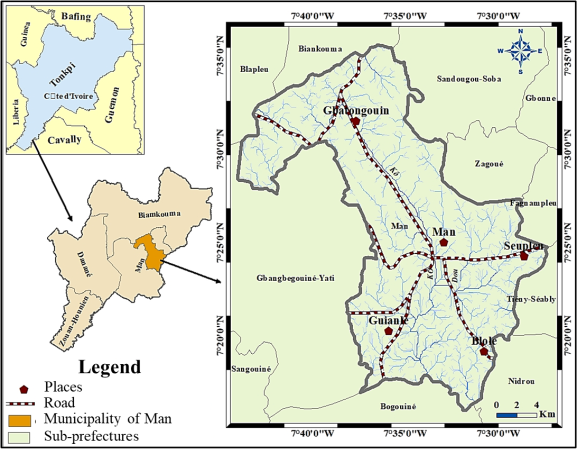
Covering an area of 4,140.7 km², the municipality of Man is located in the Tonkpi region in western Côte d'Ivoire between 07°20' and 07°35' north latitude and 07°25' and 07°45' west longitude. It is bordered to the north by the sub-prefectures of Blapeu and Sandougou-Soba, to the south by the sub-prefectures of Bogouiné and Nidrou, to the east by those of Tiény-Séably, Fagnampleu, and Zagoué, and to the far west by the sub-prefecture of Gbangbégouiné-Yati (Figure 1).


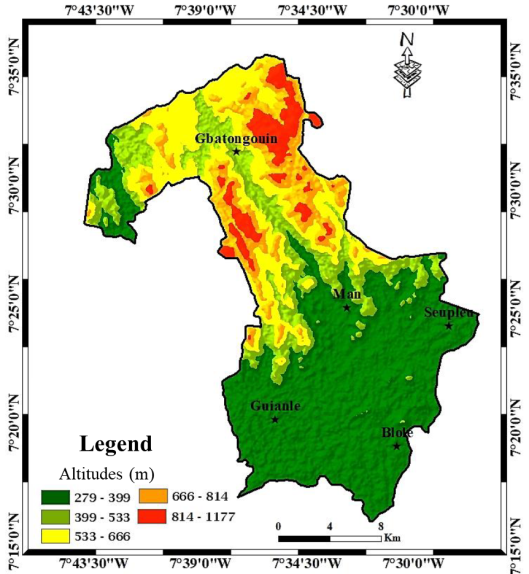
Demographically, the population is estimated at 241,970 inhabitants according to the General Population and Housing Census 9. The municipality of Man is characterized by two morphological features, the most rugged of which is located in the northern part, with mountains reaching altitudes of up to 1,117 m. The southern area consists mainly of plains (Figure 2).
The soils are sandy-clay and loamy and benefit from a climate with high rainfall of over 1,700 mm/year 7. The average temperature is 24°C and humidity varies between 80 and 85% 10. The hydrographic network is denser in the south in the plateau area than in the mountainous area. It is dominated by the Kô and its tributaries, which are temporary watercourses.
The study required a set of data consisting of:
- Landsat OLI 8 satellite images with a resolution of 30m, dating from 2020, downloaded from: https://earthexplorer.usgs.gov . This was used to create the land use/land cover map;
- a Digital Terrain Model (DTM) with a resolution of 30 m covering the study area. This enabled the creation of a map of the slopes, the hydrographic network, and the drainage density of the study area;
- Demographic data for the municipality of Man provided by 9. This data was used to create the population density map.
This data was processed using ENVI 4.3 and ArcGIS 10.5 software at the University Center for Research and Application in Remote Sensing (CURAT) in order to create the various thematic maps.
3.2. MethodsThe methodological approach is based on socio-environmental investigations dominated by field observations, multi-criteria analysis, and GIS mapping.
It was carried out in March 2024, before the heavy rains. It consisted of identifying the different neighborhoods in the municipality of Man and observing the area’s most likely to be flooded based on geomorphology, precarious areas, the condition of storm water drainage channels, and the identification of illegal garbage dumps.
The flood susceptibility mapping methodology follows the Analytical Hierarchy Process (AHP) 11. AHP is a mathematical model that simplifies and improves the decision-making process. It involves the following steps 12:
- Identification and prioritization of criteria;
- Classification and standardization of criteria;
- Weighting of criteria;
- Aggregation of criteria through a GIS.
This methodology has been recognized by researchers, practitioners, and decision-makers for its application in assessing various geological risk issues, including flood susceptibility 13, 14, 15, 16, landslides susceptibility 17, 18, groundwater vulnerability 19, and urban seismic vulnerability 20. According to 21, the use of a multi-criteria approach enables the spatial prediction of surface movements such as floods, and the application of multiple analyses results in reliable thematic maps.
¡ Identification of natural and anthropogenic criteria
Based on the available data and the high degree of urbanization in the study area, the following criteria were used to map flood susceptibility in the study area: land use/land cover, topographic slope, drainage density, population density, and anthropogenic environmental factors.
- Land use/land cover (LU/LC)
Land use/land cover is mainly linked to human occupation but also to the presence of certain natural phenomena such as rivers and vegetation. It is mainly explained by urban expansion, which influences the infiltration capacity of soils in watersheds and the occupation of flood-prone areas 14. The root system improves soil permeability, while the foliage protects the soil from the impact of rain and reduces soil crusting 22. In addition, the vegetation cover also helps to retain water beneath the area it covers, thereby reducing the rate of direct evaporation. Uncovered or impervious land tends to increase runoff and erosion 23. The land cover map was produced using ENVI. The methodological approach is explained in the works of 24, 25.
- Slope (S)
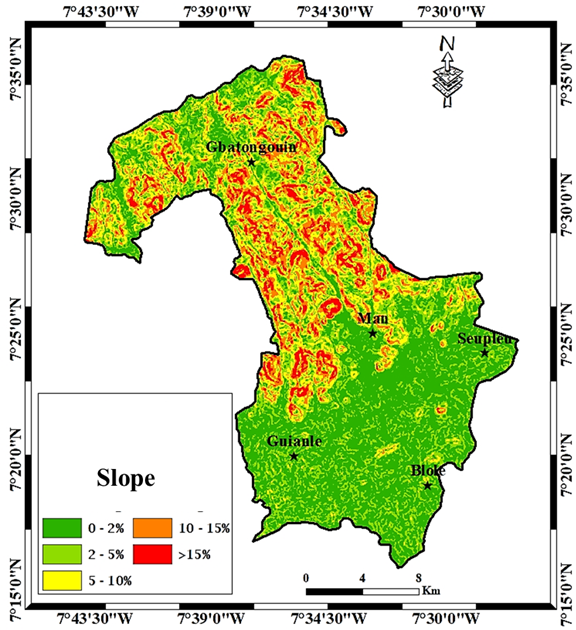
Slope is a geomorphological feature that influences surface water flow in a given area. It reflects areas that are potentially favorable to runoff or infiltration, with the hydrographic network taken as representative of the actual distribution of runoff 26, 27. The steepness of a slope affects the speed at which water flows and the length of time it remains stagnant in an area. After rainfall, water flows slowly on flat surfaces and concentrates very quickly. It is therefore more likely to cause flooding than on steep slopes. Thus, the gentler the slope, the greater the likelihood of flooding.
- Drainage density (DD)
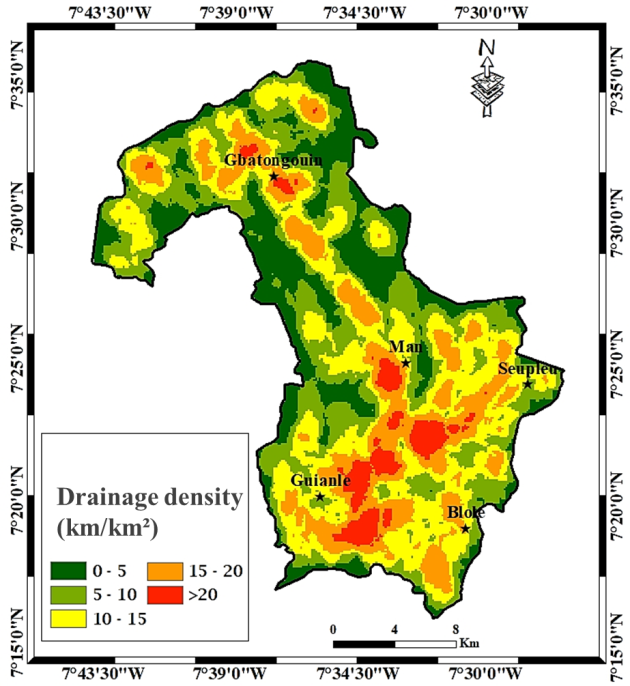
Drainage density is a fundamental concept in the analysis of hydrological processes 28. It corresponds to the length of a watercourse in a grid of one (1) square kilometer. The higher this number, the greater the risk of flooding. Drainage density depends on the geology (structure and lithology) and topographical characteristics of the area under study. It is linked to the density of the hydrographic network. Indeed, the denser the hydrographic network, the more intense the runoff phenomenon and therefore the lower the infiltration 14, 26.
- Population density (PD)
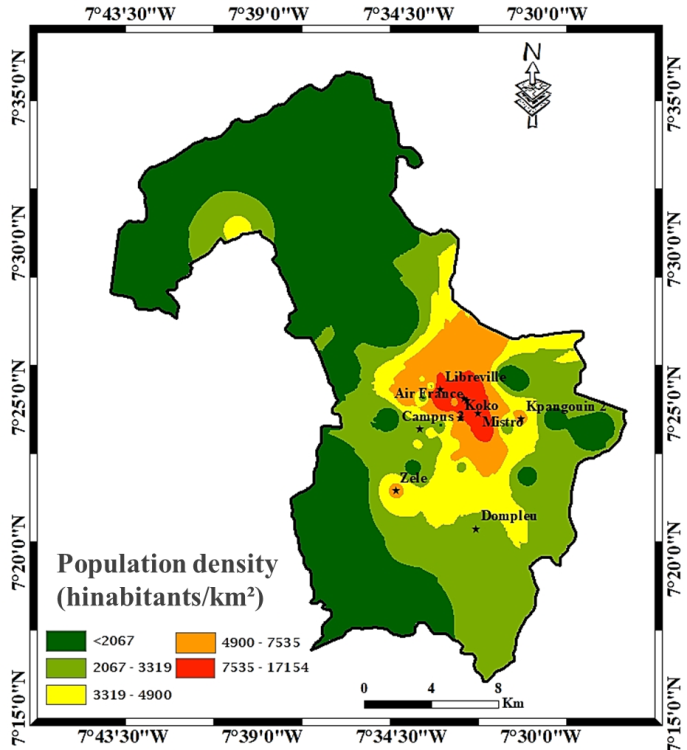
Demographics are a factor that contributes to flooding. Indeed, the fact that an area is densely populated indicates a reduction in vegetation, which gives way to infrastructure of all kinds. Population density data were derived from census records 9 for each neighborhood and village in the municipality of Man. Population density was interpolated using GIS to highlight the number of inhabitants per square kilometer. The higher the density, the greater the susceptibility is considered to be.
- Anthropogenic environmental factors (AEF)
The increase in the population of the municipality of Man (from 148,171 inhabitants in 2014 to 241,970 inhabitants in 2021) inevitably leads to increased urbanization, which in turn exacerbates the anthropogenic environmental factors contributing to flooding. These include:
√ Degradation or obstruction of the drainage network;
√ Illegal dumping of waste;
√ Unregulated construction, particularly in marginal areas (lowlands, basins, and swamps).
The tendency of people to settle in low-lying areas and on storm drains contributes to flooding. Another behavior that contributes to flooding is the use of storm drains for domestic wastewater drainage.
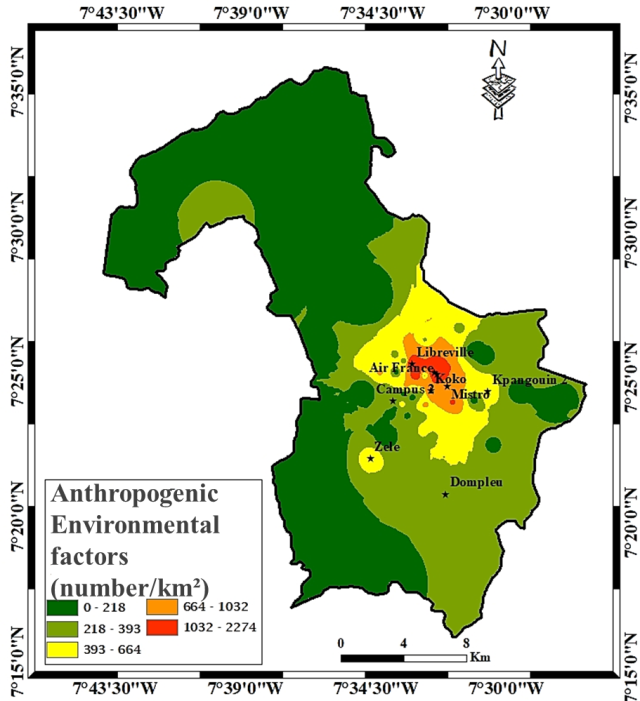
The map of anthropogenic environmental factors was obtained following a geographical survey conducted to collect data that could cause flooding. It was carried out from March 23 to 25, 2024, and from April 19 to 22, 2024. It consisted of recording the coordinates of certain selected anthropogenic environmental factors (illegal dumping, drainage network, road infrastructure), describing them, and conducting interviews with technical service agents from the Man town hall.
¡ Classification and standardization of identified criteria
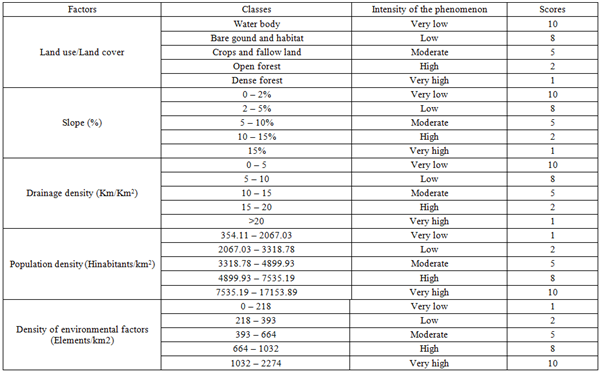
Since the criteria are measured on different scales, with different units, standardization was necessary to enable proper multi-criteria analysis. As part of the study of potential aquifer recharge, a rating scale was developed by 22 to estimate the ratings of the various criteria in a consistent manner, based on the ranges of variation of the proposed criteria (Table 1).
In this study, the scale proposed by 22 for studying potential aquifer recharge was used to classify flood susceptibility factors (Table 2). The classes of the various factors are coded according to their importance in promoting flooding or not. For example, in the case of drainage density, high scores indicate poorly drained areas that are prone to flooding, while low scores indicate well-drained areas that are less prone to flooding.
¡ Weighting of factors using multi-criteria analysis
The Saaty method 29, used by several authors including 16, 30, 31, 32, 33. This method allows weights to be assigned to each susceptibility factor, based on a pairwise comparison of these factors. The weights considered in this study are those obtained by 16 in the municipality of Bingerville (Table 3).
¡ Aggregation of factors
This consisted of summing the standardized and weighted values of each factor. This approach is summarized in equation (1).
 | (1) |
S: Sum
Wi: Weight of factor
Xi: Standardized value of factor i
Finally, the susceptilbility map was obtained from equation (2).
 | (2) |
- Land use/Land cover map
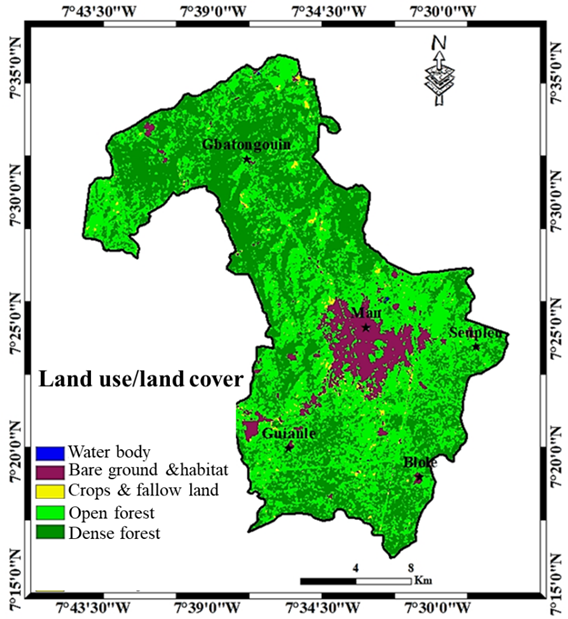
Figure 3 shows five land use/land cover classes: water body, bare ground and habitat, crops and fallow land, open forest, and dense forest. The overall accuracy of the classification is 93.78%. The Kappa coefficient, another criterion for classification accuracy, is 0.92, which is sufficiently close to 1.
In 2020, land use/land cover was dominated by “dense forest” class, covering 48.53% of the study area. This is followed by the “open forest” class, which covers 42.66% of the total area of the study zone. The “bare ground and habitat” and “crops and fallow land” classes represent 7.48% and 1.3% of the study area, respectively. The “water body” class accounts for only 0.02%. This class is virtually non-existent because the municipality has no large rivers or lakes. There are a few rivers, some of which are intermittent, that drain the municipality of Man.
- Slope map
Slopes greatly influence the speed of water flow and, above all, the response time of rivers. In the municipality of Man, they vary between 0 and 48%. Thus, the very steep slope class (≥ 15%) is considered the least susceptible, while the very gentle slope class [0–2%[ is the most susceptible. Steeper slopes accelerate runoff, while gentler slopes promote water concentration. Analysis of Figure 4 shows that the area’s most susceptible to flooding are located in the southern part of the municipality, while the central and northern areas are less exposed to flooding. The city of Man is located in valleys around peaks with slopes of up to 20% to the north, east, and west of the study area. The distribution of slopes greater than 20% further highlights the confinement of the city of Man and the site's building restrictions.

In general, land that cannot be built on is determined based on slopes exceeding 15%. As a result, the only possibilities for urban expansion are in the southern part of the city.
- Drainage density map
Analysis of Figure 4 shows that the lowest densities (< 10 km/km²) are mainly found in the north of the study area, with a few pockets scattered throughout. Densities between 10 and 20 km/km² are located in the southern part, with a corridor running along the Kô River in a north-south direction. It should also be noted that the highest densities (> 20 km/km²) are mainly found in the southern part of the municipality, with a few pockets in the north (Figure 5). Thus, in terms of surface runoff, the southern part of the municipality of Man is highly susceptible to flooding.


- Population Density Map
The population density in the municipality of Man is relatively low (Figure 6). Across the study area, population density is unevenly distributed. High population densities (4,900 to 17,153 inhabitants, or 71% of the population) are found in the center of the area, while the lowest densities (354 to 4,899 inhabitants, or 20% of the population) are observed across almost the entire area. The greater the population density in an area, the greater the flood susceptibility. Rapid population growth is causing increasing urban sprawl, which is leading to the destruction of forests, the encroachment into floodplains, and an increase in flooding. Immigration to cities is caused by rural exodus, unemployment, and poverty.
- Map of anthropogenic environmental factors
Figure 7 shows the map of anthropogenic environmental factors in the municipality of Man. Areas with low anthropogenic impact (43 and 493 dwellings, or 18% of buildings) cover almost the entire area. These correspond to rural areas represented by villages such as Kassiapleu, Kiélé, and Dompleu. The center of the municipality has medium to high anthropogenic activity, as this area represents the heart of the municipality where human activity is significant. The values range from 664 to 2,274 habitats, representing 82% of the buildings in the area. Ideally, properly constructed crossing structures supported by regular maintenance should allow for easy drainage of stormwater. But the opposite is true in the city of Man, where unregulated construction tends to contain runoff and feed floodplains, indirectly causing traffic jams. Illegal garbage dumps litter the neighborhoods of the city of Man, some of which are carried by stormwater into the already undersized sewer systems, creating blockages during floods.
In summary, taking into account the distribution of inhabited areas (the town center, a few villages, and neighborhoods), the municipality of Man can be considered to have a predominantly medium flood susceptibility.

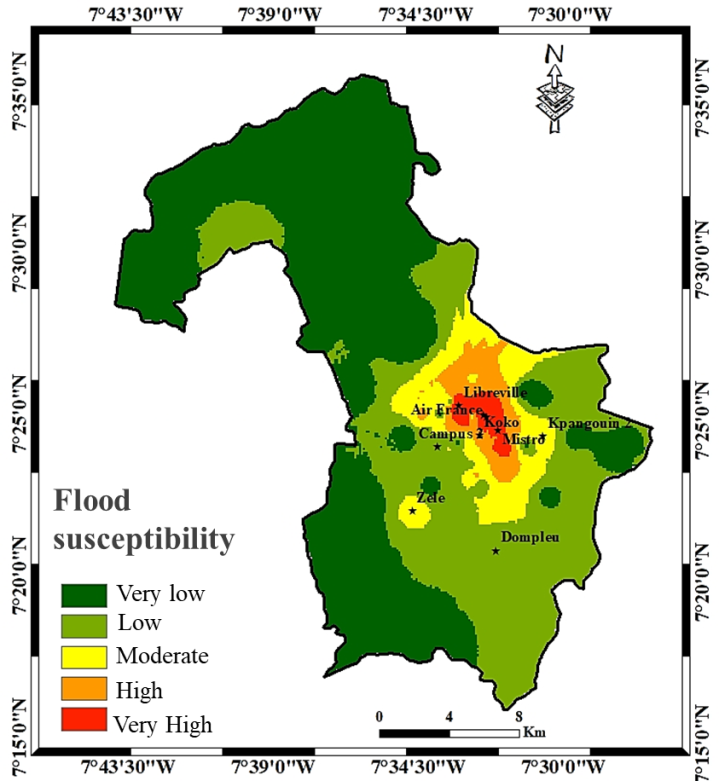
The combination of the five reclassified maps made it possible to obtain the flood susceptibility map of the municipality of Man (Figure 8). This map shows five flood susceptibility classes ranging from very low to very high. Analysis by class shows that very low and low flood susceptibility classes are found across virtually the entire area. The moderate flood susceptibility class dominates the center of the municipality. These are areas of bare ground, or with a predominance of buildings and with medium to strong drainage on medium slopes. These are mainly urban areas (city center). The high and very high flood susceptibility classes are mainly located in the center of the municipality, specifically in the downtown area of Man (Air France, Mistrot, Belleville, Libreville, Koko). These classes correspond to areas with low to moderate slopes, low drainage density, high anthropogenic and population density, predominantly composed of buildings and bare ground.
In summary, given the distribution of inhabited areas (the town center, a few villages, and neighborhoods), the municipality of Man can be considered to have a predominantly medium flood susceptibility.

The use of Saaty's multi-criteria analysis method made it possible to identify susceptible and potentially flood-prone areas in the municipality of Man. Given that the weighting of decision-making factors in Saaty's multi-criteria approach is based on expert judgment, the results can sometimes be subjective 34. Furthermore, 35 showed that in a hierarchical model, criteria and alternatives should be independent of each other, whereas this is rarely the case in reality. However, a good understanding of the phenomenon being studied and the consideration of several expert judgment can eliminate potential subjectivity in the assignment of weights to decision-making criteria. To minimize bias and obtain a more representative aggregation of the various expert judgment, we used the geometric mean. This takes into account multiplicity and reduces the influence of extreme values. Moreover, standardizing the classes within each factor makes the decision criteria perfectly comparable. Thus, multi-criteria analysis made it possible to effectively synthesize the various factors used in this study, namely slopes, drainage density, land use, population density, and anthropogenic environmental parameters. This synthesis led to the implementation of an effective flood management tool in the municipality of Man. The results of this study showed that the municipality of Man is, on the whole, not very susceptible to flooding, but does have areas of high flood susceptibility, particularly in certain neighborhoods in the center of the urban area (Air France, Mistrot, Belleville, Libreville, Kôkô). One of the causes of flooding in Man is the failure of the drainage system. The stormwater and wastewater drainage network are non-existent in some parts of the city. Where it does exist in a few affluent neighborhoods, it is very poorly maintained. In addition to maintenance failures, there is also the problem of undersized infrastructure. Like bridges, gutters, culverts, etc., these structures were often built without taking hydrological parameters (extreme water levels and flow rates) into account. The predominantly rural character of Man municipality explains its low susceptibility to flooding.
At the city level, Man has an average susceptibility rating. This is followed by high and very high flood susceptibility ratings in the city center. Very low and low flood susceptibility ratings are virtually non-existent in Man. The few pockets of these ratings are found in the outlying neighborhoods.
Our findings align with 16’s study in Bingerville, in southern Côte d'Ivoire. These authors highlighted a moderate susceptibility due to the relief, which has slopes in certain places, and the rational use of land, facilitating stormwater drainage. Similarly, 36, 37, 38, 39 have shown that flood risk is linked to a combination of many factors, including uncontrolled urbanization, human activity, rainfall intensity, low slopes, and land use.
Socio-environmental surveys have shown that the neighborhoods potentially susceptible to flooding in the municipality of Man are Air France, Campus 2, Kôkô, Belleville, Libreville, and Mistrot. These neighborhoods are often affected during periods of heavy rainfall due to their geographical location and lack of adequate sanitation systems. The risk of flooding in these areas is all the more real given that certain authors, including 18 and 40 have shown an upward trend in rainfall in the semi-mountainous region of Man.
The results of this study can serve as an early warning system for local authorities. They can also guide their decisions regarding integrated and sustainable flood crisis management and prevention.
The application of the multi-criteria analysis method made it possible to combine land use, slope, drainage density, population density, and anthropogenic environmental factor density maps to obtain a flood susceptibility map for the municipality of Man. This map shows five levels of susceptibility: very low, low, moderate, high, and very high. The results indicate that the center of Man municipality is the most flood-susceptible area. This area is by far the most densely populated in the municipality and is characterized by gentle slopes, unplanned construction, illegal dumping, and poor road and drainage infrastructure, which hinders proper drainage in some areas. The most affected neighborhoods are Air France, Mistrot, Belleville, Libreville, and Kôkô.
This flood susceptibility map is a valuable tool that can provide municipal managers with warning information about areas likely to be affected by flooding. This map can help planning authorities take preventive measures to avoid flood-related disasters or mitigate their effects. These neighborhoods require priority action from public authorities in terms of infrastructure modernization.
We would like to express our sincere thanks to the technical department of Man Town Hall for its support in collecting data.
| [1] | Barroca, B. Risque et vulnérabilités territoriales, les inondations en milieu urbain, Thèse, Université de Marne-La-Vallée, Paris, 2006. | ||
| In article | |||
| [2] | Ba, P.D. Approches hydrologiques des zones inondables en milieu urbain : exemple de la ville de Thiès (Dakar), Dakar, Sénégal, 2005. | ||
| In article | |||
| [3] | Leroux, L. Analyse diachronique de la dynamique paysagère sur le bassin supérieur de l’Ouémé (Bénin) à partir de l’imagerie Landsat et MODIS-Cas d’étude du communal de Djougou, Mémoire de Master, Université de Montpellier, Montpellier, 2012. | ||
| In article | |||
| [4] | Koumassi, H. Risques hydroclimatiques et vulnérabilités des écosystèmes dans le bassin versant de la Sota à l’exutoire de Couberi». | ||
| In article | |||
| [5] | Carine, N.M.A. 6eme édition du salon international de la géomatique ’ “géo information et sécurité urbaine” ’», 2023. | ||
| In article | |||
| [6] | Agence France-Presse, Ouest de la Côte d’Ivoire : 20 morts en un mois après de fortes pluies, 13 mars 2024. | ||
| In article | |||
| [7] | Brou M.K. Croissance urbaine et risques naturels en milieu de montagne : l’exemple de Man (Côte d’Ivoire), Thèse de Doctorat, Université Félix Houphouët-Boigny, Abidjan, Côte d’Ivoire, Abidjan, Côte d’Ivoire, 2015. | ||
| In article | |||
| [8] | Koffi, Y.B., Ahoussi, K.E, Kouassi, A.M., et Biémi, J. Ressources minières pétrolières et gazières de la côte d’Ivoire et problématiques de la pollution des ressources en eau et des inondations », Geo-Eco-Trop, vol. 38, no 1, p. 119‑136. | ||
| In article | |||
| [9] | Institut National de la Statistique, Recensement Général de la Population et de l’Habitat, Institut National de la Statistique, Abidjan, Côte d’Ivoire, 2021. | ||
| In article | |||
| [10] | A. C. Tiesse, A.C. Apport de la télédétection et des SIG pour le suivi spatio-temporel de l’occupation du sol et la cartographie de la sensibilité à l’érosion hydrique dans la région montagneuse du Tonkpi (Ouest de la Côte d’Ivoire), Thèse unique de Doctorat, Option : Gestion des ressources naturelles et de l’environnement, Institut National Polytechnique Félix Houphouët-Boigny, Yamoussoukro, Côte d’Ivoire, 2020. | ||
| In article | |||
| [11] | Saaty, T.L. The analytical hierarchy process: decision-making in complex environments, in Quantitative assessment in arms control: mathematical modeling and simulation in the analysis of arms control problems, Boston, MA: Rudolf Avenhaus & Reiner K. Huber, 1984, p. 285‑308. | ||
| In article | View Article | ||
| [12] | Aragonés-Beltrán, P., Poveda-Bautista, P., and Jiménez-Sáez, F. An in-depth analysis of a TTO’s objectives alignment within the university strategy: An ANP-based approach», J. Eng. Technol. Manag, vol. 44, p. 19‑43, 2017. | ||
| In article | View Article | ||
| [13] | Danumah, J.M. Cartographie des zones à risques d’inondations. Apport des Systèmes d’Informations Géographiques (SIG) et de l’imagerie satellitaire. Application au bassin versant de la Davo (SASSANDRA), Abidjan, Côte d’Ivoire, 2013. | ||
| In article | |||
| [14] | Kazakis N. and Voudouris, K.S. Groundwater vulnerability and pollution risk assessment of porous aquifers to nitrate: Modifying the DRASTIC method using quantitative parameters, Journal of Hydrology, vol. 525, p. 13‑25, 2015. | ||
| In article | View Article | ||
| [15] | Althuwaynee, O.F.,Pradhan, B. and Lee, L. A novel integrated model for assessing landslide susceptibility mapping using CHAID and AHP pair-wise comparison, Int. J. Remote Sens, vol. 37, p. 1190-1209., 2016. | ||
| In article | View Article | ||
| [16] | Eba, A.E.L., Ake, G.E., Gouadou, D.F. and Jourda, J. Evaluation de la Vulnérabilité à l’Inondation des Communes à Proximité des Grandes Villes Ouest Africaines : Cas de la Commune de Bingerville (Est d’Abidjan – Côte d’Ivoire)», ESJ, vol. 17, no 14, p. 277, avr. 2021. | ||
| In article | View Article | ||
| [17] | Althuwaynee, O.F. and Pradhan, B. Ensemble of Data-Driven EBF model with Knowledge Based AHP Model for Slope Failure Assessment in GIS Using Cluster Pattern Inventory», in In Proceedings of the FIG Congress 2014, Kuala Lumpur, Malaysia, 2014, p. 16‑21. | ||
| In article | |||
| [18] | Kouadio, B.H., Kouamé, K.F., Saley, B.M., Biémi, J., and Ibrahima, T. Insécurité climatique et géorisques en Côte d’Ivoire : étude du risque d’érosion hydrique des sols dans la région semi-montagneuse de Man (Ouest de la Côte d’Ivoire). | ||
| In article | |||
| [19] | Neshat, A., Pradhan, P., and Dadras, M. Groundwater vulnerability assessment using an improved DRASTIC method in GIS », Resour. Conserv. Recycl, vol. 86, p. 74‑86, 2014. | ||
| In article | View Article | ||
| [20] | Alizadeh, M, Hashim, M., Alizadeh, E., Shahabi, H., Karami, M., Beiranvand P.A., Pradhan, B., Zabihi, H. Multi-Criteria Decision Making (MCDM) Model for Seismic Vulnerability Assessment (SVA) of Urban Residential Buildings, ISPRS Int. J. Geo-Inf., vol. 7, no 444, 2018. | ||
| In article | View Article | ||
| [21] | Mulder, M.A. Advance in the application of remote sensing and GIS for surveying mountainous land, International Journal of Applied Earth Observation and Geoinformation, vol. 3, no 1, p. 3‑10, 2001. | ||
| In article | View Article | ||
| [22] | Haouchine, A., Boudoukha, A., Fatima, Z. H., and Rachid, N. Cartographie de la recharge potentielle des aquifères en zone aride, Eurojournals, vol. 45, no 4, p. 1‑13, 2010. | ||
| In article | |||
| [23] | Douay, D., Lardieg, E. Délimitation des Aires d’Alimentation des captages prioritaires du bassin Adour Garonne, Méthodologie de cartographie de la vulnérabilité intrinsèque des captages d’eau superficielle, 2010. | ||
| In article | |||
| [24] | Oloukoi, J., Mama, V.J., Agbo, F. B. Modélisation de la dynamique de l'occupation des terres dans le département des collines au Bénin. Télédétection, vol. 6, no 4, p. 305‑323, 2006. | ||
| In article | |||
| [25] | Makaya, N.V.L, Ndiaye, M.L., Traoré V.B., Thiam, O.N., Land Use/Land Cover Dynamics Effects on Urban Heat Islands: A Case Study of Dakar Region, ENV, vol. 13, no 1, p. 16‑30, mai 2025. | ||
| In article | View Article | ||
| [26] | Koffi, A.B. Détermination des zones de recharges de la nappe de Bonoua : Approche cartographique et SIG. Mémoire de Master, Option : Science de la Terre, Université Félix Houphouët Boigny, Abidjan, Côte d’Ivoire, 2016. | ||
| In article | |||
| [27] | Mahmoud, S.H. and Gan, T.Y. Multi-criteria approach to develop flood susceptibility maps in arid regions of Middle East, J. Clean. Prod, vol. 196, p. 16‑229, 2018. | ||
| In article | View Article | ||
| [28] | Ogato, G. S., Bantider, A., Abebe, K., and Geneletti, D. Geographic information system (GIS)- Based multicriteria analysis of flooding hazard and risk in Ambo Town and its watershed, West shoa zone, oromia regional State, Ethiopia.», Journal of Hydrology: Regional Studies, vol. 1 18, p. 1 18, 2020. | ||
| In article | View Article | ||
| [29] | Saaty, T. L. A scaling method for priorities in hierarchical structures», Journal of Math. Psychology, vol. 15, no 3, p. 234‑281, 1977. | ||
| In article | View Article | ||
| [30] | Jourda J.P., Saley M.B., Djagoua E.V., Kouamé K.J, Biémi J., et Razack M. Utilisation des données ETM+ de Landsat et d’un SIG pour l’évaluation du potentiel en eau souterraine dans le milieu fissuré précambrien de la région de Korhogo (nord de la Côté d’Ivoire): approche par analyse multicritère et test de validation. Télédétection, vol. 5, n° 4, p. 339-357. 2006 | ||
| In article | |||
| [31] | Youan Ta, M., Lasm, T., Jourda, J.P.J. Saley, M.B., Miessan, A.G., Kouamé, K., Biémi, J. Cartographie des eaux souterraines en milieu fissuré par analyse multicritère. Cas de Bondoukou (Côte-d´Ivoire)», Revue internationale de géomatique, vol. 21, no 1, p. 43‑71, mars 2011. | ||
| In article | View Article | ||
| [32] | Aké, G.E., Eba, A.E, L., Assi, J.J., Kouadio, B.H., et Biemi, J. Apport des SIG à la délimitation des périmètres de protection autour de la prise d’eau de la SODECI à Aboisso, Sud-Est de la Côte d’Ivoire, Afrique Science, p. 243‑252, 2019. | ||
| In article | |||
| [33] | Kokobou, K.H.J., Konan-Waidhet, A.B., Soro, T.D., et Biemi, J. Mapping of Potential Recharge Areas of Fractured Aquifers in the Departments of Yamoussoukro and Toumodi (Central Côte d’Ivoire)», JGIS, vol. 14, no 05, p. 527‑545, 2022. | ||
| In article | View Article | ||
| [34] | Eba A.E.L., Kouame K.J., Jourda J.P., Saley M.B., Aké G.E., Deh S.K. and Anoh K.A. Demarcation of Surface Water Protection Perimeters by Using GIS: Case of Gagnoa Reservoir in West Central of Côte d’Ivoire», International Journal of Scientific & Engineering Research, vol. 4, no 4, p. 1311‑1320, 2013. | ||
| In article | |||
| [35] | Neaupane K.M, and Piantanakulchai, M. Analytic network process model for landslide hazard zonation, Eng. Geol., vol. 85, p. 281‑294, 2006. | ||
| In article | View Article | ||
| [36] | Saley, M.B. Kouamé, K.F., Penven, M.J. Biémi, J. et Kouadio, B.H. Cartographie des zones â risque d’inondation dans la région semi-montagneuse à l’ouest de la Côte d’Ivoire : apports des MNA et de l’imagerie satellitaire, Télédétection, vol. 5, no (1-2-3), p. 53‑67, 2005. | ||
| In article | |||
| [37] | Abdellah, B. Risques d’inondation et occupation des sols dans le thore (region de labruguiere et de mazamet), Institut Daniel Faucher, Toulouse, France, 2008. | ||
| In article | |||
| [38] | Aroua, N. et Berezowska-Azzag, E. Contribution à l’étude de la vulnérabilité urbaine au risque d’inondation dans un contexte de changement climatique. Cas de la vallée de l’oued el harrach à Alger, in Fifth Urban Research Symposium: Cities and Climate Change: Responding to the Urgent Agenda, Marseille, 2009, p. 20. | ||
| In article | |||
| [39] | Konan K.E. et Alla, D.A. Evolution et exposition d’une ville de montagne aux risques naturels : Man (Côte d’Ivoire), Geo-Eco-Trop, vol. 44, no 4, p. 531‑540, 2020. | ||
| In article | |||
| [40] | Zaouli, B.G.D. Impacts de la dynamique paysagère et de la variabilité climatique sur les ressources en eau dans le bassin versant du Cavally à l’exutoire de Toulepleu (Ouest de la Côte d’Ivoire), Université de Man, 2023. | ||
| In article | |||
Published with license by Science and Education Publishing, Copyright © 2025 Kouadio Assemien François Yao, Ismaïla Ouattara, Léréyaha Coulibaly, Kouassi Alex Jean-Martial Konan, Koffi Eugène Kouakou and Koffi Blaise Yao
 This work is licensed under a Creative Commons Attribution 4.0 International License. To view a copy of this license, visit
http://creativecommons.org/licenses/by/4.0/
This work is licensed under a Creative Commons Attribution 4.0 International License. To view a copy of this license, visit
http://creativecommons.org/licenses/by/4.0/
| [1] | Barroca, B. Risque et vulnérabilités territoriales, les inondations en milieu urbain, Thèse, Université de Marne-La-Vallée, Paris, 2006. | ||
| In article | |||
| [2] | Ba, P.D. Approches hydrologiques des zones inondables en milieu urbain : exemple de la ville de Thiès (Dakar), Dakar, Sénégal, 2005. | ||
| In article | |||
| [3] | Leroux, L. Analyse diachronique de la dynamique paysagère sur le bassin supérieur de l’Ouémé (Bénin) à partir de l’imagerie Landsat et MODIS-Cas d’étude du communal de Djougou, Mémoire de Master, Université de Montpellier, Montpellier, 2012. | ||
| In article | |||
| [4] | Koumassi, H. Risques hydroclimatiques et vulnérabilités des écosystèmes dans le bassin versant de la Sota à l’exutoire de Couberi». | ||
| In article | |||
| [5] | Carine, N.M.A. 6eme édition du salon international de la géomatique ’ “géo information et sécurité urbaine” ’», 2023. | ||
| In article | |||
| [6] | Agence France-Presse, Ouest de la Côte d’Ivoire : 20 morts en un mois après de fortes pluies, 13 mars 2024. | ||
| In article | |||
| [7] | Brou M.K. Croissance urbaine et risques naturels en milieu de montagne : l’exemple de Man (Côte d’Ivoire), Thèse de Doctorat, Université Félix Houphouët-Boigny, Abidjan, Côte d’Ivoire, Abidjan, Côte d’Ivoire, 2015. | ||
| In article | |||
| [8] | Koffi, Y.B., Ahoussi, K.E, Kouassi, A.M., et Biémi, J. Ressources minières pétrolières et gazières de la côte d’Ivoire et problématiques de la pollution des ressources en eau et des inondations », Geo-Eco-Trop, vol. 38, no 1, p. 119‑136. | ||
| In article | |||
| [9] | Institut National de la Statistique, Recensement Général de la Population et de l’Habitat, Institut National de la Statistique, Abidjan, Côte d’Ivoire, 2021. | ||
| In article | |||
| [10] | A. C. Tiesse, A.C. Apport de la télédétection et des SIG pour le suivi spatio-temporel de l’occupation du sol et la cartographie de la sensibilité à l’érosion hydrique dans la région montagneuse du Tonkpi (Ouest de la Côte d’Ivoire), Thèse unique de Doctorat, Option : Gestion des ressources naturelles et de l’environnement, Institut National Polytechnique Félix Houphouët-Boigny, Yamoussoukro, Côte d’Ivoire, 2020. | ||
| In article | |||
| [11] | Saaty, T.L. The analytical hierarchy process: decision-making in complex environments, in Quantitative assessment in arms control: mathematical modeling and simulation in the analysis of arms control problems, Boston, MA: Rudolf Avenhaus & Reiner K. Huber, 1984, p. 285‑308. | ||
| In article | View Article | ||
| [12] | Aragonés-Beltrán, P., Poveda-Bautista, P., and Jiménez-Sáez, F. An in-depth analysis of a TTO’s objectives alignment within the university strategy: An ANP-based approach», J. Eng. Technol. Manag, vol. 44, p. 19‑43, 2017. | ||
| In article | View Article | ||
| [13] | Danumah, J.M. Cartographie des zones à risques d’inondations. Apport des Systèmes d’Informations Géographiques (SIG) et de l’imagerie satellitaire. Application au bassin versant de la Davo (SASSANDRA), Abidjan, Côte d’Ivoire, 2013. | ||
| In article | |||
| [14] | Kazakis N. and Voudouris, K.S. Groundwater vulnerability and pollution risk assessment of porous aquifers to nitrate: Modifying the DRASTIC method using quantitative parameters, Journal of Hydrology, vol. 525, p. 13‑25, 2015. | ||
| In article | View Article | ||
| [15] | Althuwaynee, O.F.,Pradhan, B. and Lee, L. A novel integrated model for assessing landslide susceptibility mapping using CHAID and AHP pair-wise comparison, Int. J. Remote Sens, vol. 37, p. 1190-1209., 2016. | ||
| In article | View Article | ||
| [16] | Eba, A.E.L., Ake, G.E., Gouadou, D.F. and Jourda, J. Evaluation de la Vulnérabilité à l’Inondation des Communes à Proximité des Grandes Villes Ouest Africaines : Cas de la Commune de Bingerville (Est d’Abidjan – Côte d’Ivoire)», ESJ, vol. 17, no 14, p. 277, avr. 2021. | ||
| In article | View Article | ||
| [17] | Althuwaynee, O.F. and Pradhan, B. Ensemble of Data-Driven EBF model with Knowledge Based AHP Model for Slope Failure Assessment in GIS Using Cluster Pattern Inventory», in In Proceedings of the FIG Congress 2014, Kuala Lumpur, Malaysia, 2014, p. 16‑21. | ||
| In article | |||
| [18] | Kouadio, B.H., Kouamé, K.F., Saley, B.M., Biémi, J., and Ibrahima, T. Insécurité climatique et géorisques en Côte d’Ivoire : étude du risque d’érosion hydrique des sols dans la région semi-montagneuse de Man (Ouest de la Côte d’Ivoire). | ||
| In article | |||
| [19] | Neshat, A., Pradhan, P., and Dadras, M. Groundwater vulnerability assessment using an improved DRASTIC method in GIS », Resour. Conserv. Recycl, vol. 86, p. 74‑86, 2014. | ||
| In article | View Article | ||
| [20] | Alizadeh, M, Hashim, M., Alizadeh, E., Shahabi, H., Karami, M., Beiranvand P.A., Pradhan, B., Zabihi, H. Multi-Criteria Decision Making (MCDM) Model for Seismic Vulnerability Assessment (SVA) of Urban Residential Buildings, ISPRS Int. J. Geo-Inf., vol. 7, no 444, 2018. | ||
| In article | View Article | ||
| [21] | Mulder, M.A. Advance in the application of remote sensing and GIS for surveying mountainous land, International Journal of Applied Earth Observation and Geoinformation, vol. 3, no 1, p. 3‑10, 2001. | ||
| In article | View Article | ||
| [22] | Haouchine, A., Boudoukha, A., Fatima, Z. H., and Rachid, N. Cartographie de la recharge potentielle des aquifères en zone aride, Eurojournals, vol. 45, no 4, p. 1‑13, 2010. | ||
| In article | |||
| [23] | Douay, D., Lardieg, E. Délimitation des Aires d’Alimentation des captages prioritaires du bassin Adour Garonne, Méthodologie de cartographie de la vulnérabilité intrinsèque des captages d’eau superficielle, 2010. | ||
| In article | |||
| [24] | Oloukoi, J., Mama, V.J., Agbo, F. B. Modélisation de la dynamique de l'occupation des terres dans le département des collines au Bénin. Télédétection, vol. 6, no 4, p. 305‑323, 2006. | ||
| In article | |||
| [25] | Makaya, N.V.L, Ndiaye, M.L., Traoré V.B., Thiam, O.N., Land Use/Land Cover Dynamics Effects on Urban Heat Islands: A Case Study of Dakar Region, ENV, vol. 13, no 1, p. 16‑30, mai 2025. | ||
| In article | View Article | ||
| [26] | Koffi, A.B. Détermination des zones de recharges de la nappe de Bonoua : Approche cartographique et SIG. Mémoire de Master, Option : Science de la Terre, Université Félix Houphouët Boigny, Abidjan, Côte d’Ivoire, 2016. | ||
| In article | |||
| [27] | Mahmoud, S.H. and Gan, T.Y. Multi-criteria approach to develop flood susceptibility maps in arid regions of Middle East, J. Clean. Prod, vol. 196, p. 16‑229, 2018. | ||
| In article | View Article | ||
| [28] | Ogato, G. S., Bantider, A., Abebe, K., and Geneletti, D. Geographic information system (GIS)- Based multicriteria analysis of flooding hazard and risk in Ambo Town and its watershed, West shoa zone, oromia regional State, Ethiopia.», Journal of Hydrology: Regional Studies, vol. 1 18, p. 1 18, 2020. | ||
| In article | View Article | ||
| [29] | Saaty, T. L. A scaling method for priorities in hierarchical structures», Journal of Math. Psychology, vol. 15, no 3, p. 234‑281, 1977. | ||
| In article | View Article | ||
| [30] | Jourda J.P., Saley M.B., Djagoua E.V., Kouamé K.J, Biémi J., et Razack M. Utilisation des données ETM+ de Landsat et d’un SIG pour l’évaluation du potentiel en eau souterraine dans le milieu fissuré précambrien de la région de Korhogo (nord de la Côté d’Ivoire): approche par analyse multicritère et test de validation. Télédétection, vol. 5, n° 4, p. 339-357. 2006 | ||
| In article | |||
| [31] | Youan Ta, M., Lasm, T., Jourda, J.P.J. Saley, M.B., Miessan, A.G., Kouamé, K., Biémi, J. Cartographie des eaux souterraines en milieu fissuré par analyse multicritère. Cas de Bondoukou (Côte-d´Ivoire)», Revue internationale de géomatique, vol. 21, no 1, p. 43‑71, mars 2011. | ||
| In article | View Article | ||
| [32] | Aké, G.E., Eba, A.E, L., Assi, J.J., Kouadio, B.H., et Biemi, J. Apport des SIG à la délimitation des périmètres de protection autour de la prise d’eau de la SODECI à Aboisso, Sud-Est de la Côte d’Ivoire, Afrique Science, p. 243‑252, 2019. | ||
| In article | |||
| [33] | Kokobou, K.H.J., Konan-Waidhet, A.B., Soro, T.D., et Biemi, J. Mapping of Potential Recharge Areas of Fractured Aquifers in the Departments of Yamoussoukro and Toumodi (Central Côte d’Ivoire)», JGIS, vol. 14, no 05, p. 527‑545, 2022. | ||
| In article | View Article | ||
| [34] | Eba A.E.L., Kouame K.J., Jourda J.P., Saley M.B., Aké G.E., Deh S.K. and Anoh K.A. Demarcation of Surface Water Protection Perimeters by Using GIS: Case of Gagnoa Reservoir in West Central of Côte d’Ivoire», International Journal of Scientific & Engineering Research, vol. 4, no 4, p. 1311‑1320, 2013. | ||
| In article | |||
| [35] | Neaupane K.M, and Piantanakulchai, M. Analytic network process model for landslide hazard zonation, Eng. Geol., vol. 85, p. 281‑294, 2006. | ||
| In article | View Article | ||
| [36] | Saley, M.B. Kouamé, K.F., Penven, M.J. Biémi, J. et Kouadio, B.H. Cartographie des zones â risque d’inondation dans la région semi-montagneuse à l’ouest de la Côte d’Ivoire : apports des MNA et de l’imagerie satellitaire, Télédétection, vol. 5, no (1-2-3), p. 53‑67, 2005. | ||
| In article | |||
| [37] | Abdellah, B. Risques d’inondation et occupation des sols dans le thore (region de labruguiere et de mazamet), Institut Daniel Faucher, Toulouse, France, 2008. | ||
| In article | |||
| [38] | Aroua, N. et Berezowska-Azzag, E. Contribution à l’étude de la vulnérabilité urbaine au risque d’inondation dans un contexte de changement climatique. Cas de la vallée de l’oued el harrach à Alger, in Fifth Urban Research Symposium: Cities and Climate Change: Responding to the Urgent Agenda, Marseille, 2009, p. 20. | ||
| In article | |||
| [39] | Konan K.E. et Alla, D.A. Evolution et exposition d’une ville de montagne aux risques naturels : Man (Côte d’Ivoire), Geo-Eco-Trop, vol. 44, no 4, p. 531‑540, 2020. | ||
| In article | |||
| [40] | Zaouli, B.G.D. Impacts de la dynamique paysagère et de la variabilité climatique sur les ressources en eau dans le bassin versant du Cavally à l’exutoire de Toulepleu (Ouest de la Côte d’Ivoire), Université de Man, 2023. | ||
| In article | |||