The increasing enrichment of the estuarine waters of the Ebrié Lagoon with faecal bacteria represents a potential risk of faecal contamination of this ecosystem. In order to combat this phenomenon, the aim of this study is to determine the extent to which these waters are enriched with faecal bacteria. Fifteen lagoon water sampling campaigns were carried out from 2014 to 2016 at eleven (11) stations. The samples were subjected to physico-chemical and bacteriological analyses based on French standards. The results show that bacterial counts give values between 9000 and 2330000 CFU/100mL for faecal coliforms, between 390 and 320000 CFU/100mL for faecal streptococci and in the range 233 and 4600 CFU/100mL for Clostridium perfringens. Water contamination by faecal bacteria is therefore high, and is mainly of human origin. The level of contamination is very high in the bays of Marcory, Cocody and Yopougon because of the strong anthropic pressures exerted there and their state of confinement. However, the level is low in bays less influenced by human activity, such as Anna and M'Badon. According to WHO/UNEP standards, the waters analysed are unhealthy and unsuitable for all seaside activities.
Today, the deterioration of the water quality of the Ebrié lagoon is a complex problem, both in terms of ecological conditions and the socio-economic development of the city of Abidjan 1. The lagoon is subject to a great deal of pollution, of which microbial pollution is one of the most worrying, given the associated health risks 2. The first assessments of microbial pollution of faecal origin in the Ébrié lagoon were carried out by Pagès 3 and Pagès and Citeau 4. The results of these assessments showed that the state of health of the waters near Abidjan is a cause for concern, especially in the bays where the rate of water renewal is very low. In addition, Lanusse 5, Lanusse and Guiral 6 and Kouassi et al. 7 have highlighted the unsanitary nature of these waters, even indicating that they are unsuitable for any seaside activity. More recently, a study of three bays in the Ebrié lagoon (Banco, Cocody and M'Badon) by Akpo et al. 8 revealed that concentrations of faecal coliforms and streptococci had exceeded the threshold value of 1000 CFU/100 mL set by the WHO for water intended for bathing activities. Furthermore, the faecal bacteria contained in the waters of lagoon bays represent major health risks for local populations, in particular diarrhoeal syndromes following the consumption of water and fish products from these bays and skin problems following the bathing activities that take place there 8. Diarrheal diseases are essentially caused by faecal pollution, the main indicator agents of which are bacteria identified as faecal Coliforms, faecal Streptococci and Clostridium perfringens 9. The contamination of the Ebrié lagoon by faecal matter has been an omnipresent theme in studies for several decades. However, to our knowledge, the last two assessments of the state of its faecal pollution were carried out between 1993 and 1998 8, 10. A new assessment of the level of faecal contamination in this lagoon is therefore necessary three decades later, especially as the most recent one 8 only covered three bays. The aim of this study is therefore to determine the level and origin of faecal contamination of the water in the urban area of the Ebrié Lagoon, with a view to maintaining health monitoring of the water.
With a surface area of 71 km2 and an average depth of 4.5 m, our study area is the part of the Ebrié Lagoon in which the district of Abidjan bathes, with its population estimated at over six million inhabitants 11, 12, 13. This area, which is subject to oceanic influence via the Vridi Canal, serves as a dumping ground for household waste, waste from businesses, wastewater and septic tank dumps 14, 15, 16.
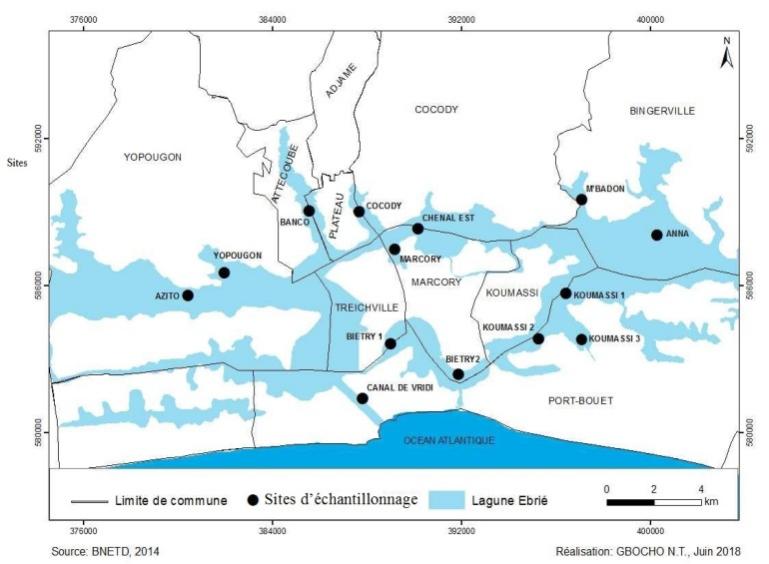
2.2. Sampling SitesFourteen (14) sites have been selected for this study, which are all part of the Ebrié Lagoon in the Abidjan district. They are the Vridi canal, the East channel, the Azito channel and the bays of Anna, Banco, Biétry (with two sites), Cocody, Koumassi (with three sites), M'Badon, Marcory and Yopougon. These were selected from all the stations in the National Observation Network (RNO) on the quality of lagoon environments run by the Ivorian Anti-Pollution Centre (CIAPOL). These stations were chosen in order to analyse the impact of human activities in the city of Abidjan on the lagoon environment. Figure 1 shows the location of the sampling sites for lagoon water in the Abidjan agglomeration.
2.3. Sampling CampaignsSampling campaigns were carried out every two months from April 2014 to October 2016 at fourteen (14) sampling sites spread over eleven (11) stations. A total of fifteen measurement campaigns were carried out, resulting in two hundred and ten (210) samples being taken. These samples were packaged in sterilised transparent glasses and stored in a cooler containing ice in accordance with current standards 17 for bacteriological analysis in the laboratory.
2.4. Analysis of Ecological VariablesDissolved oxygen was measured in situ using a YSI 6920 V2 multi-parameter probe. For each measurement, the pre-calibrated probe was immersed in the water and, after stabilisation, the reading was taken on the instrument's digital display screen. The nutrients (nitrate, nitrite, ammonium and orthophosphate) were analysed at the Central Environmental Laboratory of the Ivorian Anti-Pollution Centre within 48 hours, in accordance with Afnor 18, Hach 19 and Rodier et al. 17.
2.5. Enumeration of Faecal BacteriaFaecal bacterial counts were also carried out at the Central Environmental Laboratory (LCE) of the Ivorian Anti-Pollution Centre (CIAPOL). They were carried out within 48 h in accordance with Afnor 18 and Rodier et al. 17. Coliforms were analysed using the membrane filtration enumeration method. After filtration of the water to be studied, the membrane was deposited on a lactose agar medium containing TTC and Tergitol. After incubation for 24 hours at 44°C, the presence of coliforms was indicated by a purplish-red coloration of the colonies. Faecal streptococci were also counted using the membrane filter method (0.45 μm) on BEA (Bile with Esculin and Sodium Azide) medium. After incubation at 37°C for 24 and 48 hours, faecal streptococci showed up as black coloured colonies surrounded by a black halo. Clostridium perfringens were counted using the Trypticase Sulfite Neomycin (TSN) agar incorporation method at 45°C for 18 and 24 hours. Their presence was indicated by black coloration of the colonies.

The bacterial densities D50 and D90 represent the concentrations of bacteria that correspond to 50% and 90% respectively of the counts carried out for the waters of the stations sampled according to Rodier et al. 5, 8, 20. Bacterial densities D50 and D90 were determined using the rank method 7, 8. This method consists of ranking the different bacterial concentrations in ascending order and identifying the concentration that corresponds to 50% (D50) and 90% (D90) of the total number of samples respectively. The healthiness of lagoon waters was assessed 5 according to the WHO/UNEP criteria 21 developed during the MED. POL.VII programme (WHO/UNEP programme for monitoring the quality of Mediterranean waters). These criteria indicate that if the density D50 < 100 faecal coliforms or faecal streptococci per 100 mL of water and the density D90 < 1000 faecal coliforms or faecal streptococci per 100 mL of water, then the bathing water is considered to be bacteriologically satisfactory. In this study, C. perfringens was also included in these criteria.
2.7. Determining the Degree of Faecal ContaminationOn the basis of the WHO/UNEP criteria set out above, the degree of contamination or faecal pollution (D.P.) is defined as the number of times a bacterial concentration exceeds the limit recommended by the WHO/UNEP 8. Thus, the degree of faecal pollution is obtained by dividing D90 by the threshold concentration of 1000 bacteria per 100 mL.
2.8. Determining the Source of Faecal ContaminationThe origin of faecal contamination is related to the quantitative ratio of faecal coliforms to faecal streptococci (R = CF/SF). According to the criteria defined by Borrego and Romero 22 if:
Ø R < 0.7: the origin is mainly or entirely animal ;
Ø 0.7 < R < 1: the origin is mixed, predominantly animal ;
Ø 1 < R < 2: the origin is uncertain;
Ø 2 < R < 4: mixed origin, predominantly human;
Ø R > 4: the cause is exclusively human.
The CF/SF ratio was calculated for all measurements taken over the study period.
2.9. Analysis of the Correlation Between Faecal Bacteria and Ecological VariablesCorrelations between ecological variables (dissolved oxygen and nutrients) and faecal bacteria (faecal coliforms, faecal strptococci and Clostridium perfringens) were studied using a correlation matrix. This matrix groups together the values calculated for the linear correlation coefficients between the variables taken in pairs. The correlation coefficients (r) between the different parameters were determined using the Pearson test performed with STATISTICA version 7.1 software.
Table 1 and Table 2 show the 50% (D50) and 90% (D90) bacterial concentrations in surface water samples from the Abidjan area of the Ebrié Lagoon. The D50 concentrations in Yopougon Bay are the highest for faecal coliforms (290000 CFU/100 mL) and faecal streptococci (7200 CFU/100 mL). However, it was in Cocody bay that C. perfringens had the highest D50 concentration (1500 CFU/100 mL). Anna Bay, on the other hand, recorded the lowest D50 bacterial concentrations (500 CFU/100 mL for faecal coliforms, 80 CFU/100 mL for faecal streptococci and 30 CFU/100 mL for Clostridium perfringens). D90 concentrations (Table 2) are highest in Marcory Bay for faecal coliforms (2330000 CFU/100 mL) and in Yopougon Bay for faecal streptococci (320000 CFU/100 mL) and C. perfringens (4600 CFU/100 mL). On the other hand, Anna Bay recorded the lowest D90 concentrations (9000 CFU/100 mL for faecal coliforms, 390 CFU/100 mL for faecal streptococci and 233 CFU/100 mL for Clostridium perfringens). It can also be seen that the D90 concentrations of the various bacteria are much higher than their D50 concentrations.
In comparison with the WHO/UNEP criteria developed during the MED.POL.VII programme (WHO/UNEP programme for monitoring the quality of Mediterranean waters), the D50 concentrations are above the threshold of 100 CFU/100 mL for all the stations with the exception of Anna Bay (80 CFU/100 mL) for faecal streptococci and M'badon Bay (70 CFU/100 mL) and Anna Bay (30 CFU/100 mL) for C. perfringens. The D90 concentrations for faecal coliforms are all above 1000 CFU/100 mL; the same is true for faecal streptococci except in Anna Bay (390 CFU/100 mL) where the D90 is below this threshold value. For C. perfringens, the D90 correspond to values above 1000 CFU/100 mL for the bays of Banco (1320 CFU/100 mL), Cocody (3740 CFU/100 mL), Marcory (2200 CFU/100 mL), Yopougon (4600 CFU/100 mL) and Koumassi (1583 CFU/100 mL). For the other sampling stations, the values were below 1000 CFU/100 mL.
The results of the degrees of pollution (DP) grouped together in Table 3 show that for faecal coliforms, Marcory bay (DP = 2330) is the most polluted and M'badon and Anna bays (DP = 9) the least polluted. For faecal streptococci, the most contaminated station was Yopougon bay (DP = 320), while Anna bay (DP = 0.39) was the least contaminated. Clostridium perfringens contamination is highest in Yopougon Bay (DP = 4.6) and lowest in Anna Bay (DP = 0.23). The degrees of pollution also make it possible to establish a classification from the most contaminated to the least contaminated stations. This gives a series of degrees of contamination for each parameter.
For faecal coliforms: Ma > Co > Yo > Ba > Bi > CE > Ko > CV > Az > Mb > An.
For faecal streptococci: Yo > Co > Ma > Ba > Bi > CV > Ko > Az > CE > Mb > An.
For Clostridium perfringens: Yo > Co > Ma > Ko > Ba > Bi > Az > CE > Mb > CV > An.
Table 4 shows that for each of the stations sampled, the origin of the faecal contamination is animal or predominantly animal for percentages of samples ranging from 0% in the Cocody bay to 27% in the Vridi canal. The origin was uncertain or undetermined for percentages of samples ranging from 0% (Cocody, Yopougon and Azito) to 18% (Vridi canal). Finally, the origin of the contamination is human or predominantly human for percentages of samples ranging from 55% in the Vridi canal to 100% in the Cocody bay. It should also be noted that just half of the samples from the Vridi canal (55%) showed human or predominantly human faecal contamination. However, at the other stations, at least three quarters of the samples (75% in Biétry Bay) or even all of them (100% in Cocody Bay) were contaminated.
Table 5 gives the Pearson correlation values between faecal bacteria and the ecological variables (dissolved oxygen and nutrient salts). Analysis of the table reveals a negative correlation between bacteria and dissolved oxygen (- 0.53 ˂ r ˂ - 0.67) and a positive correlation between bacteria and ammonium (0.50 ˂ r ˂ 0.81). The table also shows that faecal bacteria are positively correlated with each other (0.53 ˂ r ˂ 0.93).
The lagoon waters of the estuarine zone of the Ebrié lagoon are heavily contaminated with bacteria indicative of faecal contamination. Bacterial counts give values between 9000 and 2330000 CFU/100mL for faecal coliforms, between 390 and 320000 CFU/100mL for faecal streptococci and in the range 233 and 4600 CFU/100mL for Clostridium perfringens. These results are in line with those obtained by other authors such as Konan et al. 23 in the Grand-Lahou lagoon and by Kambiré et al. 24 in the Aby lagoon. According to Leclerc 25, faecal coliforms are abundant in faeces and represent the predominant environmental indicators.
The assessment of bacterial densities in lagoon waters highlighted the unsanitary nature of these waters. Determination of bacterial concentrations (D50 and D90) revealed that the highest densities were recorded in the bays of Yopougon, Marcory and Cocody. This indicates that these three bays are particularly exposed to faecal contamination, as shown by the faecal pollution levels calculated for each station over the entire study period (Table 1 and Table 2). On the basis of these levels, the stations were ranked from the most contaminated to the least contaminated. The results are similar to those obtained by Kouassi et al. 10 for the period 1993 to 1998. These authors reported that Yopougon Bay receives all the urban and industrial effluent from the commune of Yopougon. At the bottom of Cocody Bay, an outfall from the stormwater network carries highly contaminated water. The bay also receives wastewater from several neighbouring districts. The Marcory bay, which is landlocked, receives the commune's wastewater due to frequent breakdowns at the lifting stations. In addition, the low turnover of water in these bays may be responsible for the high levels of contamination 26. Indeed, as Pagès and Citeau 4 point out, the degree of contamination is a function of both the size of the discharges and the confinement of the water. On the other hand, the fact that Anna Bay is located outside the urban area may explain the low bacterial densities D50 and D90 obtained in this bay. As a result, there is little contamination of the water. The healthiness of the lagoon waters was assessed according to the WHO/UNEP 21 criteria drawn up during the Mediterranean water quality monitoring programme. All of the water was found to be unhealthy and unsuitable for any kind of seaside activity. Effluent discharges contribute to a very significant increase in faecal contamination of the water in the urban area. In addition, the densities of bacteria indicative of faecal contamination indicate a high level of pollution of the lagoon banks compared with the open waters of the Ebrié Lagoon 27. This enrichment is due to the proximity of the stations sampled to the discharge sites. Hydrodynamics in these confined sites are less active and bacterial pollution tends to concentrate there 20. Faecal coliforms are generally more abundant in human faeces than faecal streptococci. The latter are thought to be more numerous than faecal coliforms in animals 28. Thus, the importance of the CF/SF ratio calculated during the spatial and temporal monitoring in this work shows that faecal contamination of lagoon waters was mainly of human origin or of mixed origin with a predominance of humans. This is directly related to domestic pollutant inputs. Indeed, various studies have shown an increase in faecal pollution of this lagoon due to illicit discharges of septic tank effluent 8.
Negative correlations were observed between bacteria and dissolved oxygen (Table 5). This shows that the increase in bacterial levels leads to a decrease in dissolved oxygen in the water, certainly due to the use of oxygen by bacteria for the biodegradation of organic pollutants contained in the water. Positive correlations were also observed between faecal bacteria and ammonium, and between the bacteria themselves. The former reflects the omnipresence of bacteria in domestic effluent, while the latter shows that the detection of one bacterium indicates a high probability of the presence of others.
This study consisted in determining not only the level of contamination of the waters of the Ebrié Lagoon in Abidjan by faecal bacteria, but also the origin of this contamination. The study was essentially based on microbiological parameters indicative of faecal pollution (faecal coliforms, faecal streptococci and Clostridium perfringens). Standardised methods were used to count these bacteria in water samples taken from fourteen (14) sites. The results obtained show that contamination of water by faecal bacteria is high and is mainly of human origin or mixed with a predominance of human origin. The level of contamination is very high in bays such as Marcory, Cocody and Yopougon because of the strong anthropic pressures exerted there and their state of confinement. However, the level is low in bays that are less affected by human activity, such as Anna and M'Badon. According to WHO/UNEP standards, the waters analysed are unhealthy and unfit for any kind of seaside activity. Awareness-raising campaigns are needed among the general public, and the authorities must take steps to minimise damage to this vital environment.
| [1] | Yao K. M. Contribution à l’étude des paramètres physico-chimiques des eaux de la lagune Ebrié dans la zone d’Abidjan (Côte d’Ivoire). Thèse de Doctorat, Université de Cocody, 2009, 182 p. | ||
| In article | |||
| [2] | Carmouze J. P. et Caumette P. Les effets de la pollution organique sur les biomasses et activités du phytoplancton et les bactéries hétérotrophes dans la lagune Ebrié (Côte d’Ivoire), In: Caractérisation de la répartition spatio-temporelle des bactéries à l’interface eau-sédiment d’une lagune tropicale: cas de la baie du Banco, Abidjan, Côte d’Ivoire. European J. Scientific Res. 21 (1): 1985, 164-174. | ||
| In article | |||
| [3] | Pagès J. Étude de la pollution bactérienne en lagune Ebrié. Documents Scientifiques de Centre de Recherches Océanographiques d’Abidjan, 11 (2): 1975, 79-107. | ||
| In article | |||
| [4] | Pagès J. & Citeau J. La pollution bactérienne de la lagune et de la mer autour d'Abidjan. Doc. Sc. Cent. Rech. Océanogr. Abidjan. 9: 1978, 43-50. | ||
| In article | |||
| [5] | Lanusse A. La contamination microbienne d'une lagune tropicale (lagune Ebrié, Côte d'Ivoire). Influences de l'hydroclimat. Thèse de doctorat de Sciences, Université de Provence (Aix-Marseille I), 1987, 147 p + annexes. | ||
| In article | |||
| [6] | Lanusse A. & Guiral D. Suivi annuel de la contamination bactérienne et virale des eaux et des sédiments lagunaires au niveau d'Abidjan. Océanis, 14: 1988, 71-87. | ||
| In article | |||
| [7] | Kouassi A. M., Guiral D. & Dosso M. Variations saisonnières de la contamination microbienne de la zone urbaine d’une lagune tropicale estuarienne, Rev. Hydrobiol. Trop. 23 (3): 1990, 181-194. | ||
| In article | |||
| [8] | Akpo S. K., Ouattara P. J. M., Eba M. G., Ouffouet S. & Coulibaly L. État de la pollution fécale dans les baies de la lagune Ebrié (Banco, Cocody et M’Badon) à Abidjan, Côte d’Ivoire. J. Mater. Env. Sci. 7(2): 2016, 621-630. | ||
| In article | |||
| [9] | Fujioka R. S., Hurst C. J., Knudsen G. R., McInerney M. J., SteZenbach L. D. & Walter M.V. Indicators of marine recreational water quality. In: Manual of Environmental Microbiology, Eds. ASM Press, Washington, D.C.: 1997, 176-183 | ||
| In article | |||
| [10] | Kouassi A. M., Tidou A. S. & Kamenan A. Caractéristiques hydrochimiques et microbiologiques des eaux de la lagune Ebrie (Côte d’Ivoire). Agronomie Africaine 17 (2): 2005, 117-136. | ||
| In article | View Article | ||
| [11] | Dufour P. Les frontières naturelles et humaines du système lagunaire Ebrié. Hydrobiologia, 94: 1982, 105-120. | ||
| In article | View Article | ||
| [12] | Akilinon G. V. Dynamique des apports en éléments nutritifs et bactéries fécales dans la zone estuarienne de la lagune Ebrié (Côte d’Ivoire) et risque d’eutrophisation. Thèse de Doctorat unique en Sciences et Gestion de l’Environnement, Université Nangui Abrogoua, Abidjan, Côte d'Ivoire, n° 707, 2021, 189 p + annexes. | ||
| In article | |||
| [13] | INS (Institut National des Statistiques). Recensement général de la population et de l’habitat 2021. Résultats globaux définitifs. 2022, 65 p. | ||
| In article | |||
| [14] | Adingra A. A. et Kouassi A. M.. Pollution en lagune Ebrié et ses impacts sur l'environnement et les populations riveraines. Fiches Techniques & Documents de Vulgarisation ; 2011, 48-53. | ||
| In article | |||
| [15] | Kouamé K. V. Caractérisation physicochimique et impacts écotoxicologiques des effluents industriels dans la lagune Ebrié. Thèse de doctorat de Sciences et Gestion de l’environnement, Université Nangui Abrogoua, n°115, 2012, 180 p. | ||
| In article | |||
| [16] | Ané A. A. Qualité environnementale d’un estuaire à pression anthropique et à forçages naturels saisonniers en lagune Ebrié (Sud-Est de la Côte D’Ivoire). Thèse de Doctorat d’Etat, Université de Cocody, 2017, 297 p. | ||
| In article | |||
| [17] | Rodier J., Legube B., Merlet N. L’analyse de l’eau. 9è édition. Dunod, Paris. 2009, 1579 p. | ||
| In article | |||
| [18] | Afnor. Qualité de l’eau, Éléments majeurs-autres éléments et composés minéraux. Aubenas Ardèche, 6e Edition, 2001, 635 p. | ||
| In article | |||
| [19] | Hach. Analyse des eaux de consommation, eaux de rejet, eaux de mer. HACH Company, Edition 1, USA, 2007, 398 p. | ||
| In article | |||
| [20] | Dufour P., Kouassi A. M. & Lanusse A. Les pollutions. In: Environnement et Ressources aquatiques de Côte d’Ivoire. Les milieux lagunaires. Ed. ORSTOM: 1994, 309-333. | ||
| In article | |||
| [21] | OMS/PNUE. Directives applicables à la surveillance sanitaire de qualité des eaux littorales. Bureau Régional de l'Europe. Copenhague, 1977, 177 p. | ||
| In article | |||
| [22] | Borrego A. F. and Romero P. Study of the microbiological pollution of a Malaga littoral area II. Relationship between fecal coliforms and fecal streptococci. VIème journée études. Pollutions, Cannes, France: 1982, 561-569. | ||
| In article | |||
| [23] | Konan K. S., Kouassi A. M., Adingra A. A. & D. Gnakri. Spatial and temporal variation of fecal contamination indicators in Grand Lahou lagoon, Côte d’Ivoire. J. Appl. Biosci. 23: 2009, 1422-1435. | ||
| In article | |||
| [24] | Kambiré O., Adingra A. A., Kakou C. A. & Koffi-Nevry R. Indicateurs de pollution fécale dans une lagune tropicale à forte influence continentale (lagune Aby, Côte d’Ivoire). Agronomie Africaine 24 (2): 2012, 89-100. | ||
| In article | |||
| [25] | Leclerc H. F. Les indicateurs bactériens dans le contrôle bactériologique de l’eau: exigences et limites. J. Fr. hydrol. (35): 1981, 213-228. | ||
| In article | View Article | ||
| [26] | Affian K. Approche environnementale d’un écosystème lagunaire microtidal (la lagune Ebrié en Côte d’Ivoire), par des études géochimiques et hydrologiques, bathymétriques et hydrologiques: contribution du S.I.G. et de la télédétection. Thèse de Doctorat d’Etat, Université de Cocody, 2003, 225 p. | ||
| In article | |||
| [27] | Guiral D., Kouassi A. M. & Arfi R. Estimation des niveaux de pollution organique et bactérienne des eaux à proximité des berges de la ville d’Abidjan (Lagune Ebrié-Côte d’Ivoire). J. Ivoir. Océanol. Limnol., 2(1): 1993, 1-18 | ||
| In article | |||
| [28] | Koffi-Nevry R., AssiI-Clair B. J., Koussémon M., A. & Wognin S. Origine des témoins de contamination fécale de l’eau d’arrosage de la laitue (lactuca sativa) cultivée dans la zone péri urbaine d’Abidjan. J. Appl. Biosci. 52: 2012, 3669-3675. | ||
| In article | |||
Published with license by Science and Education Publishing, Copyright © 2024 Akilinon Gansso Valentin, Kombo Mananga Olivier Simon, Yaya Coulibaly and Yapo Ossey Bernard
 This work is licensed under a Creative Commons Attribution 4.0 International License. To view a copy of this license, visit
https://creativecommons.org/licenses/by/4.0/
This work is licensed under a Creative Commons Attribution 4.0 International License. To view a copy of this license, visit
https://creativecommons.org/licenses/by/4.0/
| [1] | Yao K. M. Contribution à l’étude des paramètres physico-chimiques des eaux de la lagune Ebrié dans la zone d’Abidjan (Côte d’Ivoire). Thèse de Doctorat, Université de Cocody, 2009, 182 p. | ||
| In article | |||
| [2] | Carmouze J. P. et Caumette P. Les effets de la pollution organique sur les biomasses et activités du phytoplancton et les bactéries hétérotrophes dans la lagune Ebrié (Côte d’Ivoire), In: Caractérisation de la répartition spatio-temporelle des bactéries à l’interface eau-sédiment d’une lagune tropicale: cas de la baie du Banco, Abidjan, Côte d’Ivoire. European J. Scientific Res. 21 (1): 1985, 164-174. | ||
| In article | |||
| [3] | Pagès J. Étude de la pollution bactérienne en lagune Ebrié. Documents Scientifiques de Centre de Recherches Océanographiques d’Abidjan, 11 (2): 1975, 79-107. | ||
| In article | |||
| [4] | Pagès J. & Citeau J. La pollution bactérienne de la lagune et de la mer autour d'Abidjan. Doc. Sc. Cent. Rech. Océanogr. Abidjan. 9: 1978, 43-50. | ||
| In article | |||
| [5] | Lanusse A. La contamination microbienne d'une lagune tropicale (lagune Ebrié, Côte d'Ivoire). Influences de l'hydroclimat. Thèse de doctorat de Sciences, Université de Provence (Aix-Marseille I), 1987, 147 p + annexes. | ||
| In article | |||
| [6] | Lanusse A. & Guiral D. Suivi annuel de la contamination bactérienne et virale des eaux et des sédiments lagunaires au niveau d'Abidjan. Océanis, 14: 1988, 71-87. | ||
| In article | |||
| [7] | Kouassi A. M., Guiral D. & Dosso M. Variations saisonnières de la contamination microbienne de la zone urbaine d’une lagune tropicale estuarienne, Rev. Hydrobiol. Trop. 23 (3): 1990, 181-194. | ||
| In article | |||
| [8] | Akpo S. K., Ouattara P. J. M., Eba M. G., Ouffouet S. & Coulibaly L. État de la pollution fécale dans les baies de la lagune Ebrié (Banco, Cocody et M’Badon) à Abidjan, Côte d’Ivoire. J. Mater. Env. Sci. 7(2): 2016, 621-630. | ||
| In article | |||
| [9] | Fujioka R. S., Hurst C. J., Knudsen G. R., McInerney M. J., SteZenbach L. D. & Walter M.V. Indicators of marine recreational water quality. In: Manual of Environmental Microbiology, Eds. ASM Press, Washington, D.C.: 1997, 176-183 | ||
| In article | |||
| [10] | Kouassi A. M., Tidou A. S. & Kamenan A. Caractéristiques hydrochimiques et microbiologiques des eaux de la lagune Ebrie (Côte d’Ivoire). Agronomie Africaine 17 (2): 2005, 117-136. | ||
| In article | View Article | ||
| [11] | Dufour P. Les frontières naturelles et humaines du système lagunaire Ebrié. Hydrobiologia, 94: 1982, 105-120. | ||
| In article | View Article | ||
| [12] | Akilinon G. V. Dynamique des apports en éléments nutritifs et bactéries fécales dans la zone estuarienne de la lagune Ebrié (Côte d’Ivoire) et risque d’eutrophisation. Thèse de Doctorat unique en Sciences et Gestion de l’Environnement, Université Nangui Abrogoua, Abidjan, Côte d'Ivoire, n° 707, 2021, 189 p + annexes. | ||
| In article | |||
| [13] | INS (Institut National des Statistiques). Recensement général de la population et de l’habitat 2021. Résultats globaux définitifs. 2022, 65 p. | ||
| In article | |||
| [14] | Adingra A. A. et Kouassi A. M.. Pollution en lagune Ebrié et ses impacts sur l'environnement et les populations riveraines. Fiches Techniques & Documents de Vulgarisation ; 2011, 48-53. | ||
| In article | |||
| [15] | Kouamé K. V. Caractérisation physicochimique et impacts écotoxicologiques des effluents industriels dans la lagune Ebrié. Thèse de doctorat de Sciences et Gestion de l’environnement, Université Nangui Abrogoua, n°115, 2012, 180 p. | ||
| In article | |||
| [16] | Ané A. A. Qualité environnementale d’un estuaire à pression anthropique et à forçages naturels saisonniers en lagune Ebrié (Sud-Est de la Côte D’Ivoire). Thèse de Doctorat d’Etat, Université de Cocody, 2017, 297 p. | ||
| In article | |||
| [17] | Rodier J., Legube B., Merlet N. L’analyse de l’eau. 9è édition. Dunod, Paris. 2009, 1579 p. | ||
| In article | |||
| [18] | Afnor. Qualité de l’eau, Éléments majeurs-autres éléments et composés minéraux. Aubenas Ardèche, 6e Edition, 2001, 635 p. | ||
| In article | |||
| [19] | Hach. Analyse des eaux de consommation, eaux de rejet, eaux de mer. HACH Company, Edition 1, USA, 2007, 398 p. | ||
| In article | |||
| [20] | Dufour P., Kouassi A. M. & Lanusse A. Les pollutions. In: Environnement et Ressources aquatiques de Côte d’Ivoire. Les milieux lagunaires. Ed. ORSTOM: 1994, 309-333. | ||
| In article | |||
| [21] | OMS/PNUE. Directives applicables à la surveillance sanitaire de qualité des eaux littorales. Bureau Régional de l'Europe. Copenhague, 1977, 177 p. | ||
| In article | |||
| [22] | Borrego A. F. and Romero P. Study of the microbiological pollution of a Malaga littoral area II. Relationship between fecal coliforms and fecal streptococci. VIème journée études. Pollutions, Cannes, France: 1982, 561-569. | ||
| In article | |||
| [23] | Konan K. S., Kouassi A. M., Adingra A. A. & D. Gnakri. Spatial and temporal variation of fecal contamination indicators in Grand Lahou lagoon, Côte d’Ivoire. J. Appl. Biosci. 23: 2009, 1422-1435. | ||
| In article | |||
| [24] | Kambiré O., Adingra A. A., Kakou C. A. & Koffi-Nevry R. Indicateurs de pollution fécale dans une lagune tropicale à forte influence continentale (lagune Aby, Côte d’Ivoire). Agronomie Africaine 24 (2): 2012, 89-100. | ||
| In article | |||
| [25] | Leclerc H. F. Les indicateurs bactériens dans le contrôle bactériologique de l’eau: exigences et limites. J. Fr. hydrol. (35): 1981, 213-228. | ||
| In article | View Article | ||
| [26] | Affian K. Approche environnementale d’un écosystème lagunaire microtidal (la lagune Ebrié en Côte d’Ivoire), par des études géochimiques et hydrologiques, bathymétriques et hydrologiques: contribution du S.I.G. et de la télédétection. Thèse de Doctorat d’Etat, Université de Cocody, 2003, 225 p. | ||
| In article | |||
| [27] | Guiral D., Kouassi A. M. & Arfi R. Estimation des niveaux de pollution organique et bactérienne des eaux à proximité des berges de la ville d’Abidjan (Lagune Ebrié-Côte d’Ivoire). J. Ivoir. Océanol. Limnol., 2(1): 1993, 1-18 | ||
| In article | |||
| [28] | Koffi-Nevry R., AssiI-Clair B. J., Koussémon M., A. & Wognin S. Origine des témoins de contamination fécale de l’eau d’arrosage de la laitue (lactuca sativa) cultivée dans la zone péri urbaine d’Abidjan. J. Appl. Biosci. 52: 2012, 3669-3675. | ||
| In article | |||