 sciepub.com
 Quick Submission

A Study on Altruism and Interest in Literature at Higher Secondary Level
Mukul Baran Mandal1, , Chitralekha Mehera1
1Department of Education, Burdwan University, Burdwan, West Bengal, India
Abstract
The present study is an attempt to look for the relationship between altruism and interest in literature of Higher Secondary students. Sample consists of 800 students (age 17+) from rural and urban H.S schools of Birbhum district, West Bengal. The Scale of Altruism as well as the Interest in Literature Scale, the first adopted by the investigators and the second developed by the investigators, were used to assess the Altruism and Interest in Literature of the students respectively. The result divulged the fact that the girl students are more altruistic and have more interest in literature than those of the boy students. The study also reveals that there exists significant relationship between altruism and interest in literature. It is strengthened by another finding that the group with low level of altruism shows lower interest in literature than the group with high level of altruism. The constructed regression equation reveals that interest in literature can be used as the predictor of altruism.
Keywords: altruism, interest in literature, adolescent, higher secondary level
Copyright © 2016 Science and Education Publishing. All Rights Reserved.Cite this article:
- Mukul Baran Mandal, Chitralekha Mehera. A Study on Altruism and Interest in Literature at Higher Secondary Level. American Journal of Educational Research. Vol. 4, No. 9, 2016, pp 689-694. http://pubs.sciepub.com/education/4/9/8
- Mandal, Mukul Baran, and Chitralekha Mehera. "A Study on Altruism and Interest in Literature at Higher Secondary Level." American Journal of Educational Research 4.9 (2016): 689-694.
- Mandal, M. B. , & Mehera, C. (2016). A Study on Altruism and Interest in Literature at Higher Secondary Level. American Journal of Educational Research, 4(9), 689-694.
- Mandal, Mukul Baran, and Chitralekha Mehera. "A Study on Altruism and Interest in Literature at Higher Secondary Level." American Journal of Educational Research 4, no. 9 (2016): 689-694.
| Import into BibTeX | Import into EndNote | Import into RefMan | Import into RefWorks |
1. Introduction
Altruism being the selfless concern for welfare of other people involves doing something simply out of a desire to help, not merely because of feeling obligated to out of one’s duty, loyalty or religious traditions. “Altruism is behavior motivated by concern for others or by internalized values, goals, and self-rewards rather than by the expectation of concrete or social rewards, or the desire to avoid punishment or sanctions,” Eisenberg et al. (1999). Altruism is a desire within one organism as an end state goal (Batson, 1983). Howard and Piliavin (2000) [5] viewed altruism as to provide benefits to its recipients in exchange of no benefits and even of incurring some cost to the actor. Our life is full of some altruistic behaviors without which we are never able to survive smoothly. The strength of altruistic mind varies from individual to individual. Girls are more altruistic than boys (Anna Drebera et al) [2]. Boys’ behavioral traits are less significant than those of girls in respect to altruism. (Rashmi et al) [9]. Human capacity for altruism is limited to those whom we feel empathy (Batson and Oleson, 1991) [1]. It is not enough to state that, the students of our modern era who are being involved more in competition of scoring marks and seeking jobs are deviating from making themselves as altruistic personality. Obviously, various types of research on altruism is called for so as to know the extension of the culture of altruism in school and society and to make necessary change in behaviors of students through proper implementation of curricula because in an academic environment a teacher with sound altruistic mind can transmit altruistic behaviors to his or her students.
1.1. Literature ReviewMario Mikulincer and Phillip R. Shaver (2005) [8] made a series of studies on attachment security and compassion to show that enhancement of attachment security was essential to be a method of fostering compassion and altruism. They found that compassionate feelings and values, responsive and altruistic behaviors were promoted by both dispositional and experimentally induced attachment securities.
Another investigation was done by Hing Keung (2005) [7] about the relationship between gender –role classification and pro-social and antisocial behavior for 505 Chinese adolescents in grades 7 to 12. The result showed that there was a significant gender difference in antisocial behavior but not in pro-social behavior. The author found that delinquent behavior was associated positively with masculinity whereas pro-social behavior was associated positively with both masculinity and femininity.
Again, a study on altruism was conducted by Rashmi, Sharma and Sushil (2010) [9]. It was done on school going children to find the altruism among the children of joint as well as nuclear families. The study showed that children from nuclear family had significantly more altruistic behavioral traits than the children from joint family had. Study also showed that boys’ behavioral traits are less significant than those of girls.
According to Michael and Roelofs (2011) [11] who made an experiment to identify heterogeneity preferences in order to personality, gender, status, giving and taking for altruism; the effect of gender on giving was more stable than previously understood and was explained collectively by various personality factors. They also found that women, high status treatment individuals, and individuals in giving language treatment gave less and were also less sensitive to the price giving.
In their study on gender difference in performance for altruism, risk and competition in math and word search among adolescents Anna Drebera et al (2012) [2] explored that boys were less altruistic and more risk taking than girls. The study also showed that there was no gender gap in change of performance when performance under non-competition is compared with that under competition. Both boys and girls were equally eager for choosing to compete in word search but in case of math competition boys were significantly more eager than girls. The authors noticed that the gender gap decreased to be non-significant when relative performance beliefs were controlled by themselves.
John Thomas Huber and Douglas A MacDonald (2012) [6] conducted a research on a sample of 186 university students to find out the relations between altruism, empathy and spirituality. The result indicated that altruism and empathy was related to each other and association of the both to spirituality was complex and multi-directional. There was a strong relation between altruism and spiritual experiences succeeded by spiritual cognitions. Non-religious spiritual cognitions and spiritual experiences were the most potent predictors of both empathy and altruism respectively.
Again in 2012 Jo Holland [4] investigated to look for the relationship between level of socio-economic characteristics of certain area and level of altruism found in individual living in that area. The author used a lost letter experiment to measure altruism across twenty neighborhoods with a wide range of income deprivation scores in London. The author found that those living in poor neighborhoods were less inclined to behave altruistically toward their neighbors. He also found income deprivation to be non-linear with returned letters. There was no significant difference between the neighborhoods in lower income quartiles or between the higher income quartiles.
From the above review it appears that altruistic behavior of students is influenced by certain facts like attachment security [8], intensity in delinquency in both the genders [7], nature of family (nuclear and joint) [9], personality factors [11], empathy and spirituality [6] and socio economic status [4]. These findings invite further exploration in this field for identification other affecting factors of altruism.
1.2. Objectives1. To assess altruism of the students with the help of an Altruism Scale adopted by the investigators.
2. To assess the interest in literature of the students with the help of an Interest in Literature Scale developed by the investigators.
3. To find out sex wise and strata wise differences if any, in altruism and interest in literature.
4. To determine the relation between altruism and interest in literature of the students.
5. To compare altruism of students with high and low level of interest in literature
6. To develop regression equation in order to obtain an estimation of altruism in terms of outcomes in interest in literature
1.3. Null HypothesesTo achieve the aforesaid objectives the following null hypotheses were formulated and tested--
0H1: There exists no significant difference between altruism of rural girls and that of rural boys.
0H2: There exists no significant difference between altruism of urban girls and that of urban boys.
0H3: There exists no significant difference between altruism of rural girls and that of urban girls.
0H4: There exists no significant difference between altruism of rural boys and that of urban boys.
0H5: There exists no significant difference between altruism of rural students and that of urban students.
0H6: There exists no significant difference between altruism of boy students and that of girl students.
0H7: There exists no significant difference between interest in literature of rural girls and that of rural boys.
0H8: There exists no significant difference between interest in literature of urban girls and that of urban boys.
0H9: There exists no significant difference between interest in literature of rural girls and that of urban girls.
0H10: There exists no significant difference between interest in literature of rural boys and that of urban boys.
0H11: There exists no significant difference between interest in literature of rural students and that of urban students.
0H12: There exists no significant difference between interest in literature of boy students and that of girl students.
0H13: There exists no significant relationship between altruism and interest in literature among the students.
0H14: Students with high and low level of altruism do not differ from one another in respect to interest in literature.
0H15: Interest in literature cannot be used as a predictor of altruism of the students.
1.4. VariablesThe following are the variables of the said research
a) Altruism of the students
b) Interest in literature of the students
c) Gender (Male and Female)
d) Localities (Rural and Urban)
2. Methodology
2.1. Research MethodAnalytical Survey method was followed for this investigation.
2.2. SampleA sample of 800 students, 400 boys and 400 girls, of class XI (age 17+) was randomly selected from four urban and four rural coeducation schools (under Higher Secondary Council) of Birbhum district in West Bengal.
2.3. Research ToolsTwo scales namely Altruism Scale (AS) and Interest in Literature Scale (ILS) were used to measure the altruism of the students and the interest in literature of the students respectively. AS was adopted by the present investigators in 2015 (unpublished Ph.D. Thesis) from Roy and Ghosh who adopted with some modifications the original scale of Eisenberg et al [3]. The altruism scale of Roy and Ghosh was applicable up to the subjects of 16 years old only and was not published anywhere. The present investigators modified Roy and Ghoshs’ scale by changing eight items considering the age of their sample. The content validity and reliability (r-.83, p<.01) by split half method were established. In AS each of the five indicators of altruism namely, Co-operation, Help, Sharing, Emotional Comfort and Restitution was represented by two situations i.e. ten situations in all. The situations were taken from everyday life. There were five alternative responses for each situation. The responses of each situation were scored on a scale value of 1-5. Summing up all the scores of a student in Altruism Scale we get his/her altruism value. An example of item from ‘Sharing’ indicator of the scale is as follows.
Situation: Your friend’s father has died. Everyone of his/her family member is crying. You cannot tolerate crying. But, you have heard your friend became very upset.
Alternative Responses: i) At this moment this is not necessary to meet him/her, he/she is accompanied by his/her many relatives. Later, if I find him/her to be very off mood then I will console him/her.
ii) My friend is very upset. So it is my duty to stay with him/her. If I can’t to do so, then I shall feel bother.
iii) I cannot go through crying. After few days I shall go to him/her.
iv) I shall go to meet my friend. It is everyone’s duty to stay with his/her friends at the time of their crisis. If I don’t go then I cannot treat myself to be a friend.
v) If I don’t meet my friend at this time then he or she may be worried upon me. So, it is necessary to meet him/her.
Level and scoring: i) Needs Oriented, 2; ii) Empathetic, 4; iii) Self Centered, 1; iv) Strongly internalized, 5 and v) Approval oriented, 3.
The scale has been validated by five experts.
ILS (r=.81, p<.01) was developed by the present investigators and consists of 25-items, presented in a multiple choice format drawing from five dimensions namely, Reading, Writing, Talking, Listening and Seeing of one’s interest in literature. Each answer is scored on a scale value of 0-4. The scale has been validated by five experts.
2.4. ProcedureMultistage sampling was done where the first stage was the random selection of four urban as well as four rural co-education schools from the list of higher secondary urban and rural schools in Birbhum district. In the second stage, from each school 100 boys and 100 girls were randomly selected from boy students and girl students of class XI respectively.
The Altruism Scale and Interest in Literature Scale were administered to get altruism scores as well as scores of interest in literature of the students.
Statistical analysis of various data were done in order to find out the relationship, if any, between altruism and interest in literature and to find out whether there exists any gender wise and strata wise difference in altruism as well as in interest in literature. t-tests were used to test the null hypotheses 0H1 to 0H12. In order to test the null hypothesis 0H13 coefficient of correlation (r) between altruism and interest in literature was calculated. To test the null hypothesis 0H14, high and low scoring ILS groups were determined on the basis of Median ± Q as their respective cutting points. Students scored above Median + Q fall in high group and students scored below Median – Q fall in low group. In order to find out the significance of differences between the mean scores in AS of the students of high- and low- scoring groups in ILS, the students belonging to each of the nine categories in ILS namely, Rural Girls, Rural Boys, Urban Girls, Urban Boys, Rural Students, Urban Students, Girl Students, Boy Students and the Entire Sample were identified and their corresponding scores in AS were tabulated and subjected to t tests.
Regression equation formula was applied to test the null hypothesis 0H15 on thirty randomly selected samples.
3. Analysis of Data
The Mean (M), Standard Deviation (S.D.), Skewness (Sk), Kurtosis (Ku) and Standard Error of Mean (S.EM) of the scores in AS as well as in ILS are found out with regard to nine categories of the testees namely Rural Girls, Rural Boys, Urban Girls, Urban Boys, Rural Students, Urban Students, Girl Students, Boy Students and the Entire Sample comprising of both sexes and strata. The various statistical measures are given in Table 1 and Table 2 for AS and ILS respectively.
Table 1. Showing the Mean (M), S.D, Sk., Ku. And SEM for Each of Nine Categories (Entire Sample, Boy Students, Girl Students, Urban Students, Rural Students, Urban Boys, Urban Girls, Rural Boys and Rural Girls) of the Students in Altruism-Scale


, S.D, Sk., Ku. And SEM for Each of Nine Categories (Entire Sample, Boy Students, Girl Students, Urban Students, Rural Students, Urban Boys, Urban Girls, Rural Boys and Rural Girls) of the Students in Altruism-Scale)
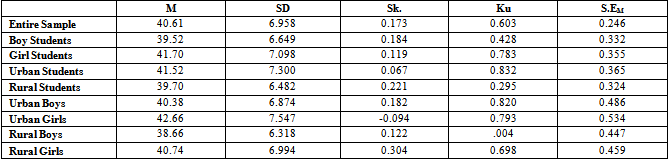


Observations from Table 1 indicate that there is a slight positive skewness in the overall, sex wise and strata wise (except Urban Girls) distribution of scores in altruism scale. Further the kurtosis values show that the distributions were platycurtic (except Rural Boys).
Table 2. Showing the Mean (M), S.D, Sk, Ku, and S.EM for Each of Nine Categories (Entire Sample, Boy Students, Girls Students, Urban Students, Rural Students, Urban Boys, Urban Girls, Rural Boys and Rural Girls) of the Students in Interest In Literature Scale

, S.D, Sk, Ku, and S.EM for Each of Nine Categories (Entire Sample, Boy Students, Girls Students, Urban Students, Rural Students, Urban Boys, Urban Girls, Rural Boys and Rural Girls) of the Students in Interest In Literature Scale)
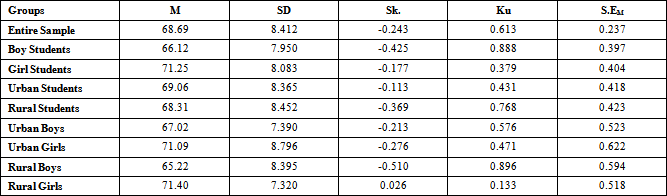


Observations from Table 2 indicate that there is a slight negative skewness in the overall, sex wise and strata wise (except for Rural Girls) distribution of scores in Interest in Literature Scale. Further the kurtosis values show that the distributions were platycurtic (except for Rural Girls).


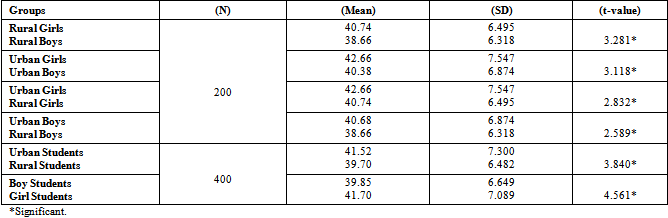

Observations from the Table 3 show the t- values 3.281, 3.181, 2.832, 2.589, 3.840, and 4.561 between the mean scores of Rural Girls and Rural Boys; Urban Girls and Urban Boys; Urban Girls and Rural Girls; Urban Boys and Rural Boys; Urban Students and Rural Students; Boy Students and Girl Students respectively. All the t- values are significant at .01 level. Hence, the null hypotheses 0H1 to 0H6 are rejected. Therefore, there is a significant difference between the mean scores of Rural Girls and Rural Boys; Urban Girls and Urban Boys; Urban Girls and Rural Girls; Urban Boys and Rural Boys; Urban Students and Rural Students; and Boy Students and Girl Students in respect to their altruism. From t-values and means it is also inferred that Girl Students and Urban Students are more altruistic than Boy Students and Rural Students respectively.


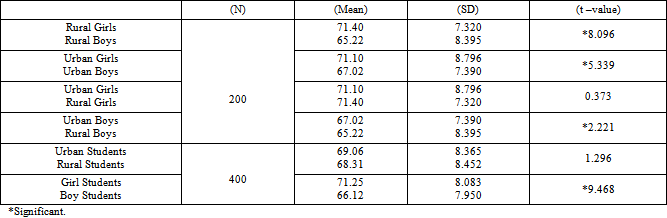

Observations from the Table 4 show the t-values 8.096, 5.339, 0.373, 2.221, 1.296 and 9.468 between the mean scores of Rural Girls and Rural Boys; Urban Girls and Urban Boys; Urban Girls and Rural Girls; Urban Boys and Rural Boys; Urban Students and Rural Students; Girl Student and Boy Students respectively. The t-values 8.096, 5.339 and 9.468 are significant at 0.01 level and t-value 2.221 is significant at 0.05 level. Therefore, the null hypotheses 0H7 , 0H8, 0H10 and 0H12 are rejected. That is, there exists significant difference between mean scores of Rural Girls and Rural Boys; Urban Girls and Urban Boys; Urban Boys and Rural Boys; Girl Students and Boy Students in respect to their interest in literature. From t-values and means it is also inferred that Girl Students are more interested in literature than Boy Students.
The t-values 0.373 and 1.296 are insignificant which means the hypotheses 0H9 and 0H11 are accepted. That is, there is no significant difference between mean scores of Urban Girls and Rural Girls; Urban Students and Rural Students in respect to their interest in literature.

 between Altruism and Interest in Literature)


From Table 5 it is clear that r-value is significant at .01 level. Thus, the null hypothesis 0H13 is rejected. This means that altruism is positively related to interest in literature of the students. It implies that if one’s interest in literature increases his value of altruism will also increase.
Table 6. Showing Mean AS Scores and Other Relevant Measures of High (H) and Low (L) Scoring Various ILS Groups

 and Low (L) Scoring Various ILS Groups)
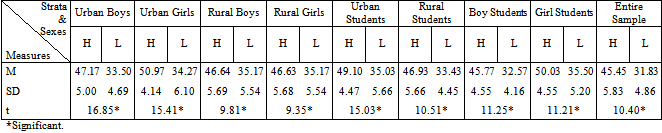

The t-values between the mean scores in altruistic behaviors of the students, belonging to each of nine categories, of the high- and low -scoring groups in interest in literature were significant at .01 levels (Table 6). Thus, the Null Hypothesis 0H14 was rejected. That means, there would be a significant difference between the scores in Altruism Scale of High- and Low- Scoring students in Interest in Literature Scale for each of the nine groups. This strengthens the finding that positive correlation exists between altruism and interest in literature.
Regression equation formula for prediction of altruism using the scores in interest in literature is constructed. The values of R along with other relevant measures are given in Table7a.


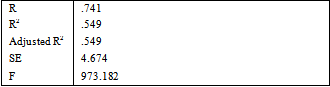




From Table 7b the regression equation formula is obtained as Y= -1.508 + .613X.


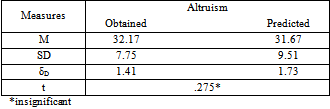

Where Y= altruism score and X = interest in literature score. This formula is applied for prediction in thirty randomly selected samples. The mean values of obtained and predicted scores in altruism along with other relevant measures are given in Table 7c. (Predicted value is estimate value and not the correct value).
The t-value shown in Table 7c is insignificant (>.05). This means that the differences between the concerned two means (obtained and predicted scores in altruism) is very slight and statistically insignificant. So interest in literature can be used as predictor of altruism. Therefore, null hypothesis 0H15 i.e. interest in literature cannot be used as a predictor of altruism of students is rejected.
4. Discussion
Based on our research results, the following facts are revealed.
From Table 3 it is inferred that Rural Girls and Urban Girls are more altruistic than Rural Boys and Urban Boys respectively. So, we can state that the strength of altruism of Girl Students is better than that of Boy Students. And it is supported by the mean scores and t-values at the end in that table. Again, it supports the finding of Anna Drebera et al (2012) [2]. Now, girls’ being more altruistic than boys, it may be due to their more empathetic feelings. Because, girls’ empathy level is more than the empathy level of boys (Toussaint and Webb, 2005) [10] and human capacity for altruism is limited to those whom we feel empathy (Batson and Oleson, 1991) [1].
Table 3 infers more that Urban Girls and Urban Boys and both together i.e. Urban Students possess greater altruism values than those of Rural Girls, Rural Boys and Rural Students respectively. This may happen because of more open mindedness in urban than in rural.
Further, from t-values and means in Table 4 it can be stated that Rural Girls and Urban Girls have more interests in literature than those of Rural Boys and Urban Boys respectively. Obviously, Girls Students are more interested in literature than the Boy Students. The logic behind this may be that the girls like to express and share positive emotions more in comparison to boys and literature creates the ambience of feeling and emotions.
Again, Urban Boys are more prone to literature than Rural Boys. This may happen due to library facilities and cultural environments in urban.
Table 5 shows that altruism is positively related to interest in literature of the students. And Table 6 shows that students with low level of altruism have lower interest in literature than their counterparts having higher interest in literature which strengthens the strong positive relationship between altruism and interest in literature. It implies that if one’s interest in literature increases his/her value of altruism also increases. Therefore, in modern competitive era, one of the means to enhance the level of altruism or altruistic behaviors of the adolescent students is to increase their interests in literature.
Finally, our result shows that interest in literature acts as a predictor of altruism. This helps us to know the value of altruism of a student only assessing his/her scores in interest in literature.
5. Summary and Conclusion
Our study explores the relationship between altruism and interest in literature at higher secondary level. A sample of 800 students (age 17+) was taken from equal numbers of rural as well as urban schools. An adopted version of altruism scale and self developed interest in literature scale were used for the study. The study reveals the main facts that are:
• Girl Students and Urban Students are more altruistic than Boy Students and Rural Students respectively.
• Girl Students and Urban Students have more interest in literature than that of Boy Students and Rural Students respectively.
• There exists positive co-relation between altruism and interest in literature which implies that more the interest in literature a person has more will be he/she altruistic.
• The former is supported by another finding that the group with low level of altruism shows lower interest in literature than the group with high level of altruism.
• Regression equation formula can be constructed to predict the value of altruism from the scores of interest in literature. That is interest in literature can be used as a predictor of altruism.
Literature creates the ambience of feelings and emotions; especially the empathetic feeling flourishes by the literature. It is studying literature through which one’s thinking power increases and conscientiousness is nurtured within him/her. Altruism is exerted by one’s internalized values, goals, empathy and self rewards. It is obvious that literature can enhance the sense of altruism via increasing empathy as well as internalized values. Therefore, one’s interest in literature study must be positively associated to his/her altruistic behavior and if one’s strength of interest in literature is once known then, his/her altruism value or the strength of altruistic behavior should be predicted. It resembles our findings that interest in literature has a significant positive impact on altruism and it can be used as a predictor of altruism. Therefore, it is necessary to enhance student’s habits of studying literature to make them more altruistic. For this, school should play a pivotal role to encourage them to culture ancient as well as modern literature.
References
| [1] | Batson, C. D., & Oleson, K. C. Current Status of the Empathy-Altruism Hypothesis. Review of Personality and Social Psychology, 12, 62-85, 1991. | ||
 In article In article | |||
| [2] | Drebera, A., Emma, V. Essenb. and Eva, Ranehillc. “In Bloom: Gender Differences in Preferences Among Adolescents”. Social Science Research Network, 35(734), 88-97, Jul. 2012, [Online]. Available: http:// ssrn.com/abstract=1804278. | ||
| In article | |||
| [3] | Eisenberg, N., R Leon, and K Roth. “Pro-social Development: A Longitudinal Study”. Developmental Psychology, 846-855, 1983. | ||
| In article | View Article | ||
| [4] | Holland Jo, Antonio S. Silva and Ruth Mac (2012). “Lost Letter Measure of Variation in Altruistic Behaviour in 20 Neighbourhoods”. PLoS One, 7(8), August 2012. [Online]. Available: http://dx.doi.org/10.1371/journal .pone.00432. | ||
| In article | |||
| [5] | Howard, Judith A. and J.A. Pilivian “Altruism”, in Encyclopedia of Sociology, New York, Macmillan, 2000. | ||
| In article | |||
| [6] | Huber J. T. and Douglas A. MacDonald. “An Investigation of the Relations Between Altruism, Empathy, and Spirituality”. Journal of Humanistic Psychology, April 2012. | ||
| In article | View Article | ||
| [7] | Ma, K. Hing,“The Relation of Gender-Role Classifications to the Prosocial and Antisocial Behavior of Chinese Adolescents.” Journal of Genetic Psychology, 166(2), 189-202, June 2005. | ||
| In article | View Article PubMed | ||
| [8] | Mikulincer, Mario and Phillip R. Shaver. “Attachment Security, Compassion, and Altruism”. Current Direction in Psychological Science, 14(1), 34-38. 2005. | ||
| In article | View Article | ||
| [9] | Rashmi, S., DK Sharma and CS Sushil. “A Comparative Study of Altruism Among the Boys and Girls of Joint and Nuclear Families”. Journal of Mental Health and Human Behavior, 15 (2), 88-90, 2010. | ||
| In article | |||
| [10] | Toussaint L. and Jhon. R. Webb. “Gender Differences in the Relationship between Empathy and Forgiveness”. J. Soc Psychol, 145 (6), 673-685, 2005. | ||
| In article | View Article PubMed | ||
| [11] | Visser S Michael and Matthew R. Roelofs. “Heterogeneous Preferences for Altruism: Gender and Personality, Social Status, Giving and Taking”. Experimental Economics, 14(4), 490-506, March 2011. | ||
| In article | View Article | ||
 CiteULike
 Mendeley
 StumbleUpon
 Delicious
 Facebook
 Twitter
 LinkedIn